Introduction
Background
The 2005 Gulf Coast hurricane season was one of the most costly and deadly in US history. Hurricane Rita stressed hospitals and led to multiple, simultaneous evacuations. Health care facility administrators facing the approaching hurricane had to make difficult decisions on whether to evacuate or shelter in place. Their ability to obtain information about the environment external to the hospital was a significant part of this process. Therefore, maintaining situational awareness of these rapidly changing circumstances is critical to sound decision making.
Situational awareness has been defined as the ability to identify, process, and comprehend the critical elements of information about what is happening in a threat scenario. It includes collecting and analyzing actionable incident data, which promotes informed decision making.1, 2 Situational awareness provides the basis for successful detection, validation, and mitigation of threats, and supports more informed decision making, improved use of resources, and better outcomes.3
Importance
Information regarding the external factors that positively or negatively impact a facility's evacuation capability is limited. Earlier studies have attempted to identify hospital evacuation issues and components related to situational awareness, but most focus on an individual hospital's experience and lack a standardized approach to data collection and analysis. This study reports the influences of factors external to the hospitals on Incident Management Team (IMT) decision making using a standardized data collection tool, and evaluates multiple hospitals facing the same threat.
Goals of This Investigation
Investigators attempted to identify the factors external to the hospital that have a significant impact on a facility's situational awareness, and ultimately, decision making during patient evacuation. In addition, researchers attempted to provide recommendations based on these findings to help hospitals anticipate evacuation challenges.
Methods
Study Design and Setting
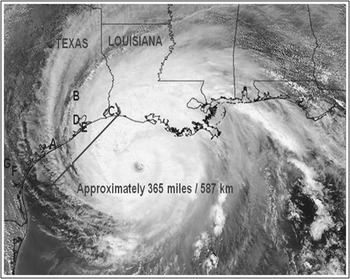
This observational, retrospective study of acute care hospitals, all part of one hospital system, took place eight to nine months immediately following Hurricane Rita's landfall on September 24, 2005.Reference Downey, Andress and Schultz4, 5 It involved hospitals that were either partially or fully evacuated in preparation for, or in response to, Hurricane Rita (Figure 1).
Partially or Fully Evacuated Hospitals

Selection of Participants
Eligible institutions and their IMTs were initially identified by a systemwide, electronic survey of all hospitals belonging to a single health care network. All hospital IMTs included: the Chief Executive Officer (CEO)/Administrator, Chief Financial Officer, Chief Nurse Executive, Officers of Safety, Operations, or Communications, and/or the Chief Medical Officer. For some teams, additional participants included the Public Information Officer, the Supplies/Materials Manager, or a Human Resources representative. In all the interview sessions, the CEO or Administrator gave the final survey response that was derived from consensus of the interview group. Consensus was achieved in real time during the meeting, as the CEO summarized the group's answer before moving on to the next question. The study was approved by the hospital system's institutional review board.
Interventions and Measurements
Researchers used an existing survey instrument (the Northridge Earthquake Hospital Evacuation Benchmarking Tool), modifying its structure where appropriate to permit evaluation of hospital evacuations due to hurricanes.Reference Schultz, Koenig and Auf der Heide6 Using this tool, the same two of the investigators conducted all on-site interviews with hospital IMTs and recorded their responses to the 95 questions in real time.
Outcomes
The study's main outcomes were identification of the major factors external to the hospital environment impacting patient evacuation that should be captured in a hospital's approach to situational awareness.
Results
Hospital Demographics
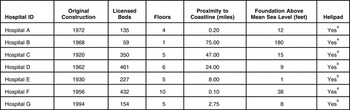
Hospital structural height ranged from one to ten stories. The age range of original construction was 19-93 years. Facility proximity to the coastline ranged from 0.1-75 miles, and foundation elevation ranged from 1-180 feet above mean sea level. All hospitals had helipads, but four of the seven helipads were located at ground level. One hospital with a ground level helipad was forced to use a cemetery as an alternate landing site to evacuate its final patient. Licensed beds ranged from 59-461, and all seven hospitals reported having Intensive Care Units (ICUs), including two with Neonatal ICUs (NICUs) and one with a Pediatric ICU (PICU). Hospital demographics are outlined in Table 1.
Hospital Demographics

aGround level.
bRoof top.
Disaster Plan Characteristics
Four hospital IMTs reported that their EOPs were comprehensive and addressed the facility as both a provider of care during an incident as well as potentially needing assistance. One hospital team reported that their EOP integrated with the system's corporate plan, the community regional plan, and their state plan.
Hospital IMTs involved the following agencies in developing their EOPs: fire (n = 7), parish/county emergency management (n = 6), and state police (n = 4). No more than one hospital team reported involving any of the following agencies: local health departments, the American Red Cross, the Metropolitan Medical Response System (if applicable), the Department of Public Safety, the Coast Guard, the local emergency planning council, private industry, or mutual aid associations. The hospital involving the least number of agencies as part of their plan had the longest evacuation time once the decision to evacuate was made.
None of the hospital IMTs reported having formal hospital-specific Mutual Aid Agreements (MAAs) in place. However, one reported having a handshake agreement with other independent hospitals in the community as well as a relationship with the local mutual aid association. Two facilities had MAAs that were not hospital specific, but these excluded hurricane incidents. None of the hospital teams reported the existence of a system-wide MAA, but this was not reported as a barrier to the response.
Impact of Hurricane Rita on Hospitals
New patients requesting medical care continued to arrive at all hospital emergency departments (EDs) during the evacuation process (EDs remained open and operational, albeit some with limited capacity). Single patient evacuations (ie, patients moved only once) were reported by three hospitals. Multiple evacuations were reported by four hospitals for the following reasons: (1) patients initially moved within the hospital were subsequently evacuated to another hospital (n = 3); (2) patients moved inside the hospital were moved again due to changes in building safety; (3) equipment availability; (4) staff availability; (5) different hospital areas were evacuated at different times (n = 2); and (6) medical concerns or other reasons (n = 2). No evacuations took place during hurricane Rita's landfall.
The majority of the hospitals (n = 4) received both medical and non-medical evacuees from their communities. All IMTs reported receiving evacuees from at least one of the following entities: other acute care hospitals (n = 4), nursing homes (n = 4), private homes (n = 4), general shelters (n = 2), and special needs shelters (n = 1).
Four of the seven hospitals were in the 100% probable hurricane strike zone. In the pre-landfall period, three hospitals fully evacuated and four hospitals partially evacuated. After landfall, one of the partially evacuated hospitals had a single remaining patient who was too fragile to transfer, and one facility went on to complete its evacuation (this latter hospital was the final hospital to complete its evacuation). One facility completely evacuated twice in the pre-landfall period; first for its original on-site patients, and second after unexpectedly receiving patients from a neighboring facility.
Hospital Decision Making and Incident Command
The two most important factors influencing the decision to remove patients from hospitals were the issuance of mandatory community evacuation orders and storm dynamics/strength. Other factors included the storm's impact on reliable communications, limited hospital staff not wanting to remain in the facility, medical staff leaving the impacted area (especially those who had previously witnessed the impact of Hurricane Katrina), and the evacuation of other nearby hospitals (outside of this hospital system).
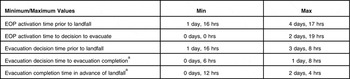
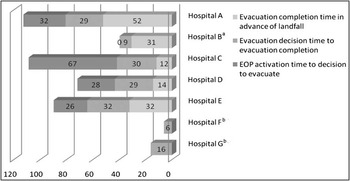
The average time to activate the Emergency Operations Plans (EOPs) prior to landfall was 85 hours (median 86, range 40-113) (Table 2 and Figure 2). The hospital with the earliest activation time (113 hours prior to landfall) was in the center of Rita's strike zone. The hospital with the second earliest activation time, in comparison to all other study hospitals, was closest to Hurricane Katrina's landfall. After Katrina passed, this hospital did not de-activate its EOP between the two storms. Rather, its activation focus shifted from Katrina to Rita, and a specific date and time for doing so was noted for the purpose of distinguishing cost estimates and reimbursement requests to the Federal Emergency Management Agency for storm-specific costs.

Evacuation Times (provided in days and hours, rounded to nearest hour)

aInformation not recorded from two hospitals and not included within these calculations.
Activation Activities in Advance of Landfall (hours)
aActivation of Emergency Operations Plan (EOP) and evacuation occurred simultaneously.
bEvacuation decision time to evacuation completion and evacuation completion time in advance of landfall not recorded by hospital.

The average time from activation of the EOP to the point where the evacuation decision was made for five of the seven hospitals was 30 hours (median 28, range 0-67). Two hospitals did not record when they decided to evacuate. One hospital activated its EOP and decided to evacuate simultaneously. On average, the evacuation decision was made 53 hours (median 43, range 40-80) in advance of Rita's landfall time.
The average time to evacuate (ie, the elapsed time between the decision to evacuate and the time the last patient left the hospital grounds) was 22 hours (median 29, range 6-32) for all seven hospitals. The average time of evacuation completion prior to landfall was 28 hours (median 31, range 12-52). However, these times do not reflect the earlier arrival of tropical force winds prior to Rita's landfall. Researchers were not able to capture this data, but patient transport to other facilities was limited by these winds. Exact counts of patients remaining in the hospital after early discharge and cancellation of elective surgeries were not captured.
The Hospital Emergency Incident Command System (HEICS), now Hospital Incident Command System (HICS), was a reported component in four of seven hospital EOPs activated during the evacuation response. Coordination of patient evacuation to other hospitals was most complicated by transportation asset deficits (the most significant of the 11 identified problem areas). Ambulances and helicopters were the most frequently used vehicles for transporting evacuated patients. Hospitals also used private and public buses, hospital-owned vehicles, fixed-wing aircraft, public-safety vehicles (police/fire), a limousine, and a school bus.
Movement of Patients to Other Facilities
The most frequently cited consideration for identifying a receiving facility was the hospital's service capabilities corresponding to the patient's medical acuity. Other considerations included: bed availability, hospitals thought to be outside the hurricane's impact zone, and an institution's proximity to the transferring hospital. The majority of hospitals transferred patients to other facilities that belonged to their hospital system. Pre-arranged transportation planning was not included in four of the seven EOPs.
Communication procedures were outlined in EOPs for two of the seven hospitals. Equipment used to contact receiving facilities included telephones, e-mail, and two-way radios. Other hospitals used cell phones, text messaging, faxes, or an electronic bed-tracking website. One hospital participated in a Regional Medical Operation Center (RMOC). Two teams reported that communication equipment inoperability or system failure contributed to the need for evacuation.
Other coordination problems included length of time to identify accepting hospitals, tracking patients (especially for those who were transferred more than once), and equipment resupply. Shortages of wheel chairs, ventilators, and oxygen tanks resulted from transfers of these devices with patients to the receiving facilities. Failure to track this equipment by transferring hospitals contributed to the problem. Additional coordination challenges specific to patient movement included lack of protocols to move medical records and/or medications and finding appropriate helicopter landing zones.
Patient tracking was frequently a manual process, but when patients were transferred more than once, this system was not reliable. Two facilities used a patient pouch/bracelet mechanism that reportedly worked well. Some institutions transferred original medical records with the patients while others sent copies. Two hospitals expressed the need for developing electronic medical records. No deaths were reported as a result of patient movement to another facility.
Recovery
Survey questions specific to the recovery process focused on obtaining new data in regards to interface with the community. For the majority of the teams (n = 5) the process for requesting local, state, and federal resources was not clear. For the remaining two teams that understood the process, one indicated that it did not work. All teams reported that more robust external communications systems are needed. Finally at the time of the interview, hospitals had submitted all eligible financial reimbursement expenses to FEMA, but none had received reimbursement (eight to nine months post landfall).
Discussion
During regional disasters, hospitals in proximity to the incident naturally become first receivers. Even in extreme events like hurricanes, communities expect these institutions to provide care in a safe and secure environment. The data obtained in this study supports hospitals in developing robust EOPs that integrate into a unified command system. In addition, these data assist IMTs in identifying EOP components and evacuation indicators that should be in place prior to an incident.
Hospital Demographics
Several hospital demographic characteristics influenced evacuation. These included situational awareness of hurricane characteristics and potential hospital structural threats including flooding and wind. Facilities at low elevation were at risk for flooding with potential loss of helipad access. However, distance from the coast was not as protective as one might believe. A hospital located 75 miles from the shoreline and at an elevation of 180 feet above sea level still required evacuation and was non-operational for the longest period of time. Even hospitals positioned at the regional rim of the disasters will experience patient surge, often in the face of reduced staffing capabilities.
Disaster Plan Characteristics
An evacuation protocol is an essential component of an “all-hazards” EOP. Hospitals, whether independent or part of a system, should develop EOPs that: (1) integrate their evacuation process with plans from other hospitals and community partners; and (2) assure this process will effectively interface with local, state, national and, for border states, international jurisdictional response. These findings support the ongoing Department of Health and Human Services’ Hospital Preparedness Planning (HPP) efforts as well as FEMA's Comprehensive Planning Guide.7, 8 In this study, the facility that incorporated the fewest outside agencies in developing its disaster plan required the longest time to evacuate patients. While this study is not powered to establish this observation as evidence, it does suggest there may be significant consequences for failure to integrate planning with the community and to directly link planning with measurable outcomes.Reference Chaffee9
Hospitals integrated into an established system have the advantage of potential access to additional resources. Therefore, the importance of MAAs might be reduced. In the current study, the lack of MAAs was not reported as a barrier, but all study hospitals already belonged to a network. For independent institutions, this finding may not apply, and absence of MAAs could have a more detrimental impact. Therefore, independently-owned hospitals should consider establishing agreements with local hospitals, community response partners, and private sector partners to potentially secure resources that may be more realistically obtained locally. Establishing MAAs that extend beyond the county/parish to include regional and interstate assets, such as the Emergency Medical Assistance Compact (EMAC), will create a tiered resource infrastructure that would be more adaptable to the magnitude of the disaster.10 Situational awareness includes knowledge and status of resources brought in by MAA activation, such as personnel and equipment.
Impact of 2005 Hurricane Season on Hospitals
During evacuation, emergency departments should plan to simultaneously assist with patient transfers while providing care to arriving patients. Hospitals opting to participate in Joint Commission Accreditation are held to standards that include Elements of Performance designed to help hospitals prepare for evacuation.11 Hospitals not opting into this accreditation process are likely to have gaps or inconsistent approaches to evacuation planning.
Skilled nursing facilities, shelters, and other congregate facilities may have less-developed evacuation plans. As a result, they often transport their residents to community hospitals during a disaster. This creates additional pressure on facilities already involved in evacuating their own patients. While some programs and legislation exist that incentivize hospitals to build partnerships and coalitions with non-hospital facilities, ultimately these congregate populations are likely to surge to the hospitals during a disaster, especially if evacuation processes are not understood by community partners.12-Reference Brown, Hyer and Polivka-West19
Hospital Decision Making and Incident Command
The average elapsed time from activation of the EOPs through completion of the evacuation process for five hospitals was 56 hours (median 57), but this number must be considered in the context of vastly different patient counts, EOPs, and evacuation planning characteristics.
Criteria for disaster plan activation and hospital evacuation should be specified in the written plan. Hospitals should also develop and share policies and protocols with local offices of emergency management to identify inconsistencies in planning. Relationships should be structured within an incident command framework such as the Hospital Incident Command System (HICS) to facilitate establishment of a Unified Command of response agencies needed for the evacuation process.20
While all hospitals belonged to the same health care system and tended to evacuate patients within this network, confusion still persisted with many transfers. In the future, regularly scheduled conference calls involving key decision makers at the affected facilities and corporate headquarters should be scheduled during an incident, and will improve situational awareness. For this strategy to be effective, emergency communication redundancies are essential.
Hospitals should secure transportation assets in advance. Careful consideration should be given to evacuation routes and transportation resource availability, given community-wide evacuation activities. Contra-flow corridors and other heavily engaged routes can affect both access to and acquisition of vehicles. Evacuations should be completed while weather conditions are favorable, roads are open, and while aircraft can fly. Therefore, access to the most reliable weather predictions should be established, closely monitored, and communicated to the hospital IMTs. While best practices documents and checklists are in development to assist hospital managers in the creation and refinement of evacuation plans, the results of this study help identify additional planning elements that should be incorporated.Reference Cocanour, Allen and Mazabob21, 22
The decision to evacuate or shelter-in-place given forecasted storm variability poses a significant challenge to hospital decision makers. Predicted and actual hurricane dynamics including direction, wind speed (category), storm surge, rainfall etc. are subject to change within 24-48 hours before landfall and may cause some hospitals to become either more or less vulnerable. Planning should include developing the hospital's capability, capacity and strategy to safely shelter-in-place while considering the hazards and vulnerabilities posed by storm dynamics.
Findings from this investigation support the value of developing core training competencies such as those outlined in the Office for Incident Management Systems Integration.23 During a disaster, hospitals and health care systems face decisions that are influenced by community response activities. The issuance of mandatory evacuation orders will impact the hospital evacuation process. Training courses similar to IS-700.a and IS-800.b provide knowledge that will support the hospital-community interface during the response process.24, 25
Movement of Patients to Other Facilities
Moving patients to other facilities requires situational awareness and planning on multiple levels. This study identified several activities that, if incorporated into the EOP, may facilitate the decision making associated with evacuation. These include: (1) determining the hospitals with the appropriate medical services, staff and resources to accept patients; (2) identifying receiving hospitals located in non-threatened locations; (3) determining transportation resources in advance; (4) triage strategies (agreed upon in advance of an incident); and (5) implementing systems for patient tracking and medical record transfer. Given the pressures on community resources, evacuation protocols contained within EOPs should be compatible with those from local/regional and state agencies.
Community transportation resources were depleted from the impact of Hurricane Katrina just three weeks earlier. In addition, federal resources were also reduced by this previous storm.26 During Hurricane Rita, more federal transportation resources eventually became available, but state coordination designed to facilitate the interface between these federal assets and local entities requesting such resources was not effectively implemented. Incident Management Teams acknowledged that their EOPs lacked effective emergency transportation strategies. Further, IMTs reported that both their emergency communication equipment and inter-hospital protocols needed improvement to provide better awareness of the evolving situation within the community.
Patient and equipment tracking systems must be robust enough for single and multiple transfers. Ventilators and wheelchairs may transfer with evacuated patients, and proper documentation is necessary to facilitate equipment return or reimbursement. Electronic tracking systems can be effective, but require endorsement from senior leadership and support for successful implementation. Electronic patient tracking systems are not only valuable for capturing patient information but for monitoring their movements and locations as well.Reference Powers and Phipps27 Staff can gain familiarity with these systems by incorporating their use into daily practice and/or drills so that implementation of the system is not first attempted during a disaster.
Recovery
Hospital teams repeatedly discussed that, had community planning and emergency response processes been in place and understood by the IMTs, recovery activities would have been faster. Recovery strategies designed to help restore critical systems that support the provision of medical care, utilities, and services after an emergency are priorities. Joint Commission accredited hospitals are required to have these as components in their EOP,28 but these requirements do not apply to non-Joint Commission hospitals. With the proper planning and documentation, preparedness activities can be linked to FEMA reimbursement.29
Patient and staff safety are the priority. As hospitals continue to enhance their EOPs and evacuation decision making tools, investments in hardening their facilities to improve capability for recovery must not be overlooked.
Limitations
While all teams contained an identical group of core incident management members, variations occurred in some of the other non-core positions within the teams, and may have influenced the ultimate consensus of the responses. Given the current federal requirements to institutionalize ICS in hospitals, however, future IMT interviews will likely be even more standardized.
For this study, modifications to the original data collection tool were necessary as it was designed for earthquake evacuations. These revisions delayed the initiation of the interview process. Additional enhancements to the data collection tool are underway that will further strengthen core all-hazards investigations, including hurricane-specific scenarios.
Conclusion
This study found that the average hospital evacuation time was 22 hours, but this was in addition to the time to activate the EOP and to recognize the need to evacuate. Further, these averages were measured in relation to landfall, not the arrival of tropical force winds (approximately 24-48 hours in advance of landfall). This is an important planning consideration regarding whether air or land transportation resources will be relied upon during evacuation.
External situational awareness limitations including evacuating hospitals, local community evacuation orders (and expectations), and transportation resources complicated the decision of the IMTs to identify when and how quickly they were able to evacuate patients. Given that all hospital IMTs stressed the need for community situational awareness (whether evacuating or not), it is likely that decision making would be facilitated by developing hospital EOPs and evacuation strategies that more accurately integrate with specific community planning efforts.
Author Contributions: ELD, KA and CHS participated in conception and design; ELD and KA acquired all the data; ELD, KA, and CHS analyzed and interpreted the data; ELD, KA and CHS drafted the manuscript and provided critical revisions for important intellectual content; and ELD and KA provided administrative and technical support.
ELD and KA had full access to all of the data in the study and take responsibility for the integrity of the data and the accuracy of the data analysis.