




No CrossRef data available.
Article contents
COVID-19 Outbreak: Burnout and Posttraumatic Stress Disorder, a Harmful Chronology for Health Caregivers in Emergency Departments and Intensive Care Units
Published online by Cambridge University Press: 21 January 2022
Abstract
An abstract is not available for this content. As you have access to this content, full HTML content is provided on this page. A PDF of this content is also available in through the ‘Save PDF’ action button.
Information
- Type
- Commentary
- Information
- Disaster Medicine and Public Health Preparedness , Volume 16 , Issue 6 , December 2022 , pp. 2283 - 2284
- Copyright
- © The Author(s), 2022. Published by Cambridge University Press on behalf of Society for Disaster Medicine and Public Health, Inc.
References
Pujo, JM, Kraiem, H, Daniel, P, et al. Work-related stress assessment in an emergency department in French Guiana. Br J Nurs. 2021;30(9):540-546.CrossRefGoogle Scholar
Azoulay, E, Cariou, A, Bruneel, F, et al. Symptoms of anxiety, depression, and peritraumatic dissociation in critical care clinicians managing patients with COVID-19. A cross-sectional study. Am J Respir Crit Care Med. 2020;202(10):1388-1398.CrossRefGoogle ScholarPubMed
WHO. Burn-out an “Occupational Phenomenon”: International Classification of Diseases. Published January 1, 2022. Accessed July 22, 2021. https://www.who.int/news/item/28-05-2019-burn-out-an-occupational-phenomenon-international-classification-of-diseases
Google Scholar
WHO. Assessment and Management of Conditions Specifically Related to Stress: mhGAP Intervention Guide Mode. Published 2021. Accessed July 22, 2021. https://apps.who.int/iris/handle/10665/112734
Google Scholar
Kannampallil, TG, Goss, CW, Evanoff, BA, et al. Exposure to COVID-19 patients increases physician trainee stress and burnout. PLoS One. 2020;15(8):e0237301.Google ScholarPubMed
He, X, Zhang, Y, Chen, M, et al. Media exposure to COVID-19 predicted acute stress: a moderated mediation model of intolerance of uncertainty and perceived social support. Front Psychiatry. 2020;11:613368.CrossRefGoogle Scholar
Madanes, SB, Rose, Levenson-Palmer, Szuhany, KL, et al. Acute stress disorder and the COVID-19 pandemic. Psychiatric Annals. 2020;50(7):295-300.CrossRefGoogle Scholar
Carmassi, C, Foghi, C, Dell’Oste, V, et al. PTSD symptoms in healthcare workers facing the three coronavirus outbreaks: what can we expect after the COVID-19 pandemic? Psychiatry Res. 2020;292:113312.CrossRefGoogle ScholarPubMed
Bao, Y, Sun, Y, Meng, S, et al. 2019-nCoV epidemic: address mental health care to empower society. Lancet. 2020;395(10224):e37-e38.CrossRefGoogle ScholarPubMed
Ali, H, Cole, A, Ahmed, A, et al. Major stressors and coping strategies of frontline nursing staff during the outbreak of coronavirus disease 2020 (COVID-19) in Alabama. J Multidiscip Healthc. 2020;13:2057-2068.CrossRefGoogle ScholarPubMed
El-Hage, W, Hingray, C, Lemogne, C, et al. [Health professionals facing the coronavirus disease 2019 (COVID-19) pandemic: what are the mental health risks?]. Encephale. 2020;46(3S):S73-S80.CrossRefGoogle ScholarPubMed
Norful, AA, Rosenfeld, A, Schroeder, K, et al. Primary drivers and psychological manifestations of stress in frontline healthcare workforce during the initial COVID-19 outbreak in the United States. Gen Hosp Psychiatry. 2021;69:20-26.CrossRefGoogle ScholarPubMed
Lucchini, A, Iozzo, P, Bambi, S. Nursing workload in the COVID-19 era. Intensive Crit Care Nurs. 2020;61:102929.CrossRefGoogle ScholarPubMed
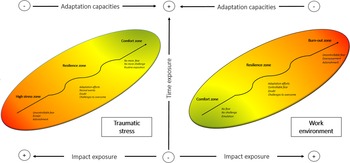
Figure 1. Dynamic related to work conditions and traumatic stress.
 You have
Access
- 4
- Cited by
In just over a year, the coronavirus disease (COVID-19) epidemic has highly destabilized all health systems worldwide. The psychological burden that continues to weigh on caregivers is unprecedented due to the longevity and scale of this health crisis. Caregivers working in emergency departments (EDs) or intensive care units are more accustomed than others to adapting to stress and pressure. Reference Pujo, Kraiem and Daniel1 However, the scientific literature is teeming with articles describing a significant upsurge in mental disorders among these caregivers, leading to an increased risk of burnout or posttraumatic stress disorder (PTSD). In France, a recent cross-sectional study among 21 EDs has shown a high prevalence of depression and traumatic stress with 30.4% and 32%, respectively. Reference Azoulay, Cariou and Bruneel2
In the 11th revision of the International Classification of Diseases (ICD 11), the World Health Organization (WHO) defines burnout as a work-related syndrome and not a disease. It results from chronic exposure to stress that has not been efficiently managed, and it is characterized by 3 elements: a feeling of exhaustion, negative emotions related to work, and impaired performance at work. 3 This definition, therefore, refers only to a professional context. Nevertheless, this evolution can make it more and more challenging to adapt to chronic exposure to stress until it reaches a stage of professional burnout.
Furthermore, WHO defines PTSD as a mental disorder that is a delayed or prolonged response to a stressful (short or long-lasting) situation or event that is exceptionally threatening or catastrophic and is believed to cause symptoms. 4 It is classic to witness a repeated reliving of the initial traumatic event, which can be triggered by situations calling for memory (flashbacks). In most cases, the progression is toward recovery, although the disorder can become chronic for some patients.
Thus, the COVID-19 outbreak, which lasts over time, has exposed health care teams to different kinds of stressors leading to a significant increase in mental disorders impacting the management of human resources and organizations. Frontline caregivers are still experiencing strong physical and psychological tensions. They must learn quickly and continuously to adapt to this new health threat. Reference Kannampallil, Goss and Evanoff5–Reference Madanes, Rose and Szuhany7 Caregivers were simultaneously exposed to several mechanisms of stress, the weight of which have varied throughout the exposure period.
During the first period of the COVID-19 outbreak, the acute stress exposure of caregivers was attributable to the ignorance of this emerging disease and the fear of being infected or to the risk of exposing their families and relatives. Later, health care teams were confronted with an uninterrupted flow of severe patients with a high case fatality rate, daily publicized by media worldwide. In addition, there was initially a feeling of helplessness in the absence of effective treatments or a consensus for disease management. Reference Carmassi, Foghi and Dell’Oste8 This type of exposure, repeated over time, was very anxiety-provoking and at risk for developing psychological distress and PTSD. Reference Bao, Sun and Meng9 However, better knowledge of the disease, the adoption of consensual practices, and training have undoubtedly desacralized the care of these patients and, at the same time, gradually reduced the emotional/traumatic impact on caregivers. Reference Ali, Cole and Ahmed10
The COVID-19 epidemic has also profoundly changed the professional environment for caregivers. In a short period, it was necessary to restructure the hospitals and create dedicated care sectors, reassigned staff who are sometimes reluctant as needed, and urgent implementation of specific procedures. Reference El-Hage, Hingray and Lemogne11 In addition, on a global scale, there has been a shortage of protective equipment, consumables, and certain pharmaceutical products, which have led to an adaptation of practices, perceived as a deterioration of working conditions and sometimes an imposed risk-taking. Reference Norful, Rosenfeld and Schroeder12 Finally, the physical workload of caregivers has increased considerably with the implementation of decontamination measures, the number of patients requiring nursing care, the increase in weekly working overtime, and the lack of human resources over a while at an unprecedented length. Reference Lucchini, Iozzo and Bambi13
Indeed, traumatic stress was dominant during the first period of the epidemic. However, the health care teams learned to adapt to this emerging disease, thus reducing the initial weight of this mechanism. Conversely, the acceptance of work procedure changes, a work environment unsuitable for the care of its patients, the chronic lack of resources, an overload of work over a particularly unusual period, and the outcome of which remains uncertain weigh on caregivers’ mental health. Identifying these different mechanisms and their level of involvement in global stress is of great importance when implementing coping strategies at any given time (see Figure 1). The psychological care of caregivers takes on different aspects of preventing or combating traumatic stress or burnout. Overall, health managers are not very aware of this issue and generally have neither the skills nor the managerial tools to deal with it. While the health crisis seems far from being managed, it is urgent for field managers to better understanding its mechanisms and to define control strategies adapted to their environment. Thus, it seems necessary to set up training focused on team management similar to what is done in the industrial environment. The psychological balance of a group often depends on how the individuals experience leadership. Good governance requires appropriate tools that have to be developed and supported from the administrative management to implement actions aimed at the well-being of health care staff.
Dynamic related to work conditions and traumatic stress.