Immersion, Interrupted
“How we experience the world is changing. People will soon be able to become totally immersed in their favourite films, sports and entertainment.” This confident assertion, made on the webpage of the UK government’s Industrial Strategy Challenge Fund (GOV.UK 2019), predicts that immersive experiences will play an increasingly pivotal role in how artistic and cultural events are encountered in all areas of life. As the momentum of the immersive zeitgeist has gathered pace, research in theatre and game studies has questioned what makes an experience immersive, leading many scholars to emphasize immediacy in space and time as key features of immersion (Calleja Reference Calleja2011; Machon Reference Machon2013). Although immersive immediacy is widely prized, spatiotemporal immediacy in participatory performance can undermine the agency of participants, undercutting their reflexive criticality by limiting perception to the here and now. As an alternative, I propose an aesthetics of reflexivity that requires a more expansive spatial perspective, alongside a depth perspective on time that combines imaginings of past and future to inform creative action in the present. These arguments are concretized through discussions of participatory performance works in theatre and digital games, alongside my practical research in the collaborative storytelling methods of live action role‐play — or larp, as it is commonly referred to. Specifically, I focus on the use of play exercises in a project with elderly service users of adult daycare centers and sheltered housing schemes in the London Borough of Haringey in 2017–2018. This project investigated the potential impact of spatiotemporal reflexivity in play, creating activities in response to personal memories that might prompt participants to make imaginative departures beyond familiar routines and fixed viewpoints.
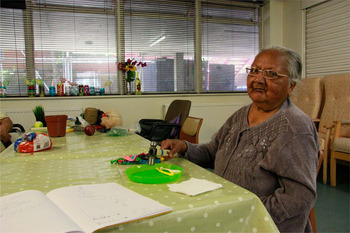
A participant plays with a hammer. (Photo by Jamie Harper)

Constraints of Immediacy in Space and Time
Recent analyses of immersion in theatre and digital games have identified spatial and temporal immediacy as core characteristics. Gordon Calleja’s work on the experience of “presence” when playing video games foregrounds the issue of mediation, noting that immersion often involves the attempt to diminish conscious awareness of an interface, creating transparent spatial immediacy so that users feel like they are really “present” in the game. Calleja states that “transparency erases the interface and offers the viewer or user as direct an experience of the represented space as possible” (Reference Calleja2011:23), drawing players “so deeply into the game that they feel as if they are part of it” (25). Similarly, in discussing theatrical immersion, Josephine Machon emphasizes the value of close‐up, haptic engagement between performers and audience members, arguing against reflexive criticality in favor of full sensory envelopment: “The immersive experience arises when medium and message are fused, resulting in the totalisation of the artwork. This ludically subverts aesthetic and critical distance, placing the perceiver of the art within the art” (Reference Machon2013:34). In addition to valorizing spatial immediacy, Machon argues that immersive theatre disrupts chronological time in favor of imminent “becoming” in an “ongoing present” that enables “dwelling in the moment; moment by moment” (130). The increasing primacy of the present moment is also strongly apparent in digital games. James Ash highlights the trend in digital game design “towards attempting to encourage players to concentrate on a modulating present moment, in an increasingly narrow spatio‐temporal envelope of perception” (Reference Ash2015:4). In other words, alongside the pursuit of spatially immediate presence, digital games, like immersive theatre works, often pursue a temporal immediacy that is tightly focused on the imminent action of now.
A common reference point for advocates of immersive experiences is Mihaly Csikszentmihalyi’s concept of flow, the state of being that occurs when an individual is engaged in an activity challenging enough to generate arousal and interest but not so challenging that they experience anxiety or frustration (Csikszentmihalyi Reference Csikszentmihalyi1990). In this state, according to Csikszentmihalyi, the task at hand is enjoyable to undertake and becomes engrossing, to the point where “goals lose their substance and reveal themselves as mere tokens that justify the activity.” Essentially, “the doing is the thing” and, through the intrinsic enjoyment of doing, “there is little distinction between self, environment, between stimulus and response, or between past, present and future” ([1975] Reference Csikszentmihalyi, Caines and Heble2015:151). Clearly, a narrow temporal focus on action in the immediate present is a core component of flow, but Csikszentmihalyi’s emphasis on the “centering of attention on a limited stimulus field” (153) also indicates a concentration of perception that excludes a more expansive spatial perspective. Essentially, the individual in a flow state ignores all considerations that are extrinsic to the activity as they enter a highly focused engagement with the action of the spatiotemporal present.
The potency of immediacy in space and time is strongly affirmed by the theory of affects of Baruch Spinoza (1632–1677). Spinoza is explicit that events in the temporally immediate present have the strongest impacts on the body, stating that “the image of a thing future or past […is] weaker than the image of a thing present, and consequently the emotion towards a thing future or past is […] less intense than the emotion towards a thing present” ([1677] Reference Spinoza, Parkinson, Parkinson and Boyle1992:150). Spinoza goes on to assert, however, that a limited temporal horizon is disabling to our powers of action, stating that “the desires by which we are most bound have regard only to present, not to future time” (182). The notion that we are “bound” by the emotion of the present implies a negative view of perception that is held in the immediacy of now. By contrast, Spinoza states that “in so far as the mind conceives a thing according to the dictate of reason, it will be equally affected whether the idea be of a thing present, past or future” (183), which suggests that if the mind is to acquire knowledge as the basis for agential action, it must be equally affected by imaginings of future or past, rather than being solely bound by the affects of the present.
In the same way that temporal immediacy can be seen to undermine the power of action, Spinoza suggests that spatial immediacy can be a harmful constraint. He asserts that “the more the body is apt to be affected in many ways or to affect external bodies in many ways, the more apt is the mind for thinking” (195). This suggests that the powers of thought and agential action are supported by moving beyond a narrow spatial immediacy to perceive a broader multiplicity of affects. Nigel Thrift affirms this argument, building on Spinoza’s ideas to call for an expansive spatiality of manifold relations. He argues that a “complex body” can only emerge from a wide plurality of relationships in social space, suggesting that: “The simple political imperative is to widen the potential number of interactions a living thing can enter into, to widen the margin of ‘play’ […] increasing the number of transformations of the effects of one sensory mode into another” (Reference Thrift2004:70). In other words, by pursuing an expansive diversification of space, manifold affective exchanges are enabled. Subsequently, as beings increase their ability to be affected and to affect others in a great many ways, their creative capacities are increased.
In considering the notion that spatial immediacy might limit human agency, analyses of the methods that digital interface designers use to focus their users’ spatial perceptions are instructive. In his discussion of digital interfaces, Ash uses the term “resolution” to describe how game designers shape perception of objects within the horizon of play. He offers the example of the first‐person shooter game Battlefield 3 (Keegan Reference Keegan2011), describing the combination of high‐ and low‐resolution objects, noting that “the grass on the ground appears in low resolution as more or less homogenised clumps that cannot be affected by the player,” in contrast to the high resolution of enemy combatants who are the intended objects of attention within the game (2015:43– 44). The emphasis here is on directing the focus of players towards highly singularized points of space, which opposes the more expansive spatiality advocated by Spinoza, who states that:
An emotion is bad or harmful only in so far as the mind is prevented by it from thinking. And therefore that emotion by which the mind is determined for regarding many objects at the same time is less harmful than another equally great which detains the mind in the contemplation of one alone or fewer objects in such a manner that it cannot think of others. ([1677] Reference Spinoza, Parkinson, Parkinson and Boyle1992:205)
Arguably, therefore, an interface design that intentionally “detains the mind in the contemplation of one alone or fewer objects” through the pursuit of high‐resolution spatial focus can be seen to hinder the capacity for thinking.
In addition to the constraints of spatial immediacy, Ash’s discussions of the digital games industry indicate the potential constraints of temporal immediacy in play. He references the work of Katherine Hayles to suggest that “rather than developing ‘deep’ modes of attention, based around temporally elongated activities such as reading, these industries create a ‘hyper’ attention, where increasing levels of stimulation are required to keep viewers interested” (in Ash Reference Ash2015:4). Ash subsequently links this “hyper” attention, which Douglas Rushkoff describes as the “perpetual now” (in Ash Reference Ash2015:6), to the proliferation of gamification strategies that use digital technologies to increase productive participation and generate economic value. Ash suggests that “the problem with these systems is how they attempt to […] focus users’ perception on a continuously modulating present tense at the expense of creative thinking in relation to future or past possibilities” (13).
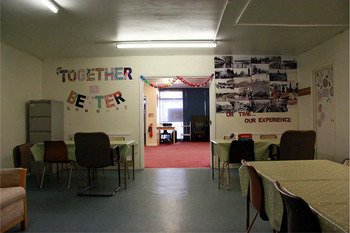
Haringey Community Hub, London. (Photo by Jamie Harper)

In contrast with critical perspectives on a “perpetual now,” contemporary accounts of “mindfulness” focus on the importance of “present‐centeredness” in creating a sense of well‐being. Drawing on Buddhist meditation practices, advocates of mindful present‐centeredness emphasize the value of attending to phenomena in the present moment in order to reduce the strain of modern life (Dreyfus Reference Dreyfus2011). Although present‐centered mindfulness may be beneficial for individuals seeking to reduce their stress levels, scholars of Buddhism are at pains to point out that traditional Buddhist texts treat “bare attention” to the present moment as a stepping‐stone to the deeper insight of “right mindfulness” (Purser and Milillo Reference Purser and Milillo2014), which also requires the combination of memory and future considerations. As Georges Dreyfus argues:
Far from being limited to the present […] mindfulness is a cognitive activity closely connected to memory, particularly to working memory, the ability to keep relevant information active so that it can be integrated within meaningful patterns and used for goal‐oriented activities. (Reference Dreyfus2011:47)
Ronald Purser and Joseph Milillo carry this critique of contemporary notions of mindfulness further, describing the valorization of present‐centeredness as a kind of “sensual romanticism” that they term “here‐and‐nowism” (Reference Purser and Milillo2014:12). Rather than viewing this as a positive state of being, they suggest, in much the same way that Spinoza warns of the passive bondage that results from being solely affected by events in the spatiotemporal present, that “such empty attentiveness and appreciation of the present moment” may be nothing more than passive acceptance of “the vicissitudes of modernity” (12). Consequently, in considering notions of a “perpetual now” or “present‐centeredness” in relation to Spinoza’s work, it seems clear that the orchestration of temporal immediacy, either in digital interface design or contemporary mindfulness practices, can hinder agential action.
Departing from the aesthetics of spatiotemporal immediacy, my creative practice, which is based on the methods of live action role‐play, encourages a more reflexive perspective. Larp is a form of creative practice that has evolved from fantasy role‐play games, with Nordic larp emerging in the 1990s as a specific subcategory based on role‐play cultures in the Nordic countries (Montola and Stenros Reference Montola and Stenros2010). Nordic larp can be understood as a fundamentally cocreative activity that necessarily draws upon the subjectivities of players in developing and enacting their roles.Footnote 1 Although early Nordic larp manifestos valorized total immersion so that players could become one with their characters (see Pohjola Reference Pohjola, Gade, Thorup and Sander2003), more recent thinking has expressed the need to maintain reflexive awareness of the “steering” that players exercise during play by holding onto an ongoing sense of their own subjectivity, together with an awareness of how they apply their subjectivity in manipulating the character being played (Montola, Stenros, and Saitta Reference Montola, Stenros, Saitta, Nielsen and Raasted2015). For example, in The Family Andersson (Nolemo and Röklander Reference Nolemo and Röklander2009), a larp about a group of siblings meeting to decide what to do with the fortune of their recently deceased parents, each character is played by two players, who switch in and out of the action, encouraging intervals of reflexive thought during which they can consider how the next phase of the play action might be steered.
Aside from the activity of the players themselves, the ideal of creating fully immersive play spaces has given way to more abstract larp designs that stimulate reflexive differentiation of the fiction from the “real world.” Johanna Koljonen argues that devices like “a hand‐written note for a lock on the door, a classroom for royal chambers, a game of chance for physical conflict” can have an “estranging” effect that usefully delineates fiction and actuality and stimulates the creative imagination of players ([2007] Reference Koljonen, Saitta, Holm-Andersen and Back2014:92). This increased appreciation of spatial abstraction has given rise to the emergence of “black box” larp, which celebrates a theatrical minimalism as opposed to immersive verisimilitude (Nielsen n.d.). A useful example is When Our Destinies Meet (Jarl and Karlsson Reference Jarl and Karlsson2013), in which players design the space of a New Year’s Eve house party by using tape to mark out the architectural composition of the space, then invent a network of character relationships amongst the party guests by following prompts from the facilitator. In the play instructions, the designers of this larp explicitly set out an aesthetics of reflexivity, calling on players to “interrupt their immersion into the character and story and start looking at what is happening and how it happens” (Jarl and Karlsson Reference Jarl and Karlsson2013). As such, it is indicative of a growing recognition in the practices of Nordic larp that reflexivity is an important source of aesthetic value. Hilda Levin argues, for example, that “by not only focusing on playing in the here and now, but also trying to consider what strategies might be useful up ahead, we can see more play possibilities” (Reference Levin, Saitta, Koljonen, Särkijärvi, Grove, Männistö and Makkonen2020:69).
An important aspect of the black box larp tradition exemplified by When Our Destinies Meet is that it tends to offer loose frameworks for player creativity, in a similar vein to the “scores” of the Activities created by Allan Kaprow (1927–2006), which serve as stimuli for the participatory action (Harviainen Reference Harviainen, Montola and Stenros2008). Nordic larps will often include preparatory workshops that enable the participants to establish general understandings of what the activity will entail prior to more detailed cocreation of aspects like scenography, roles, and character relations. Marjukka Lampo describes the cocreative development of larp as an “ecological” approach to performance whereby players respond to a series of stimuli within the conceptual framework of the scenario to construct the fabric of play, which can be conceived as a kind of intersubjective interweaving that is emergent, rather than prescribed by the designer (Lampo Reference Lampo2016).
In the same way that Nordic larps create frameworks for players to build their scenarios of play, the Haringey project, in which I worked with elderly clients of adult daycare centers and sheltered accommodation schemes, invited participants to apply their subjectivities in creating fictional stories from personal memories. My aim was to engage with participants on familiar terrain by asking them to tell stories about meaningful places and times in their lives, then experiment with making fictionalized renovations of these stories that might take them into unfamiliar territory. To do this, I began by sourcing photographic images related to locations that they had told me about and finding audio clips to match the pictures. I then asked participants to look at their picture whilst listening to the soundscape and invited them to make fictional elaborations of their stories. In one session, I worked with Ganguly,Footnote 2 showing him a picture of a train passing through a snowy landscape in the mountains of northern India, along with a soundscape of a train clanking along the tracks, which mapped onto the stories he had told about traveling home in the winter from boarding school when he was a boy. As he looked at the picture and listened to the sounds, he said:
GANGULY: Looks like — reminds me of the snow — the snow all over… (he listens) …I love it — on the train. It reminds me of my school days… (he listens) …I’m delighted — I’m happy. You can make a trip on the train. Through the hillsides. And have a good holiday. (Ganguly 2017)
In my reflections on this activity, it seemed clear that Ganguly had been moved by the experience, but although he had apparently found it very gratifying, I realized that I had unwittingly applied immersive strategies, providing rich sensory affects that offered passive satisfaction rather than prompting generative imagination. In other words, focusing Ganguly’s attention on familiar images and sounds that related closely to his memory seemed to make him feel as though he was “present” in that space and time, and despite the pleasure that this immersive experience appeared to give him, it was not conducive to creative thinking beyond the limits of his experiential horizon.
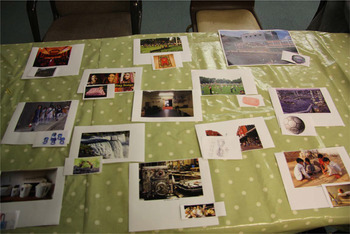
Playing with images. (Photo by Jamie Harper)

Following the immersive sound and image combination, I experimented with the juxtaposition of familiar and unfamiliar spatial images, investigating what the interruption of spatial immediacy might offer in stimulating an imaginative departure. In the course of this experiment I worked with Brenda, who had previously told a story from her childhood about suffering an epileptic seizure, which had almost caused her to drown during an excursion to a pond in Epping Forest just outside London. To begin, I laid out a range of photographic images linked to stories that members of the group had told and asked each participant to pick the image that interested them the most. Perhaps unsurprisingly, they all chose the image that related to the story they had previously told. I invited Brenda to look at her image, which depicted a young girl splashing (and possibly struggling) in a small lake, whilst also playing a soundscape of splashing water:
BRENDA: Going in the water — I was unconscious — didn’t know anything in that respect… (she listens) …sounds very much like me bath when I pull the plug out… (she listens) …I’m just thanking God someone was there and I survived. Grateful. This is what that must have sounded like to my friend.
Subsequently, I asked Brenda to imagine another character in her scenario, either a real person or a fictitious one, to which she replied:
BRENDA: Yes, my friend’s older sister who was supposed to be looking after us. I can imagine she wishes she was away in the forest — or at the sea and go away — because it frightened her very much — because of what happened. Mavis was her name.
Next, I asked Brenda to pick a second image, choosing one of the pictures relating to the stories that other participants had told, and she chose a photograph of a small airplane flying over a large river. This related to the story of another participant, Daniel, a Congolese man, who described seeing a plane for the first time when he was a child. I then invited Brenda to listen to the soundscape of the airplane and look at the picture, whilst imagining a destination that her character wanted to go to, to which she replied:
BRENDA: Possibly France — run away from Tottenham — if she thought we was gonna say something to mine or possibly her own parents. She’s frightened — so she runs away […] she’d want to go somewhere nice — Paris. Have a good time — knowing Mavis. Drink — and all the things that young women and girls would do — especially where there’s no father to put her in her place… (she listens) …possibly a weekend. Maybe just a day and then she would come back.
At the end of the exercise, Brenda commented on the divergence between the true aspects of the story and the fiction she had invented:
BRENDA: There was a lot of memories because it was a true story. That’s only imagination that she would want to get away, but I can imagine her doing it — she was that kind of person.
I then asked her to comment on how familiar the two images (the girl in the lake and the plane over water) seemed to her, and she replied that the first was familiar but the second was unfamiliar:
BRENDA: I’ve never flown — I don’t even have a passport. I’ve never been abroad. I’ve been to France, but on the ferry. That was on a one‐day pass. (Brenda 2018)
In my reflections on this activity, I formed the idea that the spatial collision between the familiar image and the unfamiliar image, alongside the invitation to take up a new subjective vantage point in the character of Mavis, opened the possibility for Brenda to make an imaginative leap from the known quantities of an immediately familiar situation. Essentially, I suggest that the defamiliarization produced through a montage of known and unknown spaces provided an imaginative gap that enabled her to think beyond the concrete limitations of her own experience.
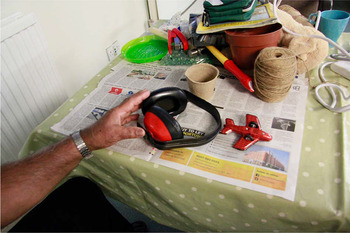
Just as spatial immediacy can be productively disrupted by the collision of familiar and unfamiliar spaces, I invited players to think beyond the present by combining past recollections and future imaginings. In one session, I worked with Daniel and invited him to create a story involving a journey from past to future, using a selection of random objects as stimuli. First, I asked him to pick an object that connected with his past and he selected a spanner (wrench):
DANIEL: It reminds me when I was younger to repair or fix the bike. And then when I went to the city capital — I was helping a friend — fixing his car.
Next, he was invited to pick an object related to the future and he selected a small orange:
DANIEL: This one is not only for the future — but also from my infancy to the future. Because my father was not only a tailor — he was also in agriculture. And we had a plantation with all kind of fruits, and this was one of them. And for me it represents when the earth will produce enough food for everyone. It’s a bright future.
Having discussed the past and the future, I asked him to pick two objects that represented a place and a character in this location. He picked up a flashlight and a balloon:
DANIEL: I’m now preparing to go somewhere in the bush where there are no lights and it’s dark. I will need it to see my way where I am going and identify objects around me…and a balloon — yes — because a balloon can be flexible, and you can put the air inside and it becomes big — this young man or woman — very young, he will grow up and become an adult.
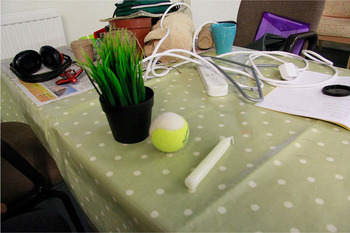
Playing with objects. (Photo by Jamie Harper)

At this point, I asked him to describe the hopes of his character and he said “he’s trying to find something very precious for them. A treasure that they can discover.” Next, I asked him to pick another object that represented a new place, or a new opportunity, and he picked up a toy airplane:
DANIEL: He found his treasure in that bush. He comes back and boards a plane. Now he wants to go to trade it in New York. And there he will land in JFK and then find somewhere he can trade his treasure. (Daniel 2018)
In reflecting on this play experience, I found it noteworthy that a very simple montage of object selections related to ideas of past and future could serve as the springboard for the construction of a relatively complex story. In this case, Daniel’s story made a significant departure from his lived experience of growing up in Congo, towards a broader horizon of possibility in America (a place that he had never visited). In selecting the toy airplane to make this journey, he drew on one of his earliest childhood memories (the small airplane flying over the large river) and I suggest that the invitation to play with temporally varied imagination, combining thoughts of a known past and an unknown future, supported his creative agency as a story maker.
Making formal distinctions through object selections. (Photo by Jamie Harper)

To summarize: Although immersive immediacy in participatory performance and digital games can be highly gratifying, perception that is limited to the here and now can hinder the agency of players by holding them within the parameters of their existing experiential horizon. Spinoza’s theories suggest that while the affects induced by immediate space and time may have the strongest impacts on the body, being solely affected by the present can constrain the body in a kind of bondage. These theoretical propositions are concretised by Ash’s discussions of digital interface designs, which illustrate how immediacy in space and time can exercise considerable control over users’ perception and actions. I argue, however, that an expansive spatiotemporal perspective can support the agency of players in participatory performances. By seeking a multiplicity of affects in a diversified space and thinking with a depth perspective on time that combines past, present, and future, the creative potential of players can be enhanced.
Reflexivity and the Formal Distinctions of Play
In setting out his theories of complex systems, Niklas Luhmann (1927–1998) argues that systems are characterized by distinctions, whereby a boundary is drawn between a form and that which lies outside it. Essentially, a form can only be defined by a distinction that separates the intended object that is “marked” from the “unmarked” external environment (Reference Luhmann and Knodt2000:27–36). In applying Luhmann’s ideas to participatory art, Tim Stott suggests that an insistence on a strict delineation between form and its outside does not mean that systems are impermeable. He argues that although the form is closed “it also remains open on its unmarked side” (2015:43). In other words, the openness of the “unmarked side” of the form implies the possibility that further distinctions can redefine the form and bring new objects from the exterior within its boundary.
Central to Luhmann’s concept of distinctions as the basis of formal definition is the idea that they are made through observations. Luhmann distinguishes first‐order observation, which is the primary action of formal distinction, and second‐order observations, which are, effectively, observations of the initial observation (Reference Luhmann and Knodt2000:55–57). Stott usefully reifies the concept of second‐ order observations by discussing a child in play who not only makes distinctions as part of her play activity, but is also consciously aware of having made these distinctions:
She now observes how she takes part, and, once she is aware of the distinction and how she relates to it, she can begin to consider what she and other players might do next. She can begin to reflect upon and evaluate the play of which she is part. (2015:46)
As Stott suggests, second‐order observations are fundamentally reflexive, and this reflexivity is significant because it enables the player to recognize that they have made a distinction and that they have the potential to make further distinctions that open wider realms of possibility. As Luhmann notes, “the world of possibility is an invention of the second‐order observer which, for the first‐order observer, remains necessarily latent” (Reference Luhmann and Knodt2000:62). He goes on to suggest that “second‐order observation affects the modality of whatever appears to be given and endows it with the form of contingency, the possibility for being different” (67). In other words, the act of second‐order observation is, in effect, the reflexive consideration of possibilities for further distinctions that can redefine the form of the system of play, opening awareness of contingent changeability.
In the Haringey workshops, second‐order observations were clearly apparent as participants made distinctions, then reflected on these distinctions as the basis for making new choices that redefined the form of their play. In the object montage activity, Daniel’s selection of the flashlight defined the initial form of his activity, establishing a play context based on the operational functions of the light within the setting of the dark forest. He subsequently made further distinctions that drew upon the “unmarked exterior” of external objects by selecting a balloon to create a character, then a toy airplane, which enabled him to expand the system of his play to develop an imaginary story of finding treasure in the forest and flying to New York to sell it. None of these systemic features were given by the authored play design; the play form was brought into resolution through an initial distinction made by the player and a sequence of formal redefinitions that were made through further distinctions.
It should be acknowledged that Daniel had, in my estimation, relatively high educational capital, so the imaginative and discursive range of his responses in the object play exercise is perhaps not surprising, but I found that the invitation to define and redefine the form of the play activity through the object selections also provided a fertile creative stimulus for participants whose affordances were arguably weaker. For example, another participant, Yamini, often struggled to create imaginative narratives. On one occasion, when I asked her to imagine a fictional journey to Zanzibar, a place she had never visited but had spoken about because it was close to where she grew up, she said “I can’t imagine. It’s very difficult. How can you visualize? You can’t visualize without seeing — unless you live in a world of fantasy. You can’t fantasize like that” (Yamini 2017a). By contrast, in the object play, having selected a ball of string (as an object that represented the past for her) and a plant pot (as an object that represented the future), she seemed more able to make imaginative constructions:
Perhaps this story does not represent a huge imaginative departure, because it focuses on the enactment of activities that Yamini was familiar with. Nonetheless, this episode was, for me, a striking moment of imaginative play supporting the idea that inviting participants to define and redefine the form of their play could strengthen their capacity to experiment with contingency, shifting beyond the familiar material of direct personal experience to reconfigure elements of their past in playful projections of imaginary futures.
Luhmann’s arguments regarding second‐order observations of distinctions have commonalities with the ideas of Gregory Bateson (1904 –1980), who argues that the evolution of communication is marked by a progressive increase in reflexive awareness:
The organism gradually ceases to respond quite “automatically” to the mood‐signs of another and becomes able to recognize the sign as a signal, that is, to recognize that the other individual’s and its own signals are only signals, which can be trusted, falsified, denied, amplified, corrected and so forth. ([1972] 1987:178)
Essentially, what Bateson is describing is a movement from a first‐order observation to a second‐ order observation, whereby an organism not only makes signals as “automatic” reactions to external stimuli, but also consciously recognizes that signals are signals of contingent meaning. Bateson’s arguments are concretized in the play‐fighting of monkeys at the San Francisco zoo. He argues that in order for the monkeys to engage in play that does not threaten injury, they must enact a form of “meta‐communication” that alerts them to the fact that “this is play” rather than actual violence (180). In other words, in entering their play‐fight, the monkeys draw a distinction between what is real and the “not real” space of play, and enact a second‐order observation by metacommunicating that a boundary, or frame, between the real and play has been drawn.
Bateson extrapolates his reflections on monkey play to suggest that play, in general, may be an important feature in the development of complex communications by creating frames that facilitate reflexive meaning‐making. He claims that “a frame is meta‐communicative. Any message, which either explicitly or implicitly defines a frame, ipso facto gives the receiver instructions or aids in his attempt to understand the messages within the frame” (188). In a similar vein to my arguments regarding Luhmann’s notion of second‐order observations, Bateson’s concept of metacommunicative frames suggests that reflexive thought that consciously recognizes both what is inside and outside the frame enables thinking at a level of abstraction that permits a movement beyond automatic responses to stimuli and promotes an awareness of contingent possibility.
The conceptual frame that delineates play from non‐play is commonly referred to as the “magic circle,” a phrase coined by historian Johan Huizinga (1872–1945) as part of his arguments that play is fundamentally separate from everyday life and players are motivated by the intrinsic enjoyment of their activity ([1938] 1949). Arguments for intrinsically motivated play within the magic circle align closely with Csikszentmihalyi’s considerations of game play, which he describes as “the flow experience par excellence” ([1975] 2015:151). Csikszentmihalyi insists that the flow of play is an “autotelic” experience in the sense that the player forgets all external considerations (151), in much the same way that Huizinga claims that games must always be free from extrinsic motivations relating to everyday circumstances ([1938] Reference Huizinga and Hull1949:10). By contrast, Nordic larp theorist Jaakko Stenros suggests that the magic circle may be considered as an activity’s “permeable” frame, arguing that role‐players continuously shift between autotelic and “telic” motivations focused on real‐world concerns as they negotiate the “dual consciousness” of being both the character and the player (Stenros Reference Stenros and Back2014). For example, in playing The Family Andersson, players are invited to regularly cross the boundary of the magic circle as they step into their character roles and pursue motivations intrinsic to the fiction, then step back to evaluate how the play is progressing. Subsequently, players may choose to pursue the extrinsic motivation of provoking heightened drama by reentering the fiction and intentionally undermining the interests of their characters for dramatic effect.
The positive value in Nordic larp of a permeable magic circle framing the play activity and delineating it from non‐play stands in sharp contrast with the aesthetics of immersive immediacy. Rainer Mühlhoff and Theresa Schütz discuss the immersive works of the Danish theatre collective SIGNA, claiming that the company’s performance installations are so “hyper‐realistic” that the frame that distinguishes the fictive world from reality dissolves as a result of “the bare immediacy of acting and reacting in an intense affective dynamic” (Reference Mühlhoff, Schütz, Slaby and von Scheve2019:235). Arguably, though, the clearest examples of blurring the divide between reality and the fictional play space can be found in digital games. In a discussion of Grand Theft Auto: San Andreas (Benzies Reference Benzies2004), which offers a digital simulation of the actual street layout of Los Angeles, Jason Farman argues that:
With the mapping of virtual space onto material space […] the cultural metaphor of the interface is altered so that “digital” and “natural” space are no longer distinct, but instead inform and influence one another to the extent that the border between them appears to dissolve. (Reference Farman2010:98)
What is striking about this description is that the pursuit of immersive immediacy in the experience of space undermines awareness of a distinction between real terrain and its mapped representation, and this has substantial implications for the reflexive potential of play. In his analysis of animal play, Bateson discusses the relationship between map and territory:
Play marks a step forward in the evolution of communication — the crucial step in the discovery of map‐territory relations. In primary process, map and territory are equated; in secondary process they can be discriminated. ([1972] Reference Bateson1987:185)
In other words, play (as a mode of performance) enables players to distinguish between actuality and its ludic (or artistic) incarnation. Consequently, the endeavor to create spatial immediacy by dissolving any mediating distinction between map and territory would seem to undercut the reflexive ability to make a second‐order observation that delineates actual space from its representation. Given that this capacity is, according to Bateson, a major step in the development of complex communications, the pursuit of spatial immediacy in the play of participatory performance would seem to prompt a regression in human perceptual capabilities.
In contrast with the aesthetics of spatiotemporal immediacy, an aesthetics of reflexivity can promote a hypermediacy of perception that enhances players’ volitional capacities. In his analysis of Grand Theft Auto: San Andreas, Farman suggests that hypermediacy results from play actions that interrupt immersion, such as the donning of ridiculous costumes that do not fit the crime world aesthetic of the game. He argues that this enacts a form of defamiliarization following the ideas of Bertolt Brecht (1898–1956) that disrupt the seamless spatiality of the “interfaceless interface” (Reference Farman2010:99–100). Farman claims that by doing so the immediate enjoyment of play can combine with hypermediacy, whereby the game “constantly calls attention to its own status and process as a mediated interface” (98). Arguments in favor of hypermediacy can also be found in Falk Heinrich’s discussions of digitally mediated participatory art. Heinrich contextualizes his analysis of contemporary works in relation to baroque art, which “aimed at overwhelming the audience on sensory levels” so that “reason was displaced by the senses” (Reference Heinrich2014:60). In contrast to the immersive strategies of baroque aesthetics, Heinrich argues for participatory artworks that invite agential action within responsive systems that provide feedback to participants on the results of their actions, unfolding a reflexive awareness of future potentialities. Crucially, he suggests that such awareness requires a movement beyond the immediacy of “what” is being represented by the system, towards a hypermediacy of perception that enables players to recognize “how” the system operates (56). In other words, a shift from the immediacy of action in the here and now towards the hypermediacy of perceiving how the system works can generate reflexive awareness of how its workings might be altered.
As I have noted, Nordic larps are increasingly transparent in showing their workings to participants. A common tactic in stimulating reflexive consideration of how the larp is functioning is the use of metatechniques that prompt players to think about their play from both the inside and outside the magic circle (Levin Reference Levin, Saitta, Koljonen, Särkijärvi, Grove, Männistö and Makkonen2020). For example, in When Our Destinies Meet, the vocalization of extradiegetic inner monologues disrupts the flow of the action, giving players the opportunity to comment on how the character‐based fiction is developing. Similarly, the collaborative role‐play exercises that I designed for the Haringey workshops pursued a hypermediacy of perception by periodically interrupting immersion in the play activity and inviting players to reflect on how the play system was functioning and how it might function differently as a result of subsequent distinctions. One such activity involved a form of palimpsest story‐making, in which participants (including me on this occasion) drew pictures of an adventure from their own experience, then renovated each other’s story contributions to produce fictional narratives. My picture featured a landscape from a solo hiking trip in the west of Ireland when I was stuck on the top of a mountain on a dark and misty day. Once each player had drawn their picture and delivered a short narration of the adventure that it depicted, the pictures were passed on to another player who was invited to change some aspect of the contextual circumstances by altering the image and progressing the narrative in a new direction. One participant, Beryl, built upon my story by inventing a new circumstance concerning a silent stranger who rescued the hiker and brought him to a derelict barn to shelter for the night. In the morning, though, the stranger was gone. At this point, the stories were passed on again and another participant, Tony, added the new circumstance that when the hiker found his way to the road, he discovered that his car was gone, and that the road was reduced to a dirt track. It subsequently transpired, in a short role‐play between Tony (playing an old man on the road) and me, that the hiker had somehow been transported to the year 1794.
In reflecting on the palimpsest story‐making exercise, Beryl expressed a number of ideas on the creative tensions (but also opportunities) of having her story reconfigured by others and doing the same thing to their story contributions:
BERYL: I don’t know — it makes me realize that your imagination can really work. Start with a part that’s absolutely true then building it up on imagination. Everyone has imagination. Children use it. As we get older — this doesn’t happen — but we do have it […] It was exciting — I’d already got this stranger, then Tony brought the kibosh — Tony brought it. It was because it threw a spanner in the works — and now my mind’s ticking round — how can I bring Tony’s story into you? 1794 […] many versions of the same story. Could’ve had a dream — fallen and knocked your head — and now you think you’re in Tony’s place in 1794.
I then asked her if she would like to bring the story back to her original version, to which she replied:
BERYL: I would like to bring it back — but I’m curious with where he’s gonna come to […] what’s interesting is that when we started, the first parts of the story were absolutely true — but then you asked Tony to take up your story — and it made me realize that when somebody else comes into it they’ve got a completely different outlook on the story and it puts a bombshell into it. (Beryl 2018)
Beryl’s comments are indicative of the imaginative potential of disrupting immersive immediacy. The invitation for participants to reconfigure their coplayers’ story material gave each piece the potential to develop in unexpected new directions, prompting players to step back from the story world they had imaginatively immersed themselves in and perceive the landscape from a fresh perspective. Beryl seemed to experience some shock at Tony’s reconfiguration of her version of my story, but ultimately, she appeared to view his “spanner in the works” as a productive intervention. Furthermore, I argue that the invitation for players to throw a spanner in the works promoted a heightened awareness of contingent changeability. The players not only made distinctions that expanded the form of the story beyond its factual origins; they also made second‐ order observations of their distinctions, reflexively acknowledging their capacity to radically change the form of the play activity. By creating a palimpsest role‐play activity that actively encouraged players to put a spanner in the works, the works themselves were highlighted, producing a hypermediacy of perception that prompted players to recognize their agential capacity to transform the system of play.
Linking Emotional Immediacy and Reflexive Hypermediacy in Play
The aesthetics of reflexivity might seem to imply a mind/body dualism whereby the mind seeks to control the body as an object. Antonio Damasio suggests that over the course of human evolution, primary emotions have led to feelings as a more complex mental awareness of affects and he claims that his conception of feelings can be seen as analogous to Spinoza’s conception of reason, in which conscious self‐awareness generates mental power over the emotional process ([2003] Reference Damasio2004:80). Damasio makes it clear, however, that Spinozist reason remains connected to the emotional affects of the body, arguing that “central to his thinking was the notion that the subduing of passions should be accompanied by reason‐induced emotion and not by pure reason alone” (12). The notion that immediate, emotional affects operate on a continuum with reflexive feeling resonates with Bruce McConachie’s suggestion that play and performance both involve what Gilles Fauconnier and Mark Turner call “conceptual blending” (Reference Fauconnier and Turner2002), through which the player is able to oscillate between engagement in the immediacy of action and critical distanciation:
Games, like other kinds of performances, depend on social conventions that locate players and spectators both in and out of the action — immersing themselves in competition one moment and pulling back to keep score or plan strategy in the next. (McConachie Reference McConachie2011:41)
In other words, in the same way that Bateson’s monkeys throw themselves into play fighting whilst also establishing a metacommunicative frame that distinguishes playful activity from actual violence, a fundamental aspect of human play in theatre and games is the capacity to oscillate between the immediacy of action and a reflexive criticality that reconfigures primary emotional affects through conscious thought.
Damasio’s arguments are similar to the ideas of Lev Vygotsky (1896–1934), who was strongly influenced by Spinoza (Vygotsky Reference Vygotsky, Rieber and Hall1997). Vygotsky’s Spinozist turn was based on the recognition that the use of language in internal thought processes enables individuals to reconfigure the stimuli that the body receives (Derry Reference Derry2004). Ekaterina Zavershneva argues that, for Vygotsky, “thought and word, by shedding light on the affect, interfere with it and change it” (Reference Zavershneva, Yasnitsky and van der Veer2016:131). She goes on to claim that “it is the meaningful word, added to the primary affect, that connects it with other conditions and the world; which elucidates it, makes it transparent and visible and, therefore, manageable and conscious” (138). Essentially, by applying language in internal thinking, humans are able to gain conscious awareness of embodied emotional states through second‐order observations that serve as the basis for agential action.
With specific reference to play, Vygotsky sees an important connection between the development of complex communication and complex ludic activity. Norris Minick offers a neat articulation of Vygotsky’s idea that although speech emerges first as social communication about tangible objects in a child’s immediate vicinity, secondarily, as the child begins to develop complex play, it becomes a tool for internalized thought that enables a higher level of imagination that moves beyond the limitations of immediate surroundings:
Vygotsky argued that word meanings are […] bound to their objects for the very young child, with word and thing fused in the child’s consciousness […I]t is through the development of the child’s play activity that thought and meanings are liberated from their origins in the perceptual field, providing the foundation for the further development of speech and its role in advanced forms of thinking and imagination. ([2005] Reference Minick and Daniels2017:46)
As Bateson suggests, the development of complex play runs concurrently with the development of complex communication. The significance of this evolutionary development is that players are able to use language internally (in their private thoughts) and externally (in social conversation) to link the primary emotional affects of their immediate experiences with conscious awareness of feelings. For example, the use of metatechniques like player inner monologues in When Our Destinies Meet invites players to punctuate the flow of the dramatic action and discursively reflect upon it, linking the primary emotions of their character with the conscious feelings of the player. Subsequently, the internal and external conversations of the reflexive player enable them to consider contingent possibilities and visualize a wider array of future potentialities, rather than being solely driven by the immediate sensory stimuli of the spatiotemporal present.
In the Haringey project, the invitation for participants to reflect on their activities through internal thought and external conversation was a continuous characteristic of the role‐play exercises undertaken, and I suggest that these reflections enabled players to shift from primary emotional reactions toward more conscious awareness of feelings. As I have noted previously, my initial workshop activities accidentally applied immersive strategies, which triggered emotionally immediate reactions from participants. One participant, Ravi, told me about his childhood experience of cutting grass at the edge of the sugar cane plantation in Mauritius where, as a boy, he cut fodder for the cows on his small family farm. Subsequently, when I invited him to look at a picture of a sugar cane plantation, whilst listening to the sound of a gentle breeze, he seemed to encounter quite a strong affective response:
RAVI: I’ll tell you something… (he listens) a long time. Although it’s gone so long — I’m 80 now — I still have young‐aged sense. I used to go pick up grass in the field for my little farm. We used to pick up grass and bring home… (he listens) and there was a smell from the grass… (he listens) and that smell still comes in my nose now. Some time — not all the time. I smell a sense of that smell. (Ravi 2017)
Although Ravi appeared to find it gratifying to recall the smell of cut grass, in much the same way that Ganguly enjoyed the immersive sound and image combination of the train passing through the snowy hillsides of northern India, it seemed that such immersive immediacy was not conducive to generative imagination, and I sought to investigate how this primary affect might link with more reflexive, second‐order thinking. To do this, I created a role‐play game called Islands (2018), based on the stories Ravi had told me of growing up in Mauritius, working on his small family farm, going to school, getting qualifications as a mechanic, then emigrating to England to work in a car plant, before starting his own auto repair business.
Islands centered on three children growing up in a village on a small island. One child had a big family farm, one child had a small family farm, and the third child had no farm. Correspondingly, the child with the big farm had a high level of economic capital while the child with no farm had lower economic capital. These levels of economic power also corresponded with levels of educational capital since the richer children could afford to skip work on the farm to go to school. Each round of play consisted of a three‐way choice that the players could make on behalf of their character: they could choose to go to school, which increased their educational capital; they could choose to play at the seaside to increase their popularity, which brought the benefit of being able to call in favors from friends; or they could choose to work, which boosted economic capital, with the added twist that the poorest child could only work on the farms of his neighbors, earning money for the owner alongside earning their own money. This basic structure was repeated as the children progressed to adulthood and, depending on their capital affordances, moved to the town to pursue further education or higher‐waged occupations, or emigrated to the “big island” (which implicitly represented Great Britain) in search of the same things on a larger scale.
When I played this game with Ravi and Ganguly, Ravi’s character, Antoine, progressed from being the poorest child in the village to finish the game on the big island with a high level of educational capital, a small amount of money, and a very low level of popularity. In reflecting on this outcome, Ravi claimed that he had won the game (even though there were no specific victory conditions) saying, “I been in the big island and I got some money and I got education — so I’m happy,” but as he elaborated on his feelings it became unclear whether he was talking about the life of his character or his own life:
RAVI: It was a good game. We played success. We played also for education, money, and happiness — I’m pleased. I got lot of education. Making money. My life — I got my money. I got education and I got happiness — little happiness. I got money and education. I done all the transactions to reach that point.
I then asked him what it was like for Antoine to leave his friends behind on the small island:
RAVI: I’m not interested in friends — the past is past. And then I go to this position — what I see— regalement — fulfilled. I don’t need the others — friends or what has passed. What is past is past. What I have here is happiness — I’m happier here. (Ravi 2018)
Despite this claim that the “past is past,” as we were concluding the play session, Ravi changed his position, saying that if he was to play the game again, he would work to acquire even more wealth so that he could return to the small island (which implicitly represented his home country of Mauritius) to buy the big farm that his family lacked when he was a child.
Ravi’s comments seemed to suggest the power of internal and external language to stimulate reflexive thought. Rather than solely being immersed in the memory of cutting grass and the affective immediacy of the smell it produced, the structure of Islands prompted Ravi to consider the interconnecting relationships between farm work, education, poverty, and migration. Essentially, the game promoted a hypermediacy of perception that invited players to shift their attention from what was occurring in the immediacy of the play action towards a broader consideration of how the system functioned and how it might function differently. The suggestion that Ravi’s experience was characterized by reflexivity does not imply a cool detachment in his play. Instead, the things he said indicated an intensity of feeling and possibly even emotional distress, at times. Importantly, though, the reflexive play that Islands promoted seemed to enable him to link his primary emotions with conscious feelings and a clear visualization of how he could actualize an alternative future (within the parameters of play) on a small island very much like the country of his birth.
In the same way that reflexivity need not connote a dualism that separates the sensing body from the thinking mind, my focus on the role of language in play should not imply that words function as mediators between the mind and the physical world. In discussing Vygotsky’s theories, Wolff‐Michael Roth and Alfredo Jornet argue that “in real relations, signs generally and language specifically do not mediate and stand between the individual and her world, between the individual and others. Instead, language is an integral part of this world” (Reference Roth and Jornet2017:84). This rejection of mediation in favor of “real relations” is strongly redolent of the work of Richard Grusin, whose argument for “radical mediation” focuses primarily on relations (2015:138). Grusin takes a critical stance towards proponents of technological immediacy who pursue the dissolution of interface mediation, and argues for a hypermediacy (131) that foregrounds conscious recognition of how relational connections bring objects, and the subjects who perceive them, into existence:
Mediation should be understood not as standing between pre‐formed subjects, objects, actants or entities but as the process, action, or event that generates or provides the conditions for the emergence of subjects and objects, for the individuation of entities within the world. (2015:129)
Grusin’s ideas on radical mediation as relational connectivity resonate with arguments from scholars who suggest that Spinoza’s concept of reason is based on understanding the causes, or mechanisms, of affects (LeBuffe Reference LeBuffe2010:221). Stuart Pethick argues that “the question of knowledge is […] the question of the composition of our affective relations” (2015:4), and he offers a striking example of relational understanding through Spinoza’s discussion of an imaginary circle. Spinoza offers two descriptions of a circle: one that already exists, and can be confirmed as a circle if it is measured to be “a plane curve everywhere equidistant from a central fixed point,” and one that might come into existence that can be “described by any one line of which one end is fixed and the other moveable” (Spinoza Reference Spinoza, Morgan and Shirley2002:26). What this rather cryptic example illustrates is the distinction between thinking that offers the immediately familiar image of a circle as a preexisting object, and a more abstract thought that recognizes “its conditions of coming into being” (Pethick Reference Pethick2015:60). In other words, the second example refers to the mechanism of how a circle might be actualized, not merely a description of what it is, in the same way that advocates of hypermediacy in play seek to shift perception beyond the spatiotemporal immediacy of experience to promote reflexive thinking about how the play system operates.
The arguable benefit of a movement from immersive immediacy towards reflexive hypermediacy is that players in participatory performance works are more able to perceive the relational composition of the play systems of which they are part. For example, Evan Torner’s analysis of tabletop role‐play games (TTRPG) describes a play form that eschews immersive immediacy and transparently displays how the system functions. Drawing on Brecht’s theories of defamiliarization, Torner argues that this form of collaborative storytelling promotes reflexivity because the design format explicitly shows the structural frameworks that underpin play: “A self‐reflexive TTRPG is one that, in the written text or play‐as‐text, renders conscious and unfamiliar these performances and the mechanisms that produce them. They expose the machinery, whilst keeping it running” (Reference Torner2016:88–89). Essentially, in much the same way that Brecht exposed the machinery of theatre to audiences to disrupt immersive verisimilitude and generate critical reflexivity, a nonimmersive approach in play promotes reflexive thinking about how the play system operates and how it might operate differently.
Following Torner’s arguments for role‐play practices that expose the machinery of their operations, the workshop exercises in the Haringey project illustrate the potential benefits of interrupting immersive immediacy and pursuing reflexive hypermediacy in the play of participatory performance. My work with Ganguly gave an early indication of the limitations of an aesthetics of immediacy. When I invited him to look at a picture of a train traveling through snowy mountains whilst listening to the sound of a carriage rumbling over the tracks, I recognized that I had unwittingly immersed him in the here and now of his childhood experience of traveling home from boarding school. Although this appeared to be highly satisfying for him, it was clear that the spatiotemporal immediacy I had created was not conducive to agential creativity. By contrast, Islands invited Ravi to reflexively compare the now of living in England with the then of his childhood in Mauritius, and to consider the network of relations between home, farm, money, and school that had shaped the life trajectories of his character and himself. It seemed that Ravi had been prompted to think quite deeply about whether he would like to return to Mauritius to buy a big farm and to consider the relational mechanisms that might enable him to actualize this vision of an alternative future.
To conclude, an aesthetics of reflexivity in the play of participatory performance that interrupts immersive immediacy can stimulate a hypermediacy of perception to strengthen players’ powers of action. Spinoza’s theory of affects affirms the notion that events in the spatiotemporal present provide our most compelling experiences, but his propositions also suggest that remaining immersed in the affective stimuli of immediate experience corrals perception in the here and now and limits human potential. By contrast, Spinoza asserts that as humans develop their ability to be affected, their powers of action also increase. I have drawn on these ideas to propose an aesthetics of reflexivity based on an expansive spatiality and a depth perspective on time. Participatory performances that pursue spatial defamiliarization can encourage players to engage with a wider plurality of affects. Similarly, play activities that shift beyond temporal immediacy to promote combined consideration of past and future are more conducive to generative, future‐oriented imagination that stimulates creative action in the present.
Luhmann’s ideas on formal distinctions and second‐order observations suggest that reflexive consideration of the formal definition of systems is essential to visualizing contingent possibilities for how these systems might subsequently change. Although these theoretical propositions are not directly related to play, they can be usefully linked with Bateson’s notion of the metacommunicative frames that delineate play from non‐play. Just as Luhmann asserts that second‐ order observations prompt conscious awareness of contingency, Bateson suggests that the capacity to establish a frame between play and non‐play marks an important step forward in the development of complex communications based on reflexive awareness of contingent meaning. Essentially, reflexivity is a fundamental aspect of complex play and complex communications that enables players to visualize variable futures, rather than simply being bound by the immediacy of “mood‐signs” (Bateson [1972] 1987:184) in the spatiotemporal present.
The reflexivity that I propose might seem to promote a Cartesian dualistic view of the human mind as being separate from the body. I have argued, however, that the primary affects of immediate experience operate in a continuum with second‐order observation of conscious feelings. An oscillation in play between immersion in the immediacy of action and periodic interruptions can prompt a more reflexive perspective and language is the vital link that connects primary emotions with reflexive feelings. As Vygotsky suggests, the capacity to operate reflexively by thinking with words is fundamental in generating abstract concepts that allow the (human) mind to visualize things that lie beyond the limitations of its immediate surroundings (Vygotsky Reference Vygotsky, van der Veer, Valsiner, Prout and van der Veer1994).
A hypermediacy of perception in play can be productively pursued through nonimmersive compositions of space and the invitation for players to think with a depth perspective on time. These aesthetic choices can prompt reflexive thought in internal and external conversations that enable players to sculpt the primary emotional affects that they have received and reshape them as conscious feelings that support volitional action. Whereas the aesthetics of immersive immediacy in participatory performance may tend to keep players bound by the affective stimuli of the here and now, reflexive hypermediacy can broaden their spatiotemporal horizons, exposing how systems of play operate, and inviting them to consider how these systems might operate differently in futures of contingent possibilities.