Introduction
Neurocognitive impairment plays a role in suicidal behavior, but the nature of that role and the specific contributions that various impairments make to the risk for suicidal behavior remain unknown. We have identified deficits in interference processing, memory and working memory in past suicide attempters across two cohorts of currently depressed, medication-free individuals (Keilp et al. Reference Keilp, Sackeim, Brodsky, Oquendo, Malone and Mann2001, Reference Keilp, Gorlyn, Russell, Oquendo, Burke, Harkavy-Friedman and Mann2013). Other recent studies have identified deficits in decision processes (Jollant et al. Reference Jollant, Bellivier, Leboyer, Astruc, Torres, Verdier, Castelnau, Malafosse and Courtet2005, Reference Jollant, Lawrence, Olié, Guillaume and Courtet2011; Clark et al. Reference Clark, Dombrovski, Siegle, Butters, Shollenberger, Sahakian and Szanto2011), reversal learning (Dombrovski et al. Reference Dombrovski, Clark, Siegle, Butters, Ichikawa, Sahakian and Szanto2010) and other facets of executive performance (Marzuk et al. Reference Marzuk, Hartwell, Leon and Portera2005; Westheide et al. Reference Westheide, Quednow, Kuhn, Hoppe, Cooper-Mahkorn, Hawellek, Eichler, Maier and Wagner2008; Dombrovski et al. Reference Dombrovski, Szanto, Siegle, Wallace, Forman, Sahakian, Reynolds and Clark2011; Bridge et al. Reference Bridge, McBee-Strayer, Cannon, Sheftall, Reynolds, Campo, Pajer, Barbe and Brent2012; McGirr et al. Reference McGirr, Dombrovski, Butters, Clark and Szanto2012). Questions remain about the comparability of samples and the generalizability of these findings across samples. In addition, the nature of the attempts made by the population under study (i.e. attempt severity and choice of violent versus non-violent methods) may play a critical role in the nature of the neurocognitive deficits observed (Keilp et al. Reference Keilp, Gorlyn, Russell, Oquendo, Burke, Harkavy-Friedman and Mann2013), further confounding attempts to characterize general risk factors for every type of suicidal behavior.
The present study extends our strategy of using a comprehensive neuropsychological assessment to evaluate depressed individuals with and without a past history of suicidal behavior to an independent sample of individuals in the community with varying levels of depression severity. Our goal was to examine basic cognitive functions that may be related to suicidal behavior, and that may underlie the more complex dysfunction in reasoning and decision making reported in other studies. Unlike our previous studies where patient participants were medication-free and met criteria for a current major depressive episode, participants in this study are a separate sample drawn from two sites, in various stages of depressive illness – on average with mild residual symptoms. The range of symptomatology, then, includes individuals who meet current criteria for a depressive episode, as well as individuals who meet rating-scale criteria for remission. There is no sample overlap with our previous studies.
Based on our previous findings (Keilp et al. Reference Keilp, Sackeim, Brodsky, Oquendo, Malone and Mann2001, Reference Keilp, Gorlyn, Oquendo, Burke and Mann2008, Reference Keilp, Gorlyn, Russell, Oquendo, Burke, Harkavy-Friedman and Mann2013), we hypothesized that individuals with a past history of suicidal behavior would exhibit deficits in interference processing and learning/memory. There were two aims to this study. First, we sought to replicate our earlier findings and to determine how past attempter/non-attempter differences might be affected by the variable severity of depression in this sample. Our previous studies have found neurocognitive deficits in past suicide attempters while depressed; are these same deficits apparent when symptoms have been reduced by treatment and/or the passage of time? As a corollary to this analysis, we also examined performance differences between past attempters who had made higher- versus lower-lethality attempts, and those whose worst attempt involved a violent (e.g. hanging, cutting, jumping from a height) versus non-violent (overdose, substance ingestion) method. We (Keilp et al. Reference Keilp, Gorlyn, Russell, Oquendo, Burke, Harkavy-Friedman and Mann2013) and others (Jollant et al. Reference Jollant, Bellivier, Leboyer, Astruc, Torres, Verdier, Castelnau, Malafosse and Courtet2005) had previously found differences between these subgroups that may or may not be evident in a less severely depressed sample.
Second, we sought to determine if deficits could be found among those with the fewest symptoms, in the subgroup of participants who met rating-scale criteria for remission. A number of previous studies of neurocognitive impairment in past suicide attempters had identified deficits while participants were remitted (Jollant et al. Reference Jollant, Bellivier, Leboyer, Astruc, Torres, Verdier, Castelnau, Malafosse and Courtet2005, Reference Jollant, Lawrence, Olié, Guillaume and Courtet2011; Malloy-Diniz et al. Reference Malloy-Diniz, Neves, Abrantes, Fuentes and Corrêa2009). If impairments can be identified among those whose depressive symptoms have been reduced to inter-episode levels, then these impairments are more likely to be trait markers of risk.
In the larger study in which this analysis is embedded, we hope to identify neurocognitive intermediate phenotypes for familial transmission, given that all subjects were parents whose offspring have been evaluated on the same neurocognitive battery. If deficits are evident both within as well as outside of a depressive episode, they may be characteristics that run within families as well, possibly with a genetic basis.
Method
Subjects were 161 individuals with a past history of major depressive episode (unipolar or bipolar), drawn from two sites at medical centers in Pittsburgh, PA and New York, NY. Subjects were recruited by advertisement for participation in a family study, requiring their offspring to be evaluated as well. This study was approved by local institutional review boards at each site, and all participants signed informed consent (offspring under the age of 18 years signed assent, with parents signing consent).
Participants were free of any major medical or neurological illnesses and current substance abuse/dependence in the last 2 months (though past history was allowed). All participants had an estimated intelligence quotient (IQ) above 80 [estimated using the Peabody Picture Vocabulary Test, third revision (PPVT); Dunn et al. Reference Dunn, Dunn and Dunn1997] and were fluent in English (had spoken English as a primary language for at least 60% of their lives). A total of 80 subjects had a past history of suicide attempt; 81 had no past history of suicide attempt.
Clinical assessment
Lifetime diagnoses were established via Structured Clinical Interview for DSM-IV Axis I Personality Disorders (SCID-I) (Spitzer et al. Reference Spitzer, Williams, Gibbon and First1990) and SCID-II interview (First et al. Reference First, Spitzer, Gibbon, Williams and Loma1996), and past history of suicidal behavior was determined via structured interview (Oquendo et al. Reference Oquendo, Halberstam, Mann and First2003). Participants also were assessed on measures of depression severity [Hamilton Depression Rating Scale (HAMD; Hamilton, Reference Hamilton1960, Reference Hamilton1967); Beck Depression Scale (Beck et al. Reference Beck, Ward, Mendelson, Mock and Erbaugh1961)], hopelessness and suicidal thinking [Beck Hopelessness Scale (Beck et al. Reference Beck, Weissman, Lester and Trexler1974); Beck Scale for Suicidal Ideation, both current and retrospectively prior to study enrollment (Beck et al. Reference Beck, Kovacs and Weissman1979)] and traits associated with suicidal behavior [Barratt Impulsiveness Scale (Barratt, Reference Barratt, Spielberger and Butcher1985, Reference Barratt, Monahan and Steadman1994); Buss–Durkee Hostility Inventory (Buss & Durkee, Reference Buss and Durkee1961)]. Past attempters also received an assessment of the severity (degree of medical damage) of past suicidal behavior [Beck Lethality Scale (Beck et al. Reference Beck, Beck and Kovacs1975)], as in our previous studies (Mann et al. Reference Mann, Waternaux, Haas and Malone1999; Keilp et al. Reference Keilp, Sackeim, Brodsky, Oquendo, Malone and Mann2001, Reference Keilp, Gorlyn, Oquendo, Burke and Mann2008, Reference Keilp, Gorlyn, Russell, Oquendo, Burke, Harkavy-Friedman and Mann2013; Brent et al. Reference Brent, Oquendo, Birmaher, Greenhill, Kolko, Stanley, Zelazny, Brodsky, Bridge, Ellis, Salazar and Mann2002).
All clinical assessments were completed by masters-level clinicians or trained psychiatric nurses, with reliability of ratings regularly evaluated across sites, as reported in previous descriptions of our study (Brent et al. Reference Brent, Oquendo, Birmaher, Greenhill, Kolko, Stanley, Zelazny, Brodsky, Bridge, Ellis, Salazar and Mann2002; Melhem et al. Reference Melhem, Brent, Ziegler, Iyengar, Kolko, Oquendo, Birmaher, Burke, Zelazny, Stanley and Mann2007).
Neuropsychological assessment
Neuropsychological measures assessed six domains of functioning: (1) attention [computerized Continuous Performance Test (CPT) – Identical Pairs; computerized Stroop Color/Word Test]; (2) memory [Buschke Selective Reminding Test (SRT); Benton Visual Retention Test]; (3) abstract/contingent learning [Wisconsin Card Sorting Task (WCST), 64-card version]; (4) working memory (computerized A, Not B Reasoning Test; computerized N-Back Test); (5) language fluency (letter and category fluency); and (6) impulse control (computerized Go-No Go Test; computerized Time Production Task). Tasks have been described in previous publications (Keilp et al. Reference Keilp, Sackeim, Brodsky, Oquendo, Malone and Mann2001, Reference Keilp, Sackeim and Mann2005, Reference Keilp, Gorlyn, Russell, Oquendo, Burke, Harkavy-Friedman and Mann2013). All assessors were trained by the primary author (J.G.K.) and supervised by each of the first two authors at each site (J.G.K. in New York and S.R.B. in Pittsburgh).
All test scores were adjusted for age, education and/or gender effects based on available norms (Keilp et al. Reference Keilp, Sackeim and Mann2005; Spreen & Strauss, Reference Spreen and Strauss2006). The principal measure from each task (see Table 2) was averaged with others within each domain to produce six aggregate domain scores for analysis, as in our previous work (see Keilp et al. Reference Keilp, Gorlyn, Russell, Oquendo, Burke, Harkavy-Friedman and Mann2013).
Statistical analyses
Demographic and clinical features of the samples were compared using univariate t tests for continuous variables and χ 2 tests for categorical variables. Neuropsychological domain scores were then analysed in an initial omnibus analysis via a general linear model, treating domains as repeated measures, as in our previous work (Keilp et al. Reference Keilp, Gorlyn, Russell, Oquendo, Burke, Harkavy-Friedman and Mann2013). Covariates were selected based on univariate differences between the groups, and only those with a significant effect on test performance retained for the final model. Following omnibus analyses, individual test scores were compared between groups using t tests and univariate analysis of covariance. We set the α level at p ⩽ 0.05.
Two secondary analyses were completed to address prior findings from the literature. Past attempters who had made higher- versus lower-lethality attempts (with high lethality defined as a score of 4 or greater on the Beck Lethality Scale) were compared, as were those attempters who had used a violent (hanging, cutting, jumping from height) versus non-violent (overdose, substance ingestion) method in their worst attempt. These groups had differed in our earlier work (Keilp et al. Reference Keilp, Sackeim, Brodsky, Oquendo, Malone and Mann2001, Reference Keilp, Gorlyn, Russell, Oquendo, Burke, Harkavy-Friedman and Mann2013) as well as in other studies (Jollant et al. Reference Jollant, Bellivier, Leboyer, Astruc, Torres, Verdier, Castelnau, Malafosse and Courtet2005). Finally, initial attempter versus non-attempter comparisons were repeated in the subgroup of individuals who met the criterion for remission at the time of their assessment, with remission defined as a 24-item HAMD score less than 10 (comparable with a suggested 21-item score <8; Riedel et al. Reference Riedel, Möller, Obermeier, Schennach-Wolff, Bauer, Adli, Kronmüller, Nickel, Brieger, Laux, Bender, Heuser, Zeiler, Gaebel and Seemüller2010). As noted above, other studies had found deficits in remitted past attempters, but these studies have not included measures used here.
Results
Demographic and clinical features
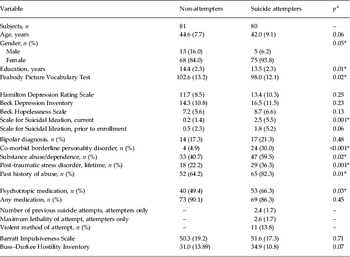
Samples were overwhelmingly female (88.8% of all participants), and both groups had a very high rate of reported past abuse (55.2% of overall samples reported physical abuse; 60.1% reported sexual abuse). However, past suicide attempters differed from non-attempters on a number of demographic and clinical measures (Table 1). The past attempter group had a larger proportion of females even though both groups were predominantly female. Past attempters had a year less education, lower overall estimated verbal intelligence, and higher levels of suicidal ideation. Both groups were mildly, but equivalently, depressed. Co-morbidities, however, were much more prevalent in past suicide attempters, including borderline personality disorder (BPD), past substance abuse, post-traumatic stress disorder (PTSD) and a history of past abuse.
Demographic and clinical rating data

Data are given as mean (standard deviation), unless otherwise indicated.
a For continuous variables, t test; for categorical variables, χ 2.
* p ⩽ 0.05.
Attempters were more likely to be on psychotropic medication (see Table 1; χ 2 1 = 4.69, p = 0.03). Percentage on antidepressants (42.5% v. 35.8%; χ 2 1 = 0.36, p = 0.38), benzodiazepines/hypnotics (10.0% v. 6.2%; χ 2 1 = 0.79, p = 0.37) or stimulants (0.0% v. 2.5%; χ 2 1 = 2.00, p = 0.16) did not differ significantly, but percentages on mood stabilizers or neuroleptics (13.8% v. 4.9%; χ 2 1 = 3.70, p = 0.05) did. Remaining medications included cardiac, antihypertensive or antihistamines (2.9% of sample), analgesic or other medications (12.9% of sample) and hormonal medications such as birth control (4.3% of sample).
Past attempters had higher hostility scores, but groups were equivalent in impulsiveness. Past attempters had made an average of just over two lifetime suicide attempts, with 56.8% (n = 46) reporting multiple attempts.
Neuropsychological performance: aggregate differences
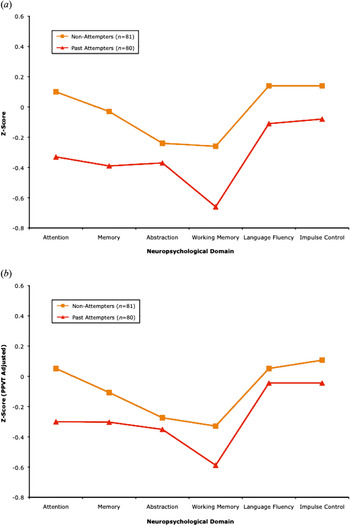
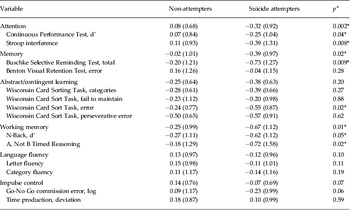
In the omnibus comparison across all six neuropsychological domains, there was a significant difference between past attempters and non-attempters (F 1,159 = 11.16, p = 0.001; see Fig. 1 a). The group × domain interaction was not significant (F 5,795 = 0.97, p = 0.43). At the level of individual domains (see Table 2), differences were found in attention, memory and working memory, with the difference in impulse control approaching significance (p < 0.10).
Neuropsychological performance in adults with a lifetime history of depression, with and without past suicidal behavior. (a) Z scores unadjusted for intelligence quotient (IQ) level. (b) Z scores adjusted for differences in Peabody Picture Vocabulary Test (PPVT) score (estimated IQ).

Neuropsychological measures

Data are given as mean Z score (standard deviation).
a t test for continuous variables.
* p ⩽ 0.05.
At the level of individual test scores (Table 2), poorer performance by past attempters was found on the CPT, Stroop interference, Buschke SRT, WCST error score, and the A, Not B Timed Reasoning Task. The difference in N-Back was marginal and the difference in Go-No Go approached significance. In all cases, past attempters performed more poorly than non-attempters.
Neuropsychological performance: covariates
The following covariates were tested for their potential effect on past attempter/non-attempter differences: PPVT score, gender, current suicidal ideation, history of BPD, history of substance abuse, history of PTSD, history of abuse, use of psychotropic medication, and research site (Pittsburgh versus New York). Age and education were not included because all test scores were adjusted for their effects prior to analyses. The only significant covariate was PPVT (F 1,134 = 41.85, p < 0.001) – and past attempt status remained significant even if all of these covariates were included in a single model (F 1,134 = 11.00, p = 0.001).
In the final trimmed model including PPVT as the only covariate, PPVT remained significant (F 1,158 = 58.12, p < 0.001), as did the attempter versus non-attempter effect (F 1,158 = 6.01, p = 0.015; see Fig. 1 b).
At the level of individual domains with PPVT as a covariate, however, only the difference in the attention domain remained significant (F 1,154 = 7.65, p = 0.006). Differences in the aggregate memory (F 1,158 = 1.91, p = 0.17), working memory (F 1,158 = 2.86, p = 0.09) and impulse control (F 1,158 = 1.75, p = 0.19) domains were non-significant. Differences in abstract/contingent learning (F 1,157 = 0.58, p = 0.45) and language fluency (F 1,157 = 0.50, p = 0.48) remained non-significant.
At the level of individual tests with PPVT as a covariate, Stroop interference (F 1,152 = 7.28, p = 0.008) remained significant. Although the aggregate memory domain did not differ with adjustment for PPVT score, the Buschke SRT score (F 1,149 = 3.88, p = 0.05), one that has repeatedly distinguished attempters in our previous studies, did. WCST error (F 1,158 = 3.39, p = 0.07) approached significance. CPT (F 1,153 = 2.60, p = 0.11) and A, Not B Timed Reasoning (F 1,157 = 2.52, p = 0.12) were now non-significant, with Go-No Go in the same range (F 1,158 = 2.02, p = 0.16). All other test score differences were non-significant.
Lethality and violence of past attempts
In this sample, there were no aggregate differences in neuropsychological performance between higher-lethality past attempters (lethality rating of worst attempt > 3; n = 54) and lower-lethality past attempters (lethality ⩽3; n = 26). Neither the main effect for lethality grouping (F 1,78 = 1.72, p = 0.19) nor the interaction with domain (F 5,390 = 1.97, p = 0.08) was significant (PPVT did not differ between the groups). Both had equivalent levels of depression severity (t 76 = 0.47, p = 0.64).
Similarly, there were no differences between the small subsample of those who used a violent method during their worst attempt (n = 11) and those who used non-violent means (n = 69). Violent means included cutting (n = 6), attempted hanging (n = 3), jumping from a height (n = 1) and attempted self-immolation (n = 1). Main effect for violence grouping (F 1,78 = 0.01, p = 0.94) and the interaction with domain (F 5,390 = 0.35, p = 0.88) were non-significant (again with no difference in PPVT). Violent and non-violent attempters in this sample were equivalent in depression severity (t 76 = 0.03, p = 0.98). Of note, violent attempters had significantly lower lethality for their worst attempts than non-violent attempters [1.5 (s.d. = 1.6) v. 2.8 (s.d. = 1.7), t 78 = 2.44, p = 0.02], lower than in our previous studies.
Remitted participants
There were 34 past suicide attempters and 36 non-attempters with a HAMD score < 10. Demographic and clinical differences were comparable with those in the total sample, with attempters having lower PPVT scores [99.4 (s.d. = 13.1) v. 108.2 (s.d. = 12.8), t 68 = 2.84, p = 0.006] and less education [13.6 (s.d. = 2.5) v. 15.2 (s.d. = 2.2) years, t 68 = 2.92, p = 0.005], and more likely to have BPD (23.5% v. 0.0%; χ 2 1 = 11.58, p = 0.003), past substance abuse (60.6% v. 38.9%; χ 2 1 = 3.25, p = 0.07), PTSD (26.5% v. 8.3%; χ 2 1 = 8.71, p = 0.01) and reported past history of physical or sexual abuse (85.3% v. 58.3%; χ 2 1 = 6.22, p = 0.01). In this subgroup, however, suicidal ideation was comparable in attempters and non-attempters and almost negligible [0.2 (s.d. = 1.2) v. 0.03 (s.d. = 0.17), t 68 = 0.88, p = 0.38], while impulsiveness (46.7 (s.d. = 16.0) v. 38.0 (s.d. = 13.8), t 52 = 2.09, p = 0.04] and hostility [31.7 (s.d. = 10.1) v. 23.4 (s.d. = 9.9), t 56 = 3.11, p = 0.003] were greater in attempters.
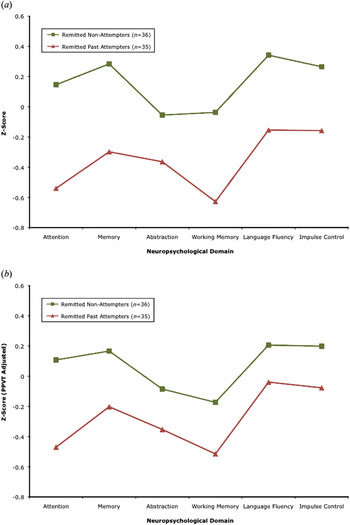
Neuropsychological domain scores in the remitted sample alone are presented in Fig. 2 a. Without covariates, attempter group differences were significant in all domains (attention: t 67 = 3.22, p = 0.002; memory: t 68 = 2.72, p = 0.008; abstract/contingent learning: t 68 = 2.53, p = 0.01; working memory: t 68 = 2.49, p = 0.02; language fluency: t 67 = 2.38, p = 0.02; impulse control: t 68 = 2.27, p = 0.03). On individual tests, attempters differed on CPT d’ (t 67 = 2.88, p = 0.005), Stroop interference (t 67 = 2.45, p = 0.02), Buschke SRT (t 66 = 2.69, p = 0.009), WCST error score (t 68 = 2.70, p = 0.009), A, Not B Timed Reasoning (t 68 = 2.60, p = 0.01) and letter fluency (t 67 = 2.50, p = 0.02).
Neuropsychological performance in adults with remitted depression (current Hamilton Depression Rating Scale score <10), with and without past suicidal behavior. (a) Z scores unadjusted for intelligence quotient (IQ) level. (b) Z scores adjusted for differences in Peabody Picture Vocabulary Test (PPVT) score (estimated IQ).

Covarying PPVT score, univariate differences were significant in the attention domain (F 1,66 = 7.44, p = 0.008) and abstract/contingent learning (F 1,67 = 3.85, p = 0.05), but non-significant in all other domains (Fig. 2 b). On individual tests, Stroop interference (F 1,66 = 6.18, p = 0.02) and WCST error score (F 1,67 = 4.97, p = 0.03) remained significant. Differences on the CPT (F 1,66 = 3.63, p = 0.06), Buschke SRT (F 1,65 = 3.76, p = 0.06) and A, Not B Timed Reasoning (F 1,67 = 3.07, p = 0.08) were marginal.
Discussion
Past suicide attempters in this sample of variably depressed subjects with previous episodes of major depression performed more poorly on many of the same tests that distinguished past attempters in our previous studies (Keilp et al. Reference Keilp, Sackeim, Brodsky, Oquendo, Malone and Mann2001, Reference Keilp, Gorlyn, Oquendo, Burke and Mann2008, Reference Keilp, Gorlyn, Russell, Oquendo, Burke, Harkavy-Friedman and Mann2013). Before adjustment for differences in estimated intelligence, these included measures of interference processing, memory and working memory, as well the efficiency of abstract/contingent learning. Even after adjustment for group differences in estimated intelligence, two core measures that have consistently distinguished past attempters in our earlier studies – Stroop interference and Buschke SRT recall – continued to differentiate past attempters here. This replication of our earlier findings in a sample with varying levels of depression severity confirms the importance of these measures as potential markers of suicide risk. Though the magnitude of differences is moderate, these neuropsychological characteristics provide a window into the type of cognitive impairment that may play a role in suicidal behavior. As we have noted in our previous work, the executive control of attention is a fundamental feature of both mindfulness-based therapies for suicidal behavior (Baer, Reference Baer2003; Bishop et al. Reference Bishop, Lau, Shapiro, Carlson, Anderson, Carmody, Segal, Abbey, Speca, Velting and Devins2004) and dialectical behavior therapy (Linehan & Dexter-Mazza, Reference Linehan, Dexter-Mazza and Barlow2008), each of which attempts to enhance the capacity to direct attention away from distressing feeling states. Memory impairments, in the form of over-general autobiographical recall have been linked to suicidal behavior as well (Sinclair et al. Reference Sinclair, Crane, Hawton and Williams2007; Arie et al. Reference Arie, Apter, Orbach, Yefet and Zalzman2008); our data suggest that poor initial learning may play a role in these recall deficits.
It is also noteworthy that the estimated intelligence of the samples in this study is close to population normative levels, and lower than in our previous studies where depressed patients as well as comparison subjects were nearly a standard deviation above normative levels (Keilp et al. Reference Keilp, Sackeim, Brodsky, Oquendo, Malone and Mann2001, Reference Keilp, Gorlyn, Oquendo, Burke and Mann2008, Reference Keilp, Gorlyn, Russell, Oquendo, Burke, Harkavy-Friedman and Mann2013). Thus, our earlier findings are not restricted to comparison groups of exceptional performers. Previous studies have found lower estimated IQs in groups at risk for suicidal behavior (Gunnell et al. Reference Gunnell, Magnusson and Rasmussen2005; Batty et al. Reference Batty, Whitley, Deary, Gale, Tynelius and Rasmussen2010; Sörberg et al. Reference Sörberg, Allebeck, Melin, Gunnell and Hemmingsson2013), similar to that in our unadjusted group comparisons. However, studies finding increased risk for suicidal behavior among those with lower IQs have primarily employed epidemiological methods in very large samples where it has been difficult to characterize other risk factors on an individual level. Thus, it is unclear if IQ itself, or life circumstances and other social pathologies that are related to lower IQ, are more important as risk factors (see Sörberg et al. Reference Sörberg, Allebeck, Melin, Gunnell and Hemmingsson2013). Controlling for intelligence suggests that there are more specific cognitive functions, ones that may covary with overall intelligence, that are more sensitive indicators of suicidal behavior risk.
Our findings with regard to interference processing and memory extended to the subsample of individuals whose depressive symptoms had largely remitted. These results can be compared directly with those of other studies of remitted subjects that have found impairments in decision making (see Jollant et al. Reference Jollant, Lawrence, Olié, Guillaume and Courtet2011). Our data suggest that there are more fundamental deficits in information processing – that may underlie other higher-order impairments – and these persist outside of depressive episodes. After covariation for PPVT in the remitted subsample, the difference in Stroop interference was significant and the difference in Buschke SRT recall was marginal (p = 0.06), though the effect size of these differences was comparable in both the full and remitted samples (for Stroop, effect size 0.50 in full sample, 0.63 in remitted; for Buschke SRT, effect size 0.42 in full sample, 0.57 in remitted). WCST error score had been marginal in the full sample, but was significantly different between attempters and non-attempters in the remitted subsample, contrary to at least one previous study suggesting that deficits are most likely state-dependent (Marzuk et al. Reference Marzuk, Hartwell, Leon and Portera2005). Of note, however, the WCST error score was the only subscore from the WCST that differed between groups. All others (categories, failure to maintain, perseverative error) were comparable, suggesting that the deficit observed on the WCST reflected an inefficiency of learning rather than a failure of abstraction or reasoning abilities.
High- and low-lethality attempters did not differ significantly in neuropsychological performance as they had in our earlier studies of individuals in a current depressive episode (Keilp et al. Reference Keilp, Sackeim, Brodsky, Oquendo, Malone and Mann2001, Reference Keilp, Gorlyn, Oquendo, Burke and Mann2008), although not our most recent study (Keilp et al. Reference Keilp, Gorlyn, Russell, Oquendo, Burke, Harkavy-Friedman and Mann2013). Mean neuropsychological performance levels tended to be poorer in high-lethality attempters (data available upon request), but these differences did not reach statistical significance in this mildly depressed sample.
Additionally, those who had used a violent method in their most serious attempt did not differ from those who used a non-violent method. While we and others (Jollant et al. Reference Jollant, Bellivier, Leboyer, Astruc, Torres, Verdier, Castelnau, Malafosse and Courtet2005; Keilp et al. Reference Keilp, Gorlyn, Russell, Oquendo, Burke, Harkavy-Friedman and Mann2013) had previously found differences in performance in violent attempters, the small size of the violent attempt sample here and the mild severity of their attempts (requiring only routine medical intervention) made finding any differences unlikely.
Overall, findings here suggest that deficits in interference processing and memory reflect a trait in past attempters. Although performance may be modulated to some degree by current clinical state, past attempters appear to perform consistently more poorly than non-attempters when both groups are in the same clinical state. The persistence of deficits in past attempters may also represent a degree of treatment resistance, at least in the cognitive realm. In the remitted sample, for example, non-attempters' performance falls approximately at normative levels (near a Z score of zero; see Fig. 2) while attempters' performance is at approximately the same level as attempters in the entire sample (Fig. 1). It is difficult to draw any definitive conclusions about the effects of clinical state without examining the same subjects at different points in treatment. Nonetheless, it is clear that relative deficits in past attempters persist outside of depressive episodes.
Limitations of this study include the variability in clinical state and treatment status of the sample. Though this study was designed as an evaluation of the robustness of our prior findings in a community sample reflecting out-patient clinical conditions and treatment practices, the variety of treatments and co-morbidities make it difficult to characterize all possible influences on neurocognitive performance. The clinical course of these participants is also unknown, such that some may be improving with/without treatment, some stable, and some worsening in ways that may have made an impact on their performance. Participants in this study were also predominantly female, and in the vast majority of cases had made their attempts by drug overdose. Data from a representative sample of male attempters as well as those using more violent methods are needed. Finally, our studies have excluded those with low estimated intelligence (below an estimated IQ of 80); neurocognitive risk factors for suicidal behavior in this group may differ from those in higher-IQ groups and remain to be examined.
In the future, follow-up studies are needed to track the course of the deficits observed here, as well as their relationship with other measures that have distinguished suicide attempters in other studies, such as the Iowa Gambling Task (Jollant et al. Reference Jollant, Lawrence, Olié, Guillaume and Courtet2011; Bridge et al. Reference Bridge, McBee-Strayer, Cannon, Sheftall, Reynolds, Campo, Pajer, Barbe and Brent2012) or reversal learning (Dombrovski et al. Reference Dombrovski, Clark, Siegle, Butters, Ichikawa, Sahakian and Szanto2010). Ideally, these studies might be undertaken in the context of a controlled clinical trial. Mechanistic studies of the role of these deficits in suicidal behavior are also needed, given that the role they play in risk for suicidal behavior remains to be explained. As noted in the Introduction above, the larger study of which this report is a part involved simultaneous evaluation of participants' offspring. In future analyses, we will be able to determine if the deficits observed here run in families, if they aggregate with other risk factors, and if they are markers of prospective risk in offspring.
Acknowledgements
This work was supported by grants from the National Institute of Mental Health (no. MH56612 MH56390 MH55123 MH66371 MH62185 and MH018951).
Declaration of Interest
None.