Introduction
It has been 62 years since the discovery of chromium polymerization catalysts, known as Phillips catalysts, which were used commercially only five years later. Chromium catalysts now account for some 40% of the world’s high density polyethylene production. Phillips catalysts have evolved significantly since those early days to the point where those early catalysts are hardly recognizable today. Although chromium catalysis is often described as “mature” in the industry literature, research in the field continues in an effort to introduce new applications and solve new problems.Reference McDaniel, Gates, Knoezinger and Jentoft 1 – Reference Monoi, Ikeda, Sasaki and Matsumoto 11 In fact, many changes have occurred to Phillips catalysts in the last decade, and in this article, some of the progress that has been recently made is described from an industrial perspective, and a list is provided of some of the current challenges facing the continued development of chromium catalysts.
Polymerization mechanism
Although hundreds of papers have been written about the mechanism of active site formation and polymerization on the Phillips catalyst, much of the process is still unclear. What makes the Phillips catalyst more difficult to understand than a Ziegler catalyst is the self-alkylation of the chromium. A Cr(VI) site is reduced by ethylene to an uncertain valence, becoming alkylated in the process, and leaving oxygenated ligands whose final disposition (perhaps desorption) is uncertain.Reference McDaniel, Gates, Knoezinger and Jentoft 1
Recent workReference Groppo, Lamberti, Bordiga, Spoto and Zecchina 12 – Reference Kissin and Brandolini 19 has provided new information, some of which is possibly inconsistentReference Schwerdtfeger, Buck and McDaniel 20 with the long accepted view of Cr(VI) being reduced to Cr(II) followed by the reversible desorption of formaldehyde.Reference McDaniel, Gates, Knoezinger and Jentoft 1 , Reference Baker and Carrick 21 , Reference Liu, Fang and Terano 22 The imagined process of adsorption and desorption of aldehydes on Cr(II) could not be duplicated. In fact, the possibility of reduction by alkanes was instead also raised in the industrial setting as another route to an active catalyst.Reference Schwerdtfeger, Buck and McDaniel 20 These new findings merely emphasize how hazy our understanding is of the process. Actually this issue is not unique to chromium oxide catalysts. Other examples include chromocene catalysts, diarene chromium (0) on acidic supports, titanium (II) oxide, bis-cyclooctatrienyl titanium and bis-cyclooctatrienyl zirconium on supports, Cr(C7H7)(C7H10) on supports, nickel oxide, and others.
Another new discovery—the addition of titania shutting down comonomer incorporation—is also seemingly mysterious (see the section on short-chain branching [SCB] later in the text), but with great commercial implications. Thus, the mechanism of polymerization will undoubtedly be an area of continued study.
Governmental regulations
In the United States and Europe, hexavalent Cr has been considered as potentially carcinogenic, and regulations have recently become increasingly severe (especially for Cr(VI) but for Cr in general). This applies to transportation of Cr(VI), disposal of Cr(VI), and especially to potential exposure of workers to Cr(VI). Where possible, the high density polyethylene (HDPE) industry has responded to the new regulations by implementing tighter engineering controls such that the catalyst is mostly contained in manufacturing operations. Unfortunately, the regulations have also discouraged the entry of new catalyst manufacturers such that currently only two companies make the basic Cr/silica catalysts.
This condition has fueled new research. For example, ascorbic acid (vitamin C) has been identified as a strong reducing agent for Cr(VI).Reference Xu, Li, Li and Gu 23 It is now widely used in manufacturing and research facilities to neutralize Cr(VI) spills and waste and as a general prophylactic for cleanup and possible personal decontamination.
Another recent answer to Cr(VI) regulation is to not add the chromium at the catalyst manufacturing facility, but rather in the polymerization plant. Most HDPE plants are built with an activator, that is, a vessel to calcine the Cr/silica catalyst. Recent findings indicate that the Cr(VI) is highly mobile during calcination, moving between one particle and another.Reference McDaniel, Collins and Benham 24 This process has now been used to add Cr to silica in an industrial setting. Although only two manufacturers of Cr/silica exist, dozens of silica manufacturers exist, from which the support may be purchased. This method of catalyst production eliminates transport of Cr/silica catalysts and reduces potential worker exposure to Cr (see the next section—Catalyst costs).
In still another answer to Cr(VI) regulation, recent research has confirmed that it is possible to prepare a highly active catalyst from Cr(III) that involves no conversion to Cr(VI).Reference Monoi, Yamamoto, Torigoe, Ishahara and Inazawa 25 , Reference McDaniel, Collins, Smith, Benham, Johnson, Eaton, Jensen, Martin and Hawley 26 The catalyst can be made inside the HDPE plant by purchasing only the support and the Cr(III) source. It produces a broad molecular weight (MW) distribution, while having extremely low elasticity (low long-chain branching—see later in the text). These polymers are unique and will likely have value in new applications that require short relaxation times.
Catalyst costs
Metallocene and Ziegler catalyst costs can be quite high in comparison to most Phillips catalysts because they involve methylaluminoxane (MAO) (see the Introductory article in this issue) or other costly materials or require multiple air-sensitive steps in their preparation. Nevertheless, research in the past decade has found ways to further reduce Cr catalyst costs. The chemistry of activation has been studied in detail.Reference McDaniel, Gates, Knoezinger and Jentoft 1 , Reference McDaniel, Collins, Benham and Cymbaluk 27 – Reference McDaniel, Collins, Benham and Cymbaluk 29 A model has been developed, along with new activation recipes aimed at enhancing plant output and catalyst quality (activity).Reference McDaniel, Collins, Benham and Cymbaluk 27
As described previously, chromium can be loaded onto a virgin support in the activator during calcination at the polyethylene (PE) manufacturing plant. Similarly, titania, fluoride, SiH4, and other components can also be added to make a tailored catalyst for a specific resin grade. For the most part, this requires minor, if any, modification of equipment. Silica, alumina, and other support manufacturers are abundant around the world, which helps maintain a competitive price. On-site catalyst preparation can also be used as a way of tailoring the catalyst to make new types of polymer. For example, adding Ti tends to broaden the MW distribution, whereas adding F tends to narrow it.Reference McDaniel, Gates, Knoezinger and Jentoft 1 , Reference McDaniel, Welch and Dreiling 30 – Reference Kallenbach 32 Molecular weight can be lowered by the use of R&R (reduction and reoxidation) activationReference McDaniel, Gates, Knoezinger and Jentoft 1 , Reference McDaniel and Welch 33 to the point where it competes with Ziegler-based injection molding resins. SiH4 can be added in small amounts to generate comonomer in situ when the catalyst contacts ethylene (see the section on short-chain branching later in text).Reference McDaniel, Gates, Knoezinger and Jentoft 1 , Reference McDaniel, Benham and Martin 34 , Reference Barzan, Groppo, Quadrelli, Monteilb and Bordiga 35
Acidity of the support
Recent work on single-site catalysts has demonstrated that solid acidic supports are capable of activating metallocenes (replacing MAO).Reference McDaniel, Jensen, Jayaratne, Collins, Benham, McDaniel, Das, Martin, Yang, Thorn, Masino, Severn and Chadwick 36 – Reference McDaniel, Collins, Johnson, Smith, Benham, Hawley, Wittner and Jensen 38 Indeed, this approach was commercialized in 2000. As part of this exploration, it was also discovered that these same acidic materials have a strong activating influence on chromium oxide catalysts as well. Consequently, many new supports have been developed that improve the activity of Cr catalysts or change the polymer properties.
One example of this is chromium impregnated onto alumina sulfate. The catalyst is quite active for ethylene polymerization, especially in the absence of a cocatalyst.Reference McDaniel, Gates, Knoezinger and Jentoft 1 , Reference McDaniel, Collins, Benham and Deslauriers 39 Surprisingly, this catalyst produced an extremely low degree of long-chain branching (LCB) in the polymer, and a very sharp (single-site) demarcation of the high MW tail. This type of polymer has not been produced before from other catalysts. It produced extremely low elasticity in the polymer melt, comparable to Ziegler-produced polymers at much lower MW. Therefore, these polymers mold easily without frozen stresses, but produce unusually tough articles.
A modification of this catalyst was recently used to produce the world’s first PE-100 pipe resin from a single catalyst in a single reactor.Reference DesLauriers, McDaniel, Rohlfing, Krishnaswamy, Secora, Benham, Maeger, Wolfe, Sukhadia and Beaulieu 40 , Reference Hernandez Vaquero, Segura, Hernandez Borjabad, Benham, McDaniel, Seltzer and Frontini 41 PE-100 is a classification of pipe indicating maximum burst resistance of any HDPE grade. To date, such polymers are otherwise only produced commercially by using two reactors or by blending two polymers. Thus, the use of one reactor and one catalyst is a major advancement.
Other new acidic supports that have produced unique polymers include silica-zirconia, silica-stania,Reference McDaniel and Collins 42 silica-sulfate,Reference McDaniel, Gates, Knoezinger and Jentoft 1 alumina-boria,Reference McDaniel and Collins 43 and others.Reference Chua, Stair and Wachs 44 , Reference Zecchina, Scarano, Bordiga and Spoto 45
Since these acidic supports activate both metallocenes and chromium, it is possible to produce hybrid catalysts consisting of two components on the same acidic oxide carrier, one a metallocene and another a chromium oxide or organochromium compound.Reference McDaniel, Collins, Benham, Eaton, Jensen, Martin, Hawley and Hsieh 46 , Reference McDaniel, Benham, Jensen, Collins, Martin and Hawley 47 Since chromium produces a broad MW distribution, with mid-MW LCB, it provides optimum molding behavior (die swell, extrusion output, melt fracture). In contrast, the metallocene component has a narrow MW distribution, and therefore is used to embellish the branching or MW of the overall polymer in a particular region. For example, the addition of high-MW branched PE from the metallocene component greatly increases the environmental stress crack resistance and creep resistance of the Cr-derived polymer. These hybrid catalysts may well be the direction of the future, providing the best of both the chromium and metallocene worlds.
Short-chain branch control
The best copolymer properties are usually produced when the branching (from the incorporation of 1-butene, 1-hexene, or 1-octene into polyethylene) is concentrated in the high MW part of the MW distribution. This happens because HDPE contains amorphous and crystalline regions. When the long chains contain branching, they are forced into the amorphous regions, where they can more effectively act as “tie chains,” holding the crystalline regions together against impact and other stresses. Unfortunately, Cr/silica catalysts (such as Ziegler catalysts) prefer to put branching into the low-MW region, where they contribute little to mechanical properties.
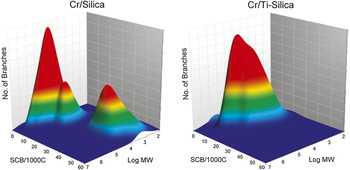
One of the results of recent research is a better understanding of why this happens.Reference DesLauriers and McDaniel 48 From this knowledge, it has been possible to more selectively locate branching where it will do the most good. For example, the addition of titania tends to produce a low-MW polymer, but that does not incorporate 1-hexene. Research suggests that this is because these sites may tend to terminate chains as soon as they incorporate 1-hexene. The end result is short chains containing little branching, with the branches situated at the end of the chain where they cannot disrupt crystallinity in the usual way. Titania has been used to increase polymer toughness, without understanding the mechanistic reasons behind this behavior. The new appreciation of the underlying cause now allows the effect to be more fully exploited. Figure 1 graphically shows the effect of titania on branch distribution.
Effect of titania on short-chain branch (SCB) distribution. Ti removes the undesirable “island” of branches at low molecular weight (MW) and high branch concentration. Note: SCB/1000C = short chain branches per 1000 carbons.Reference DesLauriers and McDaniel 48

Phosphate also produces this effect. This was one of the underlying reasons for the production of PE-100 pipe resin from a phosphated-sulfated Cr/alumina catalyst. Boron has a similar effect and has been recently used to produce another pipe resin known not only for its ease in molding, but also for its high burst resistance.Reference DesLauriers, McDaniel, Rohlfing, Krishnaswamy, Secora, Benham, Maeger, Wolfe, Sukhadia and Beaulieu 40
Still another type of branch control is the efficiency of 1-hexene incorporation (i.e., the amount of 1-hexene needed in the reactor to achieve a certain level in the polymer). High efficiency is desirable in plant operations for a number of reasons and is especially important for production of low density (<0.930 g/mL) polymers, often used in film or sheet form. Several modifications of Cr catalysts have been found to increase this efficiency by several fold.Reference McDaniel, Gates, Knoezinger and Jentoft 1
Long-chain branch control
Cr catalysts produce LCB, whereas Ziegler catalysts do not.Reference Hogan, Levett and Werkman 49 This accounts for the highly desirable extrusion molding characteristics of Cr-derived polymers, in contrast to Ziegler-derived polymers. Such characteristics include melt strength, melt sag, die swell, melt fracture, die pressure, and output. These characteristics explain why Ziegler-derived polymers cannot substitute for Cr-derived polymers in commercial applications. Until the last decade, this superior molding performance was not connected with the presence of LCB in Cr-derived polymers.
However, research during the past decade has allowed a new understanding of how catalyst and reaction variables control LCB. For example, active site concentration is extremely important.Reference McDaniel, Rohlfing and Benham 50 This fact shows up in the effect of activation temperature, co-catalysts, titania, Cr loading, and poisons. Many (perhaps most) metallocene catalysts have also recently been found to produce high levels of LCB. However, the molding performance of these polymers is very poor in comparison to Cr-derived polymers. It is now understood that this is because Cr catalysts concentrate LCB into the low-MW or mid-MW regions of the distribution, whereas single-site catalysts tend to put LCB into the high-MW region.Reference McDaniel, Gates, Knoezinger and Jentoft 1 , Reference Yu, Schwerdtfeger and McDaniel 51 The formation of LCB in the longest chains is expected from single site catalysts because the very act of incorporating LCB increases the MW.Reference McDaniel, Gates, Knoezinger and Jentoft 1 Thus, Phillips catalysts have a desirable tendency to put LCB where it is most needed.
This happens on Phillips catalysts because different sites tend to incorporate their own characteristic level of LCB. In theory, the SCB and LCB incorporation should parallel one another, between metallocenes, and between sites on a Phillips catalyst; but they do not. This new information, which will be very useful in the future, suggests that the mechanism of LCB formation is not random, but selective, both on metallocene catalysts and on Cr catalysts.Reference Yang, Jensen and McDaniel 52
Support morphology
Hogan reported that the porosity of the silica support could affect the MW of the polymer produced,Reference Hogan and Kitchen 53 and this relationship has since been exploited in several commercial catalysts.Reference Dietz 54 – Reference Hogan and Norwood 56 During the past decade, a more detailed exploration of this connection has been made in an effort to understand the underlying principles behind the observation.Reference McDaniel 57 – Reference McDaniel and Collins 59 The silica morphology was found to control not only the polymer MW, but also the catalyst activity, the MW distribution, and (surprisingly) the amount of LCB produced. In fact, no other variable seems to be as influential at governing LCB as the structure of the support.
It is now believed that all of these responses are driven by the underlying tensile strength of the support matrix. That the strength should determine catalyst activity is obvious, since the catalyst must disintegrate during polymerization. But the influence on MW, MW distribution, and LCB is less intuitive. The MW distribution was found to exhibit two components, whose relative amount varies with the support morphology: (1) a mid-MW main peak and (2) a high-MW shoulder. Thus, the new working theory holds that these two types of polymer are formed, one from the exterior of fragments, and the other being extruded from inside the porous fragments. Thus the latter is formed inside restricted, packed pores, which perhaps makes β-H elimination more difficult and increases the MW. Such crowded conditions may also encourage the retention of macromer coordinated near the site, generating higher LCB.Reference Yang, Jensen and McDaniel 52
The strength of the catalyst matrix determines the extent to which it breaks up during polymerization and therefore the size of the fragments. Large fragments result in lower activity because the interior of the fragments are mostly unavailable. But the pores probably contribute some polymer, at least to some limited depth. This is the high-MW, high-LCB component.
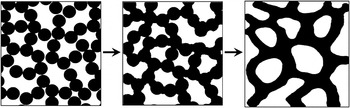
One can see from this picture, if correct, why simple correlations with pore volume, pore diameter, or surface area do not always work. It is the strength of the matrix that is important, which is related (but not identical) to these physical measurements. For example, one of the main factors found to control LCB is the degree of coalescence of the primary silica particles ( Figure 2 ). This type of reinforcement does not necessarily show up in porosimetry measurements, but it has a major effect on the polymer. There is also evidence that the size of the pore may determine the ease of egress of polymer chains, and thus perhaps the depth to which pores may participate.Reference McDaniel and Collins 58 , Reference McDaniel and Collins 59
Increased coalescence in the catalyst leads to rising long-chain branching in the polymer (typical diameter of silica particles is 3–10 nm).Reference McDaniel and Collins 58 , Reference McDaniel and Collins 59

These relationships have been observed for supported metallocene catalysts too. In fact, the principles have been used to design new supports to produce new resins of either highReference Yu, Schwerdtfeger and McDaniel 51 or low elasticity.Reference Shveima, McDaniel, Martin, Collins, Benham, Eaton and Sukhadia 60 The latter is particularly useful in PE film manufacture. For example, adding minor amounts of magnesia to dry silica causes etching and conversion of the structure, probably to small crystallites of MgSiO3, which raises (even doubles) the surface area and causes a major lowering of polymer elasticity. As another example, alumina produces much lower LCB than silica, probably because it has a different morphology even when compared at the same pore volume and surface area.Reference McDaniel 57
Homogeneous systems
The past decade has seen an explosion of research interest in metallacycle chemistry, especially pertaining to chromium. McGuinness has written an excellent review of this area.Reference McGuinness 61 In 2003, Chevron-Phillips started the first commercial plant in Qatar dedicated to the sole production of 1-hexene from the selective trimerization of ethylene. This technology was the result of a discovery in the 1980s that several chromium pyrrolide complexes were capable of 1-hexene production.Reference Reagen and Conroy 62 – Reference Reagen, Pettijohn and Freeman 65 Under certain conditions, the Phillips Cr/silica polymerization catalysts had long been known to produce 1-hexene along with high-MW polymer,Reference Benham, Smith and McDaniel 66 , Reference Benham, Smith, Hsieh and McDaniel 67 but this catalyst was found to make 1-hexene with no accompanying polymer.
Recent research by many authors, academic and industrial, has explored the mechanism of trimerization, which is thought to occur through a metallacycle, and a number of new catalytic complexes have been discovered that also display high activity and selectivity for ethylene trimerization.Reference McGuinness 61 , Reference Dixon, Green, Hess and Morgan 68 This includes other bi- and tridentate complexes of chromium, where the ligands provide N, S, O, or P coordination. Most interesting is the discoveryReference Bollmann, Blann, Dixon, Hess, Killian, Maumela, McGuinness, Morgan, Neveling, Otto, Overett, Slawin, Wasserscheid and Kuhlmann 69 , Reference Blann, Bollmann, Dixon, Neveling, Morgan, Maumela, Killian, Hess, Otto, Pepler, Mahomed and Overett 70 of catalysts that can also selectively tetramerize ethylene, or in some cases produce both 1-hexene and 1-octene.
The future
The high density polyethylene (HDPE) market, with its many diverse applications, is mostly dictated by the molding behavior of existing “legacy” polymers from Cr or Ziegler catalysts, because molding equipment is generally optimized for these earlier resins. Therefore, new polymer entries, however superior in properties, must exhibit similar processing performance to the earlier grades they are to replace. This sometimes makes it difficult to introduce improved polymers, and consequently there is a great deal of inertia in these markets.
The greatest future competition for chromium-derived PE could come from multi-metallocene combinations, that is, two or more single-site catalyst components on a single support in a single reactor. These new catalysts are just now appearing in industry, and the polymer properties obtained are spectacular.Reference Beaulieu 71 This is the result of being able to fully control, for the first time, where the branching goes. However, most of these new polymers must mimic the processing of older Cr-derived grades, which is difficult and enormously complicated. It often challenges our knowledge of both old and new catalysts. This is where much future catalyst research must focus.
One answer is to combine single-site compounds with traditional Cr-based catalysts or even with new Cr-based catalysts. This is currently being done, and the problems associated with their interactions are being successfully worked out.
Another possible answer is to develop new Cr catalysts by applying some of the lessons learned from metallocenes. For example, the acidity of the supports developed for metallocene activation has proven important for chromium as well, and these supports have already produced an exciting new generation of Cr-based catalysts.