In the early or mid-second century c.e., a Jewish proselyte named AquilaFootnote 1 translated the Hebrew Bible into Greek.Footnote 2 The translation survives today only in fragments, but both Jewish and Christian sources from Late Antiquity offer perspectives on and information about Aquila as well as citations of his translation. To fully understand the role his legacy played in Jewish and Christian communities requires careful analysis of each of the sources. I believe that prior scholarship, especially regarding ancient perspectives on Aquila and his translation, as well as the popularity of his translation in various communities, has drawn conclusions based on overall impressions of texts that may appear quite differently when examined closely and in context. My goal in the following pages is to develop a more nuanced understanding of the history of Aquila's Bible translation in Late Antiquity.
The Rabbinic Sources
The only ancient Jewish sources that mention Aquila or use his translation are rabbinic, dating from the early-third to fifth centuries, though of course, these sources do not represent the full extent of Late Antique Jews and Judaism in Palestine or elsewhere. I shall show that the rabbinic literature gives quite a different picture than the one that emerges from the early Christian writers' portrayals of the reception of Aquila's translation among the Jews. Since these two groups of texts have often been indiscriminately grouped together when discussing Aquila, it is worth reevaluating what each has to say on its own terms.
Before proceeding to the texts, a note on Aquila and Onkelos is in order. Owing in large part to A. E. Silverstone's 1931 study, Aquila and Onkelos,Footnote 3 scholars have long accepted the notion that Aquila is identical to Onkelos, a character mentioned numerous times in the Tosefta and to whom the Aramaic Bible translation is attributed in the Babylonian Talmud. However, there is no basis for this claim. As early as 1937, Leon Leibrich published a review of Silverstone's book that pointed to flaws in his logic, textual analysis, and assumptions, as well as to blatant inaccuracies in the work.Footnote 4 Based on Leibrich's review and other points that space does not permit me to delineate here, it is clear to me that Onkelos bears no relation to Aquila.
In addition to excluding from my discussion traditions about Onkelos, I have also chosen to focus only on classical rabbinic texts, that is, those produced before the sixth century.Footnote 5 This includes the Palestinian Talmud (henceforth, the Yerushalmi, redacted between the late-fourth and early-fifth centuries) and the classical midrashim: Genesis Rabbah, Leviticus Rabbah, and Eichah Rabbah (redacted circa the fifth century in Palestine).Footnote 6 There is no mention of Aquila in the Babylonian Talmud (redacted during the sixth century).Footnote 7 I exclude the later Palestinian texts because I am interested specifically in the centuries closest to the time of Aquila's life and in the first stages—not the later development—of his appearance in rabbinic literature. While rabbinic texts both before and after the sixth century contain sources that originate in the early rabbinic period, from the sixth century onwards rabbinic editors begin to rework their sources more thoroughly and more heavy-handedly than they had previously. Since the nature of the sources shifts in this way, I shall attempt to answer the questions at hand by sticking closely to the earlier corpora of rabbinic literature.
We can divide the rabbinic texts about Aquila into two groups: narratives about Aquila's activities, and reports of his translations of specific biblical words or phrases. These texts can answer two questions: 1) to what extent Aquila's translation was “popular” among the rabbis; and 2) what role Aquila himself is portrayed as having played within rabbinic society. The answers that will emerge from the rabbinic texts are: 1) Aquila's translation was popular insofar as he provided some helpful explanations of difficult biblical words or phrases; and 2) his role within rabbinic society is portrayed as having been ambiguous.
On the other hand, the rabbinic sources will not show that Aquila's translation came from rabbinic circles, or that the rabbis used it in general as a Bible version they appreciated and adopted as their own, or that Aquila's translation had any ideological significance for the rabbis. While a number of early Christian writers refer to Aquila's translation as the favorite of the Jews, the rabbinic sources suggest that the situation was much more nuanced. Moreover, although a number of Christian writers related to Aquila's translation on ideological grounds, Aquila's ideology was not at stake for the rabbis.
The Narrative Texts: Portrayals of Aquila's Place in Rabbinic Society
Genesis RabbahFootnote 870:5
Aquila the proselyte approached R. Eliezer. He (Aquila) said to him: Is this the entirety of a proselyte's gain: “[God] loves the proselyte,Footnote 9 providing him bread and raiment” (Deut 10:18)?
He (R. Eliezer) said: Is a matter about which the patriarch (Jacob) begged unimportant in your eyes? “And [if God] will give me bread to eat [and clothing to wear]” (Gen 28:20). And this one (i.e., the proselyte) comes and [God] hands it to him with a reed (i.e., simply pronouncing it the reward of the proselyte in Deut 10:18)!
He approached R. Joshua, who began comforting him with words: “Bread” refers to the Torah, as it is said, “Go and eat of my bread” (Prov 9:5); “clothing” refers to talit.Footnote 10 When a person obtains Torah, he obtains it for his children;Footnote 11 and further, that person's daughters may marry priests, and their children's children sacrifice burnt offerings upon the altar.Footnote 12
In this story, Aquila approaches two sages with a complaint about the rewards of conversion to Judaism. R. Eliezer responds harshly while R. Joshua responds reassuringly. For our purposes, two points are worth considering, both relating to the portrayal of Aquila's place within rabbinic society.
First, the text portrays Aquila as having had sufficient access to the sages—or at least to these sages—as to engage two prominent figures in conversation. However, we should not overstate this; it does not necessarily portray him as a disciple of these two sages, and even if it did, we should not assume this reflects an historical reality. Classical rabbinic texts portray many types of people as asking questions of rabbis, and we cannot assume a master-disciple relationship in every instance. Below we will discuss a text depicting the emperor Hadrian asking Aquila a question about Judaism, and we certainly would not therefore conclude that Hadrian was Aquila's disciple.Footnote 13
The second noteworthy point is that this story depicts Aquila expressing a measure of insecurity. He is disturbed that the only reward the Bible mentions for a proselyte is financial, and he is unimpressed. While the sages defend the status of proselytes, the story portrays Aquila as expressing concern about the implied worth (or lack thereof) of his status as a convert. Both sages hold that the rewards of conversion to Judaism are indeed great, but the text uses Aquila as a foil for the opposite position. The author's choice of Aquila for this role may reflect a perception that his place within the rabbinic fold was unclear, whether on the basis of being a convert or on some other unstated basis.
Thus this text, on the one hand, portrays Aquila as asking questions of the sages and expressing a yearning to be a valued member of Jewish society on the basis of rabbinic values. Indeed, he converses with prominent sages. On the other hand, we cannot say with confidence that the rabbis considered Aquila to have been a sage or disciple. In the following text, we find a similar ambiguity.
Yerushalmi Hagigah 2:1, 77aFootnote 14
R. Yudah bar Pazi [said] in the name of R. Yosse son of R. Yudah: Hadrian asked Aquila the proselyte:
Is it true that you (plural)Footnote 15 say that the world is sustained by wind?
He said to him: Yes.
He (Hadrian) said to him: Based on what do you say this?
He (Aquila) said to him: Bring me camels.
He brought him camels.
He (Aquila) loaded the camels with burdens, stood them up and made them kneel, took them and strangled them. He (Aquila) said to him (Hadrian): Here you go; stand them up.
He (Hadrian) said to him: After you strangled them?!
He said to him: I have taken nothing from them; is it not (merely) wind that I took from them?Footnote 16
The first thing to noteFootnote 17 is that there are numerous similar stories in rabbinic literature, involving prominent Greeks, Romans, and Persians (including emperors) conversing or interacting with rabbis.Footnote 18 Hadrian himself appears in the classical midrashim asking R. Joshua b. Hananiah—the same R. Joshua with whom Aquila is associated—similar questions to the one posed to Aquila.Footnote 19 Therefore, there is little about Aquila specifically, or the rabbinic perception of Aquila, that we can derive from this story.
What we can conclude is that Aquila is portrayed as an insider among the Jews; if there is an “us” and “them” relationship between Jews and Romans, the text portrays Aquila squarely on the Jewish side (“Is it true that you (plural) say …”). But again, we should not overstate the matter; not only do important sages like R. Joshua converse with non-Jews, but sometimes a person who specifically lacks prominence is chosen to speak with an emperor.Footnote 20 Therefore, as above, we see that while Aquila is remembered as a Jew, there is no indication that he is a prominent figure or a learned disciple of any sort. This remains a possibility, of course, but there is no evidence for that conclusion from the narratives involving Aquila that we have seen.
Yerushalmi Megillah 1:8, 71a–b
The next narrative text is the one most commonly cited in the scholarly literature about Aquila, as it refers explicitly to his translation of the Bible.
It is taught (in the Mishnah): Rabban Shimon ben Gamliel says: Scripture was only permitted to be written in Greek (or Hebrew).
They investigated and found that the Torah is able to be sufficiently translated only into Greek.
A barbarian (or watchman) “took out” for them the Latin from the Greek.Footnote 21
(Said) R. Yirmiyah (early-fourth century) in the name of R. Hiyya bar Ba
(late-third century): Aquila the proselyte translated the TorahFootnote 22 before R. Eliezer and R. Joshua, and they praised him, saying to him “You are fairerFootnote 23 than the children of men” (Ps 45:3).Footnote 24
Scholars have drawn various conclusions from this text about Aquila's relationship to these two sages, about his translation's general acceptance or popularity within the Jewish community at large, and about these two sages' perspectives on his translation. I believe, however, that close attention to the particular wording of this passage in the context of similar usages throughout rabbinic literature can offer a more nuanced understanding of this text and its implications. First, however, in response to previous scholarship, I will point out what the text does not say:
1) The text does not indicate that Aquila composed his translation under the auspices of any sage.Footnote 25
2) The text does not indicate any wider rabbinic approbation of Aquila's translation than that of R. Eliezer and R. Joshua.Footnote 26
3) The text does not indicate that any written text was physically presented to the sages,Footnote 27 much less adopted as a synagogal Targum.
4) The text does not indicate at what stage in Aquila's life this interaction occurred.
I turn now to what this text does indicate, beginning with R. Hiyya bar Ba's opening word:  . Our understanding of this verb colors the entire picture of this interaction.Footnote 28 First of all, it refers to speech: Aquila verbally translated Scripture before these two sages.Footnote 29 This verb is never used in rabbinic literature to denote studying (whether Scripture in general or Targum); almost everywhere else it is used in the Yerushalmi it is followed by a quotation.Footnote 30 Thus, stands in only for words like (said)Footnote 31 or (expounded),Footnote 32 and not (sat) or (studied).Footnote 33
While there are instances of this verb denoting the synagogal practice of Targum (the interlinear recitation of an Aramaic translation during the weekly public reading of the Torah),Footnote 34 it is also clear that translations of individual words or verses sometimes served a midrashic, scholarly function entirely separate from their liturgical functions.Footnote 35 I do not believe there is sufficient evidence to deduce in which sphere these translations originated—that of liturgy or scholarship—but there is ample evidence that they were used in both.
Biblical translations may have been useful in rabbinic scholarly circles in a variety of ways. A frequently cited Tannaitic midrash states: “Scripture leads to targum, targum leads to mishnah (the legal teachings), mishnah leads to talmud (argumentation).”Footnote 36 There are plenty of examples of either the entirety of a midrashic comment consisting of no more than a translation, or of a translation being embedded within a midrashic discussion, among other types of midrashic techniques. That is to say, not only could a translation as an extended composition be useful for Jews (whether in the academy or the synagogue), but the translations of individual words and phrases embedded within it—atomistically, separate from the composition as a whole—could be useful pieces of midrash.Footnote 37 Rabbinic citations of Aquila's translations (below) will serve as clear examples of this sort of atomistic translation functioning as midrash.
A further indication that Aquila's recitation of his translation fit into the normal routine of rabbinic activity is the phrasing of the sages' response. In the Yerushalmi, there are numerous instances of one sage offering a praiseworthy interpretation (legalFootnote 38 or otherwiseFootnote 39) or behaving in a proper way (such as reciting one or the other of a disputed formula for a certain blessing),Footnote 40 and a teacher responding just as R. Eliezer and R. Joshua do here—by praising the person (using the same verb as is used here: ),Footnote 41 and often expressing that praise with a biblical verse appropriate to the situation.Footnote 42 Thus, Aquila's recitation of his biblical translation was received by the sages to whom he presented it just as any clever, proper, or insightful point offered by a sage or student might similarly be received.
In contrast to the previous two narratives concerning Aquila, here he occupies an unambiguous position within the normal rabbinic social structure. Thus the perspective on Aquila expressed in this text is somewhat different from that of the other two. It seems that the sages related to Aquila as a person slightly differently from how they related to him as a Bible translator. In the two stories about Aquila that have nothing to do with his identity as a translator, his role is ambiguous. But when discussing Aquila as a Bible translator, there is no ambiguity about his value and his welcome place within the rabbinic fold. This phenomenon may be explained by noting that since the sages used Aquila's translation for their midrashim (see the citations below), they needed to portray the translation's entrance into their purview in terms of a familiar rabbinic context.
In addition, several other Palestinian rabbinic passages feature a scholar translating a biblical phrase before () a teacher, as in our case.Footnote 43 It should be noted in this context that speaking, expounding, or asking a question before a given sage does not indicate that this sage is one's primary teacher, though we can assume the perception of some relationship (whatever its precise nature) between Aquila and R. Eliezer and R. Joshua since they appear together in more than one text. In another place in the Yerushalmi, Aquila is recorded as having translated a particular verse before R. Akiva.Footnote 44 No source indicates that Aquila was either the principal student of these sages, or that they were his principal teachers. The rabbis portray him in contact with them, but this may simply be because they were three of the most prominent sages of their day. Jerome mentions two centuries later that Aquila was a student of R. Akiva,Footnote 45 but again this tradition may have developed since R. Akiva was such a prominent sage. Alternatively, this may reflect Jerome's perception that he was a full-fledged disciple of the sages, but as we have seen, this is not expressed unequivocally in rabbinic texts.
The description of Aquila translating before certain sages shows that he is perceived to have afforded them respect and shared his knowledge with them, but this may be true even of one who is not himself a sage. Thus, from this text, like the above two narratives, while Aquila is most certainly depicted in a rabbinic context, there is no clear depiction of him as a sage or as a disciple. He is present in rabbinic circles, but overstated conclusions should be avoided.
I turn now to the question of the acceptance of, or enthusiasm for, Aquila's translation among sages other than the two who are mentioned in our passage. The rabbinic authors and editors were quite able to express general consensus among sages (at least of a certain time and place) with the term (sages), whose collective positions are often opposed in rabbinic texts to minority positions, and with expressions such as (the sages assented to him). Here, we have no such expression of general agreement; only these two rabbis are mentioned. Moreover, in numerous cases of individual sages “praising” () a person for their insight or behavior, that insight or behavior accords specifically with one—of at least two—extant possible traditions.Footnote 46 In our case, I would not suggest that R. Eliezer and R. Joshua necessarily reflect a minority opinion in appreciating the translation, but it is clear that it does not imply anything beyond the opinion of these two sages.Footnote 47
Furthermore, we cannot draw any conclusions about the point in Aquila's life or career at which his translation before the sages occurred. The verb , as I noted, does not mean to compose a translation; Aquila recited something already composed (since we assume he did not compose it on the spot).Footnote 48 Therefore, it is plausible, for instance, that he composed the translation ten or twenty years prior and enjoyed considerable popularity (or the opposite) in synagogues in, say, Asia Minor, and only then approached the rabbis. It is equally possible that he first offered his translation to the rabbis, and only then branched out to other communities of Jews or to the synagogues. The point is simply that some questions regarding the origin of Aquila's translation are not answerable based on the rabbinic evidence, and this evidence should not be used for historical reconstruction of Aquila's career.
To summarize my conclusions about this group of texts, in each story Aquila is depicted as a Jew somewhat integrated into rabbinic society, but only in his role as Bible translator is he depicted as fully within the fold. Still, in none of these texts do we find a clear depiction of Aquila as a sage or disciple of the sages; indeed we need not assume that everyone who interacted with Palestinian rabbis was himself a rabbi.Footnote 49 Aquila is present in rabbinic circles, but his role is ambiguous.
Citations of Aquila in Rabbinic Literature
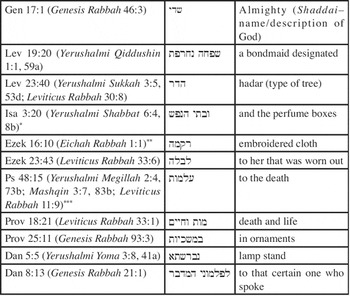
Giuseppe VeltriFootnote 50 has already provided translations and explanations (particularly valuable due to his analysis of the Rabbis' transliterated Greek) of each of the citations of Aquila in rabbinic literature, so I shall not reproduce all the texts here. What I shall add to Veltri's analysis is specific attention to the context of the citations, and a closer analysis of what the citations (in form and content) can tell us about the role Aquila's translation played within Palestinian rabbinic circles of Late Antiquity.
Aquila is citedFootnote 51 eleven timesFootnote 52 in the Yerushalmi and the Palestinian amoraic midrashic collections (Genesis Rabbah, Leviticus Rabbah, and Lamentations Rabbah).Footnote 53 Veltri provides translations for the following verses and words (given here in Hebrew with English translation from the Koren edition of The Holy Scriptures):Footnote 54

* And see Louis Ginzberg, Seride ha-Yerushalmi min ha-genizah asher be-Mitsrayim (New York: Jewish Theological Seminary, 1909) 80.
** Veltri, Libraries, Translations, and “Canonic” Texts, 179–80, cites the parallel in Song of Songs Rabbah.
*** Veltri does not note the parallel in Leviticus Rabbah, which happens to provide a better transcription of the Greek.
Two of the translations (Lev 19:20 and Dan 8:13) are recorded, however, only in Hebrew,Footnote 55 and several are followed by HebrewFootnote 56 or AramaicFootnote 57 explanations of the Greek. A few of the rabbinic citationsFootnote 58 contradict the Greek witnesses to Aquila (others have no parallel in the extant fragments). These points can help us evaluate the source or sources from which the rabbis drew in citing Aquila.
If the rabbis had written copies of Aquila's translation to consult, one would expect that their citations would come closer to those of our extant texts,Footnote 59 and that the original Greek would not be omitted, even if it had to be re-translated. This observation, in conjunction with the more important fact that the word introducing all of the citations——specifically denotes oral translation, should lead us to rule out the rabbis possessing a written text of the translation.
Did the rabbis then possess an orally transmitted version of Aquila's translation? Or did they simply retain atomistic translations of difficult texts? I am inclined towards the latter view since, apart from the narrative discussed above, the rabbis never refer to the composition as a whole. But at present there is simply not enough evidence in this case to ascertain what the rabbis preserved, beyond what they actually report. The narrative tradition cited above reflects an awareness that Aquila did not merely provide ad hoc translations, but it is the only source for such an awareness. Indeed, that tradition may have been embellished to make a point about the value of Greek translations in general, since the topic under discussion there is the translation of the entire Torah.
As I noted in passing, citations of Aquila's translation are always introduced with the phrase (Aquila translated). In contrast, many other translations of words are recorded anonymously in rabbinic literature, often simply into Aramaic. Why do Aquila's translations of a select few words merit rabbinic repetition in Greek and citation of his name? This question is particularly apparent upon reading Yerushalmi Shabbat 6:4, 8b. This passage provides word-by-word translations, mainly into Aramaic (although three times the translations are into Hebrew, and sometimes the translations are accompanied by a helpful related verse), first of Numbers 31:5 and then of Isaiah 3:18–23. In the midst of this word-by-word translation, we come across Aquila's translation of the phrase in Isaiah 3:20, introduced as always with (Aquila translated). The passage as a whole begins with an attribution to a sage, though it is not clear whether the intention is Rav Yehudah (the Babylonian sage, third century) or R. Yohanan (the Palestinian sage, third century),Footnote 60 and only for this one phrase (out of twenty-six words and phrases translated) is the origin of the translation, here Aquila, cited.Footnote 61 Was this the only phrase in these verses for which they knew Aquila's translation, or was it the only phrase for which they were interested in it, and if so why?
These are only some of the many questions suggested by such a passage, but unfortunately answers are scarce. In any case, it is more fruitful to inquire into how the rabbis made use of whatever they did know, and into how they portray the figure of Aquila. From this example we learn that while Aquila's translations are uniquely stamped with the label , they otherwise fall right into place as standard points of interest for the rabbis. One of the things rabbinic texts do is provide translations of difficult biblical words, phrases, and verses.
The fact that each and every one of the attributed citations of Aquila begins (Aquila translated) can help us understand the role the rabbis perceived him to have played in their world. Aquila is always introduced this way even when the citation appears beside a rabbi's Aramaic translation introduced merely by “Rabbi so-and-so said.”Footnote 62 The introduction, “so-and-so translated” to a translation-interpretation is used in rabbinic literature many times, but Aquila is unique in that his translations are never introduced by a different verb (, , etc.), and in that these translations are his only contribution to rabbinic literature. Aquila only translates.
This fact is difficult to interpret. It is possible either that this reflects a second-class status afforded him, or that it reflects a special respect shown to him as a professional; it is possible either that the rabbis knew that he was a professional biblical translator, or that all they knew was that he never happened to say anything besides translations or explanations of individual verses or words. This observation, when considered in conjunction with the narrative texts, suggests that while he is perceived as being integrated into rabbinic society in some way, his primary value lies in his distinct capacity as a Bible translator.
Thus despite not being himself a sage, the traditions recorded in Aquila's name are unambiguously valuable midrashic comments, recorded as on par with other rabbinic exegeses of the Bible. I shall now emphasize this point with a few examples which also generally illuminate the rabbinic usage of Aquila's translations.
In y. Qid. 1:1, 59a, Aquila's translation of Leviticus 19:20 is incorporated by R. Yohanan into a halakhic discussion about the “designated maidservant” and the annulment of her marriage. R. Samuel son of R. Isaac asks a question, and the Talmud then includes two alternative possibilities, each based on a statement of R. Yohanan. The Talmud then buttresses the second possibility with a further statement of R. Yohanan, namely his citation of Aquila's translation—in HebrewFootnote 63—of Lev 19:20. This is followed immediately by yet another statement, again in the name of R. Yohanan: (Similarly R. Lazar son of R. Shimon explained it before the Sages), followed by the exact same translation and explanation as R. Yohanan had cited in the name of Aquila.Footnote 64
Thus, the exact same statement is introduced first as “Aquila translated,” and then “R. Lazar son of R. Shimon explained.” But it is Aquila's translation that is cited first and solves the halakhic question posed by R. Samuel at the beginning of the pericope; the sage's explanation buttresses Aquila's translation, not the other way around. Thus, while R. Yohanan appears aware that Aquila's role was as translator, the editor of this talmudic pericope understood these translations as exegeses with legal force like the statement of any sage.
The Talmud uses Aquila's translation uniquely in Yerushalmi Yoma 3:8, 41a. Here the question under discussion is how to interpret a Hebrew word used in the Mishnah: Helene, the mother of Munbaz of the royal family of Adiabene who converted to Judaism in the first century c.e., is reported by the Mishnah to have donated a golden (nivreshet) to the temple. The Talmud first mentions the Aramaic translations of two unnamed sages, grouping them together with the introduction (Two amoraim. One said … and the other said …). Next the Talmud cites Aquila's translation of Daniel 5:5— (nivrashta)—which is taken to be the Aramaic of the Mishnah's (nivreshet). Presumably, (nivrashta) was a difficult or uncommon enough Aramaic word that the two amoraim cited did not bother to mention it, since it would clarify nothing (or alternatively it simply did not occur to them). However, Aquila's translation of this biblical Aramaic word could illuminate its cognate Hebrew word in the Mishnah.
Here we see that Aquila's Bible translation is utilized as a dictionary of sorts that can help explain the Mishnah. Aquila's role is ambiguous. He himself does not explain the Mishnah; he does not even address the particular word in the Mishnah under discussion. But his translation can shed light on the interpretation of the Mishnah, which is one of the central projects of the Talmud. Aquila's role can perhaps best be described here as a resource for the rabbis (although how comprehensive a resource, again, is not clear). Thus, Aquila himself stands outside this discussion of the Mishnah, having never commented on the Mishnah directly, but his translation of Daniel fits smoothly into the discussion. Once again, Aquila himself is not fully integrated into the social picture that the pericope reflects, but his translations are fully absorbed into the rabbinic discussion.
Most of the other references to Aquila's translation function as midrashic explanations of the Bible, as in Yerushalmi Shabbat (discussed above); and were we to find “Rabbi so-and-so said,” instead of “Aquila translated,” we would find nothing out of the ordinary in these passages. However, in one case, Leviticus Rabbah 11:9 and its two parallels in the Yerushalmi, we observe something more.
In this example, if one were to remove Aquila's actual translation, leaving only the explanation that follows it, we would still have a perfectly coherent midrash. The biblical word in question is (‘ almut). Amidst several anonymous translations, each based on a proposed connection to a different Hebrew stem (, , ), we read, ,Footnote 65 (Aquila translated: ἀθανασία [immortality], a world in which there is no death). Aquila's rendering indicates that he interpreted (or used a text that interpreted) (' almut) as two words: (above death) or (against death).Footnote 66 But we did not need to know the Greek word for immortality in order to arrive at such an interpretation; Aquila's translation adds nothing.Footnote 67 Why did the text not provide just another anonymous interpretation of this enigmatic word as (a world in which there is no death)?
We are familiar with the rabbinic preference for citing one's sources,Footnote 68 and can see on any page of a given rabbinic text their interest in precise attribution when it comes to each generation's rabbinic (or proto-rabbinic) forebears. But why should Aquila fall into the category of a source that one must cite? Why would the sages not simply take what they learn from Aquila's translation and convert it into their own midrashim, leaving Aquila's translation, which is merely the linguistic trigger, unmentioned? This example shows that the rabbis considered Aquila more important than mere background information. He was a bona fide source of knowledge and deserved to be cited as such.
Conclusions Based on the Rabbinic Texts
We have seen that the rabbis depict Aquila's identity ambiguously. On the one hand, both the narrative accounts and the citations of his translation indicate that in some respects he was perceived as an insider in rabbinic culture and valued in his lifetime by at least two or three sages with whom he interacted. Furthermore, rabbinic scholarship appears to have used his translations for generations. On the other hand, we have also seen indications (again, in both sets of sources) that he is set apart from the sages, marked as a translator and only a translator.
In addition, we have seen the sort of interest that the rabbis, both as individuals (albeit represented only by a few) and as editors and compilers of the various Palestinian rabbinic corpora, took in Aquila's translation. However, there is not enough evidence to determine whether the rabbis knew his translation as a complete work, or whether they knew only atomistic translations of select words or verses. But what they cite—and the fact that they cite it—reflects an appreciation of the explanatory and interpretive value of these translations.
In summary, we have seen that it is far too simplistic to view the rabbis as having unequivocally embraced Aquila, to assume he was one of their own, or to suppose that the translation came from or was influenced by rabbinic circles. Aquila had his place, but his role was limited, and the texts do not portray his integration into rabbinic society as having been seamless. His translation was useful to the rabbis, but only insofar as it helped with difficult words. We must keep in mind this limited view from the Jewish sources when we see how the patristic authors portray the Jews' acceptance of Aquila.
The Patristic Sources on Aquila's Popularity among Jews
The patristic sources that portray the Jews' acceptance of Aquila are potentially useful since they mention aspects of Aquila's place within Jewish society on which the rabbinic sources shed only limited light. The rabbinic sources we have seen reflect only a slice of Palestinian Jewish society, whereas the patristic sources derive from a wider range of places and communities. However, these texts need to be approached carefully and critically. A number of sources that on the surface would seem to communicate a great deal about Jewish interest in Aquila's translation on closer consideration are less clear or less reliable than we might have assumed.
One problem in navigating the patristic sources (specifically on the topic of Aquila's translation among the Jews, but also on the topic of Aquila's translation in general, as discussed below) is that they mention the translation as though it were a single volume, bound and portable like a modern book. This was simply not the case. Not only was the material reality different from books of today, but the very idea of the Bible as a circumscribed body of literature was not yet fully formed for Christians. The material nature of the Bible and the concept of biblical literature perforce influenced the way early Christians in particular thought about and used the Bible and, by extension, translations of the Bible.Footnote 69 Robert A. Kraft has recently stated:
We do an injustice to the Jewish and Christian heritage if we import our concept of “Bible,” with its fixed and exclusive canon, back into the period when the respected literatures known as “scriptures” were transmitted piecemeal, on scrolls or mini-codices, and held together, if so desired, through lists or physical collections or conceptual abstractions which often were more open ended (or less closely defined) than became possible and actual with the development of the mega-codex in the 4th century c.e.Footnote 70
Along similar lines, copies of one and the same “book” varied from manuscript to manuscript. Therefore, especially given that only fragments of Aquila's translation survive, it is not clear to what extent the various references to it, as to versions of the Septuagint, reflect a stable text.Footnote 71 Furthermore, it is not clear to what extent Christian authors were aware of this problem.Footnote 72
There is at present no scholarly consensus on how to resolve these problems, nor of terminology that avoids all confusion. I raise these issues for two reasons. First, knowing the limitations of understanding the evidence of the patristic sources allows us to focus more closely on questions that we can answer. Second, I present these questions as potential directions for further scholarship. For now, I will adopt simple terminologies such as “Bible” and “Septuagint,” although this should not be understood as reflecting the actual material state of these books in antiquity.
There are a few sources commonly cited in the literature as Christian evidence of the popularity of Aquila's translation among Jews. The one remark that I believe can be made generally is that for a few early Church Fathers representing a variety of locales, Aquila's translation is associated in some way with the Jews. For all that my readings below may be minimalist, the point must be made that even when Aquila figured into Christian writings in purely Christian contexts (i.e., contexts in which neither Judaism nor particular Jews are mentioned), Aquila is known—and moreover mentioned—as an important figure, or text, to Jews as well. Yet it is hard to know exactly what to make of each piece of evidence, and I now turn to the task of uncovering some of their subtleties.
Origen (185–254 c.e.)
In Origen's letter to Africanus (c. 240 c.e.)Footnote 73 he says the following about Aquila, in the context of a reading of Aquila that accords with the Hebrew against the Septuagint:
For so Aquila, a slave to the Hebrew language,Footnote 74 gives it, who has obtained the credit among the Jews of having translated (ἠρμηνευκέναι) the Scriptures with no ordinary care, and whose version is most commonly used by those who do not know Hebrew, as the one which has been most successful.Footnote 75
This testimony is of considerable importance, even as some scholars have taken its implications too far. Origen indicates three things. First, that Jews in the third century respect Aquila for his efforts. Second, that Aquila's translation is used by those who would otherwise have used the original, but did not know Hebrew. Third, that Aquila's translation is regarded by those people as comparatively more successful than the other extant Greek translations.
However, it is not clear which Jews respect Aquila. If Origen is referring to the rabbis, then the evidence of rabbinic literature confirms this, as we have seen. But if he is referring rather, or in addition, to a wider Greek-speaking Jewish community, then we lack corroborating evidence of this claim.
As for the second point, Origen is certainly not referring to the rabbinic Jewish community when he references those who do not use the Hebrew text because they do not know Hebrew. Where Swete concluded from this line that Aquila's translation was “used by all Jews who did not understand Hebrew,”Footnote 76 Veltri comments, “Origen is without doubt speaking not only about Jews ignorant of Hebrew, but also (perhaps especially?) of Christian writers like himself who use Aquila as a dictionary of the Hebrew language.”Footnote 77 My only disagreement with Veltri is the phrase “without doubt.” It is possible that Origen means only Jews, in keeping with the start of his description.Footnote 78 On the other hand, it is also possible that he is now talking about non-Jews; after all, throughout this letter he mentions Jews as those who use the Hebrew text of the Bible, even if the Bible is the extent of their Hebrew knowledge. And of course, as Veltri assumes, it is also possible that he means to include both categories. If Origen is referring at least in part to Jews, this broadens Aquila's place in Jewish society from the learned, Hebrew-speaking rabbinic community to the broader, Greek-speaking Jewish community. But again, it is impossible to know to whom he is referring.
Furthermore, we do not know in what contexts Aquila's translation was “used.” Veltri assumes an academic context (as a dictionary), while other scholars have cited this passage as evidence of synagogue use. In fact, Origen's comment is firm evidence of neither. If he means synagogue use, once again, this broadens the scope of Jewish interest in Aquila from what we knew from the rabbinic texts.
My point is simply that Origen's testimony is vague, so many of our conclusions must be tentative. What we can conclude with certainty is that according to Origen, Aquila's translation was in circulation and use (“commonly,” to use Origen's word) in mid-third-century Palestine, and that Aquila's translation was known and respected among some Jews.
Augustine (354–430 c.e.)
Augustine makes the following comment in The City of God 15.23 amidst a discussion of the nature of angels:
In the Septuagint too they are called both angels of God and sons of God. This reading, to be sure, is not attested in all the manuscripts, for some have only “sons of God.” Aquila, on the other hand, whom the Jews prefer to the other translators, says in his version neither angels of God nor sons of God but sons of gods. But either expression is right.Footnote 79
This comment possibly constitutes early-fifth-century testimony of a Jewish preference for Aquila. However, scholars disagree about whether Augustine had actual contact with Jews,Footnote 80 so his testimony cannot necessarily be relied upon to reflect a contemporary reality. The above passage may simply reflect a tradition that Augustine had heard from predecessors like Africanus, and even if it does reflect a contemporary perspective, the question remains as to what extent Jews used translations in the first place. His wording is comparative, stating only the Jews' relative appreciation of Aquila.
But in noting this comparative phrasing, we may attempt to resolve another question. Augustine's wording (whether based on his own observations or based on the testimony of his predecessors) indicates that at least some Jews knew of other translations, and chose (or chose to stick with) Aquila's. It is tempting to conclude the same from Origen's comment that Aquila has been the most successful “of all the others”—again, stated comparatively. But it is worth hesitating since, as has already been shown, it is not clear that Origen was speaking about Jews in that part of the sentence, and since we do not have any evidence of this from the rabbis.
Justinian (482/3–565 c.e.)
Although I did not venture into sixth-century rabbinic sources, since as I noted at the outset the nature of rabbinic texts shifts dramatically at that time, I will include in this study a Christian Roman legal passage dated to 553 c.e.,Novella Justiniani 146,Footnote 81 since it is often cited in literature about Aquila, in my opinion inappropriately. This law published by Justinian deals with the question of what version of Scripture the Jews may use in synagogue or “in general, any place where there are Hebrews.”Footnote 82 Justinian writes that he is responding to a Jewish petition to resolve a dispute among Jews about admitting Greek as an acceptable language in which to read Scripture. We do not know who submitted this petition, which side of the argument they were on, and how many others they represented.Footnote 83 In fact, Leonard Rutgers has recently argued that the petition was a fabrication by Justinian, and that the emperor himself brought up the issue in an effort to eliminate Hebrew from synagogues, for reasons having nothing to do with internal Jewish affairs.Footnote 84 It is also important to note that the question, if it really existed and from whomever it comes, does not mention any translation specifically.
Justinian answers that Jews may indeed read in Greek and any other language that they speak, since this will allow them to see the (Christian) truth of Scripture unencumbered by errant (Jewish) interpretations. He then specifies that if they read in Greek, they should read from the Septuagint due to its accuracy and to its miraculous origins. But he permits Aquila's translation as well, as follows:
But in order that we shall not appear to prohibit them all the other translations, we give permission to use also Aquila's translation,Footnote 85 although he was a gentileFootnote 86 and in some readings differs not a little from the Septuagint.Footnote 87
It is surprising that someone who wants to rid Jewish readings of Scripture of anti- or non-Christian interpretations would permit Aquila to be used, given that some Christian writers (see below) believed Aquila to have corrupted key theological points in the Bible.Footnote 88 Further, as Rutgers points out, since Justinian emphasizes the importance of allegorical rather than literal understandings of the Bible, it is surprising that Justinian permits Aquila; Aquila's translation is known to have been literalistic.Footnote 89
We might speculate that Justinian chooses Aquila precisely because, despite Aquila's literalism, he was viewed as something of an interpreter; and if Justinian permits that version, the Jews might be quicker to replace their postbiblical interpretations with Aquila's biblical translation (in which case Justinian comes out on top by far).Footnote 90 But in any event, we have no idea whether Jews actually responded by reading Aquila. (Perhaps Justinian assumed they would, given that earlier Church Fathers kept mentioning Aquila as a favorite of the Jews. But we saw already that those texts are vague, and do not necessarily represent the entirety of the Jewish world.) Therefore, this text should not be considered evidence of Jewish use of or interest in Aquila's translation.Footnote 91 Indeed, it is barely evidence of a clear perspective on the part of Justinian.
When dealing with Christian sources that purport to tell us about Jewish behaviors or perspectives, we have two realities to contend with: the historical reality we are trying to reconstruct, and the perceived reality we are trying to decipher. Regarding the former, we have evidence that suggests that there were Jews, Christians, and likely other non-Jews, who wanted access to the Hebrew Bible but were faced with a language barrier of one sort or another, and Aquila's translation was useful to them. Regarding the perceived reality, we have also seen some evidence that Christian writers—Origen in third-century Palestine and Augustine in fifth-century North Africa—associated Aquila's translation with Jews, possibly Jews not associated with the rabbis. I refer to this as the perceived reality mainly because it is always possible that early on Aquila was associated with the Jews and that this association was repeated uncritically. Whatever the case, understanding that this is how Christians perceived reality may affect our understanding of the fact that some of them still appreciated and utilized Aquila's translation for their own purposes, while others disparaged it as heretical.
Moving on from the complications of navigating a perceived reality and an historical reality, we are on firmer ground when dealing with patristic sources that express the Church Fathers' own perspectives on Aquila and his translation. It is to these sources that I now turn.
The Church Fathers' Perspectives on Aquila and His Translation
A number of Christian writers were concerned with the interpretive nature of Aquila's translation. These writers reflect what might be considered the inverse of the rabbinic interest in its interpretive value. We have seen that for the rabbis, mundane translations function as midrash. Not all midrashim need be ideological; rendering the Hebrew text into another language—be it Aramaic or Greek—is midrashic activity enough. So when we say the rabbis are interested in Aquila's translation's interpretive value, that is to say that they cast their net wide in terms of what counts as “interpretive.” It was apparently Aquila's Greek translations that entered their purview, so it was Aquila's that they cited.
But for the Church Fathers, by whose time and in whose circles the SeptuagintFootnote 92 was already in common use,Footnote 93 Aquila's translation meant something else. A translation in and of itself was by no means a novelty. They therefore turned their attention to the exegetical contents of the translation in a way that is foreign to the rabbinic texts. Thus, while for the rabbis Aquila is primarily a translator who is useful to the rabbinic exegetical project, for Irenaeus, for example, Aquila is an exegete who expresses his heretical ideas about the meaning of the Bible by means of a translation.
Irenaeus (120–202 c.e.)
Irenaeus provides the first patristic reference to Aquila's translation, and so the publication of Irenaeus's Adversus haereses some time between 177 and 192 c.e. is often cited as a terminus ante quem for Aquila's translation.Footnote 94 Irenaeus mentions Aquila in the context of his disapproval of Aquila's and Theodotion's translation of in Isaiah 7:14 as νεᾶνιϛ (young girl) rather than the Septuagint's παρθένοϛ (virgin). His choice of words is telling:
God, then, was made man, and the Lord did Himself save us, giving us the token of the Virgin. But not as some allege, among those now presuming to expound (μεθερμηνεύειν; interpretari) the Scripture, [thus:] “Behold, a young woman shall conceive, and bring forth a son,” as Theodotion the Ephesian has interpreted (ἡρμήνευσεν; interpretatus), and Aquila of Pontus, both Jewish proselytes.Footnote 95
Whereas the rabbinic word for Aquila's translation is , Irenaeus refers to Aquila's activities with words that also connote expounding and interpreting.Footnote 96 Unlike the rabbinic authors, Irenaeus did not use a word that refers strictly to translation, such as μεταγράϕω or μεταϕέρω, which in some measure reflects the different role Aquila plays for the rabbis and for certain Church Fathers.Footnote 97 For the rabbis he is marked as different from those who interpret because all he does is translate. For Irenaeus he is included among the interpreters because he is a translator.Footnote 98
Irenaeus also sees Aquila's translation as an offensive act in and of itself. In the same section, after discussing the divinely inspired nature of the Septuagint, and its importance as the text he believes the apostles used, Irenaeus writes of the new translators:
Truly these men are proved to be impudent and presumptuous, who would now show a desire to make different translations.Footnote 99
In this context he points out also that the new translators indeed failed to thoroughly communicate the interpretations they intended, since they did not correct, as it were, other similar verses. He says the translators “did not understand” enough to effectively change the biblical text, try as they did.
Thus, Irenaeus critiques Aquila and Theodotion for their wrong beliefs (regarding the virgin), their presumptuousness, and their lack of understanding. The first two concerns are utterly foreign to the rabbis. Aquila is everywhere described as a Jew, and the closest he comes to wrong beliefs is his expression of dissatisfaction with the rewards of conversion. As well, translation is a perfectly accepted rabbinic endeavor.
As to a lack of understanding, the fact that Irenaeus is examining the entirety of Aquila's biblical translation makes all the difference. Irenaeus finds Aquila inconsistent and short-sighted. But he does not mention philological problems or linguistic errors (though we will see that later Christian writers do). The rabbis nowhere indicate awareness of the whole work, nor do they ever juxtapose two translations of his.
Regarding all three problems with Aquila that Irenaeus raises, we see not so much a disagreement between the rabbis and the Church Fathers as a different set of questions and different criteria for evaluating the worth of Aquila's work. It is not merely a matter of Jewish “acceptance” of Aquila and Christian “rejection.” Each of their reactions was more nuanced, as well as based on their specific contexts and interests. Each Christian writer, in turn, needs to be read on his own terms. Irenaeus's work is concerned with doctrine, whereas Origen, for instance, is concerned with text criticism of the Hebrew Bible.
Origen (ca. 185–254 c.e.)
In considering the various Church Fathers' responses to Aquila, in many cases it is important to understand their perspectives on the Septuagint, of which they might see Aquila's translation as a revision. Origen viewed the Septuagint from a critical perspective. While like the other Church Fathers he seems to have accepted the inspired nature of the original Septuagint,Footnote 100 he did not consider the copies extant in his own day to reflect that original reliably. He therefore sought to reestablish the correct text and meaning of the SeptuagintFootnote 101 by comparing it with the Hebrew text in his day, and with other Greek translations that better accorded with the Hebrew than the Septuagint did.Footnote 102 Given this goal and his consequent composition of the Hexapla, he is distinguished from Irenaeus (and Epiphanius, discussed below) in that he uses Aquila's translation not as an interpretation, but as a textual witness.
There are only a few statements about Aquila and Aquila's translation in the portion of Origen's writings that are extant today, and our main evidence of Origen's perspective on Aquila is that he includes that translation in the Hexapla. Besides this, Origen cites Aquila's translations as support for certain biblical readings or understandings,Footnote 103 and he uses peculiarities in Aquila's translation as a guide (at least in part) to the proper rendering or meaning of Scripture.Footnote 104
One description Origen gives of Aquila, which is sometimes misconstrued, appears in his letter to Africanus (see above for the fuller context): δουλεύων τῇ Ἑβραίων λέξει (“slave of the Hebrew language”). Out of context this might seem like a condemnation; in context he is using Aquila's translation as a support, and goes on to describe the esteem shown to Aquila by Jews and those who do not know Hebrew (see above). Therefore, I believe this description is a positive evaluation of Aquila's accuracy.Footnote 105
Epiphanius (c. 310–403 c.e.)
In Epiphanius's treatise On Weights and Measures, written in 392,Footnote 106 he provides an elaborate biography of Aquila which, it is commonly noted, cannot be trusted as historical.Footnote 107 For our purposes, his final comments on Aquila are worth noting since we are interested in early Christian perspectives on Aquila's translation, and because Epiphanius's followers may have taken his comments quite seriously.Footnote 108 After telling of Aquila's pagan origins, his conversion to Christianity, and then his conversion to Judaism, Epiphanius describes the translation as follows:
He was moved not by the right motive, but (by the desire) so to distort certain of the words occurring in the translation of the seventy-two that he might proclaim the things testified to about Christ in the divine Scriptures to be fulfilled in some other way, on account of a certain shame that he felt (to proffer) a senseless excuse for himself. … But we must say, beloved, the words of it are incorrect and perversely translated.Footnote 109
Epiphanius does not give examples of these charges against Aquila, as other writers do, and comments not merely on the product, but on the motivation of the translation.
After he writes about Aquila, Symmachus, and Theodotion individually, Epiphanius refers to all three together:
Now you become the judge, O great lover of the good, of such a matter as this, whether the truth is more likely to be found with these three—I mean Aquila, Symmachus, and Theodotion—who, moreover, were not together, but were remote from one another in both time and place; and there were not many, but only three, and yet they were unable to agree with one another.Footnote 110
Then after describing the miraculous origin of the Septuagint and the divine inspiration of the translators, he says of the Septuagint translators:
Though they did not know what each one by himself was translating, they agreed absolutely with one another, and the translations were identical. And where they cast out words, they translated in agreement with one another. So it is clear to those who through love of the truth seek to investigate that they were not merely translators but also, in part, prophets.Footnote 111
These passages show that, like Irenaeus,Footnote 112 Epiphanius took issue with the very fact of new translations, emphasizing that the Septuagint should not merely be considered a translation, but an inspired, prophetic Bible. The proliferation of different versions is therefore senseless.
As noted with regard to Irenaeus, this critique derives from one of the most basic and central differences between (at least a certain) Jewish perspective and the perspective of certain Christians. For rabbinic Judaism, the only thing sacrosanct is the Hebrew Bible. Translations, as we have seen in the rabbinic texts, were essentially commentaries, and when it came to scriptural exegesis, the rabbinic world did not seek to promote orthodoxy.Footnote 113 For Epiphanius, this was not a question of divergent commentary; it was a divergent text of the Bible itself, this time uninspired.Footnote 114
In the eyes of the rabbis, Aquila composed a translation of Scripture; in the eyes of some Christians, he corrupted Scripture. But they were starting from vastly different assumptions about what Scripture was.Footnote 115 For this reason, it seems appropriate to view this aspect of Christian and Jewish reception of Aquila—that is, the issues raised by Epiphanius—as a matter of disagreement not about Aquila's translation or the translator himself, but about the very nature of Scripture and what is required in order to translate it. Epiphanius will not countenance anything but the prophetically revealed text of the Septuagint.
Jerome (ca. 347–420 c.e.)
In contrast to Irenaeus's and Epiphanius's concerns about heresy and affronts to the Septuagint, when Jerome writes about Aquila he does so as a linguist and a translator. In his Epistle to Pammachus, written in 395, he writes on the best method of translating:
Yet the Septuagint has rightly kept its place in the churches, either because it is the first of all the versions in time, made before the coming of Christ, or else because it has been used by the apostles (only however in places where it does not disagree with the Hebrews). On the other hand we do right to reject Aquila, the proselyte and controversial translator (contentiosus interpres), who has striven to translate (transferre) not words only but their etymologies as well. Who could accept as renderings (frumento) of “corn and wine and oil” such words as χεῦμα ὀπωρισμόν στιλπνότητα,Footnote 116 or, as we might say, “pouring,” and “fruit gathering,” and “shining”? or, because Hebrew has in addition to the article other prefixes as well, he must with an unhappy pedantry translate (interpretur et … dicat) syllable by syllable and letter by letter thus: σὺν τὸν οὐρανὸν καὶ σὺν τὴν γῆν,Footnote 117 a construction which neither Greek nor Latin admits.Footnote 118
The question about which we should be careful not to speculate excessively is what Jerome meant by “controversial translator.” Was Aquila controversial among the Christians? Among the Jews? Or was it a point of contention between Jews and Christians? I do not believe it is possible to know what Jerome perceived. I therefore turn to what we can understand from this passage.
Jerome favors the Septuagint translation, at least for use in church, for two reasons, also found in Irenaeus's writings: it was the first, and it was used by the apostles. But Jerome's problem with Aquila is not a traditionalist one;Footnote 119 that is, the problem is not that Aquila attempted to supercede the Septuagint,Footnote 120 as we saw with Epiphanius, or that his translation was heretical or inaccurate, as we saw with Irenaeus. Jerome views Aquila as simply a bad translator who strove to accomplish more than is possible for a decent Greek text. Whereas Irenaeus refers to Aquila's work as interpretation, Jerome also uses other words besides interpres to describe Aquila's work: dicat, transferre, and below, editionem.
This problem of the awkwardness of Aquila's translation would not have been relevant in any of the extant rabbinic usages of Aquila, since the rabbis, as we have seen, only cite words or phrases, never whole verses or even clauses. If anything, Aquila's attention to detail would have found favor with them, since they sought precise translations of difficult words (though it remains speculative whether or not the rabbis were specifically drawn to that aspect of Aquila's translations).
Once again we see that a Church Father has a problem with Aquila because he is looking at the translation from a particular point of view. The Christian community reads the Bible as a whole in Latin and/or Greek, and Jerome is therefore concerned with the running text and with Greek (or as the case may be, Latin) style. Jerome in particular, himself a translator, was sensitive to the issues involved in producing a new version, as well as to the idiosyncrasies of different translators' styles. The rabbis, on the other hand, use the Hebrew Bible, and are only interested in atomistic Greek translations (and presumably running Aramaic translations for synagogal use, though that is not our concern).
As Hillel Newman has pointed out, Jerome's distaste for Aquila's running text did not stop him from utilizing that same translation when it suited him.Footnote 121 In fact, in Jerome's Epistle 32 to Marcella—written in 384, eleven years before the above letter—he writes that he is in the process of comparing Aquila's version to the Hebrew (having already completed his comparison of the prophets, which one assumes includes Isa 7:14, which so bothered Irenaeus):
Let me tell you, then, that for some time past I have been comparing Aquila's version of the Old Testament with the scrolls of the Hebrew, to see if from hatred to Christ the synagogue has changed the text; and—to speak frankly to a friend—I have found several variations which confirm our faith.Footnote 122
When it comes to the content of the translation, Jerome, at least at this stage, approves (or at least does not disapprove) of Aquila's translation.Footnote 123 Its Jewish origin renders it suspect, but ultimately its inherent worth overrides the suspicion.Footnote 124 Sarah KaminFootnote 125 has argued that Jerome was more tolerant of the Jewish revisions of the Septuagint than of the original Septuagint, based on his assessment of their respective translation techniques. Jerome writes that the Septuagint translators did not understand what the Hebrew Bible meant when it referred to the future coming of Jesus, so they translated vaguely or doubtfully.Footnote 126 The Jewish revisions, on the other hand, translated the Hebrew exactly, even though they did not understand (or they rejected) its true Christian meaning.Footnote 127 So Aquila's literalism had a positive element even for Jerome. Thus we see that even within the works of a given writer, Aquila's reception requires a nuanced answer, and it is not simply a matter of acceptance or rejection, popularity or unpopularity.
Jerome's testimony also sheds light on the perspective of his readers. In the prologue to his translation of Isaiah, he defends himself against those who would criticize his translation's departure from the Septuagint. He writes regarding Aquila, Symmachus, and Theodotion:
Therefore, knowing and being wise, I place my hand in the fire, and nevertheless I pray this for the scornful readers: that just as the Greeks after the Seventy translators read Aquila and Symmachus and Theodotion, either for study of their doctrines or so that they better understand the Seventy through their collation, that these are deemed worthy to have at least one translator after the earlier ones. Reading first and afterward despising, they are seen not to condemn by judgment, but rather by the ignorant presumption of hatred.Footnote 128
Jerome here encourages people to accept his Latin translation, just as they accepted that there were translations in Greek after the Septuagint. This is quite significant; Jerome does not merely reflect his own perception of the post-Septuagint translations, but he expects his readers to agree that there is nothing preposterous about putting forth a new translation of the Bible.Footnote 129 This perspective stands in stark opposition to that of Irenaeus (before Origen's Hexapla) and Epiphanius (even after the Hexapla).
As we have seen, each of the above authors and texts bears unique nuances and perspectives. They also represent different places and time periods. Irenaeus lived in the second century, before Origen's Hexapla, and was writing in Lyon; Origen lived in the third century in Alexandria and then Palestine; Epiphanius lived in the fourth century in Cyprus; and Jerome lived around the same time but in Rome and then in Palestine. Aquila's place in these authors' personal study, literary work, and teaching, like his place in their Christian communities and among their Jewish neighbors, was anything but uniform. The only thing that can be said with certainty is that Aquila's translation managed to work its way into the purview and interest of some of the most significant figures in early Christianity.
Conclusion
Aquila's legacy in the scholarship, polemic, and memory of Late Antique Jewish and Christian tradition is particularly intriguing in that it figures in both traditions over the course of centuries. It is equally remarkable that both traditions seem aware of that fact, at least to some degree. Even Irenaeus and Jerome, who do not mention contemporary Jews in connection with Aquila, mention that he was a Jewish proselyte, as does Justinian later on. Origen and Augustine say explicitly that Aquila's translation occupied a prominent place in Jewish communities.
From the rabbinic sources it is harder to be sure what the rabbis knew of Christian interest in Aquila's translation. But it is plausible that part of the reason Aquila is not portrayed by the rabbis as a standard rabbinic figure is that he and/or his translation also functioned outside of the rabbinic sphere. Yet despite the rabbinic perception of Aquila's identity as less than fully rabbinic, and the Christian awareness of his Jewish connections, his translation was utilized by Jews for purely Jewish reasons, and by Christians for purely Christian reasons.
Appreciating this phenomenon requires a clear understanding of the answers to the following questions: How did the rabbis perceive or remember the historical Aquila, and how did they use his translation? How did the Christians respond to his work, and how did they perceive the Jews' interests in his translation? I have attempted to answer these questions through a detailed analysis of the sources, keeping a close eye on what may reasonably be inferred and what is mere speculation, since often in the past the scarcity of evidence has led scholars to overstate matters.
To reiterate my conclusions: Rabbinic narratives about and citations of Aquila show that he was perceived as a figure who was in some sense integrated into the rabbinic community, but who was not himself a sage and was not fully comfortable with his place in rabbinic society, expressing insecurity about his own status. He is also portrayed as having functioned outside the rabbinic sphere (albeit as a Jew, in his conversation with Hadrian), and all of his translation traditions are introduced with a special formula that distinguishes him from the rabbis. Yet his translations themselves are unambiguously incorporated into rabbinic midrashic and legal discussions. The Palestinian rabbis thus manage to express the limits of their identification with Aquila the proselyte translator, while culling his translation for all the insight it offered.
Christian writers have a greater diversity of opinions about Aquila's work. Being heresiologists, Irenaeus condemns the translation as heretical and presumptuous and Epiphanius echoes that condemnation in even stronger terms. However, in stark contrast to them, Origen considers Aquila's translation a valuable text witness for the original Hebrew Bible and a useful tool in correcting the Septuagint translation. Jerome, with the critical eye of a translator who, like Origen, highly values the original Hebrew text of the Bible, expresses mixed feelings about Aquila's translation; Aquila's running text reflects poor translation technique in Jerome's eyes, but individual translations were useful to him, as they were for the rabbis. Moreover, the fact that the translation as a whole was not seen as preposterous helped Jerome claim validity for his own translation.
All of these views about Aquila—Jewish and Christian—varied according to the perspectives with which the ancient authors approached the translator and his translation: whether they saw him as Aquila the Greek-speaker, Aquila the Hebrew-speaker, Aquila the Jew, or Aquila the Roman, and whether they saw translation as interpretation, as philological tool, or as Bible version. Therefore, examining the different responses to Aquila and his translation is illuminating both in what it tells us specifically about Aquila's legacy in Late Antiquity, as well as in the light it sheds on the various issues—whether issues of language, doctrine, exegesis, or others—that were important to different segments of the Jewish and Christian communities of this time period.
Furthermore, the very diversity of perspectives on, concerns about, and uses of Aquila's translation among Jews and Christians is instructive in and of itself. Despite the similarities between Jews and Christians at this stage—as they lived in the same geographical areas, were minorities within the Roman Empire, were readers of the Bible, and were Greek-speakers—Jewish and Christian perspectives on Aquila were not at all monolithic. A Greek translation of the Hebrew Bible by a Jewish proselyte might have served as a bridge between these communities, but instead, it became a source of controversy that illuminates not their unity but their divergence. Further still, we have seen that different opinions of Aquila's translation do not reflect a binary division between Jews and Christians.
Even more significant than the diversity of opinions about Aquila's translation among various writers is the diversity of their reasons for addressing the translation in the first place. For Irenaeus it is a matter of heresy; for Jerome a matter of language; for the rabbis a matter of commentary. The rabbinic sources are more unified on this topic than the Christian sources, but even the rabbinic sources reflect the different angles from which the rabbis viewed Aquila—as a translator, as a non-rabbi, as a proselyte. Other Jewish sources are silent. The sources presented here occupy a miniscule amount of space in the literature of one slice of the Jewish world—the Palestinian rabbinic community. We need not speculate about the specific opinions of silent voices in the Jewish world, rabbinic or otherwise, but it seems more than likely that the broader Jewish community included a diverse array of perspectives on Aquila's translation, just as did the broader Christian community. Indeed, we glimpse this possibility in the various comments Christian writers make about the Jews' interest in Aquila's translation.
The case of Aquila's Bible translation serves then as a demonstration of the complexity of these two Late Antique communities. As such, this case may serve as a corrective to scholarly searches for the Christian or the Jewish view of any given matter of interest. It also demonstrates the necessity of seeking not only the final opinions expressed by ancient writers, but also their underlying assumptions and their motivations for taking up a given question in the first place.