INTRODUCTION
Cystic fibrosis (CF) is the most commonly inherited childhood disease, affecting 1 in 2500 births (Lissauer & Clayden, Reference Lissauer and Clayden1997). CF results in multisystem damage, including respiratory failure, pancreatic dysfunction, and liver disease (Kerem et al., Reference Kerem, Conway and Elborn2005). Twenty years ago, it was common for patients with CF to die before they reached adulthood (Dobbin & Bye, Reference Dobbin and Bye2003). However, life expectancy today is between 30 and 40 years, and, increasingly, lung transplantation is emerging as the most effective means for improving long-term survival (Dobbin & Bye, Reference Dobbin and Bye2003). Over the last 30 years, specialist CF centers in the United Kingdom have proven to be the most effective way to treat patients, and teams typically consist of physicians, nurses, nutritionists, physiotherapists, respiratory therapists, and, recently, psychologists and social workers (Mitchell et al., Reference Mitchell, Nakielna and Tullis2000). Transplants are usually performed at dedicated transplant centers, and patients are referred to them by their CF centers, which often resume patients’ long-term care post-transplant.
Because of the chronic nature of CF and the increase in life expectancy, staff support and maintain relationships with patients over long periods of time, both at home and in hospital. If patients are waiting for a lung transplant, staff often have to balance two care approaches: first, to provide active care to maintain patients’ health to improve their recovery post-transplant, and second, to provide sensitive, palliative care to help patients achieve a pain-free, dignified death should they not receive a transplant. Even in terminal stages, patients can respond well to active treatment, making it hard for staff and families to know when to switch to palliative care (Mitchell et al., Reference Mitchell, Nakielna and Tullis2000).
In addition, patients can receive last-minute transplants at acute end-of-life stages. Therefore, knowing when to stop active care and start providing palliative care approaches that help patients die more comfortably is a significant psychological issue for staff (Chapman et al., Reference Chapman, Landy and Lyon2005).
The difference between terminal care for CF patients and established, traditional palliative care for terminal conditions such as cancer is that in the latter, all invasive, active treatment is discontinued and only pain relief is provided. This is because these conditions are often progressively degenerative and the patient has deteriorated to an extent that health cannot be improved with treatment (Mitchell et al., Reference Mitchell, Nakielna and Tullis2000). In CF care, active treatments such as providing IV antibiotics and physiotherapy are continued because of the severe level of discomfort experienced by patients. In addition, patients are already familiar with these treatments because deterioration occurs frequently in patients’ lives and is often acute, rapid, and unpredictable (Murray et al., Reference Murray, Kendall and Boyd2005). Fortunately, because of patients’ relative youth, and the nature of their condition, active treatment is often successful in improving their health, and patients can, and do, recover from potentially fatal episodes and continue their lives at home until their condition deteriorates again (Mitchell et al., Reference Mitchell, Nakielna and Tullis2000).
As well as providing physical care, staff must be able to contain their own distress to help patients and their families face key fears about death, dying, and identity.
The limited research available within CF care indicates that staff can experience considerable distress providing specific end-of-life care (Gotz, Reference Gotz2003; Chapman et al., Reference Chapman, Landy and Lyon2005). Staff distress is more widely evidenced in the greater body of qualitative literature about end-of-life care within other medical conditions. Thompson et al. (Reference Thompson, McClement and Daeninck2006) interviewed 10 nurses working on acute medical units in hospitals, and found that conversations about death seemed to be lacking as part of routine care. Moreover, there was a great sense of sadness about the death of patients, and frustration at not being able to provide more appropriate care. Staff's feelings of powerlessness and frustration providing end-of-life care have been well documented (Ray, Reference Ray1987; Yang & Mcilfatrick, Reference Yang and Mcilfatrick2001). Indeed, Ray (Reference Ray1987) suggests that nurses are often willing to stop active treatment earlier than the physician, in order to begin palliative care, highlighting the lack of resolution about end-of-life treatment that can exist between health professionals.
Despite the acknowledged distress that CF staff experience when faced with end-of-life issues, formal palliative care training has not traditionally been part of CF care practices, and the prevalence of formal palliative care approaches for managing terminally ill patients remains low (Mitchell et al., Reference Mitchell, Nakielna and Tullis2000; Chapman et al., Reference Chapman, Landy and Lyon2005).
End-of-life initiatives are currently high on the agenda, and care providers in CF fields are increasingly recognizing the need to provide good quality end-of-life care for their patients (Mitchell et al., Reference Mitchell, Nakielna and Tullis2000).
Research documenting staff's experiences of delivering both active and palliative care is extremely limited across all medical fields, including general transplant and CF literature. Ward (Reference Ward2002) suggests that the nature of certain medical conditions, such as heart disease, has traditionally precluded palliative care, because of the misperception that it was inappropriate for conditions in which there was an inability to predict patients’ deaths. However, there has recently been a wider acceptance of palliative methods in general medical fields (Murray et al., Reference Murray, Kendall and Boyd2005), although research is mainly quantitative and seems to focus on achieving smoother transitions from active to palliative care, outlining the challenges arising from the lack of progressive deterioration and forewarning in many conditions (Ronaldson & Devery, Reference Ronaldson and Devery2001).
Little is, therefore, known about the impact on CF staff of managing the provision of end-of-life and pre-transplant care. Indeed, the majority of CF research is mainly quantitative in design and concerned with presenting data about the circumstances of patients’ death, including outcomes for people on transplantation lists (Dario Vizza et al., Reference Dario Vizza, Yusen and Lynch2000). A literature review revealed only one qualitative design study with CF teams, which explored staff's in-depth experiences of dealing with death related issues (Chapman et al., Reference Chapman, Landy and Lyon2005). This study interviewed staff, patients and families at a UK CF centre (Chapman et al., Reference Chapman, Landy and Lyon2005). It found that staff experience stress trying to provide both end-of-life and pre-transplant care. However, the impact on staff holding these two approaches, and on their capacity to offer appropriate care, was not explored in any detail.
Chapman et al., (Reference Chapman, Landy and Lyon2005) also indicated that staff found it difficult to talk to patients about death because of patients’ resistance to these issues, and that staff experienced difficulties keeping appropriate boundaries because of the long-term nature of the care. However, although staff found dealing with death issues difficult, they found the center's new palliative orientation professionally beneficial and supportive.
These findings provide interesting signposts to areas of staff difficulty. However, the study's findings are limited, because it was conducted in an atypical CF center with transplants performed on site. No research has yet explored staff's experiences working in typical CF centers where patients are transferred away to dedicated transplant units. This transferral process can promote anxiety and pressures for both patients and staff often because of the lack of shared knowledge and understanding between care centers (Robinson et al., Reference Robinson, Ravilly and Berde1997). Further research to explore care in this situation and to provide an in-depth exploration of staff burden providing pre-transplant and end-of-life care is, therefore, required.
Gaining an understanding of staff's experiences, and the impact of their work upon them is fundamental for promoting a greater awareness of CF staff's psychological needs and the impact on patients’ care. This will have implications for not only developing staff support structures within United Kingdom CF centers, but also for raising the profile of patients’ end-of-life needs and bringing the issue of palliative care provision within chronic and life-threatening conditions to the fore.
The lack of research and knowledge in this area highlights the need for research to adopt an open, exploratory stance. Similar methods have been used extensively to explore staff's feelings and experiences about work-related situations (Chapman et al., Reference Chapman, Landy and Lyon2005; Ablett & Jones, Reference Ablett and Jones2007). For these reasons, this study aims to explore staff's experiences of providing pre-transplant, end-of-life care to patients with CF within a qualitative method design.
METHOD
Participants
Ten multidisciplinary staff were recruited from four CF centers and units across the Southwest and the East Midlands. Participants included: three nurses, one physiotherapist, one psychologist, one social worker, two dieticians, and two physicians.
The inclusion criteria stated that participants were required to have worked with at least one patient with CF who had been on the transplant waiting list. This was informed by the external supervisor's expertise in the CF field and work by Chapman et al., (Reference Chapman, Landy and Lyon2005).
A reasonably homogeneous sample was obtained by purposive sampling methods, ensuring that all participants met the inclusion criteria and shared an experience of providing care to pre-transplant, end-of-life patients with CF.
There was no prior intention to recruit from each professional group that worked in CF care, but simply to ensure that the inclusion criteria was met. All participants volunteered to take part in the study.
Design
A qualitative explorative research design was used to collect data and analyze participants’ responses. Multisite Multicentre Research Ethics Committee (MREC) ethical approval was granted by a local ethics committee.Footnote 1 This route was chosen in order to maximize the recruitment strategy and provide opportunity to recruit sufficient participants.
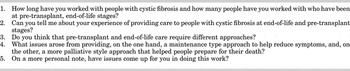
Ten participants volunteered to participate in the study, and interviews were arranged at a place of their choosing. Interviews laste d ~ 1 hour and were conducted by the principal researcher. All interviews were digitally recorded with participants’ prior consent. A brief semistructured interview schedule was developed collaboratively by the principal researcher and her supervisors. This was guided by Smith & Osborn (Reference Smith, Osborne and Smith2003). Two pilot interviews were conducted with the first two participants. Their feedback informed a slight amendment of the interview schedule (Appendix 1).
Analysis
Interviews were transcribed verbatim and the transcripts were analysed using interpretative phenomenological analysis (IPA) (Smith et al., Reference Smith, Osborn, Jarman, Murray and Chamberlain1999; Smith & Osborn, Reference Smith, Osborne and Smith2003).
IPA is concerned with an individual's personal perception of a situation, and enables the researcher to access participants’ experiences and play an important role in understanding, interpreting, and presenting them to the reader (Smith & Osborne, Reference Smith, Osborne and Smith2003). This method enabled the researcher to immerse herself as fully as possible in the richness and breadth of each participant's experience, and identify emerging themes. All themes were compared across transcripts, and a compilation of master themes was produced. This was then used to produce a list of superordinate themes, which were used to analyze the remaining four transcripts. This method is advocated for analysis of larger scale IPA studies (Smith et al., Reference Smith, Flowers and Larkin2009).
In order to ensure the validity of the links within the theme clusters, transcripts were consistently referred to and re-examined. This enabled the researcher to continually check participants’ accounts against her own sense-making thoughts. Further validity was provided by cross-checking themes with another researcher experienced in the use of IPA.
RESULTS
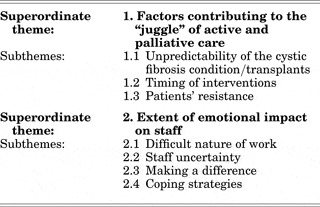
Five main themes emerged from the analysis of the participants’ transcripts: unpredictability in CF care, timing issues, patients’ resistance, emotional impact (covering “difficult nature of work,” “staff uncertainty,” and “making a difference”), and coping strategies. Two superordinate themes were identified: “factors contributing to the ‘juggle’ of active and palliative care,” and “Extent of emotional impact on staff.” These themes and their subthemes are described in detail and are supported by quotes and extracts from the transcriptsFootnote 2 (see Table 1).
Summary of superordinate themes and subthemes

Factors Contributing to the “Juggle” of Active and Palliative Care
This superordinate theme refers to the factors that were found to cause staff the greatest difficulty balancing active and palliative care, viewing their task as “a juggle of palliative and active care” (P4).
Their main “difficulty” was the unpredictability of the CF condition for each patient, including its prognosis and patients’ individual responses to treatment.
The “lottery” of when, or if, transplants would take place further exacerbated this. As a consequence, staff experienced timing dilemmas about when to hold discussions about transplants and end-of-life care, and when to switch from an active to a palliative care approach. A further contributing “strain” was the resistance of some patients to acknowledge the severity of their condition and mortality. Each theme will now be presented and supported by quotes.
Unpredictability of the CF Condition and Transplants
During the analysis, the issue of the “unpredictability” of certain factors as part of CF care emerged consistently as a source of “strain” for the majority of participants in the study (P1, P3, P4, P6, P7, P8, P9, P10).
The other striking thing about it is not being able to predict when anything's going to happen, whether actually someone is dying or the transplantis coming along […] not being able to be definite about those sorts of things is hard for everybody (P6).
Patients require transplants when their lung function significantly deteriorates.
Although there can be physical markers that signal this decline, the level of deterioration that accompanies these markers can be unclear. Occasionally, these normal markers are absent, and it seems that “every case is different” in CF (P3, P4, P6, P8, P7).
One of the difficult things about this is that they can be doing quite well and then all of a sudden they can take a nose dive and then don't come out of it as well and you can't predict that (P10).
Even when it's absolutely clear that they are dying, because they're young, it's not infrequent to see people just get better, you've withdrawn everything and they just get better, not better better, but ready for the next time (P9).
Somebody we know […] went from being discharged from hospital home because they thought she was basically better and being admitted somewhere else as an emergency a couple of days later and dying (P7).
Timing of Interventions
Because of the level of unpredictability in patients’ individual prognoses and treatment response, participants found the timing of discussions and interventions “more difficult” (P4, P5, P6, P7, P8, P9).
A key dilemma was knowing when to talk to patients about having a transplant and about their wishes should they not receive one, without upsetting or unmotivating them, “you also don't want to get that timing wrong because you don't want to upset them but you want them to be prepared because you never know what's going to happen, so trying to choose that time can be quite difficult” (P1).
Some staff were also concerned about when to switch care approach if their patient was on the transplant waiting list and appeared to be deteriorating, not just because of the significant impact of changing approach and its meaning for participants, but also because staff themselves do not know for certain that patients will not recover or receive a last minute transplant. “When do you make that decision that it's no longer realistic that somebody's going to get a transplant” (P8).
With a transplant, it's just a lottery, you have no idea what's going to happen so you can't predict whether they are going to get one or not, I think that's the hard thing about it, you just don't know from moment to moment, day to day, what's going to happen (P3).
Many participants indicated that the issue of when to switch care approach was accentuated because of their strong desire for patients to have a “comfortable death” (P1, P2, P4, P6) that enabled them to “address what they need to address” (P4). Most participants advocated maintaining a balance of active and palliative approaches to keep hope alive but to also prepare patients for death. One participant felt that this did not always happen, as illustrated.
I think it's not addressed enough that the patient is actually dying. [… ] I think probably it's more looked at as active treatment and not as much concentration is put on the fact that the patient is also dying at the same time, until the last, very last bit, when it's obvious that the outcome is going to be death and not transplant (P4).
A number of participants did not view active and palliative care as separate types of care, seeing them instead as “joined approaches” that could provide appropriate overlapping care incorporating the patient's wishes (P1, P3, P6, P7). “We will only withdraw treatment where they feel it's more of a burden, […] if they feel they want to carry on with active treatment, we will do that” (P1). “In CF, active treatment is sometimes something that improves your quality of life so it doesn't mean IV's are out […] but what you don't try and do is give active treatment to cure” (P7).
Patients’ Resistance
The third subtheme relates to some participants’ feelings that the level of unpredictability in their provision of care was increased by patients’ “resistance to even discussing transplant” (P8) or end-of-life issues (P2, P4, P5, P7, P8, P9). However, a small number of participants were affected differently and seemed less concerned (P1, P3, P6, P10).
It emerged that some staff felt it was harder to juggle the active and palliative approaches because of feeling pressured to “put off” end-of-life or transplant discussions by patients and their families. “ It's much harder to get the person to a place where they're achieving what they need to, or want to achieve, before they die, because it's so much put off, mostly by the patients and their families, they're leading in putting it off” (P4).
Participants described difficult problems trying to engage patients in decision- making processes that gave them informed choices (P3, P4, P5, P7, P8, P9).
We tried so many times and usually we would just be met with no eye contact and literally no talking at all and she'd often get upset […] so we've never really been able to have an in-depth discussion with her (P8).
A large number of participants ( P3, P4, P5, P7, P8, P9) described situations in which attempts to talk about transplant or end-of -life concerns were curtailed by patients with beliefs that they were not going to die or become seriously unwell, because “its always been there, they always get better and that's what is expected” (P4).
My experience is that the majority of CF patients deal with CF by denial coping mechanism and even in death they're in denial (P9).
This resistance and patients’ numerous positive recovery experiences prompted one participant to question whether “being on the transplant list stopped patients preparing for death” (P8). Certainly one participant seemed surprised at “how shocked families are when patients do die, because even though everyone would think they would expect it, they don't”, making it “hard to pick up the pieces” (P3).
Extent of Emotional Impact
This superordinate theme refers to the depth of the impact of working with people with CF at end-of-life, pre-transplant stages. All participants were affected psychologically at various levels by certain aspects of their work. The overall title acts as an umbrella to summarize the key issues that were found to be significant among the majority of the participants, including the “difficult nature of the work,” “staff uncertainty,” “making a difference,” and “coping strategies.”
Difficult Nature of the Work
The majority of participants found working with patients awaiting transplant and nearing the end of their lives difficult, and experienced this in a number of ways (P1, P3, P4, P5, P7, P8, P9, P10).
Some participants found talking about transplant and end-of-life issues with their patients “difficult” (P2, P3, P5, P9, P10).
I do find it very difficult to talk to patients about these types of situations, emotionally I find it difficult […] I find it difficult to find the right words to open up the conversation (P10).
Many participants acknowledged the distressing nature of the work when patients died awaiting transplant (P1, P3, P4, P7, P8, P10), “it's upsetting, no matter how many times you see it happen, it is still difficult to see somebody that age die” (P8).
Several participants experienced “draining” emotional effects of caring for patients they had known for long periods of time, watching them deteriorate and die (P1, P3, P8, P10), “it's emotional, it's draining because you are giving so much of yourself to the family and to them and because you've known them so long” (P1).
Some participants seem to have been affected more heavily than others, (P1, P3, P4, P7, P10), particularly those who developed close relationships with patients because of the frequency of time together.
I do think we build up strong relationships, I think they talk a lot to us because we spend a lot of time with them (P3).
When I allow myself to think about them dying, I just feel a little panic […] I don't know how I will manage those patients (P9).
Occasionally, I have felt that it got me down a lot on one or two occasions […] sometimes you need more advanced support (P7).
A small number of participants found the process of talking about their patients upsetting during the interview and became visibly distressed or struggled to keep their emotions in check (P1, P3, P10).
The doctor said to him have you come to any decisions, […] I said would you like me to say the decision you've come to and umm, I'm welling up just thinking about it, he said yeah, he decided he wanted to die and course his mum started to cry (participant crying), it hadn't been that openly discussed so I think it enabled him but it was hard for him to have to say those words in front of his parents (P3).
Staff Uncertainty
Staff seemed to experience considerable uncertainty about whether they had provided good enough or appropriate treatment, about their professional identity, and about keeping boundaries with patients.
Many participants expressed some sense of uncertainty or anxiety related to whether they were providing the appropriate care (P1, P2, P4, P5, P7, P8).
It was the anxiety of not knowing whether we ticked the right boxes I suppose, […] there's a lot of anxiety about whether you're doing the right thing or the wrong thing (P4).
Staff seemed to strive for more certainty and clarity about the appropriateness of their treatments and whether they were helpful for patients’ care (P3, P4, P7, P8, P9). It made one participant “feel like a baddy […] you worry about how the person is and how much they can take really” (P2).
Powerful feelings of “impotence” were expressed by a participant who was frustrated at finding her approach ineffective at times and not knowing how to best support her patient (P5).
A few participants were unsure about their role and maintaining boundaries with patients, particularly if contact was regular and their ages were similar (P1, P3, P4, P10).
It's been quite hard because you are friends with your patients and also there are boundaries there as well[…] you don't always know where your role is sometimes […] you get very involved with their lives and discuss lots of things with them like your friends and they're about a similar age as well a lot of them (P3).
Making a Difference
Despite the difficult emotional aspects of the work, the majority of staff seemed to want to “make a difference” in their patients’ lives. For some, it indicated their dedication to their role and respect for patients.
I think feeling like you are doing a worthwhile job, and I do get an awful lot and I feel like I'm making a difference if you like, I know that's another cliché but it's the sort of work I like to do because I like to help people basically (P10).
A real sense of commitment to the role was demonstrated by a large number of participants who said it had been an active decision to work in this field, and how much they enjoyed the role, “I chose to work in this area so it was my choice, not something that has been suddenly asked of me” (P6, P3, P5, P7).
Participants frequently expressed their admiration and respect for patients living with CF and it seemed to provide additional meaning to their work, “the amazing thing about working with CF is somehow the way each person with CF manages to live their life, it is incredibly humbling really” (P5, P6).
Participants working closely with patients also seemed to derive a sense of connection and satisfaction from their work (P1, P3, P4, P5, P10), “I had some amazing conversations with him” (P3). The closeness of their relationships also appeared to provide benefits for patients including productive end-of-life discussions that enabled patients to plan and achieve dignified deaths, addressing their psychological and physical needs (P1, P3).
Coping Strategies
It seemed that for many staff, part of “making a difference” was being able to provide “a good death,” and that this was a way of coping with the uncertainty and difficult nature of their two care approaches (P1, P3, P4, P6, P8, P9).
The biggest thing for me is just to make it comfortable, if a death is comfortable and the family are supported, that is one thing to me that helps, the biggest coping strategy, as long as we have done as a team, everything we should have done for that patient (P1).
Grief seemed to impact significantly on many participants. The most frequent strategy used was team support and talking to others who understood the situation and knew the patient as long as they had, which gave them an opportunity to “share that and know generally how others are feeling” (P1, P2, P3, P5, P6).
A couple of participants found support from psychologists helpful, “I feel safe that I can actually say things that I might not say in front of everybody else” (P10).
Although team support was acknowledged as being one of the most helpful coping strategies, not all participants felt that the level of support from teams was quite enough (P7, P4), “working as part of a team, support from the rest of the team is always useful, helpful, could be done better, and I do find over and over again with these issues that often it is the nurses that it all comes back to because for some reason we know everything and we're the centre pin of everything apparently” (P4). For one participant, realistic expectations about becoming upset, and working in a culture that anticipated this, assisted her coping ability, “I expect that I'm going to be upset sometimes or find something difficult” (P6).
A number of participants found it helpful to attend their patients’ funerals (P1, P3, P4, P5), “I've been to quite a few funerals which I think helps, […] it's a bit of closure […] it's very much acknowledged that we've been an important part of their lives and that's nice to know” (P3). Faith and spiritual-based strategies were also mentioned as a supportive resource, providing a sense of “not being alone in all this” (P5), and providing a way of making sense of patients’ struggles (P3, P4, P5, P7).
Individual coping strategies used by participants involved psychologically preparing for patients’ deaths, so that they had “worked through the distress before they die” (P9), or using tools such as reflective writing “to allow myself to access those sorts of feelings and permission to sit with it” (P5). One participant stated that “I suppose part of how I do that is to try and push that all to one side” (P1). Another said that “when I allow myself to think of that patient dying, I experience a bit of panic, and I push it down”, indicating that sometimes, participants use tactics to compartmentalize or bury their feelings of grief and emotion, perhaps in the absence of other more helpful techniques.
DISCUSSION
This study aimed to explore in depth the psychological impact of working with people with CF at end-of-life, pre-transplant stages and its impact on staff's capacity to provide appropriate care to patients and their families.
The findings reveal the extent of the unpredictability of the CF environment in which staff work. This is reflected in staff's emotional uncertainty about their professional identity and delivery of appropriate care practices, as well as in their anxiety about their professional boundaries. The findings highlight the potential depth and intimacy of staff–patient relationships. This applies particularly for those staff working regularly with patients that are similar in age, making them especially vulnerable to psychological distress when patients die.
In addition, the findings demonstrate the strength of staff's commitment and desire to form meaningful relationships and to support patients at a humanistic level, in addition to provision of core clinical duties. Finally, the findings demonstrate an interesting range of coping resources that staff use to deliver appropriate care. These include positive strategies that utilize team and peer group support, adoption of rituals, such as attending funerals, to assist with emotional closure, taking off uniforms as part of work–life boundary demarcations, using emotional processing tools such as reflective writing, drawing strength from spiritual and religious beliefs, and psychologically preparing for patients’ deaths.
Factors Contributing to the Juggle of Active and Palliative Care
The finding that staff suffer because of unpredictability issues within CF is already acknowledged in the CF field.
Chapman et al. (Reference Chapman, Landy and Lyon2005) indicated this as an area of “particular difficulty” for staff trying to provide active and palliative care “because of the need to balance hope with reality” (Chapman et al., Reference Chapman, Landy and Lyon2005). The current study highlights the extent of the impact of the unpredictability on staff, and specifically describes the complex issues relating to CF care that staff “juggle” in trying to deliver end-of-life and pre-transplant care.
The finding that some participants viewed active and palliative care as joined rather than separate approaches was interesting, and highlights uncertainty and difference of opinion among staff about this issue. These participants described active treatments being beneficial in increasing patients’ quality of life by reducing distressing symptoms such as breathlessness. Additionally, it seemed that certain active treatments were associated with comfort and increasing patients’ confidence because of their prior familiarity with their use. It is already established that active care is often part of CF end-of-life care, particularly in the absence of other formal palliative methods (Mitchell et al., Reference Mitchell, Nakielna and Tullis2000). Although this was supported by a few participants believing that active care remains too dominant at the expense of patients’ achieving a dignified death, this study suggests that it may also be a beneficial end-of-life treatment and employed more fluidly to enhance patients’ last days. Further research is required to provide more clarity about staff's perceptions of the nature of active and palliative care and the contributing factors to their use. This could include an exploration of the comprehension of and practice of palliative care within CF centers, and, as part of this, how often patients are included in treatment discussions.
This knowledge may reduce some level of unpredictability about CF care, and help staff feel more confident in changing care approach or, perhaps, in introducing certain aspects of palliative care earlier into treatment plans as advocated by Murray et al. (Reference Murray, Kendall and Boyd2005), who considered the provision of overlapping care as a positive way of enabling patients to receive a more considered and dignified death.
Patients’ Resistance
Staff's experiences of some patients being resistant to discussions about transplant and end-of-life care supports similar findings in Chapman et al. (Reference Chapman, Landy and Lyon2005), and therefore warrants further investigation. Some participants experienced patients’ being unwilling or unable to confront the disagreeable aspects of their disease or the reality of their impending death. Patient resistance is hypothesized to have developed as a coping strategy to help people manage their uncertain prognoses (Chapman et al., Reference Chapman, Landy and Lyon2005). The necessity of creating positive illusions is also widely recognized as elements of patients’ struggles to construct and maintain some identity and self esteem (Taylor, Reference Taylor1983). With these issues in mind, the study's findings that staff are impacted upon by their patients’ reluctance to address transplant or mortality issues raises questions about CF staff's understanding of patients’ defense mechanisms and the level of support staff receive.
It also raises questions about the possible role and attitude of CF centers to their patients’ beliefs, and why patients seem to be introduced to treatments such as transplant and end-of-life discussions so late in their illness. The fact that one participant wondered whether transplants stop patients preparing for death suggests a level of uncertainty and lack of knowledge that staff have about patients’ concepts of their illness and treatments.
Therefore, this study highlights a potential need to explore patients’ understanding about life saving treatments and end-of-life planning, and their preferences for information provision in order to develop appropriate care practices that help them make informed choices. Further research about staff's understanding of patients’ defenses and particular areas of staff support is also requested.
Extent of Emotional Impact
Difficult Nature of Work
Whereas the majority of staff found it difficult emotionally juggling end-of-life and pre-transplant care, this study's findings suggest that staff who work closely with patients, or are similar in age, are particularly impacted upon. One participant explained that it felt as if she had lost a family member when her patient died.
Brown et al. (Reference Brown, Shultz and Forsberg2002) found that whereas it is normal for staff to grieve for their patients, the grief reaction is intensified when staff care for younger adults, because they identify with them much more and become personally involved. This signifies the importance of support and training that aids staff's emotional awareness and ability to feel comfortable in acknowledging their emotions.
Perhaps tellingly, participants who had established particularly close relationships with their patients were visibly distressed reflecting on their care experiences, demonstrating the proximity of the emotion and the extent to which it was perhaps still unresolved. Their emotions took a few participants by surprise, one of whom expressed incredulity that she should be expressing such feelings, and another admitting that perhaps her work did affect her more than she had previously acknowledged. Additionally, a number of participants admitted that they sometimes coped by pushing their emotions to one side, or pushing down feelings of panic when they thought about patients’ deaths. It is conceivable that their responses reflected their traditional coping method for dealing with difficult emotions by cognitively minimizing the impact and reframing them less negatively.
These findings support those of Corner (Reference Corner1993), who postulated that staff often struggle to manage their emotions in difficult care scenarios, leading to the adoption of more restoration-orientated grieving approaches that emphasize controlling emotions and getting back to a normal routine, at the expense of a loss-orientated approach that restricts complicated emotional problems in the long-term (Stroebe and Schut, Reference Stroebe and Schut2001).
The current study outlines the challenge for all staff working in CF to recognize and acknowledge the depth of emotion and sadness they experience on a regular basis.
Furthermore, Goldman et al. (Reference Goldman, Hain and Liben2006) argue that they have a responsibility to own their emotions in order to process them and maintain functional grieving patterns that assist them, rather than limit them in their role, and help them grow as professionals.
Uncertainty
The degree of uncertainty in staff's environment was mirrored in some participants’ display of anxiety and self-doubt. A small number of participants appeared unhappy at their incapacity to help patients achieve short-term quality of life benefits, and self-berating about whether their treatments were helpful or even appropriate. Thompson et al. (Reference Thompson, McClement and Daeninck2006) demonstrated that staff experience distress when they feel their care approach is incongruent with their own moral and spiritual values. The current study highlighted staff's uncertainty and a sense of staff being alone with their concerns.
It is likely that staff required support and guidance specific to their role to deal with their concerns more effectively, and that this may have been lacking or unavailable at that time. Although this is speculative, Loes Van Staa et al. (Reference Loes Van Staa, Visser and Van de Zouwe2000) suggest it is the lack of support in delivering appropriate palliative care, particularly the lack of institutional and managerial support and training, and resource limitations, that contribute significantly to psychological issues for staff.
The levels of uncertainty and anxiety at being unable to provide appropriate treatment because of the unpredictability of CF factors or patients’ resistance to discussions seemed to compromise some staff's professional identity and self-esteem, resulting in staff feeling burdened and unsupported.
Existing research informs us that failure to provide what staff feel is appropriate care or a good death often occurs at the expense of professional satisfaction (Oberle & Davies, Reference Oberle and Davies1993). The current study indicates not only the extent of anxiety and stress experienced by staff, but the likely deconstruction of professional skills that working with such uncertainty and with limited support promotes. It is understandable that given these circumstances, staff should strive for greater certainty within their role and professional remit because of the unpredictability of the condition. Isaak and Paterson (Reference Isaak and Paterson1996) suggest that obtaining professional satisfaction and being able to provide a “good death” are key coping resources in situations in which staff feel unsupported emotionally, and, perhaps, explains some staff's desire to provide what they feel is appropriate care.
These issues of anxiety and uncertainty highlight the importance of training, supervision, and support for staff.
This study accounts for the experiences of a small number of health professionals working in one medical field, and exists within a small area of literature that is underdeveloped. Any findings emerging from this study are, therefore, tentative and require more research to validate them.
The study was exploratory in nature and had a broad scope for asking questions about participants’ experiences providing end-of-life and pre-transplant care.
The study was, therefore, not able to thoroughly explore the numerous specific issues that arose during the study, such as the meaning of a “good death,” the differences in staff's opinions about use of active and palliative care, and the difference in staff's attitudes about the impact of patients’ resistance.
This study explored the experiences and perceptions of a mixture of multidisciplinary health professionals specialized in working in CF. Further research replicating this study within staff groups, as opposed to across staff groups, may produce different themes. Alternative findings could be sought by undertaking this research within specific CF centers, or units with whole CF teams, and comparing each center's findings. Overall, this study has provided a more detailed layer of knowledge about staff's experiences providing pre-transplant, end-of-life care for patients with CF.
Specifically, it has revealed the extent of the unpredictability that staff work with, and the range of emotions that staff experience, including uncertainty about their professional identity and anxiety about treatment practices. The depth and intimacy of staff–patient relationships has been highlighted, particularly for staff in regular contact who are similar in age to their patients.
In addition, the strength of staff's commitment and desire to care for patients within broader humanistic terms that mesh with their own personal values was brought to light. Finally, more specific details about how staff cope with the unpredictability of working in CF care have emerged. This study identified a range of largely positive coping strategies that demonstrated staff's ability to facilitate emotional closure, prepare for loss and patients’ deaths, and maintain work–life boundaries.
Interview schedule