Introduction
Prior to the late 1980s scientists considered it unlikely that communities of microbes could colonize what were considered nutrient-poor ‘harsh’ deep environments, even though microbes had earlier been observed in deep marine sediments and groundwater samples (Fliermans & Balkwill Reference Fliermans and Balkwill1989). A program established by the US Department of Energy (DOE) in 1985 sought to extend the knowledge of subsurface microorganisms. Abundant diverse microbial communities were sampled from boreholes down to 520 m beneath the soil surface (e.g. Fliermans Reference Fliermans1989; Fliermans & Balkwill Reference Fliermans and Balkwill1989; Jiménez Reference Jiménez1990). An extensive array of independent reports has since then extended our knowledge of the widespread subsurface deep biosphere. Microbes from a large variety of environments, at extreme temperatures, salinities, pressures, and acidities, have been added to the tree of life (e.g. Schleper et al. Reference Schleper, Pühler, Kühlmorgen and Zillig1995; Ventosa et al. Reference Ventosa, Arahal, Volcani and Oren1999; Kashefi & Lovley Reference Kashefi and Lovley2003; Marion et al. Reference Marion, Fritsen, Eicken and Payne2003; Junge et al. Reference Junge, Eicken and Deming2004; Torsvik & Øvreås Reference Torsvik, Øvreås, Dion and Nautiyal2008). Living prokaryotic cells have recently been reported (Roussel et al. Reference Roussel, Cambon bonavita, Querellou, Cragg, Webster, Prieur and Parkes2008) discovered at depths down to 1626 mbsf (metres below the seafloor). Moreover, gene sequences and microbial isolates from a wide variety of different subsurface lithologies have been characterized, including: the seafloor (e.g. Cowen et al. Reference Cowen, Giovannoni, Kenig, Johnson, Butterfield, Rappé, Hutnak and Lam2003; Kimura et al. Reference Kimura, Asada, Masta and Naganuma2003; Lysnes et al. Reference Lysnes, Torsvik, Thorseth, Pedersen, Pedersen, Christie and Miller2004; Schippers et al. Reference Schippers, Neretin, Kallmeyer, Ferdelman, Cragg, Parkes and Jørgensen2005), marine sediments (e.g. Parkes et al. Reference Parkes, Cragg, Bale, Getliff, Goodman, Rochelle, Fry, Weightman and Harvey1994; Hinrichs et al. Reference Hinrichs, Hayes, Sylva, Brewer and DeLong1999; Kormas et al. Reference Kormas, Smith, Edgcomb and Teske2003; Toffin et al. Reference Toffin, Webster, Weightman, Fry and Prieur2004; Schippers & Neretin Reference Schippers and Neretin2006), and terrestrial rocks (e.g. Kotelnikova & Pedersen Reference Kotelnikova and Pedersen1997; Pedersen Reference Pedersen, Fredrickson and Fletcher2001).
Microbes in the deep biosphere encompass a wide range of energy metabolisms such as sulphate reduction, methanogenesis, methane oxidation, and aerobic respiration (e.g. Teske et al. Reference Teske, Ashita and Sogin2003; Schippers et al. Reference Schippers, Neretin, Kallmeyer, Ferdelman, Cragg, Parkes and Jørgensen2005; Schippers & Neretin Reference Schippers and Neretin2006; Wortmann et al. Reference Wortmann, Chernyavsky, Bernasconi, Brunner, Böttcher and Swart2007). Hydrogen, as a strongly reduced component, is an integral part of many of these metabolic pathways and is a basal component of the deep biosphere. The basal nature of hydrogen in these systems suggests that the deep biosphere is to some extent dependant on hydrogen. In this context, the hydrogen-driven deep biosphere is defined as a subsurface syntrophic biosphere with hydrogen as its basal component. Nealson et al. (Reference Nealson, Inagaki and Takai2005) distinguished between hydrogen-facilitated and hydrogen-driven ecosystems. The former involves metabolism where hydrogen is produced by one organism and a syntrophic partner that removes hydrogen is needed to facilitate the overall ecosystem, whereas the latter is driven by oxidation of hydrogen by oxygen or other photosynthetically produced oxidants or geologically supplied oxidants such as carbon dioxide (Nealson et al. Reference Nealson, Inagaki and Takai2005). Subsurface lithoautotrophic microbial ecosystems (SliMEs) are geologically powered dark ecosystems that operate without any influence from photosynthesis (Nealson et al. Reference Nealson, Inagaki and Takai2005). The term hydrogen-driven deep biosphere as used in this review is broad and covers both hydrogen-facilitated and hydrogen-driven ecosystems as defined by Nealson et al. (Reference Nealson, Inagaki and Takai2005).
About two-thirds of the Earth's outer rigid shell is made of an oceanic lithosphere (Karson Reference Karson2001) consisting of reduced mafic and ultramafic rocks. Fresh unweathered material is constantly supplied at divergent plate boundaries and at so-called mantle hot spots. The fresh reduced material is highly reactive in contact with seawater at the ocean-floor pressures and temperatures. It is at the interface between the hydrosphere and the reduced magmatic rocks that hydrogen forms. The driving mechanism for the deep biosphere is the dissipation of energy from the inner Earth. Moreover, without the plate tectonics that drives element cycling the Earth would eventually be a lifeless planet.
This paper provides a review of the driving force behind plate tectonics, hydrothermal convection, and life on Earth. As hydrothermal vents can be regarded as point sources of elevated hydrogen production some representative hydrothermal vent sites together with hydrothermal laboratory experiments provide evidence for the hydrogen production. A theoretical section then gives insight into the reactions that are responsible for hydrogen formation in these environments, and the limiting factors for these reactions and reaction rates. As organic molecules are fundamental parts of the present-day deep biosphere and necessary constituents for the Archean emergence of life, the role of hydrogen in the synthesis of some organic molecules is also discussed. The last part covers the present-day global hydrogen production with some speculations as to how this has changed from the Archean to present.
The driving force for the deep biosphere
Energy is dissipated from the Earth's core and mantle by the decay of radioactive atoms and crystallization of the outer liquid core. Recent estimates by Hoffmeister & Criss (Reference Hoffmeister and Criss2005) suggest that the Earth's global heat engine, mainly powered by radioactive decay of uranium and thorium, is 30–32 TW. Potassium in the core is also a significant heat source with an estimated content of the core of 60 to 130 ppm giving off 0.4–0.8 TW of heat (Rama Murthy et al. Reference Rama Murthy, van Westrenen and Fei2003). The heat produced in the Earth gives rise to large-scale dissipative structures in the mantle, which effectively transports the heat to the Earth's mantle–lithosphere boundary. Mantle convection, in turn, shapes the Earth's surface through plate tectonics, which is the dynamic drifting of rigid continental and oceanic lithospheric plates on the mantle (e.g. Condie Reference Condie1997; Bercovici Reference Bercovici2003; Ogawa Reference Ogawa2007).
Plate tectonics is mainly driven by the pull exerted by subduction of dense oceanic lithosphere, and in part by the gravitational push of the elevated portion of the plates at ridge crests and shear tractions between the lithospheric plates and the convective mantle (Kearey & Vine Reference Kearey and Vine1996; Bercovici Reference Bercovici2003; Steiner & Conrad Reference Steiner and Conrad2007; O'Neill et al. Reference O'Neill, Jellinek and Lenardic2007). Mid-ocean ridges, which are the divergent plate boundaries, extend for approximately 55 000 km across the ocean floor (Dick et al. Reference Dick, Lin and Schouten2003; German et al. Reference German, Lin and Parson2004), and with spreading rates ranging from ultra slow (<20 mm year−1) to fast (~80–180 mm year−1), approximately 3.4 km2 of new oceanic crust is formed every year (Rowley Reference Rowley2002). The ocean floor covers more than two-thirds of the Earth's surface and the bulk of energy dissipated as heat from the Earth is transported by conduction and convection through the seafloor or as extrusion of volcanic rocks. Dissipative structures form where high thermal gradients lead to unstable density stratification of groundwater. Water fluxes that are present in the rocks along mid-ocean ridges are most pronounced at the focused medium- to high-temperature hydrothermal systems. At these sites spectacular chimney structures form and the nutrient-rich solutions mixed with ocean water give rise to rich biological communities (e.g. Baross & Deming Reference Baross and Deming1985; Van Dover Reference Van Dover2000; Tarasov et al. Reference Tarasov, Gebruk, Mironov and Moskalev2005). Budgets of chemical elements in the ocean water and heat flux estimations suggest, however, that focused flows contribute orders of magnitude less to the overall hydrothermal circulation compared with diffuse flow (de Villiers & Nelson Reference de Villiers and Nelson1999 and references therein). Large-scale diffuse hydrothermal circulation thus has to be taken into account when estimating the global potential of the seafloor to support a hydrogen-driven deep biosphere.
The Earth is divided into compartments with strongly contrasting redox potentials. The core is strongly reduced, the mantle is relatively oxidized, and the crust, hydrosphere and atmosphere today are strongly oxidized (e.g. Jones Reference Jones2004). Dissipative structures at the interface between the hydrosphere and the lithosphere are places where fresh unaltered mantle or mafic to ultramafic magmatic rocks are in contact with water. Here biochemical reactors may form as microbial communities utilize metastable redox gradients as energy sources. The efficiency of these reactors is dependent on the redox contrast between the rocks and the reacting water. When it comes to the upper mantle and mantle-derived magmatic rocks, data suggests that the oxygen fugacity, a measure of the redox potential, has not changed much for 3.5 Ga (Canil Reference Canil2002; Li & Lee Reference Li and Lee2004). On the other hand, the redox potential of the atmosphere and hydrosphere have changed dramatically from reduced in the early Archean, to oxidized after the oxidation event at approximately 2.3 Ga ago to present (e.g. Kasting Reference Kasting1993; Catling & Claire Reference Catling and Claire2005; Kump & Barley Reference Kump and Barley2007). There is, however, one feature that ensures a steady supply of metastable redox gradients as long as plate tectonics and condensed water are present, namely the preferential incorporation of ferrous (Fe2+) to ferric (Fe3+) iron into olivine even at high mantle oxygen fugacities. For olivine, the most abundant mineral in the upper mantle, it is energetically favourable to substitute ferrous iron for magnesium as they have a similar ionic radius and charge, and only negligible ferric iron is incorporated into the structure (McCammon Reference McCammon2005). As olivine reacts with water, the aqueous solution may be reduced to such a level that hydrogen forms. It does not matter at this point how much oxygen was present initially. Hydrogen forms and oxygen is kept at a level given by the dissociation of water at a given hydrogen activity as long as olivine dissolves in the reduced solution. Dissolution of pyroxenes that contains ferrous iron will contribute to the hydrogen formation, but to a much less extent than olivine. A summary of the driving force powering a deep biosphere residing in the seafloor is illustrated in Fig. 1.
A summary: Crystallisation of mantle minerals and decay of radioactive elements dominated by thorium and uranium with a significant contribution from potassium produces heat (Q). The heat is dissipated through large-scale convection cells. Plate tectonics driven by subduction of dense lithospheric plates gives rise to divergent and convergent plate boundaries. Heat is dissipated effectively through the former by the formation of hydrothermal convection cells. Ocean water that enters through hydrothermal convection reacts with the crustal and mantle rocks and releases ferrous iron which in turn reduces the water to such an extent that the water decomposes and produces hydrogen (H2O→H2+0·5O2). This give rise to a locus of hydrothermal synthesis of organic compounds and metastable redox gradients that supply energy for a dark-powered deep biosphere.

Evidence of H2 production
The reactions responsible for hydrogen production in the Earth's crust are now well understood based on observations from drill cores, ophiolite outcrops, fluids venting at active hydrothermal sites, laboratory experiments and numerical simulations. This section presents some indirect and direct evidence of hydrogen production in the seafloor and in continental geothermal systems.
Information regarding mineral alteration of the ocean floor is readily available from the ocean drilling program (ODP) reports (e.g. Früh-Green et al. Reference Früh-Green, Plas, Dell Angelo, Mével, Gillis, Allan and Meyer1996a,b; Alt et al. Reference Alt, Teagle, Laverne, Vanko, Bach, Honnorez, Becker and Pezard1996a,b; Karson et al. Reference Karson, Cannat, Miller and Elthon1997; Laverne et al. Reference Laverne, Agrinier, Hermitte and Bohn2001; Alt & Shanks Reference Alt and Shanks2003; Bach & Edwards Reference Bach and Edwards2003; Bach et al. Reference Bach, Paulick, Garrido, Ildefonse, Meurer and Humphris2006). In order to better understand how seawater interacts with peridotite, drill holes 920B and D were drilled as a part of the ODP Leg 153 at the southern part of the MARK (Mid-Atlantic Ridge, Kane Fracture Zone) area. The two drill holes penetrated 120 and 200 m respectively into the <1-Ma-old peridotite with 95% of the recovered rock being serpentinized peridotite. The remaining 5% was variably metamorphosed and altered gabbroic rocks and diabase units (Karson et al. Reference Karson, Cannat, Miller and Elthon1997). Olivine and pyroxene is altered to serpentine (chrysotile and lizardite) and brucite, with several generations of veins containing serpentine and magnetite plus a later more oxic mineral assemblage which crosscuts the altered peridotite (Dilek et al. Reference Dilek, Coulton, Hurst, Karson, Cannat, Miller and Elthon1997). The crosscutting relationships indicate a progressive change towards more oxic alteration with time, a feature which is also found in other altered peridotite systems (e.g. DSDP/ODP Leg 209, Site 1268). Important indicators for hydrogen production are local blebs of minerals such as awaruite (FeNi3) and heazlewoodite (Ni3S2) that are stable only under very reduced conditions (Alt & Shanks Reference Alt and Shanks2003). Hydrogen production is also suggested by carbonate veins enriched in 13C which indicate the formation of methane in the system (Alt & Shanks Reference Alt and Shanks2003). Moreover, local differences in equilibrium-mineral assemblages suggest that the peridotites experienced heterogeneous serpentinization with local variations in fluid fluxes (Alt & Shanks Reference Alt and Shanks2003). Textural and compositional relations in altered peridotites from ODP Leg 209, Site 1274, shows how iron substitutes into serpentine minerals and brucite and how this affects the timing of magnetite precipitation (Bach et al. Reference Bach, Paulick, Garrido, Ildefonse, Meurer and Humphris2006). Bach & Edwards (Reference Bach and Edwards2003) compiled data on the oxidation state of the upper basaltic oceanic crust from a range of DSDP/ODP drill core samples at different ages. Their study suggests that Fe3+/Fetot increases from 0.15±0.05 to 0.45±0.15 within the first 10–20 Ma. Several lines of evidence indicate that most of the oxidative alteration takes place in young (<10 Ma old) oceanic crust (Bach & Edwards Reference Bach and Edwards2003 and references therein).
The most compelling evidence for hydrogen production is available from active hydrothermal vent sites. Two types of peridotite-hosted hydrothermal fields have been recognized based on their temperatures and fluid characteristics (Mével Reference Mével2003), the high-temperature (360°C) black-smoker Rainbow type of field, and the low-temperature (40–75°C) ‘white-smoker’ Lost City type. These two end-member hydrothermal systems will be reviewed here to illustrate hydrothermal venting characteristics.
The black-smoker type of vent fields was first discovered in 1977 while surveying the Galapagos Rift by the submersible Alvin (Lonsdale Reference Lonsdale1977; Corliss et al. Reference Corliss, Dymond, Gordon, Edmond, von Herzen, Ballard, Green, Williams, Bainbridge, Crane and van Andel1979). Since then, many examples of black-smoker systems have been located along the mid-ocean ridges and in back-arc basins (e.g. Binns & Scott Reference Binns and Scott1993; Sudarikov & Roumiantsev Reference Sudarikov and Roumiantsev2000; German & Von Damm Reference German, Von Damm, Holland and Turekian2003). The Rainbow hydrothermal field, situated at 36°14′N south of the Amar segment of the Mid-Atlantic Ridge, is hosted in ultramafic rocks and driven by a magmatic heat source (Charlou et al. Reference Charlou, Donval, Fouquet, Jean-Baptiste and Holm2002). High-temperature acidic (pH 2.8) fluids with hydrogen concentrations as high as 16 mM emit from vents in this area (Charlou et al. Reference Charlou, Donval, Fouquet, Jean-Baptiste and Holm2002). Hydrogen concentrations as well as methane and carbon monoxide are extraordinary high compared with other vent sites along the Mid-Atlantic Ridge. The high hydrogen concentrations are attributed to high-temperature alteration of olivine and orthopyroxene. Abundant linear hydrocarbons up to C29 found in the Rainbow system may suggest abiotic Fischer–Tropsch type (FTT) synthesis of organic compounds in this system (Holm & Charlou Reference Holm and Charlou2001).
A hydrothermal system radically different from the earlier known black-smoker types of system was discovered in 2000. The new system called the Lost City hydrothermal field is an ultramafic-hosted, low-temperature, high-pH (9.0–9.8) field that builds towering carbonate chimneys (Kelley et al. Reference Kelley, Karson, Blackman, Früh-Green, Butterfield, Lilley, Olson, Schrenk, Roe, Lebon and Rivizzigno2001, Reference Kelley2005). Lost City is an off-axis hydrothermal vent field located on 1.5-Ma-old crust, nearly 15 km away from the spreading axis of the Mid-Atlantic Rift (Kelley et al. Reference Kelley, Karson, Blackman, Früh-Green, Butterfield, Lilley, Olson, Schrenk, Roe, Lebon and Rivizzigno2001, Reference Kelley2005). Owing to the exothermic nature of serpentinization it has been suggested that hydrothermal systems such as Lost City can be driven partly by the heat released by serpentinization (e.g. Kelley et al. Reference Kelley, Karson, Blackman, Früh-Green, Butterfield, Lilley, Olson, Schrenk, Roe, Lebon and Rivizzigno2001; Lowell & Rona Reference Lowell and Rona2002; Früh-Green et al. Reference Früh-Green, Kelley, Bernasconi, Karson, Ludwig, Butterfield, Boschi and Proskurowski2003). This has important consequences as ultramafic rocks exposed to seawater are common along slow- to ultraslow-spreading mid-ocean ridges (Dick et al. Reference Dick, Lin and Schouten2003). One might thus expect an abundance of ultramafic-hosted hydrothermal systems along such ridges, and this is supported by several recent discoveries of hydrothermal activity at the ultraslow-spreading Arctic Ridges north of Iceland (e.g. Edmonds et al. Reference Edmonds, Michael, Baker, Connelly, Snow, Langmuir, Dick, Mühe, German and Graham2003; Pedersen et al. Reference Pedersen, Thorseth, Hellevang, Schultz, Taylor, Knudsen and Steinsbu2005, Reference Pedersen, Thorseth, Olson, Hellevang, Okland, Baumberger, Lilley, Bruvoll, Mjelde and Haflidason2007, Reference Pedersen, Barriga, Escartin, Früh-Green, MacLeod, Mjelde and Thorseth2008; Connelly et al. Reference Connelly, German, Asada, Okino, Egorov, Naganuma, Pimenov, Cherkashev and Tamaki2007).
As for the Rainbow field, fluids emitting from the Lost City show strong evidence of abiotic hydrogen production (Proskurowski et al. Reference Proskurowski, Lilley, Kelley and Olsen2006, Reference Proskurowski, Lilley, Seewald, Früh-Green, Olson, Lupton, Sylva and Kelley2008). End-member concentrations of vent fluids have hydrogen concentrations from 0.5 to 14.4 mM and methane up to approximately 2 mM (Proskurowski et al. Reference Proskurowski, Lilley, Kelley and Olsen2006). Moreover, low-molecular weight hydrocarbons (C1 to C4) venting from the Lost City are suggested to be synthesized by a FTT of reaction (Proskurowski et al. Reference Proskurowski, Lilley, Seewald, Früh-Green, Olson, Lupton, Sylva and Kelley2008).
Several researchers have also argued that continental hydrothermal systems such as in the Yellowstone National Park and in the Columbia River Basalt (CRB) produce hydrogen from strongly reduced geothermal solutions (e.g. Stevens & McKinley Reference Stevens and McKinley1995, Reference Stevens and McKinley2000; Spear et al. Reference Spear, Walker, McCollom and Pace2005). For instance, hydrogen at concentrations above 300 nM, which is well above the nanomolar concentrations required for energy metabolism (Kral et al. Reference Kral, Brunk, Miller and McKay1998), has been recorded in hot springs belonging to the Yellowstone geothermal system (Spear et al. Reference Spear, Walker, McCollom and Pace2005). Moreover, the phylogenetic composition of hot-spring communities suggests hydrogen to be the main energy source (Spear et al. Reference Spear, Walker, McCollom and Pace2005). Similar micromolar and higher concentrations of hydrogen has been measured from the CRB, which has been attributed to be inorganic formation from water–basalt interactions (Stevens & McKinley Reference Stevens and McKinley1995, Reference Stevens and McKinley2000). Experiments on representative basaltic material by the same authors showed that hydrogen forms in appreciable amounts at the alkaline conditions encountered in the CRB for temperatures above 30°C (Stevens & McKinley Reference Stevens and McKinley2000). The potential to produce hydrogen from basalt has, however, been contested by Anderson et al. (Reference Anderson, Chapelle and Lovley1998, Reference Anderson, Chapelle and Lovley2001) and the controversy regarding the capability of basalt to support hydrogen-consuming microbial communities will likely go on.
The exact reaction paths for the various systems mentioned above is challenging because of the complex temporal changes and spatial heterogeneities, and one commonly has to rely on indirect measurements (e.g. measurements of vent fluids) and extrapolations. One way to overcome this is to bring the system into the laboratory and run simplified experiments at some well-defined physical conditions (T, P, x). A combination of laboratory experiments and numerical simulations reported by Seyfried et al. (Reference Seyfried, Foustoukos and Fu2007) has shed more light on both the rates of reactions and the complex nature of serpentinization. Of most interest here is that at the end of a one-year experiment on peridotite alteration at 200°C and 500 bar they measured hydrogen concentrations in excess of 75 mM. Their numerical simulations however overestimated the hydrogen production with a final concentration of approximately 350 mM. The authors suggest that this discrepancy is partly due to the incorporation of ferrous iron in the secondary phases and less-efficient conversion of peridotite in the experiment relative to the numerical simulation.
Hydrogen production: how much and how fast?
Hydrogen is observed at up to millimolar concentrations in fluids from focused hydrothermal venting sites at mid-ocean ridges (e.g. Charlou et al. Reference Charlou, Donval, Fouquet, Jean-Baptiste and Holm2002; Proskurowski et al. Reference Proskurowski, Lilley, Kelley and Olsen2006). Hydrogen forms at these settings by serpentinization reactions where mafic to ultramafic minerals dissolve and are replaced by a hydrated mineral assemblage consisting of serpentine minerals, oxides etc. (Moody Reference Moody1976; Sleep et al. Reference Sleep, Meibom, Fridriksson, Coleman and Bird2004; Bach et al. Reference Bach, Paulick, Garrido, Ildefonse, Meurer and Humphris2006; Schulte et al. Reference Schulte, Blake, Hoehler and McCollom2006; Oze & Sharma Reference Oze and Sharma2007). Hydrogen production is linked to the capacity of the rock to reduce the aqueous solution, which is given by the reactivity of the minerals. This is a function of the reaction rate and affinity with respect to the aqueous solution, and the fraction of reductant in the mineral phases. Iron-rich olivines have both reasonably fast reaction rates and contain ferrous iron in a solid-solution between the two olivine end-members fayalite (iron) and forsterite (magnesium). A mid-ocean ridge olivine typically substitutes approximately 10% magnesium for ferrous iron and is called forsterite 90 (Fo90). A general expression for the dissolution of a forsterite with a fraction x of iron substituted for magnesium is given by

The magnesium and silica is incorporated into minerals such as brucite, talc, the serpentine minerals chrysotile, lizardite or antigorite and, at low temperatures, zeolites and clay. The exact mineral assemblage is given by the local temperature and pressure (Moody Reference Moody1976). The ferrous iron released is oxidized to ferric iron by

and the ferric iron speciates according to the solution pH and commonly precipitate magnetite:

The precipitation of magnetite by reaction (3) consumes ferric iron and indirectly drives the oxygen consumption by reaction (2). Reactions (2) and (3) assume that magnetite is the only mineral that precipitates iron. However, this is not the case as a significant amount of iron is also incorporated in other phases such as brucite and serpentine minerals (Moody Reference Moody1976; Bach et al. Reference Bach, Paulick, Garrido, Ildefonse, Meurer and Humphris2006; Seyfried et al. Reference Seyfried, Foustoukos and Fu2007). This may lead to a reduced activity of the ferrous iron and less consumption of oxygen by reaction (2). In the remaining part of this section, however, we assume the simplified end-member picture that all iron is incorporated into magnetite.
As iron is oxidized, oxygen eventually reaches such a low concentration that water decomposes and produces hydrogen:

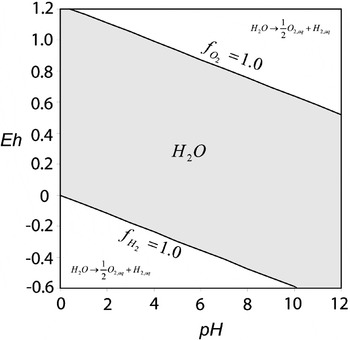
Fig. 2 shows an Eh-pH diagram that illustrates the stability limit of water. For illustration, two lines bracket the water stability given by unit fugacities of oxygen (upper limit) and hydrogen (lower limit). As the oxygen fugacity decreases according to reaction (2), the equilibrium reaction given by (4) is driven towards the decomposition of water. Thus, hydrogen is produced until the product of hydrogen and oxygen fugacities again satisfy the equilibrium. In Fig. 2 this corresponds to moving the stability of water towards lower Eh at progressively higher hydrogen concentrations. The maximum hydrogen concentration (lowest Eh) possible to achieve at a given temperature, pressure and salinity is given by the bubble point of hydrogen:

where x is mole fraction of hydrogen, P is pressure, y is the fraction of hydrogen in a gas phase, φ is the fugacity coefficient, K H is the Henrys law coefficient, γ is the activity coefficient, γ is the partial molar volume of hydrogen in water, R is the gas constant and T is temperature.
The stability of water depicted in a pH-pe diagram. Stability limits for water at unit hydrogen fugacity (lower) and unit oxygen fugacity (upper) are shown. Outside these limits water will decompose into molecular hydrogen and oxygen according to H2O→H2+0·5O2.

The local hydrogen concentration is a balance between the reaction rates of the minerals involved and the hydrodynamic conditions. An end-member case is a closed system with no replenishment of the aqueous solution. If also assuming that the product phases are in equilibrium with the water, as is commonly done (e.g. Seyfried et al. Reference Seyfried, Foustoukos and Fu2007), then the formation rate of hydrogen is proportional to the olivine dissolution rate. The rate of olivine dissolution at acidic to basic conditions can be expressed by

where k is the far-from-equilibrium dissolution constant (n m−2 s−1), S is the reactive surface area (m2), K is the equilibrium constant for reaction (1), a H is the proton activity, i is the reaction order with respect to H+ activity at a given condition, Ea is the apparent activation energy and q is the activity product for reaction (1) given by
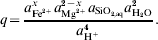
The activity product suggests that with increasing pH, the silica, magnesium and iron concentrations in a closed system will eventually reach saturation with respect to olivine. However, this is not the case because pH will eventually reach a steady-state value given by the steady-state conservation of elements between the reacting olivine and the precipitating phases. The serpentinization is then isochemical except for the uptake of water and release of hydrogen.
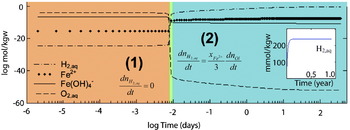
To illustrate how olivine dissolution changes the redox state and produces hydrogen, the outcome of a simplified kinetic is shown in Fig. 3. Minerals considered are Fo91, dissolving according to the rate parameters given in (Pokrovsky & Schott Reference Pokrovsky and Schott2000) using equation (6), and magnetite, brucite and chrysotile equilibrated with the aqueous solution. Aqueous carbon and iron speciation is taken into account. The system is solved at 200°C at the vapour pressure of water for 1 year with an initial freshwater solution equilibrated with the equilibrium mineral assemblage. The initial oxygen concentration is 10−4 moles kgw−1. Fig. 3 shows how such systems can be divided into two different regions: the first corresponds to an oxidized solution and the second corresponds to the reduced solution. The transition between the two, as oxygen is exhausted, is very rapid. In the first region, olivine dissolution and magnetite precipitation lead to a depletion of oxygen and the amount of hydrogen that forms is not proportional to the amount of ferrous iron supplied by the olivine. This can be expressed by combining reactions (1) to (3) as

After the transition, as oxygen is exhausted, decomposition of water has to be taken into account and the combined reactions (1) to (4) now read
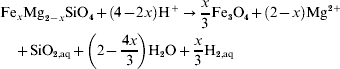
At this stage, for each three moles of ferrous iron supplied by olivine, one mole of hydrogen forms. In hydrodynamic settings where local systems are continuously replenished by less-reduced water, a system may stay in the first region and no hydrogen forms as the rock is weathered. This is discussed in more detail below for low-temperature alteration of basalt.
The temporal reaction progression of 200°C serpentinization of forsterite 91 illustrated by H2,aq, O2,aq, Fe2+ and Fe3+ as Fe(OH)4. The progress is divided into two regions: (1) an initial oxidised state where oxidation of ferrous iron consumes oxygen but without exhausting the oxygen, followed by (2) a reduced state that where the oxygen is strongly depleted. The amount of hydrogen that forms, not taking into account ferrous iron incorporation in brucite and serpentine minerals, is for the reduced region equal to x/3*(dO/dt), where x is the fraction of iron in forsterite and dO/dt is the reaction rate.

Inorganic synthesis of organic molecules
Hydrothermal formation of hydrogen is important with respect to the biosphere for two reasons: (1) it is a basal part of a present-day deep biosphere (e.g. Stevens Reference Stevens1997; Chapelle et al. Reference Chapelle, O'Neill, Bradley, Methé, Ciufo, Knobel and Lovley2002); and (2) it is an integral component to the hydrothermal synthesis of organic compounds (McCollom et al. Reference McCollom, Ritter and Simoneit1999; Holm & Charlou Reference Holm and Charlou2001; Simoneit Reference Simoneit2004; McCollom & Seewald Reference McCollom and Seewald2006) and may thus be a key to the emergence of life on Earth (e.g. Russell Reference Russell2007; Milner-White & Russell Reference Milner-White and Russell2008). Thermodynamic calculations by Shock (Reference Shock1990) suggest that the formation of organic molecules in hydrothermal systems is energetically favourable. Experiments at hydrothermal conditions as well as observations of molecules in hydrothermal settings support this.
FTT organic synthesis is a well-known industrial process used to produce hydrocarbons from dry gaseous CO or CO2 reacted with H2 over some catalyst (Fischer & Tropsch Reference Fischer and Tropsch1923; Anderson Reference Anderson1984a,Reference Andersonb). The outcome of the synthesis is related to the specific catalyst used (Anderson Reference Anderson1984a,Reference Andersonb). Abundant organic molecules venting from hydrothermal mounds suggest that FTT synthesis also occurs in the aqueous phase in these settings (e.g. Holm & Charlou Reference Holm and Charlou2001; Proskurowski et al. Reference Proskurowski, Lilley, Seewald, Früh-Green, Olson, Lupton, Sylva and Kelley2008). Moreover, experiments at hydrothermal conditions using different catalysts support this (e.g. McCollom et al. Reference McCollom, Ritter and Simoneit1999; Rushdi & Simoneit Reference Rushdi and Simoneit2001; Fu et al. Reference Fu, Seyfried, Horita, Wanty and Seal2004). For example, aqueous FTT experiments by McCollom et al. (Reference McCollom, Ritter and Simoneit1999) and Rushdi & Simoneit (Reference Rushdi and Simoneit2001) at temperatures between 100 and 400°C formed a range of different lipid compounds ranging from C2 to >C35, such as n-alkanols, n-alkanolic acids and n-alkenes. By varying the amount of the mineral montmorillonite, McCollom et al. (Reference McCollom, Ritter and Simoneit1999) showed that the yield was a function of the amount of mineral catalyst present. Moreover, FTT synthesis in the absence of clay suggested that the stainless steel walls of their reaction vessels also acted as a catalyst. The authors found that the synthesis was most efficient at temperatures between 150 and 250°C with a maximum yield at around 175°C (McCollum et al. Reference McCollom, Ritter and Simoneit1999; Rushdi & Simoneit Reference Rushdi and Simoneit2001). The formation of lipids in hydrothermal settings has been argued to be of importance for the onset of life in such environments because of their potential for membrane formation (Apel et al. Reference Apel, Deamer and Mautner2002; Simoneit et al. Reference Simoneit, Rushdi and Deamer2007) and the generation of secondary products such as esters and peptide oligomers (Tsukahara et al. Reference Tsukahara, Imai, Honda, Hatori and Matsuno2002). Another series of FTT experiments by Fu et al. (Reference Fu, Seyfried, Horita, Wanty and Seal2004) used magnetite as a catalyst at 400°C and 500 bar. From solutions consisting of CO2 and H2 they observed reduction of CO2 to CO and the formation of CH4 and hydrocarbon compounds.
Hydrogen production through time
The present-day annual hydrogen production can be roughly estimated from: (1) the rate at which new seafloor forms; (2) the average hydration depth; and (3) the fraction of olivine and pyroxene that reacts with time. The potential amount of organic molecules and biomass derived from hydrogen can be estimated in a similar manner.
Based on the area/age versus age distribution of the modern ocean floor, Rowley (Reference Rowley2002) estimates a steady seafloor production rate of 3.4 km2 per year for the last 180 Ma. The maximum depth of alteration can be studied from IODP/DSDP drill cores. A complete section of lavas, dikes and gabbros was drilled during IODP expeditions to Site 1256 in the Eastern Pacific. Cores show abundant iron oxyhydroxizes down to more than 700 mbsf, and pervasive higher-temperature alteration assemblages at depths down to the deepest parts at around 1500 mbsf (Wilson et al. Reference Wilson2006). Biotic alteration as traced by alteration textures in glassy pillow lava margins has been found at depths down to more than 500 mbsf (Furnes & Staudigel Reference Furnes and Staudigel1999). The last variable to be taken into account, the weathering rate, can be estimated based on comparisons of oxidized iron Fe3+/Fetot from seafloor of different ages. Crust that is 118 Ma old sampled at ODP Sites 417/418 shows an average Fe3+/Fetot of 0.56 (Staudigel et al. Reference Staudigel, Plank, While, Schmincke, Bebout, Scholl, Kirby and Platt1996), whereas 6.6 Ma old crust at ODP Site 504B shows an average value of 0.35 (Bach et al. Reference Bach, Peucker-Ehrenbrink, Hart and Blusztjan2003). This suggests that most of the alteration takes place at an early stage with a gradual reduction of alteration rate with age. Based on values such as these, the annual global hydrogen production rate and biomass production from the basaltic seafloor has been estimated by Bach & Edwards (Reference Bach and Edwards2003). They assumed a seafloor production rate of 3.0±0.5 km2 per year, a depth of oxidation of 0.5±0.2 km, basalt density of 2950±50 kg m−3, resulting in an upper crust production rate of 4.0±1.8×10¹² kg per year. From these values an estimated oxidation rate of 1.7±1.2×10¹² mol Fe per year with 50% of the oxidation attributed to hydrolysis provides 4.5±3.0×10¹¹ mol H2 per year (Bach & Edwards Reference Bach and Edwards2003). Thus, the potential chemolithoautotrophic biomass formed from Fe and S oxidation and hydrogen-consuming reactions may be as high as 1012 g carbon per year (Bach & Edwards Reference Bach and Edwards2003). It has been questioned whether alteration of basalt can lead to high enough hydrogen concentrations to support microbial growth (Anderson et al. Reference Anderson, Chapelle and Lovley1998, Reference Anderson, Chapelle and Lovley2001). Bach & Edwards (Reference Bach and Edwards2003) show that if the hydrogen flux is diluted by 4.0±1.8×10¹⁵ kg seawater per year, which corresponds to a water-to-rock mass ratio of 1000, the average hydrogen concentration will be approximately 100 μM. This should be more than sufficient for a hydrogen-driven community as the lower limit for energy metabolism is of the order of a few nanomolar (Kral et al. Reference Kral, Brunk, Miller and McKay1998). However, as Bach & Edwards (Reference Bach and Edwards2003) also point out, the amount of hydrogen that is introduced into the upper basaltic crust at ridge flanks still remains uncertain. As explained above the progression of olivine (or ocean floor) alteration might be divided into an oxidized or reduced state (Fig. 3). Only in the reduced state will the amount of hydrogen that forms be proportional to the amount of ferrous iron that is released from the rock and oxidize. Given the low content of olivine in basalts relative to ultramafic rocks and the sluggish reaction kinetics of pyroxenes relative to olivine, the latter is nicely illustrated by the experiments by Seyfried et al. (Reference Seyfried, Foustoukos and Fu2007), it is likely that a large portion of the oceanic seafloor never reaches the strongly reduced state necessary to decompose water to hydrogen. Moreover, the assumption that the ferrous iron is only oxidized by oxygen is likely to fail when nitrate is present in appreciable amounts. Oxidation of ferrous iron by nitrate might prevent the lowest oxygen levels and thus inhibit hydrogen formation.
The majority of the oceanic crust formed today is created at intermediate- to fast-spreading ocean ridges. These ridges are characterized by a large magma supply which builds a robust thick volcanic pile (Karson Reference Karson2002). At the other end of the scale is the ultraslow-spreading ridges with a full spreading rate of less than 20 mm per year (Dick et al. Reference Dick, Lin and Schouten2003). At these ridges the magmatic supply is small and tectonic spreading dominates (Dick et al. Reference Dick, Lin and Schouten2003). Amagmatic segments along such ridges have only scattered volcanism and typically expose abundant mantle peridotite (Dick et al. Reference Dick, Lin and Schouten2003). As 20 000 km out of the 55 000 km of the world's oceanic ridges can be characterized as ultraslow-spreading (Dick et al. Reference Dick, Lin and Schouten2003), only a few per cent of the oceanic floor produced annually expose ultramafic rocks. It is, however, likely that the majority of hydrogen production today is focused around the ultraslow-spreading ridges. This might have been different in the Archean seafloor.
Most studies suggest a warmer Archean mantle and a gradual cooling to present (e.g. Abbott et al. Reference Abbott, Burgess, Longhi and Smith1994; Durrheim & Mooney Reference Durrheim and Mooney1994). The consequence of a warmer mantle is that a greater amount of heat dissipated through the crust imposes globally elevated spreading rates or a greater overall ridge length (Karson Reference Karson2001). Globally elevated spreading rates then leads to even less-exposed mantle rocks relative to volcanics compared with the present day. Melting of a warmer mantle would, however, also imply the formation of more mafic high-magnesium melts (Langmuir et al., Reference Langmuir, Klein and Plank1992). Widely acknowledged evidence for this is that high-magnesium ultramafic lavas termed komatiites are only observed in Archean ophiolites such as the type locality in the 3.5 Ga old Barberton Greenstone Belt (Viljoen & Viljoen Reference Viljoen and Viljoen1969). Moreover, a more reduced atmosphere and ocean in the Archean as indicated by a wide array of isotopic and mineralogical evidence (e.g. Wiechert Reference Wiechert2002; Rouxel et al. Reference Rouxel, Bekker and Edwards2005) mean that, even though less ultramafic rocks were exposed to seawater, even moderate interaction between the reduced seawater and the mafic rocks could potentially produce more hydrogen than on the present seafloor. The Archean ocean would have been close to the reduced state of Fig. 3 and likely produced hydrogen proportionally to the release rate of ferrous iron from the seafloor.
Summary and conclusions
Heat dissipated from the interior of the Earth drives plate tectonics and leads to hydrothermal circulation along plate boundaries and at magmatic active plate interiors. Energy hidden in the chemical potential difference between magmatic minerals and the hydrothermal water is released as the minerals dissolve. Oxidation of released ferrous iron may consume oxygen to such an extent that water decomposes and form molecular hydrogen.
Studies of drill cores, ophiolites, laboratory experiments and numerical simulations suggest that iron-holding olivines are responsible for the bulk of hydrogen production. At present, the largest abundance of olivine is in ultramafic rocks exposed to seawater along the slow- to ultraslow-spreading mid-ocean ridges. The rate of hydrogen formation is controlled by the release rate of ferrous iron from olivine and the fraction of released iron that oxidize. Once hydrogen has reached nanomolar concentrations microbes that reduce components such as carbon dioxide and sulfate can utilize it as a energy source. Moreover hydrogen reacts with carbon through FTT reactions and form organic molecules such as hydrocarbons and lipids. These molecules and others that are formed from hydrogen may have been important as precursor molecules for the onset of life in hydrothermal systems.
Based on numerical simulations on olivine dissolution, the reaction progression is suggested to be divided into two regions based on the oxidation state of the aqueous solution. The first region is characterized by oxygen consumption by the oxidation of ferrous iron without producing hydrogen. After a sharp transition into a reduced solution, the hydrogen production becomes proportional to the amount of ferrous iron released. As basalts have limited reduction capacity, a package of water may reside in the oxidized region throughout its convective travel. The higher reduction capacity of ultramafic rocks leads to a faster progression into the reduced region and significant hydrogen production. A significantly higher global hydrogen production is expected in the Archean because ultramafic lavas such as komatiites may have been abundant. Moreover, a more reduced ocean and atmosphere in the Archean would lead the even higher potential for widespread hydrogen production.
Acknowledgements
I would like to thank Bjarte Hannisdal and Nicola McLoughlin for their helpful comments and reviews. I also acknowledge insightful comments from Gretchen Früh-Green and Ingunn Thorseth. This work was supported by the Research Council of Norway through the BIODEEP project.