INTRODUCTION
The vertical zonation pattern is a common characteristic in rocky coasts. The species distribution in these environments is affected by the individual and combined effects of several abiotic and biotic factors, such as oceanographic and physical conditions, size and type of substrate, aerial exposure, high temperatures and desiccation, seasonality abundance of planktonic larvae, recruitment patterns and two main biological interactions as competition and predation (Connell, Reference Connell1985; Menge & Sutherland, Reference Menge and Sutherland1987; Roughgarden et al., Reference Roughgarden, Gaines and Possingham1988; Minchinton & Scheibling, Reference Minchinton and Scheibling1991, Reference Minchinton and Scheibling1993; Zaixso et al., Reference Zaixso, Vidal and Lizarralde1994; Sánchez & Zaixso, Reference Sánchez and Zaixso1995; Calcagno et al., Reference Calcagno, López Gappa and Tablado1998, Reference Calcagno, Curelovich, Fernandez, Thatje and Lovrich2012; Menge, Reference Menge2000a, Reference Mengeb; Bertness et al., Reference Bertness, Silliman, Bazterrica, Reyna, Hildago and Crain2006; Hidalgo et al., Reference Hidalgo, Silliman, Bazterrica and Bertness2007). Factors governing intertidal vertical zonation are variable across the world, and usually the main factor(s) is site-specific (Schiel, Reference Schiel2004; Bertness et al., Reference Bertness, Silliman, Bazterrica, Reyna, Hildago and Crain2006). As a general rule, physical tolerance of organisms controls the upper intertidal zonation whereas biological interactions regulate the lower levels, or a combination of both (e.g. Dayton, Reference Dayton1971; Underwood, Reference Underwood1980; Navarrete, Reference Navarrete1996; Rius & McQuaid, Reference Rius and McQuaid2009).
Organisms living in the marine rocky intertidal zone compete for space (Connell, Reference Connell1961a). Multiple physical and biological factors affect the settlement and recruitment of many marine species (Minchinton & Scheibling, Reference Minchinton and Scheibling1991; Rodríguez et al., Reference Rodríguez, Ojeda and Inestrosa1993).
The presence of other organisms can affect positively or negatively the new settlers (Jones et al., Reference Jones, Lawton and Shachak1994). For example, molluscan grazers can negatively affect the settlement and recruitment of barnacles through the detachment of newly settled larvae (bulldozing) or the accidental predation of settled larvae while grazing algae (Buschbaum, Reference Buschbaum2000, Reference Buschbaum2002; Chan & Williams, Reference Chan and Williams2003). Moreover, algal coverage negatively affects barnacle and mussel larval settlement (Menge Reference Menge1976; MacPherson & Scrosati, Reference MacPherson and Scrosati2008). On the other hand, grazers can also positively affect the abundance of sessile invertebrates in an indirect way by reducing the abundance of algae and other competitors (Petraitis, Reference Petraitis1983; Dungan, Reference Dungan1986).
Knowledge on factors affecting recruitment rates and distribution patterns is scarce in the Atlantic coast of southern South America. In Northern Patagonia (44°S), the rocky intertidal communities are reportedly organized by the unusually harsh physical conditions generated by the dry southern trade winds (Bertness et al., Reference Bertness, Silliman, Bazterrica, Reyna, Hildago and Crain2006; Hidalgo et al., Reference Hidalgo, Silliman, Bazterrica and Bertness2007). As a consequence of the stress caused by living at the highest levels of the coast, Perumytilus purpuratus (Lamarck, 1819) has the highest recruitment in the lowest intertidal zone suggesting optimal conditions in that zone, and no barnacle recruits settle in wave-protected sites where desiccation is higher than in wave-exposed sites (Bertness et al., Reference Bertness, Silliman, Bazterrica, Reyna, Hildago and Crain2006). Our previous study of physical disturbance and recovery of a bivalve assemblage in a different site in Southern Patagonia (53°S) showed that bivalve larvae do not settle on the bare substrate, yet recruitment begins in crevices from which the assemblage grows (Calcagno et al., Reference Calcagno, Curelovich, Fernandez, Thatje and Lovrich2012). This experimental work showed that rock crevices and interstices of the mussel bed play an important role in recruitment (Calcagno et al., Reference Calcagno, Curelovich, Fernandez, Thatje and Lovrich2012). Unlike the intertidal communities of the South Atlantic, those south of 32–33°S in the South Pacific, where the gastropod Concholepas concholepas is a key-stone predator, are strongly organized by its predation pressure (Durán & Castilla, Reference Durán and Castilla1989; Navarrete & Castilla, Reference Navarrete and Castilla2003). The South Pacific intertidal populations north of 32–33°S would be limited by recruitment (Navarrete et al., Reference Navarrete, Wieters, Broitman and Castilla2005).
The main objective of this study was to examine the effect of grazers and predators on barnacle and mytilid recruitment at high, mid and low intertidal levels, under the hypothesis that the presence of consumers would decrease recruitment. Our second objective was to investigate the effect of free substrate availability on barnacle and mytilid bivalve recruitment at all intertidal levels, under the hypothesis that increasing substrate availability would enhance recruitment. Our third objective was to test the hypothesis that the presence of crustose coralline algae would decrease barnacle and mytilid bivalve recruitment at low level.
MATERIALS AND METHODS
Study area
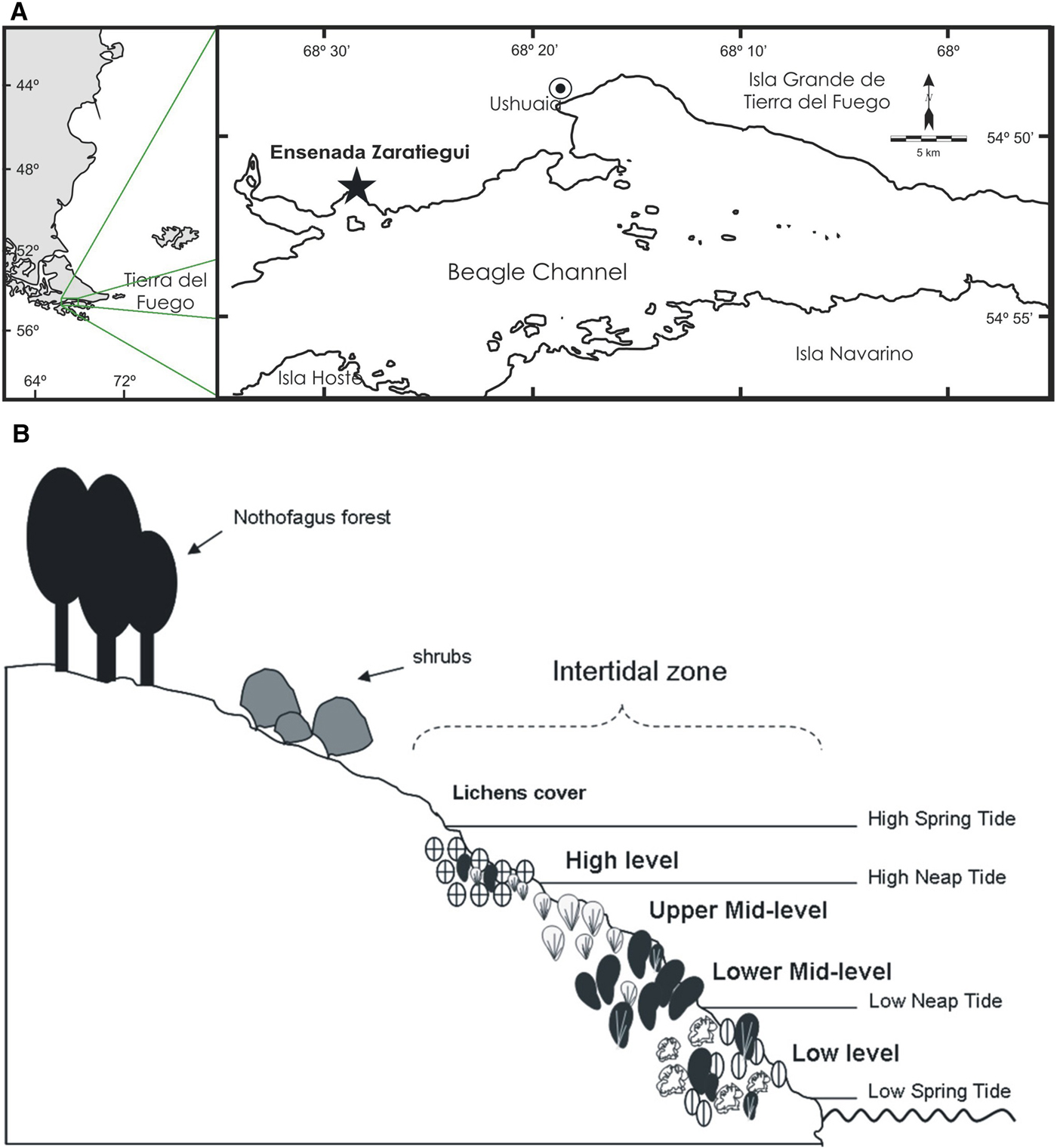
This study was conducted in Ensenada Zaratiegui, Beagle Channel, Tierra del Fuego (54°51′S 68°29′W), Argentina (Figure 1A). The community is located at the southernmost tip of South America, between the southern temperate zone and the Antarctic, and is exposed to extreme physical conditions such as low temperatures, strong winds from Antarctica, large changes in photoperiod, substrate freezing during winter, and variable surface salinity during summer. The studied rocky shore faces the SW and is exposed to the most frequent winds in the area and dominant wave energy, with an annual frequency of about 23.6% and a mean velocity of 31 km h−1 (Bujalesky, Reference Bujalesky2007).
(A) The study site at the Beagle Channel, in Tierra del Fuego, Argentina. (B) Profile of the coastline of Ensenada Zaratiegui, Tierra del Fuego, Argentina Intertidal zonation pattern is shown. ( ) Notochthamalus scabrosus; (
 ) Perumytilus purpuratus; (
 ) Mytilus chilensis; (
 ) Notobalanus flosculus; (
 ) coralline algae.

Tides are semidiurnal; the surface water temperature ranges from 4.4°C in August to 9.4°C in January. Salinity reaches an average of 24 psu during November–March, attaining local minimum values as low as 15 psu in near-shore waters (Curelovich et al., Reference Curelovich, Lovrich and Calcagno2009).
The study was carried out in the intertidal zone and three levels were determined according to the distribution pattern of organisms: the high intertidal is dominated by the barnacle Notochthamalus scabrosus; the mid level is dominated by mytilid bivalves (Perumytilus purpuratus, Mytilus chilensis and Aulacomya atra); and the low level is covered by the barnacle Notobalanus flosculus and crustose coralline algae. At the high level, N. scabrosus covers ~80% of the substrate (Curelovich, Reference Curelovich2013). At the mid level, percentage cover of mytilid bivalves is almost 100% (Curelovich, Reference Curelovich2013). Perumytilus purpuratus dominates the upper mid-level, whereas M. chilensis covers the lower mid-level. Aulacomya atra is present at low densities and frequencies in both mid and low intertidal levels. At the low level, both crustose coralline algae that often settles and grows on barnacles and other organisms, and N. flosculus cover more ~70% of the substrate, while the remaining surface is free or covered by mytilid bivalves that form groups of few individuals of varying sizes (Curelovich, Reference Curelovich2013) (Figure 1B).
The mobile fauna is represented mainly by grazers, such as chitons and limpets. The dominant limpet Nacella magellanica inhabits the mid and the upper-low level, while Nacella deaurata inhabits the low intertidal level and subtidal (Morriconi & Calvo, Reference Morriconi and Calvo1993). Other common limpet species are Siphonaria sp., Colisella sp. (both inhabiting the high and upper-mid levels) and Fissurella picta (low level). Predators in the area include the gastropod Trophon geversianus and seastars of the genus Anasterias, both inhabiting the mid and low levels. These predators are absent from upper levels because they die due to desiccation and no other predators were detected during this study.
Recruitment
EFFECT OF GRAZERS, PREDATORS AND FREE SUBSTRATE AVAILABILITY
Experiments began in September 2007 and lasted 1 year. In order to quantify the recruitment of mytilid bivalves and barnacles at different intertidal zones, a total of twelve 25 × 25 cm quadrats (four per level) were set at the high, mid and low intertidal levels (treatments for each particular plots are explained below). All barnacle and mytilid bivalve recruits within the plots at each intertidal level were recorded by taking photographs approximately every three months. Before photographic sampling, recruits were identified and marked with pins in order to increase the likelihood of detection during image processing. We consider recruits to be those new individuals that appeared since the previous sampling, reaching an arbitrary size that allows them to be detected by the naked eye. Barnacle recruits were those that ranged between 0.5–0.8 mm carino-rostral length and bivalve recruits were those that measured 0.3–0.5 cm shell length, approximately. Photos were useful to detect new recruits that had not been previously detected with the naked eye by comparing the same plot in time. Images were analysed using Adobe Photoshop CS3 software.
(i) Grazers and predators
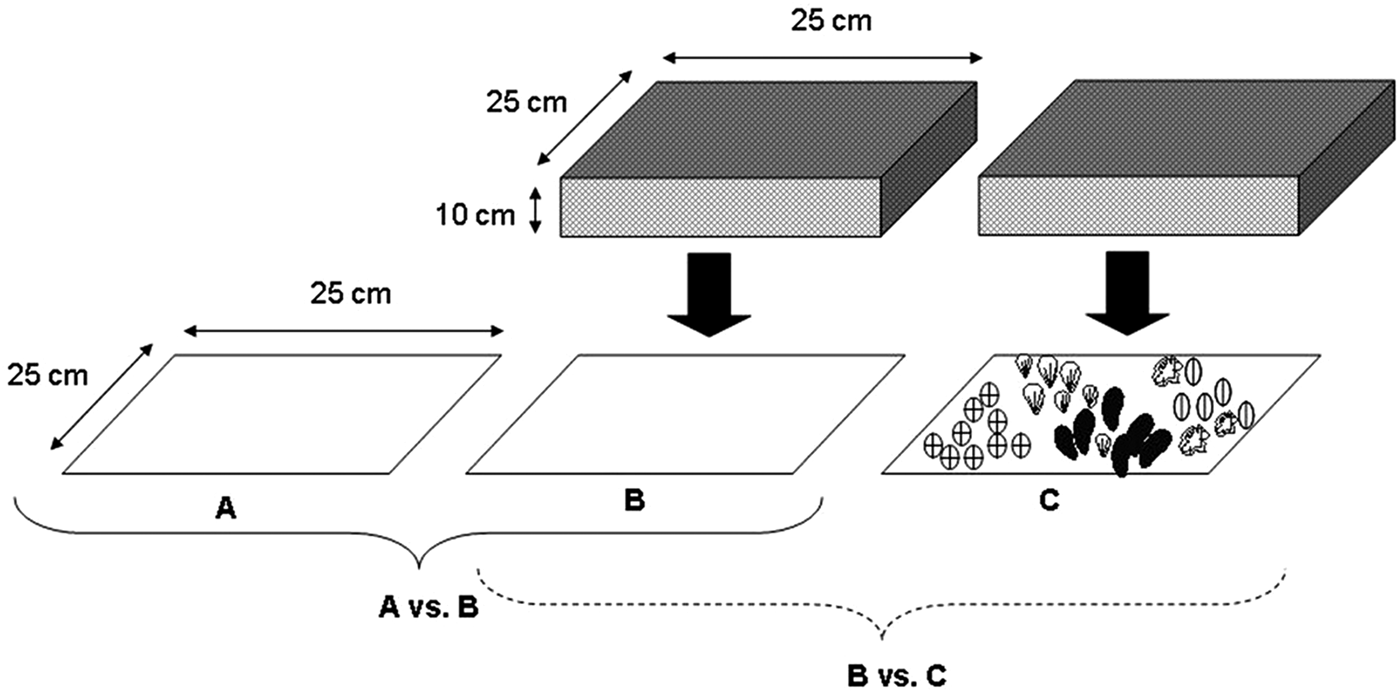
To study the effect of grazers and predators on barnacle and mytilid bivalve recruitment, organisms were totally removed from eight quadrats in each intertidal level and the rock surface was cleared using a 10% HCl solution, hereafter ‘organism removal plots (ORP)’. Four of these plots were covered with a 25 × 25 × 10 cm stainless steel cage of 0.1 cm mesh-size in order to exclude grazers and predators (caged-ORP), and the other four remained uncovered (uncaged-ORP) (Figure 2). At the low level, the uncaged-ORP could not be sampled throughout the complete study period due to a huge tree that fell on the rock blocking access to the plots after starting the experiment.
Experimental plots scheme. Four plots per treatment per intertidal level: (A) uncaged-‘organisms’ removal plots’ (ORP); (B) caged-‘organisms’ removal plots’ (ORP); (C) caged-‘no organisms’ removal plots’ (NORP). (A vs B): effect of grazers and predators on barnacles and mytilid bivalves’ recruitment. (B vs C): effect of free substrate availability on barnacles and mytilid bivalves’ recruitment. This scheme was replicated in each of the three intertidal levels, i.e. high, mid and low.

(ii) Free substrate availability
To study the effect of free substrate availability on barnacle and mytilid bivalve recruitment, sessile organisms were not removed from four quadrats in each intertidal level. These plots were covered with a cage, hereafter ‘no organism removal plots (caged-NORP)’ (Figure 2). At every sampling, cages used to test the effects (i) and (ii) that had algae growing on them were replaced by clean ones in order to allow good circulation of water through the mesh.
Effect of crustose coralline algae
Since we observed that crustose coralline algae quickly covered the free substrate at low level, the per cent coverages of both crustose coralline algae and bare rock in the caged-ORP (the same plots mentioned previously) were quantified by processing photos with the Scion Image software. The area size was measured by outlining the region of interest using the free hand selection tool. The recruitment of barnacles and bivalves on both coralline algae and bare rock were quantified as well. Data were recorded only in September 2008 and January 2010 (~50 and 90% of the surface covered by algae, respectively). The sampling of these plots was extended for another year in order to observe the effect of algae coverage on barnacles and mytilid bivalves recruitment.
Data analysis
A Hurdle Poisson regression model for each species (N. scabrosus, N. flosculus and ‘mytilid bivalves’ that includes M. chilensis, P. purpuratus and A. atra) was performed using a Generalized Linear Mixed Model approach (package glmm ADMB, in R, Skaug et al., Reference Skaug, Fournier, Nielsen, Magnusson and Bolker2013), using the number of individuals recruited per plot as the response variable. This model assumes that mechanisms that determine the presences are different from those that determine the counts in the populations of interest (Zuur et al., Reference Zuur, Ieno, Walker, Saveliev and Smith2009). A Hurdle model is a modified counting model that includes two processes: (1) A binomial distribution was used to model the probability that 0 (plot without recruitment) or 1 (plot with recruitment) were observed; and (2) The non-0 count data (number of individuals recruited when recruitment was possible) were modelled using a zero-truncated Negative Binomial distribution. Both parts of the Hurdle model were modelled as a function of treatments (uncaged-ORP, caged-ORP and caged-NORP), intertidal level (high, mid and low) and sampling date (January, May and September 2008, and January 2009). Since recruitment was measured in the same plot at each sampling event, a random factor (plots) was included in the models. Only interactions among ‘treatments’ and ‘intertidal levels’ were incorporated into the models. The coefficients of interactions that involved ‘sampling dates’ could not be estimated correctly (due to high values of standard errors) since the effective sample size obtained for these coefficients in all models was too small. To simplify the models, interactions between factors were incorporated into the model only if it produced a significant reduction in residual deviance, using a likelihood ratio test (Zuur et al., Reference Zuur, Ieno, Walker, Saveliev and Smith2009).
A χ2 test was used to determine whether the proportion of barnacle recruits on bare substrate and crustose coralline algae in September 2008 was 1:1. To compare the total number of barnacle recruits within the caged-ORP in September 2008 and January 2010 a Student's t-test was performed.
RESULTS
Effect of grazers, predators and free substrate availability on recruitment, by intertidal level
Our results show that Notochthamalus scabrosus recruited at all the studied intertidal levels, while Notobalanus flosculus recruited only at the mid and low levels (Figures 3 & 4).
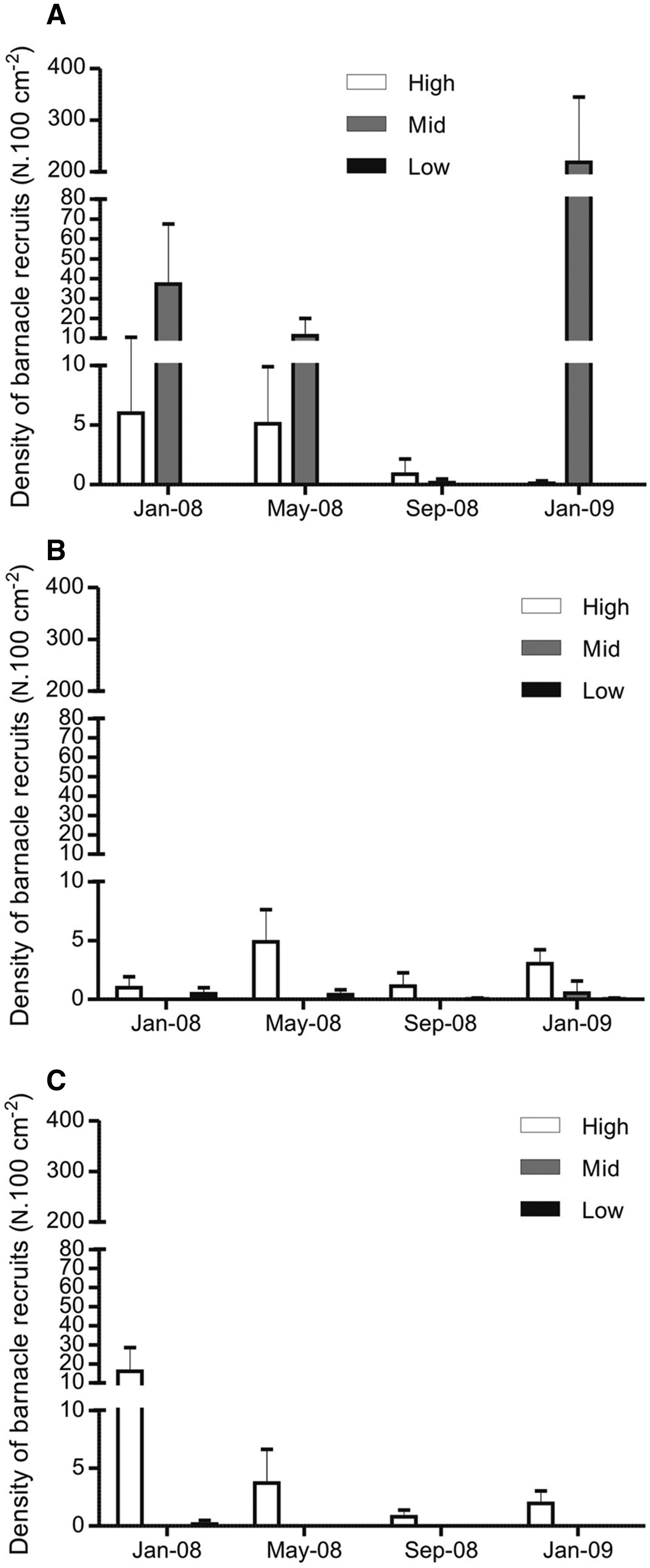
Density of Notochthamalus scabrosus recruits by intertidal level in (A) uncaged-plots where all organisms were removed at the beginning of the experiment (ORP). At the low level this treatment was missing, (B) caged-ORP; (C) caged-plots with no organisms’ removal (NORP). (A vs B): Effect of grazers on recruitment. (B vs C): Effect of free substrate availability on recruitment.

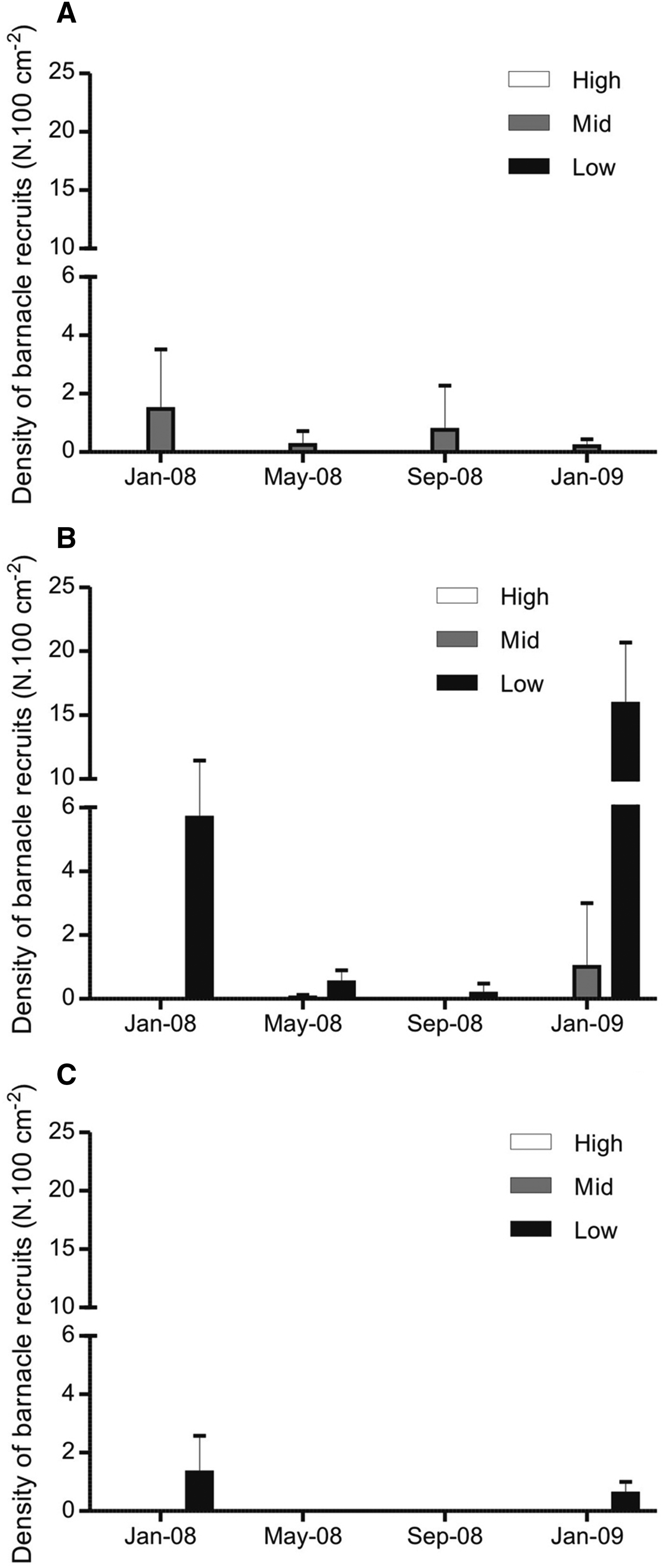
Density of Notobalanus flosculus recruits by intertidal level in (A) uncaged-plots where all organisms were removed at the beginning of the experiment (ORP). At the low level this treatment was missing; (B) caged-ORP; (C) caged-plots with no organisms’ removal (NORP). (A vs B): Effect of grazers on recruitment. (B vs C): Effect of free substrate availability on recruitment.

(i) GRAZERS AND PREDATORS
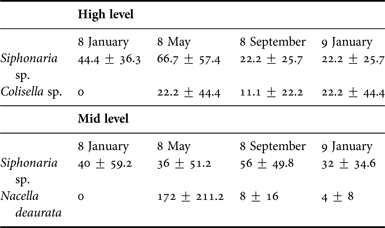
Although predators were common in the area, throughout the study period we observed none within the uncaged plots at high and mid levels. Limpet density within uncaged plots was variable among samplings at all levels (Table 1).
Density of limpets (N m−2) ± standard deviation at high and mid levels in plots where all organisms were removed at the beginning of the experiment (uncaged-ORP). At the low level this treatment was missing.

In the case of N. flosculus and mytilid bivalves, we initially decided not to include the uncaged-ORP treatment in the statistical analysis because barnacle recruits were recorded only at the mid level in uncaged-ORPs (confounding treatment and intertidal level effects) (see Figure 4A), and no bivalve recruit was recorded in any intertidal level under this treatment (Table 3). Finally, we performed a second model for N. flosculus in order to compare the effect of treatments only at the mid level.
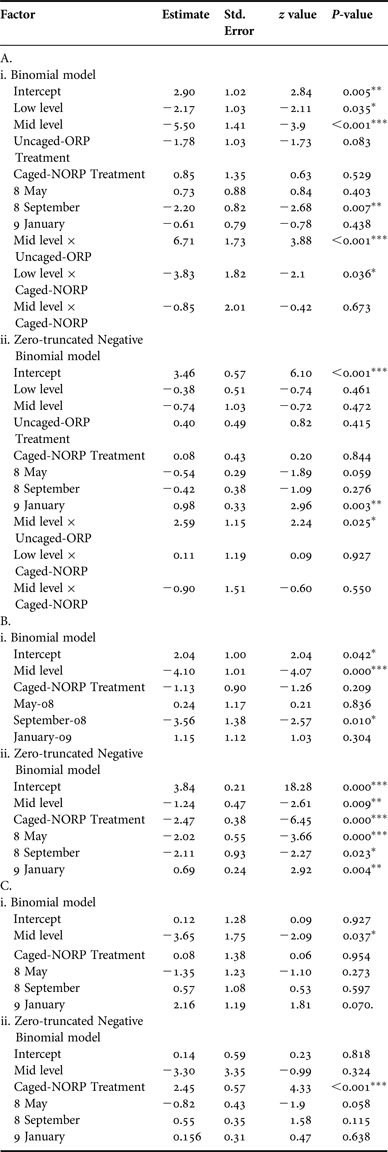
We registered a significant interaction between intertidal levels and treatments when we modelled the probability of finding plots with N. scabrosus recruitment. By entering this interaction to the model, residual deviance was significantly reduced (Change in deviance: 38.56, df: 4, P < 0.001).
As for the recruitment by intertidal level, the proportion of plots with N. scabrosus recruits was significantly higher at high level compared with the mid and low levels (Table 2Ai). At the mid level, the proportion of plots with recruitment was 0.29, whereas at the high level it was 0.83. However, when the interaction treatment × intertidal level was analysed, the proportion of plots with barnacle recruitment placed at the mid level under uncaged-ORP treatment (plots where all organisms were removed at the beginning of the experiment and grazers were present, proportion: 0.81) was statistically higher than expected for the mid level (Estimate: 6.71, P < 0.01, Table 2Ai).
Parameter estimates of fixed factors from both parts (i. Binomial and ii. Zero-truncated Negative Binomial) of the Hurdle Poisson regression model for A. Notochthamalus scabrosus, B. Notobalanus flosculus, C. mytilid bivalves (Mytilus chilensis, Perumytilus purpuratus and Aulacomya atra). Parameter estimates were calculated as contrasts with the followed reference category: A, C: ‘High Level’, B: ‘Low level’; A, B, C: ‘Caged-ORP Treatment’; A, B, C: ‘January 2008. ‘Uncaged-ORP’: Total removal of organisms and presence of grazers; ‘Caged-ORP’: Total removal of organisms and absence of grazers; ‘Caged-NORP’: No organisms’ removal and absence of grazers.

We registered a significant interaction between intertidal levels and treatments when we modelled the number of N. scabrosus recruits in plots with recruitment. By entering this interaction to the model, residual deviance was significantly reduced (Change in deviance: 12.56, df: 3, P < 0.01). The number of N. scabrosus recruits per plot did not significantly differ between treatments or intertidal levels from the reference value (High level, Caged ORP, January 2008): average number of recruits per plot: 8.3 individuals), except for plots placed at the mid level under the uncaged-ORP treatment, where the average recruitment was significantly higher compared with the reference value (Mean Mid level × Uncaged-ORP: 514.38 individuals; Estimate: 2.59, P < 0.05) (Table 2Aii, Figure 3A, B).
The analysis of the effect of treatments on the recruitment of N. flosculus only at the mid level showed that the proportion of plots with N. flosculus recruitment was significantly higher in removal plots when grazers were present (uncaged-ORPs) (0.44) than removal plots with absence of grazers (caged-ORP) (0.13) (Estimate: 2.03, z: 1.98, P = 0.048). On the other hand, we could not reliably analyse the effect of treatments on the number of N. flosculus recruits per plot at the mid level, due to the low sample size.
(ii) FREE SUBSTRATE AVAILABILITY
The proportion of plots with N. scabrosus recruitment at the low level was significantly lower compared with the high level (0.31 vs 0.83, respectively). When the interaction treatment × intertidal level was analysed, this proportion in plots placed at low level under the caged-NORP treatment (plots without removal) was even lower (Estimate: −3.83, z: −2.1, P < 0.05). The number of N. scabrosus recruits was similar between treatments, although a notably higher density was observed in plots without organism removal in the first sampling (Table 2Aii, Figure 3B & C).
As for the recruitment of N. flosculus, we registered a non-significant interaction between intertidal levels and treatments (no significant changes in deviance: P < 0.1) when we modelled both the probability of finding plots with N. flosculus recruitment and the number of N. flosculus recruits in plots with recruitment. The same happened for mytilid bivalves.
Notobalanus flosculus showed a higher probability of recruiting and a higher number of recruits per plot at the low level compared with the mid level (proportion of plots with recruits: 0.61 vs 0.06%, respectively) (Table 2Bi and 2Bii). Notobalanus flosculus did not recruit at the high level. On the other hand, the probability of recruiting did not significantly differ between treatments (i.e. plots with increased (caged-ORP) or decreased (caged-NORP) free substrate availability) (Table 2Bi). However, when the number of N. flosculus recruits was analysed, a significantly higher value was observed in plots with increased free substrate availability compared with plots with decreased free substrate availability (Table 2Bii, Figure 4B, C).
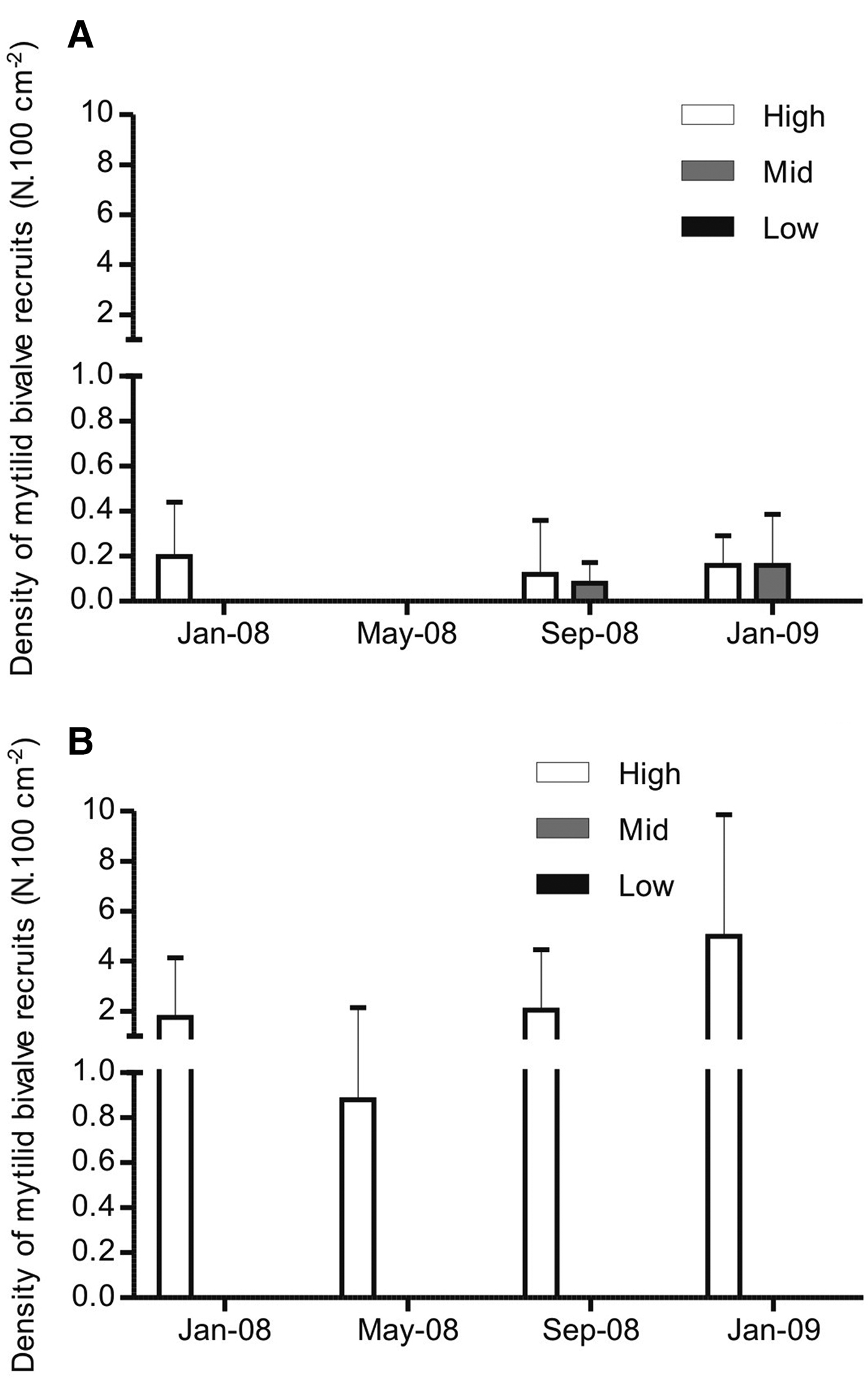
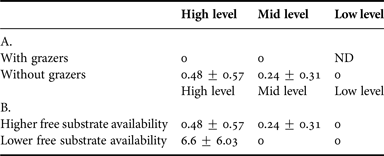
There was no recruitment of mytilid bivalve species at the low level (Table 3), while plots at the high level showed a significantly higher probability of recruiting than those at the mid level (0.53 vs 0.13%, respectively) (Table 2Ci). As for the number of mytilid bivalve recruits by treatment, non-removal plots (caged-NORP) had significantly more recruits (average number: 15 individuals per plot) than removal plots (caged-ORP) (average number: 1.5 individuals per plot) (Tables 2Ci, Cii & 3; Figure 5).
Density of Perumytilus purpuratus, Mytilus chilensis and Aulacomya atra recruits (N 100 cm−2) by level in (A) caged-with organisms’ removal at the beginning of the experiment (‘ORP’); (B) caged-with no organisms’ removal (‘NORP’).

Density of Perumytilus purpuratus, Mytilus chilensis and Aulacomya atra recruits (N 100 cm−2) ± standard deviation by level in A, plots where all organisms were removed at the beginning of the experiment and grazers were present (uncaged-ORP) and absence of grazers (caged-ORP) and B, plots where all organisms were removed at the beginning of the experiment (caged-ORP) (higher free substrate availability) and no organisms’ removal plots (caged-NORP) (lower free substrate availability). Data cover the entire sampling period (~1 year).

ND, no data.
Concerning the recruitment of barnacles by sampling date, a significantly higher probability of finding N. scabrosus and N. flosculus recruits in January 2008 (0.56% for N. scabrosus and 0.47% for N. flosculus) than in September 2008 (0.38% for N. scabrosus and 0.06 for N. flosculus) was observed (Tables 2Ai & 2Bi.). The number of N. scabrosus recruits per plot was significantly higher in January 2009 (average: 374 ind.) than in January 2008 (average: 84.9 ind.), while a marginal decrease was recorded in May 2008 (average: 33.2 indiv.) compared with January 2008 (Table 2Aii, Figures 3 & 4). The number of N. flosculus recruits was significantly higher in January 2008 (average: 25 ind.) compared with both May 2008 (average: 3.5 ind.) and September 2008 (average: 4 ind.) (Table 2Bii; Figures 3 & 4).
The probability of finding recruits of mytilid bivalves marginally increased in January 2009 (average: 0.33 ind.) compared with January 2008 (average: 0.21 ind.) (Table 2Ci.). The number of mytilid bivalve recruits marginally decreased in May 2008 (average: 7.33 ind.) compared with January 2008 (average: 9.8 ind.) although this difference in recruitment was not significant (Table 2Cii, Figure 5).
Effect of crustose coralline algae on recruitment
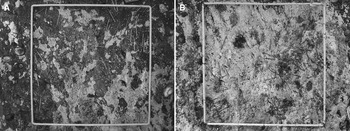
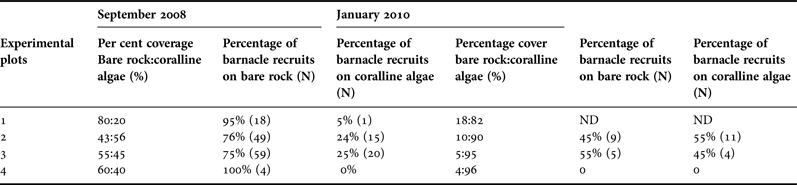
Throughout the study, at the low level the bare substrate (ORP) was quickly covered by coralline algae, which increased its coverage from ~50% to 90% in one year (Figure 6, Table 4). At the early stages of colonization, coralline algae appeared on the substrate as small, approximately circular spots, which expanded radially, and in more advanced stages of development grew in height forming 3-dimensional structures. Furthermore, these algae were able to grow on other organisms, mainly barnacles, covering them largely and sometimes even reducing the opening of the operculum.
Coralline algae coverage in a plot where all organisms were removed at the beginning of the experiment (caged-ORP): (A) September 2008; (B) January 2010.

Per cent coverage of coralline algae and percentage of Notochthamalus scabrosus and Notobalanus flosculus recruits on coralline algae or bare rock, in plots where all organisms were removed at the beginning of the experiment and grazers were absent (caged-ORP).

ND, no data.
At the low level, N. flosculus and N. scabrosus recruited preferentially on bare rock than on coralline algae. When algae coverage was ~50% of the experimental area (by September 2008), 75% of barnacle recruits occurred on the bare substrate (χ2 test, X 2 1 = 53.2, P < 0.001). In January 2010, the experimental plots were almost totally covered by coralline algae (~90–95% coverage) and percentages of barnacle recruits on both the bare substrate and algae were similar to each other (χ2 test, X 2 1 = 53.2, P = 0.85, Table 4). Moreover, the average number of barnacle recruits within the caged-ORP in January 2010 when coralline algae covered ~90–95% of the substrate was significantly lower than a year earlier when the coralline algae coverage reached ~50% (11.67 ± 7.37 vs 98 ± 36.59, respectively) (Paired t-test, t = 4, P = 0.03).
No recruitment of mytilids was recorded at the low level, hence we could not evaluate the effect of coralline algae on mytilid bivalve recruitment.
DISCUSSION
Our results show that grazers, substrate availability and crustose coralline algae have a significant importance in the recruitment of the dominant sessile species such as mytilid bivalves and barnacles of the rocky intertidal communities in the Beagle Channel. However these effects differed by species and intertidal levels. For example, at the upper level there is an absence of predators, since they are susceptible to desiccation; the snail Trophon geversianus only predates on bivalves at the lower mid-level and not on barnacles; and coralline algae are only present at the lower level. Grazers could cause an increase in barnacle recruitment, whereas mytilid bivalves would recruit in plots with presence of other organisms. On the other hand, increased availability of free substrate is favourable for barnacle recruitment at the low intertidal level, whereas at the high level the presence of sessile organisms is important for the recruitment success, mainly at the beginning of the experiment, but this effect was not as evident as the study progressed.
As for barnacles, the middle intertidal level of Ensenada Zaratiegui, Tierra del Fuego offers the most favourable environment for recruitment of Notochthamalus scabrosus. At this level, a high recruitment of this species was observed in removal plots with grazers (uncaged-ORP). On the other hand, the low barnacle recruitment observed in ORP without grazers (caged-ORP) at the mid level could be due to a negative effect exerted by macroalgae, which rapidly increased in biomass on the bare substrate. In other systems, algae decrease the barnacle larval settlement or increase the mortality of settlers (Jernakoff, Reference Jernakoff1985; Jenkins et al., Reference Jenkins, Norton and Hawkins1999; MacPherson & Scrosati, Reference MacPherson and Scrosati2008).The rapid macroalgal growth could be caused by the absence of grazers and/or the effect of the exclusion cages (see below). Notobalanus flosculus did not recruit at the high level, while the low level seems to be the most suitable for the recruitment of this species. This is probably because chthamalids are more resistant to desiccation than balanids (Connell, Reference Connell1961a). Similarly as for N. scabrosus, areas with presence of grazers (uncaged-ORP) may have a higher probability of being occupied by N. flosculus than those with absence of grazers. Yet, this effect could only be observed at the mid level since the uncaged-ORP treatment was not performed at low level, as was mentioned previously.
The lowest recruitment of N. flosculus registered in non-removal plots (caged-NORP) could be related to the reduced free space available for settlement (Gaines & Roughgarden, Reference Gaines and Roughgarden1985; Minchinton & Scheibling, Reference Minchinton and Scheibling1993; Bracewell et al., Reference Bracewell, Robinson, Firth and Knights2013). At the low level, crustose coralline algae and N. flosculus are the most conspicuous organisms covering most of the free substrate. On the contrary, when the number of N. scabrosus recruits in removal plots (caged-ORP) and non-removal plots (caged-NORP) was analysed by level and sampling date (see Figure 3), a remarkably higher density was recorded in plots with low availability of free substrate at high level in the first sampling (January 2008). This pattern was not observed in subsequent samplings. The presence of conspecific adults for this gregarious species may have played an important role in larval settlement at the beginning of the experiment, mainly at high level where the physical conditions are harsher. This hypothesis is supported by previous research suggesting that high-density barnacle aggregations improve the recruitment, survival or reproductive output (Bertness, Reference Bertness1989; Rodríguez et al., Reference Rodríguez, Ojeda and Inestrosa1993; Bertness & Leonard, Reference Bertness and Leonard1997; Bertness et al., Reference Bertness, Leonard, Levine, Schmidt and Ingraham1999; Leslie, Reference Leslie2005; Beermann et al., Reference Beermann, Ellrich, Molis and Scrosati2013). At the low level, by contrast, the presence of conspecifics or other species individuals may have been detrimental due to competition for space (Bertness, Reference Bertness1989; Bertness & Leonard, Reference Bertness and Leonard1997; Bertness et al., Reference Bertness, Leonard, Levine, Schmidt and Ingraham1999).
In our study, barnacle species recruited at different levels consistently with their adult distribution. At high intertidal level, the recruitment of N. scabrosus in ORPs with both presence or absence of grazers was remarkable, while N. flosculus did not recruit at this level. Conversely, at the low level N. flosculus recruited in plots without grazers (caged-ORP), where very few recruits of N. scabrosus were observed. Differences in the recruitment of both barnacle species at the high level may reflect differences in desiccation tolerance. Heat and desiccation were identified as the primary post-recruitment mortality factors in the high zone (Connell, Reference Connell1961a, Reference Connellb; Menge, Reference Menge2000b). Further north, in Quequén (~38°34′S 58°38′W), the desiccation stress is one of the factors influencing the upper limit of distribution of the barnacle Balanus amphitrite Darwin, 1854 (Calcagno & Luquet, Reference Calcagno and Luquet1997). In the Beagle Channel, N. scabrosus can recruit and survive higher on the shore probably due to its desiccation tolerance, as observed with other members of the family Chthamalidae (Wethey, Reference Wethey1983, Reference Wethey1984; Power et al., Reference Power, Myers, O'Riordan, McGrath and Delany2001, Reference Power, McCrann, McGrath, O'Riordan, Simkanin and Myers2011).
At the low intertidal level the recruitment of N. flosculus was higher than N. scabrosus. We observed that crustose coralline algae quickly colonize the experimental plots without grazers (caged-ORP), covering the bare substrate and growing also on sessile organisms, i.e. barnacles and mytilid bivalves in caged-NORP. Furthermore, barnacles seem to prefer recruiting on bare rock than on crustose coralline algae since the barnacle recruitment decreased with increasing algal cover. Our results strongly suggest that at low intertidal level, coralline algae could directly affect barnacle settlement and recruitment, and even N. scabrosus might be more negatively affected than N. flosculus due to differences in behavioural preferences at settlement and/or in early survival of the settlers between both barnacle species (see discussion in Raimondi (Reference Raimondi1990) and Pineda (Reference Pineda1994)).
Even though mytilid bivalve species dominate the mid intertidal level of Ensenada Zaratiegui, a higher probability of recruitment was observed at the high level than the mid level. No recruits were recorded at the low level during the present study. Moreover, a higher density of recruits was registered in plots covered almost 100% by both N. scabrosus and mytilid bivalves (caged-NORP) compared with removal plots (caged-ORP) at this level (see Figure 5). Recruits settled mainly into crevices or between mytilid bivalve individuals. The highest density of mytilid bivalve recruits registered in non-removal plots suggest that mytilid bivalve species are less resistant to desiccation conditions characterizing the high zone (Petes et al., Reference Petes, Menge and Murphy2007), and hence the presence of barnacles and juvenile and adults of mytilid bivalves may provide protection from desiccation (Lively & Raimondi, Reference Lively and Raimondi1987; Silliman et al., Reference Silliman, Bertness, Altieri, Griffin, Bazterrica, Hidalgo, Crain, Alteiri and Reyna2011). Additionally, mytilid bivalves are probably unable to settle directly on bare rock and depend on the presence of recruitment-mediators such as barnacle shells, filamentous algae and/or mytilid bivalve clumps (Lively & Raimondi, Reference Lively and Raimondi1987; McGrath et al., Reference McGrath, King and Gosling1988; Navarrete & Castilla, Reference Navarrete and Castilla1990; Bertness et al., Reference Bertness, Silliman, Bazterrica, Reyna, Hildago and Crain2006; Calcagno et al., Reference Calcagno, Curelovich, Fernandez, Thatje and Lovrich2012). Furthermore, the settlement of planktonic larvae on or near adult conspecifics is particularly prevalent in hard bottom, sessile intertidal organisms such as bivalves, barnacles and polychaetes (McGrath et al., Reference McGrath, King and Gosling1988; Pawlik, Reference Pawlik1992).
It is noteworthy that the density of mytilid bivalve recruits was very low or nil in non removal plots at both the mid and low levels throughout the experimental period. At the mid level, the full coverage of the substrate by adult mytilid bivalve individuals may hinder the recruitment of new ones in the study area. At the low level, mytilid bivalves form groups of very few adult individuals, N. flosculus covers ~50% of the substrate and the remainder is free or covered by coralline algae (Curelovich, Reference Curelovich2013). Moreover, at the low level the substrate is notably smoother than upper levels. At high and mid levels, the very few new mytilid bivalves observed in removal plots (caged-ORP) recruited into crevices, therefore the substrate roughness would also be an important variable influencing the mytilid bivalve recruitment (Skinner & Coutinho, Reference Skinner and Coutinho2005). The effect of roughness of substrate on mytilid bivalve recruitment was observed in an intertidal area of the Atlantic shore of Tierra del Fuego (Argentina), in which the primary space occupancy by barnacle species or algae is irrelevant (Calcagno et al., Reference Calcagno, Curelovich, Fernandez, Thatje and Lovrich2012). Our results suggest that barnacles are the first colonizers. They seem to play an important role in providing a rough surface, hence facilitating the mytilid bivalves recruitment in the intertidal area of Ensenada Zaratiegui, as we found remains of dead individuals of both barnacle species under the mytilid bivalve bed. It is likely that mytilid bivalves outcompete barnacles once they are set at this level (Lively & Raimondi, Reference Lively and Raimondi1987; Menge & Sutherland, Reference Menge and Sutherland1987; Scrosati, Reference Scrosati2013), although this could not be observed during the period of our study.
On the other hand, in removal plots where grazers were absent (caged-ORP) there was some mytilid bivalve recruitment, while those with grazers (uncaged-ORP) showed no recruitment (see Table 3), probably due to the presence of algae that invaded the experimental plots. Although the presence of grazers would increase the probability of finding barnacle recruits, which in turn are recruitment-mediators for mytilid bivalves in the area, it is likely that the experimental period was not sufficient to observe this effect. The role of barnacles on mytilid bivalve recruitment depends on recruitment rates, population densities and growth rates of barnacles (Lively & Raimondi, Reference Lively and Raimondi1987; Navarrete & Castilla, Reference Navarrete and Castilla1990). In the Beagle Channel, the low temperatures and high seasonality could affect the growth rates of barnacles and subsequent crowding, a probable requisite to provide a suitable surface for the settlement of mytilid bivalves. Our results suggest that the secondary succession in this area is slow as in other intertidal communities in the Atlantic Patagonia (Bertness et al., Reference Bertness, Silliman, Bazterrica, Reyna, Hildago and Crain2006; Calcagno et al., Reference Calcagno, Curelovich, Fernandez, Thatje and Lovrich2012). Additionally, in many rocky coasts, mytilid bivalve beds serve as foundation species by providing protection from desiccation or predation to a large number of mobile and sessile organisms (Bertness et al., Reference Bertness, Silliman, Bazterrica, Reyna, Hildago and Crain2006; Borthagaray & Carranza, Reference Borthagaray and Carranza2007; Arribas et al., Reference Arribas, Donnarumma, Palomo and Scrosati2014). Consequently, low recruitment rates of foundation species could greatly slow the secondary succession in opening spaces, affecting the community structure and ecosystem functioning (Crain & Bertness, Reference Crain and Bertness2006).
Several authors reported that cages used as barriers against grazers and predators can modify physical and biological conditions within the experimental units by casting shade, slowing down water movement, entrapping sediments and providing surfaces for settlement and growth of algae and invertebrates (Schmidt & Warner, Reference Schmidt and Warner1984; Underwood & Denley, Reference Underwood, Denley, Simberloff, Strong, Abele and Thistle1984; Hayworth & Quinn, Reference Hayworth and Quinn1990; Miller & Gaylord, Reference Miller and Gaylord2007). Although the use of cages may have affected some results, such as macroalgal growth inside cages and impeding the normal water flow, we mitigated this outcome by replacing cages each time we verified the macroalgal proliferation. Nevertheless the presence of our cages may have underestimated recruitment specially at the mid level, where macroalgal fouling seems to be intense and probably rapidly clogged the cage mesh. This also could have reduced the larval supply into the cages, probably with a more negative effect on mussel larvae (cf. Figures 3–5; polychaetes, Tamaki, Reference Tamaki1985; bivalves, Flach, Reference Flach2003; barnacles, Beermann et al., Reference Beermann, Ellrich, Molis and Scrosati2013). However, the recruitment of different species could be fitted using Zero-inflated generalized linear mixed-effects models (ZIGLMMs). These models consider response variables with non-Gaussian distribution, random factors (repeated measures in each quadrate along time), and data with a great amount of zero-valued observations. Thereby, generalized linear mixed models are powerful and flexible tools to analyse recruitment processes along time.
Factors governing the intertidal zonation in the Beagle Channel seem to be different than in other localities of southern South America. For a more comprehensive understanding of the community organization, other biotic and abiotic factors possibly structuring this intertidal community should be studied, namely competition for space between crustose corralline algae and sessile organisms, predation and/or the effect of desiccation stress.
ACKNOWLEDGEMENTS
The authors are grateful to M. Diez, O. Florentín, M. Gutierrez, P. Pérez-Barros, M.C. Avalos, M. Liljesthröm, A. Giamportone, A. Mattenet and M. Pérez, for fieldwork assistance. A special thanks to Dr Ricardo Scrosati, St. Francis Xavier University, Antigonish, Nova Scotia, Canada, and two anonymous reviewers, who provided valuable comments to improve the manuscript. This study was done in the Parque Nacional Tierra del Fuego and was in accordance with the Argentine National Parks Administration rules.
FINANCIAL SUPPORT
This work was supported by the National Agency for Science and Technology Promotion (ANPCyT, Grant number PICT 2007-1385) and a grant from the Administración de Parques Nacionales.