The recent resurgence of interest in the shaft tombs of western Mexico is due in part to the publication of salvage excavations carried out three decades ago in the Atemajac valley, central Jalisco, by the Instituto Nacional de Antropología e Historia (INAH). This fieldwork, which included the excavation of the Tabachines cemetery and a few isolated shaft tombs elsewhere in the valley, is by far the largest sample of archaeologically excavated shaft tombs from anywhere in West Mexico (cf. Galván 1976; Schöndube and Galván 1978 for preliminary reports). The publication of the final monograph on the excavations (Galván 1991) was followed by independent analyses by other scholars of the data recovered (Aronson 1993, 1996; Beekman 1996a:858–863). However, the importance of this sample of shaft tombs has generally not been recognized among professional archaeologists or the interested public, although some (Weigand 1985) saw its significance for overturning prior views of western Mexico.
This article reports on some of the major findings of this research, and discusses the relationship of these materials to contemporary settlement in the Atemajac valley, and to the Tabachines phase to which they belong. We aim to demonstrate that the Tabachines cemetery in particular provides evidence for significant social inequalities in the society that built these shaft tombs, that there were major social changes partway through the Tabachines phase, and that the mortuary ritual practiced in the tombs shows commonalities with other areas of Mesoamerica.
THE EXCAVATIONS AT TABACHINES
In the mid 1970s construction of a new housing development began at Tabachines, half a kilometer northwest of the archaeological site of El Grillo. El Grillo is located just inside the northern stretch of the Periférico, or beltway, that circles Guadalajara, and is the most extensive archaeological site in the Atemajac valley (Galván and Beekman 2001a). When construction at Tabachines began to expose the first of 19 shaft tombs, an INAH project run by L. Javier Galván V. took the opportunity to recover information from the tombs as they each came to light. An additional two tombs (Tombs 11 and 12) were located by the INAH project through a series of trenches, and were the first shaft tombs excavated from start to finish by archaeologists (Galván 1991:159–169). Another four shaft tombs or possible shaft tombs were also identified and recorded by INAH investigators over the next several years at Ciudad Granja, Valle de Guadalupe, Ixtepete, and Bugambilias, all within the Atemajac valley (Galván 1991:194–204, 313–320). These were salvage projects, and excavations and recording had to be carried out quickly in order to avoid further disturbance of the exposed remains by looters. Nonetheless, the amount of information recovered and the thoroughness with which the remains were analyzed and published surpassed that of any prior shaft tomb research. Even the earlier work of Stanley Long (1966) had focused on only a few looted tombs and did not make full use of the materials recovered. For example, Long never attempted a typological analysis of the excellent collection of ceramics obtained through his efforts.
Many of the 25 shaft tombs excavated by the INAH were damaged to varying degrees during their exposure by construction crews, but it was possible to map the remainder and develop good reconstructions of most of the tombs. Twenty-one were of the stereotypical boot shape, with a vertical shaft from 1.3 to 3.25 m in depth (Galván 1991:Chart 1), terminating in a side chamber in which one or more bodies were placed. A single tomb had two side chambers (Tomb 7). At least eight of the tombs had a small step at the base of the shaft at the entrance to the chamber itself, and one tomb (Tomb 10—Galván 1991:Figure 92) displayed the remains of a plug placed over the mouth of the chamber to seal it. Atypical examples include a bottle-shaped tomb (Tomb 2), a tomb so shallow that no shaft is clearly apparent (Tomb VG), and two more burials whose tomb architecture was so thoroughly destroyed as to be undeterminable (Tomb BG and IX), although these two were deep enough to be shaft tombs.
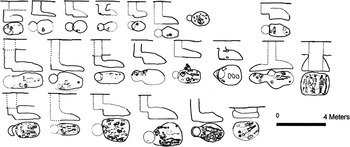
It is uncertain what significance the diversity of shaft tomb forms may hold (Figure 1). Long (1967:Table 1) identified a wide variety of tomb shapes, but the lack of artifactual data has left it unclear as to whether these are chronological differences. The boot-shaped tombs are found over an extremely wide area (Long 1967), whereas the bottle-shaped tombs are known from Nayarit and elsewhere in central Jalisco (Corona Nuñez 1954; Weigand 1985:61). The form of Tomb VG closely resembles the “One step open pit” illustrated from Usmajac, in the Sayula lake basin to the southwest (Valdez et al. 1996:Figure 4d, this issue). What any of these variations might mean is unclear, and their distributions over space do not appear to form regional clusters. For this reason, Weigand has instead focused on quantitative, not qualitative, differences between tombs, such as the depth of the shaft (Weigand 1985:64–66).

Depiction of the range of shaft tomb forms found within the Atemajac valley. Modified from Galván 1991:224, Figure 1.
Skeletal preservation in the Atemajac valley tombs was generally poor, probably due to intrusion by water, but a total of 43 individuals from the 25 shaft tombs could be identified or were inferred in the field. Most remains were extremely fragile, but their position and orientation could generally be recorded (see Galván 1991:Figure 70 for a photograph showing the poor preservation). Sex could not be determined due to the lack of preservation, although the grave goods suggest socially defined gender in several cases. These inferences are largely made through reference to oft-described gender roles among the Aztec (effectively and critically examined in McCafferty 2001), and these may not hold true for Late Formative to Classic period Jalisco. All of these examples are inferred by Galván to be females, based on the presence of metates for grinding foodstuffs and/or the presence of small solid female figurines (e.g. Tomb CG in Galván 1991:194–202). By the same inferential approach, one of the individuals in Tomb 8 (Galván 1991:Figures 83, 85) and another in Tomb 17 (Galván 1991:Figures 115,116) might be defined as gender male on the basis of accompanying weaponry. Nine of the chambers are extremely small and have no surviving skeletal remains, suggesting that these were used for children (Galván 1991:112). All of these sub-adult burials had some associated offerings.
Although most tombs held evidence of a single occupant, several had two, three, four, or even five individuals. No particular directional orientation seems favored over others. Bodies were typically laid out on their backs or sides in an extended position, and in six cases lay on a bed of unworked obsidian pebbles up to 2 cm thick (Galván 1991:111). It is worth noting that obsidian and chert debitage was occasionally dumped over the top of Classic period elite burial chambers in the Maya region (e.g. Chase and Chase 1996:71; Taschek and Ball 1992:492), an interesting link between shaft tomb mortuary symbolism and that in other regions of Mesoamerica. Small stones and obsidian flakes were also found in the mouths or otherwise around the heads of several individuals (e.g. Tomb CG in Galván 1991:198). Discussing mortuary patterns of the sixteenth-century Aztecs of central Mexico, Sahagún notes the following:
And when the rulers and the noblemen died, they put green stones in their mouths. And if they were only commoners, [they used] only greenish stones or obsidian. It was said that they became their hearts. (Sahagún 1978:Book 3, Appendix, Chapter 1, 45)
A correlation between the kind of objects placed in the mouth at Tabachines and the apparent status of the individual may hold true (Galván 1991:247–248), but status is relative, as we shall see.
Obsidian hydration dates were obtained from samples taken from 13 of the tombs, using methods current in the late 1970s. These dates would appear to place the tombs from approximately 750 b.c. to a.d. 450 (Galván 1991:Chart 1). This extended period has been defined as the Tabachines phase. The obsidian hydration results were used to group the tombs into Early and Late Tabachines subphases (Galván 1991:255–256), and clear differences exist between early and late ceramic offerings. Obsidian hydration dating has received increased scrutiny in recent years (Braswell 1992; Webster and Freter 1990; Webster et al. 1993), and even its defenders have argued that field measurements of temperature and humidity are necessary accompaniments to the method. These were not available at the time of the Tabachines excavations, and Beekman has suggested a somewhat different range of dates, from 300 b.c. to a.d. 550, based on radiocarbon dating and regional ceramic comparisons (see the more detailed discussion in Beekman, this issue).
Offerings from the tombs consist of ceramic vessels, flaked obsidian tools, ground stone tools, and a variety of other prestige objects, including one vessel imported from northeast Jalisco and several examples of the well-known hollow figures. The pottery analysis may be the most valuable addition to shaft tomb studies, as ceramic vessels have received little attention in comparison to the popular representations of humans, animals, and architecture. Despite the literally thousands of hollow figures that have found their way into museum or private collections, and hence are illustrated in art volumes, relatively few ceramic vessels are found on the art market (cf. Kan et al. 1970 for an example of this pattern). We can provide field documentation for the process used by looters in selecting pieces for resale. At the site of Estolanos, on the western edge of the Atemajac valley, intact ceramics looted from the tombs were found smashed indiscriminately on the spot, whereas every last fragment of the hollow figures had been carried away (Beekman 1996a:278–287). Ceramic vessels are evidently not worth the effort financially for looters to carry them away, thanks to their fragility and lower black market value relative to the aesthetically pleasing hollow figures. Informants reported to Beekman that those few vessels that were taken away were given to friends or used as toys or ashtrays, while the figures were more carefully preserved (Beekman 1996a: 278–287).
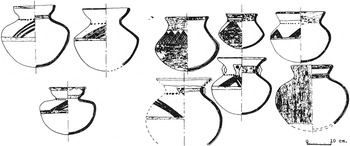
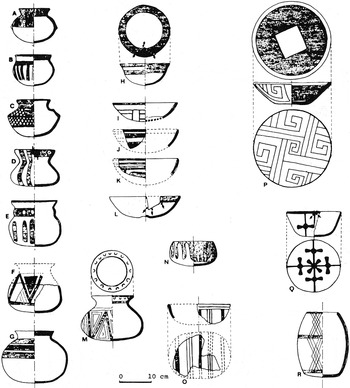
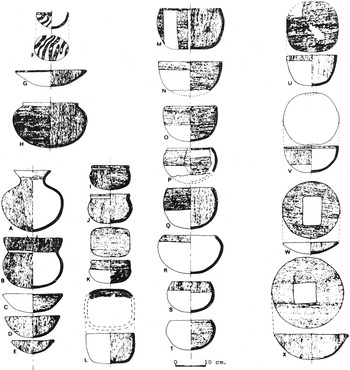
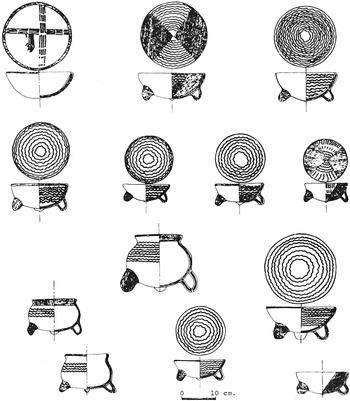
Galván classified the whole ceramic vessels into three distinct ceramic groups, or more correctly wares, called Colorines, Tabachines, and Arroyo Seco (Galván 1991:47–83). These or related groups have been identified in the adjacent valleys to the west (discussed in Beekman, this issue). All of these wares include red-on-cream bichromes among their possible color combinations. Aronson's technological analysis (Aronson 1993:125–200, 283–299; 1996) found consistent differences in production methods, and to a lesser degree pastes, that support the distinction based on typological grounds. Her use-wear analysis found that Colorines vessels were largely utilitarian (Figure 2), whereas Tabachines (Figure 3) and Arroyo Seco vessels (Figure 4) were much less heavily used, although still not produced for exclusive use as a mortuary ware (Aronson 1993:200–214). Tabachines vessels seem to have been particularly favored, and examples exist of Tabachines Rojo Crema vessels (the finest of the Tabachines wares) that have been found in tombs, even some that have been repaired or improperly fired (e.g. Aronson 1993:180, Figure 5.47; Beekman 1996a:474, Figure 5.10b; Galván 1991:69, Figure 23). This kind of conservation behavior is to be found elsewhere in Mesoamerica whenever high value prestige wares are involved (e.g. Kerr 1989:115, File no. 1835). Aronson concludes (1993:295) that none of these pottery groups were likely to have been made by full-time specialists, largely based on the lack of apparent standardization.

Examples of the most common Colorines type, Rojo sobre Café Ollas. Modified from Galván 1991:Figure 5.

Examples of Tabachines Rojo sobre Crema. Based on Galván 1991:Figure 24.

Examples of the most common Arroyo Seco type, Rojo Amplio. Based on Galván 1991:Figure 28.
Vessel iconography is predominantly geometric, although some more organic motifs have been noted. Designs include bands, cross-hatching, drips, propeller-shapes, horseshoes, clusters of dots, s-shapes, and, more rarely, rectilinear spirals referred to by some researchers as xicalcoliuhquis. Perhaps the most interesting decorative motif, at least in terms of interregional implications, is the pattern of parallel undulating lines (Figure 5) that Galván (1991:51–63) rightly describes as akin to the much later Mazapan red on buff ceramics of Epiclassic central Mexico, usually associated with Terminal Corral phase Tula (Cobean 1990:267–282). Far more complex iconography on ceramics that otherwise match Galván's type descriptions has been identified in the Tequila valleys to the west (Beekman and Weigand 2000), suggesting that the Atemajac valley societies placed less emphasis on symbolic signaling, or that the Tabachines cemetery did not encompass that variation. Even at Tabachines, however, the geometric designs on the shaft tomb vessels are frequently organized into broader layouts of clear ideological significance. In particular, we can point to the common pattern of the division of ceramic bowls into four quadrants, representing the four quadrants of Mesoamerican cosmology.

Examples of the Colorines type, Lineas Multiples. Based on Galván 1991:Figure 9.
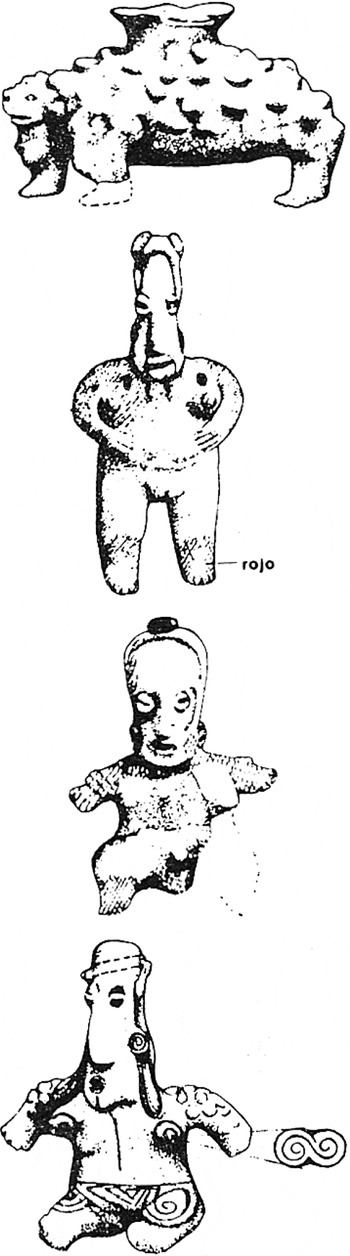
The Tabachines tombs are also important because they provide a context for the shaft tomb figures that have so thoroughly engaged archaeologists and art historians. The excavations recovered 10 hollow figures of the Elephantine and Ameca-Etzatlan styles (Figure 6), and three solid figures. Forms include a male hunchback, a warrior, an acrobat, a player of the Mesoamerican ballgame, and a female carrying a probable acocote, a tubelike gourd used to extract pulque from the maguey plant (Galván 1991:Figures 40–42, Appendix, Figure 18). Galván interprets the figures as symbolic of living servants of the deceased, being interred to continue their service into the next life (Galván 1991:103). Many of the figures (though not the hunchback!) might equally be interpreted as self-representations of the deceased themselves. Among the other items found in the tombs are weaponry in the form of obsidian points and stone spearthrower hooks, as well as stone yokes associated with the ballgame (Galván 1991:Figures 39, 46). The presence of these artifacts in the tombs was no mere posturing. Pickering and Cabrero (1998:75) discuss a skeletal injury in a male from the Huitzilapa shaft tomb (López and Ramos, this issue) that may correspond to the repetitive use of a spearthrower, the remnants of which were found alongside him. Clearly the deceased were no strangers to these kinds of activities, and the social roles of the interred and the figures overlap to a degree still to be determined.

Hollow figures recovered from the Tabachines shaft tombs. Modified from Galván 1991:Figures 41 and 42.
Other artifacts from the Atemajac valley shaft tombs range from utilitarian goods to exotic prestige objects. Several of the dead were accompanied by manos and metates for grinding foodstuffs, as well as by obsidian blades and several forms of scrapers (Galván 1991:83–94, Figures 37–39). Personal decoration occurs in the form of obsidian and shell jewelry (see also Beekman 1996a:790–799, Figures 6.16,6.17; Long 1966:228–230 for more examples of the former) and clay earspools, as well as cylinder seals possibly used for body decoration (Galván 1991:Figures 32, 45–48). There are also several anthropomorphic obsidian figures (Beekman 1996a:Figure 6.16; Galván 1991:Figures 37, 38, 47; better illustrated examples are in Beekman, this issue) that are simpler than the more finely made examples from the burials at the Temple of the Feathered Serpent at Teotihuacan (Cabrera Castro et al. 1991:Figure 10).
Galván takes a Neo-Marxist approach to interpretation in his monograph on the excavations, focusing on the delineation of different classes. He emphasizes in particular that the deceased in the richest tombs had clear access to unique and high-value goods and quantities of ceramic vessels that others did not. He also points to the pattern of burial, in which 11 of the tombs included multiple interments (up to five in a single tomb). The question of whether these tombs were used once, or whether they were reused numerous times, is critical to their interpretation. Sequential inhumation, or repeated use of the same tomb for later burials, would imply social continuity and some kind of corporate basis to the shaft tombs. Simultaneous inhumation, or the burial of multiple individuals as a single event, could signify that some of the dead could have been victims of human sacrifice. Based on several points, none entirely convincing on their own, the initial conclusion was that each of the tombs had been sealed after single burial events (Schöndube and Galván 1978:154–156). Galván has since noted that Tomb 8 might be an exception (1991:149). A re-examination of the published tomb maps (in Galván 1991) suggests that some of the bodies within Tombs 1, 2, 3, 6, 8, and 11 are crammed over to one side, or stacked atop one another. This strongly suggests repeated tomb use, a behavioral pattern that has turned out to be common among certain Mesoamerican elites (most tightly documented in Chase and Chase 1996). In fact, the disagreement over simultaneous versus sequential inhumations, and their accompanying social implications, virtually duplicates the much older debate over the Zapotec tombs of Oaxaca (Caso 1933; Lind and Urcid 1983). Following the interpretation that the Tabachines tombs were primarily single burial events, Galván argues that each tomb had a single primary individual for whom the tomb was built, while the other inhumations were sacrificed retainers accompanying the primary individual into the next world (Galván 1991:234–240). Beekman supports the sequential inhumation hypothesis and the association of tombs with corporate kin groups (Beekman 2000). Some other participants in this special section also hold the position that sequential interments are reflected in their case studies (e.g. Oliveros; Valdez et al.), while others argue for single interments of lineage or community members (e.g. Mountjoy and Sandford). Some of these may be regional differences.
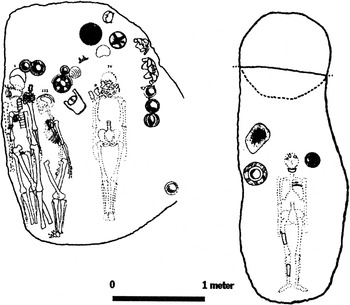
If we compare the variation across tombs, the analysis of mortuary practices and interred goods defines two categories Galván describes as the “Dispossessors” and the “Dispossessed,” or the “Haves” and the “Have-Nots” (Figure 7). He notes that the wealth disparity between the two is not only evident but also far greater than many investigators have come to associate with the society that built the shaft tombs (1991:259–284,291–298). This is particularly significant in light of the fact that all of the Atemajac valley shaft tombs fit comfortably within the third and lowest rank of Weigand's hierarchy of shaft tombs (Weigand 1985:64–66), and they do not even approach the amassed wealth in higher ranking tombs such as Huitzilapa (López and Ramos, this issue). The Tabachines appears relatively low ranking compared to the better-known tombs further to the west. But we must also remember that shaft tombs are themselves a special form of burial that was not available to everyone. In the Tequila valleys to the west, where Weigand has kept a running tally of the different burial forms during the shaft tomb era, over 90% of the burials are simple pit tombs (Weigand 1985:64–66). In other words, the known Atemajac valley shaft tombs represent only a narrow slice of the full range of mortuary variability, somewhere along the border between high- and low-ranked groups.

Two examples of burial chambers from Tabachines. On the left is Tomb 6, an example of a high-status tomb. On the right is Tomb 9, an example of a low-status tomb. Modified from Galván 1991:Figures 72 and 89.
This distinction seems to decline with time. The later Tabachines tombs show a decrease in the quantities and degree of elaboration of grave goods. Entire categories of artifacts (among them the hollow figures and obsidian jewelry) drop out of the assemblage, and single burials are now the dominant pattern. With the disappearance of the major evidence for social ranking among the later shaft tombs, Galván argues for a transformation of the social system toward a relatively more egalitarian pattern (1991:256–257).
There are other ways to interpret this shift, however. It could, alternatively, be a reflection of the increasing peripheralization of the Atemajac valley vis à vis the developing core of the Teuchitlan Tradition to the west. Or, it could actually reflect an overall increase in social stratification within the system of which the Tabachines area was a part. The gulf between the uppermost elites and the rest of society could actually be widening, and the truly high-status individuals in the society might no longer be found in a small local cemetery like that at Tabachines. Seen from the perspective of a single cemetery serving a local community, the increasing marginalization and decline in access to status goods would appear as a growing egalitarianism. The Tabachines cemetery clearly allows us to evaluate social change in a way that a single spectacular tomb does not, but we will need to excavate entire cemeteries at different levels of the settlement hierarchy.
SHAFT TOMBS WITHIN THE ATEMAJAC VALLEY SETTLEMENT SYSTEM
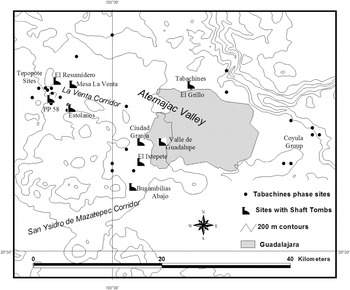
The Atemajac valley is located in the highlands of central Jalisco and is the site of the modern metropolis of Guadalajara, Mexico's second largest city (Figure 8). The valley is delimited to the north, south, and west by mountains, with major passes like the La Venta Corridor to the west and the San Isidro de Mazatepec Corridor to the southwest. To the north and east is the deep canyon of the Rio Santiago. The valley floor ranges between 1,500 and 1,600 m above sea level, and the region is considered semi-arid, particularly when one takes into account that most of the 900–1,000 mm of annual rainfall falls from May to October. Despite the contemporary population densities, the valley was not the primary regional center of population in early pre-Columbian times, in large part because of the distribution of natural resources. Water sources in the valley are limited to small streams and springs, many seasonal, and sources for crop irrigation are not impressive. A limited number of sources for obsidian are to be found in the mountains along the western edge of the valley (e.g. Beekman 1996a:100–106). The Tequila valleys further west were the focus of large population concentrations and in-situ development of complex societies during the pre-Columbian epoch. This is perhaps not surprising in light of the presence of numerous high-quality obsidian sources, as well as the presence of two lakes, with the accompanying increased diversity in wildlife (Weigand 1996). The potential of the valleys to the west is undeniable. Although the Atemajac valley may not have been a major center of pre-Columbian population, numerous village sites have been identified through archaeological survey.

Map of Tabachines phase settlements over 1 ha in size within the Atemajac valley, with special reference to sites mentioned in the text.
The Atemajac valley today, with its large urban population, has been a hostile environment for archaeology, because of urban growth and the more deliberate ravages of looting. Galván's main settlement survey, carried out primarily through the use of aerial photos and reports from the inhabitants of the valley, has been partial and focused toward larger and more directly threatened centers. The data have not yet been organized into a coherent settlement hierarchy that we can present at this time, but we can provide a general description of Tabachines phase settlement (see also Galván and Beekman 2001b). We can supplement these data with the results of an intensive survey carried out on the western margins of the Atemajac valley, in the La Venta Corridor that leads into the Tequila valleys and the core of the Teuchitlan Tradition (Beekman 1996a).
When viewed at a grand scale, settlement in the Atemajac valley was generally associated with water sources. Accessible year-round sources are limited, however, so settlement continues to be located in the same four regions, regardless of the specific archaeological phase. The settlements in the center of the valley around El Grillo revolve around the small Arroyo Atemajac and Arroyo Seco. Northern sites relied upon proximity to the Arroyo Ocote and other seasonal streams. Sites around Ixtepete, in the southwest, are generally associated with seasonal streams and the numerous springs found in this part of the valley. The eastern settlements are found along the upper slopes of the canyon of the Rio Santiago. Access to the Rio Santiago would have been difficult, but the cluster of terraced sites along these upper slopes of the canyon suggests that it was not prohibitively so, and in either case there are natural springs in this region as well.
During the Tabachines phase, however, there was an additional focus to Atemajac valley settlement that sacrificed easy access to water supplies for proximity to communication routes. Survey in the La Venta Corridor to the west encountered increased settlement and architectural investment in this region during the Tabachines phase, specifically the later subphase, signaling the greater emphasis on the passage of people, goods, or information between valleys. This may correspond to the period of greatest centralization of the Teuchitlan Tradition, and Beekman has argued elsewhere that the polity based in the Tequila valleys established several strategic sites on the passes into its political core (Beekman 1996a). The Atemajac valley would have been marginalized by these changes, and this appears to correspond chronologically to the later Tabachines phase and the decline in the elaboration of offerings in the Tabachines tombs.
The cemetery of Tabachines is, as already stated, a bare 500 m from the main concentration of public architecture at the prehistoric settlement of El Grillo. The most obvious architecture at the site, however, dates rather clearly from the succeeding El Grillo phase (Galván and Beekman 2001a), and it is unclear just how large the settlement might have been in Tabachines times. No single settlement within the valley appears extensive enough to have had a population of more than a thousand people, unless there is a great deal more residential material waiting to be found. Weigand (1996:202) has estimated that each major shaft tomb cemetery identified within the Tequila valleys typically tends to be associated with 18 residential compounds, which he in turn estimates to have had around 15 people per compound. These compounds have not yet been defined in print. While the minor cemetery of Tabachines may have had less associated settlement, this should give some very rough sense of the expected population in the immediate area. Unfortunately, all evidence of residential settlement is probably beneath the streets of northern Guadalajara. A synthesis of the scattered salvage excavations carried out across the city would be a significant addition to our understanding of the living society that built the shaft tombs.
Some of the other shaft tombs identified in the Atemajac valley are more clearly connected to single component Tabachines phase settlements. A cemetery was located at the site of Estolanos in the La Venta Corridor (Beekman 1996a:278–287). The information recovered there was far less complete than at Tabachines, because the cemetery had been looted some time before we located it, and the open tombs had mostly collapsed. Nonetheless, the cemetery area was located at the northernmost end of a long narrow mesa with 5 ha of fairly intensive occupation, which we might estimate to represent perhaps 125 people. We located another cemetery (PP.58) beneath the town of La Primavera, but no surviving evidence of residential settlement could be identified. At Bugambilias Abajo, in the southwestern part of the valley, and possibly at El Resumidero, in the west, shaft tombs occurred in close proximity to Teuchitlan Tradition public architecture (Beekman 1996a:159–164; Galván and Beekman 2001c), although not directly below the outer satellite structures as at Huitzilapa and other centers (see López and Ramos, this issue). Another looted tomb at Ixtepete was located near a more modest residential structure (Fernández and Deraga 1986).
Shaft tombs therefore occur in various locations relative to settlement. They can occur grouped into cemeteries associated with small villages; Estolanos and perhaps Tabachines and PP.58 fall into this category. Some can occur associated with individual residential structures, as at Ixtepete. These may represent high-status individuals living in the countryside—perhaps we should begin to consider a model of scattered estates or an otherwise more differentiated rural area (see Robin 2003). Presumably the tombs from Ciudad Granja and Valle de Guadalupe were once associated with small dispersed structures, but all evidence of the latter has disappeared. The tombs found at Bugambilias and suggested at Resumidero are interesting for different reasons, because their presence near public architecture of the Teuchitlan Tradition may indicate that the deceased were specifically political elites. Hence, settlement contexts for the Atemajac valley tombs appear to be quite comparable to those from the adjacent Tequila valleys.
Other aspects of society, politics, and economics are difficult to evaluate, but some hints occur through use of the more detailed chronology. Our detailed survey in the La Venta Corridor found the area lightly populated during the Early Tabachines subphase. The two small villages were to be found at either extreme of the corridor, and the one shaft tomb cemetery (PP.58) was located in the very center. The Middle Tabachines subphase witnessed rapid growth in settlement, as measured by site area, and a series of fortified sites were founded on Cerro Tepopote. Beekman (1996a, 1996c) interprets the hilltop sites as part of a directed strategy of boundary establishment by the polity in the Tequila valley core to the west. Not only were the sites militarily valuable as defensive locations with commanding views of the pass and adjoining valleys, they were also major symbols of political power to settlers in the region. They may have centralized some economic functions as well—test excavations found workshop debitage from the production of the obsidian jewelry known from the tombs (Beekman 1996a:368, 790–799). Another circle of the Teuchitlan Tradition was built just to the north at El Resumidero, and that at Bugambilias Abajo to the far south should also have been constructed by this time (Figure 3). Much of the minor settlement in the La Venta Corridor seems to have vacated the area by the Late Tabachines subphase, leaving primarily the hilltop sites. Whether this represents the concentration of population in the Tequila valley core, the increasing specialization of the boundary area, or some misunderstanding of the chronological sequence remains unclear.
The end of the Tabachines phase is still a matter of some debate. The succeeding El Grillo phase is marked by a change in mortuary pattern to single-interment box tombs with very different pottery and design complexes, as well as replacement of the Teuchitlan Tradition circular architecture by rectangular platforms or U-shaped public buildings, some with talud-tablero facades (cf. Aronson 1993; Beekman 1996b; Galván 1984; Galván and Beekman 2001a, 2001b). Although we disagree as to the timing of this transition (Galván argues a.d. 300, while Beekman suggests a.d. 550) and its source (Galván says Teotihuacan, and Beekman argues for the Bajio of Guanajuato), we agree that it was a rapid and dramatic change partly involving new populations (Beekman and Christensen 2003; Galván 1984f).
CONCLUSIONS
The salvage excavations described here were a tremendous opportunity to collect data on a substantial number of shaft tombs. Up to that point, shaft tombs were typically recorded long after looters had already pillaged them, and the level of confidence in the data recovered was correspondingly low. Most of the tombs recovered in the Atemajac valley were initially located because of modern-day construction, which did damage some of the cultural material, but this hardly nullifies the significance of the work. This is one of the methodological lessons of the Tabachines excavations, along with lessons regarding salvage archaeology in general; projects initiated for salvage purposes can and should be analyzed and published to the limits allowed by the recovered data. The Atemajac valley project also made use of the experience gained through the salvage work, and it found two additional tombs.
It is in the arena of regional culture history, however, that the Atemajac valley shaft tomb excavations make their greatest contribution. Although some radiocarbon dates were obtained previously for shaft tombs in Nayarit and Jalisco, data of this nature are not very useful unless tied to defined complexes of material culture. In this, the Atemajac valley project was pivotal for modern shaft tomb research. The definition of the Tabachines phase through typological analysis of ceramics, lithics, figures, and other materials is baseline archaeological work that can be built upon and modified by future research. The Tabachines study also provided extensive information on a population of tombs, allowing a better understanding of the range of variation, and the significance of any particular tomb can be better contextualized.
In the area of broader theory, the Atemajac valley study defined the shaft tombs as the Jalisco variant of the wider Mesoamerican pattern of Late Formative/Classic period ranked societies. Galván's original conclusions were more strongly worded than this, interpreting the Tabachines tombs as indicative of a society following a Tributary or Asiatic Mode of Production (Galván 1991:297–303). Considering the data that have come to light over the past 30 years regarding West Mexican society, we can regard the Atemajac valley project as one of the earliest steps toward the recognition that complex societies were developing in western Mexico more closely in step with the rest of Mesoamerica.
RESUMEN
En los años setenta fueron excavados por personal del Instituto Nacional de Antropología e Historia 25 tumbas de tiro en el valle de Guadalajara, Jalisco. El cementerio de Tabachines todavía destaca como la muestra más representativa de las tumbas de tiro del Occidente de México. Pero el panteón de Tabachines todavía queda menospreciado para el estudio del llamado tumbas de tiro. Aquí consideramos de nuevo la investigación original en el contexto de descubrimientos mas recientes. Pretendemos demostrar que el panteón de Tabachines presenta evidencia para desigualdades sociales en la cultura que utilizaron las tumbas de tiro, que había cambios mayores a través de la fase Tabachines, y había similitudes entre los ritos mortuorios que se practican en las tumbas y los de otras áreas de Mesoamérica. Con estos fines, discutimos la distribución de ofrendas entre las tumbas, la clasificación de la cerámica encontrada, las primeras figuras huecas recubiertas de contextos excavados y otros datos. También consideramos datos no disponibles en la publicación original, como la distribución de asentamiento en el valle de Atemajac basados en dos proyectos de recorrido.
ACKNOWLEDGMENTS
The authors thank the Centro Regional INAH Jalisco for its institutional support to Galván over the years, and the National Science Foundation for award DBS-9221787, Explorer's Club, Sigma Xi, and the Vanderbilt University Dissertation Enhancement Grant for financial support to Beekman's project during the field seasons in the La Venta Corridor. We also thank the anonymous reviewers for their suggestions. Permits were provided by INAH.