1 Introduction
Linguists have long been interested in studying sibilant sounds in languages as the acoustic and spectral properties presented in these sounds pose many interesting questions. According to the World Atlas of Language Structures (Dryer & Haspelmath Reference Dryer and Haspelmath2013), although most languages have sibilant fricatives or affricates, the number of these sounds within each language is not usually large. According to Maddieson (Reference Maddieson1984, as cited by Maddieson Reference Maddieson, Hardcastle, Laver and Gibbon1997), out of the 453 languages he studied, 80% of them have a type of /s/ in their phonetic inventory. The place of articulation (PoA) of these fricatives is, generally, either dental or alveolar (Mielke Reference Mielke2018: 140). Maddieson (Reference Maddieson2014) maintains these results, where more than 500 languages have already been studied. For instance, that is the case for Northern Peninsular Spanish (NPS), which has an alveolar fricative /s/ and a post-alveolar affricate /tʃ/.
In this study, we examine the realization of sibilants in two languages in contact, Basque and Spanish (the NPS variety, specifically), which show different sibilant systems in their phonetic inventories. As just mentioned, NPS has two sibilant sounds, the voiceless alveolar fricative /s/, as in casa [kása] ‘house’, and the voiceless post-alveolar affricate /tʃ/, as in cacha [káʧa] ‘handle piece’. It is worth mentioning that NPS also has an interdental fricative phoneme /Θ/, as in caza [káΘa] ‘hunting’.
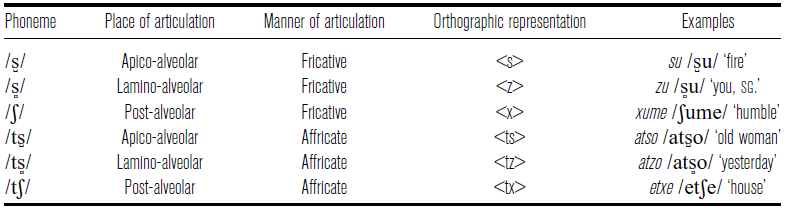
Sibilant system of conservative varieties of Basque (adapted from Beristain Reference Beristain, Unamuno, Romero, Etxebarria and Iglesias2018a: 70).

On the other hand, conservative varieties of Basque show a rich system of six sibilants of which three are fricative and the remaining three are affricate. All sibilant sounds in conservative varieties of Basque are voiceless. Table 1 shows the sibilant phonemes in conservative varieties of Basque with their respective features, orthographic representations, and examples within words.
Nonetheless, this system of sibilant sounds is not the norm for most Basque varieties. In many other dialects of Basque, mergers have occurred, reducing the number of sibilants in their phonetic inventories. In this regard, Basque shows different patterns regarding fricative and affricate sibilants.
As far as sibilant fricatives are concerned, most neutralizing varieties have merged the two alveolar phonemes in favor of the apico-alveolar /s̺/, a neutralization process known as seseo (Iribar & Isasi Reference Iribar and Isasi2008). Zuazo (Reference Zuazo2014) points out that this process appears in Biscay (western Basque Country), Araba (southwestern Basque Country), and some areas of Gipuzkoa (central Basque Country).
However, neutralization of alveolar sibilant fricatives in favor of the lamino-alveolar /s̻/ is also present in more geographically restricted areas in Gipuzkoa. Hualde (Reference Hualde2010) mentions that the varieties spoken in the towns of Azpeitia and Azkoitia are representative of this process, which is called zezeo (Hualde Reference Hualde2010, Beristain Reference Beristain2018b, Reference Beristain2019). Hualde (Reference Hualde2010) also explains that it has taken place since the 17th century. In El borracho burlado, a play written by Xabier Munibe (Reference Munibe1764), resident of Azkoitia and a speaker of that town’s variety, there are some instances of zezeo. For example, the sentence in Basque ezango diote ‘they will say that to him’ (Munibe Reference Munibe1764: 32) shows a <z> where there should be an <s>. This leads us to think the use of <s> and <z> was not clear because of the merger of such sounds.
In addition, although not so prevalent, the process of xexeo happens in Basque varieties in contact with French (Hualde Reference Hualde2010: 101). In those varieties, the sibilant fricative inventory includes the lamino-alveolar /s̻/ and post-alveolar /ʃ/ sibilants. The apico-alveolar sibilant /s̺/ has merged with /ʃ/ in favor of the latter.
There has been neutralization with affricates as well. Yet it has only been in one direction, namely the apico-alveolar /ts̺/ with the lamino-alveolar /ts̻/ in favor of the latter (/ts̺/ → [ts̻]; e.g. atso ‘old woman’, atzo ‘yesterday’, both pronounced as [ats̻o] in neutralizing varieties). This process is called tzetzeo (Gaminde et al. Reference Gaminde, Unamuno, Iglesias and Gandarias2013, Beristain Reference Beristain, Unamuno, Romero, Etxebarria and Iglesias2018a). All Biscayan varieties and several Gipuzkoan ones have undergone this process. However, although not so prevalent, txetxeo (merging of /tʃ/ and /ts̻/ in favor of [tʃ]), also occurs in some areas of Gipuzkoa (Hualde Reference Hualde2010: 98). Remarkably, as a reviewer points out, no varieties of Basque have been found to merge the affricate sibilants in favor of the apico-alveolar one (*/ts̻/ → [ts̺]; e.g., atso ‘old woman’, atzo ‘yesterday’, both pronounced as [ats̺o]), and therefore the most common pattern for the neutralization with affricates is the least common one with fricatives.
This study explores how bilingual Basque–Spanish speakers from different dialectal areas of the Basque Country produce anterior sibilant fricatives in Spanish and Basque. This study will compare the bilingual production of native speakers of three Basque varieties with different sibilant fricative systems: (1) Lemoa Basque, a variety where seseo has occurred; (2) Azpeitia Basque, a variety where zezeo is prevalent; and (3) Goizueta Basque, a conservative variety where the canonical system of Basque sibilants is maintained. Due to the absence of non-anterior sibilant fricative phonemes in NPS, i.e., the post-alveolar /ʃ/ phoneme, the present paper will focus on anterior sibilants.
In addition, we will also consider the effect of having several versus one anterior sibilant fricative(s) in Basque on the acoustic dispersion of /s/ in Spanish. In Flemming’s (Reference Flemming and Aronoff2017) Dispersion Theory, dispersion relates to how extensively the data distribution is stretched. Linguistic transfer will be examined via Flege’s (Reference Flege and Strange1995) Speech Learning Model, which states that mapping two different sound categories between two similar sounds in the first language (L1) and second language (L2) will be a daunting task.
The present paper starts by presenting research questions and predictions (Section 2). Next, a review of the literature concerning the production of sibilants in Basque and Spanish is provided (Section 3). Then, the study’s methodology is presented (Section 4). Finally, results (Section 5), a discussion (Section 6), and concluding remarks assessing support for hypotheses (Section 7) are given.
2 Research questions and predictions
An important prediction that Flemming’s (Reference Flemming and Aronoff2017) Dispersion Theory makes is that the degree of diffusion in phonetic realization of a given phoneme will be limited when there is a phonemic neighbor. Furthermore, Flege’s (Reference Flege and Strange1995) Speech Learning Model predicts that L2 learners will accommodate the production of similar L2 sounds to those in the L1. Based on these theoretical claims, the present study intends to answer the following research questions (RQs):
-
RQ1: Is the /s/ of monolingual Spanish speakers more acoustically dispersed than the /s/ in the Spanish of Basque speakers? If so, does having contrastive phonemic neighbors in Basque have an effect?
-
• Prediction 1: Yes, it is expected that monolingual Spanish speakers’ acoustic dispersion of /s/ will be more diffused than that of Basque speakers who have the phonemic contrast between /s̺/ and /s̻/ (non-merging speakers).
-
• Prediction 2: Within Basque varieties, those with a merger should show similar results to those of monolingual Spanish speakers, since only one anterior sibilant is kept in the Basque sibilant system and there is no neighboring phonemic contrast.
-
-
RQ2: Do Basque speakers transfer Basque /s̺/ to Spanish /s/?
-
• Prediction 1: Yes, speakers of varieties that show the apico-alveolar phoneme /s̺/ in their phonological inventories will transfer that sound onto Spanish /s/. This is due to strong similarity between the two sounds.
-
• Prediction 2: No, speakers of varieties that neutralize anterior sibilant fricatives in favor of the lamino-alveolar /s̻/ will not transfer that sound into Spanish /s/ due to acoustic dissimilarity between /s̻/ and the canonical /s/ in Northern Peninsular Spanish. These speakers should be able to map a new sound category. It is expected that the production of the new sound should show a less fronted place of articulation as opposed to Basque /s̻/.
-
-
RQ3: Is the realization of Spanish /s/ by Basque–Spanish bilingual speakers comparable to that of monolingual Spanish speakers?
Considering that Basque /s̺/ is described to be more acoustically and articulatorily similar to /s/ in Northern Peninsular Spanish than Basque /s̻/ is, the prediction is the following:
-
• Prediction 1: Speakers of Basque varieties that have /s̺/ in their phonological inventory should produce Spanish /s/ in a way that resembles the production of monolingual Spanish speakers more than Basque speakers of varieties that only have the lamino-alveolar sibilant fricative /s̻/.
-
3 Literature review
3.1 Theoretical framework
3.1.1 Paradigm
This study is situated within the cognitivist paradigm. ‘Cognitive aspects of second language acquisition […] seek to identify the mental processes that are implicated in learning and using a second language’ (Bialystok Reference Bialystok1994: 158). This study will analyze the influence that the L1 of bilingual speakers might have on the production of their L2. More specifically, the two languages under study are Basque (as L1) and Spanish (as L2).
Previous research has attempted to answer: (a) whether bilingual speakers have an L1–L2 intermingled phonological system or whether they have two different sub-systems (Etxebarria Reference Etxebarria1997, Bosch & Sebastián-Gallés Reference Bosch and Sebastián-Gallés2001, Flege Reference Flege, Burmeister, Piske and Rohde2002, Reference Flege2007, Sebastián-Gallés & Bosch Reference Sebastián-Gallés and Bosch2002, Flege, Schirru & MacKay Reference Flege, Schirru and MacKay2003); and (b) whether, in bilingual environments, L2 sound discrimination is more native-like in production (Flege Reference Flege and Strange1995) or perception (Best Reference Best2001). This study will aim to advance what is known about the former question. It will further study the contact effects between Basque and Spanish and whether L1-Basque L2-Spanish bilingual speakers are able to produce small L1–L2 phonetic differences.
3.1.2 Bilingualism and sound production
A model that tests L2 phonological acquisition is the Ontogeny and Phylogeny model (Major Reference Major2001). This model predicts that minor differences between L1–L2 sounds will result in a slow linguistic development. Minor differences include those that are not so easily perceivable, such as the difference between the PoA of English /t/ and /d/ and Spanish /t̪/ and /d̪/. Whereas these phonemes are alveolar in English, they are dento-alveolar in Spanish. The subtle difference in production (and perception) complicates their acquisition. Indeed, the variable under study in the present paper falls into this category. Yárnoz (Reference Yárnoz2001: 58), citing Navarro Tomas (Reference Navarro Tomás1923), summarized the differences between Spanish /s/ and Basque /s̺/ as follows:
The rounded tongue tip is pointed in Spanish, the convex pre-dorsum in Basque is concave in Spanish, the apico-alveolar narrowness is more open in Basque, the PoA is more retracted in Basque, and the position of the tongue is a little more palatalized than in the Spanish /s/ as a consequence of the greater lingual surface in contact with the palate.
Flege’s (Reference Flege and Strange1995) Speech Learning Model (SLM) makes the claim that the sound inventory of the L1 influences the production of the L2 in specific ways. If an L2 sound does not appear in the L1 inventory (i.e. new sound), mapping a new sound category should not be complicated for a learner. This is due to the fact that there is not a near phonemic category in the L1 phonological inventory. However, if the distinct L1 and L2 sounds are similar to one another (i.e. similar sound), the speaker might find it more complicated to map two different phonemic categories, and the L2 sound will assimilate to that of the L1. The latter situation applies to the present study, as NPS /s/ and Basque /s̺/ are extremely similar to one another. It could be expected that Spanish /s/ will assimilate to Basque /s̺/.
Another aspect to consider is the fact that, while NPS has one sibilant fricative in its phonetic inventory, conservative varieties of Basque have three. Flemming’s (Reference Flemming and Aronoff2017) Dispersion Theory posits that the dispersion degree of the phonetic realization of a particular phoneme will be narrower when there is another phoneme in the phonological inventory that shares several phonetic and phonological features with it. In other words, the acoustic diffusion of a given phoneme will be narrower when there is a near phonological neighbor. Thus, it could be expected that the acoustic dispersion of /s/ in Spanish as produced by Spanish L1 speakers will be greater than that of both the Spanish /s/ and the Basque /s̺/ of speakers of conservative varieties of Basque, which have two other sibilant fricatives in their inventory, i.e. the lamino-alveolar /s̻/ and the post-alveolar /ʃ/. Gaminde et al. (Reference Gaminde, Unamuno, Iglesias and Gandarias2013) also proposed this hypothesis while studying the realization of affricates in the Western Basque dialect.
In sum, having considered all these theoretical claims, it can be expected that L1-Basque speakers who have an apico-alveolar sibilant fricative in their inventories will assimilate the /s/ in Spanish to /s̺/ in Basque. Nonetheless, for speakers who do not have an apical sibilant in Basque, but rather only a lamino-alveolar one, it should be easier to produce the /s/ sound in Spanish in a similar way to monolingual speakers of this language, mapping it to a new phoneme category, since their native Basque sibilant is sufficiently distant from NPS /s/.
3.2 Previous work on Basque and Spanish sibilants
After Navarro Tomás’s (Reference Navarro Tomás1923) claim, several studies have attempted to investigate whether Basque speakers maintain their Basque /s̺/ realization for Spanish /s/. According to previous descriptions by Navarro Tomás (Reference Navarro Tomás1923) and Yárnoz (Reference Yárnoz2001), these phonemes have slightly different phonetic realizations in the two languages, but empirical evidence from several studies on the matter provide conflicting results.
Elejabeitia & Bizcarrondo (Reference Elejabeitia and Bizcarrondo1992) (as cited by Paasch-Kaiser Reference Paasch-Kaiser2013: 48) conducted a transcriptional and acoustic study and interviewed 22 students at the University of Deusto in Bilbao (the capital of Biscay). Half of them were Basque–Spanish bilingual speakers, whereas the other half were monolingual Spanish speakers. When the researchers analyzed the productions of the sibilant fricative /s/ in Spanish by inspecting the spectrograms, they deduced that the Basque–Spanish bilingual group’s Spanish /s/ showed acoustic features of the Basque apico-alveolar /s̺/. The researchers also state they did not find any instances of lamino-alveolar sibilant fricative productions for Spanish /s/ in their corpus. It needs to be mentioned that neither did the researchers control the participants’ dialectal areas nor did they provide a description of the participants’ origins.
Iribar et al. (Reference Iribar, Isasi, Seibane, del Hoyo, González, Fernández and González2005) analyzed the production of /s/ in Spanish by a group of Basque-dominant speakers in Lekeitio, a town in Biscay. It should be noted that, in the Basque variety spoken in Lekeitio, anterior sibilant fricatives are merged in favor of /s̺/. They wanted to investigate whether the productions of /s̺/, /s̻/, and /s/ were cross-linguistically shared between Basque and Spanish. They tested a small number of participants (n = 2). Speakers had to produce 70 words. The first 30 words were Spanish words with orthographic <s>, the next 20 were Basque words with orthographic <s>, and the last 20 were Basque words with orthographic <z>. The authors analyzed the mean intensity of the consonant, which was also further divided into three equal parts along the first 8 kHz of the spectrum, and the initial frication point for each sibilant (idem: 3). They analyzed the aforementioned variables because: (a) intensity is correlated with the degree of energy of the air expelled, where the greater the oral constriction, the lower the intensity values; (b) research had shown that the frequency range of Basque sibilants reaches up to 8 kHz; and (c) the initial frication point was believed to be correlated with the sibilants’ spectral peaks (and PoA), where the lower the initial frication point, the more retracted the PoA.Footnote 1 After observing the intensity values of the Basque and Spanish anterior sibilants, the researchers concluded that the merger of the three sibilants was evident since the difference in intensity and frequencies between the three sound categories was almost non-existent.
Iribar & Túrrez (Reference Iribar and Túrrez2015) carried out a more extensive study that encompassed several dialectal areas. They included 15 participants who had had little exposure to Spanish throughout their lives. The researchers wanted to determine whether these speakers had been able to develop a different target for Spanish /s/. They included several acoustic measurements in their analysis: (a) mean frequencies, where the higher the value, the more fronted the PoA of the sibilant; (b) intensities of the first three spectral peaks, and the start point of frication (see previous paragraph); and (c) bandwidths of the first three spectral peaks, where a lower and more fronted tongue position is correlated, respectively, with higher F1 and F2 values, and lower F3 values have usually been associated with lip rounding (Lindblom & Sundberg 1971, Fant 1992, as cited by Lawson, Stuart-Smith & Rodger 2019: 4365). Examining the results, Iribar & Túrrez (Reference Iribar and Túrrez2015) found that speakers showed practically identical results for the acoustic realizations of the Basque anterior sibilant fricative phonemes and the Spanish one. If speakers showed the lamino-alveolar /s̻/ phoneme in Basque, they showed higher spectral peaks and F1 values, which would correlate with the PoA of the sibilant and the lower position of the tongue while producing the lamino-alveolar sibilant. As in the previous study, the results were practically identical for these speakers’ Spanish. However, if a speaker did not have the lamino-alveolar /s̻/ phoneme but the apico-alveolar /s̺/ in Basque, spectral peaks were lower and the F1 and F2 values were lower too, indicating that the tongue showed a more elevated and retracted position in the oral cavity. Once again, this type of speaker showed almost identical results between their neutralized Basque sibilants in favor of /s̺/ and Spanish /s/. Iribar & Túrrez (Reference Iribar and Túrrez2015: 231) also point out ‘a few difficult cases to explain’, where a speaker did not have a lamino-alveolar /s̻/ phoneme in Basque but, when producing /s/ in Spanish they showed acoustic properties of the phoneme /s̻/ produced by speakers who had it. Nevertheless, it is important to consider that these researchers only tested participants with little exposure to Spanish. Nowadays, the degree of bilingualism is higher in the Basque Country, and younger speakers start having contact with Spanish from an early age at school.
Jurado (Reference Jurado2011) conducted an extensive study of Basque sibilant fricatives and the production of /s/ in the Spanish variety of the Basque Country. She focused on the north-central part of the Basque Country, specifically the Donostialdea and Bidasoa counties of Gipuzkoa. Within the Bidasoa county, only participants from Irun were selected. These areas were chosen because they exemplify conservative varieties of Basque. A total of 24 participants were recruited. The researcher divided the participants into three groups: (1) monolingual Spanish speakers, (2) Basque–Spanish bilingual speakers whose L1 was Basque, and (3) Basque–Spanish bilingual speakers whose L1 was Spanish. She utilized several dependent variables to examine the PoA of sibilants: (a) F2 values at the initial point of the sibilant, expecting lower F2 values for the lamino-alveolar /s̻/ phoneme since the position of the tongue is lower than for the apico-alveolar /s̺/ phoneme; (b) intensity (see previous paragraphs); (c) frequency cut-off, which shows the lowest frequency at which energy is concentrated, and according to Ladefoged & Maddieson (1996), as cited by Jurado (Reference Jurado2011: 103), the bigger the length of the vocal tract downstream of the constriction is, the lower the frequency cut-off will be; (d) center of gravity (CoG), which has been correlated with the PoA of sibilants showing lower values for a more retracted PoA, and higher values for a more fronted PoA; and (e) spectral peaks (see previous paragraphs). According to her results, Basque–Spanish bilingual speakers whose L1 was Basque did not have three clear phonetic targets for Basque /s̺/, /s̻/, and Spanish /s/. These speakers had only two realizations, one for Basque /s̻/ and one for the two apico-alveolar phonemes. Against her initial predictions, Basque–Spanish bilinguals whose L1 was Spanish showed lower CoG values for the production of Basque /s̺/ and Spanish /s/ as opposed to the /s/ produced by monolingual Spanish speakers. This would imply that, even if Spanish was their L1, the influence of Basque /s̺/ was still present in the production of Spanish /s/ in the Spanish variety of the Basque Country.
Segura (Reference Segura2014) studied the production and perception of Basque sibilants by L1 Spanish speakers with different degrees of proficiency in Basque. According to her production results, the degree of proficiency did not significantly affect the results. As mentioned by one reviewer, the author found that speakers produced the lamino-alveolar sibilant /s̻/ in a more posterior region than is reported in the literature, and thus their pronunciation is closer to that of the apico-alveolar sibilant /s̺/.
Larraza, Samuel & Oñederra (Reference Larraza, Samuel and Oñederra2016a) examined the effect of dialectal variation on the discrimination of Basque sibilant fricatives. They tested the discrimination of sibilant fricatives in speakers from a merging variety and a non-merging variety. Their results show that speakers who had a merger in their variety had lower accuracy scores in a discrimination task and higher response times as opposed to speakers who had a contrast between the two alveolar sibilant fricatives in Basque. This indicates that the lack of the contrast in their native phonological inventory complicated the correct discrimination.
In a different study, Larraza, Samuel & Oñederra (Reference Larraza, Samuel and Oñederra2016b) compared the discrimination of Basque alveolar sibilants by Basque–Spanish (simultaneous, early, and late) bilinguals and Basque–French (simultaneous and early) bilinguals. According to their results, late Basque–Spanish bilinguals (L1 Spanish, L2 Basque) showed lower accuracy scores and higher response times in the critical condition, i.e. /s̺-s̻/, as opposed to the other two Basque–Spanish bilinguals. In the case of Basque–French bilinguals, the difference between control and critical pairs was not prevalent. Furthermore, early bilinguals showed higher response times than simultaneous Basque–French bilinguals. However, they also showed slightly higher accuracy scores than simultaneous bilinguals, showing a lack of correlation between the two parameters.
3.3 Acoustic parameters for the classification of sibilants
Most recent acoustic studies conducted on sibilant fricatives have turned to the study of the spectral moments of these sounds (Jongman, Wayland & Wong Reference Jongman, Wayland and Wong2000, Nissen & Fox Reference Nissen and Fox2005, among others). The four spectral moments of sibilant sounds are identified with the four typical statistical measures of a random distribution (mean, standard deviation, skewness, and kurtosis). This study will include the analysis of the first two spectral moments, which are commonly known as the center of gravity of the energy (henceforth, CoG, see e.g. Boersma Reference Boersma2002), also called ‘centroid’, and the variance, also called the ‘standard deviation’ (henceforth, SD).
Several studies have determined the apparent relationship between the PoA of fricatives and the CoG value (Jongman et al. Reference Jongman, Wayland and Wong2000). The general correspondence is that the more retracted the PoA, the lower the CoG value. For instance, Jongman et al. determined the difference between English /s/ and /ʃ/, and showed that the CoG of /s/ (6133 Hz) was higher than English /ʃ/ (4229 Hz).
Other authors have opted for using spectral peak as the variable under study (Reidy Reference Reidy2016). The main reason for that is that peak frequency has been found to correlate more strongly than CoG with speakers’ perceptual prototypes (Newman, Clouse & Burnham Reference Newman, Clouse and Burnham2001, Newman Reference Newman2003). The correlation between the spectral peak with PoA is similar to that of CoG and PoA. As observed in Johnson (Reference Johnson2011: 130), the higher the spectral peak, the more fronted the PoA. However, according to the literature, both spectral peak and CoG can serve to yield accuracy with respect to the PoA of the phoneme being produced (Li, Edwards & Beckman Reference Li, Edwards and Beckman2009). Since CoG has been shown to be an accurate variable to use to determine the PoA of a sibilant phoneme, this is the measurement that will be used in this study (see Jesus & Shadle Reference Jesus and Shadle2002 for a different approach).
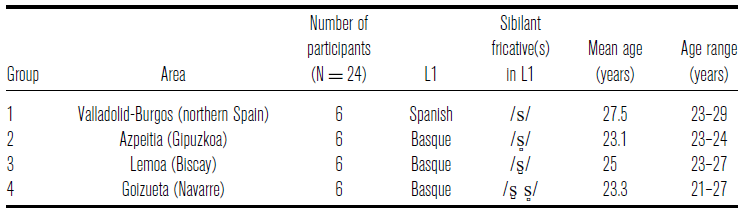
Participants and their backgrounds.

4 Methodology
4.1 Sampling
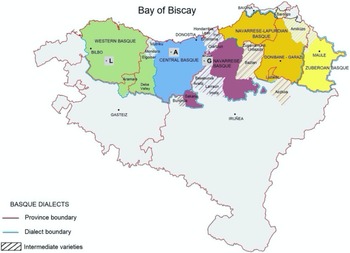
A total of 24 female participants were recruited in this study. With a small sample size, it was thought it would be sensible to limit the speakers to one gender, and this would help to preserve normal distribution in the data. All participants had received college education at the time of the experiment, and none of the participants reported any history of speech, language, or hearing disorders. Participants were further divided into four different groups. Serving as control, six Spanish monolingual speakers were elected for Group 1 (n = 6). These speakers were from the Valladolid–Burgos area, a north-central area in Spain. The remaining three groups were Basque–Spanish bilingual groups. These groups were chosen because they represent different scenarios of phonemic contrast in Basque sibilant fricatives. Group 2, from Azpeitia (in the Urola Valley of central Gipuzkoa), merges the two alveolar phonemes in favor of the lamino-alveolar /s̻/ (n = 6). Group 3, from Lemoa (in the Arratia Valley of south-western Biscay), merges the two alveolar sibilant fricatives in favor of the apico-alveolar /s̺/ (n = 6). Group 4, from Goizueta (in north-western Navarre), represents a conservative non-sibilant-merging variety of Basque (n = 6). Table 2 summarizes the main information regarding groups, and Figure 1 shows a map of the Basque Country with its dialectal areas where the three towns under study have been marked.
The Basque varieties of Azpeitia, Lemoa, and Goizueta Basque have been previously studied with respect to other linguistic matters such as accentual systems (Hualde Reference Hualde1997), verbal morphology (Yrizar Reference Yrizar1991, Reference Yrizar1992, Reference Yrizar2008), and lexical usage. Several dialectological studies mention Azpeitia Basque (Bonaparte Reference Bonaparte1869, Yrizar Reference Yrizar1991), but only a few studies in recent years have attempted to give a more detailed phonological description of it (Hualde & Beristain Reference Hualde and Beristain2017, Reference Hualde and Beristain2018, Reference Hualde, Beristain, Etxebarria, Iglesias, Lejarreta and Romero2019, Reference Hualde and Beristain2020, Beristain Reference Beristain2018b, Reference Beristain2019). As far as Lemoa Basque is concerned, Gaminde (Reference Gaminde2002) and Gaminde et al. (Reference Gaminde, Unamuno, Iglesias and Gandarias2013) have contributed to better understanding the phonological processes arising in varieties in that area. Dialectological descriptions of Goizueta Basque have been given in Zubiri & Perurena (Reference Zubiri and Perurena1998) and Zubiri (Reference Zubiri and Zuazo2000). A phonological analysis of this variety in the format of an Illustration of the IPA was published in Hualde, Lujanbio & Zubiri (Reference Hualde, Lujanbio and Zubiri2010). Lujanbio’s (Reference Lujanbio2016) doctoral dissertation examines linguistic variation within this town. There are also a number of studies concerned with the pitch accent system of Goizueta Basque including Hualde & Lujanbio (Reference Hualde, Lujanbio, Artiagoitia and Lakarra2008), Hualde, Lujanbio & Torreira (Reference Hualde, Lujanbio and Torreira2008), Hualde & Beristain (Reference Hualde and Beristain2018), and Lujanbio (Reference Lujanbio2018). Nonetheless, no study focusing on sibilants in three participant samples with different sibilant systems has been previously conducted, and this project will aim at addressing this gap in research.
Basque varieties under study. L: Lemoa, A: Azpeitia, G: Goizueta (retrieved from Zuazo Reference Zuazo2019 with author’s permission)

4.2 Data collection
Two production experiments were conducted. One of the experiments involved eliciting Basque data and the other one involved Spanish data. For obvious reasons, Spanish monolingual speakers only participated in the experiment that involved eliciting Spanish data. Half of the speakers in each of the three Basque groups produced Spanish first, and then Basque, whereas the rest first produced Basque and then Spanish. The assignment of the order type was randomized. This experimental variable was included in order to determine whether language order could have an effect on the production of sibilants.Footnote 2
Participants in this study were recorded reading sentences in Basque and/or Spanish. The target sentences were read from PowerPoint slides shown in a 13-inch MacBook Pro Retina Display, 2015 model laptop. A MicroTrack 24/96 recording machine and a SONY F-720 external microphone were used to collect the data. The frequency range of the microphone was 50–13,000 Hz. The sampling rate was 44,100 Hz. The researcher held the microphone approximately 10 cm (almost 4 inches) away from the participants’ mouths. All recordings took place in a quiet room in the participants’ respective towns.
In target words, the quality of vowels preceding and following /s/ in Spanish, and /s̺/ and /s̻/ in Basque was controlled. The first condition was that the second vowel is always a vowel in the periphery of the vowel space, i.e. a corner vowel /a, i, u/. Regarding the preceding vowel, it has been shown that vowels producing distinct coarticulatory effects affect CoG measurements differently. For example, Fujisaki & Kunisaki (Reference Fujisaki and Kunisaki1978) found that the [+round] feature of the vowel /u/ lowered the mean frequencies of /s/ in Japanese. Taking this possible effect into account, the most frequently occurring combinations in V1SV2 (where V2 is a corner vowel) in Beristain’s (Reference Beristain2018b, Reference Beristain2019) corpus were considered. This corpus is a dialectological dictionary of Azpeitia Basque that includes a thorough phonological description of the variety and almost 3,000 lexical entries of every-day use. Thus, the list of the considered environments for the sibilant to appear both in Basque and Spanish is the following one: /a_a, a_i, a_u, e_a, u_i/. It needs to be mentioned that the most important factor is the following vowel (V2) because the sibilant and V2 are in the same syllable.
Jurado (Reference Jurado2011) and Muxika-Loitzate (Reference Muxika-Loitzate2017) point out that the presence or absence of stress on the syllable where the sibilant appears has an effect on the CoG, with higher CoG values when the syllable is stressed. In the Spanish experiment in this study, the stress of the syllable was controlled. However, because of dialectal variation with respect to stress location in Basque varieties and inter-speaker variation within each variety it could not be controlled in Basque.
Thus, regarding the total number of tokens per speaker, monolingual Spanish speakers produced (1 sibilant) × (2 V2-stress conditions) × (3 V2 conditions per stress condition, /a/: 4 words, /i/: 4 words, /u/: 2 words) × (2 repetitions) = 40 tokens per speaker, × 6 speakers = 240 tokens. The number of tokens produced in Spanish per group was the same. In total, then, there were 240 tokens × 4 groups = 960 tokens. With respect to the Basque experiment, the number of tokens per speaker is the following: (2 sibilants, /s̺, s̻/) × (3 V2 conditions, s̺ (/a/: 9 words, /i/: 7 words, /u/: 4 words) and s̻ (/a/: 8 words, /i/: 8 words, /u/: 4 words)) × (2 repetitions) = 80 tokens per speaker, × 6 speakers per group = 480 tokens, × 3 groups in total = 1,440 tokens in Basque. Therefore, the total number of tokens considering the two languages is 2,400. The list of words produced in Spanish and Basque are included in Appendix A and Appendix B, respectively.
Participants were asked to read a list of target words put into context. They read the carrier phrase I said
 in Spanish and I/She said
in Basque. In the case of Spanish, the stimulus sentence was Digo
+ additional phrase; and in the case of Basque, in order to accommodate to the participants’ native varieties, the stimulus sentences appeared in the regional variety. Since the number of tokens to be produced was twice as many as in Spanish, the decision was made to vary the subject of the sentence on some occasions so that the task would not feel so repetitive. Note that Basque is a pro-drop language and therefore the natural tendency is to drop subject pronouns. The grammatical information appears in the auxiliary verb after the main verb, which in the present study is esan ‘to say’. In the case of Azpeitia Basque, the stimulus sentence was
esan det/du, for ‘I/She’ respectively; for Goizueta Basque, it was
san dut/du; and for Lemoa Basque, the stimulus sentence was
esaot (< esan dot) /esan dau. The standard Basque form would be esan dut/du.
4.3 Data analysis
The variables of interest in this experiment are the first and second spectral moments of sibilant fricatives, i.e. the CoG and SD. The original control variables were the phoneme (levels: Spanish /s/, Basque /s̺/, Basque /s̻/), order of experiments (levels: Spanish–Basque, Basque–Spanish), preceding vowel (V1) (levels: /a, e, u/), following vowel (V2) (levels: /a, i, u/), and stress of syllable (levels: stressed, unstressed). An intercept for word was included and a random slope for phoneme within speaker was included (contemplating the fact that some speakers might merge the two Basque phonemes).
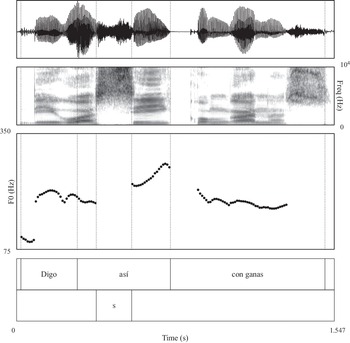
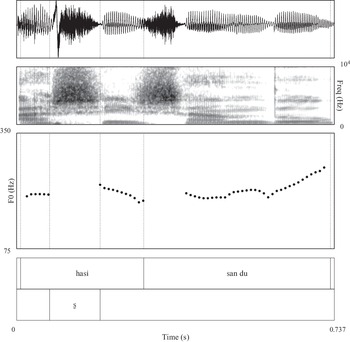
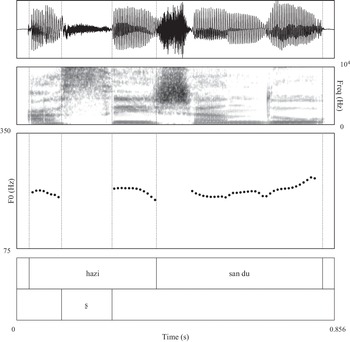
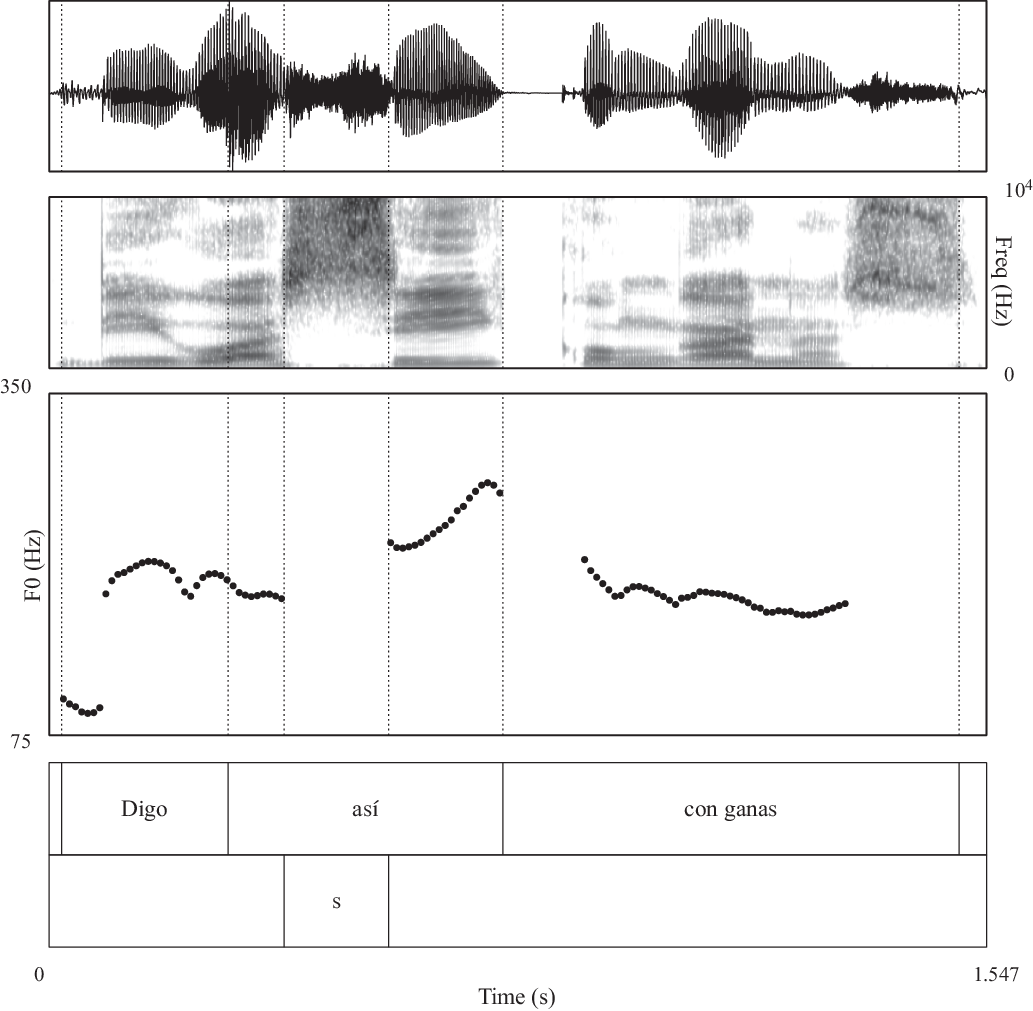
The realizations of Spanish /s/ and Basque /s̺/, and /s̻/ were analyzed via Praat (Boersma & Weenink Reference Boersma and Weenink2019). Different criteria were employed to segment sibilants from neighboring vowels: (a) inspection of the acoustic properties of the waveform (sibilants under study show aperiodic waves as opposed to periodic ones in vowels); and (b) inspection of the spectrum (voiceless sibilant fricatives show no f0 due to the lack of wave periodicity as opposed to vowels showing f0). Figures 2, 3, and 4 show an illustration of the waveform, spectrogram, f0, and segmentations for each phonemic sound under study.
Segmentation of the target word Digo así con ganas ‘I say “like this” eagerly’ (in Spanish) by Castilian Speaker 5. (A recording is available as supplementary material: please visit <https://doi.org/10.1017/S0025100320000274>.)
Next, using a script that was specifically written for this project, values for CoG and SD of the fricative were obtained in Praat. The signal was not pre-emphasized. Even if all sibilants under study are voiceless, they appear in intervocalic contexts. In order to avoid coarticulatory effects of voicing, two filters were applied: first, a high-pass filter was applied to remove energy below 550 Hz (Henriksen & Harper Reference Henriksen and Harper2016, Chodroff Reference Chodroff2017). Second, the initial 5% and final 5% of the sibilant spectrum were not considered for the extraction of CoG and SD in order to reduce any coarticulatory effects.
Once the data were coded, Bayesian mixed-effects linear regression models were built under the package brms (Bürkner Reference Bürkner2017) in R (R Core Team 2019) to determine the predictability of the variables. In order to visualize the results in R, the ggplot2 package was employed (Wickham Reference Wickham2016). The reason that Bayesian inference was used, as opposed to conventional frequentist analyses, is that, since part of the study involves mergers in specific varieties, some speakers might not show any mergers while some others do. Frequentist analyses rely on single points as means or medians, and having different kinds of speakers could alter the baseline for inferential statistics. Bayesian analysis does not rely on single points to draw on inferential conclusions. It adds previously known information (called priors) into the statistical model. The output will return a lower-level and upper-level credible interval (CrI), which will provide a range of interest of the variable being studied (Vasishth et al. Reference Vasishth, Nicenboim, Beckman, Li and Kong2018). Priors utilized for Bayesian inference in this study were weakly informative ones. This is because there is not extensive research that has shown clear values of CoG and SD of sibilants in Basque and Spanish.
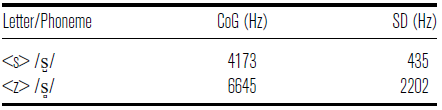
Priors for Basque sibilants were obtained from Hualde (Reference Hualde2010: 94), who provides CoG and SD results for a speaker from the same non-merging variety that is studied in this project, i.e. Goizueta Basque (Table 3).
Basque priors (from Hualde Reference Hualde2010: 94).

Segmentation of the target word hasi san du ‘She said to start’ (in Basque) by Goizueta Speaker 30. (A recording is available as supplementary material: please visit <https://doi.org/10.1017/S0025100320000274>.)

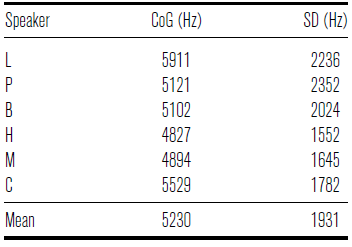
Spanish priors (from Cicres Reference Cicres2011: 42).

Segmentation of the target word hazi san du ‘She said to grow’ (in Basque) by Goizueta Speaker 30. (A recording is available as supplementary material: please visit <https://doi.org/10.1017/S0025100320000274>.)

Priors for Spanish were obtained from Cicres (Reference Cicres2011: 42) who studied the acoustic production of different Peninsular Spanish fricatives. He studied six speakers, and obtained individualized results for each fricative he studied. This project will use the mean value for /s/ from all these speakers as priors (Table 4).
A leave-one-out (LOO) validation was used to obtain the optimal statistical model (see Vehtari, Gelman & Gabry Reference Vehtari, Gelman and Gabry2017). In this method, a data point is left out, and after running the model, the model itself is used to predict that data point and calculate the difference between the predicted and actual value. The model that will fit the dataset best is that which has the lowest LOO score.
In order to answer each RQ, different statistical models were created. Below are the formulae and explanations of the structure of each model:
-
RQ1 (acoustic diffusion of /s/ in Spanish per variety):
-
• Statistical model: brm(stdev ∼ Variety + (1|Speaker) + (1|Word), data = SpanishData, family = gaussian(), prior = priors_sp_stdev, iter = 2000, chains = 4, warmup = 1000, control = list(adapt_delta = 0.99))
-
-
RQ2 (L1-Basque transfer):
-
• Statistical model (one per Basque variety): brm(cogfilt ∼ Phoneme + (Phoneme| Speaker) + (1|word), data = VarietyData, family = gaussian(), prior = priors_ spbq_cog, iter = 2000, chains = 4, warmup = 1000, control = list(adapt_delta = 0.99))
-
-
RQ3 (Monolingual Spanish /s/ = X Basque variety’s /s/):
-
• Statistical model: brm(cogfilt ∼ Variety + (1|Speaker)+ (1|word), data = SpanishData, family = gaussian(), prior = priors_sp_cog, iter = 2000, chains = 4, warmup = 1000, control = list(adapt_delta = 0.99))
-
The first and third statistical models have the same structure except for the dependent variable. The model for RQ1 has the SD of the sibilant as the dependent variable since the acoustic diffusion of the sibilant is examined. The model for RQ3 has CoG as its dependent variable since the similarity in PoA is examined. variety was included as the fixed factor and random intercepts for word and speaker were included. variety refers both to monolingual Spanish speakers and to bilingual speakers from the three Basque varieties. The Castilian variety was set as the intercept since RQs are formulated as comparisons between what participants in Basque–Spanish bilingual groups do as opposed to the Castilian group. Priors only include the Spanish data for RQ1 and RQ3.
The statistical model for RQ2 includes both Basque and Spanish data. Since it is understood that each Basque–Spanish bilingual group is independent from one another, a separate model was created per group rather than creating an interaction between phoneme and variety. A random intercept was included for word. In order to contemplate possible mergers in Basque participants, a random slope was included of phoneme within speaker. The phoneme /s̺/ was set as the intercept. This allows for the possibility to compare its production as opposed to that of /s̻/ in Basque (indicating whether there is a merger in that variety of Basque or not) and /s/ in Spanish (showing whether participants transfer Basque /s̺/ into Spanish /s/). Priors include both Basque and Spanish data for RQ2.
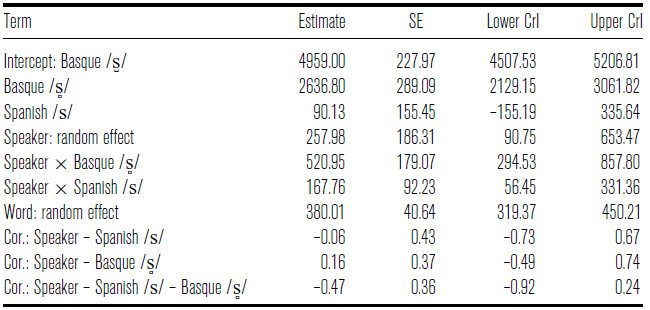
It should also be noted that Bayesian analysis will not return p-values, but a CrI range from where probabilistic conclusions will be drawn. The model output can be interpreted the same way as a dummy-coded linear mixed-effects regression model, i.e. every level will return the difference from the intercept. If the 95% CrIs cross the zero mark, then it is deduced that, probabilistically speaking, there will not be any differences between the two elements that are being compared. If the 95% CrI does not cross the value of zero, then it is deduced that there is little probabilityFootnote 3 where the comparison of the two elements equals zero, and therefore it is deduced that they are different.
5 Results
5.1 RQ1: acoustic diffusion of /܃/ in Spanish
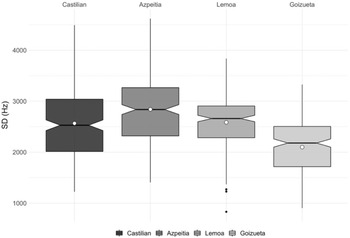
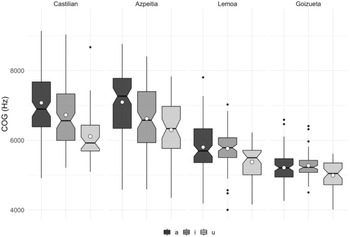
The Goizueta group (non-merging variety) showed the lowest SD of all groups. Mean and standard deviation values are shown in Table 5.Footnote 4 These results are plotted in Figure 5. As expected, sibilant-merging Basque varieties show more dispersed acoustic productions of /s/ in Spanish than the non-merging variety. Notice the narrowness of the dispersion of /s/ in the Goizueta group (the non-merging variety) as opposed to the other groups.
SD mean (and its standard deviation) of /s/ in Spanish per variety (in Hz).

SD of /s/ in Spanish per variety (in Hz). [The white dot is the mean, the horizontal black line in the middle is the median; the box represents the interquartile range (IQR); vertical lines represent the dispersion of the data and are never 1.5 times the IQR; single black data points are outliers that fall outside this range.]

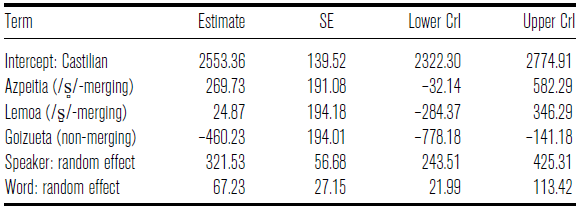
In order to examine the statistical significance of the results, the output of the model will be observed. Table 6 shows a summary of the model output for the SD of /s/ in Spanish per group. As can be observed in the output of the model, the Goizueta group (the non-merging variety of Basque) is the only group that does not cross the zero mark (Est. = –460.23, SE = 194.01, l-95% CrI = –778.18, u-95% CrI = –141.18). The Azpeitia and Lemoa groups cross the zero mark, which probabilistically speaking means that they behave as the intercept (the Castilian group).
Summary of Bayesian model output for the SD of /s/ in Spanish per group.

5.2 RQ2: L1-Basque influence on Spanish
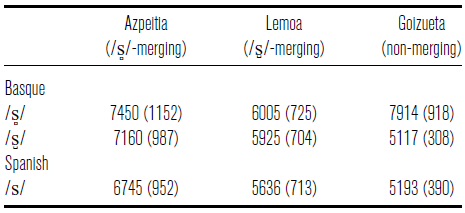
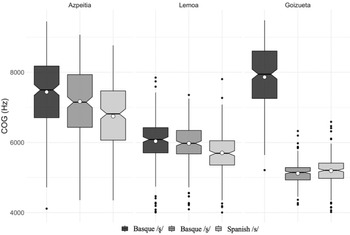
In order to examine the influence of L1 Basque on Spanish, CoG values were observed in both languages. Table 7 shows a summary of those results, and Figure 6 provides a visual representation of those results. As previously stated, a different statistical model was built per Basque variety in order to examine whether there is (1) a merger in that Basque variety, and (2) transfer from Basque to Spanish.
Mean CoG (and its standard deviation) values per sound category and group (in Hz).

Basque and Spanish sibilants by Basque–Spanish bilinguals.

5.2.1 Azpeitia (/܃̻/-merging variety)
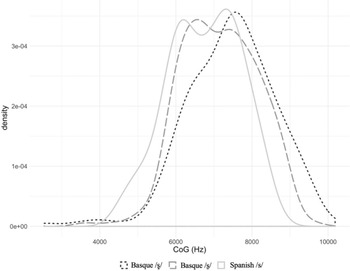
As can be seen in Figure 7, there is great overlap between the three sibilants in the Azpeitia group. That is, these Basque data would coincide with the results of the previous literature, i.e. there is a merging in this Basque variety as far as the apical fricatives are concerned. Examining the means of the sibilants produced by the Azpeitia group, which are around 7000 Hz, it can be inferred that the merger is in favor of the lamino-alveolar sibilant fricative.
CoG of sibilants in the Azpeitia group. [A density plot could be described as a smoother version of a histogram, and it marks the local density of points along the x-axis; where data points occur more frequently, the density will be greater, thus showing peaks.]

Nevertheless, it is worthy of mention that Basque /s̺/ and Spanish /s/ show bimodality for this group of speakers. This is more evident for the production of Spanish /s/. Some participants show lower CoG values, thus indicating a more retracted point of articulation than Basque /s̻/. However, other participants show similar peaks between Basque /s̻/ and Spanish /s/. The production of Basque /s̺/ also shows two peaks, one that is closer to the higher CoG values (indicating a complete merger) and another one that is similar to that of Spanish /s/, indicating that some speakers might not merge the two sibilants in Basque.
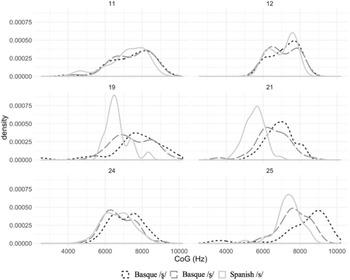
Figure 8 shows the productions of the three sibilants per speaker. As can be observed, there is inter-speaker variation, and most of the participants show variation in the production of sibilants. Speakers 19, 21, and 25 show lower distribution peaks for Spanish /s/ as opposed to the distribution peaks of Basque sibilants.
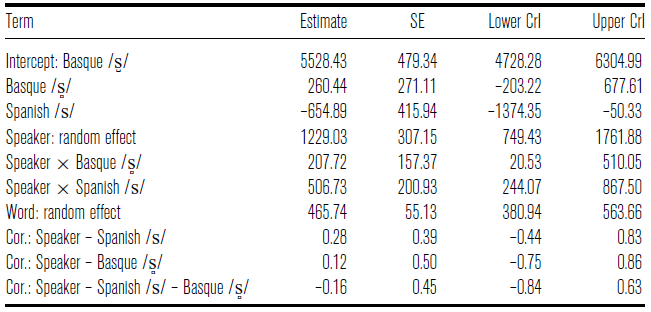
Table 8 shows the output of the statistical model for the Azpeitia group. As can be observed, the output informs us that, probabilistically speaking, Basque /s̻/ and /s̺/ are merged, since the CrI crosses the zero mark (Est. = 260.44, SE = 271.11, l-95% = –203.22, u-95% = 677.61). However, the production of Spanish /s/ is shown to be different from the rest as the zero mark is not crossed in the credible intervals (Est. = 654.89, SE = 415.94, l-95% CrI = –1374.55, u-95% CrI = –50.33).
Output of statistical model for Azpeitia group.

CoG of sibilants in each participant of the Azpeitia group.

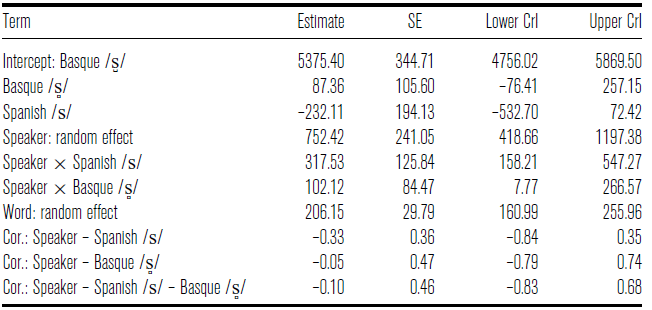
5.2.2 Lemoa (/܃̺/-merging variety)
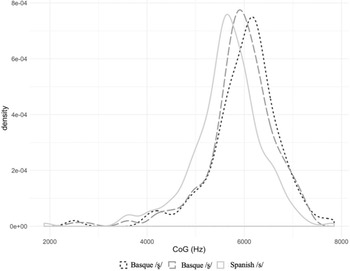
As can be observed in Figure 9, there is strong overlap between the three phonemes produced by the Lemoa group. Examining the means of the sibilants produced by this group, which are around 6000 Hz, it can be inferred that the merger is in favor of the apico-alveolar sibilant fricative, as described in the previous literature.
CoG of sibilants in the Lemoa group.

CoG of sibilants in each participant of the Lemoa group.

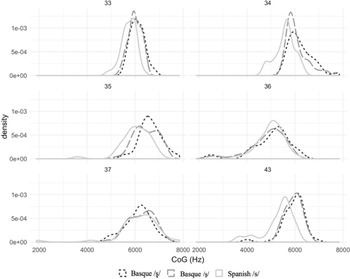
Figure 10 shows the productions per speaker. As can be observed, there is less inter-speaker variation within this group than in the previous one, indicating that the merger is more stabilized in this variety. Most speakers merge the three sibilants into one phonetic realization. Speaker 43 shows a lower peak for Spanish /s/ as opposed to the distribution peaks of the two Basque sibilants.
Table 9 shows the output of the statistical model for the Lemoa group. As can be seen, the CrI differences between /s̺/ and /s̻/ (Est. = 87.36, SE = 105.60, l-95% CrI = –76.41, u-95% CrI = 257.15), and /s̺/ and /s/ (Est. = –232.11, SE = 194.13, l-95% CrI = –532.70, u-95% CrI = 72.42), cross the zero mark, showing that there is not 95% credibility that there is a difference between each of these phoneme pairs, and thus indicating a likely merger.
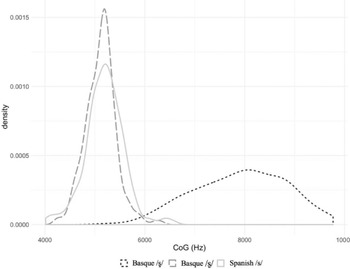
5.2.3 Goizueta (non-merging variety)
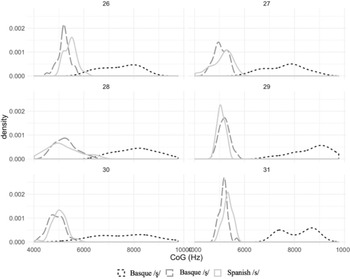
As seen in Figure 11, Basque /s̺/ and Spanish /s/ show great overlap, whereas Basque /s̻/ shows clearly distinct values from the other two phonemes. Figure 12 shows there is not considerable inter-speaker variation in the Goizueta group. Two speakers (26, 27) show slightly higher CoG values for Spanish /s/ than for Basque /s̺/, indicating they have possible different realizations for each sound and therefore map Spanish /s/ as a different sound category. Nonetheless, the general tendency is towards merging of the apico-alveolar phonemes of Spanish and Basque into one realization.
Output of statistical model for Lemoa group.

Table 10 shows the output of the statistical model for the Goizueta group. The data show that, whereas Basque /s̺/ and Basque /s̻/ are realized completely differently as the CrI range does not cross the zero mark (Est. = 2636.80, SE = 289.09, l-95% CrI = 2129.15, u-95% CrI = 3061.82), Basque /s̺/ and Spanish /s/ are merged (Est. = 90.13, SE = 155.45, l-95% CrI = –155.19, u-95% CrI = 335.64).
CoG of sibilants in the Goizueta group.

CoG of sibilants in each participant of the Goizueta group.

5.3 RQ3: Similarity of monolingual Spanish speakers’ /܃/ to Basque–Spanish bilingual speakers’ /܃/ in Spanish
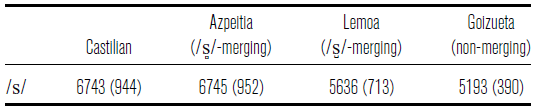
Monolingual Spanish speakers showed higher CoG values for /s/ than that described in the previous literature, indicating a more fronted PoA (Table 11). Their results are similar to those obtained in the Azpeitia group (the variety that merges the two alveolar phonemes of Basque into the lamino-alveolar sibilant). The Lemoa and Goizueta groups show lower CoG values, indicating a more retracted PoA, most presumably conditioned by the apico-alveolar /s̺/ in Basque. As noted by one of the reviewers, it should be considered that, on average, /s̺/ in Basque has a more posterior PoA than Spanish /s/. Figure 13 shows the production of those sounds by group.
Output of statistical model for Goizueta group.

Mean CoG (and its standard deviation) values of /s/ in Spanish by group (in Hz).

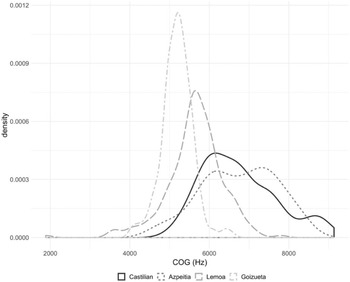
CoG of /s/ in Spanish by each group.

Notice how, while the distributions of the density curves of the CoG are broader in the groups that only have one single sibilant fricative (Castilian, Azpeitia, and Lemoa), the dispersion is much narrower in the Goizueta group, i.e. the only group that has more than one sibilant fricative in the L1 phonological system. These results align with those obtained as an answer to RQ1, where the SD of /s/ was significantly lower for the Goizueta group.
To go into greater depth on additional variables, let us recall that the absence vs. the presence of stress in the syllable where the anterior sibilant was present was not included in the final model. Indeed, stress effects on CoG were minimal.Footnote 5 The fact that not all vowel conditions had the same total number of stressed and unstressed syllables in Spanish, i.e. both /a/ and /i/ had four target tokens per stress condition, but /u/ only had two per condition, could have allowed the data to show greater/lesser variation.
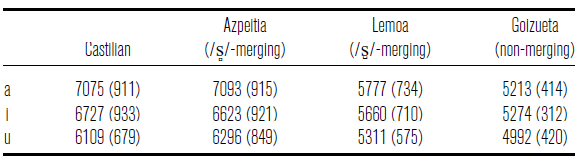
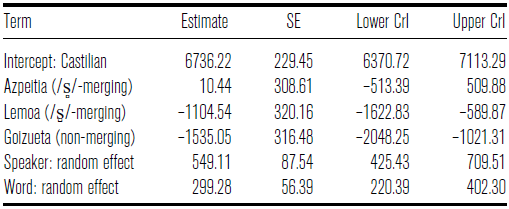
Regarding the vocalic context in which the Spanish anterior sibilant fricative /s/ appeared, it was found that the preceding vowel /u/ lowered CoG values. Each group showed a similar trend where /a/ had the highest CoG values, followed by /i/, and then /u/. Table 12 provides a summary of the results and Figure 14 shows a visual representation of those results.Footnote 6
Mean CoG (and its standard deviation) of /s/ in Spanish by following vowel (in Hz).

CoG values by group and V2.

As previously mentioned, the structure of the optimal model built via the LOO validation method did not include either Syllable Stress or V2 as factors; it included only variety as a fixed factor as well as speaker and word as random factors. Table 13 includes the output of the model for CoG values in Spanish across groups. As the table shows, probabilistically speaking, the /s/ produced by the Castilian group (the intercept) is only similar to that produced by the Azpeitia group (Est. = 10.44, SE = 308.61, l-95% CrI = –513.39, u-95% CrI = 509.88). The CrI ranges do not cross the zero mark in the Lemoa (Est. = –1104.54, SE = 320.16, l-95% CrI = –1622.83, u-95% = –589.87) or Goizueta (Est. = –1535.05, SE = 316.48, l-95% CrI = –2048.25, u-95% = –1021.31) groups; therefore, it is assumed that their production of /s/ in Spanish is not comparable to that of the intercept.
Output of Bayesian model of CoG of /s/ in Spanish across groups.

6 Discussion
This study provides data that support the main theoretical claims that were considered in Section 1. Based on the current results, it has been shown that the group with more than one anterior sibilant fricative in the L1 shows the lowest degree of acoustic dispersion, as opposed to the two sibilant-merging varieties in Basque and the monolingual Spanish group. The predicted hypothesis was therefore met (RQ1, P1). As explained in Flemming’s (Reference Flemming and Aronoff2017) Dispersion Theory, the more phonemic targets that share similar phonological features, the less acoustic dispersion those phonemes will show. The SD of /s/ in Spanish in the Goizueta group (non-merging Basque variety) was 2098 Hz, which was significantly different from and lower than the other three groups: Castilian = 2565 Hz, Azpeitia (/s̻/-merging) = 2841 Hz, Lemoa (/s̺/-merging) = 2585 Hz. The difference between the groups that have only one anterior sibilant fricative in their L1 was not significant, confirming the second prediction (RQ1, P2). Previous literature has explained that CoG and SD are also correlated, in the sense that the higher the CoG, the higher the SD. If such claims are considered, then the fact that the Azpeitia group shows the highest SD values could be attributed to the fact that their CoG values are generally rather high. However, if that applies in general, the Spanish monolingual group should show higher values, too, which is not seen here. Regardless, the statistical model showed no significant differences between the three groups that only have one anterior sibilant fricative in the L1 phonological inventory.
Linguistic transfer was apparent in this study and the predictions made by Flege’s (Reference Flege and Strange1995) Speech Learning Model and Major’s (Reference Major2001) Ontogeny and Philogeny model are met. The Lemoa group, which shows the neutralization of the apico-alveolar and lamino-alveolar anterior sibilant fricatives in favor of the apico-alveolar in Basque, showed a complete merger for the three sound categories /s̺/, /s̻/, and /s/. The speakers of the non-merging variety from Goizueta showed clearly different values for the two anterior sibilant fricatives in Basque. Yet these speakers produced their Basque apico-alveolar fricative and Spanish /s/ identically. As hypothesized (RQ2, P1), the small L1–L2 differences in articulation between the apico-alveolar sounds in Basque and Northern Peninsular Spanish would make it difficult for these speakers to map a new sound category for Spanish /s/. The Azpeitia group, i.e. the variety that merges the apico-alveolar and lamino-alveolar sibilant fricatives in favor of the lamino-alveolar, showed the expected neutralization in Basque. Nevertheless, the statistical model demonstrated that these speakers do not transfer the only anterior sibilant fricative they have in their L1 phonological inventory into Spanish (RQ2, P2). It can be inferred that the articulatory and acoustic differences between the lamino-alveolar sibilant fricative and the canonical /s/ in Spanish are sufficient for these speakers to be able to map a new sound category for Spanish /s/. As opposed to what the previous literature had stated, not all Basque speakers in strongly Basque-speaking towns transfer Basque sibilants into Spanish. The main difference between these participants and those of Iribar & Túrrez (Reference Iribar and Túrrez2015) is that their participants had little exposure to Spanish. Participants in this study, although they are inhabitants of towns where the use of Basque is predominant, have received formal instruction in Spanish at school since the age of six. Therefore, although there is no way to directly compare the degree of bilingualism between the participants in Iribar & Túrrez and participants in this study, it is speculated that it is higher in the present study.
As far as the spectral properties of Basque sibilants are concerned, it is worth mentioning that the phonetic realizations of the only anterior sibilant fricative in the merging varieties differs from those in the non-merging varieties. The non-merging variety, Goizueta Basque, shows a mean COG of 5117 Hz (stdev 308 Hz) for the apico-alveolar /s̺/, and 7914 Hz (stdev 918 Hz) for the lamino-alveolar /s̻/. Azpeitia Basque, the /s̻/-merging variety, shows a mean COG of 7160 Hz (stdev 987 Hz) for the apico-alveolar sibilant /s̺/, and 7450 Hz (stdev 1152 Hz) for the lamino-alveolar /s̻/. Finally, Lemoa Basque, the /s̺/-merging variety, shows a mean COG of 5925 Hz (stdev 704 Hz) for the apico-alveolar /s̺/, and 6005 Hz (stdev 725 Hz) for the lamino-alveolar /s̻/. These results would indicate that the phonetic realizations of the merging varieties are not shared by the non-merging variety. The lamino-alveolar sibilant fricative in the non-merging variety is more fronted than that produced by the /s̻/-merging group. Furthermore, the apico-alveolar sibilant fricative produced by the non-merging variety is more retracted and, as described by Navarro Tomás (Reference Navarro Tomás1923), more palatalized than that produced by the /s̺/-merging group.
Regarding the PoA of /s/ in Spanish by each group, it was found, surprisingly, that monolingual Spanish speakers produced /s/ in a more fronted manner than that described in the previous literature (RQ3, P1). The results of CoG showed that monolingual Spanish speakers’ mean CoG value was 6743 Hz (stdev 944 Hz), as opposed to 6745 Hz (stdev 952 Hz) in Spanish produced by the Azpeitia group, 5636 Hz (stdev 713 Hz) by the Lemoa group, and 5193 Hz (stdev 390 Hz) by the Goizueta group. This is remarkable because it would indicate that the realization of /s/ in Northern Peninsular Spanish is more fronted, and not so apico-alveolar as dialectological texts describe. The statistical model showed that the realization was shared with (or is comparable to) that of the Azpeitia group, the only group that does not show an apico-alveolar sibilant fricative in the L1 phonological inventory. As previously explained, the Azpeitia group showed no transfer from Basque into Spanish /s/, and it was deduced that these speakers create a new sound mapping for Spanish /s/. If CoG results are observed in Table 7, it could be deduced that the Spanish realization is still somewhat more fronted than ordinary apico-alveolar sounds, 6745 Hz vs. 5636 Hz in the /s̺/-merging group. Due to the small sample size in the monolingual Spanish group, no major conclusions can be drawn, nor can one venture to say that a sound change in progress is happening in Northern Peninsular Spanish.
Regarding the effect of linguistic factors in CoG measurements, the vocalic context which follows the anterior sibilant fricative has an effect on the mean frequencies. As shown in Fujisaki & Kunisaki (Reference Fujisaki and Kunisaki1978), the /u/ context lowers the frequencies. Nonetheless, unpredictably, the stress of the syllable where the sibilant appears showed no remarkable differences, as opposed to the findings of the previous literature, i.e. sibilants in stressed syllables show significantly higher CoG values. It is believed that the lack of a balanced number of target tokens per vocalic and stress condition could have interfered in the analysis.
Finally, the limitations of this study cannot be disregarded. The sample size was small; nevertheless, Bayesian probability was used to produce representative results. Although the present study has helped to demonstrate how the L1 sibilant system might have an effect on the L2 sibilant system, and how the number of phonemes that share similar phonological features might affect the acoustic dispersion of L2 phonemes, there is still much to be studied. Furthermore, a lack of gender-balanced participants was a limitation. For further studies, a balanced number of male and female participants should be considered. In addition, the vocalic contexts under consideration were not balanced, as more target tokens were followed by /a/ and /i/ than by /u/. Therefore, the results concerning the effect of V2 should be read with caution. Although acoustic measurements were useful to describe differences between anterior sibilants in Basque, and the results agree with the previous literature, CoG measurements might lack sensitivity and mean values could be affected by secondary energy sources. Articulatory instruments should be used to avoid lack of sensitivity and directly examine the PoA of sibilants. Finally, this study employed weakly informative priors in the analysis, as opposed to strongly informative ones. A model that can synthesize results from a large body of literature would be able to use strongly informative priors and provide a clearer picture. The decision was made to use weakly informative priors since there is not a large body of research which includes several spectral moments for both Basque and Spanish sibilants. Nevertheless, it is expected that this corpus and the results obtained from it could serve as part of strongly informative priors in future research.
7 Conclusion
This study has shown that the number of sibilant fricative phonemes in the L1 phonological system affects the acoustic dispersion of /s/ in L2. The non-sibilant-merging Basque variety of Goizueta, which has a phonemic contrast between the apico-alveolar /s̺/ and lamino-alveolar /s̻/, showed a significantly more reduced acoustic dispersion than the sibilant-merging varieties of Azpeitia Basque and Lemoa Basque, and the Castilian group, which only have one sibilant fricative in their L1 phonological inventories.
Speakers of Basque varieties with the apico-alveolar /s̺/ in the L1 phonological system, i.e. Lemoa Basque and Goizueta Basque, transferred that sound into Spanish /s/. However, speakers of Azpeitia Basque, which has only a lamino-alveolar sibilant fricative /s̻/, did not transfer it. It is thought that acoustic and articulatory dissimilarities with the canonical Peninsular Spanish /s/ allowed for speakers to have different sound mappings as opposed to the varieties where the apico-alveolar sound of Basque is remarkably similar to that of Peninsular Spanish. For these speakers, creating a new sound category for Spanish /s/ is more complicated.
Monolingual Northern Peninsular Spanish speakers showed a more fronted production than has been described in the literature. Unpredictably, CoG measurements would indicate that the realization of /s/ in Spanish was more lamino-alveolar than apico-alveolar. In fact, the production by Northern Peninsular Spanish speakers resembled that by Azpeitia speakers, who do not have an apico-alveolar fricative phoneme in their L1 phonological system.
This has served as a study in the cross-dialectal production of anterior sibilant fricatives in Basque and Spanish using Bayesian probability for the statistical analysis. It is expected that future research on acoustic properties of sibilant fricatives in Basque and Northern Peninsular Spanish could benefit from these results, employing them as possible priors.
Acknowledgments
This project was funded by the author using a research fellowship granted from the Department of Spanish and Portuguese at the University of Illinois at Urbana-Champaign. The author would like to thank several people who have been essential in the completion of this study: José Ignacio Hualde and Ryan Shosted, for the stimulating discussion and their invaluable help; Marissa Barlaz, for statistical advice and for reviewing the data analysis and results sections; Oihana Lujanbio and Eider Etxebarria-Zuluaga, for their assistance in participant recruitment in Goizueta and Lemoa, respectively; Krissy Gunderson, for stylistic feedback; and last, but not least, Jody Kreiman, Adele Gregory, and three anonymous reviewers, for their helpful comments.
Appendix A. Spanish stimuli
Target items in Spanish.

Appendix B. Basque stimuli
Basque items are grouped in two columns according to whether they have orthographic <s> or <z>. This corresponds to a phonemic distinction only in Goizueta Basque, which I indicate in the phonological transcription with the corresponding IPA symbols. For the other two varieties examined here, Azpeitia and Lemoa, both graphemes signal a single phoneme. Thus, the phonological transcriptions for these two dialects employ a single symbol /s/. Basque dialects differ considerably in their accentual patterns. The accentual marks that are provided are based on the author’s perception after listening to the recordings. When variation in accentuation was found in the experimental data, both attested patterns are given.
Target items in Azpeitia Basque (/s̻/-merging variety).

Target items in Goizueta Basque (non-merging variety).

*In isolation, these words would exhibit a word-final rising tone, e.g. hasi /as̺í/. However, in Goizueta Basque, there is a tone sandhi rule in which a word-final rising tone shifts to a falling tone when this is followed by a word-initial rising tone, i.e. σ́#σ́ → σ̀#σ́. Target items are followed by the word san /sán/ ‘say’; therefore, /as̺ís̺án/ → [as̺ìs̺án].
Target items in Lemoa Basque (/s̺/-merging variety).

Supplementary material
To view supplementary material for this article (including audio files to accompany the 752 language examples), please visit https://doi.org/10.1017/S0025100320000274.