1 Introduction
From Old English (OE) to Middle English (ME) inflection is gradually lost, which is due to changes in the phonology (e.g. centralisation of vowels in unstressed syllables) and in the syntax (e.g. more fixed word order; see Allen Reference Allen2006). From a long-term perspective, the change from a highly inflecting to an almost non-inflecting language may seem to be a linear and continual process. However, it is a truism that language change is not a straightforward process: cognitive mechanisms such as analogy and reanalysis are always at play. Reanalysis is perhaps the source or mechanism par excellence for the emergence of new rules or constraints in a language system. Analogy is usually analysed as the cause of the reduction or the loss of inflection: increase of syncretism within the same inflection class (intra-paradigmatic analogy), and reduction of allomorphy across inflection classes (inter-paradigmatic analogy). However, an analogically levelled form can be reanalysed to encode a different morphosyntactic category than it previously did or a new morphosyntactic category that was previously not present in the language system (exaptation). It can therefore be expected that new inflectional rules/constraints also emerge in languages undergoing extensive loss of inflection, such as in English.
The loss of inflection in English may be seen as a continuous and gradual process from a long-term point of view. However, if one ‘zooms in’ and analyses single manuscripts from the Early Middle English period, it can be observed that the change from a highly inflecting language to an almost non-inflecting language is much more complex. Inflection is lost over centuries. However, in the meantime, different remaining material can be reanalysed. This article aims to investigate which effects analogy and reanalysis have within and across inflection classes in the noun inflection in Early Middle English (EME). It will be shown that analogy does not simply lead towards a reduction of inflection, but the instances of analogy change the language system in a systematic and specific direction. There is an increase in syncretism and a decrease in allomorphy: the result of these changes, however, is a new inflectional system with reanalysed forms. The article does not therefore focus on the change of a specific morphosyntactic property (although gender does play an important role), but investigates the changes in the paradigm of nouns, i.e. the different changes that simultaneously affect the noun paradigm and that are interrelated. This also means that the noun paradigms of individual manuscripts must be investigated. In this article the Lambeth Homilies (Lambeth Palace Library 487, fols. 1–21, 30–51, language 1 of hand A) are analysed.
The article is structured as follows. Section 2 summarises previous work regarding the emergence of new systems in EME (section 2.1) and the noun inflection in the Lambeth Homilies (section 2.2). This section also introduces the research questions (section 2.3) and the theoretical background (section 2.4). Section 3 presents the data and method. Section 4 discusses the results: the plural and the singular of the noun inflection (section 4.1 and section 4.2), the inflection of the definite article and the use of unhistorical gender (section 4.3), and the discussion about possible instances of exaptation (section 4.4). Section 4.5 gives an overall analysis based on the results discussed in the previous sections. Section 5 summarises the results and provides a brief outlook.
2 Previous work and research questions
2.1 Previous work regarding the loss and emergence of inflection
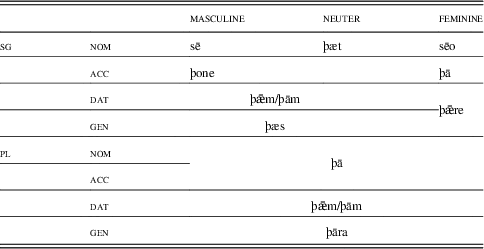
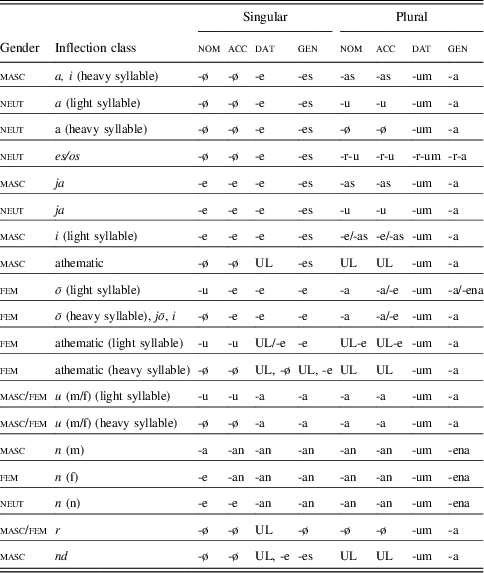
OE distinguishes four cases (nominative, accusative, dative, genitive; remnants for instrumental singular), three genders (masculine, feminine, neuter) and two numbers (singular, plural). The nouns can be categorised in many different inflection classes as shown in table A1 (Appendix), so a lot of allomorphy can be observed. Regarding the simple demonstrative pronoun, three genders differ from one another in the singular, but they are syncretised in the plural (table 1). Other case and gender syncretisms can be observed: masculine = neuter in the dative and genitive singular, dative = genitive in the feminine singular, and nominative = accusative in the neuter singular and in the plural.
Simple demonstrative pronoun in OE (Lass Reference Lass1998: 143)

From OE to ME case and gender are gradually lost, more precisely the inflectional encoding of these categories is lost over several centuries. The result of this change is a system that morphologically distinguishes singular from plural and possessive from non-possessive. This change is well understood in its generality. However, we still do not know exactly what the single steps are from a highly inflecting to an almost non-inflecting language, for example, which parts of the inflection are first affected by the loss and how the loss spreads within the paradigms.
Additionally, there is very little investigation regarding the emergence of new nominal inflectional systems. Major investigations have been undertaken regarding unhistorical determiners (for example, feminine nouns that are preceded by a masculine determiner or vice versa) (e.g. Hoffmann Reference Hoffmann1909; Jones Reference Jones1967, Reference Jones1988). However, they focus on the unhistorical determiners and do not analyse the entire paradigm, that is, including the historically correct determiners. As regards the noun inflection, no analysis explicitly tackling the possible emergence of new inflection can be found. Some editions provide an introduction into the inflectional system. However, they are usually based on a selection of nouns, they do not show full paradigms, and they are purely descriptive, i.e. they provide neither a systematic synchronic analysis of the inflection nor a diachronic analysis.
This article does not aim to provide a comprehensive analysis of the different EME inflectional systems. The goal is to provide a detailed analysis of one new inflectional system, and to show which effects analogy and reanalysis have. Several such investigations can, at some point, be taken together, and the single steps from a highly inflecting language to an almost non-inflecting language can be analysed.
2.2 Previous work regarding the inflection in the Lambeth Homilies
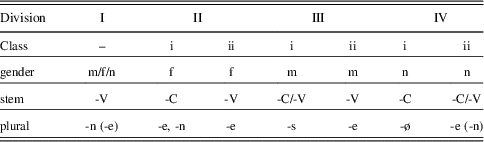
The most comprehensive descriptions of the Lambeth Homilies are Morris’ (Reference Morris1868) edition and Stadlmann’s (Reference Stadlmann1921) neogrammarian description of the phonology and inflection. Morris (Reference Morris1868) edits numerous homilies including the Lambeth Homilies. He also provides a description of the inflection, but no analysis or explanation of the changes. He divides the nouns into four divisions and into two classes within the same division (table 2). The nouns in Division I are originally weak. Division II contains the strong nouns which are originally feminine, Division III masculine and Division IV neuter. Note, however, that IIii and IIIii show the same paradigm, so they are merged. The dative singular is marked by -e (less frequently by -n) in the divisions II–IV, the dative plural by -e or -n in all divisions (Morris Reference Morris1868: XXI). It can also be observed that the suffix -e encodes plural in all divisions, while -ø is clearly related to neuter, -s to masculine, and -n to feminine (in variation with -e) and the weak inflection (in variation with the less frequent -e). The suffix -n, however, may also be used with neuter nouns (IVii), but less frequently than the suffix -e. The plural suffixes that are connected to gender are mainly used with nouns ending in a consonant. Most feminine nouns end in a vowel, while masculine and neuter nouns tend to end in a consonant (this is shown in section 4.2). Therefore, it can be deduced that the feminine plural suffix -n is used with only very few nouns, and that most feminine nouns do not inflect (i.e. they terminate in -e in the singular and in the plural).
Noun classes and plural inflection in different homilies of the twelfth and thirteenth centuries (Morris Reference Morris1868: XX–XXI)

Summarising Morris’ description of the individual divisions (see Morris Reference Morris1868: XXII–XXXII), it can be observed that there is rich variation regarding the encoding of morphosyntactic properties, variation that is not surprising, but that may be owing to the fact that many different homilies (including the Lambeth Homilies) from two centuries form Morris’ data source. Additionally, Morris (Reference Morris1868) does not report the frequencies, only mentioning that some suffixes are more or less frequent.
Stadlmann (Reference Stadlmann1921) provides a neogrammarian description of the Lambeth Homilies based on Morris’ (Reference Morris1868) edition. He categorises the nouns according to the original stems,Footnote 2 and he lists the suffixes for the different morphosyntactic properties. Like Morris (Reference Morris1868), Stadlmann (Reference Stadlmann1921) reports several variants that encode the same morphosyntactic property. Stadlmann’s (Reference Stadlmann1921) description is simply a list of suffixes: there is no discussion or analysis of the paradigms from a synchronic or diachronic point of view.
2.3 Research question
The loss of inflection in English is explained by changes in the phonology (centralisation of vowels in unstressed syllables, merger of /m/ and /n/, etc.) and in the syntax (more fixed word order; see Allen Reference Allen2006). However, analogy (inter- and intra-paradigmatic) can also be expected, which is not due to phonological changes, but is a pure morphological change. Analogy may be seen as reducing inflection. This, however, is not a random process, but follows a certain direction which may lead to a new system. Additionally, analogically levelled forms can be reanalysed to encode a morphosyntactic category that has already been present in the language system or that is new in the language system (exaptation). The following questions are addressed in this article:
− What system does analogy and reanalysis lead to?
− Is case and gender marking reduced or enforced due to analogy and reanalysis?
− Can changes be observed that only occur within one gender?
− Which suffixes are reanalysed, and how do they spread? Why are they suitable for reanalysis?
− Can only reanalysed forms be found, or exapted forms, too?
− How can the unhistorical determiners be explained? Do they form a separate subsystem (Jones Reference Jones1967, Reference Jones1988), have they changed gender (Hoffmann Reference Hoffmann1909), or is there another explanation?
− What are the changes caused by? Are they triggered by changes in the syntax or phonology, or are they genuine morphological changes?
2.4 Theoretical background
The data are analysed as theory-independently as possible. However, some very basic concepts are mentioned here mainly in order to avoid misunderstandings, but not to enter into the discussion around these concepts. A realisational-inferential concept of morphology underlies the analysis. In very general terms, this means that form and function are treated separately: words are associated with morphosyntactic properties, and these associations allow the application of rules that license the inflectional exponents (Ackerman & Stump Reference Ackerman and Stump2004: 116).
Regarding analogical changes in a paradigm, two directions can be distinguished: inter-paradigmatic and intra-paradigmatic (Fertig Reference Fertig2015: 213–14). Analogical extension means that an existing morphological pattern is extended to lexemes that followed another morphological pattern (inter-paradigmatic). Applied to noun inflection, this means that allomorphy is reduced across inflection classes and, in a final stage, inflection classes merge (usually but not necessarily, nouns from an inflection classes with a low type and token frequency inflect according to an inflection class with a higher type and token frequency). Intra-paradigmatic analogy means an increase of syncretic forms within an inflection class. For example, two cases are encoded by two different suffixes; over time the encoding of the two cases changes, with the result that the two cases show the same suffix (this does not necessarily mean that the two cases are lost).
Finally, there is a controversial discussion around the term ʻexaptationʼ: do we need exaptation in language change and, if so, how do we define it? In this article, exaptation is seen as a special type of reanalysis that involves (a) junk status of the input, (b) unexpectedness, (c) novelty of the new function. The following gives only a very short overview (following Van de Velde & Norde Reference Van de Velde and Norde2016) without expounding the issues around the term ʻexaptationʼ. Lass’ (Reference Lass1990) original definition of exaptation mainly concerns the junk status of the input. The basic idea is that a function is morphologically encoded, but over time this function is lost, while the material which encoded the lost function is preserved. Three things can happen to the preserved material: it can be lost, preserved as irregular morphology or refunctionalised. This refunctionalisation is called exaptation (Lass Reference Lass1990: 81–2). Two different definitions are proposed for ʻunexpectednessʼ: (a) the change is cross-linguistically non-recurrent; (b) the change goes in a rather unpredictable direction cognitively, i.e. against regular grammaticalisation or against common cognitive principles (e.g. analogy) (Van de Velde & Norde Reference Van de Velde and Norde2016: 16). Regarding the novelty of the new function, a more and a less rigid definition exist: (a) the function encoded by the preserved material must be entirely new to the grammar; (b) the material encodes a new function unrelated to the old function, so the change has no analogical/levelling effect (Van de Velde & Norde Reference Van de Velde and Norde2016: 16).
3 Data and method
The Lambeth Homilies I–V and IX–XIII are analysed here, that is, the language 1 of hand A (Lambeth Palace Library 487, fols. 1–21, 30–1). In the following sections, these homilies are referred to for convenience as the ʻLambeth Homiliesʼ. These homilies are situated in the northwest of Worcestershire and dated from c. 1200 (late twelfth century / early thirteenth century, according to Millett Reference Millett2007: 44–5; c. 1200 according to LAEME).
Sisam (Reference Sisam1951) categorises the homilies of hand A into Group A (the homilies investigated in this article) and Group B, whereby Group A is assumed to be older than Group B. This division is based on an orthographic analysis (see Sisam Reference Sisam1951: 107). According to Sisam (Reference Sisam1951), the two groups are copied from two different manuscripts, and the scribe can be considered a faithful transcriber (Sisam Reference Sisam1951: 107). Group A of the Lambeth Homilies can be further divided into three subgroups, mainly on the basis of their orthography: sermons I–V (A1), sermons IX and X (A2), sermons XI–XIII (A3) (Sisam Reference Sisam1951: 108). These differences can be explained among other things by the fact that sermons IX and X are derived from Ælfric (Sisam Reference Sisam1951: 109). However, this also is true for parts of sermon XI, and sermon II includes most of Wulfstan’s Be Godcundre Warnunge (Sisam Reference Sisam1951: 109–10). Thus, the question is whether these homilies can be analysed together, and whether possible similarities are simply the result of conservative copying.
Millett (Reference Millett2007) challenges Sisam’s assumption that Group A is older than Group B. Firstly, Millett shows that some material in Group A is relatively modern (Millett Reference Millett2007: 63). Secondly, more conservative orthography is not necessarily an indicator of an earlier date, as the features listed by Sisam can be found well into the thirteenth century, for example in the Ancrene Wisse group (Millett Reference Millett2007: 63). Thirdly, Millet compares the sermons in the Lambeth Homilies with the ones in the Trinity Homilies (B. 14. 52, dated earlier than the Lambeth Homilies), and can show that more traditional and newer preaching material was already being combined before the Lambeth Homilies were copied. Moreover, in sermon II of the Lambeth Homilies, passages of Wulfstan are incorporated in a more modern sermon. This incorporation shows an active integration process, and does not indicate that newer material is simply added to older material (Millett Reference Millett2007: 63).
Based on Sisam’s (Reference Sisam1951) observations, we would expect variation in the noun inflection between more and less conservative forms. In this article, however, a clear synchronic system in the noun inflection is identified, as will be shown in section 4. That there is variation is not surprising as variation can be seen as the natural or usual state of a language (with the probable exception of standard languages, but they also show variation). Moreover, the diachronic analysis of the Lambeth Homilies in this article identifies clear patterns in the change towards a specific language system. The synchronic and diachronic findings regarding the inflection of nouns therefore suggest that the Lambeth Homilies (language 1 of hand A) can be investigated together (at least regarding the inflectional morphology). It would perhaps be more accurate to analyse every single sermon separately. However, we would then have so little data that a morphological analysis of the full inflectional paradigm would not be possible.
The Lambeth Homilies contain 18,808 words (index of sources in LAEME, http://archive.ling.ed.ac.uk/ihd/laeme2_scripts/search_sourcesZ.php), which is a comparatively large data source for EME. They are transcribed and morphosyntactically tagged in LAEME. As LAEME is built directly from the manuscripts, it is particularly suitable for investigating inflection. Historical corpora based on editions present the problem that, for example, some editors restore inflections that do not appear in the manuscript.
There are, however, some issues regarding the tagging method. All words and their derivational and inflectional affixes are lexico-grammatically tagged. Regarding the nominal parts of speech, LAEME distinguishes between subject (nominative), direct object (accusative), indirect object (dative), possessive (genitive) and after-preposition (PP), as well as between singular and plural. For convenience, the OE case terms are used to refer to the different syntactic functions in the following. The noun suffixes are tagged only for possessive singular and plural. As a consequence, either too much or too little may be tagged in LAEME. Both possibilities are illustrated in the following.
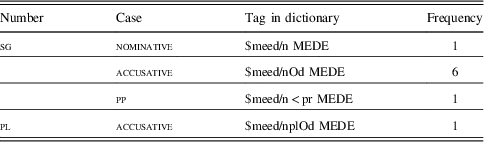
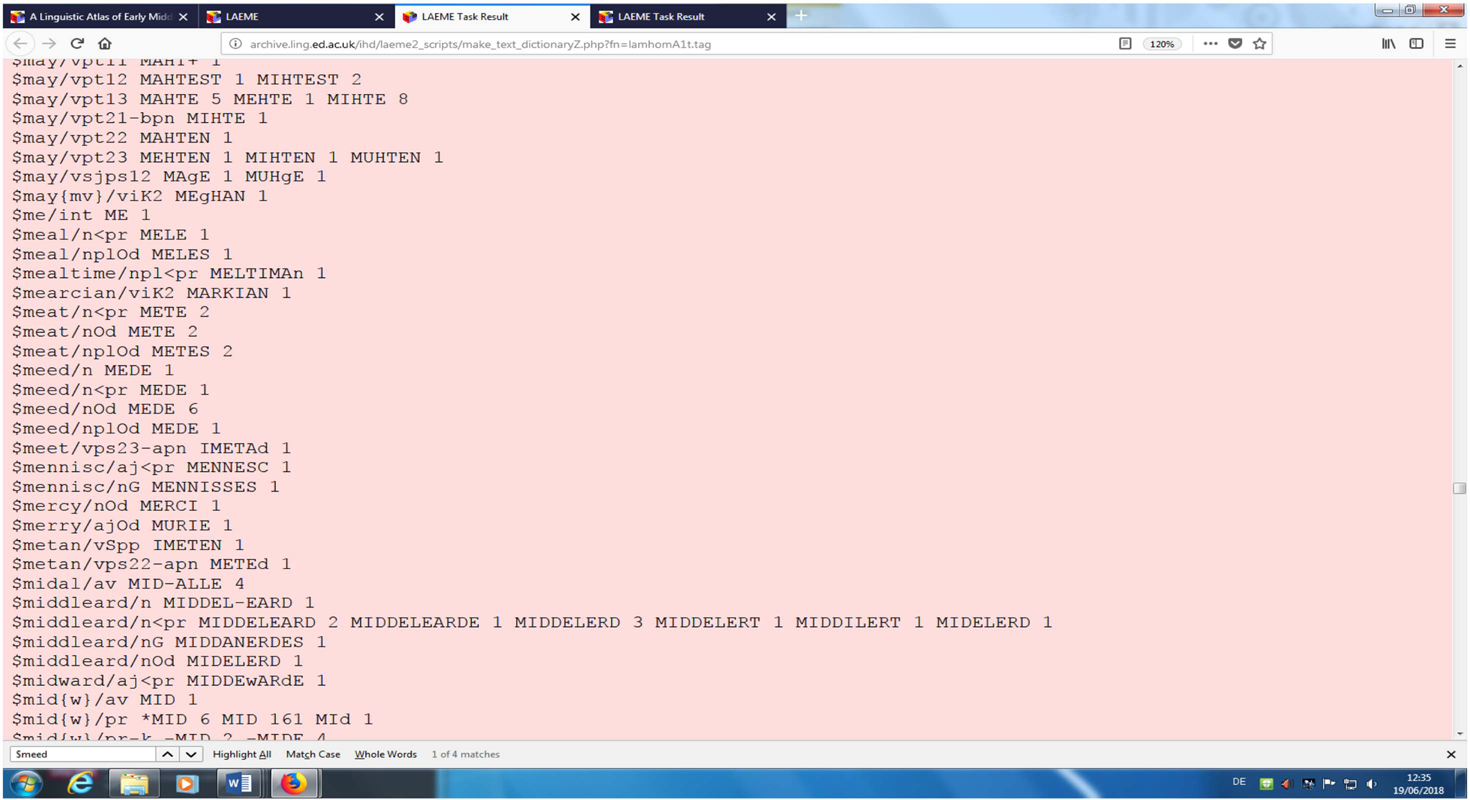
LAEME provides four documents, one of which is the tag dictionary, and one the tagged text. The dictionary lists all tagged lexemes and affixes alphabetically. It is an excellent database for collecting all the word forms of a specific lexeme. Table 3 displays all the word forms for the lexeme meed which can be found in the Lambeth Homilies (figure A1 in the Appendix). It can be seen that the word forms do not change depending on syntactic position. We can therefore conclude that meed is not inflected in this manuscript.
Word form of the lexeme meed in the tag dictionary

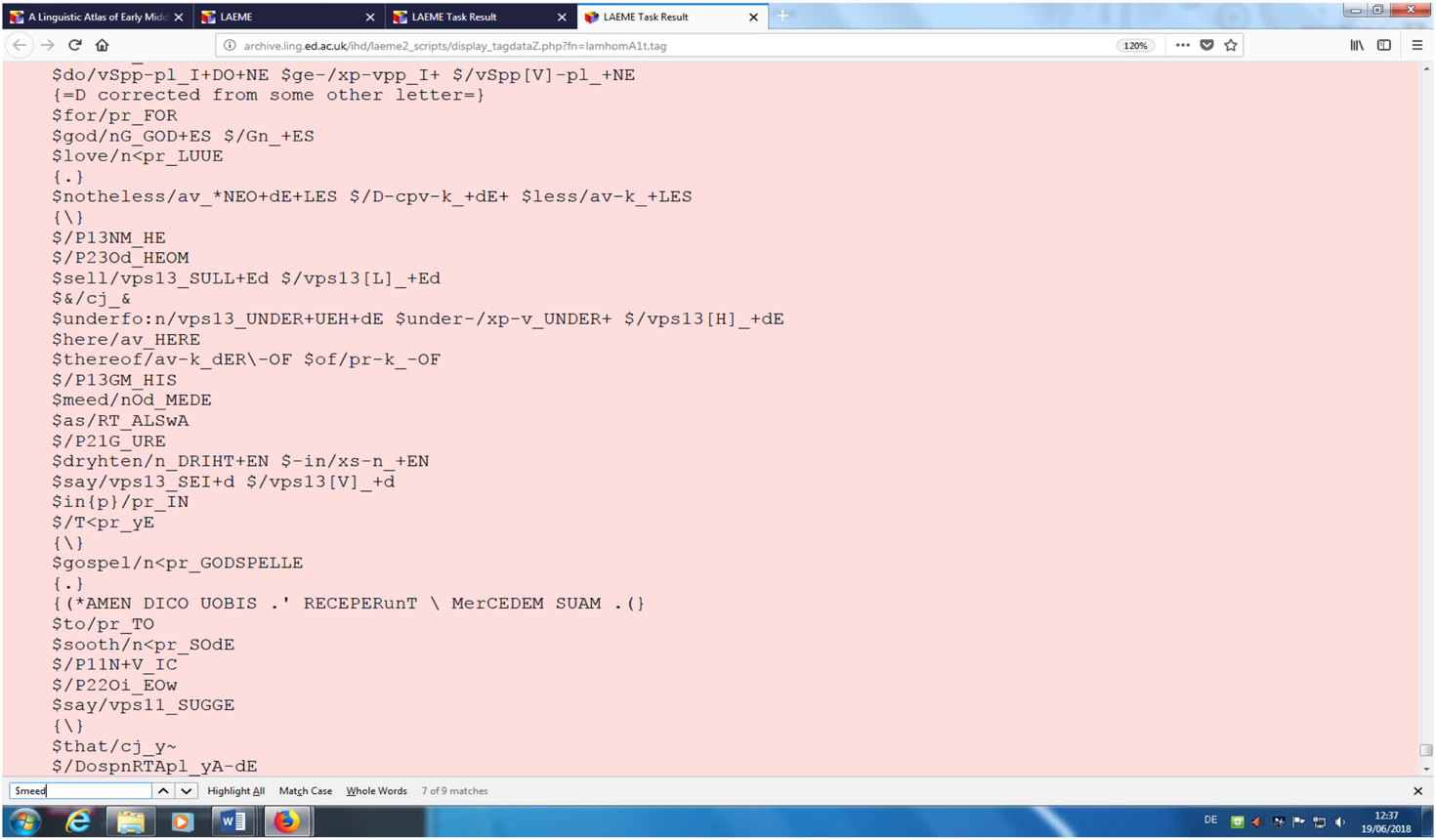
The tagged text contains all the tags for every word form (which corresponds to a morphological analysis of every word form), and follows the word order in the manuscript (figure A2 in the Appendix). In the tagged text, the final schwa of the word form meed in the accusative plural is analysed as a suffix (1), the final schwa of the after-preposition word form is analysed as belonging to the stem (2). It is obvious that this is not a correct analysis of the data. Therefore, too much is tagged regarding the lexeme meed.
(1) $meed/nplOd_MED+E $/plnOd_+E
(2) $meed/n<pr_MEDE
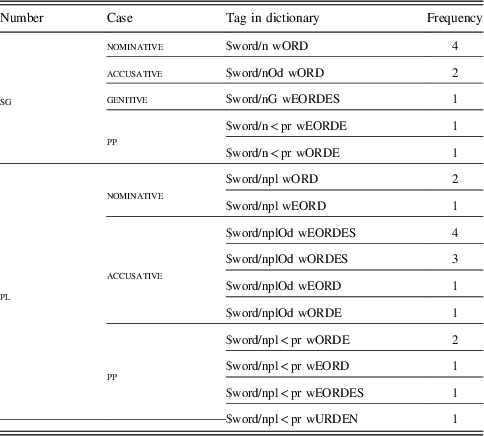
The opposite can also be found, that is, too little is tagged. Table 4 reports all the word forms for the lexeme word in the Lambeth Homilies. The nominative and accusative singular and all plurals contain the stem of the lexeme. -ə is suffixed after preposition in the singular and plural, as well as in the accusative plural. The suffix -s occurs in the genitive singular, as well as in the accusative plural and after preposition in the plural.
Word form of the lexeme word in the tag dictionary

In the tagged text, the word form worde is analysed in two different ways: The final schwa is a plural-marking suffix ((3) and (4)), but it is part of the stem in the singular after preposition (5). Again, this is not an appropriate analysis for the different word forms of the lexeme word.
(3) $word/nplOd_wORD+E $/plnOd_+E
(4) $word/npl<pr_wORD+E $/pln<pr_+E
(5) $word/n<pr_wORDE
It can be concluded that a new morphological analysis needs to be undertaken. To do so, the following steps are carried out:
(i) Extract each noun from the tag dictionary.
(ii) Exclude nouns occurring in a rhyming position (rhyme may influence the presence/absence of a suffix as well as the form of the suffix).
(iii) Identify the OE gender and inflection class for each noun (LAEME does not report the OE inflection class or gender) using OE dictionaries (Bosworth–Toller Anglo-Saxon Dictionary and The Dictionary of Old English). Group nouns according to gender and inflection class.
(iv) Identify the nouns’ stems and suffixes.
(v) Build new noun paradigms based on the findings.
(vi) For the definite article, extract each NP and PP from the tagged texts.
(vii) Identify the morphosyntactic properties of the definite article (case, number, gender) using the findings from step (v)).
(viii) Based on these findings, build the paradigms of the definite article.
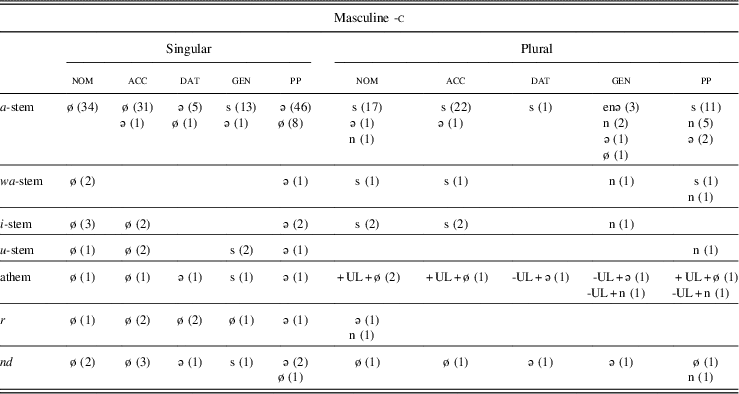
Table 5 shows the suffixes of the masculine nouns that end in a consonant (-C). It distinguishes number and OE inflection classes (a slightly simplified OE noun paradigm is displayed in the Appendix, table A1). The abbreviation ʻULʼ stands for umlaut, the abbreviation ʻathemʼ for athematic stems, the symbol -ø for ‘no suffix’, i.e. only the stem occurs in this cell of the paradigm. The number after the suffix indicates the frequency of the suffix. The same type of table is created for masculine nouns ending in a vowel (-V), and for neuter nouns (ending in a consonant or vowel). As will be shown, almost all feminine nouns end in a vowel, so only one paradigm needs to be built.
Full paradigm of the masculine nouns ending in a consonant in the Lambeth Homilies

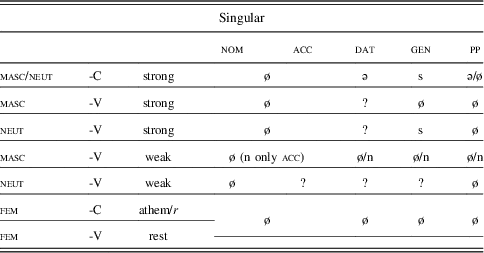
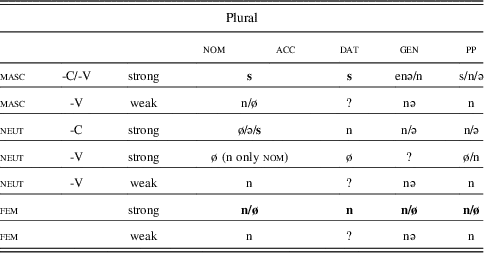
Based on this paradigm, systematic observations in order to make generalisations are rather difficult. Additionally, as can be expected, several inflection classes have collapsed and show the same set of suffixes; that is, they have merged into one inflection class. Thus, table 5 does not appropriately represent the paradigm of the masculine nouns. Therefore, table 5 can and must be reduced. Firstly, all suffixes that occur only once are deleted, unless the suffix is the only form in the cell of the paradigm. Secondly, the inflection classes that show the same set of suffixes are merged. Table 6 displays the reduced paradigm for the singular (all genders and inflection classes); table 7 displays the reduced paradigm for the plural (all genders and inflection classes). If more than one form occurs in a cell, the first form is the most frequent one, followed by less frequent forms. The following stems are excluded in the plural due to their very low type and token frequency: athematic stems, r-stems, nd-stem and es/os-stems.
Reduced paradigm of the masculine, neuter and feminine nouns in the singular in the Lambeth Homilies

Reduced paradigm of the masculine, neuter and feminine nouns in the plural in the Lambeth Homilies

4 Results
4.1 Plural
Three genders and strong and weak inflection classes can be distinguished in the plural (table 8): -s for masculine strong, -ø for neuter strong (most frequent form), -n for feminine strong, and for the weak inflection of all genders. Feminine strong and weak inflections differ from each other because weak feminine plurals are always marked by -n, while there is variation between -n and -ø in the strong feminine inflection. In the neuter, nouns ending in a consonant or a vowel are distinguished: -s for nominative and -n for dative never occur in the neuter strong -V. The focus of the following discussion is not to provide a detailed description of the paradigm, but to analyse changes from the OE paradigm to the paradigms found in the Lambeth Homilies.
Paradigm of the masculine, neuter and feminine nouns in the plural in the Lambeth Homilies

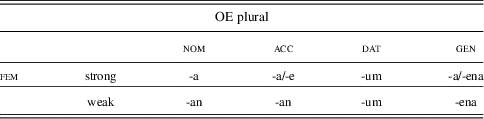
Masculine and neuter: the suffix -s extends from the nominative/accusative (OE -as) to the dative (OE -um) (the OE noun paradigm is in the Appendix, table A1), and to nouns after prepositions in the masculine. In OE, prepositions govern accusative, dative or genitive. However, prepositions have lost government in the Lambeth Homilies: for example, the prepositions through (governing accusative in OE) and mid (ʻwithʼ, governing dative in OE) can be followed – among others – by the definite article þe and þan (OE dative þām/þǣm). Not only can we observe the intra-paradigmatic analogy of -s within the masculine, but also inter-paradigmatic analogy between masculine and neuter: the suffix -s is sometimes used in the neuter nominative/accusative plural. Finally, the weak genitive suffix -ena extends to the strong inflection, which is encoded by -a in OE. All three genders are affected by this change in the genitive. However, already in OE the feminine shows weak forms in the strong genitive plural (see table 9) that are in variation with the strong form (-a).
Old English feminine plural inflection (Campbell Reference Campbell1959: 234)

Based on these observations, we can formulate some generalisations regarding the extension of the suffix -s. One may assume a complete extension within the masculine (all syntactic positions syncretised), and a subsequent extension across genders and inflection classes. However, a systematic and simultaneous extension within and across inflection classes/genders can be observed: (a) within the masculine, all syntactic positions are affected by the extension of -s, except the genitive/possessive (thus, the possessive is the latest affected by the extension of -s, all possessives are marked by -s by early Modern English); (b) simultaneously, -s extends from the masculine nominative/accusative to the neuter nominative/accusative. Regarding the possessive (genitive), inter-paradigmatic analogy from the weak to the strong inflection is observed in the Lambeth Homilies. This analogy in the possessive, and the fact that the possessive masculine is the latest form affected by the analogy of -s, can be explained by a more general tendency. The source of this change is not to be found in the morphology or phonology, that is, changes within the paradigm lead to a ±possessive system. I propose that the change starts in the syntax from a four-case system to a ±possessive system that requires a (more or less) clear inflectional encoding of the possessive.Footnote 3 The most distinct and suitable available marker for this category is the weak genitive form -enə/-n, because (a) -s encodes subject and object, (b) the most frequent (in most inflection classes) genitive plural marker in OE is -a which is reduced to -ə and therefore is not suitable to encode a new category.
Feminine: the feminine plural strong inflection differs from the feminine plural weak inflection in OE (table 9). In the Lambeth Homilies, however, the strong feminine plural nouns are encoded by -n or not marked at all. The suffix -n, originally an inflection class marker, can therefore be analysed as a feminine plural marker. At first glance this seems to be a case of exaptation. However, -n is still an inflection class marker in the masculine and in the neuter, so it has not entirely lost its original function. I suggest analysing this as an instance of inter-paradigmatic analogy within the feminine plural which causes a merger of the feminine inflection classes in the plural. This has two consequences: (i) the inter-paradigmatic analogy reinforces the feminine as a distinct category from masculine and neuter; (ii) that the levelling only occurs within the feminine plural – and not within all genders – proves that the feminine is still a separate category in the language system. Such a dramatic change within a category of nouns (i.e. the feminine) would not be possible if this category no longer existed.
In summary, from a synchronic point of view the presented analogy within and across inflection classes not only strengthens the marking of the plural, but also the distinction between masculine/neuter on the one hand and feminine on the other. Additionally, there seems to be a more general tendency towards a ±possessive system.
4.2 Singular
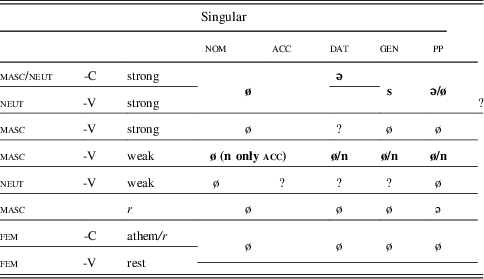
Masculine and neuter: the strong masculine/neuter -C show -ə in the dative, -s in the genitive, and variation between -ə and -ø after prepositions (table 10). The same applies to the neuters -V, with a nominative/accusative and PP always ending in a schwa: if a schwa is suffixed to a stem ending in a schwa, the word form does not change. To summarise, this system corresponds in its basic structure to the OE one (with changes in the phonology).
Paradigm of the masculine, neuter and feminine nouns in the singular in the Lambeth Homilies

The most important change can be found in the OE u-stems (the OE noun paradigm is given in the Appendix, table A1). They show the suffix -a in the genitive in OE; therefore this inflection class has merged with the other strong inflection classes in the Lambeth Homilies, as -s is suffixed in the genitive. Thus, the suffix -s has extended to another inflection class, and is reanalysed as a possessive marker.
The weak masculine accusative, dative and genitive show variation between -n (OE -an) and non-marking, while the nominative is not marked, corresponding to OE. There is only one word (eye) representing the neuter singular weak inflection occurring once as a subject, and once after preposition. Therefore, nothing substantial can be said about this inflection class.
The strong masculines -V form a separate inflection class: they show neither -s for the genitive (strong -C), nor -n (weak). Note, however, that the only difference between masculine nouns ending in a consonant or a vowel would be in the genitive. As there is only one instance of a masculine -V for the genitive, the question of whether they form a separate inflection class must remain open.
Finally, the nd-stems have lost the umlaut in the dative, and therefore merged with the strong nouns. The r-stems preserve their non-marking in the nominative, accusative, dative and genitive, but -ə is suffixed after preposition. Therefore, they form a separate inflection class.
In summary, only very little has changed in the inflection of masculine and neuter nouns that can be explained by inflectional changes, but the changes are mainly due to phonological changes (except for -s as a possessive marker). In very general terms, the masculine and neuter nouns can be categorised into two inflection classes, i.e. strong vs weak without gender distinction (excluding strong masculine -V and weak neuter, but they should probably be excluded from the analysis due to their low frequency).
Feminine: the situation regarding the feminine nouns is very different. Almost all feminine nouns end in -ә, independently of whether the noun ends in a consonant or vowel in OE (-V rest in table 10). The athematic and r-stem have preserved their non-inflection and end in a consonant in the Lambeth Homilies. There are only very few feminine nouns ending in a consonant which belong to the ō-, jō-, wō, i-stems in OE. It can therefore be hypothesised that schwa is a feminine marker.
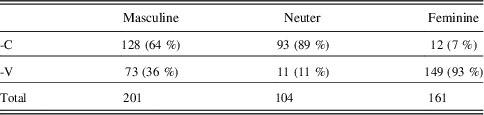
To check this hypothesis, the number of nouns (in subject position) ending in a consonant or a vowel is counted for the three genders (table 11). There is a clear split between the feminine and the masculine/neuter nouns: the large majority of the feminine nouns end in a schwa, while the large majority of the masculine and neuter nouns end in a consonant. Synchronically, then, schwa can be analysed as a feminine marker.
Number of nouns ending in a consonant or a vowel in the Lambeth Homilies

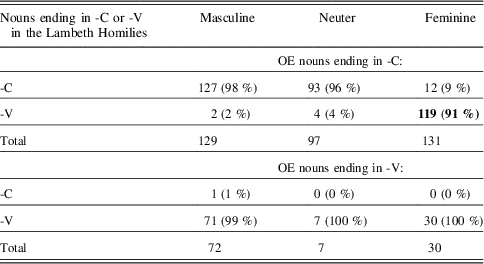
This is also borne out from a diachronic perspective (table 12): 91 per cent of the feminine nouns in the Lambeth Homilies that ended in a consonant in OE end in a schwa in the Lambeth Homilies. Masculine and neuter nouns ending in a vowel or a consonant in OE, and feminine nouns ending in a vowel in OE, have not changed in the Lambeth Homilies (apart from very few exceptions).
OE nouns ending in -C or -V in the Lambeth Homilies

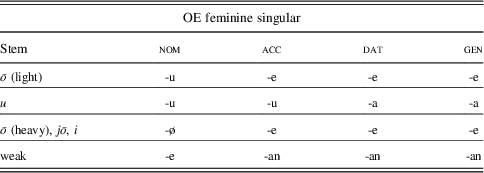
It could be argued that the fact that most feminines end in a schwa is a ʻside effectʼ of a phonological change. Table 13 reports the slightly simplified paradigm of the OE feminine nouns. From OE to EME, full vowels in unstressed syllables are centralised. This centralisation causes the collapse of the light ō-stems and u-stems.
Inflection of the OE feminine nouns (Campbell 1956: 234–42, 246–56)

However, if we apply this phonological change to the heavy ō-stems, jō-stems, i-stems and the weak inflection class, the result does not correspond to the data in the Lambeth Homilies. Firstly, the centralisation of full vowels is unrelated to the occurrence of schwa in the nominative of the heavy ō-stems, jō-stems and i-stems. That these feminine nouns end in a schwa can be explained by analogy: (a) accusative, dative and genitive show a schwa in this inflection class; (b) the light ō-stems and u-stems have a schwa in all syntactic positions. It can therefore be expected that the schwa will be added to the nominative of the heavy ō-stems, jō-stems and i-stems. Secondly, phonological changes (loss of /n/ after vowel in unstressed syllables) do not explain the loss of -n in the weak inflection, as -n is preserved in the plural (weak inflection of all genders) and reanalysed as a feminine plural marker (see table 8). The loss of -n in the singular is owing to analogy across inflection classes, because all the other feminine nouns (except the very few athematic and r-stems) end in a schwa in all syntactic positions. This change may be facilitated by the reanalysis of -n as a plural marker (see section 4.1).
4.3 Definite article and unhistorical gender
It is worth adding some observations regarding the forms of the singular definite article, as it clearly marks gender in OE. Moreover, there are some nouns which combine with the historically ʻincorrectʼ form regarding gender. Firstly, the paradigm of the definite article in the singular is introduced. Secondly, the unhistorical forms are analysed.
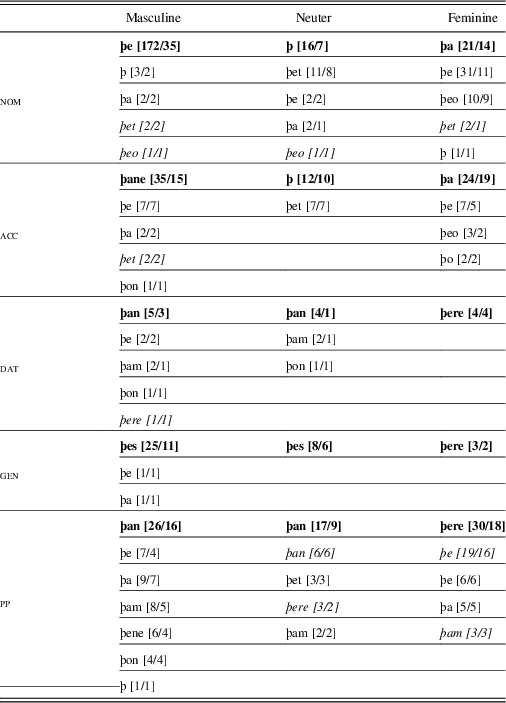
The forms of the definite article in the Lambeth Homilies show a wide range of variation (table 14, first number = type frequency, second number = token frequency). However, the most frequent forms (bold in table 14) produce a system which is very close to the demonstrative pronoun in OE. Additionally, three genders can clearly be distinguished in the accusative, two genders in the other cases: masculine/feminine vs neuter in the nominative (due to the emergence of þe in the nominative),Footnote 4 masculine/neuter vs feminine in the dative, genitive and PP (mainly using the dative forms) (for a detailed analysis, see Baechler forthcoming). Therefore, three genders are maintained in the definite article.
Singular definite article in the Lambeth Homilies

The three-gender system is also preserved regarding gender assignment in the vast majority of instances, i.e. nouns that have gender X in OE preserve gender X in the Lambeth Homilies and do not change to another gender. The system of gender assignment seems, then, to be very stable. There are a few nouns, however, which are preceded by a seemingly incorrect article, especially in the dative and PP, i.e. feminine nouns combined with þan/þam, masculine and neuter nouns combined with þere (italic in table 14). Additionally, some masculines and feminines combine with the neuter article (þet) in the nominative and accusative. Two explanations have been proposed: (a) the nouns have changed gender (among others Hoffmann Reference Hoffmann1909); (b) they form a new subsystem encoding case by the most distinctive form (Jones Reference Jones1967, Reference Jones1988). It will be shown here that it is probably more reasonable not to seek a single explanation, as there appear to be different changes occurring at the same time.
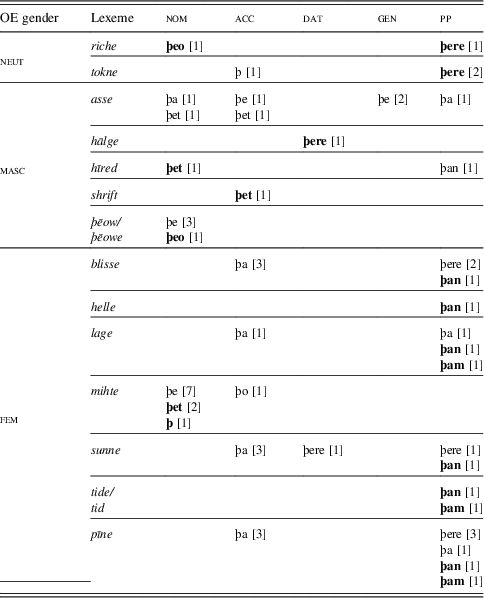
Table 15 displays the nouns that are combined with a form of the definite article inconsistent with their gender in OE (in bold). It can be observed that the instances with unhistorical gender are very rare (comparing the frequencies in table 14 with those in table 15). In the following I will first discuss masculine and neuter nouns preceded by the feminine article (nominative: þeo; dative, PP: þere), then feminine nouns preceded by the masculine/neuter article (PP: þam/þan), and finally masculine and feminine nouns preceded by the neuter article (nominative and accusative: þet).
Nouns with unhistorical forms of the definite article regarding gender in the Lambeth Homilies

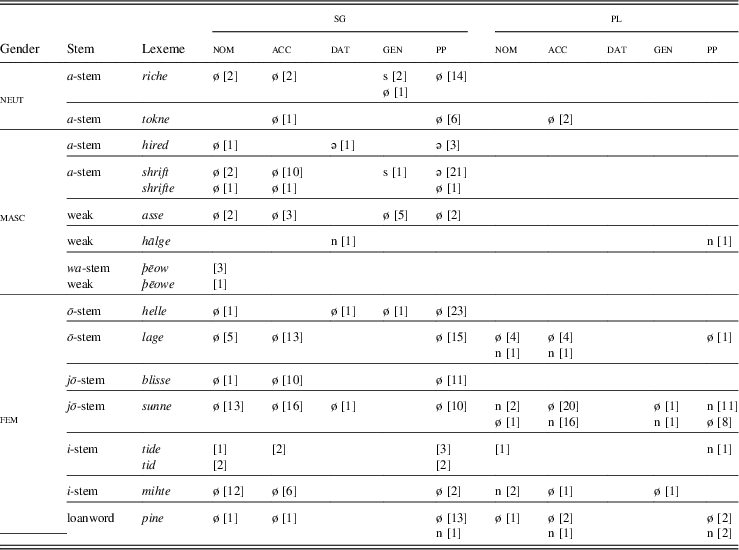
Masculine and neuter nouns with þere or þeo: the lexemes riche and hālge combine only with feminine articles, tokne with a neuter form (þ; see table 14) and a feminine form (þere). The lexeme þēow has two forms in OE: þēow (wa-stem), þēowe (weak). The form þēow is preceded by þe (see table 14), þēowe by the feminine article. These masculine and neuter nouns both end in a schwa. It was observed in section 4.2 that the large majority of the feminine nouns end in a schwa, while the large majority of the masculine and neuter nouns end in a consonant. Thus, at first glance the masculine and neuter nouns that combine with a feminine article have changed gender. To check this hypothesis, the inflection of these nouns must be analysed. As displayed in table 16, these nouns seem to behave like other masculine and neuter nouns. Due to the lack of data, this can only be stated with certainty for the lexemes riche and hālge: -s is suffixed to riche in the genitive singular, -n is suffixed to hālge in the dative singular. Another explanation may be that the use of the feminine article is influenced by the language contact with Norman French. However, the four masculine and neuter lexemes are masculine in Norman French. A third possible explanation is that masculine and neuter nouns ending in a schwa combine with the forms of the article that are usually feminine, but the nouns do not change gender. This means that the morphology would have two forms for the dative (þere, þan): þere combines with nouns ending in a schwa, þan with nouns ending in a consonant. However, this possibility does not explain the distribution of the definite article because most masculine and neuter nouns that end in a schwa are preceded by þan. In summary, masculine and neuter nouns can be combined with the feminine form of the definite article, which can be explained by their phonological shape: they all end in a schwa, and if the lexeme varies (þēow/þēowe), the form ending in a schwa is preceded by the feminine form of the article. The generalisation is: all feminine forms of the definite article that combine with a masculine or neuter noun combine only with a masculine or neuter noun ending in a schwa; the opposite – nouns that end in a schwa are preceded by a feminine article – does not apply.
Inflection of the nouns of table 15

Feminine nouns with þan/þam: regarding the feminine nouns, similarities to the masculine and neuter nouns can be observed. The feminine nouns that combine with a masculine/neuter article are reported in table 15 (all feminine nouns in table 15 except mihte); their inflection is reported in table 16. Note that only feminine nouns after prepositions show the masculine/neuter forms of the article. Firstly, the inflection of these nouns corresponds to what has been observed for all feminine nouns: schwa in the singular without case distinction, -n or -ø in the plural. Therefore, they have not changed gender. Secondly, the masculine/neuter form of the article always varies with the feminine form of the article for the same lexeme. There are two exceptions that only combine with masculine forms: helle and tide/tid. There is only one instance of helle preceded by a definite article, so nothing more precise can be said about helle. The lexeme tide comes in two forms, but tid is more frequent in the singular than tide (see table 16). It is therefore possible that the masculine/neuter article is selected with the lexeme (not the word form) tide because it usually ends in a consonant. Note, however, that the other feminine nouns that end in a consonant do not combine with a masculine/neuter form of the definite article. I propose that this is related to analogy, based on the following observations: (a) only feminine nouns in PPs can be preceded by a masculine/neuter form of the definite article (one exception in the nominative); (b) only very few neuters and no masculines show a feminine article in PPs, while the percentage of feminine nouns combined with a masculine/neuter form (þan and þam) of the article is relatively high; (c) prepositions no longer govern different cases, but the most frequent forms after prepositions are those which also occur in the dative. It can therefore be deduced that the masculine/neuter form of the definite article is becoming the default form after prepositions, i.e. this is an instance of analogy within the paradigm of the definite article and is unrelated to gender.
Feminine and masculine nouns with þet: regarding the feminines, þet combines with the lexeme mihte only in the nominative. However, the most frequent form of the article with the lexeme mihte is þe (see table 15). Additionally, the inflection of mihte follows the same patterns as the other feminine nouns (see table 16). The masculine nouns preceded by þet are the lexemes asse, hīred and shrift. There is only one instance of the lexeme shrift with an article, and the lexeme hīred is preceded once by þet in the nominative and once by þan after preposition (masculine and neuter dative are already syncretised in OE). Therefore, nothing can be said about these two lexemes. The lexeme asse selects the þe/þa (þa can be seen as a variant of þe) in the nominative (1), accusative (1), genitive (2) and after preposition (1), þet in the nominative (1) and accusative (1). Therefore, uninflected forms are in variation with neuter forms. The question of whether asse has changed gender or not cannot be answered because the inflection of the masculine and neuter nouns has merged (see section 4.2). In summary, no morphological reason can be found to explain the use of þet with masculine and feminine nouns. Another possibility would be that nouns referring to inanimate entities combine with the neuter article. However, asse is animate (although not human), and the large majority of the feminine and masculine nouns referring to inanimate entities combine with the historically ʻcorrectʼ feminine or masculine article.
In summary, nouns are mainly preceded by an unhistorical form of the article because of (a) their phonological shape (masculine and neuter) or (b) inter-paradigmatic analogy (feminine). The nouns have not changed gender, and nor do the unhistorical forms constitute a subsystem encoding syntactic functions.
4.4 Instances of exaptation?
In very general terms, it can be summarised that -ə is reanalysed as a feminine singular marker and -n as a feminine plural marker. One may now ask whether these are instances of exaptation. Regarding the plural, this clearly does not apply. The suffix -n is an inflection class marker in OE (the OE noun paradigm is given in the Appendix, table A1), a feminine marker in the Lambeth Homilies. However, -n is not lost as an inflection class marker in the Lambeth Homilies as it clearly distinguishes the strong plural (masculine and neuter) from the weak plural (masculine and neuter).
As regards the singular, the situation is more complex because there are arguments for and against -ә being exapted to mark feminine. The following observations point in the direction of exaptation:
1. The suffix -e/-ә is a case marker in OE, and becomes a feminine marker in the Lambeth Homilies; the phonological material encodes a new function (criteria ʻnoveltyʼ).
2. Some masculine and neuter nouns ending in -ә show feminine articles. This does not mean that these nouns have changed gender, but it does show that -ә is in some way connected to the feminine forms of the definite article (see 1).
3. In the Lambeth Homilies, a three-gender system is preserved, but it clearly tends towards a two-gender system, as a clear split between masculine/neuter and feminine is observed from a synchronic and diachronic perspective. Compared to other Germanic languages, this is at least unusual. To my knowledge, Germanic languages show three different types of gender systems: (a) a three-gender system is preserved; (b) common (masculine/feminine) vs neuter; (c) gender is lost. Thus, a masculine/neuter vs feminine system is micro-typologically not expected (criteria ʻunexpectednessʼ).
The following observations argue against exaptation:
4. The original case marker -e/-ә encodes feminine. However, this change has a levelling effect on the paradigm, i.e. feminine inflection classes merge due to the reanalysis of -ә as a feminine marker.
5. It was shown that feminine nouns which end in a consonant in OE show -ә in the Lambeth Homilies. However, two entire inflection classes are excluded from this change: athematic and r-stems. If only a few lexemes had not yet changed, they could be explained as being some exceptions. What we observe here is a systematic exclusion of entire inflection classes. However, athematic and r-stems are very small inflection classes, i.e. only a few nouns are part of these inflection classes.
6. Almost all feminine nouns ending in a consonant in OE end in a schwa in the Lambeth Homilies. If schwa were exapted as a feminine marker, we would expect masculine and neuter nouns to lose their final schwa. This, however, is not the case (at least in the Lambeth Homilies).
In summary, there are several arguments in favour of and against analysing -ә as being exapted to mark feminine, and the arguments against exaptation are rather strong. However, the Lambeth Homilies represent only one dialect at a specific time. This is why it would be worth examining whether the arguments against exaptation also apply in other dialects and in later manuscripts.
Finally, -s as a plural marker (originally a case marker form nominative/accusative plural), -s and -ena as possessive markers (originally a case marker for genitive) are also potential candidates for exaptation. However, both instances have a levelling effect on the paradigm. Additionally, regarding the former genitive markers, it must be borne in mind that the genitive is a case that encodes different functions in OE, among others genitive objects (governed by the argument structure of the verb) and possessive. Thus, the original function (possessive) is not lost, but other functions (genitive objects) are lost which are encoded by the same morphology in OE. That -s and -ena are selected to encode possessive is not surprising, as these suffixes are phonologically the most distinctive ones among the OE genitive allomorphs (see the OE noun paradigm in table A1, Appendix). The same applies to -s as a plural marker, i.e. it is the most distinctive form among the OE allomorphs.
4.5 Analysis
The changes in the Lambeth Homilies can be summarised as follows:
1. Inter-paradigmatic analogy is observed regarding the OE genitive plural suffixes of the weak inflection (-ena) as n-forms are found in the strong inflection. This can be explained by the change in the system towards a ±possessive system. The most distinctive form among the OE genitive plural allomorphs (-a, -ena) is -ena, which makes it a good candidate to encode the category possessive.
2. The same is true for the possessive singular. The genitive singular allomorphs in OE are -es, -e, -a, -an and -ø (see table A1, Appendix). The suffix -s has extended to all masculine/neuter strong inflection classes (i.e. including masculine u-stems), but it has not yet extended to the strong feminines and to the weak nouns of all genders. The suffix -an would potentially be a good candidate, too, because it would permit encoding the possessive (singular and plural) with one marker. However, the system requires a distinction between singular and plural (see below), that is, possessive singular and possessive plural must be distinguished. Additionally, -n is also used as an inflection class marker and as a feminine plural marker, while -s only forms plural (masculine and neuter).
3. Inter- and intra-paradigmatic analogy is found regarding the OE nominative/accusative plural suffix of the masculine strong inflection (-s): it extends to the dative plural in the masculine inflection, and to the nominative/accusative plural in the neuter.
4. The feminine plural is mainly encoded by -n. This suffix can be traced back to OE -an, which encodes the plural of the weak inflection (all genders). This is therefore an instance of inter-paradigmatic analogy, i.e. from the weak feminine to the strong feminine nouns.
→ The changes described in 3 and 4 are possible only if at least two genders are distinguished, i.e. masculine/neuter (or non-feminine) vs feminine: the OE nominative/accusative plural allomorphs are -u, -e, -a-, -as and -an (Campbell Reference Campbell1959: 222–60). The vocalic suffixes are centralised to schwa, so the most distinctive suffixes and best candidates to encode plural are -s and -n. Interestingly, one consonantal suffix is selected to encode masculine and neuter plural (-s), the other one to mark feminine plural (-n). The language system tends towards a ±feminine system.
5. Inter-paradigmatic analogy was observed within the feminine singular regarding -ә. In OE, many feminines show vocalic suffixes in all cases of the singular. These suffixes are centralised due to phonological changes. Schwa can then be reanalysed as a feminine marker and extended to feminines which end in a consonant and to the weak feminines which mark accusative, dative, and genitive with the suffix -an in OE. The loss of -n in the feminine singular weak cannot be explained by phonological changes as -n is used to mark feminine plural. I propose that the loss of -n is due to the change that the plural must clearly be distinguished from the singular, and feminine from masculine/neuter. The latter change leads to -s (masculine/neuter) and -n (feminine) as plural markers. Then, the suffix -n cannot be selected to encode feminine singular and is lost.
Intra-paradigmatic analogy (increase of syncretism) and inter-paradigmatic analogy (reduction of allomorphy) can be seen as a reduction/loss/simplification of inflection. However, inflection is not reduced randomly, nor is it entirely due to phonological changes. The change is driven, among other things, by three rules/constraints: distinguish plural from singular; distinguish possessive from non-possessive; and distinguish feminine from non-feminine. This also means that the loss of gender is not a gradual process. What we see here is a reinforcement of the feminine: the feminine forms differ from the masculine/neuter (in the singular and plural), and there are changes that occur only within the feminine. That the system tends towards a ±feminine system is rather unusual for a Germanic language because some have lost gender, others have preserved a three-gender system, while others distinguish neuter from common (former masculine and feminine). However, from a purely inflectional point of view, this is the change that can be expected as there are several syncretisms between masculine and neuter in all nominal parts of speech already in OE.
A significant change regarding inflection classes can be observed, too.Footnote 5 The inflection classes are connected to stems in Proto-Germanic (more precisely, to the vowel in the case/number portmanteau suffix (Ringe Reference Ringe2017: 197–8), which is due to the merger of the Proto-Indo-European stem-vowel and the case/number suffix (Ringe Reference Ringe2017: 224–5)). This means that the best predictor of how a noun is inflected is the stem for Proto-Germanic. For OE, the best predictor may be the form for the nominative/accusative plural, but it does not predict all the forms, which signifies that several principal parts and the gender are needed to predict the inflection of an OE noun. In the Lambeth Homilies, the inflection classes are mainly connected to gender (except for the weak nouns, which are already almost entirely syncretised in OE). This means that the best predictor of how a noun is inflected in the Lambeth Homilies is gender (and most likely in other manuscripts of the same area and period).
5 Summary and outlook
In the Lambeth Homilies (I–V and IX–XIII), two numbers (singular and plural), three genders (masculine, feminine and neuter) and five morphosyntactic properties (subject, direct and indirect object, possessive, and after preposition) can still be distinguished through morphological encoding. However, the observed inter- and intra-paradigmatic analogies change the language towards the following system: one which distinguishes plural from singular, possessive from non-possessive (in the singular and plural) and feminine from non-feminine (in the singular and plural). The original inflection classes related to different stems are almost lost, except the weak inflection classes. The inflection classes are instead related to gender; that is, gender is the information that best predicts how a noun is inflected. Thus, the analogical changes observed here do not simply cause a reduction/loss of inflection, but new rules/constraints on inflection emerge through the reanalysis of analogically levelled suffixes. Finally, gender is not lost, but the feminine is reinforced through reanalysed markers which differ from masculine and neuter suffixes.
Based on the observations made in this article, new questions arise regarding gender and the spread and stability of this system, as well as a methodological question.
− Section 3 discussed the possible issues when analysing the Lambeth Homilies. As already mentioned, it is not possible to build paradigms for every single sermon because the sermons are too short to have – ideally – several forms for the same cell of the paradigm. Sisam (Reference Sisam1951) assumes that the Lambeth Homilies of group A are older than those of group B based on an analysis of the orthography. This view has been challenged by Millett (Reference Millett2007). It would now be interesting to compare the inflectional morphology of the two groups, and see whether group B has a more modern inflection than group A. There is, however, a methodological issue: group B only contains 7,048 tagged words (group A 18,808 tagged words), so it may not be possible to build full paradigms.
− Schwa is reanalysed as a feminine marker. However, feminine athematic and r-stems are not affected by this change in the Lambeth Homilies, and masculine and neuter nouns do not lose their final schwa. Do these restrictions also apply to other manuscripts from the same area, or does this change continue towards feminine nouns ending in a vowel and masculine and neuter nouns ending in a consonant (in later manuscripts from the same area)? Are similar systems found in other EME dialects at the same time, earlier or later (i.e. did this system originate in the Southwest Midlands, or elsewhere, or does is emerge in all EME dialects at the same time)?
− Inflection is gradually lost, but new systems can emerge in the meantime. The question is, then, how stable these new systems are. Is the inflectional system in the Lambeth Homilies preserved in later manuscripts from the same area, and if so, for how long is it preserved? Has this system spread to other areas?
To put it in a nutshell: there is no comprehensive synchronic and diachronic analysis of the noun inflection of the different EME dialects regarding the emergence of new inflectional paradigms, their stability and spread.
APPENDIX
The inflection of OE nouns (slightly simplified) (Campbell Reference Campbell1959: 222–60)

LAEME tag dictionary

Tagged text in LAEME