INTRODUCTION
This paper examines the distribution of power among public, private and criminal interests invested in Mombasa port, and highlights the dominant relationships shaping its infrastructural development.Footnote 1 It focuses on the construction and persistence of private dry ports (transit sheds or container freight stations) to explore the political settlements that sustain them.Footnote 2 Container storage, a highly lucrative component of international trade, is presented as a crucible in which Kenya's political settlements are being tested and reshaped.
Despite well-documented corruption inside private dry ports and the heavy congestion that they produce in Mombasa, these facilities survive owing to an unlikely coalition of actors, united by the desire to maintain profitable inefficiencies in container storage. The case exposes a dynamic interaction between the country's shifting political settlement on the one hand, and the gateway itself – Mombasa port's physical infrastructure and regulations – on the other. Since 2008, profitable inefficiencies in container storage have been designed and exploited to circumvent the state's dominant control over port revenue. This has widened the Kenyan gate, both in terms of the profitability of interactions with the outside world, and in terms of the number of actors able to exploit them. As the gate has grown, it has produced a push for state consolidation over new sources of revenue. This can already be seen in the development of large inland storage facilities away from Mombasa in Embakasi and Naivasha, and in new policies forcing cargo aboard the the Standard Gauge Railway (SGR) and out of the port town.
This paper draws on formal and informal discussions that took place in Mombasa and Nairobi between August and November 2017.Footnote 3 Those interviewed include freight forwarders, transporters, logistics managers, clearance agents, dock workers, dry port operators, journalists, and representatives of shipping lines, trading associations, and government agencies. Interview material is supplemented by information from local news outlets, maps and official documents.
What follows is structured into four sections. The first provides a theoretical framework concerning gatekeeper states and the use of a political settlements approach to port politics, as well as some necessary context regarding Kenyan politics. Section two turns specifically to container freight stations at Mombasa port. It progresses through political relationships at different scales to show how these have shaped the development of port storage over time. Section three analyses the storage facilities with regard to port efficiency and to future developments in Mombasa. A final section summarises and points to areas that warrant further research.
POLITICAL SETTLEMENT AT THE GATE
Cooper's (Reference Cooper2002) concept of the ‘gatekeeper state’ contains several characteristics that can be observed in modern Kenya. It highlights the elite's obsessive focus on controlling points of interaction between the state and the rest of the world. With this control come resources derived from customs revenue, tender negotiations, permits to do business and move currency, visas and foreign aid, among others, which are in turn distributed internally via patronage networks to maintain political support. This often takes place at the expense of other traditional state functions, notably efforts to penetrate the social and cultural spheres and to turn the nation-state into a symbol that inspires respect or loyalty (Cooper Reference Cooper2002: 157).
Operating a gatekeeper state model can make for a vulnerable national elite. The stakes of control over a single point – the interface between the national and the international – are often made so high that the consequences of exclusion from it are politically catastrophic (Cooper Reference Cooper2002: 5). Behind temporary allegiances and bitter handshakes lie complicated negotiations about access to gatekeeping rents.
Several factors suggest the Kenyan case fits important features of Cooper's model. The first is the fluidity of the governing coalition, which has seen fierce rivals turn to allies in the space of a single electoral cycle (Cheeseman et al. Reference Cheeseman, Lynch and Willis2016). This can be expected in cases where coalitions are built on the negotiated distribution of gatekeeping rents.
Second is the country's high prevalence of official corruption, endemic in its national politics and analysed in detail in recent literature (Cohen & Odiambo Reference Cohen and Odhiambo2004; Wrong Reference Wrong2009; Branch et al. Reference Branch, Cheeseman and Gardner2010; D'Arcy & Cornell Reference D'Arcy and Cornell2016). High-profile scandals – often involving international tenders, foreign exchange and customs irregularities – dominate much of the national dialogue.Footnote 4 As the elite struggle for control over the national-international interface, money leaks out of official channels and into private bank accounts.
Third is the tension surrounding Kenya's recent devolution, which radically restructured the centre's relationship with its outlying counties, and concentrated gatekeeping roles and revenue in Nairobi (Willis & Chome Reference Willis and Chome2014; Cheeseman et al. Reference Cheeseman, Lynch and Willis2016). Dissatisfaction with current arrangements has prompted a political backlash from coastal politicians, and the consequences for port development and customs revenue are ongoing.
These issues are inseparable from the politics of ethnicity. The country's political and geographic centres are strongly associated with its largest ethnic group, the Kikuyu. Mombasa, meanwhile, is made up primarily of Swahili, Mijikenda and Luo (see Bratton & Kimenyi Reference Bratton and Kimenyi2008; Hornsby Reference Hornsby2013). Again, this raises the stakes of controlling the country's gateways. Control of the gate, as Cooper (Reference Cooper2002: 157) argues, is a zero-sum game, especially when spoils are distributed according to ethnically aligned patronage networks at the exclusion of others.
When it comes to examining rents and power at the Kenyan gate, a political settlement approach provides a practical lens. While traditional models of rent distribution emphasise either formal institutions, often state entities and political parties, or clientelist networks, the shadowy patterns of informal rent distribution that lurk behind them, the political settlement approach looks beneath both to the underlying distribution of power in a given section of society (see North et al. Reference North, Wallis, Webb and Weingast2007; Khan Reference Khan2010; Putzel & DiJohn, Reference Putzel and Di John2012). Emphasising bargaining outcomes among competing elites, it offers a political explanation for the effectiveness or weakness of institutions, and a valuable framework for understanding developments at Mombasa.
The nature of clientelism – why, when and how it occurs – is determined in large part by the societal cleavages that are highlighted by this approach. When powerful groups are not getting what they consider to be their share, both formal institutions and informal networks are often reshaped, ignored or otherwise undermined until this changes (see Helmke & Levitsky Reference Helmke and Levitsky2004). A ‘settlement’, as such, refers to the point of equilibrium at which rents are distributed roughly according to the relative power of groups in society. ‘Power’ is determined by a combination of not only financial resources and the occupation of formal institutions, but also by the historically rooted capacity for particular groups to organise themselves (Khan Reference Khan2010: 4).
Power can be distributed both ‘horizontally’, between elites, and ‘vertically’, between those elites, smaller subordinate organised groups and the population at large (Khan Reference Khan2010) Elsewhere in the region, examining the relationships and compromises that exist at these levels has been used to investigate sectors ranging from industrial policy (Gray Reference Gray2013), social policy (Lavers & Hicky Reference Lavers and Hickey2015), the nature of political extraversion (Behuria & Goodfellow Reference Behuria and Goodfellow2016) and the provision of health care (Chemouni Reference Chemouni2016). It seems, however, particularly suitable to ports, where national governing bodies are often geographically distant, powerful groups are diverse and competitive, and the potential rents for those serving as gatekeepers – both legal and illegal – are enormous.
Overall, the gatekeeper model is well-complemented by a political settlements approach, which provides it with a practical analytical lens. This paper endeavours to combine the two, analysing the structure of power underlying not the Kenyan political system as a whole, but its most lucrative gateway to the outside world, the port of Mombasa.
MOMBASA PORT AND ITS STAKEHOLDERS
Mombasa holds the largest seaport in East Africa, and supplies an extensive hinterland in Uganda, Rwanda, South Sudan and the Eastern Democratic Republic of Congo. Although growth was relatively stagnant through the latter half of the 20th century, both the port and its market have expanded rapidly in recent years. In 2016, throughput reached one million containers for the first time in Mombasa's history, and the construction of both a second container terminal and standard gauge railway line have significantly boosted its capacity.Footnote 5 Figure 1 shows Mombasa Island, with the port's new container terminals on the left of the image. Private dry ports are clustered around the city's central business district.
Mombasa Island and Kilindini Harbour.

Although development at the Kenyan port has attracted a significant amount of attention and investment in recent years, time and again its politics have been sidelined. Gekara & Chhetri (Reference Gekara and Chhetri2013: 559) outline a range of ‘performance enhancing initiatives’ – notably the dredging of new berths and the construction of a second container terminal, but note that their success is limited by a constricted economic environment, poor hinterland connectivity and logistics bottlenecks along the transport corridor extending westwards (see also Kotut & Mugambi Reference Kotut and Mugambi2014; Wanjiru & Otumba Reference Wanjiru and Otumba2014; Ruto & Datche Reference Ruto and Datche2015). Along similar lines, Nyema (Reference Nyema2014: 39) writes of container terminal operations at the port:
This study revealed that factors such as inadequate quay/gantry crane equipment, reducing berth times and delays of container ships, dwell time, container cargo and truck turnaround time, custom clearance, limited storage capacity, poor multi-modal connections to hinterland and infrastructure directly influence container terminal efficiency.
Political relationships, vested or competing interests, or even simply people, are nowhere to be found. Much the same thing can be seen in materials on the port that are sponsored by developmental and government agencies, where the focus falls heavily on improving storage, rail and road transport capacity, each of which are identified as key sources of inefficiency (see World Bank 2012; JICA 2015; KPA 2015; TMEA 2016).
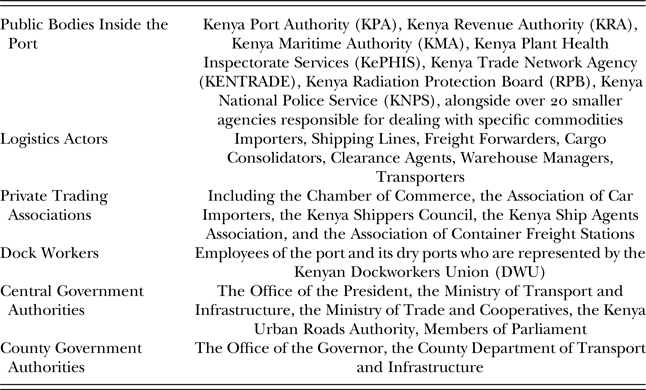
The sections below focus instead on the actors who manage, operate and make use of the port. Broadly speaking, these port stakeholders can be broken down into six clusters. Table I lists these and the actors within them. The selection is not exhaustive, but gives a sense of the large number of groups invested in Mombasa port and the complexity of their interactions, with different clusters pulling it in different directions. The growth of private dry ports offers a window into how these groups relate to one another, and how their interactions have shaped infrastructure development in Mombasa.
Port Stakeholders by Cluster.

PORT STORAGE AND PRIVATE DRY PORTS
In 2008, the lack of container capacity in Mombasa port reached a crisis point. Shipping line managers describe a difficult period, in which container vessels were forced to queue out to sea for indefinite periods while importers paid costly vessel delay surcharges. Kenya Revenue Authority (KRA) systems failed regularly and cargo entering Mombasa could take up to 10 days to be cleared through customs.
In this context, a group of investors proposed to the Kenya Port Authority (KPA) that they provide storage units in and around Mombasa in order to ease the burden on the container terminal. These units would be an extension of the port area, managed privately but licensed as sites for customs clearance by the KRA. One senior maritime consultant described this as a ‘stop gap’, which had been necessary at the time but has since become redundant.Footnote 6 Others were more critical, with one interviewee commenting that the venture was ‘a scam from the start’, and that among the shareholders in the private venture could be found an ‘exclusive club of the who's who of Mombasa’, mostly higher-ups from the KRA.Footnote 7 Undoubtedly, the list of investors in dry ports has featured prominent names from the Kenyan elite. The ex-Commissioner General of Customs owned one of the first facilities in Mombasa, while the Autoport and Portside facilities currently belong to the family of Mombasa's Governor, Hassan Joho.Footnote 8 With political support and little competition, private dry ports emerged as a profitable enterprise. Over the past decade, they have grown in number, and currently more than 20 are scattered throughout the central business district of Mombasa.
The decentralisation of customs clearance to small facilities across the city has led to additional problems of oversight and accusations of malpractice.Footnote 9 Repeatedly, court cases relating to corruption and smuggling have seen individual dry ports closed or sold. The Association of Container Freight Stations defends its members by arguing that the KPA is still able to monitor all containers through scanners at the port gates, and is therefore ultimately responsible for policing cargo.Footnote 10 This contradicts claims that dry ports remove the burden on port authorities, however, and does not account for the well-documented mishandling, overloading and fraudulent documentation that has taken place within the facilities themselves.Footnote 11 Originally, the service provided by dry ports was not paid for by the port, and the KPA encouraged the owners to pass on costs to importers through storage fees. Dry ports vary greatly in their quality of service, and many are plagued by understaffing, poor machinery and untidy storage yards.
The business model has frustrated importers, who have complained of deliberate stalling to extract higher fees.Footnote 12 Shipping lines, similarly, have found themselves liable for shore-handling practices in facilities selected for them by the KPA. They complain of containers being damaged or vanishing altogether in the process.Footnote 13 Several interviewees went further in their criticism, questioning the need for private dry ports in light of infrastructural developments at the port.Footnote 14 The recent construction of a 1.2 Million TEU container terminal and the Standard Gauge Rail (SGR) line direct to storage facilities in Embakasi (Nairobi), mean that, barring sabotage or deliberate stalling, the port is able to run comfortably within capacity without private yards (Wissenbach & Wang Reference Wissenbach and Wang2017).
Traffic has been another key point of concern. Representatives of the Association of Container Freight Stations (ACFS) claim the facilities alleviate traffic at bottlenecks around the port gates by dispersing cargo outside of the harbour area.Footnote 15 Their argument was roundly dismissed by other interviewees. With or without private dry ports, the same amount of cargo leaves the gates. Under current arrangements instead of transiting directly out of Mombasa, containers are held in local facilities and moved twice through the central business district. As a result, dry ports have given rise to internal circulation of freight trucks that has damaged roads and exacerbated congestion.
The problem is made worse by a port regulation stipulating that private dry ports must be constructed within 10 kilometres of the city centre.Footnote 16 This is ostensibly for security reasons, although in practical terms it serves the interests of CFS owners by reducing their port-to-CFS freight expenses. The 10 kilometre rule was cited repeatedly as an example of how the facilities were intended for profit more than as a service to the port or the city. Despite all of this, dry ports have persisted and multiplied with the growth of the port itself.
POLITICAL LEVELS AND PRIVATE DRY PORTS
Examining political relationships sheds light on the perseverance of Mombasa's dry ports, as well as changes to port storage that may occur in the future. The most significant contests occur at the following levels: (1) international, between the Kenyan, Ugandan and Rwandan governments with regard to port development; (2) central-regional, in particular the relationship between county government in Mombasa and central government in Nairobi; (3) inter-port, as Mombasa competes with other ports along the East African coast; (4) inter-agency, notably the relationships between the KPA, KRA and KMA; (5) public-private, between logistics and private trade associations on the one hand, and public authorities in the port on the other; and (6) legal-illegal, between actors operating inside and outside of the laws of Kenya.
International and inter-port interactions
Landlocked states to the west of Kenya rely heavily on Mombasa as a source of imports, with approximately 30% of all containers arriving in the port being transited on to Uganda, Rwanda, South Sudan and the Democratic Republic of Congo. Testament to the port's regional importance, both Presidents Yoweri Museveni (Uganda) and Paul Kagame (Rwanda) were present in 2013 at the commissioning of Berth 19, the first to service the new container terminal. In times of inefficiency and delay at the port, these governments have been known to exert pressure on Kenyan authorities in order to keep goods moving.Footnote 17 Behind-the-scenes bargaining takes place at regional ministerial meetings, or else directly between presidential offices.
On the surface, the leverage of landlocked states is limited.Footnote 18 Their main threat involves shifting import routes to other ports, in particular to Dar es Salaam in Tanzania. Kenyans generally considered such threats to be impotent. They reasoned that the pivot south would require an expensive logistical operation that even relatively high degrees of inefficiency in Mombasa would not justify. Dar es Salaam has lagged behind Mombasa in terms of total storage capacity, and a significant relocation there by Rwanda and Uganda would likely push it into a situation of heavy congestion.
There are other reasons making a major relocation south unlikely, at least for the time being. In recent years, Tanzania has acted as a spoiler in terms of regional integration in the East African Community (EAC). Importers and freight forwarders spoke of the risk of additional tariffs in the country's current political environment, and of mounting prejudices against foreign traders working there. They also commented informally that even without the problems brought on by private dry ports, Dar es Salaam's situation offered no tangible improvement on Mombasa in terms of corruption and inefficiency. Elsewhere, despite recent developments at Bagamoyo (Tanzania) and Lamu (Kenya), these deep-water ports still offer no challenge to Mombasa, and little bargaining power for the hinterland states (see also Hoyle Reference Hoyle1999).
In spite of this, Ugandan authorities in particular have been able to lobby for change in Mombasa. The sheer bulk of transit cargo passing into Uganda – upwards of 80% of all Mombasa's transit goods to the hinterlands – has given Ugandan authorities and importers room to manoeuvre in regional negotiations. Dry ports have been a flashpoint in these discussions, and Ugandan importers were vocal in criticising informal practices, corruption and delays associated with the facilities.
In 2013, Ugandan importers came into conflict with the port authority, demanding preferential treatment and reduced import tariffs based on the quantity of throughput to the country. This was denied by the then managing director of the KPA, Gichini Ndua. According to one interviewee, within weeks, almost all transit cargo to Uganda was being rerouted through a Uganda-owned dry port, denying the KPA storage fees and informal charges.Footnote 19 This resulted in the KPA deliberately delaying cargo destined for the facility, an issue that was subsequently raised at regional ministerial meetings.
After several rounds of discussion, an agreement was brokered in late 2013 by the Kenyan Ministry for Trade and Infrastructure in which all Ugandan and Rwandan goods would be housed in the second container terminal and exported directly without having to pass through private dry ports. According to importers, this has meant that a range of goods can be imported to Uganda for less than the cost of importing to Kenya, since differences in storage charges outweigh transport costs. Currently, only cargo destined for Kenya passes through Mombasa's private storage facilities, which operate at full capacity even without housing transit cargo. In effect, the regional response to dry ports has been for the hinterland states to circumvent them entirely, rather than attempt to push for reform.
Central-regional interactions
Recent years have seen heated debates about the port, involving central government, the Kenyan Port Authority, the county assembly and the office of the governor. This is owed in part to party politics, with Mombasa representing an opposition stronghold and the town's population aligning itself with Raila Odinga's National Super Alliance rather than President Kenyatta's Jubilee Party in the election results from 8 August 2017.Footnote 20 Behind the political allegiances, however, tensions have also resulted from a series of well publicised personal disputes between the county Governor, Hassan Joho, and President Uhuru Kenyatta in the months leading up to election day, from broader disputes regarding devolution and efforts to shift the balance of power between the coast and the centre, and from vested interests at both levels (see Willis & Chome Reference Willis and Chome2014; Chome Reference Chome2015).Footnote 21
At the heart of these disputes is the issue of port revenue. Many coastal residents are frustrated that considering its substantial contribution to the national budget Mombasa port is managed by a national entity, the Kenyan Port Authority, and its revenue is accumulated centrally in Nairobi and only redistributed to Mombasa on the basis of its standing as one of Kenya's 47 counties (World Bank 2018). One senior official commented that Mombasa's share was in fact artificially low, since revenue redistribution to the county was calculated on the basis on population figures that did not properly account for daily labour migration into the city. He also reflected on the additional costs incurred for local authorities based on the presence of the port, particularly in terms of damage to roads.Footnote 22 In general, perceived efforts to develop a ‘first world port in a third world city’ were aggravating for representatives of county government. Interviewees consistently stressed a section of the Kenyan Constitution (Part 2, Article 5e) that they interpret as delegating control of ferries and harbours to the county level, and complained of how county authorities were sidelined in decision making.Footnote 23 An abortive effort on the part of the Kenyan government to rename Mombasa Port the Central Port of Kenya was cited as testament to its contempt for Mombasa's claims to port ownership.Footnote 24
Debates surrounding port revenue have become tied to grievances about land that date back generations, and have been instrumentalised by coastal political actors. Land appropriation was of the principal drivers behind the growth of the secessionist Mombasa Republican Council (MRC) in the early 2000s (see Goldsmith Reference Goldsmith2011; Botha Reference Botha2014). Many residents of Mombasa have found themselves classified as squatters on land owned by powerful individuals in Nairobi. Although the government appears to have succeeded in stifling the movement for the time being, the MRC agenda retains substantial support in the city. As the port expands and land is designated for new roads, storage facilities and the standard gauge railway, publicly lobbying against the Kenyan government's control of the port and its ownership of land in Mombasa has been a consistent vote-winner for Governor Joho.
Behind the well-publicised issues of land ownership and port revenue are subtler points of tension in the relationship between the Government of Kenya and Mombasa county. Political appointments in particular have been a source of frustration for the local elite in the port city. Several interviewees complained that the most prestigious and profitable positions in the KPA and KRA are being reserved for allies of the president – generally Kenyan hinterlanders rather than those of coastal origin. At times these arguments take on a more insidious rhetoric, amplified by the election campaign, about ethnic Kikuyu interference in coastal politics.
Governor Joho has complained that the government's initiative to construct a large inland dry port at Naivasha in the Rift Valley, and to increase use of the inland container terminal at Embakasi outside of Nairobi, constitute attempts to ‘kill Mombasa’.Footnote 25, Footnote 26 This attitude has local support in the port city, where the Rift Valley is regarded as the heartland of the governing elite in Nairobi. The selection of the central district for potentially profitable storage facilities is seen to be driven by elite interests, especially considering that it is set at a significant distance from the northern corridor along which the majority of transit goods pass. One interviewee compared the logic of the Naivasha project to ‘fishing in Lake Victoria and doing the fillet in Marsabit [in the far north of the country]’.Footnote 27 He went on: ‘Mombasa people also have to eat. They are told they are just to look at the cargo. If you want them just to eat the smell, they will fight you.’Footnote 28
To an extent, public debate about all of these issues serves as the more acceptable face of a contest for private control of port storage facilities. A number of interviewees were more moderate on the topic of Naivasha, and pointed to the Governor's conflict of interest considering his family's ownership of dry ports and large swathes of land in Mombasa. From the perspective of county representatives, although jobs and some taxation revenue would be lost from the relocation of dry ports, the removal of the dry ports from the city centre was not considered a threat to the city, and was not as significant an issue as revenue sharing. Several suggested that Joho's public spat with the President was disingenuous, amounting to ‘just noise to protect his CFS’, and that such high profile disputes deployed the interests of the county only as ‘bargaining tools’ to advance elite self-interest, particularly in private storage.Footnote 29 This goes some way towards explaining why the Governor has received little support from coastal Members of Parliament in his public crusade against central authorities on the matter.
Overall, inter-district interactions tie the historical and political grievances of coastal Kenyans to the personal interests of elites invested in port storage. The overlap between the two is imperfect, and many residents in Mombasa are simultaneously protective of the district's historical and geographic claims to port revenue while suspicious and resentful of the business interests running dry ports. Lingering in the background of debates about central state control and coastal autonomy are more personal contests between powerful individuals at the coast and business interests in Nairobi looking to shift the sources of port revenue inland.
Inter-agency interactions
Over 30 government agencies operate in Mombasa Port, the majority of which specialise in the verification of particular cargos. Within this assortment of acronyms is a relatively well-defined hierarchy, with the KPA, the KRA and the KMA at the top. These groups do not always work in harmony, and developments at the port have been shaped in part by competition between them.
CFS provide a space in which these groups interact. The KPA is responsible for releasing cargo from the port gates and for designating a particular dry port to house it.Footnote 30 The KRA scans containers as they leave the port, and its representatives travel to storage facilities to conduct clearance and verification (alongside the Kenya Bureau of Standards and the Kenya National Police Service). Each group has its own interests in how the process takes place, and each draws its authority from different sources.
The influence of the KPA has two facets. As the landlord of the port area, it manages operations within it and controls the gates. This means that the Managing Director (MD) of the KPA sits as chairman of most important port meetings, including the weekly port stakeholders’ forum. It also means the port authority is responsible for distributing and withholding port gate passes to other individuals or groups, effectively mediating all access to port facilities.
The KPA's influence also draws on the agency's relationship with central government ministries. The MD – already a political appointee – is in direct communication with the Executive Secretary of the Ministry of Transport and Infrastructure. Through contact with this ministry, the KPA is the only body in the port that is able to negotiate directly for loans from overseas. The MD answers to a six-person executive board made up of political appointees. Several interviewees commented to the effect that this board ‘plays to the tune of the presidency’, particularly in times of crisis.Footnote 31 Contact with the board gives the MD political legitimacy from the very top, but it can also subject them to abrupt disciplinary action. In 2016, MD Gichini Ndua was removed under what was reported as a ‘cloud of inefficiency’.Footnote 32 Notably, local accounts challenge this justification, and suggest that the more likely reason was to do with adjustments made to the port regulatory environment that put him at odds with other agencies, particularly the KRA.
The power of the KRA stems in large part from the revenue that it brings in for the central authorities. Where the KPA generates income from port fees (including pilotage, navigation, rope men, tug boats, stevedoring, shore-handling and container terminal storage fees), the amounts involved are insignificant when compared with customs duty. Collecting customs revenue gives the KRA privileges in its access to central government, a high status among government departments, and a regular turnover of high profile political appointees. To this effect, one interviewee commented that the KRA was run as a ‘for profit business … at both the organisation[al] and individual level’.Footnote 33
Despite its financial clout, however, in practice the KRA comes in a close second to the KPA in terms of influence at the port, a fact that is said to have embittered ranking customs agents. In 2011, a Port Community Charter was drafted as an attempt to reconcile the two, but the KPA still maintains the last word on most issues (TMEA 2014). Local journalists provided accounts in which the organisations clashed, either in official decisions such as gate designation (for particular commodities) and the location of particular facilities (offices and container scanners), or else unofficially in contests to exploit profitable informal opportunities at the port. One interviewee spoke of a publicised case in which KRA officers were found to be complicit in shutting down container scanners and illegally importing disguised vehicles in exchange for cash payments. According to this account, KPA employees were made aware of the case and leaked it to the press only once it became clear that KRA staff would not adequately share the profits.Footnote 34
The KMA is a different type of agency altogether. A relatively new entity, it was established in 2011 in order to oversee the performance indicators of different agencies and enforce elements of the Maritime Service Providers Act. It was revealing that in parallel discussions, when asked which agency regulated the port industry, representatives of the KPA pointed to the KRA and vice versa. In general, neither mentioned the KMA, which is considered toothless despite its official remit. The maritime authority generates only a marginal income from registration fees, a fact that limits its lobbying ability in Nairobi and the prestige of its political appointees. In practice, it performs monitoring activities with very little enforcement capacity, amassing data while being sidelined by the KPA and KRA.
The frictions between agencies at the port are played out weekly in a Friday afternoon stakeholders meeting. The forum is chaired by the KPA MD, and is an official platform upon which public and private groups can express their concerns. Although it brings actors together on a regular basis, many interviewees were sceptical about its usefulness. The meeting was described as a ‘forum for mutual blame’, discussing ‘berthing and fees and little else’, while real decisions were said to be negotiated elsewhere in KPA or KRA offices.Footnote 35
Public-private interactions
With regard to negotiations that cut across the public-private divide, three issues stand out in terms of port storage. The first is the allocation of cargo to individual dry ports, and the deals that are struck between importers, freight forwarders, the KPA and storage managers. The second is the relationship between the KPA and the dominant shipping lines that make use of the port. A third issue is the privatisation of the container terminals, and the controversy surrounding efforts to do so.
Regarding the allocation of cargo, since the facilities vary greatly in their quality of service, the choice of where goods are to be held has resulted in tense negotiations between importers, freight forwarders, dry port management and the KPA. Originally this was a simple matter of designation, with the KPA having the final say. But as dry ports have grown in number, and following complaints and legal battles, importers are now able to select their CFS of choice, with the KPA stepping in only in the event that they fail to do so.Footnote 36 Simultaneously, a new fee has been put in place that charges the KPA for using dry ports in order to reduce the burden on importers. This was said to be the result of both successful lobbying by importers on central government, and more informally by CFS owners and the KPA.Footnote 37
The result has been an increase in competition between dry ports, now subsidised by the KPA, which offer more free days of storage in order to attract more cargo. Notably, according to freight forwarders and shipping line representatives, it has not resulted in significant improvements in clearance time or in the efficiency of the facilities. Several interviewees commented candidly that the transition had benefitted both importers and dry port owners at the expense of the KPA and consumers. For dry ports, the result has been a greater scope for negotiation with importers, as well as guaranteed income from the port authority. From the perspective of importers, reduced costs stemming from more days of free storage (particularly where these are informally negotiated) do not necessarily convert into reduced shelf prices, in effect raising the bottom line on particular goods. This was presented as an unusual example of inefficiencies benefitting almost all private actors, including somewhat surprisingly the importers themselves.Footnote 38
Shipping lines in Mombasa have had a more fractious relationship with the port authority, mired in distrust and ongoing legal battles. Maersk and the Mediterranean Shipping Company (MSC) have been frustrated by the KRA's insistence that all cargo intended for trans-shipment deliveries must undergo a time-consuming 100% verification on arrival in Mombasa, even if the ultimate destination is outside of Kenya. At least for the time being, Kenyan authorities appear unwilling to act on this issue, due in part to the formal and informal revenue derived from unloading, storing and verifying transhipment cargo.
With the growth of dry ports, shipping lines found themselves increasingly exposed to liabilities stemming from the damage or misplacement of containers.Footnote 39 Notably, where accidents or thefts occur inside dry ports, cargo insurance would rarely cover the pre-paid duty of goods passing into them. In 2012, MSC demanded the ability to veto particular facilities, a request that was denied in court. By threatening to reduce operations at the port and shift operations to its rivals along the Tanzanian coast, however, MSC was able to renegotiate the terms of import such that their responsibility for cargo ends at the point of discharge.Footnote 40 The model has since been adopted by other shipping lines, and the resulting arrangement has effectively removed them from discussions about the future of dry ports.
Efforts to privatise the operation of the second container terminal have been controversial. In 2016, the bidding process was cancelled by central government authorities amid speculation that members of the coastal elite were profiting from the transaction. The truth in this case is murky, and two court cases see major international firms suing the KPA for their handing of the process. Notably, however, privatising the terminal would threaten the continued operation of Mombasa's dry ports, and several of those interviewed suggested that vested interests were involved in delaying the process.
Legal and illegal activities
A final set of interactions shaping the port takes place between actors operating inside and outside of the law. Focusing on Cotonou, Benin, Arifari (Reference Arifari2001, Reference Arifari, Blundo and Olivier de Sardan2006) provides a seminal account of how informal revenue is generated. Many of the same mechanisms – under-declaration at the point of discharge, hidden transit of goods, false classification of goods, fraudulent removal of goods, ‘rounding up’ of costs, informal escort fees by officials, the abuse of overtime fees, and deliberately mismatching schedules between agencies – can either be observed or are openly discussed in Mombasa. Rather than revisit all of these in a different context, the purpose here is to focus specifically on the profitability and illegal opportunities that come with storing cargo in the port city.
In 2014, the not-for-profit trade facilitation organisation TradeMark East Africa produced its Port Community Charter, spelling out the roles of port stakeholders, including government agencies. The Charter stands apart from other developmental reports in that it explicitly acknowledges a lack of oversight and official corruption as serious challenges facing the port, and is co-signed by many of the port's most significant players (TMEA 2014: 15–16). Nonetheless, the document is carefully worded to ensure that individual signatories are not implicated. Informal rent seeking is treated as a technical issue to be resolved, and very little detail is provided on the relationships and compromises that allow it to persist.
CFS have gained notoriety as a space in which criminal activity is rife, from the level of petty corruption by various gatekeepers and machine operators, to high profile breaches of international law – the import and export of drugs, weapons, stolen or unregistered vehicles and animal trophies. A useful distinction in this regard, best explained through the examples below, can be drawn between criminal acts and corruption that take place (1) at dry ports, and (2) through dry ports.
On (1), interviewees spoke of a multitude of circumstances in which money passes ‘under the table’ to facilitate the movement of goods or the attainment of documents. Such accounts are difficult to verify without making direct accusations. Nevertheless, confirmed cases of corruption have featured in local and national news outlets, while further accounts circulate freely in informal conversations in the port town.Footnote 41 Scanners, cranes and forklift trucks break with a regularity and a strategic timing that suggests foul play over poor maintenance. In spite of the single window customs system, counterfeiting, verification and standards assessments still work on a stop and check basis that is open to abuse.Footnote 42 These processes vary enormously in the degree to which they delay particular containers, belonging to particular importers, inside particular dry ports. According to freight forwarders, small payments tend to make cargo resistant to inconveniences.
Regarding (2), more high-profile crimes ‘through the dry ports’, crime statistics for the region suggest that an enormous quantity of contraband goods transit Mombasa, which serves as a bottleneck for the movement of ivory out of East Africa and the import of illegal drugs and stolen vehicles into it (UNODC 2013). International criminal networks responsible for smuggling high value goods can exploit localised informalities and the existence of petty corruption, linking the two categories of crime. One interviewee gave a revealing example of this, in which KRA scanners at the port gates broke down, allegedly in order to extract payments from exporters who wanted their goods to be cleared the same day. When scanners fail, the resulting backlog of freight trucks moving from private dry ports through the central business district of Mombasa creates gridlock that takes upwards of six hours to clear. In such cases, government authorities have at times insisted that the trucks be waved through unchecked in order to reduce traffic. This has allowed for the passage, allegedly, of much more high-value contraband into the container terminals.Footnote 43
To a degree this kind of activity is simply the product of the port environment. Across the world, harbours are both bottlenecks for flows of illegal goods and sites of opportunity for those looking to personally profit from delay (see Arifari Reference Arifari, Blundo and Olivier de Sardan2006; Chalfin Reference Chalfin2010). Nevertheless, the existence of private dry ports provides a particular set of opportunities for criminal activity in Mombasa, and results in more entrenched interests maintaining them. Rather than having one centralised storage facility in which oversight, both legal and informal, is the shared responsibility of all stakeholders, private dry ports have split the port as a whole into smaller, more corruptible units. Once clearance and storage occur out of sight in dozens of private facilities, there are fewer eyes to monitor what goes on. At the same time, the facilities require an increased number of agents – several thousand according to the ACFS website – who are involved in clearance and cargo verification, and provide a more private setting for their face-to-face negotiations with importers and freight forwarders. The scale of these activities is not possible to gauge. Nevertheless, both formal and informal discussions in Mombasa strongly suggest that a great number of people benefit from the informal arrangements currently in place and that these people are influential in resisting reforms.
DRY PORTS AND PORT DEVELOPMENT IN MOMBASA
Mombasa's private dry ports provide a practical lens through which the port's political fault-lines can be observed. Based on the empirical materials above, three main points emerge.
The first is that fixating on efficiency too often assumes a linear series of improvements in port capacity, size, clearance times and so on. This can be seen in the common typology of ports by ‘generation’, from first to fourth, and pervades the literature more generally as ports are shown to expand and modernise, with the purchase of new cranes, the dredging of deeper berths and the updating of computer systems (see Woo et al. Reference Woo, Pettit, Kwak and Beresford2011). Adopting a political settlement approach to discussions of port storage shows a very different picture. The growth of dry ports in Mombasa is tangential to the kind of linear progress laid out in the port, county, city and national master plans, and developmental reports. What has occurred instead is the entrenchment of facilities that interfere with the pursuit of those plans, even if at one time they helped to alleviate a crisis in storage capacity. Private dry ports have lessened oversight, both of corrupt practices and of the cargo itself, which is regularly damaged or misplaced within them. They have increased traffic congestion and damaged roads, without generating sufficient tax revenue for local authorities to combat this.
Second, and relatedly, the perseverance of private dry ports reveals an unlikely coalition. The ownership of these facilities is made up of a spectrum of Kenyan elites that cuts across ethnic, party and regional allegiances. Their interests have aligned with powerful private sector actors, as large logistics holding companies have bought their own yards. Meanwhile the KRA and KPA both benefit from additional employment and, at some level, from the opportunities for informality within the facilities. Although on the surface county authorities critical of dry ports have been sidelined by the KPA and central government authorities, in practice this divide is complicated by the private business interests of the current Governor. This constitutes a widening of the Kenyan gate, as non-state actors (or actors in state-sanctioned roles but performing them in self-interest) have developed their own facilities to exploit the national-international interface, and positioned themselves to control them.
Those negatively affected by dry ports have divorced themselves from the facilities where they have the power to do so. Hinterland states have been able to negotiate for an arrangement in which all transit goods are handled in the container terminals, while shipping lines have reached an agreement in which their liability for cargo ends at the point of discharge from vessels. Meanwhile freight forwarders have been able to pass on additional costs associated with storage to importers, who have passed them on in turn to consumers in marked-up shelf prices. Interestingly, there is some suggestion that these arrangements may benefit logistics firms, who maintain their augmented prices even in periods where temporary government crackdowns or informal deals have lessened their costs. Overall, although complaints and court cases have at times resulted in special dispensation for certain groups, they have not resulted in substantial changes to the way storage is handled. Dockworkers and private dry port staff are frequently scapegoated for inefficiencies, and consumers across Kenya foot the bill.
Third, and finally, the political compromises supporting these facilities shed light on some of Kenya's major infrastructural projects: the privatisation of the second container terminal, the operation of the SGR, and the construction of a large SEZ in Naivasha intended to serve as an inland dry port.Footnote 44 In each of these cases, seen by many in development circles as the natural next phases of the port's development, the profitability of port storage is central, and current dry ports stand to lose out. The privatisation of the container terminal would increase its throughput and lessen the need for the yards in Mombasa city centre. The same logic applies if the SGR succeeds in increasing the speed at which containers are transported out of the port town. The degree of resistance to these projects stemming from the beneficiaries of dry ports remains to be seen, and certainly warrants further research (see also Wissenbach & Wang Reference Wissenbach and Wang2017). More immediately, the battle playing out as Governor Joho reacts to the Naivasha project, and the strong claims that the SEZ is an effort to ‘kill Mombasa’, speak to the politicisation and profitability of port storage and the entrenched interests intent on keeping it in Mombasa. As one interviewee commented:
The current arrangement cannot change … not for seven years or more at least. Too many people make too much money. The only way it changes is if they [government authorities in Nairobi] change the rules entirely, or they build their own CFS inland (Anon., 2017 Int.).Footnote 45
This remark seems particularly prescient considering the events that have followed, with central government pursuing an aggressive strategy of forcing cargo out of Mombasa onto the SGR and into storage facilities in Nairobi and in the Rift Valley. In effect, the Kenyan gate has been widened by non-state actors, who have developed new ways of profiting from the national-international interface. Rather than narrowing it, closing the loopholes and reducing the inefficiencies that make CFS necessary, central authorities have instead pushed to capture them for themselves, shifting port storage inland.
CONCLUSION
In Mombasa, a complex political settlement at the international, inter-district, inter-port and inter-agency levels, as well as between private and public-sector actors and actors operating within and outside of the law, has shaped the development of the port. Due to the substantial revenue produced by the seaport, its development appears to act as a crucible in which the country's broader political settlements are being tested and reshaped.
Looking closely at the specific contests playing out at different scales of analysis, it becomes clear that efficiency is not in the interests of a significant section of port stakeholders who benefit from delays in unloading, clearing and transportation. Fixating on efficiency obscures the political relationships that are central to the development of port infrastructure, particularly where path dependencies develop that render a port inflexible to further change.
Analysing the persistence of private dry ports through a political settlement lens exposes faultlines that go unmentioned in technical reports. These faultlines indicate the sites of future contestation, as the settlement shifts to accommodate powerful actors vying for their share. What emerges is a dialectical interaction between the country's political settlement and the gate itself. The Kenyan gate is first made wider by the creativity of non-state actors, and then re-captured by the state, with the profits of port storage being shifted away from the coast to regions controlled by the governing coalition. As the Kenyan government pursues large-scale infrastructural development along the Northern Corridor, the profitability both of port storage and inefficiency are set to become dominant political issues.