I. Introduction
Today a second oil-boom in the Gulf of Guinea is coming. … here the multinational companies in the energy sector compete for exploration licences and spend billions in dollars and euros in the erection of drilling platforms, pipelines and transport hubs. Will oil benefit development this time?Footnote 1
This paper outlines the development of regional cooperation in the Gulf of Guinea leading to the recent establishment of the Gulf of Guinea Commission.Footnote 2 The objectives of the commission are to create a collective framework for the legal regulation of the oil multinationals that already operate in this area and those that may be attracted to do so in the future. The recently concluded Treaty Establishing the Gulf of Guinea CommissionFootnote 3 outlines the framework of the Gulf of Guinea Commission and prescribes its objectives, powers and responsibilities. With the huge interest generated among the major oil-producing multinational corporations (MNCs), the newer independent producers and the participating States, a critical assessment ought to be made of the main provisions of this treaty to see whether and to what extent they can facilitate a sustainable and responsive regime for the anticipated explosion of exploitative activities in this resource-rich and strategic littoral zone.
The paper will, thus, also assess the peculiar demands, tensions and predictable consequences the creation of the Commission and the onset of wide-scale oil exploration will have on the Member States and the participating multinationals. The prescribed regime of disputes settlement under the Treaty will be discussed with a view towards determining its possible utility for disputes with third States and MNCs. Consideration will be given to the peculiar and sometimes opposing interests of the various actors, with the aim of reconciling the various viewpoints and highlighting the desirability of a win–win approach to the relationship between the MNCs and the participating developing States. This will involve an assessment and prescriptive analysis of the jurisdictional limits and regulatory framework of the Commission. Consideration will be given to policies and strategies that would encourage optimal attraction of ‘inward direct investment’ into the Treaty area while retaining optimal benefits to the developing States through technology-transfer requirements and economic stability. Strategies to reduce the occurrence of the main threats to sustainable oil and gas investment practice in the Treaty area, such as corruption and environmental damage, will be identified. The significance of this paper will, therefore, be to pre-empt the myriad of issues that are likely to create differences and disputes among and between the participating States and multinational concerns.
II. The Geophysical/Strategic Setting of the Gulf of Guinea
The Gulf of Guinea is a large concave gulf of about 590,000 square miles in area, ranked the ninth largest sea in the world.Footnote 4 Oil and gas reserves in sub-Saharan Africa (with the exception of Chad and Sudan) are generally found in countries located along the Atlantic coast. Namibia, South Africa and offshore Mauritania are also host to very promising hydrocarbon reserves but it is generally considered that most of the known reserves of any magnitude are concentrated in an area that spans the Atlantic littoral from Nigeria to Angola. Geographically this area spans West Africa (Nigeria),Footnote 5 Central Africa (Cameroon, Gabon, Congo, Equatorial Guinea, São Tomé and Príncipe), and Southern Africa (Angola). In this way the Gulf is a geographical area that cuts across the boundaries of several existing regional organizations: the Economic Community of West African States (ECOWAS), the Economic and Monetary Community of Central Africa (CEMAC) and the Southern African Development Community (SADC). Of the eight Gulf of Guinea States, only Nigeria is a member of the Organization of Petroleum Exporting Countries (OPEC). This massive littoral territory is what has acquired in scholarly literature the ‘quaint and curious’ nomenclature the ‘Gulf of Guinea’.Footnote 6 In geophysical terms the Gulf of Guinea provides different opportunities and challenges in comparison to comparable maritime oil fields that currently occupy much of the attention of oil exploration companies, such as the Caspian Sea, for example. Since the Caspian Sea is landlocked, transportation must at least begin by pipeline, followed in many cases by tanker travel through the shallow and already congested Bosporus straits. Comparatively, access to the Gulf of Guinea is much easier.Footnote 7
The strategic importance and economic implications of the littoral oil discoveries for States and multinationals can hardly be overemphasized. Oil companies and Western governments are engaging in new strategic thinking about the countries in the Gulf of Guinea (off the coast of West Africa) and other locations around the continent as potential replacements for the Middle East as a source of oil.Footnote 8 Experts have predicted ‘a second oil-boom in the Gulf of Guinea’.Footnote 9 African governments are crucially aware of their increasing and unique bargaining powers in the scheme of world oil production. Sources in the Nigerian Government recently noted that:
The attempt to gain a strong foothold in the oil-rich West Africa by Europe and North America has been linked to economic and geopolitical considerations. Currently, West Africa supplies about 15 per cent of US oil imports, compared to the Middle East, which supplies 25 per cent. However, with ever-increasing tension and rash of conflicts in the Persian Gulf, American officials are searching for more secure and predictable sources of oil … The high quality of the crude (usually very low sulphur content) as well as the absence of religion-based violence in West Africa is said to make the Gulf of Guinea particularly attractive.Footnote 10
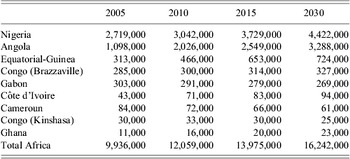
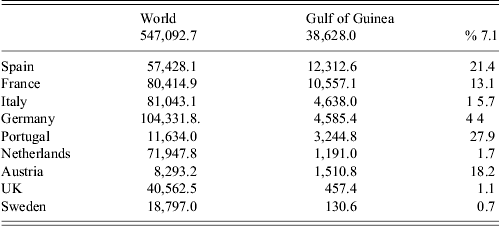
For the ‘fortunate’ States, their production figures can be expected to double in the next few years in the aftermath of Western political problems in the Middle East, particularly as a result of US adventures in Iraq. The success rate and ease of striking oil reserves in the West African region greatly increases the attraction to the Treaty area for prospecting companies and investors. As Tables 1 and 2 below reveal, nearly all the States in this region are predicted to vastly increase their oil production by 2030. The demand for oil from the region by Europe alone is substantial and is inexorably set to rise. Whereas the discovery ratio for oil wells in the United States of America (USA) is normally about 10 per cent, in West Africa (also falling within the Gulf of Guinea) the same ratio has been almost 60 per cent. This means that at least every second hole drilled has been a hit.Footnote 11 It is, thus, no wonder that it has been predicted that American multinationals are set to invest $60 billion in West Africa alone in the next 20 years, in what will certainly be the largest influx of revenue in African history, surpassing the combined development aid provided by the US to all African countries since 1960, when most of the States there attained independence.
Projected Oil Production of Gulf of Guinea 2005–2030 in barrels per day (b/d)

Source: EIA, US Department of Energy
Oil Imports by the EU in 1000 tons (2002)Footnote *
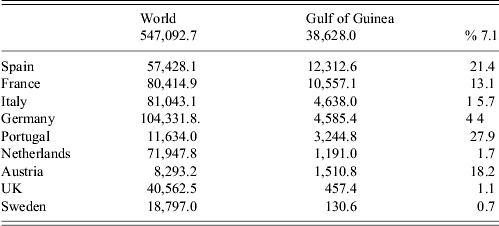
1958–2003, Source: Eurostat 23 September 2003
* Ireland, Denmark, Greece, Belgium, Luxembourg and Finland did not import from Gulf of Guinea
A further attraction of the Treaty area for investors, and perhaps a source of quiet joy for many of the governments in the capitals of the participating States, is the fact that the resources in the Gulf of Guinea are not on land territory but are conveniently based offshore in the sea. This offshore theatre for oil production represents for governments and MNCs a welcome distance from many of the problems that are, for instance, afflicting the Niger Delta area in Nigeria, and, therefore, guarantees the safety of investments.Footnote 12 A US politician put it tellingly: ‘things usually work fairly well if you're out in deep water’.Footnote 13 The positive dimension of the expected oil boom in the Gulf of Guinea is perhaps best exemplified by the experience of the small State of Equatorial Guinea, which has witnessed an average of 22 per cent growth of its GDP since 1996 when oil exploration and production commenced. Such spectacular success in increased incoming investment prompted the Equatorial Guinea Minister of Mining, Christobal Manana Ela, to comment: ‘What you are about to see in my country is an economic explosion’.Footnote 14
III. The Gulf of Guinea Treaty—Structure and Leading Provisions
In comparison with other treaties that establish international organizations, the Gulf of Guinea Commission Treaty is a relatively short and concise legal instrument. It has a preamble, 31 articles and lists the signatures of the current heads of States appended to it. The preambular provisions of the Gulf of Guinea Treaty emphasize the motivation of the seven current State Parties to make the natural resources of their countries available for economic development and social progress of their peoples through multifaceted cooperation, mutual understanding, good neighbourliness and strong bonds of friendship.Footnote 15 The parties express their will to be guided by the noble aim of ensuring that the natural resources of their various countries are made available for the economic development and social progress of the peoples of the Member States.
There is indeed little doubt that for developing States that are rich in hydrocarbons and other natural resources in the highly competitive, if not ruthless, globalized world of multinational investment, the path of ‘common and concerted action is the sure guarantee for a harmonious, rational and peaceful exploitation’(preamble). To further these objectives, the State Parties have undertaken to pool their efforts towards the harmonization of their respective policies in the areas of common interest. To this end, they pledge to map out common policies, particularly in the areas of (a) peace and security; (b) exploitation of hydrocarbons; (c) fishery and mineral resources; (d) the environment; (e) the movement of people and goods; (f) development of communications; and (g) promotion of the economic development and integration of the Gulf of Guinea region (Article 5).
Membership of the Commission is open to sovereign States bordering the Gulf of Guinea that sign up to and ratify the Treaty (Article 2). Membership is also open by accession to any State bordering the Gulf of Guinea which has not signed this Treaty at the time of its entry into force by notification to the Executive Secretary of the State's intention to accede to the Treaty (Article 27).Footnote 16 Certain crucial requirements may, therefore, be easily discerned. First, to be a Member State of the Commission a State shall be ‘bordering the Gulf of Guinea’. Secondly, it must have accepted to be bound by the provisions (rights and obligations) under the Treaty, although there is the possibility that a State may under certain circumstances exempt itself from specific provisions and obligations by virtue of the safety clause incorporated in Article 30 of the Treaty. This provision allows the Assembly of the Commission to decide on the modalities and conditions under which a Member State may be authorized to stay the implementation of specific provisions of the Treaty. Thirdly, membership of the Commission is not open to corporations but only to sovereign States bordering the Gulf of Guinea that become parties to the treaty (Article 2).
These provisions mark a significant development on the African continent in the management of sovereign resources through international organization. The Commission is established in the tradition of a line of reputable organizations and structures in the African continent, and internationally. Antecedents in Africa include the Agreement Establishing the African Petroleum Producers' Association (APPA).Footnote 17 Whereas membership of the APPA is open to African States from various regions, membership of the Commission is geographically discriminatory to the extent that it insists on appurtenance to the Gulf of Guinea. This feature also differentiates the commission from the Organization of Arab Petroleum Exporting Countries (OAPEC)Footnote 18 and the Organization of the Petroleum Exporting Countries OPEC.
The Commission shares more basic similarities with OAPEC than with OPEC. Petroleum products are incontestably the domain in which the Arab countries have really shown a will to cooperate and the African States are following suit in making oil cooperation the latest manifestation in their penchant for effective communal action.Footnote 19 The Commission and OAPEC are regional inter-governmental organizations concerned with the development of the hydrocarbon industry for States that rely on these exports. The broad aim is to foster cooperation among their members. OAPEC, for instance, contributes to the effective use of the resources of member countries through sponsoring joint ventures. OPEC was created in 1960 with the purpose of ensuring a fair price for oil, as well as to support market stability. OPEC therefore, in comparison with OAPEC and the Commission, concentrates more on crude oil pricing issues.Footnote 20
In the case of OAPEC, there was a deliberate policy of cultivation of Arab membership across regional lines, especially in the early stages of the organization and in cognizance of the special circumstances surrounding the period in which it was created—particularly the 1967 Middle East conflict.Footnote 21 The latter is an international organization made up of 11 major oil-producing nations. The OPEC Statute contains no geographical limitations but only stipulates that
… any country with a substantial net export of crude petroleum which has fundamentally similar interests to those of member countries may become a Full Member of the Organization, if accepted by a majority of three-fourths of Full Members, including the concurring votes of all Founder Members.Footnote 22
The Commission is, therefore, unique in its double requirement of regional and geophysical characteristics for qualification of membership and the reasons for this are clear. The offshore resources in question are likely to be a series of interlocking oil fields which can realistically only be sensibly exploited under the cooperation of the neighbouring coastal States. There are similarities in this sense with the hydrocarbon resources found in the Caspian region. The Caspian region presents a good analogy with the Gulf of Guinea because of the emphasis on offshore exploration. However, the Caspian region does not presently have a similar mature regime of coordination through membership of a common overarching oil and gas organization. Indeed, recently, the Russian President has suggested that CIS and Caspian Petroleum Producers and Exporting Countries should form an organization similar to OPEC, in order for the Caspian Sea region to realize its full energy potential. However, the littoral States must first agree on the legal status of the Sea. Whereas the legal status of the sovereign and non-sovereign waters of the Gulf of Guinea do not pose any serious controversies and existing delimitation is widely respected, this has not been achieved to the satisfaction of the concerned Caspian States.Footnote 23
It shall also be possible to withdraw from the Treaty, under Article 28, by notification to the Executive Secretary who shall also inform the other Member States. At the end of a six-month period, the State concerned may, if notice is not withdrawn, cease to be a member of the Commission. It is, however, important to note that during the six-month period, the Member State which has expressed its intention to withdraw from the Commission shall continue to be bound by the provisions of the Treaty. Withdrawal from intergovernmental organizations is as much a political event as it is clearly a technical and legal act. In 1986, Tunisia submitted a request for withdrawal to the OAPEC. This request was considered by the organization's Ministerial Council and, rather than allow withdrawal, it was agreed to suspend Tunisia's rights and obligations in OAPEC, until such a time that Tunisia chooses to reactivate its membership. The OPEC Statute in Article 8 provides that no member of the organization may withdraw from membership without giving notice of its intention to do so to the Conference. Such notice shall take effect at the beginning of the next calendar year after the date of its receipt by the Conference, subject to the member having at that time fulfilled all financial obligations arising out of its membership.
To enable the Commission to perform its role and implement its aims and objectives, Article 6 of the Treaty establishes certain organs, namely (a) The Assembly of Heads of State and Government;Footnote 24 (b) The Council of Ministers; (c) The Secretariat; and (d) The Ad Hoc Arbitration Mechanism (Article 6).Footnote 25
The Assembly is designed to be the supreme organ of the Commission and is composed of the ‘Heads of State and Government’ or their duly accredited representatives. This body is expected to meet at least once a year for its regular sessions. Extraordinary sessions may be called subject to approval by a two-thirds majority of the Member States (Article 10). The Council of the Commission is always to be constituted of the various ministers responsible for foreign affairs or other ‘ministers or authorities’ as designated by the Member States (Article 11).Footnote 26 The Council is answerable to the Assembly and is entrusted with the responsibility of: (a) preparing the sessions of the Assembly; (b) promoting all activities geared towards the attainment of the objectives, of the Treaty and within the framework of the general policy defined by the Assembly; (c) formulating and proposing general policy measures; (d) taking cognizance of any matter referred to it by the Assembly; and (e) generally implementing the cooperation policy of the Commission in accordance with the will and the general policy defined by the Assembly. To this end, the Council may create committees and determine their areas of competence.Footnote 27 Decisions of the Council are ordinarily to be taken by consensus. Where consensus is not achievable decisions would have to be by two-thirds majority of the members present (Article 13).Footnote 28 The Treaty envisages that the Council shall adopt its own rules of Procedure (Article 14).
The pre-eminent role given to The Assembly of Heads of State and Government in the Commission is perhaps indicative of the desire of the States to ensure the involvement of the highest levels of government in decision making within the organization. It also underscores the sensitive nature of the Commission's work to the economic expectations, if not survival, of the participating States. While the apex of the OPEC and OAPEC governance structures are the Conference and the Ministerial Council respectively, the need for developmental growth would appear to have dictated the close involvement of the sovereign leaders of the Gulf of Guinea States who are placed in direct leadership and control of the Commission. There are other positive aspects of this particular governance structure. It arguably reduces further the possibility of allegations of ultra vires against the acts of representatives to the Commission. It removes the old bugbear of diplomatic representation at international organizations—whereby allegations are made that there exists a gap between conferred legal powers and the authority of the official representatives of a State and particular actions or positions taken during representation that are or which eventually become controversial.Footnote 29 Protection is offered to the organization in that when the assembly has adopted a position it is difficult to imagine that a State will be likely to easily rescind from the collective decision. Admittedly involvement of heads of States does not solve the problem of ultra vires arising out of procedural irregularities and the exercise of substantive powers that are not expressly provided for in the constitutive instrument of the organization.Footnote 30
The functions of the Secretariat are quite similar to those of other international organizations, including: (a) carrying out the day-to-day functions of the Commission; (b) implementation of the decisions of the Assembly and the Council; (c) preparing the reports, draft decisions and agreements for the attention of the Assembly and the Council; (d) formulating the recommendations that might enhance the efficient and harmonious functioning and development of the Commission; (e) provision of technical services for the sessions of the Assembly and the Council, as well as the Specialized Committees; (f) playing the role of custodian of the documents and assets of the Commission; (g) preparing the budget of the Commission; and (h) carrying out any other duties that may be assigned to it by the Assembly or the Council (Article 17).
The function of the Secretariat in preparing reports, draft decisions and agreements is a very important one and is crucial to the survival of any intergovernmental organization.Footnote 31 The secretariat sponsors studies, organizes seminars and conferences, and collaborates with other relevant governmental and intergovernmental organizations within and outside the region and internationally. The OAPEC Secretariat, for instance, regularly conducts business with the Arab Fund for Economic and Social Development, the Arab League and the Arab Industrial Development and Mining Organization.Footnote 32 The Commission's Secretariat would, therefore, be expected to maintain regular consultation and activities with the APPA, and the various national energy companies such as the Nigerian National Petroleum Corporation (NNPC). It may be suggested that one of the ways that the Secretariat will greatly enhance the Commission's work and indeed add enormous value to its existence, is to embark on the implementation of a data bank along the lines of the work done by the OAPEC General Secretariat. Such a data bank would consist of an annually compiled publication of relevant energy data by national and international groupings. The OAPEC publication is based on British Petroleum's (BP) database and in accordance with an agreement with BP is distributed to OAPEC member countries only.Footnote 33 Similar restrictions may be advised in favour of the Commission's members. The noticeable information deficit surrounding oil and gas activities in some of the individual States of the region would be remedied in this way.
It is clear that the aim of the drafters of the Treaty is the creation of a progressive institutional regime to govern the Gulf of Guinea. The Treaty does consider many of the major areas that ought to be considered in a legal instrument of this nature. In other words, the Treaty is a charter for the onset of major exploration of a substantial portion of African deep seas. It lays a foundation for rational discussion of issues relating to the common interest of the participating States and will in many ways guarantee peaceful conduct of exploratory activities in what appears to be the resource Eldorado (consisting primarily of hydrocarbons but including other valuable resources such as fisheries) for the next few decades. The Treaty broadly identifies the scope of the Commission's tasks, areas of operation, hopes and aspirations. It also addresses the means and manner by which the Member States hope that the organization would function, and deals with the usual details that would ensure the smooth operation of an international organization such as the official languages of the Commission (Article 21)Footnote 34 and its privileges and immunities (Article 22).Footnote 35
3.1 A. The Settlement of International Disputes
The provisions on dispute resolution naturally constitute a crucial part of any treaty. It is, thus, not surprising that the parties to the Treaty stated they are ‘anxious to settle our disputes by peaceful means’ (Preamble). This is even more so with respect to a treaty that seeks to regulate matters of resource control and exploitation among sovereign States. Thus, the issues of dispute settlement deserve separate attention in our analysis. As dispute settlement provisions go, the Treaty's Dispute Settlement provision in Article 20 is arguably austere:
Member States shall act collectively to guarantee peace, security and stability as prerequisites to the realization of the objectives set forth in this Treaty. To this end, they undertake to settle their disputes amicably. Failing which either party shall refer the matter to the Ad Hoc Arbitration Mechanism of the Treaty or any other mechanism for peaceful resolution of conflicts stated by the Charters of the United Nations, the Organisation of African Unity and the African Union.
State members are, thus, generally enjoined to act collectively to guarantee peace, security and stability as prerequisites to the realization of the objectives set forth in the Treaty. To this end, the Member States are enjoined to settle their disputes amicably. Where a dispute persists, the State Parties may refer the matter to the Ad Hoc Arbitration Mechanism of the Treaty or another mechanism for peaceful resolution of conflicts stated by the charters of the United Nations,Footnote 36 the Organisation of African UnityFootnote 37 and the African Union.Footnote 38 The formulation of Article 20, therefore, arguably suggests a hierarchy of dispute management techniques for the Member States. Attempts should first be made to reach amicable settlement and by this the drafters appear to refer to bona fide negotiation. Secondly, Ad Hoc Arbitration may become applicable. The Commission's Ad Hoc Arbitration has more in common with the Dispute Settlement mechanisms of the World Trade Organization (WTO).Footnote 39 The similarity lies in the fact that they cannot meet the permanency standard of international judicial bodies.Footnote 40 Disputes between WTO members are submitted, after several other diplomatic options have been exhausted, to an ad hoc panel composed of three experts chosen by the parties. The DSU created two distinct bodies: the Dispute Settlement Body (DSB) and the Appellate Body.Footnote 41 Thirdly, parties to the dispute may make reference to any of the means of resolution contained in the UN Charter. The principal means are to be found in Article 33 of the Charter. It is, however, doubtful that reference is being made here to Article 33 because the provision therein largely refers to methods which form part of the ‘amicable means’ already envisaged in the first sentence of Article 20.Footnote 42 It appears, therefore, that reference is being made to the jurisdiction of the International Court of Justice (ICJ). The ICJ is the principal judicial organ of the UN and its basic instrument is the Statute of the Court, which forms an integral part of the Charter and is annexed to it. It must, however, be noted that reference of the dispute to the Security Council or the General Assembly of the UN under Article 34 and 35 (1) of the Charter is also a possibility.Footnote 43 Fourthly, the matter may be dealt with in accordance with the African Union (AU) Charter. It is possible, however, to also argue that the parties to the Treaty, being African States themselves, would have a preference for the mechanisms under the AU Charter and would prefer to seek resolution of the dispute under the AU regime before the UN regimes. Indeed, it may be suggested that the provisions of Article 20 are somewhat sketchy and clumsily drafted. The formulation of this article ironically appears to make all structures of dispute resolution it recommends appear not to be part of the initial requirement that parties ‘settle their disputes amicably’. The question this raises is whether or not judicial settlement, mediation or arbitration are not amicable or peaceful means.
A further and perhaps more significant point is the silence of the Treaty on the preferred means by which the Member States may collectively or individually attempt resolution of disputes that arise involving non-Member States and/or MNCs that will operate in the area. This may yet prove to be a quite significant omission in the light of the fact that many of the disputes in this area would involve MNCs. The development of water-tight dispute settlement processes and procedures would at any rate be central to the successful regulation and operation of corporations in the Treaty area in addition to being crucial to the conduct of the relationship between the State Parties.
It is possible to envisage that the State Parties may frequently avail themselves of the mechanism of the Court of Justice of the AU,Footnote 44 which is the principal judicial organ of the African Union.Footnote 45 It is perhaps for this reason that the institution of arbitration is preferred by the drafters of the Treaty to the creation of a judicial body as was the case during the creation of the Judicial Tribunal of the OAPEC.Footnote 46 Of particular significance are the provisions of the protocol on Eligibility to Submit Cases (Article 18), Competence/Jurisdiction (Article 19), Sources of Law (Article 20), Summary Procedure (Article 55) and Special Chambers (Article 56). It is perhaps necessary to mention that virtually all the State Parties to the Gulf of Guinea commission are Member States to the African Union and, therefore, parties to the Protocol. Where the dispute in question is between the State Parties, there is no difficulty in locating the eligibility of the parties in accordance with Article 18. Where, however, the dispute involves a multinational corporation or other corporate body and a State Party or State Parties, Article 18 would arguably also be useful to the extent that it also recognizes the right of ‘third parties’ to submit cases to the Court of Justice under conditions to be determined by the AU Assembly and with the consent of the State Party concerned (Article 18 (d)). There is much justification for the position that MNCs may in a similar manner be admitted before the Court. It must, however, be admitted that an amendment to the existing rules would be necessary to admit MNCs as parties in their own right unless of course use is made of the time-honoured concept of amicus curiae.Footnote 47 It is notable that this interpretation indeed falls well within the increasing treatment of MNCs as subjects of international law. It is perhaps a shortcoming of the Protocol that it does not expressly spell out the possibility of a concerned State Party instituting proceedings against a ‘third party’ before the court with the latter's consent. The fact that the article does not expressly govern this particular situation does not mean it is not possible, especially where the jurisdiction is accepted by the respondent State. This interpretation is also consonant with the intention of the drafters to increase access to the Court of Justice rather than to restrict it. It must be emphasized that following the logic of subparagraph (d) the consent of the third party would be crucial to the exercise of jurisdiction by the Court.
It is notable that the competence/jurisdiction of the Court of Justice includes disputes relating to ‘the existence of any fact which, if established, would constitute a breach of an obligation owed to a State party to the Union’ (Article 19 (f)). Furthermore, the assembly is empowered to confer on the Court of Justice power to assume jurisdiction over any dispute (Article 19 (2)). On the whole, it is the intention of the drafters to make it easier for State Parties (to both the Treaty and the Protocol) to institute actions than it is for a multinational or non-State Party to institute claims against State Party/Parties. In the light of previous practice, it would, however, be a peculiar scenario indeed whereby a multinational operator would choose an African international court as its preferable institution.Footnote 48
It is desirable that the Court of Justice develops and establishes clear jurisprudence in the area of resource exploitation, maritime delimitation and environmental disputes. If indeed judicial settlement proves to be the preferred method of settling a dispute between States in the Treaty area, it would be desirable that the Court of Justice makes good use of the unique provisions allowing (inter alia) the general principles of law recognized by African States (Article 20 (d)) to form part of its jurisprudence.
It is also noteworthy that the provisions establishing the Court of Justice share many similarities with those that establish the jurisdiction of the ICJ. For instance, the provision on competence of the court and sources of law are drafted largely along the lines of Articles 36 and 38 of the Statute of the ICJ. Apart from the controversial compulsory jurisdiction mechanism in Article 36 (2 a–d of the Statute), the jurisdiction of both courts includes (a) the interpretation of treaties; (b) any question of international law; (c) the existence of any fact which, if established, would constitute a breach of an international obligation; (d) the nature or extent of the reparation to be made for the breach of an international obligation.
Both courts have as their function the making of decisions in accordance with international law through the application of: (a) international conventions, whether general or particular, establishing rules expressly recognized by the contesting States; (b) international custom, as evidence of a general practice accepted as law; (c) the general principles of law recognized by civilized nations; and (d) the teachings of the most highly qualified publicists of the various nations, as subsidiary means for the determination of rules of lawFootnote 49 and the ability to decide a case ex aequo et bono, if the parties agree thereto. African scholars and critics of the perceived ‘eurocentricity’ of public international law would follow the jurisprudence of the Court of Justice very closely to see what principles it would recognize as ‘general principles of law recognized by African States’ and indeed how much diffidence it would pay to this invitation to enrich international judicial practice. The power of the Court of Justice to appoint experts and commission enquiries under Article 30 are also useful mechanisms of the court which may assist it to quickly attain world-class judicial competence.
As mentioned above, the Treaty Area also swallows the area of the Joint Development Zone (JDZ) that exists between Nigeria and São Tomé & Príncipe. It may, therefore, be necessary for both States to re-examine very closely their common obligations and applicable provisions under the JDZ Treaty (2001) in the light of their dispute resolution obligations under the Treaty, and perhaps formulate a standing policy as to which rules will apply in the following circumstances: (a) when a dispute arises between the two parties in their JDZ activities; and (b) where a dispute occurs involving one or both JDZ partners (relating to the JDZ area) and a non-JDZ State which is, however, a party to the Treaty. It may be suggested here that where the dispute involves only Nigeria and São Tomé & Príncipe, the provisions on dispute resolution within the JDZ Treaty (2001) would apply. Where the dispute involves a non-JDZ third party State, but one which is also party to the Treaty, the rules under the Treaty would prevail.
IV. Legality and the Legal Status of the Gulf of Guinea Commission
Founding States determine the status they confer on international organizations at the time of their creation. Typically, the rights, duties and obligations conferred on that organization will be expressly set out in their constitutive treaties. Article 2 established the intention of the parties to create the Commission and its membership. The status of the Commission under the national law of the Member States is inherent in the provision of Article 22, which states:
The Commission shall have legal status and the power to: (a) enter into contracts; (b) Purchase and assign movable and immovable property; (c) Be party to judicial and other legal proceedings … The privileges and immunities granted to the Secretariat shall be the same as those enjoyed by diplomats in the country hosting the headquarters of the Commission and in the Member States.
The intention to confer international legal personality on the Commission is inherent in Article 24, which governs its relations with other organizations. Accordingly, the Commission is empowered ‘to enter into co-operation agreements with other regional organisations, intergovernmental institutions and third parties …’
Perhaps it is necessary to very briefly place these provisions in the context of State practice and aspects of public international law. The intention to create an international organization is rarely more clearly expressed than as it was in Article 1 of the OPEC statute, which stated that the organization was ‘created as a permanent intergovernmental organization in conformity with the Resolutions of the Conference of the Representatives of the Governments of Iran, Iraq, Kuwait, Saudi Arabia and Venezuela …’, its founder members. Similarly, Article 4 of the OAPEC Agreement defined its legal status in national law and granted it juridical personality and legal capacity to exercise all the powers of a juridical person.Footnote 50 The drafters of these instruments follow a tradition of public international law whereby rights ceded to international organizations are set out in their constitutive treaties.Footnote 51 International law generally proceeds upon the theory that there is ‘an inherent’ right of organizations that have been created in this manner to take part in international life in the absence of stipulations to the contrary, clearly set out by the founders.Footnote 52 This is probably due to the fact that it is not usual for international organizations to make separate, express provision to confer status in international law. In practice international legal status is conferred de facto even where this is not addressed in the legal instrument establishing a multilateral institution. In practice the organization would also acquire certain connected competences beyond the explicit provisions of the constitutive treaty by virtue of the competence implied by the terms of the treaty.Footnote 53
In this regard it is important to note the implications of the powers contained in Article 24, which empowers the Commission to ‘enter into co-operation agreements with other regional organisations, intergovernmental institutions and third parties, provided that such agreements are not incompatible with the provisions of this Treaty’.
Clearly, these powers are concomitant with the possession of international legal personality.Footnote 54 All doubts are removed by Article 25, which mandates the Commission to specifically maintain relations with the ‘OAU/AU/AEC and the Regional Economic Communities for the realisation of the effective integration and African Union objectives’. To this end, the Commission may establish ‘consultation mechanisms’ and conclude agreements with these organizations. The Treaty may appear to have unfairly limited the express scope of the Commission's powers if an ejusdem generis interpretation is given to use of the phrase ‘Regional Economic Communities’ in Article 25. There is a sense in which it is arguable that the drafters, at least in that provision, expect the Commission's ‘consultations’ and ‘agreements’ to be with regional economic communities on the African continent. However, with other regional organizations such as OAPEC it may only enter into ‘co-operation agreements’ (Article 24). In this manner the Commission joins the list of intergovernmental organizations on the continent, such the AU, which can conclude agreements with other States and international organizations.Footnote 55 Its international legal status is rooted in the international competences it possesses. In accordance with the Certain Expenses case, it is a titular holder of international rights and duties.Footnote 56 As a consequence of its status, the Commission and its key officials such as the Executive Secretary will in time maintain wide-ranging contacts and close external relations with third parties and other organizations both nationally and internationally, such as the European Union, OPEC, OAPEC, UN agencies, the Arab League, etc. Furthermore, the status enjoyed by the Commission can be extended at the discretion of the Assembly of Heads of State and Government.
It, therefore, remains to consider situations where there is a dispute as to whether and to what extent acts and decisions of the Commission are in conformity with its established rules and procedures. It may be noted that the Treaty does not contain any express provisions on the legal status or effects of decisions adopted by the main organs in excess of their functions and powers, or in violation of the express provisions of the Treaty. There are also no provisions on whether members may raise objections to such decisions or the manner in which any such objections may be decided. A number of objections have been raised to ultra vires acts of international organizations in the past, and there appears to be no unanimity as to the treatment of this issue in customary international law, or in any general law applicable to international organizations.Footnote 57 The fact that the Commission does not have a standing Court may arguably curtail the possibility of such an organ extending the Commission's competences through the exercise of judicial powers as may, for instance, be done by the Court of Justice of the OAPEC and numerous other regional intergovernmental organizations.Footnote 58
It appears that the drafters of the Treaty are unwilling to create judicial structures in order not to increase what is gradually beginning to appear to some legal commentators as judicial forum fatigue. This position may prove to be regrettable to the extent that the organization may have to rely on external judicial bodies to determine the legality of its actions or the ambit of its authority. In this manner it would thereby not enjoy an important privilege exercised by comparable international bodies.
It is significant to the legal status of the Commission and the Treaty that in case of incompatibility between the provisions of the Treaty and those of previous agreements concluded before it comes into force, ‘the provisions of the treaty will prevail, except for the imperative rules of general international law’ (Article 24).Footnote 59 But even in relation to this rule it is difficult at this stage to see how errant members will be held responsible by the organization itself in the absence of action by individual member(s) to institute the ad hoc arbitral processes. Therein lies the problem sought to be resolved through the creation of judicial bodies by comparable organizations. A writer correctly points out:
The rationale for opening the doors of international courtrooms to international organizations' organs is straightforward. Today, there is almost no international regime in which the upholding and vindication of its normative structure is vested solely in the individual member state … when even occasional non-compliance with the regime's norms is likely to threaten the whole regime's structure, as in the case of REIAs, or even in that of the ‘international criminal law regime,’ its defense is usually not left at the mercy of individual member's political calculations.Footnote 60
V. The Transnational Dramatis Personae
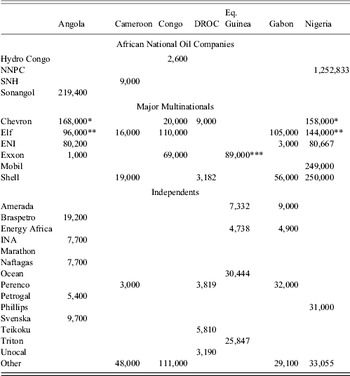
The enthusiasm of the major prospecting companies in the Gulf has already been alluded to above.Footnote 61 What needs to be ascertained are the likely actors in these new littoral oil fields. The rank of actors includes the traditional investors with decades of experience in Africa and those that have only very recently engaged in setting up business in the area.Footnote 62 In terms of size, Table 3 below reveals that there are the so-called super majors and other smaller actors. The three major foreign oil companies that have historically dominated the Gulf of Guinea are Shell, TotalFinaElf and Chevron. The big three in 1999 produced around 75 per cent of the 3.7 million barrels a day (30 per cent for Shell, 25 per cent for Chevron and 20 per cent for TotalFinaElf). ExxonMobil, despite being the largest oil company in the world, has been under-investing in the Treaty area so far but reports are that it is also eager to establish itself in the region. Shell, Chevron and Total have enjoyed historical advantages in the relevant areas and it has been noted that they were in fact sheltered from veritable competition in their respective zones of activity. However, these companies are now facing fierce competition from other ‘super-majors’ (notably ExxonMobil) in addition to other numerous independents with ambitious international outlook.Footnote 63
The MNCs operating in the Gulf of Guinea as at 2002 and their Reported Oil Production by Company (b/d)

Source: West African Oil and Gas Sourcebook 2002
* includes Texaco ** includes Total & Petrofina *** includes Mobil
Indeed, since 2002 newer actors, particularly among the ranks of the independents, have emerged on the scene. These include the ERHC/Addax Petroleum consortium (Swiss) Anadarko (US), ERHC Energy/Addax Petroleum consortium, Conoil Producing, Overt Energy, Hercules Energy and Godson Energy. The grip of MNCs from the developed world is gradually lessening with the emergence of some companies from developing States. These include new Asian actors such as China National Petroleum Corporation (CNPC), China Petrochemical Corporation (SINOPEC), the Malaysian State oil company Petronas (which has been extremely active in Chad and Sudan) and the Japanese National Oil Company, Mitsubishi (see table above).
It is not surprising that the repercussions of development in the Gulf are felt beyond the area and are significantly changing investment practice in hydrocarbons. The average number of rigs operating in Africa has been increasing steadily in the last few years and increased to about 50 in early 2006. Production in deep offshore areas is forecast to reach about 9 million b/d in the next five years and the investment in exploration and development is focused in the Gulf area, where international companies made significant petroleum discoveries in 2004. The diversion of the interest of investors has in fact become a source of concern to the OAPEC States who, in 2005, initiated a study entitled ‘The Evolution of Non-OPEC Oil Supplies and their Probable Effects on OAPEC Countries Oil’. This study was presented at the 74th meeting of OAPEC's Ministerial Council, which was held in Cairo on 23 May 2005. The study concluded that developments in some African countries, among others, would have an impact on the international oil market and OAPEC Member States would certainly be affected in the short term. A study into the investments of 327 major oil companies around the globe found that their investments in exploration and production in 2004 rose above 12.5 per cent in 2003 alone, as the companies realized record profits that enabled them to increase their expenditure on equipment and oil services in the hope of further boosting oil output rates.Footnote 64 Some 120 floating production platforms were estimated to have been built in the last five years at a cost of $32 billion. The Gulf alone accounts for 70 per cent of the estimated $8.3 billion of increased investment in building oil platforms in the last five years.Footnote 65
What becomes apparent from this analysis is that there is very little scope for a truly indigenous African corporation in this new and exciting future of oil production in the Gulf of Guinea. Although Hydro Congo, NNPC, SNH and Sonangol are national companies and there is beginning to be involvement of African-owned private independent companies such as Chrome Energy, which has a stake in ERHC, there is near unanimity of opinion among informed commentators that there is no appreciable African corporate involvement in oil production. The existing national champions are seen as no more than rent-collecting companies. Unlike the oil industry in the Persian Gulf—where national oil companies control most ‘upstream’ activities and foreign firms control ‘downstream’ business—the oil industry in the Gulf of Guinea remains firmly the privileged reserve of foreign multinationals. The resulting skewed scenario has been described by a writer thus:
In the Persian Gulf the national oil companies pump the oil, and sell it to the foreigners. In the Gulf of Guinea, the foreigners pump the oil, and sell it to themselves (often keeping two sets of books, and squirreling away the difference in Swiss bank accounts).Footnote 66
He further queries: ‘What role will the African state oil companies play in the future? Will they manage to seize control of their national resources from the foreigners, or will they continue to serve as mere rent collectors?’ The indications are that the phenomenon of ‘Rentier States’ will remain true of the Gulf of Guinea States for the foreseeable future unless the issue of technological transfer is addressed with renewed and imaginative vigour.Footnote 67 In the absence of that, the major national producers of oil in the region, such as the NNPC of Nigeria and Sonangol of Angola, may continue to be mere rent collectors from the active producers ‘in a world dominated by ever-merging supermajors’.Footnote 68 In this context it is very difficult to disagree with the conclusions of Yates that:
Business, in general, can best be understood as a system of power. The emergence of a significant degree of concentration of power does not mean the end of competition. It does mean that competition has been raised to a new level. The impetus to invest abroad arises out of a competitive struggle among giants. To become masters of their own destiny, African oil producing states have to overhaul the existing international trade and investment patterns and transform their industrial and financial structures. But there are a number of features of their historical situation that hinder them: the lateness in time at which they approached the problem of industrialization; their poverty and economic underdevelopment; their relative backwardness in comparison to the developed countries; the unequal contact between them which facilitates the drain of surplus and distorts patterns of production. Monopoly is the central element of the theory to explain the drive behind European imperialism in the 19th and 20th centuries. It is also central to the explanation of why the capitalist system so operates as to allow only some of its component countries to become fully industrialized. Billions of dollars of direct foreign investment, in this light, are not good omens for the African national oil companies.Footnote 69
VI. Constructive Reform and Progressive Engagement by the Participating States: Imperative Considerations
If indeed the parties to the Treaty are serious about their preambular declaration to ‘harmonize our economic policies’, there are certain aspects of the operation of MNCs that may have to be harmonized to take account of best practices and the peculiar demands of African States. These include plugging perceptible lacunae and inadequacies of corporate governance in their various national laws. Some of the identifiable issues that ought to be looked into include security, tightening of controls and checks on corruption, the development of regional regulatory frameworks generally and, particularly, the responsibilities of groups and transnational networks, taxation and settlement of disputes, antitrust laws, technology transfer and labour relations.
6.1 A. Security and Policing in Exploration and Production Activities
It is an increasing worry that the Gulf of Guinea is plagued by the nefarious activities of pirates, smugglers and other criminals. Although the situation within certain States is worse than in others, there are substantial security problems in the wider area of the Gulf of Guinea waters. Shell Petroleum Development Company of Nigeria and Chevron Nigeria ((plc) a subsidiary of ChevronTexaco) lost 180,000 barrels and 23,000 barrels a day respectively for long periods in 2006 due to vandalism and theft of oil pipelines in Nigeria.Footnote 70 Illegal fishing in the area is estimated to cost more than $1 billion a year. At least 25 attempted piracies or armed robberies at sea were reported in 2005 alone, and the Gulf of Guinea is said to remain a major trafficking route for cocaine.Footnote 71 The USA has, thus, more or less arrogated upon itself the duty to police this area with its vastly more sophisticated naval facilities in comparison with those of the regional States. The US increased its military presence in the Gulf of Guinea, although it has been at pains to explain that it does not have any unworthy motives in this regard. A senior American diplomat stated that the USA's primary goal in the Gulf of Guinea is to support West African leaders and organizations seeking to improve regional security. At any rate, since 2005 American military and naval units have been involved in substantial security and maritime operations in the area and American frigates have been frequently deployed in the Gulf of Guinea area.Footnote 72
The intricacies of the security problem in the Gulf of Guinea area cannot possibly be exhaustively treated in this paper and are certainly deserving of a fuller study. But it is perhaps safe to make certain observations. First, the safety of the vast and valuable natural resources of the Gulf of Guinea cannot meaningfully be secured on the cheap. Secondly, the participating States ought to realize that in both the short and long term it is near impossible for them to correctly assume that certain foreign power(s) will have only their genuine interests as the basis of involvement in the exploitation of the hydrocarbons. A more sensible option is for the Gulf of Guinea States to realize that coupled with the benefit of immense natural resource wealth and economic advantages is a concomitant and compulsory duty to upgrade national and regional defences, especially naval power and presence. New and state-of-the-art technology may have to be purchased at great expense, but the funds to do this should hardly be a problem in view of the projected economic benefits of hydrocarbon exploitation in the area. Thirdly, in reality the security of the region can only be meaningfully undertaken by the concerned States themselves. The important duty of keeping the Gulf secure and safe for hydrocarbon exploration and production can only be farmed out to outsiders at the risk of immense economic, political and military losses to the participating States.
Although allegations of complicity in the abuse of human rights by multinationals are more common than can be proved, it is clear that reliance by States on multinationals to maintain security in the Gulf of Guinea would only open up a Pandora's Box of intrigue that would be of no benefit to all concerned.Footnote 73 Much of the significant international trade that took place over the waters of the Gulf of Guinea in the better part of the last century has been directed towards the protection of Western interests and the African States were given very little space to operate their trade for their own benefit.Footnote 74 History also informs us that there is nothing in the Gulf of Guinea area or any of the waters in the region which is beyond security control by local means and Africans have competently handled the matter since antiquity. Patrick Manning noted that by the mid-19th century maritime security was ‘nearly total’ in the Abomey Kingdom.Footnote 75 It therefore behoves the concerned States to take their common colonial past into consideration in regulating security in the area of the Gulf.Footnote 76
The Gulf of Guinea States ought to embark upon a serious attempt at creating a regional naval security task force which will be responsible for maintaining security in the offshore areas of oil operations in the Gulf of Guinea that are beyond State territory. This may take the form of a ‘Gulf of Guinea African High Naval Command’. Nothing prevents a structure like this from operating in conjunction with willing foreign powers that may possess vastly superior naval technology and boats but at the very least the security operations should as a starting point always be under the command of the Gulf of Guinea States themselves. In this way, the dangerous activities of pirates, bunkering criminals, rebel groups and hostile foreign States would be prevented. The establishment of such a joint naval body will undoubtedly further cement regional cooperation, especially in the field of military operations. This option also ensures that the security objectives in the non-sovereign parts of the Gulf of Guinea would not become hostage to the political considerations and fortunes of individual States.
At any rate, it must be realized that a dilatory and incoherent approach to the issues of security in the Gulf of Guinea may again in the 21st century lead to loss of control over sovereign resources. Concerted effort must be made to avoid the modern-day equivalent of the dubious ‘treaties of protection’ that were a common factor of the history of all the Gulf of Guinea States and which blighted their destinies in so many ways. Lord Lugard, a quintessential colonial governor, spoke of a ‘valuable concession purchased by the present of an old pair of boots’.Footnote 77 In the event, African rulers like King Jaja of Opobo found to their dismay that the meaning of ‘protection’ could be elusive. He was denied trading rights even after assurances that ‘protection’ would preserve his country's sovereignty and the right to trade as equal partners.Footnote 78 It is important that African States watch out for modern-day equivalents of ‘old pair of boots’ bargains.
6.2 B. The Transfer of Technology
Few issues can arouse the passion of scholars from the developing States as much as the transfer of technology, which is seen as one of the veritable means by which developing States have a chance to bring themselves out of the relationship of dependency and exploitation that weighs them down and makes it impossible for most States to meaningfully contribute to international trade.Footnote 79 The United Nations Conference on Trade and Development (UNCTAD) recognizes that:
Behind the success of individual economies lies the performance of its leading firms, for they are the principal investors and agents of technological and economic change. Their ability to thrive, grow and compete in the world market is central to the process of catching up with the more advanced economies and overcoming poverty.Footnote 80
There is little doubt that oil-production technology falls within the scope of the definition of ‘technology’ contained in the Draft Transfer of Technology (TOT) Code which describes technology as ‘systematic knowledge for the manufacture of a product, for the application of a process or for the rendering of a service …’.Footnote 81 Unfortunately the record of technology transfer in the oil industry, which is more or less the economic live wire of the participating States, has been negligible. Even for those States like Nigeria, Angola and Cameroon that have had over five decades of experience (even if part of this was as colonies) in oil prospecting and production, the level of technology transfer in oil-production ranges from non-existent to negligible.Footnote 82 Nigeria, for instance, set up an ambitious regime under the National Office of Industrial Property Act which is meant to ensure systematic technology transfer to the country but in reality technology transfer has been largely ignored by both indigenous businesses and MNCs.Footnote 83
It is perhaps more necessary now than at any other time for the Gulf of Guinea States to embark on a meaningful quest for technological transfer. Charity in this sense must, however, begin at home. The Commission as it is presently contemplated and constituted would appear to be the best opportunity for its members to exchange expertise. States like Nigeria with considerable experience in both onshore and offshore oil production that also have relatively advanced (at least for the standards of a developing African State) indigenous expertise ought to assist the newer entrants in the business. Altruistic intentions aside, there are economic gains that can be retained within the region through such an approach. Relatively more affordable remuneration would, for instance, be demanded by a State such as Nigeria for assistance in consultancy services, manpower training, and perhaps refining activity. Encouraging precedents already exist in the use of Nigerian seismic facilities which currently serve both the national petroleum company (NNPC) and foreign oil multinationals operating in the country. Another successful story in this direction is the ultra-modern seismic data-processing centre at Oko in Nigeria's Midwest area which already renders commercial services in the processing of hydrocarbon data for other African States.Footnote 84
Fortunately, there is evidence of a sincere appreciation of the imperatives of collective and cooperative game scenario advocated here in the highest echelons of African political leadership. The Nigerian President Olusegun Obasanjo, one of the architects of the Commission, and one of its strongest advocates, cautioned African nations to restructure and reposition themselves so as to be able to be masters of their own fates in today's knowledge-and-technology-driven world. He stated:
We must all stay focused on ensuring that this fourth scramble for Africa signals the resurgence of our continent as a major and influential player in the twenty first century world. … We must however be awake to the new danger that the emerging world economic order poses for the African continent. This is the dynamic of the new scramble for Africa and African resources by China and the emerging economies of Asia on the one hand, and Europe and the United States of America on the other.
It is easy to relate the direct relevance of President Obasanjo's caveats (that Africa needs to equip its young population with the requisite scientific and technological training to compete with the best in a world increasingly driven by knowledge and technology) to the particular demands of exploitation of the Gulf of Guinea.Footnote 85
It is perhaps necessary to state that for the Gulf of Guinea States any meaningful quest for technological transfer would require the consent and long-term commitment of the developed States and their multinationals. The transfer of know-how and technical expertise is needed at many levels in the upstream and downstream activities. It is, however, important that the regime of transfer of technology in the oil and gas sector must be sufficiently liberal and should not become a debilitating hindrance to investment. In this case it may be necessary that the freedom of host-State businesses and their foreign counterparts to negotiate the terms of the technology may have to be retained.Footnote 86 A stratagem to improve transfer of technology in the oil and gas sector would be the targeted reduction of rents that are accruable to host governments from foreign multinationals that demonstrate an appreciable record of technology transfer particularly in the qualitative training of local staff to handle most, if not all stages of oil production in the entire region. A graduated punitive rental-fee structure may also be implemented against those companies with unappreciable progress in technology transfer after review periods of about five years. In order that the benefits of technology transfer may be shared by the Gulf of Guinea producing States, it would be important that the States adopt a broad-based approach to the issue. This may involve the creation of a ‘joint technology transfer monitoring board’ that would promote the issue, harmonize the existing regimes and monitor progress.
6.3 C. Corruption and Disclosure by Operators in Annual Accounts and Other Statements
There is a perceptible shift away from wasteful corruption and towards revenue transparency throughout the international extractive industry. This is partly due to legal reforms in international law and the oil-producing Gulf of Guinea States may avail themselves of these laws at this crucial and formative period of their organization and interaction with MNCs. One of the more impressive recent achievements is the ‘Extractive Industry Transparency Initiative’ (EITI) scheme launched by the UK Government following the 2002 Johannesburg World Summit on Sustainable Development. So far among the oil-producing Gulf of Guinea States, only Nigeria has been adopting the EITI template.Footnote 87 The Angolan Government on its part announced that it intended to support EITI at the ‘appropriate time’, though the Government had to be ‘certain that nothing could jeopardize the stability of Angola's contracts with international companies, owing to some clauses regarded as confidential’.Footnote 88 Despite the sophistry of such arguments there is a clear connecting nexus between the phenomenon of corruption and the impoverishment of oil-rich States.Footnote 89 The story of corruption in this area has been a two-way street. Many African governments have been implicated in corrupt practices and multinationals have been known to be complicit in high-level corruption and to actively devise means by which to corruptly maximize profits at the expense of the legitimate interests of the vast populations in the developing host States.Footnote 90
In line with international practice and as a result of the imperatives of the development needs of the States in the region, the Member States ought to streamline their general disclosure rules, particularly those relating to MNCs in the oil industry. This includes the rules concerning annual accounts and other statements, to provide the Member States (individually and collectively) with a more holistic picture of the benefits and problems that accrue to the region by the influx of new oil and gas actors on a massive scale.Footnote 91 Thus, in addition to the traditional corporate disclosure rules in annual accounts, the Gulf of Guinea States ought to insist on regular information on indices such as social disclosure rules that are aimed not at investors but at other consistencies that are wider in social and political interests; value-added statements that reveal the economic contribution of the MNE to particular host State(s); and environmental audits showing the environmental impact of the operator's activities to the State(s) in which it operates and the entire Gulf of Guinea region. Such information is best held as a common resource between the Gulf of Guinea States.Footnote 92
Useful indications of good practice may be found in the UN Proposals and Code of Conduct on Transnational Corporations (1977).Footnote 93 More current developments may be found in the Norms on the Responsibilities of Transnational Corporations and Other Business Enterprises with Regard to Human Rights;Footnote 94 the Organisation for Economic Co-operation and Development (OECD) Guidelines for Multinational Enterprises on Disclosure;Footnote 95 and the International Labour Organisation (ILO) Tripartite Declaration of Principles Concerning Multinational Enterprises on Disclosure of Information.Footnote 96 At the broadest level, these standards request that transnational companies make timely disclosures to host Governments regarding any information that is relevant to their activities and operations. Underlying the OECD guidelines for instance, is an international consensus that multinational corporations must conduct business in host countries with the preservation of human rights held in the highest regard.Footnote 97
Furthermore, it would be desirable that minimum conduct requirements for takeover bids be established to provide a framework of protection for shareholders as well as the economic interests of the oil-producing Gulf of Guinea States. In this way monopolistic behaviour and anticompetitive arrangements would not go unchallenged.Footnote 98 The Commission as well as the securities and financial regulators in the oil-producing Gulf of Guinea States indeed deserve to receive news as soon as practicable about the likelihood of foreign mergers and takeovers that may drastically affect the ownership structure of MNCs operating in the Treaty Area, so that they may consider the ramifications of the proposed arrangements on the individual and collective interests of the Member States. Without this safeguard a couple of mergers and acquisition activities in Europe or America may inadvertently place the resources of the entire Gulf of Guinea in the hands of a cartel, duopoly or monopoly.
Similarly, at a period in which corporate scandals have wreaked much havoc internationally and in the leading financial jurisdictions, it would be unwise for the Commission not to consider disclosure mechanisms and strategies that would expose corruption and under-performance in the oil production that takes place within the Treaty Area.Footnote 99 The necessity for harmonization and better corporate governance and disclosure requirements recommended here is underlined by the demonstrated insufficiency and shortcomings of national standards in the individual Member States and even in the capital-exporting States, where long-standing legislation such as the Sarbanes-Oxley Act of 2002Footnote 100 has failed to prevent avoidable human errors and corruption. In the US jurisdiction, leading corporate names such as Enron/WorldCom, Enron, Tyco, Titan, Tenet HealthCare Corp, Boeing, HealthSouth, and Martha Stewart Living all produced disappointing sagas. Dramatic failures have also presented themselves in Europe in the form of the Parmalat, Ahold and Solutia cases.Footnote 101 At any rate, much diffidence must be given to the findings that inadequate disclosure regimes were a central factor in the collapse of important multinationals such as Enron.Footnote 102
It is important to add that the comprehensive disclosure regime for multinationals in the Treaty Area advocated here need not necessarily be seen as burdensome for the concerned operators in the Gulf of Guinea. Indeed it only contributes to the developing regime of global defences against reckless and unsustainable corporate behaviour which more often than not will predicate economic loss if not collapse of investments—a situation that is unpalatable to home and host States. The need for better environmental and social disclosure, for instance, not only helps promote corporate social responsibility, it is also ultimately good strategy to ensure sustainable economic returns of investments.
It may not be presumed that the corruption that afflicts the oil-rich nations of Africa or their relative under-development, even with the presence of valuable human and natural resources, is all due to the relationship of exploitation between these States and MNCs. Indeed reorientation, rethinking and changes of seismic proportions must be implemented to favour economic and political accountability by the governments in the region if appreciable development is to be attained in the States of the Gulf of Guinea. There is much scope, despite the increasing voices of criticism challenging its practical value, for the Gulf of Guinea States to explore the radical approach currently being applied to the control of government management of oil revenues and social expenditures in Chad. The Chadian Government is obliged to spend 80 per cent of oil income on social projects. A special control committee—Le Collège de Contrôle et de Suivi des Revenus Pétroliers (CCSRP)—supervises compliance with the objectives of the system and even representatives of civil society hold a blocking vote.Footnote 103
VII. HarmoniZation and Reform by the MNCs: Imperative Considerations
It is important to view the developments in the Gulf of Guinea from the perspective of the multinational investor, who is literally sinking huge amounts of money into a part of the world which as yet has failed to attract much foreign investment from the major centres of capital in the developed world. The issues discussed above in relation to the desirable areas in which the oil-producing States and the Commission must focus their attention in the next few months and years are equally pertinent to the MNCs that are to operate successfully in the Gulf of Guinea. It is suggested that the so-called ‘new constitutionalism’ identified by writers such as Muchlinski that prevents public institutions from engaging in the interference with multinational property rights has come full circle to discipline the actions of multinationals themselves. The positive elements of the new constitutionalism encompass the imposition of a discipline on multinationals to engage in serious and deep thinking of the impact of their investments on not only the business and economic fabric of the target States but also the social impact of such investments. Indeed, the increasing involvement and integration of global multinational oil corporations in international trade and foreign direct investment has necessarily given rise to a new agenda of regulatory questions.Footnote 104 Perhaps the new test ground for this theory in the first quarter of this century should be the developing law and practice of multinational operations in the Gulf of Guinea considering the vulnerable nature of the States involved and their sheer number and concentration along the same continental coastline.
7.1 A. MNCs and International Political Relations
It is commonly assumed that the influx of investment by MNCs in the oil and gas field should indicate an economic boom. The reality, cynics like to point out, is that in most cases the development signals the onset of political doom and curiously chronic economic doom. One such account states that:
Black gold often brings hardship and misery to the societies where it is found. Petroleum-producing countries are plagued by corrupt and authoritarian governments, lopsided and unsustainable economic development and violent conflict. Foreign powers and their huge multinational oil companies often manoeuvre for control of the oil fields through clandestine operations or outright military intervention. In addition, disaffected rebels challenge governments in hope of winning a share of the lucrative oil revenues. Environmental damage by oil extraction can spark protest movements, which are frequently met by violent repression. Boundary disputes between states over oil reserves represent yet another link between oil and violence. As worldwide oil and gas production peaks and consumer demand continues to rise, prices soar, making conflicts for this increasingly scarce resource even more likely in the future.Footnote 105
Such predictions make for sober reflection for developing States and more so the MNCs that operate therein that are in the process of mounting a regional approach to the exploitation of vast natural oil and gas reserves. Indeed the indictment of MNCs for many problems faced by developing States found in legal and political literature must not be lost to the MNCs that are set to operate in the Gulf of Guinea. The potential for MNCs to contribute to setting the entire region ablaze through excessive rivalry and opportunism is not merely theoretical but is one that must be avoided at all costs. The politics surrounding the receipt and distribution of oil rents are particularly rife with potential conflict. On the international level the creation of a supplier monopoly throws the relation between oil-producing and oil-consuming States into jeopardy. It has also been noticed that even when markets are open, competition to supply may still create severe strains upon the relations among States. Neighbouring States very frequently become involved in ownership disputes when oil fields cross their borders and they cannot agree on how to jointly exploit them. International politics has always had an effect on the shape of any regional sharing regime. An analysis by John Donaldson of the International Boundaries Research Unit of Britain's Durham University takes a look at the debate over dividing the Caspian Sea's vast energy resources among its five littoral states. He noted that although there are genuine indications of cooperation on security, superseding all issues is the continuing competition between Russia and the USA for regional dominance and concluded that their ‘jockeying [serves] to increase the volatility of the situation.’Footnote 106 MNCs, therefore, have to constantly evaluate the role they may be inadvertently playing in contributing to or aggravating international disputes. There is little doubt that when States become embroiled in avoidable international disputes and embark on gun-boat diplomacy, investments are threatened and may indeed have to be literally abandoned at sea.
It is indeed true that international lawyers have either remained somewhat oblivious to the extent that major oil transnational corporations (TNCs) have succeeded in shaping international affairs. Much legal analysis focused on oil corporations has been within discussions relating to the
threefold object of preoccupation: as involved in the 1960s–1980s fight over nationalization and the measure of compensation (adequate or full); as holders of sui generis property rights under international law; and, more recently, as targets for the application of norms of international environmental law and international labor law.Footnote 107
But, it is becoming increasingly clear that oil corporations' interests and power reach far beyond this set of concerns and often touch the very core of the most fundamental problem in political theory, ie the legitimate use of violence and of the coerced imposition and preservation of order.
It is for this reason that it is difficult to disagree with Robert Dufresne, who wrote:
The recent occupation of Iraq by American, British, and other coalition troops can also, albeit incompletely, be analyzed in petro-strategical terms. Interstate resource conflicts also arise in order to keep oil transportation routes open or to pacify a region in order to establish one. Such large-scale, spectacular, and, usually, media-covered interstate military operations no doubt benefit oil corporations, but they are, to a large degree, conducted and mediated by states. International law, with its prohibition of aggression and of acquisition of territory by force, regulates behavior of that sort. In that respect, the failure of states to abide by international law—such as in the U.S.–U.K. military operation in Iraq—is less significant for our purposes than the fact that international law is rich enough in doctrines and institutions aimed at constraining and sanctioning states undertaking such endeavors.Footnote 108
It must be realized that the road to a unified approach to the exploitation of the Gulf of Guinea is bound to remain susceptible to the usual pressures that afflict international cooperation between States and perhaps even more. Governmental sources also admit that:
[t]here are fears that this development might breed cutthroat competition for oil fields among West African countries thereby exacerbating the common border disputes and boundary delimitation problems. Artificial boundaries and indeterminate borders between neighbouring countries are legacies of the colonial partitioning of Africa.Footnote 109
MNCs must aim to understand international political relations without necessarily becoming disruptive of governance or unnecessarily interfering. If it was ever possible for a multinational to ignore the foreign policies of the areas where it operates it would be particularly ill advised for that to be the case now with respect to the Gulf of Guinea. It is inevitable that foreign economic and military powers would make bold overtures towards the countries in this region. An account captures this reality:
The Gulf of Guinea oil boom has meant a flurry of consultations between President Bush and oil-producing African countries, especially in the light of possible embargo on Middle East oil in the event of a threatened attack on Iraq. This has certainly increased the political relevance and profile of West African countries, especially the microstates, in the global geopolitical architecture, and would explain the suggestion that America establishes a military high command in São Tomé and Prícipe.Footnote 110
In a similar manner the shape of conflict in the Gulf of Guinea is not necessarily one that involves the African States themselves only. Fears have been expressed that despite the fact that the Atlantic coast of Africa is the only oil-producing region in the world that is not yet dependent on any single regional client, it is foreseeable that the keen interest shown by the Government of the US may soon bring an end to the free competition in the Gulf of Guinea and the region may become one that produces oil essentially for American consumers. Thus, the possibilities include severe rivalry between the US and European States. A commentator describes what is shaping up to be ‘the soundtrack for a new “Scramble for Africa”’.Footnote 111 A good knowledge of the changing patterns of demand for energy in the developed world and their policies and politics may be a useful barometer of what pressures will be exerted in the Gulf of Guinea.
The MNCs that operate in the Gulf of Guinea ought to develop excellent diplomatic skills with their host States and governments as well as neighbouring States, whether they are in the Gulf of Guinea or not. Experience shows that many disputes would be easily prevented through tact and diplomacy. More importantly, the cultivation of good relations and closeness to the political leadership in the States would prove invaluable in quickly resolving disputes that have arisen. The importance of personal contacts and good relations between the two heads of State involved cannot be overestimated.Footnote 112 Where possible, influential investors may be brought in to persuade political leaders to resort to deliberations and negotiations rather than adopt zero-sum postures or play to the gallery for the benefit of their national population. To prevent unbridled opportunism by differing corporate interests the operators in the Gulf of Guinea, the multinationals themselves, would have to observe a self-exacting code of restraint and integrity. The home States where the major MNCs come from also have a role to play in the assurance of a peaceful future in the Gulf of Guinea. They must be made to understand the value of inaction in certain scenarios where they have traditionally been reactive. Pressures would in time be mounted by corporate interests and it would in an overwhelming number of instances be prudent not to adopt a confrontational, supervisory or even overtly engaging approach, not only because of the limited value of such reactions but also because of the prejudicial and counter-productive value of such engagement. Tact and sensitivity in the best traditions of diplomacy would nearly always be more fruitful. This is probably what an author meant when it was stated:
International actors should avoid attempting to settle all boundary disputes until the parties invite them to do so. Many disputes remain inactive. They do not impede good bilateral relations in other areas; many boundary disputants remain parties to bilateral or multilateral free trade or common market agreements, as the Central American cases illustrate best. International attention in these cases may shine too much light on a dormant dispute, activate it, worsen bilateral relations, and fail to obtain a satisfactory solution. But international mediation at the request of the parties to a dispute can be effective.
Following this reasoning it is important to allow the Gulf of Guinea States to develop their intrinsic diplomatic and legal traditions at least with respect to intra-region disputes that fall within the purview of the Treaty. Perhaps a further caveat has to be added of the extra restraint that is incumbent upon defunct colonial powers. These States must do their utmost best to avoid embellishing or providing further proof of the anecdotal evidence that they have played a divisive role in Africa in order to lay open the continent's riches to plunder for European businesses. Particularly in relation to peaceful settlement of disputes, it is important that the African States involved in the present arrangement be allowed to develop their own jurisprudence in this area, free from European influences which at any rate have in the recent past only produced decisions and not genuine or lasting settlement of disputes.Footnote 113
Indeed the record of settlement of territorial disputes involving oil and gas by the States in the region is quite commendable. Political maturity and rational compromises are common features in the international relations of the concerned African States. Aside from the JDZ experience, which is regarded as a resounding success by most observers, there is much evidence that African States can resolve their oil and gas problems without litigation. The governments of Nigeria and Equatorial Guinea, after bilateral negotiations, signed an agreement in September 2000 witnessing the former conceding sole ownership of Zafiro offshore fields operated by Exxon-Mobil to Equatorial Guinea and in return gaining a large share of Elf-operated Acquitaine fields which lie further south. The governments of São Tomé Prícipe and Nigeria have also been successfully developing resources offshore of the island through a Joint Production Zone (JPZ) which was established by an agreement signed on 21 February 2001.Footnote 114
7.2 B. Political Risks
It is perhaps important to examine the Gulf of Guinea from the perspective of an investor. It goes without saying that a feature the States in the region share is a high level of political instability. Thus, investment in the area carries a fair share of exposure to political risk. But then it is recognizable that political risk is the bread and butter of the oil and gas investor. Indeed it has been persuasively argued that
[p]olitical risk must be accepted as an unavoidable aspect of international business, which has to anticipated, identified and monitored continuously through the life span of an investment project … nothing is more important to maintaining the profitability of international companies than the successful management of exposure to political, economic, and financial risks.Footnote 115
Thus, the tasks facing both the old and new investor/operator in the Gulf of Guinea area is, first, to get very familiar with the political and historical nuances of the State(s) with which their activities are most closely related. Secondly, the knowledge and understanding must be set into the frame of the new multilateral setting. The economic, social, historical and political nuances and considerations of the entire region may have to be factored into decision-making. There is much scope for simulative studies and an engagement with the highly challenging academic field of futures. In other words the operator's tasks are not over until he computes several alternative models of possibilities and is able to put himself in a position to react to multilateral stimuli, all at the same time, without risking the possibility of offending national sensibilities and sentimentalities. This task is rendered more difficult because the countries in this region have every historical reason to be wary of much of Western attention and investment intentions.
It is important to state that the fact that oil exploration and exploitation would occur largely offshore does not mean that multinationals (particularly the major ones) that operate within the Gulf of Guinea can completely ignore the practice of high-visibility financing of development projects. Indeed this practice is fast approaching customary practice in MNC engagement in developing States.Footnote 116 A long-term view of corporate interests would, therefore, dictate an acceleration of assistance by multinationals for sustainable community development and strategic social investment rather than a reduction. Furthermore, it should be recalled that the OECD guidelines require that multinational corporations should consider the views of local indigenous peoples in investment and policy decisions. The guidelines require that MNEs should contribute to the economic and social infrastructure of their host States while respecting human rights and encouraging local development through cooperation with the local community.
7.3 C. Environmental Law and Fisheries
Given its crucial significance for the sub-regions concerned, it is indeed not surprising that the Treaty on the Gulf of Guinea incorporates fisheries within its scope of regulation. Fisheries receive specific mention along with hydrocarbons and mineral resources in Article 5 and would readily fall within the declared objectives in Article 3 of the Treaty. Fisheries would also naturally fall within the areas of cooperation envisaged under Article 5 as ‘areas of common interest’ in relation to which the member aims to ‘establish and develop close and multifaceted cooperation’. The rational management of fisheries and a common commitment to the demands of environmental protection would also be in consonance with the aim of the parties to achieve harmonious, rational and peaceful exploitation of their natural resources.Footnote 117 An increasingly common feature of international practice is the establishment of regional fisheries bodies that regulate fishing for particular areas or for particular stocks. Recent multilateral treaty practice involving fisheries is also moving towards tying access to participation in fisheries to participation in regional fisheries arrangements. The problems that ought to be considered are quite significant. The commencement of significant oil and gas activities in the Gulf of Guinea maritime areas is bound to produce environmental effects and affect the rights and interests of the largely aritisanal fishing communities that feature along all the relevant coasts as well as fishing trawlers from the EC and elsewhere. Lack of adequate coordination in fisheries would increase the resort to self-help and inevitably produce more frequent conflicts.Footnote 118 The Gulf of Guinea waters are ranked among the top 10 most threatened coral reef hotspots of the earth and this presents special environmental concerns which the States and the MNEs must keep in view.Footnote 119 The importance of the demands of recent international regulatory standards imposed on MNEs by the OECD guidelines on multinational corporate responsibility can not be overemphasized. MNEs have an unrelenting duty to maintain the integrity of the host country's environment. Multinational corporations are, thus, encouraged to work within the country's framework of laws, policies and regulations on environmental conservation, while taking account of the prevailing international principles and objectives applicable to environmental protection.Footnote 120
With regard to the strict demands of environmental standards in the Treaty Area, it is perhaps important to begin by noting that, just like it was said of England that ‘There must be no Alsatia in England where the King's writ does not run’, so also the Gulf of Guinea cannot in any way be seen as a legal grey area where lesser environmental standards may be deployed with little or no consequence.Footnote 121 MNCs must also be aware of studies which demonstrate that MNEs that implement one uniform environmental standard around the world performed better financially than those that just complied with the law in each country of operation selectively and separately.Footnote 122 It is indisputable that oil production is full of risks and is a potentially hazardous activity especially in terms of shipping accidents, oil spills etc. It is necessary to point out that the preferred view among scholars and the courts of developing States is that although most legal systems preserve the legal separation of parent and subsidiary, the general rule is that a parent company can be held liable if it can be shown it was a joint tortfeasor. The doctrine of ‘lifting the veil’ also offers a means of justifying group liability in circumstances where the subsidiary ‘has insufficient assets to meet the claims against it but where the case for compensation of the claimants is hard to resist on moral grounds’.Footnote 123 Note may also be taken of the decisions in the Bhopal Case,Footnote 124 where the Indian Court decided, inter alia, that 50.9 per cent equity ownership is enough to make a proper case for lifting the veil in accordance with Indian and English law. Similarly in Mehta v Union of India,Footnote 125 where a leak occurred of ‘oleum’ gas from caustic chlorine plant causing 340 injuries and one fatality, the Court held that there is a principle of absolute liability for enterprises engaged in hazardous or inherently dangerous industry. In sum, it is increasingly difficult for parent companies to escape liability for damage caused abroad by their subsidiaries and this lesson ought to be kept in mind by oil producers in the Gulf of Guinea. Writers like Professors Muchlinski and Teubner appear to suggest that parent bodies, networks and conglomerates should take note of the evolving principle that imposes liability on them in favour of developing States where a subsidiary causes catastrophes abroad and is unable to satisfy the damages. Thus, transnational networks and groups that have subsidiaries under their control which operate in the Gulf of Guinea can expect that if dangerous activity and/or negligent actions result in catastrophic damage, responsibility may be assigned to ‘the network, the centre and the individual unit’.Footnote 126
VIII. Conclusions
There is no doubt that because of the importance of the issues at stake to the survival of the economic and even security fortunes of the participating States it is important that the law must develop fast to cope with the expected upsurge in extractive activities in the Gulf of Guinea. Thus, there is a balance to be struck between implementing a very detailed and probably unwieldy legal instrument or a basic legal instrument which does not fetter the discretion of its client States but may be ambiguous in its anticipation of the very likely legal and factual scenarios that are bound to play themselves out in relation to such significant international development in business and security terms as the recent discoveries of oil resources in the Gulf of Guinea represent. In view of the potential sensitivity and economic ramifications of the issues within the scope of the Treaty, it is our assessment that the current instrument is a skeletal effort that may have to be revisited in the light of current and changing circumstances.
It is, therefore, arguable that the Treaty will in a relatively short period be subjected to further amendments and modification. There are certain important topics that have not been touched by the Treaty on the Gulf of Guinea that may indeed soon be seen as severe shortcomings and may have to be addressed under the Amendment and Revision provisions of Article 29.Footnote 127 These include the lack of emphasis on scientific research and the military use of the seas. It is notable that with respect to scientific research, African States have traditionally not addressed this issue with any appreciable vigour, a situation that ought to change in the light of the relatively improved general education standards in the continent and indeed elsewhere in the world. This shortcoming crucially denies the continent the accruable benefits of technology transfer.
The creation of a Scientific Council alongside the existing organs provided for in Article 6 of the Treaty is desirable. This may include or form the basis for the establishment of a ‘Gulf of Guinea Petroleum Institute’ to handle the training of high-calibre engineers, drilling experts, geologists, geophysicists, marine and fisheries experts and even business and management experts to service the demands of the entire region. There ought to be an interest in achieving self-sufficiency, at least in the provision of skilled labour that would service the oil industry of the States within the Gulf of Guinea. The benefits of this to all States concerned are innumerable and of course include reductions in high levels of unemployment and under-employment in the entire region. In this way the region may also contribute to the international demand for highly skilled expatriate workers in oil production. Without a largely indigenous army of skilled workers in this key industry there can be no meaningful control of oil production by the sovereign States and this would ultimately prove fatal to their various national purses and even collective security.
The silence of the Treaty on military use of the seas is perhaps understandable because no one likes to discuss marriage counselling and divorce matters on a wedding day or cemetery locations during the naming ceremony of a newborn. However, it is argued here that it is quite prudent for the parties to bring cooperation in military and naval issues within the architecture of their existing regime. The inclusion of this area within the regime may prove crucial in protecting the massive investments that would, over the next few years, be placed at sea. Furthermore, if the State Parties themselves demonstrate adequate strategic foresight and harmonize the requisite aspects of their naval and military defences, not only will this greatly improve investor confidence but it would go far to remove the rationale for the intimidating presence of foreign frigates belonging to foreign powers prowling the Treaty Area under the guise of a subsisting or subsequent bilateral arrangement. Allowing foreign powers to police the Treaty Area may render the entire littoral territory a de facto sphere of influence of one or two States, a situation which at best is bad for business competition and at worst may indeed spark off a power rivalry in what are, at present, generally very peaceful maritime territories apart from the areas where there are flashes of domestic rebellion. Thus, it is desirable that a general regime of defence and a non-aggression pact between the participating States is enacted. Without of course seeking to be pedantic on issues of nomenclature, the creation of a body capable of serving as a ‘Gulf of Guinea African High Naval Command’ is needed. Omitting to put in place a viable and indigenous security regime, apart from reducing efficiencies, threatens the very survival of the legal and political arrangements already in place. To envisage the formulation of a concerted immigration policy under Article 3 (h) of the Treaty but to leave it perfectly possible for foreign warships to traverse the sovereign maritime zones or prowl around the installations and rigs in the relevant EEZ would indeed be a curious state of affairs. In the final analysis it may indeed be necessary in an uncertain world for the parties to develop a common defence policy, at least in the defence of their common maritime areas.
There is a multiplicity of judicial organs before which disputes that arise as a result of activities in the Gulf of Guinea may be referred. A conservative list would include the Ad Hoc Arbitration Mechanism, the Court of Justice of the AU and the ICJ.Footnote 128 This situation may be seen as good to the extent that there is no shortage of avenues for States to engage in peaceful resolution of the likely disputes. On the other hand, the situation may create confusion in the future as to which party is correct in approaching one institution or the other and in what order this ought to be done. Confusion is more likely where the interests of third States or MNCs are closely involved in the dispute. More importantly, the absence of a standing judicial body may make it more difficult for the organization itself to examine the legality of its actions. State Parties may also not readily bring the organization or its organs before a competent tribunal to determine legal questions and disputes. Whereas the institution of arbitration appears to be more in tune with African legal tradition, the absence of a standing legal body may prove to be a serious shortcoming of the Treaty. Perhaps drafters ought to have created a judicial board along the lines of the OAPEC's Court of Justice.
Developments in the Gulf of Guinea came as a result of a massive rise in investments in exploration operations in deep offshore areas. It is likely that the successes recorded in this area will also encourage offshore exploration in many other areas by international oil companies that are interested in increasing their reserves and their share of world oil and gas production.
The national governments of the participating States have to recognize the finite nature of the hydrocarbon resources. It becomes imperative, therefore, that the substantial income that accrues over the next few decades must not all be spent on the present generations. A new culture of saving for future generations ought to emerge as a necessary compliment to the determination of the parties under the treaty to ensure that the natural resources of their various countries are available for the economic development and social progress of their peoples. The complete absence of reference to inter-generational equity, even in the preambular provisions of the Treaty, may in this way be seen as a shortcoming.Footnote 129 The Norwegian policy on oil resources is a commendable model which the parties may adopt with appropriate and necessary modifications for the developmental needs of the Gulf of Guinea States.Footnote 130
Another imperative task of the national governments is to fix attention on macro-economic issues to prevent the reoccurrence of the so-called ‘oil paradox’ on a grand scale. Thus, both governmental and personal spending is to be adjusted to cushion the domestic economy from the sharp and unpredictable variations in oil prices and revenue. The new-found riches from hydrocarbons should not be allowed to render non-mineral industries non-competitive.Footnote 131
With a large number of industrially developed States recognizing the accruable advantages of their involvement in the region, there is a heightened risk of a geopolitical competition that could aggravate existing instability. It is hoped, however, that rather than serve as a zone for unbridled geopolitical rivalry or confrontation, the Gulf of Guinea region would become a zone of cooperation. For this to happen all parties and interests, including existing multilateral organizations, would have to pay attention to social welfare issues of poverty, environmental crises, sweeping disease epidemics, malnutrition, and power shortages. Specific attention must also be given to the provisions on conflict resolution in the Treaty. Non-parties to the Treaty but participants in the zone must also be committed to pacific conflict-resolution mechanisms. Needless to say, regional arms control, humanitarian assistance, progressive economic reform and closer socio-economic cooperation would help the participating States in the creation of a better future for their peoples.
There is no inescapable reason why the ‘oil curse’ should manifest in the Gulf of Guinea States if the lessons of the past are taken seriously. States like Nigeria have experienced the boom-and-bust side of hydrocarbon-based economy. Their experience ought to serve as a lesson to the ‘nouveaux riche’ entrants into the Gulf of Guinea club who must particularly strive to avoid previous mistakes and utilize the benefit of observable best practices in the international system.
Nothing in the Treaty reveals the intention of the parties to use their significant hydrocarbon resources as a sword. The creation of the Commission (and the conceptualization of the Treaty) is rather a shield, which the parties hope will serve as a bulwark against unbridled and damaging exploitation by actors from within and outside the region. The focus on ‘common and concerted action’ as a basis for harmonious, rational and peaceful exploitation as articulated in the Treaty is devoid of the much-vaunted ‘oil as weapon’ discourse in legal and political literature, arising from the events of the 1970s.Footnote 132 In this important way the African experience of intergovernmental oil diplomacy may be very different from the Arab version. The political, if not the legal, import of the oil-as-weapons route has indeed been undermined by the experience of the Arab nations.Footnote 133 The Treaty charts a departure from the philosophy that informed late Egyptian President Nasser's proclamation that oil is one of the three components of Arab power.Footnote 134 The spirit of the Treaty could be best summed up as ‘oil as opportunity’. Yet there is much to be learnt by the African States from the directive philosophy enshrined in the preamble to the OAPEC Agreement,Footnote 135 which expresses the parties' intention to engage in oil multilateral diplomacy ‘so as to reap the greatest possible legitimate profit’. Certainly there is a sense in which this fits well within the tradition of the ‘global south's’ determination to set up a new international economic order which should take the form of ‘the establishment of international relations based on real democratic participation of all states’.Footnote 136
The African States of the Gulf of Guinea must not forget two inescapable facts of recent history. Where the political will and tenacity of purpose is missing, intergovernmental organizations eventually fizzle out into nothingness. This is usually followed by chronic under-realization of the potential in the area they were created for. Examples of this include the case of the Intergovernmental Council of Copper Exporting Countries (CIPEC).Footnote 137 Whereas tenacity and cooperation in furtherance of noble economic and legal purposes, when followed through with careful implementation, leads to successes and benefits for the countries concerned, the effects of these are probably to be experienced even within the same generation that dared to dream of them.