Introduction
The English language is a global lingua franca that has itself been experiencing rapid change. This change can be attributed mainly to easy access to the internet worldwide and the popular use of social media. Frequent and common online communication amongst multilingual speakers mediated in English has naturally generated a diverse semiotic repertoire. As a result, new words are constantly and rapidly evolving on online platforms across language boundaries where there is little linguistic authority in place. The forms of many new words in English are becoming more hybridised and complex than ever before and the origins of these words are often difficult to trace because of their simultaneous and multitrajectory pathways.
The present study examines five translingual words of Korean origin from pop culture that have received significant international attention in recent years. These five words demonstrate representative trajectories that are common in their unconventional formation processes. These five words are: ram-don, banjiha, mukbang, oppa and chimek (chimaek). All of these words have become internationally popular via Korean popular culture and they present characteristics which are noteworthy because they exemplify the unpredictable and complicated nature of the formation processes and the patterns of global spread of such words. The Korean language is largely considered as a recipient in the contact situations between two languages; however, these words can be considered as donors. Their global spread is also hard to explain using the existing theoretical frameworks. Therefore, the present study also aims to demonstrate a novel methodological approach that can be useful in investigating the dynamic nature of translingual words of non-English language origins. It employs Google Search, Google Trends, and Dow Jones’ research platform, Factiva. Google Trends search results were used in order to understand the popularity trends and the countries in which these words were searched over the period 2014 to 2019 in search queries.
Factiva is a media monitoring research tool owned by Dow Jones. It provides access to more than 32,000 online sources such as newspapers, journals, magazines and television from nearly every country. Although Factiva gathers information from 28 languages, the present study only examines its English language sources. Most commonly, this tool is used for business purposes, since it shows where and how particular words are used making this database a practical and meaningful resource for understanding the global usage of the selected words in the news media. Information from Factiva includes the frequency of use of words, the sources (i.e. The New York Times, Indian Express Online) in which they are used. However, not all results from Factiva are presented as the main purpose of the application of Factiva is to showcase the wide global spread of the exemplary words examined in this study.Footnote 1 The search period set for Factiva also differs depending on the words chosen, ranging from five years prior to March 2020 to three months prior to March 2020. A tailored search setting was applied to examine each of the words to effectively determine their current popularity and usage. For example, the popularity and global spread of some words are very recent phenomena; therefore, a lengthy search period was not needed.
Global K-Wave fandom in social media
Whilst the K-Wave originally spread regionally through traditional broadcasts such as cable and television, a new era of the K-Wave, dubbed by many scholars as Hallyu 2.0 (Jin, Reference Jin2016), has seen social media – social networking sites (Facebook), microblogging sites (Twitter) and user-driven online platforms (YouTube and Instagram) – spreading the K-Wave to consumers across the globe.
Korean popular culture reached a recognisable peak in recent years with its contents (K-pop, K-film, K-drama) receiving mainstream media attention. No longer marginalised to fandoms, the K-Wave is recognised by the general populace. On YouTube, which is the primary platform for the release of K-pop music videos, video views of the top 200 K-pop artists have tripled since 2012. In 2019 they were viewed around 24 billion times with 80% of those views coming from outside of Korea. This was highlighted recently by the success of Bong Joon–ho's Parasite, which in 2020 became not only the first Korean film to win an Academy Award, but also the first foreign-language film to win the prize for best picture. Meanwhile, K-drama has been introduced into mainstream television via Netflix, which according to Statista.com, had 167 million subscribers worldwide in 2019 (statista.com, n.d). Global interest in Korean popular culture is also visible in academia. K-Wave literature is increasing and with it is the need for diverse perspectives that delve beyond the topic of popularity and the development of the Korean popular culture industry (Park & Lee, Reference Park and Lee2019).
Fandom lexicon: Global English words in social media
Fandom communication across the globe erodes the borders of nation-state languages and the words belong to them. Global Englishes are increasingly utilised online to cross boundaries of language and culture. All fandoms engage in a degree of semiotic productivity (Fiske, Reference Fiske and Lewis1992), but K-fandoms stand out for their common practice of turning Korean words into global English words. These words are not limited to nouns or unknown concepts in English. Instead, fandoms choose and use Korean words for their empathic solidarity and the bonding they create between the members of the fandom, forming an environment that is stylised by their culture. Some of the Korean words introduced through the Korean Wave now even appear in the Oxford English Dictionary (Ahn, Reference Ahn2019). In the past, subcultural words like these have been considered peripheral rather than core words. Yet, through social media, the values of these words are more recognisable. The words entered into the English lexicon through K-fandom receive new forms, meanings and identities in World Englishes.
Translingual words: words online
New words are being created simultaneously with multiple forms and meanings and they often have cross-cultural and cross-lingual origins. As Schneider (Reference Schneider2014: 28) states, ‘the expansion of English today is fundamentally transnational, disregarding the language's origins and going far beyond the earlier native speaker's centeredness’, as Kachru predicted decades ago (1986). Kiaer (Reference Kiaer2018) further elaborates on this by introducing the notion of ‘translingual words’ as follows:
i) They are ‘borderless’ as they are created across several languages.
ii) They are often created and spread by online users via online platforms where few regional and linguistic boundaries exist.
iii) Many of them have experienced diverse life trajectories. They often have complex and multiple language origins, not only being influenced by local languages but also by many other remote languages.
iv) They often have multiple forms and are hybridised.
Kiaer (Reference Kiaer2018) argues that assigning these new English words to a particular variety of English, bounded by regions or countries, is meaningless. This contrasts with the pre-social media era, where many people were limited to using local forms of English words as stipulated by a national mainstream linguistic authority and the more linguistically regulated media of newspapers, television and so on. Now, with the advent of social media, a space for laypeople to participate actively in making, sharing and spreading words of their own has been created and this creation happens very quickly.
Theoretical models to understand the birth and spread of new English words
In order to understand the formation process of new English words and their spread, several theoretical models have been proposed. In this section, three models will be briefly reviewed. Firstly, Schneider (Reference Schneider2003, Reference Schneider2014) notes the limitations of Kachru's three concentric circle model (Kachru, Reference Kachru1986) in capturing the rapidly changing sociolinguistic reality of English. He proposes a comprehensive framework named the ‘dynamic model of the evolution of new Englishes’ which classifies English varieties into five stages – ‘Foundation, Exonormative stabilisation, Nativisation, Endonormative stabilisation, and Differentiation’, based on their sociolinguistic characteristics and settings (See Schneider, Reference Schneider2003: 243–253 for details). The main argument of this model is that in order for a new English word to reach the ‘Differentiation’ stage, it requires a rather lengthy, constant and stable contact period. A decade later, he acknowledged the limitations of this model in accommodating the vibrant and highly unpredictable nature of new Englishes developing from ‘emergent contexts’ (Schneider, Reference Schneider2014: 24). He suggests the notion of ‘transnational attraction – the appropriation of components of Englishes for whatever communicative purposes at hand, unbounded by distinctions of norms, nations or varieties’ (Schneider, Reference Schneider2014: 28) to capture the arbitrary nature and unbounded features of norms found in these new Englishes.
Secondly, Kiaer and Bordilovskaya (Reference Kiaer and Bordilovskaya2017) propose a new framework for describing the products of complex language contact situations such as first-generation words, second-generation words and global words. First-generation words include most of the earliest borrowings from English. These types of English words, used in Korea, include for example, words with different origins such as coffee, banana and chocolate. Second-generation words are hybrid constructions that mix elements from English and Korean, predominantly coined and used locally. The third type of English words are global English words which have gained global status from being used widely in an international context yet, still strongly express a local flavour such as choco-pie. The word choco-pie began as a brand name for a cake consisting of two small round layers of a chocolate-covered, spongy bread with a marshmallow filling. Choco-pie has since become a term used widely across the globe, particularly by Southeast Asian English speakers to describe similar products. Some of these third-generation words are also listed in English dictionaries. The Oxford English dictionary contains 17 entries of words of Korean origin including: bibimbap, chaebol, chon, hangul, kimchi, soju and so on.
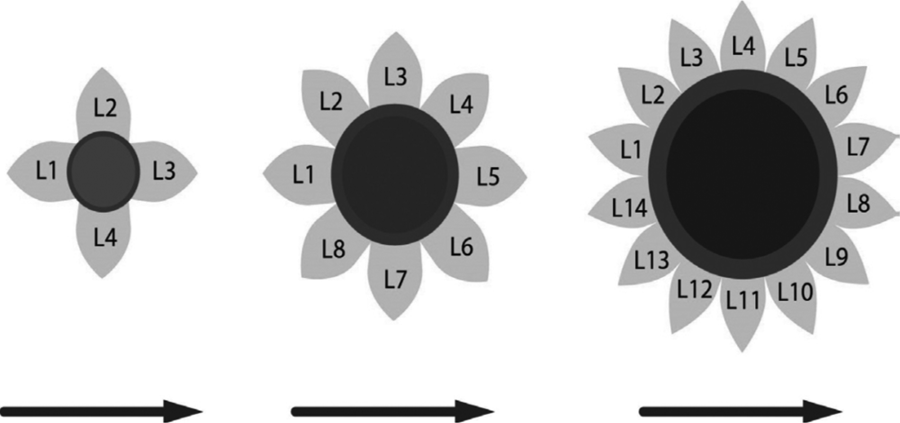
Although the dynamic model and the three generation models have been influential in several studies of new English lexicons, they are limited in understanding the unconventional and unpredictable process of the formation of new words and their rapid, international spread via online platforms. Kiaer (Reference Kiaer2018: 45) has proposed a sunflower model to capture the commonalities and diversities of the global lexicon due to complex lexical interaction. In Figure 1, the dark core of the sunflower is apparent. This represents the shared section (or translingual words) common to the varieties represented as L1, L2, L3 (e.g. the dialects or idiolects). Whilst there are shared aspects of words, there are also a growing number of petals which represent differences. When a sunflower first begins to grow, the dark core area is relatively small. As the plant grows, however, the sunflower head develops more seeds and expands. As the dark core of the flower gets bigger, the number of petals increases as well. For instance, the word mukbang, now a globally recognised word thanks to the increased popularity of the Korean Wave, has variants such as meokbang, mookbang, mokbang or eatcast, all of which were born at almost the same time. Despite this, mukbang has clearly become the most popular of all the different variants, thus mukbang sits at the core of a sunflower model, whilst the other variants remain as petal words.
The sunflower model (Kiaer, Reference Kiaer2018: 45)

This model can be alternatively understood as a model for a specific repertoire of vocabulary. The other words that are discussed in this study (ram-don, banjiha, chimek and oppa) would have been considered only as petal words belonging solely to the Korean language not long ago. Now these terms are rapidly becoming global words as a result of the popularity of the Korean Wave. In the past, more naturalised words would have been preferred, but nowadays, ‘foreignised’ words frequently find their status as global words. For instance, for what we at one time might have preferred to refer to as ‘Asian Pasta’, the most recognised word is instead noodle, a foreign import into English. Nowadays, words such as ramen, japchae, and udon are becoming increasingly visible as terms referring to Japanese thin wheat noodles, Korean glass noodles and Japanese thick wheat noodles respectively. Likewise, the sunflower model can vividly illustrate the simultaneous growth in both the commonalities and diversities of global lexicon. As more and more exchanges occur cross-culturally, the number of words that are shared by multiple languages will increase, just as the increasing number of seeds in the centre of the sunflower cause it to expand. That being said, the proportion of words that are shared between people across the globe is exploding, yet at the same time, lexical repertoires are also becoming increasingly diverse; the size of the global lexicon is increasing, yet immeasurable diversity exists between the lexical repertoires of individuals.
Case studies of five translingual words of Korean origin
1) ram-don and banjiha
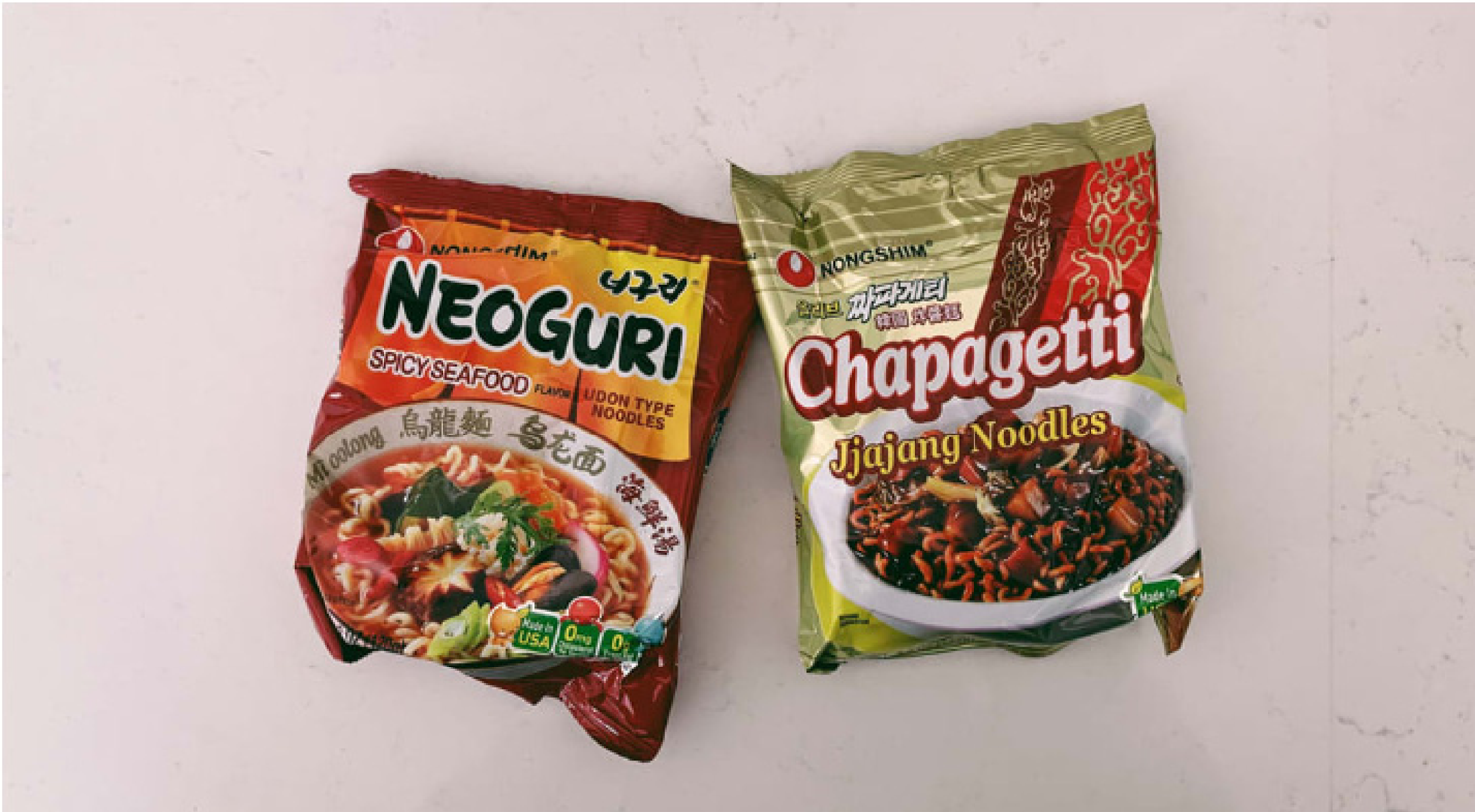
The words ram-don and banjiha became internationally known on the back of the global success of the Korean film Parasite. The word ram-don is an accidental name for a noodle dish whose Korean name is jjapaguri, which is the combination of two brand names of Korean instant noodles (with different flavours), jjapaghetti and neguri as shown in Figure 2. Although this word is a combination of two popular Korean instant noodle brand names, this word would most likely be unfamiliar to most Koreans as it was invented for the film's subtitles by the film's translator Darcy Paquet. In an interview, Paquet said:
I was embarrassed because I made up this word ‘ram-don’. I thought people would laugh at me for it, but it works in the film. The word is first used during a phone conversation. Later, as one character prepares the food, we see the packages on the screen, and I wrote ‘ramyeon’ and ‘udon’ over them to show how ‘ram-don’ came about. I did Google ‘ram-don’ actually before writing it, and nothing came up. It appears to not be a word in any language at all.
(Lee, Reference Lee2019)The Korean name jjapaguri is a complex, hybrid word: Jja comes from Sino Chinese, meaning black bean sauce; Pa comes from the Italian spaghetti, and guri is from the name of a Korean instant noodle, neguri which literally means racoon in Korean. Paquet explains that jjapaguri would be too complex for the international audience and he came up with the term ram-don by combining ramyeon and udon. Ramyeon and undon arrived in Korea through the Japanese language and now this hybridised word ram-don is being used by English speakers.
Chappguri: Chappagetti + Neoguri

When Googling ram-don, numerous websites introducing ram-don recipes appear. The popularity of this food can be evidenced by the fact that a Michelin-starred New York restaurant introduced a ram-don dish on their menu (Konstantinides, Reference Konstantinides2020). The word ram-don did not exist before the movie Parasite. In sum, the origin of ram-don is difficult to trace. Is it from the Korean language? It became a global word from its birth, and it was an accidental creation that spread and was accepted instantly across the globe.
The word banjiha is the transliteration of the Korean word 반지하, and it is often translated as referring to a semi-basement apartment or a type of house which is built partially underground. When searching banjiha on Google it can be seen that the news media is unable to decide between the words ‘semi-basement’ or banjiha to refer to such residences and sometimes both words are used in the same report. For example, a BBC news article uses the words, ‘Seoul's basement apartments’ to introduce the article and then subsequently uses banjiha in the rest of the article (Yoon, Reference Yoon2020). On the other hand, a CNN article does not use banjiha at all; instead, it uses ‘semi-basement apartment’ throughout (Wong, Reference Wong2020). This kind of approach found in the media towards new words from non-English languages is not new; nevertheless, it showcases ‘the battle’ between alternatives as new words become part of the English lexicon.
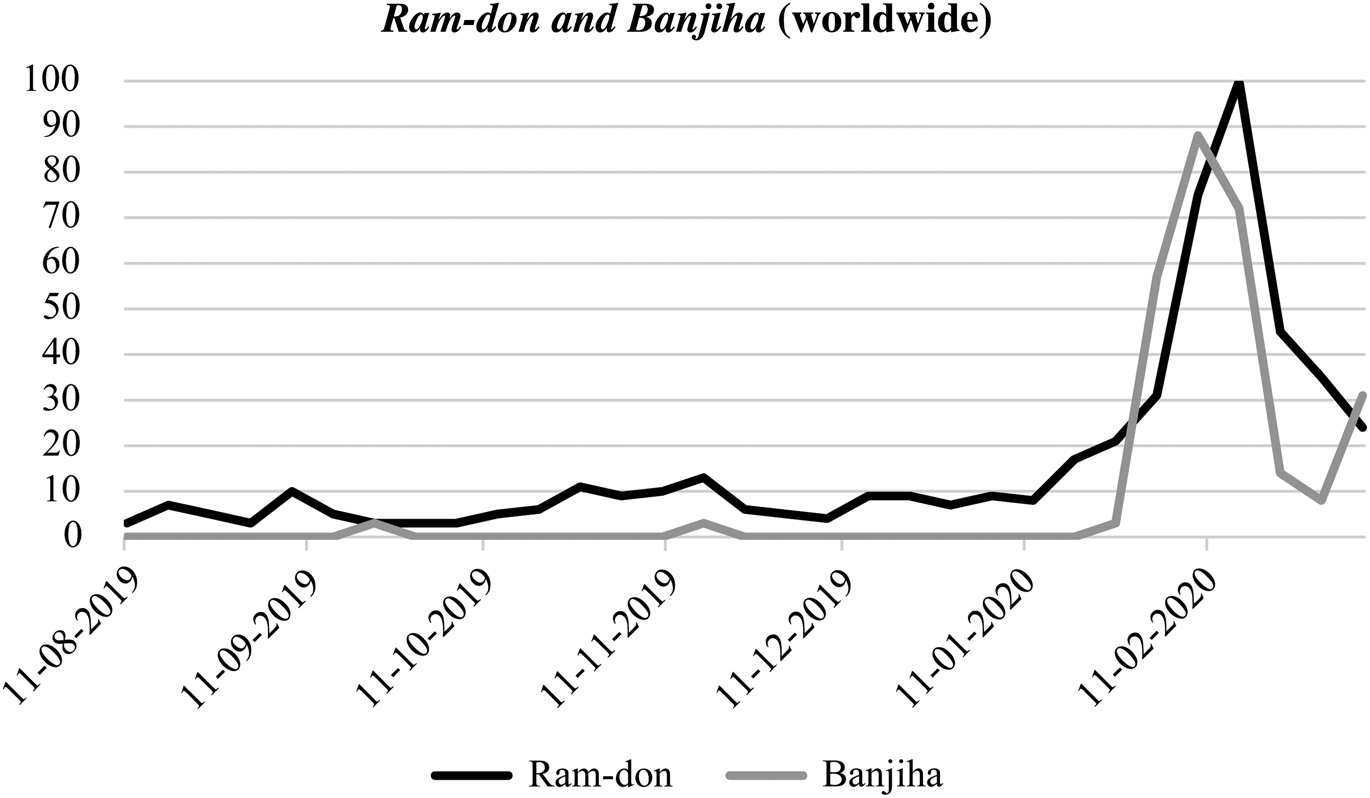
According to Google Trends, as shown in Figure 3, the use of ram-don and banjiha hit their highest frequency in February 2020, soon after the announcement of the 92nd Academy Awards to be held on February 20, 2020. The five countries in which ram-don is most frequently used are the Philippines, Canada, Singapore, Denmark and the United States and the word banjiha is most popular in Singapore, the Philippines, Mexico, the United Kingdom and Indonesia. In Figure 3 the numbers on the vertical axis represent search interest relative to the highest point on the chart for the given region and time. A value of 100 indicates peak popularity for a word. A value of 50 means that the word is half as popular. A score of 0 means that there was not enough data to rate the popularity of this term.
Ram-don and banjiha (2019 August to 2020 February, worldwide)

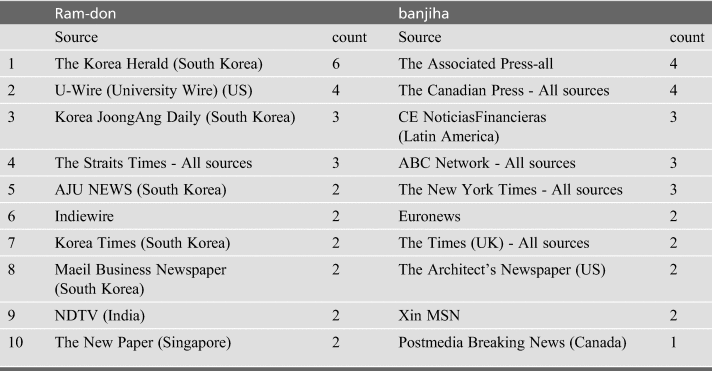
According to Factiva results, ram-don appeared 88 times and banjiha 66 times in several media sources over the past three months worldwide as can be seen in Table 1. Table 1 does not include all the sources that mention ram-don and banjiha. It only includes the ten sources that mention these words most frequently. Ram-don not only appeared in several Korea-based media sources but also it appeared in the US-based media outlet U-Wire, the Singapore-based media source The Straits Times and the India-based media NDTV. Banjiha also appeared in several international media sources including: The Canadian Press, Latin American media – CE Noticias Financieras, and The New York Times. Table 1 suggests that ram-don and banjiha appear worldwide in media sources.
Factiva source: ram-don and banjiha

In sum, these two words became instantly internationally known because of the success of the movie Parasite. Ram-don became internationally known by accident and banjiha is a transliteration of a Korean word, yet, its referent was introduced through a Korean movie. It also showcases the attitudes of the international media towards the use of the commonly understood word ‘semi-basement’ or banjiha, that represents a South Korean semi-basement styled house with unique cultural and societal characteristics. Although it is too early to predict the longevity of these words in the international context, they showcase how quickly a word of non-English origins can be shared by the broader international community.
2) chimek (chimaek)
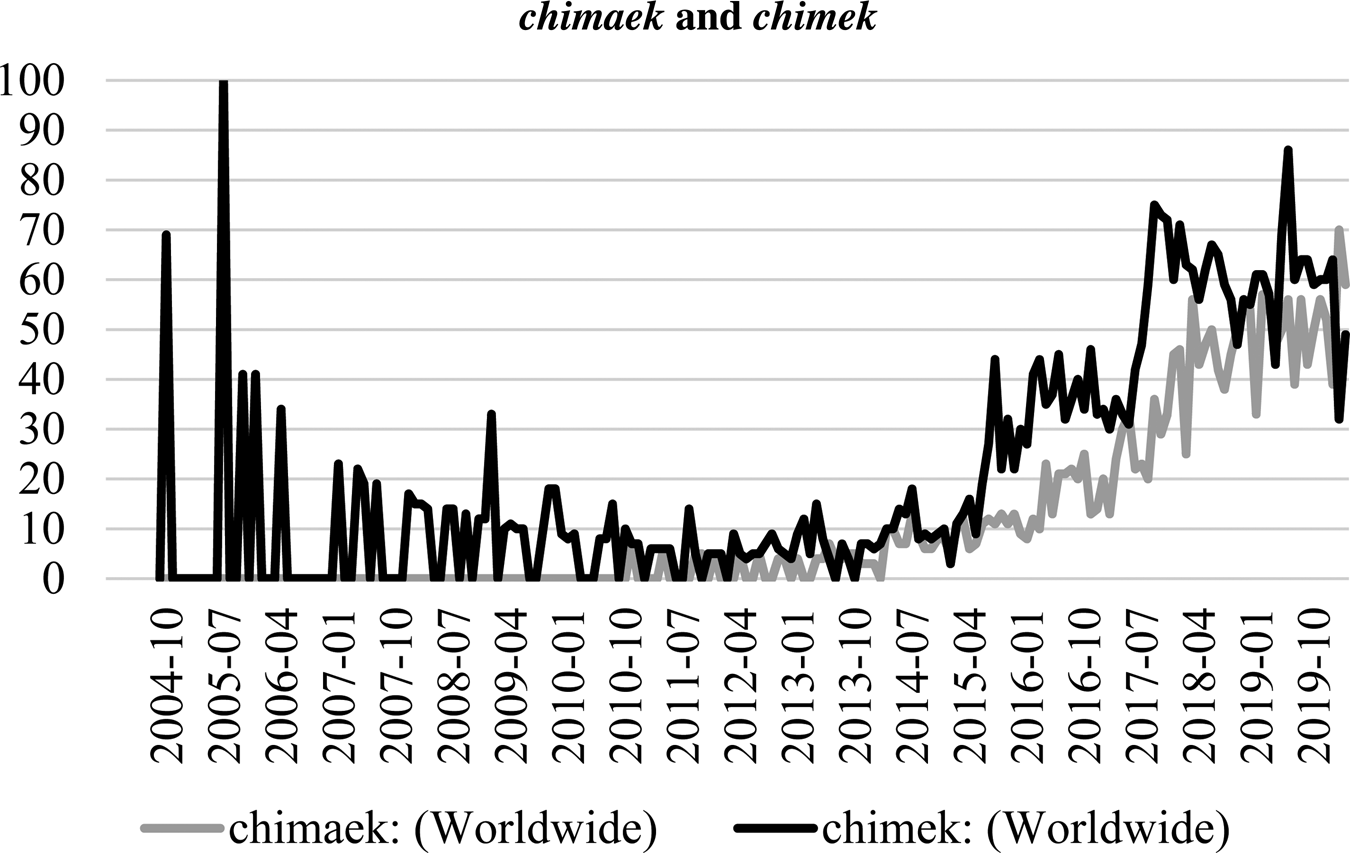
If a movie made the two words ram-don and banjiha internationally well known, the Korean TV program, My Love from the Star, which aired in 2013, placed the word chimek (chimaek) on the international stage with the line spoken by the lead actress Jeon Ji-hyun: ‘A day when it's snowing is just perfect for our chimaek (chimek) time . . . ’ Chimek refers to a paired food combination of fried chicken and beer. It is a coined word constructed from chi taken from chicken and maek from the Sino-Korean word maekju (beer). The Korean word 치킨 [chi-kin], which is borrowed from the English word ‘chicken’, exclusively refers to fried chicken. This word also has two interesting spellings, chimaek and chimek. According to Google Trends (see Figure 4), the two variants, chimaek and chimek have popularly appeared in searches online since 2004, yet chimaek, the recently added variant, saw the number of searches soar in the year the TV program My Love from the Star was released. Chimek appeared most frequently in searches in Australia, Singapore, South Korea, Poland and the US. Related queries were ‘chimek menu’, ‘chimek Perth’ and ‘chimek chicken’. Chimaek most frequently appeared in searches in South Korea, Singapore, Canada, the UK and Malaysia with related queries including ‘chimaek Manchester’, ‘chimaek menu’ and ‘chimaek London’.
Chimaek and chimek (2004 to present, worldwide)

While both variants were popular in search queries on Google, Factiva showed somewhat contrasting results. According to Factiva data over the past five years, the word chimaek was mentioned 192 times while the word chimek was used significantly less, only 18 times. This reflects the news media's preferred use of chimaek over chimek. While South Koreans invented this word borrowing the element ‘chi’ from the English word ‘chicken’, they are now returning it with a new meaning to English-speaking communities. Thus, although the word chimek may appear to have originated from Korean, one can argue that it may also be partially ‘imported’ from English and it has now been ‘exported’ back to English with a new meaning and in a new form. This reflects the complicated trajectories that many translingual words follow.
3) mukbang
The word mukbang also represents several characteristics of translingual words. These include several spelling variants, phonetic adaptations and rapid international spread before ‘settling’ in its native context. In addition, like the word banjiha, the media has shown indecision about where to use mukbang or ‘eatcast’, a shortened form of ‘eating broadcasting’. Mukbang combines the stem of the Korean verb 먹 [meog] meaning ‘to eat’ and 방 [bang], meaning ‘broadcasting’. This term first appeared in Korea during the late 2000s, on an internet broadcasting channel called Afreeca TV, where various well known presenters made conversational broadcasts similar to reality television programs, whilst eating various kinds of takeaway food. Viewers seemed excited to see the more ordinary aspects of the life of celebrities as represented by them eating everyday food and the popularity of mukbang has soared in the years since.
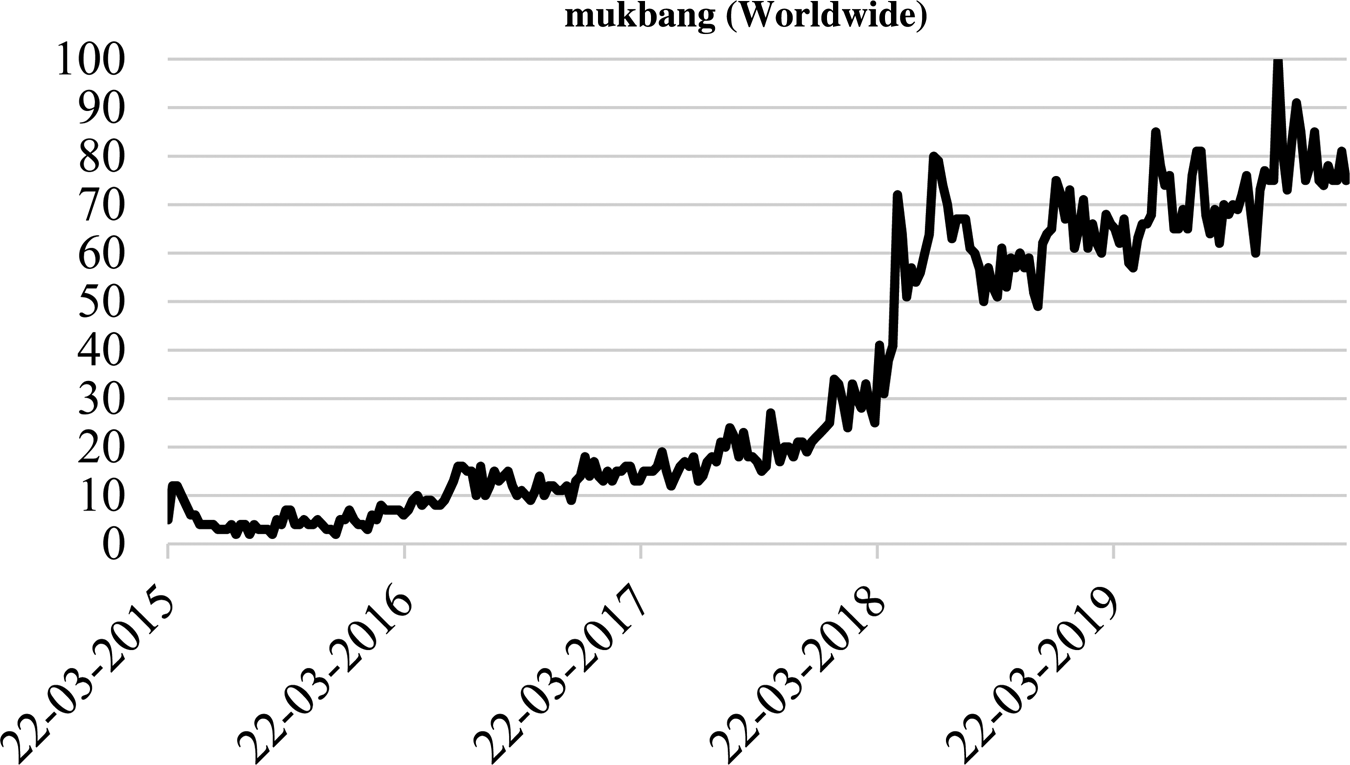
Mukbang appears in several forms including meokbang, mookbang and mokbang. The Korean vowel ‘ㅓ[eo]’ can be difficult for non-Korean language speakers to pronounce and this is reflected in several different spellings of this sound such as: ‘eo’ of ‘meok’, ‘oo’ of ‘mook’, ‘o’ of ‘mok’, or ‘u’ of ‘muk’, although the spelling mukbang is the most predominantly popular form and its use is continually on the increase as shown in Figure 5.
Mukbang (2015 March to 2019 March, worldwide)

Interestingly, mukbang does not follow any of the authorised romanisation systems. The Korean word 먹방 should be spelt as meog-bang, mŏk-pang or mek-pang depending on whether the RR, the MR or the Yale system is followed. This is an example of established linguistic authorities having little impact on determining the form of a translingual word spread through online platforms. Since mukbang has become the most popular form, it is clear this word has also experienced phonetic adaption. The Korean vowel ㅓ[eo] in 먹 generally corresponds to the English vowel sounds of [ə] or [ɜ] in the international phonetic alphabet and sounds like [məg] or [mɜg] to Koreans. However, international speakers change this vowel sound to [mug].
In addition, there are several definitions of mukbang meaning different things to both Korean and international users. This may be because mukbang became internationally popular before it came into use among Korean speakers. The word mukbang is largely unfamiliar to those many Koreans who are not considered to be part of the ‘social media generation’, even though it is already popularly used by the social media generation internationally. According to several online dictionaries, mukbang generally includes the meaning of an online live stream program with the host eating (a large amount of) food while talking to the audience. Here are some varying definitions:
According to Wikipedia, ‘mukbang’, an eating show, is an online audiovisual broadcast, in which a host eats food while interacting with the audience. (mukbang, 2020)
According to dictionary.com, mukbang is a live stream of a host who binge eats large quantities of food as they talk to their audience (mukbang, n.d.).
According to the Urban dictionary, mukbang is an internet fad that finds viewers watching mukbangers binge eating copious amounts of food (mukbang, n.d.).
Mukbang differs from a cooking show which is a television genre presenting food preparation by a professional chef. To many South Koreans, mukbang is not necessarily associated with ‘online livestream’ or ‘eating a lot of food’ as they are familiar with mukbang as it appears on television in programs where the guests and hosts eat together during the course of the television show. For example, a South Korean television program called Let's Eat Dinner Together, starring Lee Kyung-kyu and Kang Ho-dong, is a documentary-like program that shows two men taking a trip together and finding dinner at a randomly selected private house in a South Korean neighbourhood. This show does not involve ‘live streaming’ or ‘hosts eating a large amount of food’, rather it focuses on ‘talking over dinner’. For South Koreans, this type of television show, as well as the mukbang shows on the internet, are widely classified under mukbang. In addition, mukbang has generated new hybrid words such as mukbangers and cookbang. Mukbangers refers to hosts who run the mukbang shows and cookbang refers to a type of casual TV cooking show (e.g. Jamie's 30-Minute Meals, Jamie's School Dinners).
According to Google Trends results over the past five years, mukbang has been most popularly searched for in the Philippines, followed by Indonesia, Singapore, Malaysia and New Zealand, while Factiva results show that the word was mentioned 1,079 times across several international media broadcasts during the same timespan. In a sense, the word mukbang does not only belong to Korea but goes beyond nation-state language borders since it is actively used by online communities who represent millions of speakers from various linguistic and cultural backgrounds.
4) oppa
With Psy's global hit Gangnam Style, the word oppa became very familiar to young English speakers who are interested in pop music worldwide. Some of the interesting characteristics of this translingual word, oppa, is that it has become hybridised by semantic changes introduced by international users. For example, the plural form of oppa is oppas with the English plural marker -s instead of the Korean plural marker -deul. In addition, the meaning of oppa in the South Korean context is that it is a versatile kinship term referring to a woman's older brother but in the international context, this term is seldom used to refer to family members. Instead it is most frequently used to refer to a handsome Korean pop idol, regardless of the age of the addressees (Khedun-Burgoine & Kiaer, Reference Khedun-Burgoine and Kiaer2018).
As shown in excerpt (1), Jungkook is the youngest member of BTS, an international boy band of Korean origin. When BTS attracted millions of international female fans, the fans called Jungkook oppa although most of them are older than him. This excerpt demonstrates how oppa became desensitised agewise in the international context.
BTS's Jungkook is finally giving fans permission to call him ‘oppa’.
ARMYs can now call him ‘oppa’ without any worries . . . ‘Oppa’ is an affectionate term that girls and women use to address their older brothers, older male friends, boyfriends, and male celebrities . . . Over time, Jungkook has gotten more used to being an oppa, and he has even responded to ‘Jungkook-oppa’ at fan events.
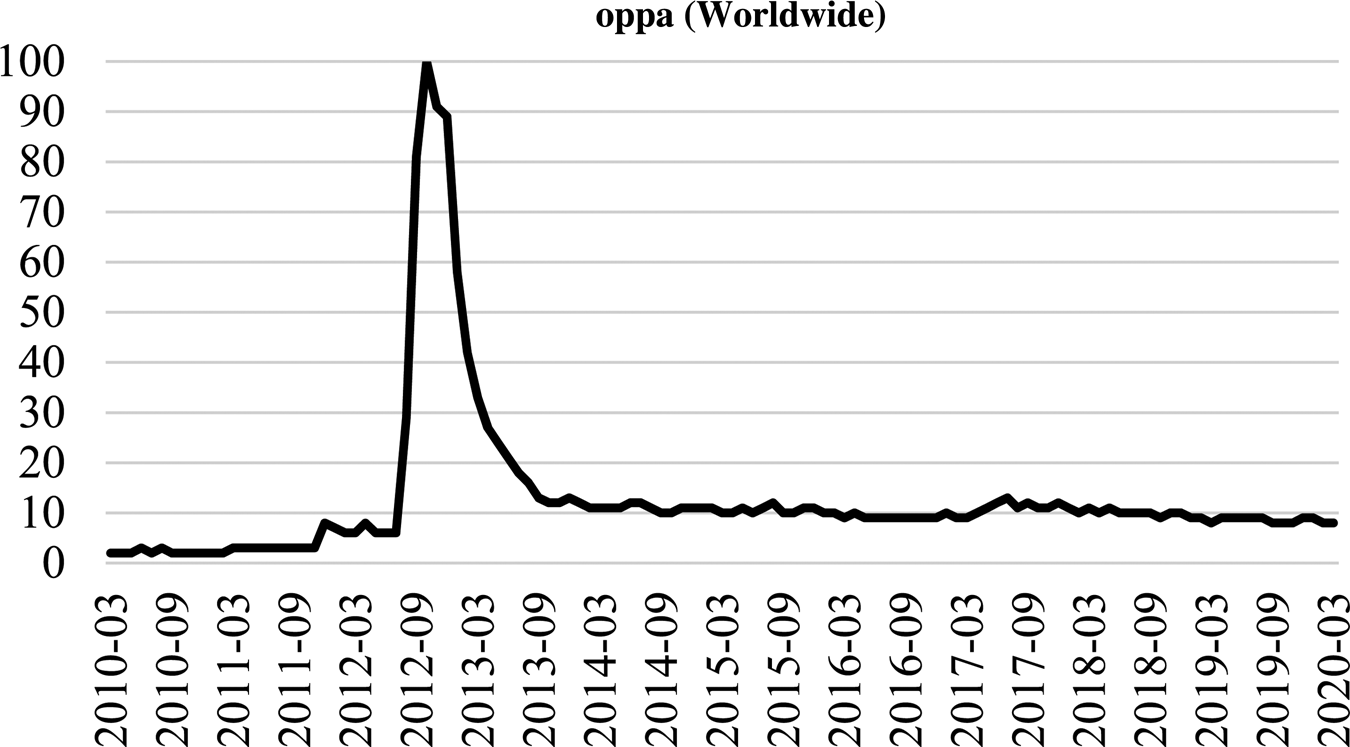
(Koreaboo, 2019, April 25)As shown in Figure 6, according to Google Trends, the word was most frequently searched for between 2012 and 2013, probably following the surge in the popularity of Psy's song. It was most frequently searched for in Brunei, Malaysia, the Philippines, Tunisia and Singapore. Although the peak period for the interest in this word seems to have passed, oppa continues to be in use in the English-speaking context.
Oppa (2010 March to 2020 Feb, worldwide)

Conclusion
The present study examined five translingual words of Korean origin that have received recent international attention and which demonstrate the vibrant transnational and transcultural language contact situations in today's global social media environment. It proposes that translingual words of Korean origin have several pertinent main characteristics:
i. They can achieve global spread rapidly.
– Some of them become global before being widely used within their native context.
– Their existence does not require stable and constant contact between languages.
ii. They often have multiple language origins; it is sometimes difficult to track the ultimate origin of the word.
iii. Their spelling and pronunciation do not always conform to linguistic authorities.
iv. Forms and meanings can change drastically.
– Their forms are often hybridised.
– These changes are often unpredictable.
v. An individual's idiolect can impact global usage.
vi. In the early stages of their formation words can experience ‘mixed’ attitudes towards their use.
This paper concurs with Kiaer (Reference Kiaer2018) in questioning whether it is meaningful to assign these words to a particular variety of English. While they have a strong connection to Korean, they demonstrate hybridity and have undergone semantic and phonetic changes as they became transnational and transcultural. The words examined in this study still have a strong local flavour. Nevertheless, their forms and meanings are rapidly changing and are immediately shared by international communities. It may be almost impossible to document the dynamic nature of more than a small sample of new words and take into account their wide and speedy spread and their rapid and multiple growths. Nevertheless, it is absolutely critical to strive for a description of the ongoing expansion and diversification of the English language in this global and technological era.
 Dr. HYEJEONG AHN works as a lecturer at the School of Humanities, Nanyang Technological University in Singapore. Her publications include Attitudes to World Englishes: Implications for teaching English in South Korea (Routledge). Her research interests include translingual practice, World Englishes, and English in Higher Education. Email: mesya0801@gmail.com
 Dr JIEUN KIAER is YBM-KF Associate Professor in Korean Language and Linguistics at the University of Oxford, UK. Her research interest includes cross-cultural pragmatics, translingualism, translation and Asian Englishes. She has authored Translingual Words (Routledge, 2018). She is the Series Editor of Routledge Studies in East Asian Translation. Email: jieunresearch@gmail.com