INTRODUCTION
Burnout syndrome among medical practitioners was first described by the psychiatrist Herbert Freudenberger in 1974 (Freudenberger, Reference Freudenberger1974). Burnout syndrome is a nonspecific clinical syndrome related to work-related distress, with three scorable dimensions: emotional exhaustion not relieved by rest, depersonalization characterized by a feeling of detachment and of negativity of the subject toward the persons with whom he interacts professionally, and a decrease in feelings of personal accomplishment and self-achievement. Unlike depression, burnout syndrome disappears when the subject is not at his workplace (Freudenberger, Reference Freudenberger1974; Maslach & Jackson, Reference Maslach and Jackson1981).
According to Maslach and colleagues (Maslach & Jackson, Reference Maslach and Jackson1981; Maslach, et al., Reference Maslach, Schaufeli and Leiter2001), depersonalization causes team conflicts and patients' or patients' family rejection. The lack of personal accomplishment results in the subject losing interest in his job and in further training, other unacceptable behaviors (Asai et al., Reference Asai, Morita and Akechi2007), and absenteeism (Galam & Mouriès, Reference Galam and Mouriès2007). This type of behavior may threaten the human and economic well-being of an institution. Trufelli and colleagues (2008) identified some factors associated with burnout in cancer professionals in a systematic review:
Personal factors: lack of exercise, lack of social activities, lack of spare time, solitary existence, and age.
Physician–patient relationship: lack of time to communicate with patients or interact with families, lower confidence in communication skills or in dealing with distressed patients, and lack of satisfaction.
Clinical settings: number of team members, increased workload, interest in research and education, lack of time for paperwork, work adjustment, and team management.
On a daily basis, palliative care physicians have to face serious progressive illnesses, distressed patients and families, suffering, and death. The literature highlights some of the difficulties experienced by clinicians when dealing with a palliative patient (Vachon, Reference Vachon1995; Meier et al., Reference Meier, Back and Morrison2001; Guex & Stiefel, Reference Guex and Stiefel2010; Hudson et al., Reference Hudson, Remedios and Thomas2010; Peterson et al., Reference Peterson, Johnson and Halvorsen2010; Kearney et al., Reference Kearney, Weininger and Vachon2009; Catalan et al., Reference Catalan, Burgess and Pergami1996), such as dealing with the difficult symptoms of terminal illnesses, interaction with families, team conflict, tense relationships with other specialists (Finlay, Reference Finlay1989), and often having to take care of patients who are dying or suffering from a progressive illness (Vachon, Reference Vachon1995; Meier et al., Reference Meier, Back and Morrison2001; Guex & Stiefel, Reference Guex and Stiefel2010; Hudson et al., Reference Hudson, Remedios and Thomas2010; Peterson et al., Reference Peterson, Johnson and Halvorsen2010; Kearney et al., Reference Kearney, Weininger and Vachon2009; Catalan et al., Reference Catalan, Burgess and Pergami1996). While many studies about oncologists have been carried out (Asai et al., Reference Asai, Morita and Akechi2007; Catalan et al., Reference Catalan, Burgess and Pergami1996; Catt et al., Reference Catt, Fallowfield and Jenkins2005; Grunfeld et al., Reference Grunfeld, Whelan and Zitzelsberger2000; Elit et al., Reference Elit, Trim and Mand-Bains2004; Tucunduva et al., Reference Tucunduva, Garcia and Prudente2006; Glasberg et al., Reference Glasberg, Horiuti and Novais2007; Bressi & Manenti, Reference Bressi and Manenti2008), there are few such studies with palliative care physicians (Asai et al., Reference Asai, Morita and Akechi2007; Ramirez et al., Reference Ramirez, Graham and Richards1995; Catt et al., Reference Catt, Fallowfield and Jenkins2005; Coulon & Filbet, Reference Coulon and Filbet1995; Graham et al., Reference Graham, Ramirez and Cull1996). Ramirez and colleagues (Reference Ramirez, Graham and Richards1995) underlined a higher emotional exhaustion rate among oncologists (38%) than palliative care specialists (23%, p = 0.006). Improving specific communication and management training could be a way of reducing burnout (Asai et al., Reference Asai, Morita and Akechi2007; Ramirez et al., Reference Ramirez, Graham and Richards1995; Reference Ramirez, Graham and Richards1996; Coulon & Filbet, Reference Coulon and Filbet1995). In addition, an interdisciplinary organization of work has been shown to protect palliative care specialists from burnout syndrome (Estryn-Behar et al., Reference Estryn-Behar, Lassaunière and Fry2011).
This paper aims to define how clinical settings can have an influence on burnout among palliative care physicians.
METHOD
We conducted a cross-sectional study on palliative care physicians working in France from July of 2012 to February of 2013, and it was approved by our ethics committee.
Studied Group
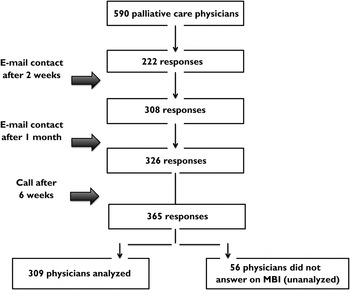
The studied group was composed of permanent physicians working in a palliative care unit (PCU) and/or on a palliative care mobile team (PCMT). Every French palliative care service received a call in order to identify all tenured physicians at their service. Some 590 physicians were identified and sent an e-mail inviting them to take part in the online study. Any e-mails that were undeliverable were withdrawn from the database. The physicians were contacted twice by mail and called once more six weeks after the launch and asked to answer within four days (see Figure 1).
Flowchart: method and response rate.

Assessment Tools
The Maslach Burnout Inventory (MBI) (Maslach & Jackson, Reference Maslach and Jackson1981) is a burnout assessment tool with a 22-item questionnaire. This comprised nine items measuring emotional exhaustion (defined as a lack of the energy necessary to confront the working day), five items measuring depersonalization (defined as professional behavior characterized by detachment, unresponsiveness, or irritability), and eight items measuring feelings of low personal accomplishment that referred to a diminution of professional satisfaction or personal accomplishment at work. In every subscale interpreted separately, Maslach and colleagues (Maslach & Jackson, Reference Maslach and Jackson1981) have described three degrees of burnout: low, medium, and high. Burnout syndrome is deemed present if at least one of the dimensions is severely abnormal (Grunfeld et al., Reference Grunfeld, Whelan and Zitzelsberger2000). The MBI is widely used by health professionals and is validated in French (Dion & Tessier, Reference Dion and Tessier1994).
We decided to restrict the number of questions and tools in order to ensure a satisfactory participation rate (Johnson & Owens, Reference Johnson and Owens2003). The General Health Questionnaire (GHQ-12) was not added to the study since earlier studies did not find any significant association between a change in general health and a higher frequency of professional exhaustion syndrome (Asai et al., Reference Asai, Morita and Akechi2007; Ramirez et al., Reference Ramirez, Graham and Richards1995; Catt et al, Reference Catt, Fallowfield and Jenkins2005; Coulon & Filbet, Reference Coulon and Filbet1995).
Study-Specific Questionnaire
Our questionnaire is designed specifically for study with a multidisciplinary group of experts (an epidemiologist, a psychiatrist, palliative care physicians, and a nurse). The items were derived from the literature, and six palliative care physicians tested the questionnaire before its final version was approved. It took 4 to 6 minutes to fill in all 32 questions: 4 questions about sociodemographic data, 16 for professional data, 1 for motivational data, and 8 for data on satisfaction. This last item was assessed by a numeric scale from 0 to 10 (0 being total dissatisfaction and 10 being maximal satisfaction).
Statistical Analysis
Before analysis, the database was anonymized. Categorical variables were expressed as numbers (n) and percentages. The hypothesis of normal distribution of quantitative variables was tested using the Kolmogorov–Smirnov test. Quantitative variables were expressed as means plus-or-minus standard deviation when the distribution was normal or median, and minimum and maximum when the distribution was not normal. Categorical variables were compared using a chi-square test or Fisher's exact test when the conditions for application of the chi-square test were not met. Quantitative variables were compared between groups using Student's t test after verification of equality of variances when the data were normally distributed, and with the nonparametric Wilcoxon test when the hypothesis of normality of distribution was not verified. Analysis with more than two groups was conducted using the Kruskal–Wallis test. In all statistical evaluations, a p value of 0.05 or less was considered statistically significant. Statistical analyses were conducted using SAS software (v. 9.1.3, SAS Institute, Cary, NC).
RESULTS
We received 365 responses from 590 participants (61.8% response rate). We included 309 physicians (52.3%), but we lacked MBI data or profession type for 56 of them (Figure 1).
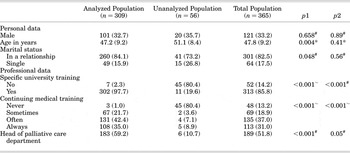
General Population (Table 1)
Comparison between the analyzed and unanalyzed populations (missing data):
Characteristics of physicians (n = 365)

#Chi-square test; ~Fisher's test; *Mann–Whitney test.
p1 = comparison established between the analyzed population and the missing answers and/or the refusals.
p2 = comparison established between the analyzed population and the complete population.
Note: Data are mean (standard derivation) or number of respondents (percentage).
Unanalyzed Population (n = 56). This population included all the physicians who filled in some elements of the questionnaire without answering the MBI. Table 1 displays the sociodemographic and professional data for the physicians who completed all parts of the questionnaire, including the MBI. The analyzed population (n = 309) was significantly (p = 0.004) younger (47.2 years ± 9.2 vs. 51.1 years ± 8.4 for the unanalyzed population) and included 59.2% (vs. 10.7%) of head of department physicians (p < 0.001). The analyzed population was mostly trained in palliative care (302/309, 97.7%) versus 19.6% (11/56) of the unanalyzed population (p < 0.001). Some 91% of the analyzed population were taking part in continuing medical education, whereas 80.4% (45/56, p < 0.001) of the unanalyzed population never participated in continuing medical education.
Analyzed Population (n = 309). This population included a majority of women (208/309, 67.3%), and the average age was 47.2 years (9.2%). The majority (84.1%) was in a relationship, had specific palliative care training (university degree) (68%) and often, or always, took part in continuing medical education (77.4%).
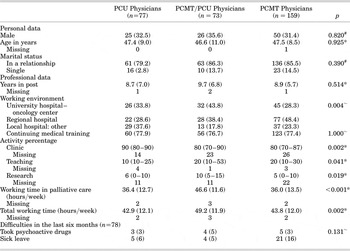
Comparison of the population according to the type of clinical setting (Tables 2 and 3)
Sociodemographic and Professional Data
We did not find any significant differences between type of clinical setting, sociodemographic data, and years of experience. However, we did find a significant difference (p = 0.004) in terms of working environment, with 77/159 (48.4%) of the physicians working on a PCMT working in regional hospitals (vs. 38.4% of PCMT/PCU physicians and 28.6% of PCU physicians). A total of 32 of 73 (43.8%) of the physicians working both on a PCMT and in a PCU worked in university hospitals or an equivalent (vs. 28.3% of physicians working on a PCMT and 33.8% of the PCU physicians). The physicians working in a PCU were distributed equally among the various services.
Comparison between the different types of clinical setting (PCMT, PCU, or both) vs. personal data, professional data, and difficulties

# Chi-square test; ~Fisher's test; *Kruskal–Wallis test.
Note: Data are mean (standard derivation) or number of respondents (percentage) or median (25th–75th).
PCMT = palliative care mobile team; PCU = palliative care unit.
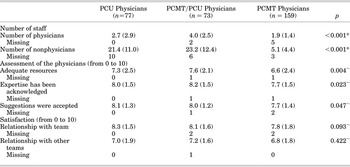
Comparison between different types of clinical setting (PCMT, PCU, or both) vs. staff number, environment. and satisfaction

~Fisher's test; *Kruskal–Wallis test.
Note: Data are mean (standard derivation).
Activity Type
PCU physicians had considerable clinical activity: up to 90 % (p = 0.002). However, these physicians spent less time (10%) teaching than physicians from other departments (p = 0.041). Physicians working on a PCMT were less active in research (p = 0.019), with only 5% doing so.
Working Time
We found many significant differences regarding clinical setting. Physicians working both on a PCMT and in a PCU spent more time at work (p < 0.001) in palliative care (46.6 (11.6) hours/week and 36.4 (12.7) for physicians working in a PCU, and 36 (3.5) for physicians working on a PCMT). The difference was similar regarding total working time (p = 0.002).
Impact of Psychological Difficulties
Some 42 of 309 participants (13.5%) had experienced difficulties during the past six months and had taken psychoactive drugs or gone on sick leave. We did not find any significant difference according to type of clinical setting.
Number of Physicians and Nonphysicians on the Team
Physicians involved with a PCMT are working in a team with a smaller number of physicians (average of 1.9 (1.4)) and nonphysicians (5.1 (4.4); p < 0.001).
Resources and Acknowledgment at Work
When asked if they had adequate resources for their work, physicians working on a PCMT gave a 6.6 (2.4) of 10 score, which was significantly less (p = 0.004) than for physicians in a PCU (7.3 (2.5)/10) and those on both PCMT/PCU 7.6 (2.1). Physicians working on a PCMT gave an average score of 7.7 (1.5)/10 to acknowledgment of expertise by others, which was significantly less (p = 0.023) than that for other physicians (respectively, 8 (1.5) /10 for PCU and 8.2 (1.4)/10 for PCMT/PCU). We observed similar patterns with uptake of medical suggestions, with an average of 7.7 (1.4) /10 for physicians working on a PCMT versus 8.1 (1.3)/10 for those in a PCU, and 8 (1.2)/10 for PCMT/PCU physicians (p = 0.047).
Job Satisfaction
We did not find any significant difference in levels of job satisfaction in the different clinical settings.
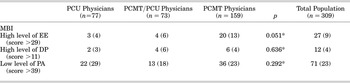
MBI Results (Table 4)
MBI and the General Population
Generally speaking, 9% (23/309) of the analyzed physicians working in palliative care in France showed high emotional exhaustion, 4% (12/309) high depersonalization, and 23% (71/309) feelings of low personal accomplishment.
Comparison between different types of exercise (PCMT, PCU, or both) vs. MBI frequency

MBI = Maslach Burnout Inventory; EE = Emotional exhaustion; DP = depersonalization; PA = personal accomplishment.
* Fisher's test.
MBI and Type of Exercise
Some 13% (20/159) of physicians working on a PCMT had high emotional exhaustion versus 4% (3/77) of PCU and 6% (4/73) of PCMT/PCU physicians. However, this difference was not statistically significant (p = 0.051).
Neither did we find any significant difference between type of clinical setting and high depersonalization or low feelings of personal accomplishment with linear frequencies.
SIGNIFICANCE OF RESULTS
The aim of our study was to explore burnout and the impact of clinical settings on palliative care physicians. It focused mainly on the impact of clinical settings according to type of clinical setting (working in a PCU, on a PCMT, or both PCMT/PCU). The response rate (61.8%) was very satisfactory (Johnson & Owens, Reference Johnson and Owens2003). The sample was much wider than in other studies, and we can therefore consider that the results are realistic.
This study allowed us to show a very low frequency of emotional exhaustion in physicians working in palliative care (9%) when compared with other studies in the same population. The average age of the study population was higher (47.8 (9.2) years) than in the Japanese study (Asai et al., Reference Asai, Morita and Akechi2007) (43 (8) years) and in the previous French study (42 (8.3)) (Coulon & Filbet, Reference Coulon and Filbet1995). Trufelli and coworkers (Reference Trufelli, Bensi and Garcia2008) had shown that there was more likely to be a risk of burnout in a younger group. This could account for the low prevalence of burnout compared to other studies. The frequency of emotional exhaustion in our study was much lower than in populations interacting with similar patients, such as oncologists (Catalan et al., Reference Catalan, Burgess and Pergami1996; Catt et al., Reference Catt, Fallowfield and Jenkins2005; Grunfeld et al., Reference Grunfeld, Whelan and Zitzelsberger2000; Glasberg et al., Reference Glasberg, Horiuti and Novais2007) or hematologists (Bressi & Manenti, Reference Bressi and Manenti2008). Depersonalization and feelings of personal accomplishment rates were extremely low when we did the same comparisons (Catalan et al., Reference Catalan, Burgess and Pergami1996; Ramirez et al., Reference Ramirez, Graham and Richards1995; Catt et al., Reference Catt, Fallowfield and Jenkins2005; Graham et al., Reference Graham, Ramirez and Cull1996; Glasberg et al., Reference Glasberg, Horiuti and Novais2007; Bressi & Manenti, Reference Bressi and Manenti2008). Other studies that have analyzed physicians working in palliative care drew the same conclusions, except for Asai's (Reference Asai, Morita and Akechi2007), which showed a high rate of feelings of low personal accomplishment (this rate can be explained by a lack of training for physicians about the psychological symptoms of patients).
It could be seen as a paradox that physicians working in palliative care had less burnout. Ramirez and coworkers (Reference Ramirez, Graham and Richards1995) showed that physicians in palliative care have a high degree of job satisfaction (they were less overwhelmed, had fewer conflicts, were less worried about drug toxicity, had access to better resources, and had better communication skills with patients). This was confirmed by Asai's study (Reference Asai, Morita and Akechi2007), in which physicians said that they had sufficient time to communicate with their patients. Another study suggested that a multidisciplinary structure could be a factor that protects against burnout (Estryn-Behar et al., Reference Estryn-Behar, Lassaunière and Fry2011). We assume that palliative care physicians have a real vocation for taking care of end-of-life patients. Their aim is not focused on curing (Ramirez et al., Reference Ramirez, Graham and Richards1995; Graham et al., Reference Graham, Ramirez and Cull1996), and they have chosen this job.
Physicians working on a PCMT tended to have a higher degree of emotional exhaustion (13%) than the others (4% for PCU and 6% for PCMT/PCU physicians. p = 0.051). Even if the study had been based on a large sample, the low rate of emotional exhaustion would make us very cautious about interpreting the results. Whereas Maslach and colleagues (Reference Maslach, Schaufeli and Leiter2001; Trufelli et al., Reference Trufelli, Bensi and Garcia2008; Wu et al., Reference Wu, Liu and Wang2013) talked about overload of work as a contributory factor to burnout, our results show that working time was not associated with occurrence of burnout. Physicians in both PCMT/PCU work the most, with an average of 46 (1.6) hours per week versus 36 (13.5) hours per week for physicians working on a PCMT or in a PCU (p < 0.001). Sociodemographic factors (sex, age, marital status) did not seem to impact this trend.
Our results suggest that the main factor associated with burnout could be the physician's feeling of isolation. Indeed, the number of physicians (average of 4 (2.5)) and nonphysicians in the team (average 5.1 (4.4)) was significantly lower (p < 0.001) for physicians working on a PCMT.
National recommendations (Ministère de la Santé, 2008) have defined the minimum number of persons necessary for a palliative care team to work satisfactorily, but a recent report (Aubry, Reference Aubry2011) showed a difference between those recommended numbers and reality. It seems that even this low number of people on a team could be reduced in some hospitals. The physicians working on a PCMT work mainly in regional hospitals (48.4%, p = 0.004), and this could be another question to explore. We assume that the regional hospitals did not have the necessary funds to hire an appropriate number of staff members. This could be a factor contributing to feelings of isolation for physicians. Informal exchange between staff members and team support (reassuring and listening to each other, sharing of competencies) seem to be vital factors. As we do not have any literature data exploring this area, further research seems to be necessary.
A lack of job satisfaction could trigger burnout, and our results also seem to demonstrate this, since physicians working on a PCMT were less satisfied than their colleagues in terms of resources (p = 0.004). As described by Finlay (Reference Finlay1989), many physicians (p = 0.023) said that there was little acknowledgment of their expertise and low uptake of their suggestions (p = 0.047), despite the ongoing development of palliative care in France (Rhondali et al., Reference Rhondali, Filbet and Bruera2012). Moreover, one of the reasons for job satisfaction reported by Swetz (Reference Swetz, Harrington and Matsuyama2009) was the possibility of an “intellectually stimulating” activity, yet we see in our study that the physicians working on a PCMT are the ones spending significantly (p = 0.019) less time doing research, with a median of 5%. We assume that this lack of job satisfaction associated with a feeling of isolation could explain the trend of emotional exhaustion observed in physicians working on a PCMT.
Our work has several limitations. There is a bias linked to the fact that people answered the questions directly, whereas semistructured interviews would have limited this bias. A qualitative study could explore the relationship between working conditions and burnout. One physician told us in an e-mail that he did not want to take part in our study because he was suffering from burnout. This could also be a bias, since the physicians who did not take part could mainly be those suffering from the studied condition (Hill et al., Reference Hill, Roberts and Ewings1997). Furthermore, our study has only identified frequency associations between the MBI and the descriptive elements. It is therefore difficult to draw a conclusions about a cause-and-effect relationship. The low prevalence of burnout makes it difficult to establish a link between burnout and low staffing levels. It is necessary to conduct other prospective studies (longitudinal with various assessments) in order to be able to identify the populations more specifically.
The prevalence of burnout in physicians working in palliative care in France is low. It would seem that working on a PCMT is a more risky situation, mainly because of the lack of medical and paramedical staff. Physician rotation between the PCU and a PCMT could prevent feelings of isolation and be a way of maintaining clinical competency. This should certainly be explored in future research.
ACKNOWLEDGMENTS
The authors would like to thank Avril Jackson for her proofreading.
DECLARATION OF COMPETING INTERESTS
The authors hereby state that they have no conflicts of interest to declare.
FUNDING
The authors declare that this study did not receive any funding.