We know that the combination of self-harming behavior, inappropriate angry outbursts, and high levels of help seeking makes borderline personality disorder (BPD) challenging for healthcare providers (Gunderson, Reference Gunderson2001), but we know little about the challenge for children of mothers who have the disorder (Macfie, Reference Macfie2009). Moreover, because BPD is not diagnosed until adolescence (Ludolph et al., Reference Ludolph, Westen, Misle, Jackson, Wixom and Wiss1990) or early adulthood (American Psychological Association, 2013), it is important to design preventive interventions. To inform such interventions, study of children at high risk of developing BPD may be useful, including offspring of women with BPD (White et al., Reference White, Gunderson, Zanarini and Hudson2003; Zanarini et al., Reference Zanarini, Frankenburg, Yong, Raviola, Reich and Hennen2004). From a developmental psychopathology perspective, the study of offspring may inform precursors to the disorder versus resilience (Cicchetti, Reference Cicchetti1984, Reference Cicchetti1993, Reference Cicchetti, Cicchetti and Cohen2006; Sroufe & Rutter, Reference Sroufe and Rutter1984).
BPD has been characterized as a disorder of attachment, with symptoms of fear of abandonment and volatile relationships (Fonagy, Target, & Gergely, Reference Fonagy, Target and Gergely2000; Gunderson, Reference Gunderson1996; Liotti & Pasquini, Reference Liotti and Pasquini2000). BPD has also been characterized as a disorder of self, with symptoms including an unstable sense of identity, feelings of emptiness, and brief dissociative states (Westen & Cohen, Reference Westen, Cohen, Segal and Blatt1993). BPD has further been characterized as a disorder of self-regulation, with symptoms of impulsivity, suicidal behaviors, self-injury, and inappropriate displays of anger (Posner et al., Reference Posner, Rothbart, Vizueta, Thomas, Levy and Fossella2003).
It is interesting that these domains of dysfunction in BPD are conceptually similar to developmental tasks of early childhood: attachment in the first year, self-development in the toddler period, and self-regulation in the preschool period (Sroufe, Egeland, Carlson, & Collins, Reference Sroufe, Egeland, Carlson and Collins2005; Sroufe & Rutter, Reference Sroufe and Rutter1984). BPD may develop in part from failures in early development in each of these domains carried forward to adolescence or early adulthood.
For childhood experience to be carried forward and impact development beyond heritable factors, mental representations need to be internalized (Carlson, Sroufe, & Egeland, Reference Carlson, Sroufe and Egeland2004). Such representations have been termed internal working models (Bowlby, Reference Bowlby1969/1982) or schemas (Young, Reference Young1990) and are theorized to inform interactions with others, a sense of self, and self-regulation (Bowlby, Reference Bowlby1969/1982; Bretherton & Munholland, Reference Bretherton, Munholland, Cassidy and Shaver2008). In the present study, we examined how mothers with BPD's representations of their own childhood attachment experiences were related to their young children's narrative representations of attachment, self, and self-regulation related to BPD.
The Adult Attachment Interview (AAI) and BPD
Mothers' representations of their childhood attachment experiences can be assessed with the AAI, a semistructured interview (George et al., Reference George, Kaplan and Main1984). A two-way classification includes secure (coherent and free to evaluate childhood experiences) or insecure (incoherent); a three-way classification includes secure, insecure preoccupied (caught up in painful memories), or insecure dismissive (unable or unwilling to provide detailed memories); and a four-way classification includes unresolved with respect to the experience of abuse or loss. Adults diagnosed with BPD are mostly insecure in two-way, preoccupied in three-way and unresolved in four-way classifications (Bakermans-Kranenburg & van IJzendoorn, Reference Bakermans-Kranenburg and van IJzendoorn2009; Barone, Reference Barone2003; Diamond, Stovall-McClough, Clarkin, & Levy, Reference Diamond, Stovall-McClough, Clarkin and Levy2003; Levy et al., Reference Levy, Meehan, Kelly, Reynoso, Weber and Clarkin2006; Patrick, Hobson, Castle, Howard, & Maughan, Reference Patrick, Hobson, Castle, Howard and Maughan1994). We expected to replicate this finding.
The above categorical AAI classifications are limited, however, with respect to statistical power and ability to capture variability. Research on the latent structure of the AAI in normative samples coded with the original system (Main & Goldwyn, Reference Main and Goldwyn1991; Main, Goldwyn, & Hesse, Reference Main, Goldwyn and Hesse2002) revealed two dimensions: one preoccupied/unresolved and one dismissive (Roisman et al., Reference Roisman, Fraley and Belsky2007; Whipple et al., Reference Whipple, Bernier and Mageau2011). Based on findings for BPD using categorical AAI classifications, we expected that mothers with BPD would be better characterized by a preoccupied/unresolved dimension than by a dismissive one. We also expected that these representations would be related to maladaptive parenting.
AAI and Parenting
Research on the AAI and parenting is currently limited to two-way classifications, with the resulting loss of important information on variability within the insecure classification. In a meta-analysis of studies of normative samples, parents' (mostly mothers') AAI security was associated with responsivity with their children (van IJzendoorn, Reference van IJzendoorn1995). Furthermore, in a normative sample of 5-year-olds, mothers' AAI security was associated with sensitivity and structuring (Biringen et al., Reference Biringen, Brown, Donaldson, Green, Krcmarik and Lovas2000).
Similar findings characterize at-risk samples. Low-socioeconomic status teenage mothers (Ward & Carlson, Reference Ward and Carlson1995) and mothers of children aged 18–42 months at social–emotional and environmental risk (Oyen, Landy, & Hilburn-Cobb, Reference Oyen, Landy and Hilburn-Cobb2000) who were secure on the AAI were more sensitive toward their infants than were those who were insecure. Moreover, mothers of behaviorally disturbed children aged 5–11 who were secure on the AAI were more supportive than were mothers who were insecure (Crowell, O'Connor, Wollmers, Sprafkin, & Rao, Reference Crowell, O'Connor, Wollmers, Sprafkin and Rao1991). We employed AAI dimensions rather than a secure/insecure dichotomy to better capture variability in the insecure classification relevant to BPD, which has not been examined previously in the relationship between the AAI and parenting. We examined parenting as a mediator between mothers' AAI and children's narrative representations.
AAI and Children's Narratives
Young children's representations can be assessed with a narrative story-stem completion task (Bretherton, Oppenheim, Buchsbaum, Emde, & the MacArthur Narrative Group, Reference Bretherton, Oppenheim, Buchsbaum and Emde1990). The beginnings of stories are presented with family figures and props, and children are asked to complete them. In normative samples, mothers' unresolved AAIs were associated with their children aged 5–7's disorganized themes (Goldwyn, Stanley, Smith, & Green, Reference Goldwyn, Stanley, Smith and Green2000), and mothers' secure AAIs predicted their children's attachment-related narratives a year later at age 6 (Gloger-Tippelt, Gomille, Koenig, & Vetter, Reference Gloger-Tippelt, Gomille, Koenig and Vetter2002). In at-risk samples of adopted children, mothers insecure on the AAI had adopted children age 4–8 who displayed more aggression in their narratives than did children of secure mothers; in addition, unresolved mothers had children who displayed more parent–child role reversal (Steele, Hodges, Kaniuk, Hillman, & Henderson, Reference Steele, Hodges, Kaniuk, Hillman and Henderson2003). We examined the relationship between the AAI and themes in children's narratives related to BPD.
Parenting and Children's Narratives
There is considerable support for the validity for narrative story-stem completions. In normative samples, secure versus insecure attachment in infancy differentiated between positive and negative narrative representations of parents in the preschool period (Bretherton, Ridgeway, & Cassidy, Reference Bretherton, Ridgeway, Cassidy, Greenberg, Cicchetti and Cummings1990; Main, Kaplan, & Cassidy, Reference Main, Kaplan and Cassidy1985; Solomon, George, & DeJong, Reference Solomon, George and DeJong1995), and mothers' concurrent distress was reflected in their preschool-aged children's narratives (Oppenheim, Emde, & Warren, Reference Oppenheim, Emde and Warren1997).
In at-risk samples, children age 4–8 removed from the home told stories with fewer secure themes than did children who lived with their families (Torres, Maia, Verissimo, Fernandes, & Silva, Reference Torres, Maia, Verissimo, Fernandes and Silva2012). Moreover, preschool-aged maltreated children portrayed parents as being less empathic toward their children's distress than did nonmaltreated children (Macfie et al., Reference Macfie, Toth, Rogosch, Robinson, Emde and Cicchetti1999). In addition, maternal depression in the toddler period predicted an increase in negative and a decrease in positive representations of parents by age 3–4 (Toth, Rogosch, Sturge-Apple, & Cicchetti, Reference Toth, Rogosch, Sturge-Apple and Cicchetti2009). We expected that a composite of observed maternal parenting would be reflected in the narrative code for children's mother–child relationship expectations. We also expected that parenting would mediate the relationship between mothers' AAI preoccupied/unresolved attachment dimension and children's representations related to attachment and BPD.
Parenting by Women With BPD and Its Effect on Offspring
We know that parenting is compromised in mothers with BPD and that their children's narratives reflect this. When infants were 2 months, mothers with BPD were more insensitively intrusive than were normative comparisons (Crandell, Patrick, & Hobson, Reference Crandell, Patrick and Hobson2003). When these infants were 13 months, mothers with BPD were still more insensitively intrusive, and 80% of the infants were disorganized in their attachment (Hobson, Patrick, Crandell, Garcia-Perez, & Lee, Reference Hobson, Patrick, Crandell, Garcia-Perez and Lee2005). At around 3 months, mothers with BPD were less positive and interactive than were mothers with major depression or healthy controls (White, Flanagan, Martin, & Silverman, Reference White, Flanagan, Martin and Silverman2011). Furthermore, when infants were 3–36 months, mothers with BPD were less sensitive and provided less structure than did normative comparisons (Newman, Stevenson, Bergman, & Boyce, Reference Newman, Stevenson, Bergman and Boyce2007).
The narratives of offspring of mothers who have with BPD are also disturbed. Children age 4–7 whose mothers had BPD, controlling for mothers' current major depression, portrayed more negative mother–child and father–child relationship expectations, more parent–child role reversal, more fear of abandonment, more incongruent and shameful representations of the self, and poorer self-regulation than did normative comparisons (Macfie & Swan, Reference Macfie and Swan2009).
Guided by the conceptual similarity between domains of dysfunction in BPD and tasks of early childhood, and believing the two might be etiologically related, we examined themes in children's narratives in the domains of attachment, self-development, and self-regulation related to symptoms and correlates of BPD. For attachment, we assessed fear of abandonment, a symptom of BPD, and also parent–child role reversal, which is reported by those with BPD (Zanarini et al., Reference Zanarini, Williams, Lewis, Reich, Vera and Marino1997) and is transmitted intergenerationally (Macfie, McElwain, Houts, & Cox, Reference Macfie, McElwain, Houts and Cox2005). For self-development, we assessed incongruent (inconsistent) child representations, a symptom of identity disturbance, and confusion between self and fantasy, which is associated with dissociation, another symptom of BPD (Macfie, Cicchetti, & Toth, Reference Macfie, Cicchetti and Toth2001). For self-regulation, we assessed representations of the destruction of objects, an example of the inappropriate expression of anger in BPD. We predicted that mothers' preoccupied/unresolved AAI dimension (but not the dismissive dimension) would be associated with these narrative representations.
Current Study
We sampled children age 4–7 whose mothers had BPD and matched normative comparisons. Studies of offspring of women with BPD ideally would also include a clinical comparison group. However, most studies reviewed above have not done so (an exception is White et al, Reference White, Flanagan, Martin and Silverman2011, who included a group of depressed mothers). However, the choice of a clinical comparison group is challenging because of widespread co-morbidity of BPD with both Axis I (Zanarini et al., Reference Zanarini, Frankenburg, Dubo, Sickel, Trikha and Levin1998a) and Axis II disorders (Zanarini et al., Reference Zanarini, Frankenburg, Dubo, Sickel, Trikha and Levin1998b). We therefore decided to covary all current Axis I mood and anxiety disorders, and all Axis II personality disorders other than BPD in tests of group differences. Furthermore, in addition to assessing BPD as a categorical diagnosis, we assessed mothers' self-reported borderline features along a continuum, providing more statistical power than with a categorical diagnosis alone, and also providing informative subscales: affective instability, identity problems, negative relationships, and self-harm (Morey, Reference Morey1991).
We hypothesized (a) that in a replication, mothers with BPD would be more likely than would normative comparisons to be classified on the AAI as insecure on two-way, preoccupied on three-way, and unresolved on four-way classifications; (b) that mothers with BPD, controlling for all current mood, anxiety, and other personality disorders, would score higher on an AAI preoccupied/unresolved dimension but not on an AAI dismissive dimension, than would normative comparisons; (c) that in the sample as a whole, mothers' self-reported borderline features (affective instability, identity problems, negative relationships, and self-harm) would correlate with an AAI preoccupied/unresolved dimension but not with a dismissive dimension; (d) that children's narrative representations theorized to be related to BPD (fear of abandonment, role reversal, incongruent child, self/fantasy confusion, and destruction of objects) would correlate with an AAI preoccupied/unresolved dimension but not with a dismissive dimension; (e) that the narrative code for mother–child relationship expectations would correlate with a composite of mothers' observed parenting; and (f) that mothers' parenting would mediate between the AAI preoccupied/unresolved dimension and the narrative attachment variables (fear of abandonment and role reversal).
Method
Participants
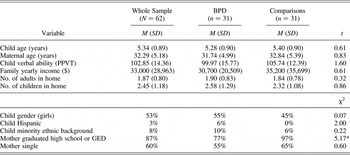
Children (N = 62) were sampled from a low socioeconomic background: children whose mothers had BPD (n = 31) and normative comparisons (n = 31). There were 29 boys and 33 girls, who were 92% Caucasian, 3% African American, 5% biracial, and 3% Hispanic. The children's average age was 5 years, 4 months (SD = 11 months, range = 4 years, 0 months to 6 years, 11 months). See Table 1 for tests of group differences on child age, child verbal ability, and demographic variables.
Demographic variables and child verbal ability by group

Note: BPD, Borderline personality disorder; PPVT, Peabody Picture Vocabulary Test.
*p < .05.
We recruited participants from a five-county region consisting of both urban and rural districts. Exclusionary criteria included inability to give informed consent or the presence of psychosis. We recruited mothers with BPD from two sources: clinicians in mental health settings and directly from the community using flyers. Clinicians included therapists, psychiatrists, nurse practitioners, and case managers. Clinicians learned about the study via presentations about BPD, newsletters, and continuing-education seminars. We provided clinicians with brochures to give to their clients. Questions on the BPD flyer included “Do you fear abandonment in relationships? Do you find it difficult to control your anger? Are you very impulsive? Do your relationships have extreme ups and downs? Have you hurt yourself or threatened to do so?”
We also recruited normative comparison participants from two sources: programs for children and directly from the community using flyers. Programs included preschools, Head Start, and Boys and Girls Clubs. Research assistants set up tables at the time children were dropped off or picked up. Mothers were handed brochures and invited to call if they were interested in participating. The flyers asked mothers if they had a child aged 4–7 and would like to take part in a study on child development.
Procedure and measures
Two research assistants went to the participant's home or a different meeting place requested by the participant. On this first visit, we obtained informed consent, maternal self-reports of Axis I and Axis II symptoms, and demographic information. We then invited the participant and her child to the university for an approximately 3-hr visit. We provided transportation for the family and babysitting for siblings. On this visit, we assessed maternal psychopathology and current stance toward childhood attachment with clinical interviews, and we filmed the mother and child solving puzzles together. In addition, we filmed children creating narratives by completing the beginnings of stories presented to them using props and family figures.
Demographics
Demographic information was collected with a maternal interview (MHFC, 1995). See Table 1 for details.
Psychiatric diagnoses
Axis 1 disorders
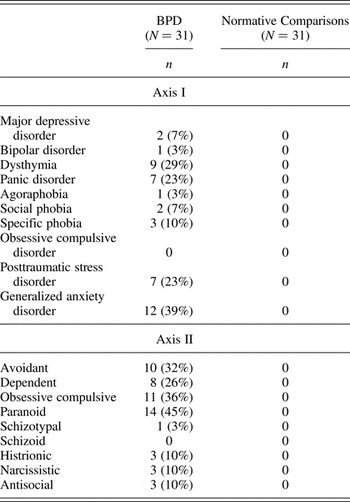
We assessed Axis I disorders first on the home visit with a preliminary self-report screen, and then with a structured clinical interview as control variables with a Structured Clinical Interview for DSM-IV Axis I Disorders (SCID-I; First, Gibbon, Spitzer, & Williams, Reference First, Gibbon, Spitzer and Williams1996). We assessed mood disorders (major depressive disorder, bipolar disorder, and dysthymia) and anxiety disorders (panic, agoraphobia, social phobia, specific phobia, obsessive–compulsive disorder, posttraumatic stress disorder, and generalized anxiety disorder). Validity for the DSM-IV version of the SCID-I has not been assessed, but for DSM-III-R it was adequate (Kranzler, Kadden, Babor, Tennen, & Rounsaville, Reference Kranzler, Kadden, Babor, Tennen and Rounsaville1996). Interrater reliability for the SCID-I is high (Lobbestael, Leurgans, & Arntz, Reference Lobbestael, Leurgans and Arntz2011). See Table 2 for Axis I disorders in the sample.
Current Axis I and II disorders

Note: BPD, Borderline personality disorder.
Axis II disorders
We assessed Axis II personality disorders first on the home visit with a preliminary self-report screen, and then with a Structured Clinical Interview for DSM-IV Axis II Disorders (First, Gibbon, Spitzer, Williams, & Benjamin, Reference First, Gibbon, Spitzer, Williams and Benjamin1997). We assessed BPD, avoidant, dependent, obsessive–compulsive, paranoid, schizotypal, histrionic, narcissistic, and antisocial personality disorders. Validity for this interview schedule is also high (Lobbestael et al., Reference Lobbestael, Leurgans and Arntz2011). See Table 2 for Axis II disorders in the sample.
Borderline features
We assessed borderline features with the Personality Assessment Inventory (Morey, Reference Morey1991). The Personality Assessment Inventory reflects the multifaceted nature of BPD revealed in factor analytic studies and has shown high internal consistency in census, college, and clinical samples (Morey, Reference Morey1991). There is a total borderline features scale (24 items) with four subscales (6 items on each) characteristic of individuals with BPD and used in the current study: affective instability, intense and unmodulated emotional experiences especially anger; identity disturbance, confusion about identity and lack of an integrated sense of self; negative relationships, acute dependence, fear of abandonment, and distrust; and self-harm, impulsivity and tendencies to hurt the self when distressed.
In the current sample, BPD diagnosis (yes/no) was significantly correlated with total borderline features (r = .83, p < .001), affective instability (r = .81, p < .001, identity disturbance (r = .80, p < .001), negative relationships (r = .72, p < .001), and self-harm (r = .66, p < .001). Internal consistency was assessed with Cronbach alpha (Cronbach, Reference Cronbach1951), where α > 0.90 is considered excellent, and α > 0.80 is very good. For total borderline features, α = 0.96; affective instability, α = 0.93; identity disturbance, α = 0.85; negative relationships, α = 0.88; and self-harm, α = 0.82.
Maternal adult attachment
We assessed mothers' recollections of their own childhood attachment with the AAI (George et al., Reference George, Kaplan and Main1984; Main & Goldwyn, Reference Main and Goldwyn1991, 2002). The AAI is a semistructured interview designed to assess current state of mind with respect to memories of childhood attachment relationships with caregivers. Both categorical classifications and continuous dimensions were used.
AAI classifications
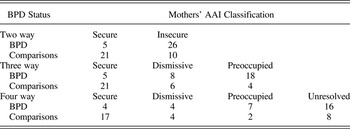
Classifications of state of mind with respect to childhood attachment include secure (autonomous, open, and coherent), preoccupied (angry or passive, and enmeshed), dismissive (derogating attachment), and unresolved (with regard to loss and/or abuse). See Table 3 for AAI classifications by group (N = 62).
Mothers' AAI classifications by group (N = 62)

Note: AAI, Adult Attachment Interview; BPD, borderline personality disorder.
AAI dimensions
A latent structure of the AAI that may better account for differences in the classifications was first assessed in a large normative sample (Roisman et al., Reference Roisman, Fraley and Belsky2007). It consists of two dimensions: one preoccupied/unresolved, the other dismissive. These factors were replicated with minor differences by Whipple and colleagues (Reference Whipple, Bernier and Mageau2011) in a smaller normative sample. In the current study, we included 12 state of mind variables in a principal components analysis: anger at father, anger at mother, passivity, unresolved loss, unresolved trauma, coherence of mind, fear of loss, idealization of father, idealization of mother, lack of recall, metacognitive monitoring, and derogation of attachment. Coherence of mind and metacognitive monitoring were reverse coded.
Following Whipple et al. (Reference Whipple, Bernier and Mageau2011), we used a larger sample (which included the current one) of 87 mothers, consisting of 44 who had BPD and 43 comparisons. Ninety-one percent of the additional mothers were mothers of adolescent-aged offspring. There were no significant differences between the current sample and the additional mothers on demographic variables (total family income, number of adults and children in the family, mothers who had a partner, or mothers with a high school education), except that the additional mothers were older because they were mothers of adolescents age 14–17 rather than children age 4–7. There were also no significant differences between the current sample and additional mothers on the 12 state of mind variables.
Mothers' current representations of their childhood attachment experiences were coded from transcripts by coders trained by June Sroufe and certified as reliable by Main and Hesse (Main et al., Reference Main, Goldwyn and Hesse2002). Reliabilities were assessed with percent agreement and with kappas to correct for chance agreement (Cohen, Reference Cohen1960), where κ > 0.70 is considered excellent, κ from 0.40 to 0.70 adequate, and κ < 0.40 poor. Reliability for 15% of the current sample (88% agreement on four-way primary classifications) was κ = 0.78. Reliability for 15% of the additional mothers (100% agreement on four-way primary classifications) was κ = 1.00. Disagreements were resolved by conferencing.
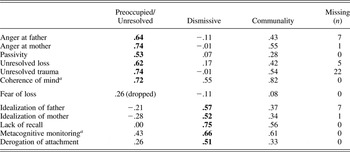
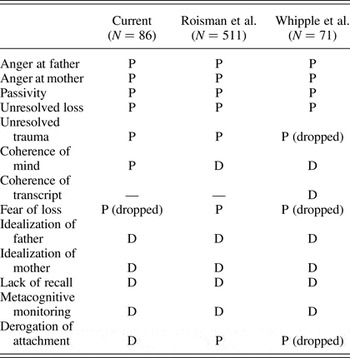
We conducted a principal components analysis with a varimax rotation in line with prior work on AAI dimensions (Roisman et al., Reference Roisman, Fraley and Belsky2007; Whipple et al., Reference Whipple, Bernier and Mageau2011). Pairwise deletion was used for data missing because some mothers grew up with no father, or no mother, or had not experienced a loss or trauma. See Table 4 for factor loadings, communalities, and missing data. See Table 5 for how loadings compare in this partially clinical sample with those found in Roisman et al.'s (2007) and Whipple et al.'s (2011) normative samples.
Factor loadings and communalities based on principal components analysis with varimax rotation for 12 variables from the Adult Attachment Interview (N = 87)

a Reverse coded.
Comparison of current, Roisman et al. (Reference Roisman, Fraley and Belsky2007), and Whipple et al. (Reference Whipple, Bernier and Mageau2011) preoccupied/unresolved (P) and dismissive (D) Adult Attachment Interview dimensions

Whipple et al. (Reference Whipple, Bernier and Mageau2011) found minor differences from Roisman et al. (Reference Roisman, Fraley and Belsky2007), and minor differences were again found in the current sample. Specifically, unlike in Roisman et al. (Reference Roisman, Fraley and Belsky2007), and Whipple et al. (Reference Whipple, Bernier and Mageau2011), but in line with Main et al. (Reference Main, Goldwyn and Hesse2002), derogation of attachment loaded on the dismissive factor in the current sample. Moreover, coherence of mind loaded on preoccupied/unresolved rather than on the dismissive dimension, and derogation of attachment loaded on the dismissive dimension rather than on the preoccupied/unresolved dimension (dropped by Whipple et al., Reference Whipple, Bernier and Mageau2011). Furthermore, fear of loss was dropped (also dropped by Whipple et al., Reference Whipple, Bernier and Mageau2011) because the loading was 0.26, where less than 0.32 is considered very poor (Comrey & Lee, Reference Comrey and Lee1992), and because the communality (proportion of variance in fear of loss accounted for by the factors) was only 0.07.
The preoccupied/unresolved dimension explained 28% of the variance in AAI scores, and the dismissive dimension explained 16%. For the preoccupied/unresolved dimension, M = 3.26, SD = 1.34, skewness = 0.68, kurtosis = 0.44, and α = 0.78. For the dismissive dimension, M = 3.78, SD = 1.08, skewness = 0.60, kurtosis = 0.45, and α = 0.57. The correlation between the two dimensions was r = .24 (p < .05).
We created preoccupied/unresolved and dismissive dimensions by taking the mean of the variables that loaded onto each. Variables included in the preoccupied/unresolved dimension were anger at father, anger at mother, passivity, unresolved loss, unresolved trauma, and coherence of mind (reverse scored). Variables included in the dismissive dimension were derogation of attachment, lack of recall, meta-cognition (reverse scored), idealization of father, and idealization of mother. Reliability was also calculated on the state of mind dimensions using intraclass correlation coefficients (Winer, Brown, & Michels, Reference Winer, Brown and Michels1991), where r i > .75 is considered excellent, r i from .40 to .75 adequate, and r i < .40 poor. In the current sample, for the preoccupied/unresolved dimension, r i = .78, and for the dismissive dimension r i = .55. In the sample of additional mothers, for the preoccupied/unresolved dimension, r i = .79, and for the dismissive dimension, r i = .87.
Mother–child interaction
The mother and her child were videotaped during a 10-min puzzle-solving session. Puzzles were presented one at a time in order of increasing difficulty, the next one presented when the previous one was completed. The mother and child were seated at a child-sized table. Mothers were told: “This puzzle is for your child to complete, but feel free to give any help you think your child might need.”
Maternal and child variables were coded from videotapes utilizing the Qualitative Ratings of Parent/Child Interaction at 58 months (Cox, Reference Cox1997), which includes adaptations from scales developed by Margaret Tresch Owen and Deborah Vandell for the NICHD Study of Early Child Care, by L. Alan Sroufe and colleagues for the Mother–Child Project at the University of Minnesota (Sroufe, Jacobvitz, Mangelsdorf, DeAngelo, & Ward, Reference Sroufe, Jacobvitz, Mangelsdorf, DeAngelo and Ward1985), and by Karlen Lyons-Ruth and Elisa Bronfman for the coding of frightened/disoriented maternal behavior (Lyons-Ruth, Bronfman, & Parsons, Reference Lyons-Ruth, Bronfman and Parsons1999). Descriptions of the scales are given below. All codes are 7-point scales, with scores of 1 indicating that the category is not at all indicative of the observed mother–child interaction, and scores of 7 indicating that the variable is highly characteristic of the observed interaction. Intermediate scores are also given. Three maternal variables were used in the current study.
Maternal sensitivity refers to the provision of emotional support and the mother's responsiveness to the child's needs and cues. It includes maternal behaviors such as acknowledging the child's accomplishments; praising the child; being reassuring, calm, and encouraging when the child is experiencing difficulties with the task; and providing an affectively positive “secure base” for the child.
Maternal autonomy support reflects the degree to which the mother acts in a way that recognizes and respects the validity of the child's individuality, motives, and perspectives. High autonomy support reflects the ability to acknowledge the validity of the child's perspective and to use this information to negotiate interactions without being intrusive.
Maternal hostility toward the child refers to the frequency and intensity of negative affect toward the child including disapproval, abruptness, harshness, and tense body or facial expressions. Hostile maternal behaviors include both instances of punitive aggression (e.g., hitting the child) and/or a pervasive display of anger, distrust, frustration, impatience, or general dislike.
Mothers' parenting was coded from videotapes by a coder trained to reliability on the current sample by Cindy Frosch, an expert coder. Reliability was assessed with intraclass correlation coefficients on 20% of the sample (Winer et al., Reference Winer, Brown and Michels1991). For maternal sensitivity, r i = .84, maternal autonomy support, r i = .88, and maternal hostility, r i = .73. Codings were conducted ignorant of group status and independently of the administration and coding of children's narratives.
Maternal sensitivity was significantly correlated with maternal autonomy support (r = .86, p < .001) and with maternal hostility (r = –.69, p <.001), and maternal hostility was significantly correlated with maternal autonomy support (r = –.61, p < .001). We therefore created a maternal parenting composite by summing maternal sensitivity and autonomy support, and subtracting hostility.
Narratives
Eliciting narratives
An examiner told the beginnings of stories, one at a time, to each child individually, moving figures and props around as though in a play. We matched the ethnic background and gender of the child with those of family figures. The examiner then asked the child to complete the stories in the same way: “Show me and tell me what happens now.” An initial story about a birthday party, not included in coding or analyses, was used to familiarize the child with the procedure. The examiner always administered the narrative stems in the same order in a session lasting approximately 30 min. We filmed the session through a one-way mirror. The child completed 10 story-stems (Bretherton, Oppenheim, et al., 1990; Bretherton, Ridgeway, et al., 1990). Resulting narratives were then coded.
Coding narratives
Narrative emotion coding (Warren, Mantz-Simmons, & Emde, Reference Warren, Mantz-Simmons and Emde1993) was used to code fear of abandonment, role reversal, and destruction of objects. The Narrative Coding Manual, Rochester version (Robinson, Mantz-Simmons, Macfie, & the MacArthur Narrative Group, 1996) was used for incongruent child and self/fantasy confusion. The Narrative Coding Manual (Bickham & Fiese, Reference Bickham and Fiese1999) was used to code mother–child relationship expectations. Both child verbalizations and behavioral enactments were included in coding directly from videotapes.
Fear of abandonment describes narratives in which a loss is resolved or attempted to be resolved immediately (e.g., when presented with the departure story in which mother and father leave the children with grandma for a weekend to go on a trip, the participant insists that the parents change their mind and stay home or take the children with them instead). Role reversal is coded in narratives in which, for example, the child tells fighting parents to “Stop that! Go to your room!” Incongruent child is coded when, for example, a child cleans up his room then trashes it. Self/fantasy confusion describes narratives in which the child participant confuses himself with the characters in the story and insists that he or she get a Band-Aid for the child figure, rather than have one of the story characters get it. Destruction of objects refers to objects that are verbalized as being destroyed, ruined, or broken by the participant within a narrative, for example, plates being thrown across the room and smashed. Mother–child relationship expectations were coded on a 5-point scale. A score of 1 reflects the parent–child relationship is almost always portrayed as dissatisfying, dangerous, and/or unpredictable, with serious and/or willful harm portrayed. A score of 5 reflects the parent–child relationship is consistently portrayed as safe, reliable, rewarding, and fulfilling, and the relationship provides opportunities for success and satisfaction. Intermediate scores were also given.
Scoring
Presence or absence of the above codes (except mother–child relationship expectations) was scored once for each narrative and then summed across the 10 narratives, giving a possible minimum of 0 and maximum of 10 for each code. Mother–child relationship expectations were scored once across all 10 narratives.
Reliability
The narratives were coded by one of the authors of the Narrative Coding Manual (Robinson et al., Reference Robinson, Mantz-Simmons and Macfie1996). Reliability with an additional coder, trained by the first, was assessed on 25% of the sample. Reliability was conducted at the level of each individual narrative rather than summing across narratives. Categorical codes were assessed with kappas: fear of abandonment, κ = 0.69; role reversal, κ = 0.67; incongruent child, κ = 0.66; self/fantasy boundary confusion, κ = 0.76; and destruction of objects, κ = 1.00. A continuous code was assessed with intraclass correlation coefficients (Winer et al., Reference Winer, Brown and Michels1991): mother–child relationship expectations (r i = .74). Codings were conducted ignorant of group status and independently of the administration and coding of mothers' parenting.
Verbal ability
Because the quality of narratives may depend in part on the child's verbal ability, receptive language was assessed with the Peabody Picture Vocabulary Test (Dunn & Dunn, Reference Dunn and Dunn1997) as a possible control variable. Standard scores were calculated for each child.
Results
Preliminary analyses
Before testing hypotheses, we tested for possible covariates. There was a significant difference between the BPD and normative comparison groups such that mothers with BPD were less likely to have completed high school. We therefore controlled for maternal education in subsequent analyses. See Table 1 for means, standard deviations, and significance tests. Because of widespread comorbidity of BPD with both Axis I and Axis II disorders noted above, we also controlled for current mood, anxiety, and other personality disorders when conducting tests of group differences.
Hypothesis testing
AAI and BPD
Our first hypothesis examined group differences in categorical AAI classifications with chi square analyses. Consistent with prior work (Patrick et al., Reference Patrick, Hobson, Castle, Howard and Maughan1994), mothers with BPD were significantly more likely to be insecure than were normative comparisons in a two-way (secure vs. insecure) classification, χ2 (1, N = 62) = 16.96, p < .001. There were also significant group differences in three-way (secure, preoccupied, and dismissive), χ2 (2, N = 62) = 19.04, p < .001, and four-way (secure, preoccupied, dismissive, and unresolved), χ2 (3, N = 62) = 13.49, p < .01, classifications. Follow-up tests revealed that mothers in the BPD group were more likely to be classified as preoccupied in three-way, χ2 (1, N = 62) = 13.81, p < .001, and unresolved in four-way, χ2 (1, N = 62) = 4.35, p < .05, classifications than were comparisons.
For our second hypothesis, we tested group differences on the continuous AAI preoccupied/unresolved and dismissive dimensions with two analyses of covariance, controlling for current mood, anxiety, other personality disorders, and maternal education. As hypothesized, mothers with BPD scored significantly higher on the preoccupied/unresolved dimension (M = 4.18, SD = 1.36) than did normative comparisons (M = 2.46, SD = 1.14), F (1, 42) = 6.35, p < .05, η2 = 0.14. There was no significant difference between mothers with BPD (M = 3.97, SD = 1.24) and normative comparisons (M = 3.54, SD = 0.99) on the dismissive dimension, F (1, 42) = 1.93, p > .10, η2 = 0.03.
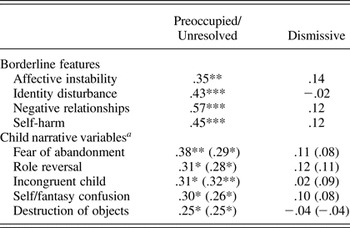
For our third hypothesis, associations between AAI dimensions and self-reported borderline features in the sample as a whole were tested with Pearson bivariate correlations. As hypothesized, the preoccupied/unresolved dimension was significantly correlated with all borderline features (affective instability, identity disturbance, negative relationships and self-harm). The dismissive dimension was not significantly correlated with any of the borderline features. See Table 6 for correlation coefficients.
Correlations between Adult Attachment Interview dimensions and borderline features and children's narrative variables (N = 62)

a The coefficients in parentheses are partial correlations, controlling for total borderline features.
*p ≤ .05. **p ≤ .01. ***p < .001.
AAI and children's narratives
We next conducted Pearson bivariate correlations to test our fourth hypothesis: that child narrative variables would be significantly associated with the AAI dimensions. As predicted, fear of abandonment, role reversal, self/fantasy confusion, incongruent child, and destruction of objects were each significantly correlated with the preoccupied/unresolved dimension but not with the dismissive dimension. In order to test whether the correlations depended entirely on the bivariate nature of clinical status, we also conducted the same correlations controlling for total borderline features. Significance remained the same, suggesting a robust finding for the relationship between unresolved/disorganized attachment and children's narrative variables. See Table 6 for correlation coefficients.
Maternal parenting and children's narratives
We tested our fifth hypothesis: that the narrative representation of mother–child relationship expectations would be correlated with maternal parenting coded from a mother–child puzzle-solving interaction. They were significantly correlated with each other (r = .44, p < .001).
Mediation of maternal parenting between mothers' AAIs and children's narratives
Finally, we tested our sixth hypothesis: that maternal parenting would mediate the relationship between mothers' AAI preoccupied/unresolved dimension and children's narrative representations related to attachment. The traditional Baron and Kenny (Reference Baron and Kenny1986) method of testing causal steps is now thought to be unduly restrictive with respect to assumptions of normal distributions, low statistical power, and absence of a test of the significance of the indirect effect (Hayes, Reference Hayes2009; MacKinnon, Lockwood, Hoffman, West, & Sheets, Reference MacKinnon, Lockwood, Hoffman, West and Sheets2002). Preacher and Hayes's (Reference Preacher and Hayes2004) bootstrapping method, in contrast, has more power, is therefore useful with small sample sizes, does not assume normal distributions, tests the significance of indirect effects, and provides confidence intervals. Preacher and Hayes's macro was used to bootstrap 5,000 resamples from the current data set (Preacher & Hayes, Reference Preacher and Hayes2004).
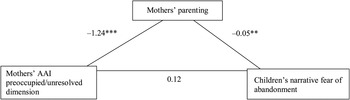
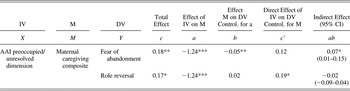
There was a significant effect for the mediating role of maternal parenting between mothers' AAI preoccupied/unresolved composite and fear of abandonment in their children's narrative representations, but there was no significant effect for role reversal. See Figure 1 for the model with fear of abandonment, and see Table 7 for unstandardized path coefficients.
Parenting mediates between mothers' preoccupied/unresolved Adult Attachment Interview (AAI) dimension and their children's narrative representations of fear of abandonment (unstandardized B coefficients).

Mediation of maternal caregiving composite between maternal Adult Attachment Interview preoccupied/unresolved dimension and child narrative representations (N = 62)

Note: IV, Independent variable; M, mediating variable; DV, dependent variable. Unstandardized B coefficients are shown.
* p ≤ .05. **p ≤ .01. ***p < .001.
Discussion
We found that mothers with BPD were significantly more likely than were normative comparisons to be classified as insecure in two-way, preoccupied in three-way, and unresolved on four-way classifications on the AAI, replicating prior research (Bakermans-Kranenburg & van IJzendoorn, Reference Bakermans-Kranenburg and van IJzendoorn2009; Patrick et al., Reference Patrick, Hobson, Castle, Howard and Maughan1994). This pattern appears to be particular to BPD. In a meta-analysis of AAIs, depression was associated with insecure attachment but not with unresolved; posttraumatic stress disorder was associated with unresolved attachment alone; antisocial personality disorder was associated with both dismissive and preoccupied attachment; and BPD was associated with both preoccupied and unresolved as found here (Bakerman-Kranenberg & van IJzendoorn, Reference Bakermans-Kranenburg and van IJzendoorn2009). We then conducted principal components analysis in a larger sample, which included the current one. We derived two continuous AAI dimensions originally identified in normative samples: preoccupied/unresolved and dismissive (Roisman et al., Reference Roisman, Fraley and Belsky2007; Whipple et al., Reference Whipple, Bernier and Mageau2011). As predicted, controlling for Axis I mood and anxiety disorders and other Axis II personality disorders, mothers with BPD were significantly more likely to be preoccupied/unresolved than were normative comparisons, but they were not more likely to be dismissive.
Parallel with examining the AAI categorically and continuously, we also examined BPD as a categorical diagnosis and as self-reported borderline features along a continuum. In the sample as a whole, mothers' borderline features (affective instability, identity disturbance, and self-harm) were significantly correlated with the preoccupied/unresolved dimension but not with the dismissive dimension. Both the preoccupied and unresolved classifications, and the preoccupied/unresolved dimension thus appear to characterize those with BPD or borderline features better than does the dismissive classification or dimension. Being distracted by and engrossed in memories of difficult childhood experiences and being unable to resolve experiences of loss and abuse may in part underlie the development of BPD, and also impact the development of offspring. A history of loss and abuse may lead to a current preoccupation with attachment in terms of, for example, fear of abandonment and angry outbursts characteristic of the unresolved/preoccupied up-regulation of the attachment system. In contrast, a dismissive down-regulation of the attachment system when an individual is not able or willing to remember and talk about attachment relationships and dismisses attachment as unimportant is not characteristic of BPD.
We then examined the relationship between mothers' AAI representations and their children's narrative representations in domains of child development that have conceptual similarity to domains of dysfunction in BPD: attachment (fear of abandonment and role reversal), self-development (incongruent child and self/fantasy confusion), and self-regulation (destruction of objects). As expected, the children's narrative representations in each domain were significantly correlated with their mothers' preoccupied/unresolved AAI dimension but not with the dismissive dimension. These narrative representations may in turn make the future development of BPD more likely.
We also found that mothers' observed parenting was significantly correlated with their children's narrative representations of mother–child relationship expectations. This provides support for the intergenerational transmission of internal working models and additional validity for the narrative story-stem completion measure as reflecting children's actual experience.
Finally, as hypothesized, mothers' parenting significantly mediated the relationship between mothers' preoccupied/unresolved dimension on the AAI and their children's narrative representations of fear of abandonment. Mother's anger associated with preoccupation with her difficult childhood experiences, and a lack of resolution of losses and abuse suffered, may affect her ability to be sensitive, supportive of autonomy, and not hostile in parenting her child, thus contributing to the child's own fear of abandonment. However, there was no meditational effect for parenting in the relationship between mothers' preoccupied/unresolved dimension and role reversal. Other aspects of parenting, such as the mother's observed role reversal with her child, may mediate the relationship with role reversal instead.
The conceptual similarity between domains of early childhood (attachment, self-development, and self-regulation) and domains of dysfunction in BPD was evident at the level of representation. Internal working models may be carried forward from mother to child and possibly influence the development of BPD in early adulthood. These pathways may be characterized by either homotypic or heterotypic continuity (Sroufe & Jacobvitz, Reference Sroufe and Jacobvitz1989). Examples of homotypic continuity include an incongruent sense of self, anger, and dissociation, which may each be carried forward unchanged via internal working models to adolescence or young adulthood. Examples of heterotypic continuity include fear of abandonment, which may underlie symptoms that develop only in adolescence or young adulthood: suicidal behavior, drug and alcohol abuse, and other impulsive and self-harming behaviors.
However, internal working models are only one possible factor in the etiology of BPD. Pathways to BPD are also thought to include temperamental variables (Siever & Davis, Reference Siever and Davis1991). The heritability estimate for BPD is high (Torgersen et al., Reference Torgersen, Lygren, Oien, Skre, Onstad and Edvardsen2000). Moreover, negative experiences beyond early childhood such as loss and maltreatment may also contribute to the development of BPD (Liotti & Pasquini, Reference Liotti and Pasquini2000; van der Kolk, Hoestetler, Herron, & Fisler, Reference van der Kolk, Hoestetler, Herron and Fisler1994; Weaver & Clum, Reference Weaver and Clum1993; Zanarini, Reference Zanarini2000), together with dimensions of parenting assessed in adolescence such as intrusiveness and inconsistency (Bezirganian, Cohen, & Brook, Reference Bezirganian, Cohen and Brook1993).
Implications for preventive interventions from the present study may include interventions designed to change both parents' and children's representational models of attachment. Dyadic child–parent psychotherapy is an attachment-based intervention that conceptualizes problems in the parent–child relationship as stemming from the parent's insecure representations from childhood, and from the child's current maladaptive representations (Lieberman, Reference Lieberman1992; Lieberman & VanHorn, Reference Lieberman and VanHorn2005). A mother, for example, and her young child together meet with the therapist. The goal is for the mother to learn more about her own past and how it affects her current understanding of her child. By separating her history from the present, she can begin to understand her child's feelings, beliefs, and needs, so that the mother–child relationship becomes a greater source of security to the child, and the child's representations change for the better. Child–parent psychotherapy led to an increase in attachment security in depressed mother–toddler pairs (Cicchetti, Toth, & Rogosch, Reference Cicchetti, Toth and Rogosch1999) and an increase in positive, and a decrease in negative, narrative representations in maltreated children (Toth, Maughan, Manly, Spagnola, & Cicchetti, Reference Toth, Maughan, Manly, Spagnola and Cicchetti2002). Both a mother with BPD and her child may therefore benefit, and development for both may return to a more adaptive pathway.
Strengths of the study include independent coding of mothers' representations, mothers' parenting, and their children's representations, without depending on self-report questionnaires or on the same respondent for more than one measure. Moreover, relative to other studies of offspring of women with BPD of children in the same developmental period, the sample size was large. Furthermore, when conducting group differences, we controlled for mood, anxiety, and other personality disorders, which might otherwise obscure the effect of BPD. In addition, we assessed mothers' AAI representations and BPD both categorically and dimensionally, giving us more power statistically to examine relationships among BPD, the AAI, parenting, and children's narratives.
Limitations include a cross-sectional design. Causal relationships assessed longitudinally between mothers' AAI representations, parenting, and children's representations, and the development of BPD in adolescence or early adulthood could not be assessed. In addition, although we were able to replicate dimensions found in normative samples with minor changes (there also being minor differences between the two normative studies), there needs to be replication of the dimensions in other clinical samples including other samples of women with BPD. Moreover, only a small percentage of mothers with BPD were diagnosed with current major depressive disorder, unlike the large percentage found in inpatient samples assessed at intake (Zanarini et al., Reference Zanarini, Frankenburg, Dubo, Sickel, Trikha and Levin1998a). Some mothers were already receiving treatment, having been referred by their clinicians, and depression may in part have been resolved. In future studies, a continuous self-report measure of depression would better account for the part played by depression than did a categorical diagnosis. The addition of a clinical sample would strengthen findings as pertaining only to BPD, beyond controlling for mood, anxiety, and other personality disorders, as in the current study. Null findings with respect to the dismissive dimension may reflect lack of power owing to sample size and need replication in a larger sample. Finally, the range of socioeconomic status was limited, mostly excluding middle class, and few participants were from minority ethnic backgrounds, limiting generalizability.
There needs to be longitudinal study of children of mothers with BPD to examine the development of BPD over time. Carlson, Egeland, and Sroufe (Reference Carlson, Egeland and Sroufe2009) followed an at-risk sample of offspring of mothers living in poverty from before birth. They found that symptoms of BPD at age 28 were associated with factors including disorganized attachment in infancy, maternal hostility, and mother–child role reversal in the preschool period, narrative representations of self in middle childhood, and parent–child relationship disturbance in early adolescence. Furthermore, the narrative representations of self mediated the relationship between attachment disorganization and BPD symptoms (Carlson et al., Reference Carlson, Egeland and Sroufe2009). However, only 2% of the sample had developed enough symptoms to receive a BPD diagnosis (Elizabeth Carlson, personal communication, August 8, 2010). The advantage of a longitudinal study of offspring of women with BPD is that it would likely yield a higher percentage of those actually developing the disorder. In this way, precursors and processes underlying their development in interaction with developmental tasks would become clear. This would in turn inform preventive interventions.
Conclusion
BPD is an excellent disorder to study from a developmental psychopathology perspective because of the similarity of domains affected to those of early childhood developmental tasks. In the present study, we found significant relationships between the AAI in mothers with BPD, their parenting, and their children's narratives. This is the first time that relationships among all three constructs have been examined in any sample. Findings shed light on the possible intergenerational transmission of internal working models of attachment, self, and self-regulation. If individuals internalize both sides of a relationship (Sroufe & Fleeson, Reference Sroufe, Fleeson, Hartup and Rubin1986, Reference Sroufe, Fleeson, Hinde and Stevenson-Hinde1988), these representations may make the development of BPD more likely. Moreover, in intervening to try to change these representations with both mothers and children, we would also be able to further test our theories about the development of the disorder (Cowan & Cowan, Reference Cowan and Cowan2002). Internalized representations developed during childhood may be influential in determining how adults behave in relationships, how they understand themselves, and how well they are able to regulate their behavior and emotions (Young, Reference Young1990). Individuals with BPD and their offspring are an ideal population for further exploration of these pathways.