INTRODUCTION
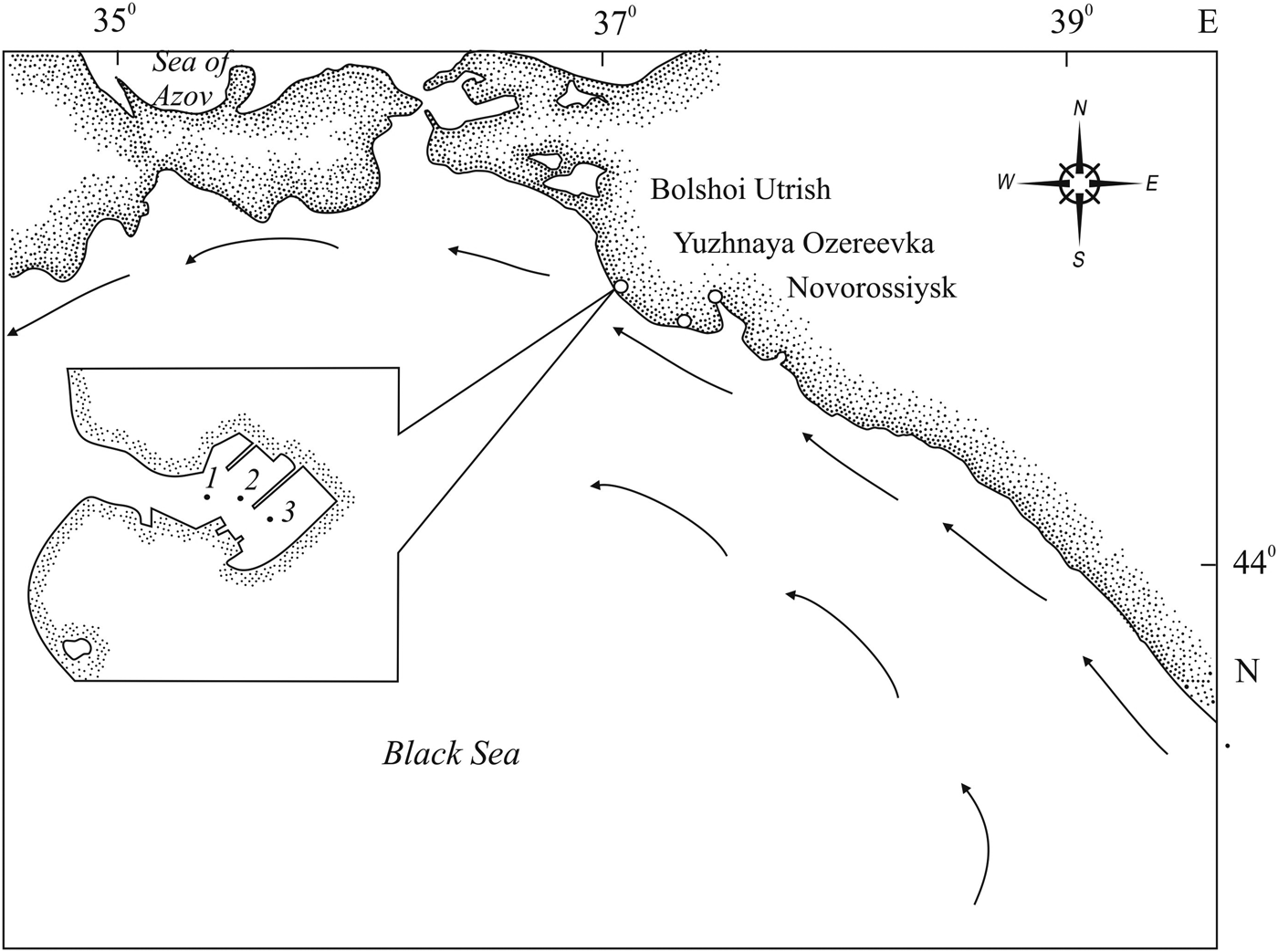
The Liman ‘Zmeinoe Ozero’ (Snake Lake) is situated in the NE part of the Black Sea, north of the cape of Bolshoi Utrish (Big Utrish) and NW of oil terminal ‘KTK-R’ (Caspian Pipeline Consortium), settlement Yuzhnaya Ozereevka (South Ozereevka) (Figure 1). It is a small (area about 0.02 km2, depth 8 m) shallow marine basin with salinity of 13–18%. In the 1960s the freshwater Zmeinoe Ozero, supplied with fresh water by underground sources, was connected with the sea by an artificially dredged channel. This created a convenient bay used by fishing vessels and yachts for calling and mooring up to the present day. In recent years, the basic source of anthropogenic sea invasions is transportation of alien organisms with ships' ballast water (Selifonova, Reference Selifonova2012; Shiganova et al., Reference Shiganova, Musaeva, Lukasheva, Stupnikova, Zasko, Anokhina, Sivkovich, Gagarin and Bulgakova2012). Due to physio-geographic and ecological peculiarities the Liman ‘Zmeinoe Ozero’ may be a reservoir-recipient for successful naturalization of alien species that are transported with ships' ballast water. Two portable berthing constructions of the terminal ‘KTK-R’ are located 4 and 5 km from the coast. Their traffic-carrying capacity is 35 million tonnes of oil products per year (29% of cargo transportation volume in the Novorossiysk port). In the waters of Liman the numbers of a recent invader, the cyclopoid copepod Oithona davisae Ferrari, Orsi in September 2010 reached the maximum values of density for the north-east shelf (Selifonova, Reference Selifonova2011a). Two species of spionid polychaetes new for this region have been revealed in benthic sediments (Radashevsky & Selifonova, Reference Radashevsky and Selifonova2013). Since 2004 in the Novorossiysk Bay there has been monitoring of biological invasions and of ships' ballast water (Selifonova, Reference Selifonova and Matishov2010, Reference Selifonova2012). In waters adjacent to the oil terminal ‘KTK-R’ such studies have never been undertaken.
Locations of stations in the Liman ‘Zmeinoe Ozero’.

The purpose of this paper was to study taxonomic composition of the biological community, to analyse the structurally functional characteristics of the ecosystem of the Liman ‘Zmeinoe Ozero’ and to define the degree of its vulnerability to invasions of alien organisms.
MATERIALS AND METHODS
We used samples of phytoplankton, bacterioplankton, ciliates, holoplankton, meroplankton and zoobenthos of loose sediments collected in the expeditions of the Southern Branch of the Institute of Oceanology, Russian Academy of Sciences in the Liman ‘Zmeinoe Ozero’ from September 2010 to November 2011. The samples were collected once in a season according to the location of stations (Figure 1).
Phytoplankton samples were preserved by neutral formalin to a final concentration of 1% and were processed by common methods (Sorokin, Reference Sorokin1979). Species identification was made according to Dodge (Reference Dodge1982) and Carmelo (Reference Carmelo1997). The bacterioplankton and ciliates were determined in the samples collected from the near surface water layer. Non-concentrated samples of bacterioplankton were preserved by glutaraldehyde up to a final concentration of 1%. The samples were processed using epifluorescent microscopy on the black nuclear filters (pore diameter 0.17–0.4 µm) with acridine orange as fluorochrom (Hobbie et al., Reference Hobbie, Dadey and Jasper1977). The larger fraction of ciliates and rotifers were counted in untreated water samples in glass chambers of 15 ml capacity, according to Sorokin (Reference Sorokin1980). Identification of ciliates was made in vivo and temporal preparations according to Kurilov (Reference Kurilov2010). The volumes of bacterial cells and ciliates were determined based on formulae of geometric similarity. The holoplankton and meroplankton were sampled in total by a medium-size Juday net (25/35) with a gauze (120 µm mesh size) filtering cone. The samples were preserved by neutral formalin to a final concentration of 2–4%. To calculate the biomass values, Petipa tables were used (Petipa, Reference Petipa1957). In the present study the recalculation coefficient of 2 was applied for Juday net undercatches (Shushkina & Vinogradov, Reference Shushkina, Vinogradov, Zatsepin and Flint2002). Samples of zoobenthos of loose sediments were taken with a Petersen sampler of aperture 0.04 m2 (Abakumov, Reference Abakumov1983).
In order to evaluate the functional roles of major components of the ecosystem in the Liman, identify anthropogenic transformation and the degree of its vulnerability to invasions of alien organisms, we made calculations of tentative energy balances of food consumption and utilization according to Sorokin (Reference Sorokin1982, Reference Sorokin1999). These values were then used to construct energy flow model between communities and environments, taking into account both the energy of allochthonous organic matter and losses of organic matter (OM) due to sedimentation. The necessary coefficients of specific production per day (P/B), efficiency of use of assimilated food for growth (K 2), assimilability of consumed food (I), and caloric equivalents of the wet biomass of major components of ecosystem were acquired from the literature (Table 1).
The energy balance of main components of the Liman ‘Zmeinoe Ozero’ ecosystem in the late summer – early autumn; Elements of energy balance: B, biomass; P, production; A, assimilated food; FR, food ration; M i, metabolic losses (respiration); E, unassimilated food; Mt, integral respiration of whole biological community calculated as ∑M i; Coefficients (*) for energy balance calculations according to Sorokin (Reference Sorokin1982), Zaika (Reference Zaika1983), Grese (Reference Grese1979), Vinogradov & Shushkina (Reference Vinogradov and Shushkina1987).
RESULTS
A total of 12 non-native species were recorded in the Liman ‘Zmeinoe Ozero’ (5 – Tintinnidae, 5 – Copepoda, 2 – Polychaeta). Among alien species of fauna were recorded established species – Tintinnopsis directa Hada, Tintinnopsis tocantinensis Kof., Camp. (Ciliophora: Codonellidae); Amphorellopsis acuta (Schmidt) (Ciliophora: Tintinnidae); Oithona davisae Ferrari, Orsi (Copepoda: Cyclopoida); Streblospio gynobranchiata Rice & Levin, Polydora cornuta Bosc. (Polychaeta: Spionidae); cryptogenic species – Eutintinnus tubulosus Kof. Camp., Salpingella sp. (Ciliophora: Tintinnidae); and casual species – Labidocera pavo Giesbr., Clausocalanus arcuicornis (Dana), Сentropages kroyeri (Giesbr.), Acartia teclae Bradford (Copepoda: Calanoida). Status of non-native species is defined according to Zenetos et al. (Reference Zenetos, Çinar, Pancuccipapadopoulou, Harmelin, Furnari, Andaloro, Bellou, Streftaris and Zibrowius2005).
Phytoplankton
Thirty-four taxonomic forms of planktonic algae were identified (Bacillariophyceae – 19, Dinophyceae – 11, Coccolithophyceae – 1, Euglenophyceae – 1, Cyanophyceae – 2). Results of phytoplankton quantification are given in Table 2. Average abundance and diatom algae biomass comprised 71–79% of the total number of phytoplankton, dinophytes – 18–22%. Pseudo-nitzschia pseudodelicatissima (Hasle) Hasle, Skeletonema costatum (Grev.) Cl., Chaetoceros curvisetus Cl., Thalassionema nitzschioides (Grun.) Grun. ex Hustedt. were represented in the total phytoplankton abundance, and Dactyliosolen fragilissimus (Bergon) Hasle, Proboscia alata (Brightwell) Sundstrom., Pseudosolenia calcar-avis (Schultze) in the total phytoplankton biomass. Among the phytoplankton species recorded, diatom species new to the region were Chaetoceros tortissimus Gran and Asterionellopsis glacialis (Castr.) Round. These species were found in area the cape of Bolshoi Utrish in 2001–2002 (Vershinin et al., Reference Vershinin, Moruchkov, Sukhanova, Kamnev, Pan'kov, Morton and Ramsdell2004). By authors' data, in August and September C. tortissimus dominated in this area, comprising 85% of the total abundance of phytoplankton. In August 2011 the density of C. tortissimus in the Liman ‘Zmeinoe Ozero’ reached 17 400 cells l−1 (19.7% of the total phytoplankton abundance). During the same time period, the cells of the potentially toxic algae of the genus Alexandrium were found. In the middle of November, its abundance increased to 1280 cells l−1. In November 2011, a new species of diatom A. glacialis was recorded in the Liman (20 500 cells l−1, or 45.5% of the total abundance of diatoms). The diatom A. glacialis was first found in the Novorossiysk Bay in the late 1990s (Yasakova, Reference Yasakova2011), and in the open north-eastern Black Sea-in October–November 2001 (Vershinin & Moruchkov, Reference Vershinin and Moruchkov2003).
Numerical abundance (N, cells, ind. m−3) and biomass (B, g m−3) of main components of the Liman ‘Zmeinoe Ozero’ ecosystem.
Heterotrophic bacterioplankton
The average numerical abundance of bacterioplankton was 2.1 × 10⁶ cells ml−1 and its biomass 0.46 g m−3. Single cells were negligible, the share of bacteria in microcolonies and particles of detritus equalled 71.5% of total number. The highest density of bacteria was found in August–September at 3.1–4.78 × 10⁶ cells ml−1, biomass 0.64–0.85 g m−3. According to Sorokin (Reference Sorokin1996) its numbers in the Liman reached those of the upper level of eutrophic waters.
Ciliates
Forty taxonomic forms of planktonic ciliates were identified, including 14 tintinnids. Aloricated infusorians reached 75–92% of the total number of ciliates. Holophrya pelagica (Lohm.), Lohmaniella oviformis Leeg., S. сonicoides (Leegaard) Kahl, Pelagostrobilidium spirale (Leegaard) Petz, Song & Wilbert, Myrionecta rubra (Lohm.),S. vestitum (Leegaard) Kahl, Urotricha pelagica Kahl, Uronema marina Duj. dominated. Tintinnids comprised 15% of the total abundance of ciliates. Among tintinnids, Favella ehrenbergii (Cl. et Lach.), Tintinnopsis tubulosa (Levand.), T. minuta Wailes, T. directa Hada, T. tocantinensis Kof., Camp., Amphorellopsis acuta (Schmidt) were abundant. New species of tintinnids Tintinnopsis directa, T. tocantinensis, Eutintinnus tubulosus (Ostenfeld) Kof. Camp., Amphorellopsis acuta, Salpingella sp. were recorded in summer and autumn. Maximum abundance of T. tocantinensis reached 2.1 × 10⁶ ind. m−3, T. directa – 1.3 × 10⁶ ind. m−3, A. acuta – 0.9 × 10⁶ ind. m−3, E. tubulosus – 0.4 × 10⁶ ind. m−3, Salpingella sp. – 0.4 × 10⁶ ind. m−3. Density of non-native tintinnids in the Liman was a record for coastal waters of the north-east shelf (at 2–8 times as much as in the water area of the Port of Novorossiysk).
In recent times, in the Black Sea eight alien tintinnids species relating to four genera have been recorded – Eutintinnus lususundae Entz.; E. tubulosus; E. apertus Kof., Campb.; Salpingella decurlata Jorgensen; Tintinnopsis directa; T. nudicauda Paulmer (Gavrilova, Reference Gavrilova and Matishov2010); Amphorellopsis acuta, Tintinnopsis tocantinensis (Selifonova, Reference Selifonova2011b, Reference Selifonovac). Seventy-seven per cent of tintinnids species inhabiting the Black Sea are of Mediterranean origin (Gavrilova & Dolan, Reference Gavrilova and Dolan2007). Alien tintinnids species are annually recorded in water areas of the large seaports of Novorossiysk, Tuapse and Sevastopol. Some of them appear episodically, and others, for example E. lususundae, E. tubulosus and T. directa, reach high numbers in different years, excluding the native species. In the Novorossiysk Bay the maximum share of alien tintinnids can reach 40% of total density of ciliates in a warm season (Selifonova, Reference Selifonova2012).
Holoplankton
Twenty taxonomic forms of mesoplanktonic animal were identified, among which Noctiluca – 1, Rotifera – 1, Chaethognata – 1, Appendicularia – 1, Copepoda – 16. The average holoplankton density was 17.4 × 10³ ind. m−3, biomass 0.17 g m−3. It comprised 95–100% of the total zooplankton density. During the period of investigation, except May, copepods reached 85–99.6% of the total holoplankton abundance. A significant density of holoplankton, up to 27.0 × 10³ ind. m−3, was recorded in September. Numerically, small cyclopoid copepods Oithona davisae Ferrari, Orsi (previously described as Oithona brevicornis Giesbr.) were most abundant at this time period. Oithona davisae is a species widely distributed in coastal waters of California, Chile, eastern Asia and the Mediterranean Sea (Temnykh & Nishida, Reference Temnykh and Nishida2012). This species was first recorded in Sevastopol Bay in 2001, and in the Novorossiysk Bay in 2003. In July 2010 O. davisae was distributed along the north-eastern Black Sea, including the Kerch Strait and the Sea of Azov (Selifonova, Reference Selifonova2011a). Oithona davisae was found in October 2009 in ballast waters of the tanker Super Lady, which arrived in Novorossiysk from Amsterdam to take a cargo of petroleum products. It is thought that this species got into the Black Sea with ballast water of vessels. Oithona davisae was a predominant species in holoplankton, reaching 88% of its total amount. Its maximum density in the Liman ‘Zmeinoe Ozero’ in September 2010 attained 26.7 × 10³ ind. m−3, in the Novorossiysk Bay – 30 000 ind. m−3. The ratio of males and females was 1 CVI M:4 CVI F. An outburst of development of Oithona led to a considerable decrease in abundance of other copepods, in particular Acartia tonsa Dana, previously abundant in the Black Sea at this time of year. In March аnd May the abundance of O. davisae was very low. Mature males, females and older copepodids were present. In August at a water temperature of 21.6°C the number of species was negligible – 6.7 × 10³ ind. m−3. The amount of nauplii in this population reached 40–50%, junior copepodite stages – 20–25%. By the middle of November, with water temperature decreasing to 12.5°C, reproduction of O. davisae in the Liman decreased to 1.9 × 10³ ind. m−3. In August 2011 five species of Mediterranean copepods new to this region (Labidocera pavo Giesbr. (♀ L = 1.9 mm), Clausocalanus arcuicornis (Dana) (♀ L = 1.15 mm), Centropagis bradyi Wheeler (♀ L = 2.0 mm, ♂ L = 1.6 mm), С. kroyeri (Giesbr.) (♂ L = 1.2 mm), Acartia teclae Bradford (♀ L = 075, ♂ L = 0.7)) were found in zooplankton samples collected. These species are assumed to penetrate into the Liman with the ballast waters of ships.
Meroplankton
Twenty-two taxonomic forms of larvae of benthic invertebrates were identified, among which Polychaeta – 10, Decapoda – 2, Cirripedia – 2, Bivalvia – 6, Gastropoda – 2. The average meroplankton density was 10 times lower than in the Novorossiysk Bay (1.8 × 10³ ind. m−3, biomass 0.02 g m−3). The meroplankton was dominated by larvae of spionid polychaetes Polydora cornuta Bosc and cirriped larvae Amphibalanus improvisus (Darwin). Among meroplankton species the spionid P. cornuta was recorded as new to the region.
Ichthyoplankton
Ichthyoplankton was examined at temperature 26.1°С by means of horizontal 10 min trawlings. Fish eggs and larvae were absent in the catch.
Zoobenthos
Fourteen taxonomic forms of benthic invertebrates were identified in mud bottom sediments. The density of zoobenthos varied from 0.35 × 10³ ind. m−2 (biomass 5.01 g m−2) to 16.6 × 10³ ind. m−2 (biomass 23 g m−2). The average density was 4700 ind. m−2, biomass – 10.5 g m−2. Capitella association (polychaetes, nematodes and oligochaetes) dominated mud bottom sediments. The strong smell of hydrogen sulphide from mud of mud bottom sediments of the Liman and low value of oxygen saturation of waters (75%) (V.K. Chasovnikov, personal communication, Southern Branch of Institute of Oceanology of the Russian Academy of Sciences) testify to contamination of sediments by labile (acid-soluble) sulphides. Such sediments are formed by the decomposition of organic matter (OM), coming to the shelf with runoff from land. This process is accompanied by movement of free hydrogen sulphide towards the bottom surface, resulting in toxic impact on zoobenthos up to its extinction and promoting development of cyanophytes (Sorokin & Zakuskina, Reference Sorokin and Zakuskina2008). The polychaetes are known as the most durable to sulphide contamination of sediments among the benthic fauna.
Among polychaetes species two new to the region were recorded, spionid Streblospio gynobranchiata Rice & Levin, Polydora cornuta Bosc (Radashevsky & Selifonova, Reference Radashevsky and Selifonova2013). Planktotrophic larvae of these species survive transportation in ballast water, and adults may form dense settlements through fouling of ship hulls. Polydora cornuta and S. gynobranchiata have been classified as the worst invaders in soft bottom communities in the Mediterranean Sea. Polydora cornuta had been previously misidentified and widely reported from the Black Sea and the Sea of Azov as P. ciliata, P. ciliata limicola and P. limicola. This species was first recorded in coastal waters of Romania in October 1998 (Radashevsky, Reference Radashevsky2005), in the southern Crimea in 2005 (Boltacheva & Lisitskaya, Reference Boltacheva and Lisitskaya2007) and in the port of Tuapse in2009 (Selifonova, Reference Selifonova2011d). Streblospio gynobranchiata is a new invader currently extending its distribution into the Mediterranean, Black and Caspian seas. In 2001 a new species of spionid was recorded in the port of Novorossiysk (Radashevsky & Selifonova, Reference Radashevsky and Selifonova2013), in 2003 at the coast of Turkey in the Aegean Sea (Çinar et al., Reference Çinar, Ergen, Dagli and Petersen2005), in 2004 in the southern Caspian Sea (Taheri et al., Reference Taheri, Seyfabadi, Abtahi and Foshtomi2008), in 2007 in the Sevastopol Bay (Boltacheva, Reference Boltacheva2008) and in 2011 in the Liman ‘Zmeinoe Ozero’. In Novorossiysk Harbour, adults of S. gynobranchiata usually occur in the estuary of the Tsemess River, with water salinity at 12.9‰. They inhabit the upper layer of muddy sediments containing hydrogen sulphide. The population density of the species reached 0.98 × 10³ ind. m−2 in 2001, 9.0 × 10³ ind. m−2 in 2007 and 10.0 × 10³ ind. m−2 in 2008. Its density in the Liman was 0.25 × 10³ ind. m−2.
Energy balance
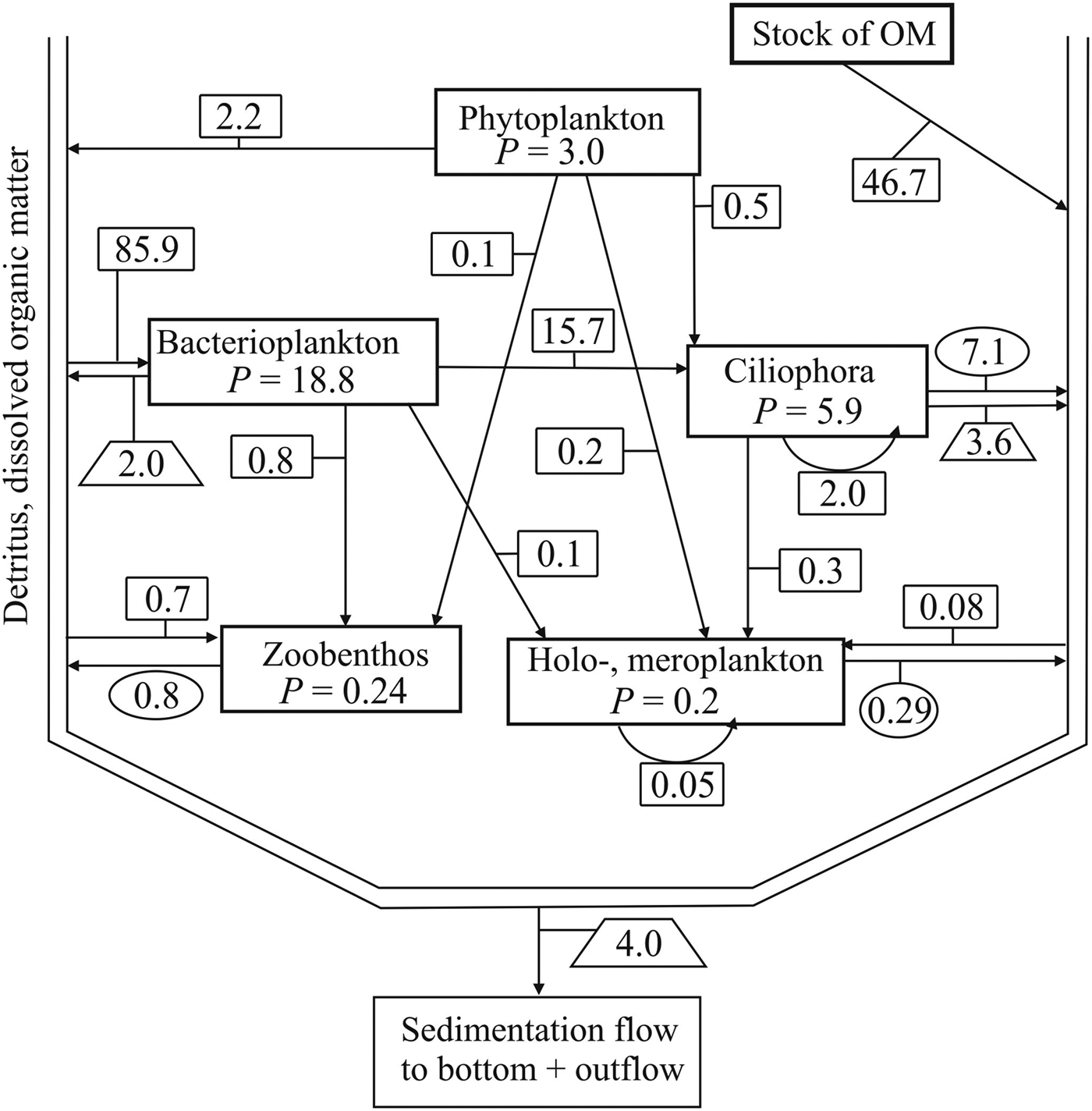
The energy balance in the Liman ‘Zmeinoe Ozero’ ecosystem was calculated for the biological community during the late summer – early autumn according to the settling times of its alien species. At this time the ctenophore Beroe ovata Mayer has a correcting influence on the ecosystem (removes the pressure of a disturbing influence of the predator ctenophore Mnemiopsis leidyi A. Agassiz on zooplankton). The results of the balance calculations shown in Table 1 were employed to compose Figure 2. The diagram demonstrates the energy fluxes between the food web components of the ecosystem, and between them and the pool of dead OM (detritus, dissolved OM). According to calculations in the late summer the planktonic community was in a heterotrophic phase of succession. Its total destruction considerably exceeded primary production (P/M i = 0.07–0.1). The considerable decrease of phytoplankton abundance was recorded in the port water areas of the north-east shelf in recent years (Selifonova & Yasakova, Reference Selifonova and Yasakova2012). Decline of phytoplankton development – the process of gradual decreasing of eutrophication or ‘de-eutrophication’ – in the Black Sea ecosystem has been observed since 2002 (Yunev et al., Reference Yunev, Shulman, Yuneva and Moncheva2009; Zaika, Reference Zaika and Plotnikov2011).
Diagram of energy fluxes (kJ m−2) in the Liman ‘Zmeinoe Ozero’ ecosystem. P, production; number in squares, food rations of subsequent food web components; number in ovals, non-digested food; number in trapeziums, non-consumed food.
However organisms with low efficiency of transformation of matter and energy on food webs to play a role in the functioning of ecosystems of the most vulnerable zones, this being proved by periodic intensive outburst of flagellates. Therefore such ecosystems has weak ecological stability against external influences, including marine biological invasions.
The Liman ecosystem functioned appreciably at the expense of energy stored in OM in the water, which included in a food web with the assistance of bacteria. It differed from other investigated port ecosystems, where the share of allochthonous OM was high enough (Selifonova, Reference Selifonova2012). Stock of OM in such ecosystems was formed mainly during autotrophic phases of seasonal succession of the planktonic community, i.e. at the outburst of water bloom by phytoplankton. The basic flow of energy passed through the detritus food webs.
At the basis of anthropogenous transformation of the Liman ecosystem was degradation of elements of the trophic chain in benthic communities. Therefore, thefunctions of benthic communities have been redistributed to planktonic communities and ecosystem functioning was carried out at the level of microheterotrophs (bacteria and ciliates). Calculation of relative shares of the Liman ecosystem components in total respiration shows that the share of bacterioplankton in total decomposition was 86.8%. The share of ciliates attained 10.4%. The respiration of benthic animals in total decomposition was 1.2%. The share of filtering holo- and meroplankton was minor – 0.5%. Exclusively high intensity of ecosystem metabolism (a balance of the processes of autotrophic production and heterotrophic destruction) contained development of crisis processes. The difference between destruction and primary production characterizes the function of the natural cleansing carried out in the ecosystem of this basin (Sorokin, Reference Sorokin1982). The capacity of heterotrophs, inhabiting the Liman ecosystem, has been expected on an ОM load 15–25 times exceeding the daily primary production of phytoplankton. Against this background favourable conditions had been established for introduction in the Liman ecosystem of the alien species that were transported with ships' ballast water.
DISCUSSION
Depletion of benthic communities, loss from the structure of the trophic web of the macrophyte community and appearance of new alien species in the planktonic and benthic communities leads inevitably to imbalance of the structure of the Liman ‘Zmeinoe Ozero’ ecosystem. According to crisis-monitoring methodology (Slavinsky, Reference Slavinsky2006), the presence of introduced species in communities, even if their taxonomic structure and biomass are insignificant, is a serious risk factor for the ecosystem especially during the periods of reduced stability and structural changes in the communities. Thus, appearance of the invasive species ctenophore M. leidyi in the period of intensified eutrophication in the Black Sea ecosystem triggered an ecosystem crisis. At the present time one of the major problems of biodiversity preservation lies in revealing the pattern of structurally functional changes in ecosystems of different organization levels. Functional destabilization of an ecosystem usually precedes its structural organization changes, therefore it is considered that by monitoring the flow of matter and energy one can make possibly ascertain potential and current crisis processes in biological communities under the influence of aggressive introduced species. There is a concept about the maximum susceptibility to biological invasions of exceedingly destroyed ecosystems-recipients, which possess certain mechanisms of biodiversity self-regulation (Zvyagintsev & Moshchenko, Reference Zvyagintsev and Moshchenko2010). It is considered that river deltas and port water areas are most vulnerable to invasions of new species (Alexandrov, Reference Alexandrov2004; Selifonova, Reference Selifonova2012). The Liman ‘Zmeinoe Ozero’ can be referred to as such a type of aquatic area. Results of this study have shown that benthic communities in the Limam ‘Zmeinoe Ozero’ are inhibited. Dominants of benthic communities (polychaetes) are biological indicators of conditions for inhabitants. Polychaetes are capable of fast growth and possess high genetic variability providing advantages in the survival in organic pollution of mud bottom sediments above a critical level. Under the influence of environmental conditions in these areas the biodiversity of ecosystems and their resistance to external influences decrease, and new ecological niches are occupied by invasions. Such ecosystems are vulnerable to biological invasions by short-cycle species-opportunists (R-strategists), species that are ‘progressive’ in relation to pollution, and also to introduction of alien species stressful and potentially toxic for native ecosystems, i.e. harmful invasions. Anthropogenic thermal industrial pollution also contributes to bio-invasion processes and acclimatization of warm-water species (Zvyagintsev Moshchenko, Reference Zvyagintsev and Moshchenko2010).
Taking into account invasive process in the ecosystems of the port zones most exposed to anthropogenic impact (Selifonova, Reference Selifonova2012) and the Liman ‘Zmeinoe Ozero’ it is possible to give a prognosis of biological pollution of the north-eastern Black Sea by ships' ballast water. During recent years in the north-eastern Black Sea 68 alien species have been revealed (45Copepoda, 2 Polychaeta, 6 Tintinnida, 6 Bacillariophyceae, 8 Dinophyceae, 1 Prymnesiophyceae), these being at different stages of acclimatization. Among the alien species of fauna were recorded casual species – 44, established species – 6 and cryptogenic species – 3. The greatest number of established species of fauna were found in the Novorossiysk Bay and the Liman ‘Zmeinoe Ozero’ in six taxonomic forms, and in the port of Tuapse in four taxonomic forms. The basic ‘groups of risk’ of invasion are tintinnids infusorians, neritic species of copepods, spionid polychaetes and phytoplankton. We can judge by indirect signs whether a new species is an invasive species or not. A number of such signs are described by A. Yu. Zvyagintsev et al. (Reference Zvyagintsev, Ivin and Kashin2009) for fouling organisms. They comprise revealing of alien species in port water area with corresponding gradients of environment, presence of free ecological niches, weak competition from outside native species, mass development of an alien species and its eurybiotic characteristics. In the north-eastern Black Sea the alien organisms have different halopathies. Most stenohaline species are not able to overcome a gradient of reduction of salinity and perish, therefore individual findings of a great number of alien copepods, whose areas are limited in poly- and euhaline waters, should be considered doubtful. Only euryhaline species can successfully overcome change of osmotic pressure and ionic concentration. Upon introduction of an alien species in a new habitat, with optimum living conditions for it, there can be an ecological ‘explosion of number’ as we observed with cyclopoid copepods O. davisae, tintinnid infusorians E.s lususundae, T. directa, T. tocantinensis, A. acuta and spionid polychaetes S. gynobranchiata. In this species list we will especially note the cyclopoid copepod O. davisae which is characterized by high stability to salinity decline (Temnykh & Nishida, Reference Temnykh and Nishida2012). It allows this species to survive not only in poorly freshened areas of the world's ocean, but also in brackish waters, including in the Sea of Azov (Selifonova, Reference Selifonova2011a). Introduced species originating from the Black Sea, the Mediterranean Sea, Atlantic ocean and Caspian Sea are being recorded in the Sea of Azov's copepods complex and obviously the process of their introduction continues (Selifonova, Reference Selifonova2013). Naturalization of O. davisae in the Black Sea is an example of favourable invasion when the invasive species occupies a vacant ecological niche in a recipient basin. Oithona davisae has occupied the niche of Oithona nana Giesbr. in open waters of the Black Sea, which disappeared in the early 1990s under the impact of the invasive ctenophore M. leidyi. Due to the eurybiotic groups biodiversity of the Black Sea ecosystem will be enriched, this process being developed by inadvertent introduction with ships' ballast water.
Biological invasion with water transport will undoubtedly strengthen the process of ‘mediterraneanization’ of the Black Sea flora and fauna, and the possibility of new species appearing in the coastal zone of the north-east shelf with toxic influences on native water organisms, including objects of mariculture and humans, remains an obvious problem. It should be noted that in the water area of the port of Novorossiysk more than 60% of the ballast waters arriving from the Mediterranean basin is dumped. Therefore the density outbursts of alien, potentially toxic algae Phaeocystis pouchetii (Hariot) Lagerheim, etc. in the port water areas of the north-east shelf raise particular concerns (Yasakova, Reference Yasakova2011). Expansion in coastal waters of an anthropogenic recipient ecosystem web for biological invasions and the intensification of dumping of ships' ballast water will undoubtedly exert appreciable impact on biodiversity and productivity of the north-eastern Black Sea.
ACKNOWLEDGEMENT
The author thanks Olga N. Yasakova (Institute of Arid zones, Russian Academy of Sciences) for identifying phytoplankton.