Introduction
Synthetic herbicides represent the foundation for weed control in conventional (i.e., nonorganic) soybean production systems across the United States. Prior to the introduction of glyphosate-resistant (GR) soybean in 1996, growers utilized a variety of PRE and selective POST herbicides from multiple sites of action for weed control (Kniss Reference Kniss2018). The introduction of GR crops in the mid-1990s dramatically altered row-crop production in the United States allowing producers more flexibility for POST weed control with the use of the systemic and nonselective broad-spectrum herbicide glyphosate. This led to a reduction in labor and time requirements, reduced herbicide costs, and decreased reliance on tillage and other means of mechanical weed control (Bradley et al. Reference Bradley, Hagood and Davis2004; Johnson et al. Reference Johnson, Bradley, Hart, Buesinger and Massey2000a; Reddy and Whiting Reference Reddy and Whiting2000). Conversely, adoption of GR soybean changed the herbicide use patterns (from 2000 to 2010) from PRE followed by POST programs to primarily POST application(s) of glyphosate alone (Duke Reference Duke2015; Givens et al. Reference Givens, Shaw, Johnson, Weller, Young, Wilson, Owen and Jordan2009; Powles Reference Powles2008), posing tremendous selection pressure for glyphosate resistance evolution.
Waterhemp (Amaranthus tuberculatus Moq.) and Palmer amaranth (Amaranthus palmeri S. Wats.) are troublesome weed species in Midwestern U.S. row crop production (Johnson Reference Johnson2000b; Norsworthy et al. Reference Norsworthy, Griffith, Griffin, Bagavathiannan and Gbur2014). The use of PRE herbicides is considered a foundation for management of such Amaranthus spp. and other problematic weeds such as kochia (Kochia scoparia L.; Kumar and Jha Reference Kumar and Jha2015; Whitaker et al. Reference Whitaker, York, Jordan, Culpepper and Sosnoskie2011). Due to overreliance on glyphosate and widespread occurrence of GR weeds, soybean producers are once again reintroducing PRE herbicides to their weed control programs. For instance, the total soybean planted area treated with metribuzin (photosystem II-inhibitor, PSII; Group 5) and sulfentrazone (protoporphyrinogen oxidase-inhibitor, PPO; Group 14), increased 18% and 22%, respectively, from 2006 to 2017 (USDA-NASS 2017). Hager et al. (Reference Hager, Wax, Bollero and Simmons2002) and Arneson et al. (Reference Arneson, Smith, DeWerff and Oliveira2019) reported that these two herbicides were effective in controlling waterhemp 6 to 8 wk after planting. Sarangi et al. (Reference Sarangi, Sandell, Knezevic, Aulakh, Lindquist, Irmak and Jhala2014) reported great control (>90%) of GR Amaranthus spp. 3 wk after planting when PRE PPO-inhibitor herbicides were used. Oliveira et al. (Reference Oliveira, Feist, Eskelsen, Scott and Knezevic2017) reported benefits of using PRE herbicides to control several annual broadleaf and grass species. Furthermore, Norsworthy et al. (Reference Norsworthy, Griffith, Griffin, Bagavathiannan and Gbur2014) indicated that the use of effective PRE herbicides is an important strategy for management of herbicide-resistant weeds. PRE herbicides control weeds that germinate in the first 3 to 4 wk after crop planting, which allow for more timely POST herbicide applications and protect crop yield loss in the early season when the crop is most vulnerable to weed competition (Butts et al. Reference Butts, Miller, Pruitt, Vieira, Oliveira, Ramirez and Linquist2017; Knezevic et al. Reference Knezevic, Pavlovic, Osipitan, Barnes, Beiermann, Oliveira, Lawrence, Scott and Jhala2019; Tursun et al. Reference Tursun, Datta, Sakinmaz, Kantarci, Knezevic and Chauhan2016).
Although soil-applied PPO and PSII inhibitors are labeled and commonly recommended as PRE herbicides for soybean, there is a concern that these herbicides may cause early-season soybean injury and affect yield. Adequate soil moisture is necessary for PRE activation and subsequent availability in soil solution for effective weed control. However, when soil conditions are cool and wet for extended periods of time during crop emergence, the ability of soybean to metabolize PRE herbicides is reduced, which leads to increased plant injury (Moomaw and Martin Reference Moomaw and Martin1978; Niekamp et al. Reference Niekamp, Johnson and Smeda2000; Osborne et al. Reference Osborne, Shaw and Ratliff1995). In addition, precipitation during the “soil cracking” stage of emergence can result in splashing of higher concentrations of PPO-inhibitor herbicides onto soybean hypocotyl, cotyledons, or growing points, which can lead to tissue necrosis (Hartzler Reference Hartzler2004; Wise et al. Reference Wise, Mueller, Kandel, Young, Johnson and Legleiter2015). Sulfentrazone is known to cause herbicide injury in the form of chlorosis, discoloration of veins, and shortening of internodes in less-tolerant soybean varieties and can reduce soybean stand by 17% and 35% in tolerant and less-tolerant varieties, respectively (Swantek et al. Reference Swantek, Sneller and Oliver1998). Other experiments reported that the range and variability in injury observed across varieties is likely due to varying tolerances to peroxidative stress caused by sulfentrazone application because no differences in uptake and translocation were observed (Dayan et al. Reference Dayan, Weete, Duke and Hancock1997). Taylor-Lowell et al. (Reference Taylor-Lovell, Wax and Nelson2001) observed early-season herbicide injury and reduction in plant stand when the PPO inhibitors flumioxazin and sulfentrazone were used; however, they observed no adverse effect on soybean yield. Interveinal chlorosis is the initial symptom of metribuzin injury, which becomes evident when the unifoliate and first trifoliate leaves are exposed, with greater risk of injury in soils with higher pH (>7) and/or low organic matter (Hartzler Reference Hartzler2017). Rogers et al. (Reference Rogers, Sloane and Zaunbrecher1971) observed that relative tolerance to metribuzin is partially related to the ability of soybean to degrade metribuzin more rapidly in tolerant varieties. Coble and Schrader (Reference Coble and Schrader1973) reported that soybean tolerance to metribuzin was greatly influenced by application rate, soil organic matter, and amount of rainfall following herbicide treatment. Bollich et al. (Reference Bollich, Dunigan and Jadi1985) reported soybean injury and reduced nodule dry weight when metribuzin was applied at 0.3 kg ha−1 in a soil with coarse texture (57% sand, 37% silt, and 6% clay), high pH (7.8), and low organic matter content (0.6%).
Early-season herbicide injury and subsequent effect on yield is a concern of soybean producers who adopt metribuzin and/or sulfentrazone PRE in soybeans. Some seed companies provide information regarding soybean variety tolerance to soil-applied metribuzin and sulfentrazone; however, to our knowledge, information on their potential impact on soybean development and yield response under field conditions prone to PRE injury is not readily available. Thus, the objectives of this study were to 1) investigate the impact of soil-applied sulfentrazone and metribuzin on early-season growth and development of soybean using multiple varieties adapted to southwestern Nebraska and 2) determine whether potential early-season herbicide-induced injury could impact soybean yield. We hypothesized that PRE herbicides would impact early-season soybean development but have no adverse effect on yield.
Materials and Methods
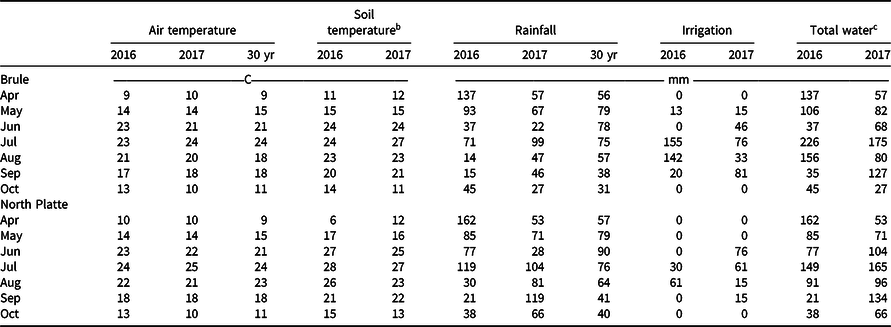
Field experiments were conducted in 2016 and 2017 at the University of Nebraska West Central Water Resources Field Laboratory, near Brule, NE (41.1597°N, 102.02871°W; hereafter referred to as Brule) and the University of Nebraska West Central Research and Extension Center in North Platte, NE (41.0865°N, 100.7780°W; hereafter referred to as North Platte) for a total of 4 site-years. The previous crop at all field sites was no-till corn (Zea mays L.). Information regarding soil characteristics, soybean planting date, PRE herbicide application time, and harvest date at each site-year is presented in Table 1. Monthly rainfall and irrigation applied via center pivot, average air and soil temperature (10-cm depth), and 30-yr average air temperature and monthly rainfall for each site-year are presented in Table 2. Experimental sites were selected due to loam soil type, relatively low organic matter, and high pH, which are representative field conditions across southwestern Nebraska and also suitable for early-season crop injury from metribuzin and sulfentrazone (Grey et al. Reference Grey, Walker, Wehtje and Hancock1997).
Soil and crop management information for field experiments.

a In parentheses: (% clay:silt:sand) soil texture ratio.
Monthly average air and soil temperature, and accumulated rainfall, irrigation, and total water.a

a Air and soil temperature and rainfall data were obtained from High Plains Regional Climate Center (https://hprcc.unl.edu) and irrigation amounts were recorded on site. The 30-yr average includes data from 1987 through 2017.
b Depth, 10 cm.
c Rainfall + irrigation.
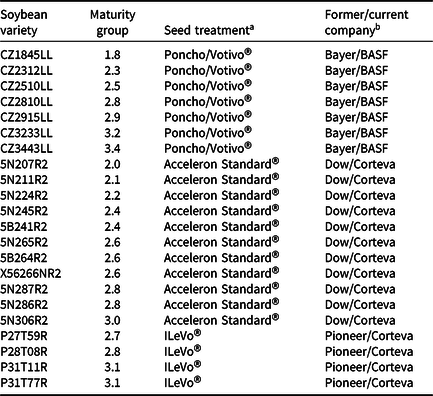
The experiment was conducted as a 3 × 22 factorial with treatments consisting of two PRE herbicides applied at recommended label rates (metribuzin, 560 g ai ha−1, Sencor® 75 DF Bayer AG, Leverkusen, Germany; and sulfentrazone, 280 g ai ha−1, Spartan® 4F, FMC Corporation, Philadelphia, PA) plus a nontreated control (NTC), and 22 commercially available soybean varieties adapted to the region (Table 3). At all site-years, soybeans were planted at 360,000 seeds ha−1 (3.8 cm deep) and the PRE herbicide was applied within 3 d after planting (DAP; Table 1) using a CO2-pressurized backpack sprayer equipped with a 3-m boom with six TeeJet XR11002 flat-fan nozzles (Spraying Systems Co., Wheaton, IL) on 50.8-cm spacing, calibrated to deliver 94 L of spray solution per hectare. Experimental units were 3 m wide (four rows on 76-cm spacing) and 9.1 m in length. Experimental units were maintained weed-free throughout the season by weekly hand weeding and/or hoeing to minimize the impact of weeds on soybean development and yield. The experiment was established in a strip-split-plot design employed in a randomized complete block design with four replications at each site-year. PRE herbicide treatments were considered as the strip-plot, whereas the soybean varieties were treated as the split-plot.
Soybean varieties evaluated.

a Poncho/Votivo® (clothianidin + Bacillus firmus I – 1582; 13 mg ai 100 seed−1); Acceleron Standard® (metalaxyl +fluxapyroxad + pyraclostrobin + myclobutanil + imidacloprid; 50 mg ai 100 seed−1); ILeVo® (fluopyram; 15 mg ai 100 seed−1).
b Varieties from three seed companies were used in the field experiments: Bayer Crop Science (St. Louis, MO, USA), Dow AgroSciences (Wilmington, DE, USA), and Pioneer (Johnston, IA, USA). Due to mergers and acquisitions since the experiments were conducted, these varieties now represent two seed companies: BASF (Ludwigshafen, Germany) and Corteva Agriscience (Wilmington, DE, USA).
Soybean Canopy Development
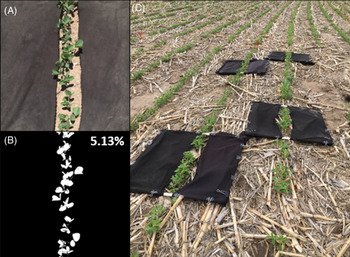
Soybean canopy development was assessed when the crop reached the V2 (two open trifoliates) growth stage (Fehr and Caviness Reference Fehr and Caviness1977), approximately 30 d after planting (DAP). The evaluation consisted of four photos of the center two soybean rows in each experimental unit (rows 2 and 3). Square frames (76 by 76 cm) were constructed from polyvinyl chloride pipe (1.25 cm diameter) and black fabric, and used to demark the areas designated for the photos (Figure 1). Two photos per row were taken at 1 m above the ground with an Apple iPhone 6s cellphone camera (Apple Inc., Cupertino CA) with the “square” setting. Black fabric fitted on squares was used to eliminate variability within photo area (e.g., emerging weeds, decaying plant residue). Photos were processed using the Canopeo cellphone application (Canopeo Software, Oklahoma State University, Division of Agricultural Sciences and Natural Resources Soil Physics program, Stillwater, OK; https://canopeoapp.com). The Canopeo app estimates fractional green canopy cover within each image (Liang et al. Reference Liang, Ma, Xie, Zhou and Wang2012; Paruelo et al. Reference Paruelo, Lauenroth and Roset2000; Patrignani and Ochsner, Reference Patrignani and Ochsner2015), and was used in this study to estimate potential soybean growth reduction due to herbicide injury.
(A) Original, unprocessed photo of sulfentrazone treatment, (B) processed photo of sulfentrazone treatment for estimating soybean green canopy cover at V2 growth stage using the Canopeo phone application platform (www.canopeoapp.com). The photo at right, (C), shows where square frames were placed on the second and third soybean rows of an experimental plot so as to demarcate the photo area.

Final Soybean Plant Stand, Final Yield, and Yield Components
Harvest at all locations was conducted manually after soybeans reached physiological maturity (Table 1). Soybean plants from 2 m of row (1 m of row from each of the center two rows) of each experimental unit were enumerated to estimate final plant stand, cut at the base, and stored in canvas bags until threshing for estimation of yield. Six random soybean plants (three plants from each of the center two rows, separate of the 2 m of row harvested) were collected from each experimental unit and stored in canvas bags until assessment of yield components, which included number of pods per plant, number of seeds per pod, total seeds per plant, and 100 seed weight. Soybean samples were threshed with a stationary ALMACO thresher (LPT – Large Plot Thresher, Almaco, IA), and seeds were counted with an Old Mill Seed Counter (Model 900-2, Old Mill Equipment, San Antonio, TX). Soybean yield and the weight of 100 soybean seeds were adjusted to 13% moisture content.
Statistical Analysis
Green canopy coverage (%), final plant stand (plants 2-m row−1), final yield (g 2-m row−1), and yield component data (number of pods per plant, total seeds per plant, number of seeds per pod, and 100 seed weight) were subjected to ANOVA using the PROC GLIMMIX procedure in SAS version 9.4 (SAS Institute Inc., Cary, NC). PRE herbicide treatments were treated as fixed effects, whereas replications nested within site-years and soybean varieties nested within site-years were treated as random effects. Site-years and soybean varieties were treated as random because the objective of this study was to evaluate the potential impact of PRE herbicide treatments assuming a random irrigated site in southwestern Nebraska (with similar environmental conditions as observed in this study) and random selection of locally adapted soybean variety. For each response variable, means were separated when PRE herbicide treatment effect was less than P = 0.05 using Fisher’s protected least-significant difference. Canopy coverage, seeds per plant, and seeds per pod data were square root–transformed prior to analyses to satisfy Gaussian assumptions of normality and homogeneity of variance; back-transformed results are presented for ease of interpretation.
Results and Discussion
Soybean Canopy Development
Sulfentrazone reduced early season soybean growth by 22% (average canopy coverage across site-years and varieties was 5.4% at 30 DAP; Table 4). The early season sulfentrazone injury observed herein corroborates with the observations from an experiment conducted by Taylor–Lowell et al. (Reference Taylor-Lovell, Wax and Nelson2001) who reported injury to 15 soybean varieties ranging from 4% to 61% when sulfentrazone was applied at three different rates (112, 224, and 446 g ai ha−1) where the higher sulfentrazone rate led to higher injury particularly when wet and cool conditions persisted after soybean planting. Additionally, in a greenhouse experiment by Ribeiro et al. (Reference Ribeiro, Maia, Arneson, Jean-Michel, Santos and Werle2019) comparing 11 PRE herbicides using a silt loam soil, sulfentrazone was the most injurious herbicide to soybean at the VC growth stage, causing a 27% reduction in soybean green canopy coverage compared with the NTC.
Final Soybean Plant Stand and Yield
Compared with the NTC, sulfentrazone had an adverse impact on the final plant stand, resulting in a 10% average reduction (four fewer plants per 2 m of row), whereas metribuzin did not impact the final plant stand (Table 4). Although sulfentrazone application led to both reduced green canopy coverage during the early season (V2 growth stage; ~30 DAP) and the final plant stand at crop physiological maturity, these effects did not translate into a reduction in yield. Conversely, both PRE herbicides resulted in slightly higher average yield (by 3%) when compared with the NTC (P = 0.0008; Table 4). Although plots were hand weeded and hoed on a weekly basis, there was a higher opportunity for early-season weed competition in the NTC (no soil residual weed control from PRE herbicide treatment), which may partially explain the slightly higher yield in the metribuzin and sulfentrazone treatments. Nonetheless, our results support those previously reported by Taylor-Lowell et al. (Reference Taylor-Lovell, Wax and Nelson2001) who observed no yield loss when soybeans were injured by sulfentrazone PRE. Additionally, despite observing sulfentrazone injury during the VC soybean growth stage, Ribeiro et al. (Reference Ribeiro, Maia, Arneson, Jean-Michel, Santos and Werle2019) reported no differences in total root and shoot biomass when the crop reached the R2 growth stage (45 DAP) in their greenhouse study. Soybean plants are known to compensate for reduced stands by producing additional branches (Cox and Cherney Reference Cox and Cherney2011). Weidenhammer et al. (Reference Weidenhamer, Triplett and Sobotka1989) suggested that soybeans can compensate for herbicide injury when it occurs during early developmental stages, but the ability to compensate decreases as soybeans approach the blooming (R1) growth stage.
Green canopy cover (%; ~30 d after treatment [V2 growth stage]), final plant stand and yield at physiological maturity.a

a Means within a column followed by the same letter are not different according to Fisher’s least significant difference test (P = 0.05).
b PRE herbicide treatments were treated as fixed effects, whereas replications nested within site-years and soybean varieties nested within site-years were treated as random effects.
c Yield adjusted to 13% moisture content.
Soybean Yield Components
PRE herbicide treatments had a significant effect on the number of pods per plant and seeds per plant (P < 0.0001; Table 5). Sulfentrazone resulted in 16% more pods per plant (seven more pods per plant) than the NTC. This could be due to axillary bud growth by individual plants when additional space was available because of the reduction in plant stand. Sulfentrazone and metribuzin treatment resulted in 15% and 4% increases, respectively, in the number of seeds per plant (15 and 4 more seeds plant−1) compared with the NTC. The number of seeds per pod and 100 seed weight were not influenced by PRE herbicide treatments (P > 0.05; Table 5). These results demonstrate that despite a reduction in early season green canopy and final plant stand due to sulfentrazone application, soybean plants that received this treatment were able to compensate yield via increases in the number of pods per plant and seeds per plant.
Soybean yield components at crop physiological maturity.a

a Means within a column followed by the same letter are not different according to Fisher’s least significant difference test (P = 0.05).
b PRE herbicide treatments were treated as fixed effects, whereas replications nested within site-years and soybean varieties nested within site-years were treated as random effects.
c Adjusted to 13% of moisture.
The findings from this experiment support previous research regarding the ability of soybean to compensate early-season PRE herbicide injury. These results should encourage soybean growers to continue including PRE herbicides as a part of an integrated weed management strategy in their production systems. The weed control benefits provided by PRE herbicides likely outweigh concerns regarding early-season injury, assuming that such herbicides are applied following their label requirements and the crop is established according to local best management practices. Soybean growers can opt to plant varieties with higher tolerance to PRE herbicides, when such information is provided by seed companies, as a means to reduce the likelihood of early-season crop injury (Belfry et al. Reference Belfry, Soltani, Brown and Sikema2015; Swantek et al. Reference Swantek, Sneller and Oliver1998; Taylor-Lowell et al. Reference Taylor-Lovell, Wax and Nelson2001). Further research should evaluate the tolerance of modern soybean varieties to PRE herbicide premixes containing multiple sites of action, which are becoming more commonly adopted by soybean growers because they provide extended and broader weed control and may potentially delay herbicide resistance (Arneson et al. Reference Arneson, Smith, DeWerff and Oliveira2019).
Acknowledgments
We thank Felipe Faleco, Gustavo Vieira, and Alexandre Rosa for their invaluable assistance and the seed companies listed in Table 3 for providing the seed we used in this research. This research received no specific grant from any funding agency, commercial or not-for-profit sectors. No conflict of interest has been declared.