In September 1958, at the height of the guerrilla war to topple dictator Fulgencio Batista, Laureano Prado, a peasant from Guantánamo, crossed Cuba's easternmost mountain range, headed toward Mayarí. He had been elected to represent his region, Ají de la Caldera, at an important peasant congress organized in conjunction with the 26th of July Movement (26JM). On his way, he picked a fight with a group of landowners. “I think that when this war is over the government will hand over the land to those who work it!” he remarked to one of them. The man turned and yelled back, “Who said that? Don't start talking trash! No government can give away land—only the communists do that, and this is a war to end communism!” In his account of this brief provocation, a pleased Laureano reports, “They, of course, had no idea that I was a Communist.”Footnote 1
A prelude to future tensions between competing factions of the anti-Batista coalition, this incident also hints at the complex, little understood history of peasant mobilization during the insurgency that helped the rebels win the war. Laureano expressed a wish, not knowing how close he was to being right about land reform. Just 20 days later, and still nearly three months before the war's end, rebel commanders ordered the immediate application of Law No. 3 of the Sierra Maestra, giving the land, as Laureano had predicted, “to those who work it.”
Guerrilla revolutionary policy in the Sierra Maestra developed over the course of two years. In 1957, Fidel Castro, then commander in chief of the 26JM Ejército Rebelde (Rebel Army), began implementing a set of rules meant to regulate the behavior of members of the guerrilla army in the movement's initial stages. As the guerrilla forces grew in both numbers and power, and as the rebels exchanged their makeshift camps for permanent headquarters, they adopted a framework of “guerrilla justice” or “guerrilla law.” Gradually, social policy became formalized and written into territory-wide laws and local regulations.Footnote 2 And as more territory came under their control, rebels had greater opportunity to apply their law. By mid 1958 the rebels controlled most of northern and southern Oriente and were opening new fronts in central Cuba.
In April, Batista had launched a military assault that he hoped would lead to the fall of guerrilla troops. But by August of 1958, the so-called “Operation End of Fidel” had been defeated, and rebels in the newly liberated territories began to work out what their revolutionary state would look like. By late 1958, their initial set of rules had evolved into a more complex legal and penal code that claimed jurisdiction over rebel-held territory.Footnote 3 In these last six months of the war, they ran an increasingly organized operation, with largely sovereign and autonomous control over vast regions across Oriente. Rebel-held territory, I show, functioned as a laboratory in which the rebels experimented with how to run a state.Footnote 4
For at least a decade following the triumph of the Cuban Revolution, sociological studies analyzed the role of the peasantry in the war, their importance for its success, and reasons for peasant support for the rebel insurgency. Accounts of the guerrilla war in the Sierra Maestra dominated narratives about the insurrection, but, with a limited source base, they left many questions about the peasants’ experience of the revolution unanswered.Footnote 5 A more recent turn has importantly centered the significance of the civic and urban fronts in the war.Footnote 6 This article returns to the theme of peasant war, not to minimize the significance of the urban and civic struggles against Batista but rather to reconsider, based on new evidence and new questions, the relationship between peasants and guerrillas. Drawing on private collections from the 26JM guerrilla headquarters during the war, oral histories from participants from across eastern Cuba, and a collection of memoirs and testimonies, this article aims to provide new insights into peasants’ everyday experience of the rebel insurgency. Ultimately, it argues that peasants articulated a set of agrarian policies, pushed them onto the agenda of rebel leadership, and made a critical imprint on the trajectory of the Cuban Revolution.
To reconsider the debate about the role of peasants in the revolution, this article shows that throughout 1958, links between the peasantry and the 26JM across the liberated territories were widespread. Peasants and rebels worked together to forge development and modernization projects in regions where rural people had not had access to anything similar. This collaboration amounted to more than the reception of material benefits by the rural population, who bore much of the economic brunt of the war. The sense that rebels provided some material benefit to local populations is occasionally mentioned in the existing literature, but a clear notion of the extent of these contributions or of their meaning to peasants in daily life in the liberated territories is absent.
Many peasants took the promises, attitudes, and actions of the bearded rebels of 1958 as a validation of their labor and social standing, and a recognition of their important role not only in articulating the agricultural policies supported by the 26JM but in making revolution more generally. Scholars of Cuba's revolutionary war have posited a dichotomous or oppositional relationship between urban members of the 26JM guerrilla army and the rural peasants who inhabited the region. Yet my research suggests that boundaries between “peasants” and “rebels” were much more fluid, as the two often and increasingly became one and the same.
Guerrilla-Peasant Encounters during the War
Control over what rebels referred to as their “liberated territories” was accompanied by the expectation that the guerillas would resolve some of the problems faced by the large rural population living under their command. This applied both to problems occurring as a result of the war and those stemming from a historical lack of social services in the area. From 1956, the rebels’ incursion into the mountainous regions of eastern Cuba had led them to an area inhabited by peasants who lived and worked mainly for subsistence.Footnote 7 Perhaps more important, they lived in an area that was, for the most part, cut off from the reach of the state.Footnote 8 This distance meant, on one hand, that individuals could evade the law and make a new life for themselves in the mountains. This had been true from the beginning of European conquest, when Taínos sought refuge from the Spanish, and it was true throughout the days of slavery, when the mountains provided cover for escaped slaves and their settlements. Independence fighters, bandits, and many others had escaped into the mountains to evade the power of the state.
On the other hand, the absence of the state also meant that state-led development projects rarely if ever reached the region. Most towns, villages, and individual homes and farms in the circumference of the Sierra Maestra lacked electricity, running water, and basic sanitation. There were few schools and almost no clinics.Footnote 9 If there were schools, there were few roads to help get children to them, and medical services were almost always dangerously far away. One of the few manifestations of the state's presence in the region was the Rural Guard, a semi-mercenary police force that was designed to address threats to landowners’ property and was feared and despised by poor peasants.Footnote 10 Campesinos in the Sierra Maestra related not to a state that extracted some amount of income from their labor and returned it in the form of social services, but rather to the imperatives of a labor market and a land regime that left them often at the mercy of employers and landowners. Unequal patterns of land ownership often meant that poor campesinos got kicked off the land they worked, while high levels of unemployment meant rural workers had to travel for months at a time in search of seasonal labor.Footnote 11
The arrival of Fidel Castro and the 26th of July forces in the Sierra Maestra was, for many of the peasant families living in the proximity of rebel soldiers, a first encounter with both the provision of state-like resources and the disciplining regimentation that came with it. A year into the war against Batista, the rebels had been able to bring teachers, schools, and doctors to some rural communities in close proximity to rebel headquarters. By the end of the war in December 1958, they were doing a lot more, over a much larger area. They signed decrees and laws, officiated marriage ceremonies, ran a legal department, held criminal trials, managed a prison, and even collected taxes. By the fall of 1958, 36 of 41 sugar mills in Oriente were paying taxes to the rebels.Footnote 12 The rebels had, in other words, managed to constitute a territory where their rule functioned as that of an actual state.Footnote 13 Inhabitants of the Sierra Maestra suddenly had to worry that if they were caught doing something deemed illegal by the Rebel Army, for example growing and selling marijuana, they could end up serving time at a rebel-managed prison.Footnote 14
If the prolonged presence of the rebels in the Sierra Maestra represented a first encounter of peasants with a budding state, it was also, and equally important, a first encounter of city-trained revolutionaries with the peasantry and the realities of rural life in Cuba. What the rebels had already believed to be true in the region—poverty, hunger, unemployment, illiteracy, land dispossession—now became a reality that they observed first-hand. At the same time, the rebels owed the campesinos their housing, food, places to hide, and the knowledge of basic skills that they needed to survive. For both guerillas and peasants, this was a transformative experience.
Members of the 26JM who had grown up in urban settings and campesinos living in the areas near rebel camps formed bonds and loyalties and—even in the presence of occasional power struggles and enmities—learned from each other and influenced each other's understanding of the prospects of change. Thus, when rebel leaders left eastern Cuba they did so with a vision of the type of development needed in the countryside.Footnote 15 And that vision was deeply marked by the peasants themselves.
Documentary and testimonial sources from the war in the Sierra Maestra and the Sierra Cristal reveal the extent to which peasants took part in the creation of the new 26JM regimen and willingly submitted themselves to it, but also the ways in which they helped formulate—and propel—the agrarian policies that the Rebel Army developed. Peasants influenced the formation of the guerilla state in multiple ways. First, they joined the military ranks of the Rebel Army. Of the 22 combatants who made it into the Sierra Maestra after disembarking from the yacht Granma in December 1956, several were of campesino origin or had closely observed peasant life, growing up in poor, underdeveloped parts of Cuba. Faustino Pérez, for example, had labored on his father's land until the age of 11, when he moved to the city of Cabaiguán where he was able to advance his education. Others, Julio Díaz González and Calixto García Martínez, and Captain Ángel Verdecia Moreno, were from peasant farms in rural Artemisa, Las Villas, and Granma respectively, while Efigenio Ameijeiras and Luís “El Guajiro” Crespo were born in settlements near the Chaparra and Carolina sugar mills in Oriente and Cienfuegos.Footnote 16
Michel Reyes-Trejo, his nine brothers, and one sister—all brought up on subsistence farms in a poor rural household just south of the Sierra Cristal—are exemplary of several “revolutionary families” that inhabited the eastern territories. Upon learning of the efforts led by Fidel Castro and his men, Michel and his 10 siblings each traveled to the sierras separately, one after the other joining the Rebel Army.Footnote 17 Although precise data is unavailable, analysts have generally agreed that a vast majority—perhaps up to three-quarters of the Rebel Army—was composed of peasant men and women. Beyond anecdotes by witnesses, participants, and protagonists of the revolution who insist that a large portion of the insurgents came from poor local rural families, specific cases support this contention. In January 1957, guerrillas kidnapped and attacked the Rural Guard at a peasant's behest, killing Chico Osorio, a hated overseer who routinely evicted and killed peasants, and gaining a number of peasant followers. Later in the year, a guerrilla contingent led by Che Guevara and composed of 75 peasants dispossessed of their land named itself Desalojo Campesino (Peasant Eviction). Towards the end of the insurgency, on November 29, 1958, when Camilo Cienfuegos had taken the city of Yaguajay, 300 peasants met to form a peasant association and organized a network to support the rebels’ hold on the liberated territories by building trenches and destroying bridges. Though the latter may not been official members of the Rebel Army, they may have, at some point, thought of themselves as combatants.Footnote 18
Not everyone who wanted to join the army was able to, however. The shortage of weapons precluded the incorporation of more would-be combatants.Footnote 19 As the guerrilla forces grew, they continued to incorporate peasant men and women into their ranks, not only as soldiers on the battlefront, but also as collaborators of all types. Some participated in civilian rather than military activities. Misael Álvarez, a blind peasant from Mayarí Arriba could not fight but he contributed, first by traversing the mountains to deliver messages between rebels, and later by organizing local support for the troops among rural communities.Footnote 20 Still others convened meetings, organized regional associations, elected representatives, and became advocates and protagonists of their own region's development. They helped build schools, roads, and clinics alongside the Rebel Army. Across the liberated territories, peasants were trained to fill positions as teachers and regional police officers. This participation—both military and civilian—allowed them to drive discussions and help plan social and agricultural undertakings affecting rural life.
Peasant influence on rebel state formation was enabled by the incorporation not only of rural folk but also of longstanding peasant leaders. Several of the peasants who joined the insurgency as both combatants and collaborators were campesino organizers who had already spent decades fighting for land rights and battling against the region's infamous Rural Guard. Their participation in the movement undoubtedly reflected the confluence of ideas held by rebels and experienced campesino organizers, who had long considered the liberation of the poor rural class a political and social priority.Footnote 21
Importantly, many of these organizers were also members of the Communist Party, then called the Partido Socialista Popular (PSP). Among them were Romárico Cordero (a delegate to the 1940 constitutional convention), José “Pepe” Ramírez Cruz and his wife Alicia Cruz Silva, Miguel Ángel Betancourt, Cándido Betancourt Ámelo, and Esther Gámbara. They were all recognized peasant organizers and PSP activists at the time of the rebel insurgency, and they had been at the forefront of peasant organizing since long before the arrival of rebel troops.Footnote 22
The communists had a long history of organizing in remote parts of rural Cuba.Footnote 23 Esther Gámbara, from a poor peasant family near El Cobre, was recruited by the PSP as a teenager. She was just 15 when she joined them to fight for agrarian reform, several years before Fidel and his rebels were on the scene.Footnote 24 The 26th of July Movement recruited, accepted, and incorporated these men and women into their ranks and allowed them to run the movement's peasant and agricultural affairs. Many of these campesino leaders turned revolutionaries joined the government following the triumph of Fidel's forces, and of these, many were later appointed to posts at the National Institute for Agrarian Reform (INRA) and worked directly on the implementation of the 1959 agrarian reform law.Footnote 25
If the rebel state incorporated peasants and their leaders, it also built on already established structures of peasant mobilization and activism. Cuba's long history of peasant organizing had built organizational structures and networks that the 26JM used and expanded. For example, the Campesino Association, widely used by the 26JM and Rebel Army to organize support from peasants, was an organization created earlier by the Communists and widely supported by peasants to fight land dispossession as far back as 1934.Footnote 26 From 1934 to 1956, with at least 32 formally constituted campesino associations across the Sierra Maestra, and at least 16 more in the Sierra Cristal, peasant organizers formed on-the-ground networks through which they could mobilize to defend their rights.Footnote 27 The 26JM tapped into this network of peasant organizing and built on it, incorporating work done earlier by peasants into its own organizational goals. These structures and networks became a place from which peasants could pressure and negotiate for their specific objectives within the 26JM.
Landed peasants and some more wealthy farmers also contributed to the rebel insurgency. In 1958, the anti-Batista coalition represented a wide range of ideologies from across Cuba. Leaders of both the traditional Auténtico and newer Ortodoxo political parties were invested in toppling Batista's dictatorship, and the aims of their constituents, including small, medium, and wealthy landowners, coincided. They provided the movement with financial support and protection against Batista's soldiers. Some gave food, sometimes butchering their livestock to help feed rebels, or helped hide them when necessary. Others allowed the guerrillas to set up encampments on their land.Footnote 28 These landowners also helped with recruitment, allowing or even pressuring their peasant employees to join and collaborate with the insurgency, or sending their children to participate.Footnote 29 Thus, the rebels had a vested interest in preventing the alienation of middle and wealthy farmers during the insurgency, although supporting that interest would prove difficult as the rebels incorporated more and more poor peasant supporters. With the subsequent seizure of farms belonging to wealthier farmers, many landowning families—though not all—would break entirely with the 26JM.
Law No. 1 of the Sierra Maestra
Batista's war on the 26JM had deliberately caused labor and supply shortages in Cuba's foremost coffee-producing region, increasing the probability that the 1958 coffee harvest would be lost. The rebels relied on support from peasants in the region and knew that a fall in the campesinos’ earnings could destabilize the peasantry and the Rebel Army. Thus, in an effort to ensure that the harvest would go forward, Ernesto “Che” Guevara, the famed Argentine member of the 26JM, organized a meeting between rebels and workers of the coffee industry in Las Vegas de Jibacoa, a Sierra Maestra region under his command. The meeting, held on May 25, 1958, was attended by somewhere between 300 and 400 coffee growers, their laborers, and other local campesinos who showed up eager to meet Fidel, Che, and Celia Sánchez, also an important rebel leader and one of Fidel's closest confidants.Footnote 30 After Fidel spoke, peasants enumerated the immediate challenges to carrying out the coffee harvest, and talked about the long-term economic and social hardships they faced. For their part, the guerrilla leadership proposed solutions to the shortages: rebel troops would help pick the ripening coffee beans and help supply material to make the thousands of sacks the coffee workers would need to save the harvest. In turn, coffee pickers would bring family members to work with them to complete the harvest. Che also proposed the organization of cooperatives to respond to mounting food scarcities and suggested turning over uncultivated lands to families who could use them to grow subsistence food.Footnote 31
The exchanges at Las Vegas de Jibacoa opened up new avenues for communication among tenants and landowners, even squatters, and the 26JM. As the landowners and coffee workers accepted the rebel army's organizing imperative and acquiesced to its proposed solutions, they were creating some of the first channels for consent to the 26JM's authority.Footnote 32 This acceptance simultaneously set the stage for the implementation of new mechanisms of coercion. Up to August 1958, the Rebel Army had been receiving voluntary donations and contributions from local farmers, but by the end of the summer siege, rebel commanders had decided to mandate an official tax on coffee production. Coffee producers had, after all, received help from the rebels in guaranteeing a successful harvest, and they were benefiting from new schools and medical aid, among other social services to the region. As the only major authority left in Cuba's coffee producing region, the entirety of which was under its command, the Rebel Army passed its first law, on August 30: Law No. 1, Fiscal Regulation of Coffee Production. The law cancelled Batista's municipal tax and all existing debts to the state, and established new taxes to be paid directly to the 26JM. It also mandated prison sentences for tax evasion.Footnote 33 Responding to coffee growers’ grievances against the predatory practices of intermediary buyers who purchased and resold their beans, the law also increased coffee prices. In addition, it established a minimum wage for coffee pickers, and abolished non-cash payments for wages.
An Embryonic State: Civil Administration in the Liberated Territories
In the first days of September 1958, just a few days after the promulgation of Law No. 1, Fidel charged Faustino Pérez Hernández with the task of creating a “civil administration” for all the liberated territories. Faustino had disembarked from the Granma with Fidel in 1956, survived the subsequent ambush, left the Sierra to work as a leader of the clandestine struggle in urban areas, and then rejoined Fidel's column in July of 1958. In a small hut made of balsa planks and palm leaves situated in the 26JM headquarters in La Plata, well inside the Sierra Maestra, the Administración Civil para los Territorios Liberados (ACTL), as Fidel suggested it be called, opened its small and unassuming central office. The ACTL's stated goals were to defend “citizens’ rights, social and economic interests, social welfare; provide guidance and stimulation in industry and farming, improvements in roads, schools, and official station infrastructure; the holistic education of citizens; and the application of justice, etc.”Footnote 34 It was divided into eight departments, with Faustino supervising them all: Justice, Sanitation and Social Welfare, Agrarian and Campesino Issues, Promotion and Administration of Industries, Public Works, Supplies/Provisions, Education, and Finance. Each department took on governmental tasks and, as it turned out, each became an embryo of a future revolutionary ministry.Footnote 35 Although the ACTL operated for just four months, until the rebels’ victory of January 1959, it's development, the campesino associations, and the organizations they built, would continue to play a role in the organization of rural life for a much longer period.
Crescencio Pérez, a peasant organizer and outlaw who had helped rescue Fidel and the rebels after they had disembarked, was put in charge of the Department of Campesino and Agrarian Issues.Footnote 36 Crescencio's task was to travel to different areas of the Sierra Maestra, meet with local peasant associations, explain to them the goals of the Rebel Army and its desire to implement land reform, and have them commit to an affiliation with the 26JM. Where there were no campesino associations, he was to help establish new ones, in conjunction with the 26JM. The rebels provided examples of organizational frameworks for the new associations and outlines of the type of work they should undertake. For the newly constituted Campesino Association of Santo Domingo, for example, 96 participants representing five nearby rural “neighborhoods” (cuartones) gathered to establish their organization, elect members of the board, and define and agree to a set of regulations for their own organization. Several members signed their names to the founding document, while those who were illiterate marked the document with fingers dipped in ink, thereby officially constituting the association.Footnote 37
The peasant associations voted on their priorities and worked with the rebels on a series of collective projects meant to address those needs. As more peasant groups organized into associations, they became part of an expanding network of rural people upon whom the 26JM could call. The ACTL took on many other types of activities related to state governance. It intervened in labor disputes and in conflicts among neighbors and within families; it officiated marriage ceremonies, divorces, and childbirth inscriptions; and it organized the building and maintenance of schools and clinics in the mountains, and supplied personnel to staff them. The ACTL also established judicial procedures and oversaw a penitentiary regimen. By the end of the war, it was receiving and investigating criminal reports and complaints, hearing witness testimonies in trials, and sentencing people to jail.Footnote 38
In many ways, the presence of the ACTL represented a first disciplining encounter for peasants in the Sierra Maestra, who, barring the generally violent presence of the Rural Guard, had rarely had any official apparatus sanction them or place limits on their activities. Upon settling in the Sierra Maestra, rebels learned that an illegal marijuana economy permeated the region. Just days after the creation of the ACTL, 26JM leaders signed a regulation prohibiting the production, sale, or use of marijuana. It promised, also, harsh punishment for anyone found disobeying the directive. On December 21, it passed a regulation outlawing cockfighting—a longstanding campesino pastime that earlier states, including the US government of occupation in 1899–1902, had also tried (unsuccessfully) to eradicate. The rebels’ justified the prohibition on cockfighting on the basis that it was needed “due to the violence it generated in an already violent Sierra Maestra.”Footnote 39 This disciplining, much as it must have been read as an assault on local culture, was likely offset by other forms of state intervention. For Aleida Enamorado, who turned to the ACTL for help, filing a complaint against a man she claimed wanted to take her month-old baby from her, its presence must have come as a relief.Footnote 40
Years later, Faustino Pérez recalled how the pressure on rebel leadership, in the form of dozens of daily visits by campesinos to rebel headquarters in search of solutions to their daily problems, led commanders to organize a department that could “administer services to the civil population.”Footnote 41 In this sense, it was very much rural people turning to the rebels for support—and thus conferring a sense of legitimacy upon them—that led to the formation of this particular form of the guerrilla state. Prior to the opening of the ACTL office, Pérez recalled, Fidel and Celia Sánchez personally attended to the local population, with often dozens of people waiting to be helped each day.Footnote 42 The numbers increased following the defeat of Batista's army and the expansion of the liberated areas, making the institutionalization of the informal program a necessity. Humberto Sorí Marín, who was in charge of writing legislation for the 26JM, recalled feeling moved when a 16-year old guajiro (Cuban slang for peasant) arrived at his office in the Sierra Maestra wanting to know how he could get married: “Practically no guajiro who has not left the Sierra is married by the law. They generally have about 10 children who are not legally registered. These people, for the Cuban government, don't exist.”Footnote 43
Not surprisingly, the ACTL also intervened in a number of agrarian issues. The summer offensive in the Sierra Maestra had taken a toll on rural families and their ability to provide their own sustenance. Among its tasks, the ACTL was given the responsibility of “assigning cows” to needy families, as well as mules for transportation.Footnote 44 For many poor families suffering from hunger or disease made worse by Batista's siege, the arrival of a cow could help make the difference between life and death. Leaders of the Rebel Army had been distributing cattle to rural families since at least the beginning of 1958, but passing the task on to Faustino at the ACTL formalized the policy.Footnote 45 Cattle redistributions, an organic although rudimentary mode of agrarian reform, gave moral appeal to the actions of the 26JM as it strategically seized cows from local Batista officials accused of fraudulently enriching themselves and handed them to poor peasants. In so doing, the rebels indicated that in lieu of possibilities for actual land distribution they were willing to take on other forms of redistributive justice.Footnote 46
Anecdotes by members of the Rebel Army describe an unofficially sanctioned form of cattle expropriation that was not limited to confiscating the livestock of Batista officials. Insurgents and their campesino companions would pry open the gates of privately owned cattle ranches and secretly lead a herd of cows out to where they could be handed over to needy families or used to feed insurgents in the rebel camps.Footnote 47 Fidel justified the need to seize and redistribute cows as a necessary response to the “hunger siege” that Batista's soldiers were enforcing along the perimeter of the rebel territories, preventing thousands of families from traveling and maintaining their livelihoods.Footnote 48 But as the siege continued to wear down campesino families, the theft of cattle by poor peasants pushed Fidel to react with a more drastic measure. In April, he wrote to cattle rancher Manolo Arcas informing him that rebel troops would be confiscating his cattle and redistributing them among the region's poorest neighbors. The peasants, desperate from hunger, Fidel explained, had been caught trespassing onto private paddocks in search of livestock to take as food. Although Fidel claimed that he had reprimanded them, he proceeded to follow through with the “expropriation” initiated by peasants. “This is not an act of force” he insisted, “but an act of humanity.” Fidel reassured Arcas that the measure was to be understood as an exception and that he and other affected cattle ranchers would be compensated as soon as the war was over.Footnote 49
Fidel was caught between the need to honor the interests of landowners and the demands of peasants, both crucial to the survival of the 26JM forces. The growing anti-Batista coalition often included landed families that not only backed the impetus for agrarian reform but also willingly contributed money, livestock, and land to the movement's efforts. Yet, when faced with unauthorized cattle smuggling and land occupations, Fidel chose the more radical route, one that took into account peasant grievances at the expense of property owners. If peasants were going to move forward despite his authority, Fidel reasoned, he would try to manage the process, or at least give it some semblance of order. This emerging pattern of peasants putting pressure on the movement—forcing it to keep its promises of agrarian reform—would resurface before the passage of the May 1959 agrarian reform and again in its implementation.
The ACTL began organizing rural life, as well as providing help for the improvement of rural infrastructure, education, and health. This work, including the distribution of cattle to people in need, served to instill confidence among rural populations that the rebels were serious about their proposed reforms and would act consistently with their rhetoric. Meanwhile, the success of the 26JM civil and military programs and the growing autonomy and local sovereignty that it held increasingly signaled the deterioration of the Batista regime's dominance.
Expanding the Reach of the State to the Sierra Cristal
In February 1958, Fidel authorized his younger brother Raúl to establish another military front, in the mountain range of the Sierra Cristal proximate to the northern coast of Oriente province. Raúl was promoted to the rank of commander in order to lead a new front in Oriente, the Segundo Frente Oriental “Frank País,” (Frank País Second Oriental Front) named after an important urban combatant who had been assassinated by Batista's police force in the city of Santiago. On the night of March 10, 1958, while Batista's soldiers were celebrating the anniversary of his 1952 coup, Raúl and his troops quietly crossed the Carretera Central—a highway usually teeming with the armored trucks, military vehicles, and soldiers that held Batista's regime together—and arrived in Mayarí Arriba, where they would establish their new headquarters.Footnote 50 Raúl divided his men into six columns and organized seven civil departments.
Soon the Sierra Cristal became the most developed and organized region under rebel control in regard to the provision of social services.Footnote 51 Although the organization of civil life undertaken by both the Segundo Frente Oriental and the ACTL happened contemporaneously, the organizational structures of the former coalesced more quickly, so much that it was called the Estado Libre (Free State) of the Segundo Frente Oriental. In contrast to the more sparsely populated region of the Sierra Maestra, the Sierra Cristal was home to many peasant communities, a good number of which had spent decades battling against the dispossession of their lands and were already well organized.Footnote 52 Batista's soldiers dropped bombs across the region throughout the war but were nonetheless unable to complete a successful on-the-ground penetration of the Sierra Cristal. For that reason, even during Batista's summertime offensive, the Segundo Frente Oriental spent less time in military battles and more time building a state. In accordance with the requests and suggestions of well-organized campesino populations in the region, the Segundo Frente, like the ACTL in the Sierra Maestra, opened schools, built clinics, and cleared roads.
Cuba's famous literacy brigades, composed of young teachers who held no formal titles, and their pedagogical techniques arguably originated in the work done by the Education Department of the Segundo Frente Oriental in its efforts to teach its own illiterate rebel soldiers how to read and write.Footnote 53 The department had a highly developed curriculum, including a language program to teach rural children to speak “correctly,” urging them, for example, to pronounce both syllables of the word “para,” instead of using the quicker, more colloquial (and still very widely used) “pa’.”Footnote 54 Subsequent intelligence agencies and the police force also had their roots in Raúl's Segundo Frente. Both the Servicio de Inteligencia Rebelde (SIR), and the fledgling Policía Rebelde police force pulled members, informants, and collaborators from the campesino associations to help discover and capture Batista soldiers, supporters, and spies, as well as speculators who used the name of the 26JM illegally.Footnote 55 The SIR, in particular, was closely linked to revolutionary campesino committees created by Raúl around April 1958 in which peasants organized patrols of the region and gathered both information and foodstuffs needed by the rebel soldiers.Footnote 56 The committees selected peasants they considered honest, moral, and loyal to the revolutionaries to serve as informants in the SIR. Many of these collaborators and informants had participated in previous local campesino struggles.
While some peasants joined the ranks of the Rebel Army or worked as informants, other men and women were pulled into branches of the parallel state that provided rural dwellers with much needed educational resources. According to Asela de los Santos, an early member of the 26JM, the rebels’ efforts to increase access to education throughout the liberated territories became an important component that helped forge peasant-rebel relations, incorporate peasants into the anti-Batista struggle, and increase support for the 26JM in the mountains. Asela, who had received a doctorate in pedagogy from Santiago's Universidad de Oriente in 1954, had participated in many of the movement's early actions, and in August 1958 joined Raul's Segundo Frente as the head of its Education Department. During its existence, the department opened over 400 schools in the Segundo Frente Oriental territory alone. In the most remote and sparsely populated areas, classes often had a ratio of one, two, or three students per teacher and were held inside peasants’ homes or in buildings lent to the 26JM by landowners.
To fulfill the growing demand for rural schooling, 26JM troops began requesting that urban factions of the party send not only weapons and medicine, but also teachers for the new schools. Women and men from urban centers, particularly Guantánamo and Santiago de Cuba, heeded the call and arrived in the Sierra Cristal to teach at schools located across the liberated territories.Footnote 57 Like teachers in Batista's rural education program, initiated under constitutional rule in the 1940s (which had waned by his second rise to power in 1952), teachers at these schools taught basic sanitation practices such as handwashing and sanitary practices for building latrines along with literacy and mathematics skills. The teachers often lived with local campesino families and partook in their daily lives, even helping with agricultural harvests. Following the triumph of the revolution, this model would be expanded in efforts to eradicate illiteracy across the country.Footnote 58
According to Asela, the Education Department's efforts to reopen closed schools and build new ones was met with enthusiasm by local peasants. The response was much greater than they expected, she recalls.Footnote 59 While the rebels were tasked with providing teaching materials such as pencils, paper, and chalk, local townspeople were responsible for building the schoolhouse if needed, often a simple one-room thatched hut with walls of palm wood and wood desks. Individual campesino associations often led the organizational efforts, calling on neighbors and mobilizing them to participate in the construction of new schools. Rebel soldiers often delivered building materials and helped in the construction.Footnote 60 Together, they also dug trenches inside the schools to provide shelter for children and teachers from falling bombs, a daily occurrence at some locations.
If testimonies about work done through the Education Department of the Segundo Frente Oriental suggest that rebel forays into providing educational and sanitation support for the Sierra's rural population led rural dwellers to support and align with the 26JM more strongly, they also attest to the ways in which campesinos took the initiative to improve and develop their own towns and villages. The network that grew out of joint civil activities between rural folk and 26JM rebels, like the building of schools and hospitals, undoubtedly bred trust and increased support for the movement. But it also provided local peasants with a stronger platform from which they could pressure the 26JM to organize around their specific goals—increasing the wages of rural laborers and improving price schemes for agricultural harvests, for example. The channels that had been opened up for communication between peasants and guerillas—the same channels that mobilized a process of consent for 26JM occupation of the region—ran in both directions.
The Agrarian Bureau and the Campesino Congress in Arms
Home to the Segundo Frente Oriental, the Sierra Cristal differed both geographically and socioeconomically from the Sierra Maestra, and had been the crucial center of armed struggle for land rights since the 1930s.Footnote 61 Unsurprisingly, it was also the center of peasant organizing around rural and agrarian issues in the liberated territories between June and September of 1958. In conjunction with the 26JM, peasants convened meetings, formed committees, elected representatives, and made demands that reflected the problems and aspirations of the rural population. These demands, which the 26JM both invited and acknowledged, formed the basis of rebel agricultural policy before the triumph of the revolution.
Indeed, the growing discourse focused on agrarian reform in materials disseminated by the 26JM during the last months of the war was itself a product of continuous peasant organizing around rural issues.Footnote 62 That a law for agrarian reform was passed by the 26JM before the end of the war was, quite plausibly, a result of the pressure exerted by peasants upon the movement. It was, equally, an attempt on the part of 26JM leaders to control and codify into legal language the activities focused on land reform that were taking place across the Cuban countryside.
Upon opening the Segundo Frente in March of 1958, Raúl immediately called for the collaboration of experienced campesino organizers from around the country.Footnote 63 José “Pepe” Ramírez Cruz was one such organizer who, along with his then wife, had spent his life working alongside the communists in the Popular Socialist Party (PSP). In April 1958, Ramírez (subsequent leader of the National Association of Small Farmers, or ANAP, the country's most important rural mass organization) was given the task of recruiting a group of experienced organizers who could “strengthen the political work” of new peasant associations and committees created in conjunction with the 26JM.Footnote 64 Miguel Ángel Betancourt, a black peasant leader who was studying at a PSP-cadre school in Havana, and Teodoro Pereira, a black United Fruit Company worker turned peasant organizer quickly joined Ramírez and half a dozen others, in the Sierra Cristal.Footnote 65
In June, this group of experienced peasant organizers convened an assembly attended by 500 peasants who discussed their difficulties with rent payments, access to credit for farming, land disputes, and dispossession, and the need for agrarian reform, as well as social problems relating to marriage, education, and health. On August 3, 1958, the Segundo Frente Oriental responded to their concerns with the creation of an Agrarian Bureau. As with the ACTL in the Sierra Maestra, the bureau's goal was to more efficiently address the problems of daily rural life and obtain necessary logistical support for the Rebel Army.Footnote 66
A 1998 memoir about the Agrarian Bureau, written by a committee of its former members, argues that with the expansion of the liberated zones and consequent freedom from the persecution of the Rural Guard, peasants began to voice their demands for “justice” more loudly and more concretely.Footnote 67 This would suggest that the 26JM's presence in the region created an opening in which longstanding grievances of rural folk could be heard. Finding campesino associations to be an effective tool for mobilizing peasants, the rebels built on their organizational structures, by both collaborating with existing associations and helping peasant communities set up new ones. For peasants who were just starting to mobilize and establish new campesino associations, it made sense to do so using the specific organizational framework suggested by the Rebel Army.Footnote 68 For older associations that relied on preexisting networks and structures, it also made sense to establish ties with the rebels, as their demands aligned well with the goals and stated intentions of the 26JM. Together, they formed a growing network of people willing to arm themselves and fight for the success of the 26JM. At the same time, they forged a growing network of people committed to making agrarian reform a reality.
As in the Sierra Maestra, the Agrarian Bureau heard from campesinos that one of their biggest problems was that coffee buyers insisted on paying them prices below those established nationally. In response, the Agrarian Bureau passed Resolution Number 51, mandating that buyers reimburse underpaid producers.Footnote 69 The memoirs of the Agrarian Bureau assert that this resolution produced tensions. Buyers and businesses reacted by suspending work hours and cutting employment. Nonetheless, with the coercive capacities of the Rural Guard curtailed by the Rebel Army's presence, the rebels could intervene on behalf of the campesinos.Footnote 70 In one case, coffee pickers complained that the landowner, Delfín, kept increasing the size of his collection tins, forcing workers to pick substantially more coffee to fill them, but for the same pay. The rebels mediated, pressuring Delfín to reduce the size of the tins.Footnote 71 With insufficient sources to corroborate the success of rebel interventions, the efficacy of these mediations is difficult to gauge. However, from the perspective of poor campesinos who detested the Rural Guard, having the armed wing of an ascendant political organization on their side must have come, at the least, as a promising novelty.
On July 10, 32 peasant delegates from the region's campesino associations and the 26JM held another large meeting, this time in Sagua de Tánamo, with the goal of organizing a massive “Campesino Congress.” That day, they elected a steering committee of experienced peasant leaders whose organizing covered much of the Oriente region.Footnote 72 According to former members of the Agrarian Bureau, this committee, called the Regional Campesino Committee, was composed of “genuine representatives of the campesino movement” who had spent years making demands for “deep and profound agrarian reform.”Footnote 73 By mobilizing in conjunction with the 26JM, longtime peasant organizers were able to negotiate the presence of the rebels to their advantage, building a mutually beneficial system that allowed peasants to signal their needs and harness the supportive apparatus of the 26JM for the achievement of their goals.
The Regional Campesino Committee elected on July 10 wasted no time in getting to work. At a follow-up meeting held on July 30, it ratified three agreements, explicitly urging rebels to pass a set of agrarian reform policies. First, they decided to circulate a bulletin alerting coffee growers not to sell at prices lower than $42.50 pesos per quintal and advising growers to notify the Agrarian Bureau or commanders of the Rebel Army if they had any trouble with buyer compliance. Second, the campesino committee would exhort peasants to contribute 10 percent of their earnings to the 26JM war tax. Third, the committee formally requested that the Agrarian Bureau endorse a proposal that echoed what peasant advocacy networks and organizations across Oriente had brought to the attention of rebel leadership: that illegal land squatters receive provisional land titles as quickly as possible, and before the end of the war.
The meeting also initiated a bustle of organizing activity: the formation of at least 81 other agrarian committees, six large assemblies (three of them with more than 1000 peasant attendees), the election of numerous regional delegates, and the reconstitution of campesino associations that had been previously shut down. Two months later, on September 21, 1958, the efforts culminated in a historic congress of peasants “in arms.”Footnote 74 Braving the torrential rains that had descended upon the mountains of the Sierra Cristal, campesinos from every municipality within the liberated territory, and others from farther away, traveled to Mayarí Arriba. Numbering in the hundreds, they crossed flooded rivers, traveling by foot or horse or mule, and sometimes moving under the threat of gunfire and bombings from Batista's air force.Footnote 75 Some traveled up to five days to attend. Others, due to weather complications, arrived only once the congress was over. The Congreso Campesino en Armas (Campesino Congress in Arms) was held in a dance hall that had been built specifically for celebrating the town's patron saint, San Sebastián, and boasted the architectural distinction of having walls made of wooden planks, zinc sheets for a roof, and a cement floor. Among the hundreds of participants were 203 regional representatives elected by their local campesino associations and representing all of Oriente, including areas with long-running and intense struggles for land such as Realengo 18, Las Cuchillas, and Caujerí.Footnote 76
Also present at the meeting was Laureano Prado, the communist peasant from Ají de la Caldera, Guantánamo province, who, as noted near the start of this article, had picked a fight with landowners on his way to the congress. Prado was not the only communist delegate among the participants. In Havana, the PSP had been widely discredited for its prior collaboration with Batista, but in Oriente, it retained popular support.Footnote 77 At the July 1958 Campesino Congress, several organizers elected by the local peasant population to direct a new regional peasant committee were radicals and socialists, suggesting that their ideas were representative of at least a significant group of peasants in the region. Like many members of the PSP and several important peasant leaders in Oriente, Laureano Prado was black. Black participation in Cuban labor unions, and in the 1930s ‘soviets’ and occupations, has been studied and documented, but details about the peasant corollary of Cuba's radical black movements and their important influence on 26JM agrarian policies remain elusive. Laureano Prado, Miguel Ángel Betancourt, Teodoro Pereira, Pedro Despaigne, Esther Gámbara, and many other black radical peasants whose names elude archival documentation, were communists, sympathizers, and organizers in the years before the arrival of Fidel's forces, and they became close collaborators with the 26JM. The integration of PSP members into the ranks of the Rebel Army indeed caused friction with some of its more moderate members. Nevertheless, their rise in eastern Cuba, part of a global-regional trajectory of the rise of black communism in the 1930s, and their later contributions to and influence on the 26JM represented an important pillar of support for the rural insurgency.Footnote 78
For many of the people invested in the struggle against Batista's dictatorship, the presence of communists among the ranks of the 26JM posed an uncomfortable dilemma. The PSP had famously condemned the 26JM plan to overthrow the dictatorship. Just weeks after the landing of the Granma in December 1956, however, it stated that it was open to supporting armed insurrection against Batista. Over the year 1957, the PSP came to navigate a cautious balance between supporting the insurgent movement and backing away from it during instances where government violence seemed to weaken the rebels. By early 1958, some members of the PSP had already joined the rebels. In March, as PSP membership came increasingly under persecution by Batista's forces, the party announced publicly that it had joined the armed struggle and would send representatives and troops to the sierras, opening a new front in Yaguajay (Sancti Spíritus province), to be led by longtime PSP peasant organizer Félix Torres González.Footnote 79
The Cuban Communist Party had been an active advocate of peasant land struggles since 1934, when it called for “the taking and redistribution of the land among landless campesinos by means of armed warfare; for the support of campesinos who are fighting for the land.”Footnote 80 If that was true of the Communist Party in general, it was particularly evident in eastern Cuba. In 1934, the party—which was illegal in Cuba until 1938—sent arms shipments and journalists to support peasant struggles in Oriente.Footnote 81 It also created an “agrarian commission” that began advocating for radical agrarian reform. Lauding the successful militancy of peasant battles in Oriente, it organized campesino associations across the region.Footnote 82 At the 1940 constitutional convention, delegates from the Communist Party, including Romárico Cordero, a well-known peasant leader from Oriente, were among the principal supporters of a radical nationalist agrarian reform project for the 1940 constitution.Footnote 83 From the 1940s through the 1950s, links between radical sugar workers, landless peasants, and the Communist Party in Oriente were active and fluid.Footnote 84 And those links persisted even as the party was again forced underground after Batista's 1952 coup. Indeed, for the PSP in rural Oriente, the distance from Havana, along with the inevitable complications with communication and the challenge of having to organize in secret, left them less bound to national party directives and more able to pursue organic local politics.
Thus, I contend that a communism, organic and indigenous to the region and with roots in rural organizing—indeed a “socialism from below”—developed in Oriente over several decades prior to the 1959 revolution.Footnote 85 By the time Fidel Castro's rebel troops settled in the Sierra Maestra and the Sierra Cristal in 1957 and 1958, the region's local peasantry already had decades-long links to the Communist Party and its political commitment to advancing land reform.
Back in Mayarí Arriba, a memorandum written and approved by the 203 delegates at the September congress stated that its purpose was to “gather and orient campesino organizing … with the goal of defending the interests of the campesino population [and] fighting for agrarian reform, and the immediate demands of campesinos in this region.”Footnote 86 During the congress, campesino representatives, guerillas, and landowners debated questions regarding unfair labor and land contracts, unpaid debts, product prices, and even emerging “sectarian issues” between communist and non-communist members of the 26JM.
Memoirs of the congress show that a plan for agrarian reform was debated and voted on before the meeting's end.Footnote 87 In the lead-up to the congress, the steering committee had collected the demands made by all of the campesino associations in Oriente.Footnote 88 Delegates now referenced those demands to draft a memorandum addressed to the 26JM's Agrarian Bureau that included a list of policy recommendations made by squatters, coffee growers, and fruit producers about their respective grievances. The squatters, for example, asked for titles to the land that they occupied and worked. Coffee growers and sharecroppers again pushed for minimum coffee prices to be set at 42.80 pesos per quintal and asked that neither their land nor their harvests be confiscated as repayment of unpaid debts. They also requested that no more than 30 percent of their harvests be destined to remunerate landowners for their use of the land, and that the cost of removing pulp from coffee beans be covered by buyers. Small-scale fruit growers, meanwhile, submitted a list of minimum prices for their products.Footnote 89
Although he was skeptical of what might be accomplished at the congress, Tranquilino Videaux, a black peasant and worker at the US-owned Guantánamo Sugar Company, joined as a delegate from Pivaló (Guantánamo province). “Once I saw and heard the rebels, I told myself this is taking a particular path,” he recalled after seeing how rebels and peasant organizers responded to attempts by “reactionaries” to influence congress votes. “It was the path that I had already been walking down for some years.”Footnote 90 At the end of the day-long congress, Raúl Castro gave a closing speech. “There cannot be revolution without agrarian reform!” he affirmed, to the applause of his audience.Footnote 91 The Campesino Congress in Arms, held on a ranch that lay against a verdant mountainside along a narrow, winding river in a remote corner of eastern Cuba—a region so geographically and materially distant from Havana—had made its mark.
The recollections of 15 peasant delegates, as told to a reporter 15 years after the event, suggest that the congress served as a turning point. Immediately afterward, the Rebel Army and Agrarian Bureau indicated that they would take seriously the solutions proposed in the memorandum, ordering several of its recommendations to be implemented. The proposal for a 30-percent maximum of harvest as payment to landowners was passed, along with the extra payment for removing the pulp from coffee beans.Footnote 92 New rules for land and labor contracts were established, and a registry and office to monitor breaches of contracts were created. In addition, the Segundo Frente's Agrarian Bureau began establishing procedures for agricultural workers to solicit land titles, and it designed the land titles that the central command of the Rebel Army would eventually sign and give to peasants.Footnote 93 Then, just 20 days after the Campesino Congress, back at the guerrilla headquarters in the Sierra Maestra, Fidel Castro signed the Rebel Army's third and most important territory-wide law: Law No. 3, Peasants’ Rights to the Land.
Demands for agrarian reform in Cuba harked back to the unmet promises of previous governments, the 1940 constitution, the short-lived 1933 revolution, and even to the War for Independence. Already in the 1890s, Cuban national hero José Martí was speaking about the need for agrarian reform. Whether the immediate demands that rural folk were making had their origins in Raúl's Rebel Army, in advocacy or covert organizing by the PSP, or in the aspirations of the peasants themselves remains a matter of debate.Footnote 94 Yet, by the time the liberated territory was consolidated and the Campesino Congress in Arms was taking place in the Segundo Frente Oriental, the demand for agrarian reform was one that peasants identified as their own and considered not only necessary but also, finally, feasible.
Land Reform in the Liberated Territories
On October 20, 1958, news of the Agrarian Reform Law traveled over the clandestine radio waves of the movement's radio station, Radio Rebelde: “In the Sierra Maestra the Rebel Army's agrarian law has begun … . The revolution has wanted the first of its conquests to be to give land to the Cubans who work it.”Footnote 95 Carlos Franqui, of peasant background and a longtime member of the 26JM who was in charge of both propaganda and Radio Rebelde, boldly announced that a law mandating agrarian reform had been passed.
Law No. 3 of Agrarian Reform, as it was more widely known, was almost the last of the laws passed in the Sierra Maestra during the war.Footnote 96 It formalized a set of practices that had been employed organically since early 1958, and placed them within a legal framework. In addition, it served to announce to the world that the rebels considered themselves a sovereign power entitled to pass and enforce laws. It further gave commanders leading the struggle in other regions the opportunity to pursue their respective agrarian policies more vigorously and openly, which they did. Finally, it demonstrated to expectant observers that the revolution would act in a manner consistent with its stated principles.Footnote 97
Published in a special edition of the Boletín Oficial del Ejército Rebelde, Law No. 3 granted two caballerías (67 acres) of land to peasants living and working on state-owned land. Tenants, sharecroppers, and squatters working on privately held lands would receive property titles following appraisal and monetary compensation to landowners by the state, as ordered by the 1940 constitution, which codified an agrarian reform program that was never implemented.Footnote 98 For peasants who had not yet had to fight against the encroachment of their land by private companies or rich landowners who used legal means to expel them for their lands, this was a welcome guarantee that their parcels would not be taken away in the future. But for campesino communities that had spent decades fighting ardently against eviction from lands they had worked without formal title, sometimes for generations, this law represented much more—a major victory ensuring that they would no longer face the threat of eviction. The law's Article 32, for example, specifically prohibited the expulsion of any potential beneficiaries during the process of land distribution.
The extent to which actual land distribution occurred as a result of Law No. 3 is difficult to gauge, though rumors and anecdotes point to several instances where expropriation and redistribution appear to have occurred. By the time Law No. 3 was passed, several new fronts had been opened to expand the war beyond the Sierra Maestra and the Sierra Cristal. Edging closer to Havana, troops led by Camilo Cienfuegos and Che Guevara moved in on the central valleys, capturing towns and cities in the province of Las Villas. Despite limited communication between commanders and the rebel headquarters in La Plata, Fidel's orders to implement the law quickly reached the troops heading west.Footnote 99 Limited communication did, however, ensure that the implementation of new agrarian policies would occur in a decentralized manner. In other words, Fidel Castro and general auditor Humberto Sorí Marín had signed the law, but would be unable to oversee its application. Thus, commanders Raúl Castro, Camilo Cienfuegos, and Che Guevara each interpreted and applied the law in the ways and to the extent that they saw fit—without coordination, sometimes unorganized, and with varying degrees of radicalism and reach.
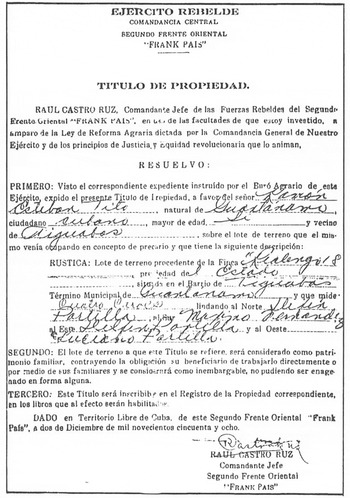
In the Segundo Frente Oriental, Raúl ordered rebels to search among campesinos for unused lands to share with other peasants.Footnote 100 But the only property titles distributed, perhaps in symbolic concession, were given to peasants occupying the historic state-owned lands of Realengo 18, where armed peasants had defended their land since the 1930s. One of the titles, dated December 2, 1958, and signed by Raúl Castro, granted property to Ramón Esteban Tito from Tiguabos, Guantánamo. Esteban's title document was a mimeographed form headed “Central Command of the Rebel Army, Second Front ‘Frank País,’” with blank spaces for entering information about the new proprietor and his land, suggesting that plans to distribute additional titles likely existed and were possibly cut short by the war's end (see Figure 1).Footnote 101
Land Title Granted by the Segundo Frente Oriental “Frank País” to Ramón Esteban Tito, December 2, 1958

In April 1958, fellow Argentine and journalist Ricardo Masetti asked Che Guevara about plans to implement agrarian reform. In his reply, Che claimed to have a system, “exempt from bureaucratic maneuvering,” in which rebels would calculate “the amount of land needed for the subsistence of a family with two, four, or more children … and give it to them after obtaining a deed from the Rebel Army auditor.”Footnote 102 Up to that point, the rebels had not systematically infringed upon private property rights, having “granted” only lands that belonged to the state. Che noted one exception in which a batistiano's land was seized and plots of two caballerías were granted to the families working that land.Footnote 103 The October land reform law emboldened Che. Knowing that his actions were covered under the legislation, he moved swiftly to redistribute land to peasants in the central Escambray mountain range area under his command.
On November 6, Che issued his first military order, calling for a land census and registry to be created in preparation for distribution of land to peasants.Footnote 104 The Las Villas Front Military Order No. 1 also announced that all campesinos who had spent more than two years renting and working a parcel of land were automatically exempt from future rent payments, and invited them to claim ownership rights over that parcel.Footnote 105 Che opened up a regional office similar to those of the Agrarian Bureaus and convened meetings with local peasants to discuss the implementation of the agrarian law. On the night of November 25, peasants from Trinidad, Sancti Spíritus, and Sagua la Grande gathered to hear his plans for the “expropriation” of two large farms, La Diana, which belonged to a former governor of the province, and Pico Tuerto.
Local peasants wasted no time. Three days after the meeting, they formed their own campesino association. They quickly built bohíos (huts) and planted fruit, vegetables, and coffee on the newly acquired lands. A testimony from Juan Broche, a sub-renter who occupied lands owned by a Batista collaborator, affirms that the 26JM distributed several parcels of land of up to two caballerías to Escambray peasants in the weeks prior to the revolution's triumph.Footnote 106 Landowners, meanwhile, decried the character and pace of the land occupations as “anarchic,” complaining in one case that the peasants had unjustly occupied land that had already been sold, even after the peasants had received appropriate compensation for their removal.Footnote 107
Che ran into trouble when his orders to implement the 26JM's agrarian reform law angered the leaders of competing guerrilla movements in the Escambray, who saw his arrival as infringing upon their territory and considered his application of the agrarian law inappropriate for the region.Footnote 108 The fault lines that were drawn in the Escambray in the fall of 1958, in which Che's implementation of agrarian reform took center stage, would result in a lasting counterrevolutionary movement that made itself felt in the region just months later.
Despite political and practical limitations to its immediate implementation—there was, after all, a war still being fought—the new agrarian reform law empowered peasants in other ways. Not long after the law was announced, Fidel began to receive reports that renters, sharecroppers, and squatters had in fact stopped paying rent, both in cash and in kind, to their landowners, a sign that inhabitants of the liberated territories took seriously the opportunities presented by the law and the rise of the 26JM. In a November 24, 1958, letter to Fidel, Faustino Pérez reported that many peasants and rebels were visiting his office each day, often “in search of the land offered by the agrarian law.” Faustino observed “that [the law] is having its repercussion, and that we need to start thinking about how we are going to implement it. For now, we are taking the information of all those who come and we send them off feeling hopeful.”Footnote 109 Faustino's comment indicates that the Central Command made less effort or perhaps had less opportunity to implement Law No. 3 than other fronts had, and suggests that neither he nor Fidel were aware of the extent to which Raúl Castro and Che Guevara were enacting it in the regions under their command.
Although the Central Command does not appear to have systematically implemented the law, its members did not stop others in the Sierra Maestra who tried. In late 1958, Fidel received a series of reports from 26JM auditors worried that PSP collaborators were proselytizing peasants, attempting to take credit for the improvement of social services, and pushing for reckless land occupations. The reports suggest that “the socialists” also took the opportunities presented by Law No. 3 seriously, pursuing their own radicalization of land reform policies in the liberated territories during the last quarter of 1958. When asked by auditors how to react, Fidel—perhaps seeking to avoid partisan conflict, or instead in silent acknowledgment of the contributions made by PSP members to the anti-Batista struggle—simply ordered his rebels to take no action against them.Footnote 110
To many members of the 26JM, the PSP's attitude showed that the organization was opportunistic, too willing to side with the enemy, and essentially insincere. For others, the fight to liberate Cuba from Batista was itself an anti-Communist struggle, so their participation in the coalition was unwelcome. For Fidel and his troops, the stakes were high regarding the acceptance of the PSP into the insurgency. On one hand, the 26JM and its forces would be no different from Batista if they excluded, demonized, or persecuted the PSP, as Batista had done. On the other hand, Fidel knew that the world, the United States especially, was watching the bearded guerillas closely, attempting to discern whether they were, in fact, communists.Footnote 111
As the anti-Batista coalition grew to incorporate a variety of political interests and ideologies, its members converged around the sense that a major change to landholding structures was necessary. But disagreements broke out over what an agrarian reform would look like, and over the extent of its radicalization. Regional PSP leaders, along with some 26JM members, adhered to a notion of agrarian reform that granted land to all poor peasants at no cost to them, and the expropriation of that land from owners. Others, more willing to protect rights to private property and concerned with maintaining the agricultural productivity of large farms imagined a less radical regime. Debates and polemics about the nature of agrarian reform born during the insurgency would play out furiously throughout 1959 and cause intense political repercussions during the first years of the revolution.
Conclusion
The popularity of the 26JM's revolutionary mission in rural Cuba was inseparable from its project of agrarian reform. The Rebel Army's legislation and audacious implementation of agrarian policies in the liberated territories was crucial to the survival and triumph of the guerrilla war against Batista and provided a workshop in which rebels experimented with how to run a state. At the same time, the implementation of agrarian policy was a testing ground for peasant acceptance of government presence in the remote parts of the Sierra Maestra and Sierra Cristal, areas relatively free of state intrusion since before the establishment of the Cuban Republic in 1902.
In acquiescing to the rebels’ revolutionary program, accepting their resources, and collaborating with them in the implementation of social policy, Oriente's campesinos bestowed the 26JM with the legitimacy it needed. In turn, the participation of peasants gave them a platform from which they could articulate a set of demands for agrarian reform and push those demands onto the platform of rebel leadership, compelling the latter to commit to fighting for the interests of landless Cubans and consequently shaping the insurgency and the future of the revolution itself. Indeed, many of the 26JM's peasant and socialist collaborators would go on to work within the revolutionary government that they helped push into power. Their early incorporation into the revolutionary project provided a fundamental pillar on which support for the revolution within Cuba has rested since 1958. Meanwhile, backlash resulting from the 26JM's agrarian policies led to diplomatic and internal conflict that would define the Cuban Revolution for decades to come.