Introduction
Alcohol is one of the most commonly used substances by adolescents, with 59% reporting initiation and 43% reporting having been intoxicated by late adolescence (grade 12) (Johnston et al., Reference Johnston, Miech, O'Malley, Bachman, Schulenberg and Patrick2019). Early alcohol use is a reliable predictor of negative outcomes later in life, including worsened mental health and psychosocial functioning, increased likelihood of adult antisocial behavior, legal problems, escalation to alcohol/drug misuse, and development of substance use disorders (Poikolainen et al., Reference Poikolainen, Tuulio-Henriksson, Aalto-Setälä, Marttunen and Lönnqvist2001; Flory et al., Reference Flory, Lynam, Milich, Leukefeld and Clayton2004; Malone et al., Reference Malone, Taylor, Marmorstein, McGue and Iacono2004; Wells et al., Reference Wells, Horwood and Fergusson2004; Iacono et al., Reference Iacono, Malone and McGue2008; Hicks et al., Reference Hicks, Iacono and McGue2010; Foster et al., Reference Foster, Hicks, Iacono and McGue2014; Irons et al., Reference Irons, Iacono and McGue2015; Savage et al., Reference Savage, Rose, Pulkkinen, Silventoinen, Korhonen, Kaprio, Gillespie and Dick2018). Evidence suggests that many of these prospective associations may be due (in part) to the potential causal effects of early drinking (Deutsch et al., Reference Deutsch, Slutske, Richmond-Rakerd, Chernyavskiy, Heath and Martin2013; Irons et al., Reference Irons, Iacono and McGue2015), and the developing adolescent brain may be particularly sensitive to the potential effects of alcohol exposure (Crews and Boettiger, Reference Crews and Boettiger2009; Jacobus and Tapert, Reference Jacobus and Tapert2013), even at non-pathological levels (Luciana et al., Reference Luciana, Collins, Muetzel and Lim2013; Squeglia et al., Reference Squeglia, Tapert, Sullivan, Jacobus, Meloy, Rohlfing and Pfefferbaum2015; Pfefferbaum et al., Reference Pfefferbaum, Kwon, Brumback, Thompson, Cummins, Tapert, Brown, Colrain, Baker, Prouty, De Bellis, Clark, Nagel, Chu, Park, Pohl and Sullivan2018) (although see Malone et al., Reference Malone, Luciana, Wilson, Sparks, Hunt, Thomas and Iacono2014; Wilson et al., Reference Wilson, Malone, Thomas and Iacono2015). Identifying the biological/neurocognitive factors conferring risk for the development of normative drinking is of significant importance given the high prevalence of non-pathological (relative to pathological) adolescent alcohol use (Substance Abuse and Mental Health Services Administration, 2018) and its potential deleterious outcomes, and yet this remains an under-studied area.
Alcohol and substance use are associated with individual differences in the prefrontal cortex and related neurocognitive mechanisms, including variations in decision making and control-related attentional processes (Field and Cox, Reference Field and Cox2008; Casey and Jones, Reference Casey and Jones2010; Koob and Volkow, Reference Koob and Volkow2010; Luciana and Collins, Reference Luciana and Collins2012; Jacobus and Tapert, Reference Jacobus and Tapert2013; Wiers et al., Reference Wiers, Boelema, Nikolaou and Gladwin2015) that may amplify risk toward alcohol initiation/use (Iacono et al., Reference Iacono, Malone and McGue2008; Tessner and Hill, Reference Tessner and Hill2010; Zucker et al., Reference Zucker, Heitzeg and Nigg2011; Wiers et al., Reference Wiers, Boelema, Nikolaou and Gladwin2015). Laboratory-based neurobehavioral endophenotypes can serve as useful tools to identify the neural mechanisms involved in the development and expression of a clinical phenotype such as alcohol use (Gottesman and Gould, Reference Gottesman and Gould2003; Anokhin, Reference Anokhin2014; Salvatore et al., Reference Salvatore, Gottesman and Dick2015; Iacono et al., Reference Iacono, Malone and Vrieze2017). As indicated in a recent extensive review of psychiatric endophenotypes (Iacono et al., Reference Iacono, Malone and Vrieze2017), one of the most compelling but under-researched characteristics of endophenotypes is their ability to predict onset of a clinical phenotype before its presentation. Endophenotypes that can potentially identify those at high risk for alcohol use well before initiation may have important clinical utility for early identification and prevention efforts. Despite this promising quality, more research is needed to better understand the prospective clinical utility and incremental predictive power of endophenotypes.
Arguably the most well-replicated neurobiological risk factor for alcohol use is the parietal target/oddball P3 event-related potential (ERP) (Iacono and Malone, Reference Iacono and Malone2011; Euser et al., Reference Euser, Arends, Evans, Greaves-Lord, Huizink and Franken2012). P3 is elicited by the detection of rare targets and is a neural correlate of decision making and signal matching, such as monitoring whether the classification of a stimulus and the associated chosen response choice is appropriate (Başar-Eroglu et al., Reference Başar-Eroglu, Başar, Demiralp and Schürmann1992; Nieuwenhuis et al., Reference Nieuwenhuis, Aston-Jones and Cohen2005; Verleger et al., Reference Verleger, Jaskowski and Wascher2005; Barry et al., Reference Barry, Steiner and De Blasio2016) (for a detailed review, see Verleger and Śmigasiewicz, Reference Verleger and Śmigasiewicz2016). Among adolescents with little to no substance exposure, reduced P3 amplitude increases the odds of prospectively developing an alcohol use disorder by late adolescence/young adulthood (AUD) (Berman et al., Reference Berman, Whipple, Fitch and Noble1993; Hill et al., Reference Hill, Steinhauer, Lowers and Locke1995, Reference Hill, Steinhauer, Locke-Wellman and Ulrich2009; Iacono et al., Reference Iacono, Carlson, Malone and McGue2002; Carlson et al., Reference Carlson, Iacono and McGue2004; Habeych et al., Reference Habeych, Charles, Sclabassi, Kirisci and Tarter2005; Perlman et al., Reference Perlman, Markin and Iacono2013; Yoon et al., Reference Yoon, Malone and Iacono2015). From a neurocognitive perspective, diminished parietal P3 may contribute to disadvantageous decisional processes or action-monitoring processes that contribute to inappropriate actions/choices and suboptimal or problematic behaviors such as adolescent drinking. The majority of prospective P3 studies have focused on predicting pathological alcohol use in predominantly male samples (Iacono and Malone, Reference Iacono and Malone2011; Euser et al., Reference Euser, Arends, Evans, Greaves-Lord, Huizink and Franken2012), and work is needed to address whether P3 reduction prospectively predicts the development of normative adolescent drinking and if these effects vary by sex.
While P3 is arguably the most well-studied candidate endophenotype indexing genetic risk for alcohol use development (Iacono and Malone, Reference Iacono and Malone2011; Euser et al., Reference Euser, Arends, Evans, Greaves-Lord, Huizink and Franken2012; Iacono et al., Reference Iacono, Malone and Vrieze2017), it is primarily an index of parietal activation (Barry et al., Reference Barry, Steiner, De Blasio, Fogarty, Karamacoska and MacDonald2019) and it is unclear whether prefrontal EEG/ERP components predict adolescent drinking. Given its suggested role in facilitating motivated behavioral responses (Delorme et al., Reference Delorme, Westerfield and Makeig2007; Cohen and Cavanagh, Reference Cohen and Cavanagh2011; Cavanagh and Frank, Reference Cavanagh and Frank2014), individual differences in midfrontal theta rhythms may reflect an electrophysiological index of dysregulated control-related processes (e.g. attentional control, action monitoring) relevant to adolescent drinking (Iacono et al., Reference Iacono, Malone and McGue2008; Casey and Jones, Reference Casey and Jones2010; Koob and Volkow, Reference Koob and Volkow2010; Zucker et al., Reference Zucker, Heitzeg and Nigg2011). Current cognitive models suggest that variations in theta, likely mediated by medial frontal/cingulate cortical sources (Makeig et al., Reference Makeig, Delorme, Westerfield, Jung, Townsend, Courchesne and Sejnowski2004; Delorme et al., Reference Delorme, Westerfield and Makeig2007; Cavanagh and Frank, Reference Cavanagh and Frank2014), reflect a reactive processing mechanism signaling the need for enhanced attentional allocation, orienting, and control-related processes toward salient events (e.g. rare targets; Başar-Eroglu et al., Reference Başar-Eroglu, Başar, Demiralp and Schürmann1992; Cavanagh et al., Reference Cavanagh, Zambrano-Vazquez and Allen2012; Clayton et al., Reference Clayton, Yeung and Kadosh2015; Harper et al., Reference Harper, Malone and Iacono2017b; Bachman and Bernat, Reference Bachman and Bernat2018) during action monitoring and behavioral control (Cavanagh et al., Reference Cavanagh, Zambrano-Vazquez and Allen2012; Cohen, Reference Cohen2014b; Clayton et al., Reference Clayton, Yeung and Kadosh2015). Prior work from our group and others suggests that reduced target-related theta power is associated with alcohol and substance use/externalizing psychopathology (Jones et al., Reference Jones, Porjesz, Chorlian, Rangaswamy, Kamarajan, Padmanabhapillai, Stimus and Begleiter2006; Andrew and Fein, Reference Andrew and Fein2010; Yoon et al., Reference Yoon, Malone, Burwell, Bernat and Iacono2013; Burwell et al., Reference Burwell, Malone, Bernat and Iacono2014). Diminished target-related theta is also observed in the high-risk adolescent offspring of alcoholics (Rangaswamy et al., Reference Rangaswamy, Jones, Porjesz, Chorlian, Padmanabhapillai, Kamarajan, Kuperman, Rohrbaugh, O'Connor, Bauer, Schuckit and Begleiter2007), and is heritable and shares genetic variance with problematic alcohol/substance use (Harper et al., Reference Harper, Malone and Iacono2019), which offer evidence that theta represents a potential candidate endophenotype for alcohol use. However, it is unknown whether reduced midfrontal theta before alcohol initiation can prospectively predict the development of alcohol use emerging in adolescence. This key standard must be met to establish that the candidate endophenotype is state-independent and provides potential clinical utility by predicting development of the clinical phenotype.
The current study was designed to test whether reductions in parietal P3 and midfrontal theta elicited during a visual oddball task predict the normative expression and initiation of alcohol use emerging in adolescence in a large epidemiological sample prospectively assessed throughout adolescence (ages 11, 14, and 17). We hypothesized that diminished P3 and theta at age-14 would each independently predict greater self-reported alcohol use at age-17. We expected that this prospective relationship would be specific to the rare target/oddball condition due to its demands on attentional control and decision-making processes as indexed by theta and P3, respectively. We tested whether any significant effects held after accounting for prominent risk factors (parental AUD; alcohol/tobacco/illicit drug initiation by age-14). We also addressed the question of whether reduced P3 and midfrontal theta in alcohol-naive individuals at age-14 predict new-onset alcohol use by age-17. Follow-up analyses were conducted to determine if the prospective P3/theta effects held for both males and females.
Significant findings would support the hypothesis that reductions in midfrontal theta and parietal P3 are present before alcohol initiation and contribute to the development of adolescent normative drinking in late adolescence; that is, the range of alcohol use behavior and consumption arising in a community-based representative sample of children first recruited for study during the year they turned 11 years old.
Methods
Sample
Participants were adolescent same-sex twins from the longitudinal population-based Minnesota Twin Family Study Enrichment Sample (Keyes et al., Reference Keyes, Malone, Elkins, Legrand, McGue and Iacono2009). Participants with relevant EEG data (described below) at age-14 were considered for the present study (N = 780). Fifty-two were excluded for EEG recording issues; 13 were excluded for task performance ⩽50%. Of the remaining 715, 594 (303 females) had complete alcohol use data at the target ages of 11 (age: mean [s.d.] = 11.80 years [0.40]), 14 (14.93 [0.49]), and 17 (17.76 [0.36]) (see online Supplementary Material for attrition analyses). Participants were recruited from the State of Minnesota birth certificate registry and were broadly representative of Minnesota families with children living at home according to the 2000 US Census. Families were eligible to participate if they lived within a day's drive of the University of Minnesota and if the children had no physical or psychological impairment that would interfere with their providing informed assent and completing the intake assessment. Using publicly available databases (e.g. phone books, Internet directories), 82% of living registry twins were located and invited to participate, and 83% of those asked to join the study agreed to do so. For the purpose of the current study, we treated the twins as individuals while accounting for the nested structure of familial data in statistical analyses.
Alcohol and substance use assessment
At each assessment, individuals reported on lifetime and past 12-month substance use using a computerized substance use inventory (McGue et al., Reference McGue, Malone, Keyes and Iacono2014; Saunders et al., Reference Saunders, McGue, Iacono and Elkins2017) administered in a private room. Age-11 and age-14 measures were aggregated to measure cumulative use/initiation by age-14.
A composite drinking index (Malone et al., Reference Malone, Luciana, Wilson, Sparks, Hunt, Thomas and Iacono2014; McGue et al., Reference McGue, Malone, Keyes and Iacono2014; Harper et al., Reference Harper, Malone and Iacono2017a) measuring past 12-month alcohol use was computed by summing four items: frequency of drinking; typical number of drinks per occasion; maximum number of drinks consumed at one time; and frequency of intoxications (possible range: 0–18; see online Supplementary Table S1 for details). The index had excellent internal consistency (Cronbach's α: age-11/14 = 0.93, age-17 = 0.94; item-wise correlations: age-11/14 = 0.65–0.96, age-17 = 0.75–0.91).
Binary (yes/no) measures were used to investigate new onset of alcohol use behaviors, specifically: ever using alcohol (without parental permission); ever being intoxicated from alcohol; and ever engaging in binge drinking (consuming five or more drinks for males/four or more drinks for females, at one time) (Substance Abuse and Mental Health Services Administration, 2018).
Parents reported on their history of alcohol dependence/abuse symptoms (DSM, Fourth ed.; American Psychiatric Association, 1994) at the adolescent's age-11 and age-17 assessments (see online Supplementary Material). For each adolescent, parental alcohol use disorder (AUD) status was defined as positive if at least one parent met criteria for AUD at either assessment; 304 adolescents (169 out of 337 individual families) were positive for parental AUD.
To control for other forms of substance use initiation by age-14, tobacco use was defined as ever using tobacco (more than a small amount, e.g. at least a full cigarette/cigar), and illicit drug use was defined as ever using any of the following substances to get intoxicated (ordered in decreasing endorsement frequency): cannabis, inhalants, stimulants, psychedelics (e.g. PCP, LSD), steroids, cocaine, Quaaludes, heroin or other opiates, tranquilizers.
Oddball task
At the age-14 assessment, EEG and behavioral data were collected during a visual rotated heads oddball task (Begleiter et al., Reference Begleiter, Porjesz, Bihari and Kissin1984). Eighty target trials [stimuli: white schematic heads (oval with stylized nose and a single ear on the left or right side)] were pseudorandomly interspersed among 160 standard trials (stimuli: white oval). Participants were asked to respond with either a right or left button press to indicate the side of the head on which the ear appeared for targets (equal number of left- or right-response targets), and to not respond to standards. The nose pointed up (easy/unrotated condition) for half of the target trials, and pointed down (hard/rotated condition) for the remainder (the easy and hard target trials were combined in all analyses). Stimulus duration was 100 ms, the response window was 1500 ms, and after the complete response window, a randomized intertrial interval (central fixation dot) separating trials varied between 1000 and 2000 ms. Relevant behavioral measures include target hit rate, mean target reaction time, and reaction time variability (intraindividual standard deviation of RT).
EEG recording, processing, and signal analysis
Continuous 61-channel EEG was collected at age-14 and processed as described in our previous reports (Harper et al., Reference Harper, Malone and Iacono2017b, Reference Harper, Malone and Iacono2019) (see online Supplementary Material).
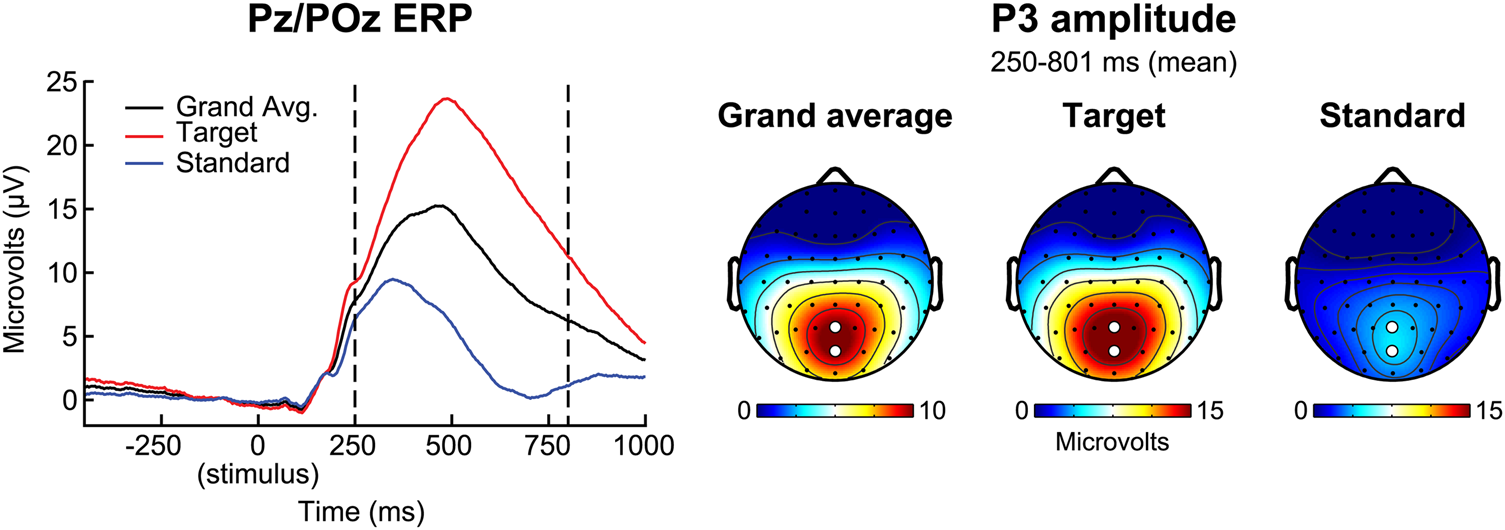
Trial-averaged ERPs were computed separately for target and standard trials/conditions (error trials were excluded from analyses). Based on the grand averaged ERP (Fig. 1), P3 amplitude was quantified as the mean amplitude between 250 and 801 ms (relative to a −450 to −250 ms average baseline) pooled across electrodes Pz/POz.
Parietal P3. (Left) Grand-averaged and condition-averaged event-related potentials (ERPs) plotted as the mean across parietal electrodes Pz and POz. Dashed lines indicate the P3 time window. Stimulus onset corresponds to 0 ms. (Right) The topography of grand-averaged and condition-averaged mean P3 voltage (250–801 ms) indicating a parietal maximum at Pz and POz (white electrodes). The reader is referred to the web version of this article for the full color figure.

Trial-level signals were transformed into time-frequency representations using complex Morlet wavelet convolution (Cohen, Reference Cohen2014a) (see online Supplementary Material). Trial-averaged power was calculated separately by condition and baseline adjusted (decibel transform; separately across conditions/frequencies) relative to the mean −450 to −250 ms prestimulus power.
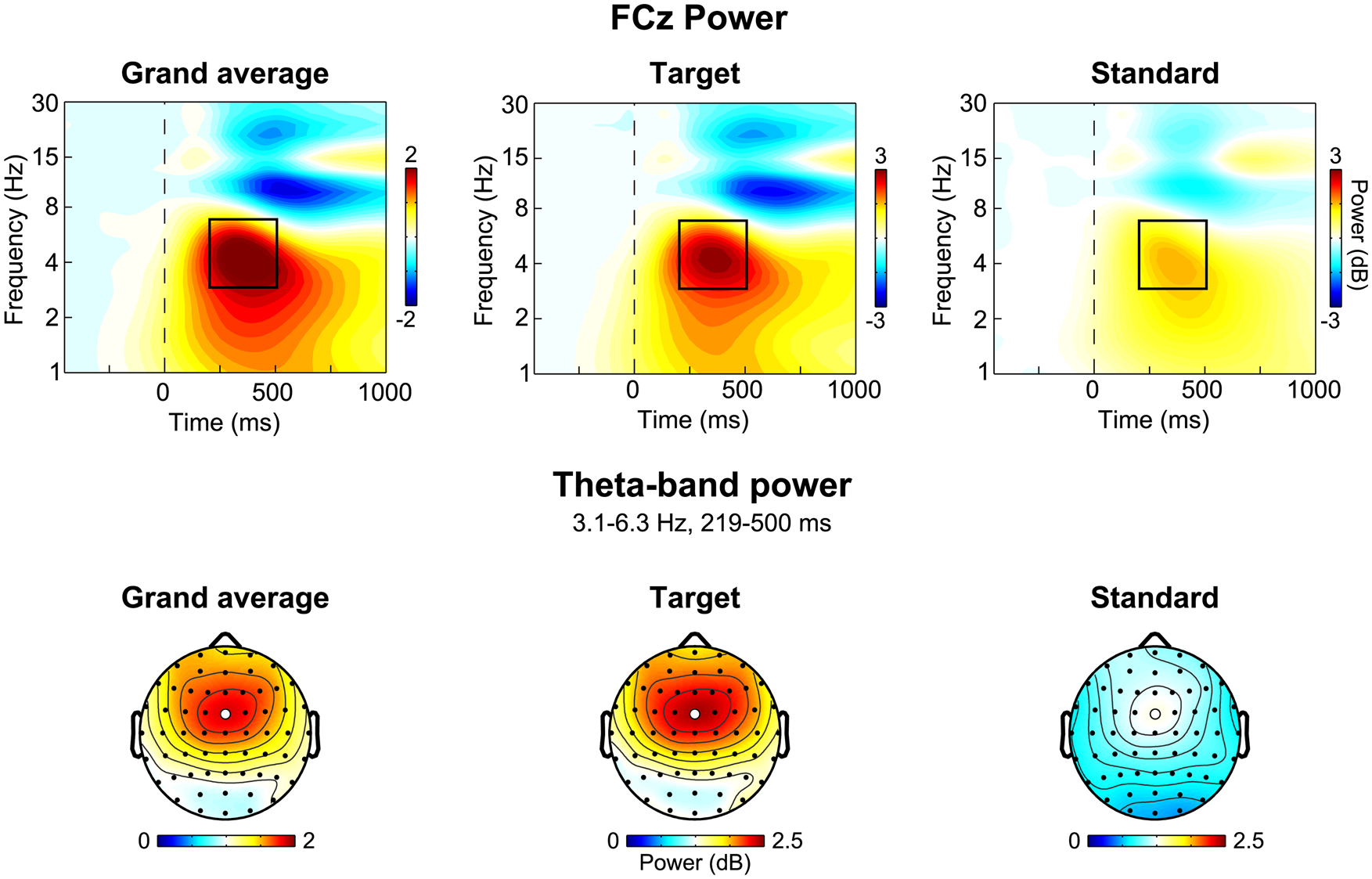
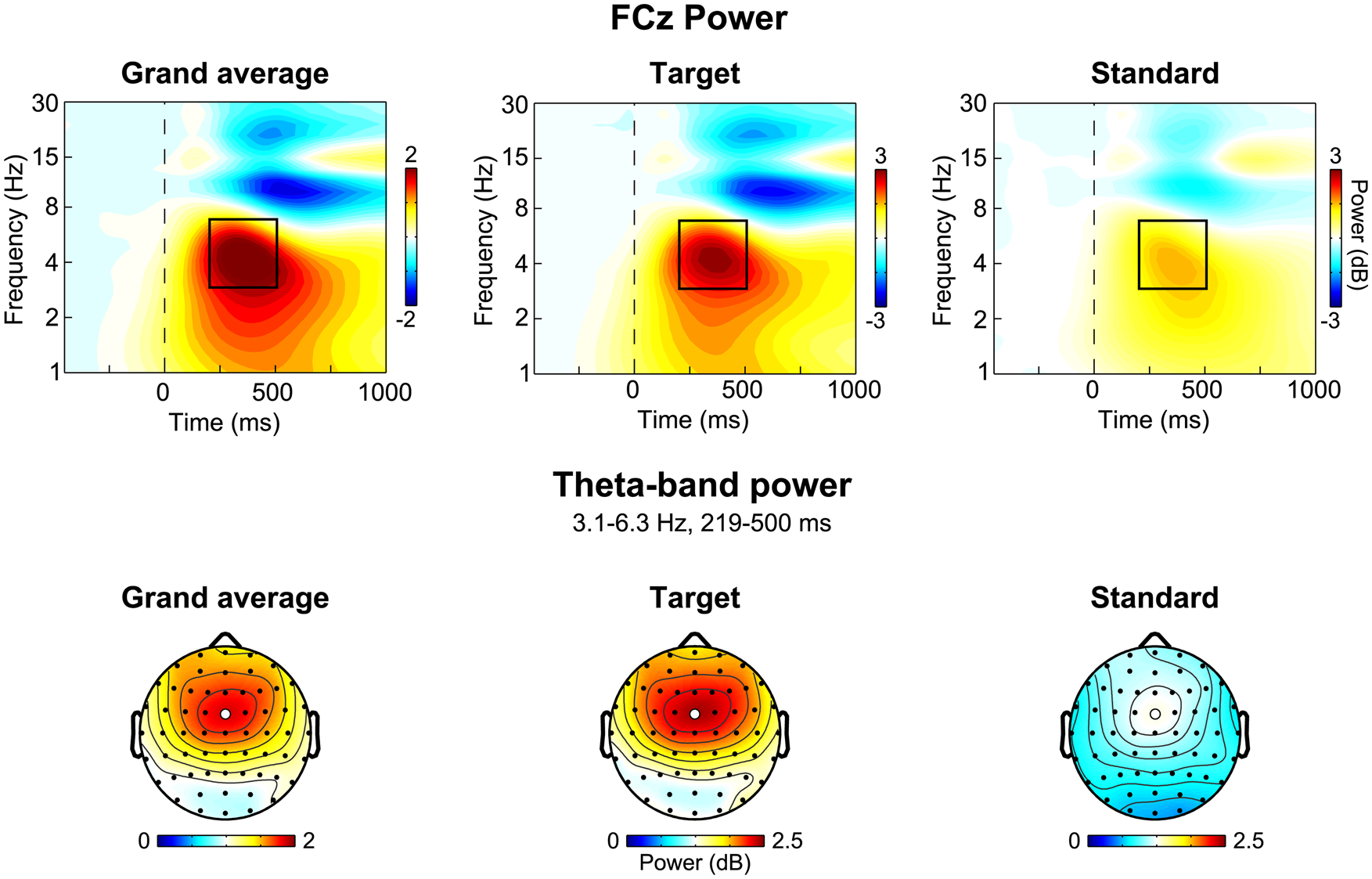
As shown in Fig. 2, grand averaged post-stimulus time-frequency power increased in the theta-band (3.1–6.3 Hz) between 219 and 500 ms with a midfrontal peak at FCz. Theta was quantified as the average power across this region of interest at FCz.
Midfrontal theta power. (Top) Grand-averaged and condition-averaged time-frequency power at midfrontal electrode FCz. Black boxes denote the region of interest used for theta in statistical analyses. Stimulus onset corresponds to 0 ms. (Bottom) The corresponding topography of theta-band power (3.1–6.3 Hz, 218–500 ms) indicating a spatial maximal at midfrontal electrode FCz (white electrode). The reader is referred to the web version of this article for the full color figure.
Statistical analyses
Statistics were conducted in R (R Core Team, 2018). Linear mixed models (LMMs) were fit using the lme4 package (Bates et al., Reference Bates, Machler, Bolker and Walker2015) using Kenward–Roger approximated denominator degrees of freedom (Kuznetsova et al., Reference Kuznetsova, Brockhoff and Christensen2017). Random intercepts at the individual and family levels accounted for within-individual and within-twin-pair correlations, respectively.
To test if age-14 P3 and theta predicted age-17 alcohol use, a prospective LMM (lmer function) was initially fit as a covariate-only model with age-17 drinking index scores as the dependent variable and sex, parental AUD, and age-11/14 drinking index scores as fixed-effect predictors. Next, age-14 P3 and midfrontal theta were entered (separately for targets and standards). The fit of this model was compared to the covariate-only model using a likelihood ratio test on the difference in the −2 log-likelihood (χ2 distribution approximation); a significant change provides evidence that P3 and theta improved model fit/prediction. Standardized regression coefficients (β) with 95% confidence intervals (Lüdecke, Reference Lüdecke2019) are presented as effect size estimates. R 2 was calculated using the method proposed by Jaeger et al. (Reference Jaeger, Edwards, Das and Sen2017) for LMMs.
To test whether age-14 P3 and theta predicted new onset/initiation of alcohol use behaviors in individuals with no reported alcohol use by age-14, a series of generalized LMMs (glmer function in lme4; logistic regressions; logit link function) were fit separately for three age-17 binary-dependent variables: ever used alcohol (without parental permission); ever been intoxicated; and ever engaged in binge drinking. Age-14 theta and P3 scores served as predictors alongside sex and parental AUD. The odds ratio (OR), reflecting change in the likelihood of developing the specified alcohol use behavior by age-17 per one-unit change in age-14 P3 or theta, was considered significant if the 95% confidence interval did not span one. We also assessed whether age-14 P3 and theta predicted the development of drinking index scores by age-17 among age-14 non-users.
To assess whether effects remained significant after accounting for other forms of substance initiation, significant findings were recomputed including tobacco or illicit drug initiation by age-14 as predictors (n = 586; eight participants had incomplete data).
Two sets of follow-up analyses were conducted. First, to determine if the EEG effects could be attributed to performance differences, models were fit for task-related behavioral measures [target mean RT and RT variability, target percent correct (arcsine transformed)]. Second, to evaluate whether the P3/theta effects were conditional on sex, significant models were recomputed adding an EEG (theta or P3) by sex (center effect coded for female) interaction term.
Results
Descriptive statistics
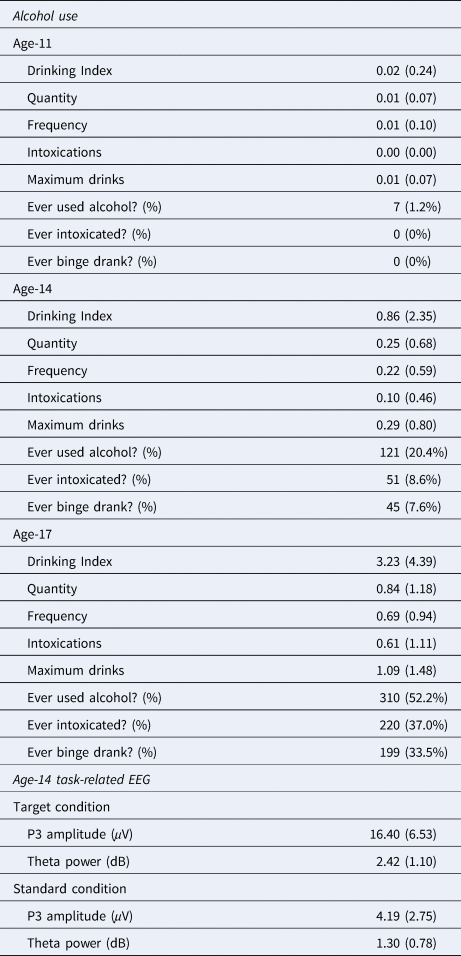
Descriptive statistics are provided in Table 1. Drinking index scores increased from age-11 to age-14 (β [95% CI] = 0.24 [0.18–0.31], t (593) = 7.27, p < 0.001) and from age-14 to age-17 (β = 0.32 [0.28–0.36], t (593) = 14.65, p < 0.001). Of note is the lack of use at age-11; only three individuals had non-zero index scores and no individual reported any history of intoxication. By age-14, only 121 individuals (20.4%) reported alcohol initiation. At age-17, 310 (52.2%) had initiated alcohol use. The mean drinking index score for those who initiated drinking by age-17 was 6.19 (s.d. = 4.30; range: 0–17). For those with age-17 scores of at least 6, their average past year use corresponded to drinking 1–3 times per month, 4–6 drinks each time, as many as 7–9 at one time, and having been intoxicated about once per month.
Descriptive statistics

μV, microvolt; dB, decibel.
Values given are mean (standard deviation) unless otherwise noted.
Age-14 parietal P3 amplitude was larger during target trials than standard trials (Fig. 1; β = 0.77 [0.75–0.80], t (593) = 54.31, p < 0.001). Midfrontal theta was enhanced during rare target trials compared to standard trials (Fig. 2; β = 0.51 [0.47–0.54], t (593) = 27.55, p < 0.001). Neither measure differed by sex [|t|(330) ⩽ 0.80, p ⩾ 0.425].
Age-14 P3/theta predicting age-17 normative alcohol use
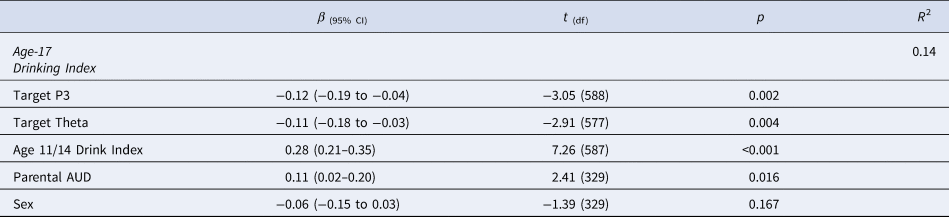
As shown in Table 2, reduced age-14 target P3 and theta prospectively predicted greater drinking index scores 3 years later. Theta and P3 explained unique variance in age-17 drinking scores, suggesting that these measures reflect distinct electrophysiological processes relevant to adolescent drinking (P3-theta zero-order correlation = 0.06). Notably, P3 and theta contributed incremental predictive power of age-17 drinking beyond relevant covariates, including parental AUD and age-11/14 drinking.
Prospective prediction of normative alcohol use at age-17 using age-14 target-related midfrontal theta power and parietal P3 amplitude

CI, confidence interval; AUD, alcohol use disorder
Note: The model fit well [F (5, 501) = 16.83, p < 0.001]. Including target-related theta and P3 improved model fit/prediction [Δχ2(2) = 18.96, p < 0.001; ΔR 2 = 0.03] beyond the covariate-only model (i.e. age 11/14 drink index, sex, parental AUD)
There was no significant effect for age-14 P3 or theta elicited by standard stimuli [ps ⩾ 0.106; change in model fit: Δχ2(2) = 2.96, p = 0.228].
Predicting new-onset alcohol use by age-17 in age-14 non-drinkers
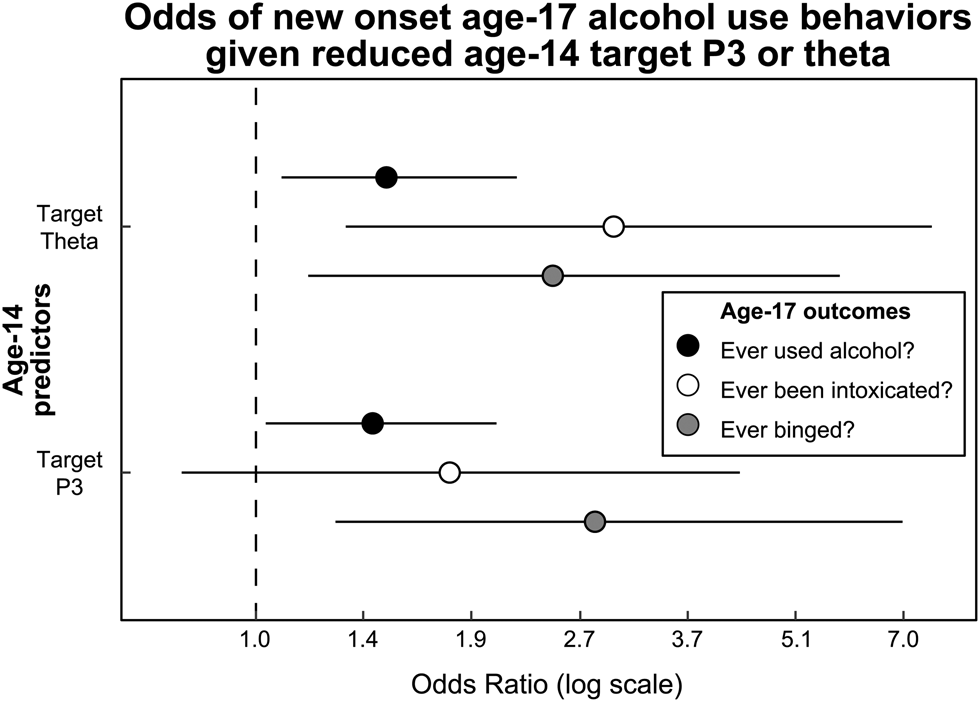
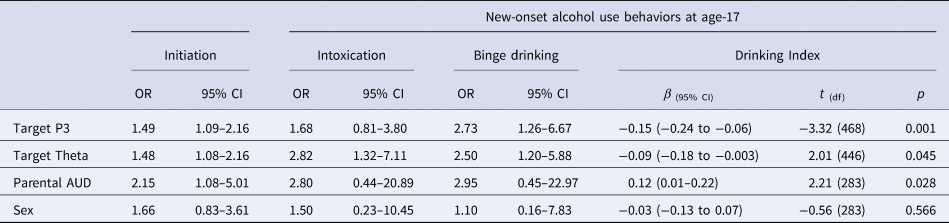
To determine if age-14 target P3 and theta predict the new onset of alcohol use behaviors at age-17, the following analyses were restricted to individuals with no alcohol use by age-14 (n = 473). Results are shown in Table 3 and Fig. 3. Smaller theta and P3 uniquely predicted greater likelihood of new-onset age-17 alcohol use initiation and binge drinking. Decreased theta predicted increased odds of new-onset alcohol intoxication; the P3 effect was in the expected direction but non-significant. Lower P3 and theta also significantly predicted the expression of normative alcohol use (i.e. drinking index scores) by age-17 (Table 3). Again, P3 and theta improved model fit/prediction.
Prospective odds of new-onset alcohol use behaviors at age-17 given age-14 P3 and theta among adolescents with no alcohol use by age-14 (n = 473). Separate generalized linear mixed models (logistic regression) were fit for the three alcohol initiation measures. Significant odds ratios (ORs) above one reflect the odds of developing the indicated alcohol use behavior by age-17 associated with a decrease in target-related parietal P3 or midfrontal theta at age-14 (theta and P3 were multiplied by −1 to produce the inverse relationship). ORs that do not cross one (dashed line) are significant (whiskers signify 95% confidence intervals). Note that because theta (log decibel) and P3 (linear microvolt) are measured on different scales, these measures were standardized for the logistic generalized linear mixed models to facilitate direct comparison of the ORs.

Prospective analyses predicting new onset of alcohol use by age-17 using age-14 target parietal P3 and midfrontal theta

OR, odds ratio; CI, confidence interval
Note: Analyses were restricted to individuals with no reported alcohol use by age-14 (n = 473). Significant odds ratios above one reflect the increased odds of developing the indicated alcohol use behavior by age-17 associated with a decrease in target-related parietal P3 or midfrontal theta at age-14 (theta and P3 were multiplied by −1 to produce the inverse relationship). Note that because theta (log decibel) and P3 (linear microvolt) are measured on different scales, these measures were standardized for the generalized linear mixed models (logistic regression) to facilitate direct comparison of the ORs. In all models, P3 and theta improved model fit/prediction beyond parental AUD status and sex [Δχ2(2) ⩾ 9.98, p ⩽ 0.007]. R 2 for the drinking index model was 0.05 (ΔR 2 after adding theta and P3 = 0.03).
Follow-up analyses
We tested whether the significant age-14 theta/P3 and age-17 drinking effects reported above (i.e. Tables 2 and 3) held after controlling for reported tobacco or illicit drug initiation by age-14. The pattern of results did not change (online Supplementary Tables S2 and S3), despite the fact that other substance initiation accounted for much of the variance in the alcohol outcome measures, indicating that the predictive utility of P3 and theta is robust to co-occurring substance initiation.
To determine if the observed EEG effects could be attributed to associations between task performance (see online Supplementary Materials for descriptives) and alcohol use outcomes, prospective mixed models were computed as above for task-related behavioral measures. No behavioral measure significantly predicted age-17 drinking index scores (ps ⩾ 0.146) or new-onset measures (all ORs spanned zero).
The approximately equal number of females and males in this sample allowed us to test whether the prospective relationships between age-14 target P3/theta and age-17 alcohol use varied by sex. The main results (i.e. Tables 2 and 3) were reanalyzed adding P3 × sex and theta × sex interaction terms. All interaction terms were non-significant (ps ⩾ 0.465 and ORs spanned zero) and did not improve model fit [Δχ2(2) ⩽ 2.03, p ⩾ 0.363], indicating that the associations between attenuated age-14 P3/theta and age-17 alcohol use measures did not statistically differ as a function of sex and held for both males and females.
Conclusions
The current study tested the ability of parietal P3 amplitude and midfrontal theta to prospectively predict the development of normative drinking in a community-based representative sample of 594 adolescents. While past work has focused on using P3 to predict clinically problematic drinking, these results provide new evidence that reduced target-related P3 and theta at age-14 predict the range of alcohol use behavior and consumption arising 3 years later. Furthermore, among individuals with no reported alcohol use by age-14, attenuated P3 and theta increased the odds of new-onset alcohol behaviors by age-17, offering strong support for P3 and theta as candidate endophenotypes. The prospective P3 and theta effects were independent of each other and several prominent risk factors (prior alcohol use, tobacco/illicit drug initiation, parental alcohol use disorder), suggesting that they reflect distinct psychophysiological processes related to alcohol use development. In addition, an important novel finding is that theta and P3 scores provided significant incremental predictive power of future alcohol use beyond relevant risk factors. Overall, the current report is the first of our knowledge to demonstrate that deviations in parietal P3 and midfrontal theta are present prior to the initiation of alcohol use and prospectively predict the emergence of normative (full range)/non-pathological drinking in a large epidemiologically representative adolescent sample.
Results from the current study build upon prior research demonstrating that diminished P3 is a premorbid risk factor for the development of substance use disorders (Iacono et al., Reference Iacono, Carlson, Malone and McGue2002; Habeych et al., Reference Habeych, Charles, Sclabassi, Kirisci and Tarter2005; Hill et al., Reference Hill, Steinhauer, Locke-Wellman and Ulrich2009; Iacono and Malone, Reference Iacono and Malone2011; Yoon et al., Reference Yoon, Malone and Iacono2015), and delinquent behaviors/substance use among adolescent males at high risk for alcoholism (Berman et al., Reference Berman, Whipple, Fitch and Noble1993). Increased alcohol use was predicted most strongly by P3 and theta during the cognitive demands of rare target detection. P3 elicited by the target condition is thought to index elaborative decisional processes to quickly and accurately determine the appropriate stimulus–response mapping (Polich, Reference Polich2007; Verleger et al., Reference Verleger, Baur, Metzner and Smigasiewicz2014; Barry et al., Reference Barry, Steiner and De Blasio2016), whereas midfrontal theta likely reflects prefrontal attentional and control-related mechanisms to facilitate goal-directed behavior (Cavanagh et al., Reference Cavanagh, Zambrano-Vazquez and Allen2012; Clayton et al., Reference Clayton, Yeung and Kadosh2015). Therefore, diminished P3 may confer vulnerability for suboptimal decision-making processes that influence the development/expression of inappropriate behaviors, while reduced attentional control-related midfrontal theta may contribute to a bias toward (or difficulty shifting attention from) alcohol/substance cues or immediate rewards. This interpretation is consistent with theoretical models implicating differences in adolescent motivational/decisional and regulatory-control systems as developmental risk factors for alcohol and substance use (Iacono et al., Reference Iacono, Malone and McGue2008; Casey and Jones, Reference Casey and Jones2010; Luciana and Collins, Reference Luciana and Collins2012; Squeglia and Gray, Reference Squeglia and Gray2016). The current findings using psychophysiological measures align with work suggesting that variations in frontal brain structure/activity (Norman et al., Reference Norman, Pulido, Squeglia, Spadoni, Paulus and Tapert2011; Wetherill et al., Reference Wetherill, Castro, Squeglia and Tapert2013; Castellanos-Ryan et al., Reference Castellanos-Ryan, Struve, Whelan, Banaschewski, Barker, Bokde, Bromberg, Buchel, Frouin, Gallinat, Gowland, Heinz, Lawrence, Martinot, Nees, Paus, Pausova, Rietschel, Robbins, Smolka, Schumann, Garavan and Conrod2014; Whelan et al., Reference Whelan, Watts, Orr, Althoff, Artiges, Banaschewski, Barker, Bokde, Büchel, Carvalho, Conrod, Flor, Fauth-Bühler, Frouin, Gallinat, Gan, Gowland, Heinz, Ittermann, Lawrence, Mann, Martinot, Nees, Ortiz, Paillère-Martinot, Paus, Pausova, Rietschel, Robbins, Smolka, Ströhle, Schumann and Garavan2014) and neuropsychological measures of executive functioning/cognitive control (Tarter et al., Reference Tarter, Kirisci, Mezzich, Cornelius, Pajer, Vanyukov, Gardner, Blackson and Clark2003; Nigg et al., Reference Nigg, Wong, Martel, Jester, Puttler, Glass, Adams, Fitzgerald and Zucker2006) reflect premorbid characteristics that predict future non-clinical alcohol involvement.
A valuable characteristic of endophenotypes is their ability to predict the development of the clinical phenotype, and demonstrating that endophenotypes account for significant unique additional variance in predicting an outcome is an important criterion to establish their potential utility and possible integration with clinical assessments (Patrick et al., Reference Patrick, Iacono and Venables2019). Despite its importance, this point has received little attention in the field of psychiatric endophenotypes (Iacono et al., Reference Iacono, Malone and Vrieze2017). An important novel aspect of the current report is the demonstration that parietal P3 and midfrontal theta contributed unique incremental predictive value of age-17 alcohol use and new-onset cases over and above prominent risk factors (co-occurring/antecedent alcohol use; tobacco/illicit drug initiation; parental AUD). This indicates that the combination of self-report and EEG measures provided the strongest prediction of future alcohol use, which is consistent with a recent study that showed age-16 binge drinking was best predicted by the joint use of age-14 externalizing, personality, and structural/functional MRI variables (Whelan et al., Reference Whelan, Watts, Orr, Althoff, Artiges, Banaschewski, Barker, Bokde, Büchel, Carvalho, Conrod, Flor, Fauth-Bühler, Frouin, Gallinat, Gan, Gowland, Heinz, Ittermann, Lawrence, Mann, Martinot, Nees, Ortiz, Paillère-Martinot, Paus, Pausova, Rietschel, Robbins, Smolka, Ströhle, Schumann and Garavan2014). While endophenotype data collection is relatively costly and lab intensive, the current results suggest that P3 and theta supply valuable (neurocognitively relevant) variance unaccounted for by self-report risk factors that contribute to the development of adolescent alcohol engagement.
The current study represents an especially stringent and novel test for P3 and theta as candidate endophenotypes for two reasons. First, restricting the sample to alcohol-naive adolescents in the new-onset analyses likely removed those at highest genetic risk [e.g. those who initiated alcohol use by age-14 had higher rates of parental AUD than those who had not, χ2(1) = 8.23, p = 0.004]. Second, we predicted the 3-year development of normative/ordinary adolescent use instead of exclusively pathological drinking, which might be expected to have the highest genetic loading. Nevertheless, P3 and theta remained significant predictors of normative drinking and new-onset alcohol behaviors 3 years later, attesting to their robustness as candidate endophenotypes.
These findings provide important evidence supporting the endophenotypic construct validity of midfrontal target-related theta (Iacono et al., Reference Iacono, Malone and Vrieze2017). Theta is associated with normative and pathological alcohol use (Jones et al., Reference Jones, Porjesz, Chorlian, Rangaswamy, Kamarajan, Padmanabhapillai, Stimus and Begleiter2006; Andrew and Fein, Reference Andrew and Fein2010; Yoon et al., Reference Yoon, Malone, Burwell, Bernat and Iacono2013; Harper et al., Reference Harper, Malone and Iacono2019); heritable (Harper et al., Reference Harper, Malone and Iacono2019); diminished in first-degree relatives with AUD (Rangaswamy et al., Reference Rangaswamy, Jones, Porjesz, Chorlian, Padmanabhapillai, Kamarajan, Kuperman, Rohrbaugh, O'Connor, Bauer, Schuckit and Begleiter2007); shares genetic variance with alcohol use (Harper et al., Reference Harper, Malone and Iacono2019); and predicts alcohol use development (as shown here); all of which are important criterion for an endophenotype (Gottesman and Gould, Reference Gottesman and Gould2003; Iacono et al., Reference Iacono, Malone and Vrieze2017). Midfrontal theta elicited by other experimental tasks and cognitive processes, such as inhibitory control (Kamarajan et al., Reference Kamarajan, Porjesz, Jones, Chorlian, Padmanabhapillai, Rangaswamy, Stimus and Begleiter2006; however, see Harper et al., Reference Harper, Malone and Iacono2018b), response conflict (Harper et al., Reference Harper, Malone and Iacono2017a, Reference Harper, Malone and Iacono2018a), and feedback processing (Kamarajan et al., Reference Kamarajan, Pandey, Chorlian, Manz, Stimus, Anokhin, Bauer, Kuperman, Kramer, Bucholz, Schuckit, Hesselbrock and Porjesz2015) may also reflect candidate endophenotypes for clinical and non-clinical drinking. This is consistent with the hypothesis that variations in midfrontal theta across varied cognitive demands reflect a generic and reactive processing mechanism to facilitate successful action monitoring and cognitive control (Cavanagh et al., Reference Cavanagh, Zambrano-Vazquez and Allen2012; Cavanagh and Frank, Reference Cavanagh and Frank2014; Cohen, Reference Cohen2014b). As such, the general operation of midfrontal theta rhythms during various forms of action monitoring may account for the ubiquity of alcohol-related endophenotype findings for midfrontal theta. Further work is needed to understand the relationship between different ‘expressions’ of theta and alcohol use risk.
As noted elsewhere (Iacono and Malone, Reference Iacono and Malone2011), there has been a lack of work investigating potential sex differences in endophenotypes. An important contribution of the present work was comparing the prospective effects of age-14 P3 and theta between males and females to determine if effects held across sexes. There was no evidence of any statistically significant difference in the strength of effects between females and males for either P3 or theta. This is in contrast to some work suggesting that P3 is a more robust endophenotype for alcohol/substance use disorders in males (Gilmore et al., Reference Gilmore, Malone and Iacono2010; Euser et al., Reference Euser, Arends, Evans, Greaves-Lord, Huizink and Franken2012). Given our findings, it may be that P3 has sex-specific effects for pathological substance use but not the full range of drinking behaviors. More work is needed to address this important gap in psychiatric endophenotype research.
This study is not without limitations. While reductions in parietal P3 and midfrontal theta appear to predate alcohol use, this does not mean that these endophenotypes may not also be affected by substance exposure, although the current study does not evaluate this possibility. Longer longitudinal studies are necessary to determine if adolescent theta, like P3, can predict alcohol use in adulthood. The scope of the study and multiple testing considerations led to a focus on predicting adolescent alcohol use; studying other forms of adolescent substance use would likely be informative. Finally, P3 and theta provided modest incremental prediction (ΔR 2 ~ 0.03) of the various alcohol measures. This was not unexpected, as it is known that the association between cross-domain measures is expected to be lower than the correlation between within-domain measures (Campbell and Fiske, Reference Campbell and Fiske1960). Correlations between psychophysiological and report-based measures are expected to be small in magnitude (Patrick et al., Reference Patrick, Venables, Yancey, Hicks, Nelson and Kramer2013, Reference Patrick, Iacono and Venables2019; Iacono, Reference Iacono2014), as has been reported for several recent large-scale studies on the brain-based correlates of substance use (Castellanos-Ryan et al., Reference Castellanos-Ryan, Struve, Whelan, Banaschewski, Barker, Bokde, Bromberg, Buchel, Frouin, Gallinat, Gowland, Heinz, Lawrence, Martinot, Nees, Paus, Pausova, Rietschel, Robbins, Smolka, Schumann, Garavan and Conrod2014; Whelan et al., Reference Whelan, Watts, Orr, Althoff, Artiges, Banaschewski, Barker, Bokde, Büchel, Carvalho, Conrod, Flor, Fauth-Bühler, Frouin, Gallinat, Gan, Gowland, Heinz, Ittermann, Lawrence, Mann, Martinot, Nees, Ortiz, Paillère-Martinot, Paus, Pausova, Rietschel, Robbins, Smolka, Ströhle, Schumann and Garavan2014; Mackey et al., Reference Mackey, Allgaier, Chaarani, Spechler, Orr, Bunn, Allen, Alia-Klein, Batalla, Blaine, Brooks, Caparelli, Chye, Cousijn, Dagher, Desrivieres, Feldstein-Ewing, Foxe, Goldstein, Goudriaan, Heitzeg, Hester, Hutchison, Korucuoglu, Li, London, Lorenzetti, Luijten, Martin-Santos, May, Momenan, Morales, Paulus, Pearlson, Rousseau, Salmeron, Schluter, Schmaal, Schumann, Sjoerds, Stein, Stein, Sinha, Solowij, Tapert, Uhlmann, Veltman, van Holst, Whittle, Wright, Yücel, Zhang, Yurgelun-Todd, Hibar, Jahanshad, Evans, Thompson, Glahn, Conrod and Garavan2018; Harper et al., Reference Harper, Malone and Iacono2018a) and adolescent externalizing psychopathology (Hoogman et al., Reference Hoogman, Muetzel, Guimaraes, Shumskaya, Mennes, Zwiers, Jahanshad, Sudre, Wolfers, Earl, Soliva Vila, Vives-Gilabert, Khadka, Novotny, Hartman, Heslenfeld, Schweren, Ambrosino, Oranje, de Zeeuw, Chaim-Avancini, Rosa, Zanetti, Malpas, Kohls, von Polier, Seitz, Biederman, Doyle, Dale, van Erp, Epstein, Jernigan, Baur-Streubel, Ziegler, Zierhut, Schrantee, Høvik, Lundervold, Kelly, McCarthy, Skokauskas, O'Gorman Tuura, Calvo, Lera-Miguel, Nicolau, Chantiluke, Christakou, Vance, Cercignani, Gabel, Asherson, Baumeister, Brandeis, Hohmann, Bramati, Tovar-Moll, Fallgatter, Kardatzki, Schwarz, Anikin, Baranov, Gogberashvili, Kapilushniy, Solovieva, El Marroun, White, Karkashadze, Namazova-Baranova, Ethofer, Mattos, Banaschewski, Coghill, Plessen, Kuntsi, Mehta, Paloyelis, Harrison, Bellgrove, Silk, Cubillo, Rubia, Lazaro, Brem, Walitza, Frodl, Zentis, Castellanos, Yoncheva, Haavik, Reneman, Conzelmann, Lesch, Pauli, Reif, Tamm, Konrad, Oberwelland Weiss, Busatto, Louza, Durston, Hoekstra, Oosterlaan, Stevens, Ramos-Quiroga, Vilarroya, Fair, Nigg, Thompson, Buitelaar, Faraone, Shaw, Tiemeier, Bralten and Franke2019). Additionally, the version of the classic visual oddball task used in this report to elicit P3/theta is simpler than other tasks used to assess cognitive control (e.g. go/nogo; Wisconsin card-sorting test). While this may have yielded smaller effect sizes relative to more complex/cognitively demanding tasks, the simple design provides strength in that the interpretation of findings can be more straightforward compared to increasingly complex experimental designs. The reader is referred to (Iacono et al., Reference Iacono, Malone and Vrieze2017; Funder and Ozer, Reference Funder and Ozer2019) for discussions on effect sizes in psychological and endophenotype research.
Reductions in age-14 target-related parietal P3 and midfrontal theta were predictive of greater drinking 3 years later, present in alcohol-naive adolescents who would later engage in alcohol use, and increased the odds of developing new-onset alcohol use behaviors (initiation, intoxication, binging) by age-17 in an epidemiologically representative sample. Results provide strong evidence that age-14 target-related parietal P3 and midfrontal theta reflect candidate endophenotypes that potentially influence the development and expression of adolescent drinking behaviors beyond salient risk factors. Identifying specific brain-based neurocognitive measures, such as P3 and theta, in early adolescence that prospectively predict future use may aid identification of high-risk youth and facilitate the developmental tracking of normative alcohol use behaviors across adolescence.
Supplementary material
The supplementary material for this article can be found at https://doi.org/10.1017/S0033291719003258.
Financial support
This work was supported by the National Institutes of Health grants DA013240 and DA036216. J.H. was supported by the National Science Foundation Graduate Research Fellowship under Grant No. 00039202 and the University of Minnesota Eva O. Miller Fellowship. Preliminary findings related to this manuscript appeared in a poster presentation at the 58th Annual Meeting of the Society for Psychophysiological Research (October 2018).
Conflict of interest
None.
Ethical standards
The authors assert that all procedures contributing to this work comply with the ethical standards of the relevant national and institutional committees on human experimentation and with the Helsinki Declaration of 1975, as revised in 2008.