The effect of voter-identification (voter-ID) laws on turnout is a hot-button issue in contemporary American politics. In April of 2008, the U.S. Supreme Court affirmed Indiana's voter-ID law, the nation's most rigorous, which requires voters to arrive at the polls with a state-issued photo ID containing an expiration date (Crawford v. Marion County 2008). In a famous incident highlighting how Hoosiers were dealing with their state's voter-ID law, representative Julia Carson (D-IN) was initially blocked from voting during Indiana's 2006 primary election for failing to comply with Indiana's voter-identification standard. Carson identified herself with her congressional ID card; since that card did not include an expiration date and therefore did not meet Indiana's voter-identification law, she was turned away at the polls before later being allowed to vote (Goldstein Reference Goldstein2006). The rising wave of public, political, and legal debate crested two years later in the wake of the Supreme Court ruling and during the Indiana primaries, with reports of a dozen nuns being denied ballots at the polls due to their lack of appropriate identification (Urbina Reference Urbina2008).
While political science research regarding the impact of voter-ID laws on turnout is scarce, a growing community of scholars is examining whether voter-ID requirements affect behavior. Though reservations regarding the fairness of these laws persist, we address the question of whether strict voter-identification requirements have (already) systematically affected voter turnout at the aggregate or individual levels. The early evidence paints an incomplete picture, consisting of some qualified claims that states with stricter voter-identification laws negatively, albeit marginally, affect turnout (Alvarez, Bailey, and Katz Reference Alvarez, Bailey and Katz2007; Eagleton Institute of Politics and Moritz College of Law 2006; Vercellotti and Anderson Reference Vercellotti and Anderson2006), while other reports find that these effects are too small to be of practical concern (Ansolabehere Reference Ansolabehere2007; Muhlhausen and Sikich Reference Muhlhausen and Sikich2007). Variations in the populations under investigation, the time periods examined, the statistical methods employed, and the specifications of the various models perhaps explain these inconsistencies. But, research is also limited by theoretical shortcomings about why voter-ID laws should impact turnout.
In this article, we argue that voter-ID laws should have little to no effect on aggregate or individual-level turnout, particularly after considering political motivations for voting. This is not to claim that voter-ID laws will not have an impact on future voting nor are we arguing no one is impacted by voter-ID laws, rather we suggest that these laws have not had a significant impact on voting thus far. Moreover, given the get-out-the-vote initiatives and grassroots programs designed to increase civic engagement and inform voters, we expect that members of the electorate who are interested in voting are more likely to do so regardless of the state laws requiring various forms of identification.
While there are many examples of anecdotal evidence in the debate over disenfranchisement and voter-identification laws, like the one with which we open this article,Footnote 1 we chose to put the question of the impact of voter-ID laws to an empirical test.Footnote 2 Using multiple data sources, we explored whether strict voter-identification laws affect voter turnout at both the aggregate (state) and individual level. We find that voter-identification laws do not affect voter turnout, and as a result we fail to reject the null hypothesis of no effects. In the sections below we review our reasoning, data, and findings, and provide discussion and conclusions regarding the impact of voter-ID laws on turnout.
VOTER IDENTIFICATION AND TURNOUT
We argue that socio-demographic and political motivational factors are far more determinative of voting than the imposition of identification laws.Footnote 3 On the one hand, education remains a crucial factor that drives turnout (Wolfinger and Rosenstone Reference Wolfinger and Rosenstone1980)Footnote 4 and perhaps more importantly, political interest (Brady, Verba, and Schlozman Reference Brady, Verba and Schlozman1995) is a strong and consistent force behind the decision to vote. Indeed, this supports earlier claims from The American Voter, where Campbell et al. wrote that “the stronger the individual's psychological involvement [in political matters] the more likely he is to participate in politics by voting” (Reference Campbell, Converse, Miller and Stokes1960, 102). On the other hand, the personal cost of voting is a potentially important part of the decision calculus as well (Downs Reference Downs1957). Recent voter-ID laws potentially increase this cost in at least two ways. First, voters who fail to supply the necessary identification may be turned away without voting. Second, there are sometimes monetary and preparation costs associated with voter-ID laws that voters must incur. These costs may be relatively low or high depending on a voter's level of sophistication, work flexibility, or income.
Yet, voters who are interested in politics should be able to overcome the potential institutional barrier of strict voter-identification requirements while citizens who are uninterested in politics should be less likely to vote regardless of the nature of a state's voter-identification law. Moreover, many individuals who plan to participate in elections have already overcome any potential costs by having obtained government-issued identification, as well as other less stringent forms of ID. Thus, we hypothesize that voters with higher levels of interest in politics are more likely to vote, and are less affected by voter-identification laws.
From a theoretical standpoint, the voters most likely to be negatively affected by voter-identification laws are those who are interested in voting, but do not know and or have the proper identification. This population may include groups such as first-time voters, those not wanting to interact with government, or those whose IDs have recently expired. For now, we are less concerned about the average member of the electorate not having a single form of government-issued identification. The data on voting-age citizens by demographic characteristics with or without photo identification is quite limited; however, recent data collected on six states (see Barreto, Nuño, and Sanchez Reference Barreto, Nuño and Sanchez2009 for an estimate of Indiana) show that while 15% of the voting-age population lacks the necessary identification to vote, 20% of minorities are lacking. However, not all the states examined (e.g., Wisconsin, California, Washington, or New Mexico) require government-issued photo ID, and these data cannot sufficiently say whether such an estimate has any relation to voting behavior, although there is the implication.
States requiring a photo ID to vote, including Indiana, have made special efforts to publicize the need for proper ID and encourage citizens to secure identification. For example, the State of Indiana spent $1.25 million on an outreach program to inform voters of the change in identification requirements, and its secretary of state's office estimates that it increased its outreach efforts by 50% during the 2008 primary election season (Indiana Secretary of State 2008). In addition to outreach efforts, Indiana's identification law was written to make acquiring a state-issued identification relatively painless. First, Public Law 109-2005 requires that the Indiana Bureau of Motor Vehicles (BMV) issue any voting eligible citizen a free voter-ID card, which is valid for six years, upon request. Aside from monetary costs, time costs—in Indiana at least—also appear to be relatively low. The BMV estimates that the average visit time to one of the 146 statewide BMV offices is eight minutes, with the longest average visit time in the state at 14 minutes (Indiana BMV 2008a). Between January 1, 2007, and May 6, 2008, the BMV issued 257,100 free identification cards (Indiana BMV 2008b).Footnote 5 Therefore, the biggest impediment to acquiring identification is a trip to the BMV; a trip that is likely to be a bit further than the distance travelled to a polling place, but made only once every six years.Footnote 6
The lead Supreme Court opinion in Crawford concurred with Indiana's position that requiring photo identification was minimally burdensome (Crawford v. Marion County 2008). In two dissenting opinions, Justices Souter and Breyer were less sanguine about the ease of availability of appropriate ID for the poor, the disabled, and the elderly. So while average visit times to the Indiana BMV are quite low, certain voters (first time voters, minorities, seniors, etc.) may face more individual scrutiny than others and face longer visit times. This may account for the disparity between the systematic state data on average visit time and anecdotal evidence of individual voters who faced difficulty in securing a free voter-identification card. Presently, there is extremely limited data regarding this claim.
In fact, efforts at making registration and voting easier have increased registration and turnout only among those groups most likely to register and vote before the new measures were implemented (Berinsky Reference Berinsky2005) while occasionally providing a modest increase in the number of voters casting a ballot (Gronke, Galanes-Rosenbaum, and Miller Reference Gronke, Galanes-Rosenbaum and Miller2007). According to Berinsky, “Individuals who utilize easy voting procedures tend to be more politically engaged and interested than those who do not take advantage of the opportunity” (Reference Berinsky2005, 482). Thus, we argue that voters who are interested enough to register and turn out to vote would also understand and secure the necessary form of identification needed to cast a ballot. We expect the individual motivation to participate in politics to not only minimize the empirical effects of voter-ID laws, but also to trump them when considered together.
DATA AND METHODS
We tested our hypothesis using both aggregate and individual-level data. We collected aggregate data across four federal elections from 2000 to 2006. At the individual level, we examined data from the 2006 Cooperative Congressional Election Study (CCES).Footnote 7 Our main theoretical variables of interest are voter turnout and strictness of voter-identification laws. Aggregate turnout is the percentage of the voting-age population that actually voted in the 2000 through 2006 elections, and individual turnout is a self-reported measure (1 = voted, 0 = did not vote) captured during the 2006 CCES interviews. Strictness of voter-identification laws is measured using a six-point Guttman scale called ID Requirement, and we also consider a dummy variable indicating whether a state requires a photo ID or not (1 = photo ID required, 0 = not).Footnote 8
Our analysis proceeds in two stages. First, we examined the bivariate relationships among turnout and state-ID law using analysis of variance (ANOVA) techniques. Second, we provided hierarchical regression model results for the turnout—state-ID-law relationship, controlling for other factors. In our aggregate data multivariate analysis, we examined a baseline model using only demographics and time (Model 1), then added the voter-identification law variables to the model (Model 2), before finally adding political variables to the model (Model 3). This allows us to reveal the effects of each variable of interest after controlling for other factors; thus, variables entered later are only allowed to account for variance unexplained by factors entered earlier. We used this same approach for our individual-level analysis using the 2006 CCES.
VOTER-ID LAW AND TURNOUT
Bivariate Results
Table 1 reports the distribution of states' identification requirements along with turnout at both the aggregate and individual level. The distribution of voting-ID requirements reveals considerable variation across the states. In the 2000, 2002, and 2004 elections the majority of states required less demanding standards of stating or signing one's name in order to cast a regular ballot; yet, by 2006, we found the slight majority of states at the top end of the scale requiring items such as a photo identification and a signature.
Mean Turnout by Identification Requirement, 2000–2006

Note
ANOVA F-tests comparing aggregate mean turnout across identification requirement categories reveal no significant mean differences within years; however turnout in 2000 and 2004 were significantly higher than turnout in 2002 and 2006 (see ANOVA results in the text). Source: Aggregate data gathered by the authors and 2006 Cooperative Congressional Election Survey (CCES).
* North Dakota and Wisconsin are omitted in 2000 and Wisconsin is omitted in 2002 because the turnout data was not available for the states. In each of the three cases, however, state law required the standard of stating one's name to cast a regular ballot.
A two-way random effects analysis of variance (ANOVA) comparing mean turnout across election year, voter identification laws, and the interaction between the two reveals only the year variable reaching statistical significance (F[3,5,545] = 140.1, p < 0.01). Post-hoc Bonferonni adjusted t-tests indicate lower turnout in the midterm election years (2002 and 2006), and higher turnout in presidential election years (2000 and 2004). Both the voter-identification requirement variable (F[5,29] = 2.35, n.s.), and the interaction of year and voter-identification requirement (F[12,161] = 0.46, n.s.) were non-significant predictors of state-level turnout. Using the same random effects model, we also found no statistically significant relationship when treating our Guttman scale measure of identification stringency as an ordinal covariate (β = −0.81, SE = 0.46, n.s.). Thus, controlling for the election year, state voter-identification laws produced no statistically significant effects on aggregate state-level turnout. This simple analysis suggests that from 2000 to 2006, state-level aggregate turnout and voter-ID requirements were unrelated.
Examining CCES data in Table 1, self-reported turnout appears to be lowest at the most stringent ID requirement; however, we examined the pattern across all stringency levels. We estimated the relationship between voter-ID laws and turnout using multi-level logistic regression (1 = voted, 0 = did not vote) with state as the cluster variable (i.e., the random factor), and voter-ID law as the predictor. When the voter-ID law variable is treated as ordinal (β = 0.01, SE = 0.04, n.s.) the results show a non-significant positive relationship, and when it is treated as photo ID required or not (β = −0.33, SE = 0.18, n.s.) the result is a negative coefficient, but it is not statistically significant. In both cases, states with strict voter-ID requirements did not significantly reduce the probability of individual-level turnout.
Multivariate Results
Having shown state voting-requirement laws have no significant effect on state-level turnout, we turn to more rigorous analyses to illustrate the factors that should matter. To save space in the symposium, we do not report the large table containing the results of a random effects general linear model with maximum likelihood estimation clustering on state explaining turnout in four elections, 2000 through 2006.Footnote 9 Our analysis begins by accounting for demographic variables and time. These variables have been shown to be consistent predictors of turnout in the voting behavior literature. Population measures the size of each state's voting age population as measured by the Census.Footnote 10 Percent black and percent Hispanic measure the percentage of each state's citizens who are black and Hispanic, respectively. We also control for states in the South and interact South and percent Black to control for differences in southern states percentages of black voters. Percent college is a variable indicating the percentage of college graduates in each state and percent urban indicates the percentage of citizens living in urban areas. This basic model does a good job of explaining aggregate turnout with statewide turnout as the dependent variable. The results of the base model are consistent with the expectations established in the turnout literature with the variables accounting for race, education, and the South reaching statistical significance. The dummy variables for election year indicate that as expected, turnout was statistically higher in presidential election years (2000 and 2004). In our second and third models we added two different measures of identification requirements, the Guttman scale variable ID Requirement and a dummy variable Photo ID respectively.Footnote 11 Neither ID Requirement nor Photo ID reached statistical significance.
In the final two iterations of the aggregate model we included legal and political control variables. First we controlled for three legal factors: voter-ID requirements (ID requirement), the number of days between each state's voter-registration deadline and Election Day (days), and a dichotomous variable indicating whether a state's election laws changed with respect to voter ID since the previous election (requirement change).Footnote 12 If voter-ID laws depress turnout, they would be most likely to do so during the first election following a change in the requirements. We controlled for election-specific characteristics that could affect turnout. Senate race and gubernatorial race are dichotomous variables indicating whether there was a Senate or gubernatorial race in a state during an election year. Spending measures the total amount of spending in 2004 dollars by federal candidates in each year as reported by candidates to the Federal Election Commission.Footnote 13 We also controlled for social issues through a variable that indicates the number of social issues (abortion, same sex marriage, or stem cell research) that were on the ballot in a state during each election.Footnote 14 Among these variables only the number of social issues on the ballot (in both models) and federal campaign spending (in the photo-ID model) were statistically significant. The aggregate turnout results reveal no significant relationship between aggregate turnout and voter-ID laws, but many statistically significant relationships among political and demographic factors.
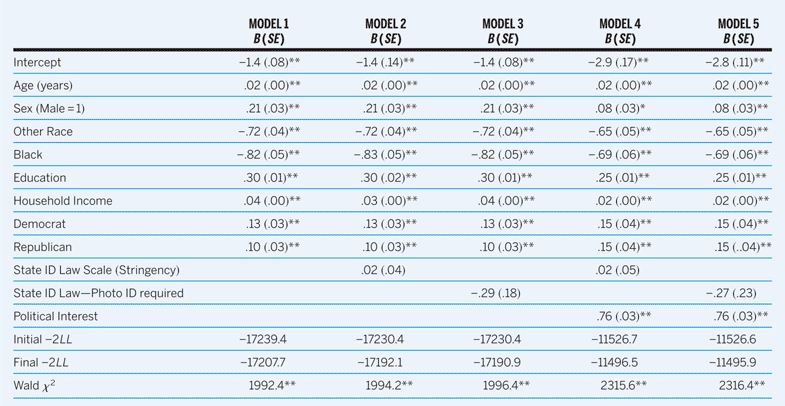
At the individual level there is a similar story. Our self-reported turnout analyses contain socio-demographics (e.g., sex, race, age, region, and socioeconomic status), political affiliation (i.e., party identification), and a 3-point ordinal measure of political interest (1 = not interested to 3 = very much interested). By controlling for political interest we tested an alternative hypothesis to the theoretical effects of voter-ID laws proffered by Alvarez, Bailey, and Katz (Reference Alvarez, Bailey and Katz2007) and Vercellotti and Anderson (Reference Vercellotti and Anderson2006). Even if voter-ID laws do have pronounced empirical effects, once political interest is taken into account, the laws should not matter at all because once the motivation to participate is held constant there is little theoretical reason to believe voter-ID laws would dampen one's desire to vote. Similar to our aggregate analysis, we estimated five models; the first examining demographic factors, the next two examining the effects of voter-ID law, and the fourth and fifth examining the effects of voter-ID law and a photo-ID requirement controlling for political interest.
Table 2 reports the results of mixed-model logistic regression analyses using states as a random factor variable, and shows that voter-identification laws—stringency and photo-ID required or not—have no statistically significant effects on self-reported turnout. However, political interest has both strong and significant effects. All five models essentially show statistically significant effects of basic demographic variables, but they also show how factors such as race and age can play an important role in voting behavior. Neither voter-ID-law stringency (Model 2) nor photo-ID requirement (Model 3) produced statistically significant effects at the threshold 95% confidence level, nor did they contribute to the explanatory power of the regression model (as indicated by the change in −2LL model fit values), especially when political-interest levels are considered. Of the 10 variables in each of the last two models, political interest has the strongest and most stable effects suggesting that political motivations trump ID requirements.
Multi-level Model for Binary Outcomes Regression Coefficients Predicting Individual-Level Turnout

Note. Analyses are based on unweighted sample CCES data; 2006 Analytic N level 1 = 22,006,
Analytic N level 2 = 49.
* p ≤ .05,
** p ≤ .01.
Source: 2006 Cooperative Congressional Election Survey (CCES).
DISCUSSION AND CONCLUSION
We are highly sensitive to those who are improperly and unjustifiably denied their right to vote; however, there is limited available data on the incidence of actual exclusion from voting due to the lack of proper identification. This is not to say that actually requiring a more strict form of identification is not on its face discriminatory; it is, and the laws deserve to be scrutinized. But, our question is whether these laws have significantly reduced turnout. Based on our analysis, they have not.
In the CCES, respondents answered questions about whether they were asked to show identification and if they were prevented from voting because of a problem with identification. Ansolabehere (Reference Ansolabehere2007) used this data to demonstrate that exclusions from voting are exceptionally rare. Twenty-two respondents out of the 36,421 person sample said voter-ID requirements prevented them from voting. Ansolabehere reports no more than 0.2% of potential voters claimed to have been excluded from voting due to ID requirements, and with no clear demographic pattern among them, there is very little empirical basis to raise the alarm over the implementation of identification requirements.Footnote 15 As Ansolabehere explains, “one would need a survey more than 10 times as large as this one to begin to gauge who was excluded and why. It is just that rare of a phenomenon” (2007, 8). Indeed, when non-voters in the Current Population Surveys (CPS) from 2000 to 2006 were asked why they did not vote, a lack of interest in politics was given as a reason twice as often as registration problems (which include a variety of issues, many of which are unrelated to having a photo ID at the polls on Election Day). Indeed, according to the CPS, even in states where photo IDs are required, 11.7% of non-voters claim that a lack of interest kept them home in 2006 while 6.3% cited general registration problems. General registration problems could include voters turned away due to a lack of identification but also includes voters who had moved without reregistering, felons, and a litany of other special cases. More telling was that one-third of 2006 CPS respondents from Indiana said they did not vote because they were “too busy,” which can arguably be interpreted to mean they were less interested in midterm voting; after all they did respond to the CPS.
At every level of analysis, and with multiple forms of data, we have consistently demonstrated that voter-identification laws appear to be a much smaller piece to the voting behavior puzzle than are factors such as the kinds of issues on a state ballot, the competitiveness of campaigns, the institutional structures of a particular election, socioeconomic factors, and individual-level motivational factors such as interest in politics. This is not to say that the rules of voting are unimportant or that there is no potential for disenfranchisement; rather our findings suggest that voter-ID laws have had no systematic effect on turnout thus far, and that some rules (voter-ID laws) do not affect turnout as much as others (same-day registration in Minnesota, a state with historically high turnout).
While voter-ID laws appear to have little to no main effects on turnout (see Alvarez, Bailey, and Katz Reference Alvarez, Bailey and Katz2007), our central argument is that other individual-level motivations such as interest in politics (Berinsky Reference Berinsky2005), types of elections (Gronke, Galenas-Rosenbaum, and Miller Reference Gronke, Galanes-Rosenbaum and Miller2007), and social issues (Tolbert, Grummel, and Smith Reference Tolbert, Grummel and Smith2001) would mediate any impacts related to ID rules. While strict ID requirements have the potential to burden some members of the electorate, our analyses suggest that these numbers are small. What's more, actions taken by state governments, interest groups, and political parties are likely strong enough to induce those who are interested in voting, but have no more strict form of ID, to take action to ensure their voice is heard. This form of political resilience is the type we expect, and have seen from racial minorities, women, and other oppressed groups in America's history.
Until there is systematic, empirical evidence of discrimination in the administration or availability of required forms of identification, there is little reason to suspect voter-identification laws will significantly affect turnout. Thus, we fail to reject the null hypothesis that voter-ID laws do not significantly affect turnout. While all state-level voting laws should be heavily scrutinized as efforts to stop voter disenfranchisement are paramount, it is time we give some credit to the electorate and as Berinsky (Reference Berinsky2005) suggests, spend more time searching for ways to increase citizens' interest in politics. ■