Today, Jewish scientists are part and parcel of the international scientific community. In the Middle Ages, too, Jews participated in the general investigation of nature. However, very few Jewish texts discussing topics that later developed into the disciplines of physics, astronomy, and other sciences have survived from Antiquity. This paper will discuss the earliest Jewish astronomical book, known to contemporary scholars as “The Astronomical Book of Enoch” (AB). Enoch was a biblical antediluvian figure. He is mentioned only briefly in the Hebrew Bible, where it is implied that Enoch acquired astronomical knowledge from divine creatures, and was taken to stay with God after 365 years of life (Genesis 5:19-24) instead of dying. The earliest explicit descriptions of Enochic visions date to the Second Temple period on fragments that have been preserved in Aramaic among the Dead Sea Scrolls. From Aramaic they were translated into Greek, and from Greek into Geʿez (Classical Ethiopic). The Book of Enoch (1 Enoch), a collection of sources composed during the second half of the first millennium BCE, is now part of the Christian Ethiopic bible, and is divided into five sections and two appendices.Footnote 1 Its third section is called “The Astronomical Book of Enoch.” Considering the long and complicated chain of transmission of this book, and the original textual fluidity of ancient Jewish compositions, it is impossible to identify one original AB, or to determine the specific time in which it was composed. However, it is generally accepted that the first versions of the AB and the astronomical knowledge contained within originated in the Land of Israel between the fifth and third centuries BCE, i.e. the Persian and Hellenistic periods, or early Second Temple period.Footnote 2 In fact, the AB is the earliest Jewish book aside from the Hebrew Bible, and dates back earlier than the latest books in the Hebrew Bible, such as the Book of Daniel. In order to appreciate the uniqueness of the AB in comparison to contemporaneous and earlier Jewish works, the book must be understood as being influenced by Mesopotamian sources (directly or indirectly). Scholars emphasize the similarities of the literary styles and astronomical content of the AB and of Babylonian astronomy from the fifth century and earlier.Footnote 3
Although some short Greek and Latin quotations of 1 Enoch were preserved in Late Antique and Byzantine Christian works, the book as a whole was considered by western scholars to be lost for many years. It was only during the seventeenth century that the first Ethiopic manuscripts of 1 Enoch were brought to Europe, and during the eighteenth century that it was first translated into a modern European language. In the beginning of the nineteenth century a few Greek papyri of some of its sections were found in Egypt, although none contained significant textual evidence of the AB. The Aramaic scrolls of the books of Enoch were found during the 1950s, but were only published in 1976 (Milik Reference Milik1976). In this first publication, only some of the fragments of the AB were included; several other fragments were published in the official series of the DJD (Tigchelaar and García Martínez Reference Tigchelaar, Martínez and Pfann2000a; Tigchelaar and García Martínez Reference Tigchelaar, Martínez and Pfann2000c). In fact, the Aramaic scrolls have only been available in their entirety to scholars since 2011 (Drawnel Reference Drawnel2011). Four copies of the AB survived in Qumran, two of which discuss the lunar theory: 4Q208 (4QEnastra) and 4Q209 (4QEnastrb). The most ancient scroll of the AB is 4Q208, which dates to the end of the third century or beginning of the second century BCE (see above, note 2). Despite its fragmentary condition, there is enough evidence to determine that 4Q208 contains a detailed description for each day of several lunar phenomena, in addition to solar phenomena transposed onto a lunar calendar. This detailing, called the “Synchronistic Calendar” (Milik Reference Milik1976, 274),Footnote 4 is absent from the Ethiopic version, and would not have been identified as coming from the AB, except that a similar detailing also appears in the first-century BCE 4Q209, which clearly contains other sections of the AB.Footnote 5
Since 4Q209 contains longer fragments of the Synchronistic Calendar than 4Q208 does, the former will be the main focus of this paper.Footnote 6 While the preservation of 4Q209 is not complete enough to permit the total dismissal of the Ethiopic testimony, one must use the Ethiopic evidence very carefully. The Ethiopic AB presents a number of challenges: it is a translation of a translation; its earliest manuscripts are from the fifteenth century CE (nearly two millennia after the composition of the Aramaic Synchronistic Calendar); the book is difficult to interpret and it contains contradictions within itself; and it obviously underwent significant modifications (including considerable additions and omissions), as it is substantially different from the Aramaic version. I will use evidence from the Ethiopic AB only in such instances as when the fragmented Aramaic version is insufficient for fully understanding a theory, and only when the existing fragments of the Aramaic version support the Ethiopic description, or at least allow it. The astronomy of the Ethiopic AB will be discussed separately, elsewhere.
The astronomical discussion of the Synchronistic Calendar serves to establish a new Jewish calendar of 364 days per year, which later became a cornerstone of sectarian disputes in the late Second Temple period. The few Second Temple Jewish sources that refer to the calendar indicate that most Jews used the luni-solar calendar, which was widespread throughout the Middle East, especially in Mesopotamia, Syria, and the Land of Israel (for an updated summary of this calendar, see Stern Reference Stern2012). However, it is unclear in which periods and communities the luni-solar calendar was regulated according to the Metonic Cycle, and in which periods and communities it was a flexible calendar, which determined ad-hoc the length of each month and year, as described later in Mishna Rosh Hashana; there may even have been other methods for regulating the calendar.
The 364-day year is an approximation of the length of the solar year, with three advantages: First, 364 divides equally into seven, a typological number with religious connotations in Jewish culture. Each 364-day year contains exactly 52 weeks, which allows for the assignment of the sacred days to fixed days of the week in order to avoid their coincidence with the Sabbath. Such coincidences when using the more general Jewish luni-solar calendar created great disputes between the different sects. Second, 364 also divides equally into four. Hence, symmetry between the four seasons occurs, with each containing exactly 91 days. Third, the synchronization between this calendar and a schematic lunar calendar of alternating 29- and 30-day months is simple, using an intercalation of one 30-day month every three years (a triennial cycle).
Drawnel was the first to explain that the Aramaic scrolls of the AB schematically describe the daily change in the phases of the moon and its visibility and invisibility during the night and the day (Drawnel Reference Drawnel2007). In other words: the scrolls specify the illuminated area on the surface of the moon, the times during day and night that the moon is visible before it sets or before that portion of nychthemeron ends, and the times it is not visible until it rises. Although the specific data that the scroll presents is inaccurate, the scroll does identify the existence of a real correlation between the amount of lunar illumination and the times of visibility and invisibility. As a result of the schematism of the text, the data concerning the phases of the moon and its visibility and invisibility are easily reconstructed: The Synchronistic Calendar points out that in the beginning of the lunar month the new crescent sets shortly after sunset and rises (but is not visible) shortly after sunrise. According to the theory of the calendar, each day the moon rises half of a seventh (1/14) of the day later compared to the previous day, and sets half of a seventh of the night later. In the middle of the month, the full moon rises at sunset and sets at sunrise. The cycle of delay of the times at which the moon rises and sets continues until the cycle of lunation ends, when the new crescent rises again right after sunset at the beginning of the next month.Footnote 7
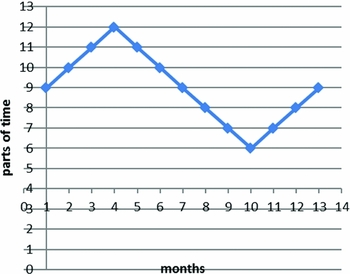
In mathematical terms, the authors of the AB describe both the phases of the moon and its visibility by an arithmetical sequence that alternates between increasing linearly for some number of days and then decreasing linearly with the same difference for the same number of days. Researchers often represent such sequences with a graph of a zigzag function or a triangle wave function. Although the ancient text used neither functions nor graphs, it is useful for us to model the mathematics graphically.Footnote 8 This paper will demonstrate that this sequence is the sole mathematical model the AB uses.
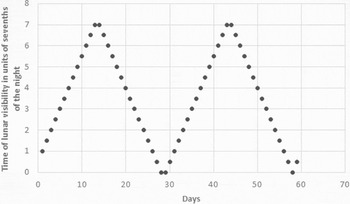
Thus, the times of moon visibility/invisibility in relation to sunrise and sunset are partially preserved on the Aramaic fragments of 4Q208-9. Several scholars have offered full reconstructions of these times during full and hollow months. The differences between the various reconstructions are minor. Here I will follow my own recently published reconstruction.Footnote 9 The scrolls detailed all the times of lunar visibility/invisibility in units of one-seventh of the day or night. For the sake of brevity, Figure 1 presents only lunar visibility during the night for two consecutive months (one hollow and one full month).
Lunar Visibility during Nighttime

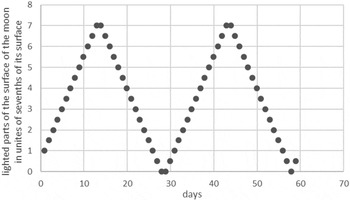
Similarly, the scroll details the phases of the moon by dividing its surface into seven parts and adding or subtracting one-half of one-seventh to determine the moon's illumination at any given point in the cycle of the moon's phases. Drawnel's reconstruction of the two patterns of the changes in the phases of the moon through full and hollow months is undisputed (Drawnel Reference Drawnel2011). Figure 2 demonstrates this scheme.
Phases of the Moon

Drawnel points to a similar detailing of lunar visibility and invisibility in Babylonian astronomy (Drawnel Reference Drawnel2007 and Drawnel Reference Drawnel2011, 302-308), especially in the astrological compendium Enūma Anu Enlil (EAE) 14 (Al-Rawi and George 1991-Reference Al-Rawi and George1992). The difference is that Table B of EAE 14 divides each half month into 15 parts rather than 14 as in the AB, since the months in the Babylonian astrological texts are always schematic months of 30 days, and the ideal year is a 360-day year. Table B also uses linear sequences, which are presentable as zigzag functions.
The temporal aspects of the lunar theory are the main focus of the Aramaic AB. However, both the Aramaic and the Ethiopic versions occasionally address spatial aspects, like the positions of the rising and setting of the moon in relation to the horizon.Footnote 10 Before addressing these issues, a brief clarification of the cosmology and coordinate system used by the AB is required. In the field of the history of ancient astronomy it is customary to use a model in which the earth is placed in the middle of the celestial sphere, which completes one revolution per day, with the world as its axis of rotation. The two coordinate systems that are normally used to describe the movement of the sun, moon, and planets are the ecliptic system and the equatorial system. This model is derived from Greek astronomy (and to some extent, also Babylonian astronomy). However, the authors of the AB had a different cosmology and used a third coordinate system. Apparently, the authors of the AB were unaware of the spherical nature of the earth; they understood the flat earth to be square, rather than circular. The earth was pictured as the ground floor of the universe, which in turn was pictured as a building or a tent. Therefore, no celestial sphere or even celestial dome exists in the AB. The firmament is spread over the earth like a sheet or a tent, which flows over the four pillars of heaven down to the edges of the earth (Ratzon Reference Ratzon2012, 197-205; Ratzon Reference Ratzon2015b, 207-209), but see Duke and Goff Reference Duke and Goff2016, 85-87. There is no description of the movement of the sun and moon during the day and night, and the text refers only to the rising and setting points of the sun and moon on the horizon. The horizontal coordinate system used throughout the AB is a gates system: The gates are openings in the firmament that stand on the edges of the earth and are used for the passage of astronomical and meteorological phenomena from heaven to earth and back (Ratzon Reference Ratzon2012, 272-276; Ratzon Reference Ratzon2014; Ratzon Reference Ratzon2015a). Despite the occasional references in the Aramaic scrolls of the AB to the passage of the moon through the gates, most scholars claim that the scrolls are too fragmented to deduce the full gates theory from them (Milik Reference Milik1976, 273; Tigchelaar and García Martínez Reference Tigchelaar, Martínez and Pfann2000b, 100-102; Ben Dov Reference Ben Dov2008, 78-80; Nickelsburg and VanderKam Reference Nickelsburg and VanderKam2012, 442-444; Drawnel Reference Drawnel2011). Below, I challenge this argument.
No detailed description of the gates of the moon exists in the Aramaic version of the AB or in the Ethiopic version. However, the Ethiopic version assumes that these gates are identical to the gates of the sun, for example: 1 Enoch 74:5 says, “During two months it sets with the sun in those two middle gates—in the third and in the fourth gate,”Footnote 11 and 78:3-5 mentions that “These are the two great luminaries . . .They set and enter the gates of the west and go around the north and emerge through the gates of the east on the firmament.” Indeed, the horizontal arc of the moon risings (or settings) is not much broader than that of the rising (or setting) of the sun.Footnote 12
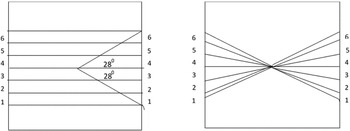
Thus, we can use the detailed description of the gates of the sun available in the Ethiopic version of the book, which seems to correspond to the cosmology underlying the Aramaic fragments.Footnote 13 The gates system for the sun includes 12 gates: six in the east for rising and six in the west for setting. It is unclear whether these gates were of equal size or whether the middle ones were larger than those on the edges (see Figure 3).
Gates of the Sun and Moon with Constant or Varying Length

Neugebauer suggests that the concept of these gates was created in order to explain the fact that the sun rises from the northeast in summer and from the southeast in winter, rather than rising in the true east and setting in the true west (Neugebauer Reference Neugebauer1979, 159-161; Neugebauer Reference Neugebauer1964; Neugebauer Reference Neugebauer and Black1985). Today we know that it is the result of the axis of the earth (around which the earth performs its daily rotation) being tilted to the axis of the yearly cycling of the earth around the sun. The earth's axis remains tilted in the same direction with reference to the stars, but not toward the sun. The tilt of the earth's axis creates the seasons, the sun's deviation from true east and true west when rising and setting, and the variations in the length of day and night. The authors of the AB noticed the correlation between the lengths of day and night and the sun's movement on the horizon, but explained this movement with the gates system rather than the ecliptic.Footnote 14
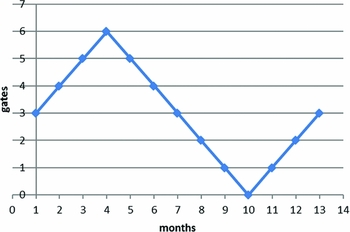
According to 1 Enoch 72, the sun rises in summer from the northeast, because it passes through northeastern gates, and from the southeast in winter, because it rises through southeastern gates. Hence, the sun's yearly cycle begins the day after the vernal equinox – on the first day of the first month – when it passes through the fourth gate. From there, it continues to rise through the northeastern gates, taking one full month to pass through each gate until the sun finishes passing through the sixth gate for the first time from south to north at the summer solstice. The sun then begins to return southward to the first gate, to whose southernmost boundary it reaches at the winter solstice; it then returns northward so that at the equinox, at the end of the twelfth month, the sun has just finished passing through the third gate again; then it repeats its cycle. All equinoxes and solstices are fixed to the 31st day of every third month. The AB describes both the variation of the length of day and night and the course of the sun through the gates with an increasing and decreasing linear sequence that can be represented by a zigzag function (figures 4 and 5).Footnote 15
The Gates of the Sun

The Length of Days

As mentioned above, the period of the moon in its passage through the gates is not preserved in the Aramaic scrolls of the AB, and most scholars think that the scrolls are too fragmented to reconstruct it. Not helpful in this respect is the fact that the horizontal position of the moon in the gates is omitted in many cases, and is only mentioned sporadically. The Ethiopic version of the AB refers to the gates of the moon in three passages (73:4; 74:5-8; 78:15-79:5), which contain numerous problems individually, as well as contradictions when read together.Footnote 16 Hence, even prior to the publication of the scrolls, Neugebauer brought to scholarly attention a later Ethiopic text called “The Table of the Rising of the Moon for every Month of the Year” (Neugebauer Reference Neugebauer1979, 159-161; Neugebauer Reference Neugebauer1964). The introduction to this text is nearly identical to the first verse of the Ethiopic Astronomical Book. Neugebauer republished the text as a table (fig. 6). The text counts the number of days the moon stays in each gate.Footnote 17
The Table of the Gates of the Moon

Zotenberg, who catalogued the first manuscript of this text, understands it to be a commentary or a later expansion of the Ethiopic Astronomical Book (Zotenberg Reference Zotenberg1877, 72). On the other hand, Neugebauer and Milik conclude that it contains materials originally belonging to the AB that have been lost through transmission (Neugebauer Reference Neugebauer1979, 159-161; Neugebauer Reference Neugebauer1964; Milik Reference Milik1976, 275).Footnote 18 Neugebauer's conclusion is quoted in nearly every subsequent study of the subject, even those released after the publication of the Aramaic scrolls (Milik Reference Milik1976, 273; Tigchelaar and García Martínez Reference Tigchelaar, Martínez and Pfann2000b, 100-102; Ben Dov Reference Ben Dov2008, 78-80; Nickelsburg and VanderKam Reference Nickelsburg and VanderKam2012, 442-444). Drawnel, however, objects to the common opinion on stylistic and literary grounds (Drawnel Reference Drawnel2011, 294). He notes that “The Table of the Rising of the Moon for every Month of the Year” deals only with the rising of the moon, whereas the Aramaic Astronomical Book refers to both its rising and setting. Secondly, the Ethiopic manuscripts focus on the number of days that the moon remains in a particular gate, while the Aramaic texts have no such concern. In addition, Drawnel points to differences in the literary forms of the formulaic sentences used in the two works, concluding that “The Table of the Rising of the Moon for every Month of the Year” cannot be an abbreviation of the Aramaic Synchronistic Calendar. Drawnel makes no claims regarding the relation between the astronomical content preserved in the Ethiopic and Aramaic manuscripts, as he believes that “the Aramaic texts cite the gates only randomly in the calculation process and do not provide enough information for constructing such a monthly, and eventually yearly, scheme.” Instead, Drawnel suggests that if the Ethiopic material had Aramaic origins, those origins constitute an example of the calculations different from the ones of the Synchronistic Calendar that are preserved in Qumran. I agree with Drawnel that the Synchronistic Calendar could not be the origin of the Ethiopic table; however, I think that the Aramaic fragments do contain enough information to reconstruct the entire gates theory contained therein. Hence, I argue that although Neugebauer's table might correspond to some verses in the Ethiopic version of the book, it cannot be a reflection of the theory found in the Aramaic version of 4Q209. I offer four reasons for this claim:
-
a. Methodologically speaking, a reconstruction of the ancient Jewish theory based on Christian Ethiopic texts, which are not part of the Book of Enoch and date to more than a thousand years later, should be accepted very cautiously. Scholars used Christian Ethiopic texts as a last resort, because they found the Aramaic scrolls to be too fragmented and the Ethiopic version too corrupted. However, if, as I claim, the data in the scrolls are sufficient, then a theory based on the data in the scrolls themselves is preferable regardless of the difficulties and contradictions between the table and the scrolls (outlined below).
-
b. The gates of the moon in the table and in the scroll are not identical on equivalent dates. The table predicts that on the ninth day of the tenth month the moon should be passing through the fourth gate, whereas the scroll says it passes through the fifth gate (4Q209 7 iii 6-8). Most scholars accept this as a good enough approximation (Milik Reference Milik1976, 275-277; Tigchelaar and García Martínez Reference Tigchelaar, Martínez and Pfann2000b, 100-102; Ben Dov Reference Ben Dov2008, 78-80). However, I suggest a theory that does not require approximations, and matches the data of the scroll completely.
-
c. Earlier I claimed that the authors of the scroll expressed their astronomical views with one mathematical model – an increasing and decreasing arithmetic sequence. This was true for the phases of the moon, its visibility and invisibility, and the variations in the length of day and night, as well as the sun's passage through its gates. This is the same mathematical model used by the classical Mesopotamian astronomical text (EAE 14 B and MUL.APIN II ii 43 – iii 15) (Hunger and Pingree Reference Hunger and Pingree1999, 44-50),Footnote 19 which continued to be used (with some improvements) even in many contemporaneous cuneiform mathematical astronomical texts (Neugebauer Reference Neugebauer1975, 374-375; Ossendrijver Reference Ossendrijver2012, 42-44).Footnote 20 It is safe to assume that the moon's passage through its gates would not be the sole exception to this rule in the AB. However, the table presents a mathematical theory that is periodic, but not linear. The moon usually passes through the middle gates – the third and fourth– for one day each; it passes through the fifth and the second gates for two days each; and it passes through the first and the sixth gates for seven or eight days each. It is a better approximation to a sinusoidal function. Because of the spherical symmetry of the solar system, this is closer to reality. Still, it is not the mathematical theory of 4Q209, which always uses increasing and decreasing linear sequences (figure 7).
-
d. The Ethiopic text does not say so explicitly, but we can assume that it attempts to synchronize the locations of the sun and the moon at the beginning of each month.Footnote 21 According to the table, the location of the moon on the first day of every month is the same as the location of the sun during that month, as specified in 1 Enoch 72. At the end of the year, the moon returns to the fourth gate, as does the sun. This synchronization ignores the fact that according to the AB, lunar months are frequently shorter than the months of the ideal solar calendar of 364 days. Lunar months alternate between 29 and 30 days, while the length of a solar month is 30 or 31 days, and a solar year is longer than a lunar year by ten days. These differences affect the synchronization of the gates. For instance: according to the table, the first day of the third month is the 60th day of the year, as the second month was a hollow month with 29 days. On that day, the moon passes through the sixth gate. However, according to the 364-day solar calendar, this is the last day of the second month, and the sun is still passing through the fifth gate. The second solar year begins ten days after the first day of the lunar year; therefore, the moon will no longer rise through the fourth gate.Footnote 22 Unlike the table, neither the Aramaic nor the Ethiopic version of the AB ignores the differences between the two types of calendars, and acknowledges these differences more than just at the end of the year. The Synchronistic Calendar uses lunar dates, but marks the corresponding dates of important events within the solar calendar. Thus, within the description of the eighth day of the tenth lunar month, 4Q209 7 iii 1-2 refers to the end of the ninth solar month. Additionally, 4Q209 26 3-4 and its Ethiopic parallel in 1 Enoch 79:4-5 note that half a lunar year is five days shorter than half a solar year. The table's failure to address the solar year of 364 days contradicts one of the central ideologies of the AB.
It seems that the late Ethiopic text does not represent the original Enochic astronomy.Footnote 23 Instead, I believe we should begin with the data found in the scroll, which, while very fragmented, still provides enough evidence to reconstruct the entire lunar theory. I will use the plausible assumption that the lunar theory of the AB can be represented by a zigzag function. Under this assumption, we need only two dates for which we know the corresponding gates of the moon in order to find the daily displacement of the moon along the horizon (vm in units of gates per day). Two such dates are offered by 4Q209 7 ii: On the 25th day of the ninth month the moon sets and rises through the second gate (B1 ), and on the ninth day of the tenth month the moon sets through the fifth gate (B2 ). It is impossible to determine with certainty where the moon passes within each gate on these dates, and we do not know if the gates are of equal size. Therefore, we will describe the entire gates system with a scale from 0 to 6 in units of gates; the different positions of the moon within the first gate will be represented by numbers between 0g to 1g (0g is the horizontal position of the rising/setting of the sun at the winter solstice, and 1g is the border between the first and second gate); the second gate will be represented by numbers between 1g to 2g; this same numbering system will be applied to all of the gates. Thus, when the moon is passing through the second gate, its position is 1g ⩽ B 1 ⩽ 2g and when the moon is passing through the fifth gate, its position is 4g ⩽ B 2 ⩽ 5g. We will refer to the time as t (a unit is one day), and to the period of the lunar cycle through all the gates twice as T. There are three ways in which the moon can travel from the second gate to the fifth (figure 8).
The Gates Through Which the Moon Passes as a Function of Time

Three Possible Paths of the Rising Moon During the Days from Month 9, Day 25 to Month 10, Day 9

Assuming that the ninth month is a hollow month (an assumption addressed in a future publication), there are 13 days between the 25th day of the ninth month and the ninth day of the tenth month. According to Option 1, during these 13 days the moon goes directly from gate 2 to gate 5. Using basic equations of motion, Option 1 gives:
 $$\begin{equation*}
{B_2} = {B_1} + 13{v_m}
\end{equation*}$$
 $$\begin{equation*}
\frac{2}{{13}}g/d \le {v_m} \le \frac{4}{{13}}g/d
\end{equation*}$$
The value of the daily displacement at the horizon is too low to represent the motion of the moon. If it were the rate of the daily displacement at the horizon of the moon, the moon would have to complete one cycle of gates in a minimum of 156 days (more than five months) and a maximum of 312 days. Since the actual period of time that is required for the moon to complete one cycle is less than one month, it is impossible to assume that this was the value of the lunar daily displacement at the horizon chosen by the authors of the AB.
According to Option 2, during the same 13 days the moon goes from gate 2 to gate 5 through the south (gate 1), and therefore:
 $$\begin{equation*}
{B_1} + {B_2} = 13{v_m}
\end{equation*}$$
 $$\begin{equation*}
\frac{5}{{13}}g/d \le {v_m} \le \frac{7}{{13}}g/d
\end{equation*}$$
According to Option 3, during the same 13 days the moon goes from gate 2 to gate 5 through the north (gate 6), and therefore:
 $$\begin{equation*}
6 - {B_1} + 6 - {B_2} = 13{v_m}
\end{equation*}$$
 $$\begin{equation*}
\frac{5}{{13}}g/d \le {v_m} \le \frac{7}{{13}}g/d
\end{equation*}$$
Options 2 and 3 result in the same values. To determine the correct one, we must add another assumption: that the sun and moon begin their course together at the fourth gate at the beginning of the first year. This rules out Option 2, since the resultant lunar daily displacement at the horizon is too high and the position of the moon would not conform to the preliminary requirements from the scroll. We are left only with Option 3. The 25th day of the ninth month is the 261st day of the year. On this day the moon has already completed n whole periods, plus 3/4 of a period, plus the distance from the first gate (i.e. 3/4 of a cycle) to point B1 :
 $$\begin{equation*}
261 = \left( {n + \frac{3}{4}} \right)T + \frac{{{B_1}}}{{{v_m}}} = \left( {n + \frac{3}{4}} \right)\frac{{12}}{{{v_m}}} + \frac{{{B_1}}}{{{v_m}}}
\end{equation*}$$
 $$\begin{equation*}
{v_m} = \frac{{\left( {n + \frac{3}{4}} \right)12 + {B_1}}}{{261}}
\end{equation*}$$
The ninth day of the tenth month is the 274th day of the year. On this day the moon has completed n+1 whole periods, plus 1/4 of a period, plus the distance from the sixth gate (i.e. half a cycle) to point B2 :
 $$\begin{equation*}
274 = \left( {n + 1.25} \right)T + \frac{{6 - {B_2}}}{{{v_m}}} = \frac{{\left( {n + 1.25} \right)12 + 6 - {B_2}}}{{{v_m}}}
\end{equation*}$$
 $$\begin{equation*}
{v_m} = \frac{{\left( {n + 1.25} \right)12 + 6 - {B_2}}}{{274}}
\end{equation*}$$
Given the above constraints, the only possible values of n are: 8, 9, and 10. When n = 8, the period of the passage of the moon through the twelve gates (T) is between 29.271. . . and 29.547. . . days. Since the 29.5-day synodic month assumed by the scroll falls within this range, when n = 8 is chosen, the scroll does not differentiate between synodic and draconitic months (the period in which the moon returns to the same node of its orbit, which, in reality, is approximately 27
 $\frac{1}{5}$
days; the period of the moon in its passage through the gates should have the same value). Though astronomically inaccurate, the same assumption exists in other ancient Jewish texts. For instance, the Palestinian Talmud, (y. RH 2:6 58, 1; 670) says: “what the sun goes in thirty days the moon goes in two and a half days . . . what the sun goes in twelve months the moon goes in thirty days.” However, the option of n = 8 can be eliminated by another fragment from 4Q209. Thus, in 4Q209 3, days one through four of an unknown even month (second, fourth etc.) are detailed (Drawnel Reference Drawnel2011, 150). This fragment mentions that the moon sets on the fourth day through the third gate. According to the option of n = 8 the moon begins its setting and rising each month through the fourth gate and continues to rise through the northeastern gates in the following days. However, the displacement of the moon along the horizon is not fast enough to allow it to rise through the third gate (which is a southeastern gate) by the fourth day of the month.
When n = 9, then 26.319. . . ⩽ T ⩽ 26.542. . . . Of the three options, n = 9 gives the most accurate astronomical values, though still quite far from the true value. While selecting n = 9 does not contradict any specific data in the scroll, it does not stand in line with the schematic nature of the scroll, which only uses “round” numbers and aesthetic patterns. One must wonder why the author of such a schematic composition would choose this value for the period of the lunar cycle through all the gates twice. If these numbers were derived from other sources it would be understandable, but I am not familiar with any Greek or Babylonian texts that use these particular approximations for the draconitic or sidereal month. No explicit estimation of the draconitic month was preserved in cuneiform tablets, although it can be derived from the Saros cycle and later from the ACT tables and procedure texts that compute the moon's distance to the ecliptic. Nevertheless, we do find very accurate values for the sidereal month by the fifth or fourth century BCE (Hunger and Pingree Reference Hunger and Pingree1999) and earlier (Ratzon Reference Ratzon2016). If astronomical accuracy was the primary concern, we might have expected the numbers 27 or 28 as approximations, as they are round, astronomically more accurate (at least 27 is more accurate), and have Babylonian precedents (for example BM 45728 uses a 27-day sidereal month and the Babylonian Intercalation Scheme uses a 28-day sidereal month). In addition, periods in the range of numbers derived from n = 9 are not even accurate enough to synchronize the locations of the sun and the moon at their supposed conjunction at the end or beginning of each month (as reality requires and the Ethiopic table attempts to do, albeit unsuccessfully). Although at the end of the first lunar month synchronization between the “gates position” of the sun and moon is still maintained, by the end of the second lunar month and the beginning of the third, the moon is expected to rise and set through the sixth gate, while the sun is still in the fifth gate (as the second solar month is not yet over). These gaps will only grow bigger with each passing month. Therefore, I do not see a reason why these numbers would have been chosen by the author of the AB in the first place, and I understand the option of n = 9 to be not impossible, but certainly implausible.
If n = 10 is chosen, possible values for vm
are between 0.498. . . and 0.5 gates per day. Considering the schematic character of the scroll, there is no reason to assume a value with higher precision than 0.5. This implies a faster movement than the real movement of the moon. Thus, the equation has only one solution:
 ${v_m} = 0.5\frac{g}{d};\ {B_1} = 1.5g;\ {B_2} = 4g$
. This means that the moon's rising/setting point changes its position by half a gate each day. This “round” number is consistent with the tendency of the AB toward schematization and with the reoccurrence of this fraction in the other aspects of its lunar theory (using half of sevenths to count lunar phases, visibility, and invisibility). However, this lunar displacement of the moon along the horizon means that the period required for the moon to complete its passage through the gates is only 24 days. This is a poor approximation of the true length of a draconitic month. In addition, using
 ${v_m} = 0.5\frac{g}{d}$
does not achieve synchronization between the locations of the sun and moon during conjunction or the first day of the month (however, no other value of n yielded synchronization, either). Perhaps this is due to the fact that although the sun and moon are in proximity at the end or beginning of every lunar month, they do not share the exact same horizontal location. Otherwise, an eclipse would occur at the end of each month. Assuming that the lunar gate theory was first created for the ideal 360-day calendar (see below), lunar displacement on the horizon does predict an eclipse every six month (specifically a solar eclipse on the equinoxes). Before the discovery of the Saros cycle probably during the fifth century BC, Neo-Assyrian astronomers were aware that most eclipses occurred six months after the previous eclipse. Although they did know that the much less frequent five-month gap is also possible, these eclipses were considered to occur not at their appointed time (ina lā minatišu), and therefore deviated from the ideal scheme (Steele 2000, 76-77; Brown Reference Brown2000, 148, 200-202; Rochberg-Halton Reference Rochberg-Halton1988, 40-43). It is possible that the lunar gate theory of the AB was originally developed by an earlier author. The primary purpose of the lunar gate theory was to serve as an ideal scheme for predicting eclipses rather than for regulating the calendar, which is the main focus of the AB as preserved in 4Q209. Nevertheless, it is difficult to ignore the inaccuracy of this theory. It seems that the author preferred to compromise astronomical accuracy for the sake of aesthetic schematization. When the authors of the AB chose to describe the solar displacement along the horizon using schematic solar months and to describe all lunar phenomena using lunar dates, they gave up all possibility of monthly synchronization.
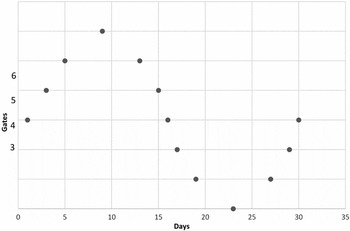
Figure 9 presents the rising/setting points of the moon in the gates as a function of time during the first few months of the year, demonstrating the zigzag function of this reconstructed theory that is in accordance with every other mathematical model of the AB. The position of the moon in the gates once every two days (since the lunar displacement at the horizon requires that the moon changes gates every two days) is presented in Appendix A (the dates attested in the scroll are in bold font). Since all data is taken from the scroll, there are neither contradictions nor glosses or corruptions to take into account.Footnote 24
The Progress of the Rising/Setting Point of the Moon through the Gates

As illustrated by figure 9, this theory is different from the lunar gates theory of the Ethiopic table in several respects. The most obvious difference is that, unlike the data in the table, the gates theory of the scrolls can be represented by a linear zigzag function. However, this zigzag function is not an approximation of the curve seen in figure 7. The difference of the arithmetic sequence of the Aramaic AB is half a gate per day, whereas the average step of the table is approximately 0.44 gates per day. Accordingly, the moon completes a cycle of all the gates in a period of 24 days, according to the Aramaic AB, whereas the average period in the Ethiopic table is 27.23 days. The period of the Ethiopic table is a much better approximation of the draconitic month than the 24 days of the Aramaic AB. In addition, the Ethiopic table attempts (unsuccessfully, as described above) to synchronize the “gate positions” of the sun and the moon in the beginning of each month. Surprisingly, attempting this same goal was sacrificed by the author of the AB in favor of schematization. Therefore, there is no reason to assume that the Ethiopic table was once included in the AB. It must be a commentary, attempting to harmonize the already-sacred gates system of the Enochic writings with the contemporary scientific knowledge of its time. Whether this harmonization is a product of a later Ethiopic author or an Ethiopic translation of Greek or Aramaic materials is not the subject of this study.
Additional Mentions of the Gates of the Moon in 4Q209
Based on the above computations, I was able to reconstruct the sequence of gates through which the moon rises/sets every day over three consecutive years (three years was chosen because the scroll uses a triennial cycle with one intercalary month added at the end of every three years). Appendix A lists the gate numbers for the rising/setting of the moon for every other day (since the moon rises twice in each gate before moving to the next). The dates preserved in the scroll are in boldface type in the table. This reconstruction allows for the verification of the consensus of the suggested theory with the rest of the data found in fragmented scroll. The computations in this paper are based on two dates. In addition to these two dates, there is only one other date for which the precise location of the moon has been preserved in the scroll (4Q209 7 ii 8-9). I have not used this instance in my computations, which enables it to serve as a test case for the theory. On this third date, the moon is passing through the second gate on the 26th day of the ninth month. This aligns with the theory perfectly.
Moreover, this theory allows us to identify accurately several other descriptions found in fragments that were preserved only partially. Although their fragmented state means that they cannot serve as supporting evidence for the suggested computation, it is notable that none of the fragments contradicts the computation. Thus, as mentioned above, in 4Q209 3, days one through four of an unknown even month (second, fourth etc.) are detailed (Drawnel Reference Drawnel2011, 150). This fragment mentions that the moon sets on the fourth day through the third gate. Using the table in Appendix A, this could happen only during the fourth or tenth month of the second year of the triennial cycle. This conclusion supports the hypothesis of (Ratzon Reference Ratzon2015, 106-108) that, in contrast to previous assumptions, the authors of 4Q209 did not limit themselves to an outline of the cycles after the complete description provided for the first year, but continued in the same detailed manner through the second and third years. 4Q209 16 preserves a very fragmented description, that, according to Drawnel's reconstruction, computes days 25 and 26 of an odd month (first, third etc.) (Drawnel Reference Drawnel2011, 180). On both these days, the moon passes through the third gate. Drawnel's reconstruction here is by no means certain. However, if we accept his suggestion, then this fragment can only describe the fifth month of the first year or the first month of the third year. The last mention of a lunar gate is 4Q209 26. However, this account is very fragmented and it is unclear whether it belongs to the Synchronistic Calendar. Uniquely, this account also has an Ethiopic version that is not identical to the version in the scroll. Therefore, a discussion of this fragment will be published separately.
Longer Calendrical Cycles
As mentioned briefly above, the question remains how the authors of the AB arrived at the number of half a gate every day, or two days to pass through each gate. According to this theory, the period in which the moon completes one cycle of gates is 24 days, instead of the draconitic month of 27-and-a-fifth days, which is only loosely reflective of reality. Neither a lunar year of 354 days nor a solar year of 364 days divides evenly by 24. However, the Mesopotamian ideal year of 360 days, traces of which are still evident in the AB (Albani Reference Albani1993, 27-32; Ben Dov Reference Ben Dov2008, 36-52), does divide evenly by 24. It seems that lunar progress of half a gate per day was developed for a 360-day year. However, while adopting the 364-day year, the authors of the AB had no problem integrating this lunar theory into their calendar, because after exactly three years the moon coincides with the sun for a moment on the limit between the third and the fourth gates. Therefore, this theory aligns with the triennial cycle. The cycles of the sun and moon are completely synchronized after six years, a Qumranic calendrical cycle familiar from the Mishmarot scrolls (4Q319-324a; 324c; 325; 328-330). Although I do not assume the entire six-year cycle was detailed in 4Q209, it is possible that this cycle did, in fact, have an astronomical purpose in addition to the synchronization of the 364-day year with the course of the Mishmarot.
Conclusion
Despite the poor preservation of 4Q209, it is possible to reconstruct the scroll's lunar theory, the phases of the moon, its visibility and invisibility, and the progress of the moon through the gates. I have shown that cosmological and mathematical patterns may be used to understand the complete theory of the gates. This reconstruction supports the scholarly opinion that the 364-day year was developed from the ideal Mesopotamian year of 360 days. In addition, it suggests, against common scholarly opinion, that the triennial cycle already existed in 4Q209. Since according to Wayne Horowitz, the triennial cycle is mentioned in Mesopotamian texts, it is probable that the authors of the Astronomical Book derived an already-developed 364-day year, along with the triennial cycle, from these Mesopotamian texts. The authors of the Aramaic scrolls adjusted the Mesopotamian sources to fit with Jewish religious views that attributed significance to the number seven, and to their own cosmological concept of the gates standing on the horizon. This cosmological theory allowed the authors to describe the course of the sun and moon systematically, with reference to the change of their rising/setting points along the horizon, while acknowledging that the draconitic month was shorter than the synodic month. An important feature of their theory was the schematization, using only “round” numbers and symmetries, even at the expense of precision. According to the authors of the Astronomical Book, a good theory should be both realistic and beautiful.
Appendix A

Acknowledgments
The research for this paper was conducted while I was a Fulbright Post-Doctoral Fellow at Princeton University, and was further developed through my first year as a post-doctoral fellow at the Cohn Institute for the History and Philosophy of Science and Ideas at Tel Aviv University. In addition, I would like to thank the Ofra and Zvi Meitar Foundation for its financial support during my stay at Princeton. Earlier versions of this paper were presented at the Scholion Lectures Marathon at the Hebrew University in Jerusalem in 2014, the departmental seminar of the Cohn Institute, and to the Changes in Sacred Texts and Traditions workshop, Ancient Jewish Cosmology – Sacred Time and Order at the École biblique et archéologique française de Jérusalem, funded by the Academy of Finland, in 2015. I am grateful for the questions and comments of those audiences, as well as for the very helpful comments of Prof. Martha Himmelfarb, Prof. Bezalel Bar-Kochva, Prof. Jonathan Ben-Dov, Prof. Steve Shneider, and the anonymous reviewers of Science in Context.