The impact of political institutions on policies has become a major research question in political science. Beginning with the classical ‘politics’ or ‘parties do matter’ hypothesis, scholars like Douglas Hibbs (Reference Hibbs1977), Francis Castles (Reference Castles1982), and Manfred G. Schmidt (Reference Schmidt1982) have stated that economic policy in OECD countries is dependent upon the party composition of government. More recently, empirical findings have been linked to theories of ‘comparative democratic politics’ (Keman Reference Keman2002) and concluded that the impact of party government on policy output has to be analyzed along with the effect of constitutional structures and veto-players. Party-driven policy changes – so they argue – are expected to have a stronger impact in majoritarian democracies with few veto players than in consensus democracies with many veto players (Schmidt Reference Schmidt2002: 183). In a similar line, Edeltraud Roller (Reference Roller2005) introduced a much wider theoretical and empirical approach for analysing the effect of political institutions on policy outcomes in OECD countries from 1974 to 1995. Based on ‘An Integrated Model for Explaining the Performance of Democratic Institutions’ she showed empirically that political institutions do have an impact on policy performance, but the degree of this effect is dependent upon the type of institution (Roller Reference Roller2005: 279f).
Building on work about the comparative politics of Western democracies this article focuses on the impact of political institutions and political actors on policy output in Central Eastern Europe (CEE). To what extent do political institutions and political actors matter? What are the effects of alternative explanatory variables such as the degree of communist legacy, economic openness, and economic ties with other European countries? To answer these questions, we analyze three broad policy output areas: economic policy, social policy, environmental policy in the ten most democratic Central Eastern European countries from 1995 until 2004 (Cameron Reference Cameron2007).Footnote 1
Theoretical Argument And Empirical Assumptions
Arend Lijphart (Reference Lijphart1999) was one of the first scholars who connected the type of democracy to policy outputs and outcomes. Yet, empirical studies have demonstrated that Lijphart's concept of the relative impact of consensual or majoritarian democracies on policy performance does not travel well in Central and Eastern Europe (Lane and Ersson Reference Lane, Ersson and Keman2002; Roberts Reference Roberts2006; Fortin Reference Fortin2008). Alternative explanations about the relationship between democratic performance and policy output have to be developed for the region.
Explaining policy output is a complex task, particularly for countries which have gone through a transition from command to market economies and from autocracy to democracy. New democracies had to create and consolidate a sustainable set of institutions that creates the framework for political games which influence policy output. Based on a neo-institutionalist approach we argue that policy output is dependent upon the interaction between formal institutional structures and actor constellation in a given regime (Rothstein Reference Rothstein, Goodin and Klingemann1996, Schmidt Reference Schmidt2002; Tsebelis Reference Tsebelis2002). More precisely, policy output is dependent upon the capability of political institutions and political actors to change the legislative status quo or to protect it against changes.
Theoretically, two sets of factors have an important impact on the legislative decision-making process and thereby on policy output. The impact of institutional veto players measures the potential veto power of extra-parliamentary institutions on lawmaking decisions. Birchfeld and Crepaz (Reference Birchfeld and Crepaz1998) differentiate between four major competitive veto-institutions outside government and national parliament: second chamber/federalism; presidentialism; constitutional jurisdiction; and direct democracy structures. All four institutions are characterized by a variety of competences that express their veto strength. We assume a significant impact on policy outputs in countries with strong institutional veto players and vice versa.
The impact of the government strength is conceptualized by the degree to which political actors have the power to change the legislative status quo. In parliamentary democracies the power to determine the legislative process is dependent on the institutional framework that provides political actors the possibility of gaining a parliamentary majority. These majorities can ideally be achieved when the decision-making process of governments is fairly ‘closed’. Yet, a ‘closed’ governmental decision-making is dependent on governmental actors agreeing on a common policy. Usually, a one party government acts very closed and thereby has a high chance of changing the legislative rule. In coalition governments an agreement on decision-making is dependent on the parliamentary support of governing parties, on the number of parties in government and on the ideological distance between these parties: the lower the parliamentary support of governing parties, the higher the number of parties in government and the larger the ideological distance among the governing parties, the lower the chances of these parties to change the legislative status quo. We therefore assume that the impact on policy output is less significant when the strength of government is low.
However, at least two additional factors have to be taken into consideration: the communist legacy and the impact of international factors (Ekiert and Hanson Reference Ekiert and Hanson2003; Brusis Reference Brusis2004; Kopstein Reference Kopstein2003; Bohle and Greskovits Reference Bohle and Greskovits2007). The former communist states have left a legacy of ideas, customs, and institutions that has influenced the behaviour of political actors to a varying degree in the new democracies. We expect a significant impact on policy outputs in countries with a weak communist legacy and vice versa.
International factors such as diffusion through globalization and international interdependencies may also be crucial for explaining policy output (Simmons and Elkins Reference Simmons and Elkins2005; Jahn Reference Jahn2006). In CEE countries pressure from the world market and the European Union gave national actors limited room to maneuver (Schimmelfennig and Sedelmeier Reference Schimmelfennig and Sedelmeier2005). Thus, we assume that a high degree of international pressure has a significant impact on national policy output. Among these international factors are the openness of the domestic economy, the engagement of foreign enterprises in the CEE and the impact of the EU.
Countries with open economies are more likely to introduce more market reforms and lower social expenditure and environmental standards. We also expect that high foreign direct investment (FDI) is associated with intensive market reforms and lower social and environmental commitments (race to the bottom). Yet, it has also been shown that competition to attract FDI creates opportunities for multinational enterprises to diffuse corporate management practices from their countries-of-origin to countries hosting their foreign operations (Prakash and Potosk Reference Prakash and Potosk2009). Since CEE countries receive most FDI from countries with higher social and environmental standards we may expect an increase of the domestic policy efforts in social and environmental policies in CEE (race to the top).
Finally the EU has an impact on national policy-making. In the past, the EU has, for instance, encouraged higher social expenditures in West-European countries. However, since globalization gained pace, the impact of the EU reversed (Jahn Reference Jahn2006). This implies its impact becomes similar to other international pressure. Since all CEE-countries negotiated with the EU for membership and had to accept the acquis communautaire (Schimmelfennig Reference Schimmelfennig2007), this might produce a reverse effect on policy performance in the area of environmental policy. EU impact is measured by the degree of economic closeness, operationalized as trade exchanged between each CEE country and Western European countries. We assume that CEE countries with extensive trade with Western Europe are more affected by EU rules. This causal mechanism may be less formal than the institutional impact (see Simmons and Elkins Reference Simmons and Elkins2004; Jahn Reference Jahn2006).
Empirical Measurement And Descriptive Findings
The dependent variable: Policy outputs
The impact of political institutions on policies is tested in three areas which are particularly important for modern industrialized societies: economic, social and environmental policy.Footnote 2 Historically state policy goals have become ever more encompassing, expanding to guarantee economic growth and well-being, followed by supporting social security and finally environmental protection (Dryzek et al. Reference Dryzek, Downes, Hunold, Schlossberg and Hernes2003; Roller Reference Roller2005). Outputs in our three chosen areas are therefore representative examples of pubic policy. For each of the policy fields we have used multiple indicators (see Appendix 1).
Scholars of transitional economies noted that the level of economic policy was highly effected by different reform tracks. Meanwhile there is a consensus that fast reformers experienced less decline of GDP, had lower inflation and experienced economic recovery more quickly. In contrast, less radical reformers saw a more drastic decline of GDP, had higher and continuing inflation and were slower to recover. Radical and comprehensive reforms at the initial state of transition thus have led to greater economic success than more gradual reforms (De Melo et al. 1996: 9–11; Åslund Reference Åslund2002: 444).
In CEE the political elites have chosen different paths of market reforms (Hellman Reference Hellman1998). Some countries like Poland and the Czech Republic introduced radical and rapid reforms right after the breakdown of command economies, thus choosing the so called ‘big bang’ approach. Market liberalization, privatization and economic stabilization were to be obtained as quickly as possible in order to restrict the period of decline and instability. Other countries like Hungary and later Slovakia introduced a more gradualist reform course. Bulgaria initially introduced radical market reforms, but reversed the radical course of reforms later. Countries such as the Baltic States later established market reforms (Delhey Reference Delhey2001: 83–87; Popov Reference Popov2007; Cameron 2009).
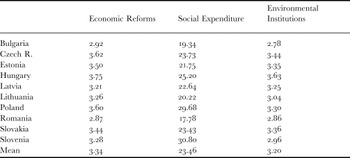
In order to analyze the effect of market reforms on policy outputs, we rely on data published annually by the European Bank for Reconstruction and Development on the achieved standards of market reforms in the transition countries (EBRD 1999, 2006). We combine expert judgments of EBRD on eight aspects of relevant market reforms into an index of MARKET REFORMS. Today, most CEE countries approach market standards of Western industrial countries. However, over time there is a non-negligible variance in the dynamic of implementing reforms and the level of reforms which have been achieved until recently. The Czech Republic, Poland and Hungary, for instance, belong to the countries which introduced most of the reforms quickly and currently show on average the highest market economy standards directly followed by Estonia and Slovakia. Bulgaria and Romania are clear laggards and Slovenia surprisingly persists at a comparatively low level after a moderately quick initial adoption of market reforms (see Table 1).
Dependent variable: policy output (1995–2004)

Weighted numbers of market reforms. social expenditure as percentage of GDP, weighted environmental institutions.
Source: Databank, Policies and Performance in Central Eastern Europe, University of Greifswald, own calculations.
In social policy, a great variety of reforms and institutional features of welfare state potentially impact the social conditions in CEE. Conceptually ambitious and empirically exact data on welfare policies as used for elaborated studies on Western welfare states is still lacking for CEE countries (e.g. Esping-Andersen Reference Esping-Anderson1990; Korpi and Palme Reference Korpi and Palme2003; Allan and Scruggs Reference Allan and Scruggs2004). Therefore we rely on SOCIAL EXPENDITURE as a percentage of GDP for measuring policy effort in this field. It stands for the fiscal commitment of a state to social matters and is widely used in aggregate data analyses (see e.g. Huber and Stephens Reference Huber and Stephens2001). This is especially true in times of low room to manoeuvre concerning fiscal policy decisions when governmental revenues and expenditures may become more relevant as indicators for governmental policy priorities (Siegel Reference Siegel, Clasen and Siegel2007). Also, studies have shown that overall social expenditure tends to be higher in countries in which the welfare policy institutions and programs are more generous and inclusive. Furthermore, social expenditure correlates highly with other, more detailed indicators of welfare policy like the decommodification index of Esping-Andersen (Schmidt Reference Schmidt, Schmidt, Ostheim, Siegel and Zohlnhöfer2007: 427).
Table 1 shows that the CEE countries vary greatly in their level of social expenditure per GDP. While no clear cut trend in social spending can be identified, there are clear differences in the effort for social policy between the countries. On average, Slovenia, Poland and Hungary spend the most and Romania as well as Bulgaria the least.
Environmental policy has long been on the agenda in industrial societies and regulations have in particular become more common after the Second World War. Highly industrialized states have developed various instruments to combat environmental degradation. Even if the CEE countries did not introduce environmental institutions to the same extent as Western societies, some efforts date back several decades. Environmental ministries were established in Poland (1972), Eastern Germany (1971), Romania (1973), Hungary (1974), and in Bulgaria (1976). Since the 1990s many more environmental institutions have been founded in the CEE countries.
The institutionalization of environmental policy is measured by an index (see Appendix 1 for further details) that covers five areas: the establishment of national environmental ministries and agencies (1) and the enforcement of national environmental laws which can be either environmental framework laws or specific laws covering air, water, and soil pollution or waste and nature protection (2). More comprehensive measures have been introduced as a reaction to the work of the Brundtland Commission. These national environmental instruments have a more holistic perspective and aim at achieving sustainable development (3). The introduction of sustainability councils or strategies as well as the existence of environmental plans and reports was included in our coding. Furthermore, new policy instruments (NEPIs) have been introduced which either focus on economic incentives, so-called economic instruments (4), or build on voluntary and informal aspects of persuasion (5). Economic instruments were coded by existing carbon dioxide taxes, energy feed-in regulations or energy quota rules. Voluntary and informal aspects of persuasion were coded by the years of introduction of ecolabels which became compulsory in the EU in 1994 and the level of ISA 14001 certification. Table 1 shows that CEE countries have rapidly introduced environmental policy instruments in the course of EU accession (see also Holzinger et al. Reference Holzinger, Knill and Arts2008: 106–108). From 1995 to 2004, institutionalization of environmental policy has been especially comprehensive in Hungary, Slovakia and the Czech Republic, followed by Estonia and Poland. As in other policy areas, Bulgaria and Romania are clear laggards.
The first set of independent variables: The impact of institutional veto players
It has been argued that institutional veto players have an impact on legislative decision-making and thereby determine policy output. Yet the competences of the four veto powers that have been introduced above follow two different logics. On the one hand, institutions may hold a veto power that depends on the degree of citizen initiatives. Among them are, for instance, referendum structures or the existence of high competences of constitutional courts. On the other hand the lawmaking process is controlled by institutional veto structures such as second chambers or federalism and the formal degree of power that is given to state Presidents by the constitution. In reality, however, democratic constitutions define veto power either by the degree of citizens initiatives or by the strength of institutional structures. This observation finds empirical evidence in a correlation matrix of veto players in CEE where both types of veto powers clearly exclude each other (Müller-Rommel et al. Reference Müller-Rommel, Harfst and Schultze2008: 689).
For theoretical reasons it would be interesting to include all four veto players in the analysis. However, since the combined data of the two types of veto players would level itself in any statistical analysis, only one type of veto players is considered in this study: the citizen initiatives. The relative strength of these veto players is measured by the degree of direct democratic structures and the competences of the constitutional court. The other alternative type of veto players (bicameralism and presidential strength) was not considered because bicameral systems with veto power only exist in Romania.
The competences of the constitutional courts and the formal institutional structures of direct democracy are measured by two indices that score from ‘0’ to ‘1’ whereby ‘1’ indicates a powerful veto institution with a strong dispersion of power and ‘0’ a weak veto institution with a strong concentration of power. Footnote 3
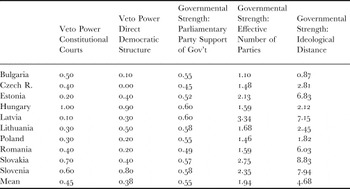
Constitutional courts are most influential on the legislative decision making rule when they have the power to decide on four issues: individual constitutional complaints; popular complaints, interpretation of the constitution and the creation of own initiatives. The index values in Table 2 show that the constitutional courts in Hungary have all four competences at their disposal while in Latvia and Estonia the constitutional court has hardly any competences. In Poland the constitutional court holds all competences except the power to decide on popular complaints. In Romania, the court has the power to introduce own initiatives, but is not allowed to decide on the interpretation of the constitution or on individual and popular complaints.
Independent variables: Institutional veto players and government strength 1995–2004

Source: Databank, Institutions and Actors in Central Eastern Europe, Leuphana Universität Lüneburg; own calculations.
Direct democratic structures make it possible for citizens to participate in lawmaking processes. Therefore, these structures have a direct impact on the legislative rule. This impact depends on the different forms of direct participation. In our context, only three forms of direct participation are considered: initiatives brought up by citizens; referendum on policy issues; plebiscite which is usually initiated either by the parliament, by the government or by the state President. These three forms of direct participation are weighted according to their impact on the legislative rule. We consider ‘plebiscites’ as the weakest form of direct participation, followed by referendum. The strongest form of direct democratic structures are seen in citizens initiatives. Table 2 summarises the index-values on direct democratic structures in CEE. The data demonstrate that direct democratic structures have a strong impact on the legislative rule in Slovenia and Hungary. In five countries (Bulgaria, Latvia, Poland, Romania, and the Czech Republic), the direct democratic structures have hardly any impact, while in Lithuania, Estonia and Slovakia the legislative rule is only to a very limited degree influenced by direct democratic structures.
Both indicators are taken together as an index of institutional veto players. In a nutshell, institutional veto players have a strong impact in Slovenia and in Hungary and a weak impact in the Czech Republic and in Latvia. Although there is very little change in the dimension of institutional veto players some alteration has occurred. With regard to the competences of the constitutional court there has only been one minor change in Poland in 1997. In all other countries, the constitutional court has kept the same power. The direct democratic structures have changed in some countries albeit not fundamentally. In Bulgaria and Hungary, for instance, minor changes took place in 1996 and 1997. In Lithuania, however, three reform processes have changed the direct democratic structures: From 1989 to 2003, the index increased from .40 to .60 (Müller-Rommel et al. Reference Müller-Rommel, Harfst and Schultze2008: 683).
The impact of political actors (government strength)
The impact of the government strength on political actors is operationalized by three factors: the parliamentary support of the governing parties, the effective number of governing parties, and the ideological distance between the governing parties.
The parliamentary support measures the percentage of parliamentary seats that are controlled by the governing parties. In five countries (Hungary, Slovakia, Slovenia, Latvia and Lithuania) the (coalition) governments hold on average a stable majority of the parliamentary seats over the whole period from 1995–2004. In the Czech Republic we find the least parliamentary support of the governing parties, followed by Romania and Estonia (see Table 2).
The number of governing parties is an indicator for the impact of government to change national policies. The higher the number of parties in government the less the chances to initiate changes in the legislative status. The number of governing parties is calculated on the basis of the formula introduced by Laakso and Taagepera (Reference Laakso and Taagepera1979) whereby the effective number of parties is measured by the proportion of seats that governing parties obtained in national parliament. Table 2 shows that the effective number of parties is comparably high in Latvia and in Slovakia. In all other CEE countries the number of effective governing parties is rather low.
The ideological distance between government parties is the third indicator that measures the impact of political actors on the lawmaking process. This indicator refers to Tsebelis' measure of partisan veto players in aggregate data analysis (Tsebelis Reference Tsebelis2002) and is operationalized as the ideological range between the two opposing parties in government. In his context it has been argued that a low ideological distance between the governing parties increases the impact of these parties on changes of the legislative status quo. The ideological distance of government parties is calculated on a 20 point left/right scale. The ideological position of governments is measured by data that have been collected by Benoit and Laver (Reference Benoit and Laver2006). The missing data for some government parties in various countries have been collected additionally using an identical expert questionnaire. The higher the value, the stronger the ideological distance between the governing parties. Table 2 shows that the ideological distance between the governing parties is on average high in three countries (Latvia, Slovenia, and Slovakia). The lowest values were measured for the governing parties in Hungary, Poland and Bulgaria.
In our empirical analysis, we summarized the standardized indices of all three factors (parliamentary support of governing parties, number of parties in government and ideological distance of governing parties) to an index of government strength. The index measures the strength of governments by focusing on the dispersion of government power. High values in this dimension means that power is strongly dispersed while low values indicate that government power is centralized. Countries with centralized power are the Czech Republic and Bulgaria. Power is highly dispersed in Slovenia, Slovakia and above all in Latvia.
The first control variable: The impact of communist legacy
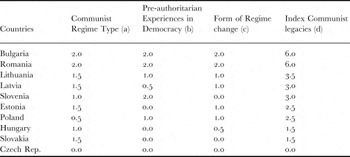
Communist legacy is operationalized by an index consisting of three indicators. First we distinguish between different types of the former communist regimes: a bureaucratic-authoritarian, bureaucratic-accommodative, and a patrimonial communist regime (Kitschelt et al. Reference Kitschelt, Mansfeldova, Markowski and Toka1999). While the former was already open for some political reforms and gave some discretion for deviant opinion, the latter rejected all political reform efforts and suppressed critical opinions. The bureaucratic-accommodative type was located somewhere between these two types of regimes. This type introduced some minor reforms while controlling public opinion. Second, some countries experienced a period of democracy prior to becoming communist regimes (Blondel and Müller-Rommel Reference Blondel and Müller-Rommel2001). We assume that a democratic period at a certain time in history stands as an indicator for low communist legacy. Thirdly, the ‘form’ of regime change matters for the strength of communist legacy (Merkel Reference Merkel2010). We distinguish between a complete breakdown of the communist regime, a negotiated regime change, and a controlled regime change by the Communist party. The more control the old regime has exercised in the transition period the stronger the Communist legacy in the 1990s. The index of Communist legacy combines these three aspects (see Table 3). The data indicate that communist legacy is non-existent in the Czech Republic. It scores only relatively low in Hungary, followed by Poland and Estonia while Bulgaria and Romania show the highest values of communist legacy.
Control Variable: Communist Legacy

(a) Ordinal scaling: 0 = bureaucratic authoritarian communist; 1 = national accommodated communism; 2 = patrimonial communism; 0.5 und 1.5 = mix types (Source: Kitschelt et al. Reference Kitschelt, Mansfeldova, Markowski and Toka1999: 39ff).
(b) Ordinal scaling: 0 = more than 20 years of democratic experience; 0.5 = 10–19 years of democratic experience; 1.0 = 5–9 years of democratic experience; 1.5 = below 5 years of democratic experience; 2.0 = no democratic experience. (Source: Blondel and Müller-Rommel Reference Blondel and Müller-Rommel2001).
(c) Ordinal scaling: 0 = collaps of communist party bureaucracy; 1 = negotiated transition; 2 = (communist) party-elite controlled regime change (Source: Merkel Reference Merkel2010: 340ff).
(d) The higher the value of the index, the stronger the communist legacy.
The second control variable: The impact of government ideology
Empirical studies have shown that the ideological position of governing parties has an impact on policy performance. More recent studies confirm great evidence that government position matters (Klingemann et al. Reference Klingemann, Hofferbert and Budge1994; McDonald and Budge Reference McDonald and Ian2005). The ideological left-right dimension seems to have a strong predicting power for policy output. Right-leaning governments support reforms towards market liberalization and left governments favor higher social spending. The ideological positions of governments are measured by the same data as the ones for the ideological distances described above. The index varies from 0 (Left) to 20 (Right). A high value means that governments are right-wing, while a low value indicates a more left-wing composition of government.
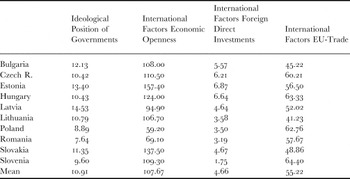
According to Table 4 we find three different patterns of government composition. First, a set of countries that were governed only by right-wing parties over the whole period from 1995 to 2004. Among them are Estonia, Latvia, and Slovakia. Secondly, we find three countries that have usually been ruled by left-wing parties (Slovenia, Romania, and Poland). Thirdly, the ideological composition of five governments has been moderate over the ten years (Bulgaria, Lithuania,Slovakia, Hungary and the Czech Republic.
Control variables: Ideological position and international factors (1995–2004)

Explanation:weighted ideological position of individual government parties with the number of seats that each of these government parties hold in parliament.
Source: Database, Institutions and Actors in Central Eastern Europe. Leuphana University Lüneburg own calculations.
Economic openness: Trade = the sum of Export + Import as percentage of Gross Domestic Product.
Source: IMF Directions of Trade CD-Rom 2006.
FDI Source: World Bank World Development Indicators 2006.
EU-Trade Source: IMF Directions of Trade CD-Rom 2006.
The third control variable: The impact of international factors
One indicator for the impact of international factors on domestic policies often used is the openness of the economy. The degree of economic openness in a given country is measured by the trade with other countries divided by the gross domestic product ((Exports + Imports) / GDP). The more open a national economy is to the world market, the more it has to obey international rules of competition. Table 4 shows that all CEE countries have trade rates that come close or even exceed their GDP. Thus, they are in line with other small states that are generally more exposed to the world economy than larger states (Katzenstein Reference Katzenstein1985). Estonia and Slovakia had the highest while Poland and Romania had on average the lowest trade rates of the ten analyzed CEE countries from 1995 to 2004.
A slightly different indicator is success of attracting the inflow of foreign direct investments (FDI). FDI is measured as the inflow of direct foreign investments (FDI) as percentage of GDP. Yet, FDI may have different impacts: on the one hand, attracting foreign capital is a sign for a stable economy in which foreign investors are willing and interested to invest in a foreign country. On the other hand, foreign capital may only seek to profit from the situation in another country, for instance, because of lower labor costs or subsidies. Table 4 shows that foreign direct investments are particularly high in Estonia, Hungary, and the Czech Republic. Interestingly, the average level of FDI is extremely low in Slovenia, followed by Poland and Lithuania.
The economic impact of the European Union on domestic policies is a third international explanatory factor. The variable EU-Trade measures the percentage of trade with EU countries as a portion of total trade. In this way we obtain an index about the degree of financial linkage between Western- and CEE states. As indicated in Table 4, trade with the EU has been essential for all CEE countries and increased substantially in the 1990s (Cameron 2009). Leading countries on EU-trade are the Czech Republic, Hungary and Slovenia, laggards are Bulgaria, Slovakia and Latvia.
Methodology And Estimation Results
In order to test our empirical assumptions we run a time-series – cross-section (TSCS) regression analysis including a sample of ten CEE countries from 1995 to 2004. As mentioned above, this study includes only consolidated democracies in order to obtain a comparable sample of countries (most similar system design). Time-series – cross section analysis combines a time series analysis and a comparison of countries. The advantage of such an analysis is that we increase the number of observations and obtain more reliable estimators. Furthermore, TSCS analysis does not rely on only one time point; it includes observation over a period of time which allows us to draw conclusions over time. Although we do not analyze trends in policies, we identify correlations which are robust over time (and countries) as will be illustrated in the following paragraphs.
Since we included some time-invariant or rarely changing variables such as legacy and institutional veto player we do not apply the conventional regression procedures such as simple panel-corrected standard error (PCSE) estimates for linear time-series – cross-sectional models where the parameters are estimated by OLS or Prais-Winsten regression (Wilson and Butler Reference Wilson and Butler2007; Beck Reference Beck, Box-Steffensmeier, Henry and Collier2008). Instead we use a procedure introduced for the analysis of time invariant and rarely changing variables (Plümper and Troeger Reference Plümper and Troeger2007). The model suggests a three-stage procedure for the estimation of time-invariant and rarely changing variables in panel data models with unit effects. The first stage of the proposed estimator runs a fixed-effects model to obtain the unit effects, the second stage breaks down the unit effects into a part explained by the time-invariant and rarely changing variables and an error term. The third stage re-estimates the first stage by pooled OLS including the time-invariant variables plus the error term of stage 2, which then accounts for the unexplained part of the unit effects.Footnote 4
All variables were lagged by one year in order to determine the causal relationship. Furthermore, a trend variable which counts through the years was included in all models. Such a variable is able to take care of non-stationary elements in the model. It has no substantial meaning and will therefore not be further interpreted. Finally, a full set of period dummies were included in all our models in order to control for unspecified period effects and temporal shocks.Footnote 5
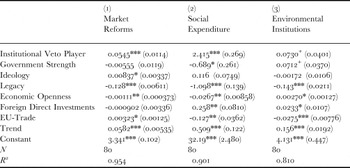
Table 5 presents five major findings: First, institutional veto players have a positive and significant effect on market reform and social expenditures. Concerning environmental institutionalization the correlation falls short of the five percent significant level (it is only significant at seven percent). With this reservation in mind, the data clearly demonstrate that in countries with high competences of the constitutional courts and strong forms of direct democratic structures the economic, the social and the environmental policy output is higher than in countries with comparably low institutional veto players. This result contradicts Tsebelis's (2002) view who claims that strong veto players obstruct policy change and innovations. Instead, it supports Lijphart's (1999) argument that countries with an institutional setting of power dispersion are forced to reach compromises and are able to introduce sustainable reforms.
Effects of Institutional, Political and Economic Factors on Policy Performance

Panel Fixed Effects Regression with Vector Decomposition. Variables defined as invariant variables: Veto Player and Legacy. Standard errors in parentheses +p < 0.10.
*p < 0.05;
**p < 0.01;
***p < 0.001.
All models include dummies for each year (period effects) which are calculated but not reported in the table.
Second, the actor constellation, measured by government strength, is much less important for predicting policy output. It is only negatively significant in the area of social policy and positively significant on the .1 level with regard to environmental policy. Furthermore, it has no statistically significant impact on the output of economic policy. In other words, the degree of parliamentary support for the governing parties as well as the effective number of parties in government and the ideological distance between these parties do not affect the economic policy output.
This result is intriguing, because it shows that the institutional dispersion of power is essential for greater activity in the field of economic, social and environmental policy. However, when it comes to behaviour of actors – this means the policy blocking capacity of political actors – no negative effect can be detected. This implies that the integration of power dispersive features in institutional structures is – as Lijphart (Reference Lijphart1999) suggested – essential for a political system. However, the fear that governments with less strength fail to deliver extensive policy reforms is not confirmed through all three policy areas. Only in the field of social expenditure we can identify an effect that weak governments have significantly lower rates of social expenditure.
Third, the impact of the communist legacy as a control variable is most impressive. Legacy has a negative and strongly significant effect on the output performance of all three policy fields. Thus, countries with a strong communist legacy did not go through substantial policy reforms while countries with a weak communist legacy show much more change in economic, social and environmental policies. This finding supports the assumptions of the path dependency hypotheses as theoretically introduced by Pierson (Reference Pierson2004) and empirically tested by Fish (Reference Fish1998), Kitschelt et al. (Reference Kitschelt, Mansfeldova, Markowski and Toka1999), and Cameron (2009).
Fourth, the estimation results of the ideological position of governments indicate that the ideological left-right dimension has no predicting power for social and environmental policy. It shows, however, a significant effect on economic policy. This finding provides evidence that the ideological composition of parties in government has an effect on the degree and the direction of market reforms. Right-leaning governments support market reforms to a significant degree. Considering the direction of the coefficients it seems that right-wing governments increase social expenditure while left-wing governments promote environmental policy. We assume that the positive relationship between right leaning governments and high social expenditure are a spill-over of economic success. However, since both results are not significant, this conclusion is more speculative than the other findings in this context.
Fifth, the findings about the impact of international pressure on policy output provide mixed evidence. On the one hand, economic openness in a given country significantly affects policy output in all three areas. However, in contrast to our assumptions, economic openness has a negative impact on economic and social policy. This finding suggests that economic openness and globalization lead to competition in these sectors which in turn may lower the degree of market reforms and social expenditure. Only in the field of environmental policy economic openness seems to support the introduction of environmental institutions. Foreign direct investments on the other hand have a positive and significant impact on social and environmental policy output and no statistically significant effect on market reforms. This finding suggests that foreign enterprises carry with them the values and standards of the home countries which promote increasing state activity in social and environmental policy in CEE (Prakash and Potosk Reference Prakash and Potosk2009). Finally, the degree of trade with the EU is significant for all three policy areas. This finding is consistent with the expectation that the interaction with the EU has a strong impact on policy output in all CEE countries. Countries which have a close trading relationship with the EU tend to promote market reforms but neglect social and environmental policy. In this view a close economic relationship with the EU promotes economic reforms but leads to a race to the bottom in the field of social and environmental policy. At least in the field of social expenditure, the results confirm the findings regarding recent trends in Western societies (Jahn Reference Jahn2006).
Conclusion
This article first of all finds that institutional veto players have a more significant effect on policy outputs than the constellation of political actors. However, the impact of the Left/Right positions of government shows that actors are not without influence. Thus, Left and Right have a meaning in CEE although only in the field of economic policy where right leaning governments promote market reforms. Secondly, the impact of international pressure on policy output is significant though less influential than political factors such as institutional veto players. Thirdly, the communist legacy in a given country has a much higher impact on policy output than expected.
The institutional dispersion of power has the beneficial effects which Lijphart (Reference Lijphart1999) claims for consensus democracy. At the same time, the constellation of actors is less relevant in CEE countries. (Müller-Rommel et al. Reference Müller-Rommel, Harfst and Schultze2008). In order to understand the impact of political institutions and political actors further research has to look at political outcomes. Confirming our hypothesis on political outcomes would be the ‘proof of the pudding’ (for a first attempt see Jahn and Kuitto Reference Jahn and Kuitto2009). Moreover, further research has to look more closely at the impact and interplay between international and domestic politics. In particular the negative correlation between economic openness and market reform needs further elaboration. While our substantial results explain much in the field of economic and social policy, they leave open some questions about environmental policy.
In sum, this analysis shows that policy output not only depends on institutional settings and political actors but also is determined by the historical development of a country (path dependency) and international factors. We need to look beyond domestic political institutions in order to understand policy performance by combining theoretically and empirically the literature on globalization and democracy with that on democratic institutions and policy performance.
Acknowledgements
The findings of this paper are based on the collaborative research project ‘Patterns of democracy and policy performance in Central Eastern Europe’, led by the two authors and funded by the German Research Foundation (DFG; JA 638/10; MU 618/14). The paper could not have been written without the continuous support of the research team, namely Philip Harfst, Kati Kuitto, and Henrike Schulze. During the research we discussed the individual concepts and analyzes in addition with Konstantin Baltz, Katja Fettelschoß, Jessica Fortin, Holger Meyer and Susanne Pickel.
Appendix 1: Policy outputs – the dependent variables
The dependent variables on policy outputs in our analysis derive from the databank ‘Policies and Performance in Central Eastern Europe’ at the University of Greifswald available upon request from Professor Detlef Jahn at djahn@uni-greifswald.de .
1. Market Reforms
The Index of Market Reforms is based on the annual Transition Indicator Scores of the European Bank of Reconstruction and Development (EBRD). The scores range from 1 (little or no change from a rigid centrally planned economy) to 4 (full standard of an industrialized market economy reached). We created an index based on the Scores in three dimensions and eight areas available over time since 1994:

The Index of Market Reforms was generated as the unweighted mean of the Indicator Scores in these eight dimensions. The higher the value of the Index, the greater the overall progress of market reforms is. Data source: Annual EBRD Transition reports 1995–2004.
B. Social Expenditure
Social expenditure refers to public expenditure on 1) social security and welfare, 2) health, and 3) education as percentages of Gross Domestic Product. This is the sum of expenditures at local, state and central level as reported by the IMF Government Finance Statistics available on a CD-ROM, December 2006.
C. Environmental Institutionalization
This Index reflects the introduction of various environmental instruments in five dimensions of environmental policy.. Each indicator is coded dichotomously and cumulative over time. The different institutions are then weighted in the manner explicated in the following table:

The data base builds on the data set developed by the Research United Environmental Policy group of the Free University Berlin. Most information has been taken from Binder (Reference Binder2002) and Busch and Jörgens (Reference Busch and Helge2005). Binder (Reference Binder2002: 39–43) cautions that some information in the original data base has only a low degree of validity and reliability. This data has been checked and revised, updated, and complemented by Detlef Jahn.