

Background
Dementia is a type of cognitive impairment caused when the brain is damaged by disease or a series of strokes; specific symptoms are dependent on the parts of the brain damaged and the disease causing the dementia. 1 People with dementia have complex needs, including communication impairments, emotional distress, withdrawal and lack of capacity. 2 There are currently 850,000 people with dementia in the United Kingdom: 1·3% of the population and 7·1% of over 65 second. 1 In all, 50% of cancer cases in the United Kingdom are diagnosed in people aged 70 and over, 3 thus it is important that therapeutic radiographers are aware of and can cater to the needs of patients with dementia.
The main symptom of dementia is memory loss. Short-term memory loss means that those affected find it hard to recall the immediate past. 1 Patients with short-term memory loss may find radiotherapy a challenge due to the required daily reproducibility of treatment position. Disorientation is another feature of dementia, a confusing scenario such as the unfamiliar treatment room and equipment could potentially cause distress for patients. 4 It is important in this situation to recognise distress and try to listen to, understand and meet the needs of the person with dementia.
The UK National Dementia Strategy emphasises the need for a skilled workforce competent in all aspects of dementia care. 5 Therapeutic radiographers are required to engage in continuous professional development, this should ideally encompass this requirement. 6 However one of the author’s personal experience of clinical practice across three different radiotherapy centres suggests that radiographers rely on their own previous experiences of treating patients with dementia rather than receiving dedicated training. This article aims to review the literature regarding training in dementia care in radiotherapy and to make recommendations for the future.
Method
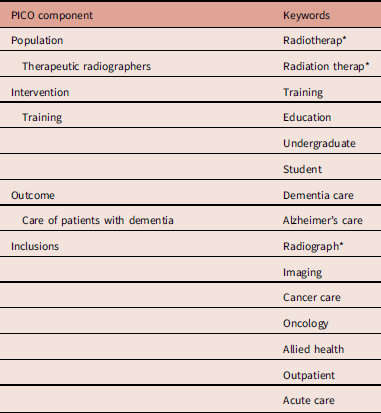
Several electronic databases holding peer-reviewed journals were accessed, these were AMED, CINAHL Plus, Embase, HMIC and Medline. The search terms were generated using the PICO method and combined using Boolean logic. The keywords can be found in Table 1.
Keywords of the literature search using the PICO framework

No specific articles for radiotherapy were returned by the initial search and so the search was widened to include literature from other related healthcare settings, such as acute nursing care. Grey literature was also searched to find current government guidance surrounding training in dementia care.
The resulting studies were primarily screened by reading the abstracts. Snowballing of reference lists was also performed to highlight further appropriate literature. Snowballing involves scrutinising the reference lists of the relevant articles to broaden the breadth of literature included.Reference Probst and Brealy 7 All final selected articles were evaluated using the Critical Appraisal Skills Programme tool. 8
Results
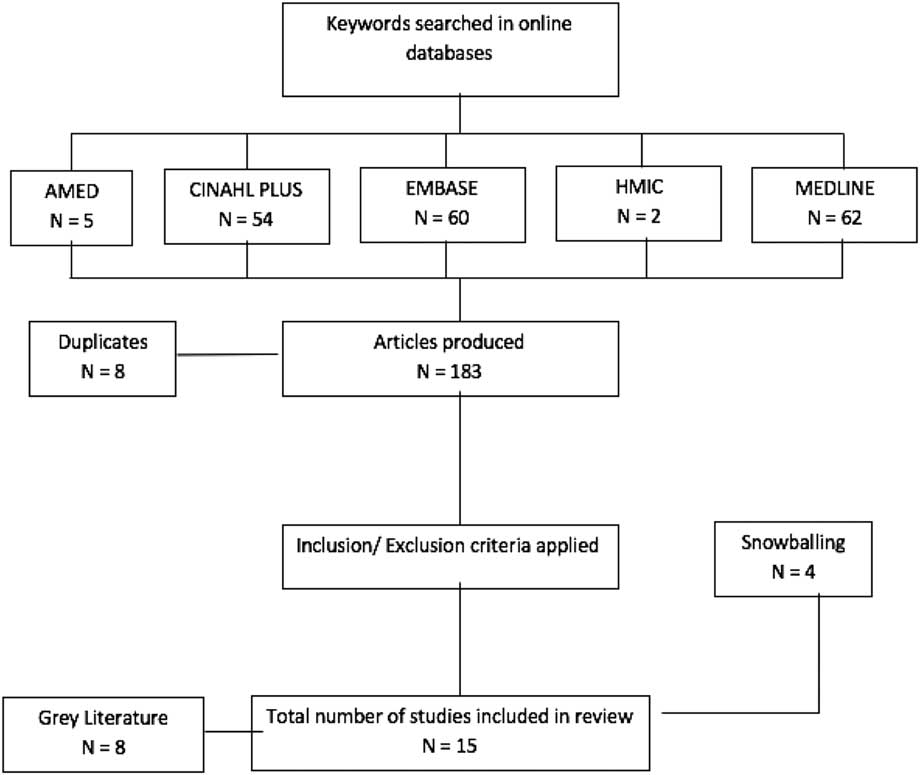
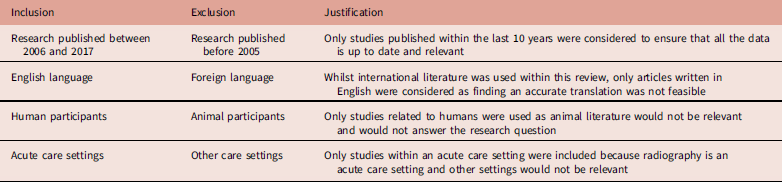
The initial search generated 183 articles, using the keywords from Table 1. The number of articles found from each database can be found in Figure 1. In total, 170 articles were excluded as a result of the inclusion criteria, which can be found in Table 2. The additional removal of duplicates left 13 articles. Six relevant publications were also included from the grey literature. The main themes that emerged were: education in caring for the person with dementia and the results of this, and guidelines in caring for the person with dementia.
Articles generated from each database.

Inclusion and exclusion criteria.

Discussion
The document ‘Dementia: Supporting People with Dementia and their Carer’s in Health and Social Care’ states that managers should ensure that all staff have access to dementia care training relevant to their roles and responsibilities. 9 In 2011, Skills for Care and Skills for Health published the ‘Common Core Principles for Supporting People with Dementia: A guide to training the social care and health workforce’. 10 The eight common core principles are relevant in all health and social care settings and provide a basis for the general understanding of dementia.
Education in caring for the person with dementia
Pulsford et al.Reference Pulsford, Hope and Thompson 11 surveyed 68 higher education institutions (HEIs) with healthcare courses regarding their education provision around dementia care. Results from the respondents revealed a large variation in timetabled input across the courses, ranging from 3 to 54 hours with no teaching on the subject from four HEIs. However, the study is 10 years old with a small response rate (32%), which could affect validity of the results. In all, 79% of responses only related to nursing programmes meaning that results could not be directly transferred to radiotherapy education.
A survey of healthcare workers in Queensland found that 70% of participants felt ‘moderately confident’ or ‘very confident’ when caring for a person with dementia. In all, 67% of participants had received some form of training, such as e-learning, in-service training or self-directed learning in the past year.Reference Travers, Beattie, Martin-Khan and Fielding 12 However, measuring confidence can be challenging, as it is based upon the feelings of individual respondents. Moreover, there was no instrument used to measure of quality of care in this study thus it is difficult to assess whether higher confidence leads to a quality delivery of care.
Smyth et al.’s studyReference Smyth, Fielding and Beattie 13 found that healthcare professionals (HCPs) relevant training and personal experience were significant predictors of knowledge of how to care for a person with dementia. In all, 93% of participants, that had some form of dementia training in the study, achieved an average knowledge score of 79%. However there is no indication that the test used was reliable.
There is a suggestion of a positive relationship between HCPs receiving training in dementia care and their resulting confidence in caring for those patients the literature also highlights variation in training available to health and social care professionals.Reference Travers, Beattie, Martin-Khan and Fielding 12 A recent survey by the UK Alzheimer’s Society 14 found only 2% of carers believed that hospital staff understood the specific needs of the person with dementia.
Guidance surrounding training
Several published guidelines support the notion that health and social care professionals should be aware of the prevalence of dementia within the United Kingdom. 10 , 15 , 16 Understanding the prevalence of dementia is important in radiotherapy as a large proportion of radiotherapy patients could be at risk of having dementia due to an increasing risk of cancer with increasing age. 3
Guidance around the need for good communication is implicit as radiographers must communicate effectively and appropriately with all patients to provide the best compassionate care. 17 Furthermore, there is a requirement to know a person and treat them with dignity and respect. 10 , 18 One way in which this can be facilitated by utilising the Alzheimer’s Society ‘This Is Me’ document. 19 This is a document holding information about a person’s personality and preferences. In radiotherapy, it is particularly useful as it can be used by staff to support the patient and adapt practices accordingly. Longer time slots for patient with dementia have been suggested by The College of Radiographers UK 20 ; this can allow patients to move at their own pace, familiarising themselves with the environment and allowing radiographers to deliver more personalised care.
The Prime Minister’s Challenge on Dementia 2020 highlights the importance of supporting individuals with dementia in their decisions and not assuming lack of capacity until it has been assessed, supporting two principles of the Mental Capacity Act 2005. 16 , 21 This is particularly important in radiotherapy, because it is imperative that radiographers ensure informed consent before treating a patient. 17 In circumstances where a lack of capacity has been established, radiographers must seek consent from the patient’s family or carer. 17 However, principle 4 of the Mental Capacity Act 2005 states that decisions made on the person’s behalf must be in their best interests. 21 Therefore, if a radiographer does not believe that giving treatment to a patient is in their best interest they reserve the right to refuse to treat the patient. 22 Thus, dementia and capacity for consent training would enable radiographers to feel empowered in their decisions as they would be armed with the information needed.
Effectiveness of training
One study reported how education in appropriate communication techniques changed the perspectives of nursing aide students on their quality of care.Reference Beer, Hutchinson and Skala-Cordes 23 The study group received training while the control group did not. Confidence was measured using a self-reflective questionnaire before and after the training. The study group reported a significantly increased confidence in understanding patients with dementia compared with the control group. However, both groups did not rate their comfort level or perceived skills when working with people with dementia highly. This rating could be due to the participants being students and it perhaps could be assumed that they had none or very little experience of working with a person with dementia in a clinical context. As previously highlighted, HCP with experience of working with persons with dementia feel more confident.Reference Travers, Beattie, Martin-Khan and Fielding 12 , Reference Smyth, Fielding and Beattie 13
Furthermore, the results of several studies indicated that after training, HCPs’ awareness, confidence and knowledge of dementia increased.Reference McPhail, Traynor, Wikstrom, Brown and Quinn 24 – Reference Robinson, Longden and Murphy 27 However, only Elvish et al.Reference Elvish, Burrow and Cawley 25 provided statistical analysis to prove this. Elvish et al.Reference Elvish, Burrow and Cawley 25 delivered a 6-hour training programme to staff with participants showing increased confidence and increased knowledge directly after the intervention, with p<0·001 for both. Participants also indicated a decrease in scores regarding beliefs about challenging behaviours, although this was relatively small. However, there was an attrition rate of 37%, the number of participants fell from 115 to 72.Reference Elvish, Burrow and Cawley 25 This could bias the results as high attrition rates can affect validity as the results are not representative of the initial population.Reference McLaren 28
The NICE Dementia Guideline 9 states that health and social care professionals should be trained to anticipate challenging behaviour and how to manage it. The Dementia Guideline describes aggressive behaviour as behaviours that challenge, 9 which suggests it is the interpretation of the professional whether they feel challenged and not the action of the patient; different staff have different interpretations of aggressive behaviour.Reference Zwijsen, Gerritsen, Eefsting, Hertogh, Pot and Smalbrugge 29 McPhail et al.Reference McPhail, Traynor, Wikstrom, Brown and Quinn 24 found that following training HCPs improved their skills in the care of patients exhibiting, what was classified previously as aggressive behaviour. The number of reports of aggressive behaviour reduced by three quarters when comparing 4 months pre-education and 4 months post-education.
The intention of one post qualifying workshop documented by McCabe et al.Reference McCabe, Davison and George 30 was to uphold sustainability in dementia care training across a ward and to encourage further changes. The results suggested that the education programme had a positive impact as staff were able to apply theory to practice to create a better environment for patients with dementia. Monthly meetings helped to ensure that changes were sustained. The researchers identified that training may lead to increased staff satisfaction but continual refresher courses may be needed for this to be maintained.
Crabtree and MackReference Crabtree and Mack 31 designed and implemented a training programme to improve staff attitudes and values towards patients with dementia in a small community hospital. All staff were offered a 1-hour training session providing a basis for the whole hospital to become dementia friendly. However, it is one of the author’s opinion that as the programme was aimed at all hospital staff it may have been too generalised, aiming to encompass tips for both admin and clinical staff. Therefore, radiographers would require further, role-specific, training.
A multiphase dementia education programme was conducted across several community hospitals and evaluated participants’ knowledge immediately post-intervention and at a 3-month follow-up. Both phases indicated a significant improvement regarding participants’ knowledge and confidence after the education programme.Reference Galvin, Kuntemeier, Al-Hammadi, Germino, Murphy-White and McGillick 32 , Reference Palmer, Lack, McGillick, Murphy-White, Carroll and Armstrong 33 At the follow-up test, results indicated a maintained confidence but showed slight declines in knowledge. However, both studies had high attrition rates for completion of the delayed test, with only 14·3 and 25% return rates. This affects the validity of the follow-up results, as they are not representative of the initial population due to attrition bias.
Kontos et al.Reference Kontos, Mitchell, Mistry and Ballon 34 developed an intervention which involved a 12-week inter-professional drama programme with the intention of educating HCP in dementia care using roleplay. Evaluation of the intervention was via focus groups and interviews. Results demonstrated that participants grew to understand the value of knowing information about the patients’ history, beliefs and past routines and using patients’ families and carer’s knowledge to provide person-centred care. This allows patients’ independence to be maintained and is in keeping with the ‘This Is Me document’. 19
In summary, the literature demonstrated that focused education programmes can improve HCPs’ knowledge and understanding of dementia. However, the evidence shows most studies were aimed at nursing professions, rather than allied health professionals such as radiographers.
Limitations
This review has some limitations. First, literature was found using online databases thus the most up to date literature may not have been accessed. A hand search may have eliminated this. Furthermore, not all the relevant articles may have been accessed as only articles written in English were included. Finally, there is the lack of research into dementia care training within the radiography setting, thus most articles included in the study were regarding an acute care setting. In order to fully measure dementia care training in radiotherapy, a primary study should be conducted.
Conclusion
The literature revealed that there is currently no set standard of training in dementia care for health and social care professionals. Thus, it is the responsibility of HEI and hospitals to ensure that staff are adequately trained to meet recommended guidelines and to provide compassionate care for the person with dementia.
The findings suggest that more research needs to be conducted into the provision of education for HCPs in the care of the person(s) with dementia. A survey of the provision of dementia care training in HEIs would help to achieve this by creating an understanding of the training available. In addition, some standardisation of education in dementia care at pre-registration level should be sought across HEIs providing healthcare programmes. Several studies showed the variation in training and the affect this has on confidence in dementia care.Reference Pulsford, Hope and Thompson 11 , Reference Travers, Beattie, Martin-Khan and Fielding 12 , Reference Beer, Hutchinson and Skala-Cordes 23 , Reference Elvish, Burrow and Cawley 25 , Reference Galvin, Kuntemeier, Al-Hammadi, Germino, Murphy-White and McGillick 32 , Reference Palmer, Lack, McGillick, Murphy-White, Carroll and Armstrong 33
Finally, it is recommended that all patients with dementia undergoing radiotherapy complete a ‘This Is Me’ booklet. 19 If this is completed therapeutic radiographers will understand the specific needs of each patient and combine their training and the booklet to cater to these needs.
Acknowledgements
None.
Financial support
There was no financial support for this study.
Conflicts of interest
There were no conflicts of interest with regard to this study.