Clostridioides difficile is a common cause of healthcare-associated infections in patients with hematologic malignancy. Reference Revolinski and Munoz-Price1 Proton-pump inhibitor (PPI) use has been associated with a significantly increased risk of C. difficile infection (CDI). Reference Janarthanan, Ditah, Adler and Ehrinpreis2,Reference Dial, Delaney, Barkun and Suissa3 At our institution, 40% of hematology-oncology patients with a positive C. difficile test had received a PPI in the prior 72 hours. Reference Ziegler, Landsburg and Pegues4 We implemented a guideline for appropriate PPI use in our hematology-oncology units and evaluated its impact on rates of PPI administration and gastrointestinal (GI) bleeding.
Methods
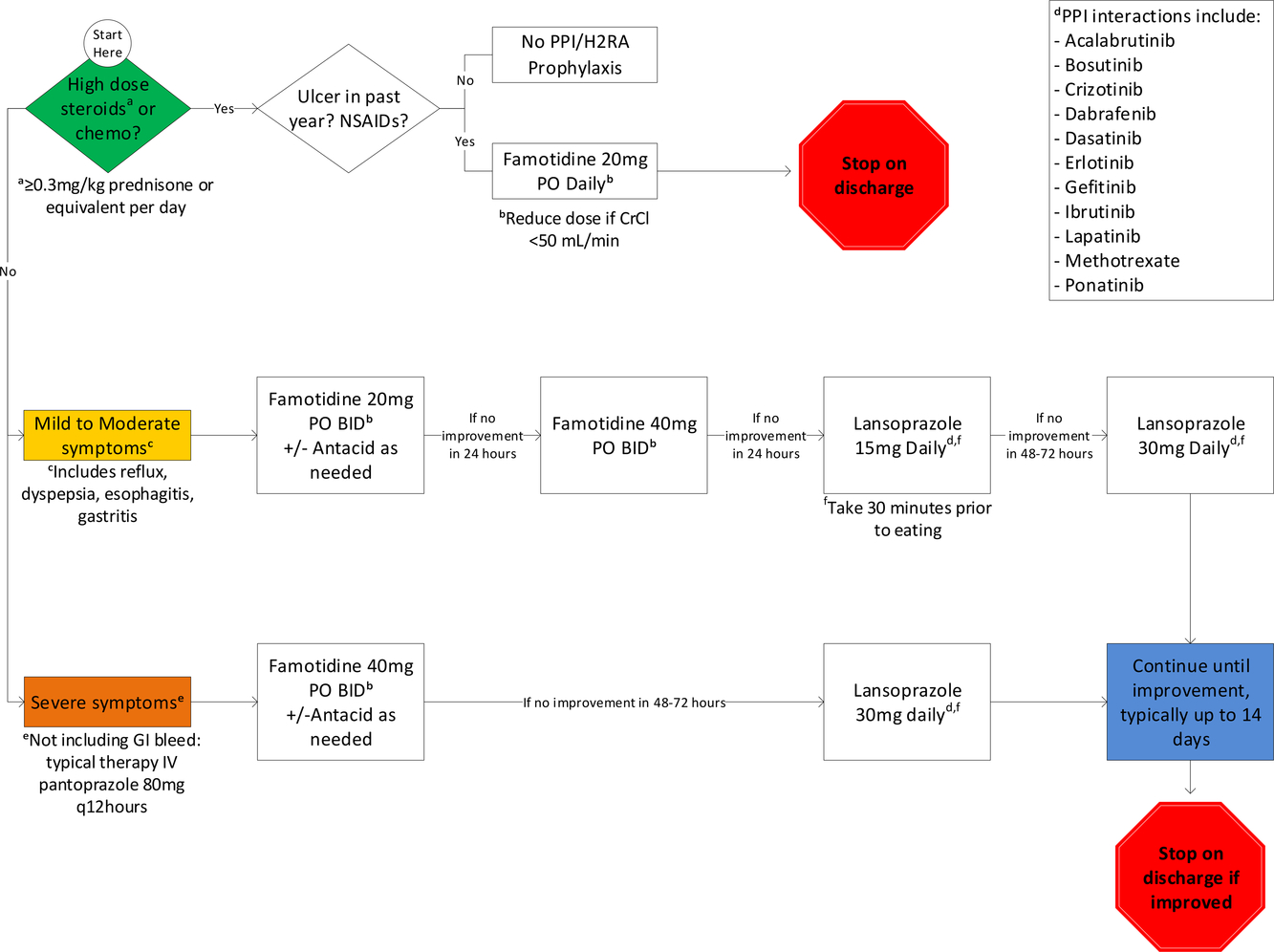
This study was conducted on 3 inpatient hematology-oncology units at the Hospital of the University of Pennsylvania, a 791-bed tertiary-care medical center. The study guideline (Fig. 1) was implemented on November 13, 2017 (see Supplementary Methods online). We analyzed the impact of this intervention by comparing a 14-month baseline cohort prior to implementation of the guideline (September 2016–October 2017) to the 10-month intervention cohort after implementation (November 2017–August 2018).
Guideline for acid suppression in hematology-oncology patients.

Our primary outcome of interest was rate of PPI use measured in days of therapy (DOT). We also ascertained rates of histamine-2 receptor antagonist (H2RA) administration and C. difficile–positive tests. Reference Ziegler, Landsburg and Pegues4 Medical record review was performed in a subset of patients with medication orders for PPIs, comparing the 3-month period before the intervention (August 12, 2017, to November 12, 2017) with the 3-month period after the intervention (November 13, 2017, to February 13, 2018). We collected he following data: PPI indication (determined by review of clinical documentation), acid suppressant prescription prior to admission, symptomatic or endoscopic evidence of GI bleeding, and PPI continuation on discharge. This study was approved by the University of Pennsylvania Institutional Review Board. Statistical methods are described in the Supplementary Methods online.
Results
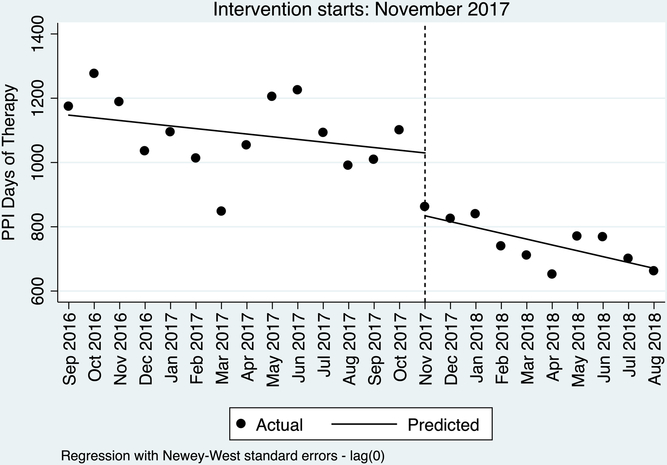
Compared to the baseline period, PPI use significantly decreased on the study units during the intervention period, from a mean of 1,092.8 DOT per month (standard deviation [SD], 113.5) to a mean of 752.4 DOT per month (SD, 73.2; P < .001). This decline in PPI administration was sustained over the intervention period, with 661 DOT in the final month of the intervention, which represented a 48% decline from the peak of use in October 2016, which was 1,275 DOT. Using segmented regression analysis, we detected a significant immediate reduction with the intervention of 195.5 DOT (95% confidence interval [CI] of reduction, 87.8–303.2; P = .001) (Fig. 2). Additionally, we detected a significant postintervention linear trend of a reduction in PPI administration of 18.2 DOT per month (95% CI of reduction, 11.2–25.1; P < .001). Assessing rate of PPI administration per 1,000 patient days, model fit, change in y-intercept, and postintervention linear trend remained significant (Supplementary Table 1 online).
Segmented regression analysis of monthly proton pump inhibitor administration on 3 hematology-oncology units.

Histamine-2 receptor antagonist use increased from an average of 615.1 DOT (SD, 124.1) in the baseline group to 714.1 DOT (SD, 88.8) in the intervention group (P = .04). In our segmented regression analysis, no immediate change was detected after guideline introduction (reduction, 102.9 DOT; 95% CI, reduction of 247.6 to increase of 41.7; P = .15). However, we identified a significant postintervention linear trend for the increase in H2RA use of 19.1 DOT per month (95% CI of increase, 5.1–33.0; P = .01). In our assessment of the rate of H2RA administration per 1,000 patient days, we detected no significant change in either the immediate postintervention change or linear trend.
In medical record review of a subset of patients, there were 155 PPI medication orders in the baseline cohort and 126 in the intervention cohort (Supplementary Table 2 online). Among them, most represented continuation of a medication began prior to admission; only 43 (28%) in the baseline and 23 (18%) in the intervention group were new orders (P = .047). There was no difference in the order indication between periods. An increased proportion of PPIs were continued on discharge in the intervention group compared to the baseline group (85% vs 70%; P = .004). Most of these represented continuation of a medication began prior to admission: 94 of 106 in the baseline group and 95 of 107 in the intervention group.
Rates of GI bleeding in this subset of patients were low: 6 (3.9%) in the baseline group compared to 6 (4.8%) in the intervention group (P = .75). Our analysis revealed no significant differences in other secondary outcomes between the groups (Supplementary Table 3 online).
We detected no significant change in rates of C. difficile–positive tests on study units, with an average of 2.057 per 1,000 patient days (SD, 1.289) in the baseline group and 2.046 per 1,000 patient days (SD, 0.959) in the intervention group (P = .93). However, the study was not powered to determine an impact of our intervention on rates of C. difficile.
Discussion
We evaluated the impact of implementation of a multidisciplinary guideline for appropriate acid suppression in our hematology-oncology population. Our results were notable for several findings. First, we demonstrated a large and sustained decline in PPI administration with guideline implementation. Second, although it was not statistically significant, we detected a trend toward decreased inappropriate ordering for GI bleeding prophylaxis during chemotherapy. Finally, we detected no increase in rates of GI bleeding, indicating low risk of harm with our intervention.
In a population with high rates of colonization and infection with C. difficile, Reference Revolinski and Munoz-Price1–Reference Dial, Delaney, Barkun and Suissa3 it is important to reduce unnecessary exposures that increase the risk of CDI. Implementation of our guideline resulted in an average 31% reduction in PPI use over time, with a sustained decline over the study period. Prior studies have investigated various methods of reducing PPI utilization in general medical patients, including a pharmacist-led inpatient PPI stewardship team Reference Wahking, Steele, Hanners, Lockwood and Davis5 and computerized order-entry alerts with prospective audit and feedback. Reference Kandel, Gill, McCready, Matelski and Powis6 These interventions have demonstrated similar levels of success, with ~41% and ~37% reductions, respectively. Our study focused on patients with hematologic malignancy and addressed acid suppressant guidelines unique to this population, including prophylactic acid suppressant use and symptomatic management during chemotherapy. We believe that addressing these areas of frequent, often inappropriate, utilization of acid suppressants in this patient population contributed to the success of our intervention without the need for prospective audit and feedback.
Although we noted a decrease in PPI use, our intervention may have resulted in increased utilization of H2RAs. However, after adjusting for patient days on study units, we detected no significant increase in H2RA use. Additionally, although H2RA agents have also been associated with risk of CDI, they carry a 29% lower odds of CDI than PPIs. Reference Kwok, Arthur, Anibueze, Singh, Cavallazzi and Loke7,Reference MacLaren, Reynolds and Allen8
There was no increased rate of GI bleeding with our intervention. This finding is consistent with previous studies that have shown that serious adverse events associated with GI bleeding, such as requirement for blood transfusion, are uncommon after chemotherapy. Reference Sartori, Trevisani, Nielsen, Tassinari, Panzini and Abbasciano9 Additionally, rates of GI bleeding with systemic corticosteroid use were similar to placebo in a meta-analysis. Reference Numico, Fusco, Franco and Roila10
Our study has several potential limitations. First, we utilized a quasi-experimental design, which may be biased by confounding variables that impacted PPI prescribing. However, no additional interventions were focused on PPI prescribing during the study period. Second, this study was one of multiple ongoing interventions targeted toward reducing C. difficile rates and was not powered to detect a significant change in this outcome. Additionally, our study focused on hematology-oncology patients at an academic institution and may not be generalizable to dissimilar populations. Finally, high rates of orders with unclear indications and continuation on discharge in the intervention group suggests an opportunity for additional improvement.
In conclusion, our findings highlight the impact of a multidisciplinary practice guideline in effectively reducing PPI use in hospitalized patients with hematologic malignancy.
Acknowledgments
Financial support
This work was supported by a CDC Cooperative Agreement (FOA no. CK16-004) from the Epicenters for the Prevention of Healthcare Associated Infections. The funding agency had no role in the design and conduct of the study; collection, management, analysis, and interpretation of the data nor in the preparation, review, or approval of the manuscript.
Conflicts of interest
All authors report no conflicts of interest relevant to this study.
Supplementary material
To view supplementary material for this article, please visit https://doi.org/10.1017/ice.2019.238