Introduction
The question of how to conceptualize and define mental disorders is at the forefront of the field, as evidenced by ongoing revisions to the Diagnostic and Statistical Manual of Mental Disorders (DSM-IV-TR) and the International Classification of Diseases (ICD-10), as well as recent efforts by the National Institute of Mental Health to launch the Research Domain Criteria (RDoC) initiative (Insel & Cuthbert, Reference Insel and Cuthbert2009). While the DSM and ICD generally emphasize self-reported or observable behaviors and emotional features as criteria for individual disorders, the goal of the RDoC is to characterize psychiatric disorders in terms of their neurobiological underpinnings (Insel & Cuthbert, Reference Insel and Cuthbert2009). Some recent efforts in this direction have taken an experimental psychopathology approach, which aims to delineate the neural circuits relevant to specific psychiatric disorders via neuroimaging methods. A prominent example of this approach is provided by the Cognitive Neuroscience Treatment Research to Improve Cognition in Schizophrenia Initiative (Carter & Barch, Reference Carter and Barch2007), whose goals are to develop and refine experimental tasks for indexing cognitive systems and processes implicated in schizophrenia, particularly with an eye toward treatment applications.
A related strategy has been to identify, through evaluation of existing research, neurophysiological indicators that relate to psychiatric disorders or disorder dimensions (Gilmore et al. Reference Gilmore, Malone and Iacono2010; Patrick & Bernat, Reference Patrick, Bernat, Millon, Krueger and Simonsen2010; Nelson et al. Reference Nelson, Patrick and Bernat2011). The aims of this ‘converging biomarker’ approach are consistent with those of the RDoC initiative in that it seeks to clarify sources of homogeneity and heterogeneity within and across specific disorders or interrelated sets of disorders. However, in contrast with the traditional experimental approach, which typically focuses on one disorder of interest (e.g. schizophrenia or depression), the converging biomarker approach considers differing biological indicators across multiple disorders that could serve as referents for neurobiological-based diagnostic phenotypes. The current review illustrates this strategy, synthesizing findings from neurobiological and quantitative modeling studies of psychopathology to identify promising avenues along which to pursue a neurobiological-informed nosology of mental disorders.
More specifically, we review and discuss results from psychopathology studies employing two distinct neurophysiological measures – the startle blink reflex and error-related negativity (ERN) – in relation to quantitative-structural models of anxiety/depressive (i.e. internalizing) disorders and affiliated traits, with the aim of illustrating how available neurobiological research can help to clarify neural substrates of psychiatric disorders involving fear, anxiety and depression. These physiological indices were chosen because they have been extensively utilized in studies of internalizing disorders and their neural bases are well understood. While previous reviews have examined patterns of associations of the blink reflex (Grillon & Baas, Reference Grillon and Baas2003; Davis et al. Reference Davis, Walker, Miles and Grillon2009; Lang & McTeague, Reference Lang and McTeague2009; Vaidyanathan et al. Reference Vaidyanathan, Patrick and Cuthbert2009b) and ERN response (Taylor et al. Reference Taylor, Stern and Gehring2007; Olvet & Hajcak, Reference Olvet and Hajcak2008) in relation to specific disorders and psychopathology dimensions, the goal of the current review is somewhat different. Rather than attempting to use psychiatric disorders/dimensions or personality traits as anchoring constructs, our strategy is to treat them as open concepts (Meehl, Reference Meehl, Millon and Klerman1986) (i.e. having fuzzy boundaries, lacking explicit definitional criteria and based more on implicit or contextual definitions) and to use information from all sources, including startle and ERN studies, to help define domains of psychopathology.
The rationale for adopting this approach is as follows. While it is widely acknowledged that neurobiological foundations of psychopathology are not in line with the categories espoused by the DSM, it is not clear whether there is a direct mapping between dimensions of psychopathology obtained from factor analytic models and neurobiological data (Brown et al. Reference Brown, Chorpita and Barlow1998; Wittchen et al. Reference Wittchen, Höfler and Merikangas1999). More fundamentally, researchers have cautioned against attributing ‘surplus meaning’ to factors (Cronbach & Meehl, Reference Cronbach and Meehl1955) by positing the existence of dimensions or latent constructs based solely on results obtained from factor analytic models (Duncan, Reference Duncan1984; Borsboom et al. Reference Borsboom, Mellenbergh and van Heerden2003; Grove & Vrieze, Reference Grove, Vrieze, Millon, Krueger and Simonsen2010). Relatedly, it is interesting to note that while constructs such as neuroticism, negative affect and internalizing have been shown to be linked to several psychiatric disorders, others have questioned the explanatory value of such associations due to their non-specificity (Ormel et al. Reference Ormel, Rosmalen and Farmer2004; Lahey, Reference Lahey2009). Thus, the purpose of the current review is to integrate information from both neurobiology and quantitative models of personality and psychopathology, with the idea that delineating points of convergence between various domains will increase our knowledge of internalizing disorders beyond what can be done by simply referencing neurobiology to statistical models of personality or psychopathology.
We open with a brief overview of dimensional models of internalizing psychopathology and affiliated personality traits. To avoid redundancy with prior reviews of the startle blink reflex and ERN, and to focus the current review on conceptual more than methodological issues, we provide a brief recapitulation of findings from these domains. We follow this by highlighting parallels in relations of the ERN and startle blink reflex with internalizing disorders and traits. Finally, we re-reference these findings to current conceptions of internalizing psychopathology in order to identify avenues for further research.
Understanding interrelations among anxiety and depressive disorders: the internalizing domain of psychopathology
Co-morbidity or co-occurrence of psychiatric disorders is a pervasive phenomenon, though of unclear origins. While diagnostic nomenclatures such as the DSM deal with co-morbidity by imposing hierarchical rules among various disorders, the approach in the experimental psychopathology literature has been to target single disorders of interest and exclude individuals with additional disorders to establish ‘pure’ samples. More recently, however, researchers in quantitative modeling have posited that co-morbidity constitutes an important signal and have conceptualized it in terms of a set of latent (underlying) variables. The most popular of these are dimensional models of psychopathology, which conceptualize co-morbidity as a set of correlated continua (Krueger, Reference Krueger1999; Vollebergh et al. Reference Vollebergh, Iedema, Bijl, de Graaf, Smit and Ormel2001; Cox et al. Reference Cox, Clara and Enns2002; Slade & Watson, Reference Slade and Watson2006). In such models, social and specific phobia, agoraphobia and panic disorder cohere together to form a ‘fear’ factor, whereas depression, post-traumatic stress disorder (PTSD), generalized anxiety disorder (GAD) and dysthymia form a ‘distress’ factor, with fear and distress subsumed by a broader internalizing factor.
The overlapping but distinctive nature of disorders marked by depression and anxiety, highlighted by such models, directly parallels findings from the literature on personality structure. For example, Clark & Watson's (Reference Clark and Watson1991) tripartite model of anxiety and depression suggests that high negative affect (encompassing traits such as anxiety, irritability and stress reactivity) plays a key role in both anxiety and mood disorders. Whereas anxiety disorders are marked by salient physiological hyperarousal, however, depression is distinguished by low positive affectivity. Brown and colleagues (Brown et al. Reference Brown, Chorpita and Barlow1998; Brown, Reference Brown2007; Brown & McNiff, Reference Brown and McNiff2009) have espoused a similar model of internalizing disorders, with negative affect being related to all disorders, positive affect associated more specifically with depression and social phobia, and autonomic arousal being specifically related to panic disorder and PTSD. Similarly, Tellegen (Reference Tellegen, Hussain Tuma and Maser1985) has suggested that although anxiety and depression share high negative emotionality, the latter is characterized additionally and uniquely by low positive emotionality.
Although notable congruencies of this kind are evident between the diagnostic and personality literatures on internalizing disorders, clear discrepancies are evident as well. For example, the ‘fear’ disorders identified by statistical models of psychopathology do not have a clear counterpart in Clark & Watson's tripartite model, Brown and colleagues' model or Tellegen's personality model. Similarly, it is unclear how depression should be conceptualized in relation to the anxiety disorders. Should it be regarded simply as a distinctive expression (facet) of the broader internalizing factor (Krueger et al. Reference Krueger, McGue and Iacono2001) or should it instead be accorded a more distinct status of its own, given the specific component of low positive affect associated with it (Mineka et al. Reference Mineka, Watson and Clark1998; Naragon-Gainey et al. Reference Naragon-Gainey, Watson and Markon2009)? This review addresses questions of this nature by illustrating how neurophysiological measures can help inform our understanding of psychopathology constructs such as fear, anxiety and depression.
The startle blink reflex and its relations with internalizing disorders
The startle blink reflex is a widely used psychophysiological index of attention and emotion. Briefly, this reflex entails contraction of the orbicularis oculi muscle in response to a sudden, unexpected stimulus and is part of a larger array of somatic and visceral changes that comprise the startle reaction (Graham, Reference Graham, Kimmel, Olst and Orlebeke1979). What makes the blink reflex particularly attractive for research on internalizing psychopathology is that its neural circuitry has been extensively researched and well mapped out, with different pathways associated with differing processes such as fear and anxiety. When an acoustic startle probe is delivered, an obligatory blink response is activated via input to the cochlear root neurons, which is transmitted to the nucleus reticularis pontis caudalis. Influential work by Davis and colleagues (Davis et al. Reference Davis, Walker and Lee1997, Reference Davis, Walker, Miles and Grillon2009; Davis, Reference Davis1998) has demonstrated that this obligatory response can be modified in negative emotional states by auxiliary input from two additional pathways associated with the amygdala: one more attuned to discrete cues signaling danger or punishment, identified with the central nucleus of the amygdala, and another implicated in states of anxiety prompted by more ambiguous or more extended emotional stressors and associated with the extended amygdala (in particular, the bed nucleus of the stria terminalis). While the two circuits are interrelated, they appear to function independently; each response can be selectively affected without changing the other (Davis et al. Reference Davis, Walker, Miles and Grillon2009). Although more poorly understood than the fear and anxiety systems, a third subsystem of the startle reflex has been identified as a response to pleasant foreground stimuli involving the nucleus accumbens (Koch et al. Reference Koch, Schmid and Schnitzler1996).
The three parameters of the startle reflex that have been most frequently studied are emotion-modulated startle, baseline or general startle reactivity and context-potentiated startle. Emotion-modulated startle refers to startle in the context of discrete affective stimuli, such as pictures from the International Affective Picture System (IAPS) and emotional sounds. For example, in IAPS picture paradigms, subjects in the general population show an increased startle response when viewing unpleasant versus neutral scenes (i.e. fear-potentiated startle) and diminished response when viewing pleasant stimuli (i.e. pleasure-inhibited startle) (Vrana et al. Reference Vrana, Spence and Lang1988). Baseline startle refers to noise-probe reactivity assessed during inter-trial intervals or average startle response across all probe trials in a study (regardless of foreground), reflecting individual variations in the general magnitude of the probe-startle response. Finally, context-potentiated startle refers to probe-blink reactivity in contexts where an aversive stimulus (e.g. shock or loud noise) is anticipated relative to contexts in which there is no such anticipation.
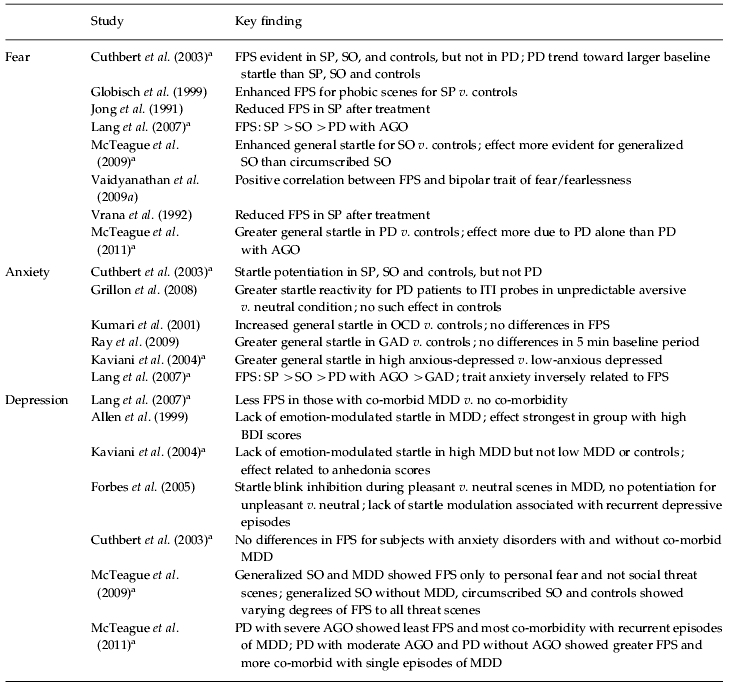
The following patterns have been documented for differing parameters of the startle blink response in relation to internalizing disorders (Grillon & Baas, Reference Grillon and Baas2003; Davis et al. Reference Davis, Walker, Miles and Grillon2009; Lang & McTeague, Reference Lang and McTeague2009; Vaidyanathan et al. 2009 b) (see Table 1).
Key findings of reviewed studies on the startle reflex

FPS, Fear-potentiated startle; SP, specific phobia; SO, social phobia; PD, panic disorder; AGO, agoraphobia; ITI, intertrial interval; OCD, obsessive-compulsive disorder; GAD, generalized anxiety disorder; MDD, major depressive disorder; BDI, Beck Depression Inventory.
a Same study depicted more than once in the table to illustrate differing findings with regard to fear, anxiety and depression correlates of startle.
Fear (phobic) disorders
Subjects diagnosed with phobias, with high levels of phobic symptoms and those scoring high in trait fearfulness demonstrate greater fear-potentiated startle for aversive stimuli (e.g. startle during aversive picture-viewing or imagery) while showing relatively normal baseline or general startle (Jong et al. Reference Jong, Merckelbach and Arntz1991; Vrana et al. Reference Vrana, Constantine and Westman1992; Globisch et al. Reference Globisch, Hamm, Esteves and Ohman1999; Cuthbert et al. Reference Cuthbert, Lang, Strauss, Drobes, Patrick and Bradley2003; Lang et al. Reference Lang, McTeague, Cuthbert, Treat, Bootzin and Baker2007; McTeague et al. Reference McTeague, Lang, Laplante, Cuthbert, Strauss and Bradley2009; Vaidyanathan et al. Reference Vaidyanathan, Patrick and Bernat2009a). Panic disorder does not dovetail with this picture as clearly as the other phobias, as the weight of available evidence suggests that startle reactivity in this disorder is more similar to that observed in non-phobic anxiety disorders, as discussed in the following section (for a detailed review, see Vaidyanathan et al. Reference Vaidyanathan, Patrick and Cuthbert2009b). However, a recent study (McTeague et al. Reference McTeague, Lang, Laplante and Bradley2011) on panic disorder reported that the presence of agoraphobia appeared to moderate this effect, such that subjects with panic disorder alone showed the greatest levels of general startle reactivity, while those with panic disorder and agoraphobia were more similar to controls. Similarly, those with generalized social phobia appear to show more pervasive activation across unpleasant imagery similar to that observed in non-phobic anxiety disorders (see next section) relative to those with circumscribed social phobia (McTeague et al. Reference McTeague, Lang, Laplante, Cuthbert, Strauss and Bradley2009).
Non-phobic anxiety disorders and negative affect
Broadly speaking, anxiety disorders such as GAD, obsessive-compulsive disorder (OCD), panic disorder and affiliated traits in the domain of negative affectivity are associated with greater baseline or general startle reactivity and greater context-potentiated startle (i.e. increased startle during periods when an unpredictable aversive stimulus is expected; Kumari et al. Reference Kumari, Kaviani, Raven, Gray and Checkley2001; Cuthbert et al. Reference Cuthbert, Lang, Strauss, Drobes, Patrick and Bradley2003; Grillon et al. Reference Grillon, Lissek, Rabin, McDowell, Dvir and Pine2008; Ray et al. Reference Ray, Molnar, Aikins, Yamasaki, Newman, Castonguay and Borkovec2009). Results regarding fear-potentiated startle have been more mixed, with some studies showing no effect (Kumari et al. Reference Kumari, Kaviani, Raven, Gray and Checkley2001; Kaviani et al. Reference Kaviani, Gray, Checkley, Raven, Wilson and Kumari2004) and others showing a progressive decrease in fear-potentiated startle as a function of increasing negative affect (Cuthbert et al. Reference Cuthbert, Lang, Strauss, Drobes, Patrick and Bradley2003; Lang et al. Reference Lang, McTeague, Cuthbert, Treat, Bootzin and Baker2007). This discrepancy could be attributable to the differing task parameters used across these sets of studies; blink reactivity has been assessed in response to picture viewing in the former versus imagined scenes in the latter. Prior work on imagined scenes has consistently found increased startle reactivity in the context of both pleasant and unpleasant relative to neutral imagery (Witvliet & Vrana, Reference Witvliet and Vrana1995; Miller et al. Reference Miller, Patrick and Levenston2002), whereas startle reactivity during picture-viewing follows a linear pattern across valence conditions [i.e. pleasant <neutral <unpleasant (Vrana et al. Reference Vrana, Spence and Lang1988)]. But, importantly, even in this latter group of studies there appears to be a distinction between fear and anxiety, such that fear reactions are presumed to elicit fear-potentiated startle, with concomitant levels of negative affect decreasing such responses.
It is worth noting that results for startle in PTSD have been especially mixed compared with findings for other anxiety disorders (Grillon & Baas, Reference Grillon and Baas2003; Pole, Reference Pole2007; Vaidyanathan et al. Reference Vaidyanathan, Patrick and Cuthbert2009b), suggesting perhaps a degree of heterogeneity in PTSD, unlike other forms of internalizing psychopathology. In fact, researchers (Miller et al. Reference Miller, Greif and Smith2003, Reference Miller, Kaloupek, Dillon and Keane2004) have proposed that there might be various subtypes of PTSD rather than it being a single homogeneous disorder.
Major depression
Depression appears to be associated with decreased emotional modulation of the startle blink reflex, with subjects showing a flattened affect-startle pattern (i.e. limited differentiation of probe reactions for either pleasant or unpleasant scenes relative to neutral). It remains unclear, however, whether this anomalous modulatory effect occurs in all depressed subjects (Lang et al. Reference Lang, McTeague, Cuthbert, Treat, Bootzin and Baker2007), as some studies have demonstrated this effect primarily in individuals with severe depression (Allen et al. Reference Allen, Trinder and Brennan1999), marked anhedonia (Kaviani et al. Reference Kaviani, Gray, Checkley, Raven, Wilson and Kumari2004) or those with multiple recurrent episodes of depression (Forbes et al. Reference Forbes, Miller, Cohn, Fox and Kovacs2005) and other studies not finding this effect at all (Cuthbert et al. Reference Cuthbert, Lang, Strauss, Drobes, Patrick and Bradley2003). A recent study (McTeague et al. Reference McTeague, Lang, Laplante and Bradley2011) suggested that this flattening of emotion-modulated startle was most evident among subjects with panic disorder and agoraphobia, along with co-morbid recurrent depression (single episodes of depression were not related as strongly to decreased fear-potentiated startle). Likewise, even among those with social phobia (McTeague et al. Reference McTeague, Lang, Laplante, Cuthbert, Strauss and Bradley2009), only those with generalized social phobia and co-morbid depression (versus circumscribed social phobia alone) showed decreased fear-potentiated startle – a finding related to results in the statistical modeling literature that have shown low positive affect to be implicated in social phobia as well as depression (Brown et al. Reference Brown, Chorpita and Barlow1998).
In summary, phobic disorders and related traits are associated with increased fear-potentiated startle, whereas increased general or baseline startle reactivity characterizes disorders involving pervasive distress such as GAD. Depression, on the other hand, appears to be associated with both decreased fear-potentiated startle and diminished pleasure-inhibited startle (i.e. a generally flattened affect-startle pattern), though this effect might be related to severity or recurrence of the disorder. Interestingly, studies have also suggested that these various parameters of the startle response are unrelated at the neurobiological level. For example, Cuthbert et al. (Reference Cuthbert, Lang, Strauss, Drobes, Patrick and Bradley2003) found that fear-potentiated startle was uncorrelated with baseline startle in a large sample of patients. Likewise, Lang et al. (Reference Lang, McTeague, Cuthbert, Treat, Bootzin and Baker2007) reported that diagnoses of anxiety and depression are associated with unique and cumulative attenuation of fear-potentiated startle. In summary, the constructs of fear, anxiety and depression appear to be associated with divergent and relatively independent patterns of startle blink reactivity, suggesting that the various circuits associated with the startle blink reflex index different processes related to internalizing disorders.
ERN and its relations with internalizing disorders
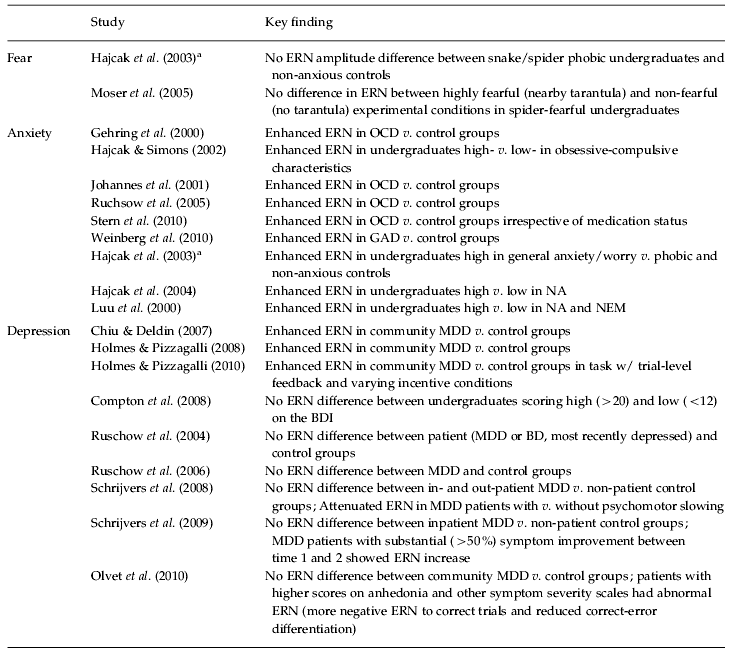
The ERN is another psychophysiological measure that exhibits distinctive relations with differing forms of internalizing psychopathology. As an event-related potential (ERP) response linked to performance errors on speeded tasks, the ERN is thought to reflect the brain's detection of behavioral errors or competition among differing response options (Falkenstein et al. Reference Falkenstein, Hohnsbein, Hoormann and Blanke1991; Gehring et al. Reference Gehring, Goss, Coles, Meyer and Donchin1993; Carter et al. Reference Carter, Braver, Barch, Botvinick, Noll and Cohen1998). In contrast to more diffuse ERP measures such as the P300, the ERN has a relatively clear neural source in the anterior cingulate cortex (ACC; Dehaene et al. Reference Dehaene, Posner and Tucker1994; Holroyd et al. Reference Holroyd, Dien and Coles1998; van Veen & Carter, Reference van Veen and Carter2002), part of a network of brain structures (including the prefrontal cortex) that governs self-monitoring and behavioral regulation (Miller & Cohen, Reference Miller and Cohen2001). Motivated by the intuitive idea that individuals with anxiety and depressive disorders appear overly sensitive to errors, research linking ERN amplitude and internalizing disorders has proliferated in recent years, with the following patterns of findings (see Table 2).
Key findings of reviewed studies on the ERN

ERN, Error-related negativity (amplitude); OCD, obsessive-compulsive disorder; GAD, generalized anxiety disorder; NA, negative affect; NEM, negative emotionality; MDD, major depressive disorder; BDI, Beck Depression Inventory; BD, bipolar disorder.
To our knowledge there have been no published studies on the relationship between ERN amplitude and panic or post-traumatic stress disorder.
a Same study depicted more than once in the table to illustrate differing findings with regard to fear and anxiety correlates of ERN.
Fear (phobic) disorders
Phobias do not appear to be associated with deviations in ERN amplitude. Individuals reporting high levels of snake- and spider-phobia symptoms exhibit ERN amplitudes comparable to those of non-anxious controls (Hajcak et al. Reference Hajcak, McDonald and Simons2003). Interestingly, even salient fear induction (involving close exposure to a live tarantula) does not alter early error-processing as indexed by ERN amplitude in spider-phobic individuals (Moser et al. Reference Moser, Hajcak and Simons2005), though concurrent affective distress and attentional/evaluative deficits were apparent, as reflected in other ERP indices. Thus, these studies provide compelling evidence that fear states do not alter the ERN. However, replication of these findings in clinical populations and extension to other fear disorders will be necessary to definitively conclude that the ERN is unaffected in these disorders as a group.
Non-phobic anxiety disorders and negative affect
Supporting the intuitive link between heightened error sensitivity and anxiety, enhanced ERN amplitude has consistently been demonstrated in relation to OCD (Gehring et al. Reference Gehring, Himle and Nisenson2000; Johannes et al. Reference Johannes, Wieringa, Nager, Rada, Dengler, Emrich, Munte and Dietrich2001; Hajcak & Simons, Reference Hajcak and Simons2002; Ruchsow et al. Reference Ruchsow, Gron, Reuter, Spitzer, Hermle and Kiefer2005; Stern et al. Reference Stern, Liu, Gehring, Lister, Yin, Zhang, Fitzgerald, Himle, Abelson and Taylor2010), GAD (Weinberg et al. Reference Weinberg, Olvet and Hajcak2010) and self-reported worry or negative affectivity (Luu et al. Reference Luu, Collins and Tucker2000; Hajcak et al. Reference Hajcak, McDonald and Simons2003, Reference Hajcak, McDonald and Simons2004). Consistent with this, neuroimaging studies have also reported increased ACC activation during performance tasks in obsessive-compulsive (Ursu et al. Reference Ursu, Stenger, Shear, Jones and Carter2003; Fitzgerald et al. Reference Fitzgerald, Welsh, Gehring, Abelson, Himle, Liberzon and Taylor2005; Maltby et al. Reference Maltby, Tolin, Worhunsky, O'Keefe and Kiehl2005) and high trait anxious (Paulus et al. Reference Paulus, Feinstein, Simmons and Stein2004) individuals relative to non-anxious controls. Together, these findings suggest that phobic and non-phobic anxiety disorders are associated with distinct neurobiological correlates, at least in the context of ACC function.Footnote 1Footnote †
Major depression
Although findings linking ERN and depression have been more mixed, there is evidence that major depressive disorder is associated with enhanced ERN amplitude (Chiu & Deldin, Reference Chiu and Deldin2007; Holmes & Pizzagalli, Reference Holmes and Pizzagalli2008, Reference Holmes and Pizzagalli2010). However, some studies have reported no difference (Ruchsow et al. Reference Ruchsow, Herrnberger, Wiesend, Gron, Spitzer and Kiefer2004, Reference Ruchsow, Herrnberger, Beschoner, Gron, Spitzer and Kiefer2006; Compton et al. Reference Compton, Lin, Vargas, Carp, Fineman and Quandt2008) or even marginally smaller (Schrijvers et al. Reference Schrijvers, de Bruijn, Maas, de Grave, Sabbe and Hulstijn2008, Reference Schrijvers, de Bruijn, Maas, Vancoillie, Hulstijn and Sabbe2009) ERN response amplitude in depressed versus non-depressed individuals. Although numerous differences between studies could account for these inconsistent findings, considering subcomponents of depression could shed light on how depression and error-monitoring are related. For example, although negative affect (common to anxiety and depression) is associated with enhanced ERN, severe depression (Schrijvers et al. Reference Schrijvers, de Bruijn, Maas, de Grave, Sabbe and Hulstijn2008, Reference Schrijvers, de Bruijn, Maas, Vancoillie, Hulstijn and Sabbe2009), anhedonia (Olvet et al. Reference Olvet, Klein and Hajcak2010) and psychomotor retardation (Schrijvers et al. Reference Schrijvers, de Bruijn, Maas, de Grave, Sabbe and Hulstijn2008) may contribute to attenuated ERN.
In sum, findings of enhanced ERN in non-phobic anxiety disorders, in conjunction with the lack of association between phobic disorders and ERN, supports the idea that these two types of anxiety disorders are distinct at the level of neurobiology and, in turn, mirrors the distinction between fear and distress anxiety disorders seen in the startle literature and proposed by dimensional-structural models based on diagnostic/symptom co-morbidity. Regarding major depressive disorder, it appears that differing components of depression (e.g. negative affect versus anhedonia or low positive affect) and distinct subtypes of depression (e.g. severe versus mild–moderate) show differing relations with error-monitoring as indexed by ERN amplitude. Hence, future research aimed at understanding the neurobiological correlates of depression should consider these factors more systematically.
Discussion
The current review provides perspective on findings for two psychophysiological measures – startle blink reflex and ERN – and three subcategories of internalizing psychopathology (identified by prior work applying quantitative models to diagnostic/personality data): fear (phobic disorders, trait fearfulness); anxiety (e.g. GAD, OCD, trait negative affectivity); depression (see Tables 1 and 2 for a summary). Although our review of the literature reveals similarities in the associations between these physiological variables and diagnostic/personality measures, notable discrepancies were also evident. Below, we derive conclusions from these findings and discuss more broadly how systematic consideration of neurobiological data could help define models of internalizing disorders.
Neurobiological differentiation between phobic fear and non-phobic anxiety
In conjunction with statistical models of psychopathology that differentiate between fear and distress components of internalizing psychopathology, both the startle reflex and ERN literatures provide support for the distinction between domains of phobic fear and non-phobic anxiety. Interestingly, however, these neurobiological findings suggest a greater degree of independence between these psychopathology constructs than is evident in statistical models of symptom data. Specifically, ERN appears to be selectively associated with non-phobic anxiety disorders such as OCD and GAD, but unrelated to fear/phobic disorders. Even when extreme manipulations for fear induction are involved (Moser et al. Reference Moser, Hajcak and Simons2005), the ERN in phobic subjects remains intact. The blink reflex is also associated differentially with these two types of disorders. Individuals with fear disorders exhibit enhanced fear-potentiated startle, whereas individuals with non-phobic anxiety disorders show enhanced general startle reactivity and increased context-potentiated startle.
The heterogeneity of depression and PTSD and the placement of panic disorder in dimensional-structural models of psychopathology
Findings for both the ERN and the blink reflex suggest that there may be subsets of depressed individuals who, despite a common diagnosis, show differing patterns of neurobiological reactivity. For example, although depression has been associated with enhanced ERN amplitude, severe depression or symptoms associated with it (e.g. anhedonia, psychomotor retardation) are instead associated with diminished ERN. Similarly, severe or recurrent depression appears to be associated with deficient affect-modulated startle. In this context, it is interesting to note other research that has shown that recurrent depression is associated particularly strongly with familial aggregation of the disorder (Sullivan et al. Reference Sullivan, Neale and Kendler2000). Similarly, Klein et al. (Reference Klein, Kotov and Bufferd2011) pointed out that though both major depression and dysthymic disorder were associated with high negative affect, only the latter was specifically linked to low positive affect and that first-degree relatives of patients with chronic forms of major depression had greater levels of depressive personality traits. Likewise, recent meta-analyses have indicated that antidepressants are most effective for patients who are severely depressed (Fournier et al. Reference Fournier, DeRubeis, Hollon, Dimidjian, Amsterdam, Shelton and Fawcett2010; Barbui et al. Reference Barbui, Cipriani, Patel, Ayuso-Mateos and van Ommeren2011). These varied data suggest that subsets of depressed individuals (e.g. those with severe or recurrent depression) appear to demonstrate a unique neurobiological profile in contrast with milder forms of depression. What remains particularly unclear is whether these results reflect a non-linear impact of depression on neurobiology (with severity or recurrence related to distinct patterns of neurobiology) or, rather, if the underlying etiology of the disorder is different in severely depressed individuals (similar to the notion of endogenous depression).
Another disorder that has proven difficult to characterize neurobiologically is PTSD (Rosen & Lilienfeld, Reference Rosen and Lilienfeld2008). Because the DSM-IV-TR lists exaggerated startle reactivity as a diagnostic criterion for PTSD, the blink reflex has been used to study this disorder quite extensively (for reviews, see Pole, Reference Pole2007; Vaidyanathan et al. Reference Vaidyanathan, Patrick and Cuthbert2009b) but with highly inconsistent results. Recent work has suggested that factors such as co-morbidity and trauma recurrence might be related to these discrepancies (McTeague et al. Reference McTeague, Lang, Laplante, Cuthbert, Shumen and Bradley2010). While dimensional models characterize PTSD as a ‘distress’ disorder along with depression, dysthymia and GAD (Slade & Watson, Reference Slade and Watson2006), other research has suggested that there are distinct internalizing and externalizing variants of the disorder (Miller et al. Reference Miller, Greif and Smith2003, Reference Miller, Kaloupek, Dillon and Keane2004). Thus, a lack of consensus is evident in the literature on PTSD with regard to both its neurobiological correlates and its location in quantitative-dimensional models.
A novel perspective on these unresolved issues comes from recent work using a person-centered approach, latent class analysis (LCA), to characterize patterns of co-morbidity among common internalizing and externalizing disorders, including major depression and PTSD, in two separate nationally representative epidemiological samples (Vaidyanathan et al. Reference Vaidyanathan, Patrick and Iacono2010). Rather than yielding continuous dimensions that account for covariance among disorders, LCA identifies distinct subgroups of individuals exhibiting similar patterns of disorder co-morbidity.Footnote 2 This approach is similar to that of the experimental psychopathology literature, which tends to compare and contrast groups of individuals (e.g. OCD versus controls). Results from this study indicated that depression occurred in all groups or classes identified in the model, suggesting that there may be multiple pathways to it. Interestingly, one group of individuals appeared to have a specific liability to depression and related disorders (dysthymia, GAD) alone; while, in other groups, major depression alone appeared to co-occur with other forms of psychopathology (i.e. individuals prone to phobic disorders or externalizing disorders who also showed elevated levels of depression, but not dysthymia or GAD). Like depression, PTSD also occurred at elevated levels across all classes obtained in this study, encouraging a similar interpretation as to the complex etiology of this disorder.
Finally, while factor analytic models of psychopathology place panic disorder with fear disorders, as discussed earlier, startle studies do not support this categorization as cleanly. One explanation for this discrepancy might be that subjects recruited for startle studies tend to be from treatment-seeking samples, displaying perhaps greater negative affect. In contrast, statistical models tend to use epidemiological samples comprising participants from the general population. Alternatively, quantitative models utilizing clinical samples (Brown et al. Reference Brown, Chorpita and Barlow1998) have indicated the presence of an ‘autonomic arousal’ factor that is specific to panic disorder and PTSD (Brown & McNiff, Reference Brown and McNiff2009) – a trait that may help shed light on this issue. A recent study by McTeague et al. (Reference McTeague, Lang, Laplante and Bradley2011) suggests that presence of agoraphobia and co-morbid depression may also impact results.
In summary, while extant research cannot provide definitive insights into the basis for discrepancies in observed relations for depression, PTSD or panic disorder, available evidence suggests heterogeneity within these disorders, indicating that factors such as co-morbidity, recurrence, severity and autonomic arousal should be taken into account and examined in greater detail when studies of these disorders are conducted.
Integrating results from neurophysiology and quantitative models of psychopathology
Collectively, available studies examining the startle blink reflex and the ERN in relation to internalizing disorders suggest the presence of three distinguishable constructs – fear, anxiety and depression –underlying common internalizing disorders. Statistical models of self-report and diagnostic data also support this perspective, with epidemiological samples clearly indicating ‘fear’ and ‘distress’ factors and a common internalizing factor (Krueger, Reference Krueger1999; Vollebergh et al. Reference Vollebergh, Iedema, Bijl, de Graaf, Smit and Ormel2001), all entailing heritable components (Kendler et al. Reference Kendler, Prescott, Myers and Neale2003). Likewise, longitudinal statistical models of psychopathology have shown that while scores on the broad internalizing factor show continuity across time, disorders marked by major depression and phobic fear appear to reflect additional specific factors that exhibit homotypic continuity across time (Fergusson et al. Reference Fergusson, Horwood and Boden2006). Thus, findings from a variety of research methodologies support the existence of these three constructs. What does appear to differ as a function of methodological approach, however, is the degree of observed interrelationship among these facets of internalizing psychopathology.
There are various possible reasons for these differences, such as methodological factors, the heterogeneous nature of the samples (e.g. in-patient, out-patient, college students, etc.) in various studies and perhaps overlap in diagnostic criteria between disorders in epidemiological studies (possibly leading to stronger correlations among dimensions). Furthermore, the current review examined only two of many possible biomarkers. However, it is notable that the relationships evinced by these two neurophysiological markers with these psychopathology constructs parallel each other. That the markers' underlying neural circuitries are theorized to be associated with considerably different functions (i.e. processing of emotional stimuli versus performance monitoring) makes the stability in these results all the more enticing. Nevertheless, this topic will indeed require further research in both the startle and ERN fields. For example, as discussed earlier, startle blink patterns observed in panic disorder appear to be more similar to the ‘distress’ disorders rather than the ‘fear’ disorders. Similarly, results regarding PTSD are also unclear. Thus, future work could examine ERN activity in relation to these disorders and potentially help shed light on such issues. Consideration of other biomarkers (e.g. amygdala reactivity to fearful faces, skin conductance reactivity) will further establish whether the distinctions among these constructs extend to measures reflective of other neural circuits.
Recent work in the statistical modeling literature (Wittchen et al. Reference Wittchen, Beesdo-Baum, Gloster, Höfler, Klotsche, Lieb, Beauducel, Bühner and Kessler2009; Lahey et al. Reference Lahey, van Hulle, Singh, Waldman and Rathouz2011), has revealed equivocal evidence for the three-factor model of psychopathology (i.e. fear, distress and externalizing) in adolescents. Hence, future studies should focus on understanding the development of psychopathology across the lifespan. Although the current review focused on findings from adult populations, there is a growing literature on neurobiological correlates of psychopathology in developmental samples, suggesting that abnormal startle blink reflex and ERN patterns may potentially be heritable and serve as trait markers or endophenotypes for psychopathology (Grillon et al. Reference Grillon, Dierker and Merikangas1998, Reference Grillon, Warner, Hille, Merikangas, Bruder, Tenke, Nomura, Leite and Weissman2005; Hajcak et al. Reference Hajcak, Franklin, Foa and Simons2008).
Finally, an additional, deeper question is implicit here. To what extent should biology define psychopathology? Is it necessary that the boundaries between mental disorders be delineated by and associated with some sort of underlying biological dysfunction? This is, however, a more fundamental philosophical question that is beyond the scope of the current review.Footnote 3
Notwithstanding these various limitations, results from the current review suggest that it may indeed be possible to develop a classification system for mental disorders based on neural circuitry (Insel & Cuthbert, Reference Insel and Cuthbert2009) and that efforts along these lines can benefit from consideration of existing statistical models of psychopathology. Such a process is likely to prove mutually beneficial to both realms of research and, more importantly, to individuals suffering from psychiatric disorders.
Acknowledgements
This work was supported by grants RC1 MH089727, P50 MH072850, and F31 MH088143 from the National Institutes of Health.
Declaration of Interest
None.