Introduction
In a broad sense, decontamination can be defined as actions carried out in order to clean a site, an object, or a person from a harmful substance. If a harmful toxic chemical has contaminated a person, decontamination is necessary to prevent acute and long-term effects as well as to reduce or eliminate the risk for secondary exposures.Reference Okumura, Takasu and Ishimatsu 1 - Reference Nozaki, Hori and Shinozawa 8
Decontamination can be carried out in a number of different ways. Undressing of the exposed person is customary during decontamination, and previous studies have shown that this is an effective way of limiting exposure when subjects have been exposed to toxic gases.Reference Nozaki, Hori and Shinozawa 8 - Reference Okumura, Okumura and Ishimatsu 10 After contamination with liquid chemicals, disrobing is followed by washing with soap and water.Reference Houston and Hendrickson 3 , Reference Okumura, Okumura and Ishimatsu 10 - Reference Wester and Maibach 12 Some highly-toxic chemicals, notably chemical warfare agents, are neutralized by using specially developed mixtures of chemicals.Reference Taysse, Daulon and Delamanche 13 Even though decontamination can be performed in open air,Reference Macintyre, Christopher and Eitzen 11 , Reference FritzGerald, Sztajnkrycer and Crocco 14 comfort and privacy as well as reasons of efficacy have resulted in the development of specially-adapted decontamination units where affected persons can undress and be decontaminated in a protected environment.Reference FritzGerald, Sztajnkrycer and Crocco 14 , Reference Okumura, Suzuki and Fukuda 15 The units also can be used to decontaminate casualties carried on stretchers. These units can be fixed (e.g., located at a hospital), or they can be mobile and transported to the affected area.
Each of these solutions has merits and drawbacks. Fixed units normally have more resources, shorter start-up time, and quick access to medical care. On the other hand, affected persons must be transported to the fixed unit without endangering themselves or their environment. Mobile decontamination units, being transportable, might be especially suitable during military missions in foreign countries, or after accidents in remote areas. The drawbacks of mobile units are fewer resources, especially water; potential problems with equipment resulting from inadequate maintenance or from poorly-trained personnel; and a long time before the unit is ready to be used.
Earlier studies 16 , Reference Törngren, Persson and Ljungquist 17 have proved that stationary units are efficient for decontaminating both water-soluble and non-water-soluble substances, thereby protecting the adjoining hospital from the risk of secondary contamination.
The mobile units found in Sweden are of three different types, with varying degrees of performance and mobility. The aims of the present study were: (1) to ascertain the decontamination efficacy as well as the functionality, the sensitivity to disruptive factors such as climate and wind direction, and general usefulness of mobile decontamination stations; and (2) to evaluate decontamination methodology and suggest improvements.
Methods
Personnel and Volunteers
The study was approved by the Swedish Ethical Research Board. Healthy volunteers were used as test-persons during the trials. They were given all necessary information before the tests and were able to leave the study at any time. The persons carrying out the decontamination were emergency health care workers and rescue service personnel. They were educated and trained in the decontamination procedure before the trials. The personnel used personal protective equipment (PPE) provided by the National Board of Health and Welfare.
Decontamination Units
The units tested are representative of the existing mobile decontamination units purchased by the Swedish Health Care, the Swedish Rescue Service and the Swedish Rescue Services Agency. These are of three kinds:
-
1. Swedish Cargo's Decontamination Trailer-Tent—produced from 1995 through 1997 by Swedish Emergency & Disaster Equipment AB, Färjestaden, Sweden. This unit has two separate tents, one on each side of a central trailer. The tents are divided into three different zones separated by drapes. The zones are for disrobing, washing, and drying, respectively. In the trials, only one of the two side-tents was tested.
-
2. Swedish Cargo's Midi/Airshower—produced in 1999 by Swedish Emergency & Disaster Equipment AB, Färjestaden, Sweden. This unit is a small (2 x 2 m) inflatable tent without any separated zones.
-
3. Safety Equipment Development AB (SEDAB )'s Decontamination Tent—produced from 2000 through 2002 by Järven Plast & Smide AB, Örnsköldsvik, Sweden. This unit is inflatable and has two decontamination lines inside one tent. The lines are divided into three different zones separated by drapes. The zones are for disrobing, washing, and drying.
Conditions
The three units were tested during both winter and summer conditions. One unit per day was tested. Heating devices provided heat, ventilation, and warm water inside the units. Air temperatures were measured continuously and the water temperature was monitored in every shower. To ensure that the wind conditions were identical during all experiments, a fan was used to create useful winds of 3-5 m/s, directed from the clean side toward the contaminated side. Comparative trials with harmful winds were carried out on the SEDAB unit under both summer and winter conditions. In these cases, the fan was directed from the contaminated side toward the clean side. The reason for choosing the SEDAB unit was only for ease of organization of the tests.
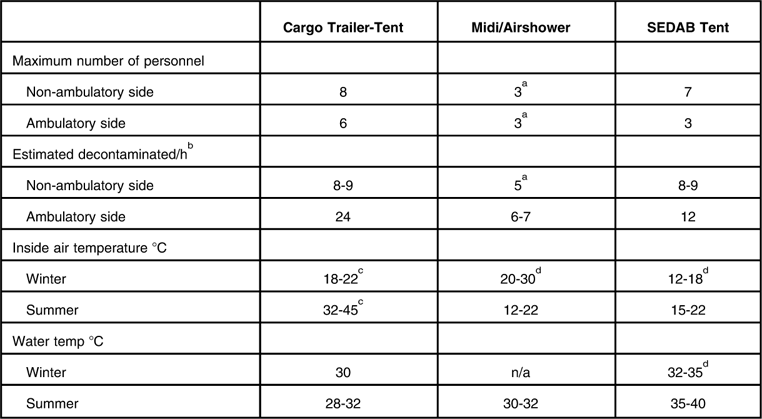
The inside air temperatures were 12-30°C during the winter trials and 12-45°C during the summer trials (Table 1). All units had increased heated ventilation during the winter trials, while the Cargo's trailer-tent also had increased ventilation during the summer trials. Water temperature ranged between 30-35°C during the winter and between 28-40°C during the summer (Table 1). Water temperature measurements did not function in the Midi/Airshower during the winter trials, but the test-persons stated that the water was between 30-35°C.
Comparison of the Three Decontamination Units in Terms of Number of Personnel, Number Decontaminated per Hour, Air and Water Temperature

Abbreviation: SEDAB, Safety Equipment Development AB.
aMidi/Airshower cannot take ambulatory and non-ambulatory simultaneously due to its small size.
bEstimation due to technical problems.
cOnly one side of the trailer was in use with full heated ventilation.
dExtra heating equipment was used.
Simulated Contaminants
The chemicals used in the study were Purasolve ethyl lactate (PEL) and methyl salicylate (MES). These chemicals are harmless to test-persons and personnel and have been used in earlier studies. 16 , Reference Törngren, Persson and Ljungquist 17 Purasolve ethyl lactate (PEL) is a relatively volatile and water-soluble substance chosen to simulate contamination by water-soluble chemicals, such as chlorine or the nerve-agent Sarin. Methyl salicylate (MES) is not very volatile and dissolves poorly in water; it was chosen to simulate contamination with mustard gas and related chemicals.
Contamination of the Test-Persons
To achieve standardized levels of contamination, pieces of cloth (100% cotton/cellulose, 20x20 cm) were placed on three body regions (both arms and one leg) of the test-persons. Five minutes before entering the units and the start of the decontamination process, a total of 100 ml of PEL were poured on two of the cloths; 30 ml of MES was poured onto the third cloth. Uncontaminated controls received similar amounts of water poured on their cloths. One additional test-person during the winter trials was contaminated with PEL and MES, then disrobed, but not decontaminated.
Number and Sequence of Decontaminated Persons
It was planned to decontaminate up to 15 persons per unit: the first five on stretchers with only one person in the unit at a time; the next five also on stretchers but processed at maximum speed; and the last five walking and processed at maximum speed. For the SEDAB unit, the walking and stretcher victims were treated in parallel lines.
Decontamination Procedure
The following procedures were used for decontamination:
-
1. All test-persons were undressed (including the pieces of cloth) in the disrobing zone (Cargo's trailer-tent and SEDAB unit) or just inside the tent entrance (Midi/Airshower). No pieces of clothing were pulled off over the head. Clothing on non-ambulatory persons was cut open and folded away from the body. The clothes and cloths were put in plastic bags and immediately placed outside of the tents on the contaminated side.
-
2. Those test-persons imitating non-ambulatory subjects were transferred to a stretcher located in the decontamination zone (when applicable). These subjects, lying on their backs, were showered with water and washed with soap, then rinsed, then given a second wash and rinse. The rinse was continued until all visible soap had been washed away. Thereafter, the subject was turned and the procedure repeated. Before the subject was lifted to a clean stretcher in the drying zone, the decontamination personnel washed off in order to reduce re-contamination of the subject. Those test-persons imitating ambulatory subjects were showered with water and then instructed to wash the whole body with soap twice (using some assistance from the personnel), followed by a final showering, before moving to the drying zone.
-
3. All test-persons were dried with a towel in the drying zone (Cargo′s trailer-tent and SEDAB unit) or close to the shower unit (Midi/Airshower). Non-ambulatory test-persons were dried on a clean stretcher. After drying, the subjects were wrapped in towels and blankets and proceeded to further processing. The clean towels and blankets were stored outside the units until they were used. The towels used for drying were put in plastic bags that then were sealed and taken out of the units on the dirty side.
Measurements
Five non-ambulatory subjects from every trial were chosen for evaluation of decontamination efficacy by monitoring evaporation of substances from the skin after decontamination. After decontamination and drying, these persons received a new t-shirt, underwear, and a blanket, and were placed in sampling chambers made of diffusion resistant Mylar polyester film. A controlled airflow of filtered air, 13 dm3/s, entered the chamber at the bottom. An air exit was located on top of the chamber where air sampling was carried out. The sampling was done with an air-flow of 100 ml/min through absorptiontubes (Minitube, Canadian Center for Advanced Instrumentation, Canada) containing 30 mg Tenax TA, which is an adsorbent specifically designed for the trapping of volatiles and semi-volatiles from air. The tubes were cleaned 10 days before the trials and kept closed until used. Sampling was carried out during three 10-minute periods over 52 minutes, starting at 2, 22, and 42 minutes. The amounts of chemicals evaporated from an undressed but un-decontaminated test-person were monitored in order to examine the contamination levels before decontamination.
To evaluate the amounts of chemicals taken up by textiles in the environments of the decontamination units, a clean blanket was placed in a basket in the drying zone of each unit during the decontamination trial. The blankets were kept in the units for the entire decontamination trial and thereafter individually placed in a ventilated barrel for sampling of MES and PEL over a five-hour period. Evaporations from the blankets were gathered in a similar manner as described above, using Tenax adsorption tubes. The total amount trapped was then calculated.
The environment in the decontamination units during and after operation was monitored in several positions within the units. The sampling was done with Tenax adsorption tubes with air flows of 100 mL/min during 10 minutes. Sampling was done continuously with the aim to take one sample per sampling point for each person decontaminated. The decrease of chemicals in the units was followed by sampling at two positions at 30 minutes, and 1, 3, 5, and 15 hours after the end of the decontaminations. All samples were then stored in a refrigerator until analysis. The analysis was performed using a gas chromatograph (Hewlett-Packard 5890, Agilent Technologies, Santa Clara, California USA) with a flame-ionization detector.
Results
Decontamination Capacity
As shown in Table 1, the decontamination capacity for ambulatory subjects varied substantially among the units: in Cargo's trailer-tent, 24 test-persons were decontaminated/h, compared with 12 in the SEDAB tent and only 6-7 in the Midi/Airshower unit. In contrast, the decontamination capacity for non-ambulatory subjects was similar when comparing Cargo's trailer-tent and the SEDAB tent (8-9 decontaminated test-persons/h). Midi/Airshower had a lower capacity of five non-ambulatory test-persons/h.
No statistically significant differences in length of the decontamination procedure were observed when comparing the different units. Excluding the technical difficulties, the lengths of the decontamination procedures were as follows: for ambulatory patients, nine minutes (of which five minutes were needed for the decontamination processing), and for stretcher cases, 12 minutes (of which seven minutes were needed for the decontamination processing).
Concentrations of Substances Inside the Units During Decontamination
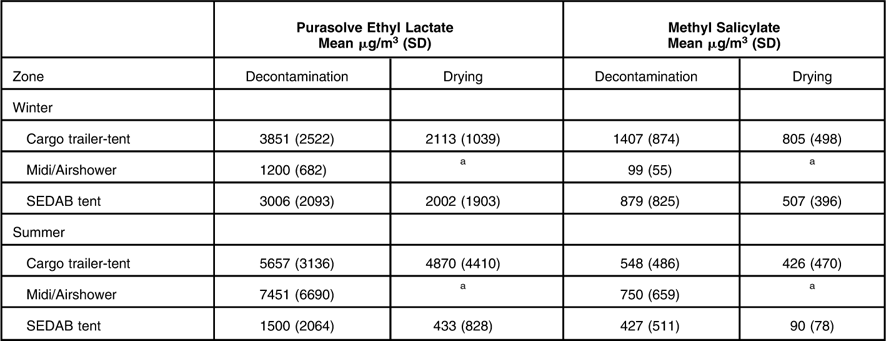
There were large differences in concentrations and patterns between summer and winter conditions for the same units. The average concentrations of PEL were generally higher than MES inside both the decontamination zone and the drying zone in the three units (Table 2). The largest difference was in the Midi/Airshower unit in which the concentration of PEL was 12 times higher than the MES concentrations during the winter experiment and 10 times higher during the summer trials.
Average Concentrations and Variations of Purasolve Ethyl Lactate and Methyl Salicylate in the Three Decontamination Units During the Winter and Summer TrialsFootnote a

Abbreviation: SEDAB, Safety Equipment Development AB.
a Midi/Airshower does not have a drying zone.
The Cargo unit showed, on average, slightly higher concentrations of both MES and PEL than the other units, under similar conditions. The exception is the Midi/Airshower unit during summer that peaked with 7451 (SD = 6690) μg/m3 PEL, which was the highest value recorded. In contrast, during the winter trials it showed the lowest concentrations, 1200 (SD = 682) μg/m3 PEL and 99 (SD = 55) μg/m3 MES. During the summer trial, the SEDAB tent showed the lowest inside concentrations with 1500 (SD = 2064) μg/m3 PEL and 427 (SD = 511) μg/m3 MES in the decontamination zone.
Effect of Wind Direction During Decontamination
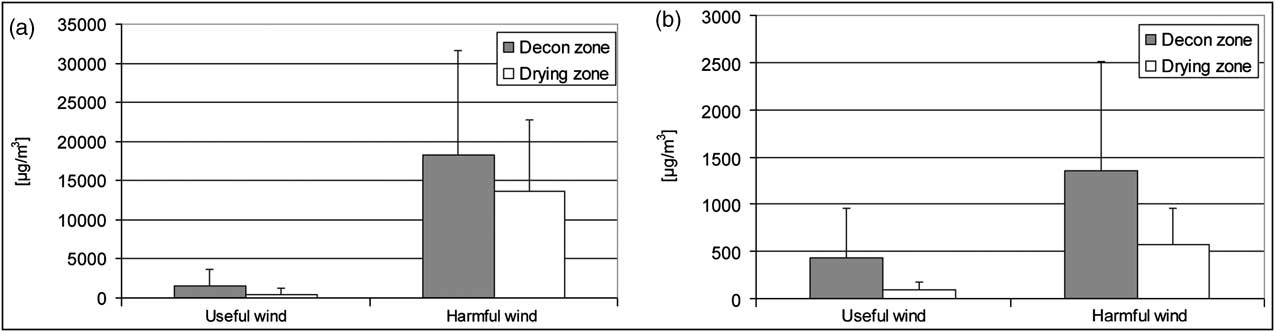
The influence of wind conditions was analyzed in the SEDAB tent during the summer trials. The effect of harmful wind conditions—that is, wind blowing in the same direction as the flow of persons through the units—resulted in considerably higher concentrations of PEL and MES in both the decontamination zone and the drying zone (Figure 1). The highest increase was noted for PEL in the drying zone, where the concentrations increased 30-fold during harmful wind conditions, from 433 (SD = 859) μg/m3 to 13 635 (SD = 9080) μg/m3. MES showed the same effects, with an increase of six times, from 90 (SD = 81) μg/m3 to 570 (SD = 387) μg/m3. The increases in the decontamination zone were lower, a 3-fold increase for MES and a 10-fold increase for PEL, but the absolute values are higher, 18 316 (SD = 13 270) μg/m3 for PEL and 1351 (SD = 1160) μg/m3 for MES.
Concentrations of PEL (Figure 1(a)) and MES (Figure 1(b)) in the SEDAB Tent During the Summer Trials with Useful and Harmful Wind
Abbreviations: MES, methyl salicylate; PEL, Purasolve ethyl lactate; SEDAB, Safety Equipment Development AB.

Decontamination Efficacy
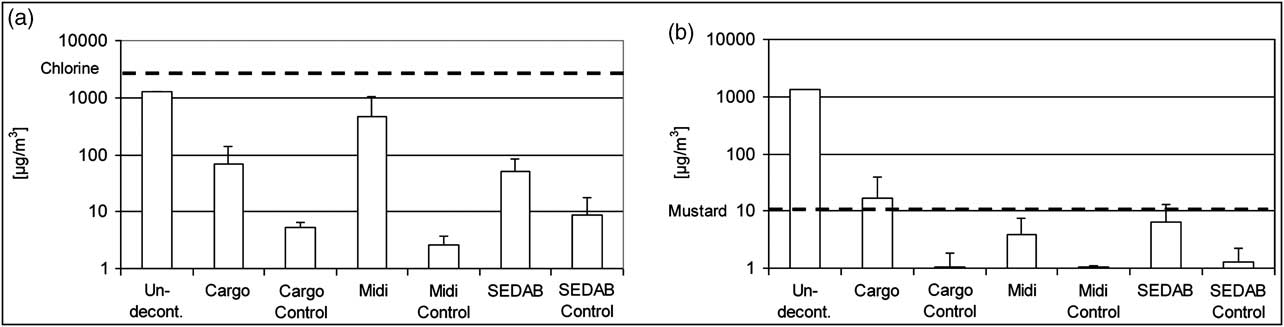
To evaluate decontamination efficacy, evaporations from decontaminated test-persons were measured during three 10-minute periods (2-12, 22-32, and 42-52 minutes). No significant differences in concentration levels were observed at the three measurement periods. Since there were no marked differences between winter or summer trials, only results from winter trials are shown in Figure 2. Evaporations from an un-decontaminated, but disrobed, person, reached concentrations above 1200 μg/m3 for PEL and 1300 μg/m3 for MES in the period 42-52 minutes after undressing (Figure 2). Evaporations of PEL from the test-persons were below 100 μg/m3, with the exception of the test-persons decontaminated in the Midi/Airshower. One test-person decontaminated in the Midi/Airshower showed evaporations of PEL >1000 μg/m3. The evaporations of MES from the same test-persons after decontamination in any of the three units showed concentrations of approximately 10 μg/m3. The control subjects, receiving only water on their cloths, showed evaporation of small quantities of PEL and MES after the decontamination procedure. These trends were similar for all three units.
Concentrations of PEL (Figure 2(a)) and MES (Figure 2(b)) Evaporating from Test-Persons During 10 Minutes, 50 Minutes Following Decontamination During the Winter Trials. The short-term exposure limit for chlorine (15 minutes) and the acute exposure guideline for mustard gas (one hourReference Raber, Jin and Noonan 18 ) are indicated in the figures.
Abbreviations: MES, methyl salicylate; PEL, Purasolve ethyl lactate; SEDAB, Safety Equipment Development AB.

Evaporation From Blankets
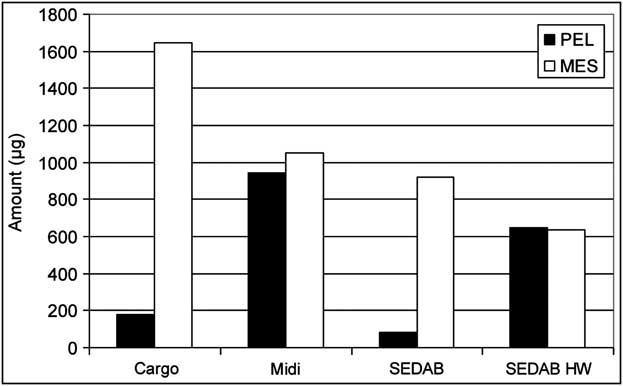
Blankets left in the drying zone of the units during the summer trials absorbed both PEL and MES (Figure 3). The blankets from the Midi/Airshower and the SEDAB tent in harmful wind showed the highest amount of PEL, while blankets left in the Cargo's unit showed the highest evaporations of MES.
Estimated Total Amount of PEL and MES Absorbed by the Blanket Placed in the Decontamination Units During the Summer Trials
Abbreviations: HW, harmful wind; MES, methyl salicylate; PEL, Purasolve ethyl lactate; SEDAB, Safety Equipment Development AB.

Remaining Amounts of Substances in the Units After Decontamination
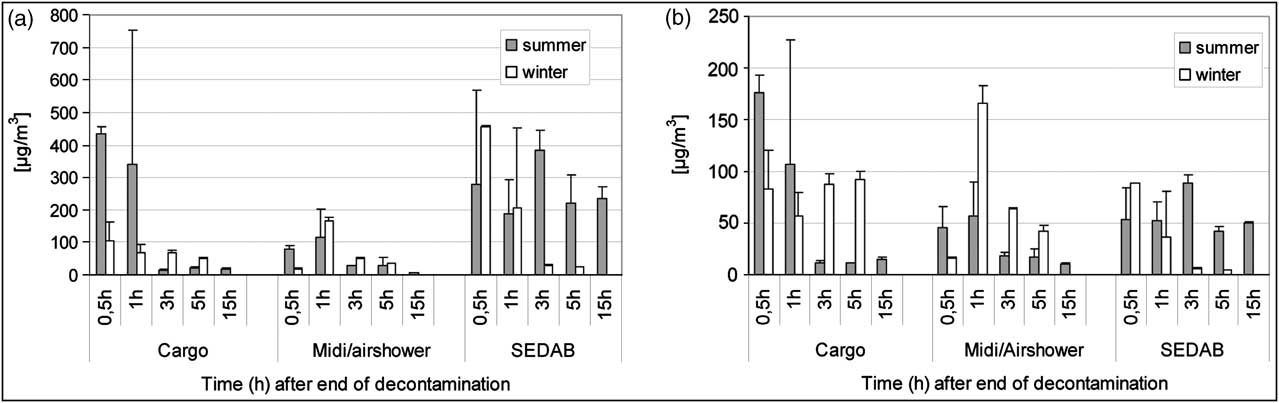
After 15 hours of ventilation, the concentration levels of PEL in the units were between 10 and 250 μg/m3 with an average of about 20 μg/m3 (Figure 4). For MES, concentrations in the units after 15 hours varied between 10 and 50 μg/m3 during the summer trial. In most of the units, the concentrations of MES and PEL decreased over time. The decrease often was strong in the beginning and ended at a constant level. The SEDAB unit showed high and constant concentrations of MES and PEL after the summer trials. The Cargo's unit displayed constant levels of MES during the winter trials. There were no other marked differences between the summer and the winter tests.
Concentration of PEL (Figure 4(a)) and MES (Figure 4(b)) in the Units Up to 15 Hours After End of Decontamination During Winter and Summer Trials. No values were available for 15-hour winter trials.
Abbreviations: MES, methyl salicylate; PEL, Purasolve ethyl lactate; SEDAB, Safety Equipment Development AB.

Discussion
This study was an independent validation and evaluation of the routines and decontamination efficacy in mobile units used in Sweden. General conclusions also can be drawn about the stations’ functionality and about airborne dissemination of chemical substances. Although only units used in Sweden were evaluated in this study, several interesting findings can be implemented by other countries to improve routines and decontamination efficacy when using their mobile units. Results of particular interest are the air concentrations during the decontamination procedure, decontamination efficacy, effects of wind direction, evaporation from contaminated blankets, and remaining amounts of substances in the tents after decontamination.
Experience from this project indicates that technical problems of various sorts are common in equipment not checked or maintained on a regular basis. Some of the equipment had to be replaced with other units in order to provide heated ventilation and warm water. These problems have a strong effect on the time to get the equipment ready for use. Consequently, the capacities of the units became somewhat limited in the numbers of persons decontaminated.
The rate at which the contaminated people could be handled depended on the units’ shape and the knowledge and experience of the personnel. When both sides of the Cargo's trailer-tent are built for decontaminating walking subjects, the capacity was calculated to 50 patients/h. The smallest unit (Midi/Airshower) does not permit decontamination of ambulatory and non-ambulatory patients simultaneously, and it had the lowest capacity with only up to seven/h. Fewer personnel will increase the time needed for decontamination and might also result in a lower quality of decontamination. Experience from this study indicates that there is a need for additional personnel to be responsible for the technical operation of the units, i.e., serving the personnel carrying out the decontaminations with material, managing the discarded clothes and used towels, and conducting medical prioritization and care.
The concentrations of test substances inside the units depended on a number of factors and varied considerably throughout the trials. The average concentrations of PEL generally were higher than MES inside both the decontamination zone and the drying zone in the three decontamination units (Table 2). This corresponds with the experiences from the evaluations of the fixed decontamination unitsReference Törngren, Persson and Ljungquist 17 and can be explained by the larger amount of PEL used in the contamination and its higher volatility. Note that the concentrations of PEL and MES are average measurements for 10-minute intervals suggesting that, at shorter time intervals, extremely high concentrations might be present in the units. The concentrations of the test substances in the tents (Figure 2) were occasionally so high that they exceeded the thresholds for brief visitsReference Raber, Jin and Noonan 18 for most industrial chemicals. If the substances had been chemical warfare agents, the concentrations would have been considerably higher than the short-time limit for nerve gases and mustard gas.Reference Raber, Jin and Noonan 18 Similar findings were observed when testing other decontamination units.Reference Louvet, Sinault and Mosset 19 Other studies have suggested that monitoring of the healthcare workers should be performed after decontamination, to determine if secondary exposure has occurred.Reference Okumura, Okumura and Ishimatsu 10 , Reference FritzGerald, Sztajnkrycer and Crocco 14 The results of this study are in agreement with such guidelines.
Large differences in concentrations and patterns were observed between summer and winter conditions for the same units. This might be explained by the fact that supplementary ventilation was used during the winter trials to ensure sufficiently warm temperatures during cold weather. The hot air used for heating the units is blown into the area where the decontaminated persons are dried, i.e., the area that should be clean compared with the disrobing and shower areas. Normally, all units would have much less heating, leading to a colder inside environment as well as much lower ventilation, consequently resulting in higher concentrations of substances in the air. This was particularly noticeable in the small Midi/Airshower unit (Table 2) since supplementary ventilation had a large influence in this relatively small tent. The Cargo's trailer-tent and the SEDAB unit have drapes separating the zones, for privacy reasons and to reduce water splash. The current study indicates that the drapes reduce ventilation in these units, resulting in increased concentration of simulation substances in both the decontamination and drying zones. The Cargo's trailer-tent has full-length drapes, which may be responsible for the especially-high concentration of MES and PEL in this unit, despite the fact that during the trials the unit had twice the normal airflow since only one side-tent was in use.
The highest concentrations of PEL and MES in both the decontamination zone and the drying zone were reached when investigating harmful wind conditions using the SEDAB tent (Figure 1). These results indicate the importance of considering wind conditions when setting up mobile decontamination units. If possible, the wind direction always should be directed from the drying zone toward the decontamination zone.
It has been shown previously that removal of clothes reduces the amount of contaminants from patients by an estimated 75-85%.Reference Houston and Hendrickson 3 , Reference Cox 9 Disrobing outside the decontamination unit would most likely contribute to lowering the concentrations of substances inside the units. Consequently, questions of privacy and hypothermia must be addressed,Reference Macintyre, Christopher and Eitzen 11 , Reference FritzGerald, Sztajnkrycer and Crocco 14 especially in colder climates such as Sweden's.
This evaluation of decontamination efficacy indicate that—when compared with an undressed but not decontaminated person—disrobing, followed by decontamination with soap and water, will reduce concentrations of evaporating water-soluble substances, such as PEL, by approximately 90% and by 99% for non-water-soluble liquids like MES (Figure 2). Other studies have shown that decontamination with water and soap will decrease absorption through the skin,Reference Wester and Maibach 12 thus providing further evidence for the efficacy of this decontamination method. However, results of the current study also indicate that all traces of simulation substances were not removed after decontamination; the high concentrations evaporating from some of the contaminated test-persons using Midi/Airshower (Figure 2) indicates the importance of thorough decontamination.
In addition, residual amounts of simulation substances on the control subjects were present in this study. Several reasons might exist: contamination and re-contamination due to the small inside area of the units; the high concentrations of MES and PEL in the inside air; and deviations in the procedures or malfunction of the equipment. Compared with the maximum concentrations evaporating from the test-persons following decontamination at permanent stations at hospitals, 16 the recorded values from test-persons in the present study often were higher.
Due to experimental reasons, the concentration of substances in the air evaporating from the subjects was measured only at between 2-12, 22-32, and 42-52 minutes. By sampling at 3x10 minutes and knowing the airflow through the chambers, a total amount of substances evaporated from each person during 60 minutes was calculated to be 9.3 (SD = 12.5) mg for PEL (n = 17) and 1.1 (SD = 2.2) mg for MES (n = 17). It is likely that such amounts of highly-toxic substances would pose a threat if spread in a small compartment, such as in an ambulance. Therefore, when transporting decontaminated subjects, good ventilation in the ambulance is vital. Another option would be use of transportation bags and PPE to avoid secondary exposure of the healthcare providers in cases of contamination with very toxic substances.
Contamination also might occur in equipment and material used in the units. Blankets placed in the units during the trials absorbed or were splashed upon with water contaminated with both MES and PEL (Figure 3). Consequently, towels and blankets should be kept on the outside, on the clean side, and not inside the units.
Monitoring the chemicals in the units after the end of operations shows that, after five hours (Figure 4), the concentrations still are so high that they exceed exposure limits for nerve gases, mustard gas, and even some regulated chemicals.Reference Raber, Jin and Noonan 18 Therefore, supplementary decontamination and cleaning of the units would be required after finished operations in mobile units.
Lessons learned from this study indicate that well-informed, educated, and trained personnel are of importance to ensure the efficiency of the decontamination and to ensure that all body parts are washed. Moreover, routines must be simple and easy to follow. To avoid contaminating un-contaminated persons, subjects should be triaged; victims who do not show any signs of contamination should be disrobed before receiving medical attention. Disrobing contaminated persons outside the tent would be an efficient method to reduce concentrations inside the mobile units and, consequently, decrease re-contamination.
Limitations
Variations in air and water temperatures are possible limitations of this study. In non-temperate conditions, the decontamination process is not optimal, possibly leading to shorter washing cycles which might affect decontamination efficacy. In addition, the non-homogeneous temperatures contribute to a variation in the amount of substances spontaneously evaporating and could possibly affect the Tenax samples which might influence the results.
Conclusion
In conclusion, this study has shown that high concentrations of chemicals might be found in the inside environment of mobile units during decontamination, posing a threat to the personnel and the casualties. In general, the decontamination procedure using soap and water did remove large quantities of contaminants, although relatively high concentrations were measured in the evaporations from some test-persons. Therefore, when handling decontaminated subjects, good ventilation is vital to minimize risk for healthcare providers.
This study also shows that the wind direction is of utmost importance to consider when setting up the units. As shown by the evaporations from blankets, towels and blankets should be kept outside of the units. After the decontamination procedure, substance amounts remaining after ventilating for five hours indicate that supplementary decontamination and cleaning of the mobile units is necessary after usage.
Abbreviations
- MES:
-
methyl salicylate
- m/s:
-
meters per second
- PEL:
-
Purasolve ethyl lactate
- PPE:
-
personal protective equipment
- SEDAB:
-
Safety Equipment Development AB