Political campaigns have a transformative effect on electorates. They intensify political communications, creating an environment filled with information about policy and performance (Farrell and Schmitt-Beck 2003; Lenz Reference Lenz2009). This information primes, persuades and informs voters about the politicians (or policies) up for election (Krosnick and Kinder Reference Johnston and Brady1990; Miller and Krosnick Reference Miller and Krosnick2000; Valentino, Hutchings and White Reference Valentino, Hutchings and White2002; Lenz Reference Lenz2009), enabling voters to make a decision that corresponds with their underlying opinions (Gelman and King Reference Gelman and King1993; Petrocik Reference Petrocik1996; Lenz Reference Lenz2013), and with a sense of being better democratic citizens (Hansen and Pedersen Reference Hansen and Kosiara-Pedersen2014). While this general model of political campaigns has been thoroughly documented in the extant literature, few articles have addressed how these campaign effects interact with different political contexts, specifically, how this general model maps onto different types of elections. In this article, we amend this by examining a type of election hitherto unstudied in the literature on campaign effects: European Parliamentary elections. One can argue that European Parliamentary elections are an electoral context in which we can expect campaign effects to be particularly significant. Most importantly, there is a relatively low level of information possessed by voters on the issues prior to the campaign. One reason for this is the lack of debate of EU issues in national politics between European Parliamentary elections. On top of that, EU issues might cross-cut traditional national political cleavages making it more challenging for voters to navigate intuitively, leaving more room for the campaign to inform and influence how voters decide.
Based on findings from the literature on campaign effects on the one hand, and the literature on European Parliament elections on the other, we propose a model of European Parliamentary elections in which the campaign shifts the calculus of electoral support, making differences in national political allegiances less important and opinions about the European project more important as the campaign progresses. Our analysis suggests that the campaign increases the level of EU knowledge and interest in European politics among voters, resulting in a change of voter calculations. In effect, we argue that the political campaign leading up to the election makes European Parliament elections less second order, enabling voters to decide based on their position on EU issues instead of merely deciding based on national factors (Marsh Reference Marsh1998; Marsh and Mikhaylov Reference Marsh and Mikhaylov2010; Adam and Maier 2011; Hobolt and Wittrock Reference Hobolt and Wittrock2011). While previous studies have demonstrated that EU issues can matter for voting behavior in European Parliament elections, existing research has drawn on post-election surveys that do not enable us to capture campaign effects (e.g., Rohrschneider and Clark Reference Rohrschneider and Clark2008; de Vries et al. Reference de Vries, van der Brug, van Egmonda and van der Eijk2011). The only exception is an experimental study done by Hobolt and Wittrock (Reference Hobolt and Wittrock2011), which found that increased information makes voters more likely to make decisions based on EU opinions. However, while the study is insightful, it tells us little about whether an actual campaign presents and imprints information upon the electorate in the same way as their experiment. Here, we assess whether their findings actually tell us something about the behavior of voters in the context of an actual European election.
Our contribution is to assess the impact of an actual campaign by utilizing a rolling cross-sectional survey (RCS) that enables us to track how voters were affected by the campaign. The study was employed in the 2014 European Parliament campaign in Denmark. Specifically, we utilize a seven-wave rolling RCS that ran fortnightly in the last two and a half months before the election that enables us to track how voters were affected by the campaign. Using this data we show that, as hypothesized, interest in EU politics and the ability to identify party positions correctly on EU issues increases during the campaign. Further, we show that more people take positions on EU issues over the course of the campaign. Taken together, these factors suggest that as the campaign intensifies the average voter would be more able to utilize EU opinions to assess which party to vote for in the election (EU issue voting) instead of just relying on national political concerns (second-order voting). We then present evidence that voters were not just able to shift the focus of their vote choice, but reshuffled it in a way that allowed them to navigate along an EU issue dimension. In effect, voters became less influenced by their national political preferences and more influenced by European issues when expressing their voting intentions during the campaign.
Taken together, these findings show that campaigns do have an effect on European Parliament election outcomes, in that they provide information that enables voters to make decisions based on EU issues. They suggest that more extensive campaigning might be a democratically fruitful way to make European elections less about national politics and more about the EU, presupposing of course that voters feel that enough is at stake in EU politics to have some form of attitude toward European integration (de Vries et al. Reference de Vries, van der Brug, van Egmonda and van der Eijk2011, 17). Therefore, while campaigns may help in a context like Denmark, where EU issues have been contested through numerous referendum campaigns in the recent past, it is by no means given that campaigns will help everywhere (Buch and Hansen Reference Buch and Hansen2002). Especially in newer member states where the average voter is not as familiar with EU issues, campaign effects might be either different or non-existent. However, more broadly, these findings reaffirm that European Parliament (EP) election campaigns can matter, and that a greater sensitivity to how these campaign effects interact with various political contexts might yield valuable insight into the intricacies of electoral behavior.
Campaign Effects and Electoral Democracy in the EU
In a 1989 article, Zaller argued that “campaigns consist of multiple messages that may penetrate differentially far into the mass electorate” (Reference Zaller1989, 181). That is, campaigns are seen to be equivalent to increased information flows. As described in the introduction of our article, this quote nicely sums up how campaigns matter: they bring new information to an electorate that often has relatively little political information to begin with (Zaller Reference Zaller1992; Bartels Reference Bartels2005).
There are three main ways in which increased information can influence voters: (1) it informs voters of candidate positions (Hansen and Pedersen Reference Hansen and Kosiara-Pedersen2014), (2) it provides voters with opportunities to find their own position (Lenz Reference Lenz2009) and (3) it can prime voter interest on the issues that the information centers on (Krosnick and Kinder Reference Johnston and Brady1990). In the context of European Parliament elections, we would expect campaigns, and the information flow that comes with it, will affect voters in a similar manner, which, we argue, will result in issue voting on EU issues. That is, voters will vote for parties that are closest to them on EU issues (Downs Reference Downs1957). In particular, we suggest that voters become less influenced by national factors and more influenced by EU issues as the campaign intensifies (Garry, Marsh and Sinnott Reference Garry, Marsh and Sinnott2005; de Vries Reference de Vries2010).
It is not obvious that this will happen. As such, the single-most important and enduring finding in the literature on the electoral democracy of the EU is the tendency for voters to use national political allegiances to guide their vote choice in these European elections—the so-called second-order election thesis (Reif and Smith Reference Reef and Schmitt1980; Hix and Marsh Reference Hix and Marsh2007; Hobolt Reference Hobolt2007; Weber 2007; Marsh and Mikhaylov Reference Marsh and Mikhaylov2010), While there is some disagreement about the exact causes and mechanisms of the second-order election thesis, at the core is the argument that when voters feel little is at stake and have little information about the issues, they either abstain from voting (e.g., Hogh and Larsen Reference Iyengar and Kinder2016), or if they decide to vote, they merely utilize heuristics drawn from first order, national affairs such as attitudes toward government performance or attitudes to national political issues to either punish unpopular incumbents (strategic voting) or by supporting smaller parties who have few chances in normal, first-order national elections (sincere voting) (Marsh and Mikhaylov Reference Marsh and Mikhaylov2010; Hix and Marsh Reference Hix and Marsh2011; Hobolt and Wittrock Reference Hobolt and Wittrock2011). Irrespective of the specific mechanisms, the result of the second-order dynamics are the same: when going to the polls in European elections, voters focus on how they feel about national politics rather than how they feel about EU politics; something that has also been documented for Danish voters for European Parliament (EP) elections (Bhatti and Hansen Reference Bhatti and Hansen2014).
What room is there for campaign effects in the second-order model? In their original article that put forward the thesis, Reef and Schmitt (Reference Reef and Schmitt1980) actually included a section on campaign effects. However, the section primarily focuses on how differences in campaign expenditure might be more important in second-order elections (Reef and Schmitt Reference Reef and Schmitt1980, 13–4). We propose another way that campaigns interact with the second-order election model. Specifically, we suggest that if political campaigns increase information and interest in EU affairs, this can lead voters to become less second order in their decision-making, resulting in more EU issue voting in European Parliament elections as voters utilize EU attitudes to decide which party to support (de Vries et al. Reference de Vries, van der Brug, van Egmonda and van der Eijk2011). It is important to note that a necessary precondition for information to result in EU issue voting is the supply of different alternative visions of the EU and European integration by parties in the campaign; if voters are only presented with one-sided, pro-EU information it is not certain that they will be able to effectively match their EU attitudes with the available party choices (see Adam and Maier 2011).
While Hobolt and Wittrock (Reference Hobolt and Wittrock2011) find some evidence of the impact of information upon EU issue voting in laboratory experiments, at present we do not know whether there are campaign effects that actually increase the likelihood of voter decisions being more based on EU attitudes.
In order to assess whether campaign effects matter for European Parliament elections, we develop the following four hypotheses. The first three deal with the assumptions required for campaign effects to matter.
Hypothesis 1: Voters become more interested in EU politics during the campaign.
Hypothesis 2: Voters become more aware of their own attitudes toward EU politics during the campaign.
Hypothesis 3: Voters become more knowledgeable about party positions on EU politics during the campaign.
The second and third hypotheses follow obviously from the discussion above, but it might not be apparent why the first one, stipulating that interest in EU increases as the campaign commences, follows from the literature on campaign effects. However, we believe that interest is a measure, albeit imperfect, of the increased engagement with politics which have been identified as a result of campaigns (Hansen and Pedersen Reference Hansen and Kosiara-Pedersen2014, 305). As such, extant literature has found that being subject to more political information almost inadvertently makes voters more politically engaged (Jung, Kim and de Zúñiga Reference Krosnick and Kinder2011).
These three hypotheses only describe the assumptions necessary for voters to draw on EU attitudes when making voting decisions. In seeking to understand how campaign effects interact with the context of European Parliament elections, the ultimate goal has to be to understand how this increased level of information and knowledge might affect the type(s) of voting behavior that is typical of European Parliamentary elections. Therefore, the potential impact of campaigns on whether EU issue voting or second-order dynamics matter more for voter calculations is investigated through the fourth hypothesis:
Hypothesis 4: More information in the campaign causes voters to rely more on EU attitudes and less on national political attitudes when deciding whom to vote for.
The dynamic of the final hypothesis is similar to the issue ownership hypotheses suggested by Petrocik (Reference Petrocik1996), where a campaign’s primary impact is on changing the locus of the electorate’s decisions. However, unlike Petrocik (Reference Petrocik1996), we suggest that the key effect of the campaign in European Parliament elections lies not in which specific issues it makes the electorate emphasize, but instead that the campaign makes voters focus more on EU issues. As second-order elections are characterized by low information (at least with regards to EU issues), low salience and low interest by voters and media, we would expect that campaigns for European Parliament elections would hypothetically have very strong impacts given the low starting levels of interest and information of average voters. Furthermore EU issues often cross-cut domestic party cleavages, e.g., compared with parties’ economic left-right position, and as the campaign progresses voters should become aware of this and depart from their party choice in national politics, and to a large extent follow their EU attitudes.
Figure 1 illustrates the relation between the different hypotheses. When the campaign begins it increases interest in EU issues and the level of information about EU issues. This enables voters to form and become aware of their own attitudes on EU issues, providing voters with the means to evaluate the correspondence between their own EU attitudes and the positions taken by parties. This results in national political allegiances becoming a less essential heuristic when voters attempt to choose which party to vote for. The result of the process is an increase in EU issue voting; a change which is intimately tied to the campaign effects produced by increased information. These different hypotheses constitute a process model of how European Parliament campaigns transform the European electorate. In the remainder of this article, we will try to see whether this model has any correspondence to how voters in Denmark actually responded to the 2014 European Parliament Campaign.
A process model of the European Parliament campaign effects

A different way to describe the mechanisms illustrated in Figure 1 is through the theory of priming (Iyengar and Kinder Reference Hogh and Larsen1987). The EU campaign context changes the political agenda from one that focuses primarily on national issues to one that focuses primarily on EU issues. This change in political agenda primes the voters’ agenda, making them think more about EU issues than national issues when evaluating the parties running for a seat in the European Parliament. Following this, as expressed in hypothesis four, we initially expect voters to evaluate parties following a national agenda, but as the campaign intensify parties are evaluated more along the lines of their stands on EU issues.
Of course, campaigns might also supply misinformation carried by the self-selective presentation of the candidates (Maurer and Reinmann Reference Maurer and Reinemann2006), and supply information of a more heuristic character (Hansen and Kosiara-Pedersen Reference Hansen and Pedersen2015). While we do recognize that such elements are also at play during campaigns, we hypothesize that the processes enhancing EU issues voting is strong enough not to be drowned out by the many other processes effecting attitudes and behaviors during campaigns.
Empirical Strategy: A rolling cross section (RCS)
In order to test the hypotheses of our model, we leverage a RCS of 2310 Danish voters conducted in the two and a half months leading up to the 2014 European Parliamentary election, together with a media content analysis.
A RCS interviews cross-sections of voters across a longer period of time. In this case before and during the campaign leading up to the European Parliament elections on May 25, 2014. It is an appropriate design for examining campaign effects, as it enables us to investigate whether voters act differently as the election gets closer. Whereas panel surveys are good at ascertaining the effect of individual-level variables, like knowledge or attitudes, the RCS excels at identifying the effect of different temporal contexts: such as the effect of a campaign (Johnston and Brady Reference Jung, Kim and de Zúñiga2002). Actually, one might reasonably argue that a RCS is a quasi-experiment, in which people are randomly assigned to different stages of the campaign. Some, who were invited to be interviewed early, have not been exposed to the campaign at all, others, interviewed just before the election, have been exposed to the whole campaign (Brady and Johnston Reference Brady and Johnston2006). Even so, there are two challenges to our design, which stem from the fact that it is more like a quasi-experiment, than an actual experiment.
The first is that it might be different kinds of voters who are likely to accept the invitation to participate in the survey at different stages of the campaign. We try to amend this by controlling for some predetermined factors when estimating the effect of the campaign in our analysis.
The second challenge is that we are not able to control for other temporally correlated contextual factors that might influence voters, such as trends in beliefs or other major events that coincide with the campaign. Here there are several potential confounders that we cannot control for. First, a referendum on whether Denmark should join the European Patent Court (EPC) was held at the same time as the European Parliamentary election. However, since the referendum was on a EU issue, it should not interfere with our central hypothesis. Additionally, the EPC issue was little debated in the campaign. In our media content analysis of three major Danish daily newspapers, of the 1237 EU stories that were coded from April 4 until election day (May 25), only 9 percent of the EU stories dealt with the EPC issue.Footnote 1
Second, a personal scandal affecting the leader of the largest opposition party erupted ten days before the election, potentially affecting whether attitudes toward governmental performance resulted in not voting for the sitting government (i.e., the strength of strategic second-order effects could have been impacted). However, the fact that this event happened late in the data collection process works against the key hypothesis suggested above, i.e., that second-order voting should diminish as election day drew closer. As such, if we find a decline it might have been even larger in the absence of this event, leaving us with a conservative test of this hypothesis.
Having detailed the advantages and challenges of using a RCS, we now turn to the details of the survey used in the present study. The survey invited respondents every other week from April 10 until May 22, 2014. In each of the seven waves, between 297 and 329 respondents answered within three days of being invited. Data were collected via a web survey by the polling company Epinion, using an internet panel to recruit respondents.
In the Supplementary Materials Section S1, we describe the sample in more detail, presenting descriptive statistics and comparing the sample on demographic variables to the Danish voting age population. We find that the sample is more highly educated and older than the population as a whole. We do not think this lack of a representative sample will be a substantial threat to inference, however, since we rely on the fact that it was random when panelists were invited to participate in our survey. As such, even though the education of the average participant in the internet panel is higher than that of the Danish electorate, we can still identify the effect of campaigns by comparing the random sample drawn from this panel in the first few waves, with the random sample drawn from the same panel in the final few waves. A concern that one might have though is that any identified effect for the older and more educated sample will be much smaller in the younger less educated population. However, since the campaign effects we investigate in the present article concern, among other things, interest, information and knowledge, it seems more likely that effects will actually be smaller for respondents who are more highly educated. As such, highly educated respondents are already likely to be interested, informed and knowledgeable about the EU at the start of the campaign.
Measurement
In Hypothesis 1, we propose that voters become relatively more interested in EU politics during the campaign. To measure interest we looked at voters answer to the question “How interested are you in European politics?.” Answers were given on a five-point scale going from “Not at all interested,” to “Very Interested.” The scale was subsequently recoded to go from 0 to 100.
In Hypothesis 2, we proposed that increased levels of information enable voters to better evaluate their own attitudes toward European integration. To measure this we use the frequency of “don’t know” answers voters gave to EU attitude questions. This is a typical measure of being informed about own attitudes (e.g., Lassen Reference Lassen2005), but of course it is a relatively crude proxy. In the specific measure we used five different items.Footnote 2 The items were on the respondents’ identification with the EU, on specific EU policies and on the consequences of these policies.Footnote 3 Further, the items chosen for the index were among those debated in the campaign, such as the EPC issue and so-called welfare tourism. The measure of how informed a respondent is corresponds to the fraction of these questions in which the respondent did not give a “don’t know” answer.
In Hypothesis 3, we proposed that increased information enables voters to better assess party positions on EU issues. To measure this we looked at the percentage of voters who could correctly recall what position the three largest Danish parties took toward joining the EPC in the parallel referendum. In particular, we asked voters “What do you believe party x recommend that the Danes vote in the referendum on the European Patent Court?” Voters could respond with a yes, no or don’t know. From this we constructed a four-point knowledge scale which we recoded to go between 0 and 100, 0 meaning that the voter did not know any party positions and 100 meaning that the voter knew all the party positions.
It would be ideal to track knowledge of party positions on several different EU-related issues, however, the survey only included positions on the EPC referendum and the correct identification of party endorsements for Commission president. Given that the issue of Commission president candidate endorsements was not discussed in the public debates in Denmark (in contrast to countries like Germany), we do not believe it is a very good proxy for voter knowledge of party positions on EU issues.Footnote 4 Given that there were no major splits within parties on the issue, and since the positions taken by the parties on the EPC nicely track party positions toward EU integration more generally, it is a reasonable proxy for voter knowledge of the party’s issue positions.
The fourth hypothesis suggested that voters would rely more on attitudes toward EU issues when deciding whom to vote for and less on national allegiances. In order to test this hypothesis we will first look at whether voter propensity to support a national political entity in the European Parliament, specifically the two parties in government, will be based less on their beliefs about the national political entity as the campaign progresses. To measure support for the parties in government we asked voters who they intended to vote for in the European Parliament elections, creating a dummy indicating whether respondent’s intended to vote for the two parties in government. To measure respondent’s beliefs about the government we asked “How do you feel the Danish government is doing?,” with answers recorded on a five-point scale going from “Very bad” to “Very good.”Footnote 5 We will also look at whether voters propensity to support pro-EU parties is based more on the respondent’s own position on EU integration. We measure support for pro-EU parties by examining whether voters intended to vote for a party which was pro-EU in the European Parliament election.Footnote 6 We measure the EU attitudes of respondent’s by transforming the answers to two questions about European integration into a pro-integration attitude scale (α=0.77) going from 0 (opposes integration) to 1 (supports integration).Footnote 7 This is naturally a simplification, given that voter attitudes toward the EU typically are multi-dimensional.Footnote 8
In addition to these variables we also use standard socio-demographic controls such as age, gender, education, general interest in politics, vote at last national parliamentary election as well as ideology (measured on scale from 0 “Very left-wing” to 10 “Very right-wing”) and perceptions of the national economy (measured on a scale from 1 “A lot worse than last year” to 5 “A lot better than last year”).
Results
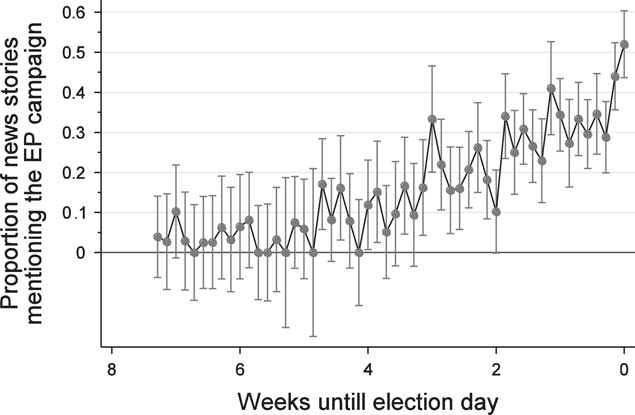
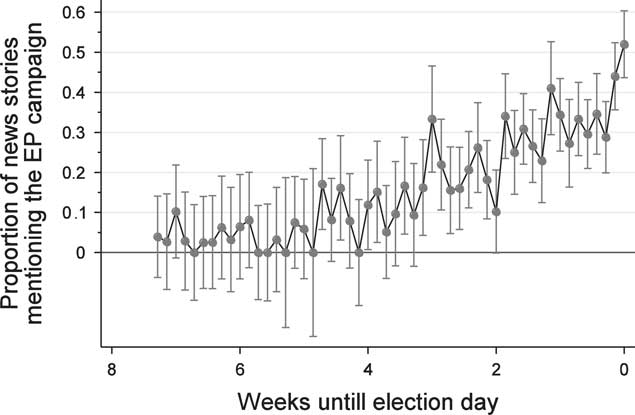
As the first hypothesis deals with the impact of increased information flows resulting from the campaign, we first discuss the extent to which there was an increase of information about the EU in the weeks prior to the EP election, and whether alternative visions were presented by parties. Figure 2 illustrates the percentage of stories from three major Danish daily newspapers that dealt with EU affairs.Footnote 9 The increased information flow can be clearly seen in the increase in the number of stories dealing with the EU in the Danish press in the weeks prior to the EP election. Whereas less than 10 percent of stories dealt with the EU campaign in the first weeks of the campaign, in the last four weeks the number kept rising, culminating in almost 50 percent of stories dealing with EU matters in the final week of the campaign.Footnote 10 Given that media attention to the campaign climaxed in the last week, we would expect the campaign effects on information, interest and knowledge to be strongest in the final survey wave, which was conducted in the final week of the campaign. National parties and Danish Members of the European Parliament (MEP) candidates were especially active in the media, with about 40 percent of all EU stories having either the government or national parties as the primary actor, and 24 percent dealing with Danish MEP’s as the primary actor.
Percentage of newspaper stories dealing with EU across campaign Note: Percentage calculated from media content analysis (DKOPT project), coded from a daily randomly selected page in three different large national newspapers in Denmark (Jyllands-Posten, Politiken, BT), total number of stories=2248, EU stories=1237.
Did these stories include both pro- and anti-integration messages? To gauge this we took a closer look at the stories in which the parties and the government were mentioned. We found that in these stories parties representing both pro- and anti-EU attitudes were part of the media coverage. In particular, about 45 percent of the sampled stories mentioned pro-EU parties, 30 percent anti-EU parties and the last 25 percent mentioned the government.
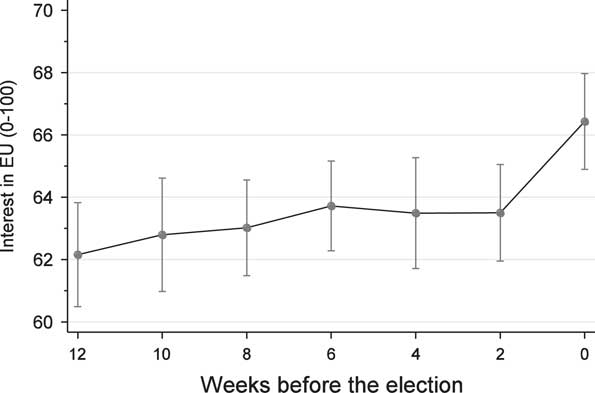
The first hypothesis proposed that voter interest in EU politics increased during the campaign. To investigate this we looked at how voters assessed their own interest in European politics across the campaign. As can be seen from Figure 3, interest goes up to 4 points on the 100-point scale from about 62 to about 66 during the campaign, which is about one-fourth of a standard deviation. Along with the time-specific means, we plot 90 percent confidence intervals.
Interest in EU issues across the campaign with 90 pct. confidence intervals Note: n=2310.
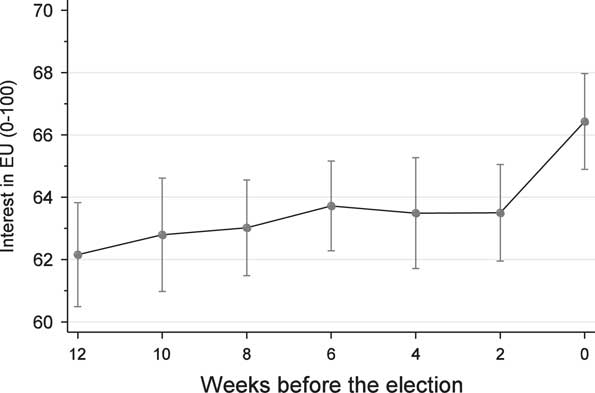
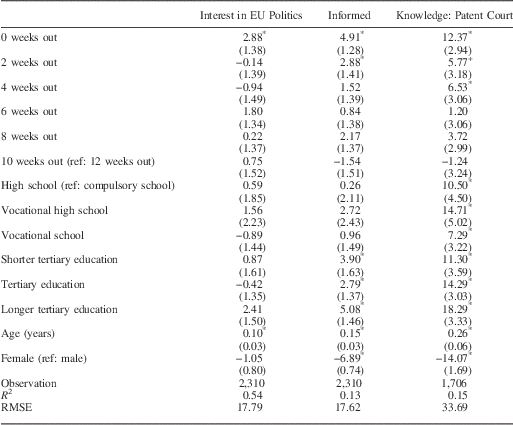
To test whether these differences are actually due to the campaign and not temporal heterogeneity in recruitment to the survey, we estimate an ordinary least squares (OLS) regression using the interest scale as the dependent variable. As independent variables we use dummies for the six survey waves leading up to the election, the first wave serving as a reference category, along with education, age, gender and party preferences at the last national parliamentary elections as controls. In addition to these controls, which will be used below as well, we included voters general interest in politics as a control in order to make sure that the European Parliament campaign had an effect on interest in European politics rather than just interest in general. The model’s estimates are presented in the first column of Table 1. These reveal that interest does go slightly up and down, but then increases in the last two weeks before the election; ending about 3 points higher in the last week compared with the first week; a difference which is significant at the 5 percent level. The fact that the interest does not change substantially until the final week, tracks nicely with the fact that the media coverage increased sharply in this week. Taken together, this suggests that interest in European politics did increase during the campaign, lending support to Hypothesis 1.
Campaign Effects on Interest, Information and Knowledge

Note: Ordinary least squares regression. Robust standard errors in parentheses. All models include party-fixed effects based on who voters supported in the last national parliamentary election. The model in column one also includes a control for general political interest, not shown.
RMSE=root mean square error.
+p<0.1, *p<0.05.
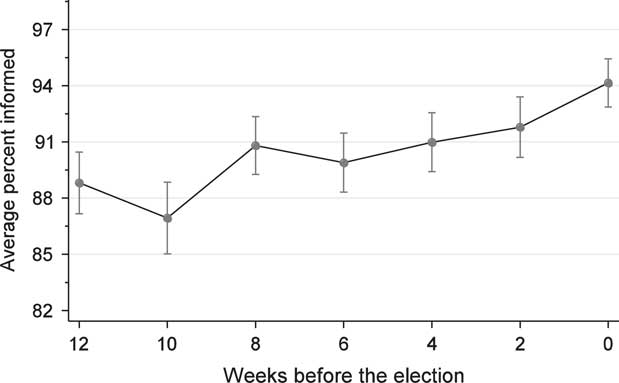
The second hypothesis proposed that voters utilized the increased attention to develop their own positions toward EU integration. To investigate this we looked at whether voters reported having an opinion (i.e., did not answer “don’t know”) to five questions about EU politics. Figure 4 plots the average percentage of actual answers on these EU-related questions. The figure shows the average percent of answers rising from about 89 percent in the beginning of the campaign to 94 percent in the end of the campaign; an increase which is about a third of a standard deviation.
Percentage of voters that were able to report their EU attitudes with 90 pct. confidence intervals Note: n=2310.
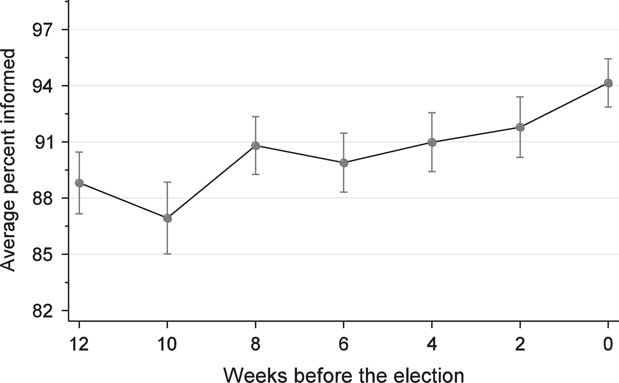
To look at this effect in more detail we estimate an OLS regression of the fraction informed including the same controls as above (except the general interest measure). The estimates are presented in the second column of Table 1. As can be seen from these estimates, the percentage that were certain of their EU attitudes increased about 3 percentage points from 12 weeks before the election until two weeks out, and then another 2 percentage points in the following two weeks. The difference is statistically significant. As such, there is evidence that voters became more informed during the campaign, in the sense that more people felt like they were able to answer more questions about EU politics.
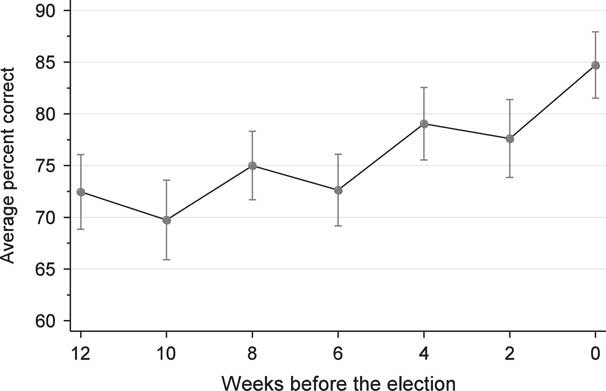
The third hypothesis proposed that voters’ knowledge of the positions of parties on EU politics would increase as a consequence of the campaign. To examine whether this was the case, we look at how much voters knew about party positions on joining the EPC.Footnote 11 Figure 5 plots average knowledge of the three largest parties’ position on the issue across the 14 weeks the RCS was conducted. As can be seen from Figure 5, knowledge of the parties position increases from about 72 percent 12 weeks before the election to about 85 percent in the week of the election.
Percentage able to correctly identify party positions on EU issues with 90 pct. confidence intervals Note: n=1706.
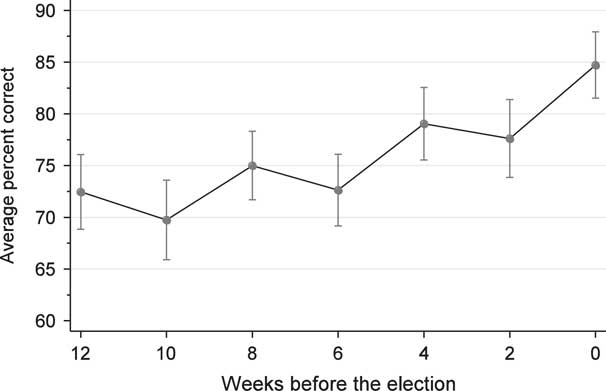
Like we did above, we estimate an OLS regression using the knowledge question as the dependent variable, with the same controls as used in the previous models. The estimates of this model are featured in the third column of Table 1. Table 1 reveals a statistically significant difference across the campaign even after controlling for the other factors. Specifically, knowledge seems to increase about 6 percentage points from the 12th week until the 4th week before the election, and then increased an extra 6 percentage points in the last weeks of the campaign. The differences are statistically significant. In summary, the campaign increased voters knowledge of parties position on an EU-related issue.
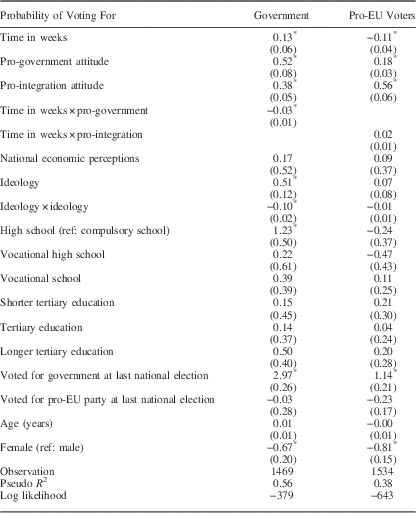
In the fourth hypothesis, we suggested that as the campaign intensified voters relied less on national political allegiances and more on their attitudes toward the EU when contemplating whom to vote for. We test this hypothesis by investigating whether the correlation between attitudes toward a national political entity, the government and voting behavior decrease across the campaign and whether the correlation between attitudes toward European integration and voting behavior increase. Specifically, we estimate two different logistic regressions. One of the regressions predicts the probability of voting for one of the two parties in government using an interaction between voters pro-government attitudes and weeks until the election. The other logistic regression predicts the probability of voting for a pro-EU party using an interaction between voters pro-integration attitudes and weeks until the election. Using these interactions, we can assess whether one’s attitudes towards the government (national political entity) matters less in deciding whether to vote for a governing party at the EP election as the campaign unfolds, and whether one’s attitudes toward European integration matters more in deciding whether to voter for a pro-EU party at the EP election.
Turning to modeling, we know that evaluating interactions in non-linear models is a complicated affair. Accordingly, we decided to simply use weeks until the elections as a continuous variable rather than including it in a dummy form as above. This leaves us with only one interaction term instead of six (one for each potential dummy).Footnote 12 Since we are no longer only interested in the effect of time, but on the interaction between time and attitude positions, it is important to specify our models carefully to minimize issues related to the endogeneity of issue positions. Although issues relating to endogeneity are less severe because we look at changes in the weight voters put on these issue positions across time, we need to be reasonably sure that the changes we see in these “weights” do not reflect changes in the importance of other factors such as party identification or ideology. We address this by employing a host of different controls. First, we include a set of socio-demographic variables; age, gender and education. Second, we included variables measuring general valence and position issues; national economic perceptions and ideology. Ideology was also included as a square term in order to allow for a curvilinear relationship with voting. As such, the ideological profile of government and pro-EU parties in Denmark is usually centrist (Buch and Hansen Reference Buch and Hansen2002), making it likely that those in the middle range of the scale are most likely to vote for the party and those who a very left wing or very right wing are less likely to vote for these parties. Finally, a proxy for partisanship was included that asks whether the respondent voted for a governing or a pro-EU party at the last national election.
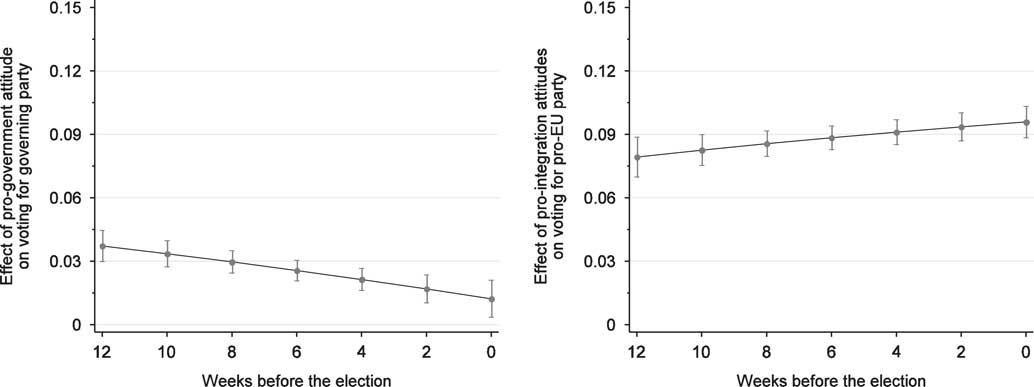
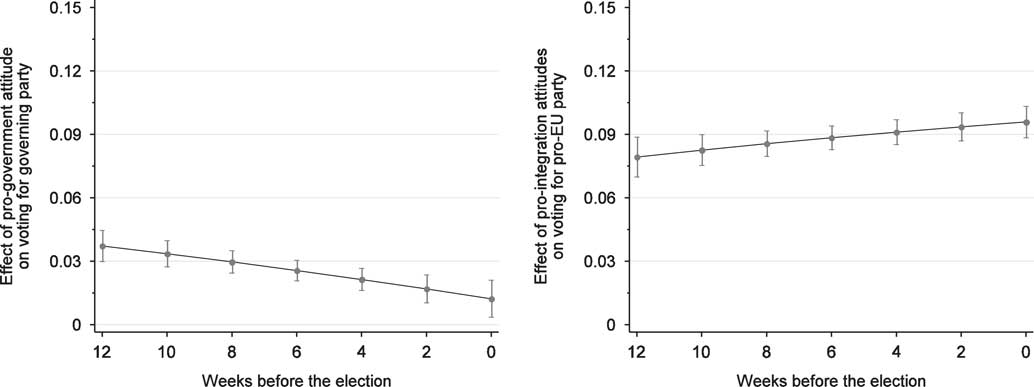
The estimates of the logistic regression are presented in Table 2. Figure 6 derives the average marginal effect of pro-government and pro-integration attitudes across the seven survey waves. As can be seen from Figure 6, the effect of pro-integration attitudes increases during the campaign (i.e., effect of attitudes as change in predicted probabilities). Twelve weeks before the election the result of moving one-tenth of the pro-integration scale increase the probability of voting for a pro-EU party with about 7 percentage points. In the election week it is just shy of 10 percentage points. In line with Hypothesis 4, EU attitudes thus seem to become a more important predictor of vote choice as the campaign intensifies.
Average marginal effect of pro-integration attitudes and pro-government attitudes across the campaign with 90 pct. confidence intervals Note: Derived from models (1) and (2) in Table 2.
The Degree to Which EU Attitudes and National Politics Matter for Voters

Note: Logit coefficients with standard errors in parentheses, *p<0.05.
Turning to the effect of pro-government attitudes they seem to play a smaller role as election day draws closer. Twelve weeks out the result of moving one-tenth of the pro-government scale increases the probability of reporting a vote for a government party of about 4 percentage points. In the week leading up to the election, the effect drops to about 1 percentage points. In line with Hypothesis 4, the allegiance to the national government thus seems to play less of a role as the campaign intensifies.
The changes in the effect of pro-government attitudes and pro-integration attitudes are statistically significant. The logit coefficient attached to the interaction in the models displayed in Table 2 are significantly different from 0 in both models (p<0.1). Further, the average marginal effects derived in Figure 6 are significantly different from each other. As such, a Wald test of equality of the average marginal effects 12 weeks before the election and in the election week show that the differences are statistically discernable (χ 2(1)=10.51, p<0.05 for pro-government attitudes and χ 2(1)=4.66, p<0.05 for pro-integration attitudes).
Having presented the main findings, we believe that there is evidence supporting all hypotheses. As such, the findings lend credibility to the EU issue voting model of European Parliament campaigns presented in the theory section.
Discussion of the results
Above we showed that as the campaign progressed voters relied more on EU issues and less on national political allegiances when deciding whom to vote for in the European Parliament election. In our EU issue voting model, we assume that this is due to the rise in information in the media and the increasing level of interest and knowledge among the voters about the EU as the campaign progresses, both of which we saw increase during the campaign. However, one might argue that the increase in EU issue voting simply reflects trends that are present across all types of campaigns, i.e., voters become more issue oriented in general (Lenz Reference Lenz2009). As campaigns progress, voters sort more on any issue and accordingly there is no unique effect of the rise in information brought about by the campaign on the importance of EU issues. If this were correct, the theoretical mechanism behind the rise in the importance of EU issue voting might not be due to information but rather some general and independent feature of campaigns, which lead voters to take issues into account.
To test whether this is the case we examined whether voters position on another issue became more important for vote choice during the campaign. The issue we used was left-right self-placement on an ideological scale. The left-right spectrum is the dominant cleavage in Danish national politics, and it is to a large extent independent of voters position on EU integration. We use ideology as a sort of placebo test, reasoning that if our explanation for the rise in EU issue voting is correct, we should not expect ideology to play a more important role in the later stages of the campaign. In order to examine whether the effect of ideology changed during the campaign we estimated a slightly respecified version of the models displayed in Table 2. Specifically, we changed the interaction terms to include ideology instead of pro-integration attitudes and pro-government attitudes, respectively (see Section S2 in the Supplementary Materials for details). Using these new interaction terms we could examine whether ideology played an increasing or decreasing role in the campaign. For presentational reasons we do not display the full models, but the key coefficients—the interaction terms—were insignificant and close to 0 across both models (p>0.5). Accordingly, unlike for pro-EU issues, we find no evidence that ideology played a more important role as the campaign commenced. As such, in the current case, the campaign for the European Parliament does not seem to make all issues more salient for voters, just those related to the EU.
Another concern is that the measure of beliefs about the government used above is not really independent of EU issues. That is, one might reasonably think that voters believe that the government is doing good in relation to their EU policies. So what happens if one uses a purely national consideration, such as evaluation of the national economy? To test this, we re-estimated the model presented in column 1 of Table 2, using the measure of respondent’s evaluation of national economic conditions rather than their evaluations of the government. For presentational reasons we do not display the full models, but the key coefficient—the interaction term—was negative, suggesting that as the campaign drew closer voters were less influenced by perceptions of national economic conditions. Deriving the average marginal effects, we found that these did decrease significantly across the campaign (χ 2(3)=17.3, p<0.05, see Section S2 in the Supplementary Materials for details).
Conclusion
In this article, we combined the literature on campaign effects with that of voting behavior in European Parliamentary elections and developed a model of EU issue voting with campaign effects. The premise of the model was that campaigns intensify EU information flows, and as a result it increased interest in EU politics, making voters more aware of their attitudes on EU issues, and increased knowledge of party positions on EU issues. The model then suggested that taken together these information effects enabled voters to rely more on their EU attitudes when deciding whom to vote for and less on national political allegiances and attitudes.
We subsequently tested four hypotheses derived from this model using a RCS, which was conducted during the 2014 Danish campaign for European Parliament. Looking at how the Danish electorate was impacted by information during the campaign, we found support for all four hypotheses. Voters became more interested and more knowledgeable about their own and party positions on EU issues, and their vote intention became less determined by their feelings toward the national government and more determined by their position on European integration. How large were these effects? Imagine two voters who disagree completely on EU issues. Our models suggest that in the beginning of the campaign there is a 30 percent chance that they will both vote for the same type of party (i.e., both vote for either pro- or anti-EU party) nonetheless. At the end of the campaign this chance drops to about 10 percent. In the same vein, imagine two voters who disagree on how the government is doing at the beginning of the campaign. Our models suggest they have a 30 percent chance of voting for different type of parties (i.e., that one votes for government and one for the opposition). At the end of the campaign there is a 10 percent chance that they vote for different types of parties. That is, although people already sort on EU issues at the beginning of the campaign, this type of sorting becomes much more likely as election day draws close. Conversely, while people do sort on their view toward the government, this type of sorting becomes rarer as election day draws closer.
While our RCS has made it possible for us to capture campaign effects on voter’s interest, knowledge about their own and party EU attitudes, and EU issue voting, the exact causal relationship between the different dependent variables is hard to ascertain without experimental or individual panel data. As such, it is hard to know whether extraneous variables, such as the presence of the referendum, are confounding our results to some degree. Even so, the proposed process model, suggesting that EU campaigns work by increasing interest and knowledge leads to EU issue voting is theoretically grounded in the general literature on public opinion (e.g., Zaller Reference Zaller1992; Lodge et al. 2001) and is compatible with previous experimental evidence on when EU issue voting is likely to occur (Hobolt and Wittrock Reference Hobolt and Wittrock2011).
An important implication of out finding is that EU issue voting could potentially play a more prominent role in European Parliament elections, and second-order voting could play a less prominent role, if EP campaigning became more prolific. As such, our findings suggest that if campaigns articulate EU issues, parties take a stand on these issues, and if the media reports on EU issues, voters then become able to form opinions based on these issues and vote accordingly. This may not necessarily be the case in all countries or campaigns, but the results suggest that voters are both willing and able to substitute a national agenda for an agenda based on EU issues.