Introduction
‘Europe's call to intolerance’.Footnote 1 This headline from the Washington Post from 1 December 2009 refers to the heated debate over the Swiss minaret ban. Over the course of time, such headlines mirroring and accelerating this ongoing public controversy concerning various kinds of tolerance have become increasingly prevalent in the media. Other exciting examples include the stirring French burqa debate in May 2010; the legislative debates in some states in Africa (e.g. Burundi, Rwanda, and Uganda) in October 2009 about making homosexuality punishable by life imprisonment; the reinforced ban on same-sex marriage in the state of California in the United States in May 2009; and the rejection of same-sex marriage laws in Portugal in October 2008. These cases have led to a lively debate over different ethical standards and values. Furthermore, discussions concerning anti-smoking laws and campaigns (in 2008, six European countries banned smoking from restaurants), the legalization of marijuana, the medicinal use of heroin in addiction therapy, or the legality of gambling take place almost on a weekly basis. These repeated debates over freedom of lifestyles, interests of various social groupings, and attitudes undoubtedly contributed to the re-emergence of the concept of tolerance on the (research) agenda (Stouffer, Reference Stouffer1955; Sullivan et al., Reference Sullivan, Piereson and Marcus1993; Norris, Reference Norris2002; Peffley and Rohrschneider, Reference Peffley and Rohrschneider2003; Andersen and Fetner, Reference Andersen and Fetner2008b).
Despite this growing awareness within the public and academic community of the importance of the concept, little research has explicitly addressed the question of how tolerance can be built. The aim of the present article is to provide an additional step toward filling this gap. Accordingly, this paper evaluates the foundations of one important aspect of tolerance, namely social tolerance. Our guiding question concerns the impact of political institutions on this key component of social cohesion. Our contribution will go beyond the existing literature in three ways:
First, while most studies refer to the concept of political tolerance, we investigate the sources of social tolerance. Whereas the concept of political tolerance has been frequently addressed within the US context and received broad attention since the 1950s, it is somewhat surprising that so little research has been conducted on social tolerance (cf. Gibson and Gouws, Reference Gibson and Gouws2000; Mutz, Reference Mutz2001; Mondak and Sanders, Reference Mondak and Sanders2005). Considering that tolerance not only means political tolerance – to allow certain groups the same (political) rights and to acknowledge the rights of others ‘even those one finds objectionable, to participate fully in political, social, and economic life’ (Weldon, Reference Weldon2006: 331) – this lack of research becomes even more astounding. Moreover, tolerance also refers to the toleration and acceptance of socio-cultural and socio-economic differences within society, ‘entailing full recognition and acceptance of the identity and uniqueness of differences that are seen as not reducible to invisibility by their bearers’ (Persell et al., Reference Persell, Green and Gurevich2001: 208). This so-called social tolerance complements the principles of political tolerance, or rather, expresses a more general level of tolerance (Persell et al., Reference Persell, Green and Gurevich2001). It captures the actual willingness to accept differences and to tolerate the contents of these expressions (Weldon, Reference Weldon2006: 336). Social tolerance thus plays a crucial role in daily interactions and constitutes a critical element of the social fabric. Particularly, in times of growing internationalization, migration, and changing social conventions lead to evolving societal and ethnical heterogeneity, which ultimately results in a diversified sphere of interest challenging individual social tolerance and peaceful cohabitation. If social tolerance and peaceful cohabitation are prevalent in a society, these contribute to the stability of a system in the long run (Feldmann et al., Reference Feldmann, Henschel and Ulrich2000: 9). Studies on political tolerance have also shown that the intolerant are more likely to ‘express a willingness to act on their views than the tolerant’ (Peffley and Rohrschneider, Reference Peffley and Rohrschneider2003: 244); assuming the same mechanisms are at work for social tolerance, it is important to learn more about a person's acceptance of difference across a range of groups (and not just objectionable or unpopular groups or actions) by examining the more general individual social tolerance. This is particularly relevant against the background of Sullivan et al.'s (1993) finding that respondents are significantly less socially tolerant than politically tolerant.
Second, compared to the few other studies in the field (cf. Sullivan et al., Reference Sullivan, Piereson and Marcus1993; Norris, Reference Norris2002; Dunn et al., Reference Dunn, Orellana and Singh2009), we present an empirically and theoretically more diverse index of social tolerance. In this regard, we exclude certain groupings from our analyses, since the broad public is unlikely to ever tolerate groups or acts that display a certain level of delinquency (see Peffley and Rohrschneider, Reference Peffley and Rohrschneider2003).
Third, the literature suggests that social and political tolerance are primarily shaped by socio-economic, societal, cultural, and democratic factors, such as economic development or religion (see among others Sullivan and Transue, Reference Sullivan and Transue1999; Peffley and Rohrschneider, Reference Peffley and Rohrschneider2003; Weldon, Reference Weldon2006; Andersen and Fetner, Reference Andersen and Fetner2008a; Ikeda and Richey, Reference Ikeda and Richey2009). However, studies in the tradition of the neo-institutionalist perspective regarding the influence of institutions on voting behavior, different policies, socio-economic developments, political culture, or social capital – hitherto fail to address the tolerance issue. Thus, combining these two research areas, we argue that an important source of social tolerance is to be found in the qualities of political institutions. By filling this research gap, we provide new insights for an even broader audience, cross-cutting and connecting disciplines. Our paper seeks to systematically complement previous studies that include some political-institutional features, yet have failed to comprehensively model and account for various institutional features (Peffley and Rohrschneider, Reference Peffley and Rohrschneider2003; Wernet et al., Reference Wernet, Elman and Pendleton2005; Weldon, Reference Weldon2006; Andersen and Fetner, Reference Andersen and Fetner2008b). In this vein, we place political institutions at the center of our analysis and present an institutional theory of social tolerance. We argue that specific facets of political institutions such as inclusiveness, universality, and fairness are capable of reducing the threat of losing social status and thereby contribute to the development of social tolerance. When people come to believe that political institutions exhibit these qualities, they will generally tolerate others in their society.
The data for our analyses stem from the latest wave of the World Values Survey (2005–08; WVS) for 28 countries and from official statistics for the aggregate-level data. The case selection is based on the availability of both individual and societal-level data. Accounting for the data-generating process, we use hierarchical models, a tried and tested means for overcoming micro–macro dualism, as individual levels of social tolerance are structured both by personal traits and societal conditions (Hox, Reference Hox2002; Steenbergen and Jones, Reference Steenbergen and Jones2002; Freitag and Bühlmann, Reference Freitag and Bühlmann2009).
The remainder of our analysis is structured as follows: the second section outlines our understanding of social tolerance. In the third section, we present our theory linking contextual conditions to the creation of individual levels of social tolerance. The fourth section elaborates on the methodology used and subsequently subjects the various independent variables to systematic empirical testing in a number of hierarchical models. The most important findings are summarized and discussed in the fifth section.
Tolerance – the dependent variable
Social changes brought on by the past few decades, such as the decreased importance of traditional relationships (family, clubs, etc.), the rapidly changing orientation patterns (religious convictions, etc.), or the increased speed at which information is exchanged (new media, etc.), have contributed to a growing number of diverging lifestyles, interests of various social groupings, opinions, and attitudes. Simultaneously differing macro social structures and the modernization process have transformed attitudes, values, and the perception of (out-) groups (Wernet et al., Reference Wernet, Elman and Pendleton2005). How these changes have been received, however, is somewhat ambiguous: On the one hand, they lead to cultural, political, and social diversity; on the other hand, different ethical standards and values compete with one another and increase the need for tolerance.
As one of the central concepts in political-philosophical discourse, the roots of tolerance and toleration can be traced back as far as Cicero or early Christian beliefs (Forst, Reference Forst2007). The interest in tolerance, however, is primarily vested in the religious-political conflicts that followed the Reformation in Europe (Forst, Reference Forst2007).Footnote 2 In the social sciences, the mainstream understanding of tolerance has its roots in pioneering studies by researchers in the United States during the 1950s and 1960s. Threatened civil liberties in the Cold War Era and the US Civil Rights Movement paved the way for this sudden surge of interest in tolerance. The most common and current approach by empirical researchers focuses on political tolerance (cf. Gibson and Gouws, Reference Gibson and Gouws2000; Mutz, Reference Mutz2001; Mondak and Sanders, Reference Mondak and Sanders2005). Characterized by conceptual heterogeneity within this strand of literature, ‘to tolerate’ is commonly understood as allowing one's political enemies to participate actively in political life (Sullivan et al., Reference Sullivan, Piereson and Marcus1979, Reference Sullivan, Piereson and Marcus1993). It refers to general political principles such as the freedom of speech, the right to vote, and the right to run for political office (Weldon, Reference Weldon2006: 335). The term tolerance itself, however, does not justify the prevalent narrow focus of research on political tolerance (cf. Gibson, Reference Gibson1992; Cigler and Joslyn, Reference Cigler and Joslyn2002; Peffley and Rohrschneider, Reference Peffley and Rohrschneider2003; Weldon, Reference Weldon2006).
Simply put, in general to tolerate is to allow ‘ideas and opinions that one dislikes or disagrees’ (Orlenius, Reference Orlenius2008: 469). A similar definition of tolerance can be found in Mendus (Reference Mendus1999: 3): ‘[W]e are genuinely tolerant of others only when we disapprove of them, or of their actions and beliefs, but nonetheless refrain from imposing our own view’. Therefore, in order to distinguish tolerance from other concepts – such as indifference or affirmation – certain criteria have to be met: (a) a conflict or competing interests concerning the particular objects of tolerance, such as practices or beliefs, is assumed (objection dimension); (b) violence, disapproved manners, or actions toward those objects, are absent; and (c) equal rights are voluntarily recognized and not coercively (Forst, Reference Forst2007; Orlenius, Reference Orlenius2008). Tolerance not only relates to political rights but also to the toleration and acceptance of socio-cultural and socio-economic differences within a society (Weldon, Reference Weldon2006: 335). This kind of tolerance, ‘the willingness to live and let live, to tolerate diverse lifestyles and political perspectives’, is known as social tolerance (Norris, Reference Norris2002: 158). It incorporates an individual's perception of what is right or wrong, and the extent to which the content of these differences can be expressed (Weldon, Reference Weldon2006: 336). Distinguishing between the act (cf. Maule and Goidel, Reference Maule and Goidel2003; Orlenius, Reference Orlenius2008), the moral issue (cf. Loftus, Reference Loftus2001; Cohen et al., Reference Cohen, Marcoux, Bilsen, Deboosere, van der Wal and Deliens2006; Andersen and Fetner, Reference Andersen and Fetner2008b), and the group (cf. Gibson and Gouws, Reference Gibson and Gouws2000; Peffley and Rohrschneider, Reference Peffley and Rohrschneider2003; Weldon, Reference Weldon2006; Dunn et al., Reference Dunn, Orellana and Singh2009; Ikeda and Richey, Reference Ikeda and Richey2009) to which tolerance can be expressed (cf. Wagner, Reference Wagner1986: 48), we focus on social tolerance regarding the latter. Social tolerance in this context is understood as the willingness to tolerate or accept persons or certain groups as well as their underlying values and behavior by means of a co-existence (even if they are completely different from one's own). With this view we tap the range of groups, and thus their ideas as well as activities ‘that people will allow to go uncensored in society’, and investigate the political circumstances in which social tolerance will be given (Chong, Reference Chong1994: 27).Footnote 3
Weldon (Reference Weldon2006: 336) operationalizes social tolerance using a content-controlled index comprising questions on the toleration of ethnic differences (concerning neighbors, employment, marriage, societal, and cultural integration). These questions were administered to respondents that found minority groups personally disturbing and to those who stated that there is a group that other people find disturbing. According to Norris (Reference Norris2002: 158), however, ‘there are many alternative measures’ to capture social tolerance. One such measure that ‘taps many of the most common types of narrow-mindedness and bigotry’ is the social tolerance scale that can be derived from the WVS (Norris, Reference Norris2002: 158). This approach also overcomes the weakness of various content-controlled measures (mostly applied to political tolerance): many only inquire about one or a few more ‘objectionable’ groups; it is therefore impossible to distinguish those who dislike only one group from those who dislike almost every group other than their own.
In the WVS, social tolerance, as the toleration or acceptance of groups outside one's own (cf. Dunn et al., Reference Dunn, Orellana and Singh2009), is measured with a battery of items: ‘On this list are various groups of people. Could you please mention any that you would not like to have as neighbors?’ The question covers ten categories: drug addicts, people of a different race, people who have AIDS, immigrants/foreign workers, homosexuals, people of a different religion, heavy drinkers, cohabiting unmarried couples, people who speak a different language, and, ultimately, another relevant minority in a given country. Each item is binary coded to capture whether the respondent accepts or rejects a particular group as neighbors. For theoretical and empirical reasons, however, we modify the social tolerance index applied in Norris (Reference Norris2002) and Dunn et al. (Reference Dunn, Orellana and Singh2009) as follows: According to the existing tolerance research (especially Peffley and Rohrschneider, Reference Peffley and Rohrschneider2003) the broad public is unlikely to ever tolerate groups or acts that display a certain level of delinquency. Peffley and Rohrschneider (Reference Peffley and Rohrschneider2003: 247) argue that ‘in most countries, criminals do not enjoy the same citizenship rights as non-criminals’. Applying this logic to the WVS battery on social tolerance, we identify drug addicts and heavy drinkers as groups that possibly fall into that category.Footnote 4
Ultimately, social tolerance is measured with an additive index ranging from 0 to 7, where higher values indicate higher social tolerance. Referencing groups outside of one's own, our definition of social tolerance also includes a variety of groups in order to avoid undermining the scale for an individual (cf. Dunn et al., Reference Dunn, Orellana and Singh2009). This summated rating scale produces an average inter-item correlation of 0.35 and a Cronbach's alpha score of 0.79. With these multiple items we anticipate that a respondent cannot be a member of each group at once, which yields a rudimentary content-controlled measure (Gibson, Reference Gibson1992; Sullivan et al., Reference Sullivan, Piereson and Marcus1993; Mondak and Sanders, Reference Mondak and Sanders2005; Dunn et al., Reference Dunn, Orellana and Singh2009).
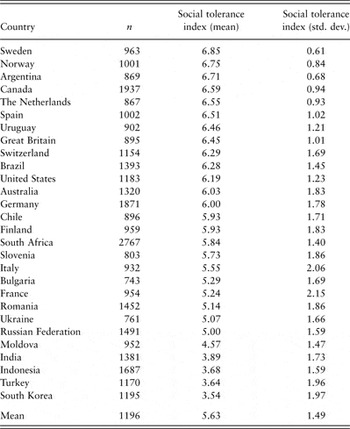
Taking a closer look at the levels of social tolerance (Table 1), it becomes clear that they vary considerably from country to country.
Country information

Note: This table presents an overview of descriptive statistics for all countries in the sample.
These figures indicate that the level of social tolerance ranges from high in Sweden and Norway, to low in some Eastern European states (Moldova, Ukraine, Russia), in some Asian states (India, Indonesia, South Korea), as well as in Turkey. They also undermine the notion that the level of social tolerance in individual countries could be directly linked to a specific type of culture. As the Western European countries are mainly clustered together, they are interspersed with other countries, such as Argentina, Brazil, or Uruguay. One can find countries from Eastern Europe, Africa, and Latin America in both the second and the third thirds of the distribution. If we are unable to find explanations based either on socio-economic resources or on shared historical-cultural experiences and their expression in modern convictions and attitudes, then how are we to explain the varying levels of social tolerance? Providing an answer to this question is the task of the next section.
Theory and hypothesis of the institutional foundations of social tolerance
Tolerance is often considered a virtue, a virtue of democracy, and pluralism. It is not, however, an innate characteristic, it must be acquired and learned; it is not only a product of individual competence but also a result of the cultural imprint – of the political, social, and religious fabric of society (Fritzsche, Reference Fritzsche1995: 11). At the core of the present analysis is the perspective that the qualities of institutions act as catalysts for social tolerance. In contrast to prior research (cf. Weldon, Reference Weldon2006; Marquart-Pyatt and Paxton, Reference Marquart-Pyatt and Paxton2007; Andersen and Fetner, Reference Andersen and Fetner2008b), we establish our theory exclusively around political-institutional conditions and their ability to shape social tolerance, an analytical dimension which, to date, has been rather neglected (cf. Peffley and Rohrschneider, Reference Peffley and Rohrschneider2003; Dunn et al., Reference Dunn, Orellana and Singh2009). Viewed systematically, this inquiry forces us to take hierarchical structures into account, as the assumption is posited that a macro-level condition (qualities of institutions) is capable of influencing individuals at the micro-level (the attitude to tolerate others).Footnote 5 Theoretically, interactions with one's social surroundings can shape individual choices; however, an individual's attitudes can also be traced back solely to the observation of one's environment. A specific incentive offered by the individual's economic and socio-political surroundings can influence the individual to think and feel in a particular manner. From the perspective of neo-institutionalism, political institutions are capable of molding individual preferences and stimulating or limiting behavioral options and affective orientations toward others by means of certain incentive mechanisms (Hall and Taylor, Reference Hall and Taylor1996). Our approach thus follows this tradition of ‘new institutionalism’ in political science. Whereas classical institutionalism focuses on formal rules, new institutionalism includes informal settings, thereby enabling the discovery of previously undetected effects. Moreover, in contrast to the earlier historical-descriptive institutionalism, which focused on rules and constitutions, the new institutionalism takes an explicitly empirical approach to the analysis of the effectiveness and regulative power of political institutions. Institutions can structure the exchange of information or various types of behavior and can also impose sanctions. In other words, political-institutional conditions as opportunity structures influence individual attitudes (Anderson and Singer, Reference Anderson and Singer2008; cf. Freitag and Traunmüller, Reference Freitag and Traunmüller2009). As demonstrated in recently published literature, there are specific qualities of institutions that have been shown to be important for forming affective orientations toward others (Rothstein and Uslaner, Reference Rothstein and Uslaner2005; Herreros and Criado, Reference Herreros and Criado2008; Rothstein and Stolle, Reference Rothstein and Stolle2008; Freitag and Bühlmann, Reference Freitag and Bühlmann2009). In this sense, institutions can stimulate individual tolerant attitudes. The central assumption of our approach is that tolerance-based relationships can be attained through the maintenance of individual social status and security.Footnote 6
According to Feldmann et al. (Reference Feldmann, Henschel and Ulrich2000: 11), one of the basic prerequisites to an unprejudiced and unbiased approach to people and concepts perceived as ‘alien’, is a stable identity. In this perspective, ‘ “identity” establishes what the person is and where he or she is situated in terms of others’ (Tatalovich and Smith, Reference Tatalovich and Smith2001: 3). The context in which individuals live is likely to contribute to a feeling of security/insecurity and adequacy/inadequacy as well as status stability/anxiety due to varying levels of threat. Tolerance must therefore be ‘affordable’, as only somebody sure of him/herself, living in an appropriate context, can afford to be tolerant: when status positions and social roles are certain and guaranteed by specific qualities of institutions, the willingness to accept others and to behave in a tolerant way will most likely increase.Footnote 7 In such an institutional environment citizens are socialized and connected to a variety of attitudes, opinions, and groups, which form an integral part of the political system and aid individuals in orienting themselves according to defined principles of conflict management. However, when status positions and social roles are uncertain, the propensity for individuals and groups to search for various modes of self-expression calculated to establish a secure identity increases. The apprehension and anxiety that accompany the demand for personal self-expression nourish growth in the number of status claimants, including disputes about alternative cultural styles of life and issues revolving around questions of race, ethnicity, gender, and other group concerns. In particular, the increased complexity of economic and social contexts through internationalization leads to a growing pluralism within society that makes people feel insecure and perceive themselves as disadvantaged. If people feel insecure of who they are and where they are situated in relation to others, they are in danger of becoming intolerant toward others (Fritzsche, Reference Fritzsche1995: 16; Feldmann et al., Reference Feldmann, Henschel and Ulrich2000; Tatalovich and Smith, Reference Tatalovich and Smith2001).Footnote 8 This process is further enhanced since unhappy and worried individuals are more likely to blame an outgroup and to believe that the members of an outgroup contribute to negative personal conditions (McLaren, Reference McLaren2003). To put it bluntly, status anxiety may ultimately lead to intolerant speech and actions, especially when individuals feel inadequate and deprived, that is, when they have few chances to be included in the democratic decision process, to obtain equal life chances, and to be treated fairly by the government. The question then remains as to which substantive qualities institutions must have in order to act as catalysts for social tolerance.
We argue that power-dispersing, universalistic, and non-partisan political-institutional configurations increase the likelihood that social tolerance will develop as long as these ‘rules’ reduce status anxiety. In this vein, the first quality of institutions is the extent to which mechanisms of inclusion are present. Some institutions are designed to afford greater opportunities of inclusiveness to both winners and losers of democratic competition. Against this background, there is the need for a crucial distinction between different types of democracies. If citizens experience systematic discrimination because of certain decision-making processes, it seems plausible that these individuals fear losing their status within society. This permanent threat will generate intolerance among individuals who are confronted with disadvantages or who are singled out as special cases due to the institutional setting. However, inclusive political-institutional structures nourish social tolerance by allowing the manifold societal interests to partake proportionally in the decision-making process and by systematically integrating minorities into this process. These systems facilitate mutual respect and contribute to deliberation among groups. Seminal work conducted by Lijphart (Reference Lijphart1999: 275ff.) suggests that consensus democracies are ‘kinder and gentler’, fostering and encouraging ‘mutual persuasion’, a strong social consciousness as well as public discourse (Lijphart, Reference Lijphart1999: 293). Consensus democracies provide a plurality of interests access and are ‘superior in social integration’, providing various (institutional) incentives to cooperation (Armingeon, Reference Armingeon2002: 82). In this form of democracy, citizens are socialized and subjected to a variety of opinions and arguments incorporated in the decision-making process according to a consociational principle, that is, conflict management by cooperation. In other words, consensual institutional arrangements produce particular habits and norms of affective orientations toward others, thus making people inherently more tolerant through socialization mechanisms and by frequently exposing individuals to a diversity of social groups and interests.Footnote 9 In this regard, inclusive political-institutional structures prevailing in consensus democracies allow policymakers to adapt policies according to the diverse preferences and ideas of people living in those structures and provide manifold access to influence and encourage political compromise as a breeding ground for social tolerance.
A second key attribute of political institutions is the extent to which they are universally oriented and provide their citizens with equal opportunities to develop tolerance (Crepaz and Damron, Reference Crepaz and Damron2009). In this regard, a universalistic welfare state has the following advantages: one can assume that people who receive assistance on the basis of equal rights and responsibilities are less likely to be stigmatized as ‘others’. Moreover, by reducing inequality and providing key resources, universalistic welfare states abate fears of being exploited by other members of society or robbed of the equal opportunity to lead a successful life. Hence, the provision of goods such as health care, education, and security are basic opportunity principles (Gutmann and Thompson, Reference Gutmann and Thompson1996: 273) that are able to bridge the class divide (Crepaz and Damron, Reference Crepaz and Damron2009: 437) as well as to universally include different social groups. Therefore, the more comprehensive a welfare state is, the more tolerant its people are expected to be.
Finally, institutions must enshrine concepts such as fairness, justice, incorruptibility, non-partisanship, truthfulness, and transparency as the core norms of communal living. These institutions generalize values to the extent that they transparently hold the members of society to these norms and impose sanctions on those who breach them. Influenced by fairness-generating institutions and with the knowledge that sanctions will be imposed on those who violate these norms, each person comes to tolerate others. These institutions create a reliable environment in which personal status security is assured and social tolerance can therefore prosper. If there is reason to suspect that the rule of law in a given country is weak, such that legal organs like the judicial system or law enforcement are unable to ensure secure contracts or prevent some actors from receiving undue privileges, social intolerance between individuals is more likely to develop. Moreover, if citizens feel that they are not treated fairly by the authorities and politicians, their self-esteem will be negatively influenced, thereby shaping how they feel toward other people. If the officials of the government or the public administration are not fair, why should the rest of society be?
Summing up, the central assumption of our approach is that institutions, depending on their level of inclusiveness, universality, and fairness, reduce an individual's perceived threat from groups outside his or her own and thus foster social tolerance. Our main hypothesis is formulated as follows.
Individuals living in a country in which political interests are represented in a proportional, inclusive manner, whose institutions of the welfare state reduce inequalities, and whose authorities are seen as incorruptible exhibit a higher level of social tolerance. It is expected that these influences will prevail even when controlling for individual and contextual level predictors.
Data, methods, and operationalizations
For the remainder of this paper, our primary focus will be on testing the introduced hypothesis. Based on hierarchical analyses of the latest WVS (2005–08) and national statistics, we assess both individual as well as contextual aspects that influence individual social tolerance. Using these data, indicators derived from the international literature on tolerance were retained and complemented with indicators accounting for political-institutional settings (cf. Peffley and Rohrschneider, Reference Peffley and Rohrschneider2003; Weldon, Reference Weldon2006; Andersen and Fetner, Reference Andersen and Fetner2008b; Dunn et al., Reference Dunn, Orellana and Singh2009). Owing to reasons of data availability and comparability, our final sample comprises 28 nations and includes 33,500 objects of analysis.Footnote 10 To encompass the influence of both individual-level (level-1) and contextual (level-2) factors, hierarchical analyses are conducted, permitting the simultaneous estimation at both levels in a statistically accurate way (cf. Steenbergen and Jones, Reference Steenbergen and Jones2002). Accounting for dependencies of individuals within the same country cluster therefore circumvents the problem of spuriously significant results (Hox, Reference Hox2002: 5). In short, we simultaneously test for differences between respondents’ characteristics and for variations in these between countries with different institutional heritages.
Our social tolerance index is constructed from an additive scale that measures personal attitudes toward various groups, ranging from unmarried couples to homosexuals (for details see section two and Appendix 1). At the macro level, based on the hypothesis presented above, the main explanatory variables of interest for our analyses are the following political-institutional attributes: inclusiveness, universality, and fairness. Inclusiveness is primarily understood as the degree of power sharing within a country (cf. Lijphart, Reference Lijphart1999) and typically conceptualized as the system of proportional representation. We measure proportional representation with the degree of disproportionality between votes and seats in national elections (Gallagher, Reference Gallagher1991; Gallagher and Mitchell, Reference Gallagher and Mitchell2008). The extent to which institutions are universally oriented is captured by health-care expenditures as a percentage of the gross domestic product (GDP; Norris, Reference Norris2009).Footnote 11 Health-care expenditures are a high-quality universal program and increase the feeling of ‘optimism’ and ‘equal opportunity’ among large segments of the population by satisfying basic needs (Clayton and Pontusson, Reference Clayton and Pontusson1998: 80f.; Rothstein and Uslaner, Reference Rothstein and Uslaner2005: 63).Footnote 12 Our fairness indicator is based on the average estimated risk of corruption (2001–02) by means of the Transparency International Corruption Perceptions Index (CPI); higher scores indicate incorruptibility (Norris, Reference Norris2009).Footnote 13
In the analyses to follow, our models furthermore control for traditional explanations of tolerance, that is, socio-economic, societal, cultural, and democratic explanations. According to prior research these four indicators are fundamental in shaping social and political tolerance,Footnote 14 respectively (Sullivan and Transue, Reference Sullivan and Transue1999; Peffley and Rohrschneider, Reference Peffley and Rohrschneider2003; Weldon, Reference Weldon2006; Andersen and Fetner, Reference Andersen and Fetner2008b; Dunn et al., Reference Dunn, Orellana and Singh2009). To capture a country's degree of economic prosperity as well as its level of modernization, we use the United Nations Human Development Index (HDI; Peffley and Rohrschneider, Reference Peffley and Rohrschneider2003; Dunn et al., Reference Dunn, Orellana and Singh2009; Norris, Reference Norris2009). Taking the average value of two years (2001–02), this mean centered index combines information on three important dimensions of development: GNP per capita, average life expectancy, and the level of education. To account for societal composition we include the measure of ethnic fractionalization (Alesina et al., Reference Alesina, Devleeschauwer, Easterly, Kurlat and Wacziarg2003; Dunn et al., Reference Dunn, Orellana and Singh2009). High values on this scale imply a highly heterogeneous society (Norris, Reference Norris2009). The cultural tradition is captured by the religious context of a country (‘cultural heritage’, cf. Minkenberg, Reference Minkenberg2002). ‘Culture does matter […] historical religious traditions have left an enduring imprint on contemporary values [… which] are part of a broader syndrome of tolerance, trust, political activism, and emphasis on individual autonomy that constitutes “self-expression values” ’ (Inglehart and Norris, Reference Inglehart and Norris2003: 64ff.). The average level of religiosity (i.e. the emotional dimension indicating how important religion is to the respondents) in a given countryFootnote 15 is aggregated from the WVS question on individual religiosity. It provides the share of people who consider themselves religious. Finally, we integrate the duration of democracy in years as a measure of the democratic tradition, accounting for the persistence and stability of a democracy (Peffley and Rohrschneider, Reference Peffley and Rohrschneider2003; Marshall and Jaggers, Reference Marshall and Jaggers2009).
At the individual level, determinants of social tolerance include social attributes, social integration, and political orientations. A considerable degree of consensus has developed in the literature concerning the following social attributes: gender, age,Footnote 16 educational level,Footnote 17 and religiosityFootnote 18 (Peffley and Rohrschneider, Reference Peffley and Rohrschneider2003: 249; Wernet et al., Reference Wernet, Elman and Pendleton2005: 353; Weldon, Reference Weldon2006: 338; Marquart-Pyatt and Paxton, Reference Marquart-Pyatt and Paxton2007: 96f.; Andersen and Fetner, Reference Andersen and Fetner2008b: 946; Dunn et al., Reference Dunn, Orellana and Singh2009: 288). It is expected that women, the young, and the highly educated are more likely to express higher levels of social tolerance (cf. Wernet et al., Reference Wernet, Elman and Pendleton2005). Individual religiosity, included as a proxy for traditional value orientations, is expected to negatively influence social tolerance (cf. Mondak and Sanders, Reference Mondak and Sanders2003; Dunn et al., Reference Dunn, Orellana and Singh2009: 290). According to Sullivan et al. (Reference Sullivan, Piereson and Marcus1993: 137) ‘the most important factor affecting [political] intolerance appears to be religious traditionalism, a diagnosis also made by other writers’. Based on Gerhards (Reference Gerhards2007: 14) we assume this individual level influence ‘regardless of the particular denomination’. Social involvement or integration in the broader society (e.g. through civic engagement or reading the news) is expected to produce more liberal attitudes due to greater exposure to the world and diversity of ideas, such as interests, beliefs, lifestyles, and values different from one's own (Gibson, Reference Gibson1987; Hodson et al., Reference Hodson, Sekulić and Massey1994: 1546f.; Dunn et al., Reference Dunn, Orellana and Singh2009; Ikeda and Richey, Reference Ikeda and Richey2009: 662). We use civic engagement and the level of personal (media) information to measure social integration. Finally, political orientations may also affect social tolerance. Support of democratic ideals and postmaterialism are anticipated to foster the attitudes of self-determination and social tolerance. A more detailed description of all variables, their operationalizations, and related hypotheses can be found in Appendix 1.
A further issue that requires clarification is the problem of directionality in our relationship. One could argue that institutions are of course the result of citizens’ collective action and may therefore be endogenous to individual attitudes and behavior in the long run. Following previous studies on institutional influences (cf. Peffley and Rohrschneider, Reference Peffley and Rohrschneider2003; Weldon, Reference Weldon2006; Dunn et al., Reference Dunn, Orellana and Singh2009), we argue, however, that institutional arrangements can be considered exogenous framework conditions which cannot be altered by an individual in the short and medium run (Freitag and Stadelmann-Steffen, Reference Freitag and Stadelmann-Steffen2010); instead, there is much evidence that they influence individual preferences, attitudes and behavioral patterns (see Huckfeldt and Sprague, Reference Huckfeldt and Sprague1987: 1200). In other words, there is little theoretical reason to assume that tolerant societies choose representation with a high degree of proportionality, universalistic welfare states, or incorruptible institutions to foster inclusiveness, universality, and fairness. Our analyses are based on this assumption, that certain qualities of political institutions facilitate individual social tolerance.
Empirical findings
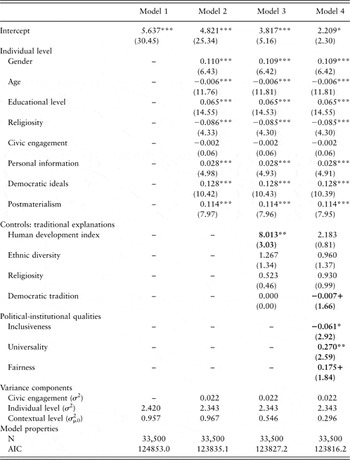
Focusing particularly on the influence of national characteristics, we follow the logic of hierarchical modeling by first introducing an empty model (model 1) and then presenting a progression of models, each one building on the last.Footnote 19 The main analysis reports the findings from four models. Model 2 assesses the impact of our individual level explanatory variables; however, it does not yet account for any macro-societal and institutional variables. Established from traditional explanations of tolerance, model 3 introduces our contextual control variables, presenting a baseline model to explain individual levels of social tolerance. We then proceed to our main hypothesis, introducing the three relevant political-institutional indicators in model 4 complementing previous explanations of social tolerance.
Turning to the empirical test of our derived hypotheses, Table 2 displays the results for the multilevel models. Discerning variation within nations from variation between nations in model 1, our analyses reveal that approximately 28% of our total variance can be accounted for by differences between countries. The intra-class correlation thus shows a rather large degree of dependence within countries.
Estimates for hierarchical models predicting levels of social tolerance in 28 countries

Notes: +P-value<0.10; *P-value<0.05; **P-value<0.01; ***P-value<0.001. Absolute z-values in parentheses.
Our second model adds micro level indicators for social tolerance, reducing the individual level variance somewhat. Except for civic engagement, which fails to reach the statistical significance level,Footnote 20 this model reveals that all individual level control variables point in the theoretically expected direction. In other words, young, highly educated women, who do not consider themselves religious, who are very informed, who have high democratic ideals, and possess a postmaterialist value orientation exhibit a higher level of social tolerance. As assumed, individual level predictors shape individual social tolerance; nevertheless, unexplained differences between countries persist. Controlling for individual characteristics even increases the contextual differences in model 2.
In addition to individual resources and predispositions as well as to avoid spurious results, model 3 establishes a baseline model against which our hypothesis will be tested (see Inglehart, Reference Inglehart1997, Reference Inglehart2000; Inglehart and Baker, Reference Inglehart and Baker2000; Peffley and Rohrschneider, Reference Peffley and Rohrschneider2003; Inglehart and Welzel, Reference Inglehart and Welzel2005; Wernet et al., Reference Wernet, Elman and Pendleton2005; Weldon, Reference Weldon2006; Andersen and Fetner, Reference Andersen and Fetner2008b; Dunn et al., Reference Dunn, Orellana and Singh2009). Accordingly, we would expect that two individuals with equal characteristics exhibit different attitudes under differing conditions, that is, a country's economic setting, societal composition, religiosity, and democratic stability. Interestingly, our third model cannot fully confirm these previous findings. Only the economic setting (HDI) exhibits statistical significance, indicating that economically developed countries show increased levels of social tolerance, thereby providing support to the oft-stated postmaterialist hypothesis, that is, Inglehart's (Reference Inglehart1997) thesis that ‘economic development can lead to changes in peoples’ psychological orientations and preferences’ (Sullivan and Transue, Reference Sullivan and Transue1999: 640). A materially secure setting thus appears capable of reducing a perceived threat that otherwise might emanate from other social groups, resulting in higher levels of social tolerance. Variables capturing the societal composition, such as ethnic fractionalizationFootnote 21 exhibit no statistically significant influence. However, we are careful to attach too much weight to this result, since we partially attribute this effect to a statistical artifact. Societal heterogeneity as operationalized here is likely measured at the wrong level of analysis. Studies on diversity suggest that ‘at the national level [diversity] often fails to translate into a plurality at the local level’ (Finke and Adamczyk, Reference Finke and Adamczyk2008: 640).Footnote 22 Furthermore, our analyses reveal that the differential effect for the level of religiosity cannot be illustrated with our data, despite the fact that religiosity has been frequently shown as having left a sizeable imprint on contemporary values by translating norms and values of the institutions into individual attitudes (see also Inglehart and Norris, Reference Inglehart and Norris2003; Rothwell and Hawdon, Reference Rothwell and Hawdon2008: 257).Footnote 23 However, since the level of religiosity might be seen as a country's path of secularization, as disenchantment (Minkenberg, Reference Minkenberg2002: 234), this effect is partially captured by a country's level of socio-economic development. Finally, we cannot observe a statistically significant effect of democratic tradition on individual level social tolerance. However, disentangling the single mechanisms of how particular democratic settings work proves a more fruitful strategy, as model 4 will illustrate. To sum up, partially supporting previous findings, lower economic development encourages ‘the maintenance of traditional values’ (Andersen and Fetner, Reference Andersen and Fetner2008b: 943).
Keeping these results from the (contextual) baseline model in mind, we now turn our attention to model 4 and its additional explanatory power. With regard to our main hypothesis, the estimations seem to confirm our arguments. Our results demonstrate the expected significant effects of the disproportionality of an electoral system, its health-care efforts as well as its level of corruption in shaping social tolerance. Therefore, institutional qualities that foster a proportional, inclusive manner of representation of political interests, that reduce inequalities, and that promote incorruptibility of authorities are conducive to higher levels of social tolerance. These influences prevail even when controlling for individual and contextual level predictors. In this vein, an individual with the lowest scores (0) on all individual characteristics (i.e. average-aged male with no formal education, no religious background, who is not actively engaged in any associations and relatively uninformed, with low scores on democratic ideals, and focuses on materialist concerns) but who lives in a country with relatively low levels of disproportionality, a universally oriented welfare system, and a strong perception of fairness (i.e. a low degree of corruption), scores about 0.81 points higher on our social tolerance index, as opposed to the same individual living in a country with opposite characteristics.Footnote 24 In comparison to our first model, model 4 reduces the individual level variance by 22% and the context dependent variance by 69% (group mean harmonized; formulae according to Windzio, Reference Windzio2008: 35). Moreover, compared to model 2, including key political-institutional aspects improves the model fit significantly.Footnote 25 The most obvious change from model 3 is in accordance with Peffley and Rohrschneider (Reference Peffley and Rohrschneider2003: 252): the effect of economic development vanishes completely when accounting for political-institutional variables. Democratic tradition now reaches the statistical significance level, however, slightly diminishing individual levels of social tolerance and thus seemingly contradicting previous studies (Peffley and Rohrschneider, Reference Peffley and Rohrschneider2003: 252).Footnote 26 These findings suggest that economic development or democratic tradition alone do not lead to higher levels of tolerance; rather, it is an effect of certain democratic institutions. To sum up, our findings imply that political-institutional factors are able to complement the traditional socio-economic, societal, cultural, and democratic explanations of social tolerance.Footnote 27 The results are in accordance with conclusions reached by previous studies on political and social tolerance that include only some political-institutional aspects (Andersen and Fetner, Reference Andersen and Fetner2008b; Dunn et al., Reference Dunn, Orellana and Singh2009).Footnote 28
Our results do however require further testing. Since we are dealing with a relatively small number of countries, single level-2 units can quickly exert a large influence on our country level effects.Footnote 29 Small samples are particularly prone to the dangers of influential observations dominating the results as well as the reliability of regression estimates resulting in questionable conclusions. However, additional analyses not presented here excluding single level-2 units from the analysis show that the estimated coefficients are similar to those obtained in model 4. The influence of disproportionality, the welfare effort, and the perceived level of fairness remain robust to this modification. Supplementary tests to assess the robustness of our results were conducted, though not presented:
As suggested by Mondak and Sanders, ‘it is the exception that signals intolerance’ (Reference Mondak and Sanders2003: 496). If we follow this understanding of tolerance, this statement implies a dichotomous nature of social tolerance, that is, whether individuals are tolerant or intolerant. Only an individual accepting all seven groups as neighbors would then be truly tolerant. This alternative operationalization [0; 1] also circumvents possible problems attached to the nature of our original dependent additive count scale. The mixed-effects models for binary responses fully confirm the results presented above. The picture becomes even clearer (reference: models 2 through 4): all of our control variables (including democratic tradition) become statistically insignificant, whereas our variables of interest show the expected signs and are statistically significant. Leaving the control variables out of the regression equation in order to avoid over-determination does not alter these results. In addition, we ran model 4 separately for each individual item of the social tolerance index [0; 1]. Again, the results confirm our findings that political-institutional factors prevail over socio-economic, societal, cultural, and democratic explanations in shaping social tolerance.
Including alternative indicators such as proportional representation (Beck et al., Reference Beck, Clarke, Groff, Keefer and Walsh2001; substituting electoral disproportionality), income inequality (Gini Index, CIA World Factbook, 2006; substituting health-care expenditures), or rule of law (Bertelsmann Transformation Index, 2003; substituting corruption) did not alter our conclusions.
Accounting for other aggregate cultural influences that could lead to spurious results, such as confessional heritage in a given country, that is, dominant religion, or a country's particular social culture, that is, prevalence of postmaterialist values, does not change our results.
Finally, if we include all major indicators separately or in different combinations with our controlling factors, the conclusions we draw remain the same. Taking all evidence together, regardless of the rather small number of countries, disproportionality, welfare effort, and the level of corruption are the most robust contextual predictors of an individual's level of social tolerance across various model specifications.
Conclusion
In recent years, scholars in the social sciences have shown resurgent interest in the analysis of tolerance, due in part to increasing diversity, immigration, or globalization accompanied by distribution conflicts. Based on hierarchical analyses of the latest WVS (2005–08) and national statistics for 28 countries, our paper has evaluated both individual and contextual aspects that influence an individual's social tolerance. In order to fully capture the nature of social tolerance, it is necessary to understand the political, cultural, and socio-economic environment that shapes people's judgments. Our contribution follows those paths by investigating the macro-sources of social tolerance, presenting an institutional theory of social tolerance focusing particularly on specific facets of institutions such as inclusiveness, universality, and fairness that are presumed to provide a breeding ground for social tolerance.
As we have seen, individual-level characteristics affect individuals in a way (generally) consistent with past research, although not to such an extent that can account for the clear differences between countries. We argue that social tolerance is primarily a function of anxiety related to one's social, political, and economic status – when one's status is threatened, one is less likely to be tolerant of minority groups. Institutions are important essentially because they influence the level of inequality in a society, and hence the standing threat of losing one's status. With regard to the key contextual factors, our analyses provide much evidence to suggest that a country's political-institutional configurations, that is, institutions as ‘the rules of the game in a society’, significantly shape social tolerance (North, Reference North1990: 3). High degrees of inclusiveness, universality, and fairness create a reliable environment in which personal security is assured and status anxiety is reduced. In this line of argumentation, our results suggest that individuals living in a country in which political interests are represented in a proportional, inclusive manner, whose institutions of the welfare state reduce inequalities, and whose authorities are seen as incorruptible exhibit a higher level of social tolerance. A major implication of the findings of this analysis is that these integrative institutional qualities provide a ‘top-down’ path to breaking out of the vicious circle of a lack of tolerance and conflict that is based upon this deficiency.
In order to complement research on social tolerance, we have used the latest available data to construct an additive social tolerance index. Our goal was therefore to increase reliability, reduce measurement error, and try to capture a more or less content-controlled measure. Nevertheless, our research is limited by the types of questions asked in the surveys. For instance, one fundamental problem common to all cross-national comparative surveys is the lack of more elaborate questions on social tolerance.
The question also remains as to whether inclusive, universal, and fair institutions lead to tolerant citizens or whether the causal relationship is reversed. We address this problem by incorporating a time lag between the institutional cause and its effect on individual social tolerance. The underlying rationale behind this strategy is somewhat ambiguous: We can only assume and theorize that the values of our main independent variables were also formed prior to individual social tolerance (see discussion above). Concerning causality, yet another scenario explaining our results seems plausible. It could be that some other factor (e.g. a long-term cultural force) influences both: the emergence of a certain institutional design and social tolerance. We cannot definitely rule out this possibility, though our robustness analyses do not support this assumption. According to our opinion there is still much work to be done before one can convincingly speak of causality and the entire causal structure of social tolerance poses a challenge worthy of additional research. However, we now know that there is at the very least a strong relationship and there is much evidence to suggest that inclusive, universal, and fair institutions lead to social tolerance.
Our findings should be viewed as the provisional results of an empirically oriented analysis. As certain limits are imposed on this research design by the limited availability and reliability of micro- and macro-level data, the hierarchical models must be viewed as a statistical method that complements previous investigations. Furthermore, while we concede that disproportionality, health-care expenditures, or estimated risks of corruption are not institutional variables per se, these are outcomes of particular institutional structures. This central assumption is based on the distinction between rules-in-form, the focus of classical institutionalism, and rules-in-use. The mere existence of formal rules (rules-in-form) is not consistently associated to their actual implementation and effective application (rules-in-use; Rothstein, Reference Rothstein1996: 146; Vatter, Reference Vatter2002). Our analyses thus rely on these rules-in-use; however, in order to pinpoint the influence of political conditions on social tolerance in a systematic manner, even more precise estimates and measures of political-institutional configurations are needed. This investigation has however taken the first step toward greater clarity in this research area.
Appendix 1 Hypotheses and operationalizations
The following table presents the applied variables, their operationalizations and sources, and the expected directions of the relationships

1All data on the individual-level come from the World Values Survey 2005–08 (World Values Survey, 2005 Official Data File v20090621a and v20090621b 2009).
2Exp. = theoretically derived expected direction of relationship (+ = positive relationship; − = negative relationship).