INTRODUCTION
The Oncholaimidae, represented by more than 300 species, are one of the largest groups of the Enoplida (Belogurov & Belogurova, Reference Belogurov and Belogurova1989). They are widespread in the seas and oceans, especially the intertidal and the upper part of the sublittoral, and are also found in freshwater lakes, rivers and even underground waters (Belogurov & Belogurova, Reference Belogurov and Belogurova1989). This group is represented by seven subfamilies (Adoncholaiminae, Krampiinae, Octonchinae, Oncholaimellinae, Oncholaiminae, Pelagonematinae and Pontonematinae), differentiated by features such as the number and length of teeth, the position of the largest tooth, the structure of the female reproductive system, and the presence and development of the demanian system (Smol & Coomans, Reference Smol, Coomans, Eyualem-Abebe and Andrássy2006).
Oncholaimellinae consists of five genera, which usually have the right ventrosublateral tooth larger than the other teeth and the demanian system simple, if present. Among the genera of this family, only members of Oncholaimellus have a sclerotized band dividing the buccal cavity into two parts (Smol & Coomans, Reference Smol, Coomans, Eyualem-Abebe and Andrássy2006). The presence or absence of the bursa, the number and size of the circumcloacal setae or papillae, the length and shape of the spicules and the length of the cephalic setae, among others, are important characteristics for the differentiation of species of Oncholaimellus.
A rich assemblage of members of Oncholaimidae has been found in the Potiguar Basin. Here we describe five new species of Oncholaimellus and provide a dichotomous key to the species of the genus.
MATERIALS AND METHODS
Sampling was carried out in the Potiguar Basin, offshore of the States of Rio Grande do Norte and Ceará, Brazil, during 2004, 2008, 2009 and 2010. The samples were collected between 3 and 919 m depth. A Van Veen grab or box-corer was used to collect sediments, and the macrofauna samples were obtained with a corer 10 cm long and 10 cm inner diameter. The sediment samples were taken in triplicate.
The collected material was preserved in 4% formaldehyde, washed on a sieve with mesh size of 0.5 mm, and then fixed in 70% ethanol. The nematodes were transferred to glycerin in an adaptation of the method described by De Grisse (Reference De Grisse1969), in which the first solution containing 4% formaldehyde was not used. The individuals were mounted permanently on glass slides. The genus was identified by using the key provided by Warwick et al. (Reference Warwick, Platt and Somerfield1998). The species were identified by comparing features with those provided in the original descriptions.
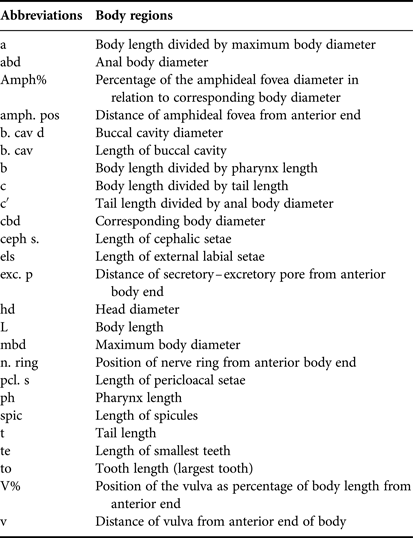
Drawings were made with the aid of an Olympus CX 31 optical microscope fitted with a drawing tube. Body measurements were taken using a mechanical mapmeter. The terms for body regions are based on Coomans (Reference Coomans1979) and presented in Table 1. Photographs were taken with an Olympus C-5050 ZOOM digital camera.
Abbreviations for body regions used in the text.

The holotypes, allotypes and one intersex paratype were deposited in the National Museum, Rio de Janeiro (MNRJ), Brazil. Paratype males and females were deposited in the Meiofauna Laboratory, Department of Zoology, Federal University of Pernambuco (NM LMZOO-UFPE), Recife, Brazil.
RESULTS
SYSTEMATICS
Taxonomic classification, according to De Ley et al. (Reference De Ley, Decraemer, Eyualem-Abebe and Andrássy2006)
Class ENOPLEA Inglis, 1983
Subclass ENOPLIA Pearse, 1942
Order ENOPLIDA Filipjev, 1929
Suborder ONCHOLAIMINA De Coninck, 1965
Superfamily ONCHOLAIMOIDEA Filipjev, 1916
Family ONCHOLAIMIDAE Filipjev, 1916
Subfamily ONCHOLAIMELLINAE De Coninck, 1965
Genus Oncholaimellus De Man, 1890
Genus Oncholaimellus De Man, 1890 (Emended after Smol & Coomans, Reference Smol, Coomans, Eyualem-Abebe and Andrássy2006)
DIAGNOSIS
Cuticle smooth, cuticular pores with sclerotized outline may be present. Right ventrosublateral tooth large and solid. Buccal cavity divided transversely by sclerotized band. Anterior pharyngeal valve present or absent (as in Vicosia). Spicules short or long, equal or unequal. Gubernaculum short or absent. Pre- and post-cloacal papillae. Copulatory bursa usually present. Demanian system similar to Viscosia or absent (O. calvadosicus). Marine.
TYPE SPECIES
Oncholaimellus calvadosicus De Man, 1890
VALID SPECIES LIST
The list of valid species is according to Gerlach & Riemman (Reference Gerlach and Riemann1974), but with addition of subsequently described species. The regions where the species were found are in parentheses.
Oncholaimellus brevicauda Timm, 1969 (Bay of Bengal).
O. calvadosicus De Man, 1890 (English Channel, North Sea); syn Oncholaimus littoralis Allgén, 1929 (Skagerrak, Allgén 1953).
O. carlbergi Allgén, 1947 (Gulf of Panama, Chile, Brazil, Gulf of Aden).
O. coxbazari Timm, 1969 (Bay of Bengal).
O. labiatus (Kreis, 1932) (Indonesia, Red Sea); syn Mononcholaimus labiatus Kreis, 1932; syn Oncholaimellus pristinus Gerlach, 1964.
O. mediterraneus Stekhoven, 1942 (Mediterranean, Red Sea).
O. meteori Gerlach, 1967 (Red Sea).
O. paracarlbergi Pastor de Ward, 1993 (Deseado River, Argentina).
Oncholaimellus patkellyi Keppner, Reference Keppner1987 (St Andrews Bay, north-west Florida, USA).
Oncholaimellus intersexus sp. nov.
MATERIAL STUDIED
7 males; 6 females; 1 intersex.
TYPE MATERIAL
Holotype male MNRJ 373; allotype female MNRJ 374; intersex paratype MNRJ 375; male paratypes 363–368 NM LMZOO-UFPE; female paratypes 369–373 NM LMZOO-UFPE. Holotype location: 3°0.3842′S 38°51.238′W (60 m depth). Allotype location: 4°51.6582′S 35°57.5573′W (60 m depth). Paratype intersex location: 5°01.913′S 36°10.177′W (3–10 m depth).
ETYMOLOGY
The specific epithet ‘intersexus’ is given because this is the first species of the family for which intersex specimens have been discovered.
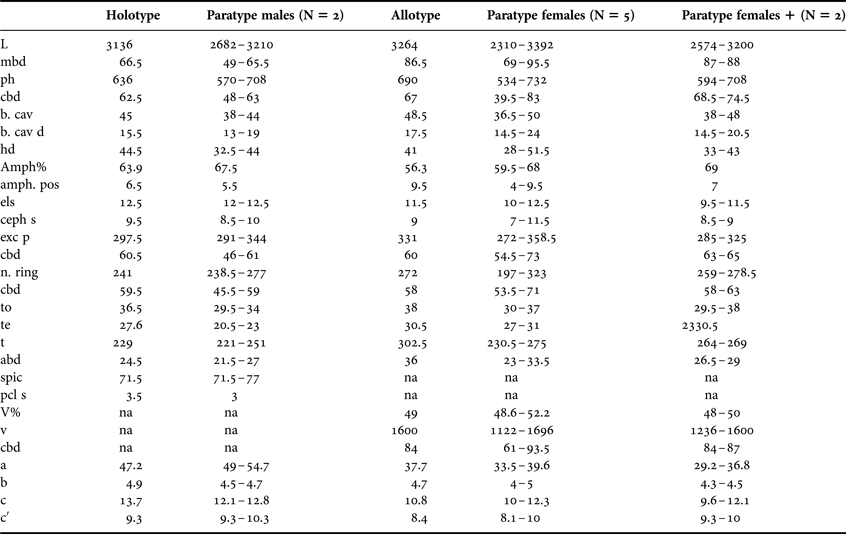
Measurements
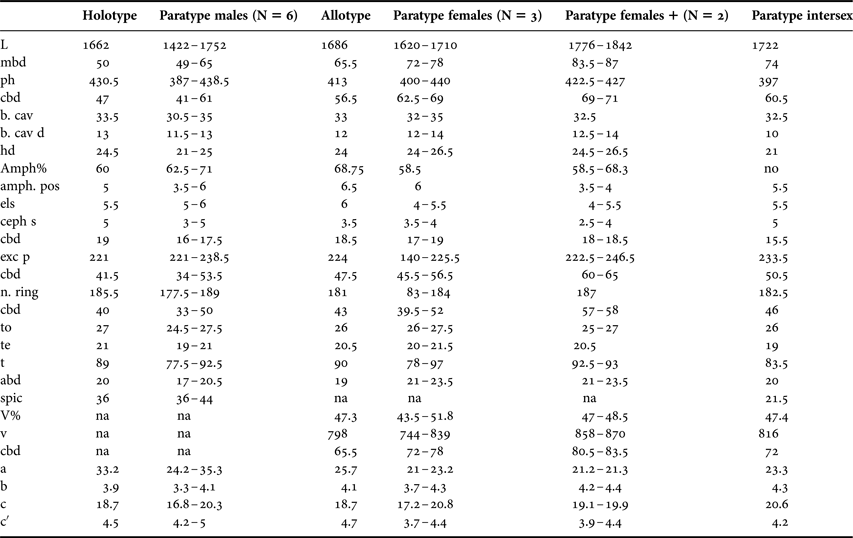
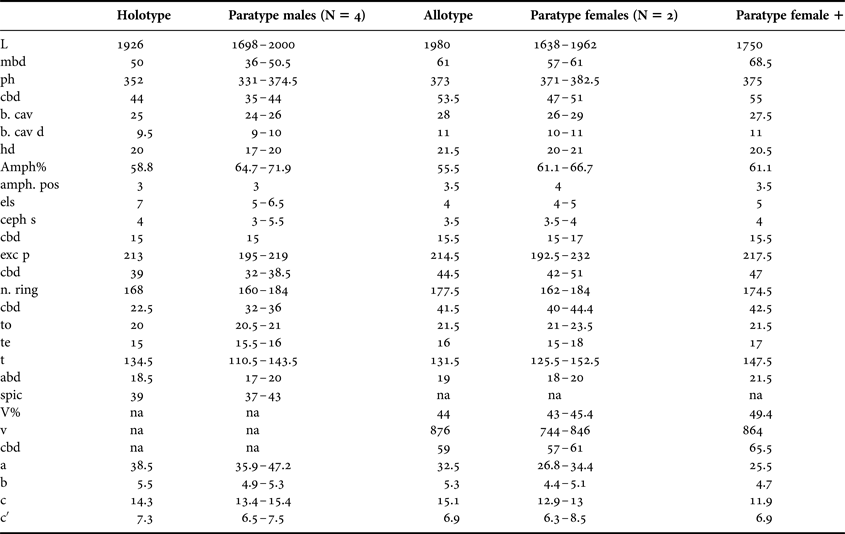
See Table 2.
Body measurements (µm) of Oncholaimellus intersexus sp. nov. See ‘Materials and Methods’ for abbreviations. cbd (corresponding body diameter) is repeated below each body region where the diameter was measured on the body.
na, not applicable; no, not observed; (+) indicates paratype females with eggs in the uterus.
DESCRIPTION
Holotype—male
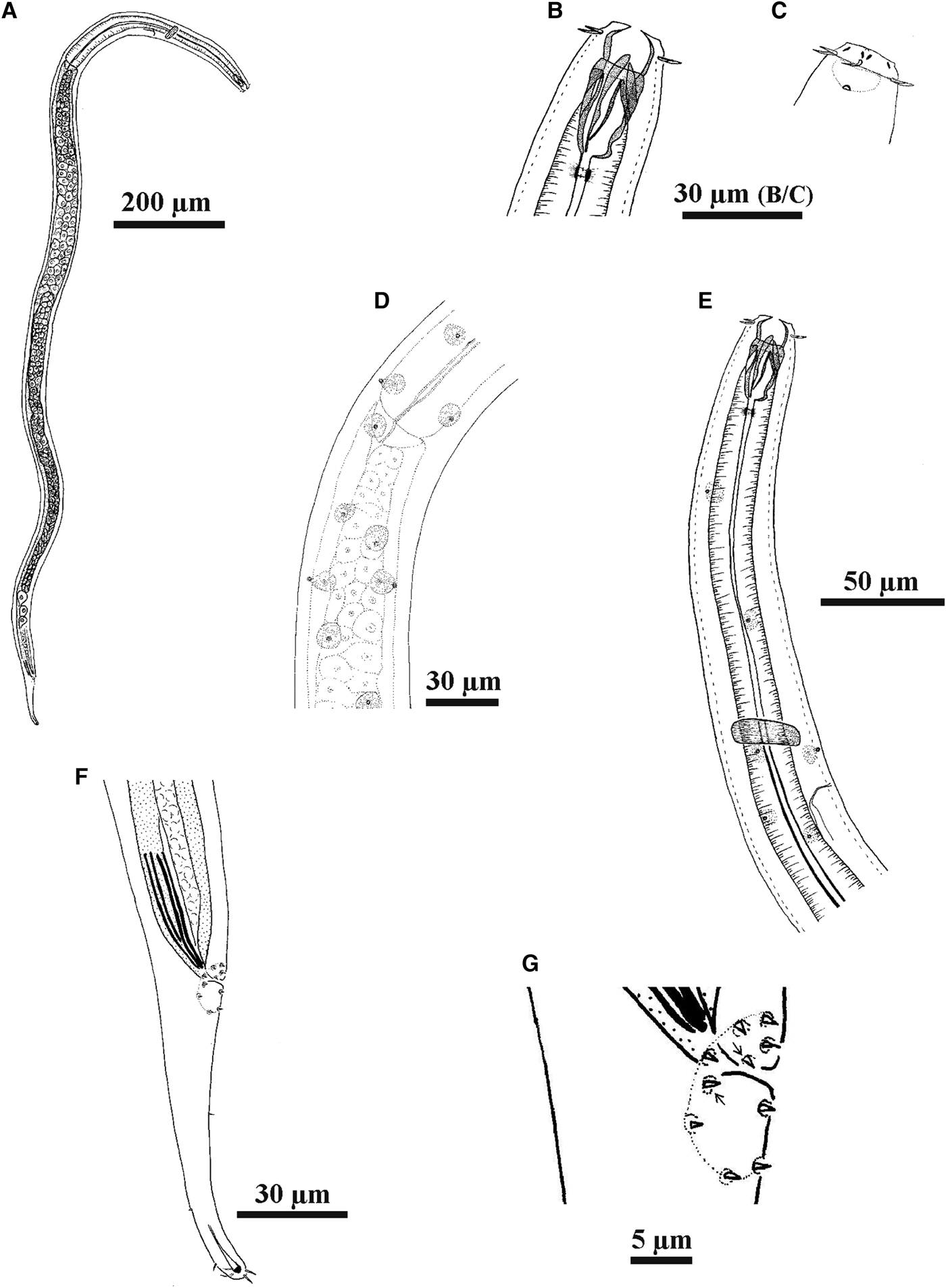
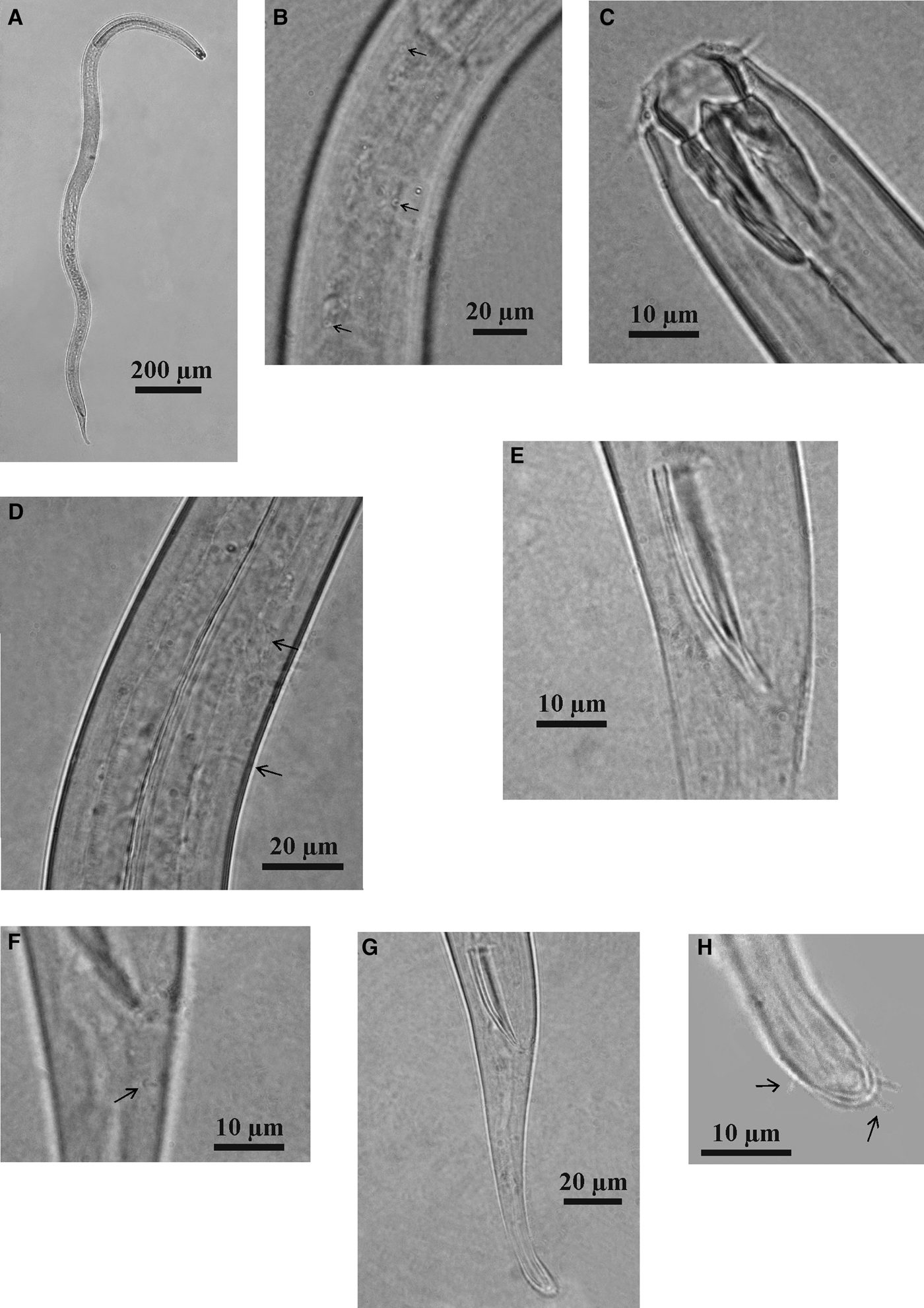
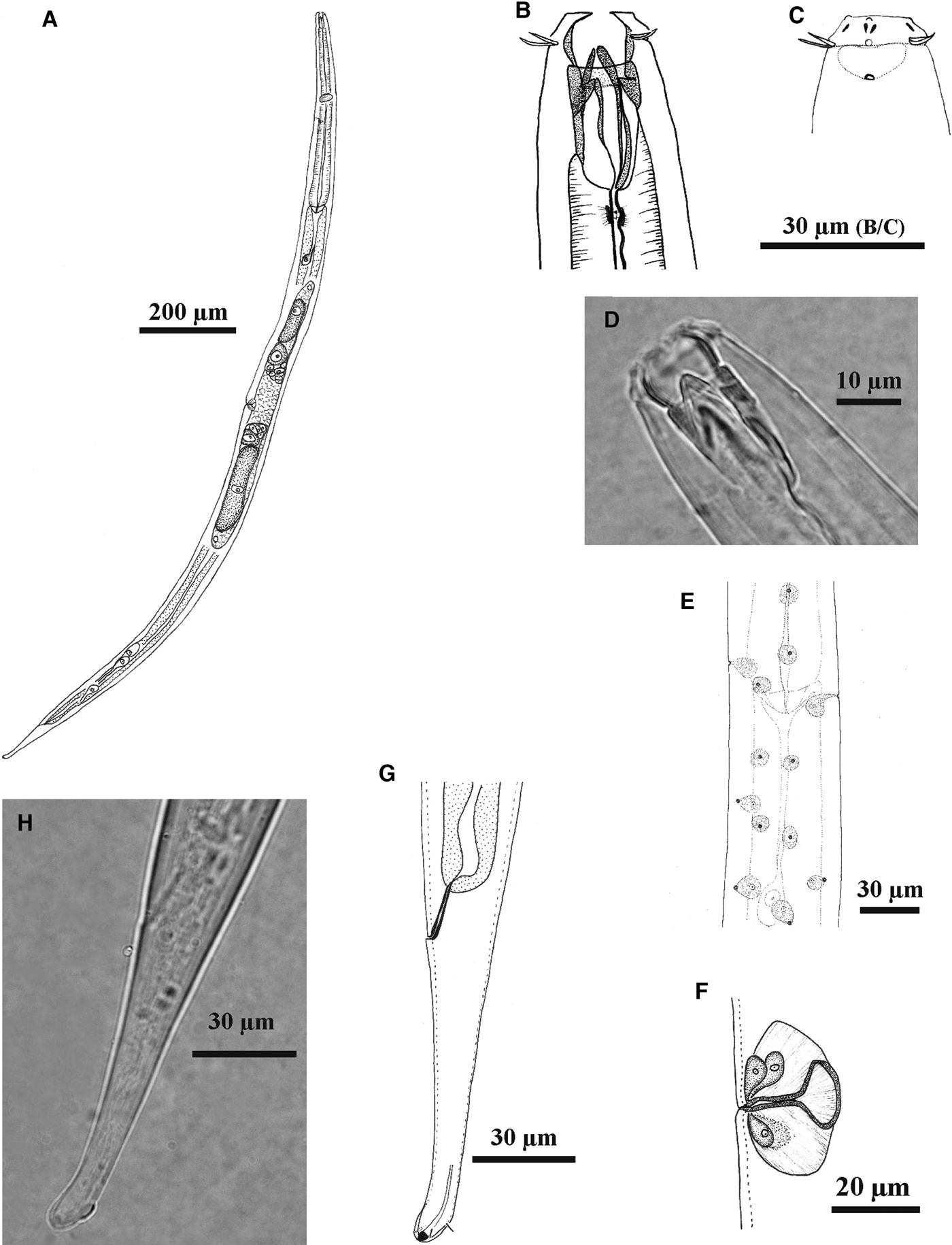
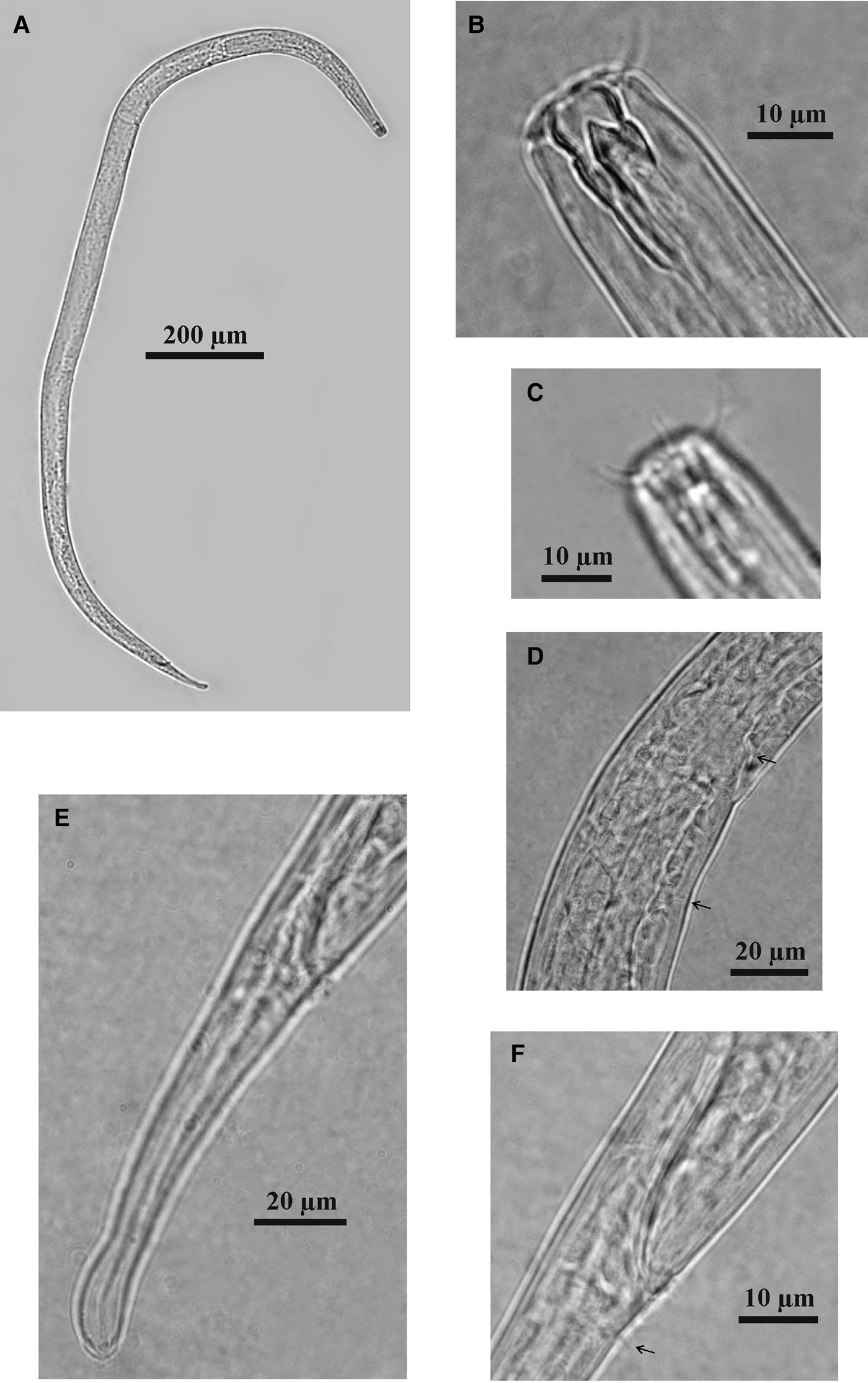
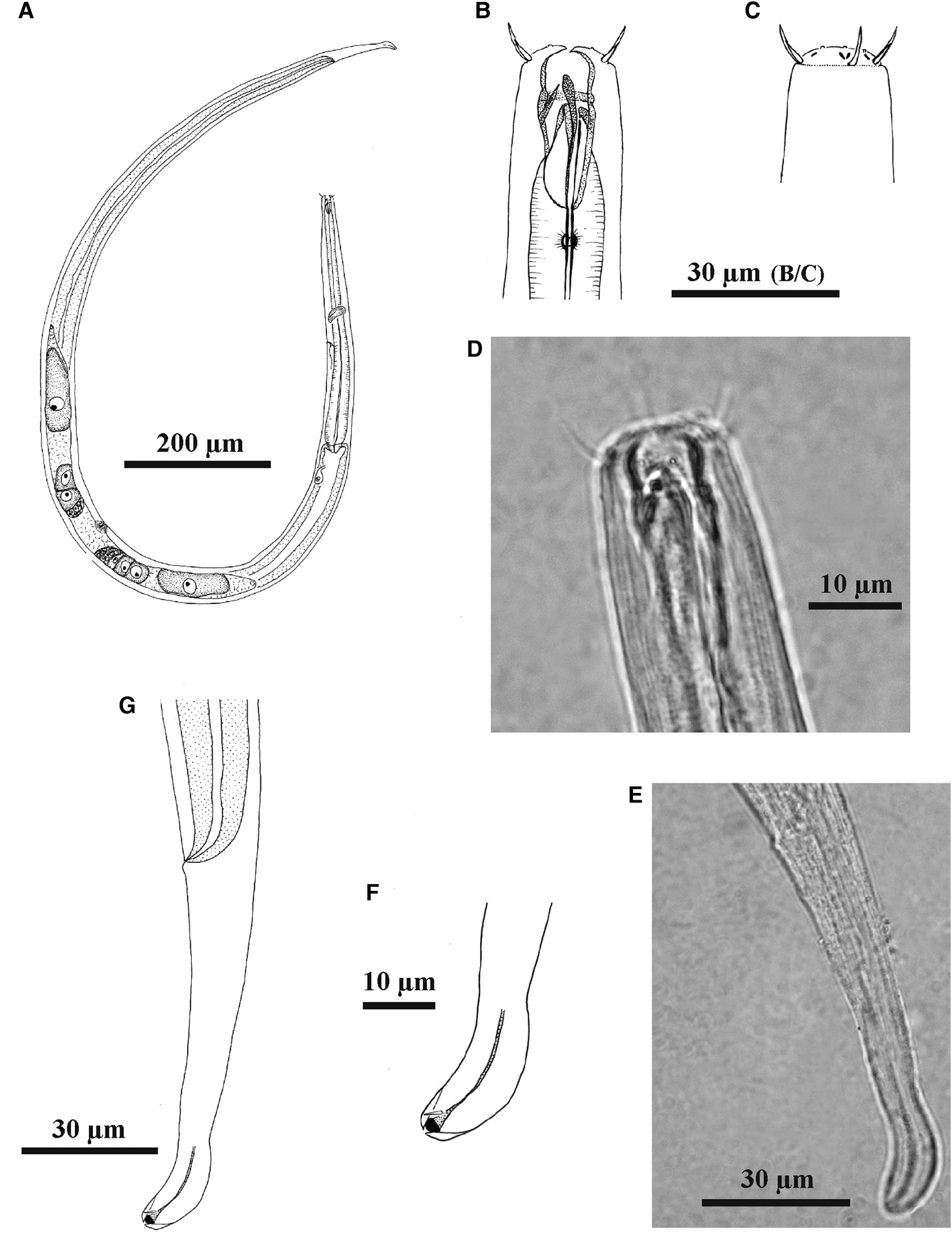
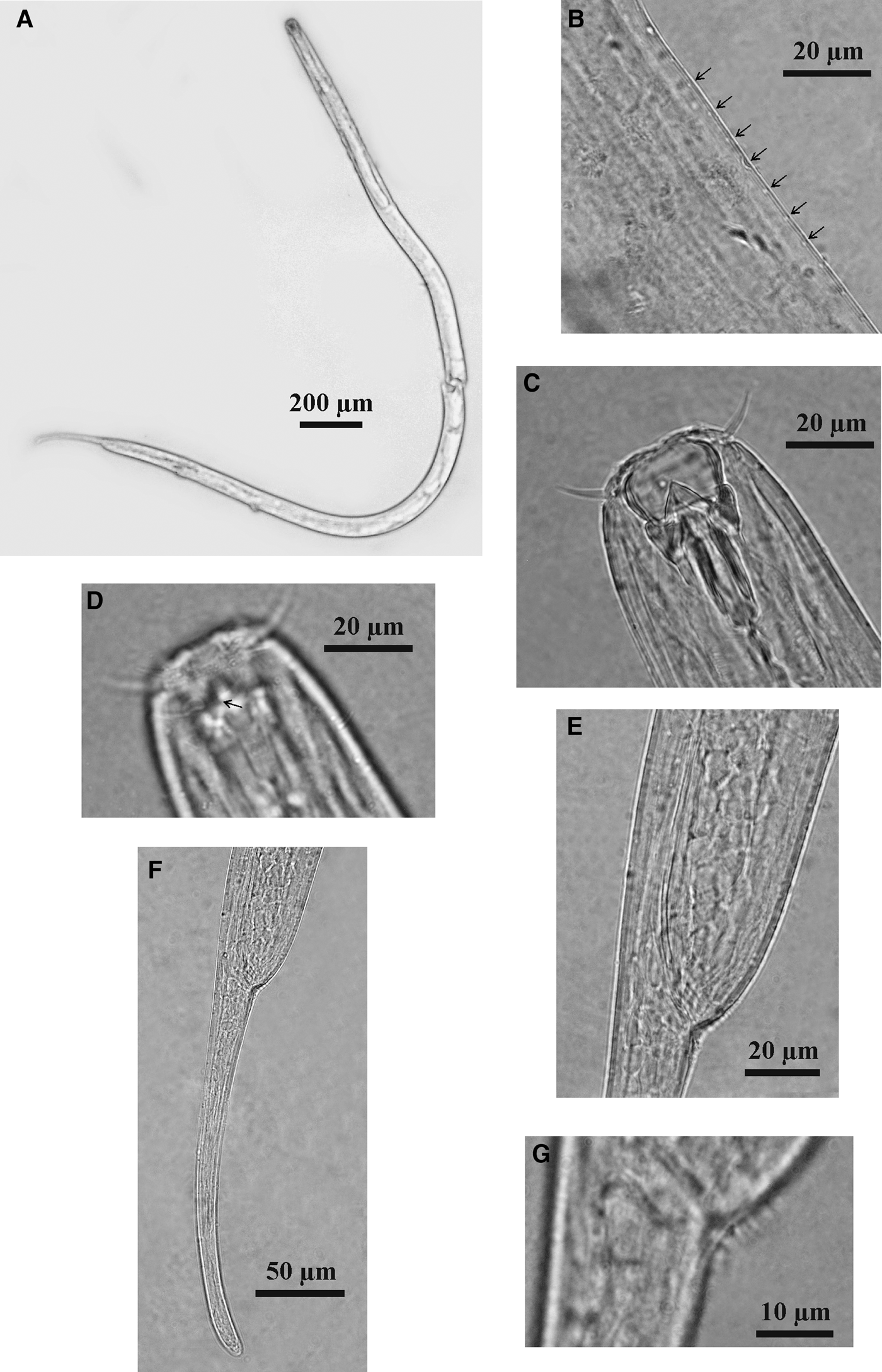
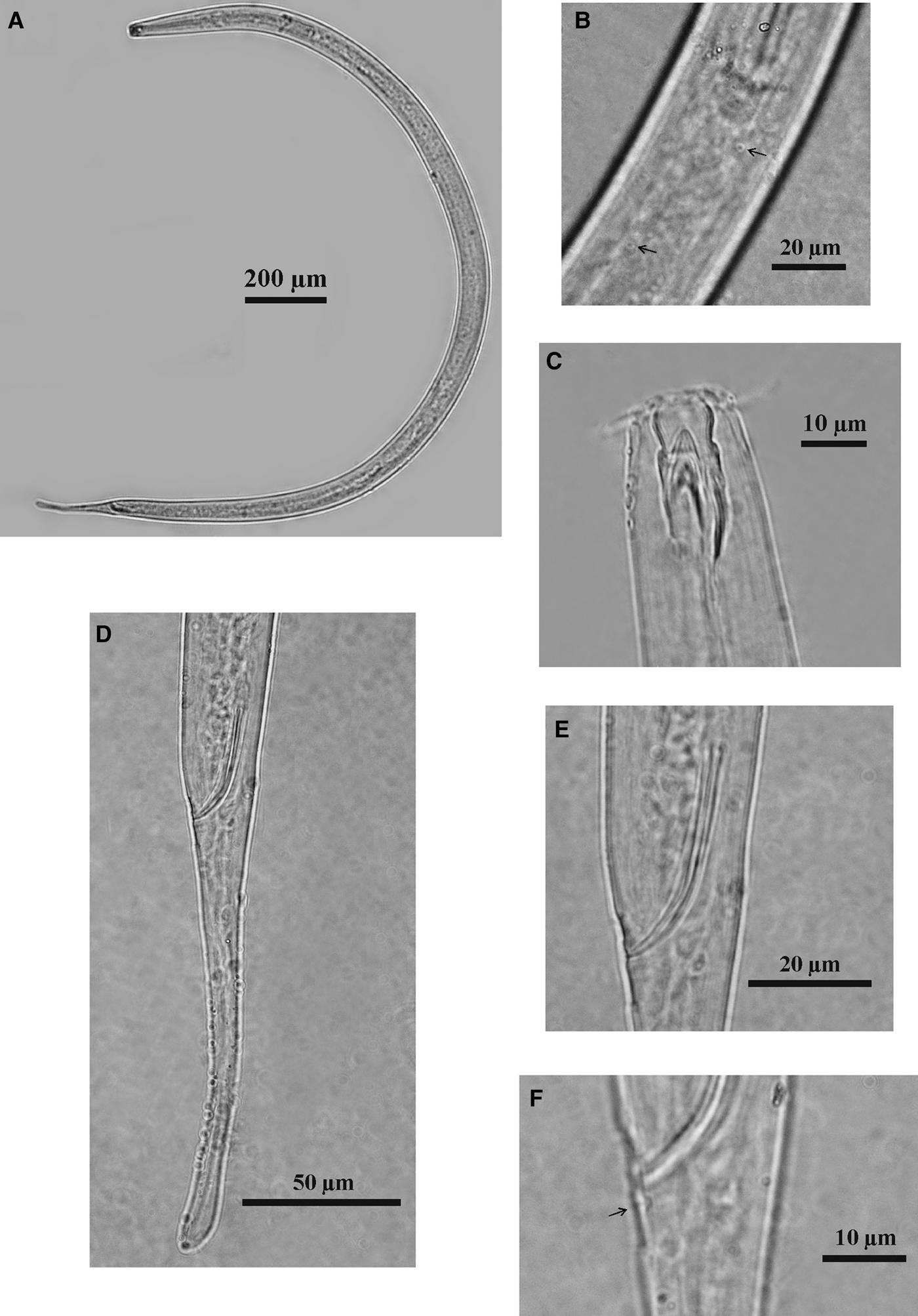
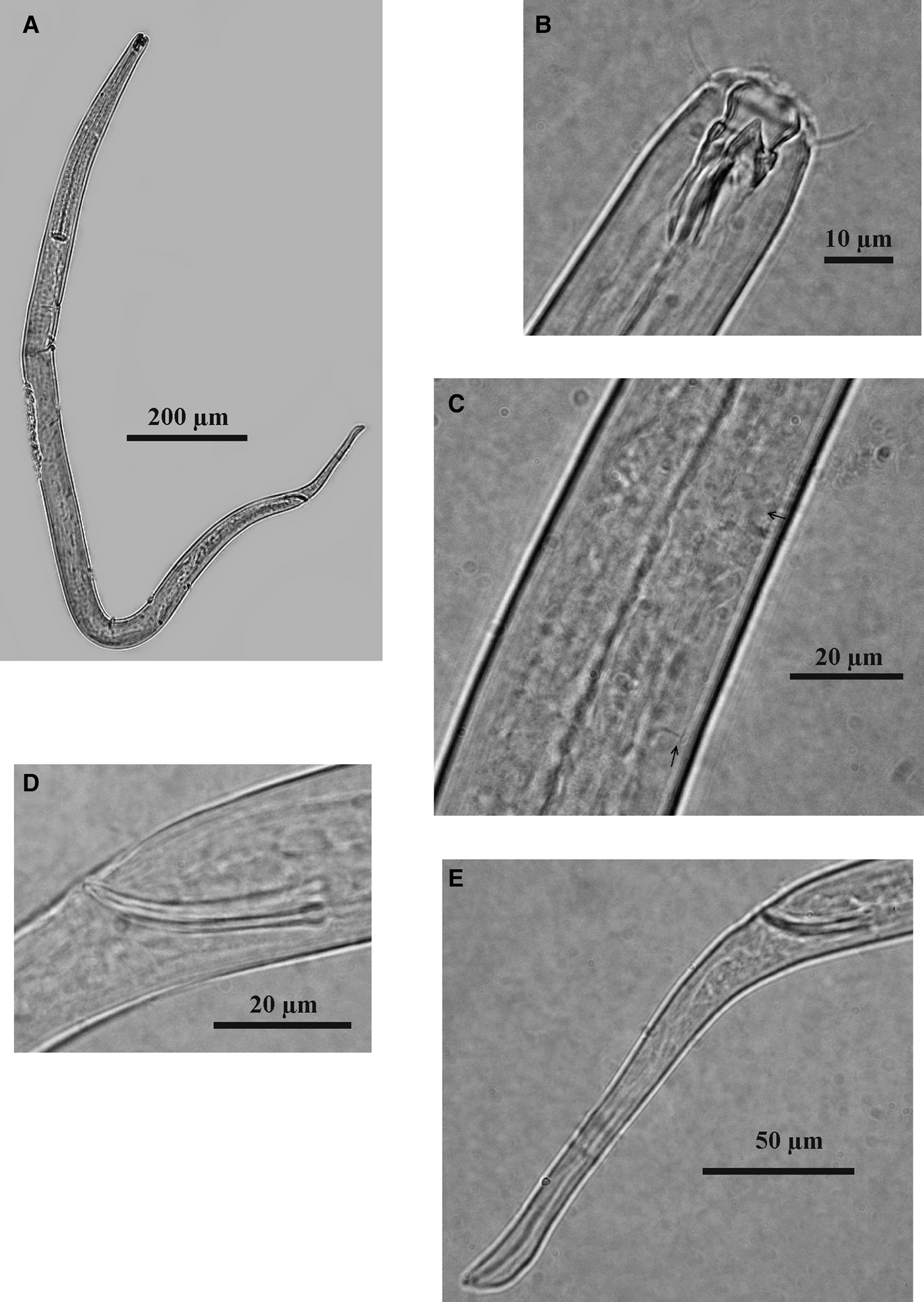
Figures 1, 2. Body cylindrical with anterior region slightly attenuated, 1662 µm long. Cuticle smooth. Cervical setae not observed. Cuticular pores associated with glands, mostly in sublateral region. Pores with sclerotized outline; more numerous from posterior to nerve ring to region near cloaca; absent on tail. Cephalic diameter and diameter at middle of pharynx base corresponding, respectively, to 49% and 94% of maximum body diameter. Head set off from body by constriction at level of cephalic setae. Anterior sensilla arranged according to pattern 6 + (6 + 4): six inner labial papillae, six external labial setae (5.5 μm) and four cephalic setae (5 μm) in one circle; 28.6 and 26%, respectively, of corresponding body diameter. Six sclerotized w-shaped structures positioned below inner labial papillae; these structures are similar to the marginal lamellae described by Belogurov & Belogurova (Reference Belogurov and Belogurova1989). Amphids vesicular, occupying region between cephalic setae, 60% of corresponding body diameter and located 5 µm behind anterior end; amphid pores sclerotised, fovea difficult to observe. Buccal cavity 33.5 μm long, divided into two unequal parts by transverse sclerotized band, anterior part smaller. Three teeth inserted in base of buccal cavity: right ventrosublateral tooth longest (27 µm), left ventrosublateral and dorsal teeth equal in length (21 µm). Pharynx cylindrical, gradually expanded posteriorly, with smooth wall (430.5 µm). Anterior pharyngeal valve present. Cardia completely inserted into intestine. Secretory–excretory pore 221 μm from head end. Ventral gland not observed. Nerve ring 185.5 μm from anterior end.
Oncholaimellus intersexus sp. nov. holotype male: (A) habitus; (B) buccal cavity; (C) anterior region (amphideal fovea and cephalic arrangement); (D) cuticular pores; (E) anterior region (nerve ring and secretory–excretory pore); (F) posterior region (tail and spicules ); (G) circumcloacal setiform papillae (arrow indicates two setiform papillae inserted into the circle circumcloacal).
Oncholaimellus intersexus sp. nov. holotype male: (A) habitus; (B) cuticular pores; (C) cephalic region; (D) nerve ring and secretory–excretory pore; (E) spicules; (F) circumcloacal setiform papillae; (G) tail; (H) tail end.
Two anterior outstretched testes on right side of intestine: larger testis extending 1165 μm anteriorly to anal opening, reaching the cardia, and smaller testis 745 μm. Spicules slightly curved in distal 1/3, about 1.8 × anal body diameter. Gubernaculum absent. Copulatory bursa absent. Four pairs of setiform papillae surrounding cloaca, two additional papillae observed inside the circle. Three caudal glands extending anteriorly to cloaca, first (most proximal) gland 141.5 μm anterior to anal opening. Tail conical (4.5× anal diameter) with spinneret, distal portion directed ventrally. Few caudal setae: two pairs of terminal setae (3 μm), two in each lateral region, one in dorsal region 7 μm anterior to tail end, and two at about middle of tail.
Allotype—female
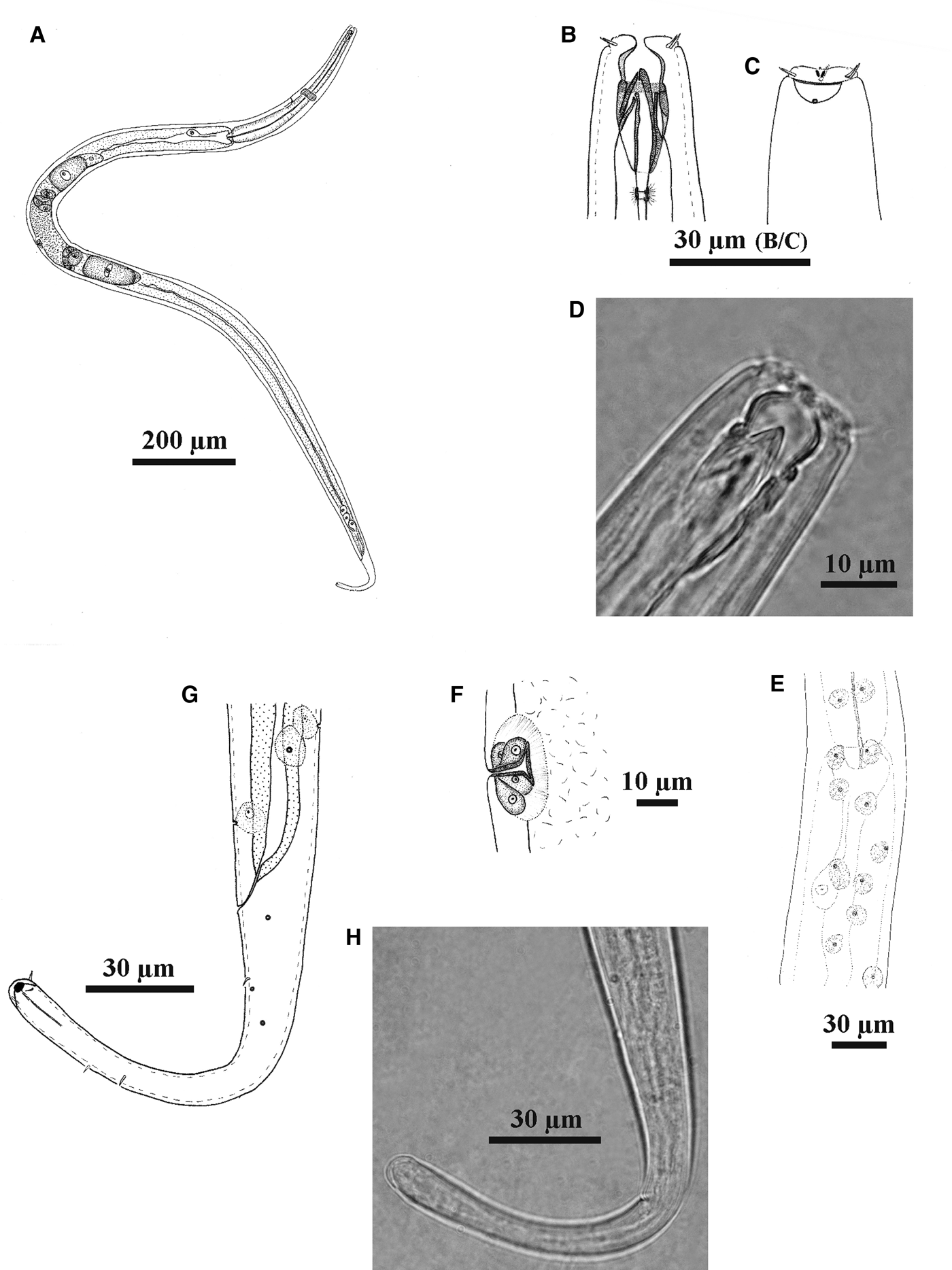
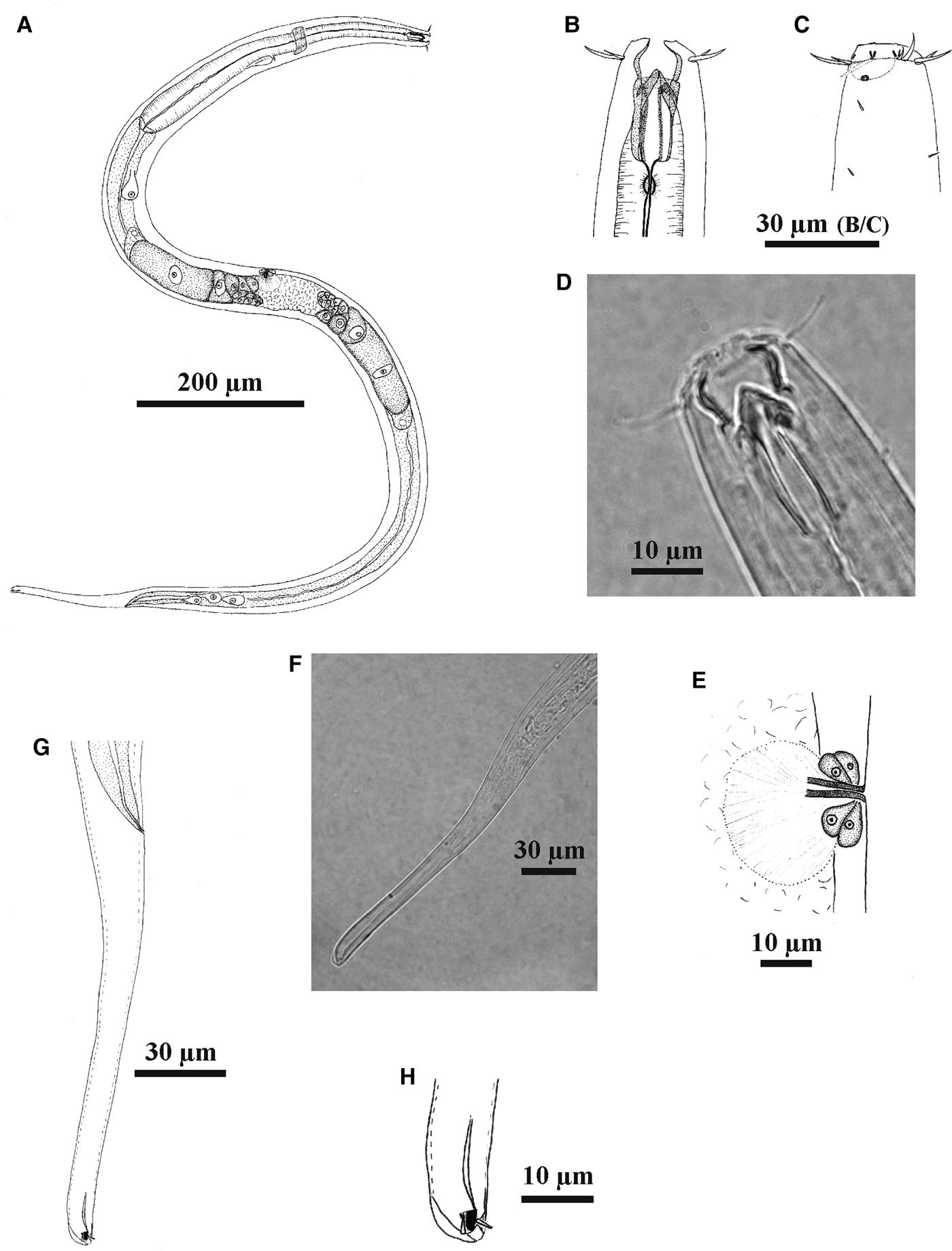
Figure 3. Female largely similar to male. Body 1686 µm long and 65.5 μm in maximum diameter. More cuticular pores apparent than in males, but similarly arranged on body. External labial setae and cephalic setae equivalent to 32.4 and 19% of corresponding diameter, respectively.
Oncholaimellus intersexus sp. nov. allotype female: (A) habitus; (B) buccal cavity; (C) anterior region (amphideal fovea and cephalic arrangement); (D) anterior region; (E) cuticular pores; (F) vulva region; (G) tail; (H) posterior region.
Vulva located 798 µm from anterior end, 47.3% of body length. Four glands: two on each side of vulva opening. Vagina sclerotized, surrounded by visible muscles. Two opposed reflexed ovaries to right of intestine, anterior branch smaller than posterior, 526 μm and 621.5 μm, respectively. Demanian system simple, Viscosia-like. Three precaudal glands, first gland (most proximal) 243 μm anterior to anus. Tail conical, 4.7× anal body diameter, distal portion directed ventrally. Only terminal lateral and subterminal dorsal setae observed.
Paratype—intersex
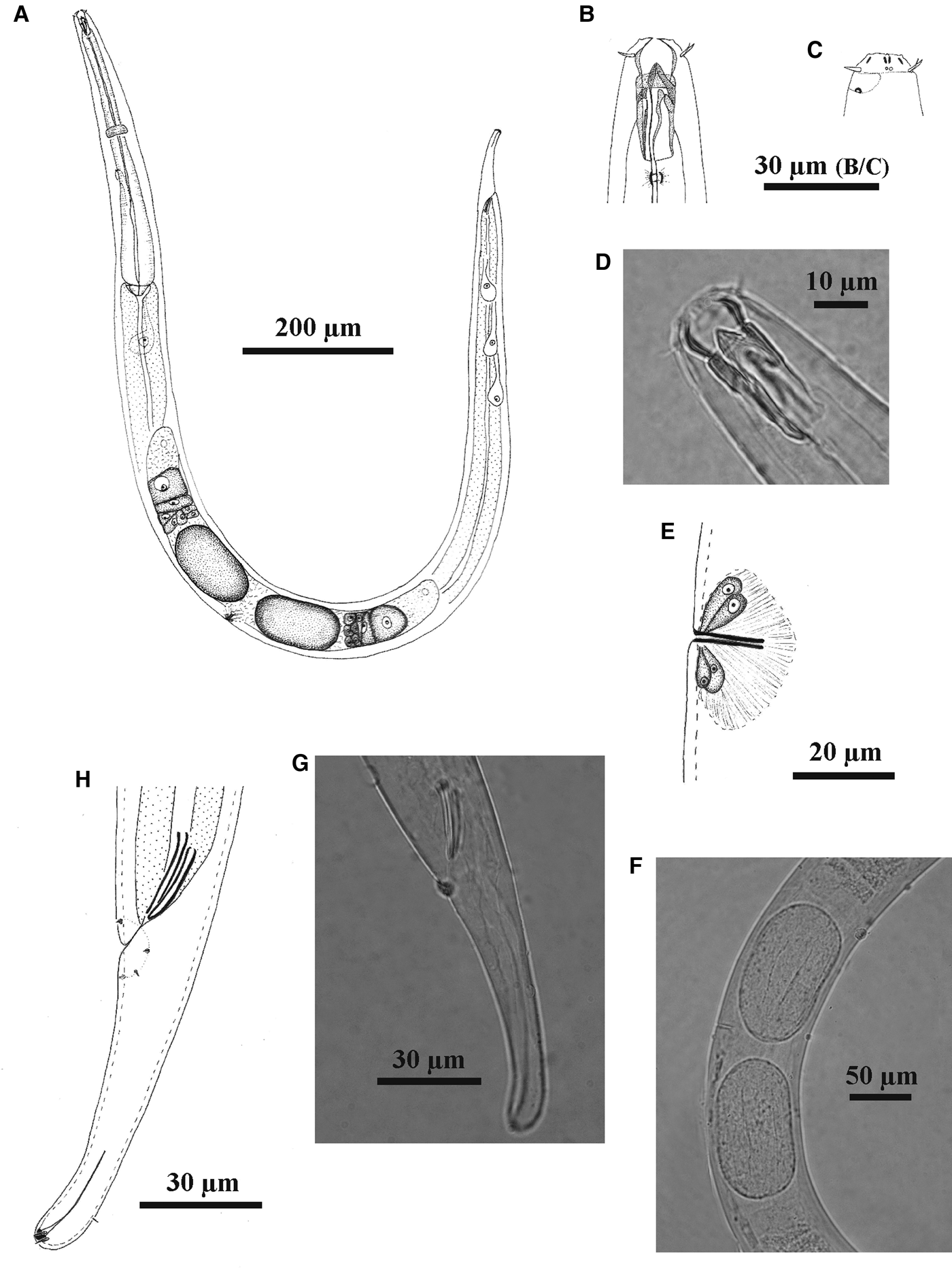
Figure 4. The single individual is similar in all features to the type specimens, except in possessing a female reproductive system with male copulatory organs. Female reproductive system is as described above for the allotype. Eggs were observed inside the uterus, showing the functionality of the female organs. Male reproductive system is composed of: spicules smaller than normal specimens (1.1× abd), circumcloacal setiform papillae present, only 4 were visualized; testes absent.
Oncholaimellus intersexus sp. nov. paratype intersex: (A) habitus; (B) buccal cavity; (C) amphideal fovea and cephalic arrangement; (D) anterior region; (E) vulva region; (F) eggs; (G) posterior region; (H) spicules, circumcloacal setiform papillae and tail.
DIFFERENTIAL DIAGNOSIS
Cuticular pores with outlines sclerotized, about the same size, mostly located in sublateral region. External labial setae and cephalic setae, respectively, 21.6–35.3% and 13.2–28.6% of corresponding body diameter. Spicules short (about 1.8–2.4× anal body diameter). Eight pericloacal setiform papillae (about 2 µm), others may be present next to cloaca. Tail conical with distal portion directed ventrally (3.7–5× abd).
Oncholaimellus distortus sp. nov.
MATERIAL STUDIED
2 males; 5 females.
TYPE MATERIAL
Holotype male MNRJ 376; allotype female MNRJ 377; male paratypes 374 NM LMZOO-UFPE; female paratypes 275–278 NM LMZOO-UFPE. Holotype location: 5°01.338′S 36°11.232′W (3–10 m depth). Allotype location: 5°01.402′S 36°23.567′W (3–10 m depth).
ETYMOLOGY
The Latin specific epithet ‘distortus’ refers to the bent distal portion of the tail.
MEASUREMENTS
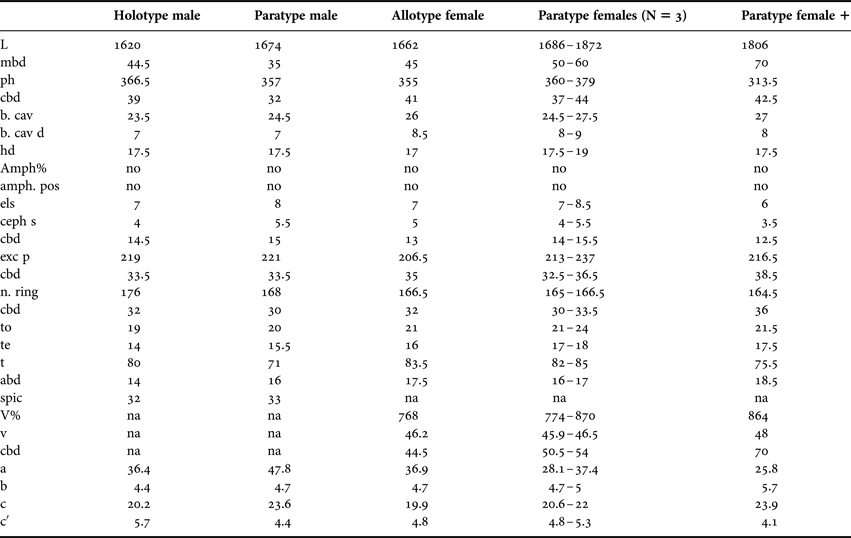
See Table 3.
Body measurements (µm) of Oncholaimellus distortus sp. nov. See ‘Materials and Methods’ for abbreviations. cbd (corresponding body diameter) is repeated below each body region where the diameter was measured on the body.
na, not applicable; no, not observed; (+) indicates paratype females with eggs in the uterus.
DESCRIPTION
Holotype—male
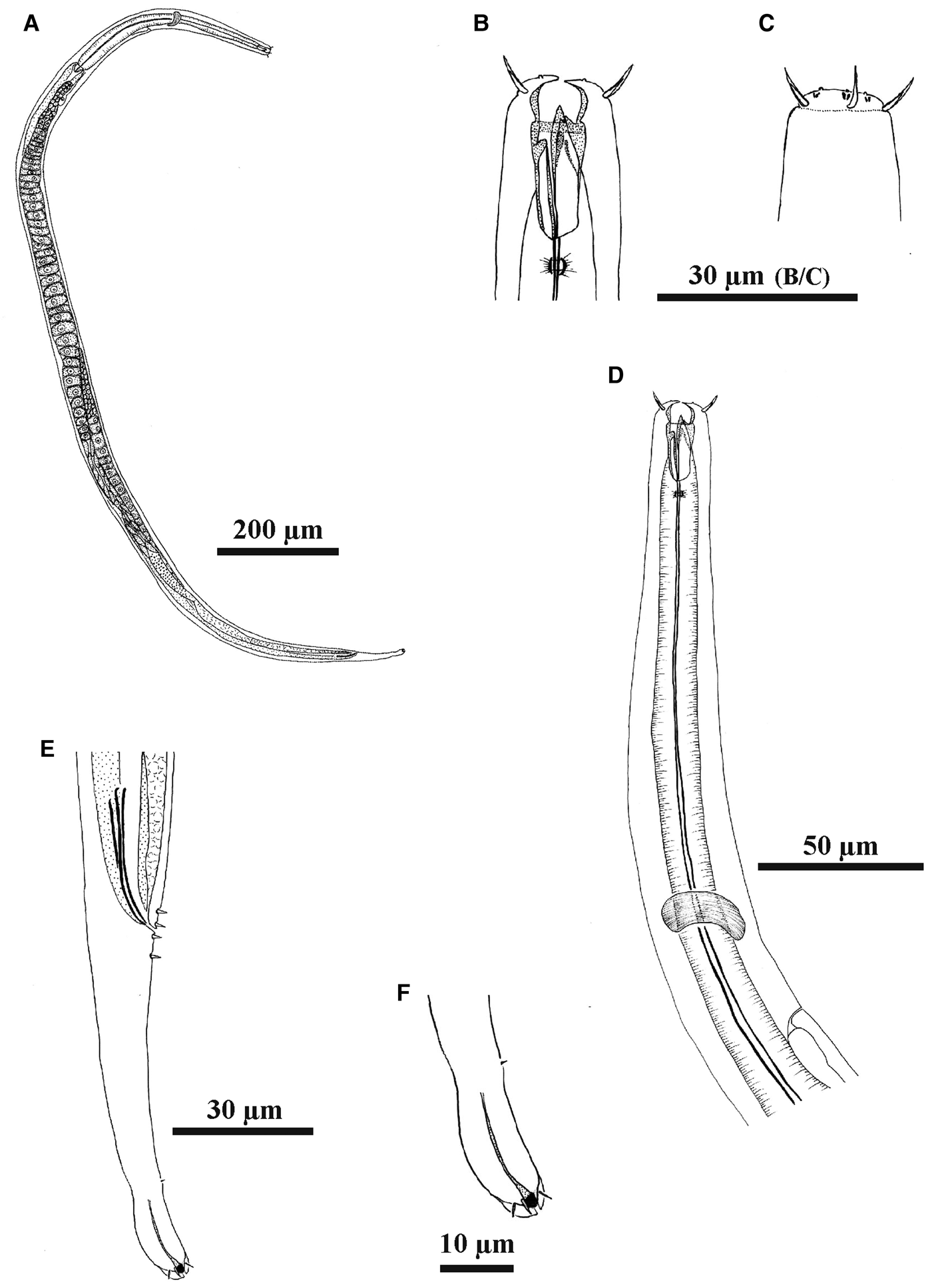
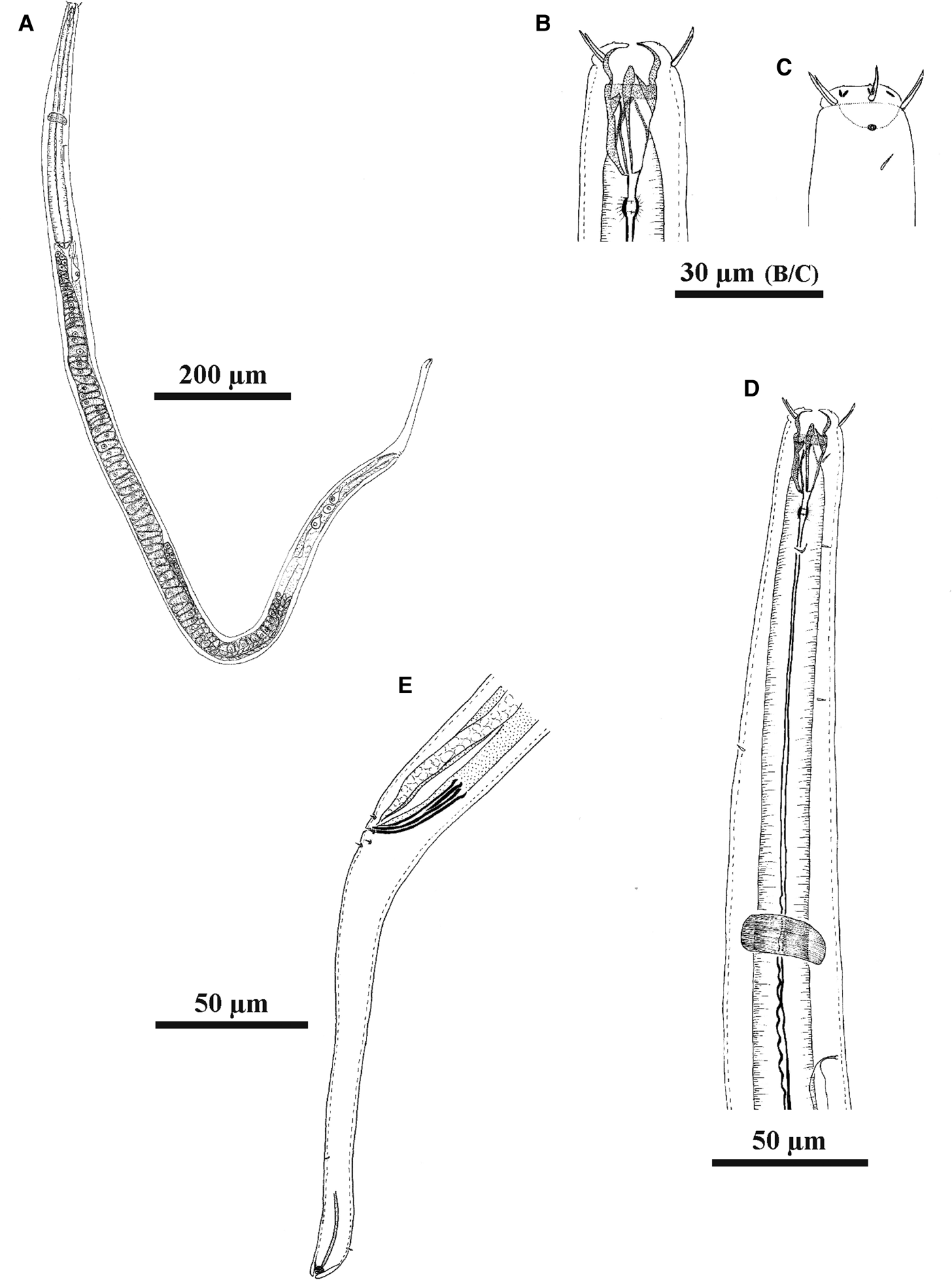
Figures 5, 6. Body cylindrical with anterior region slightly attenuated, 1620 µm long. Cuticle smooth. Cervical setae not observed. Cuticular pores with sclerotized outline absent. Cephalic diameter and diameter at middle of pharynx base corresponding, respectively, to 39.2% and 87.8% of maximum body diameter. Head set off from body by constriction at level of cephalic setae. Anterior sensilla arranged according to pattern 6 + (6 + 4): six inner labial papillae, six external labial setae (7 μm) and four cephalic setae (4 μm) in one circle; 50 and 29.1% of corresponding body diameter, respectively. Marginal lamellae w-shaped, positioned below inner labial papillae. Amphideal fovea not observed. Buccal cavity 23.5 μm long, divided into two unequal parts by transverse sclerotized band, anterior part smaller. Three teeth inserted in base of buccal cavity: right ventrosublateral tooth larger (19 µm), left ventrosublateral and dorsal teeth equal in length (14 µm). Pharynx cylindrical, gradually expanded posteriorly, with smooth wall (366.5 µm). Anterior pharyngeal valve present. Cardia completely inserted into intestine. Secretory–excretory pore posterior to nerve ring, opening 219 μm from head end. Ventral gland posterior to pharynx end. Nerve ring 176 μm from anterior end.
Oncholaimellus distortus sp. nov. holotype male: (A) habitus; (B) buccal cavity; (C) anterior region (cephalic arrangement); (D) anterior region (nerve ring and secretory–excretory pore); (E) posterior region (tail, spicules and circumcloacal setiform papillae); (F) tail end.
Oncholaimellus distortus sp. nov. holotype male: (A) habitus; (B) buccal cavity; (C) anterior region (cephalic arrangement); (D) nerve ring and secretory–excretory pore); (E) tail; (F) spicules and circumcloacal setiform papillae.
Two anterior outstretched testes to right side of intestine: larger testis extending 1293.5 μm anteriorly to anal opening, almost reaching the cardia level, and smaller testis 800 μm. Spicules slightly curved, about 2.3× anal body diameter. Gubernaculum absent. Copulatory bursa absent. Eight pericloacal setiform papillae. Precaudal glands not observed. Tail conical (5.7× anal body diameter) with distal portion bent; terminal setae present (2.5 μm); ventral setiform papillae 21 μm anterior to tail end.
Allotype—female
Figure 7. Female largely similar to male. Body 1662 µm long and 45 μm in maximum diameter. External labial setae and cephalic setae equivalent to 53.8 and 38.5% of corresponding body diameter, respectively.
Oncholaimellus distortus sp. nov. allotype female: (A) habitus; (B) buccal cavity; (C) cephalic arrangement; (D) anterior region; (E) posterior region; (F) tail end; (G) tail.
Vulva located 798 µm from anterior end, 46.2% of body length. Two opposed reflexed ovaries to right of intestine, anterior branch smaller than posterior, 198 μm and 252 μm, respectively. Demanian system simple, Viscosia-like. Pre-caudal glands not observed. Tail conical, 4.8× anal body diameter, distal portion bent. Terminal setae present.
DIFFERENTIAL DIAGNOSIS
Cuticle without pores with sclerotized outline. Labial external and cephalic setae 46.7–54.8 and 26.7–38.5% of corresponding body diameter, respectively. Spicules short (2.1–2.3× anal body diameter). Eight pericloacal setiform papillae (about 2 µm). Tail conical with distal portion bent (4.1–5.7× anal body diameter). Male with ventral setiform papillae on last 1/4 of tail.
Oncholaimellus multiporus sp. nov.
MATERIAL STUDIED
3 males; 8 females.
TYPE MATERIAL
Holotype male MNRJ 378; allotype female MNRJ 379; male paratypes 379–380 NM LMZOO-UFPE; female paratypes 381–387 NM LMZOO-UFPE. Holotype and allotype location: 5°02.928′S 36°23.39′W (3–10 m depth).
ETYMOLOGY
The specific epithet ‘multiporus’ is given for the many pores over the entire body, which lend an ornamented appearance to the cuticle.
MEASUREMENTS
See Table 4.
Body measurements (µm) of Oncholaimellus multiporus sp. nov. See ‘Materials and Methods’ for abbreviations. cbd (corresponding body diameter) is repeated below each body region where the diameter was measured on the body.
na, not applicable; (+) indicates paratype females with eggs in the uterus.
DESCRIPTION
Holotype—male
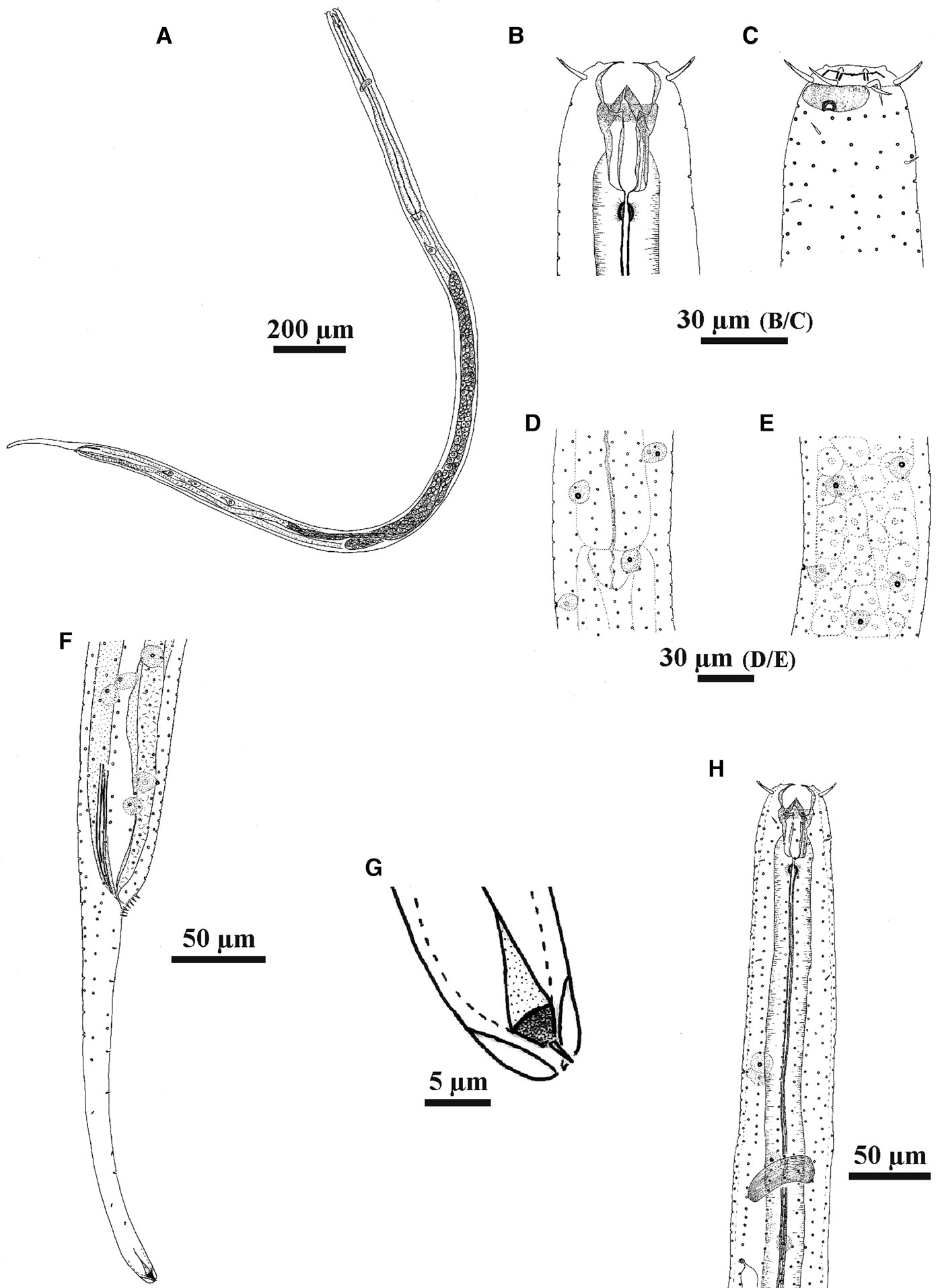
Figures 8, 9. Body cylindrical, stout, with anterior region slightly attenuated, 3136 µm long. Cuticle smooth. Cervical setae 4–5 μm long. Cuticular pores of different sizes: smaller pores most abundant, distributed from base of amphideal fovea to midlength of tail, many in longitudinal rows; largest pores more numerous from posterior region of nerve ring to near cloaca, first observed 175 µm behind anterior end; absent from tail. Larger pores associated with glands, most of them situated in sublateral region. Both pore types with sclerotized outline. Cephalic diameter and diameter at middle of pharynx base corresponding, respectively, to 70% and 94% of maximum body diameter. Head set off from body by constriction at level of cephalic setae. Anterior sensilla arranged according to pattern 6 + (6 + 4): six inner labial papillae, six external labial setae (12.5 μm) and four cephalic setae (9.5 μm) in one circle. Marginal lamellae almost parallel. Amphideal fovea vesicular, occupying 63.3% of corresponding body diameter and located 6.5 µm behind anterior end; amphideal pore sclerotized and fovea striated in appearance. Stomatoidal ring with irregular line. Buccal cavity 45 μm long, divided into two unequal parts by transverse sclerotized band, anterior part smaller. Three teeth inserted in base of buccal cavity: right ventrosublateral tooth longest (36.5 µm), left ventrosublateral and dorsal teeth equal in length (27.5 µm). Pharynx cylindrical, gradually expanded posteriorly, with smooth wall (636 µm). Anterior pharyngeal valve present. Cardia completely inserted into intestine. Secretory–excretory pore posterior to nerve ring, opening 297.5 μm from head end. Ventral gland 107 μm posterior to pharynx end. Nerve ring 241 μm from anterior end.
Oncholaimellus multiporus sp. nov. holotype male: (A) habitus; (B) buccal cavity; (C) anterior region (amphideal fovea and cephalic arrangement); (D and E) cuticular pores; (F) posterior region (tail, spicules and circumcloacal setae); (G) tail end; (H) anterior region (nerve ring and secretory–excretory pore).
Oncholaimellus multiporus sp. nov. holotype male: (A) habitus; (B) cuticular pores; (C) buccal cavity; (D) cephalic region (amphideal fovea); (E) spicules; (F) tail; (G) circumcloacal setae.
Two anterior outstretched testes to right of intestine: larger testis extending 1860 μm anteriorly to anal opening, smaller testis extending 745 μm. Spicules distally curved, about 2.9× anal diameter. Gubernaculum absent. Copulatory bursa absent. Seven pairs of setae surrounding cloaca. Three caudal glands extending anteriorly to cloaca, the first (most proximal) 457.5 μm anterior to anal opening. Tail conical–cylindrical (9.3× anal body diameter) with spinneret, distal portion directed ventrally. Caudal setae more concentrated in ventrolateral portion; two terminal setae on spinneret level, one on each side.
Allotype—female
Figures 10. Female largely similar to male. Body 3264 µm long and 86.5 μm in maximum diameter. Larger cuticular pores more numerous than in male, with similar body distribution except also on first 1/4 of tail.
Oncholaimellus multiporus sp. nov. allotype female: (A) habitus; (B) buccal cavity; (C) amphideal fovea and cephalic arrangement; (D) anterior region; (E) cuticular pores; (F) posterior region; (G) tail.
Vulva sclerotized, located 1600 µm from anterior end, 49% of body length. Two opposed reflexed ovaries to right of intestine, anterior branch smaller than posterior, 478.5 μm and 488 μm, respectively. Demanian system simple, Viscosia-like. Three pre-caudal glands, first gland (most proximal) 341.5 μm anterior to anus. Tail conical, 8.4× anal body diameter, distal portion directed ventrally; not observed in allotype due to body position, but observed in other females. Terminal lateral setae present.
DIFFERENTIAL DIAGNOSIS
Cuticular pores of different sizes with sclerotized outline: smaller pores more abundant, many in longitudinal rows; larger pores mostly located in sublateral region of body. External labial and cephalic setae about equal in size. Amphideal fovea vesicular, with striated appearance. Spicules long (about 3× anal body diameter), curved in distal part. Pericloacal setae present (3–3.5 µm), about seven pairs. Tail long (8.1–10.2× abd).
Oncholaimellus paulus sp. nov.
MATERIAL STUDIED
5 males; 4 females.
TYPE MATERIAL
Holotype male MNRJ 380; allotype female MNRJ 381; male paratypes 388–391NM LMZOO-UFPE; female paratypes 392–394 NM LMZOO-UFPE. Holotype and allotype location: 3°8.7041′S 38°51.9616′W (30–35 m depth).
ETYMOLOGY
The specific epithet ‘paulus’ is given in homage to Paulo Barros Filho, husband of the first author, and Paulo Genevois, son of the fourth author.
MEASUREMENTS
See Table 5.
Body measurements (µm) of Oncholaimellus paulus sp. nov. See ‘Materials and Methods’ for abbreviations. cbd (corresponding body diameter) is repeated below each body region where the diameter was measured on the body.
na, not applicable; (+) indicates paratype females with eggs in the uterus.
DESCRIPTION
Holotype—male
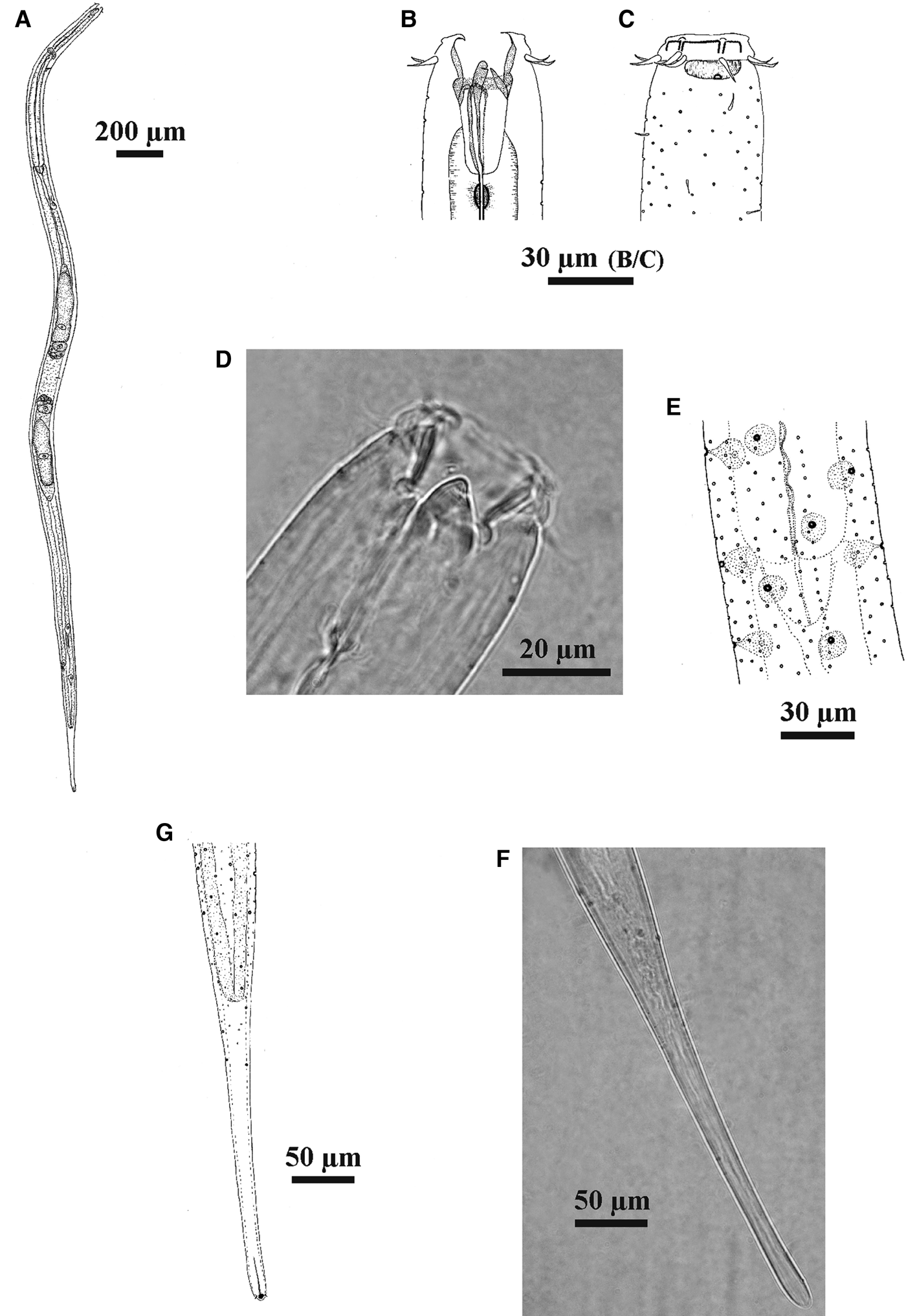
Figures 11, 12. Body cylindrical with anterior and posterior regions attenuated, 1926 µm long. Cephalic diameter and diameter at middle of pharynx base corresponding respectively to 15% and 43.8% of maximum body diameter. Cuticle smooth. Cuticular pores associated with glands, mostly located in sublateral region of body. Pore outlines sclerotized. Pores more numerous from after nerve ring to region near cloaca; absent on tail. Marginal lamellae w-shaped, positioned below inner labial papillae. Head set off from body by constriction at level of cephalic setae. Anterior sensilla arranged according to pattern 6 + (6 + 4): six inner labial papillae, six external labial setae (7 μm) and four cephalic setae (4 μm) in one circle; 46.7 and 26.7%, respectively, of corresponding diameter. Amphideal fovea vesicular, occupying 60.7% of corresponding body diameter and located 3 µm behind anterior end; amphid pores sclerotised, fovea difficult to observe. Buccal cavity 25 μm long and 9.5 µm in diameter (measured in middle), divided into two unequal parts by transverse sclerotized band, anterior part smaller. Three teeth inserted in base of buccal cavity, right ventrosublateral tooth longest (20 µm), left ventrosublateral and dorsal equal in length (15 µm). Pharynx cylindrical, gradually expanded posteriorly, with smooth wall (352 µm). Anterior pharyngeal valve present. Cardia completely inserted into intestine. Secretory–excretory pore at 213 µm from anterior end, located posterior to nerve ring (168 µm from head end). Ventral gland 95.5 µm after end of pharynx.
Oncholaimellus paulus sp. nov. holotype male: (A) habitus; (B) buccal cavity; (C) anterior region (amphideal fovea and cephalic arrangement); (D) anterior region (nerve ring and secretory–excretory pore); (E) cuticular pores; (F) posterior region (tail, spicules and circumcloacal setae); (G) tail end.
Oncholaimellus paulus sp. nov. holotype male: (A) habitus; (B) cuticular pores; (C) cephalic region; (D) tail; (E) spicules; (F) circumcloacal setae.
Two anterior outstretched testes to right of intestine: larger testis extending 1390 μm anteriorly to anal opening, and smaller testis 907 μm. Spicules slightly curved (about 2.1× anal body diameter). Gubernaculum absent. Copulatory bursa absent. Four pairs of small setae surrounding cloaca (2.5 µm). In other males, these setae are 2 µm long and are considered, therefore, as setiform papillae. Three caudal glands extending anteriorly to cloaca; first gland (most proximal) 148.5 μm anterior to cloaca. Tail conical–cylindrical (134.5 µm) with spinneret. Few caudal setae. Four terminal setae, one pair on each side.
Allotype—female
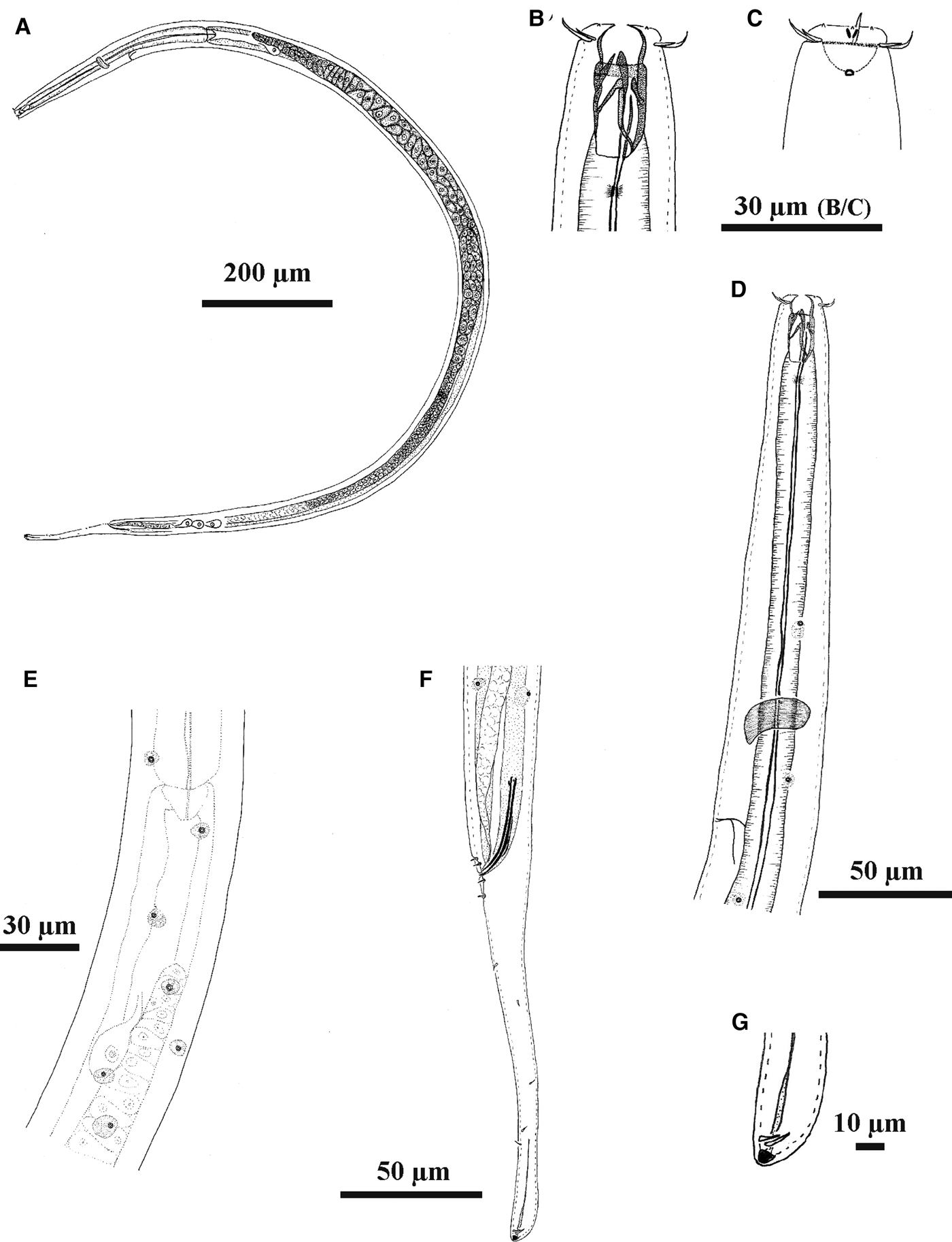
Figure 13. Female largely similar to male. Body 1980 µm long and 61 μm in maximum diameter. Cuticular pores more numerous than in males but with similar body distribution. External labial and cephalic setae almost equal in length and smaller than corresponding setae in male, 25.8 and 22.6% of corresponding diameter, respectively.
Oncholaimellus paulus sp. nov. allotype female: (A) habitus; (B) buccal cavity; (C) amphideal fovea and cephalic arrangement; (D) anterior region; (E) cuticular pores; (F) vulva region; (G) tail; (H) posterior region.
Vulva located 876 µm from anterior end, 44% of body length. Four glands: two on each side of vulva opening. Vagina sclerotized surrounded by muscles. Two opposed reflexed ovaries to right of intestine, anterior branch smaller than posterior, 390.5 μm and 400 μm, respectively. Demanian system simple, Viscosia-like. Three precaudal glands, first gland (most proximal) 1923 μm anterior to anus. Tail conical–cylindrical (131.5 µm/ 6.9× abd) with spinneret. Few setae observed on tail. Two pairs of terminal setae, one pair on each side.
DIFFERENTIAL DIAGNOSIS
Cuticular pores with sclerotized outline present, mostly located in sublateral region of body. External labial setae proportionately smaller in female in relation to diameter of the region; external labial setae (male: 33.3–46.7% of corresponding diameter, female: 25.8–32.3%) and cephalic setae (male: 20–36.76% of corresponding diameter, female: 22.6–25.8%) of corresponding diameter. Spicules short (2.1–2.4× anal body diameter). Four pairs of circumcloacal setae or setiform papillae (2–2.5 μm). Tail long (6.6–8.5× anal diameter).
Oncholaimellus sineporus sp. nov.
MATERIAL STUDIED
3 males; 7 females.
TYPE MATERIAL
Holotype male MNRJ 382; allotype female MNRJ 383; male paratypes 395–396 NM LMZOO-UFPE; female paratypes 397–400 NM LMZOO-UFPE. Holotype location: 5°01.3533′S 36°10.1583′W (3–10 m depth). Allotype location: 4° 51,6582′S 35° 57,5573′W (35–50 m depth).
ETYMOLOGY
The specific epithet ‘sineporus’ is given because this species has no cuticular pores with a sclerotized outline.
MEASUREMENTS
See Table 6.
Body measurements (µm) of Oncholaimellus sineporus sp. nov. See ‘Materials and Methods’ for abbreviations. cbd (corresponding body diameter) is repeated below each body region where the diameter was measured on the body.
na, not applicable; (+) indicates paratype females with eggs in the uterus.
DESCRIPTION
Holotype—male
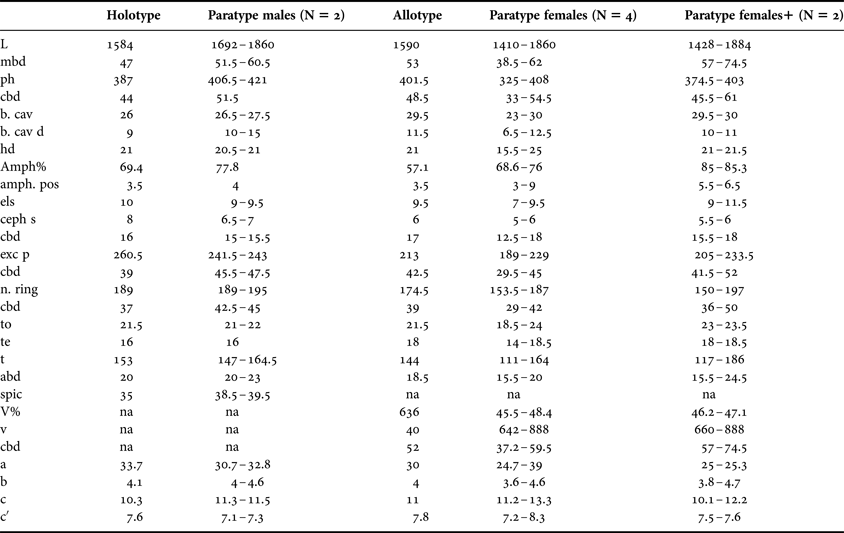
Figures 14, 15. Cuticle smooth, without cuticular pores with sclerotized outline. Few cervical setae. Body cylindrical, with anterior and posterior regions attenuated, 1584 µm long. Head set off from body by constriction at level of cephalic setae. Cephalic diameter and diameter at middle of pharynx base corresponding respectively to 44.7% and 93.6% of maximum body diameter. Marginal lamellae w-shaped, positioned below inner labial papillae. Anterior sensilla arranged according to pattern 6 + (6 + 4): six inner labial papillae, six external labial setae (10 μm) and four cephalic setae (8 μm) in one circle; 62.5 and 50%, respectively, of corresponding body diameter. Amphideal fovea vesicular, occupying 69.4% of corresponding body diameter and located 3.5 µm behind anterior end; amphideal pores sclerotised; fovea difficult to observe. Buccal cavity 26 μm long and 9 µm in diameter with three large teeth, divided into two unequal parts by transverse sclerotized band, anterior part smaller. Right ventrosublateral tooth large and solid (21.5 μm); left ventrosublateral and dorsal teeth equal (16 μm). Anterior pharyngeal valve present. Secretory–excretory pore located 260.5 µm from anterior end, posterior to nerve ring, 189 µm from head end. Ventral gland 35 μm after end of pharynx. Pharynx cylindrical, gradually expanded posteriorly, with smooth wall (387 µm). Cardia completely inserted into intestine. Two anterior outstretched testes lying to right of intestine: larger testis extending 1102.5 μm anteriorly to anal opening, reaching cardia level; smaller testis 622.5 μm. Spicules slightly curved, with small capitulum (about 1.7× anal body diameter). Gubernaculum absent. Copulatory bursa absent. Four pairs of setiform papillae surrounding cloaca. Three precaudal glands, first (most proximal) located 1923 μm anterior to cloaca. Tail conical–cylindrical (153 µm) with spinneret (7.6× abd); diameter of distal portion of tail corresponding to 59.5% of anal diameter. Few caudal setae; terminal setae present on spinneret level; dorsal setae located 13 μm anterior to tail end.
Oncholaimellus sineporus sp. nov. holotype male: (A) habitus; (B) buccal cavity; (C) anterior region (amphideal fovea and cephalic arrangement); (D) anterior region (nerve ring and secretory–excretory pore); (E) posterior region (tail, spicules and circumcloacal setiform papillae).
Oncholaimellus sineporus sp. nov. holotype male: (A) habitus; (B) cephalic region; (C) nerve ring and secretory–excretory pore; (D) spicules; (E) tail.
Allotype—female
Figure 16. Female largely similar to male. Body 1590 µm long and 53 μm in maximum diameter. External labial setae and cephalic setae equivalent to 55.9 and 35.3% of corresponding diameter, respectively.
Oncholaimellus sineporus sp. nov. allotype female: (A) habitus; (B) buccal cavity; (C) amphideal fovea and cephalic arrangement; (D) anterior region; (E) vulva region; (F) posterior region; (G) tail; (H) tail end.
Vulva located 366 µm from anterior end, 40% of body length. Four glands, two on each side of vulva opening. Vagina sclerotized surrounded by muscles. Two opposed and reflexed ovaries to right of intestine, anterior branch smaller than posterior, 382.5 μm and 464 μm, respectively. Demanian system simple, Viscosia-like. Tail conical (144 µm) with spinneret. Two setae on tail tip.
DIFFERENTIAL DIAGNOSIS
Cuticle without cuticular pores with sclerotised outline. External labial and cephalic setae 43.7–74.2 and 30.5–50% of corresponding body diameter, respectively. Spicules short (1.7–1.9× anal body diameter). Four pairs of circumcloacal setiform papillae. Tail long (7.1–8.3× anal body diameter).
KEY TO THE SPECIES OF THE ONCHOLAIMELLUS
This key is based on the one provided by Keppner (Reference Keppner1987), with the addition of the five new species and O. paracarlbergi. As the main features that differentiate the species are present in males, most of the key steps use only features associated with the male copulatory structures.
1. Distinct copulatory bursa present ……2
— Distinct copulatory bursa absent ……5
2. Spicules unequal ……3
— Spicules equal ……4
3. Cephalic setae equal in both sexes …O. mediterraneus
— Cephalic setae much longer in male …O. calvadosicus
4. Spicules 60–74 µm long with wavy tip; tail 26–35 µm long …O. brevicaudata
— Spicules 51–54 µm long with smooth tip; tail 48–69 µm long …O. coxbazari
5. Cuticular pores present ……6
— Cuticular pores absent ……8
6. Cuticular pores of different sizes: smaller pores more abundant and distributed over almost entire body; larger pores more concentrated in sublateral portion from region posterior to nerve ring to near cloaca ……O. multiporus sp. nov.
— Cuticular pores of same size, more numerous from region posterior to nerve ring to near cloaca, mostly in sublateral region ……7
7. Tail 3.7–5× abd ……O. intersexus sp. nov.
— Tail 6.6–8.5× abd ……O. paulus sp. nov.
8. Four pairs of setiform papillae or circumcloacal setae ……9
— More than four pairs of setiform papillae or circumcloacal setae ……12
9. Spicules 1.7–2.3× abd ……10
— Spicules 3–5× abd ……11
10. Spicules 2.1–2.3× abd; tail of male (4.4–5.7× abd) with distal portion bent, almost s-shaped ……O. distortus sp. nov.
— Spicules 1.7–1.9× abd; tail of male (7.1–7.6× abd) ……O. sineporus sp. nov.
11. Spicules 3× abd; circumcloacal setae 2 pairs pre- and 2 pairs post-cloacal, 2 median pairs shorter than distal and proximal pair; excretory pore 30 µm from anterior end ……O. meteori
— Spicules 5× abd; circumcloacal setae equal in length and diameter; excretory pore 168–180 µm from anterior end ……O. carlbergi
12. Spicules about 1/4 to 2/3 of tail length ……13
— Spicules almost same length as tail …O. paracarlbergi
13. Spicules about 1/2 to 2/3 of tail length; amphideal fovea pore-shaped; cephalic setae about 29.6% of corresponding body diameter ……O. patkellyi
— Spicules about 1/3 to 1/4 of tail length; amphideal fovea vesicular rounded; cephalic setae very short in relation to corresponding body diameter (about 24%) ……O. labiatus
DISCUSSION
New species
The lengths of the tail and spicules, the length of the external labial setae and cephalic setae in relation to the diameter at the insertion point on the head, the presence of circumcloacal papillae or setae and their number, as well as the existence of cuticular pores and if they are of different sizes, are important features differentiating among the five new species, as well as between these and previously described species.
The five species here described lack a copulatory bursa, as Oncholaimellus carlbergi, O. labiatus, O. meteori, O. paracarlbergi and O. patkellyi. Instead of a bursa, these species have setae or setiform papillae around the cloaca. Among the new species, four have eight setiform papillae or setae around the cloaca: O. intersexus sp. nov., O. distortus sp. nov., O. paulus sp. nov. and O. sineporus sp. nov., the same number observed in O. carlbergi and O. meteori. Oncholaimellus intersexus sp. nov. is the only species that has additional setiform papillae within the circle formed by the eight setiform papillae mentioned above.
The anterior pharyngeal valve (as in Viscosia) was reported only for O. calvadosicus; as this structure was observed in all five new species, we do not know if it really is not present in the other species or if it merely has not been observed/reported. The secretory—excretory pore located behind the nerve ring, a feature observed in all five new species, has also been described in O. patkellyi, O. labiatus and O. calvadosicus.
Among the new species described here, Oncholaimellus intersexus sp. nov. is most similar to O. distortus sp. nov. in tail length; however, O. distortus sp. nov. has the distal portion of the tail bent and lacks subterminal dorsal setae. Among the species without a bursa, only two have a short tail: O. paracarlbergi and O. patkellyi. The former species is differentiated from O. intersexus sp. nov. and O. distortus sp. nov. by the shorter tail, the long spicules (about equal to the tail length or 3× abd), the five precloacal papillae, and about six pairs of circumcloacal setae (3 µm). Oncholaimellus patkellyi has the tail similar to O. intersexus sp. nov., with the distal portion directed ventrally, but not bent as in O. distortus sp. nov. Additionally, O. patkellyi has 7–8 pairs of circumcloacal setae and 3 pairs of precloacal setae in the submedial region; while O. intersexus sp. nov. and O. distortus sp. nov. have only four pairs of circumcloacal setiform papillae, and precloacal setae in the submedial region are absent.
The cephalic region (cephalic diameter and setae arrangement) of O. distortus sp. nov. is similar to O. sineporus sp. nov. and both species have no cuticular pores as previously described, but are differentiated by the length and shape of the tail, longer and without tortuous portion in O. sineporus sp. nov. In O. distortus sp. nov. the external labial and cephalic setae are larger than O. intersexus sp. nov., especially with respect to the corresponding diameter, because in O. intersexus sp. nov. the anterior region is more robust than in O. distortus sp. nov.
Cuticular pores are present in O. multiporus sp. nov., O. intersexus sp. nov. and O. paulus sp. nov.; however, only O. paulus sp. nov. and O. intersexus sp. nov. exhibit the same pore distribution throughout the body. Oncholaimellus multiporus sp. nov. has pores of different sizes and distribution, which is an autapomorphic character. Although O. intersexus sp. nov. has cuticular pores similar to O. paulus sp. nov., the former species has a much shorter tail. Additionally, O. paulus sp. nov. has sexual dimorphism in the length of the labial external setae, a feature absent in O. intersexus sp. nov.
Oncholaimellus paulus sp. nov. is similar to O. sineporus sp. nov. in tail length, spicules, and setiform papillae/setae around the cloaca (four pairs). However, in O. sineporus sp. nov. the pores are absent, and the labial external and cephalic setae are longer, especially when considering their proportion in relation to the corresponding body diameter.
Among the species without a bursa, only three have a tail length similar to O. paulus sp. nov. and O. sineporus sp. nov.: O. carlbergi, O. labiatus and O. meteori. These two new species have four pairs of setiform papillae or setae around the cloaca; in O. paulus sp. nov. these setae are 2.5 µm long, and in O. sineporus sp. nov. the setiform papillae are 2 µm long, although this difference is very small. Oncholaimellus carlbergi and O. meteori also have four pairs of setae; however, in O. meteori the first and the last pair are thicker than the two middle pairs; furthermore, O. meteori males have a row of the setae in the ventral portion; O. labiatus has 8–10 pairs. Additionally, O. carlbergi and O. meteori have larger spicules (5 and 3× abd, respectively) than the two new species (O. paulus sp. nov. and O. sineporus sp. nov.) and O. labiatus has spicules of about the same length.
Oncholaimellus multiporus sp. nov. is very different from the other species found in the Potiguar Basin. This species has larger spicules and 7 pairs of circumcloacal setae, which also are larger than those in the other new species. Furthermore, the cuticular pores of different sizes, numbers and distribution, which give an ornamented appearance to the cuticle, are an important feature in the differentiation of the new species. Oncholaimellus multiporus sp. nov. has the anterior region robust and a spicule length similar to those observed in O. brevicauda and O. coxbazari; however, these two species have many differences: the presence of a bursa, tail much shorter, amphideal fovea much smaller, and non-striated appearance.
Cuticular pores
According to Chitwood & Chitwood (Reference Chitwood and Chitwood1950), very commonly there are two sublateral rows of unicellular glands situated in the lateral chords and opening by short ducts through pores in the cuticle, in both the Enoplida and Chromadorida (corresponding to Enoplia and Chromadoria in the classification by De Ley et al., Reference De Ley, Decraemer, Eyualem-Abebe and Andrássy2006). In the Enoplina (Enoplida in the current classification) these glands are known to occur in such forms as Thoracostoma, Deontostoma, Cylicolaimus, Oxystomina, Oncholaimus and Metoncholaimus. In the first four genera these glands are large and conspicuous in whole specimens, but in the last two genera the glands and pores are minute. In three species of Oncholaimellus (O. intersexus sp. nov., O. multiporus sp. nov. and O. paulus sp. nov.) several cuticular pores were observed, located mainly in the lateral chords of the body. These pores have a cuticularised edge, which is a rare feature (or not observed) in Enoplida.
Hopper (Reference Hopper1970) described for Pareurystomina bissonetei hypodermal pores with minute apertures and a circular outline, widely spaced along the edges of the lateral and medial chords. This species was also found in the Potiguar Basin, and in our specimens we observed small pores with a cuticularised edge, but they were rare throughout the body. In addition, many hypodermal cells were present, with their ducts passing through the cuticle; however, the pores in the external line had no cuticularized margin.
In some families of marine nematodes, the presence of pores over the entire body is common (e.g. Cyatholaimidae and Chromadoridae); however, the function of the pore complex is not clear (Sharma et al., Reference Sharma, Hopper and Webster1979).
Nehring (Reference Nehring1993) studied the formation of tubes by two species of Ptycholaimellus, and reported that the secretions by hypodermal-gland cells are also involved in the construction of the mucus tube. In Oncholaimellus, these glands are likely also involved in mucus secretion, since in a study of feeding ecology in many aquatic nematodes, Jensen (Reference Jensen1987) noted that oncholaimids were attracted to organic matter in decaying plant material, showed gliding movements along the substrate, e.g. cotton fibres, and released large amounts of mucus, agglutinating detritus particles from the surroundings. This mucus also promotes the proliferation of bacteria and fungi (Giere, Reference Giere2009), probably food for oncholaimids, which are omnivores.
Nehring (Reference Nehring1993) also stated that the pores in Ptycholaimellus are connected with cuticular sense organs consisting of sensory dendrites, which may have an (additional) mechanosensory function. However, it is not proved whether species of Oncholaimellus possess a similar system.
Intersexuality
One specimen of Oncholaimellus intersexus sp. nov. contained both the female reproductive system and male copulatory organs. Two eggs were present in the uterus, showing that the female reproductive system was functional. The male reproductive system was present, with spicules and setiform papillae around the cloaca, although these were fewer and smaller than in normal males. These observations concord with the observation of Gourbault & Vincx (Reference Gourbault and Vincx1990) regarding intersexes, that in most cases, the female reproductive system is functional, and the copulatory apparatus may or may not be similar to that of the typical male.
Although intersexuality is uncommon in marine nematodes (Gourbault & Vincx, Reference Gourbault and Vincx1990), some studies have mentioned specimens with reproductive structures of both sexes. Intersex individuals were described in Dorylaimopsis mediterranea Grimaldi De Zio, 1968 by Bovée (Reference Bovée1975). Gourbault & Vincx (Reference Gourbault and Vincx1990) described two new species with intersexuality, Spirobolbolaimus boucherorum and Sabatieria maboyae, and one intersex individual of Dorylaimopsis pellucidum (Cobb, 1920). Intersexuality was also observed in Sphaerolaimus gracilis de Man, 1876 by Turpeenniemi (Reference Turpeenniemi1997), in Acantholaimus barbatus by Miljutina & Miljutin (Reference Miljutina and Miljutin2012), in Enoplus michaelseni Linstow, 1896 by De Man (Reference De Man1904) and in Bernardius lineatus by Fonsêca-Genevois et al. (Reference Fonsêca-Genevois, Smol, Decraemer and Venekey2009). Oncholaimellus is the first genus of the family reported to show intersexuality.
ACKNOWLEDGEMENTS
The authors are very grateful to the PETROBRAS project ‘Evaluation of benthic and planktonic biota in the offshore portion of the Potiguar and Ceará basins’ for collecting the samples, and to Professor Paulo Jorge Parreira dos Santos, coordinator, for providing the material for study. Sincere thanks also to Dr Janet W. Reid, JWR Associates, for the English revision.