Introduction
We wish to present a case series of two five-year-old children presenting to the same ENT department with circumferential entrapment of their tongue within a plastic drinking bottle lid of similar design. The anaesthetic and surgical challenges surrounding these cases are discussed and compared to the available literature.
Materials and methods
An advanced literature search was conducted on Google Scholar, using the search terms: oral, foreign body, tongue, entrapment, paediatric and bottle lid. Written consent was obtained from each patient's guardian for use of the images.
Case reports
Case one
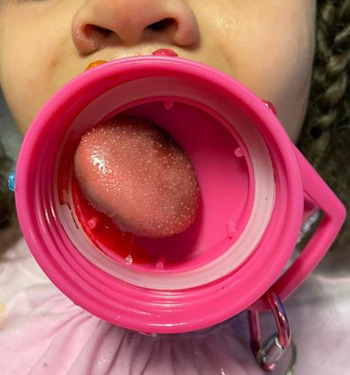
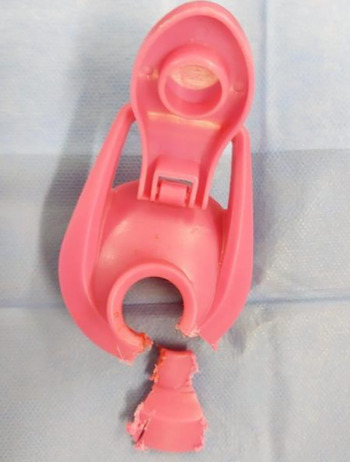
A five-year-old child presented to a satellite emergency department with circumferential entrapment of their tongue within the large, rigid, plastic lid of a reusable drinking bottle (Figure 1). The event was unwitnessed, but it was assumed the child had inserted their tongue into the bottle neck and created a vacuum effect by sucking. The mother had attempted initial manoeuvres to remove the foreign body, such as unscrewing the vessel from the lid to relieve negative pressure and applying manual force. These measures were unsuccessful, and so they presented to their local emergency department approximately 2 hours following the event.
Circumferential entrapment of the child's tongue within a rigid plastic drinking bottle lid.

At assessment, medical observation measurements were within the normal ranges and the child was maintaining their airway. There were no discernible intra-oral injuries associated with the foreign body; however, the tongue had become significantly oedematous. A dose of nasal diamorphine was given for pain relief and distress. Further manoeuvres for removal were then attempted in the department, including the liberal use of lubricant with further manual force; however, the child became more distressed and uncooperative. The rigidity of the plastic lid negated the use of cutting instruments available in the department, such as ring cutters and trauma scissors. A decision was made to refer the patient to the otolaryngology department in light of the failed removal attempts, the development of worsening tongue oedema and early signs of ischaemia. The child underwent emergency transfer with anaesthetic accompaniment to the receiving hospital.
At the initial otolaryngology assessment, the patient was distressed, but stable; however, there was evidence of early tongue ischaemia. Given the child's distress, and the rigidity and size of the plastic lid, surgical intervention was deemed to be the safest course of action. Furthermore, it was likely that powered cutting instruments would be required for foreign body removal. Orthopaedics were consulted for instrument choice and their experienced handling.
A detailed anaesthetic plan was devised given the novel challenges that the foreign body presented; its size meant oral intubation would not be possible, and nasal intubation may be complicated if anterior lingual oedema had migrated to the tongue base. Plan A involved a conservative approach, with reassurance and extraction under local anaesthetic. Plan B involved sedation with ketamine, and transnasal Optiflow™ high-flow nasal oxygen therapy to maintain oxygenation, spontaneous respiration and avoid the need for tracheal intubation. Plan C would require nasotracheal intubation using bronchoscopy. Plan D involved securing the airway with front of neck access. Because of the patient's significant distress, plan B was enacted and general anaesthesia was successfully achieved.
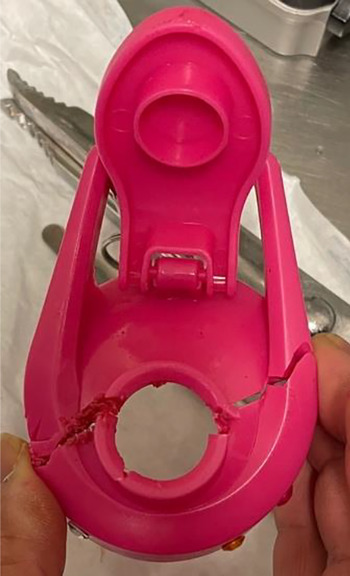
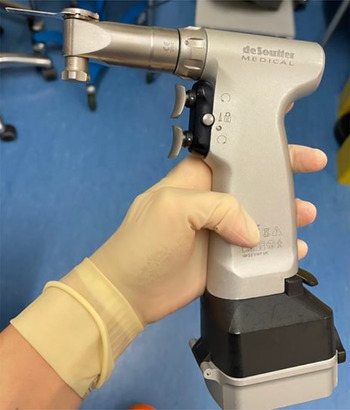
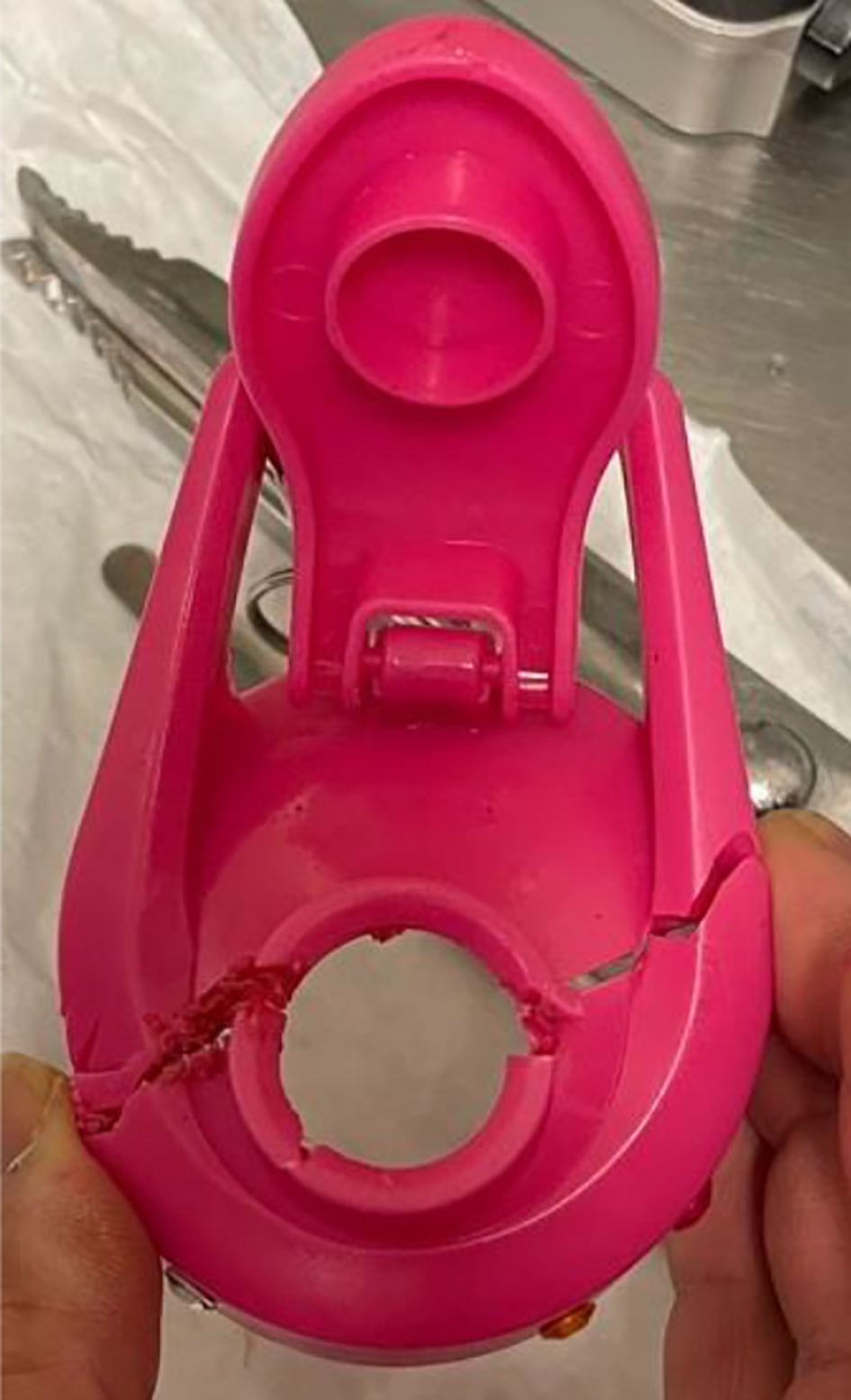
The orthopaedic consultant on call was recruited for their experienced handling of the powered cutting instrument. The foreign body was successfully removed with an oblique incision through the plastic lid (Figure 2) using an oscillating saw (Figure 3). The lid was then fractured using a pair of plaster splitters. The tongue was protected using a teaspoon handle inserted between the lid and tongue. There were no injuries associated with this technique.
Oblique incision through the bottle lid (left side).
Oscillating saw used to cut the bottle lid.

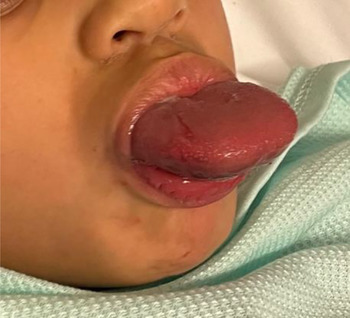
Shortly after removal, ischaemia reversed and the tongue's previous dusky blue colour returned to a healthy pink (Figure 4). The larynx was deemed safe, avoiding endotracheal intubation post-extraction with flexible nasendoscopy. The child was prescribed regular intravenous (IV) dexamethasone for 24 hours to reduce residual lingual oedema and was admitted for observations overnight. The following day, the patient was tolerating an oral diet and the oedema had almost resolved. The patient was discharged and did not re-present.
Child's tongue immediately after removal.

Case two
Several months following the first case, there was a second unconnected case involving another five-year-old child. This patient presented to the satellite emergency department with circumferential entrapment of the tongue within a bottle lid of the same design. The child was again transferred to the otolaryngology department at the receiving hospital following failed attempts at removal in the emergency department.
By the time the patient was assessed by the otolaryngology department, approximately 6 hours following the incident, there was once again significant lingual oedema with signs of early ischaemia. Immediate surgical removal was organised.
The same anaesthetic technique and a modified surgical approach were employed. A wedge excision was made in the bottle's lid. This prevented the need to fracture the lid open with plaster splitters, as the tongue could be eased through the gap (Figure 5).
Second foreign body following removal with wedge excision.

Following removal, the child was admitted for monitoring and regular IV dexamethasone administration. Twenty-four hours after removal, the child was tolerating an oral diet. The patient was subsequently discharged home.
Discussion
These cases presented two novel challenges: firstly, the approach to achieving general anaesthesia in a child with a large obstructing oral foreign body preventing orotracheal intubation; and, secondly, the technique for removing a large rigid plastic foreign body causing circumferential entrapment of the tongue. Our cases demonstrate a safe and reproducible anaesthetic and surgical technique for removal of difficult oral foreign bodies.
The literature reports a handful of cases describing approaches to remove a circumferential foreign body entrapping the tongue.Reference Gadiwalla, Bruzual, Altieri, Taylor and Whear1–Reference Malik, Aftab, Altaf, Ashraf, Shahzad and Rehman9 One other case reports a similar foreign body; however, lid extraction was achieved with a more conservative approach using topical anaesthetic, and lubricant injected between the lid and tongue with a 20 G cannula.Reference Gadiwalla, Bruzual, Altieri, Taylor and Whear1
Four cases presenting to the emergency department involved metal foreign bodies,Reference Bank, Diaz, Behrman, Delaney and Bizzocco2–Reference Whited, Rocke and Lee5 including an aluminium juice can and a soft-drink can, which were removed with medic shearsReference Bank, Diaz, Behrman, Delaney and Bizzocco2 and a dental drill,Reference Siegel, Speiser and Bikofsky3 respectively. Shah et al.Reference Shah, Sciarrino, Barth, Cook and O'Reilly4 reported the removal of an aluminium drink can using light sedation and topical anaesthetic; wire cutters and scissors were used with the addition of heavy orthopaedic pin cutters for removal of the reinforced rim. This patient required post-operative nasotracheal intubation because of delayed lingual oedema. Another challenging case involved the removal of a metal drinking bottle with a reinforced thickened rim using industrial metal snips and tongue protection with a malleable ribbon retractor; IV fentanyl and light sedation were given, avoiding general anaesthesia.Reference Whited, Rocke and Lee5
Three cases of glass bottle entrapment have been reported.Reference Mills and Simon6–Reference Guha and Catz8 General anaesthesia was avoided in two of these cases, and positive pressureReference Mills and Simon6 and a malletReference Green7 were used to break the glass. The other case required the services of a professional glazier,Reference Guha and Catz8 and the bottle was extracted under general anaesthesia with straightforward orotracheal intubation.
One study reported a case of prolonged entrapment of the tongue for 3 days with a rubber band.Reference Malik, Aftab, Altaf, Ashraf, Shahzad and Rehman9 This was successfully removed under general anaesthesia following uncomplicated orotracheal intubation.
• This paper describes the only reported cases of circumferential entrapment of the tongue by a foreign body requiring general anaesthesia, where orotracheal intubation was contraindicated
• Powered instruments were successfully used for foreign body removal
• General anaesthesia was achieved with ketamine and Optiflow therapy, maintaining oxygenation and spontaneous respiration whilst avoiding orotracheal intubation
Our study describes the only cases reported in the literature of circumferential entrapment of the tongue by a foreign body requiring general anaesthesia, where orotracheal intubation was contraindicated because of the foreign bodies’ size. A creative general anaesthetic approach was taken using ketamine and Optiflow therapy. Furthermore, we are the first to report a reproducible technique for the safe and successful removal of circumferential oral foreign bodies using powered cutting instruments. The thickness, shape and rigidity of the plastic lids meant that alternative non-powered heavy-duty cutting instruments, such as orthopaedic pin cutters, could not be used for extraction. We avoided tongue injury through careful and experienced use of the oscillating saw, and provided protection with a commonly found metal object (teaspoon) that fit between the lid and tongue.
The described cases highlight significant health and safety concerns surrounding these rigid, plastic, reusable drinking bottles. This product is marketed for children and is sold as a customisable drinking bottle, available from an online platform. The two cases we encountered appear to involve the same product; however, the parents purchased them from different companies on the same online platform. We have reported these cases to the Royal Society for the Prevention of Accidents, the local Trading Standards Officer, and the Office for Product Safety and Standards.
Acknowledgements
We would like to acknowledge Professor Bijayendra Singh (orthopaedic consultant) and Mark O'Reilly (operating department practitioner) for their assistance with surgical removal.
Competing interests
None declared