Introduction
The water lotus (genus Nelumbo) has recently been classified into the family Nelumbonaceae [reviewed in Savolainen and Chase, (Reference Savolainen and Chase2003)]. This genus contains two species, Nelumbo nucifera (Indian or sacred lotus) and Nelumbo lutea (American lotus). The former is distributed in Asia and north Australia, and the latter is found in north and south America (Borsch and Barthlott, Reference Borsch and Barthlott1994). These two species have similar characters except for differences in petal colour and leaf size, and they can be crossed easily. Nelumbo represents one of the most famous water flowers in the world. In particular, ornamental flower cultivars are called ‘flowering lotuses’. More than 900 flowering lotus cultivars have been released mostly from China (Wang and Zhang, Reference Wang and Zhang2005). In Japan, about 350 cultivars are currently known, including 100 or more Japanese landraces (Kaneko, Reference Kaneko2002).
Nelumbo cultivars have been classified based on morphological characters of the flower, leaf, plant size, rhizome, etc. [reviewed in Watanabe, (Reference Watanabe1990) and Wang and Zhang, (Reference Wang and Zhang2005)]. In most cases, flower characters (e.g. colour and number of petals, sharpness of petal vein, and size and shape of flower) are used for the standards of the classification [see Watanabe, (Reference Watanabe1990) and Supplementary Table S1, available online only at http://journals.cambridge.org for instances]. The evolutionary and breeding histories of lotuses have recently been taken into account in the classification system. However, morphological characters are often hard to distinguish because of continuous variations and environmental effects. Several DNA analyses have been conducted with different molecular markers for the classification of Nelumbo samples (e.g. Kanazawa et al., Reference Kanazawa, Watanabe, Nakamoto, Tsutsumi and Hirai1998; Zou et al., Reference Zou, Cai, Wang and Xu1998; Katori et al., Reference Katori, Nomura, Watanabe and Yoneda2003; Huang et al., Reference Huang, Tanabe and Itai2003, Reference Huang, Tanabe and Itai2004; Peng et al., Reference Peng, Han, Wang, Teng, Zhou, Hu and Song2004; Xue et al., Reference Xue, Zhuo and Zhou2006; Guo et al., Reference Guo, Li, Peng and Ke2007; Han et al., Reference Han, Teng, Chang, Robert, Zhou, Hu and Song2007a, Reference Han, Teng, Zhong, Zhou, Hu and Songb, Reference Han, Teng, Wahiti, Zhou, Hu and Song2009; Chen et al., Reference Chen, Zhou, Lin, Wu, Qian and Huang2008; Tian et al., Reference Tian, Xue, Wen, Mitchell and Zhou2008b). These previous DNA analyses have the disadvantage that they basically detect haplotype or dominant alleles. Nelumbo has protogynous flowers, which are usually outcrossed via insects, although self-pollination is also possible. The resultant heterozygosity can be maintained as long as Nelumbo undergoes vegetative propagation with rhizomes. In this context, dominant or organellar markers may only clarify part of the genetic information in Nelumbo, which may retain relatively high heterozygosity. That is, genetic information from the parent that provides null alleles with a dominant marker may be unclear or no information of the male lineage could be obtained with an organellar marker. Therefore, co-dominant markers are ideal for studying this species. Although allozymes have recently been used in Nelumbo as co-dominant markers (Tian et al., Reference Tian, Xue, Wen, Mitchell and Zhou2008b), the number of available allozyme markers is very limited.
Recently, we developed simple sequence repeat (SSR) markers in Nelumbo (Kubo et al., Reference Kubo, Hirai, Kaneko, Tanaka and Kasumi2009). SSR is a DNA repeat consisting of 1–6 nucleotide repeat units. Because of their high reproductivity, relatively high polymorphism content, co-dominant inheritance and abundance in eukaryotic genomes, SSRs have frequently been used for genetic analysis such as taxonomic classification, genetic diversity studies and making genetic maps [reviewed in Varshney et al., (Reference Varshney, Graner and Sorrells2005)]. Although a few studies on SSR markers in Nelumbo have recently been conducted (Pan et al., Reference Pan, Quan, Li, Liu, Huang, Ke and Ding2007; Tian et al., Reference Tian, Chen, Wang, Xue, Wen, Mitchell and Zhou2008a; Kubo et al., Reference Kubo, Hirai, Kaneko, Tanaka and Kasumi2009), these markers have not yet been used for the classification.
In this study, we conducted the classification of our Nelumbo collections based on SSR markers. Additional Nelumbo SSR markers from SSR-enriched libraries and registered EST data were developed. In total, 98 Nelumbo cultivars were tested. We included 21 cultivars, most of which had been collected from the ‘Ogura-ike Reclaimed Land’. The Ogura-ike Reclaimed Land was the biggest pond in Kyoto, Japan, and was famous for its lotus flowers. Such cultivars as many as 70 (namely the ‘Ogura-ike group’ cultivars) with various morphological characters are known (Kaneko, Reference Kaneko2002; Uchida, Reference Uchida2006). However, their genetic relationships are unknown. One of our aims in this study was to investigate the relationships of the various cultivars in this group. A neighbour-joining (NJ) tree based on the SSRs showed that the Nelumbo cultivars were separated into two main groups, one of which included American lotus-derived cultivars. This confirmed the genetic difference between American and sacred lotuses. The other group comprised sacred lotuses, and it could be further divided into four subgroups. A possible genetic differentiation between Chinese and Japanese cultivars might have been suggested. We also conducted parentage analysis using the SSR alleles, which resulted in the confirmation and prediction of parents in several Nelumbo cultivars. The utility of SSR markers for the classification of Nelumbo species and the relationships of the cultivars are discussed.
Materials and methods
Plant materials and DNA isolation
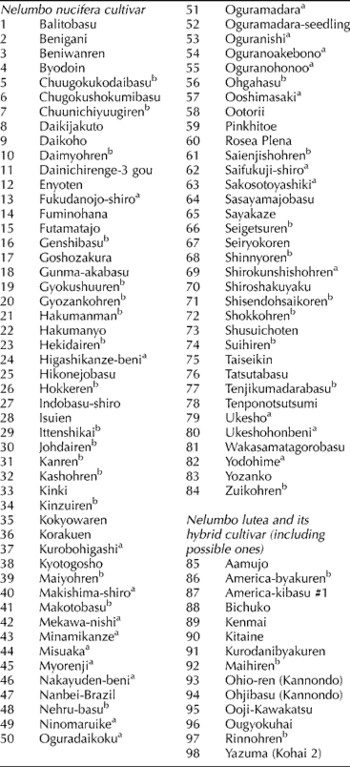
The 98 Nelumbo cultivars used in this study are listed in Table 1. Most of them have been obtained from the Uchida Flowering Lotus Farm (Kumiyama, Kyoto, Japan) and the Kyoto Flower Center (Seika, Kyoto, Japan). Detailed information on their origins and pedigrees is described in Supplementary Table S1, available online only at http://journals.cambridge.org. These cultivars are being maintained at Kannondo, Joyo, Kyoto, Japan. An American lotus cultivar, ‘America-kibasu #1’, was kindly provided by the Experimental Station for Landscape Plants, Graduate School of Agricultural and Life Sciences, the University of Tokyo (Hanamigawa-ku, Chiba, Japan). This cultivar was introduced from USA to Japan and is thought not to have been hybridized with any sacred lotus. Total DNA was extracted from each cultivar as described previously (Kubo et al., Reference Kubo, Hirai, Kaneko, Tanaka and Kasumi2009).
List of Nelumbo samples used in this study

a ‘Ogura-ike group’ cultivar (see text).
b Cultivar names from Watanabe (Reference Watanabe1990).
See Supplementary Table S1, available online only at http://journals.cambridge.org for detail.
Development of SSR markers
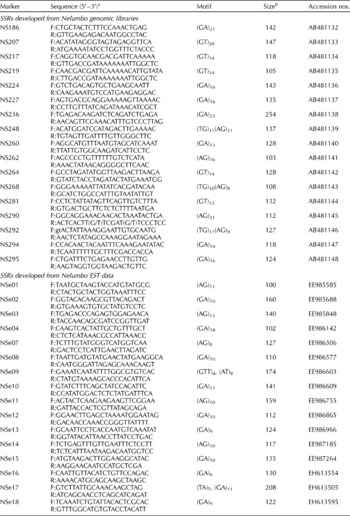
The SSR-enriched DNA libraries were constructed from total DNA of the ‘Oguramadara-seedling’ as described in Nunome et al. (Reference Nunome, Negoro, Miyatake, Yamaguchi and Fukuoka2006). A 5′-biotin-conjugated (GA)15 or (GT)15 oligonucleotide (Invitrogen, Carlsbad, CA, USA) was hybridized for enrichment of SSR-containing DNA fragments. The SSR-enriched fragments have been sequenced and their nucleotide sequences have been deposited in the DDBJ/EMBL/GenBank databases under accession nos. AB481132–AB481148. Registered Nelumbo EST data (Cai et al., unpublished) were retrieved from the GenBank database (accession nos. EE985570–EE987522, EH613358–EH613607 and EL740203–EL740207) and used for the development of the Nelumbo SSR markers. Primer pairs flanked by SSRs of six or more dinucleotide repeats were designed with manual inspection from the genomic (NS186–NS295) and EST data (NSe01–NSe18).
PCR amplification and detection of polymorphisms
SSR fragments were amplified by PCR using each SSR primer pair, either of which was fluorescence-labelled (Sigma-Aldrich, St Louis, MO, USA). Recently published Nelumbo SSRs (Pan et al., Reference Pan, Quan, Li, Liu, Huang, Ke and Ding2007; Tian et al., Reference Tian, Chen, Wang, Xue, Wen, Mitchell and Zhou2008a; Kubo et al., Reference Kubo, Hirai, Kaneko, Tanaka and Kasumi2009) were also tested. The PCR reaction, fragment analysis of amplified products and allele scoring were performed as described previously (Kubo et al., Reference Kubo, Hirai, Kaneko, Tanaka and Kasumi2009). SSR markers with missing data were omitted from further analyses.
Data processing, phylogenetic analysis and assessment of parentages
Expected (H e) and observed heterozygosities (H o) of each SSR locus, and other gene diversity indices were calculated using the Cervus 3.03 program (Kalinowski et al., Reference Kalinowski, Taper and Marshall2007) and Popgene 1.32 software (Yeh et al., Reference Yeh, Yang, Boyle, Ye and Mao1997). Based on the allele data, pairwise genetic distances were calculated using the Microsat 1.5 program (Minch et al., Reference Minch, Ruiz-Linares, Goldstein, Feldman and Cavalli-Sforza1998). We used the 1 − P distance measurement, where P is the proportion of shared alleles for the SSR markers (Bowcock et al., Reference Bowcock, Ruiz-Linares, Tomfohrde, Minch, Kidd and Cavalli-Sforza1994). This genetic distance measure is suitable for closely-related samples and is frequently used for SSR loci. An NJ tree was constructed using the Phylip 3.67 package (Felsenstein, Reference Felsenstein2007). Bootstrap (BS) analysis was performed from 1000 replicates using the Microsat 1.5.
Parentage analysis was performed based on the allele data using Cervus 3.03. No mismatch was permitted at any paired locus for the analysis. In predicting cultivars of unknown parentage, only pairs showing relatively greater genetic distance (pairwise genetic distance ≥ 0.30) were considered as candidate parentages so as not to simply choose a cultivar pair with similar genotypes. We did not examine the maternity of five cultivars (‘Aamujo’, ‘Bichuko’, ‘Maihiren’, ‘Ougyokuhai’ and ‘Rinnohren’), which are predicted to be offsprings of an American lotus cultivar ‘Ohjibasu’, because the original ‘Ohjibasu’ cultivar was unavailable.
Results
Development of Nelumbo SSR markers from genomic libraries and EST data
In addition to 35 SSR markers developed previously (Kubo et al., Reference Kubo, Hirai, Kaneko, Tanaka and Kasumi2009), in this study we further isolated SSR fragments from SSR-enriched genomic libraries. Of the 53 clones sequenced, 17 SSR markers were newly designed (Table 2, NS186–NS295). Three markers had compound SSRs that had different types of repeat motifs. Thus, we developed 52 SSR markers from Nelumbo genomic DNA in both studies. Another 16 SSR markers (Table 2, NSe01–NSe18) were developed from 2207 Nelumbo ESTs in the database (Cai et al., unpublished). In the 68 Nelumbo SSR fragments, the lengths of GA/AG and GT/TG dinucleotide repeats ranged from 6 to 26, with an average of 14.5.
Nelumbo simple sequence repeat markers developed in this study
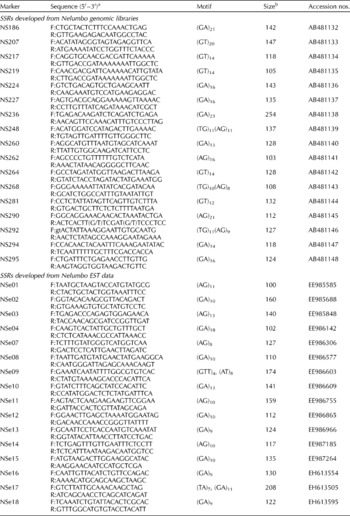
a Small cases are nucleotide addition assumed from the restriction sites.
b Estimation of PCR products according to the sequenced fragment used for primer design.
Polymorphisms of SSRs in Nelumbo cultivars
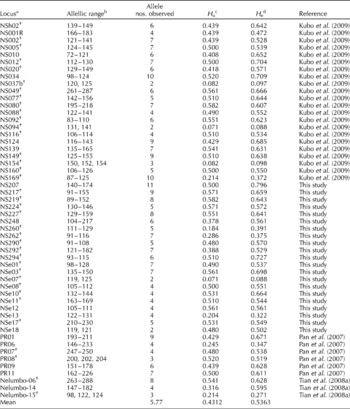
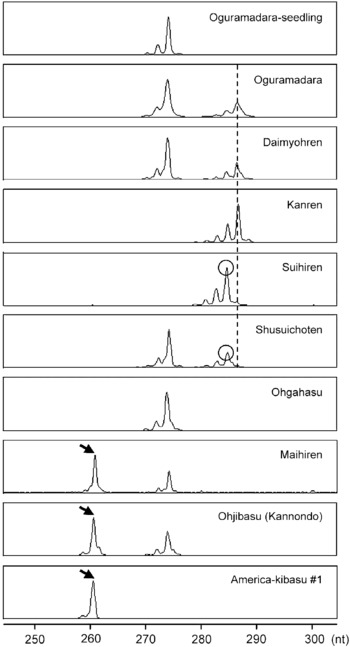
Polymorphisms of the SSR markers were examined in 98 Nelumbo samples (Table 1). Of the 94 SSRs used [68 developed by Kubo et al. (Reference Kubo, Hirai, Kaneko, Tanaka and Kasumi2009) and this study; 26 developed by Pan et al. (Reference Pan, Quan, Li, Liu, Huang, Ke and Ding2007) and Tian et al. (Reference Tian, Chen, Wang, Xue, Wen, Mitchell and Zhou2008a)], 52 primer pairs that clearly amplified polymorphic bands were chosen. One or two alleles were constantly detected at each locus in all the Nelumbo samples examined. A total of 300 alleles were detected with the 52 SSR markers (Table 3). These markers revealed 2–11 alleles with an average of 5.77. H o ranged from 0.071 to 0.582 per locus, with an average of 0.4312. The 52 primers were applicable to amplification in N. lutea (American lotus) and its hybrid cultivars. Alleles of different sizes (e.g. Fig. 1, arrows) were observed with 37 SSR markers (Table 3, daggers). These alleles are likely to be derived from American lotuses because most have been identified as homozygous loci in the N. lutea cultivar ‘America-kibasu #1’. In contrast, all of these loci were heterozygous in eight possible American lotus-derived cultivars (Table 1, ‘Aamujo’, ‘Bichuko’, ‘Kenmai’, ‘Kurodanibyakuren’, ‘Maihiren’, ‘Ohio-ren (Kannondo)’, ‘Ohjibasu (Kannondo)’ and ‘Ougyokuhai’). This indicated that these eight cultivars are inter-specific hybrids between N. lutea and N. nucifera. Unexpectedly, the remaining five possible American lotus-derived cultivars [‘America-byakuren’, ‘Kitaine’, ‘Ooji-Kawakatsu’, ‘Rinnohren’ and ‘Yazuma (Kohai 2)’] had no American lotus-specific allele at any of the loci examined.
Characterization of the 52 simple sequence repeat loci examined in this study

a Daggers (†) indicate markers, with which American lotus-specific alleles were detected.
b Estimation of nucleotide size by fragment analysis.
c Observed heterozygosity.
d Expected heterozygosity.
The SSR polymorphisms in Nelumbo cultivars. Fragment analysis of the SSR marker NS049 in ten cultivars is shown as an example. The American lotus-specific allele is indicated with an arrow. A small nucleotide difference observed in ‘Suihiren’ and ‘Shusuichoten’ is enclosed with a circle, and the corresponding allele in ‘Oguramadara’, ‘Daimyohren’ and ‘Kanren’ is marked with a dashed line. A molecular weight standard is shown at the bottom.

Relationships of Nelumbo cultivars based on an NJ tree
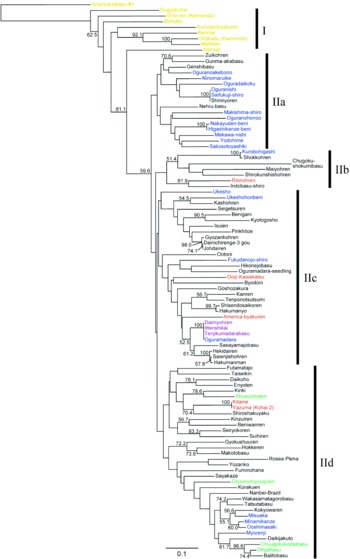
We calculated the genetic distance of each cultivar (Supplementary Table S2, available online only at http://journals.cambridge.org) from the allele data, and we constructed an NJ tree using the cultivar ‘America-kibasu #1’ as an outgroup. The ingroup 97 Nelumbo samples were separated into two main groups (I and II; Fig. 2). Group I was composed of the eight American lotus-derived cultivars described above (Fig. 2, yellow). Group II included the rest of the cultivars and could be subdivided into four subgroups (IIa–d). The subgroup IIa consisted of 17 cultivars, 12 of which were ‘Ogura-ike group’ cultivars (Fig. 2, blue). The subgroups IIb and IIc contained 7 and 31 cultivars, respectively, most of which were Japanese cultivars. The subgroup IId included two ‘antique lotuses’ (‘Chuugokukodaibasu’ and ‘Ohgahasu’) and their progenies (‘Chuunichiyuugiren’ and ‘Shusuichoten’; Fig. 2, green). ‘Chuugokukodaibasu’ and ‘Ohgahasu’ were closely positioned on the NJ tree with a high BS value (96.6%). This result confirmed their close genetic relationship, as previously reported (Kanazawa et al., Reference Kanazawa, Watanabe, Nakamoto, Tsutsumi and Hirai1998; Han et al., Reference Han, Teng, Chang, Robert, Zhou, Hu and Song2007a). Four ‘Ogura-ike group’ cultivars (‘Minamikanze’, ‘Misuaka’, ‘Myorenji’ and ‘Ooshimasaki’) were also included in this subgroup. The subgroup IId showed a higher proportion of Chinese cultivars (11 out of 36) than the other subgroups.
An NJ tree constructed by 97 Nelumbo samples based on 52 SSRs. The American lotus cultivar, ‘America-kibasu #1’, was used for an outgroup. Numbers on the node are BS values (>50%) from 1000 replicates. A cluster composed of American lotus-derived cultivars (group I) and four subgroups (IIa–d) is indicated on the right. Colours represent the following cultivars: American lotus-derived cultivars confirmed (yellow) and questionable (brown); ‘Ogura-ike group’ cultivars (blue); antique lotuses and their progenies (green); possible synonyms of ‘Daimyohren’ (purple); and other cultivars (black).

Among these groups and subgroups, only one division of the main groups I and II was supported by a BS value of more than 50% (59.6%). However, some distal clades were relatively well supported with BS values of 51.4–100%.
Assessment of genetic identity with SSR markers
To date, several synonyms and parentages have been known in Nelumbo cultivars. In this study, we examined such relationships based on the SSR alleles. Our samples included two pairs of synonyms, ‘Daimyohren’–‘Ittenshikai’ and ‘Gyokushuuren’–‘Hokkeren’ (Watanabe, Reference Watanabe1990). In the former case, all the detected alleles were identical. Furthermore, two additional cultivars (‘Oguramadara’ and ‘Tenjikumadarabasu’) had the same allele sets as ‘Daimyohren’ and ‘Ittenshikai’ (Fig. 2, purple). The latter case (‘Gyokushuuren’–‘Hokkeren’) was rejected in this study because of several mismatches between their alleles (data not shown). However, ‘Gyokushuuren’ and ‘Hokkeren’ appeared to be genetically similar, because they were in the same cluster on the NJ tree (BS = 72.2%; Fig. 2, subgroup IId). In addition to the known synonyms, each of the following three groups had identical alleles: ‘Dainichirenge 3-gou’–‘Johdairen’; ‘Kitaine’–‘Yazuma (Kohai 2)’ and ‘Oguranishi’–‘Saifukuji-shiro’–‘Shinnyoren’. There was a single-allele difference in each of the following four cultivar groups: ‘Gyozankoren’–‘Dainichirenge 3-gou’ or ‘Johdairen’; ‘Higashikanze-beni’–‘Nakayuden-beni’; ‘Kurobohigashi’–‘Shokkohren’; and ‘Saienjishohren’–‘Hakumanman’ or ‘Hekidairen’.
Confirmation and prediction of parentages with SSR markers
Parentages of Nelumbo cultivars were examined based on the SSR alleles. Although the parentages of some Nelumbo cultivars based on dominant inter-SSR markers have been examined previously (Huang et al., Reference Huang, Tanabe and Itai2004), co-dominant SSR markers have the advantage of enabling simultaneous comparison of the alleles derived from both parents in a given sample. We investigated nine cultivars, in which either or both parents were included in the samples (except for the offspring of ‘Ohjibasu’, see ‘Materials and methods’). These were ‘Chuunichiyuugiren’, ‘Daikoho’, ‘Kenmai’, ‘Maihiren’, ‘Oguramadara-seedling’, ‘Ootorii’, ‘Sayakaze’, ‘Shusuichoten’ and ‘Tenponotsutsumi’ (Supplementary Table S1, available online only at http://journals.cambridge.org). Among these cultivars, the following relationships were confirmed: ‘Ohgahasu’ as paternity of ‘Maihiren’, ‘Oguramadara’ as maternity of ‘Oguramadara-seedling’ and ‘Ootorii’, and ‘Tenjikumadarabasu’ as maternity of ‘Tenponotsutsumi’. For example, ‘Maihiren’ shared at least one allele with ‘Ohgahasu’ at each locus (Supplementary Table S3, available online only at http://journals.cambridge.org, light-blue). There was also no incongruence between the ‘Ohgahasu’-derived alleles and the American lotus-specific alleles at 33 loci in ‘Maihiren’ (Supplementary Table S3, available online only at http://journals.cambridge.org, yellow). This observation did not contradict the pedigree of ‘Maihiren’ as an inter-specific hybrid between ‘Ohjibasu’ and ‘Ohgahasu’, although we did not directly examine its original maternal parent. In contrast, the remaining five possible parentages were negative in this study because of incongruence at several loci (data not shown). However, each of the following cultivar groups, ‘Daikoho’–‘Taiseikin’, ‘Kenmai’–‘Maihiren’ and ‘Shusuichoten’–‘Chuunichiyuugiren’–‘Chuugokukodaibasu’, appeared to share similar genetic backgrounds because they each fell into the same group or subgroup on the NJ tree (Fig. 2).
In addition to already-known parentages, potential paternal parents were predicted for three cultivars. (1) ‘Aamujo’ was derived from the natural pollination of ‘Ohjibasu’ (Kaneko, Reference Kaneko2002; Uchida, Reference Uchida2006), but its paternal parent is unknown. In this case, the ‘Ogura-ike group’ cultivar ‘Sakosotoyashiki’ was predicted to be a paternal parent because either allele was congruent with ‘Aamujo’ at each locus examined (Supplementary Table S3, available online only at http://journals.cambridge.org, light-blue). ‘Genshibasu’, ‘Higashikanze-beni’ and ‘Nakayuden-beni’ were also congruent as having paternity of ‘Aamujo’. Like the case of ‘Maihiren’, no incongruence was observed between the alleles of these predicted paternal parents and the American lotus-specific alleles. (2) The paternal parent of ‘Ootorii’ was predicted to be ‘Kurobohigashi’ or ‘Shokkohren’ without any incongruence at paired alleles. This prediction was strongly supported by an allele of 108 nucleotides at locus NS290 (Supplementary Table S3, available online only at http://journals.cambridge.org, asterisks), which was specific in the three cultivars. (3) The paternal parent of ‘Tenponotsutsumi’ was predicted to be ‘Kanren’ or ‘Shisendohsaikoren’. These three cultivars formed a single cluster on the NJ tree (Fig. 2, subgroup IIc) and shared similar morphological characteristics such as colour and number of petals.
Finally, possible cases of inbreeding were predicted in four cultivars. ‘Byodoin’, ‘Hikonejobasu’ and ‘Oguramadara-seedling’ were predicted to have been derived from ‘Oguramadara’ and its possible synonyms (‘Daimyohren’, ‘Ittenshikai’ and ‘Tenjikumadarabasu’). At each locus, alleles in ‘Byodoin’, ‘Hikonejobasu’ and ‘Oguramadara-seedling’ were always the same with either or both of the alleles in the predicted parents (Supplementary Table S3, available online only at http://journals.cambridge.org, purple). This evidence raised the hypothesis that the three cultivars arose by self-pollination or by a cross between very closely-related cultivars. A significant decrease of heterozygous loci in ‘Byodoin’, ‘Hikonejobasu’ and ‘Oguramadara-seedling’ compared with the parents (8, 10 and 11 vs. 42, respectively) may also support this hypothesis (Supplementary Table S3, available online only at http://journals.cambridge.org, underlines). A typical case was found in an ‘Ogura-ike group’ cultivar. The parentage of ‘Minamikanze’ was predicted to be ‘Dainichirenge-3 gou’. When their genotypes were compared, alleles in ‘Minamikanze’ were homozygous at all loci with regard to those in ‘Dainichirenge-3 gou’. This may represent a fixation of alleles probably because of successive selfings or inbreedings.
Discussion
In this study, we conducted the classification of flowering lotus (Nelumbo) cultivars based on the SSR markers. To accomplish this, 33 additional SSR markers were developed from genomic and EST sequences. Together with the 35 markers that we previously developed (Kubo et al., Reference Kubo, Hirai, Kaneko, Tanaka and Kasumi2009) and 26 markers developed by other researchers (Pan et al., Reference Pan, Quan, Li, Liu, Huang, Ke and Ding2007; Tian et al., Reference Tian, Chen, Wang, Xue, Wen, Mitchell and Zhou2008a), we tested a total of 94 SSRs. Fifty-two of these markers were capable of genotyping 98 Nelumbo cultivars. Some alleles showed small nucleotide differences among cultivars (e.g. Fig. 1, circles). Therefore, SSR fragment analysis with a DNA sequencer or equivalent would be effective for accurate genotyping. Some of our SSRs also amplified products of similar size in a tree, Platanus (data not shown), which is a sister taxon to Nelumbo [reviewed in Savolainen and Chase, (Reference Savolainen and Chase2003)]. Therefore, our SSR markers may be useful for the analysis of species closely-related to Nelumbo.
Previously, we reported the presence of American lotus-specific alleles in SSR markers (Kubo et al., Reference Kubo, Hirai, Kaneko, Tanaka and Kasumi2009). In the present study, this assumption was confirmed in the American lotus-derived cultivars (‘Aamujo’, ‘Bichuko’, ‘Kenmai’, ‘Kurodanibyakuren’, ‘Maihiren’, ‘Ohio-ren (Kannondo)’, ‘Ohjibasu (Kannondo)’ and ‘Ougyokuhai’) plus ‘America-kibasu #1’. In contrast, another five cultivars predicted to be derived from the American lotus (‘America-byakuren’, ‘Kitaine’, ‘Ooji-Kawakatsu’, ‘Rinnohren’ and ‘Yazuma (Kohai 2)’; Fig. 2, brown) did not show any such alleles. A similar incongruence between genetic data and pedigree has also been reported by Huang (Reference Huang2004). These observations raise the possibility that the identities or pedigrees of the five cultivars in question were incorrect. Alternatively, these cultivars might contain an American lotus-specific allele at loci that we have not yet analysed.
The SSR-based phylogenetic tree showed that the eight American lotus-derived cultivars were separated from the sacred lotus group (Fig. 2, yellow). This confirmed that American lotuses (N. lutea) are genetically distinct from sacred lotuses (N. nucifera), as reported previously with various types of molecular markers (Kanazawa et al., Reference Kanazawa, Watanabe, Nakamoto, Tsutsumi and Hirai1998; Katori et al., Reference Katori, Nomura, Watanabe and Yoneda2003; Peng et al., Reference Peng, Han, Wang, Teng, Zhou, Hu and Song2004; Han et al., Reference Han, Teng, Chang, Robert, Zhou, Hu and Song2007a; Chen et al., Reference Chen, Zhou, Lin, Wu, Qian and Huang2008; Tian et al., Reference Tian, Xue, Wen, Mitchell and Zhou2008b). The sacred lotus cultivars in our samples formed four subgroups (IIa–d). It is noteworthy that most Chinese cultivars examined in this study were in the subgroup IId (Fig. 2), unlike previous studies (Huang et al., 2003; Katori et al., 2003). Some of these Japanese cultivars may have been imported from China in ancient times, but the detailed relationships of Chinese and Japanese cultivars have yet been studied sufficiently. The present data suggest a possible genetic differentiation of some Japanese cultivars from Chinese lotuses. Because major studies of flowering lotuses have mainly examined Chinese cultivars with few Japanese samples, the present results may be helpful in assuming the differentiation of Chinese and Japanese lotuses. To infer a correlation between the genetic classifications and morphological characteristics, we plotted petal characters on the NJ tree (Supplementary Fig. S1, available online only at http://journals.cambridge.org). There was no strong overall correlation between petal characters and genetic relationships, except for the American lotus group and small local clusters that formed on the NJ tree. For example, cultivars with white petals were distributed throughout the tree, without forming an apparently large cluster. This was also the case with the characters of nail-red petal and petal number. These results reflect the complex history of petal characters during the differentiation of Nelumbo cultivars. We are currently unable to trace the origins of these petal characters because each of the subgroups was poorly supported with BS values. The low BS values could be because of the relatively small genetic diversity of Nelumbo species (Xue et al., Reference Xue, Zhuo and Zhou2006). However, this assumption contradicts the fact that the gene diversity indices from the present data were not low (Supplementary Table S4, available online only at http://journals.cambridge.org). It is more likely that resolution of the NJ tree was disturbed by intra-specific hybrids between distantly-related cultivars, as seen in our parentage analysis. On the other hand, because relatively higher BS values were obtained in distal clades (Fig. 2), the present SSRs seem to be more effective for distinguishing the closely-related cultivars.
One of our aims in this study was to examine the relationships among cultivars of the ‘Ogura-ike group’, which constitutes one of the unique Japanese lotus cultivar groups. Twelve of these cultivars (‘Higashikanze-beni’, ‘Makishima-shiro’, ‘Mekawa-nishi’, ‘Nakayuden-beni’, ‘Ninomaruike’, ‘Oguradaikoku’, ‘Oguranishi’, ‘Oguranoakebono’, ‘Oguranohonoo’, ‘Saifukuji-shiro’, ‘Sakosotoyashiki’ and ‘Yodohime’) were grouped into a cluster with five other cultivars (‘Genshibasu’, ‘Gunma-akabasu’, ‘Nehru-basu’, ‘Shinnyoren’ and ‘Zuikohren’; Fig. 2, subgroup IIa). This was in good agreement with the observation that ‘Genshibasu’ and ‘Nehru-basu’ have similar morphological characteristics to ‘Sakosotoyashiki’ (Uchida, Reference Uchida2006). Another cluster was found with four ‘Ogura-ike group’ cultivars (‘Minamikanze’, ‘Misuaka’, ‘Myorenji’ and ‘Ooshimasaki’; Fig. 2, subgroup IId). These results suggest that the ‘Ogura-ike group’ cultivars in each cluster are genetically close and perhaps originated from a few closely-related cultivars.
Besides the genetic relationships among cultivars, comparison of SSR alleles allowed us to examine the identity and pedigree of each cultivar. We confirmed an already known synonym (‘Daimyohren’–‘Ittenshikai’), in which two additional cultivars (‘Oguramadara’ and ‘Tenjikumadarabasu’) may be included. Three cultivar groups with identical genotypes and four cultivar groups with almost identical genotypes were also identified. Each member of a cultivar group may represent a novel synonym or a close relative. However, slight morphological variations have also been observed in some cases. For example, ‘Daimyohren’ has a bigger plant size and more spots than ‘Ittenshikai’ (Kaneko, Reference Kaneko2002). ‘Tenjikumadarabasu’ has many more spots than the other three possible synonyms. ‘Oguranishi’ and ‘Shinnyoren’ have single white flowers but they show morphological differences in petal angle and receptacle (data not shown). It is unclear which factor(s) cause such slight variations. Although it is unlikely that genotypes would be identical at all 52 loci by chance, the possible synonyms might contain small DNA differences that were undetectable in this study. There might be a small chance of somaclonal mutation, such as bud sport, because Nelumbo mutants in flowering lotuses (full double flower mutants ‘Myohren’ and ‘Qianban lian’) have been known (Watanabe, Reference Watanabe1990; Wang and Zhang, Reference Wang and Zhang2005).
The present study also demonstrated the usefulness of SSR markers for parentage analysis. Relatively few parentages were confirmed and suggested here: four known parentages of ‘Maihiren’, ‘Oguramadara-seedling’, ‘Ootorii’ and ‘Tenponotsutsumi’; and six currently-unknown parentages of ‘Aamujo’, ‘Byodoin’, ‘Hikonejobasu’, ‘Minamikanze’, ‘Ootorii’ and ‘Tenponotsutsumi’. However, the number of predicted parentages is likely to have been underestimated because we applied stringent conditions for the parentage analysis to avoid false positives. In contrast, incongruences between the genetic data and the reported pedigrees were found. In this study, we verified morphological characteristics for most of the examined cultivars and omitted questionable ones to the best of our knowledge. The identities or pedigrees of these cultivars in question need to be clarified.
In conclusion, the utility of SSR markers for classification and identification has been demonstrated in Nelumbo. Fragment analysis of the SSRs enables more accurate genotyping of Nelumbo samples, especially for closely-related cultivars. Further studies using broader-based samples and data exchange among different research groups will uncover the classification and the pedigree of Nelumbo cultivars in future. The sequence-specific, co-dominant SSR markers would provide one of the most ideal tools for this purpose.
Acknowledgements
The authors thank Dr T. Nunome for helpful advice on construction of SSR-enriched libraries, two reviewers for valuable comments, Ms H. Kasaoka for technical assistance, and Hot Space Hanashobu for maintenance of Nelumbo cultivars. The authors are grateful to the Experimental Station for Landscape Plants (Graduate School of Agricultural and Life Sciences, the University of Tokyo), Tottori City, and the Okayama Korakuen Garden for providing Nelumbo samples. This work was partly supported by an ACTR grant from Kyoto Prefectural University to N.K.