INTRODUCTION
In recent years, discourse phenomena have come to the forefront of linguistic research. Yet, as pointed out by Erteschik-Shir (Reference Erteschik-Shir2007), little is known to date about the acquisition of information structure (which can be defined as the “tailoring of an utterance by a sender […] that reflects [their] hypotheses about the receiver's assumptions and beliefs”; Prince, Reference Prince, Alford, Hunold, Macaulay, Walter, Brugman, Chertok, Civkulis and Tobey1981). Acquisition studies so far have generally concentrated on NPs independently of their structural (i.e. syntactic) position, and most of the work has been dedicated to the acquisition of definiteness contrasts (e.g. the use of a(n)/the in English).
This study provides experimental evidence for preschool children's competence in basic information structure, with particular attention to the notions of topic and focus. It investigates their mastery of structural and definiteness distinctions to encode the information status of discourse referents, and seeks to distinguish linguistic competence from cognitive development as the source for children's ‘errors’.
The article is organized as follows. The next section sketches the basic linguistic competence needed for the successful encoding of information and reviews the main findings from the acquisition literature. Two main research questions are then identified, which are addressed in subsequent sections. The methodology is outlined in the following section. Then evidence is provided to show that there is continuity between the child and the adult systems in terms of basic information structure. In the following two sections I investigate children's use of definiteness contrasts to encode information status. After a summary of the main findings, the conclusions are drawn.
COMPETENCE TO BE ACQUIRED
Prerequisites for the successful encoding of information
What do children have to master to encode information like adults? The organization of sentences into a cohesive discourse depends first and foremost on the establishment and maintenance of reference, which requires the conversation participants to access an internalized, active representation of the current state of the discourse. This has been formalised for instance by File Change Semantics. This is based on the metaphorical representation of discourse as a file, each card it contains corresponding to a discourse referent. In this model, adapted to the study of information structure by Reinhart (Reference Reinhart1981) and Erteschik-Shir (Reference Erteschik-Shir1997) among others, speaker and hearer build in their minds a context set consisting of referents introduced in the conversation or previously available from the shared knowledge between the participants. Two key linguistic notions are at the heart of this process of information exchange: focus and topic. The focus is the most informative part of the utterance. By default, it corresponds to the most deeply embedded constituent – typically the complement of the verb. The topic of a sentence generally corresponds to what the sentence is about and it provides the referential frame with respect to which the predication is evaluated (Reinhart, Reference Reinhart1981; Erteschik-Shir, Reference Erteschik-Shir1997). For instance, to evaluate whether the sentence in (1) is true, one needs to identify a referent for the topic (les Martiens), and then check if the information provided by the focus (‘their being green’) is verified.Footnote 1
(1) Les Martiensi, ilsi sont verts.the Martians they are green‘Martians are green.’
Referents are introduced as follows. In the standard case, the speaker brings the existence of a particular referent to the attention of the hearer, and this triggers the creation of a ‘file card’ for that referent. Information relative to that referent is subsequently entered on that card. The linguistic encoding of a referent depends on its informational status: first mentions typically require the use of an indefinite noun phrase in a focus position, as in (2a); subsequent mentions typically require the use of a definite noun phrase or pronoun as in (2b).
- (2)
a. I have a very strange bike and an old tricycle.
b. I store them in the shed. /I use the tricycle every day.
When information is contributed about an established referent, the speaker has to instruct the hearer as to which existing card to pick. This is standardly done by designating the topic of the sentence (corresponding to the card in question). But it is only workable if the topic corresponds to a referent which is suciently salient in the context for the hearer to identify it (something the speaker needs to assess).
This brief sketch of reference establishment and maintenance only scratches the surface of quite complex phenomena, but it suces to highlight the fact that information structure competence requires the ability to keep track of the informational status of referents in the discourse (which requires the building and maintenance of an abstract representation of discourse) and to encode this informational status via structural and morphological/lexical distinctions. The acquisition task is further complicated by the fact that this encoding is subject to quite a lot of cross-linguistic variation, depending on the means used to identify topic and focus (e.g. using dedicated structural positions, using morphology, using prosody alone), depending on whether the target language uses overt determiners, and depending on how definiteness distinctions are mapped onto interpretive distinctions. In the adult language, structural position and definiteness distinctions work in tandem to encode the information status of referents.
The use of definiteness distinctions is central to the establishment and maintenance of reference. It depends not only on information structure, but also on semantic factors. We have seen above that definites are used to signal referents available from the previous context (i.e. anaphoric reference, as in (2b)), and indefinites are standardly used to signal new referents. There are, however, exceptions to this rule. Cross-linguistically, if a referent is inherently unique, it is normally encoded directly as definite, even on first mention. Inherently unique referents are typically referents like the sun, the moon, the sea: either there is only one instance in the world, or only one can possibly be relevant in the context, as in (3), where no woods would have been mentioned before:
(3) She decides to go for a walk in the woods.
Uniqueness can also be derived by accommodation, using a process known as bridging (Heim, Reference Heim1982), whereby the existence of a particular referent is derived from that of another because of a correlation between the two, thereby licensing the introduction of the derived referent as definite on first mention. The introduction of the author as a definite on first mention in (4) is licit because its reference can be derived from the book previously introduced.
(4) I'm reading a great book but I can't remember who the author is.
Finally, uniqueness can be obtained via the use of physical deixis, such as pointing or gaze (assuming joint attention between speaker and hearer). If we are in the same room and I point at a box, I can use a definite to refer to it even on first mention:
(5) The box is too heavy for me to lift.
Another case allowing the use of definites on first mention (at least in languages like French) is that of generics. Generic referents are by definition permanently part of the context: they belong to our knowledge store (Lambrecht, Reference Lambrecht1994), i.e. they are part of our knowledge of the world. The use of a definite in (6) is therefore licit even on first mention.
(6) Les ours, c'est pas toujours blanc.the bears it-is not always white‘Bears aren't always white.’
Definiteness distinctions are not restricted to referential noun phrases exclusively: they are also relevant to the encoding of non-referential noun phrases. For instance, NPs used predicatively (as in (7)) are obligatorily encoded as indefinites (in languages like English and French). Predicative NPs denote a property of an individual (or the absence of that property):
- (7)
a. It's a bear.
b. It's not a bear.
In spite of being non-referential in the traditional sense of the term, the mention of the indefinite noun phrase in (7) contributes to triggering the introduction of a new variable in the discourse, which can be used for subsequent anaphoric reference. In other words, the utterance of a (non-referential) predicative NP can have the (indirect) eect of introducing a referent in the discourse context. This is true even in the case of (7b), in spite of the negation. Note that it is actually not the indefinite itself that introduces the new variable in that case, but the fact that it is predicated of a (pronominal) subject.Footnote 2 The utterance in (7b) can be used to introduce a new referent (corresponding to what the it designates, and which should be available from the physical context) and the information conveyed about that referent is that it cannot receive the label ‘bear’. Subsequent mention under the guise ‘bear’ would be anomalous (as shown in (8a)), but subsequent mention of the new (but not yet labelled) referent as a pronoun (it) is nonetheless possible (8b).
(8) It's not a bear …
a. #That bear is very hungry.
#It is hairy and looks ferocious. (bear-like qualities)
b. It is pink and hairless. (not bear-like qualities)
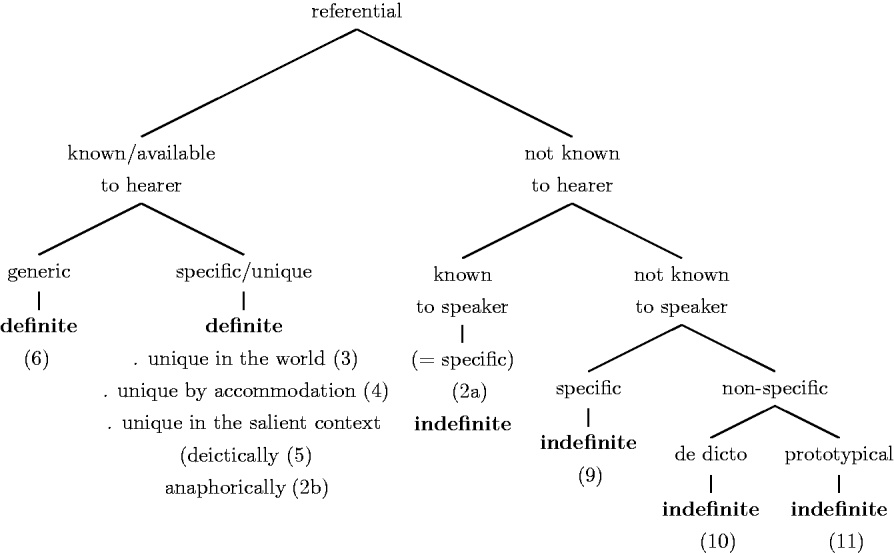
Figure 1 gives an overview of definiteness choices in French for referential NPs, based on semantic and information structural distinctions. It is organized as a decision tree to help identify possible sources of errors in child speech and will be used for ease of identification throughout the article. The numbers in the tree refer to illustrative examples in the text.
Definiteness choices
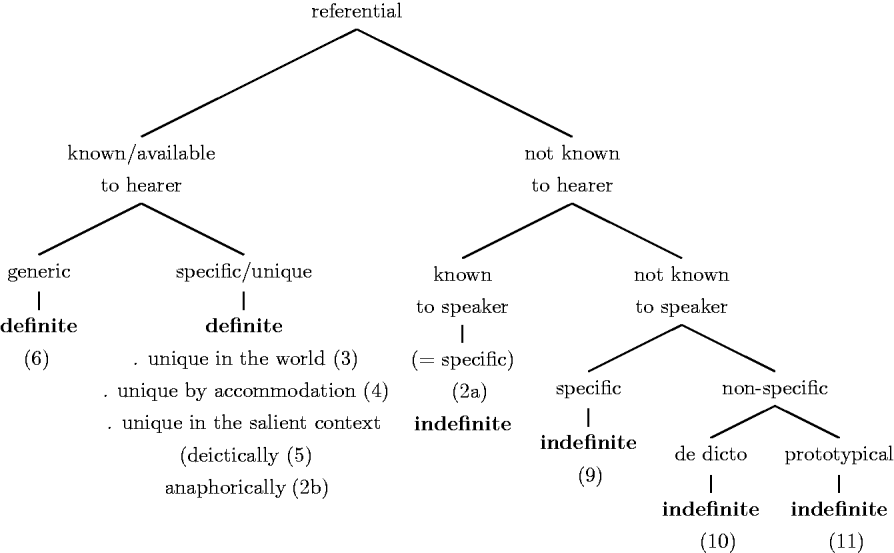
The only cases not illustrated so far are those where the referent is known neither to the hearer or the speaker. In (9), reference is made to a specific doll, but the speaker doesn't know the exact identity of the doll (i.e. the exact reference).
(9) There is a doll in the box but I don't know which one.
In (10), the speaker doesn't have a particular referent in mind: the indefinite receives what is known as a de dicto interpretation (i.e. it refers to an unspecific individual who might have the property of being ‘a new friend’ rather than an actual new friend).
(10) She wants a new friend.
In (11), the indefinite is interpreted as prototypical (it does not refer to a particular nose). Note the dierence between this and generic reference, which requires the use of a definite in French.
(11) Les clowns ont souvent un nez rouge.the clowns have often a nose red‘Clowns often have a red nose.’
As shown in Figure 1, the encoding of information in conversation is intrinsically an interactive process, in which the speaker has to evaluate the hearer's knowledge state, i.e. monitor which referents are new or salient from their point of view, in order to determine how to best encode them in their speech.
Evidence from the acquisition literature
Since the 1970s, children's mastery of certain aspects of information encoding has received quite a lot of attention. I survey below some of the main findings and highlight areas where consensus has not yet been reached.
Acquisition of definiteness distinctions
There is a huge amount of literature on the acquisition of definiteness distinctions. This review will concentrate on representative studies, and attempt to draw warranted comparisons in spite of dierences in the methodologies adopted and the populations tested. Studies have tended to focus on two broad types of errors:
(i) incoherence errors (so called by Emslie & Stevenson, Reference Emslie and Stevenson1981), where the child uses an indefinite to refer to an entity previously introduced in the discourse context:
(ii) egocentric errors (so called by Maratsos, Reference Maratsos1974), where the child uses a definite on first mention of a specific referent, in the absence of hearer knowledge (instead of an indefinite, as in (2a) in Figure 1).
(13) #He takes the block. (block unknown to hearer)
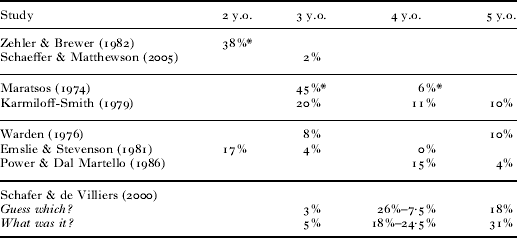
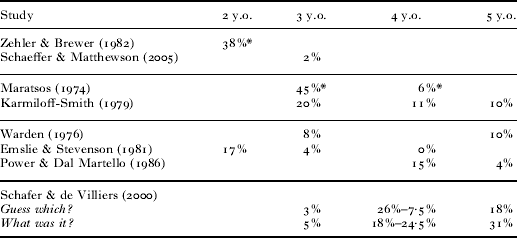
Tables 1 and 2 report incoherence errors and egocentric errors, respectively, from a selection of the most comparable, representative studies. Table 1 shows the proportion of illicit answers in contexts requiring the use of a definite for subsequent mention of a previously established referent, as in (2b) in Figure 1. The figures followed by an asterisk are those for which the breakdown in genuine incoherence errors vs. missing determiners was not provided, so these results have to be interpreted with caution. The methodologies are briefly described below the table. Similar methodologies are grouped together in the table (and separated by horizontal lines).
Illicit uses of indefinite NPs for reference maintenance in two- to five-year-olds
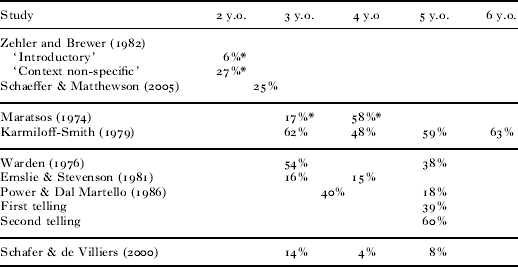
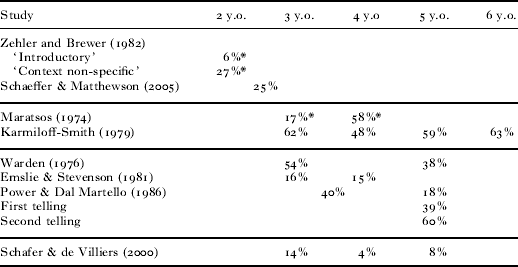
Illicit use of definite NPs for referent introduction in two- to five-year olds
Zehler & Brewer (Reference Zehler and Brewer1982) conducted a story-completion elicitation task, in which contexts were set up using props and toys, but the target referent was never present in the visual context. They tested 20 children between 1 ; 9 and 3 ; 1.
In the Schaeffer & Matthewson (Reference Schaeffer and Matthewson2005) study, participants witnessed a scene or looked at pictures, after which a puppet (who was said to be too silly and absent-minded to have noticed things) asked the child what happened. For instance, the child was shown a picture of a cup and a car and asked ‘What are these?’, followed by a picture of Mickey washing the car. The puppet then asked ‘What is Mickey doing?’ Twenty-six children between 2 ; 1 and 3 ; 10 participated.
In the Maratsos (Reference Maratsos1974) study, children were told stories in which an ‘antecedent’ was introduced, with the aim of eliciting either a definite or an indefinite form designating (a member of) that antecedent. The antecedents consisted of individuals (X) or groups of Xs (e.g. a boy vs. a group of boys). The referents introduced in the context were either de re (e.g. a particular group of boys) or de dicto (e.g. a cat somebody would like to have). After each story, the child was asked a ‘who’ question. For instance, at the end of a story about a man who saw some monkeys and some pigs, and was hoping one of them would come out and be his friend, the question was: ‘And one of them did. Who went out to the man?’ The results reported in Table 1 are those for contexts a X: the X, i.e. those where a particular referent is introduced and the child is subsequently prompted to refer to it. Twenty children between 3 ; 0 and 3 ; 6 and 20 children between 4 ; 0 and 5 ; 0 participated.
Karmiloff-Smith (1979: 141–47) replicated Maratsos' design (although using dierent scenarios). There were 6 children between 3 ; 3 and 3 ; 11, 11 children between 4 ; 0 and 4 ; 11, and 8 children between 5 ; 0 and 5 ; 11.
The results from Warden (Reference Warden1976) are from a story-telling task. Two stories consisting of three sequential events were presented to the participants on separate cards, with black-and-white drawings. Children were asked to tell the stories to another child who was behind a screen and couldn't see the pictures. There were 20 children per age group.
Emslie & Stevenson (Reference Emslie and Stevenson1981) used a similar design to Warden (Reference Warden1976), but with simpler stories and clearer pictures (with very distinctive colours identifying the participants). There were 10 children in each age group (2 ; 2–2 ; 11, 3 ; 3–3 ; 10, 4 ; 1–4 ; 10).
Power & Dal Martello (Reference Power and Dal Martello1986) replicated Emslie & Stevenson's design, but the language used was Italian. Twenty-five four-year-olds and 25 five-year-olds participated.
Schafer & de Villiers (Reference Schafer, de Villiers, Howell, Fish and Keith-Lucas2000) tested 37 children between 3 ; 6 and 5 ; 5. After a one-or two-sentence story without any visual stimulus, children were asked a question to elicit a DP response (again, without visual stimulus). There were 40 questions in total, designed to elicit 6 types of a or the. The results in Table 1 are for condition familiarthe only, where children were prompted to refer to a previously mentioned object. An example is given in (14). No significant effect was observed between age groups.
(14) Emily has two pets: a frog and a horse. She wanted to ride one of them, and so she put a saddle on it. Guess which. /What was it?
Table 1 reveals a large amount of variation in children's performance. However, the high proportion of ‘errors’ in the youngest age groups does in some cases include missing determiners, which obscures the picture substantially.
Table 2 gives an overview for the egocentric errors in the above-mentioned studies. This table represents the percentage of illicit uses of definites on first mention of a referent – where an indefinite was expected. The figures followed by an asterisk are those which include not only illicit definites but other ‘errors’ as well (such as missing determiners). As in the previous table, similar methodologies are grouped together (and separated by horizontal lines).
Zehler & Brewer's two conditions should be combined for comparison with Schaeffer & Matthewson's results because out of Schaeffer and Matthewson's 9 indefinite-eliciting contexts, only 3 could be argued to correspond to the Context non-specific condition. The 20 adults in Zehler & Brewer's study produced 100% (102/102) licit responses in the Introductory condition, but interestingly only 92% (99/108) licit responses in the Context non-specific condition. context non-specific indefinites are those in which many like-items are present in the context, and an unspecified one is mentioned. The example given by Zehler & Brewer (Reference Zehler and Brewer1982: 1269) is:
(15) This girl opens her bag of blocks and takes out … a block.
Zehler & Brewer note that, when there is a small number of like-items in the context, a definite can be licit (but is not obligatory), as shown in (16). The fact that adults use definites in the context non-specific condition 8% of the time suggests that the evaluation of whether there are many candidate like-items is subject to variation (between speakers, between situations, or both). Some of the ‘illicit’ uses of definites in Table 2 are therefore likely to be licit after all.
(16) This little boy runs to their car and opens the door.
Similarly, Schaeffer & Matthewson (Reference Schaeffer and Matthewson2005) carried out a Felicity Judgement Task to ascertain whether the use of an indefinite is indeed required and not just preferred by adults in contexts where the referent is believed by speaker only. Adults in fact accepted definites in that type of context 15% of the time (which Schaeffer & Matthewson attributed to presupposition failure or presupposition accommodation (p. 78, n. 22)). One item was also excluded from the counts because it yielded ‘anomalous results’ (n. 21).
These caveats in both studies suggest that the use of an indefinite to encode new referents is not a clear-cut requirement, and that it is diffcult to summon contexts in which adult speakers will categorically choose to use an indefinite.
The results from Maratsos reported in Table 2 are those for the Xs: aX contexts, i.e. those in which a set of specific referents were introduced and the prompt-question elicited the mention of one of them (expecting an indefinite form).Footnote 3 Note that the results for the four-year-olds given in the table are for Maratsos' 4-Low group only, as he does not give the detailed results for the 4-High group beyond saying that their overall accuracy in choosing a definite vs. an indefinite is 98%.
Data for a further four groups of children from the Karmiloff-Smith study is not included in Table 2: seven-year-olds (48%), eight-year-olds (21%), nine-year-olds (14%), and ten-year-olds (0%) (see Karmiloff-Smith, Reference Karmiloff-Smith1979: 144). As pointed out by Karmiloff-Smith herself, the prompt question in this design was of a type that tends to induce definite reference. And indeed, the proportion of definites used by the children was very high, even for children six years old and above.
The dramatic difference between the results of Warden (Reference Warden1976) and Emslie & Stevenson (Reference Emslie and Stevenson1981) may be due to the simpler plots and very distinctive characters (which were dressed quite differently and with bright colours) in the Emslie & Stevenson design, which the authors claim helped the children keep track of established referents.
In contrast, the differences in performance in Power & Dal Martello's five-year-olds remains entirely puzzling. The figures on the first line are from their first experiment, which simply replicated the design of Emslie & Stevenson (Reference Emslie and Stevenson1981). The figures on the second and third lines are from a further experiment, conducted on five-year-olds only (albeit a different group), in which the children had to tell the story twice, to different listeners. The performance on the first telling in experiment 2 (line 2) should be close to identical to that in the first experiment (line 1), as this part of the experiment was simply replicated from the first one. Yet children's performance dropped by a margin of 21 percentage points. The authors tentatively attribute this to differences between urban and rural communities.
The figures from Schafer & de Villiers (Reference Schafer, de Villiers, Howell, Fish and Keith-Lucas2000) reported in Table 2 are those for their Specific Indefinite condition. In spite of 14% use of illicit definites in the youngest group, there was no significant difference between groups.
This brief overview of the literature has revealed a significant amount of variation between the results obtained by studies attempting to elicit the same kind of data. The designs clearly have a major impact on children's performance when it comes to definiteness distinctions. I will suggest below an explanation for (some of) these discrepancies.
Acquisition of information structure
Information structure can be defined as an aspect of syntactic representation which encompasses notions such as topic, comment, focus, background, etc. The basic notions of new vs. old information, which are prerequisites to the acquisition of the linguistic notions of topic and focus, are already in place at the one-word stage: children display sensitivity to the informational status of referents, as reflected by their tendency to only mention what is new information (Greenfield & Smith, Reference Greenfield and Smith1976; Baker & Greenfield, Reference Baker and Greenfield1988). Allen has further shown that information status plays a key role in the realization vs. omission of arguments in early language production (Allen, Reference Allen2000; Reference Allen, Bowerman and Brown2007).
Information structure competence per se has received less attention to date in the acquisition literature (as pointed out by Erteschik-Shir, Reference Erteschik-Shir2007). Children have been shown to master the syntactic aspects of focus marking from at least 3 ; 11 (Costa & Szendröi Reference Costa, Szendröi, Torrens and Escobar2006) — but this was the youngest age tested in that study, so competence may well be in place earlier. Evidence for the ability to identify and encode topics has been found from 1 ; 10 in spontaneous production (De Cat, Reference De Cat, Beach-ley, Brown and Conlin2003) and 2 ; 6 (youngest age tested) in experimental conditions (De Cat, Reference De Cat2009). What remains unclear is whether the obligatory associations between definiteness and structural position to encode information contrasts are in place in the early stages, or whether there is discontinuity between the child and the adult systems in that respect. Within a functionalist approach, Hickmann and her colleagues have suggested that so-called ‘global markers’ (i.e. the use of dedicated syntactic positions to encode information status, such as topic and focus) are more complex to acquire than ‘local markings’ (i.e. the use of definiteness distinctions to encode information status) and should therefore be more difficult to acquire. This predicts a delay in the acquisition of structural distinctions, which in turn implies lack of continuity.
Children should first use the devices that are obligatory for newness in their language, but […] they might have more difficulties acquiring […] global markings […] than local markings. (Hickmann, Hendriks, Roland & Liang, Reference Hickmann, Hendriks, Roland and Liang1996: 599)
Research questions
The present study contributes new data to the debate and seeks to situate the acquisition of definiteness distinctions within the broader realm of information structure, in order to address the following questions:
(i) Is there evidence for discontinuity between adult and child information structure systems? Or are the required associations between structural and definiteness encoding of newness distinctions in place early on?
(ii) How early is the linguistic knowledge underpinning definiteness distinctions established? To what extent can residual ‘errors’ be explained by (non-linguistic) difficulties with reference tracking?
METHODS
Subjects and tasks
Forty-five monolingual French-speaking children from middle-class backgrounds participated in the study. There were three groups of fifteen children, but the data from two of the youngest children had to be discarded: one because she only produced determinerless nouns in isolation, the other because of technical problems with the recording. The mean ages were: 2 ; 11 for Group A (2 ; 6·22–3 ; 3·21), 4 ; 0 for Group B (3 ; 5·17–4 ; 5·28) and 5 ; 2 for group C (4 ; 6·10–5 ; 6·15). Children were recorded and filmed in their kindergarten in Nivelles (Belgium).
The two story-telling tasks were performed in sequence after a warm-up session. They were preceded by a Theory of Mind test, the results of which are covered in a separate article due to length limitations (De Cat, forthcoming).
At the beginning of the story elicitation tasks, one interviewer pretended to have a pain in her eyes and asked to be blindfolded. She demonstrated to the child that she couldn't see anything. Then she asked the child to find one of the ‘books’ on the table, and to tell her the story. The second experimenter took care of the filming and recording equipment. The blindfolded experimenter would remind the child from time to time that she couldn't see anything by asking clarification questions or reminding the child of the blindfold.
Based on observations from previous studies, the plots and elicitation material were designed to minimize the impact of factors likely to mask or interfere with children's linguistic competence. The plots were very simple, and consisted essentially of the introduction of new characters joining a group of established characters. To discourage recourse to the thematic strategy (Karmiloff-Smith, Reference Karmiloff-Smith1979), according to which children tend to treat main (especially human) characters as topics even on first mention, only animals were used, and no character was promoted to a more prominent position in the story. The animals were very different from each other to facilitate recognition from picture to picture. Accommodation via bridging was discouraged by the fact that the animals appeared in a setting they don't normally belong to. Each story consisted of five pictures made of colourful cut-outs.
One story was set in a city. In picture 1, a hen is walking in front of high-rise buildings. In picture 2, she meets a dog. In picture 3, the dog and the hen see a sheep arrive on its bicycle. The dog is waving to the sheep. In picture 4, the dog and the hen meet a goat with a bell around its neck. In picture 5, they see a pig flying a blue plane. The hen is waving to the pig and the pig is waving back.
The other story was set on an island. Picture 1 showed a blue bird on the island, close to a coconut tree. In picture 2, the bird is in the tree, and a snake appears in the foreground. They are looking at each other. In picture 3, the snake has climbed up the tree and is near the bird. Both are looking at a zebra in the foreground. In picture 4, the zebra has joined the other animals, and a tiger appears in the foreground. In the last picture, a rhinoceros appears. All the other animals have gathered in the tree, which is now bending dangerously towards the ground. There is a big smiling sun in all five pictures.
The next section outlines the information structure diagnostics used to analyze the children's stories and explains the motivation for choosing French as the language of study.
Information structure diagnostics in spoken French
Languages like English are not best suited to studying the emergence of topics, as they do not use syntactic or even prosodic cues that could be used to diagnose this discourse role. Spoken French, by contrast, is a discourse-configurational language in the sense of E. Kiss (Reference E. Kiss and Kiss1995), as its primary sentence articulation is motivated essentially by discourse-semantic considerations. This makes it an ideal language to study (the emergence of) information structure, as notions such as topic and focus are in most cases transparently encoded in the syntax. I present below the diagnostics needed to evaluate whether a subject noun phrase should be interpreted as topic or focus.
In spoken French, topics are obligatorily dislocated when they are not expressed with a weak pronoun only (Lambrecht, Reference Lambrecht1994; De Cat, Reference De Cat2007).Footnote 4 This is illustrated in (17), where the dislocated phrase (italicized) appears either on the left or on the right of the core of the sentence. These sentences are licit only in a context where the lettuces are salient (e.g. because they have just been mentioned), and not in an all-focus context, where they would be new information (see below).
- (17)
a. Tes salades, elles poussent vite.your lettuces they grow fast‘Your lettuces grow fast.’
b. Elles poussent vite, tes saladesthey grow fast your lettuces‘Your lettuces grow fast.’
The presence of a subject clitic forces a topic interpretation of a co-referential noun phrase (irrespective of whether one chooses to analyze clitics as agreement markers or not; see De Cat (2004b) for discussion). It can therefore be used as a diagnostic for the topic status of that noun phrase: the understood subject is obligatorily interpreted as topic in (17), but a topic interpretation is impossible in (18), where the subject noun phrase is part of the focus.
(18) Ton vélo a disparu.your bike has disappeared‘Your bike has vanished.’
New referents appear in a focus position. What makes spoken French special is that, when the new referent is encoded as a subject, a presentational structure (il y a x ‘there is x’) as in (19) is strongly preferred (at least in informal speech) over the canonical SV option (20) (see, e.g., Côté, Reference Côté1999; De Cat, Reference De Cat2007).
- (19)
a. Il ya quelqu'un qui frappe à la porte.there is somebody who knocks at the door‘Somebody's knocking.’
b. Il ya un policier qui arrive.there is a policeman who arrives‘A policeman's coming.’
- (20)
a. Quelqu'un frappe à la porte.somebody knocks at the door‘Somebody's knocking.’
b. Un policier arrive.a policeman arrives‘A policeman's coming.’
The canonical SV option (18), (20), which contains a ‘heavy’ subject (i.e. a full NP, not a weak pronoun), is only possible if the subject is in focus: either narrow focus or part of an all-focus (thetic) sentence. Thetic sentences typically occur out of the blue or in answer to a question like ‘What happened?’
In child French, distinguishing left-dislocated subjects (as in (17a)) from ‘heavy’ subjects (as in (18), (20)) is complicated by children's tendency to omit subject clitics during the null subject stage. Any strong pronoun apparently in the subject position was analyzed as dislocated, following De Cat (2004a). Full noun phrases in that position were analyzed as dislocated only if they received a clear left-dislocation prosody (see De Cat (Reference De Cat2007) for detailed prosodic diagnostics).
RESULTS
General description of the children's narratives
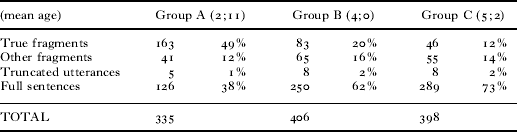
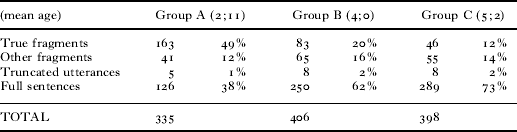
Before addressing the two research questions, a brief description of the children's narratives is in order. A clear developmental effect was observed in terms of how much they said, which can be measured by the number of utterances produced in relation to each picture, and the overall length of their sentences. Table 3 shows the growth of utterances (in terms of amount of overt structure) in the children's narratives, by age group. In this and the following tables, data from the two stories is combined, as there was no significant difference between the two with respect to the relevant features. The measure used here isn't the word or the morpheme (so MLU values are irrelevant here), but the amount of syntactic structure pronounced by the child. The smallest structures consist of fragments, and the largest of full sentences, as explained below.
Utterance growth (in amount of structure) in children's narratives
Fragments are utterances which are semantically, but not syntactically,Footnote 5 propositional. True fragments are utterances consisting of a single constituent that is uttered out of the blue, as in (21).
(21) Un mouton sur un vélo ! (True fragment)a sheep on a bike‘A sheep on a bike!’
Other fragments are also single-constituent utterances, but are uttered as follow-up to a full sentence (e.g. in answer to a wh-question), as in (22).
- (22)
Q: Qu'est-ce que tu vois ? what-is-it that you see ‘What do you see?’
A: Un mouton. (Other fragment) a sheep ‘A sheep.’
Truncated utterances, as in (23), are syntactically propositional in spite of not being full sentences.
(23) Une poule qui est sur le plancher. (Truncated utterance)a hen who is on the floor‘(There's) a hen on the floor.’
A clear developmental effect is observed in the overall number of utterances: Group A produced far fewer utterances in total than the other two groups. The most striking developmental effect is in the proportion of true fragments. Most of the time, these consisted of one existential indefinite referring to a new character in the story. Such utterances are attested in the speech of adults (De Cat, Reference De Cat2007), but, as clearly shown in Table 3, the younger the children, the more they exploit that option. This type of fragment must therefore be somehow easier/more economical to produce. De Cat & Tsoulas (Reference De Cat, Tsoulas, Belleti, Bennati, Chesi, Domenico and Ferrari2006) argue that such fragments only require a minimum of syntactic structure to be projected (pace, e.g., Merchant, Reference Merchant2004). This allows the child to achieve maximal expressive power using a minimum of syntax, relying heavily on the hearer's access to contextual information to retrieve the full propositional content. In most of the cases observed in the children's narratives, however, very little content had to be retrieved from the context, as the fragment merely brought the existence of a particular character to the attention of the hearer.
The narrative abilities of most of the children in the age groups studied are still primitive: they mostly list apparently unrelated referents and events and it is up to the listener to establish the cohesion using the visual context. In spite of this, their information structure competence is already relatively adult-like, as will be shown in the following sections.
CONTINUITY BETWEEN CHILD AND ADULT SYSTEMS
This section addresses the first research question: Is there continuity between the child and adult systems in terms of basic information structure? If not, this would mean that, at least in the early stages, the child acquires definiteness and structural markings of information structure sequentially (relying on one before the other), which means that two types of errors are expected:
(i) If definiteness marking is acquired ahead of structural encoding, we can expect the adequate use of definiteness, but randomly used in any structural position. Indicative errors would consist in principle of (a) indefinites in a structural position that cannot be used to encode new information or (b) definites in a structural position that cannot be used to encode old information. The latter type of evidence is unobtainable, because all structural positions in spoken French can host old information. (In particular, definites are licit in focus positions if the speaker wishes to attract the attention of the hearer to the referent in question. This could not be controlled for.) The former type of errors (a) would manifest itself in the use of new-information indefinites in dislocated structures (as in (24)), which are banned in the adult language (Reinhart, Reference Reinhart1981; Lambrecht, Reference Lambrecht1994; Erteschik-Shir, Reference Erteschik-Shir1997).
(24) #Un chat, il arrive.a cat he arrives
Another manifestation of this type of error would be the random use of dislocated structures in new- vs. old-information contexts – indicating that the child does not know they are only licit with old information.
(ii) If structural encoding is acquired ahead of definiteness marking, we can expect the random use of definiteness distinctions in structural positions associated with particular information status: random use of definites/indefinites in focus structures encoding new referent; and random use of definites/indefinites in dislocated structures encoding given referents. Dislocated structures should however only be used to encode old information.
In other words: if the two types of markers are acquired sequentially, we do not expect a correlation of definiteness and structural position in the encoding of newness distinctions, at least in the youngest age group.
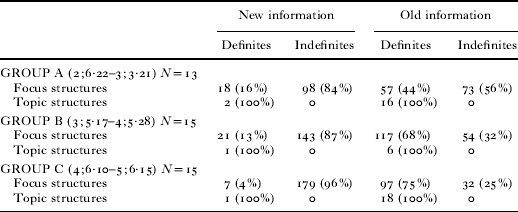
The relevant data from the story elicitation task is presented in Table 4. Focus structures include fragments (as in (21), (22)), presentatives (19), canonical SV (18), and internal arguments (2a). Topics all correspond to dislocated structures (17).Footnote 6 Any referent mentioned for the first time by the child was coded as new information. Any subsequent mention was coded as old information.Footnote 7 Only those instances that allowed the choice between a definite or an indefinite article are included in Table 4. Excluded from the counts are: noun phrases without articles (i.e. pronouns, proper nouns, nouns with omitted articles) and referents that correspond to available information even on first appearance in the context (i.e. unique referents, instances of bridging, generics). These discarded data will be discussed shortly. The rows represent structural encoding, and the columns morphological encoding. The shaded cells indicate the combinations of structural and morphological encoding required as per the rules of adult language. Low values in these cells would support the hypothesis that the two types of markers are not (yet) correlated in a particular age group.
Structural and morphological markers of newness across age groups (full noun phrases only) in the story-telling experiment
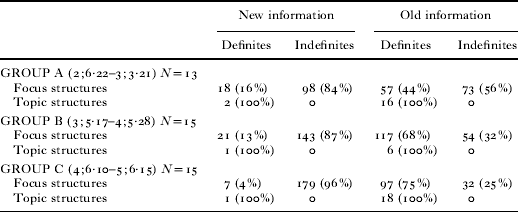
None of the dislocated structures contained an indefinite noun phrase, indicating that the children tested abide by the adult rules for the structural encoding of topics (see, e.g., Reinhart, Reference Reinhart1981; De Cat, Reference De Cat2007). Topic structures are unexpected in new-information contexts, but their occurrence in such contexts indicates inaccurate evaluation of the salience requirement on topics rather than lack of mastery of structural or morphological distinctions to encode newness. This, of course, only applies to definite dislocated phrases. Indefinites with an existential reading in that position would constitute a violation of the adult information structure rules. (See De Cat (Reference De Cat2009) for an in-depth discussion of children's ability to evaluate salience.) The overall number of dislocated structures in this dataset is small, but the absence of new-information indefinites from dislocated structures was observed both in the spontaneous production of children between 1 ; 10 and 3 ; 6 (De Cat, Reference De Cat, Beach-ley, Brown and Conlin2003) and in another experiment (De Cat, Reference De Cat2009). The latter provided robust evidence for the early mastery of the notion of topic and its encoding by the very group of preschool children studied here (figures will be provided in Table 5). That study also demonstrated clearly that children only use dislocated structures in contexts requiring a topic interpretation of the referent in question. In the absence of corroborating evidence, the hypothesis that definiteness marking is acquired ahead of structural encoding should therefore be discarded.
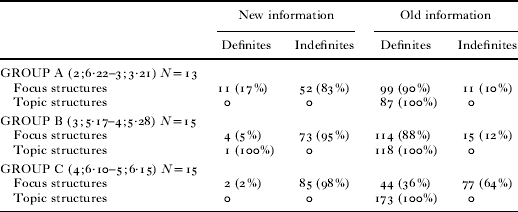
Structural and morphological markers of newness across age groups (full noun phrases only) in the topic experiment (De Cat, Reference De Cat2009)
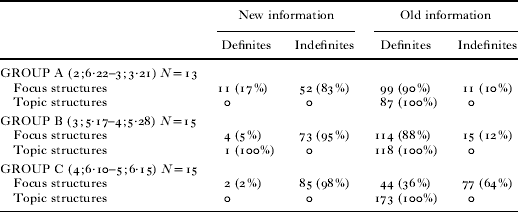
Clear indication that structural and definiteness distinctions are correlated even in the speech of the youngest children comes from the overwhelming preference for indefinites in focus structures for the encoding of new information. As shown in Table 4, this preference already manifests itself in 84% of cases in the youngest children. The small proportion of definites in focus structures encoding new information constitutes a non-negligible error margin, but it is much too low to suggest that the use of definiteness distinctions in focus structures is random. (I come back to these errors in the section ‘Definiteness and reference tracking’.) The hypothesis that structural encoding is acquired ahead of definiteness marking should thus also be discarded.
What a possible delay of one type of marking (whether it be morphological or structural distinctions) cannot explain is the relatively high use of indefinites in focus structures to encode old information – visible in the rightmost column in Table 4. Here, a clear developmental effect is observed, showing that especially the youngest children tend to encode old information as new. Crucially, the error here is not the mismatch of morphological and structural distinctions, but the coherent use of both types of encoding to indicate newness, in a context where the referent in question is not new. In the youngest age group, the correlation between the two types of markers appears to hold irrespective of the actual newness status of the referent in question, as indefinites are preferred in focus position whatever the information status. However, a chi-squared test reveals otherwise (χ2(1,N=246)=23·213, p=0·000). Even the youngest children are sensitive to newness contrasts, in spite of a strong tendency to treat old referents as new. Note that pronouns are excluded from Table 4, so referents encoded as old information are under-represented. I will come back to this shortly.
Few dislocated structures were produced by the children in this story-telling task. However, strikingly similar results were obtained in another experiment with the same children, designed to elicit ‘subject’ noun phrases with topic vs. focus interpretation (see De Cat (Reference De Cat2009) for details). The former required the use of a dislocated structure (as in (17)), and the latter of a focus structure (as in (18)). In that experiment, children produced a large number of dislocated structures, as shown in Table 5. Yet the results are directly comparable with those in Table 4, except for the near-absence of indefinites encoding old information (something I come back to below).
This examination of full noun phrases has clearly shown that the structural and morphological encoding of information status are already correlated even in the youngest group, thus ruling out the possibility that one type of marker be acquired ahead of the other. The necessary association of morphological and structural distinctions to encode information structure is thus clearly in place from at least 2 ; 6. We can conclude that there is continuity between child and adult systems in terms of basic information structure. From the youngest age tested, children build an internalized, active representation of the discourse context, and they use the morphological and structural cues of the adult grammar to encode the information status of referents. The information structure primitives of topic and focus are clearly in place at that point.
What remains to be explained is the two types of errors committed by the children: using definites in focus structures to encode new information (as in (25)), and using indefinites in focus structures to encode old information (as in (26)).
(25) #I see the hen. (Illicit in a context where the hen is new information)
(26) #I see a hen. (Illicit in a context where the hen is old information)
DEFINITENESS AND REFERENCE TRACKING
We have seen above (in Table 4) that children, especially in Group A, often encoded old referents as new and sometimes new referents as old. Only full noun phrases were included in that table, though, which skewed the overall picture when it comes to the mastery of definiteness distinctions per se. Table 6 rectifies this, by including inherently definite subject and object clitics.
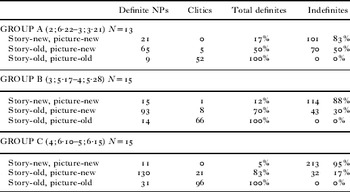
Definiteness according to newness distinctions, by age groups

Table 6 represents children's use of definiteness distinctions (in columns) according to the information status of the referent (in rows). The following were excluded from the counts: referents that could be encoded as definites on first mention (because of bridging, uniqueness, genericity), proper names, and noun phrases with a missing or unclear article. Three degrees of newness are distinguished in Table 6: ‘Story-new, picture-new’ corresponds to referents mentioned by the child for the first time in the whole story; ‘Story-old, picture-new’ corresponds to referents mentioned by the child for the first time in a particular picture, but already mentioned earlier in the story; ‘Story-old, picture-old’ are old information both in the picture context and in the story context. From an adult point of view, only ‘Story-new, picture-new’ should be treated as new information.
A first important observation is that, in spite of the ‘errors’, the use of definiteness to encode information status is not at all random. In the clearest cases (first mention in the story vs. subsequent mentions in a given picture), children's performance is close to target-like: they overwhelmingly chose indefinites for new information and definites for available information. This tallies with Allen (Reference Allen, Bowerman and Brown2007) and Serratrice (Reference Serratrice2006), who both observe that from at least 2 ; 0 (Allen) or 3 ; 3 (Serratrice) years of age, children are sensitive to the previous mention of referents.
Use of indefinites
Table 6 reveals that the target-deviant use of indefinites to encode old information only occurs on first mention of the referent in a picture context (i.e. between page turns – corresponding to the second row in each group). Subsequent mentions within a given picture context were always definite, i.e. target-like.
The intended interpretation of these illicit indefinites is clearly ‘new information’, as they exclusively appear in focus position. Children's difficulty is therefore not with the encoding (i.e. choosing the wrong form) but with the evaluation of what should count as new after a page turn. In other words, they are having trouble recognizing that some characters have already been introduced in a previous picture.
Children are known to experience difficulties with discourse integration (until around eight years of age, according to Krämer, Reference Krämer, Barbara, Amanda and Frances2003). The present findings suggest that, before the age of 4 ; 6, children tend not to track the reference of entities that are absent from the visual context. This may be due in part to the inability to recognize characters from previous pictures. Children's difficulties in that respect were particularly clear when they used an entirely different label to designate the same character in different pictures. It could also be that children failed to individualize some of the characters, as suggested by the use of encore ‘again’ in (27), for instance.
(27) Une petite poule encore.a little hen again‘Another little hen.’
The number of characters (five per story), their lack of distinctive characteristics as individuals (especially the hen and the dog – in spite of the dog wearing a blue collar) and the appearance of a new animal on each picture are likely to have contributed to children's relative confusion. In the Topic experiment (De Cat, Reference De Cat2009), the contexts were much simpler: they consisted of only one previous picture. Indefinites are hardly ever used for established referents (i.e. old information) in that experiment, as shown in Table 5. This indicates that, if they are not confused by the complexity of the context, children are able to track the information status of referents and encode it appropriately.
Their relative inability to track referents outside the visual context doesn't imply that these children are unable to consider referents beyond the here-and-now, however. Some of them even mentioned referents shown in previous pictures but absent from the one they were commenting on, as in (28a). Others talked about imagined referents, as in (28b).
- (28)
a. Mais le mouton en vélo, il est pas là. (5 ; 5·25)but the sheep on bike he is not there‘But the sheep on a bike isn't there.’
b. Oui, mais il est par là, le poussin qui fait crrr. (3 ; 5·17)yes but he is by there the chick what does crrr‘Yes but the chick that goes crrr is over there.’
This shows that, from at least 3 ; 6 (and probably earlier), children's use of reference can be discourse-anaphoric, and not just deictic (in the sense of Karmiloff-Smith, Reference Karmiloff-Smith1979). The ability of children aged 3 ; 6 to talk about referents absent from the visual context has also been demonstrated by Schafer & de Villiers (Reference Schafer, de Villiers, Howell, Fish and Keith-Lucas2000).
It appears that children are able to track reference, even beyond the here-and-now, but that their main focus of attention is on what is in the visual context. Children's use of indefinites to encode old referents would therefore be due essentially to an experimental artifact: the artificial breaks in the context flow (induced here by the turning of pages). The label incoherence error (Emslie & Stevenson, Reference Emslie and Stevenson1981) is a bit of a misnomer: children are not being incoherent with their internalized representation of the context, they are simply failing to recognize in a small number of cases that a referent has already been encountered and introduced. A more adequate label would be discourse integration error, following Krämer (Reference Krämer, Barbara, Amanda and Frances2005). The underlying information structure competence is in place, but children have trouble with the evaluation of the newness status of a small proportion of referents. This is a cognitive rather than a linguistic limitation.
Use of clitics (inherently definite forms)
Children's use of inherently definite forms is fully target-like. As shown in Table 6, clitics are never used on first mention of a referent; they are exclusively used for reference maintenance. In the topic-elicitation experiment (De Cat, Reference De Cat2009), the same children only used subject clitics when a topic interpretation was required, and never to encode new referents (error margin: 3%). This is consistent with the findings of Song & Fisher (Reference Song and Fisher2005), who showed that, from at least three years of age, children are sensitive to discourse prominence in pronoun interpretation, based on the same cues as adults. The present findings go further, in showing that the relevant knowledge is in place from at least 2 ; 6, and that it underlies children's production as well as their comprehension.
Use of definite noun phrases
Few ‘egocentric’ errors are found in this elicitation task, even in the youngest age groups. As shown in Table 6, only 17% (21/122) of new referents were introduced with a definite noun phrase in Group A, and this proportion drops down to 5% (11/224) in Group C. This is a much lower error rate than has been found in some of the studies mentioned at the outset of this article. An explanation for the residual errors is, however, still needed.
Previous studies have attributed egocentric errors to a delayed pragmatic competence (Schaeffer & Matthewson, Reference Schaeffer and Matthewson2005) or to cognitive limitations (Maratsos, Reference Maratsos1974). The delay of pragmatic competence with respect to syntactic competence has been a recurrent theme in the generative literature. Schaeffer & Matthewson (Reference Schaeffer and Matthewson2005), following Schaeffer (Reference Schaeffer2000), argue that very young children don't know that speaker and hearer assumptions are always independent, which is attributed to an immature pragmatic system. More specifically, they claim that children lack the Concept of Non-Shared Assumptions, which states that “Speaker and hearer assumptions are always independent” (Schaeffer & Matthewson, Reference Schaeffer and Matthewson2005: 69). Schaeffer (Reference Schaeffer2000) argues that this concept becomes available to the child around age 3 ; 0 because of maturation. Schaeffer & Matthewson (Reference Schaeffer and Matthewson2005: 86) suggest that this concept is acquired on the basis of experience, because of communication breakdowns – which predicts substantial variation between children, and presupposes the usability of (at least indirect) negative evidence. The exact predictions of what lacking this concept should entail are, however, unclear: if children don't know that speaker and hearer assumptions are always independent, does that mean that they assume such assumptions are never independent? In that case, one would expect a much more radical difference between children and adult than is actually observed. Overall, children's performance in the Schaeffer & Matthewson study isn't vastly different from the performance of the adults (even though the difference is significant) because it goes in the right direction: for both children and adults, the preference is for indefinites in contexts where the existence of a particular referent is believed by speaker only. Alternatively, lacking the Concept of Non-Shared Assumptions could be interpreted as assuming that speaker and hearer assumptions are sometimes independent. But how is the child to decide when to assume independence? And, crucially, what makes the child behave like adults most of the time, as shown by Schaeffer & Matthewson's results?
Going back to Figure 1, if children were unable to appreciate what is not known to their listener, they should by default treat referents known to themselves (as in (2a)) as they would referents known to the hearer (as in (2b)–(5)), i.e. they would by default use definites even on first mention of new referents. If in most cases they correctly use indefinites in such contexts, we should assume that they have the relevant linguistic competence, i.e. that they know that indefinites are used to signal to the hearer the existence (and/or relevance) of a specific referent not yet mentioned in the discourse and not yet present to the hearer's mind. The use of definites in a limited number of cases would therefore arise from a failure to evaluate either what has been mentioned before in the discourse, or what isn't present to the hearer's mind. The source of errors would therefore be cognitive rather than linguistic: it would lay in the evaluation rather than the knowledge of when to use an indefinite on first mention.
Linguistic knowledge vs. cognitive limitations
The only study reporting a total absence of egocentric errors is that of Schafer & de Villiers (Reference Schafer, de Villiers, Howell, Fish and Keith-Lucas2000). The key factor in their design is that they didn't use any visual support to prompt the children. Instead, in the relevant condition, they questioned the children about their own world (clearly unknown to the interviewer). While the children tested were slightly older than that of Zehler & Brewer (Reference Zehler and Brewer1982) and Schaeffer & Matthewson (Reference Schaeffer and Matthewson2005), they were still well within the age range of other studies reporting a high proportion of egocentric errors, such as Warden (Reference Warden1976), Maratsos (Reference Maratsos1974), Karmiloff-Smith (Reference Karmiloff-Smith1979). A very likely explanation is that egocentric errors are due principally to children's over-reliance on deixis as a source of mutual knowledge to license definites upon first mention.Footnote 8
The great variation in children's performance across studies supports the hypothesis that the choice of task had a significant impact. In the present design, great care was taken to avoid the possible licensing of definites upon first mention (such as in (3), (4)), which may partly explain the relative improvement in performance. However, the use of images as prompts still resulted in a small proportion of egocentric errors.
Children's reliance on the visual context manifests itself in different ways. For instance, in the present study, the youngest group uttered many fragments, which rendered their stories difficult to interpret without the aid of the pictures (something also reported by, e.g., Hickmann, Reference Hickmann2003). The egocentric errors discussed above are another manifestation of this tendency to rely on their addressee to recover background information from the visual context. The joint attention between themselves and their interlocutor (in spite of the blindfold, probably because of habit) is likely to have had an effect, reinforcing children's assumption of shared perspective. Young children tend to assume that their addressee will perceive as salient what is salient for themselves. In the present design, this manifested itself especially with respect to main characters in pictures. In spontaneous conversation, this could happen with what is important to the child.
Insufficient monitoring of others' perspective or knowledge state is, however, by no means unique to children. Adults (some more than others) do also sometimes misevaluate the salience of what they are talking about. And this usually leads to minor conversational breakdowns. Anderson & Boyle (Reference Anderson and Boyle1994), for instance, have shown that adults sometimes use definites to introduce referents which they know to be visible to themselves only and not to their interlocutor.
Recent research has revealed that adults do not in fact systematically ascribe beliefs to others: they monitor others' knowledge state only if explicitly required to do so (Apperly, Riggs, Simpson, Chiavarino & Samson, Reference Apperly, Riggs, Simpson, Chiavarino and Samson2006). Adults have even been claimed not to be less egocentric than children when assessing other people's perspective (Epley, Morewedge & Keysar, Reference Epley, Morewedge and Keysar2004). The essential difference lies in adults' ability to correct an initial egocentric interpretation (Epley et al., Reference Epley, Morewedge and Keysar2004: 766).
As suggested by Serratrice (Reference Serratrice2008), children's insufficient monitoring of their interlocutor's knowledge state can be better understood within the model of dialogue of Pickering & Garrod (Reference Pickering and Garrod2004). According to that model, if speaker and hearer have similar representations of a situation, they do not need to keep monitoring the other's mind. Alignment between interlocutors' perspective arises from the automatic build-up of an implicit common ground, which does not derive from the modelling of each other's belief (p. 178). Realignment with active monitoring is only required if the speaker detects signals indicating that the listener cannot straightforwardly interpret the input and that a rectification based on the speaker's own representation is insufficient to repair the breakdown.
What causes children to overuse definites to encode new information would therefore not be insufficient monitoring of their listener's perspective (as this is something that even adults only rarely need to do in daily conversation). Instead, it may be their reliance on the visual context as the main domain of reference that biases children towards assuming a wider implicit common ground with their addressee.
More on definiteness
As shown in Figure 1, discourse integration errors (so-called incoherence errors) and egocentric errors are only part of the picture when it comes to definiteness distinctions. In this section, I provide indicative evidence that children in the age group targeted in this study also have the linguistic competence necessary to choose between definites and indefinites in other contexts. The cases considered here are:
(i) NPs with a generic interpretation as in (6)
(ii) NPs denoting a specific referent available to the hearer by virtue of being
(iii) NPs denoting a referent unknown to both speaker and hearer
NPs with a generic interpretation
Some of the spontaneous comments produced by the children in this and the Topic experiment contained generic statements. These included Individual Level Predicates, which are known to require a generic interpretation of their subject (Diesing, Reference Diesing, Bach, Kratzer and Partee1989; Erteschik-Shir, Reference Erteschik-Shir1997). Such predicates can be roughly defined as encoding permanent properties (e.g. being a frog, as opposed to being upset). In spoken French, the subject of Individual Level Predicates is obligatorily dislocated, because it is a topic (De Cat, Reference De Cat2007). Children's use of full noun phrases as topics was always target-like, as illustrated in the representative examples below. Ages are given in parentheses. In each case, the intended generic interpretation was clear from the context: there was never a group of birds, monkeys, bees, etc. either in the context or on the picture, to which the child might have referred specifically, and the utterance generally provided a justification for a previous statement by invoking known properties of the referent in question.
- (29)
a. Les oiseaux, ils volent. (2 ; 6·24)the birds they fly‘Birds fly.’
b. Parce que les singes, ils grimpent aux arbres. (3 ; 2·8)because the monkeys they climb to-the trees‘Because monkeys climb trees.’
c. Et les abeilles, ça pique. (3 ; 2·8)and the bees it stings‘And bees sting.’
d. Les serpents, ils sont pas gentils hein. (3 ; 4·16)the snakes they are not nice eh‘Snakes aren't nice, are they?’
e. Les histoires, (il) faut toujours les tenir dans ce sens-là. (3 ; 11·25)the stories it must always them to-hold in that direction-there‘Stories always have to be held like this.’
f. Mais ça existe pas, les serpents avec des dents. (3 ; 11·25)but it exists not the snakes with indef teeth‘Toothed snakes don't exist.’
Referents inherently unique or unique by accommodation
In the story elicitation experiment, children sometimes referred to entities inherently unique in the context. In such cases, the use of a definite is licit (and sometimes even required) on first mention. Children tended to introduce such entities directly as definites. They never used an indefinite when this would have been illicit in the adult grammar. Representative examples of inherently unique are given below:Footnote 9
- (30)
a. Ah c' est la mer ! (2 ; 11·13)ah that is the sea‘Ah it's the sea!’
b. Une poule qui est sur le plancher. (3 ; 4·16)a hen who is on the floor‘There's a hen on the floor.’
c. Elle est dans la montagne. (3 ; 9·29)she is in the mountain‘She's in the mountain.’ (Child mistaking the high rises for mountains.)
d. Elle se promenait sur la rue. (3 ; 11·25)she refl walked on the street‘She was having a walk on the street.’
e. Il y a un cochon qui fait la voiture de l' hôpital. (4 ; 5·28)there is a pig who does the car of the hospital‘There's a pig doing (driving) the hospital car.’
Representative examples of referents unique via accommodation are given in (31). These tended to be possessives.Footnote 10
- (31)
a. Il fait la langue. (2 ; 6·24)he does the tongue‘He's poking his tongue out.’ (literally: ‘He's doing his tongue.’)
b. Alors elle voulait ses amis. (4 ; 3·0)so she wanted her friends‘So she wanted her friends.’
c. Ici, un cochon et son avion. (4 ; 5·22)here a pig and his plane‘Here, (there's) a pig and his plane.’
d. Une poule qui est toute seule qui regarde où est son coq. (4 ; 10·27)a hen who is all alone who looks where is her cockerel‘(There's) a hen who's alone and who's looking for her cockerel.’ (no cockerel in picture nor in context)
These observations are consistent with the findings of Avrutin & Coopmans (Reference Avrutin, Coopmans, Howell, Fish and Keith-Lucas2000) : four-year-old children have an adult-like command of bridging, and this knowledge is emergent in younger children. Schafer & de Villiers (Reference Schafer, de Villiers, Howell, Fish and Keith-Lucas2000) also found early mastery of definites as an inherent part of a previously mentioned object, as required in a context like (32).
(32) Adrienne got a pet hamster for her birthday and put it in a nice cage. It tried to escape so she quickly closed something. What did she close? (Schafer and de Villiers, Reference Schafer, de Villiers, Howell, Fish and Keith-Lucas2000: 612)
Illicit use of indefinites in that context was attested in children between 4 ; 0 and 5 ; 0 only, and at a rate of 6·5–7%. None was found in the children aged 3 ; 6–3 ; 11 nor in those aged 5 ; 0–5 ; 5.
Referents unknown to both speaker and hearer
Referents with a prototypical interpretation require the use of an indefinite. In the representative examples below, the prototypical interpretation was clear from the context (e.g. eating fish is presented as the prototypical behaviour of snakes in (29d)), and the referent in question was never present either in the preceding context nor in the picture the child was commenting on.
- (33)
a. Ils mangent des poissons, en plus. (3 ; 4·16)they eat indef fish in addition‘On top of that, they eat fish.’ (follow-up from the generic statement about snakes, in (29d))
b. Ils sont tout petits comme des bébés. (3 ; 11·25)they are all small like indef babies‘They're small like babies.’
c. Et quand ils vont grandir comme ça, ils ont des feuilles. (3 ; 11·25)and when they will grow like that they have indef leaves‘And when they grow, they'll have leaves.’
d. Il ressemble à un hippopotame. (5 ; 3·29)he resembles to a hippopotamus‘He looks like a hippopotamus.’
Some instances of referents with a de dicto interpretation were also found in the children's speech. In such cases, the speaker does not have a particular referent in mind: the interpretation isn't specific. The complement receives a property reading.
- (34)
a. Moi, j'ai jamais vu un mouton en vélo. (3 ; 2·8)me I-have never seen a sheep on bike‘I've never seen a sheep on a bike.’
b. Elle cherche un ami. (4 ; 1·4)she looks-for a friend‘She's looking for a friend.’
Again, these observations are consistent with findings from previous studies. Maratsos (Reference Maratsos1974) observed adult-like performance in non-specific contexts in 82–91% of cases (in the three-year-old and the high-four-year-old groups respectively). Schafer & de Villiers (Reference Schafer, de Villiers, Howell, Fish and Keith-Lucas2000) found only around 2% illicit uses of definites in non-specific contexts (illustrated below).
- (35)
a. Cindy is going to the pond. She wants to catch some fish. What will she need?
b. Think of a baseball player. Can you imagine what one looks like? What does he have?
Summary of findings
Preschool children appear to have the basic linguistic competence underlying the choice of definiteness distinctions for referential noun phrases (as sketched in Figure 1). The evidence presented in this section is indicative, as the experiment did not conjure up obligatory contexts for the relevant interpretations. Nonetheless, it goes in the expected direction if there is continuity between the child and the adult systems of discourse representation and provides a more complete picture of children's mastery of definiteness distinctions.
CONCLUSION
This article has provided evidence for continuity in basic discourse representation from the youngest age tested (2 ; 6): very young children already build an abstract, dynamic representation of the information conveyed in the discourse, and they have established adult-like associations of definiteness and structural distinctions to encode the information status of referents. In particular, the notions of focus and topic have been shown to be in place even in the youngest group. This strongly suggests that the integration of information at the interface between syntax and discourse-pragmatics is unproblematic for children, at least with respect to the basic notions of topic and focus (paceSerratrice, Sorace & Paoli, Reference Serratrice, Sorace and Paoli2004; Sorace & Filiaci, Reference Sorace and Filiaci2006).
As widely documented in the literature, preschool children nonetheless produce a number of definiteness errors. Two types were investigated in detail: discourse integration errors, whereby the child uses an indefinite to encode a previously mentioned referent, and egocentric errors, whereby the child uses a definite to encode a new referent. These were shown to be caused by cognitive limitations: young children's difficulties with establishing the continuity between events/pictures (general story-telling abilities), and their tendency to assume a wider common ground with their interlocutor than adults would – possibly exacerbated by the assumption of joint attention in spite of the blindfold. Children seem to assume the alignment of perspective between themselves and their addressee more than adults do, and to monitor less than adults for the need for perspective adjustment. Discourse integration and egocentric errors have been argued to mask what is in fact adult-like linguistic knowledge underlying definiteness choices to encode information status.
Indicative evidence of linguistic competence with respect to other aspects of definiteness distinctions (involving generic and other types of non-specific referents) was also provided.
In the light of the above, we can interpret the great variation in rates of definiteness errors in the studies surveyed at the outset as the result of a combination of experimental artifacts and cognitive limitations.