Summations
Deep brain stimulation as a therapeutic method is gaining popularity resulting in higher numbers of conducted surgeries and assessed placements of electrode implantation.
The characteristic of long-term side effects after deep brain stimulation is still mostly unpredictable.
Considerations
The review concentrates only on side effects of deep brain stimulation which could lead to blurred vision of this method as lacking positive outcomes.
Some of the presented side effects, for example, tiredness/fatigue, are hard to categorise between neurological and psychiatric side effects.
Criteria of exclusion proposed in the review lead to a limited number of articles analysed in order to obtain possibly the most homogenous results.
Introduction
Deep brain stimulation (DBS) is a neurosurgical method of modulating brain activity by implantation of electrodes to the brain. The very beginning of this technique should be sought in 1870 when the first experiment with dogs’ motor cortex took place. The electrical stimulation of this region led to movements of the limbs (Kringelbach et al., Reference Kringelbach, Jenkinson, Owen and Aziz2007). However, the broad use of DBS in humans only started over 100 years later. In 1997 the Food and Drug Administration approved the first indications for thalamic DBS for essential tremor and Parkinson disease–related (PD-related) tremor. To this day, approved anatomical targets for DBS are also extended to the subthalamic nucleus/globus pallidus internus, for treating PD, primary generalised or segmental dystonia and obsessive-compulsive disorder (OCD; Miocinovic et al., Reference Miocinovic, Somayajula, Chitnis and Vitek2013). Through the years several efforts were made to examine the potential of DBS in the treatment of other diseases, such as Gilles De La Tourette (GTS) syndrome or drug-resistant depression.
Nevertheless, there are also many drawbacks of DBS to be carefully considered. The mechanism of technique and its neural effects are yet not fully understood, meaning that much of the clinical research involving DBS has been done under hypotheses with a considerable degree of uncertainty (Miocinovic et al., Reference Miocinovic, Somayajula, Chitnis and Vitek2013). Furthermore, the side effects which can occur after surgical procedure are yet very unpredictable (Cyron, Reference Cyron2016). Reported long-term psychiatric complications associated with DBS, such as personality and mood changes, may possibly be explained by the lack of use of advanced neuroimaging and brain mapping techniques, during pre-surgical planning. Such would involve the study of the whole-brain connectivity fingerprints leaving the candidate an anatomical target for stimulation. Therefore, this review aims to summarise the key findings and limitations found in clinical DBS research.
Possible complications caused by electrode implantation can be divided into four groups: perioperative, postoperative, technical and stimulation-induced side effects (Beric et al., Reference Beric, Kelly, Rezai, Sterio, Mogilner, Zonenshayn and Kopell2001).
Perioperative and postoperative side effects are almost inevitable in neurosurgical interventions.
Technical complications (hardware-related problems) such as electrode or extension wire failure may occur.
The most unpredictable and yet not well understood are the stimulation-induced side effects. This group will be on focus in this review because of quite a little number of research works done and as a result – rather undiscovered characteristic. It is difficult to control the development of neurological and psychiatric disorders during chronic treatment. Fortunately, many of the complications could be easily prevented if they occur during or shortly after the surgery. These transient problems can be successfully overcome with programming adjustments (Videnovic & Metman, Reference Videnovic and Metman2008). The diagnosis consists of turning off the device in order to check for changes in symptomatology. Due to the sudden start in the postsurgery follow-up, the aetiology and the triggers of short-time stimulation-induced side effects are relatively clear. Proposed models focus on the level of stimulation intensity (Okun et al., Reference Okun, Mann, Foote, Shapira, Bowers, Springer, Knight, Martin and Goodman2007). Voltage levels above functional threshold applied right after the implantation may result in spreading the signal into distant brain structures and inhibition of surrounding neural structures (off the target). However, the voltage level must be sufficient to make a change in patients’ disorder. Too low stimulation could lead to little/no response. In a case of mania following DBS in obsessive-compulsive disorder (OCD) after implantation into the anterior limb of the internal capsule/nucleus accumbens (ALIC-NA), the intensity of symptoms decreased after programming adjustments (Haq et al., Reference Haq, Foote, Goodman, Ricciuti, Ward, Sudhyadhom, Jacobson, Siddiqui and Okun2010). The authors citing the prevalence of transient hypomania with ALIC/NA DBS (50%–67%) (Greenberg et al., Reference Greenberg, Malone, Friehs, Rezai, Kubu, Malloy, Salloway, Okun, Goodman and Rasmussen2006) as contrasted with subthalamic nucleus (STN) DBS (4%–8%) (Temel et al., Reference Temel, Kessels, Tan, Topdag, Boon and Visser-Vandewalle2006) state that such a significant difference could be caused by the connectivity profile of these two targets. The ALIC/NA is more richly connected to limbic and frontal regions than the STN (Nakano, Reference Nakano2000). In the case of transient hypomania in STN DBS for PD, the importance of this connection is consistent with evidence from fibre tracking (Coenen et al., Reference Coenen, Honey, Hurwitz, Rahman, McMaster, Bürgel and Mädler2009). After bilateral stimulation, the acute hypomanic episode occurred. The analysis of data revealed that the left electrode is targeting the putative limbic STN tributaries to the medial forebrain bundle (MFB). After adjusting the settings to this specific context the symptoms disappeared.
The problem with chronic side effects is, unfortunately, more complex and difficult to examine. The threshold between them and short-term side effects is not specified by any guidelines; that is why the boundaries are defined by every research group on their own. The lack of easily reversible causes is also a characteristic of chronic side effects. Because of these two aspects of the characteristic of stimulation-induced chronic side effects this group was chosen to be a main part of the review.
Material and methods
The review was based on the literature search according to several criteria:
Criteria of inclusion
Research study or case report
DBS conducted for the therapeutic purposes
At least one full electrode’s settings (voltage, frequency, pulse) in the study
Chronic character of stimulation-induced side effects with voltage independency – device adjustment was not a variable to be a reason for them
Psychiatric/personality-changing character of side effects
The precise period of follow-up (at least 1 month)
Criteria of exclusion
Trial studies conducted in order to evaluate the effects of DBS on cognitive functions
Mental disorders in patients’ medical histories
The literature search was conducted in January 2019. To find the relevant studies, following databases were used: PubMed, EMBASE and Cochrane Library. Only the articles in English were analysed. All of them must have been published till the end of 2018. In case of search settings of the database including the type of the study – case reports and clinical studies/trials were chosen (Table 1).
Databases used

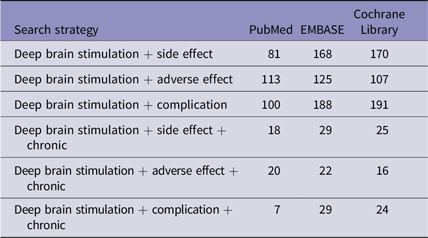
The search strategy was based on the priority of the type of the manipulation (DBS) and the presence of side effects. The characteristic of complications – chronicity and stimulation-induction – was the additional variable (Table 2).
Search strategy (articles published till the end of 2018)

All articles in search strategies ‘Deep Brain Stimulation’ AND ‘Adverse Effect/Side Effect/Complication’ AND ‘Chronic’ were read. Their analysis was focused on the personality-changing/psychiatric characteristic of side effects.
References from the articles were also used in order to include relevant studies not found in databases stated earlier.
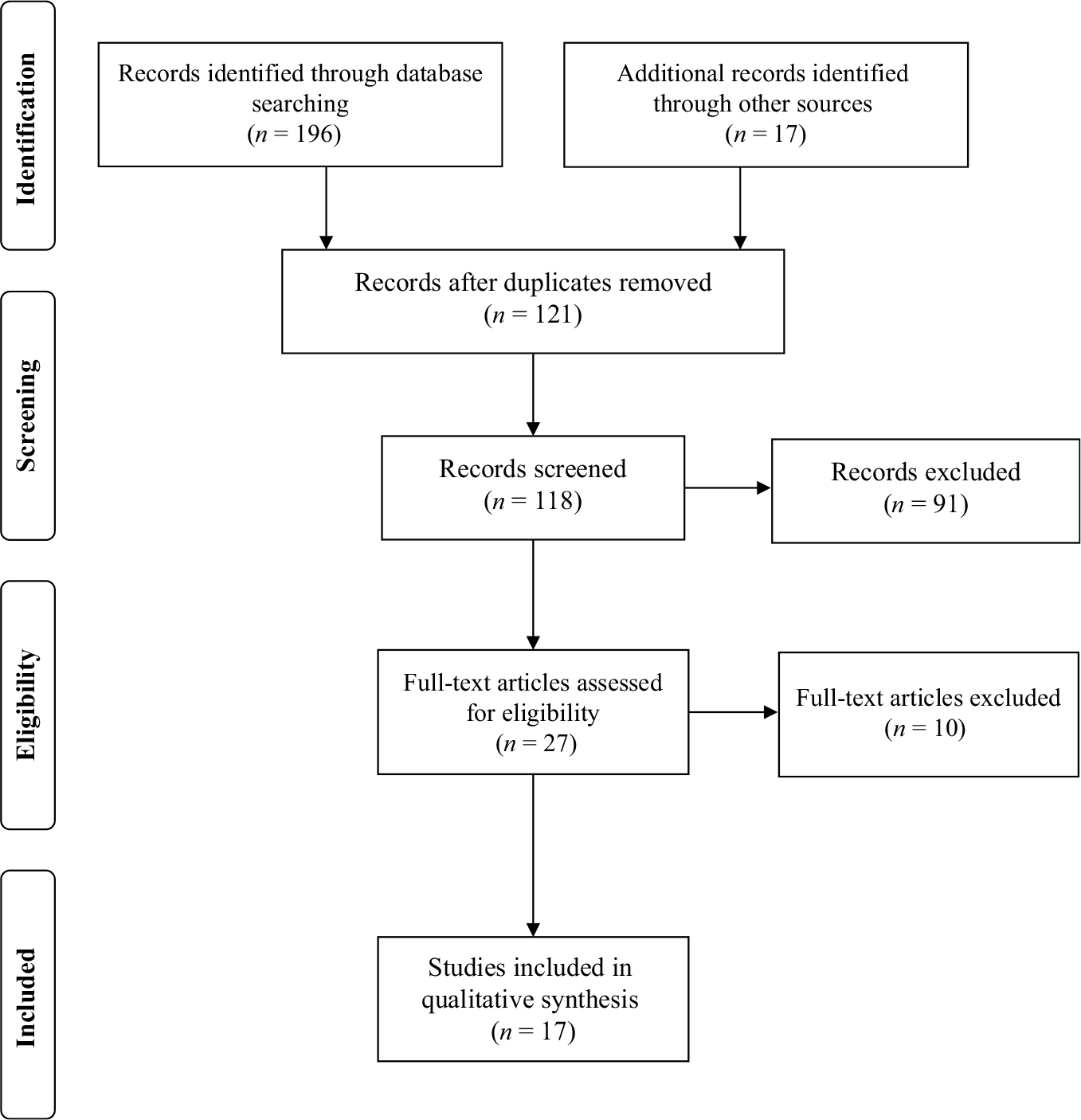
After the analysis of inclusion and exclusion criteria 17 studies were used in the review (Fig. 1).
Study selection based on the PRISMA (Moher et al., Reference Moher, Liberati, Tetzlaff, Altman and Group2009).

Results
Movement disorders

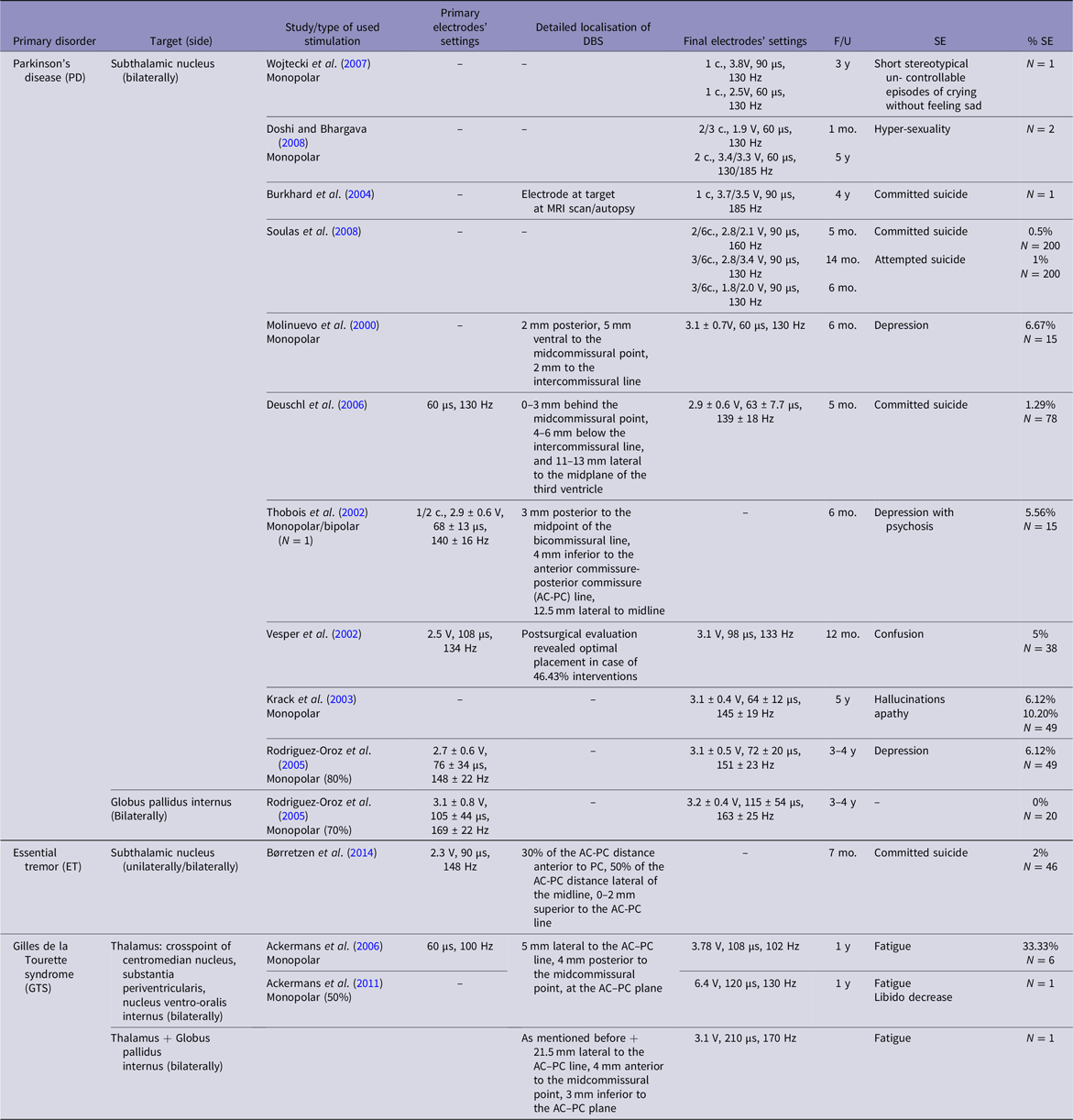
C, canal; F/U, follow-up; SE, side effects; y, year; mo., month.
Affective disorders

C, canal; F/U, follow-up; SE, side effects; y, year; mo., month.
Discussion
Up to date, the Food and Drug Administration approved the indications for thalamic DBS for essential tremor, Parkinson disease-related (PD-related) tremor and the subthalamic nucleus/globus pallidus internus DBS for PD, primary generalised or segmental dystonia and obsessive-compulsive disorder (OCD; Miocinovic et al., Reference Miocinovic, Somayajula, Chitnis and Vitek2013). DBS could be used when other methods of treatment (e.g. pharmacotherapy) are not effective.
Movement disorders
Parkinson’s disease, essential tremor and GTS DBS were analysed. According to Table 3 there are clear indications that chronic side effects in movement disorders DBS are strongly related to the placement of the electrode implantation (Burkhard et al., Reference Burkhard, Vingerhoets, Berney, Bogousslavsky, Villemure and Ghika2004; Deuschl et al., Reference Deuschl, Schade-Brittinger, Krack, Volkmann, Schäfer, Bötzel, Daniels, Deutschländer, Dillmann, Eisner, Gruber, Hamel, Herzog, Hilker, Klebe, Kloss, Koy, Krause, Kupsch, Lorenz, Lorenzl, Mehdorn, Moringlane, Oertel, Pinsker, Reichmann, Reuss, Schneider, Schnitzler, Steude, Sturm, Timmermann, Tronnier, Trottenberg, Wojtecki, Wolf, Poewe and Voges2006; Soulas et al., Reference Soulas, Gurruchaga, Palfi, Cesaro, Nguyen and Fénelon2008; Børretzen et al., Reference Børretzen, Bjerknes, Sæhle, Skjelland, Skogseid, Toft and Dietrichs2014). Thalamus should be perceived as more predictable than STN – in the group of GTS patients the possible complications were very specific and sensitive to this placement (Ackermans et al., Reference Ackermans, Temel, Cath, van der Linden, Bruggeman, Kleijer, Nederveen, Schruers, Colle, Tijssen and Visser-Vandewalle2006, Reference Ackermans, Duits, van der Linden, Tijssen, Schruers, Temel, Kleijer, Nederveen, Bruggeman, Tromp, van Kranen-Mastenbroek, Kingma, Cath and Visser-Vandewalle2011). In every analysed case there was some information about tiredness/fatigue after the surgery (in Table 3 the value is 33.33% because of the patients with prior mental disorders). This observation suggests the local character of stimulation without the effect on the limbic system. The attention-related processes (mediated by centromedian nucleus) inhibition by DBS could be perceived as an inevitable complication of the therapy. Nevertheless, the lack of affective changes is surprising because of the richly developed connections of this region with amygdala and hippocampus (Eckert et al., Reference Eckert, Metzger, Buchmann, Kaufmann, Osoba, Li, Safron, Liao, Steiner, Bogerts and Walter2012). Based on this evidence, the theory could be created that adverse effects seen in PD therapy are caused by other structures.
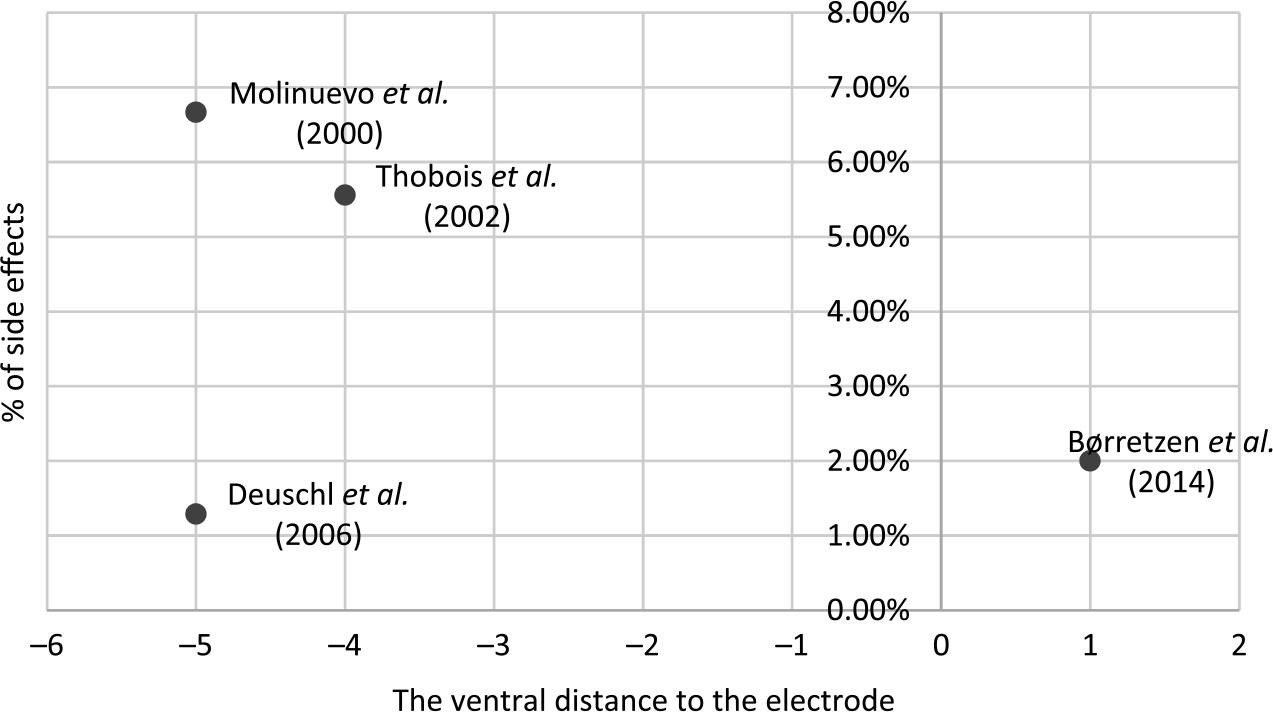
Side effects caused by STN targeting, despite the motor nature of the region, are mostly affective (Molinuevo et al., Reference Molinuevo, Valldeoriola, Tolosa, Rumia, Valls-Sole, Roldan and Ferrer2000; Thobois et al., Reference Thobois, Mertens, Guenot, Hermier, Mollion, Bouvard, Chazot, Broussolle and Sindou2002; Krack et al., Reference Krack, Batir, Van Blercom, Chabardes, Fraix, Ardouin, Koudsie, Limousin, Benazzouz, LeBas, Benabid and Pollak2003; Burkhard et al., Reference Burkhard, Vingerhoets, Berney, Bogousslavsky, Villemure and Ghika2004; Rodriguez-Oroz et al., Reference Rodriguez-Oroz, Obeso, Lang, Houeto, Pollak, Rehncrona, Kulisevsky, Albanese, Volkmann, Hariz, Quinn, Speelman, Guridi, Zamarbide, Gironell, Molet, Pascual-Sedano, Pidoux, Bonnet, Agid, Xie, Benabid, Lozano, Saint-Cyr, Romito, Contarino, Scerrati, Fraix and Van Blercom2005; Deuschl et al., Reference Deuschl, Schade-Brittinger, Krack, Volkmann, Schäfer, Bötzel, Daniels, Deutschländer, Dillmann, Eisner, Gruber, Hamel, Herzog, Hilker, Klebe, Kloss, Koy, Krause, Kupsch, Lorenz, Lorenzl, Mehdorn, Moringlane, Oertel, Pinsker, Reichmann, Reuss, Schneider, Schnitzler, Steude, Sturm, Timmermann, Tronnier, Trottenberg, Wojtecki, Wolf, Poewe and Voges2006; Doshi & Bhargava, Reference Doshi and Bhargava2008; Soulas et al., Reference Soulas, Gurruchaga, Palfi, Cesaro, Nguyen and Fénelon2008; Børretzen et al., Reference Børretzen, Bjerknes, Sæhle, Skjelland, Skogseid, Toft and Dietrichs2014). These complications are likely to be considered as the results of complex brain connectivity. The stimulation of STN leads to the inhibition of fusiform gyrus which debilitates the identification of facial expressions of negative emotions (Geday et al., Reference Geday, Ostergaard and Gjedde2006). The rich connectivity with centromedian nucleus could induce side effects comparable with those observed during GTS therapy (Brunenberg et al., Reference Brunenberg, Moeskops, Backes, Pollo, Cammoun, Vilanova, Janssen, Visser-Vandewalle, ter Haar Romeny, Thiran and Platel2012). Except associative areas, STN DBS is primarily affecting limbic regions. Ventral pallidum is involved in addictive and hedonic activities which could affect the hypersexuality (Berridge & Kringelbach, Reference Berridge and Kringelbach2015; Blum et al., Reference Blum, Badgaiyan and Gold2015). Nucleus accumbens is used as a target at the experimental treatment of depression (Bewernick et al., Reference Bewernick, Hurlemann, Matusch, Kayser, Grubert, Hadrysiewicz, Axmacher, Lemke, Cooper-Mahkorn, Cohen, Brockmann, Lenartz, Sturm and Schlaepfer2010). Orbitofrontal cortex and anterior cingulate cortex are thought to be in charge of emotion and motivation control – the link to depressive side effects (Bush et al., Reference Bush, Luu and Posner2000; Drevets, Reference Drevets2007). These structures were also seen to be highly activated after stimulation (Knight et al., Reference Knight, Testini, Min, Gibson, Gorny, Favazza, Felmlee, Kim, Welker, Clayton, Klassen, Chang and Lee2015). Such an effect could be observed in patients with more ventral STN DBS. However, the postmortem analysis of a patient who committed suicide revealed an accurate localisation of electrode (Burkhard et al., Reference Burkhard, Vingerhoets, Berney, Bogousslavsky, Villemure and Ghika2004). In addition, the ventral distance of the electrode is not conclusive (Fig. 2). During postsurgical evaluation only in 46.43% cases the optimal placement was obtained (confusion – 5%) (Vesper et al., Reference Vesper, Klostermann, Stockhammer, Funk and Brock2002).
The relationship between the ventral distance to the electrode and % of side effects. The zero point stands for midcommisural line.

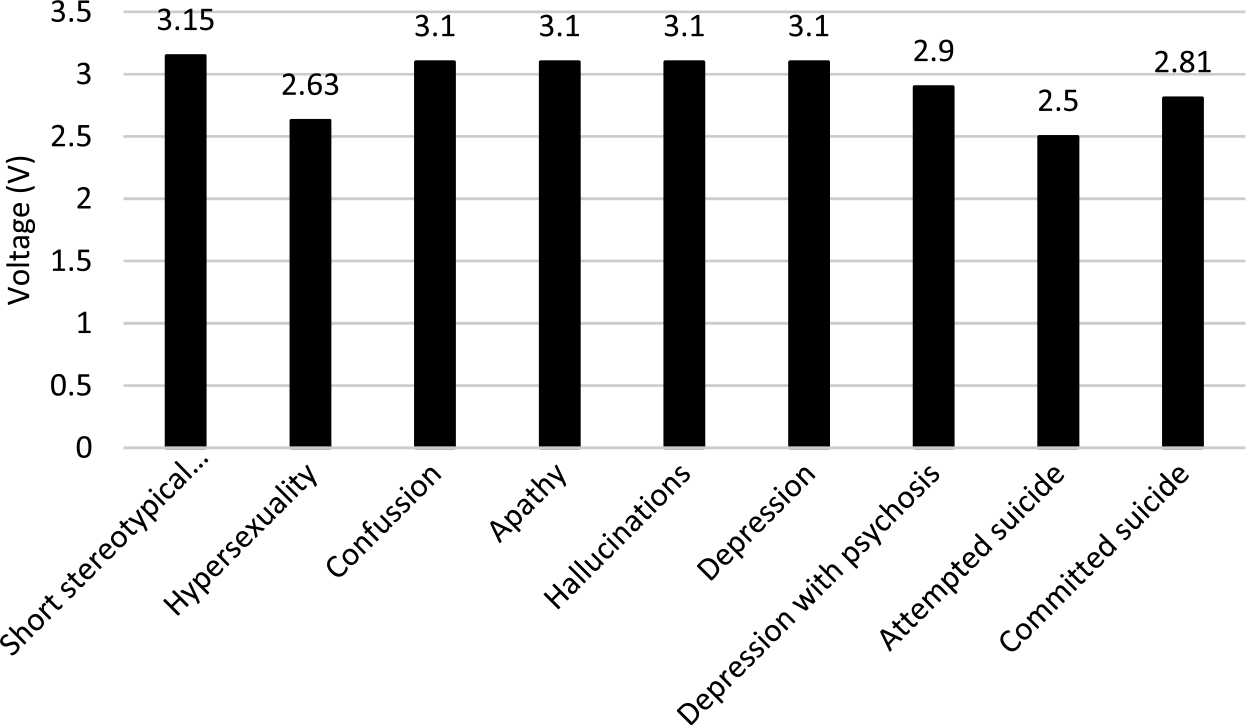
In comparison to the short-time side effects, the relationship between electrodes’ settings and the possible complications is less visible. Interestingly, the patients with depression had higher voltage level than those with suicidal actions (Fig. 3). The exception in this remark is a group of patients who committed suicide. This observation could lead to the hypothesis that a patient with suicidal thoughts is more susceptible to the DBS stimulation. The group of patients with attempted suicide had DBS with voltage the lowest of all groups – higher parameters were leading to more desperate suicide actions. The other possible explanation of this phenomenon is that the future suicides had better outcomes; that is why they were more able to be deadly for themselves.
The relationship between type of side effect and mean voltage used in the studies.

The analysis of adverse effects caused by DBS in the group of patients with movement disorders leads also to some restrictions. In parallel with PD progression, the hallucinations or depression with psychosis could appear as a part of the disorder not caused by implantation (Fénelon et al., Reference Fénelon, Mahieux, Huon and Ziégler2000; Mayeux et al., Reference Mayeux, Stern, Rosen and Leventhal1981). Hypersexuality and cortical disinhibition are also found as a pathological component during anti-Parkinson therapy (Evans et al., Reference Evans, Strafella, Weintraub and Stacy2009; Codling et al., Reference Codling, Shaw and David2015). The higher number of depression or suicidal attempts in comparison to the society is an inevitable aspect of chronic diseases (Cheattle, Reference Cheattle2011). Due to these conditions, the probable complications could be hardly distinguished from the pathological progress of disorder.
Affective disorders
Due to eligible features of included articles, only three research studies were analysed – two about OCD and one about depression. The placements of electrodes’ implantation differ from those that are used in movement disorders. Forgetfulness and word-finding problems as activities connected with cognition may be a natural outcome if obsessive thoughts are to be inhibited. Such a statement is convergent with fatigue after the treatment of GTS (excessive movement activity) (Ackermans et al., Reference Ackermans, Temel, Cath, van der Linden, Bruggeman, Kleijer, Nederveen, Schruers, Colle, Tijssen and Visser-Vandewalle2006, Reference Ackermans, Duits, van der Linden, Tijssen, Schruers, Temel, Kleijer, Nederveen, Bruggeman, Tromp, van Kranen-Mastenbroek, Kingma, Cath and Visser-Vandewalle2011). These complications could be explained by resting-state functional magnetic resonance imaging (fMRI) which revealed that nucleus accumbens DBS affects frontostriatal networks (Figee et al., Reference Figee, Luigjes, Smolders, Valencia-Alfonso, van Wingen, de Kwaasteniet, Mantione, Ooms, de Koning, Vulink, Levar, Droge, van den Munckhof, Schuurman, Nederveen, van den Brink, Mazaheri, Vink and Denys2013). The excessive connectivity between the nucleus accumbens and the lateral prefrontal cortex and medial prefrontal cortex is decreased after the implantation of electrodes.
The analysis of adverse effects after DBS in depression group is problematic due to the probable progress of the disorder. Cited cases of probable suicides could be caused by electrodes’ implantation or the worsening of major depression disorder (MDD). To expand the numbers of presented complications it is valuable to set that in excluded articles (mostly because of not defining the sustainability of side effects) the hospitalisations on account of suicidal ideations or disorder progression were in the majority. This observation leads to the statement that adverse effects caused by DBS could be in fact the cases of patients who are resistant to the treatment. The use of imaging methods in subcallosal cingulate gyrus targeting is also inconclusive (Johansen-Berg et al., Reference Johansen-Berg, Gutman, Behrens, Matthews, Rushworth, Katz, Lozano and Mayberg2008). The DBS effect could be mediated by strong connections to orbitofrontal cortex, nucleus accumbens, amygdala or hippocampus. Such a diversity makes an analysis of probable adverse effects causes even more challenging.
Conclusions
The number of available studies related to DBS and side effects caused by this manipulation is still insufficient. The better cooperation between neurosurgeons and psychiatrists/psychologists could improve this situation and lead to more effective paradigms. According to analysed studies, a ‘gold standard’ of electrodes’ settings is highly required. Most of presented by researchers side effects are voltage dependent. During the follow-up, transient episodes of mania/depression/anxiety were eliminated by DBS adjustment. The optimal electrodes’ settings should be specified as both effective and secure for the patients. However, this requirement is connected with the problem of connectivity. In cited studies, there were only a few with the exactly specified target of implantation. The use of brain mapping such as MNI is the opportunity to obtain more predictable results. The ‘gold standard’ in the field of placement is also highly needed.
The postulated technical changes should be introduced together with more specific patients’ recruitment. Despite the use of DBS in the most resistant and chronic cases, the thorough evaluation of electrodes’ impact on the brain requires the exclusion of the patients with any psychiatric disorders (in the group of movement disorders) or any other than the dominant psychiatric disorder. The proposed modification, no matter how hard to be introduced, may give the opportunity to differ the psychiatric side effects from the pathological progress of the diseases.
Financial Support
None.