Introduction
Source memory errors occur when people fail to remember not the information itself but the origin of this information (Johnson et al. Reference Johnson, Hashtroudi and Lindsay1993). In verbal memory tasks, various types of source memory error can be observed. They include repetition of the answer, recall of words that came from previous lists, or erroneous recall or recognition of words that were not part of the material to be learned.
It has been suggested that source memory deficits underlie many of the positive symptoms of schizophrenia (Frith, Reference Frith1995). The concept of source memory is broad and refers to a variety of functions. One source memory function that is frequently investigated in patients with schizophrenia is the ability to distinguish between self-generated and externally generated events, or ‘self-monitoring’. Self-monitoring of verbal material has been typically assessed in tasks that required the subjects to indicate whether speech or target words had been produced by themselves or by another person. Failure to distinguish between one's own and someone else's production has been linked to psychotic symptoms, notably auditory-verbal hallucinations (Ditman & Kuperberg, Reference Ditman and Kuperberg2005). Negative findings have been reported as well (e.g. Versmissen et al. Reference Versmissen, Janssen, Johns, McGuire, Drukker, Campo, Myin-Germeys, Van Os and Krabbendam2007a), although they may be attributable to failure to control for certain factors in the data analysis, as suggested by Woodward et al. (Reference Woodward, Menon and Whitman2007). Another source memory function consists of distinguishing events that occurred from those that were only imagined, or ‘reality monitoring’. This ability may be assessed in recognition tasks, in which subjects are required to remember whether stimuli had been previously presented or are new. The tendency to make false recognitions of non-target words, reflecting a reality monitoring deficit, was associated with delusions and thought disorder in Ragland et al. (Reference Ragland, Moelter, McGrath, Hill, Gur, Bilker, Siegel and Gur2003), and with hallucinations in two studies from our group (Brébion et al. Reference Brébion, Smith, Amador, Malaspina and Gorman1998, Reference Brébion, David, Jones and Pilowsky2005). Another instance of deficit in the reality monitoring of language consists of remembering imagined or silently read speech as being publicly uttered. Such confusion has been associated with proneness to hallucinations in a non-clinical population (Rankin & O'Carroll, Reference Rankin and O'Carroll1995), with hallucinations in schizophrenia (Franck et al. Reference Franck, Rouby, Daprati, Daléry, Marie-Cardine and Georgieff2000) and with thought disorder (Harvey, Reference Harvey1985). Source memory might also apply to the remembering of spatial or temporal context of the production of target events. Errors in remembering whether target words were presented in the first or in the second list, reflecting impairment in processing temporal context, have been found to be associated with auditory hallucinations (Brébion et al. Reference Brébion, David, Jones, Ohlsen and Pilowsky2007). Thus, a number of verbal memory errors, stemming from various types of source memory failure, have been linked to hallucinations, delusions and thought disorder.
The current study was focused on a specific type of source memory error, namely intrusions in free recall. Intrusion during list-learning tasks is defined as the erroneous recall of words that were not presented in the target list. Intrusions may be divided into extra-list intrusions (words that were not presented in any target list) and intra-list intrusions (words that came from previous target lists). Within the framework of source memory, these two types of intrusion can be considered as stemming from different mechanisms. The extra-list intrusions constitute verbal material that is added to the target list. They are thus internally generated words mistaken for the externally presented target words, due to self-monitoring errors. The intra-list intrusions arise from failure to remember the context of presentation of the target words.
Intrusion errors may be associated with positive symptoms of schizophrenia, as other types of verbal memory error. Accordingly, Moritz et al. (Reference Moritz, Heeren, Andresen and Krausz2001) observed an association between the positive symptom score and a global number of extra- and intra-list intrusions. This association did not emerge in the study by Heinrichs & McDermid Vaz (Reference Heinrichs and McDermid Vaz2004), however, possibly because positive symptoms were assessed by means of a less comprehensive scale. Subotnik et al. (Reference Subotnik, Nuechterlein, Green, Horan, Nienow, Ventura and Nguyen2006) investigated thought disorder and found it to be associated with the global number of intrusions.
Considering that extra- and intra-list intrusions are assumed to stem from distinct types of source memory failure, it would be informative to study the specific association of each with positive symptoms. This has been achieved in a few studies. Extra-list intrusions were correlated with delusion and thought disorganization scores in previous research from our group, whereas they were not correlated with a global hallucination score (Brébion et al. Reference Brébion, Gorman, Amador, Malaspina and Sharif2002). Stip et al. (Reference Stip, Corbière, Boulay, Lesage, Lecomte, Leclerc, Ricard, Cyr and Guillem2007) did not measure hallucinations but reported an association between extra-list intrusions and score on the Magical Ideation Scale, assessing delusional thought content. These authors used semantically related pairs of words, and assumed that extra-list intrusions reflect lack of inhibition of semantically related information. The association between extra-list intrusions and delusions might reflect semantic disorders common to both phenomena or, alternatively, might stem from the fact that certain types of delusion are associated with self-monitoring deficits (Versmissen et al. Reference Versmissen, Myin-Germeys, Janssen, Franck, Georgieff, Campo, Mengelers, Van Os and Krabbendam2007b).
The lack of association with hallucinations in our previous study is surprising because both hallucinations and extra-list intrusions may be related to self-monitoring deficit. The use of a global hallucination score including hallucinations in all modalities might have masked a more specific association. Extra-list intrusions may be related to hallucinations with verbal content. Indeed, voices are assumed to arise from defective monitoring of internal speech (Shergill et al. Reference Shergill, Bullmore, Simmons, Murray and McGuire2000), and extra-list intrusions in free recall might be related to the content of voices or thoughts. As far as we know, no study has specifically investigated a potential association between extra-list intrusions and verbal hallucinations.
With regard to the intra-list intrusions, they were correlated with a global hallucination score and with thought disorganization in our previous work, although not significantly with the delusion score (Brébion et al. Reference Brébion, Gorman, Amador, Malaspina and Sharif2002). Torres et al. (Reference Torres, O'Leary and Andreasen2004) reported an association of intra-list intrusions with disorganized symptoms, but not with a measure of combined hallucinations and delusions. No significant association between intra-list intrusions and delusions emerged in Stip et al. (Reference Stip, Corbière, Boulay, Lesage, Lecomte, Leclerc, Ricard, Cyr and Guillem2007). Although the available data are scant, the finding of significant associations between intra-list intrusions and hallucinations or disorganization gives some support to the theory that certain positive symptoms are related to deficit in processing the context of the stimuli (Servan-Schreiber et al. Reference Servan-Schreiber, Cohen and Steingard1996; Hemsley, Reference Hemsley2005).
In the current study, we wanted to test the hypothesis that extra-list intrusions in schizophrenia are associated with verbal hallucinations. We therefore conducted in another schizophrenia sample an analysis of the intrusions derived from a free-recall task. We expected the number of extra-list intrusions to be correlated with higher ratings on the clinical scale items pertaining to voice hearing. By contrast, we did not expect any association with visual hallucinations. Following our previous findings, we also expected significant associations between extra-list intrusions and delusions as well as thought disorganization. The intra-list intrusions were also investigated. We expected them to be significantly associated with hallucinations and thought disorganization, in agreement with previous research (Brébion et al. Reference Brébion, Gorman, Amador, Malaspina and Sharif2002; Torres et al. Reference Torres, O'Leary and Andreasen2004). A possible association with delusions was investigated, even though it was not observed in Brébion et al. (Reference Brébion, Gorman, Amador, Malaspina and Sharif2002) and Stip et al. (Reference Stip, Corbière, Boulay, Lesage, Lecomte, Leclerc, Ricard, Cyr and Guillem2007). Considering that intra-list intrusions reflect context-, rather than self-, monitoring failure, their pattern of associations with clinical symptoms was expected to be different from that of extra-list intrusions. In particular, the alleged association between intra-list intrusions and hallucinations was not expected to pertain specifically to the hallucinations with verbal content.
Our previous work revealed that the number of extra-list intrusions in free recall was also associated with certain negative symptoms, namely anhedonia, lack of spontaneity and emotional withdrawal, although in the direction opposite to that of positive symptoms (Brébion et al. Reference Brébion, Gorman, Amador, Malaspina and Sharif2002). Higher ratings of these negative symptoms were associated with fewer extra-list intrusions. However, no significant inverse correlation with intra-list intrusions was observed. Heinrichs & McDermid Vaz (Reference Heinrichs and McDermid Vaz2004) obtained an inverse association between the global number of intrusions and a negative symptom score. They suggested that negative symptoms might involve the intensification of inhibitory processes that prevent intrusions. Turetsky et al. (Reference Turetsky, Moberg, Mozley, Moelter, Agrin, Gur and Gur2002) reported that a subgroup of schizophrenic patients with a low rate of cued-recall intrusions presented elevated ratings of negative symptomatology, and notably demonstrated significantly greater affective flattening than another subgroup with higher rate of intrusions. The finding that certain clinical symptoms may be associated with fewer errors seems counterintuitive. However, we observed in previous research that a number of negative symptoms were associated with decrement in various other types of source memory error, notably confusion between self and non-self, false recognition of non-target items, and list discrimination errors (Brébion et al. Reference Brébion, Gorman, Amador, Malaspina and Sharif2002, Reference Brébion, David, Jones and Pilowsky2005, Reference Brébion, David, Jones, Ohlsen and Pilowsky2007). These symptoms may be associated with fewer of the errors stemming from source memory deficit or, alternatively, with fewer of the commission errors resulting from lack of inhibition. In this study we used the Scale for the Assessment of Negative Symptoms (SANS), which comprises affective flattening, alogia, avolition, anhedonia and attentional disorders. We expected affective flattening and anhedonia scores to be inversely correlated with the number of extra-list intrusions. A potential negative correlation with the number of intra-list intrusions was explored, even though it was not observed in our previous study. Specific associations with affective flattening and anhedonia were expected because our work has suggested that only the negative symptoms reflecting emotional or social withdrawal were involved in the inverse association with memory errors.
Method
Subjects
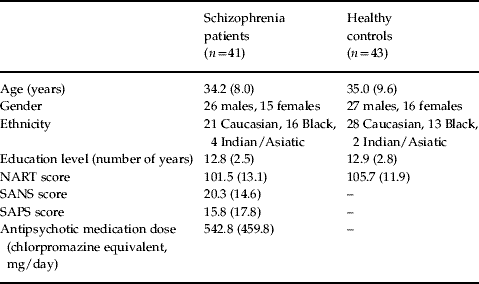
Forty-one patients with schizophrenia were recruited at the Maudsley Hospital, London. Table 1 presents their sociodemographic and clinical information. Diagnosis was made on the basis of DSM-IV criteria by two experienced psychiatrists who used clinical interview, patients' history and chart review, and reached a consensus. They also conducted the clinical assessment. Videotape training in clinical rating was undertaken to achieve over 90% inter-rater reliability in assigning the subscale score. All patients except three were on daily antipsychotic medication (olanzapine, quetiapine, amisulpiride, clozapine, risperidone, haloperidol, zuclopenthixol).
Sociodemographic information for all participants, and clinical information for the schizophrenia patients

NART, National Adult Reading Test; SANS, Scale for the Assessment of Negative Symptoms; SAPS, Scale for the Assessment of Positive Symptoms.
Values are mean (s.d.).
Forty-three healthy control subjects were recruited by local advertisement, and were screened by telephone interview to rule out any current or recent psychiatric history. The two groups were not significantly different with respect to age, gender distribution, ethnicity, education level and verbal IQ assessed by the National Adult Reading Test (NART), which provides an estimation of pre-morbid IQ in patients (p>0.10 for all comparisons). Ethical approval for the study was obtained from the local hospital Research Ethics Committee. After a full explanation of the study, subjects provided written informed consent to participate.
Clinical ratings
Positive symptoms were assessed with the Scale for the Assessment of Positive Symptoms (SAPS). A global hallucination score was derived by summing all the scores from the hallucination subscale. In addition, a verbal hallucination score was computed by summing the scores obtained on the second and third items of the hallucination subscale (‘voices commenting’ and ‘voices conversing’). Twelve patients were classified as ‘voice hearers’, with a verbal hallucination score ⩾2. The ‘visual hallucinations’ score was also tallied, and eight patients were classified as ‘visual hallucinators’ with a score ⩾2. Note that four patients belonged to both the verbal and the visual hallucinating subgroups. Global delusion and thought disorganization scores were derived by summing all the scores from the relevant subscales. Negative symptoms were assessed with the SANS. A score for each negative symptom was computed by summing all the subscale scores. The clinical symptom assessment and cognitive testing were most often conducted on the same day, or at least within one week of each other. The psychiatrists were blind to cognitive results during clinical assessment. The experimenter (G.B.) was blind to patients' symptoms during cognitive testing.
Material and procedure
The free-recall task was part of a broader memory assessment aimed at investigating various aspects of semantic and source memory functioning in schizophrenia. Four lists of 16 concrete words were administered. Two of the lists were non-organizable, and two were organizable in four semantic categories, with four items per category. One of the semantically organizable lists was made up of typical instances of the categories, so that the organization was relatively easy to spot. The other semantically organizable list was made up of atypical instances, rendering the latent organization much less salient. The lists of words were printed out. The subjects were presented with one list and informed that they had 45 s to learn it. They were required to read the list aloud at least once, so that the experimenter could ensure that all the items had been processed. They were then provided with a blank sheet and required to write down as many words as they could remember from the list, in any order and without any time limit. The procedure was identical for the four lists, except with regard to the delay elapsing between list learning and recall. One non-organizable list was followed by a few minutes' delayed recall, whereas the other three lists were followed by immediate recall. It should be noted that the different lists of words were built with the aim of investigating the effect of semantic organization and delay on the number of correctly recalled words. We did not set out to study the effect of these factors on the number of intrusions. Indeed, each list yielded a very small number of intrusions, and separate analyses of the intrusions in each condition were not meaningful. The memory scores were thus summed across the four lists. The total number of extra-list intrusions, as well as the total number of intra-list intrusions, was tallied. The total number of correctly recalled words was also tallied and used as a measure of recall efficiency.
The verbal hallucination score, thought disorganization score, number of extra-list intrusions and number of intra-list intrusions did not follow a normal distribution in the whole patient sample, and were normalized by square root transformation before data analysis.
Results
Group comparisons
The patients were highly significantly impaired relative to the healthy controls in the number of correctly recalled words [mean=20.5, s.d.=8.4 versus mean=31.3, s.d.=10.3; t(82)=5.24, p<0.0001]. The two groups were not significantly different with regard to the number of extra-list intrusions [patients: mean=1.46, s.d.=1.85; healthy controls: mean=1.98, s.d.=2.25; t(82)=1.06, n.s.] or the number of intra-list intrusions (patients: mean=0.46, s.d.=1.07; healthy controls: mean=0.40, s.d.=0.69; t<1). We have previously reported the performance achieved by patients and healthy controls in terms of the number of correctly recalled words as a function of the list organization (Brébion et al. Reference Brébion, David, Jones and Pilowsky2004). This paper focuses on the free-recall intrusions.
Associations between free-recall intrusions and positive symptoms
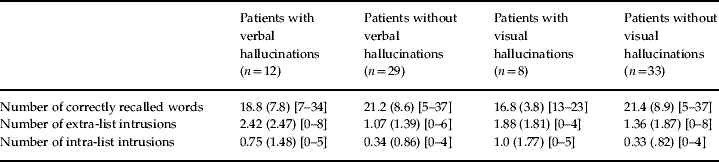
The 12 patients with verbal hallucinations were not significantly different from the 29 other patients with regard to NART score (t<1). They obtained a significantly higher SAPS score [33.8 v. 8.3, t(39)=3.93, p<0.002] and marginally significantly higher SANS score [28.5 v. 17.0, t(39)=2.07, p=0.056] than the other patients. The eight visual hallucinating patients were not significantly different from the 33 other patients on either NART (t<1), SAPS [t(39)=1.80, n.s.] or SANS (t<1) score. The memory data for each subgroup of patients with or without verbal or visual hallucinations are presented in Table 2.
Memory scores (summed over the four lists) in subgroups of patients with and without verbal or visual hallucinations

Values are given as mean (standard deviation) [range].
Extra-list intrusions
The 12 patients who were classified as voice hearers were compared to the 29 other patients on the number of extra-list intrusions. The sum of affective flattening and anhedonia scores was controlled as these two symptoms were expected to have an effect opposite to that of positive symptoms. The results show that the voice hearers committed significantly more extra-list intrusions than the other patients [F(1, 38)=5.05, p<0.03], as expected. By contrast, both subgroups were equivalent for the number of correctly recalled words (F<1), which indicates that the increased number of extra-list intrusions in voice hearers was not a mere consequence of poor memory efficiency. The eight patients with visual hallucinations were then compared to the 33 other patients after controlling for affective flattening and anhedonia scores. No significant difference on the number of extra-list intrusions was observed between the two subgroups (F<1).
Correlations between number of extra-list intrusions and positive symptoms were computed in the patient group. The number of correctly recalled words and the NART score were partialled out, to control for memory efficiency and general verbal abilities. The sum of affective flattening and anhedonia scores was also partialled out.
The expected positive correlation between number of extra-list intrusions and verbal hallucination score was observed (r=0.35, p<0.05). The correlation with the visual hallucination score was near zero. The correlation with the global hallucination score was marginally significant (r=0.32, p=0.053), but disappeared when the verbal hallucination score was controlled (r near zero). This suggests that only hallucinations with verbal content were associated with extra-list intrusions.
Visual inspection of the data suggested that the association between number of extra-list intrusions and verbal hallucination score was masked by the patients who did not commit any extra-list intrusion at all. We recomputed the analyses in the subsample of 26 patients who committed at least one extra-list intrusion, after checking the normality of the score distributions. The correlation between number of extra-list intrusions and verbal hallucination score was much enhanced (r=0.60, p<0.005). Again, the correlation with the global hallucination score was only marginally significant in this subsample (r=0.40, p=0.059), and disappeared when the verbal hallucination score was controlled. The correlation with the visual hallucination score remained near zero.
To demonstrate the specificity of the association of verbal hallucinations with the extra-list intrusions, we computed the correlation of the verbal hallucination score with the number of correctly recalled words, after controlling for NART score. No significant correlation was observed in either the whole patient sample or the subsample of 26 patients with extra-list intrusions (p>0.10 in both cases). The results were unchanged when the sum of affective flattening and anhedonia scores was also controlled.
Contrary to our expectations, neither the delusion nor the thought disorganization score was correlated with the number of extra-list intrusions in the whole patient sample (r near zero for both correlations). When only the 26 patients with at least one extra-list intrusion were considered, the correlation of number of extra-list intrusions with delusion score was still near zero, and the correlation with thought disorganization score remained non-significant.
Intra-list intrusions
Subgroups of patients were compared on the number of intra-list intrusions, after controlling for affective flattening and anhedonia scores. No significant difference was observed between the 12 patients with verbal hallucinations and the 29 other patients (F<1), or between the eight patients with visual hallucinations and the 33 other patients [F(1, 38)=1.52, n.s.].
Correlational analyses were conducted in the whole patient sample after controlling for number of correctly recalled words, NART score, and sum of affective flattening and anhedonia scores. Contrary to our expectations, the number of intra-list intrusions was not significantly correlated with the global hallucination score (r=0.22, n.s.), perhaps because the association was masked by the non-hallucinating patients. We thus recomputed the correlations in the subsample of patients who presented definite hallucinations in some modality (n=24; score ⩾2 on one or more of the hallucination items from the scale), after checking the normality of the score distributions. A significant correlation between number of intra-list intrusions and global hallucination score was revealed (r=0.52, p<0.015). The correlation with verbal hallucination score did not reach statistical significance (r=0.36, p>0.11). No correlation with the visual hallucination score emerged in this subsample (r=0.10, n.s.).
The number of intra-list intrusions was not significantly correlated with delusion score (r=0.21, n.s.) or with thought disorganization score (r=0.11, n.s.) in the whole patient sample. However, in the subsample of patients with delusions (n=26; score ⩾2 on one or more of the delusion items), a marginally significant correlation between number of intra-list intrusions and delusion score was observed (r=0.41, p=0.053). Only nine patients presented with thought disorganization, and thus no correlation was computed in this subsample.
The correlations of global hallucination and of delusion scores with number of correctly recalled words were computed, after partialling out the NART score. No significant association was revealed in either the 24 patients with hallucinations or the 26 patients with delusions. The correlations remained insignificant when affective flattening and anhedonia scores were also partialled out.
Associations between free-recall intrusions and negative symptoms
Extra-list intrusions
We computed the correlations between number of extra-list intrusions and negative symptoms in the whole patient sample, to test the hypothesis that affective flattening and anhedonia were associated with fewer extra-list intrusions. The number of correctly recalled words and the NART score were partialled out, as was the verbal hallucination score. Contrary to our expectations, neither affective flattening nor anhedonia score was significantly correlated with the number of extra-list intrusions. The analysis was recomputed in the subsample of 26 patients who committed extra-list intrusions, after checking the normality of the score distributions. A strong negative correlation between anhedonia score and number of extra-list intrusions emerged (r=−0.52, p<0.015). The direction of the correlation indicates that higher ratings of anhedonia were associated with fewer extra-list intrusions in free recall, as expected. The correlation with affective flattening score remained non-significant. Considering that potential associations with negative symptoms may be influenced by the presence of the voice-hearing symptom, we recomputed the correlations in the subsample of 29 patients who were not classified as voice hearers, after checking distribution score normality. The verbal hallucination score was removed from the covariates. This analysis revealed a significant negative correlation between affective flattening and number of extra-list intrusions (r=−0.38, p<0.05), but no association with anhedonia. The other symptoms from the SANS (alogia, avolition and attentional disorders) did not show any significant correlation with the number of extra-list intrusions in either the whole patient sample, the subsample of 26 patients with at least one extra-list intrusion, or the subsample of 29 patients who were not suffering from voice hearing (r ranging from −0.19 to 0.07, p>0.10 for all correlations).
To demonstrate the specificity of the association of affective flattening and anhedonia with the extra-list intrusions, we computed the correlations of these symptoms' scores with the number of correctly recalled words, after controlling for the NART score. No significant association appeared in either the whole patient sample, the subsample of 26 patients who committed extra-list intrusions, or the subsample of 29 patients who were not voice hearers (p>0.10 for all six correlations). T tests indicated that the subgroups of patients with no or very low ratings of either affective flattening or anhedonia did not recall significantly more words than the other patients (p>0.10 for both comparisons).
Intra-list intrusions
The correlations of number of intra-list intrusions with affective flattening and anhedonia scores were computed in the whole patient sample after partialling out the number of correctly recalled words, NART score, and global hallucination score. The number of intra-list intrusions was not correlated with either the affective flattening (r near zero) or anhedonia (r=0.12, n.s.) score. In addition, no significant correlation was observed in the subsample of 17 patients without definite hallucinations.
Intercorrelations between both types of intrusion and among clinical symptoms
The numbers of extra- and intra-list intrusions were not significantly intercorrelated in the healthy control group (r=0.20, n.s.) or in the whole patient sample (r=0.24, n.s.). However, a significant correlation emerged in the subsample of 24 patients with hallucinations (r=0.49, p<0.015). The correlation was unchanged when the number of correctly recalled words was controlled (r=0.49, p<0.02). By contrast, extra- and intra-list intrusions were unrelated in the subsample of 17 patients without hallucinations (r=−0.13, n.s.). Similarly, a significant correlation between numbers of extra- and intra-list intrusions emerged in the subsample of 26 delusional patients (r=0.43, p<0.03), and remained unchanged when the number of correctly recalled words was controlled (r=0.43, p<0.04). No association was observed in the 15 non-delusional patients (r=−0.10, n.s.). In the subsample of 26 patients who committed extra-list intrusions, the two types of intrusion were not significantly intercorrelated (r=0.15, n.s.).
The verbal hallucination score was significantly correlated with the delusion score (r=0.58, p<0.0001) and with the thought disorganization score (r=0.50, p<0.001) but not with the visual hallucination score (r=0.21, n.s.). In the subsample of 24 patients with hallucinations, verbal and visual hallucination scores were unrelated (r=−0.06). With respect to the associations with negative symptoms, the verbal hallucination score was significantly correlated with affective flattening in the whole patient sample (r=0.34, p<0.05) but not with anhedonia (r=0.15, n.s.).
Discussion
Research on verbal memory in schizophrenia has mostly focused on correct responses, notably the number of accurately recalled or recognized words in standardized neuropsychological tests. Memory errors may prove a worthwhile object of investigation as well. In this study, we conducted analyses on the number of intrusions tallied in the free recall of lists of words. A twin study has suggested that free-recall intrusions constitute an endophenotypic indicator of genetic risk for schizophrenia (Cannon et al. Reference Cannon, Huttunen, Lonnqvist, Tuulio-Henriksson, Pirkola, Glahn, Finkelstein, Hietanen, Kaprio and Koskenvuo2000). Although the number of intrusions is not always reported in memory research, it was found to be elevated in schizophrenia patients relative to healthy controls in several studies (Gold et al. Reference Gold, Randolph, Carpenter, Goldberg and Weinberger1992; Paulsen et al. Reference Paulsen, Heaton, Sadek, Perry, Delis, Braff, Kuck, Zisook and Jeste1995; Hazlett et al. Reference Hazlett, Buchsbaum, Jeu, Nenadic, Fleischman, Shihabuddin, Haznedar and Harvey2000).
Intrusions in free recall can be seen as source memory errors (Lezak, Reference Lezak1995). Given the repeated observation of a link between source memory deficit and positive symptoms in schizophrenia, intrusions might be expected to be associated with positive symptoms. The distinction between extra- and intra-list intrusions (two memory errors assumed to arise from distinct types of source memory failure) allows a better characterization of these associations.
The number of extra-list intrusions in our data was associated with voice hearing, as hypothesized. The subsample of patients who were classified as voice hearers made significantly more extra-list intrusions than the other patients. In addition, higher ratings on the verbal hallucination score were correlated with increased rates of this type of intrusion. It is worth noting that this correlation was weak in the whole patient sample, but strong in the subsample of patients who committed at least one extra-list intrusion. This observation suggests that hearing voices was a strong determinant of extra-list intrusions only when combined with another unidentified mechanism leading to intrusions. The correlation between extra-list intrusions and global hallucination score disappeared when the verbal hallucination score was controlled. Thus, it was not the hallucinatory state per se that determined extra-list intrusions. These intrusions, which reflect misattribution of internally produced words to the experimental list, seem to be selectively associated with verbal hallucinations. Our data are compatible with the view that verbal hallucinations stem from impairment in the ability to monitor internal speech (David, Reference David, David and Cutting1994). Future research could investigate the impact of the emotional valence of the target words on the extra-list intrusions (Larøi et al. Reference Larøi, Van der Linden and Marczewski2004; Costafreda et al. Reference Costafreda, Brébion, Allen, McGuire and Fu2008). It has been reported that schizophrenia patients experiencing auditory hallucinations make more external misattributions of self-generated thoughts induced by emotional rather than by neutral stimuli (Morrison & Haddock, Reference Morrison and Haddock1997); they are also more likely to make errors in the source attribution of target words when these words have a derogatory meaning (Johns et al. Reference Johns, Rossell, Frith, Ahmad, Hemsley, Kuipers and McGuire2001). It could be hypothesized that patients with verbal hallucinations commit more intrusions on lists of words with negative emotional valence. It would also be interesting to determine how confident the patients with verbal hallucinations are that the items they add to the list recall have in fact been presented (Moritz et al. Reference Moritz, Woodward and Ruff2003).
Contrary to our expectations, delusion and thought disorganization scores were unrelated to the number of extra-list intrusions. This is in contradiction with data from our previous research (Brébion et al. Reference Brébion, Gorman, Amador, Malaspina and Sharif2002). The divergence may partly stem from the fact that two of the four target lists in our previous study were followed by a delay filled by reading aloud from a book. Thus, the intruded words were likely to consist of material from the intervening reading. Our results are also at odds with Stip et al. (Reference Stip, Corbière, Boulay, Lesage, Lecomte, Leclerc, Ricard, Cyr and Guillem2007), who reported an association between extra-list intrusions and delusional ideation. Of note, these authors used a memory task that favoured semantic associations by use of semantically related word pairs as targets. Likewise, Ragland et al. (Reference Ragland, Moelter, McGrath, Hill, Gur, Bilker, Siegel and Gur2003) reported that the observed association between delusions and false recognitions of words was restricted to the condition when the target words had been semantically processed. Deep semantic processing of the material may be necessary for a correlation with delusions to be revealed, whether intrusions or false recognitions are studied. Indeed, disordered semantic memory has been associated with delusions (Rossell, Reference Rossell2006).
With regard to the intra-list intrusions, they do not consist of material produced by the subject and added to the list. They are target material misplaced in the wrong list, which suggests failure to remember the context of word presentation. Our results indicate that these intrusion errors were significantly correlated with the global hallucination score, as expected, although the correlation emerged only in the subsample of patients presenting with definite hallucinations of any kind. This association corroborates our previous finding (Brébion et al. Reference Brébion, Gorman, Amador, Malaspina and Sharif2002). The intra-list intrusions were also marginally significantly correlated with the delusion score in the subsample of delusional patients. The observed pattern of results is thus compatible with the assumption that context processing impairment underlies positive symptoms of schizophrenia (Waters et al. Reference Waters, Badcock, Michie and Maybery2006). The expected correlation between thought disorganization and intra-list intrusions was not observed, but the low prevalence of this symptom prevented us from studying a possible association in the subgroup of disorganized patients. Previous studies have failed to obtain significant associations between intra-list intrusions and delusions (Brébion et al. Reference Brébion, Gorman, Amador, Malaspina and Sharif2002; Stip et al. Reference Stip, Corbière, Boulay, Lesage, Lecomte, Leclerc, Ricard, Cyr and Guillem2007) or positive symptoms (Torres et al. Reference Torres, O'Leary and Andreasen2004). Negative findings might be due to the restricted range of intra-list intrusions. Nonetheless, the data suggest that the association with hallucinations is more robust than that with delusions.
Only in the subsamples of patients with either hallucinations or delusions were the numbers of extra- and intra-list intrusions significantly intercorrelated. This may reflect the common source memory impairment involved in various positive symptoms. However, these two types of intrusion presented a differentiated pattern of associations with specific symptoms. Notably, the extra-list intrusions were strongly correlated with the verbal hallucination score, and this accounted for their correlation with the global hallucination score. By contrast, the intra-list intrusions were strongly correlated with the global hallucination score, but not significantly with verbal hallucinations. The subgroup of patients presenting the voice-hearing symptom committed more extra-list, but not more intra-list, intrusions than the other patients. This pattern of results illustrates the fact that different positive symptoms can be related to failure in distinct source memory functions. Errors in the self-monitoring of internal speech, reflected by extra-list intrusions, were particularly associated with verbal hallucinations, whereas errors in remembering the context of presentation of the stimuli, reflected by intra-list intrusions, might be a cognitive underpinning of a broader range of positive symptoms.
Although we have interpreted our results within the framework of source memory impairment in patients presenting with positive symptoms, alternative explanations might be possible. Notably, cognitive disinhibition might be a factor leading to both free recall intrusions and hallucinations (Waters et al. Reference Waters, Badcock, Maybery and Michie2003; Paulik et al. Reference Paulik, Badcock and Maybery2008). Unfortunately, we did not include any measure of cognitive inhibition in our battery and therefore were unable to test this hypothesis.
Potential effects of certain negative symptoms on the intrusion rate were also investigated. The intra-list intrusions were unrelated to affective flattening and anhedonia, as they were in Brébion et al. (Reference Brébion, Gorman, Amador, Malaspina and Sharif2002). However, significant associations with the number of extra-list intrusions were revealed. Higher ratings of anhedonia were correlated with fewer of these intrusions, which corroborates the results from our previous study (Brébion et al. Reference Brébion, Gorman, Amador, Malaspina and Sharif2002). The correlation was restricted to the subsample of patients who committed extra-list intrusions, and thus the effect of anhedonia on these intrusions was opposite to that of voice hearing. In addition, a negative correlation with affective flattening was observed in the subsample of patients who did not suffer from voice hearing. This is consistent with the report by Turetsky et al. (Reference Turetsky, Moberg, Mozley, Moelter, Agrin, Gur and Gur2002) of an association between a high level of affective flattening and a low rate of intrusions. Our results are also compatible with Heinrichs & McDermid Vaz's (Reference Heinrichs and McDermid Vaz2004) finding of an inverse association between intrusions and a global negative symptom score. Finally, the data corroborate the associations of certain negative symptoms with various other types of memory error previously observed by our group. The inverse relationship between memory errors and certain negative symptoms appears to be robust. However, its interpretation is ambiguous. Negative symptoms might be associated with decreased rate of memory errors stemming from cognitive disinhibition or, alternatively, from source memory failure.
It is important to note that hallucinations and negative symptoms were significantly associated with the number of intrusions, but not with the number of correctly recalled words. These symptoms are thus specifically associated with erroneous responses, irrespective of memory efficiency. This observation highlights the interest of studying memory errors for the understanding of clinical symptoms.
Our conclusions are limited by the fact that the task yielded few intrusions of each type. An increased number of lists of words should be used in future research focusing on free-recall intrusions. This would lead to more numerous intrusion errors and enable to study the role of potentially relevant language factors, such as emotional valence and semantic processing, on the associations between intrusions and positive symptoms. Another limitation is the small number of individuals from whom the conclusions were derived. Few of the patients presented the key symptom of hearing voices, and the correlation between extra-list intrusions and verbal hallucination scores, although significant in the whole patient sample, was strong only in a subsample of 26 patients who committed this type of intrusion. The correlation between global hallucination score and intra-list intrusions emerged in a subsample of 24 patients with hallucinations. Intra-list intrusions and delusion score were only associated at a marginally significant level, whereas the correlation might have been significant in a larger sample. Nonetheless, our findings add to the numerous studies that have demonstrated an association between source memory errors and positive symptoms, and underscore the involvement of distinct types of source memory failure in various clinical manifestations.
Acknowledgements
G.B. was funded by grants from the Bial Foundation, the British Academy, the National Alliance for Research on Schizophrenia and Depression, and the Wodecroft Foundation. We gratefully acknowledge awards from MedicAlert and Eli Lilly.
Declaration of Interest
None.