Introduction
Discourses that emphasize the value of older people’s participation have become widespread in the past decade. The language of social participation – deeply embedded in today’s models of aging – began to appear in the gerontological scholarship of the 1990s through attention to productive, successful, and active aging (Morrow-Howell, Hinterlong, & Sherraden, Reference Morrow-Howell, Hinterlong and Sherraden2001; Rowe & Kahn, Reference Rowe and Kahn1998; Walker, Reference Walker2002). In a policy context, interpretations of aging as success, health, and activity were solidified at the Second World Assembly on Ageing (United Nations, 2002) held in Madrid in 2002. At that time, older people began to be considered as social actors responsible for their aging trajectories. This viewpoint represents a noteworthy turning point in the international perspectives on aging, and a significant departure from the 1982 Vienna First World Assembly on Aging which stressed the protection of a vulnerable elderly population (United Nations, 1982).
Over a period of 20 years, the portrait of aging in international policy shifted from the acceptance of aging as a gradual process of decline and dependency to the reconfiguration of aging as individual achievement and social contribution. Such metamorphosis is connected to increased life expectancy, extended stages of human development, and more-attractive late-life lifestyles (Biggs, Reference Biggs, Daatland and Biggs2004; Katz, Reference Katz2000; King & Calasanti, Reference King, Calasanti, Baars, Dannefer, Phillipson and Walker2006; Tulle-Winton, Reference Tulle-Winton1999). Moreover, this metamorphosis is reflected in socioeconomic and political decisions that, from the 1980s onward, dismantled many protective measures for older people and profoundly realigned pension schemes (Phillipson, Reference Phillipson, Baars, Dannefer, Phillipson and Walker2006; Phillipson & Walker, Reference Phillipson, Walker and DiGregorio1987; Walker, Reference Walker, Walker and Naegele1999a). With these trends, the depictions of seniors in public policy shifted from a passive perspective – older people as the recipients of social benefits – to an active perspective: citizens who support social and economic development through their contributions and social participation (see United Nations, 2005). This emphasis on participation is also present in the public health sphere, where seniors are considered to play a central role in maintaining optimal health conditions and avoiding illness and disability (Katz, Reference Katz2000; Minkler, Reference Minkler1990). Yet, while this positive reframing of participation in late life within public policy has resonance for many older people, the functional model of health can be seen to reinforce exclusionary attitudes towards the ill, disabled, and decrepit across the board (Grenier, Reference Grenier2012; Katz, Reference Katz2005).
This article presents an analysis of the concept of social participation as articulated in public policy1 in the Canadian Province of Québec. Guided by agenda-setting in international frameworks such as those established by the United Nations, the language of participation with regards to older people is implemented in varying ways by different countries.2 In Canada,3 the federal-provincial structure means that policies and concepts such as participation may be differentially adopted throughout the provinces. Across the country, the World Health Organization’s model of age-friendly cities was taken up by British Columbia, Manitoba, and Newfoundland/Labrador in the first decade of the 2000s (Wilson, Osei-Waree, Hewitt, & Broad, Reference Wilson, Osei-Waree, Hewitt and Broad2012), with efforts focused on encouraging healthy, active, or positive aging. Seniors’ participation appears as a leading concept throughout these provinces but nowhere with the same intensity as in the Province of Quebec. The context of Quebec, with its combined political impetus of a governmental re-engineering project (Côté, Lévesque, & Morneau, Reference Côté, Lévesque, Morneau, Côté, Lévesque and Morneau2009) and a socio-historical commitment to social movements (Vaillancourt, Reference Vaillancourt2002), provides a notable example of how the logic of individual participation is translated into both policy and practice context.
Three Quebec aging policies set between 2005 and 2011 were studied, with results illustrating the prominence of the concept of participation in this province, the shifting definitions of the term, and the challenges raised for groups whose experiences differ from the expected trajectories, such as persons aging with disabilities. We begin with a review of the concept of participation in scientific research and international aging policy. We then outline the methodology of critical discourse analysis used to assess the concept of participation in the selected policy documents. Next, thematic results are discussed, with supporting examples provided from the three Quebec policies (which we refer to elsewhere as policies A, B, and C). We conclude with a critical reassessment of aging policy on participation by specifically considering people who are aging with disabilities.
Literature Review
The Concept of Participation in Scholarly Literature
There is little consensus on the definition and use of the term participation in social gerontological literature. Although published articles tend to specifically cite a definition of participation, virtually countless definitions exist elsewhere (Raymond, Gagné, Sévigny, & Tourigny, Reference Raymond, Gagné, Sévigny and Tourigny2009; Raymond et al., Reference Raymond, Sévigny, Tourigny, Vézina, Verreault and Guilbert2013). Definitions of participation range from social interactions and the accomplishment of activities of daily living (Demers, Robichaud, Gélinas, Noreau, & Desrosiers, Reference Demers, Robichaud, Gélinas, Noreau and Desrosiers2009), to friendships, family ties, and social connectivity (Thompson & Whearty, Reference Thompson and Whearty2004), to formal involvement in social organisations and movements (Bukov, Mass, & Lamper, Reference Bukov, Mass and Lamper2002).
More specific typologies also exist. For example, in an article from the Survey of Health, Ageing and Retirement in Europe (SHARE) study, participation included the following five social activities: voluntary/charity work, training course, sport/social clubs, religious organizations, and political/community organizations (Sirven & Debrand, Reference Sirven and Debrand2008). An inventory and content analysis of social participation in the gerontology and rehabilitation literature was also conducted by Levasseur, Richard, Gauvin, and Raymond (Reference Levasseur, Richard, Gauvin and Raymond2010) who identified and reviewed no fewer than 43 definitions. They found that the majority of definitions focused on the person’s involvement in activities and interactions with others in a society or the community (Levasseur et al.). They classified the definitions into six proximal to distal levels of involvement, including (a) doing an activity in preparation for connecting with others, (b) being with others, (c) interacting with others without doing a specific activity with them, (d) doing an activity with others, (e) helping others, and (f) contributing to society. Although various definitions and interpretations of participation exist, the most prevalent seems to be that of participation as a daily and social activity.
Participation within International Aging Policy
Since the year 2000, the concept of participation has become increasingly apparent in the discourse of international aging policy (United Nations, 2002, 2005, 2008; World Health Organization, 2002, 2007). Support for what may be referred to as a “participative agenda” can be found in gerontological scholarship (Minkler & Holstein, Reference Minkler and Holstein2008) as well as within critiques of a global re-engineering of modern welfare that focus on individual responsibility and participation to compensate decreasing state expenditure (Côté & Lévesque, Reference Côté, Lévesque, Côté, Lévesque and Morneau2009; Rosanvallon, Reference Rosanvallon2000, Reference Rosanvallon2008). In fact, participation is considered as central to the citizenship regimes that have governed capitalist democracies since the 1990s (Jenson & Saint-Martin, Reference Jenson and Saint-Martin2003). Within such regimes, welfare is produced and provided through a “welfare diamond” (Evers, Pilj, & Ungerson, Reference Evers, Pilj and Ungerson1994) composed of the state, market, community, and family. The rights and responsibilities of citizens are recognized, with voice and participation used to define the boundaries of inclusion in a political community. Seniors are invited, as fellow citizens, to become active contributors within the welfare partnership. Notions such as participation or social capital – concepts which have gained wide-scale popularity during the 1990s – reflect the balance between community trust and cohesiveness – which seniors are expected to offer society through their participation – and the individual free choice and initiative citizens ought to demonstrate as partners in the welfare diamond (Rose, Reference Rose2000).
The prevalence – and seeming broad acceptance – of the participation concept in international aging policy can thus be considered to correspond with the shifting political context of retrenchment from public services; the role participation plays in the sustainability of various economies; and a general agreement about the positive effects of participation for individuals, families, and the social environment (Zedlewski & Butrica, Reference Zedlewski and Butrica2007). Adjectives of “active”, “full”, and “engaged” that are used throughout policy statements serve to qualify the meaning of participation and link it to larger agendas on health, well-being, and social contributions. Throughout policy documents at the international level, older people’s participation is depicted as a healthy and obvious choice that leads to personal fulfillment or empowerment.
A number of trends in the international discourse on participation set the framework within which older people are expected to participate. Within international policy, participation tends to be defined from a global model that links aging and social development, and operationalizes the concept as a series of expected individual practices. Several examples exist. The literature stemming from the Madrid assembly outlines the full and active participation of seniors in the social, cultural, and political life of their society (United Nations, 2002, 2005, 2008). In the World Health Organization’s (World Health Organization, 2002) active aging model, participation designates involvement in social, economic, spiritual, and civic affairs, while in the age-friendly cities approach, a distinction is made between social participation on the one hand, and civic participation and employment on the other hand. Social participation refers to the engagement of older people in recreation, socialization, and cultural, educational, and spiritual activities; older people’s civic participation and employment relates to opportunities for citizenship, and to unpaid and paid work (World Health Organization, 2007). What arises from this context is a concern for how, when implemented into practice, the participatory project may differentially impact older people who do not have the same levels of health, labor force involvement, or access to the social, cultural, and political life of the societies in which they live (Dannefer, Reference Dannefer2003; Higgs & Gilleard, Reference Higgs, Gilleard, Daatland and Biggs2004).
Design and Methods
This study analysed the participation concept in aging policy in the Canadian province of Quebec and explored how the structure and practices that surround participation could create opportunities or challenges for people aging with disabilities. The overarching focus was on policy as an agenda-setting mechanism that can shape norms and expectations concerning seniors’ participation. The research questions were as follows: How has the concept of participation evolved in aging policy in Quebec within the past decade? What models of participation are suggested for aging and late life? Are the stated norms and expectations held within the notion of participation adjusted for disability and impairment across the life course?
While several international examples of policy on participation exist, policy in the Province of Quebec was chosen because it offered a pivotal example of the rapid change taking place regarding public policy and planning. In less than four years, the provincial government of Quebec created an overarching policy framework on aging that employed participation as both a guiding principle and as a projected outcome (Gouvernement du Québec, 2008, 2012a, 2012b).
A critical discourse analysis was used to study the concept of participation in the selected policy documents. This approach provides an analytical tool that takes ideology, social relations, and a changing political context into account (Fairclough, Reference Fairclough, Wetherell, Taylor and Yates2001; Marston, Reference Marston2004). Critical discourse analysis considers language as a form of social practice and is primarily concerned with how social power is “enacted, reproduced and resisted by text and talk in the social and political context” (van Dijk, Reference van Dijk, Tannen, Schiffrin and Hamilton2001). It explores micro (e.g., day-to-day social relationships) and macro (e.g., social policy) levels, and the intersections between, in order to understand how power relations are produced and reproduced, sanctioned or contested (van Dijk). For example, questions typical of this perspective consider how discourses mediate the mutual interactions between members and groups, actions and processes, context and social structure, as well as personal and social cognition. Critical discourse analysis also focuses on how powerful groups may control policy discourses and, in doing so, come to influence the beliefs and actions of less powerful groups. In sum, as an approach, critical discourse analysis offers an analysis of power and domination that reaches beyond the theoretical borders of micro or macro levels, and draws attention to the social inequalities that may exist.
Policy documents published between 2005 and 2011 were considered in our review. We selected this period for two reasons. First, it took some time for international governments to formally respond to the Madrid assembly (2002) and develop policies that reflected the new framework. Second, and more important in the context of Quebec, the year 2005 represented a major turning point in government decision making and public policy. In 2004, the freshly elected liberal government4 set out a major state re-engineering project with central elements of citizen participation and partnership between public, private, and community sectors (Côté & Lévesque, Reference Côté, Lévesque, Côté, Lévesque and Morneau2009). Aging was identified as one of several priorities, and Quebec’s Ministry of Families and Seniors was established the following year. This new Ministry quickly published the report Full Participation of Seniors in Quebec’s Development (2005), and from this point on, participation came to the forefront of Quebec’s aging policy, both as a general social vision and as an individual pragmatic target for action.
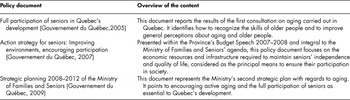
Between 2005 and 2011, the province of Quebec published 10 aging-policy documents referring to participation. These included reports, strategic planning documents, and documents best categorized as public information leaflets.5 We used two inclusion criteria to identify policy documents relevant for our research. First, the policy document had to be thematically relevant, offering a definition of participation, the activities included, and the target population. Documents with a more generalized focus on aging were excluded. Second, documents had to contain the capacity to assess change over time. The documents therefore needed to include clear objectives and measures of participation that could be assessed for continuity or change. Based on these criteria, we selected three documents for full review: Full Participation of Seniors in Quebec’s Development (Gouvernement du Québec, 2005), Action Strategy for Seniors: Improving Environments, Encouraging Participation (Gouvernement du Québec, 2007), and Strategic Planning 2008-2012 of the Ministry of Families and Seniors (Gouvernement du Québec, 2009). An overview of each document is outlined in Table 1.
Participation in Quebec’s aging policy: Selected documents

Critical discourse analysis was performed using the model provided by Fairclough (Reference Fairclough1995). In this model, the researcher carries out three specific analysis processes: (a) textual, (b) process, and (c) social. Textual analysis considers the analysis from a descriptive scope. In our study, textual analysis was guided by the following questions: How is individual participation defined in policy? Also, what are the accepted forms and locations of participation? Process analysis is more interpretative and alludes to the ways the object of analysis (i.e., the concept of participation) is produced and received by the targeted audience. Examples of our questions are as follows: Who is accountable for promoting or supporting seniors’ participation? Who are the stakeholders and proponents of participation? Also, who is likely to feel represented within this image of participation? In the third and final process, social analysis attempts to understand the ways in which historical and social conditions regulate the interactions between the object, producers, and receptors of social discourses. Questions at this level included these: What are the material and ideological circumstances and trends surrounding aging policy, both internationally and provincially? How might the suggested models that are available in public policy shape expectations of older people? Where are the boundaries for status, resources, inclusion, and meaningful participation? All three policy documents were coded and categorized according to these three analytical steps.
Two strategies were used to enhance the rigor and trustworthiness of the analytical process. First, we employed observer triangulation; both authors had to achieve independent inter-subjective agreement about coding, categorization, and interpretation in order for results to be validated (Denzin, Reference Denzin1978). Second, the search for negative cases was used. We scrutinized the seven remaining policy documents (among the 10 published between 2005 and 2011) for falsifying evidence, but policies were either unable to assess the questions at hand or failed to provide coherent alternate interpretations with the strength of those discussed here.
The following results speak to the evolution of the participation concept in aging policy in Quebec, and discuss how policy may, through the language used, create opportunities and challenges for the participation by a wide range of seniors. In this discussion, we balance our assessment of how participation may impact a general population of older people with a concern for specific groups whose life experiences may not correspond with dominant trajectories, especially where health and impairment are concerned. We draw on the specific case of seniors aging with disabilities to discuss the inherent challenges in the new participatory agenda.
Results
Guided by the analytic questions, we identified three marked themes in the evolution of participatory discourse. First, in terms of the definition, policy documents demonstrated a progression from understanding participation as a vector of well-being to one of usefulness. Second, in terms of responsibility, we witnessed a transition from participation’s being situated as a social-level concept to its becoming an individual-level feature or behaviour. Third, in terms of patterns shaping expectations and experience, the three aging policies revealed a distinctive polarization activity and what is known as a “loss of autonomy”. Together, these themes demonstrate the rapid pace with which the Ministry of Families and Seniors elaborated a participative agenda reflective of the larger dismantling of social protection schemes and re-engineering of citizens regimes (Jenson & Saint-Martin, Reference Jenson and Saint-Martin2003; Phillipson, Reference Phillipson, Baars, Dannefer, Phillipson and Walker2006; Phillipson & Walker, Reference Phillipson, Walker and DiGregorio1987; Rosanvallon, Reference Rosanvallon2008; Walker, Reference Walker, Bengston and Warner Schaie1999b).
The Shift from Well-being to Usefulness
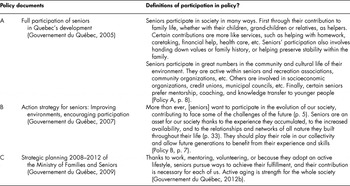
Our review of aging policies in Quebec found evidence of a shift in thinking from a concern about older people’s well-being to a focus on their usefulness. This change can be identified in each of the individual government policy documents, as well as between documents and over time. Table 2 provides direct quotations from each of the three documents (which we have identified as policy A, policy B, and policy C for simplicity) to demonstrate the move from well-being to usefulness. In policy A (Gouvernement du Québec , 2005), participation was employed to define the roles and contributions of older people in society (see Table 2). The vision of participation was one of wellness and involvement, with participation considered a means for seniors to combat ageism and to achieve more respect. A broad range of practices, from caring to coaching, were considered as valued forms of participation, and a global concern regarding seniors’ living conditions was also expressed. Participation is considered as grounded in the socioeconomic and cultural context within which it is expected to flourish.
The shift from well-being to usefulness in Quebec public policy. (For ease of reference, the policies in the first column are labeled A, B, and C.)

Two years later, in policy B (Gouvernement du Québec, 2007), participation focused on the individual’s rights and desires to access diversified and meaningful projects in retirement. This second document distinguished the current view of retirement as proactive, from previously held understandings of retirement as a condition in which a person is socially disengaged. This document fixed seniors’ contributions in the future rather than the present, with government investment in aging made on the basis of expectations of a productive return. Also noteworthy in this document is the way in which participation came to be framed in economic terms, through investments made for coming generations. In this way, the link between participation and welfare shifted from seniors being regarded as passive recipients of social benefits to individuals being regarded as actively making contributions for themselves and future generations.
In policy C, (Gouvernement du Québec, 2009) the landscape shifted even further towards usefulness. Participation was no longer an array of practices articulated according to seniors’ preferences and situations, but implied that aging took place within an active and contributory framework. The language of contribution (i.e., social, civic, economic, and professional contributive practices) replaced the diverse forms of participation outlined in policy A (i.e., caring, family transition of values, participation in cultural and community life, involvement in seniors’ movements/organizations, leisure activities, mentoring, etc.). Instead, participation became more closely aligned with the act of giving or providing. This emphasis on usefulness and contribution was also expressed in the policy C mission statement: “The Ministry of Families and Seniors contributes to the Province of Québec’s development supporting the wellbeing and the fulfillment of families, as well as children’s development and the social, civic, economic and professional contribution of seniors” (p. 15). Here, the target for children and families was support and development – seniors appeared as an add-on to the equation, framed as active contributors rather than passively in terms of their well-being or development. This quote raises concerns about whether only the contributions of seniors would be recognized, or whether they, like families and children, would be supported in their desire for well-being and personal fulfillment.
The Shift from State-Based to Local and Individual Responsibility
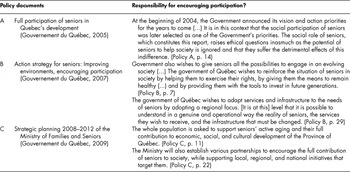
The second theme in the policy documents involves a change in the location or context of participation. When the notion of participation first appeared in the Province of Quebec’s aging policy, it was considered as a state-based responsibility, reflecting the province’s history and tradition of social policy. Table 3 provides direct quotations from each of the three policy documents to demonstrate how, over time, the context (within which participation has been defined and enacted in Quebec) shifted from the global to the local and individual level (see Table 3). Policy A (Gouvernement du Québec, 2005) strongly stated that seniors’ social participation constituted a governmental priority in the broader context of changing age demographics. It suggested that the lack of social status and role for older people in society was an ethical question that required recognition and attention on a global level. The document outlined how seniors’ desires to participate were hindered by structural obstacles such as economic expenses associated with participation, insufficient public transportation, prejudices, and so forth. With seniors’ participation in society located in the public domain, government responsibility was clearly articulated, and programs suggested directions for social programs that may have better served older people’s needs.
The shift from a state-based to a local and individual responsibility in Quebec public policy

Over time, however, a shift reflecting the retrenchment of services and government responsibility began to take place. Policy B (Gouvernement du Québec, 2007) represented an intermediate stage in the transition between a broader social and individual responsibility for participation. On the one hand, the government claimed its responsibility for offering services, support, and infrastructure; it recognized its role in changing the mind-set with regards to the position of older people in society. On the other hand, policy B represented a step towards a regionalized response to seniors’ needs and a shift in responsibility from the collective/social level to the intermediate/regional level. Although the relationship between structures and needs was not made clear, the regionalization of services and an altered infrastructure were depicted as the best ways to understand seniors’ needs. While this new framework could be considered as a positive means to more closely connect policy with the everyday experiences and realities of seniors in Quebec, questions about access and equity between regions and diverse groups of seniors could be raised. Also of concern were the ways in which these changes could be interpreted as a step away from social protection and a downloading of responsibilities onto individual seniors and their families (Phillipson, Reference Phillipson, Scharf and Keating2012).
In policy C (Gouvernement du Québec, 2008), we see the full incorporation of numerous social actors as partners in the promotion of seniors’ social participation (e.g., regional task forces, organisations for seniors’ rights, community groups) with government adopting the role of sponsor. Echoing the first theme of contributions made by older people, what emerged in Policy C was an articulation of participation as a shared responsibility between seniors and the third sector. Aging individuals had responsibility for active aging and involvement, while the third sector (largely funded by the government in Quebec), had the responsibility to provide the settings and conditions required for seniors’ participation. Such a perspective raised questions about different social actors’ role and accountability for providing access to participation not only in architectural terms, but also in socioeconomic, cultural, and symbolic terms. Meeting such needs on a local or regional basis, however, risked increasing social inequalities, as not all contexts and locations considered participative had the same priorities and/or resources.
Participation and the Polarization of Activity and Impairment
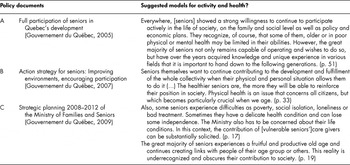
The third theme focuses on the models suggested for aging and how the definition of participation seems to play a role in polarizing activity and impairment. Unlike the first analytical themes which demonstrate significant change over time, the suggested pattern for participation consistently links health and activity with participation. The increased call for usefulness and individual responsibility that characterise more recent aging policy alters the strength and imperative for individual health and activity. In all three documents, we find a clear portrayal of the majority of seniors as healthy and active, with participation articulated as both the means to achieve this health on an individual level and as an outcome of health and activity. Table 4 provides quotations from each of the documents in order to demonstrate the importance placed on health and participation.
The polarization of activity or loss of autonomy in Quebec public policy on aging

Poor health, chronic conditions, and/or impairment are recognised but are considered to describe only a minority of older people. In policy A (Gouvernement du Québec, 2005), older people were depicted as individuals who actively participated in society, lived a healthy lifestyle, and had greater wealth than previous generations. Policy B (Gouvernement du Québec, 2007) and Policy C (Gouvernement du Québec, 2008) confirmed this reasoning, and suggested that seniors who fit this “lifestyle” description – with life experience, free time, and extensive social networks – were optimal candidates for social participation. Being healthy was presented as a requirement for maintaining social status and involvement, and vice versa.
Yet alluding to the majority of older people as healthy and active – and emphasising the importance of these lifestyles and attributes – can unintentionally serve to set apart ill or impaired seniors whose circumstances, often articulated through the notion of a “loss of autonomy”, require care or protection. When impairment was mentioned in a policy, it was described as the situation confronted by a small number of older people. Policy B stated the following: “Only 6% of the people of 65 years or more need help for their everyday activities” (Gouvernement du Québec, 2007, p. 12). In creating such distinctions between the majority and the minority of seniors needing help, assistance became associated with a category that raised questions about the extent to which these seniors could contribute in the desired fashion. The implication is that older people with impairments were considered less able or less interested in participating or contributing to their society. Older people in need of care became re-aligned with notions of dependency and, as such, seemed to lose their status as social actors and, in turn, their relationship to participation.
Such emphasis on impairment as affecting a minority of the older population seems both understated, especially where ”fourth age” – that is the social construct used to differentiate the periods of early (people aged 65–74) and late ageing (75+) (Grenier, Reference Grenier2012) – is concerned, but is also problematic for two trajectories among others: (a) that of older persons who acquire impairments in late life, and (b) that of persons aging with a chronic condition, impairment, or lifetime disability.
Discussion
Our investigation of how participation was defined and articulated in policies in Quebec between 2005 and 2011 reveals that the suggested construct of participation focused on usefulness, shifted the agenda from a collective to a local and individual model of responsibility, and created divisions between those deemed healthy and those with an impairment or loss of autonomy.
This language of participation, however, contains tensions and contradictions depending on whether it is viewed as a generalised guideline or specific measurable objective. On one hand, the language employed to describe participation and its individual rewards of social integration and recognition sound favourable and inclusionary. On the other hand, however, it can be seen to confine participation to the idealistic image of a participative senior who contributes to society, engages in self-care, and tries to avoid illness or impairment. While seemingly resonating with the lives and experiences of healthy active seniors, this approach to participation can also deprive some groups of older people from the possibilities and experiences of meaningful participation. For example, discrepancies can emerge between how older people’s participation is articulated and supported in public policy, and how it is lived by seniors on a daily basis. Here, attention to accounts at varying locations of experience that challenge taken-for-granted trajectories into late life demonstrate the need to reconsider guiding principles such as participation, and in particular, how the assumptions made may create opportunities or result in barriers for particular groups (Biggs, Reference Biggs2001; Grenier, Reference Grenier2012) such as people aging with disabilities. We draw on this specific population to more carefully consider the implications that participatory discourses may have.
A major concern for people aging with disabilities is that the definition as articulated lacks the political position from which to discuss difference and/or “otherness” (Said, Reference Said1978). In public policy, contributory and active participation is increasingly defined as being in the best interest of all, with adopting the behaviors associated with participation a matter of choice and will (Harvard School of Public Health, 2004). This standpoint can be problematic for people aging with disabilities for two central reasons. First, it is anchored in an ideal of prolonged independent adulthood, which for people with disabilities, long marginalized by such a model, results in the implication that they cannot attain the late-life standard of participation that is implied within “normal ageing” (Putnam, Reference Putnam2002), and further, that aging may become the marker of their “social death” (Priestley, Reference Priestley2003). Second, conventional frameworks or measures of participation may not fully capture the reality of older people living with disabilities (Minkler & Fadem, Reference Minkler and Fadem2002). For example, many people aging with disabilities experience situations of abrupt physical decline that produce adaptive and emotional strains.
Such situations, however, can also defy prescribed responses or interpretations. In such cases, new impairments or illness can be considered as the onset of a “second disability” and the further restriction of social activities, as well as motivate new forms of participation and involvement sparked by the idea that “time is running out” (Zarb, Reference Zarb, Arber and Evandrou1993). Here, the forms of participation experienced by persons with lifelong disabilities are not necessarily – as depicted in the emerging participatory agenda – the motor or outcome of active and productive aging, but are an evolving practice rooted in subjective interpretations, life trajectories, and unique social and cultural contexts.
In terms of responsibility, the transition from participation as a social-level concept to participation as an individual-level concept that can be identified in Quebec’s public policy can lead to taking for granted environmental, socioeconomic, and symbolic access to participative settings. For example, one exploratory study concluded that older people with disabilities felt excluded from many possibilities of participation, and in particular, places traditionally associated with seniors, such as golden age clubs (Raymond & Pomerleau, Reference Raymond, Pomerleau, Pomerleau and Thériault2011; Raymond, Sévigny, & Tourigny, Reference Raymond, Sévigny, Tourigny, Pomerleau and Thériault2011). Seniors with lifelong disabilities outlined how their demands for accommodation with regards to vision and mobility were usually rejected, depriving them of the possibility of participating in leisure activities. Empirical data from across international sites also confirm that barriers to participation are both architectural and symbolic, with disability considered the result of a lack of personal discipline, a synonym of dependence, or the greatest fear of “healthy” seniors (Cohen, Reference Cohen1988; Katz, Reference Katz1996; Minkler & Fadem, Reference Minkler and Fadem2002; Zarb & Oliver, Reference Zarb and Oliver1993).
In terms of models for experience, the Province of Quebec policy documents we reviewed revealed a distinctive path that resulted in a polarization of activity and a loss of autonomy. This theme reverberates with the finding that organisational practices and classifications made concerning frail older people can serve to exclude older people considered at risk from the expectations of a fully flourishing aging process, and in turn, enact a cultural separation between older people in the “third age” and those in the “fourth age” (Grenier, Reference Grenier2012; Grenier & Hanley, Reference Grenier and Hanley2007). Even in cases where healthy older people with long-term disabilities would be chronologically classified in the third-age group, their physical state of impairment is used to align them with the narrative of decline that is associated with the fourth-age group. With participation and health portrayed as intricately linked features of the new aging lifestyle, participation is considered to produce health, and health to generate participation – impairment and disability become relegated to the margins, invisible, or unvoiced. Such divisions conceal the ways in which older people with disabilities perceive and discuss their autonomy and support needs. For many older people living with disabilities in late life, independent living does not mean doing everything by oneself, but making choices and decisions about the way a life is organized (Buys, Boulton-Lewis, & Tedman-Jones, Reference Buys, Boulton-Lewis and Tedman-Jones2008; Zarb & Oliver, Reference Zarb and Oliver1993) and the person’s participation in society. And, while many current arguments about impairment in the fourth age seem to exclude the potential for agency (Grenier & Phillipson, 2013), the possibility of participation and inclusion from within these opportunities have begun to emerge (Shura, Siders, & Dannefer, Reference Shura, Siders and Dannefer2012).
The arguments we make here resonate with more than a decade of critical inquiry into the “new” models for aging. Scholars have drawn attention to the contradictions between universal optimistic discourses and the structural norms they impose over paths of aging (Katz, Reference Katz2005), and the alignment with the dominant ethics of activity and consumption that are taking place with regards to aging (Tulle-Winton, Reference Tulle-Winton1999). Such trends can also be interpreted as part of a larger neo-liberal agenda of non-involvement and lack of public responsibility for seniors (Phillipson, Reference Phillipson, Baars, Dannefer, Phillipson and Walker2006). Adoption of a healthy and independent lifestyle whereby participation is improved, or at minimum maintained (Rowe & Kahn, Reference Rowe and Kahn1998), is linked with a postponement of impairment and decline, and as such, the avoidance of being considered a burden on state social expenditure. Critics have argued that in current conditions and globalised pressures for cost containment, the activity credo can be considered as a strategy for declining welfare states to efficiently manage at-risk populations (Biggs, Reference Biggs, Daatland and Biggs2004; Hasmanová Marhánková, 2011; Katz, Reference Katz1996, Reference Katz2005; Laliberté-Rudman, Reference Laliberté-Rudman2011).
The challenge raised by the aforementioned tensions prompts us to ask a series of questions with respect to seniors aging with disabilities: Where do seniors with disabilities “fit” in the current frameworks of aging and participation? To what extent are seniors with a disability performing expected forms of participation and contribution to society? Can their involvement challenge the narrative of decline or are they de facto expelled from the status of meriting older and aged citizens? These questions are essential if aging policy is indeed meant to be connected with seniors’ experiences, choices, and forms of participation. Currently, it appears that the evolution, in aging policy, of the participation concept of the past decade, and the patterns suggested for late life, generate norms and expectations that are poorly aligned with disability and impairment.
Conclusion
The study of how participation was defined and operationalized in the Province of Quebec’s aging policy between 2005 and 2011 suggests a contemporary policy rhetoric that shapes norms and expectations regarding aging trajectories and seniors’ lives. Our results draw attention to the challenges embedded in such constructs, and suggest that the widely conveyed and well-accepted call for participation in old age be reconsidered. Framing the participative practices of healthy seniors in individual representations of usefulness results in a situation where older people who are either unable or uninterested in participating according to the defined standards are left out of both the activities and the definitions of success.
Although our study focused only on the concept of participation within one Canadian province, findings suggest that a broader study of participation in old age is required, and in particular a widening of critical narratives where the participative accounts of diverse groups of seniors are concerned. The use of critical discourse analysis in this analysis of public policy documents in Quebec, for example, give rise to questions that should be explored in other policy and practice contexts as well as in other population groups. Future research can build on the foundations of this study to consider the suggested models of aging that are being promoted in varying contexts, in order to see if the definitions given to participation reckon older people with particular aging trajectories. A crucial path of inquiry involves exploring in detail how seniors at intersecting social locations of experience (Calasanti, Reference Calasanti1996; McMullin, Reference McMullin2004) understand and practice participation in their everyday lives and activities, so that we may better understand how to create open and meaningful participative opportunities. This appears as a major requirement for more inclusive policies on aging and late life.