I. Introduction
THE concept of deliberative democracy stresses the value of informed citizens collectively and publicly weighing diverse arguments on their merits.Footnote 1 To its proponents, this process of deliberation holds epistemic value in revealing informed public opinionFootnote 2 and also, in some conceptions, constitutes a necessary component of democratic legitimacy.Footnote 3
This study seeks to test mechanisms to enact this ideal of democratic deliberation in a particularly challenging setting: a low-income country in the midst of a resource boom. In 2010, natural gas reserves were discovered off the southern coast of Tanzania. At the time of our experiment, in 2015, the value of these reserves was roughly fifteen times the country's gross domestic product (gdp).Footnote 4 The scale of this windfall raises a host of questions about the extraction, refinement, export, management, and allocation of resource revenues.Footnote 5
Oil and gas discoveries are commonly associated with increased authoritarianism, deteriorating governance, and slow growth.Footnote 6 Some scholars have even argued that electoral democracy is not just a victim in this story but a culprit, exacerbating the “resource curse” through populism and clientelism.Footnote 7 Measures promoted by the International Monetary Fund (imf) and other international organizations to protect resource revenues from political influence—such as sovereign wealth funds and policy rulesFootnote 8—reflect this perceived tension between sound resource governance and democratic politics.
Other strands of the literature on the politics of natural-resource wealth question the evidence for a deterministic “curse.”Footnote 9 In some accounts, initial institutional conditions,Footnote 10 including certain forms of democratic politics (for example, strong nonethnic political parties), moderate the impact of resource discoveries on economic development. This debate about the relationship between democratic participation and good resource governance provides the core motivation for our study.
We report on a two-day, nationally representative deliberative process and a longitudinal survey of two thousand voting-age adults to examine how ordinary Tanzanians wanted to use the revenue windfall from their country's recent natural gas discovery. This deliberative exercise is couched within an experimental design that allows us to measure its overall impact on public opinion, and to begin to disentangle the role of receiving additional information from collective deliberation per se. While the main treatment is a bundle of information and deliberation, we also test the effect of information alone—that is, distributing information on natural-gas management options via video presentations without the benefit of deliberation.
The early literature on oil and gas booms in developing countries identified the main policy failure to be overly rapid and unsustainable fiscal expansion.Footnote 11 On the substantive question of whether deliberation moderates public pressure toward policy choices that may contribute to profligate spending and a broader resource curse, our results are somewhat nuanced. We find that public opinion strongly supports spending rather than saving Tanzania's resource windfall, and prefers recurrent expenditures in health and education rather than in physical infrastructure. These preferences do not appear to stem from a lack of information or a failure to consider the implications of policy choices. Information treatments and two days of intensive deliberation either leave these preferences unchanged or reinforce them.
Increased social spending need not imply fiscal profligacy. While even informed and considered public opinion in Tanzania supports spending rather than saving resource revenues, voters are conservative or economically orthodox about most other aspects of resource governance, and this orthodox stance is reinforced through deliberation. Voters support the extraction and export of natural gas. They oppose fuel subsidies, more so than a benchmark group of Tanzanian policy elites whom we polled separately. Voters also support independent oversight of gas revenues and publishing gas contracts, measures the government resisted at the time of this study. Information and deliberation reinforce all of these prudential tendencies.
Notably, deliberation significantly turns citizens against one specific measure proposed to remedy the governance challenges stemming from resource rents: cash transfers. Xavier Sala-i-Martin and Arvind Subramanian,Footnote 12 as well as Todd Moss, Caroline Lambert, and Stephanie Majerowicz,Footnote 13 suggest direct cash distribution of resource revenues to households, similar to Alaska's system of oil dividends, to break the state's reliance on rents and heighten public awareness of the opportunity costs of profligate spending decisions. At baseline, poll respondents in Tanzania express mixed views on such proposals, but support declines dramatically in follow-up polling for respondents assigned to the deliberation treatment, bringing citizens more closely into alignment with Tanzanian elites’ opposition to cash transfers.Footnote 14
Should the results of citizen deliberation—particularly with a less-educated population in a developing country—be taken seriously? The political psychology literature suggests that deliberation can help to overcome limited information, ideological inconsistency, and vulnerability to framing effects. But to do so, deliberation must attend to various context factors, including the risk of group polarization and the possibility that unequal social identities will shape it.Footnote 15 We test experimentally a number of longstanding concerns in the literature on democratic deliberation. First, Lynn SandersFootnote 16 raises the possibility that adult males, the rich, and more-educated participants will impose their views through deliberation. More recent critiques emphasize the same risk; for example, Arthur Lupia and Anne NortonFootnote 17 caution that “inequality is always in the room.” A second and related concern is that group leaders (or “facilitators,” in our terminology) will inevitably drive deliberation toward their own preferences, as Macartan Humphreys, William Masters, and Martin Sandbu have documented.Footnote 18 We find that although these risks are certainly real, as shown in other contexts and deliberative formats, citizens can overcome them. Exploiting our experimental design, we show that randomly assigned groups with randomly assigned facilitators do not gravitate toward the views of the initial majority, nor toward the views held by male participants, identifiable social classes, or the group facilitator.
Political psychology also suggests that constructive deliberation should embody certain procedural ideals, such as an “equal chance to voice one's distinctive views and to be heard” and an “absence of coercion.”Footnote 19 In an effort to enact these ideals, we test a specific model of deliberation known as Deliberative Polling, previously applied to numerous topics across dozens of contexts.Footnote 20 This model is built on the presentation of balanced information briefs, question-and-answer sessions with panels of topic experts, and moderated small-group discussions held without any attempt to reach consensus or a collective verdict. Our project is the first national Deliberative Polling effort to be conducted in Africa, and the first national experiment testing the effect of deliberation (discussion plus information) on opinion change, as opposed to only information. Further, our experiment takes place in an African country where much of the literature has been skeptical about whether deliberation could be applied at all. We find this process yields significant shifts in public opinion across diverse levels of wealth and general knowledge. As noted, we demonstrate that these effects are driven by deliberation per se, and not by the information treatments in isolation.Footnote 21
The following section motivates our main hypotheses in more detail: first, about the design and feasibility of deliberation in this context; second, about the effect of deliberation on the substance of public opinion related to Tanzania's resource windfall. Section III explains the experimental design and data collection. The results are divided into two parts: Section IV presents the main effects on public opinion, and Section V evaluates the deliberative process itself by testing for heterogeneous effects; facilitator effects; and, through a small follow-up experiment, the impact of disseminating the poll results on elite policy preferences. Section VI concludes.
II. Conceptual Framework and Hypotheses
Implementing Democratic Deliberation in a Low-Income Setting
The past two decades have brought a shift toward participatory consultation in development policy-making. As noted in the World Bank's Comprehensive Development Framework, “Development goals and strategies should be ‘owned’ by the country, based on citizen participation in shaping them.”Footnote 22 Many scholars have supported this general idea. Joseph Stiglitz, for example, views “development as a participatory process” and argues that “participatory processes must entail open dialogue and broadly active civic engagement, and it [sic] requires that individuals have a voice in the decisions that affect them.”Footnote 23 Similarly, Amartya Sen emphasizes the importance of discussion for the meaningful formation of preferences, in his case for participation: “We cannot, in general, take preferences as given independently of public discussion, that is, irrespective of whether open debates and interchanges are permitted or not.”Footnote 24
These considerations point toward some form of consultation that combines public participation with deliberation as an input to policy-making. But how can this be done in developing countries? One influential model that attempts to achieve this combination is “participatory budgeting,” which has spread to many countries, including some in sub-Saharan Africa.Footnote 25 But this self-selected design, as first developed in Porto Alegre, Brazil, engages unrepresentative samples of the public who are mobilized to bring specific and often predetermined benefits to their own neighborhoods.Footnote 26 Is it possible in developing countries to apply a model that is both more representative and deliberative?
Much recent work has employed the general idea of a deliberating “minipublic” chosen by random sampling.Footnote 27 Random sampling is meant to ensure that the deliberators are representative of the relevant population. The deliberations then take place according to a design that facilitates thoughtful and informed discussion. Models for these minipublics vary in sample size and in the kind of data collected. Some are closer to juries (citizens’ juries) and some seek consensus (consensus conferences). Deliberative Polling is a design for a minipublic that employs confidential questionnaires before and after deliberations in moderated small-group discussions and plenary sessions in which the groups pose questions to competing experts. Unlike in citizens’ juries and consensus conferences, the samples are large enough for statistically meaningful evaluation of the attitudinal and demographic representativeness of the deliberators, and evaluation of the opinion changes that might come with deliberation. Because the opinions are solicited only in response to a confidential questionnaire, the social pressure of a shared verdict, as in a jury, is avoided. And because the small groups are typically recorded, it is possible to collect qualitative data in the evaluation.
Can the results of such polling exercises truly reflect the considered views of the population? First, we address one challenge that faces the application of democratic deliberation in developing countries: the low literacy and educational levels found in many low-income countries in sub-Saharan Africa. Privately, Tanzanian policymakers expressed skepticism that subsistence farmers could deliberate in a meaningful way about complex natural-gas policy questions. Our results provide evidence that they could indeed: after watching informational videos about the natural-gas discovery and other countries’ experience with extractive industries, respondents’ scores on a knowledge test about natural-gas policy improved significantly. Also, participation in deliberation significantly altered respondents’ preferences about gas policy in a number of dimensions; treatment effects were uniform across knowledge and wealth levels; and these effects were often in a direction that we characterize as prudential or conservative.
Our study is closely related to the literature on clientelism, specifically to experimental work on the question of whether polities in low-income democracies such as Tanzania will inevitably tend toward rapid, zero-sum distribution of public rents. In a seminal experiment on this topic, Leonard WantchekonFootnote 28 shows that candidates espousing clientelist policies in Benin reap electoral advantages. Building on this work, Thomas Fujiwara and WantchekonFootnote 29 show that town hall meetings with voters in Benin can significantly dull the impact of clientelism, maintaining voter turnout while reducing vote shares for candidates campaigning within their regional stronghold. And in a work that hones in on the role of deliberation per se, Gabriel López-Moctezuma and colleaguesFootnote 30 randomize congressional candidates in the Philippines to a “one-way” campaign involving distribution of information and campaign promises, versus a “two-way” interactive town hall with the candidate and voters, holding policy platforms constant. The authors find that the more deliberative approach generates a significant positive return in candidate vote shares, as well as movement in voters’ support for policy platforms.Footnote 31
Second, the results of democratic deliberation may be conflated with the simple effect of exposure to more information. Given the high cost of conducting large public gatherings with a nationwide sample, is it really necessary to meet and discuss the issues, rather than passively absorb information? Might simple exposure to an information briefing be enough for citizens to reach considered judgments? We present results from two experimental treatments: information only, and information plus deliberation. We invited both groups to the same predeliberation meeting at which they viewed a documentary video about natural gas. We found that impacts on gas knowledge are statistically indistinguishable between the two treatment arms, but that opinion changes are significantly greater for the deliberation treatment group (and indistinguishable from zero across all dimensions for the information-only group).Footnote 32
Within the large literature on testing information treatments on voters, a subset of articles explores these issues in the context of low-income democracies characterized by clientelism and ethnic voting blocks. For instance, Kelly Bidwell, Katherine Casey, and Rachel GlennersterFootnote 33 find that information treatments around policy platforms in Sierra Leone can significantly reduce ethnic voting.
Third, previous research has cast doubt on the true participatory nature of group deliberations, suggesting that group facilitators or privileged social groups may drive results. Perhaps the closest study to ours, by Humphreys, Masters, and Sandbu,Footnote 34 found that deliberation over the use of oil revenue in São Tomé and Príncipe was primarily driven by group leaders. We attempted to both minimize these effects and test for them. To minimize them, the study team instructed facilitators to play a mostly passive role, encouraging participants to speak up but not express their own (facilitators’) opinions whatsoever; and they instructed groups not to vote or reach any type of consensus. To test for the effect of facilitators and other privileged groups, we randomly assigned participants to small groups for deliberation, including random matching with facilitators. Our results show no association between facilitators’ initial policy views and movements in participants’ opinions. Ex post, we also asked facilitators to subjectively characterize the sentiment of the group, and we then compared these reports to participants’ posttreatment poll responses. We found no tendency for facilitators to distort respondents’ actual views in the direction of their own preferences.
A fourth and related concern is that deliberation may simply reinforce majority opinion, leading to group polarization as groups on either side of an issue move further apart. Cass SunsteinFootnote 35 predicts that “members of a deliberating group move toward a more extreme point in the direction indicated by the members’ predeliberation tendencies.” Because the deliberation groups were relatively small (fifteen people), random assignment to groups resulted in some variance in majority opinion across groups at baseline. But we find no evidence that majority opinion affected individuals’ opinion changes through the process of deliberation.
Although some of these potential challenges are specific to our context (that is, a natural-resource boom in a low-income setting), several others are broadly applicable to efforts to implement democratic deliberation anywhere. For instance, although specific social cleavages and group dynamics will vary by context, the challenge of enacting deliberation without succumbing to group polarization, the undue influence of specific social groups, or a dictatorship of moderators is quite generic.
Public Opinion about Natural-Resource Management
In preparation for this study, we collaborated with a Tanzanian think tank, Research on Poverty Alleviation (repoa), to convene a high-level group of experts and political leaders in Dar es Salaam. After conducting several rounds of discussion, we built a list of six broad policy topics related to natural gas management, based loosely on the “natural resource charter” described in Paul Collier and Anthony VenablesFootnote 36 and ratified by Tanzania. Those six topics formed the foundation of our public opinion polling. For each topic we developed a public opinion index, combining several polling questions that constitute the main outcome variables in the experimental analysis. For example, the question or topic area that we label “sell” (that is, sell gas abroad rather than subsidize cheap energy at home) is an index reflecting responses to five survey questions. The following sections describe our six topic areas. The full question wording and response options can be found in the supplementary material (Appendix I).
topic 1: support for extracting and exporting natural gas
Our first policy index measures public support for extracting gas, processing it into liquefied natural gas, and exporting it; and opposition to fuel subsidies or a focus on prioritizing domestic consumption of gas. According to expert judgment by professional economists, Tanzania would benefit economically from gas exports.Footnote 37 But Tanzanian politicians have emphasized the importance of exploiting the gas discovery to provide cheap fuel to Tanzanians, or to supply domestic electricity generation. Fuel and energy subsidies make up a sizable share of public expenditures in many developing countries, particularly in resource-rich economies.Footnote 38
topic 2: support for saving rather than spending gas revenue
The standard imf view of managing natural-resource revenues is to follow some form of rule inspired by the Permanent Income Hypothesis (pih): all resources are saved (that is, held in assets that pay a financial return) and spending is set at a level that is sustainable over an infinite time horizon.Footnote 39
More recently, the consensus around the pih rule has softened. Many analysts, including some within the imf, advocate front-loading spending, given low initial consumption levels and the potential for fast consumption growth in a resource-rich developing economy.Footnote 40 Others have pushed to broaden the definition of savings to include onshore assets and, in some cases, illiquid assets that do not pay a financial return.Footnote 41 Circa 2015, the government of Tanzania planned to create a sovereign wealth fund, but the structure of this fund had yet to be determined, and questions—such as whether the fund would be offshore and legislatively ring-fenced—had not been widely discussed among government officials.
Participants in the treatment group used case studies that illustrate previous experiences with varied fund structures in other countries as background information to inform their deliberation on questions of saving versus spending.
topic 3: support for direct distribution of rents versus government spending
Experience in other countries has shown that natural-resource wealth contributes to a number of bad governance syndromes, including increased corruption, increased risk of civil war, and reduced democratic accountability and tax compliance.Footnote 42 Many studies link governance failures to the existence of sovereign rents, which decouple control of the budget from the need to tax citizens.
One proposal to overcome these governance pitfalls—a variant of which was supported by both of Tanzania's major opposition parties at the time—is direct cash distribution of gas revenues to citizens. Precedents for cash distribution include the growing wave across the developing world of conditional and unconditional cash transfer programs for social protection, such as the Tanzania Social Action Fund,Footnote 43 as well as limited experiments with distribution of resource rents, as in the case of Alaska.Footnote 44 Initial polling data from an independent source suggested that a sizable minority of Tanzanians support some form of direct distribution, though a plurality support government management of the funds in some form.Footnote 45
topic 4: preference for government spending on social services versus infrastructure, transport, and industry
As noted above, the question of saving versus immediate spending of gas revenues spills over into a debate about the distinction between saving and investment, and the boundaries of investment. Few economists advocate rapid expenditure of revenues from oil and gas discoveries on consumption, but many debate which expenditures constitute consumption versus long-term investments. An orthodox view has traditionally been that saving should be liquid, should generate a financial return, and, in the case of resource-rich economies, should be located offshore to combat Dutch disease.Footnote 46 Once this constraint is relaxed—as advocated by Collier and Anke HoefflerFootnote 47 and embraced by some sovereign wealth funds that now invest onshore, and by some Tanzanian policymakers in private conversations—the debate turns to whether roads and infrastructure hold a special place in the category of investment, or whether recurrent expenditures on health and education might reasonably constitute a long-term investment in human capital.Footnote 48
The point here is simple: elite discussion of policy rules to avoid Dutch disease often goes beyond technical macroeconomic management and encroaches on broader policy priorities among health, education, infrastructure, and other uses of public expenditure. This makes it hard to justify excluding public participation in these debates.
topic 5: support for transparency and oversight of gas revenues
Transparency gives citizens greater opportunity to hold elected officials accountable to a standard of responsible management of natural-gas revenues. The government can increase its transparency regarding the natural-gas subsector by publicly releasing contract agreements between natural-gas companies and the government, as well as permits, concession agreements, signing bonus agreements, and tax audit reports.
A number of key issues can be discussed. Should the government publicly release all contractual agreements, even if they contain sensitive information? Are the media free and open to report balanced information to Tanzanian citizens? What's the best medium for sharing transparent information about construction, development, and revenue management associated with the natural-gas subsector? Should this information be published on a government website, announced by village leaders, released on state television or state newspapers, or all of the above?
topic 6: knowledge of the natural-gas discovery
Last, democratic deliberation is premised on the participation of informed citizen deliberators. A core concern in the background of our experiment is that ordinary voters have little or no information about the natural-gas sector, potential revenue flows, or policy options to manage these revenues. We measure this knowledge before and after treatment by issuing a short quiz about Tanzania's gas discovery, including when and where it occurred, and the rough magnitude of projected revenues.
Each of the above six outcomes is measured by the mean of the standardized responses to several survey questions. The components of each index are listed in Table A1 in Appendix II in the supplementary material. The precise survey wording can be found in the supplementary material; in addition, questions and corresponding variable names from the micro data are available in the preanalysis plan (pap), which was uploaded to the American Economic Association's Registry for Randomized Controlled Trials prior to the deliberative event and follow-up data collection.
We also test heterogeneous effects on each of these outcomes along four dimensions: general knowledge (about politics, current events, and geography); per capita household consumption (“wealth”); trust in government; and gender. For general knowledge, the index is a weighted average of correct answers on a short quiz. For “wealth,” we use a predicted consumption measure, based on the coefficients on a regression of household consumption on survey items in Tanzania's National Panel Survey that overlap with our questionnaire, including household amenities and, notably, schooling (we included these items in the questionnaire verbatim from the government's national survey for this purpose).Footnote 49 See Appendix III in the supplementary material for detailed methodology of the household per capita consumption measure. For trust in government, we use a simple mean effects index of the relevant items in the questionnaire, as listed in our pap.
III. Experimental Design and Data
Context
Economically, Tanzania has remained poor since independence, with a gdp at the time of our experiment of just $2,300 per capita in purchasing power parity terms. Prior to the natural-gas discovery, Tanzania received only modest natural-resource rents, mostly from gold: equivalent to about 5 percent of the Tanzanian gdp from 2005 to 2015, a level slightly higher than that of Kenya, but significantly lower than other countries in the region, including Uganda, Ethiopia, and, in particular, the Democratic Republic of the Congo. Conflicts between the Tanzanian government and Barrick Gold, a Canadian mining company, came to a head only after the discovery of gas.
Politically, from 2010 onward, civic space in Tanzania had been shrinking. Seeing its electoral majority decreasing, the ruling Chama Cha Mapinduzi (ccm) Party undertook a program of oppression that culminated in the large-scale manipulation of the 2020 election, violence against opposition leaders, and legal restrictions on opposition parties and independent media.Footnote 50 In 2015, when the survey and deliberations reported in this article took place, debate about the use of possible gas revenues was active, but also the opposition's ability to demand accountability for financial scandals or transparency over the government's international financial dealings was diminishing.
Interventions
Our experiment comprises two interventions: an information treatment, administered to a random subset of individuals in a random subset of clusters immediately after baseline surveying; and a deliberation treatment, to which we invited a subset of the information treatment group.
In the information treatment, poll respondents received detailed information about the natural-gas discovery, and the pros and cons of various gas policy options. The information was conveyed via a video of about thirty minutes, screened in the field by survey teams after the baseline poll (that is, in group viewings in two hundred separate survey clusters). The video aims to provide a balanced view of controversial alternatives, and was based on a script written with input from and approval by a panel of researchers, Tanzanian industry representatives, civil society leaders, and politicians spanning all three major political parties as well as relevant government agencies.
Topics covered in the information treatment included the anticipated scale and timing of gas revenues (expressed in terms meaningful to peasant farmers), and the basic structure of a possible production-sharing agreement with international oil and gas companies. Case studies for other economies in Africa and beyond illustrated various policy options, highlighting the pros and cons of each. For instance, the option of extracting and saving resources was shown by the contrasting experiences of Norway, Nigeria, and Botswana; the idea of direct cash distribution was shown by the experiences of Mongolia, Alaska, and South Africa.
The deliberation treatment was considerably more intensive than the information treatment. We invited a randomly drawn subset of individuals who received the information treatment to attend a national deliberative event. We paid each participant a stipend for living expenses, approximately US$5 per day, on top of the food, bus fare, and lodging that we provided in kind. This stipend was not a trivial inducement to participate, especially in rural areas. Participants were told they had been selected at random.
The deliberation consisted of four sessions spread over two days, held in a hotel on the outskirts of Dar es Salaam in April 2015. Each session consisted of two parts. First, participants broke into randomly assigned small groups, each with a trained facilitator who led a ninety-minute small-group discussion in response to a question prompt. Each prompt related to one of the five overarching policy questions that constitute our main outcome variables, as discussed below. (For example, the prompt in session 1 was, in Kiswahili, “Should Tanzania save its natural gas revenue, or spend it?” Time constraints did not allow for a session specifically dedicated to the fifth policy outcome, regarding transparency measures.) Facilitators were primarily Dar es Salaam residents, many university graduates, and most with past experience as survey enumerators for Economic Development Initiatives, the firm contracted to manage logistics (headquartered in Bukoba, Tanzania). They were instructed to encourage all participants to speak, to keep the dialogue civil, to avoid leading the group to any conclusion, and to make clear that the group had no need to reach consensus. We collected the participants’ final considered judgments in confidential questionnaires, administered orally rather than through any agreed-upon statements.
The second part of each session was a ninety-minute plenary with all the small groups and a panel of experts. The small groups nominated spokespersons to pose questions to the panel. Panel members reflected diverse viewpoints, including those from opposing political parties, academics, and civil society leaders. The panelists were introduced with their relevant expertise; some (such as a recent presidential candidate) may have been recognizable to participants.Footnote 51
Study staff told participants that the poll results would be shared with policymakers—as indeed they were, in a subsequent public event held in central Dar es Salaam, with representatives from the media, government, aid donors, and local think tanks and universities. Portions of the deliberative event itself were also covered by national newspapers and broadcast on Tanzanian TV; a number of participants were interviewed for these reports, and journalists were fairly visible.
Note that while our experimental design allows us to identify the impact of information alone, we cannot experimentally identify the impact of deliberation alone (as deliberation was always paired with the information treatment). Following earlier work, such as that by Cynthia Farrar and colleagues,Footnote 52 the underlying premise of our research design is that deliberation interacts with information in important ways: deliberation sans information might lead to dramatically different results. What we want to avoid is a setup where deliberation is framed to lead participants toward a set of predefined conclusions implied by the information treatment. For that reason, we emphasize the balanced nature of the information treatment, presenting the pros and cons of various policy options. This balance is inherently subjective, but we attempt to establish it procedurally. The information treatments were developed by a group of Tanzanian policymakers and intellectuals representing all three major political parties, government agencies, the private sector, and civil society ngos advocating for greater government accountability and transparency.
Sampling and Random Assignment
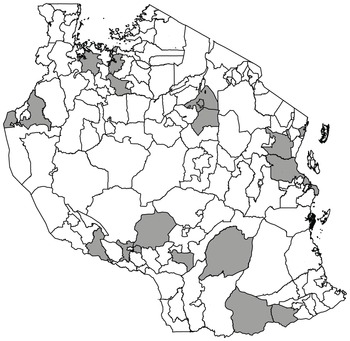
A nationally representative baseline poll asked a target sample of two thousand adult Tanzanians in two hundred rural and urban clusters spread across twenty districts about their knowledge and policy preferences regarding Tanzania's recent natural-gas discovery and the use of any future revenues. Sampling took place in multiple stages. We randomly selected twenty districts using probability proportional to size (pps) sampling based on district population from the 2012 Tanzania Population and Housing Census (see Figure 1). Within each district, we selected ten clusters, also by pps sampling. In rural areas, we define clusters as a subvillage or hamlet (kitongoji); in urban areas, clusters are a block or subward (mtaa). Within each cluster, we selected ten households using a random walk method. Within households, we chose one adult respondent from the household roster; this respondent was randomly selected electronically within the survey software on mobile computers used in the field. All respondents received a free mobile phone to enable follow-up polling.
Twenty Sampled Districtsa
a The twenty districts sampled with probability proportional to size (PPS) based on 2012 census data were: Babati, Bagamoyo, Geita, Handeni, Ilemela Municipal Council, Kasulu, Kigoma Municipal Council, Kinondoni Municipal Council, Kondoa, Mbarali, Mbeya City, Misungwi, Momba, Nanyumbu, Njombe Rural, Shinyanga, Tanga City, Temeke Municipal Council, Tunduru, and Ulanga.

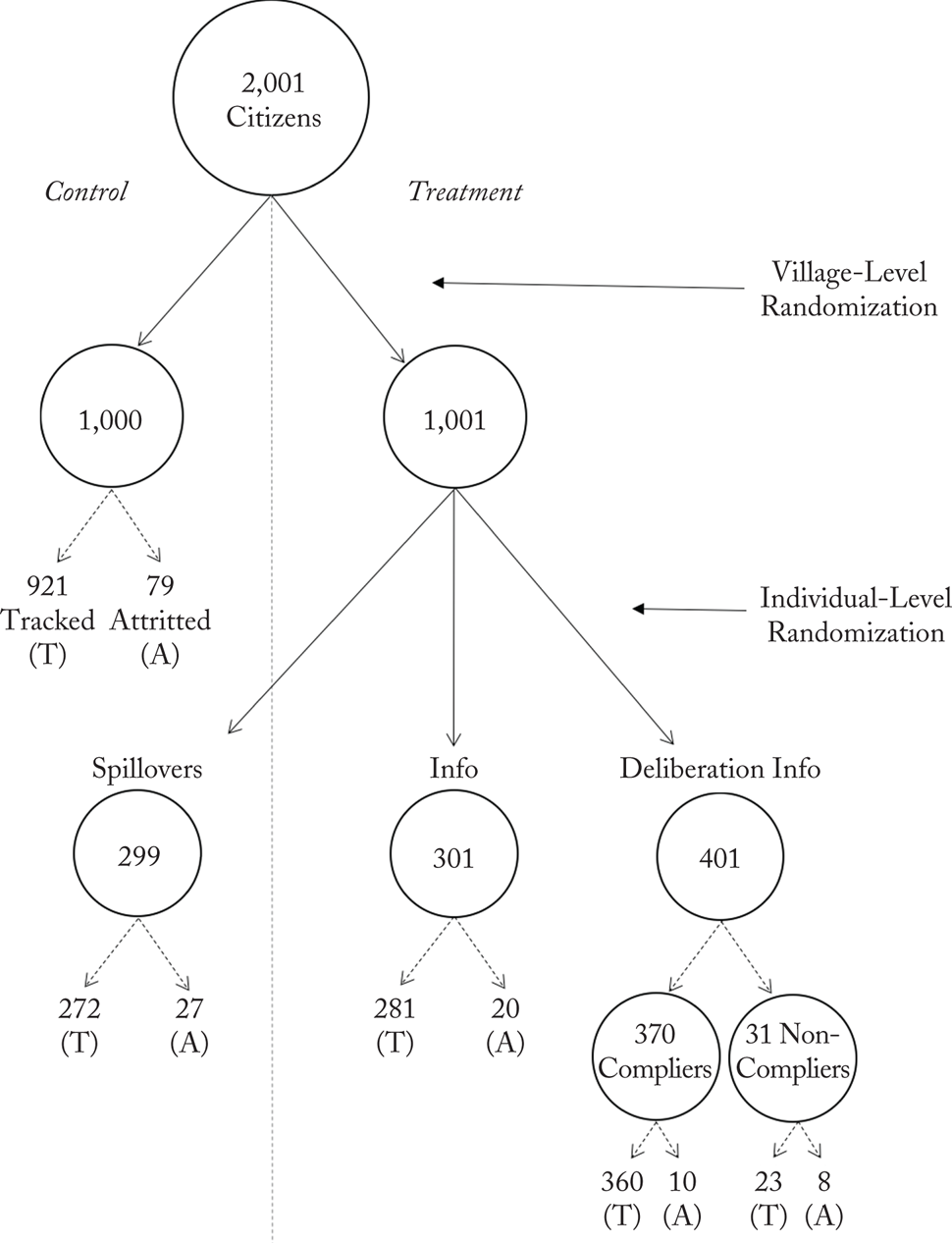
In each of one hundred randomly selected survey clusters, study staff invited seven of ten respondents to view a documentary video presenting the pros and cons of various gas policy options (the information treatment). Of the 702 respondents invited to the information treatment, all complied. Of these, we invited 401 individuals to a democratic deliberation about the use of the natural gas. Figure 2 summarizes the experimental design.
Experimental Design, Compliance, and Attritiona
a Each circle indicates the number of individuals from the baseline poll assigned to each treatment arm. All numbers to the left of the dashed vertical line report individuals assigned to the control condition. Data collection for all treatment arms occurred concurrently at baseline (face-to-face interviews) and follow-up (phone interviews). Figures denoted (A) for attrition indicate individuals who could not be interviewed for the follow-up phone poll. Noncompliers are individuals who were invited to the deliberation but did not attend. Noncompliance did not occur with the information treatment.

Of the 401 individuals invited to the deliberation, 370 complied and traveled to the event in Dar es Salaam. The study divided these 370 participants into twenty-five randomly assigned small groups to discuss a sequence of gas policy options. The discussions took place over four rounds, with groups being randomly reassigned after the second round. The random assignment of facilitators to deliberative groups is implicit in this design.
Within the villages or urban subwards assigned to treatment status, the sample of individuals invited to attend the information sessions, or to attend the information sessions and the deliberation as well, composed a minority of their village's or subward's total population. Because these individuals resided in close proximity to untreated individuals, the untreated individuals might be indirectly influenced by these treatments via social interactions. To test and allow for this possibility, we sampled 299 untreated individuals in treatment communities (see “spillovers” in Figure 2).
Given the national scope of the sample, the density of the social networks in our sampled communities—and hence the potential for spillovers—likely varied enormously. “Communities” here refers to the primary sampling units, which are vitongoji (subvillages or hamlets) in rural areas, with an average population of around seven hundred residents, and mitaa (subwards or blocks) in urban areas, with an average of around thirty-seven hundred residents.
Follow-up polling measured the medium-term impact (that is, determined weeks rather than hours after treatment) of information and deliberation on respondents’ knowledge and policy preferences. Study staff conducted this polling by phone, broken into multiple interviews with each respondent to limit respondent fatigue. Overall, 93 percent of baseline respondents were reinterviewed by phone after the deliberation. We examine this attrition in more detail below.
Baseline Correlations
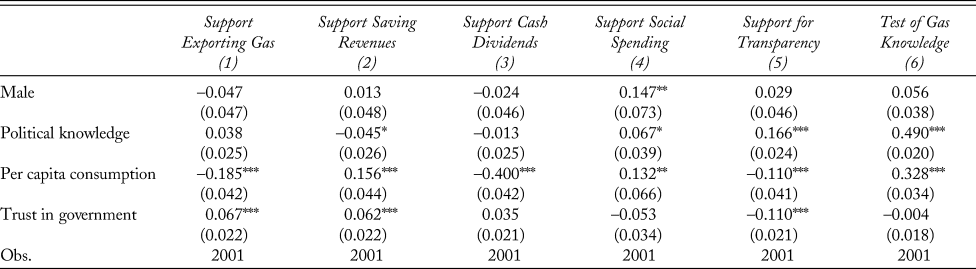
Before turning to the experimental results, we examine correlations between citizens’ policy preferences at baseline and four covariates: gender, general knowledge, wealth, and trust in government. Table 1 presents the results. Each column reports a separate multivariate regression, in which each of our six main outcome indices is separately regressed on all four covariate indices.
Correlates of Poll Responses at Baselinea

* p < 0.01, ** p < 0.05, *** p < 0.1; standard errors are clustered at the level of the primary sampling unit (for example, a village or urban block) and are noted in parentheses.
a Each column reports a separate regression. Dependent variables are listed in the top row. Each dependent variable is the pretreatment value of a mean effect index combining multiple survey responses, with mean zero and standard deviation of one at baseline.
Conditional on the other covariates, we find few differences in baseline responses by gender, with the exception that men are more supportive than women of using gas revenues for social-sector spending (relative to alternative uses, such as infrastructure). Unsurprisingly, scores on the general knowledge quiz are highly correlated with knowledge about natural gas. Respondents who are more informed about politics, current events, and so on are also more supportive of transparency measures.
Wealthier individualsFootnote 53 have significantly different baseline views, across the board. They are less inclined to sell natural gas abroad, more supportive of saving (rather than spending) revenues if gas is sold, much less supportive of directly distributing gas revenues through cash transfers, less supportive of transparency measures, and more knowledgeable about gas issues.
Trust in government is the only dimension that is positively correlated with support for commercialization of gas; it is also (positively) correlated with support for saving. Last, individuals with a greater trust in government have a slightly lower demand for transparency measures than those with lower trust in government.
Balance
Given the logistics of the experiment, baseline data were not available at the time of randomization,Footnote 54 which makes it particularly important to verify that randomization did not produce any large discrepancies in outcomes between treatment groups. To test for balance, we regress the baseline values of our six main outcome indices and various baseline controls on the various random assignment indicators.
 $$Y_{ij, 0} = \alpha _0 + \alpha _1Y_{ij, 0} + \alpha _2Z_{ij}^{delib} + \alpha _3Z_{ij}^{info} + \alpha _4Z_{ij}^{spill} + \varepsilon _{ij}$$
In this notation, j indexes clusters and i indexes individuals. The variable Zdelib equals one if the respondent was invited to both the information treatment and the deliberation treatment; Zinfo equals one if the respondent was invited to only the information session; and Zspill equals one if the respondent was not personally assigned to any treatment but resides in a village or urban block in which other individuals were treated.
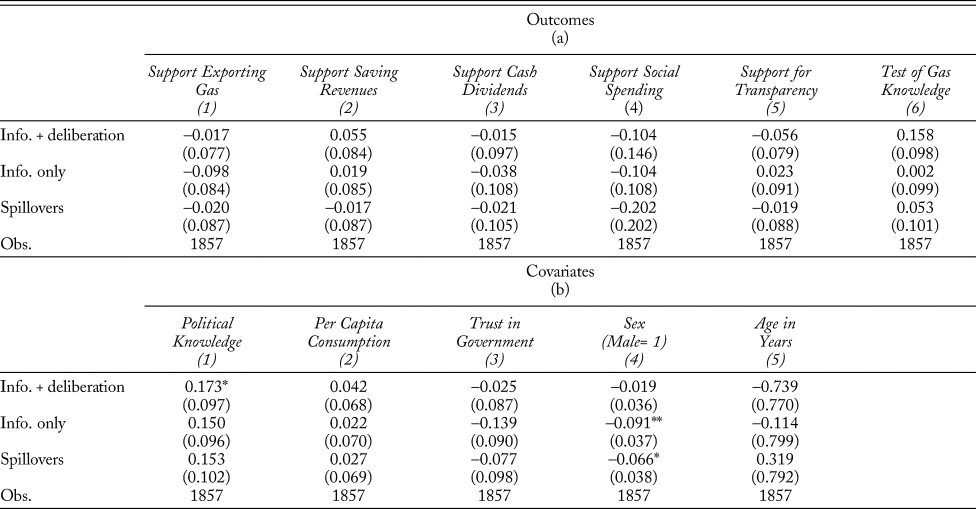
Turning to the results, we see no evidence of statistically significant imbalance on any of these six main outcomes, as Table 2 reports. In all cases, the differences between treatment arms are less than 0.1 standard deviation and insignificant at conventional levels. We do see some evidence of baseline imbalance in the case of two of the control variables: individuals invited to the deliberation scored 0.17 standard deviations higher on the political knowledge test, and random assignment led us to sample slightly fewer men (less than 10 percent) than women in treatment villages and to invite slightly fewer men to the information treatment sessions. In the following section, we discuss the results with and without controls for these imbalanced covariates, which are effectively indistinguishable.
Balance Test at Baseline across Six Outcome Indices and Key Covariatesa

* p < 0.01, ** p < 0.05, *** p < 0.1; standard errors are clustered at the level of the primary sampling unit (for example, a village or urban block) and are noted in parentheses.
a Each column reports a separate regression. Dependent variables are listed in the top row. In panel (a), each dependent variable is one of the main experimental outcomes, that is, the pretreatment value of a mean effect index combining multiple survey responses, with mean zero and standard deviation of one at baseline. Panel (b) tests for balance on baseline covariates, the first three of which are also indices of multiple survey responses.
IV. How Does Deliberation Shape Views on Resource Management?
We measure impacts on six outcome indices, listed below. Following work by David McKenzie,Footnote 55 we adopt an analysis of covariance (ancova) specification to maximize power in the presence of a baseline survey and relatively low autocorrelation in response (as we find). For each outcome we regress the outcome variable in the follow-up poll on baseline responses and the set of random assignments.
 $$Y_{ij, 1} = \beta _0 + \beta _1Y_{ij, 0} + \beta _2Z_{ij}^{delib} + \beta _3Z_{ij}^{info} + \beta _4Z_{ij}^{spill} + u_{ij}$$
Subscripts 0 and 1 refer to the pre- and posttreatment rounds of data collection, respectively. Based on these variable definitions, β 2 provides a measure of the total impact of information and deliberation combined; β 3 measures the impact of information alone; and β 4 measures spillovers within the village or urban block.
Note that equation 2 constitutes an intention-to-treat (itt) analysis, estimating impacts of the information and deliberation treatments based on random assignment to the relevant treatment arm, regardless of actual treatment status. In practice this makes little difference, as compliance with random assignment to the deliberation and information treatments was 90 percent and 100 percent, respectively (as Figure 2 shows above). We found no documented defiance (that is, individuals assigned to the control group who nevertheless received treatment).
Spillovers occur if individuals who participate in deliberation and/or receive the information treatment communicate with friends and family and thereby influence others’ views on natural-gas policy. Note that such word-of-mouth is not the primary pathway for policy influence that we conceived for the experiment (rather, we envisioned the primary influence on policy occurring through the dissemination of polling results to policymakers and elites). But such spillovers may be of independent interest, and failure to account for them could bias our main results.
Given the length of the questionnaire, an obvious concern is that we will spuriously reject the null hypothesis of no treatment effect in some instances—that is, multiple comparisons will generate false discovery. We deal with this problem of multiple comparisons in two ways, following standard practice in the social science experimental literature. First, we group outcomes into indices based on a priori judgments to reduce the total number of statistical tests. The definition of these six indices was preregistered before the deliberation treatment and follow-up data collection. We calculate the indices following Jeffrey Kling, Jeffrey Liebman, and Lawrence Katz,Footnote 56 by (1) rescaling each indicator so that higher values indicate support for the hypothesis, (2) computing z-scores for each indicator, (3) averaging the indicators within an index, and (4) creating z-scores for this composite index.
Second, because our analysis still involves at least six comparisons for each component of the experiment, we control the false discovery rate using the procedure suggested by Michael Anderson to calculate the Yoav Benjamini, Abba Krieger, and Daniel Yekutieli q-values, which we report in lieu of naive p-values where relevant.Footnote 57
Main Effects: Information, Deliberation, and Policy Preferences
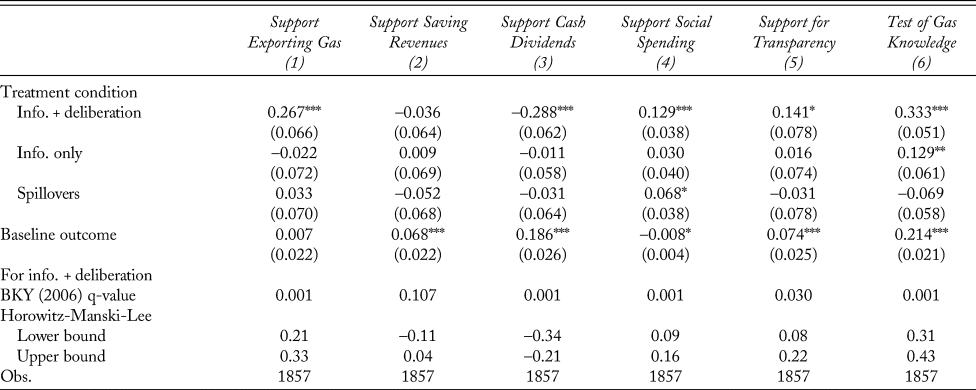
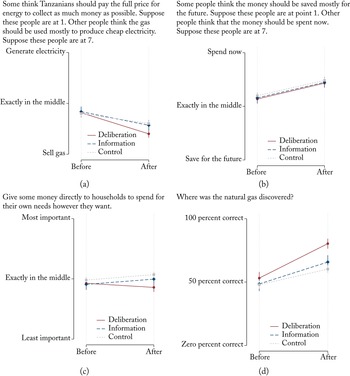
The full deliberation treatment significantly alters public opinion about natural-gas use on four of five dimensions, and also raises scores on the index of gas knowledge, as Table 3 shows.Footnote 58 On the first dimension, selling natural gas versus subsidizing power generation or leaving it in the ground, the combination of deliberation and information increased support for extracting and selling the gas by nearly 0.3 standard deviations. Looking at the subcomponents of the index in Table A2 in the supplementary material, this result is driven primarily by support for selling gas abroad over using gas for energy generation, rather than explicit opposition to fuel subsidies (see Figure 3).Footnote 59
Intent-to-Treat (ITT) Effectsa

* p < 0.01, ** p < 0.05, *** p < 0.1; standard errors are clustered at the level of the primary sampling unit (i.e., a village or urban block) and noted in parentheses.
a Each column reports a separate regression. Dependent variables are listed in the top row. Each dependent variable is the posttreatment value of a mean effect index combining multiple survey responses, with mean zero and standard deviation of one at baseline. Horowitz-Manski-Lee bounds refer to the coefficient on info. + deliberation.
Average Poll Responses for Select Indicators

Deliberation had no effect whatsoever on support for saving gas revenues. Citizens began by being strongly supportive of spending and remained so. But deliberation did reduce support for direct cash distribution of gas revenues, by roughly 0.3 standard deviations. This treatment effect has a consistent sign across all eight questions in the index measuring support for cash transfers (see Table A2 in the supplementary material), though it is worth noting that support began (and remained) highest for proposals that targeted transfers to the needy, or were framed as individual savings accounts.
Though deliberation reduced support for cash transfers, it increased support for spending on social services rather than infrastructure, by about 0.3 standard deviations. It also increased support for transparency and oversight by 0.14 standard deviations.Footnote 60
Notably, information alone has no significant effect on public opinion about any dimension of gas policy (see Table 3). Even on dimensions where the effect of deliberation is large and significant, such as selling gas or distributing revenues as cash transfers, the treatment effect of information alone is insignificant and point estimates are close to zero. The only outcome that we see a significant effect of information on is knowledge of the natural-gas discovery, where information alone raised scores by 0.13 standard deviations and information plus deliberation raised scores by more than 0.3 standard deviations.
Last, although our design allows us to measure spillovers from either treatment, in practice we find no such effects. That is, we see no evidence that participants in the information or deliberation treatments shared information or influenced their neighbors within the village. However, some caution is advised, given the statistical power of our design to detect spillovers. The minimum detectable effect (mde) for spillovers is approximately 0.21 when calculated using the observed standard errors from our estimate of the spillover effect (0.078 for the largest of these standard errors across our six outcomes, corresponding to the transparency index in Table 3). Although we deemed this mde reasonable ex ante, in practice 0.2 standard deviations is roughly the same magnitude as the main effects observed in Table 3. Thus, if we anticipate spillovers to be partial and incomplete, and thus strictly smaller than the main effects, we are potentially underpowered to detect these spillovers given the actual magnitude of our main findings.Footnote 61
Discussion
Can we discern a coherent logic of natural resource management in citizens’ poll responses prior to and, more importantly, after deliberation?
Consistent with concerns flagged in the political psychology literature, poll responses prior to deliberation and in the control group exhibited some degree of internal inconsistency and fragility to question framing. In short, respondents wanted natural gas to pay for everything: a majority wanted to sell the gas for cash and also to use it to produce cheaper energy; they wanted to save the revenues for future generations but also to invest in infrastructure; and they also wanted to spend on social sectors and to distribute revenues directly to citizens via cash transfers. These inconsistent demands were particularly acute when the study presented options for revenue use in isolation, with almost all options receiving majority support. Deliberation appears to have heightened respondents’ appreciation for trade-offs. Responses moved in the direction predicted by baseline responses to direct trade-off questions: for example, selling gas gained relative to generating energy, and social-sector spending gained relative to both infrastructure investment and direct cash distribution.
There is some sign that deliberation made respondents more attuned to the political-economy risks associated with a large resource discovery. Hence, deliberation increased support for publishing contracts as well as for international oversight of revenue management (although tying the government's hands remained unpopular). But the purely economic prescriptions of the orthodox view of resource management won fewer adherents: respondents were not persuaded to support saving or investing revenues. There is little sign that macroeconomists’ concerns about Dutch disease or resource booms leading to profligate spending had any purchase here.
Addressing Attrition
The baseline survey interviewed 2,001 individuals. Posttreatment interviews for all treatment groups and the control groups were conducted by mobile phone. In total, we interviewed 1,857 respondents during the posttreatment poll, or 93 percent of the baseline sample.
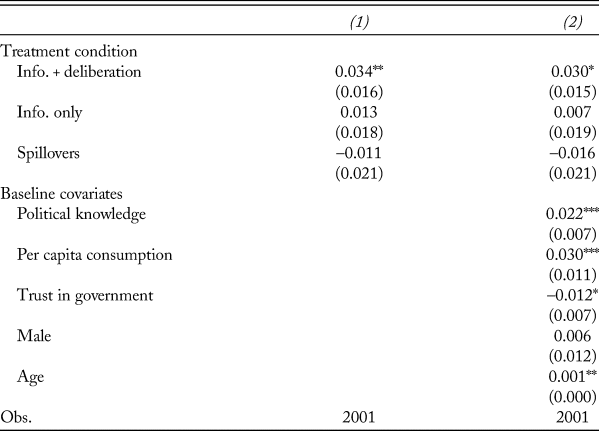
The attrition of the remaining 7 percent of the sample introduces the possibility of bias in our experimental estimates. To examine this, we first measure the observable correlates of attrition in our baseline data. Results in Table 4 show that we were no more likely to interview respondents in treatment villages (that is, the spillover group) or respondents who received the information treatment. But respondents who were invited to the deliberation were three percentage points more likely to be interviewed posttreatment relative to control individuals.
Attritiona

* p < 0.01, ** p < 0.05, *** p < 0.1; standard errors are clustered at the level of the primary sampling unit (for example, a village or urban block) and are noted in parentheses.
a Each column reports a separate regression. The dependent is an indicator that takes a value of 1 if the respondent was successfully interviewed in the posttreatment survey round.
Baseline covariates show some significant correlations with attrition. Individuals who are older, more knowledgeable, wealthier, and less trusting of government are more likely to be included in the posttreatment sample.
These results cannot definitively state whether attrition introduced bias in our treatment effect estimates, as attriters may also differ on unobserved dimensions. To address this possibility, we estimate nonparametric bounds in the manner of Joel Horowitz, Charles Manski, and David Lee on our main treatment effects.Footnote 62 These bounds are reported at the bottom of Table 3. We focus on bounding the total effect of information and deliberation combined, as this is the only treatment arm for which we find large and robust treatment effects across multiple outcome measures.
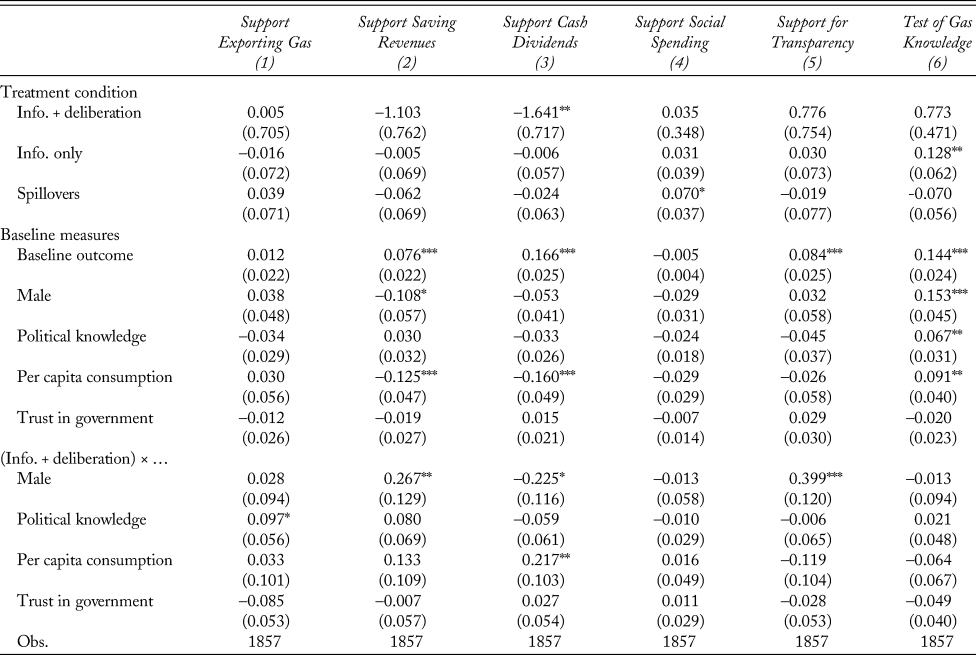
Last, as a robustness check related to the possibility that attrition introduced an imbalance between treatment arms, we also report estimates of the main itt effects when controlling for a full set of baseline covariates, including the three indices shown in Table 1 (political knowledge, per capita consumption, and trust in government), as well as gender and age. Results are substantively unchanged, as Table A3 in the supplementary material reports.
V. Evaluating the Deliberative Process
Does the fact that deliberation changes people's minds imply any normative assessment? One approach to answering this question is to assess whether deliberation moves citizen views toward some preestablished set of “right” answers. In the previous section, we noted that deliberation moves opinion in the direction of economic orthodoxy about natural-resource management in some cases, but not in all. Below, we test whether deliberation moves citizens in the direction of elite opinion, which may or may not reflect economic orthodoxy in Tanzania.
A second approach, which we explore in this section, is to examine the dynamics of the deliberative process itself, in hopes of gaining insights about its procedural integrity. We divide the issue of social-group interactions in deliberation into two parts, looking at how different social groups affect others and are themselves affected by others. In more econometric language, we use a heterogeneous treatment effects approach to examine whether deliberation has differential effects on different groups. Separately, we also test a peer-effects framework, in which peers are divided into subgroups, to examine the question of whether deliberation promotes the views of certain social groups. Last, we examine the role of group facilitators in shaping participants’ views during deliberation.
Do Social Groups Respond Differently to Deliberation? Heterogeneous Treatment Effects
Skeptics of democratic deliberation in developing countries question whether illiterate voters with limited information are capable of grappling in meaningful ways with complex policy issues. If this lack of ability is true in general, we might expect it to be especially true for the least informed voters, or for the poorest voters in our sample. Concretely, we might expect smaller treatment effects from deliberation in these groups.
In practice, we find little evidence of differences in treatment effects across groups, as seen in the bottom rows of Table 5, which show the interaction terms between deliberation and group dummies. But a few exceptions exist. Though men and women show no significant differences in opinion about saving gas revenues or support for transparency measures at baseline, deliberation moves men further in support of these measures. That effect is canceled out by a countervailing movement for women on savings, but not on transparency measures.
Heterogenous Treatment Effectsa

* p < 0.01, ** p < 0.05, *** p < 0.1; standard errors are clustered at the level of the primary sampling unit (for example, a village or urban block) and are noted in parentheses.
a Each column reports a separate regression. Dependent variables are listed in the top row. Each dependent variable is the posttreatment value of a mean effect index combining multiple survey responses, with mean zero and standard deviation of one at baseline.
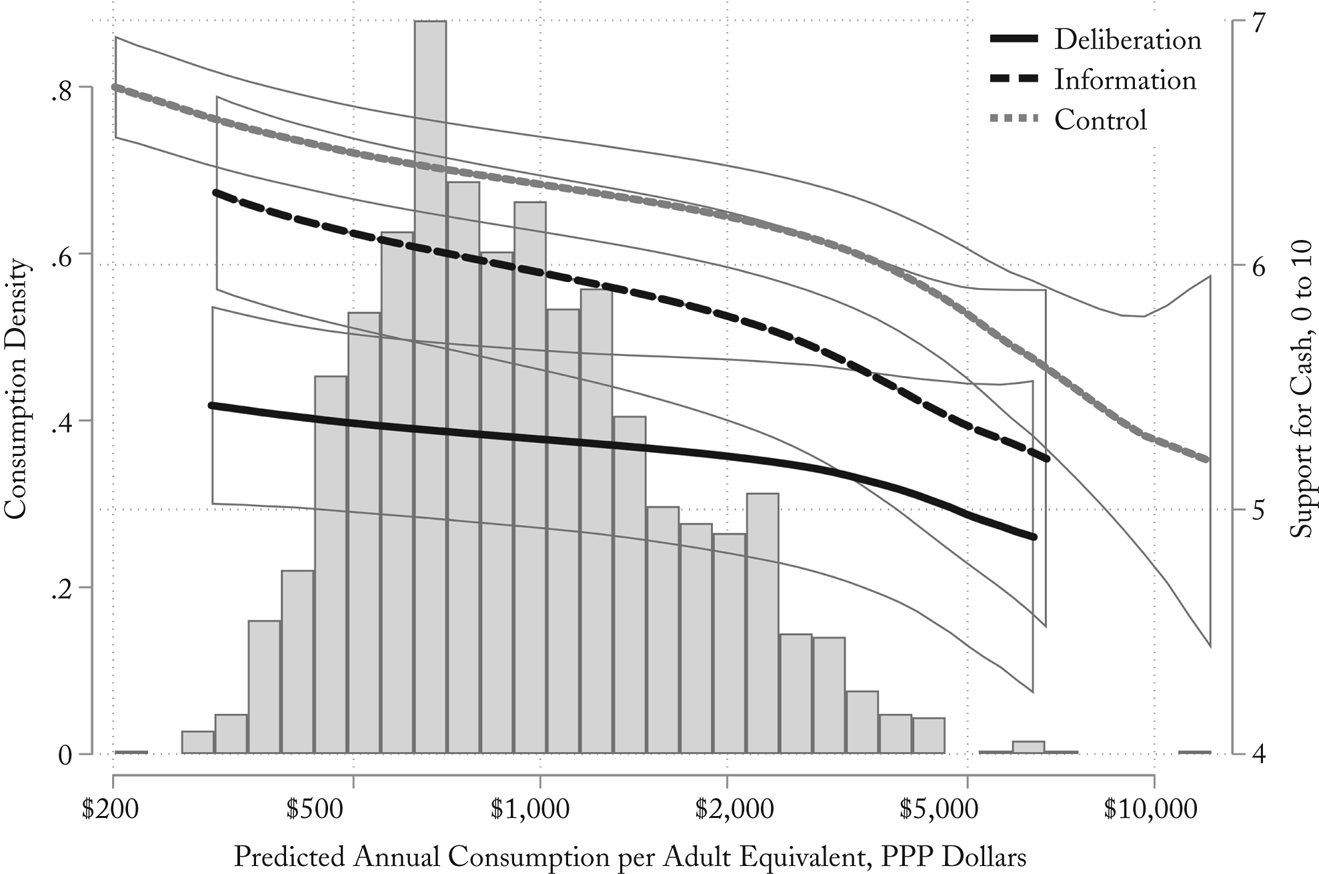
Deliberation reduces support for direct distribution of gas revenues overall, but that effect is attenuated for richer participants—who were already less supportive of this policy at baseline.Footnote 63 To take just one poll question as an illustration, average support for cash transfers (see the full phrasing for question 4.1 in the supplementary material) is shown at each point of the household consumption distribution in Figure 4, for both deliberation participants and the pure control group at end line. The control group shows the same baseline (negative) correlation between wealth (proxied by our index of per capita consumption) and support for cash transfers; as noted, deliberation has a heterogeneous effect that attenuates this correlation. But the strongest effect is the simple average treatment effect, reducing support for cash transfers.
Deliberation and Support for Cash Transfers, by Household Consumptiona
aLines represent a local polynomial regression of support for cash transfers (question 4.1) on log household consumption, with a bandwidth of one log point. For comparison, the figure also shows a histogram of the distribution of (predicted) log household consumption. For a full description of the consumption measurement methodology, see the supplementary material.

We also investigate whether baseline trust in government is associated with differential receptivity to the information and deliberation treatment. As Table 1 shows, trust in government is associated with stronger support for selling natural gas and saving revenues, and with opposition to transparency and governance measures. But we find no relationship between trust in government and treatment effects in Table 5.
Do Social Groups have Disparate Influence on Deliberation? Peer Effects and Marginalized Groups
Does deliberation help people to form reasoned opinions, or does it reinforce groupthink and marginalization? The hypothesis that information and deliberation shape citizens’ policy preferences is somewhat distinct from saying that people conform to their peers’ views when exposed to those views through group discussion. Of particular concern is the possibility that certain social groups dominate these interactions, so the results of deliberation do not represent popular opinion.
To estimate peer effects, we regress the posttreatment poll responses of individual i in group g on her own baseline response, as well as the average of her G − 1 peers, indexed by p.
 $$Y_{ig, 1} = \gamma _0 + \gamma _1Y_{ig, 0} + \gamma _2\sum\limits_{\,p\ne i} {\displaystyle{{Y_{\,pg, 0}} \over {G-1}} + v_{ij}} $$
We run equation 3 separately for each of the four topics covered in the group deliberations. Recall that the 383 deliberation participants were divided into twenty-five groups for each session, so the average group size was about fifteen people, plus a facilitator and notetaker.Footnote 64 Four deliberation sessions occurred, focused on the four topics listed as outcomes in Table 6, but groups were randomized only twice: at the outset and between sessions two and three.
Peer Effects during Deliberationa

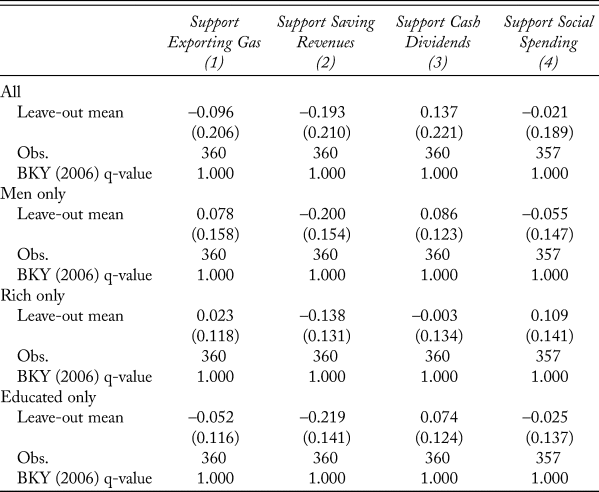
a Each column and each panel is a separate regression. Dependent variables are measured posttreatment and are listed in the top row. Peer effects are calculated using peers’ baseline responses. The leave-out mean is the average of the dependent variable for individual i's group, ignoring his or her own value. Leave-out means for men, the rich, and the educated are constructed using values for those subsets of group members (where rich and educated are defined as being above the median for the overall sample). All regressions include controls for the individual's own baseline response and a constant (not reported). Standard errors reported in parentheses.
We find no evidence that peers’ baseline views affected the participants’ preferences after deliberation. The coefficients on peers’ views in the first row of Table 6 are somewhat noisily estimated, but fall on either side of zero with no clear pattern, and are never significantly different from zero.
To test whether particular social groups have an undue influence on deliberation, we repeat estimation of equation 3, restricting the group of peers to men only, richer individuals only (that is, above the median on our consumption index), or only the educated (that is, with some secondary education). Once again, the results show no significant signs of peer influence on posttreatment poll responses. The baseline views of men, the rich, and the educated all appear to exert no disproportionate influence on their peers’ preferences after participants spent hours together debating these topics.
Do Facilitators Drive Deliberation Results?
Given the conclusion of Humphreys, Masters, and Sandbu that deliberation about the use of oil rents in São Tomé was not truly participatory but was driven by the will of the leaders or facilitators, we designed our experiment to test for “facilitator effects” and collected additional data on that topic.Footnote 65 We hypothesize that careful training and supervision of the facilitators should mitigate these effects, as should the structure of the deliberative process used here—involving presentation of balanced briefing materials, no requirement to come to consensus, and an individual “secret ballot” rather than collective reporting of posttreatment preferences.
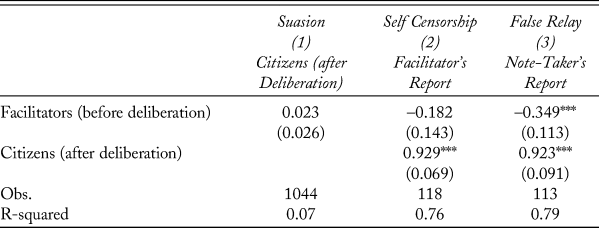
Humphreys, Masters, and SandbuFootnote 66 enumerate three mechanisms by which facilitators might skew results. In the first scenario, labeled “suasion,” facilitators intervene in deliberations to sway participants’ views in the direction of the facilitators’ own pretreatment preferences. Random assignment of participants to groups allows us to identify these effects experimentally. To increase power, we pool responses from all four topics that were deliberated in the small groups, and include indicator variables for each topic. Table 7 shows no significant relationship between facilitators’ baseline views on a given topic and participants’ posttreatment poll responses (column 1), controlling for their baseline views in an ancova specification. Note that because facilitators led only one session on each topic, we cannot isolate the role of suasion through facilitator fixed effects, as in Humphreys, Masters, and Sandbu.Footnote 67 But it is notable that the group fixed effects in a regression of posttreatment poll responses are not jointly significant. These fixed effects should incorporate both suasion and the peer effects discussed above, which may or may not point in the same direction.
Do Facilitators’ Views Drive Deliberation?a

* p < 0.01, ** p < 0.05, *** p < 0.1; standard errors are clustered at the group level and reported in parentheses.
a Each column reports a separate regression. Dependent variables are listed in the first row. Column 1 also includes a control for citizens’ own baseline views (not reported). Column 1 is estimated on individual level data, with a separate observation for each of the four outcomes indices, which were the direct focus on the four small-group deliberation sessions. Columns 2 and 3 are estimated on group-level averages. In these latter columns, variables are defined such that they have a range of one (from –0.5 to 0.5), and zero signifies indifference, while column 1 uses the mean-effects indices presented in the main analysis.
The second scenario in which facilitator effects may arise is self-censorship, where participants’ opinions expressed during deliberation will conform to the facilitators’ views. To test this hypothesis, we asked independent notetakers to observe each deliberative session and to report on the tone of the discussion for each polling topic. Notetakers were asked to respond to a subset of the same poll questions as participants, but to do so on behalf of the group, relaying what they understood to be the gist of the debate in the group they observed.Footnote 68 If self-censorship is at play and participants conform to facilitators’ views, we would expect the notetakers’ summaries of the discussions to be at least partially explained by the facilitators’ views. As column 2 of Table 7 shows, we find no such relationship; being randomly assigned a facilitator who was sympathetic to a given policy position did not lead to a discussion that was more favorable to that facilitator's view.
A third possible mechanism that we test is “false relay,” where facilitators exaggerate the extent to which deliberation conformed to their own views. Note that none of our main results in earlier sections rely on the facilitators’ reports of what happened in the sessions; we use the participants’ own posttreatment responses. But we also asked facilitators to summarize the deliberation to test whether this could, in theory, be a possible source of bias with a different deliberative setup in our context. As with the notetakers’ reports, we find no relationship between facilitators’ reports of the tone of the deliberation and their own baseline views (column 3, Table 7), while the citizens’ own views strongly predict the facilitators’ reports.
Postscript: Do Elites Care What People Think?
In private conversations with both Tanzanian policymakers and academic economists in Europe and the United States, we found considerable skepticism that voters could process complex natural-gas policy issues, as well as resistance to the notion that public opinion should directly inform these policy choices. To explore this elite resistance to public consultation on the gas issue, we designed a small survey experiment as part of our dissemination activities for the nationwide poll.Footnote 69
We incorporated the outcomes from the nationwide poll into the question prompts in a survey among a sample of Tanzanian elites in Dar es Salaam. Individuals were selected from mailing lists and event invitation lists at civil society organizations, ngos, development banks, academia, and government offices in Dar es Salaam. All 280 elites in the sample were invited to a dissemination event held in Dar es Salaam in early September 2015, and more than 50 attended. We administered an abbreviated version of the full citizen survey to 44 individuals at this event. To expand our reach, we emailed a digital version of the survey to about 230 individuals who were not able to attend the event.
A total of 124 individuals completed the survey: 44 did so at the dissemination event and 80 completed the digital version. Individuals within the sample—though they clearly self-selected when deciding to attend the event—were then randomized into control and treatment groups: 67 were sampled for the control group and 56 for the treatment group.
The citizen survey included several questions on each of the five main issue areas, but we designed the elite survey to present only a select list of questions to respect the participants’ limited time to complete the survey. The questions included in the elite survey were considered to be core indicators for each of our five topical hypotheses (not including change in knowledge).
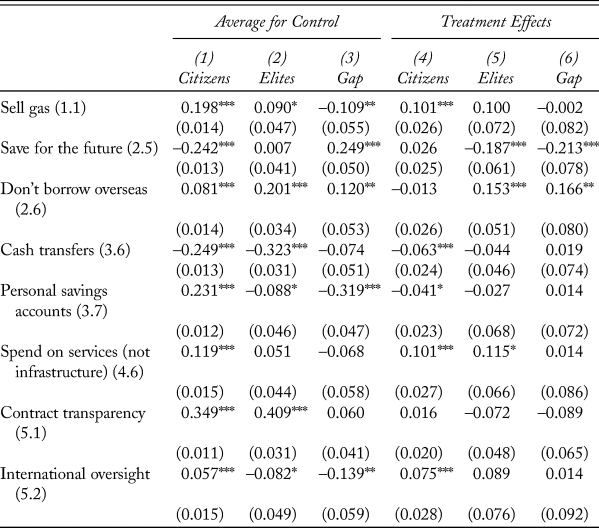
Before examining any treatment effects, we can see considerable differences between citizens’ and elites’ opinions. For five of the eight policy questions tested, the gap between citizens’ and elites’ opinion is statistically significant, and for three of the eight, the overall balance of opinion points in the opposite direction for the two groups (see Table 8).
Citizen versus Elite Opiniona

* p < 0.01, ** p < 0.05, *** p < 0.1; standard errors are clustered at the level of the primary sampling unit (for example, a village or urban block) and are noted in parentheses.
a Outcome variables are listed in the left column, and are defined such that they have a range of one (from –0.5 to 0.5) and zero signifies indifference. Columns 1 and 2 show the mean for the control group in each sample, and the gap between the two control samples (citizen and elites) is shown in column 3. Columns 4 and 5 show the effect of deliberation and information on citizens and of the survey experiment on elites, respectively, and column 6 reports the net effect of the treatments on the gap between citizens and elites. (To see the level of disagreement between citizens and elites after treatment, sum columns 3 and 6.)
Compared to citizens, elites are less inclined to sell Tanzania's gas and more interested in subsidizing energy generation. More fiscally cautious, elites are more inclined to save gas revenues for the future and more opposed to using the gas reserves as collateral to enable Tanzania to borrow money internationally. They are less enthusiastic about distributing gas revenues to individualized savings accounts—a proposal that is quite popular with citizens. And elites are markedly less interested in international oversight of Tanzania's management of its gas revenues than are citizens (bear in mind that some elite respondents are themselves the government officials who would be subject to that hypothetical oversight).
The effect of showing citizens’ poll results to elites is statistically significant for just three of the eight poll questions tested, which includes dampening elite support for saving for the future, and strengthening their existing support for spending revenues on public services rather than investments in capital infrastructure. Notably, one of these three significant effects is in the “wrong” direction: elites move further away from public opinion on international borrowing, though both groups remain opposed to borrowing on average after treatment.
On the whole, our judgment is that the combination of our citizen and elite treatments goes some way toward bridging the gap between the two samples, even though several of these results are insignificant due to our small sample size in the elite survey. For six out of eight indicators, the point estimate on the citizen-elite gap narrows due to the combination of treatments.
VI. Conclusion
A key question in the literature on deliberative democracy is whether ordinary citizens, particularly among a less-educated population in a developing country, can reach meaningful conclusions about complex policy topics—or, instead, whether deliberative outcomes will be determined by the interests of powerful social groups and the framing that facilitators impose. We tested these hypotheses in the context of a nationally representative deliberation in Tanzania, in the wake of a large natural-gas discovery that poses unprecedented questions for Tanzanian policymakers about the exploitation and use of a new natural resource. Key features of this deliberation included the presentation of balanced information briefs (as adjudicated by a multiparty advisory group) to a representative cross-section of Tanzanian adults, question-and-answer sessions with panels of topic experts, and moderated small-group discussions without any attempt to reach consensus or a collective verdict.
The results of a randomized experiment within our nationwide polling sample show that deliberation meaningfully changed public opinion, and that these changes were disproportionately not driven by the prior views of males, the educated, the rich, or group facilitators. The combination of information and extended, structured, participatory deliberation generated (1) a measurable increase in knowledge of the gas sector; (2) increased support for the sale of natural gas and reduced support for energy subsidies; (3) no change in support for saving versus spending gas revenues; (4) a sharp decline in support for direct cash distribution of resource rents to citizens; (5) increased support for spending on social services as opposed to infrastructure; and (6) a marginally significant increase in support for transparency and oversight measures.
In short, even after deliberation, Tanzanians remain impatient to spend resource revenues quickly, but otherwise deliberation makes them more prudential about resource management. Furthermore, we find that deliberation works in a procedural sense, even with such relatively low-information voters as is our predominantly rural Tanzanian sample.
Unlike previous polls of this type conducted in low-income countries, our Tanzania results draw from a larger and more diverse population, and the findings are based on a controlled experiment allowing clean causal inference about the impact of deliberation, and also allowing us to unpack the role of information and deliberation.Footnote 70 Democratic deliberation appears to be the key to changes in policy preferences: the information treatment alone produced no significant impacts, and impacts did not spill over onto individuals in the same community who did not participate in deliberation.
Are our findings here generalizable and policy-relevant within Tanzania and beyond? We see three distinct issues worth separating. First, we designed our experiment to test issues related to the process of deliberation that are potentially of wide relevance, beyond Tanzania and beyond the question of natural-resource management. Such issues include questions about group polarization, the influence of powerful social groups on deliberative outcomes, and the role of deliberation per se versus information provision. Our results establish that it is possible to overcome these pitfalls, even in a population of voters with low education levels and limited information. Second, the specific views that we uncovered about natural-gas management may reveal lessons about how deliberation helps citizens to appreciate budgetary trade-offs, and makes them more attuned to the governance risks associated with large resource discoveries. Specific views will vary in other countries, time periods, and resource discoveries, but we hypothesize that these basic impacts of deliberation may show up in future experiments elsewhere.
Third, what this experiment reveals about Tanzania's current democracy is a separate question. Because we conducted our experiment with a randomly selected, representative sample of eligible Tanzanian voters, our statistical findings are (in a narrow, technical sense) fully generalizable to the Tanzanian electorate as a whole. But the intense deliberation that we conducted—using a panel of experts and bringing in participants from across the country—is prohibitively expensive, and not intended to be done at scale. Rather, the idea is that such deliberative events can serve as a laboratory about public opinion to inform elected representatives. Elements of democratic deliberation exist in the Tanzanian political system at large—for example in village councils or ad hoc public consultations organized by the central government around its five-year plans—but these deliberations lack many of the ingredients tested here: presentation of balanced background information, diverse groups, and no requirement of consensus.
From a practical policy perspective, our results are limited in their ability to predict whether any change in public opinion for the nationally representative deliberative group studied here will translate into a change in policy or an improvement in natural-resource governance. Multiple steps in this chain may fail—steps that are far beyond the scope of this experiment. Elected officials could, and indeed might rationally, ignore the results of deliberation in favor of the nondeliberated views of the broader swath of voters. But in a survey experiment based on the dissemination of our findings, we do find modest support for the hypothesis that Tanzanian elites adapt their own policy preferences in response to public opinion data of the sort presented here.
Future work could explore the impact of deliberation on costly political behavior, beginning with voting. Given the high cost and intensity of our deliberation treatment, it is difficult to imagine replicating this exact procedure at a much larger scale. Our method is a sample-based technique for measuring public opinion, as opposed to a mechanism either for mass participation in deliberation or to shape views at the population level. Future work could explore cheaper, “lighter-touch” mechanisms that adhere to similar deliberative principles and could be extended to a broader population. For now, we interpret our results as proof of concept for a practical mechanism for measuring the public's representative and informed views on complex issues, even those involving difficult trade-offs—and even in the challenging context of a low-income country in the midst of a resource boom.
Supplementary Material
Supplementary material for this article can be found at https://doi.org/10.1017/S0043887122000090.
Data
Replication files for this article can be found at https://doi.org/10.7910/DVN/S3NRQL.
Acknowledgments
We are grateful to Sam Wangwe, Abel Kinyondo, and the members of the cgd–repoa working group on natural gas for their guidance; to Economic Development Initiatives, which collected the polling data for this project and organized the deliberative events; and to Alice Siu of Stanford University and Bobby Fishkin of Reframe It for their help in the survey design. Jennifer Richmond and Faraz Haqqi provided excellent research assistance throughout design, implementation, and data analysis.
Funding
The project benefited from the financial support of the Bill and Melinda Gates Foundation (OPP1083297), the International Initiative for Impact Evaluation—3ie (TW8.1001), the International Growth Centre (1-VCS-VTZA-VXXXX-40303), and Canada's International Development Research Council. All opinions and any errors are ours. Fieldwork was conducted under the Tanzania Commission for Science and Technology permit number 2014-269-NA-2014-133 and registered in the aea rct registry, ID AEARCTR-0000689.