Introduction
Neuropsychiatric symptoms and impaired sensory functioning commonly coincide with neurocognitive disorders and have been identified as precursors of incident Mild Cognitive Impairment (MCI) and dementia (Lin et al., Reference Lin2004; Geda et al., Reference Geda2014; Yamada et al., Reference Yamada2016). While there is growing recognition the role of neuropsychiatric symptoms as risk markers for dementia, there has been relatively little research examining how they interact with single and dual sensory loss throughout the disease course.
Neuropsychiatric symptoms (also referred to as behavioral and psychological symptoms of dementia) are non-cognitive behavioral and psychiatric symptoms associated with dementia-related neurodegeneration (Lyketsos et al., Reference Lyketsos2011) and are a major contributor to carer burden and early institutionalization (Dillon et al., Reference Dillon2013). The expression of neuropsychiatric symptoms can be attributed to a complex interaction between underlying pathology, pre-existing morbidity, and pre-morbid psychosocial characteristics and exposures (Low et al., Reference Low, Brodaty and Draper2002; Aalten et al., Reference Aalten2006; Spalletta et al., Reference Spalletta2010; Cerejeira et al., Reference Cerejeira, Lagarto and Mukaetova-Ladinska2012).
Vision and hearing loss are two conditions that may contribute to the expression of neuropsychiatric symptoms. Sensory impairments are highly prevalent among older adults (Swenor et al., Reference Swenor, Ramulu, Willis, Friedman and Lin2013; Kiely et al., Reference Kiely2016) and are among the most common chronic conditions to coincide with dementia (Australian Institute of Health and Welfare, 2012). Co-occurring vision and hearing loss, referred to as dual sensory loss (Saunders and Echt, Reference Saunders and Echt2007) leads to communication problems and reduced social engagement (Erber and Scherer, Reference Erber and Scherer1999; Viljanen et al., Reference Viljanen, Törmäkangas, Vestergaard and Andersen-Ranberg2014), social isolation (Schneider et al., Reference Schneider2011), and loss of functional independence (Raina et al., Reference Raina, Wong and Massfeller2004). Dual sensory loss is considered to be particularly debilitating as it represents the loss of an important compensatory mechanism for a single sensory loss. However, evidence showing that a dual sensory loss confers additional burden over the effects of a single sensory loss is inconsistent (Schneider et al., Reference Schneider2011). Critically, high levels of cognitive functioning are important for mitigating the impacts of sensory loss on everyday living (Heyl and Wahl, Reference Heyl and Wahl2012) by controlling the execution of adaptation strategies. There are well-established links between single sensory loss and individual neuropsychiatric symptoms such as delirium (Inouye et al., Reference Inouye, Westendorp and Saczynski2014), hallucinations (Linszen et al., Reference Linszen, Brouwer, Heringa and Sommer2015), and agitation (Vance et al., Reference Vance2003), and between dual sensory loss and depression (Kiely et al., Reference Kiely, Anstey and Luszcz2013). To date, there have been no studies investigating the impact of dual sensory loss on overall neuropsychiatric symptom counts in the general population.
This study examines the association between single and dual sensory loss and informant reported neuropsychiatric symptoms in a sample of community-dwelling older adults with and without a diagnosed neurocognitive disorder. Overall, we expect that a greater number of neuropsychiatric symptoms will be reported for those with sensory loss (poor visual acuity and self-reported hearing difficulties) and that this risk will be greater for those with impaired levels of cognitive functioning.
Methods
Sample
Participants were sampled from wave four of the oldest cohort (aged 60–64 years at baseline) of the Personality and Total Health Through Life (PATH) study (Anstey et al., Reference Anstey2011). The PATH study is a representative community-based longitudinal cohort commencing in 2001 with follow-up every four years. Participants are residents of the city of Canberra and the adjacent town of Queanbeyan, Australia, and were randomly recruited through the electoral roll (Anstey et al., Reference Anstey2011). Enrolment to vote is compulsory for Australian citizens. The study was approved by the Australian National University Human Research Ethics Committee.
Of the 2,551 older PATH participants at baseline, 1,645 completed the fourth wave of assessments (in 2013/14). Of these, 1,417 participants completed the informant-based PATH neuropsychiatric symptoms sub-study. These participants predominately resided in their own home (94%) or in independent living accommodation (5%). Informant selection procedures are detailed elsewhere (Mortby et al., Reference Mortby, Burns, Eramudugolla, Isamil and Anstey2017). Informants were nominated by the PATH participant and provided information on the participant's physical and mental health via a telephone interview. Informants were predominantly spouses (49.6%), children (33.6%), or a close friend (9.6%). The remaining 7.2% of informants were other relationships such as cousins or siblings.
Of the 1,417 participants for whom both wave four data and informant-based PATH–NPS data were available, 77 met the Diagnostic and Statistical Manual of Mental Disorders 4th Edition (DSM-IV) criteria for dementia or 5th Edition (DSM-V) criteria for major neurocognitive disorder, and 196 met the Winblad et al., (Reference Winblad2004) criteria for MCI or DSM-5 criteria for mild neurocognitive disorder, and 34 were identified with other mild or medically related cognitive disorders. The majority of major neurocognitive disorders consisted of either Alzheimer's disease (n = 28) or were of unspecified etiology (n = 37). The remaining 13 diagnoses comprised six cases of vascular dementia, two cases of frontotemporal dementia, one case of Lewy body disease, and four cases of dementia with Parkinson's disease. Clinical diagnoses were based on a case file review by a research neurologist and confirmed following a consensus diagnosis with a clinician specializing in Psychiatry. Case files were reviewed by the research neurologist and included neuropsychological test data, informant data, structural brain MRI scans to aid differential diagnosis of dementia subtypes, self-reported medication list, and contact of participant for further clarification of details relevant to diagnosis (Eramudugolla et al., Reference Eramudugolla2017; Mortby et al., Reference Mortby, Burns, Eramudugolla, Isamil and Anstey2017).
Outcome measure: neuropsychiatric symptoms
Neuropsychiatric symptoms were assessed using the Neuropsychiatric Inventory (NPI), a structured informant interview with established reliability and validity (Cummings et al., Reference Cummings1994). The NPI assesses the presence, frequency, and severity of 12 neuropsychiatric symptom domains, including hallucinations, delusions, agitation/aggression, dysphoria/depression, anxiety, irritability, disinhibition, euphoria, apathy, aberrant motor behavior, sleep and night-time behavior change, and appetite/eating change. Each domain is scored by multiplying the domain frequency (scored 1–4) by the domain severity (scored 1–3), resulting in domain scores ranging from 1–12. If a symptom is absent, the domain is scored as zero. Higher scores indicate greater symptom frequency*severity. Symptoms were considered clinically relevant if the domain score was ≥4 (Lyketsos et al., Reference Lyketsos2002; Steinberg et al., Reference Steinberg2004). Scores ≥4 are considered in the clinical setting to require an intervention to manage the symptom (Lyketsos et al., Reference Lyketsos2002).
Sensory loss
Participants rated their own hearing on a four-point Likert scale (“Hearing is adequate for all purposes,” “Hearing is a slight inconvenience at times (e.g. cannot hear in groups or noisy environments),” “Hearing is a definite inconvenience (e.g. some words are missed in conversation or conversation is difficult),” “Hearing is a definite handicap (cannot participate in normal conversation or is virtually deaf)”). Self-report measures in other domains have been shown to be valid among patients with mild to moderate cognitive impairment, but are compromised in participants with impaired insight or advanced dementia (Feher et al., Reference Feher, Larrabee and Crook1992; Herr et al., Reference Herr, Coyne, McCaffery, Manworren and Merkel2011). Presenting distance visual acuity was assessed by a trained interviewer. Impaired visual acuity was defined by presenting distance visual acuity greater than 0.3 logMAR (worse than 20/40 or 6/12 vision). This is a standard definition of a mild visual impairment.
Based on the hearing and vision items, a variable reflecting single and dual sensory loss was coded into the following groups:
-
1. Good sensory functioning (No hearing problems, and visual acuity ≤0.3 logMAR).
-
2. Poor visual acuity only (No hearing problems, and visual acuity >0.3 log MAR).
-
3. Poor self-rated hearing only (Hearing a slight or definite inconvenience, and visual acuity ≤0.3 logMAR).
-
4. Dual sensory loss (Hearing an inconvenience, and visual acuity >0.3 logMAR).
This is a common grouping of dual sensory loss (Kiely et al., Reference Kiely, Anstey and Luszcz2013; Loprinzi et al., Reference Loprinzi, Smit and Pariser2013; Viljanen et al., Reference Viljanen, Törmäkangas, Vestergaard and Andersen-Ranberg2014) that enables examination of the additive effects of a dual sensory loss over a single sensory loss.
Covariates
Covariates included sex, age (range 72–79), years of education, marital status, informant relationship, physical functioning, and current use of medications (for anxiety and depression, sleep, or pain). Physical functioning was defined by the physical functioning component scale from the SF-12 (Ware et al., Reference Ware, Kosinski and Keller1996). Table S1 (available as supplementary material attached to the electronic version of this paper at www.journals.cambridge.org/jid_IPG) provides further details regarding the data source for each variable (i.e. participant, informant, trained interviewer).
Analysis
Participants with complete data were retained in all analyses and there were no exclusion criteria. Negative binomial regression models with robust standard errors were used to examine if sensory loss predicted total number of clinically relevant neuropsychiatric symptoms identified by the NPI. Initially, we conducted an unadjusted analysis that only included the sensory loss variable and no covariates (unadjusted model), we next included the sensory loss variable and all covariates (Model 1). The second model was further adjusted for clinical diagnosis of a neurocognitive disorder (Model 2). In a third model, interaction terms between clinical diagnosis and level of sensory loss were included to examine if the association between sensory loss and number of neuropsychiatric symptoms differed between diagnostic groups (Model 3). To facilitate interpretation of the interaction terms, the model estimated mean number of neuropsychiatric symptoms and predicted probabilities (for no symptoms, one symptom, and two or more symptoms) were reported for each level of sensory loss by diagnosis. Constrained estimation and log-likelihood ratio tests were used to assess if dual sensory loss was associated with a greater number of neuropsychiatric symptoms compared to a single vision or hearing loss.
A number of sensitivity analyses were conducted to test the robustness of our findings. Due to anticipated small cell sizes for groups with dual sensory loss, models were refitted with alternative coding of sensory and diagnosis variables that reflected (i) any type of sensory loss (combining vision and hearing problems), (ii) visual impairment and hearing problems without an indicator of dual sensory loss, and (iii) any type of diagnosis (combining mild and major neurocognitive disorder). To further probe the differential effect of sensory loss on risk of neuropsychiatric symptoms, all analyses were stratified by type of diagnosis. In a final sensitivity analysis, cases with frontotemporal dementia, dementia with Lewy bodies, and dementia with Parkinson's disease were excluded from analyses. All analyses were conducted using Stata/SE 14.1 (StataCorp, 2015).
Results
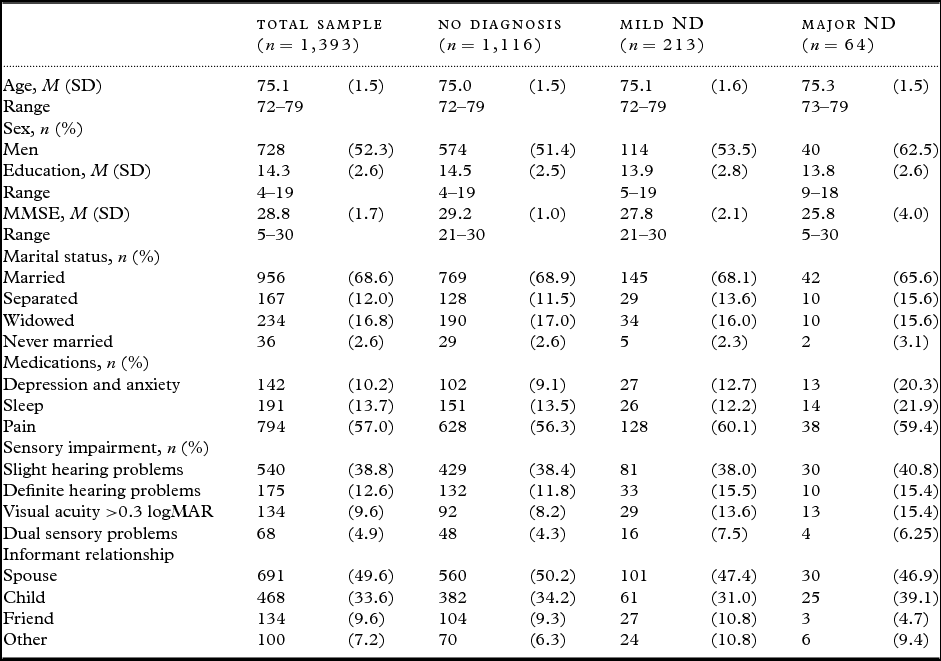
Of the 1,417 participants with informant interviews, 24 were excluded due to missing sensory data, resulting in 1,393 participants in the analytic sample. Table 1 presents the sample characteristics by dementia diagnosis. The mean age was 75.1 (SD = 1.5, range: 72–79) and 52.3% of participants were men. There were 134 (9.6%) participants identified with impaired visual acuity, 540 (38.9%) participants reported their hearing to be a slight inconvenience, and 175 (12.6%) participants reported their hearing to be a definite inconvenience or handicap. Overall, 68 (4.9%) participants were identified with dual sensory loss. There was one participant with an MMSE score of 21 who did not meet criteria for a diagnosis of a major or mild neurocognitive disorder. Table S2 presents the number of clinically relevant neuropsychiatric symptoms assessed by the NPI for each level of sensory loss. Clinically relevant neuropsychiatric symptoms were relatively rare, occurring in less than 15% of all participants. Overall, 109 (7.8%) participants identified with one symptom and 73 (5.2%) with two or more symptoms. No individual symptom occurred in more than 5% of cases. These small numbers precluded investigation of the differential associations between sensory functioning and each individual symptom by clinical diagnosis. The most common clinically relevant neuropsychiatric symptoms were sleep disturbances, appetite problems, depression, and apathy. The least common symptoms were hallucinations, delusions, and euphoria. There appeared to be slightly higher prevalence of sleep problems, apathy, and agitation among those with vision and/or hearing loss.
Sample characteristics by cognitive status

Mild ND: Mild neurocognitive disorder.
Major ND: Major neurocognitive disorder.
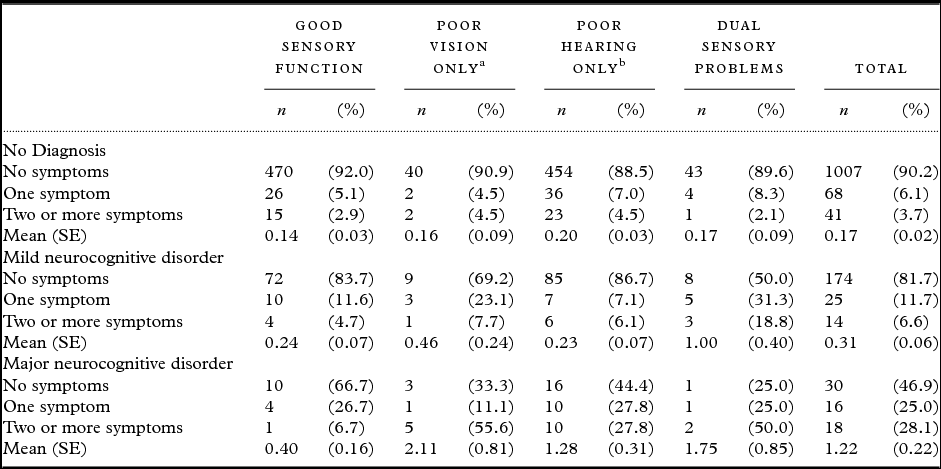
Number of clinically relevant neuropsychiatric symptoms by level of sensory loss and diagnosis

a Poor vision defined by impaired visual acuity (>0.3 logMAR).
b Poor hearing defined by self-reported hearing problems.
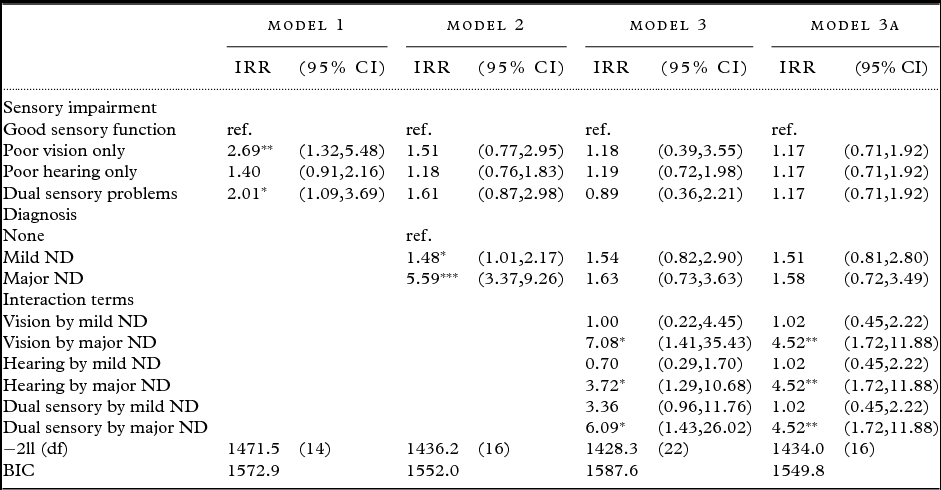
Table 2 presents the number of clinically relevant neuropsychiatric symptoms in the overall sample and by cognitive status (no diagnosis, mild neurocognitive disorder, and major neurocognitive disorder). Cell sizes for major neurocognitive disorder are small, most notably for those with dual sensory loss (n = 4). In unadjusted analyses (that did not include covariates), all types of sensory loss were associated with a greater number of informant reported neuropsychiatric symptoms (results not shown). Table 3 presents the results from the multivariable adjusted negative binomial regression models. Analyses that did not include dementia diagnosis (Model 1) indicated that overall, participants with poor vision only (β = 0.99, SE = 0.36), and dual sensory loss (β = 0.70, SE = 0.31) were estimated to have a greater number of clinically relevant neuropsychiatric symptoms compared to participants with good sensory functioning. There was slightly elevated risk of neuropsychiatric symptoms among those with poor hearing only (β = 0.34, SE = 0.22). These associations were reduced and no longer statistically significant after further adjusting for diagnosis of mild and major neurocognitive disorder (Model 2).
Modifying effect of neurocognitive diagnosis on associations between sensory loss and number of clinically relevant neuropsychiatric symptoms estimated by negative binomial regression (n = 1393)

*p < 0.05.
**p < 0.01.
***p < 0.001.
Note: All models adjusted for age, sex, marital status, informant relationship, physical functioning, and medication use. Constrained estimation is applied to Model 3a whereby coefficients for all sensory loss groups are fixed to be equal. IRR: Incident rate ratio. ND: Neurocognitive disorder.
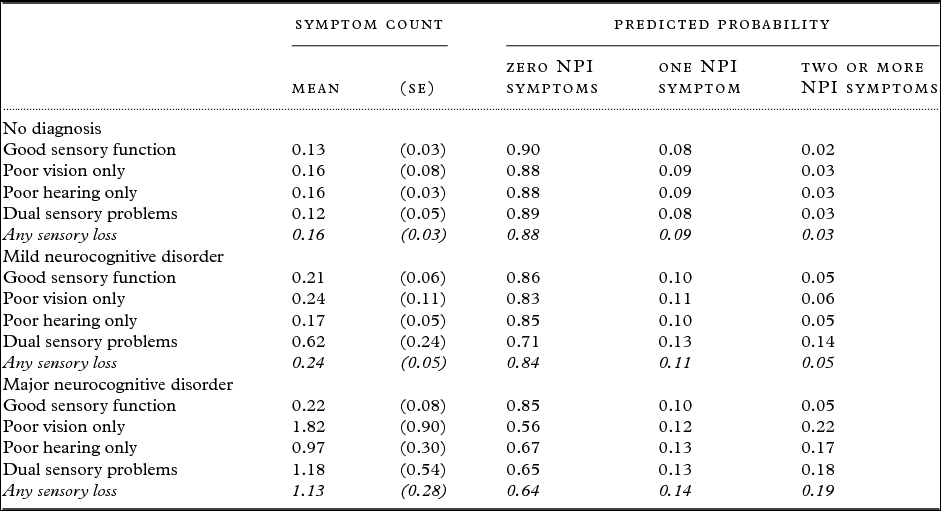
There were significant interaction terms between all types of sensory loss and major neurocognitive disorders but not mild neurocognitive disorders (Model 3), indicating that the association between sensory loss and increased number of neuropsychiatric symptoms was most strongly evident among those with a major neurocognitive disorder. There were a greater number of neuropsychiatric symptoms associated with dual sensory loss for those with mild neurocognitive disorder (β = 1.21, SE = 0.64). Among participants with no diagnosis, there were no differences in the predicted number of symptoms or the probability of having no symptoms across the four types of sensory loss (see Table 4). In contrast, for those with a major neurocognitive disorder, the predicted mean number of symptoms was lower (mean = 0.22, SE = 0.08) and the probability of having no symptoms was higher (probability = 0.85) among those with good sensory function compared to those with poor vision only (mean = 1.82, SE = 0.90, probability = 0.56), poor hearing only (mean = 0.97, SE = 0.30, probability = 0.67), and dual sensory loss (mean = 1.18, SE = 0.54, probability = 0.64). Post-analysis comparisons indicated that there was no difference in the rate of neuropsychiatric symptoms across the three sensory loss groups (χ 2(6) = 5.65, p = 0.464) suggesting that there was no additional risk associated with a dual sensory loss over and above the risk associated with a single sensory loss.
Predicted number of NPI symptoms and predicted probability of being reported to have zero symptoms, one symptom, and two or more symptoms, for each level of sensory loss and diagnosis estimated from negative binomial regression (Model 3)

Note: Marginal means and predicted probabilities estimated at mean values for all covariates. SE: Standard error.
We conducted a series of sensitivity analyses using alternative coding of the sensory and diagnostic variables due to concerns about small cell sizes and to assess how robust these findings were to differences in variable construction and methods. These analyses were consistent with the results reported above and are presented in Tables S3–S6. Of note, there were significant interactions between visual impairment with both major (β = 1.66, SE = 0.61) and mildneurocognitive disorders (β = 1.03, SE = 0.51), and between definite hearing problems and major neurocognitive disorder (β = 1.78, SE = 0.72) (Table S4). When analyses were stratified by type of diagnosis: dual sensory loss (β = 1.37, SE = 0.45) was associated with number of NPI symptoms among those with mild neurocognitive disorder (Table S6). These substantive findings remained unchanged after excluding participants diagnosed with frontotemporal dementia, dementia with Parkinson's disease, or dementia with Lewy bodies (results not shown).
Discussion
This is one of the first studies to examine the association between single and dual sensory loss and a range of informant reported neuropsychiatric symptoms in a mixed community-based cohort with a broad spectrum of cognitive functioning (ranging from cognitively healthy to those clinically diagnosed with dementia). Consistent with our hypotheses, two key findings were made: (1) poor vision and self-reported hearing difficulties were associated with a greater number of clinically relevant neuropsychiatric symptoms; and (2) level of cognitive function appeared to moderate this association, with the increased risk most strongly evident among individuals who were identified with a sensory loss and received a diagnosis of a major neurocognitive disorder. There was no evidence that co-occurring visual impairment and hearing problems resulted in any additional risk of neuropsychiatric symptoms over and above the risk associated with a single sensory loss, except among individuals diagnosed with a mild neurocognitive disorder.
Despite being highly prevalent and linked to a wide range of adverse outcomes (Schneider et al., Reference Schneider2011; Raina et al., Reference Raina, Wong and Massfeller2004; Kiely et al., Reference Kiely, Anstey and Luszcz2013; Viljanen et al., Reference Viljanen, Törmäkangas, Vestergaard and Andersen-Ranberg2014), loss of sensory functioning with age is often poorly recognized and under-treated (Heine and Browning, Reference Heine and Browning2002; Davila et al., Reference Davila2009). There is good evidence of links between sensory loss and cognitive impairment (Lin et al., Reference Lin2004; Albers et al., Reference Albers2015), and individual neuropsychiatric symptoms, but little research has investigated the interaction between limited sensory and cognitive abilities and the accumulation of neuropsychiatric symptoms. As expected, our findings show that when compared to individuals with unimpaired levels of vision and hearing, individuals with poor sensory functioning were more likely to experience a greater number informant reported neuropsychiatric symptoms. Specifically, individuals with a diagnosed major neurocognitive disorder and a sensory loss were on average estimated to have an additional 0.91 neuropsychiatric symptoms relative to those with a diagnosed major neurocognitive disorder who had unimpaired sensory functioning. To put this in perspective, in the overall sample individuals with a major neurocognitive disorder diagnosis were estimated by the same model to have 0.72 additional symptoms relative to those with no clinical diagnosis.
Both neurobiological and interpersonal mechanisms may help explain the current findings. First, the association may be attributable to shared neuropathology that increases susceptibility to both sensory loss and neuropsychiatric symptoms. This is consistent with explanations that identify sensory decline and neuropsychiatric symptoms as dementia prodromes. Alzheimer's-related neurodegeneration has been shown to affect retinal morphology (Blanks et al., Reference Blanks, Torigoe, Hinton and Blanks1996), lead to problems with visual processing (Iseri et al., Reference Iseri, Altinas, Tokay and Yuksel2006) and functioning in other sensory-motor domains (Albers et al., Reference Albers2015). Alternatively, psychosocial factors such as reduced opportunities to engage in stimulating and meaningful activities may explain these findings. Unmet physical and social need arising from sensory loss may lead to the expression of relatively common neuropsychiatric symptoms such as depression, apathy, and agitation (Cohen-Mansfield, Reference Cohen-Mansfield2001). For example, greater tendencies for agitated behavior could be due to frustrations arising from simple misunderstandings in communication, excess disability (McCurry and Drossel, Reference McCurry, Drossel, McCurry and Drossel2011), or boredom due to sensory deprivation and social isolation (Vance et al., Reference Vance2003). Difficulties with social interactions can mean adults limit physical activity and withdraw socially, leading to cascading declines in physical and mental well-being.
These analyses provide further evidence that cognitive resources are important for mitigating the impacts of age-related sensory loss on everyday functioning (Heyl and Wahl, Reference Heyl and Wahl2012). Older adults with neurocognitive disorders may have diminished coping capabilities and experience difficulties implementing compensatory strategies to adapt to sensory declines that would otherwise enable them to remain engaged in daily life. It was interesting that dual sensory loss appeared to be a neuropsychiatric symptom risk factor for those with MCI but conferred no additional risk relative to a single sensory loss for those with dementia. This implies a gradient whereby people with MCI have greater capacity to manage a single rather than a dual sensory loss, but for people living with dementia even a single sensory loss poses significant challenges.
The clinical relevance of neuropsychiatric symptoms as an early marker of cognitive decline, which may precede the onset of cognitive symptoms and clinical diagnosis is increasingly being recognized (Mortby and Anstey, Reference Mortby, Anstey and Pachana2015). The concept of Mild Behavioral Impairment (MBI) has been proposed as a late-life transitional state between normal cognitive aging and dementia, in which the presence of neuropsychiatric symptoms in cognitively normal individuals or those with MCI confers an increased risk of developing dementia (Ismail et al., Reference Ismail2016). The current findings highlight the importance of also considering the role of sensory loss as a possible risk state for neuropsychiatric symptoms and MBI. According to the operationalized criteria, MBI is hallmarked by changes in behavior or personality which start in later life (after the age of 50 years); where behaviors are of sufficient severity to produce at least minimal impairment to social functioning and are not attributable to another current psychiatric disorder, traumatic or general medical causes, or the physiological effects of a substance or medication. In some instances, it may be unclear if the exclusion of general medical causes applies to sensory loss. A challenge for MBI is the need to discern if neuropsychiatric symptoms and sensory loss co-occur due to underlying neurodegeneration, or if behaviors classed as neuropsychiatric symptoms are responses to sensory limitations. Longitudinal follow-up of this PATH sample will be important to track the evolution of MBI in relation to sensory loss. Future research will also need to investigate how sensory loss is associated with the diagnostic criteria of MBI.
Previous research investigating neuropsychiatric symptoms among individuals with sensory loss has generally focused on single outcomes in isolation and primarily been conducted in clinical or care settings. A number of studies have demonstrated that dual sensory loss leads to raised levels of depressive symptomatology (McDonnall, Reference McDonnall2005), and shown that this can primarily be attributed to participation in social activities (Schneider et al., Reference Schneider2011; Kiely et al., Reference Kiely, Anstey and Luszcz2013). Alzheimer's-related retinal neurodegeneration affects ganglion cell photoreceptors that are important for light perception (Blanks et al., Reference Blanks, Torigoe, Hinton and Blanks1996; Guo et al., Reference Guo, Duggan and Cordeiro2010) and severe visual impairment that restricts light perception is known to disrupt circadian rhythms causing sleep problems (Lockley et al., Reference Lockley, Arendt and Skene2007). One recent study has linked high and low frequency hearing loss with sleep apnea (Amit et al., Reference Amit2014) which the authors speculate could be due to vascular inflammatory mechanisms. There is also evidence that vision and hearing loss are risk factors for psychosis-related symptoms such as hallucinations and delusions (Berrios and Brook, Reference Berrios and Brook1984; Chapman et al., Reference Chapman, Dickinson, McKeith and Ballard1999; Linszen et al., Reference Linszen, Brouwer, Heringa and Sommer2015) and they have been reported to be linked with increased risk of delirium in acute care settings (George et al., Reference George, Bleasdale and Singleton1997; Fong et al., Reference Fong, Tulebaev and Inouye2009; Inouye et al., Reference Inouye, Westendorp and Saczynski2014) and confusion in residential aged care (Cacchione et al., Reference Cacchione, Culp, Dyck and Laing2003). Elevated levels of agitation have also been observed among those with vision or hearing loss (Vance et al., Reference Vance2003). Unfortunately, we were unable to examine the modifying effect of cognitive status on the association between sensory loss and individual symptoms due to insufficient sample size.
The present work has several limitations. This study employs a cross-sectional design and we were, therefore, unable to investigate the progression of sensory impairment with the onset of neuropsychiatric symptoms or make inferences regarding causation. Small cell sizes for some sub-groups means we were underpowered to detect interaction effects, and our significant associations likely overestimate the magnitude of the true effect size. This also limited our capacity to examine single symptom domains. The reliability of self-reported hearing difficulties depends on participant awareness of their true level of hearing loss, or recognition of how hearing loss is restrictive and leads to functional limitations. Although self-report measures in other domains have been shown to be valid among patients with mild to moderate cognitive impairment, they are compromised in participants with impaired insight or advanced dementia (Feher et al., Reference Feher, Larrabee and Crook1992; Herr et al., Reference Herr, Coyne, McCaffery, Manworren and Merkel2011). In this sample, participants with a clinical dementia diagnosis are likely to be in early and less severe stages of disease course, and the use of trained interviewers minimizes bias introduced by misreporting of hearing problems. We note that the occurrence of hearing loss (55%) and dual sensory loss (5.1%) in our sample was broadly in line with Australian prevalence estimates derived from clinical measures of hearing for a comparable age range (Kiely et al., Reference Kiely, Anstey and Luszcz2013; Kiely et al., Reference Kiely2016) providing a degree of external validation of our data. Similarly, we acknowledge that using informant-reported NPI symptoms may be subject to recall and interpretation bias, and restrict our inferences to the psychiatric health of participants as perceived by their immediate family and close friends.
The NPI was developed for use clinical and psychiatric settings rather than the general population, but is the most widely used measure of neuropsychiatric symptoms (Lyketsos et al., Reference Lyketsos2011). To improve understanding of neuropsychiatric symptom etiology, a number of studies have used associative clustering to sub-categorize individual NPI symptoms into classes (Nowrangi et al., Reference Nowrangi, Lyketsos and Rosenberg2015). This approach is considered preferable to global NPI scores, particularly for advanced stages of dementia, as it provides more nuanced symptom profiles that better reflect underlying neuropathology (Leoutsakos et al., Reference Leoutsakos, Forrester, Lyketsos and Smith2015). However, there is no clear consensus on the best way to classify symptom clusters (Canevelli et al., Reference Canevelli2013), and this approach has been shown to have no benefit in cognitively healthy samples (Leoutsakos et al., Reference Leoutsakos, Forrester, Lyketsos and Smith2015). For example, recent analysis of PATH data demonstrated that the number of co-morbid NPI symptoms were associated with increased risk of dementia but symptom clusters were not (Mortby et al., Reference Mortby, Burns, Eramudugolla, Isamil and Anstey2017). Some have suggested the use of global measures of neuropsychiatric symptoms to be appropriate in pre-clinical and early stages of dementia (Freer and Badrakalimuthu, Reference Freer, Badrakalimuthu, Dening and Milne2011) or when there is a broad outcome of interest such quality of life and functioning (Lyketsos, Reference Lyketsos2007). In cases where the expression of neuropsychiatric symptoms are due to factors such as communication difficulties, sensory deprivation, and unmet need of sensory loss, then responses to these precipitating factors are likely to manifest in a variety of behaviors and focusing on a single symptom domain may miss or underestimate this association. Moreover, our use of an overall NPI symptom count is consistent with MBI which conceptualizes neuropsychiatric symptoms as a broad syndrome.
While we applied a validated cut-point for clinically relevant symptoms, it is possible that such criteria was too conservative for our sample and underestimated the occurrence of some symptoms, as indicated by low prevalence. However, this enabled group comparisons on a common measure of symptoms that were conspicuous, severe, and/or frequent. We, therefore, feel these limitations should not detract from the study strengths and primary findings that show a clear link between sensory loss and overall number of informant reported NPI symptoms in adults with low levels of cognitive functioning.
Implications and conclusion
Dementia care guidelines emphasize non-pharmacological interventions as the first-line approach to manage neuropsychiatric symptoms (Cohen-Mansfield, Reference Cohen-Mansfield2001). While medications are still commonly relied upon, they are unlikely to directly address the underlying etiology of symptoms arising from sensory limitations. There is a need for non-pharmacological interventions targeting individual needs and capabilities (Cohen-Mansfield et al., Reference Cohen-Mansfield, Thein and Marx2014; Cohen-Mansfield, Reference Cohen-Mansfield2015) that enable adults with cognitive impairment and sensory loss to maintain agency (Grenier and Phillipson, Reference Grenier, Phillipson, Baars, Dohmen and Grenier2013). Importantly, sensory loss is amenable to intervention. Such interventions include use of assistive technologies and communication aids, social engagement, sensory stimulation, and alterations to the built environment (Erber and Scherer, Reference Erber and Scherer1999; Livingston et al., Reference Livingston2014; Abraha et al., Reference Abraha2017). Small pilot studies have provided some evidence for the feasibility of hearing aids as effective interventions for neuropsychiatric symptoms (Palmer et al., Reference Palmer, Adams, Bourgeois, Durrant and Rossi1999; Mamo et al., Reference Mamo2017); however, there are low rates of hearing aid use among adults with cognitive impairment (Nirmalasari et al., Reference Nirmalasari2017), possibly due to issues of affordability, limited capacity of persons in residential aged care, and constraints on staff in high and acute care settings. Training of formal and informal care providers should include development of effective communications skills (Cohen-Mansfield, Reference Cohen-Mansfield2001) and ability to recognize and distinguish between sensory and cognitive impairment (McCurry and Drossel, Reference McCurry, Drossel, McCurry and Drossel2011). As organizational structures can often act as barriers to interpersonal and psychological interventions, implementation of dementia enabling design principles that anticipate sensory limitations have the potential to be powerful and permanent strategies to reduce challenging behaviors (Fleming and Purandare, Reference Fleming and Purandare2010; van Hoof et al., Reference van Hoof, Kort, van Waarde and Blom2010). Most environmental interventions have been evaluated in residential care homes, with relatively little research based in family care settings for people living in their own home (van Hoof et al., Reference van Hoof, Kort, van Waarde and Blom2010; Livingston et al., Reference Livingston2014; Cohen-Mansfield, Reference Cohen-Mansfield2015; But see Brodaty and Arasaratnam, Reference Brodaty and Arasaratnam2012).
Older adults with sensory loss are not only at greater risk of neurocognitive dysfunction, but are also more likely to express neuropsychiatric symptoms that typically precede and coincide with dementia. This study makes an important contribution by clearly demonstrating that sensory loss is linked to non-cognitive symptoms of dementia and may contribute to excess disability, even outside of residential aged care and primary care settings. The extent to which this association is the result of underlying neuropathology, unmet need, or other factors is unresolved. Research examining these putative mechanisms will help inform strategies to address sensory loss. Our results indicate the need for a randomized controlled trial intervention targeting sensory deficits to reduce neuropsychiatric symptoms in this clinical group of community-dwelling older adults.
Conflict of interest
None.
Description of authors’ roles
K. M. Kiely developed the study objectives, was responsible for the statistical design of the study, carrying out of the statistical analysis and writing the paper. M. E. Mortby developed the study objectives, supervised the data collection for the PATH-NPS sub-study, advised on data analysis, contributed to the interpretation of data, and writing of the paper. K. J. Anstey designed the PATH study, supervised data collection, advised on data analysis, contributed to the interpretation of data, and assisted with the writing of the paper.
Acknowledgments
We thank the study participants, PATH Interviewers, Trish Jacomb, and Karen Maxwell. We thank Chantal Meslin, Rajeev Kumar, and Ranmalee Eramudugolla for conducting clinical diagnoses. We acknowledge the contribution of Helen Christensen, Peter Butterworth, Nicolas Cherbuin, Andrew McKinnon, and Simon Easteal. We would also like to acknowledge support from the Australian Research Council (ARC) CE110001029. KMK is supported by the Australian National Health and Medical Research Council (NHMRC) fellowship #1088313 and Alzheimer's Australia Dementia Research Foundation (AADRF) #13F00005. MEM is supported by the NHMRC and Australian Research Council (ARC) Dementia Research Development Fellowship #1102028 and AADRF grant #13F00029. KJA is funded by NHMRC Fellowship #1102694. The wave 4 of the PATH Through Life Study was funded by NHMRC Grant #1002160. The authors have no disclosures to report.
Supplementary material
To view supplementary material for this paper, please visit https://doi.org/10.1017/S1041610217001120.