1 Introduction
In this paper we show that phonetic studies of production patterns corresponding to synchronic variation are a valuable source of information on the historical evolution of linguistic systems. Our study relies on experimental phonetic data to determine differences in the details of variation in vowel sequences in five varieties of Romance. We argue that the most informative interpretation of the phonetic results is possible when they are seen within the diachronic context of each language. The synchronic patterns each reflect a different stage within the evolution of a contrast. We show that these different patterns in related languages follow from the interaction of system-internal factors (lexical attractor effects) and independent phonetic factors (prosodic factors).
We describe in our study a striking case of variation in the Romance languages, found in the realisation and syllabification of vocalic sequences of the type ‘high vocoid’ ([i] or [j], [u] or [w]) followed by a non-high vowel. In this paper we focus on sequences with [i] or [j]; we will refer to them throughout as ‘iV sequences’. These types of sequences vary in their syllabification in different Romance languages, even if the lexical items in which they occur are otherwise almost identical in many cases. That is, in cognate forms we may find hiatus [i.V] in some languages, but a diphthong [jV] in others, as illustrated in (1):
(1) Cross-language [jV]∼[i.V] variability in three Romance languages

Our goal is to determine whether the variability attested in the modern Romance languages can be traced back to the different historical evolution of vocalic sequences and diphthongs in each individual language. We show that a comparative study of phonetic variability can provide valuable insight into the development of individual phonological systems. Throughout the paper we will refer to the two realisations, [iV] and [jV], as ‘heterosyllabic sequences’ (or hiatus) and ‘diphthongs’ respectively. The term ‘diphthong’ is used here independently of a specific syllable structure: i.e. whether [j] is syllabified in the onset or in the nucleus with V.
There appears to be a natural cross-linguistic tendency for unstressed hiatus [iV] sequences to be replaced by [jV] diphthongs. The hypothesis we are testing in this paper is that the observed difference in variability across and within Romance languages is related to two factors independent of this general tendency. One factor is the presence and distribution of [jV] diphthongs in a language, from historical sources other than Latin *iV sequences. Another factor is the duration of iV sequences in different prosodic positions, as sequences resist diphthongisation in positions favouring longer vowels than shorter ones. The interaction of these factors can slow down or speed up the gliding process, and can also account for language-internal variability, as we argue for Spanish.
While the focus of this study is on general phonetic, language-specific structural and prosodic factors playing a role in the evolution of a hiatus/diphthong contrast, our explanation can be successfully framed within the general evolutionary view of sound change proposed by Blevins (Reference Blevins2004, Reference Blevins2006). Building on work by Hyman (Reference Hyman and Juilland1976), Ohala (Reference Ohala, Masek, Hendrick and Miller1981, Reference Ohala, Breivik and Jahr1989), Lindblom (Reference Lindblom, Hardcastle and Marchal1990, Reference Lindblom, Hurford, Studdert-Kennedy and Knight1998) and Pierrehumbert (Reference Pierrehumbert2003), Blevins proposes a complex model of sound change where phonetic explanation and language-specific feedback in the course of acquisition result in emergent recurrent sound patterns. Within this model, variation in pronunciation of iV sequences may include diphthongal [jV] realisations, a common instance of ‘choice’. The specific questions we ask are: (i) what general factors might favour [iV]>[jV] changes over [jV]>[iV], or [iV] stability; (ii) what structural language-specific factors might encourage [iV]>[jV] changes; and (iii) what prosodic factors might inhibit [iV]>[jV] changes?
In § 2 we describe the specific synchronic phenomenon we are studying. § 3 contains the relevant diachronic facts in each language. In § 4 we present the results of the acoustic studies showing the effects of prosodic factors. In § 5 we consider effects related to frequency. Our discussion and interpretation of the results is given in § 6, and in § 7 we present the conclusions and outline a series of follow-up studies.
2 Variation in the syllabification of iV sequences in Romance
The phenomenon we are interested in is the following: all modern Romance languages have cognate words containing iV sequences, but some of these languages differ in the realisation of the first vocalic segment, which is either a vowel [i] or a glide [j]. For instance, a word like piano may be disyllabic [pja.no], trisyllabic [pi.a.no] or variable in its syllabification, depending on the language. The variations surface only when the high vocoid is unstressed. If it is stressed it will be a syllable nucleus, as in Spanish Marí.a.
In this paper we analyse five Romance varieties experimentally. These varieties were chosen according to the presence or absence of variability reported in the literature and/or observed by ourselves. The languages are: Peninsular Spanish, Romanian, Standard French and two varieties of Portuguese, European and Brazilian. We treat European and Brazilian Portuguese as separate languages, due to the prosodic differences between them (Frota & Vigário Reference Frota and Marina2001), which will be relevant to our proposal.
The differences among the languages can be schematised as aligned along a continuum (2), depending on the tendencies observed in each language in the production of vocalic sequences. Thus at one end we have sequences of rising sonority, which are tautosyllabic (diphthongs); at the other end we have heterosyllabic (hiatus) sequences. None of these languages has an orthographic distinction between /i/ and /j/.Footnote 1
(2)
In French (as well as Italian), sequences of vocoids of rising sonority are consistently syllabified as diphthongs (with very few exceptions, to be discussed below). In Spanish, the general tendency is also to produce diphthongs, but hiatus pronunciation is possible or preferred in certain cases, with a great deal of interdialectal and some idiolectal variation (details are presented below). Finally, in Romanian and Portuguese, there is a clear preference for heterosyllabic bivocalic sequences. In Romanian, heterosyllabic [iV] sequences contrast with lexical diphthongs in a relatively small set of lexical items. There is no such contrast in Portuguese.
The question we want to address is to what extent we can identify factors that may predict the differences in syllabification. We hypothesise that two relevant factors are:
- (3)
a. Factor 1
The presence of [jV] diphthongs in the language from other historical sources.
b. Factor 2
Effects of prosodic structure (specifically position in the word and proximity to stress) on the duration of vocalic sequences.
3 Historical sources of heterosyllabic [iV] sequences and [jV] diphthongs: general considerations
We consider first the influence of independent diphthongs (or prevocalic glides) on the diphthong/hiatus contrast in different Romance languages. In this section we survey the historical sources of diphthongs in Romance languages, and in parallel, the historical sources of hiatus [iV] sequences.
In many Romance languages, including Spanish, French, Italian and Romanian, Late Latin stressed /ε/ and /ɔ/ from Classical Latin short mid vowels underwent a process of ‘breaking’.Footnote 2 This happened under somewhat different conditions in different languages, but in all cases produced rising diphthongs. In Portuguese and Catalan, on the other hand, low mid vowels did not produce diphthongs.Footnote 3
(4) [jV] diphthongs from the diphthongisation of stressed mid vowels
Breaking of stressed mid vowels is an important source of [jV] diphthongs in Spanish, French, Italian and Romanian. Language-specific differences are found with respect to this type of diphthongisation, and will be presented in more detail below. For now it is important to note that in these diphthongs we find no variability within or across languages: they are always realised as diphthongs.
In addition, in Italo-Romance and Balkan Romance the palatalisation of [l] in consonant clusters constitutes another significant source of rising diphthongs.
(5) [jV] diphthongs from obstruent-liquid clusters
Again, the languages differ in the details of this sound change. Italian is the only language in which the change takes place without restrictions, resulting in glides after all obstruents. In French the change does not take place, and the original clusters are maintained. In Spanish and Portuguese all the clusters involved undergo palatalisation, resulting in palatal laterals and fricatives respectively. In Old Portuguese these clusters became affricates (still preserved in modern Galician), then became fricatives in modern Portuguese. Romanian maintains the liquid in all cases except after dorsal stops. Prevocalic glides of this origin are also always tautosyllabic, and always give rise to diphthongs.
In Classical Latin vowel sequences of rising sonority, as in cliens ‘client’ and italia, were always heterosyllabic. Additional sequences of the same type were created in the evolution from Latin to the various Romance languages by the deletion of intervocalic consonants, as in Lat. crūdēle(m)>Sp. cruel, Lat. fidēle(m)>Sp. fiel. We find great variability in the syllabification of sequences of this origin across and sometimes within Romance languages. The general attested evolutionary tendency is for heterosyllabic [iV] sequences to be reduced to diphthongs. As we will show, this tendency is clearly stronger in those languages that have a robust class of words with etymological diphthongs arising from the breaking of mid vowels or other sound changes. These diphthongs may act as attractors, leading to the recategorisation of originally heterosyllabic sequences as ‘lexical diphthongs’. We therefore want to propose that the syllabification of such iV sequences depends, in part, on the presence of rising diphthongs from other sources, and on their lexical frequency in a given Romance language.Footnote 6
In the remainder of this section we discuss the historical details for the individual languages we have studied, as well as the synchronic state of the diphthong/hiatus contrast in each language.
3.1 Romanian
Of the languages examined here, Romanian is the one with the most robust diphthong/hiatus contrast. Speakers' intuitions are consistent, and there are near-minimal pairs contrasting in syllabification; e.g. p[já]tră ‘stone’, with a historical diphthong, contrasts with p[i.á]stru ‘piastre’, with a heterosyllabic sequence (Chitoran Reference Chitoran2002). Additional examples are given in (6):
(6) Romanian
Whether a given lexical item contains a diphthong or a heterosyllabic sequence is generally predictable from etymological considerations. Sequences of vocoids of rising sonority are realised as diphthongs if they come either from the breaking of lower-mid vowels or from the palatalisation of laterals. The set of diphthongs from breaking is, however, much smaller than in the other Romance languages where mid vowels underwent this process. Diphthongs from breaking are found only after labials or in word-initial position, as in the examples in (6b). This is because in Romanian the glide was subsequently absorbed through the palatalisation of coronals and velars.
(7) Romanian ‘breaking’ and subsequent palatalisation
The palatalisation of laterals produced glides only after velar stops (as shown in (5)), and word-initially (8).
(8) Romanian lateral palatalisation
Hiatus remains, however, a very common configuration. In particular, Latin sequences in hiatus have not contracted to diphthongs in any position, as shown in (9). The only lexical exception known to us is [djavol] ‘devil’ from Latin diabolu, where a vowel sequence contracts to glide–vowel, and moreover does not cause palatalisation of [d], as it did in die(m)>zi ‘day’.
(9) Romanian hiatus
A few additional sources of prevocalic [j] can be cited for Romanian, specifically from the Slavic and Turkish sections of the vocabulary. Some words of Slavic origin contain prevocalic glides, as reflexes of glides or of palatalised laterals: e.g. [ja]rmaroc ‘fairgrounds’ from Ukrainian jarmarok, [ju]bi ‘to love’ from Slavic ljubiti. Some of the Turkish loans from the 18th and 19th centuries include prevocalic glides as adaptations of the front rounded vowels [y] and [ø]: carag[jo]s ‘funny’ (Turk. karagöz), g[ju]lea ‘cannonball’ (gülle), g[jo]l ‘lake (regional variant)’ (göl). In the Turkish loans these prevocalic glides always occur after velar stops.
The Romanian vocabulary also contains a large number of French loanwords, and the reflex of the French front rounded vowels occasionally also surfaces as a diphthong with a prevocalic glide: p[ju]rew from Fr. purée, k[ju]vetă from cuvette ‘sink’, lik[jo]r from liqueur. This particular adaptation is very infrequent, however. In the majority of cases, the French front rounded vowels are borrowed as [u] or [i] for [y], and as [o] or [e] for [œ ø]. This situation is largely due to the fact that most of the French loanwords are recent, learned borrowings, and have been borrowed into Romanian in their written form. This can also be seen in examples such as pavilion [pavilion] from Fr. pavillon [pavij ] ‘pavilion’, and in other loans from Romance languages which are among the words investigated in this study: f[ia]kru from Fr. fiacre [fjakʀ] ‘carriage’, f[ia]sco from It. fiasco [fjasko], s[ie]stă from Sp. siesta [sjesta] via Fr. [sjεst]. It is particularly interesting to note that the vocalic sequences in these words did not merge with the diphthongs already existing in the language, but instead were categorised with hiatus sequences, contributing in fact to strengthening the hiatus/diphthong contrast.
Romanian therefore appears to be a conservative Romance language in this respect. We find an etymologically determined lexical contrast between rising diphthongs (from breaking of mid vowels and palatalisation of prevocalic [l]) and sequences of vowels in hiatus (from Latin *iV sequences). We suggest that the reduced lexical frequency of diphthongs from other historical sources is one reason why etymological hiatus sequences have not been attracted to the diphthong class, and why Romanian shows a delay in this progression relative to other Romance languages, notably French and Spanish.
An additional glide-related fact about Romanian is the presence of word-final devocalised high vowels, as in singular–plural pairs: [lup]–[lupʲ] ‘wolf’, [ban]–[banʲ] ‘coin’. They are found to be shorter than actual glides, devoiced and perceptually not salient (see Spinu Reference Spinu2006). Given their shorter duration and absence of voicing relative to full glides, it is possible that they also play a role in inhibiting the recategorisation of prevocalic high vowels as glides in Romanian.Footnote 7
3.2 French
In French, unlike Romanian, the sequences of vocoids under discussion are quite systematically syllabified as diphthongs.
(10) French general gliding rule
Somewhat marginally, heterosyllabic sequences are reported in two cases: after a complex onset, subject to some interspeaker variation (11a), and in some sequences where a morpheme boundary intervenes, including compounds and certain verbal forms (11b) (Tranel Reference Tranel1987: 95–98, 115–122):
(11) French heterosyllabic sequences
a. sequences following complex onsets
b. compounds and some verbal forms
In considering the sources of hiatus [iV] sequences in French, we should note that ‘breaking’ historically affected both stressed low-mid and high-mid vowels in open syllables. High-mid vowels developed off-glides. Most of these sequences underwent later developments (Rickard Reference Rickard1974: 24, Price Reference Price1984: 64–68).
(12) French evolution of Latin mid vowels in stressed open syllables
a. Latin short e (Vulgar Latin open /ε/)
b. Latin short o (Vulgar Latin open /Ɔ/)
c. Latin long ē (Vulgar Latin close /e/)
d. Latin long ō (Vulgar Latin close /o/)
Most present-day diphthongs, however, derive from originally heterosyllabic sequences. Present-day French has lost the pronunciation and syllabification difference between heterosyllabic sequences and historical diphthongs with a source in the developments in (12a, c). More recently, delateralisation of the palatal lateral has given rise to new heterosyllabic sequences, which could potentially contrast with diphthongs, but these also tend to be reduced: billet [bi.(j)e]∼[bje] ‘ticket’.
3.3 Spanish
Spanish presents a somewhat more complex situation. Whereas some Spanish varieties may not greatly differ from French or Italian in their preference for diphthongisation, other varieties, including standard Peninsular Spanish, do have a (somewhat unstable) lexical contrast between diphthong and hiatus. This is because the reduction to diphthongs of originally heterosyllabic sequences has been blocked under certain conditions. First of all, these sequences may be pronounced in hiatus if there is an intervening morphological boundary, as in boqu[i.ˈa]ncho ‘wide-mouthed’ (Navarro Tomás Reference Navarro1948, Hualde Reference Hualde1997, Reference Hualde, Gutiérrez-Rexach and Martínez-Gil1999), or if the word is paradigmatically related to another word where the stress falls on the high vowel, as in l[i.ˈa]mos ‘we tie’, cf. ˈl[i.a]s ‘you tie’. In general, these factors are well documented (on paradigm effects, see Steriade Reference Steriade, Broe and Pierrehumbert2000). Interestingly, the same morphological factors may block regular syllabification as diphthongs in other languages. Thus, as mentioned above, the French sequence ia is heterosyllabic in a compound such as anti-aérien, while Italian spianti [spi.ˈanti] ‘those who are spying’ (cf. spia ‘s/he spies') may contrast with spianti [ˈspjanti] ‘you uproot’, which represents the regular syllabification of the sequence (Lepschy & Lepschy Reference Lepschy and Giulio1988: 89).
But even leaving aside all such examples, there are certain lexical items that irregularly contain a hiatus in Peninsular Spanish, although there is substantial variation in speaker intuitions regarding membership of specific words in the hiatus class. Exceptional non-morphologically conditioned hiatus is generally possible under two conditions. One condition, which we refer to as the initiality condition, shows preference for hiatus in word-initial position, e.g. b[i.ˈo]logo ‘biologist’, with possible hiatus, vs. raˈd[jo]logo ‘radiologist’, with an obligatory diphthong. The second condition, which we refer to as the stress condition, shows a preference for hiatus in stressed or pretonic iV sequences, e.g. d[i.ˈa]logo ‘dialogue’, d[i.a]ˈlogo ‘I converse’ vs. d[ja]loˈgo ‘s/he conversed’ (Hualde Reference Hualde1997, Reference Hualde, Gutiérrez-Rexach and Martínez-Gil1999, Reference Hualde2005, Colina Reference Colina, Gutiérrez-Rexach and Martínez-Gil1999).
When we consider etymological origin, it is clear that hiatus is impossible in words whose sequence derives from the breaking of mid vowels. In Spanish, Classical Latin lower-mid vowels diphthongised in both open and closed syllables. Furthermore, the vast majority of words with etymological heterosyllabic sequences nowadays have lexical diphthongs, the unmarked or regular syllabification of iV sequences. That is, most original hiatus sequences have been recategorised as diphthongs. This is shown convincingly by the thorough study of syllabification judgements by Cabré & Prieto (Reference Cabré and Pilar2004, Reference Cabré, Pilar, Martínez-Gil and Colina2007). We hypothesise that the existence of a robust class of diphthong words has acted as an attractor for words with original heterosyllabic sequences. This transfer to the diphthong class has been prevented or slowed down under certain morphological and prosodic conditions. The distribution of diphthongs and hiatus sequences in Spanish is illustrated in (13).
(13) Spanish
a. [je, we]from breaking of mid vowels: always diphthong
b. Sequences from other sources: general rule, also diphthong
c. Exceptional morphologically triggered hiatus (dialectal variation)
d. Exceptional prosodically triggered hiatus (dialectal variation)
Leaving aside the class of words in (13c), we hypothesise that diphthongisation has been prevented under the initiality and stress conditions, as in the examples in (13d), because vocalic sequences are relatively longer in these positions, as tested by our acoustic study in § 4. The longer duration of iV sequences in these contexts may be incompatible with their perception as diphthongs.Footnote 8
3.4 Portuguese
In Portuguese there is no diphthong/hiatus contrast. The general pattern is syllabification in hiatus, with optional gliding occurring in colloquial speech, mostly in post-tonic position, as in palác[ju] ‘palace’, glór[ja] ‘glory’.Footnote 9 It has been noted that in this respect Portuguese is strikingly different from Spanish, French and Italian (see Stavrou Reference Stavrou1947: 22–23 for Brazilian Portuguese; Mateus & d'Andrade Reference Mateus and Ernesto2000, Mateus et al. Reference Mateus, Ana, Inês and Isabel2003 for European Portuguese).
We would like to suggest that this difference between Portuguese and Spanish is related to the fact that Portuguese lacks other historical sources of diphthongs. Unlike Spanish and French, mid vowels did not undergo breaking in Portuguese (see (4) above). Stop–liquid clusters gave rise to affricates in Early Portuguese, later weakened to fricatives (Mateus & d'Andrade Reference Mateus and Ernesto2000): pluvia>[]uva>[ʃ]uva ‘rain’, clamare>[]amar>[ʃ]amar ‘to call’, flamma>[]ama>[ʃ]ama ‘flame’.
3.5 Conclusions regarding historical development
Based on the historical facts presented in this section, we would like to propose that the syllabification of iV sequences in the different Romance languages follows in part from historical considerations, in particular from the existence and abundance of historical diphthongs that may have acted as attractors for originally heterosyllabic sequences.
Both French and Spanish have a robust lexical representation of historical diphthongs from the breaking of Latin mid vowels. In these languages, all or most of the historically heterosyllabic sequences have converged with these historical diphthongs. In Romanian, on the other hand, where historical diphthongs are limited to only certain positions because of subsequent historical changes, the contrast between etymological heterosyllabic sequences and diphthongs has been maintained in a very clear way in the syllabification judgements of native speakers. In Portuguese, where mid vowels did not undergo breaking and, consequently, there are no etymological diphthongs, all sequences are still generally judged to be heterosyllabic (leaving aside the post-tonic context), in clear opposition to Spanish and French.
In addition, we saw that Peninsular Spanish also allows syllabification in hiatus if the sequence is word-initial and either stressed or pretonic. The influence of these prosodic factors on syllabification is more puzzling. In the next sections we describe a series of experiments that we have conducted in order to try to understand this phenomenon.
4 Prosodic effects on the duration of iV sequences
It is known that diphthongs and hiatus sequences differ in terms of duration (Aguilar Reference Aguilar1999, Hualde & Prieto Reference Hualde and Mónica2002 for Spanish; Chitoran Reference Chitoran and Solé2003a, Reference Chitoranb for Romanian). In principle, we expect that heterosyllabic sequences will tend to be recategorised as diphthongs in those positions where they tend to be realised with shorter duration. Conversely, we hypothesise that the initiality and stress conditions that have been identified for the preservation of hiatus in Spanish may relate to the fact that in those positions sequences are realised with greater duration, reducing the likelihood of their recategorisation as diphthongs.
Our working hypothesis is based on well-established effects of prosodic structure on linguistic units in several languages. Here we look at lengthening at prosodic boundaries. Studies by Fougeron & Keating (Reference Fougeron and Patricia1997), Turk & Shattuck-Hufnagel (Reference Turk and Stefanie2000), Cho & Keating (Reference Cho and Patricia2001) and Fougeron (Reference Fougeron2001), among others, have shown that lengthening is correlated with boundary strength, a notion corresponding to the hierarchical organisation of prosodic structure (Selkirk Reference Selkirk1984, Nespor & Vogel Reference Nespor and Irene1986, Pierrehumbert & Beckman Reference Pierrehumbert and Mary1988). To the extent that these are general phonetic tendencies, we would expect to find analogous effects in other Romance languages. Rhythmic/prosodic effects appear to be highly inheritable within linguistic families (see Ladd Reference Ladd1996 on Germanic vs. Romance rules of nuclear accent, and Port & Leary Reference Port and Adam2005: 943–946 on rhythmic patterns in Germanic).
4.1 Experiment 1: initiality effects
We tested the following hypothesis: the reason for historical reduction to diphthong sometimes being blocked in word-initial position is because iV sequences in this position tend to be longer than in other positions. We therefore compared the duration of iV sequences in word-initial and word-medial positions. Word-initial sequences are separated from the left word boundary by one consonant. For all the experiments reported here we measured the acoustic duration of the iV sequence from waveforms and wideband spectrograms, using Praat (Boersma & Weenink Reference Boersma and David2006). The onset of the sequence is marked at the onset of F1 in the high vocoid. The offset of the sequence is marked at the offset of F2 of the second vowel before stops and fricatives, and at the point of amplitude drop before liquids and nasals.
The recordings were made on DAT recorders or directly onto a computer, in a soundproof booth or in a quiet room, using a unidirectional microphone in all cases. The following native speakers participated in the experiment:
(i) Four speakers of Spanish, three female and one male (the second author). The speakers come from different parts of Spain, but all speak a standard, non-regional variety.
(ii) Four speakers of Romanian, three female and one male, all from Bucharest.
(iii) Five speakers of French, three female and two male. Two of the speakers are from Paris, and three from Lyon. All were living in Lyon at the time of the recording. All speak the same standard variety of French.
(iv) Four speakers of European Portuguese, two female and two male, all from Lisbon.
(v) Five speakers of Brazilian Portuguese, three female and two male. Two speakers are from São Paulo, two from Rio and one from Recife; all are speakers of the standard variety with respect to iV sequences.
All speakers read a randomised list of words in their respective languages. The list included words containing iV sequences, historical diphthongs from the break-up of stressed mid vowels (except for Portuguese, which doesn't have any), monophthongal vowels and filler items. The words were embedded in a carrier phrase containing the same number of syllables across the five languages, two syllables before and three syllables after the target word.
(14) carrier phrases
At the end of each recording session, each speaker was asked to syllabify all the words on the list, sounding the syllables out loud and writing them down. We wanted to test whether, in any of the five languages, the iV sequences were syllabified differently from the historical diphthongs.
In spite of the care we took to design the experiment in a similar way for all languages, various organisational problems (e.g. speaker availability) have resulted in some gaps, preventing us in the end from having perfectly consistent tests. For example, in testing the initiality condition in Spanish, we selected a different set of data from those used in the other languages, for reasons that are explained below. Nevertheless, the results are sufficiently clear to constitute reliable indicators of the possible relationships between prosody and diphthongisation. A future study should of course replicate the initiality effect for Spanish under exactly the same conditions as those used for the other languages.
An initiality effect was found in three of the five languages. In Spanish, Romanian and French, word-initial vocalic sequences were found to be longer than word-medial ones. In European and Brazilian Portuguese, the durations of word-initial and word-medial sequences were comparable. Details are presented in the remainder of this section.
The Spanish data analysed for the initiality effect consists of 33 words, with four repetitions, resulting in a total of 528 words across the four speakers. The list is given in the Appendix (§1). Test words belong to one of three groups: initial stressed, non-initial stressed and initial unstressed. These test items do not include any words with diphthongs derived from historical breaking. We added to this list what we found to be the preferred syllabification judgements for each sequence in Peninsular Spanish, emerging from the variable intuitions of the speakers. For clarity, stress marks have been added in all words.
The three groups of words were chosen on the basis of reports of syllabification judgements in the literature on Spanish. Phonological descriptions of Peninsular Spanish report that the general tendency for iV sequences to be syllabified as diphthongs is violated in certain cases, especially when there is a morpheme boundary between vocoids and when the high vocoid receives the stress in paradigmatically related words (e.g. vac[i.ˈa]mos ‘we empty out’; cf. vaˈc[i.o] ‘I empty out’) (Navarro Tomás Reference Navarro1948, Real Academia Española 1973, Quilis Reference Quilis1993). In Hualde (Reference Hualde1997, Reference Hualde, Gutiérrez-Rexach and Martínez-Gil1999) the claim was made that in cases where morphological/paradigm effects can be excluded, exceptional syllabification in hiatus occurs in Spanish only when both of the following conditions are met: (a) the iV sequence is word-initial, and (b) the stress is either on the sequence or on the following syllable. These claims were made based on syllabification intuitions (see also Hualde Reference Hualde, Campos and Martínez-Gil1992, Simonet Reference Simonet, Frota, Vigário and Freitas2005, Cabré & Prieto Reference Cabré, Pilar, Martínez-Gil and Colina2007). In an acoustic study, Hualde & Prieto (Reference Hualde and Mónica2002) (replicated in Face & Alvord Reference Face and Scott2004) show that, to a great extent, speakers' syllabification intuitions and durational measurements coincide, so that sequences that tend to be classified as heterosyllabic by speakers have greater duration. As reported in all these studies, however, there is a fair amount of variability in speakers' intuitions of syllabification, even when dialect is controlled for. As expected, the syllabification intuitions from our four speakers showed similar patterns.
Our own Spanish experiment was therefore intended to test the proposed word-initiality and stress conditions identified in Hualde (Reference Hualde1997, Reference Hualde, Gutiérrez-Rexach and Martínez-Gil1999) in a more direct way. Of the five languages, Spanish is the only one for which syllabification judgements were very mixed, and we were therefore particularly interested in seeing how this played out in terms of duration trends. We examined Peninsular Spanish, since this is the only variety that has been described in detail in this respect.
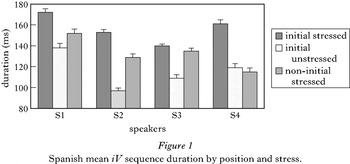
An ANOVA was performed, with duration as the dependent variable, and two independent factors: ‘Position&Stress’ (with three levels, corresponding to the three groups) and ‘Speaker’.Footnote 11 A main effect of Position & Stress on the duration of the sequence was found for all four Spanish speakers (p<0·001). Most relevantly, initial stressed sequences are the longest for all four speakers, and non-initial stressed sequences are significantly shorter than initial stressed ones for three subjects (S3 shows a non-significant tendency in the same direction). This second result is particularly interesting, given the fact that the non-initial stressed sequences include three words where the vocalic sequence is final (racial, cordial, trivial). Assuming effects of word-final lengthening, we would predict that without these three words, the duration of non-initial sequences would be even shorter.
The results in Fig. 1 lend support for our hypothesis: iV sequences tend to be longer in initial position in Spanish. Because of this increased duration, word-initial heterosyllabic sequences would more often tend to be perceived as hiatus, lagging behind non-initial sequences in their diachronic recategorisation as diphthongs. As indicated earlier, hiatus words have generally been transferred to the diphthong class. This is the general tendency reported in the language (Lloyd Reference Lloyd1987: 320, Quilis Reference Quilis1993: 184, Penny Reference Penny2002: 60). In Peninsular Spanish we and the authors cited above find that intuitions regarding syllabification as diphthong or as hiatus are less clear for word-initial sequences, and include more hiatus responses. We explain this as a consequence of the relatively greater duration of sequences in this position.
Spanish mean iV sequence duration by position and stress.

If the initiality effects found in Spanish have a phonetic explanation, we reasoned that similar effects might also be found in a related language such as Romanian, even if there the effects have not led to a phonological transfer of words from the hiatus to the diphthong class. In the syllabification intuitions we elicited from the four Romanian speakers after the recording session, the only tautosyllabic (diphthong) responses we obtained were for the words containing historical diphthongs. All the other vocalic sequences were systematically judged to be heterosyllabic. We hypothesised that among these heterosyllabic vocalic sequences, word-initial ones may also show longer duration than non-initial ones.
In testing the initiality effect, the same design was used for the remaining four languages; i.e. the test items were divided into two balanced groups, according to the position of the sequence in the word: initial and non-initial. The location of stress and the number of syllables were kept constant. We also matched the segmental context (consonants preceding and following the vocalic sequence) for each pair of words, and the type of syllable (open or closed) in the rest of the word. The test items analysed for Romanian are given in the Appendix (§2). Seven repetitions were recorded, for a total of 560 tokens across the four speakers.
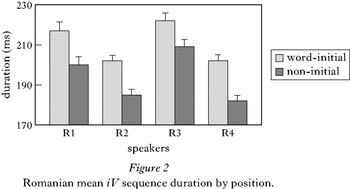
An ANOVA test was performed, with ‘Duration’ as the dependent variable, and ‘Position’ (with two levels, ‘initial’ and ‘medial’) and ‘Speaker’ as independent factors. The results, given in Fig. 2, show that for all four speakers sequences are significantly longer word-initially than word-medially (p<0·0001).
Romanian mean iV sequence duration by position.

We conclude that the word-initiality effect is found in Romanian as well. Just as in Spanish, word-initial sequences tend to have a longer duration than medial (non-initial) ones. A phonological difference between the two languages is that in Romanian there has been no recategorisation of phonetically shorter sequences as tautosyllabic. We attribute this fact to the relatively reduced presence of etymological diphthongs in Romanian.
The preserved contrast between diphthongs and vowel sequences in Romanian is confirmed by the syllabification intuitions of native speakers, as well as by duration measurements. In separate studies, Chitoran (Reference Chitoran and Solé2003a, Reference Chitoranb) reports significantly shorter durations for diphthongs (e.g. p[ja]tră) than for hiatus sequences (p[ia]stru), for each of the same four speakers recorded here. In the context of this robust contrast, the initiality effect suggests the following: hiatus sequences in Romanian are slowly making their way towards diphthongs (more slowly than in Spanish), with gliding occurring first in non-initial sequences, and later in initial ones.
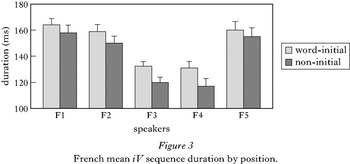
In standard French, no hiatus/diphthong contrast is reported, and iV sequences are universally judged to be diphthongs, with the exceptions noted in § 3. Nevertheless, we suspected that the same initiality factor found in Spanish and Romanian might be present, with initial sequences being longer. The French test items are listed in the Appendix (§3). We recorded seven repetitions of each word, for a total of 630 analysed words across all five speakers. The results are shown in Fig. 3.
French mean iV sequence duration by position.

An ANOVA performed on the data for all five speakers revealed an effect of Position (p=0·023) and Speaker (p<0·0001), with no interaction between these two factors. As in Spanish and Romanian, an initiality effect was found, although to a smaller degree. In the syllabification test administered after the recording, all speakers agreed in judging the sequences in the test words to be tautosyllabic.
An experiment similar in design was also conducted for European and Brazilian Portuguese. As shown in § 3, both varieties lack a diphthong/hiatus contrast, and show a preference for hiatus in stressed and pretonic sequences. Nevertheless, European and Brazilian Portuguese differ substantially in their rhythmic patterns (Frota & Vigário Reference Frota and Marina2001), which in principle might have an effect on the realisation of the sequences under investigation.
The test items are given in the Appendix (§4). For European Portuguese, seven repetitions were recorded, for a total of 504 analysed words across all four speakers. For Brazilian Portuguese, three repetitions were recorded, resulting in 270 analysed words across all five speakers. The results are given in Fig. 4. Unlike the other three languages, no initiality effect was found in either European or Brazilian Portuguese (p>0·05).
Portuguese mean iV sequence duration by position: (a) European; (b) Brazilian.

The Romance languages investigated in this experiment show different patterns with respect to the degree to which they maintain a contrast between glides and high vowels (or between diphthong and hiatus). The patterns are summarised in (15).
(15) Summary of diphthong/hiatus contrast in Romance
We conclude that a tendency to shorten heterosyllabic iV sequences to diphthongs can be conditioned by several factors. One such factor is the presence of diphthongs or prevocalic glides in the language from other historical sources, as discussed in § 3. In languages where such diphthongs are well represented, there will be a greater tendency for gliding in heterosyllabic sequences in comparison to languages with fewer or no such diphthongs. In the first type of language the gliding tendency will eventually lead to the disappearance of the contrast between unstressed heterosyllabic sequences and diphthongs.
A second factor was identified in three of the languages under investigation. In Spanish, Romanian and French, word-initial sequences appear to have greater duration than non-initial ones. This positional factor may be slowing down the recategorisation of heterosyllabic vowel sequences as diphthongs. This factor can indeed be seen to play a role in Spanish, where speakers often judge sequences to be heterosyllabic if they are word-initial, the context where they have longer duration.
Position in the word is, however, not the only prosodic factor that can affect duration. We also hypothesised that proximity to stress has an effect on duration, and in the case of Spanish, it also affects syllabification judgements. In the next subsection we present the results of a second experiment, testing the effects of proximity to stress in iV sequences and monophthongal vowels.
4.2 Experiment 2: proximity to stress effects
It has been noted in work on the syllabification judgements of Spanish speakers that the possibility of having an exceptional hiatus is subject to a proximity to stress condition, in addition to the initiality condition discussed in the previous section (Hualde Reference Hualde, Gutiérrez-Rexach and Martínez-Gil1999, Reference Hualde2005: 84, Simonet Reference Simonet, Frota, Vigário and Freitas2005). An initial iV sequence may be syllabified as heterosyllabic if stress falls on the sequence itself or on the next syllable, but not if stress is further along. For instance, some Spanish speakers syllabify di-á-lo-go ‘dialogue’ and di-a-ló-go ‘I converse’, with a syllable break between the two vocoids, but dia-lo-gó ‘s/he conversed’, with a tautosyllabic sequence. We hypothesise that this effect is due to the fact that sequences in stressed and pretonic position are longer than other sequences, which more often causes them to be perceived as hiatus and not as diphthongs.
Stressed sequences can uncontroversially be expected to be longer. The part of our hypothesis that needs to be demonstrated is that sequences also have greater duration in immediately pretonic position than earlier in the word. We would like to extend this claim in two directions. First, if syllabification in the case at hand follows in part from phonetically induced duration, the same durational differences should be found in syllables containing single vowels. Second, to the extent that this is a rhythmic pattern common across Romance, we expect to find similar effects in other Romance languages. The experiment presented in this section is designed to test these related hypotheses.
The data for this experiment were obtained in the same recording sessions reported in § 4.1, embedded in the same carrier phrases, with the same number of repetitions. The experimental items all contain the initial sequence dia-. Because of the slightly fewer dia- words available in Portuguese, and the smaller number of repetitions in Brazilian Portuguese, we increased the number of test words for these two language varieties by including some additional sequences, in which the consonant preceding the iV sequence is different from [d]∼[], and the sequence also includes the mid vowels [e o]. The test items are given in the Appendix (§5).
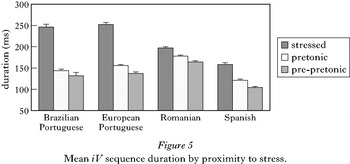
The position of stress was varied to fall either on [dia σ σ] (the stressed condition), on the following syllable [dia σ σ] (the pretonic condition), or two syllables later [dia σ σ] (the pre-pretonic condition). The same Spanish, Romanian, European and Brazilian Portuguese speakers participated. French was not included in this experiment, because it does not have such triplets. The duration of the word-initial iV sequence was measured; the results are shown in Fig. 5.
Mean iV sequence duration by proximity to stress.

Note that for Portuguese the stressed iV sequences are much longer than for the other languages, and much longer than the Portuguese pretonic and pre-pretonic sequences. This is consistent with other work, which has shown that the difference in duration between stressed and unstressed syllables is considerably greater in Portuguese than in Spanish (e.g. Kelm Reference Kelm1989). Unstressed vowel reduction in European Portuguese can then be seen as resulting from the fact that unstressed vowels are very short, and can be further reduced and deleted. The increased role of duration as a cue for stress in Portuguese may compensate for the fact that F0 provides a weaker cue for stress than in Spanish and other Romance languages. This is true for both Portuguese varieties considered in this paper.Footnote 12
An ANOVA was performed for each language, with duration as the dependent variable, and two independent factors: ‘Stress class’ (with three levels: stressed, pretonic, pre-pretonic) and ‘Speaker’. Post hoc comparisons on the data for each language revealed the same differences in duration, all significant at p<0·05:
(16) Significant differences in duration (in each language)
stressed>pretonic>pre-pretonic (p<0·05)
As expected, stressed sequences are the longest in all languages, pretonic sequences are significantly shorter than these, but significantly longer than pre-pretonic ones. For Spanish and Portuguese, interactions were found between Stress class and Speaker. For two of the four Spanish speakers, pretonic and pre-pretonic sequences have comparable duration. The same is true for three of the four European Portuguese speakers, and for two of the five Brazilian Portuguese speakers. Nevertheless, it is always the case that stressed sequences are the longest, and that pre-pretonic sequences are never longer than pretonic ones.
For Spanish, these results offer support for the hypothesis that iV sequences tend to be perceived as hiatus in those positions where they are realised with greater duration. Given the difference between tonic and pretonic sequences, however, we expect that the perception of hiatus should be more robust or consistent across speakers in stressed than in (immediately) pretonic position. This is, in fact, what Simonet (Reference Simonet, Frota, Vigário and Freitas2005) found. Our results are also consistent with syllabification judgements subsequently reported by Cabré & Prieto (Reference Cabré, Pilar, Martínez-Gil and Colina2007). The speakers surveyed in their study reported an increasing percentage of diphthong syllabification with increased distance from main stress: e.g. 93% diphthongs in diagonál vs. 70% in diadéma vs. 58% in diálogo. To the extent that greater duration correlates with a hiatus percept, these durational facts explain syllabification judgements. Our results indicate the same durational pattern in Romanian and Portuguese, even though in these languages the difference in relative duration does not affect syllabification intuitions.
We hypothesise that these duration differences are not particular to the vocalic sequence, but reflect a general rhythmic pattern in the language that affects monophthongal vowels as well. Furthermore, we may expect to find the same pattern in other Romance languages, since such durational patterns appear to be highly inheritable and resistant to diachronic change (see van Leyden Reference Leyden2004: 23–40).
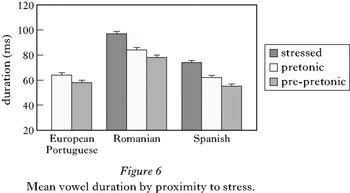
The test items for this experiment are given in the Appendix (§6). We analysed data from Spanish, Romanian and European Portuguese. The words were embedded in the same carrier phrases as in Experiment 1. For Spanish and European Portuguese, three of the original four speakers were available for this additional experiment. The Brazilian Portuguese speakers were no longer available. For Spanish, we recorded five triplets differing only in the position of stress. For Romanian, six triplets were used for three speakers, and seven triplets for the fourth speaker. For European Portuguese, we compared seven minimal pairs consisting of the pretonic and the pre-pretonic conditions, both of which have reduced vowels in the initial unstressed syllable. The stressed condition was not included, because it contains a full, unreduced vowel, which would obviously be much longer. As noted above, the stressed syllables in Fig. 5 are much longer in Portuguese than in Spanish and Romanian. We were particularly interested in comparing the duration of pretonic and pre-pretonic vowels. For all languages, the measurement that was taken was the duration of the vowel in the word-initial syllable of each word. Results are shown in Fig. 6.
Mean vowel duration by proximity to stress.

The data for each language were submitted to an ANOVA, with vowel duration as dependent variable and two independent factors: ‘Speaker’ and ‘Stress class’ (stressed, pretonic and pre-pretonic for Spanish and Romanian; pretonic and pre-pretonic for European Portuguese). Our hypothesis that proximity to stress affects vowel duration is supported by the results. For European Portuguese pretonic vowels were found to be significantly longer than pre-pretonic ones (p<0·05). A post hoc Least Significant Difference (LSD) test revealed the following three-way significant differences for Spanish and Romanian.
(17) Significant differences for Spanish and Romanian
stressed>pretonic>pre-pretonic (p<0·05)
An interaction was found between Speaker and Stress class only for Romanian. We further analysed the data in an LSD test for Stress class, with the data split by Speaker. The results show that one Romanian speaker has a significant difference among all three stress conditions, two speakers have significantly longer vowels in stressed syllables, but comparable pretonic and pre-pretonic vowel duration, and one speaker does not have any significant differences. Overall, it is never the case that pre-pretonic vowels are longer than pretonic ones, or that pretonic vowels are longer than stressed ones. All three Spanish speakers show a significant difference among the three conditions, in the direction shown in (17).
We interpret these results as supporting our hypothesis, as they show that stressed initial syllables are longer than unstressed initial syllables, and that there is a strong tendency for initial syllables immediately preceding stress (pretonic) to be longer than initial syllables further away from stress (pre-pretonic).
Given these results, an important aspect of the skewed distribution of exceptional hiatus in Spanish can be explained by reducing it to a more general rhythmic pattern: exceptions to the syllabification of iV sequences as diphthongs are found only in stressed and immediately pretonic syllables, because these syllables tend to have greater duration than other syllables. The duration differences thus correlate with the distribution of heterosyllabic vowel sequences in Spanish. Whereas with single vowels these durational differences are not phonologised, in the case of sequences relative differences in duration contribute to their phonologisation as diphthongs or hiatus.
The results obtained are consistent with findings reported for Catalan (Recasens Reference Recasens1991). Vowels in immediately pretonic syllables tend to be longer than other earlier vowels (at least in words bearing a pitch accent). A similar pattern is also found in Russian, where vowels in pretonic syllables are reported to be less reduced than vowels in other unstressed syllables (see e.g. Hamilton Reference Hamilton1980, Cubberley Reference Cubberley2002).
5 Frequency
One final issue we need to address before drawing any conclusions is the potential relevance of frequency to the implementation of sound change. A large body of literature has argued that frequency plays an important role in historical change (e.g. Zipf Reference Zipf1929, Hooper Reference Hooper and Christie1976, Bybee Reference Bybee2001, Pierrehumbert Reference Pierrehumbert, Bybee and Hopper2001, Reference Pierrehumbert2003). Frequency is known to play a role in lexical diffusion, with high-frequency words undergoing a given sound change earlier than lower-frequency words. At the same time, there is evidence that sound change does not always affect the most frequent words first (see Phillips Reference Phillips1984, Round Reference Round2004), because frequency itself may interact with other variables in the system in such a way that its relative weighting as a factor may be reduced. It is therefore crucial for us to determine whether the frequency of occurrence of a given word plays a role in the gliding change we are investigating. It is plausible, after all, that iV sequences may be shorter in some words simply because those words have higher frequency.
Of the languages we looked at, Spanish is one for which a frequency count would be truly informative. This is because Spanish is the only language where the variability in the duration of vocalic sequences is paralleled by variability in the syllabification intuitions of native speakers. Spanish is apparently the only language of the five where we see a change in progress involving the loss of the diphthong/hiatus contrast. Frequency effects may therefore be visible in the shift of individual words from the hiatus to the diphthong class.
For the frequency count we used Davies's Corpus del español, an online database consisting of 100 million words of text from the 1200s to the 1900s. The search results we report here are based on the 1900s corpus. The database for the 1900s alone contains 20 million words, and consists of records from three styles of Spanish: literary texts, spoken language, periodicals and encyclopedias.
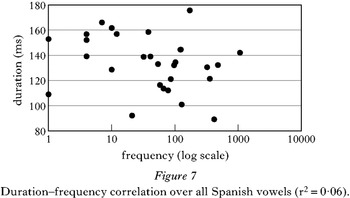
We carried out a frequency count of all the words included in our Spanish experiment, listed in the Appendix (§1). We plotted the mean duration of the vocalic sequence in each word, computed over four repetitions and four speakers. The scatter plot in Fig. 7 shows the absence of a correlation between duration and word frequency. A Pearson correlation test confirmed the absence of any correlation between word frequency and acoustic duration of the vocalic sequence (correlation value=−0·265, p=0·130, n=33).
Duration-frequency correlation over all Spanish vowels (r2=0·06).

We also selected a subset of the Spanish words that have a similar number of syllables, and repeated the correlation test. A perfect control for the number of syllables is not possible, since the syllabification of iV sequences is variable. The reduced list of words is given in the Appendix (§7). The Pearson test still showed no correlation between duration of the iV sequence in these words and their frequency of occurrence in the corpus (correlation value=−0·241, p=0·352, n=17).
The fact that word frequency does not directly correlate with duration of the iV sequence suggests that it is not as important a factor as the others we have identified, namely the lexical attractor effect and the prosodic factors. The way in which gliding progresses in Spanish can be reliably attributed to the interaction of these factors. In the next section we explain in more detail the way in which we conceptualise this interaction.
6 Discussion
The facts we have investigated in our study have to do with hiatus resolution. It is well known that hiatus is dispreferred cross-linguistically (see Casali Reference Casali1997 for a comprehensive survey). In the case of high–non-high vowel sequences, a very common sound change is the reclassification of heterosyllabic sequences (i.V) as tautosyllabic diphthongs (jV). This means that the diphthong in some sense acts as an attractor for vowels in hiatus.
We would like to suggest that the best way to conceptualise this particular status of the diphthong as attractor comes from its articulatory structure. The sound change we are studying is one in which a high–non-high vowel sequence results in the gliding of the high vowel. It is particularly useful to think of this change in gestural terms, following work by Browman & Goldstein (Reference Browman and Louis1989, Reference Browman and Louis1990, Reference Browman and Louis1992), as resulting from variable overlap of the vocalic gestures in a hiatus sequence. Browman & Goldstein propose a model for the syllable which consists of asymmetric coordination relations. Their model, based on experimental evidence from several languages, shows that onset-consonant gestures are coordinated synchronously with the following vowel gesture, whereas coda-consonant gestures are coordinated sequentially with the preceding vowel gesture (Browman & Goldstein Reference Browman, Louis, Bell-Berti and Raphael1995, Reference Browman and Louis2000). A similar sequential coordination is also observed across syllable and word boundaries. The sequential mode of coordination is less stable than the synchronous one, with instability manifested in increased variation (Nam, to appear).
For Browman & Goldstein stable coordination modes are attractors, and diphthongs, which are tautosyllabic, have a stable coordination mode.Footnote 13 This type of model can capture the fact that gliding (diphthongisation) is the natural tendency for hiatus [iV] sequences, all else being equal. In a language like Portuguese or Catalan, for example, where there are no independent prevocalic glides from other sources to act as additional attractors, the stable articulatory structure of the diphthong alone may have an effect on hiatus sequences. In Portuguese, gliding is occasionally possible in casual speech. In this sense, the diphthong can be said to constitute a phonetically more natural structure.Footnote 14
Hiatus sequences being heterosyllabic, the gestures involved are expected to vary more in their relative timing. In a language that already has glides, if this variation often results in an overlapped, shorter [i] vowel that can be easily perceived as a glide, this could in turn lead to a recategorisation of the hiatus sequence as a tautosyllabic diphthong. But if the language does not already contain other glides (like Portuguese), there is less impetus for the recategorisation to take place. This means that such languages should linger in a relatively longer stage of hiatus and variation. This is the stage currently reported for Portuguese.
The proposal that the stable mode of coordination specific to diphthongs can act as an attractor for the instability of heterosyllabic hiatus sequences makes the prediction that the general cross-linguistic tendency should be for [iV] sequences in hiatus to become diphthongs, rather than the other way around, in the absence of any other pressures acting on them (e.g. stress). As far as we can tell, this prediction is borne out. We know of relatively few instances of diphthongs separating into vowel sequences historically. Jakobson (Reference Jakobson1931 [1962]: 213) reports that in Serbo-Croatian the long phoneme ie changes in some dialects into a disyllabic group /i+e/ (although information on stress is not given). In contrast, there is a strong tendency in Colombian Spanish to diphthongise etymological sequences with mid vowels, as in pelear [peˈljar] ‘to fight’, peor [ˈpjor] ‘worse’ (Garrido, in preparation). This sound change produces neutralisation between the verb classes represented in standard speech by cambiar [kamˈbjar] ‘to change’ – cambia [ˈkambja] ‘s/he changes’ and pelear [pele.ˈar] ‘to fight’ – pelea [peˈle.a] ‘s/he fights’. This has further led to hypercorrected pronunciations where the original diphthong is replaced by a sequence in hiatus with displacement of the stress: e.g. cambia becomes [kamˈbe.a] in hypercorrected speech.
We believe it is possible to see an unstable coordination mode as a potential source of variability. An unstable mode is characterised by considerable variation, which in turn may give rise to ambiguous percepts. In our specific example, the ambiguity arising in hiatus sequences is that between a glide [j] and a high vowel [i], in a language that already has such glides. The intrinsic instability of hiatus results in articulatory variants, and this variation can give rise to sound change with sources in choice (Blevins Reference Blevins2004: 32–42). In this case, sound change results from ‘choice’ of a representative diphthong, distinct from hiatus of earlier generations. A prediction of Blevins' model is that sound changes with sources in choice will be more sensitive to ambient sound patterns of a language than sound changes with sources in misperception. This is because pre-existing categories can serve to ‘direct’ CHOICE, acting as attractors where novel categorisation is involved (Blevins Reference Blevins2004). This principle, termed ‘Structural Analogy’ (cf. de Chene & Anderson Reference de Chene and Stephen1979, Kiparsky Reference Kiparsky and Goldsmith1995) finds support in the data examined here. The presence of prevocalic glides in the phonological systems of Romance languages is therefore crucial in resolving the ambiguity induced by variation of the sort currently found in Spanish. The presence of unambiguous [jV] diphthongs from other sources gives rise to resolution of ambiguity in favour of the diphthong. In languages where such prevocalic glides are well represented, the tendency towards gliding in iV sequences is reinforced, eventually leading to the neutralisation of contrast between [iV] and [jV].
Structural analogy alone is not a sufficient explanation, however, as shown by the ambiguity arising from iV hiatus sequences. Variation in such sequences can give rise to a [jV] diphthong percept, if the variation involves primarily the duration of the high vocalic component, but it can equally well give rise to the percept of an intervocalic homorganic glide [ijV], if the ambiguity stems from the reinterpretation of the V–V transition. Blevins (to appear) presents exactly this latter type of scenario in three languages from distinct families (Hindi, Chamorro, Tauya). In many western and central Basque dialects, a glide was also historically inserted and underwent further fortition in this context. Thus, mendia /mendi+a/ [mendi.a] ‘the mountain’ has become [mendiɟa]∼[mendiƷa]∼[mendiʃa], depending on the dialect, whereas in eastern varieties we find diphthongisation: [mendja] (Hualde Reference Hualde1991).
Structural analogy predicts that either of these changes is likely to occur in a language that already has /j/ in its phonemic inventory. It is quite possible that among the variable tokens found in the Romance languages we have examined, some of the longer ones might have intervocalic glides, as is often assumed for French plier [plije] ‘to fold’. But what is important is the fact that the tendency in Romance is to move towards a diphthong [jV], whereas in the languages surveyed by Blevins (to appear) the outcome of the change given a similar segmental context is [ijV]. Identifying factors which might determine [iV]>[jV] as opposed to [iV]>[ijV] sound changes will involve further articulatory and acoustic studies of synchronic variation of iV sequences, perceptual studies determining factors in misperception and full-blown assessments of the potential structure-preserving role of segment inventories, general phonotactics and syllable structure.
For the Romance facts we argue that an additional factor comes into play, and can potentially oppose the gliding tendency. Based on the results of our study, we propose that this factor is prosodic, and unlike the lexical factor, it slows down the tendency of hiatus sequences to merge with diphthongs in particular lexical items. We have identified two main prosodic effects on the duration of vocalic sequences, originally motivated by our observations of the distribution of exceptional hiatus in the syllabification intuitions of Spanish speakers. First, vocalic sequences are longer word-initially than word-medially. Second, vocalic sequences as well as simple vowels are longer in stressed syllables and pretonically. This suggests that, at least under stress, in word-initial position and in immediately pretonic position, the merger of hiatus sequences with diphthongs will be delayed. The different stages of contrast found at present in the five Romance languages investigated can be explained by language-specific differences in the lexical and prosodic factors noted. Specifically, the prosodic effects explain the fact that gliding will occur in word-medial vocalic sequences before word-initial ones, in pre-pretonic sequences before pretonic ones and in unstressed sequences before stressed ones.
In sum, we suggest that the synchronic reflexes of Latin *iV sequences in modern Romance languages reflect distinct evolutionary forces, including:
(i) the stable coordination of diphthongs as general articulatory attractors, affecting the ‘direction’ of the change;
(ii) pre-existing unambiguous [jV] diphthongs from other sources as language-specific attractors, affecting the ‘speed’ of the change;
(iii) prosodically determined lengthening of iV, which can inhibit diphthongisation and affect the ‘trajectory’ of the change by determining gradient patterns of hiatus to diphthong shifts in the lexicon.
Though lexical frequency has been associated with faster lenition or coarticulatory sound changes in other studies, we did not find any clear associations between high-frequency items and diphthongisation in Spanish.
Our proposal, based on the interaction of the three factors, could be tested in a computational model (e.g. Yang Reference Yang2000, Wedel Reference Wedel2004, Reference Wedel2006, Reference Wedel2007, Niyogi Reference Niyogi2006). For example, the presence or absence of historical diphthongs from other sources could be modelled as an ‘initial condition’ (Niyogi Reference Niyogi2006),Footnote 15 while the stable coordination mode of the diphthong and the prosodic factor can be modelled as conflicting attractors. Following Wedel (Reference Wedel2004), the influence of historical diphthongs can be modelled as pattern reinforcement by structural analogy. Wedel's simulations predict that, all else being equal, the greater the number of forms in the lexicon that share a pattern, the greater the bias toward that pattern in language change.
One particular challenge for a computational model is parallel to the challenge posed by frequency: how frequent is frequent enough for frequency to make a difference? Similarly, the presence of glides in a given language may have some kind of threshold below which it may not determine any differences among languages. In other words, how many more glides must Spanish have in order to outpace the diphthong/hiatus merger in Romanian?
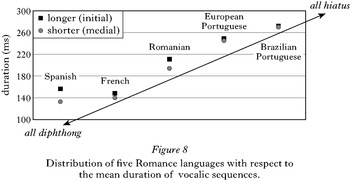
A summary of our results is given in Fig. 8. The figure represents the distribution of the five Romance languages analysed in this study with respect to the mean duration of iV sequences divided between the longer ones (black squares, in word-initial position) and the shorter ones (grey circles, in word-medial position). Each data point collapses between 130 and 280 tokens. The graph recalls the diphthong–hiatus continuum schematised in (2). There are three patterns that emerge from this graph that are relevant to our study. First, Spanish and French sequences have the shortest duration values, which is consistent with the fact that native speakers of these languages generally perceive these sequences as diphthongs. Second, both varieties of Portuguese show the longest duration. This is again consistent with their systematic syllabification as heterosyllabic sequences. Third, the languages with the greatest difference between initial and medial sequences are Spanish and Romanian, suggesting that word-initial sequences have not yet been entirely assimilated to historical diphthongs. Indeed, these two languages are the only ones that still maintain a full or partial contrast between diphthongs and hiatus. At the same time, Romanian has overall longer values than Spanish, showing that the attraction exerted by historical diphthongs, with their limited distribution, is less strong.
Distribution of five Romance languages with respect to the mean duration of vocalic sequences.

The figure also reflects the position of each language with respect to the change from hiatus to diphthong. In French all iV sequences have been recategorised as diphthongs (at the shortest end of the continuum). While French has lost its diphthong/hiatus contrast in favour of diphthongs, Portuguese, which never had a contrast to begin with, has maintained all hiatus sequences (at the long end of the continuum). Romanian is positioned towards the middle of the continuum, suggesting that a diphthong/hiatus contrast is currently being maintained in the language, but may develop in favour of the diphthongs. Spanish is currently in this more advanced stage of change in progress. It is significantly the only language whose native speakers have variable syllabification judgements regarding iV sequences.
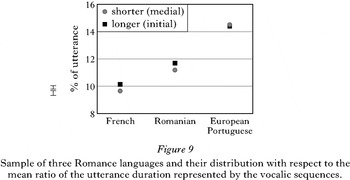
The data in Fig. 8 consist of absolute duration values, without normalisation for speaker-dependent differences in speech rate. In order to verify whether the distribution is accurate, we proceeded to normalise the data for three of the languages (French, Romanian, European Portuguese), for two speakers from each language. The new graph is shown in Fig. 9. What we have plotted here is the mean ratio of the entire utterance duration that is represented by the iV sequence. It turns out that distribution of the three languages remains the same as in Fig. 8, from which we infer that normalisation does not make a very large difference for the simple illustration we are trying to show. The same cross-Romance diphthong–hiatus continuum emerges.
Sample of three Romance languages and their distribution with respect to the mean ratio of the utterance duration represented by the vocalic sequences.

7 Conclusions and further studies
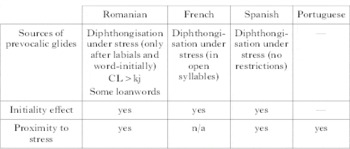
In this paper we have proposed an explanation for the differences in synchronic variability identified in the degree of contrast between diphthong and hiatus in five Romance languages. We attributed the differences in variability to the interaction of several factors that can facilitate or inhibit diphthongisation. The relevant historical and prosodic factors are summarised in Table I.
Summary of proposed interacting factors.

Our hypotheses suggest a number of follow-up studies. One challenge is to accurately model the interacting factors we propose. For this to be possible, it is necessary to determine the weighting of each factor. For example, as one reviewer points out, among the prosodic effects, the initiality effect and the proximity to stress effect are potentially in conflict. An iV sequence in word-initial position is longer only if it is also stressed or immediately precedes the stressed syllable. Otherwise, if it is in pre-pretonic position, it may actually be shorter than an unstressed medial sequence. We therefore need to know the exact number of words in a lexicon containing the relevant vocalic sequences in all the relevant prosodic positions in order to determine how these conflicting effects are weighted with regard to each other.
In addition to modelling, a number of acoustic and perceptual studies can contribute to verifying parts of our proposal. We have shown that duration correlates with the syllabification intuitions of native speakers. But what remains to be established is the actual duration threshold below which a sequence will no longer be perceived as hiatus. A perception study could be set up, containing the sequences from our experiment as stimuli, asking listeners to judge whether what they hear is a diphthong or hiatus (as in Face & Alvord Reference Face and Scott2004). The results of the perception study could then be compared to the syllabification intuitions.
We have argued that the percept of a glide in iV sequences may arise from substantial overlap between the two vowels, resulting in a shorter, overlapped [i]. An acoustic study can test this particular hypothesis by comparing the formant structure of the [i] in iV sequences to that of [j] in (real) historical diphthongs. If we are right, we expect that the formant structure of [i] in the short sequences perceived as diphthongs, as well as in [j] in historical diphthongs, will be more similar to the formant structure of the following vowel (an expected consequence of articulatory overlap). In a longer sequence perceived as hiatus, the formant structure of [i] should be more different from the following vowel. Such comparisons have been used successfully for a different set of Romanian diphthongs by Marin (Reference Marin, Gess and Rubin2005, in preparation), and highlight the continued importance of integrating perceptual findings into a comprehensive theory of sound change.
7.1 Appendix: Data for experiments
Test items are given in the standard orthography, with stress marked with an acute accent where appropriate.
1
Spanish: test items for initiality condition
2
Romanian: test items for initiality condition
3
French: test items for initiality condition
4
Portuguese: test items for initiality condition
5
Test items for the proximity to stress condition: iV sequences
6
Test items for the proximity to stress condition: vowels
7
Subset of words considered in the duration-frequency correlation (more similar number of syllables)