Conventional methods for the evaluation of cardiac arrhythmias such as ambulatory heart rhythm monitoring and exercise stress testing are limited in diagnostic yield by the low probability of capturing arrhythmias in athletes that experience infrequent symptomatic episodes during sports participation. These methods are also unfeasible for the detection of symptomatic arrhythmias in athletes that compete in water sports due to lack of waterproofing and inconvenience of wearing monitors during high-intensity training.Reference Nakao and Kobayashi1,Reference Reyes, Posada-Quintero and Bales2 An implantable loop recorder is a small, subcutaneously implanted device that is capable of recording a patient’s electrocardiogram for up to 2–3 years.Reference Rossano, Bloemers, Sreeram, Balaji and Shah3-Reference Dwivedi, Joza and Malkani5 Implantable loop recorders are proven to be an effective tool in diagnosing and managing arrhythmias in patients, resulting in changes that can improve management strategies and overall treatment.Reference Rossano, Bloemers, Sreeram, Balaji and Shah3 This case report describes the use of an implantable loop recorder to record an episode of symptomatic ventricular tachycardia in a competitive swimmer.
Case report
A 17-year-old female competitive swimmer presented with a chief complaint of infrequent palpitations (approximately once every other month) that only occurred during swim practice. The patient’s medical, family, and social history were all non-contributory. Her physical examination, resting electrocardiogram, echocardiogram, and exercise stress test were also normal.
Taking into consideration the timing and circumstances surrounding the episodes, the decision was made to implant a Confirm Rx™ ICM 3500 (Abbott, Minneapolis, MN) implantable loop recorder using standard insertion tools and techniques. After implantation, the device was linked to the patient’s smartphone Confirm Rx™ app through Bluetooth® technology and programmed to automatically detect and record tachycardia when the rate exceeds 200 bpm for 12 intervals. The patient could also manually trigger rhythm recording and send an alert during or after symptoms. Upon symptom trigger, the device stores the patient’s rhythm recordings for 8 minutes prior to and 1 minute after the trigger.
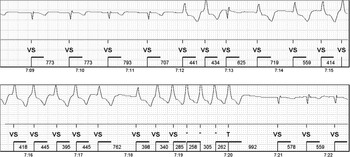
The patient was allowed to resume swimming 4 weeks after device implantation once the wound was healed and device had begun to scar in. Approximately 4 months after device implantation, the patient experienced dyspnea and palpitations during a swim workout. She manually triggered her device using her phone app and logged her presenting symptoms. The symptomatic episode was transmitted to and reviewed by our clinicians. The implantable loop recorder tracings revealed non-sustained monomorphic ventricular tachycardia with variable cycle length as short as 300 milliseconds (Fig 1).
The implantable loop recorder tracings revealed non-sustained monomorphic ventricular tachycardia with variable cycle length as short as 300 milliseconds. The times below the strip represent the time that had passed since eight minutes prior to the patient manually triggering her device. The numbers within the strip represent the cycle length.

After the event tracings were reviewed, the patient was seen in clinic for a repeat history, family history, physical examination, echocardiogram, repeat exercise test, and cardiac magnetic resonance imaging (MRI), all of which were non-contributory. The patient was eventually diagnosed with idiopathic hemodynamically insignificant ventricular tachycardia. She was started on 20 mg of Nadolol per day. She remains on this regiment and has had no recurrence of her palpitations or ventricular tachycardia.
Discussion
In certain pathologies, cardiac response to exercise can result in cardiovascular events, including ventricular arrhythmias.Reference Zorzi, De Lazzari and Mastella6-Reference Chahal, Mostofsky and Mittleman8 When exertional symptoms occur during participation in sports, physicians are faced with the challenge of evaluating these symptoms under similar circumstances.Reference Zorzi, De Lazzari and Mastella6,Reference Chahal, Mostofsky and Mittleman8 Current methods that use external electrodes and patches may hinder an athlete during high-intensity participation.Reference Peritz, Howard, Ciocca and Chung9 In addition, the supine body position, breathing pattern, and compressive forces associated with swimming and being immersed in water present physiological changes that differ from those induced by other forms of exercise.Reference Nakao and Kobayashi1,Reference Reyes, Posada-Quintero and Bales2,Reference Lazar, Khanna, Chesler and Salciccioli10 Thus, there is a need for long-term, accurate evaluation of exertional symptoms in athletes participating in water and high-intensity sports. Proposed alternatives to address this obstacle are the waterproof carbon black powder and polydimethylsiloxane (CB/PDMS) electrodes developed by Chon et al. and smartphone apps such as the AliveCor heart monitor (AliveCor Inc., San Francisco, CA) that utilise ultrasonic proprietary technology for rapid arrhythmia evaluation.Reference Reyes, Posada-Quintero and Bales2,Reference Peritz, Howard, Ciocca and Chung9 However, external electrodes may not be practical for high-intensity exercise and contact sports. Furthermore, smartphone apps may still not be able to capture infrequent arrhythmias, particularly if they are short in duration. In this case report, an episode of ventricular tachycardia was captured using an implantable loop recorder in a competitive swimmer. Due to the ubiquity of smartphones, the Bluetooth-enabled technology for this implantable loop recorder allowed for acquisition and transmission of the heart rhythm immediately following symptom onset during the athlete’s normal training regimen. In addition, the ability to obtain rhythm recordings prior to the trigger allowed for the discovery of this patient’s arrhythmia, as the arrhythmia had resolved by the time the patient could trigger her device. To our knowledge, this is the first reported case in which an implantable loop recorder was used to detect a ventricular arrhythmia during swimming.
Conclusion
The purpose of this case report is to describe the use of an implantable loop recorder in an athlete participating in water sports. This monitor did not significantly disrupt day-to-day activities or training regimen. Continuous monitoring with an implantable loop recorder resulted in detection of ventricular tachycardia that had gone undetected using other diagnostic modalities. This case highlights the importance of carefully considering the context of exertional symptoms within an athlete’s day-to-day training regimen when choosing an appropriate strategy for diagnosis.
Financial support
This research received no specific grant from any funding agency, commercial or not-for-profit sectors.
Conflicts of interest
None.