


This book focuses on the phenomenon of vowel neutralisation, and develops a model in which vowel neutralisation arises as the result of phonetic factors that become re-analysed in terms of phonological patterns of distribution.Footnote * Barnes emphasises a modular architecture, in which the application of phonological rules does not have access to online or real-time phonetic information. Rather, phonetic trends may become a part of phonology only through the processes of language change and reanalysis, informed by phonetic processes. Once a process becomes part of phonology, it no longer has direct access to phonetic information.
The book is divided into three chapters, which focus on positional neutralisation in initial, final and stressed syllables. The focus is largely on the role of reduced duration as a phonetic factor that can lead to decreased articulatory and perceptual ability to maintain vowel distinctions. The book is a revised version of the author's 2002 UC Berkeley dissertation, and forms part of the publisher's Phonology and Phonetics series, whose specific goal is to explore phenomena that illuminate the relationship between the interfaces of phonology and phonetics.
1 Stress-based neutralisation
Phonologisation (Hyman Reference Hyman and Juilland1976, Ohala Reference Ohala, Masek, Hendrick and Miller1981) is the process of turning a phonetic tendency in a given language, either in production or perception, into a stable rule that is part of its phonological grammar. Barnes' guiding idea in this chapter is that there are two kinds of vowel neutralisation: one is phonologised and categorical, and the other is gradient and duration-dependent. For example, in one of the case studies on unstressed vowel reduction, Barnes shows that Russian has two distinct processes of reduction: pretonic reduction of /o/ to [a] and pre-pretonic (what he calls ‘second pretonic’, counting from the right) reduction of [a] (either underlying or derived) to [ə]. This process is shown in (1): (a) exhibits [o]/[a] contrasts in stressed syllables, (b) shows reduction of /o/ to [a] in pretonic position and (c) shows reduction of /a/ and /o/ to [ə] in the position two syllables before stress:
(1)


Barnes' measurements show that the neutralisation of /o/ to [a] of (1b) is a complete merger (see also Padgett & Tabain Reference Padgett and Tabain2005 for this same result). By contrast, he finds that reduction to [ə] of (1c) is gradient and highly dependent on duration, thus, for example, rarely occurring in absolute word-initial position, because of longer duration in that position. Barnes asserts that the existence of a completely categorical process of neutralisation in unstressed syllables (alongside a gradient and phonetically sensitive process in the same language) provides strong evidence for a model of phonology that, once it ‘fossilises’ phonetic effects, is encapsulated from the full range of online phonetic detail.
Contrasting his model with those in which the applications of phonological rules are not encapsulated from phonetic detail, he writes: ‘Direct Phonetics approaches to neutralization … predict that neutralization of contrasts in UVR [unstressed vowel reduction] systems should be sensitive to speech rate (or position in the phrase, etc.). The experiment in Chapter 2 shows clearly that … phonological vowel reduction, such as merger of Russian /a/ and /o/ in unstressed syllables, is not sensitive to factors such as these. No amount of additional phonetic duration will avert this merger and bring back the contrast between /a/ and /o/’ (p. 212). In other words, although unstressed vowel reduction ultimately has its diachronic source in the reduced duration of unstressed syllables and concomitant loss of robust contrast, once phonologised, it becomes an abstract and categorically applying rule that applies in any immediately pretonic syllable.
One of Barnes' arguments in Chapter 2 for the phonologisation approach, in which phonological rules arise as the formal discretisation of gradient patterns, is that it allows for phonetically unnatural patterns to arise as long as they have a diachronic source: ‘should they ultimately come to exist by whatever circuitous path, the abstract, categorical phonology assumed here, devoid as it is of restrictions on the phonetic content of its patterns, should have no trouble implementing the typologically disfavored patterns’ (p. 23).
Just such a typologically unnatural pattern of vowel reduction examined in this book is that of Seediq, which according to Holmer (Reference Holmer1996), shows a pattern in which unstressed /e/ becomes [u].
(2)

This pattern might not be predicted in theories of vowel reduction in which height distinctions are lost but colour distinctions are maintained as best as possible. Barnes' hypothesis is that ‘[e] never arose outside of stressed syllables in the first place’ and that schwa had a variable pronunciation ‘which became rounded’.Footnote 1 The diachronic path of two independent changes, then – the development of /e/ in tonic syllables and the rounding of [ə] in unstressed syllables – leads to the synchronically odd-looking alternation.
However, there is a ‘systemically’ natural fact about Seediq: its five-vowel inventory of /a i e o u/ is reduced to [a i u] in unstressed syllables. Though the mapping from stressed to unstressed inventory is surprising (i.e. the fact that both mid vowels become [u]), the fact that this cardinal/corner vowel inventory is the overall result of unstressed vowel reduction is not explicitly captured in Barnes' phonetic drift+phonologisation model, whereas it may be capturable in a model such as Crosswhite (Reference Crosswhite2001), in which one pattern of vowel reduction aims to produce maximally dispersed unstressed inventories.Footnote 2 Thus, one finds /e/ to [i] in unstressed vowel reduction, as in Southern-Central Brazilian Portuguese (e.g. Rio de Janeiro and São Paulo), /e/ to [u], as in Seediq and /e/ to [a], as in Belarusian, but never, despite any amount of phonetic drift, /e/ to [o], thereby supporting the view that unstressed vowel reduction often aims for corner inventories.
As a fair amount of Barnes' Chapter 2 deals with Brazilian Portuguese, it is important to include some facts from northeastern dialects, in particular Salvador, that have escaped attention in studies of vowel reduction and may have importance for both cross-linguistic and phonologisation models. As Barnes points out, Brazilian Portuguese contrasts seven underlying vowels, /i u e o ε ɔ a/. While in Southern-Central Brazilian Portuguese the pattern of pre-tonic reduction is for /e ε/ to become [i] and /o ɔ/ to become [u], one of the noticeable shibboleths of northeastern dialects is the tendency for pretonic /e ε/ to merge as [ε] and, to a lesser extent, pretonic /o ɔ/ to merge as [ɔ] (Lee & Oliveira 2003, Maximiliano Guimarães, personal communication). Examples of the former are shown in (3):Footnote 3
(3)
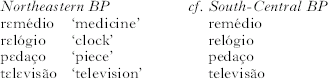
Northeastern Brazilian Portuguese shows an additional pattern of pretonic ‘harmonic’ raising when the stressed vowel is high, and shows post-tonic reduction of mid vowels to [i u]. Coupled with pretonic neutralisation of [e o] in (3) and neutralisation of [e o] (cf. note 3), it seems clear that all of these factors point together towards a general dispreference for the [+ATR] mid vowels [e o], which are only preserved in the stressed syllables of non-verbs. In principle, Barnes' model could capture this pattern by attributing the ability to uniquely host the [ATR] contrast among mid vowels in non-verbs to a combination of the greater duration of stressed syllables and morphological factors (i.e. syntactic category).
The contradictory phonetics of final syllables
Final syllables often enjoy apparent ‘strength’, due to the phenomenon of phrase-final lengthening (e.g. Delattre Reference Delattre1966, Oller Reference Oller1973, Wightman et al. Reference Wightman, Shattuck-Hufnagel, Ostendorf and Price1992). Barnes argues, however, that final syllables are rarely the sole licensers of vowel contrasts in the word domain, and thus that rather than enjoying a special form of positional licensing, final syllables enjoy a ‘resistance’ to otherwise operative processes.
In his model, a phonologisation process can sometimes percolate this gradient phrase-level effect down to a word-level strengthening of final syllables, which allows them to escape otherwise operative unstressed vowel reduction. Indeed, one of his recurrent themes is that phrase-edge effects which are phonetically expected are often phonologised into word-edge effects which may make less phonetic sense. For example, Ukrainian mid vowel reduction (through raising to high vowels) does not occur in word-final position, showing categorical ‘resistance’. In a variety of languages, however, the behaviour of final vowels in undergoing reduction is gradient, and in some cases this reduction occurs only in phrase-final position. Under the phonologisation model, the categorical reduction of internal pretonic syllables is the innovation that already occurred, while the final syllable gradient pattern reflects a variability that has always been present in the system and never reached a stable critical minimum of shortness to be phonologised as categorical reduction.
To this end, Barnes shows that in many languages word- and phrase-final resistance patterns often involve only final open syllables, which enjoy greater lengthening, whereas final closed syllables do not, and hence are often susceptible to reduction. The idea is thus that ‘final syllable’ need not be a phonological primitive in describing absence of reduction, but rather an epiphenomenon due to phonetic final lengthening, which usually targets only open and phrase-final syllables.
Of interest is the question of how this final strengthening can be reconciled with what Shcherba (Reference Shcherba1912) called ‘the general v'alost' [flaccidity] of the articulatory organs at the end of the word’, i.e. the final devoicing of vowels, final drops in pitch and intensity, and onsets of non-modal phonation (Dauer Reference Dauer1980, Gordon Reference Gordon1998). The decline in subglottal pressure during the course of an utterance leads to the elimination of the pressure drop across the glottis that is necessary for voicing to be maintained, a form of passive devoicing. The fact that devoicing is more common for high vowels than non-high vowels points to a durational interaction with devoicing, as high vowels are shorter than non-high vowels (Lehiste Reference Lehiste1970). This increased susceptibility to devoicing fits in with the central role of duration in Barnes' model as one of the initial seeds for eventual categorical phonologisation of segmental quality.
The question then arises how phonological theory can reconcile the simultaneous strength of final vowels in escaping reduction with the facts that final vowels are often devoiced, that length contrasts are often neutralised in final position and that iambic lengthening is inhibited in final position (Buckley Reference Buckley1998). Barnes argues that the two phonetic trends, final lengthening and a phrase-final drop in subglottal pressure, are not in fact contradictory in synchronic phonetic implementation. However, the acoustic result of the overlay of these patterns within a system may indeed produce instability, resulting in divergent phonologisation patterns. Indeed, they may exhibit this variable licensing potential even within a single system, e.g. Nanai (Tungusic), where final syllables are strong for the licensing of nasality, but weak for pharyngealisation contrasts. Barnes draws a dramatic interpretation from these divergent behaviours: ‘Final syllables cannot be considered from a crosslinguistic perspective either monolithically strong or monolithically weak in terms of their potential to license vowel contrasts. … This is a serious challenge to theories of positional neutralization which assume that the phonological strength or weakness of structural positions is specified in Universal Grammar’ (p. 159).
Initial syllables and contrast
In many languages, the initial syllable hosts contrasts that are not found elsewhere within the word domain. Rather than accord a privileged phonological status to the initial syllable (as adopted recently in e.g. Beckman Reference Beckman1998, Smith Reference Smith2002), Barnes' goal is to explain these phenomena either in terms of initial stress or in terms of a morphological factor of being root-initial. In addition, Barnes conducts a durational study of contemporary Turkish and finds that initial syllables are indeed longer in duration than non-initial syllables, suggesting that this may arise particularly naturally in languages such as Turkish, in which stress is not duration-cued (see Konrot Reference Konrot1981). Barnes appeals to initial segment strengthening effects (Oller Reference Oller1973, Fougeron & Keating Reference Fougeron and Keating1996, Cho & Jun Reference Cho and Jun2000, Turk & Shattuck-Hufnagel Reference Turk and Shattuck-Hufnagel2000) and argues that most if not all phenomena in which the initial syllable hosts more contrasts are due to phonologisation of increased duration from either phonetic initial strengthening (which can affect only the absolute initial segment) or from stress (which can affect the entire initial syllable).Footnote 4
Karaim (Kowalski Reference Kowalski1929, Nevins & Vaux Reference Nevins and Vaux2004) is a Turkic system that, due to contact with Slavic and reanalysis of vowel harmony as consonant harmony, has a severely restricted distribution of front–back contrasts. Karaim has final stress. It allows the front rounded vowels [ø y] only in absolute initial position. This is in agreement with Barnes' prediction that absolute initial position is often the domain of initial strengthening, and that phonologisation may refer to linearly absolute initial position in licensing contrasts.
However, his assertion, ‘I know of no system in which vowels of all initial syllables, onset or no, are exempt from a process of unstressed vowel reduction that otherwise targets all unstressed vowels’ (p. 205), is too strong, as Karaim allows the vowel [e] only in initial syllables, regardless of being absolute initial or not, cf. [mʲenʲ-dan] ‘1st person-abl’, [kʰʲelʲ-uvʲ] ‘arrive-denom’ and [elʲ-nʲinʲ] ‘hand-gen’. If we follow Poppe (Reference Poppe1960) in assuming that proto-Turkic had initial stress, perhaps these can be understood in terms of increased duration under stress. However, it also seems likely that the positional restrictions of vowel contrasts in Karaim are more closely tied with the general loss of vowel harmony (and gain of consonant harmony) than with stress placement.Footnote 5
In addition, Karaim exhibits a restriction that the back unrounded vowel [ɯ] is allowed everywhere except in absolute initial position (cf. [imɯɾtʰχa] ‘egg’), a restriction that may be understood in terms of the fact that [ɯ] is so short it became misperceived as [i] without a preceding non-palatalised consonant to enhance its perception. However, there is the testable possibility within Barnes' theory that this neutralisation may be grandient.
Barnes' general account for vowel harmony in Turkic is that it arises due to the durational increase of initial syllables, whose coarticulation and reanalysis within a system of non-duration-cued stress and largely mono- and disyllabic roots led to the phonologisation of front/back vowel harmony. The question remains why this coarticulation was phonologised as vowel harmony as opposed to consonant harmony and whether this follows from phonetic or analytic factors.Footnote 6 A stronger case for the durationally based phonologisation account of vowel harmony is made in the explanation of the emergence of vowel lowering in Bantu, where underlying high vowels lower to mid only if a mid vowel precedes. Following Hyman (Reference Hyman, Hombert and Hyman1999), Barnes suggests that it was originally the mid vowels that were underlying in these positions. Due to non-initiality, and hence shorter duration, these mid vowels were gradually raised in all non-initial syllables, except when supported by a preceding mid vowel. They were then reanalysed as underlyingly high except when preceded by a mid vowel.
The aforementioned process of reanalysing the underlying form due to phonological principles of relative heterogeneity of distribution is a key ingredient in the phonologisation approach, and one that could deserve more elaboration throughout the book. As Barnes himself remarks, ‘phonology of course places its own restrictions on the implementation of sound patterns, involving perhaps concerns of predictability and symmetry rather than phonetic naturalness’ (p. 222). Continued success of the phonologisation research programme can best proceed with a concerted focus on formalising these principles in aiding our understanding of how (un)predictable an alternation must become for reanalysis to take place.
Conclusions
Some of the best arguments for a categorical and encapsulated approach to vowel reduction come from ‘double dissociations’: cases in which actual phonetic duration and the process of vowel reduction seem to be at cross-purposes. I would like to end this review with a particularly dramatic pair with which Barnes demonstrates the possibility of phonological rule application that is to some degree phonetically based, but independent enough to suggest the modular architecture Barnes proposes. Both cases involve unstressed vowel reduction, which, as we have discussed repeatedly above, is argued to have its ultimate source in durational asymmetries.
Shimakonde (Bantu) is a language with penultimate stress, in which all pretonic mid vowels may reduce to [a] (Liphola Reference Liphola2001; tone omitted from examples here), as shown in (4).
(4)

The fact that the stressed vowels additionally lengthen points to a durational source for the reduction of pretonic syllables. However, it is interesting to note that even pretonic long vowels, which may be formed in the language by glide deletion and compensatory lengthening, suffer vowel neutralisation as well:
(5)

The lesson we can draw from this case is clear. As phonetically long vowels are undergoing reduction, Barnes states that ‘while historically this reduction process was clearly duration-driven, synchronically, duration is simply beside the point; the process applies whenever its structural description is met’ (p. 219).
The converse case comes from Uyghur (Hahn Reference Hahn1991), which has stress on the final syllable and a process of reducing non-final and non-initial low vowels /æ a/ to [i] when unstressed.
(6)

Uyghur has etymological long and short vowels that synchronically have ‘little or no clearly audible phonetic length distinction’ when appearing in non-initial and non-final positions (Hahn Reference Hahn1991: 55; see also p. 217). When these etymologically long (and by hypothesis, still long in the abstract phonology) vowels occur in positions of reduction (e.g. non-initial and non-final), they still manage to escape vowel reduction, e.g. /hawaː-da/ ‘air-loc’ becomes [hawada], not *[hawida]. This suggests that the phonological process of vowel reduction in Uyghur does not in fact have online access to the phonetic fact that these vowels are short but only to their phonological status as long, and hence exempt from the categorical rule.
When considered jointly, the Shimakonde reduction of long vowels and the Uyghur non-reduction of phonetically short vowels indeed imply a degree of independence between duration in the physical world and the instruction to perform vowel reduction in the speaker's mind. Having accepted this conclusion, however, the pursuit must continue for the principles that govern the cognitive, formal and systemic constraints on phonologisation as a process that occurs at an actual moment in time.


