


Employers are increasingly faced with protecting their employees from the impacts of diverse crises including weather events, infectious disease outbreaks, and acts of violence. Yet, 1 out of 4 workplaces may be unprepared for any of these hazards.Reference McLaughlin 1 A framework called Total Worker Health® Employer Crisis Preparedness (TWH-ECP) has been proposed to assist employers in their comprehensive, “all-hazards” preparedness planning.Reference Roelofs 2 TWH-ECP is defined as “Actions employers take to plan to prevent, manage, respond to, and/or recover from crises and disasters impacting the workplace, employees, and their community.” TWH-ECP differs from “traditional” emergency planning, disaster response, and business continuity planning because it focuses on employee well-being and prevention of harm to employees. For example, it addresses domains such as employee benefits and prevention of disaster-related mental health problems that are not commonly addressed in traditional disaster preparedness.Reference Teng-Calleja, Presbitero and de Guzman 3
We developed a TWH-ECP training program to advance awareness of and action on TWH-ECP as described in a recent manuscript (under review). Our needs assessment data showed that participants were less concerned with technical preparedness tasks such as setting up alert systems and more interested in developing relevant “soft skills” such as compassionate leadership, communication, trust-building, organizational change management, and making the case for preparedness to leadership. The assessment also revealed challenges such as “crisis fatigue” and the need for a menu of customizable step-wise preparedness initiatives rather than a prescriptive plan. This led us to create the TWH-ECP Planning Guide and Workbook alongside ten training modules. The training modules were:
-
• What is Total Worker Health Employer Crisis Preparedness
-
• Promoting Preparedness and Overcoming Obstacles
-
• Vulnerability Assessment
-
• Emergency Action Plans
-
• Crisis Leadership
-
• Communication
-
• Human Resources Issues
-
• Mental Health
-
• Training
These modules were first piloted in a 10-session synchronous hybrid training course with 11 participants who gave feedback that informed the further development of the training as an online asynchronous course. The 2-hour training that was developed based on the pilot incorporated a video module format with presentations narrated by the investigator and crisis preparedness experts and interactive elements such as opportunities to reflect on the trainees’ own experiences. In response to participant preferences, the training incorporated case-based learning through realistic disaster scenarios and curated resources in each of the TWH-ECP domains. Additionally, as described above, the emphasis on employee well-being led to the integration of mental health throughout the recommended preparedness actions, such as in the development of crisis communication protocols.
Here we describe the results of an assessment of this short online training intervention to promote awareness, confidence, and action to prepare workplaces to prevent harmful disaster impacts on employees. The training was evaluated via pre- and post-training surveys conducted among enrollees before and after the 10-module self-directed e-Learning course hosted by the Center for the Promotion of Health in the New England Workplace (CPH-NEW), a National Institute for Occupational Health and Safety (NIOSH) Center of Excellence for Total Worker Health.
Methods
The training course was hosted on the Brainshark platform and offered as a free e-Learning course to anyone in the world. It was promoted through networks of the Society for Human Resources Management, Total Worker Health Centers, and the American Society of Safety Professionals through webinars, short articles, email, LinkedIn, and the project website. Interested individuals were directed through the promotional materials to an enrollment link where they registered for the course. At their own pace, they completed course modules and were invited within the first and last module videos to participate in optional pre- and post-training surveys hosted outside the Brainshark platform in Qualtrics (Provo, UT). From April 2024 through January 2025, pre- and post-training surveys were collected from online course takers. No identifiers were collected on these surveys, and participants were not required to take the survey to take the course. The research was approved by the University of Massachusetts Lowell Institutional Review Board.
The purpose of the pre- and post-training surveys was to learn how participants responded to the training, such as by rating its quality and reporting their confidence in their capabilities and intention to undertake various preparedness activities. While we did not request detailed demographic data, we did ask them to describe their job type and characteristics of the organization that they worked for. Survey questions also asked respondents to rate their TWH knowledge and utilized a set of adapted TWH organizational readiness questions.Reference Robertson, Tubbs and Henning 4
Although not the primary focus of the evaluation, both pre- and post-training, we asked participants to assess their employers’ TWH-ECP, including their employer’s preparedness for diverse hazards and the status of emergency action plans, personal protective equipment, human resources policies, disaster response resources, and training. Finally, the post-training survey included a question about the degree to which the course made them aware of their own company’s preparedness. This was based on our experience with the pilot training, where we found that in the process of learning what they didn’t know, trainees reduced their estimation of their employers’ preparedness. The full survey instruments are available as supplemental files.
Qualtrics data were analyzed in Excel to develop the descriptive statistics presented in the tables below. In addition, pre- and post-training responses were compared on the questions regarding confidence and planned action using an independent-samples means comparison t-test in SPSSv31. We examined mean differences in participant responses among those reporting high level vs. low level of participation in preparedness in their organizations and between those reporting high vs. low TWH knowledge levels using ANOVA mean comparisons, again in SPSSv31.
To link responses while maintaining anonymity, participants created a unique identifier for both surveys. However, only about 50% of responses (n = 65) could be matched across time points. Consequently, the post-test data were treated as an independent sample from the pre-test. We also conducted paired analyses among the 65 respondents whose pre- and post-training surveys could be matched and added those results as a sensitivity analysis. These analyses were directionally consistent with the full-sample results and can be found in the Supplemental Data Files.
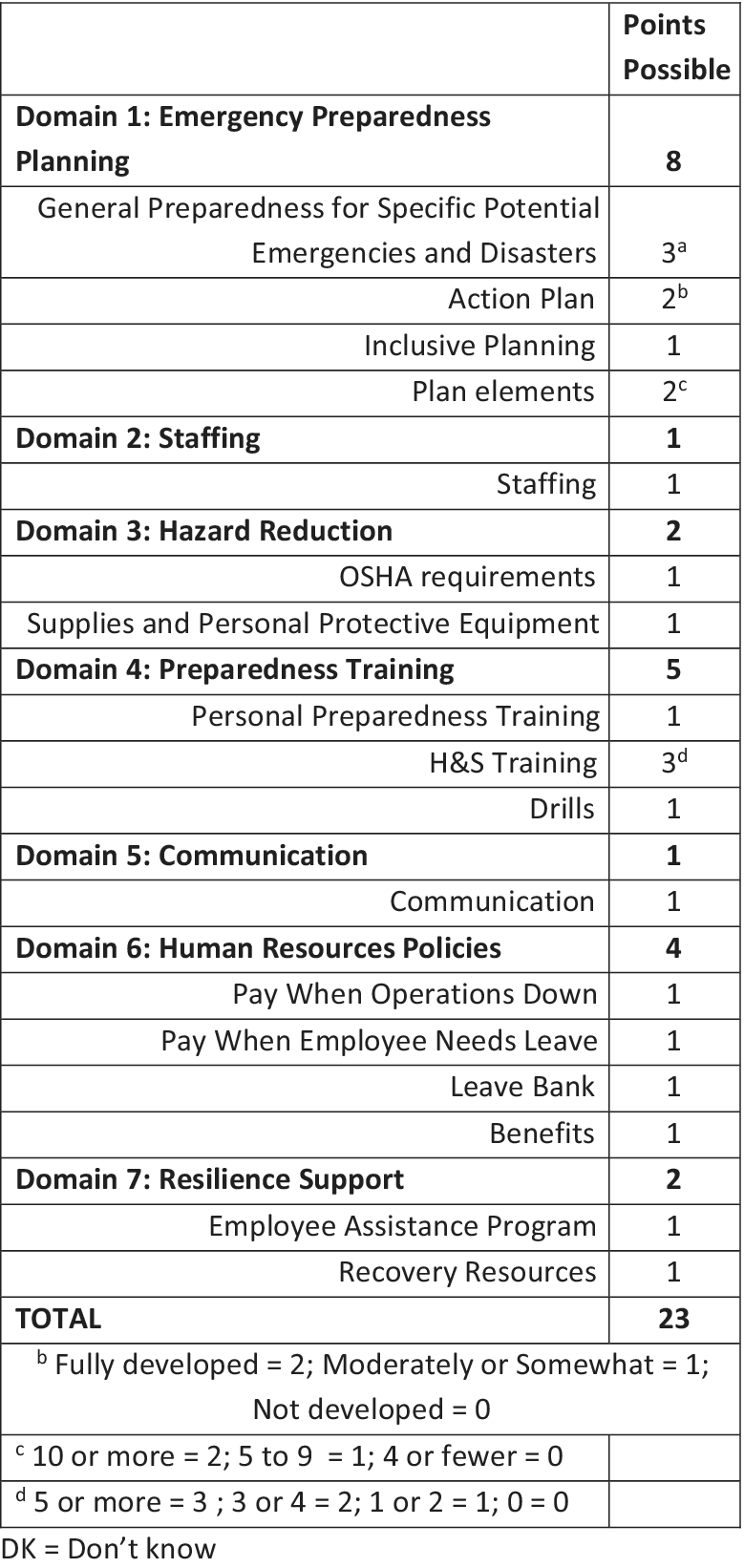
We previously developed a scoring index to assess levels of preparedness in a sample of employers who responded to questions aligned with those posed in this study.Reference Roelofs 2 The purpose of the index was to enable an efficient composite score that could suggest a comparable “level” of preparedness. The survey included questions in each of the TWH-ECP domains. The index for the current study included High, Medium, and Low designations to allow post-test comparison by level of participation. Figure 1 describes the possible points and their distribution among the domains.
TWH-ECP Index.

Figure 1 Long description
TWH-ECP Index totals 23 points: emergency planning, 8; staffing, 1; hazard reduction, 2; preparedness training, 5; communication, 1; HR policies, 4; and resilience support, 2. Subitems address plans, OSHA, PPE, drills, pay, leave, benefits, assistance, and recovery resources.
Results
Characteristics of Survey Participants
Two hundred and nineteen people began the course and 121 completed it during the study period. One hundred and thirty course takers completed the pre-training survey. One hundred and thirteen completed the post-training survey. Characteristics of participants and their employers were assessed in the pre-training survey. Sixty-seven percent of survey responders were environmental health and safety, emergency management, or risk management professionals. Ten participants were human resources professionals, and the remaining participants were distributed among operations and maintenance, executive, wellness, nurses, or students. Participants were approximately evenly divided between those with five years or more in their current job and those with less. Almost half of the participants worked for private sector, for-profit companies. Forty percent were public sector employees, and the remaining worked for non-profit organizations.
Mining, Utilities, and Construction was the sector with the greatest representation among survey takers, with 20% of the total in this sector. Government, manufacturing, health care, and educational sectors were also well represented. About one-third of participants were located in the Northeast United States. The Midwest and the South were also strongly represented among participants. Eleven percent were located outside the US, primarily in Canada. Participants were fairly evenly divided between firm sizes, with half of participants working for firms above and below 500 employees. Half of participants’ organizations included at least some unionized employees, with 25% having between 75% and 100% of employees represented by unions. Almost 40% of the employers represented by the participants were global companies, while 20% had an exclusively local reach.
In the pre-survey, participants were asked to rate the degree of their participation in emergency planning at their place of employment. Almost half of the respondents reported either a lot or a moderate amount of involvement, and 19% reported no participation. When asked to assess their knowledge of the concept of TWH, 43% pre-training rated their knowledge as 1 or 2 out of 5, with 5 being the most familiar. Twenty-five percent rated their knowledge as 4 or 5.
Training Evaluation
Over 70% of survey respondents reported completing the course within “a few hours,” and 20% took “a few days” to complete the course. When asked to rate the quality of the modules, 89% rated modules 5 or 4 (5 = excellent). Ninety-six percent agreed that the course enhanced their awareness of TWH-ECP, the content was relevant, they could use what they learned, the course was well organized, and the instruction was effective. Ninety-one percent said they would recommend the course. Course resources, including the guide, workbook, and links, were consistently rated excellent or good quality. (Data available upon request.)
Confidence and Intention to Undertake TWH-ECP Activities
In the pre-training survey, respondents (n = 128) were asked a series of questions regarding their confidence in their ability to undertake TWH-ECP activities and their intention of taking action on preparedness. On average, 50% of respondents pre-training reported that they felt very or moderately confident to undertake the activities reported in Table 1. Eighteen percent on average reported that they were “not confident at all.” The highest confidence ratings were for their ability to convene a preparedness team and produce crisis-related communications for employees. The activities with the lowest confidence ratings were for conducting a vulnerability analysis (26% not confident at all). As shown in Table 1, post-training, confidence in undertaking TWH-ECP activities improved in every domain (P < 0.001, 2 tailed student T test). Post-training, 86% on average reported that they were very or moderately confident in undertaking these activities, and only 3% reported that they were not confident at all.
Confidence and plans to undertake preparedness activities, pre- and post-training changes (independent samples t-test)

Table 1. Long description
Average confidence in taking action to advance preparedness increased from 2.49 to 3.21, and planned action increased from 2.06 to 2.37; both changes were statistically significant. Confidence increased significantly for every measured activity. Pre-test n=128; post-test n=113.
Pre-test N = 128; post-test N = 113.; ** P < 0.010.; * P < 0.050.
With regard to their intention to undertake these activities in the next 6 months, pre-training, on average 23% of survey respondents reported that they will take action on these preparedness activities vs. 21% who said they would not and 12% who said they already have. Post-training, as shown in Table 1, intention to undertake these activities increased significantly in all domains. Intention to undertake TWH-ECP activities post-training increased such that 44% on average said they would undertake these activities, vs. 10% who said they would not and 17% who already had. The activities they were most likely to take action on post-training were “Influence management to undertake preparedness planning and activities” (53%) and “conducting a vulnerability analysis” (51%). The activities they were least likely to undertake were “recommend leave and benefits policies to promote employee wellbeing” (30% will take action in the next 6 months). At post-training, one-third of respondents reported that they had already talked with coworkers about TWH-ECP.
Assessment of TWH-ECP Status
The training intervention assessed in this study was only 2 hours long if completed in 1 sitting. Given the short time frame of the intervention and limitations of the study that did not permit a follow-up survey, we did not design the evaluation to determine the training’s influence on participants’ or their organizations’ preparedness. However, we took advantage of our trainees’ interest in this subject to ask them to characterize their employers’ preparedness for various potential crises and their preparedness in the TWH-ECP domains. These questions were asked in both the pre- and the post-training surveys. As expected, there were no statistically significant shifts in responses regarding preparedness pre- to post-training (data provided in supplemental files). The results from the post-training survey are presented in this study because when we asked whether the training had increased participants’ awareness of their employers’ preparedness, 82% indicated that it had, either a moderate amount, a lot, or significantly. Increased awareness of the elements of preparedness would suggest that their assessments post-training could be considered more accurate than their pre-training assessments, to the extent that they differed, which was rare.
Trainees’ assessments of their employers’ TWH-ECP are presented in 3 tables covering planning, human resources, and training domains. An analysis of the overall level of preparedness as reported by these training participants according to our TWH-ECP Index (see Figure 1) is also described. As noted above, almost half of the respondents had direct involvement in these preparedness planning domains. As shown in Table 2, trainees reported that their employers were most commonly prepared for winter storms, extreme heat, and infectious disease outbreaks and were more likely to report being unprepared for acts of terrorism, hurricanes, and active shooters. Two-thirds reported that their employers were doing well on meeting the U.S. Occupational Safety and Health Administration (OSHA) requirements on emergency preparednessFootnote a and had preparedness supplies such as personal protective equipment on hand. However, more than 1 out of 10 said that their employers were unprepared in these domains. Seventy-five percent reported their employer had either a fully or moderately developed emergency action plan, and 4% reported that their employer had no emergency action plan. Sixty percent reported that their employers had at least an adequate emergency alert or other communications system to communicate with workers during and after disasters, and 12% reported minimal or no communications capacity. The one question related to planning equity asked if employers took into account disabled staff needs in disaster planning. Forty percent reported that they did this at least moderately well, while 20% reported they did not do this well.
Participant assessment of TWH-ECP, post-training, planning domains (n = 112)

Table 2. Long description
Respondents reported the greatest preparedness for winter storms and extreme heat. Most described emergency plans, OSHA compliance, protective supplies, and communication systems as at least moderately developed or adequate. Accommodation of disabled staff received less favorable ratings and substantial “don’t know” responses.
Forty-five percent of respondents said that their employer had a plan in place for human resources management and staffing during and following an emergency or disaster. Twenty-one percent said that this plan was in development, 7% said there was no plan, and 27% said they were unsure if their employer had a plan or not. In Table 3, the TWH-ECP domains related to human resources and concerns central to employee well-being are reported. About half of the respondents did not know if the plan included policies to continue to receive pay if the employer was closed due to a disaster or if the employers could not report due to a disaster. About a third reported that their employer’s plan included such provisions, and two-thirds reported that the employer would allow employees to use paid time off if they could not report to work following a disaster. About one-fifth reported that their employers had “leave banks” to which employees could contribute and withdraw paid time related to time off needed post-disaster. While the majority reported that they didn’t know if their employer would allow employees to retain their health insurance if the employer was impacted by a disaster, 41% reported that they would be able to. Respondents generally reported that Employee Assistance Programs and other resources were available to employees to help cope with and recover from disasters. About a quarter reported that their employers conducted employee health screening related to capacity to work during extreme conditions, such as heat events, and about half of respondents reported that plans were in development for health screening. Finally, while very few (10%) reported that their Human Resources marketing included reference to their preparedness for disasters, almost half said that this was in development.
Participant assessment of TWH-ECP, post-training, human resources domains (n = 112)

Table 3. Long description
Commonly reported resources included disaster-ready employee assistance programs, trauma-recovery support, and use of paid time off. Respondents were often uncertain about continued pay, health-insurance coverage, leave banks, and preparedness-related recruitment practices.
Table 4 presents responses related to TWH-ECP training topics. Almost half reported that their employer offers programming to educate employees about personal disaster preparedness for themselves and their families and that, in the majority, this training was also offered to temporary employees. While fire drills are common in places of employment, half of the respondents reported that their employers also conducted other types of emergency drills, such as active shooter drills. Respondents reported which TWH-ECP topics their employees received training in. General emergency response was the most popular topic (83%), and psychological resilience training was the least popular (11%). On average, respondents reported that 4 TWH-ECP topics were the subject of employee training. In addition to general emergency preparedness, popular topics were extreme weather events, infectious diseases, and active shooters.
Participant assessment of TWH-ECP, post-training, training domains (n = 112)

Table 4. Long description
About half reported personal-preparedness programming and emergency exercises beyond fire drills. Emergency response was the most frequently covered topic, followed by extreme weather, infectious disease, and violence-related emergencies; psychological resilience was covered least often.
Participants were scored based on the TWH Employer Preparedness Index (see Figure 1 and data available in Supplemental files). Out of 23 total points possible, participants scored an average of 12 points, with the bottom quartile scoring 9 points and the top quartile scoring 15 points. Participants were more likely to be prepared in the domains of Communications and Resilience Support and less so in the Staffing domain. The domain where respondents were most uncertain about their preparedness was the Human Resources domain. When Index scores were compared based on participation level, respondents who reported “no participation” in emergency planning scored lower on the Index than those with moderate or high participation (F = 6.38, P < 0.001). No statistically significant differences in Index scores were found for those high in self-reported TWH knowledge compared to those with low self-reported knowledge (F = 0.54, ns).
Limitations
Training course participants were invited to take the surveys, but completing the surveys was not required for taking the course. It is not known how the survey participants differed from, or were similar to, all those who completed the course, or the population (employees who influence TWH-ECP). The scope of this study did not include follow-up with training participants and, thus, we were not able to assess the impact of the training on participants beyond the immediate post-training period nor on their employers’ level of TWH-ECP. Overall, the small sample is inadequate to generalize about the level and characteristics of preparedness among employers in the US and beyond.
Strengths of this study include the evaluation of a unique and relevant training program to help address an urgent public health concern. The respondents represented diverse employer sectors, size of organizations, and geographic areas. The immediate pre- and post-training survey was linked directly to the training intervention, and results showed a robust range of responses. Relative to the number of course takers, the survey respondents represented a significant sample. The study found that the training was well received and effective in increasing self-reported awareness of TWH-ECP and confidence and intention to take action to enhance preparedness. Additionally, the study reports on an understudied aspect of workplace organization and management.
Discussion
Despite the increased risk of disasters impacting workplaces and potentially negatively impacting employees, few researchers have developed materials to help guide employers to consider how best to prepare for and mitigate the impacts of such disasters. Even in a population that had considerable experience with emergency preparedness, this short e-Learning course was able to increase their confidence and intention to take action to enhance their employer’s preparedness. This study’s findings align with previous work pointing to specific areas that may be more likely to be neglected in preparedness, such as human resources planning, including disaster staffing, pay, and benefits.Reference Teng-Calleja, Presbitero and de Guzman 3
While not its principal aim, this study provides insight into the extent of employer preparedness in businesses and organizations. While businesses are often prepared in traditional domains, such as emergency communications, the training drew attention to preparedness in less considered, but equally essential domains, such as support for employees’ mental health and economic security in the face of disasters. Compared to a prior study with human resources managers, the participants in this course scored higher, with fewer totally unprepared participants. However, as with the prior study, the mean preparedness scores were still solidly in the mid-range.Reference Roelofs 2 These results are also in line with recent surveys of elements of “business continuity planning” related to employee health and safety planning and ability to communicate with employees in the event of a disaster.Reference Morioka, Takeshita and Miyashita 5
Conclusion
This study provides evidence that a short online TWH-ECP course and accompanying planning materials can help improve participants’ TWH-ECP awareness, confidence, and intention to advance preparedness. This course fills a critical need for businesses and organizations of any size who wish to prepare for disasters in a way that centers worker well-being.Reference Morioka, Takeshita and Miyashita 5 Additionally, this course can help overcome previously identified barriers to employer preparedness such as lack of commitment in the face of competing demands, organizational “silos,” and not knowing how to proceed.Reference Wang, Hutchins and Garavan 6 Additionally, the course was well received and recommended by participants. In conclusion, this brief course, which is publicly accessible, is a beneficial contribution to overall efforts to protect employees from the impacts of diverse and increasingly common disruptive events affecting their workplaces and their employment.
Other acknowledgments
The authors would like to thank the Northeast Human Resources Association, Suzanne Nobrega, and Bryan Patriquin for their assistance with this project. This work was funded by the National Institute for Occupational Safety and Health (NIOSH). Its contents are solely the responsibility of the authors and do not necessarily represent the official views of NIOSH.
Supplementary material
The supplementary material for this article can be found at http://doi.org/10.1017/dmp.2026.10488.
Author contributions
Both authors conceived of the study, developed and conducted the intervention, analyzed the data, and drafted and approved the final manuscript.
Funding statement
This work was supported by Grant Number U19 OH012299 from the National Institute for Occupational Safety and Health (NIOSH). Its contents are solely the responsibility of the authors and do not necessarily represent the official views of NIOSH.
Financial disclosure
None.
Competing interests
None.
Human participant compliance statement
UML Institutional Review Board reviewed the research protocol and determined it to be exempt.


 Open access

