Central line-associated bloodstream infections (CLABSIs) are a major cause of morbidity and mortality in the United States.Reference O’Grady, Alexander and Dellinger 1 , 2 Although prior efforts have focused on the identification and prevention of CLABSI in the intensive care unit (ICU) setting, the importance of CLABSI in non-ICU inpatient wards is increasingly recognized.Reference Tedja, Gordon, Fatica and Fraser 3 , Reference Kallen, Patel and O’Grady 4 Despite lower device utilization rates, studies have demonstrated greater prevalence of central venous catheters (CVCs)Reference Climo, Diekema and Warren 5 and equivalent rates of CLABSI in non-ICU wards compared with the ICU.Reference Marschall, Leone, Jones, Nihill, Fraser and Warren 6 Potential reasons for this trend include longer median catheter duration,Reference Zingg, Sax and Inan 7 varying catheter types and anatomic location,Reference Climo, Diekema and Warren 5 and less attention and adherence to appropriate catheter care.Reference Shapey, Foster, Whitehouse, Jumaa and Bion 8 , Reference Trick, Vernon, Welbel, Wisniewski, Jernigan and Weinstein 9 However, patient-specific risk factors that may account for these infections remain relatively unknown.
Furthermore, the impact of dialysis-dependence on CLABSI rates outside of the ICU is unclear. Dialysis dependence is a well-known independent risk factor for hospitalization related to vascular access infections. 10 CLABSI in dialysis-dependent patients is not trivial; in 2000, results from a 30-month matched case-control study revealed that patients requiring chronic hemodialysis had a relative risk of 2.4 for developing nosocomial infections, even after adjusting for longer median length of hospital stay, with CVC-related bloodstream infections being the second most common nosocomial infection.Reference D'Agata, Mount, Thayer and Schaffner 11 Similarly, cross-sectional analysis based on the 2003 US Nationwide Inpatient Sample data set revealed an odds ratio of 4.82 for nosocomial bloodstream infections in patients receiving hemodialysis, even after adjusting for age and sex.Reference Al-Rawajfah, Stetzer and Hewitt 12
Therefore, the aim of our study was to better characterize patients with CLABSI admitted to non-ICU wards, with further analysis of the dialysis-dependent subgroup. We hypothesized that patients undergoing dialysis would comprise a large proportion of the CLABSI population, with distinctive high-risk qualifiers.
METHODS
Study Setting
The University of Michigan Hospital is an 880-bed tertiary care hospital with an average of 33,430 admissions per year in 22,824 adult patients. The study was approved by the University of Michigan Health System Institutional Review Board.
Study Design and Data Collection
We conducted a retrospective chart review of patients 18 years of age and older with CLABSI that were admitted to medical and surgical units outside of the moderate care units and the ICU from January 2010 to December 2011. Cases were ascertained from the Department of Infection Control and Epidemiology using TheraDoc (Hospira, Inc, Lake Forest, IL), the microbiology laboratory, and electronic medical records. CLABSI and pathogen definitions were based upon the Centers for Disease Control (CDC) National Healthcare Safety Network (NHSN) criteria. 13 Patient days were obtained from the finance department billing system, calculated using census days.
Data collection included demographic data, length of stay, central-line descriptors, and recovered pathogens. Laboratory and comorbidity data were collected in relation to time of CLABSI, including presence of neutropenia (absolute neutrophil count <1,000 cells/μL), total number of neutropenic days prior to infection during hospitalization, malignancy within 6 months of infection, and immunosuppressant use within 1 week of infection (definition per CDC smallpox vaccine contraindication list 14 ).
Dialysis-specific determinants were also collected, including dialysis within 48 hours, type and acuity of dialysis, presence of chronic kidney disease or end-stage renal disease, and presence of fistula or graft. Outcome data included discharge location and mortality, with the latter inclusive of discharge from hospital to inpatient or outpatient hospice care.
Statistical Analysis
Descriptive statistics were performed using SAS-PC, version 9.2 (SAS Institute, Cary, NC). Pathogen data were analyzed on a per-infection basis. All other data were evaluated on a per-patient basis, which accounted for the first infection within the study period only.
RESULTS
Patient Characteristics
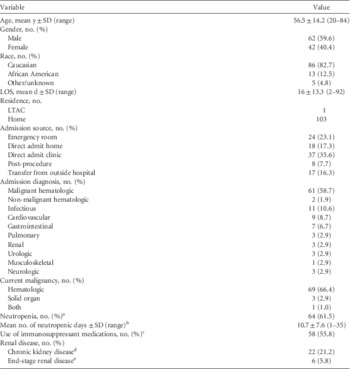
The study period included 323,076 non-ICU patient days. A total of 113 CLABSIs were identified in 104 adult patients, with a rate of 0.35 CLABSIs per 1,000 patient days. Most patients with CLABSIs were Caucasian, and males comprised 59.6% of the cohort. The mean patient age was 56.5±14.2 years old (Table 1). Mean age and race demographics were comparable to all patients admitted to inpatient wards over the study period.
Characteristics of 104 Patients with Central Line-Associated Bloodstream Infections in Non-Intensive Care Units, 2010–2011

NOTE. SD, standard deviation; LOS, length of stay; LTAC, long-term acute care facility.
a As defined by ANC <1,000 cells/μL.
b Total no. of patients was 64.
c As defined per Centers for Disease Control and Prevention guidelines for immunosuppressives.
d As defined by estimated glomerular filtration rate (eGFR) <60 mL/min/1.73 m2 by Modification of Diet in Renal Disease (MDRD) Study equation for 3 months, or sustained, or as diagnosed by nephrologist.
e As defined by eGFR <15 mL/min/1.73 m2 by MDRD equation for 3 months or sustained, or as diagnosed by nephrologist.
The mean length of hospital stay prior to CLABSI was 16±13.3 days (range, 2–92 days), nearly 3 times that of the hospital-wide non-ICU mean total length of stay of 5.5 days. A malignant hematologic diagnosis was the most common reason for admission (58.7%), of which 45.9% of patients were admitted for bone marrow transplant and 31.1% of patients were admitted for chemotherapy. Notably, 70.2% of patients had an underlying malignancy at the time of CLABSI, and the majority of these were of hematologic origin. Approximately half of all patients were on immunosuppressants within 1 week of CLABSI, and 61.5% of patients had concomitant neutropenia with a mean of 10.7±7.6 neutropenic days. More than 90% of patients (56 of 61) admitted with a malignant hematologic diagnosis were neutropenic at the time of CLABSI. Similarly, only 8 of 64 neutropenic patients were admitted with a diagnosis other than malignant hematologic disease.
Microorganism and Pathogen Data
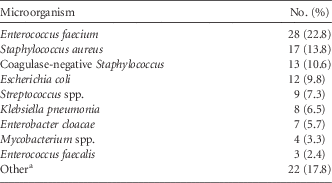
Organisms identified by culture are listed in Table 2. Gram-positive infections were prevalent. Enterococcus faecium was the most common organism recovered, representing 22.8% of the total; 24 of these 28 isolates (85.7%) were vancomycin resistant. Staphylococcus aureus was the next most commonly identified organism, representing 13.8% of the total; 6 of these 17 isolates (35.2%) were methicillin resistant. Coagulase-negative Staphylococcus spp. was the next most commonly identified organism, accounting for 10.6% of all isolates.
Microorganisms Associated with 113 Central Line-Associated Bloodstream Infections in Non-Intensive Care Units

NOTE. Total no. of isolates was 123.
a Includes Acinetobacter baumannii, Bacteroides spp., Candida albicans, Clostridium spp., Enterobacter aerogenes, Fusobacterium nucleatum, Gram-negative rod unspecified, Gemella morbillorum, Haemophilus parainfluenzae, Klebsiella oxytoca, Kocuria spp., Lactobacillus spp., Pseudomonas aeruginosa, Stenotrophomonas maltophilia, Weisella confusa.
Central Venous Catheter Characteristics
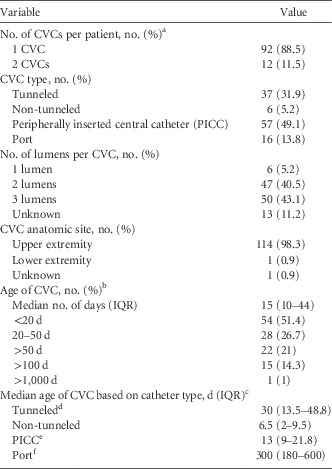
A total of 116 CVCs in 104 patients were present within 48 hours of CLABSI (Table 3). Most patients had 1 CVC, and 9 of 12 patients (75%) with 2 CVCs had a concomitant port. Nearly 50% of all CVCs were peripherally inserted central catheter (PICC) lines. The majority of lines had ≥2 lumens and had been placed above the waist. The median age of CVC at time of CLABSI was 15 days (interquartile range [IQR], 10–44 days). Although 50% of all CVCs were <20 days old at the time of CLABSI, 16 patients had CVCs that had been present for ≥100 days, and 1 CVC was present for >1,000 days. When stratified by catheter type, non-tunneled catheters had been present for the shortest amount of time (median 6.5 days; IQR, 2–9.5), while ports had been present for extended periods of time (median 300 days; IQR, 180–600).
Characteristics of 116 Central Venous Catheters (CVCs) in 104 Patients with Central Line-Associated Bloodstream Infections in Non-Intensive Care Units

NOTE. IQR, interquartile range.
a Total no. of patients was 104.
b Total no. of CVCs was 105.
c Total no. of CVCs per type was as stated in this table.
d Data unknown for 1 tunneled CVC.
e Data unknown for 3 PICC lines.
f Data unknown for 7 ports.
Description of Patients with Underlying Hematologic Malignancies
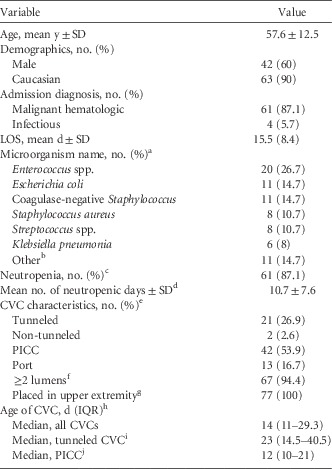
A total of 70 patients had an underlying hematologic malignancy at the time of CLABSI (Table 4). Males compromised 60% of the population, and almost all patients were of Caucasian race. Most were admitted with a malignant hematologic diagnosis, and only 4 of 70 of patients (5.7%) were admitted with a diagnosis related to infection. Enterococcus spp. were the predominant organisms identified, with a near equivalent proportion of Staphylococcus spp. present (26.7% vs 25.3%, respectively). Length of hospital stay, number of neutropenic patients, and mean number of neutropenic days prior to CLABSI were comparable to those of the combined cohort. A total of 78 CVCs were present, with PICC lines present in 60% of patients (42 of 70) and representing 53.9% (42 of 78) of all lines. The majority of lines were multi-lumen, and the median age of all lines was similar to those of the overall CLABSI population (14 vs 15 days, respectively).
Characteristics of 70 Patients with Central-Line Associated Bloodstream Infection Who Have Underlying Hematologic Malignancy

NOTE. SD, standard deviation; CVC, central venous catheter; PICC, peripherally inserted central catheter.
a Total no. of microorganisms was 75.
b Includes Clostridium spp., Enterobacter cloacae, Fusobacterium nucleatum, Kocuria spp., Lactobacillus spp., Mycobacterium spp., Weisella confusa.
c As defined by ANC <1,000 cells/μL.
d Total no. of patients was 61.
e Total no. of CVCs was 78.
f Data unknown for 7 CVCs.
g Data unknown for 1 CVC.
h Data unknown for 6 CVCs.
i Total no. of CVCs was 21.
j Total no. of CVCs was 41; data unknown for 1 CVC.
Renal Disease and Dialysis-Related Descriptors
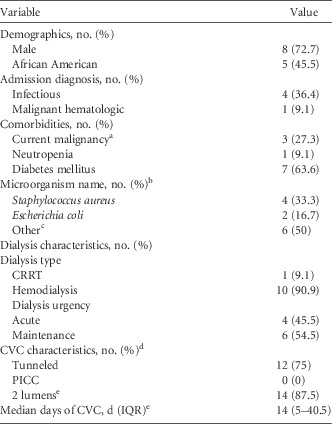
Approximately 20% of CLABSI patients had chronic kidney disease (Table 1), and 11 (10.6%) patients received dialysis within 48 hours prior to CLABSI (Table 5). All but 1 patient was receiving intermittent dialysis. A relatively equal distribution of patients received acute versus maintenance dialysis. Despite comparable mean age, a higher proportion of patients were African American and male compared with the remaining CLABSI population. The most common reason for admission was an infectious diagnosis. The most common organism recovered was S. aureus, with 3 of 4 isolates being methicillin resistant. There were 16 total CVCs, with ~50% of patients having >1 CVC. Most were tunneled, double-lumen CVCs, and there were no PICC lines in this group. The median age of lines was comparable to that of the remaining CLABSI cohort. A total of 4 patients had fistulas and/or grafts; however, only 2 were accessed, and the majority of dialysis patients (9 of 11, 81.8%) were catheter dependent. Only 1 patient was admitted for a hematologic malignancy diagnosis and was neutropenic. However, 63.6% of patients had underlying diabetes mellitus, while only 27% in the general cohort were diabetic.
Characteristics of 11 Patients with Central-Line Associated Bloodstream Infections Who Received Hemodialysis

NOTE. CRRT, continuous renal replacement therapy; CVC, central venous catheter; PICC, peripherally inserted central catheter; IQR, interquartile range.
a Hematologic and/or solid origin.
b Total no. of microorganisms was 12.
c Includes Enterobacter cloacae, Enterococcus faecalis, Gamella morbillorum, Haemophilus parainfluenzae, Pseudomonas aeruginosa, Stenotrophomonas maltophilia.
d Total no. of CVCs was 16.
e Data unknown for 2 CVCs.
Outcome Data
The hospital mortality rate of the entire CLABSI cohort was 18.3%, including 12.5% of patients with in-hospital death and 5.8% of patients discharged to hospice. The mortality in the dialysis group was slightly higher (27.3%), and among those with hematologic malignancy, mortality was 14.3%. Among survivors in the total cohort, the majority (81.7%) returned to their homes at discharge.
DISCUSSION
Patients with CLABSI outside of the ICU have unique patient-specific and CVC-related characteristics that may contribute to his or her overall risk profile. While significant attention has been focused on CLABSIs in ICU patients, studies have only recently begun to recognize the importance of CLABSI in non-ICU patients. In general, reported rates of CLABSI outside of the ICU have been variable, ranging from a pooled mean of 0.9 infections per 1,000 central-line days in the 2011 NHSN device-associated module reportReference Dudeck, Horan and Peterson 15 to 5.2 infections per 1,000 catheter days at a major teaching hospital in the United States.Reference Marschall, Leone, Jones, Nihill, Fraser and Warren 6 Many other institutions have been reported to exceed national ratesReference Son, Daniels and Eagan 16 and significant variability in rates has been observed, even among inpatient wards.Reference Dudeck, Horan and Peterson 15 , Reference Weber, Sickbert-Bennett, Brown and Rutala 17 Despite this variability, few studies have systematically investigated patient-specific characteristics that may explain these differences as well as guide future infection control measures. To our knowledge, this study is the first to focus on dialysis-dependent patients who acquired CLABSI outside the ICU, and it is the second to identify patients with hematologic malignancy as a unique subgroup.Reference Tedja, Gordon, Fatica and Fraser 3
In 2011, the CDC reported a trend toward significant decreases in CLABSI in the ICU setting, but the report contrasted this improvement with persistently high CLABSI rates in hemodialysis patients. 2 We found only a small percentage of CLABSI patients (10.6%) to have renal failure in our study, despite the high degree of catheter dependence for dialysis in our population. The small number of patients is consistent with hospital discharge data, which revealed 4 instances of CLABSI outside of the ICU per 4,930 dialysis treatment days in 2010 as well as a nearly equivalent number in 2011. Nonetheless, our study identified several distinctive characteristics, including the high proportion of African American, diabetic, and male patients, lack of PICC lines with high catheter dependence for dialysis, S. aureus as the predominant organism, and a higher mortality burden.
In contrast, a substantial proportion of CLABSI patients (67%, 70 of 104 patients) outside the ICU had underlying hematologic malignancy and 91.8% of patients (56 of 61) admitted with a malignant hematologic diagnosis were neutropenic at the time of bloodstream infection (BSI). In a recent retrospective review of 136 non–ICU patients with CLABSIs admitted to a tertiary care center in Cleveland, Ohio, over a period of 12 months, Tedja et alReference Tedja, Gordon, Fatica and Fraser 3 also discovered a significant proportion of patients with hematologic malignancy (57%); however, rates of neutropenia were not reported. Hematologic malignancy is known to be associated with CLABSI in the literature,Reference Kelly, Conway, Wirth, Potter-Bynoe, Billett and Sandora 18 – Reference Mollee, Jones and Stackelroth 20 and several studies have demonstrated that neutropenia is a risk factor for CLABSI in bone marrow transplant and cancer patients, including those with hematologic malignancy.Reference Elishoov, Or, Strauss and Engelhard 21 – Reference Dettenkofer, Ebner and Bertz 23 Nonetheless, systematic review of existing studies has been limited by a previous lack of standard CLABSI definitions within this population.Reference Tomlinson, Mermel, Ethier, Matlow, Gillmeister and Sung 24
Fortunately, recent studies have shed light on the importance of neutropenia and mucosal damage in patients with hematologic malignancies and transplants, which resulted in a 2013 revision of NHSN definitions to identify CLABSI patients who have suspected mucosal barrier injury (MBI) in the setting of severe neutropenia, diarrhea, or gastrointestinal (GI) graft-versus-host disease. 13 These changes were implemented in response to studies that demonstrated the predominance of GI organisms such as Escherichia coli and Enterococcus spp., which were speculated to be more representative of translocation and breaches to the gut mucosa, rather than true central-line etiology.Reference Steinberg, Robichaux, Tejedor, Reyes and Jacob 25 – Reference Digiorgio, Fatica and Oden 27 With retrospective application of the new NHSN definitions, 1 study at a large teaching hospital in San Diego was able to demonstrate that exclusion of BSI attributable to MBI resulted in a 15% reduction in reported 5-year CLABSI rates,Reference Dutcher, Lederman, Brodine and Patel 28 thereby supporting previous studies that suggested overestimation of CLABSI rates within neutropenic populations.Reference Freeman, Elinder-Camburn and McClymont 29 In our study, the high prevalence of neutropenic patients with hematologic malignancy may be represented by the large percentage of enteric organisms recovered; however, Staphylococcus spp. still represented a significant proportion of organisms (25%), suggesting that neutropenia-related translocation risk may occur in conjunction with, rather than in place of, baseline central-line–related factors.
Lastly, PICC-lines were present in >50% of all patients with CLABSI with a median age of 13 days (IQR, 9–21.8 days), including 60% of patients (42 of 70) with hematologic malignancy, which represented 73.7% (42 of 57) of all PICC lines on the wards. In contrast, only 7% of patients with hematologic malignancy had PICC lines in the aforementioned study by Tedja et al.Reference Tedja, Gordon, Fatica and Fraser 3 Although PICC lines have become increasingly popular in the medical field, more studies are revealing that patients with PICC lines incur high rates of CLABSI, including a recent meta-analysis of 23 studies that demonstrated comparable CLABSI rates between hospitalized patients with PICC lines or traditional CVCs.Reference Chopra, O’Horo, Rogers, Maki and Safdar 30 Data on PICC lines and CLABSI risk in those with cancer, including hematologic malignancy, are limited and conflicting.Reference Mollee, Jones and Stackelroth 20 , Reference Chopra, O’Horo, Rogers, Maki and Safdar 30 , Reference Cheong, Perry, Karapetis and Koczwara 31 However, institutional variability may contribute to overall differential risk, and further studies are needed to investigate the use of this increasingly common vascular access method in patients admitted with malignancy.
We are aware of several limitations in our study. As a single-center study, our results naturally reflect our patient population and may not be representative of other medical centers. In addition, because this was an observational study, we were unable to determine attributable mortality or infer causation; this is particularly problematic for patients with neutropenia, whose neutropenic days were not necessarily contiguous. Similarly, the retrospective design is also an inherent limitation that increases risk of bias. Due to our study being conducted prior to the 2013 NHSN CLABSI definition revision to include MBI, we may have overestimated the rate of CLABSI in the hematology/oncology population. Lastly, due to unreliable reporting of catheter days in non–ICU inpatient wards, CLABSI rates were calculated per patient days, which may limit comparison to several existing studies. Nonetheless, our study provides important descriptions of this relatively poorly understood population and provides a platform for future prospective studies.
In recent years, much attention has been focused on reducing CLABSI rates within the ICU, including a landmark Michigan Health and Hospital Association Keystone Initiative, a 5-component intervention in 103 ICUs that reduced the mean rate of CLABSI by ~65% within 3 monthsReference Pronovost, Needham and Berenholtz 32 and sustained this effect for 3 years.Reference Pronovost, Goeschel and Colantuoni 33 However, no studies to date have implemented such dramatic reductions in CLABSI rates outside of the ICU, partly due to the relatively newer interest and identification of CLABSI in inpatient wards as a unique entity. In this study, we hypothesized that dialysis patients would be the highest risk group for CLABSI, but our results showed that patients with hematologic malignancy comprised the largest subgroup, with a high prevalence of those who were neutropenic. Future studies should address whether similar patient characteristics are demonstrated in other institutions to develop interventions that target these high-risk subgroups.
Acknowledgments
We thank Jennifer Arndt, Cindy Nelson, and Melanie Williams in the Department of Infection Control and Epidemiology for their assistance with data acquisition.
Financial support: No financial support was provided relevant to this article.
Potential conflicts of interest: All authors report no conflicts of interest relevant to this article.