The Children's Gallery is more than a general introduction to the main Collections, for although there are a number of exhibits illustrating elementary principles, the Gallery's chief purpose is to show what things mean, that is, their significance in our daily lives, rather than how they work.Footnote 1
In the twentieth century, science museums emerged from relative obscurity to become major cultural attractions, catering to large numbers of adults and children from all segments of society. This popularity has tended to increase rather than decrease the meanings attached to science museums in culture. Today, science museums are heterogeneous sites of enjoyment, education, engagement, conservation, communication, collaboration and so on. But such differing agendas are not easily combined. This is especially the case when the aim is to present science in an understandable and meaningful way. It was in the 1960s that the contemporary discourse about learning from science museums really took off and this was accompanied by the rise of the science centre movement. According to this approach, the emphasis is on the interplay between visitors’ meaning-making experiences and the museum exhibits and often, although not exclusively, children are the target audience.Footnote 2 This has led to a situation where there is little doubt that science museums, with their instructive displays of scientific and technological achievements and high degree of interactivity, have done much to stimulate learning about science and technology, but at the same time it can be argued that they have tended to (over)emphasize a childish approach to science and the kind of science topics children tend to find attractive.Footnote 3 Balancing different styles of museum curating with the active roles of visitors is a precarious task, to say the least, and one that, in the course of the twentieth century, has resulted in successes as well as problems. There have been disagreements, and even conflicts, between museum professionals, visitors and the researchers who study the interaction of educational exhibits and the ways in which visitors give meaning to their experiences in the museum.
In the case of the Science Museum in London, it is notable how popularity has gone hand in hand with an unusual degree of ‘uncertainty’ about the role of the Museum.Footnote 4 Since becoming an independent institution in 1909, the Museum has attracted impressive crowds: from just around a million visitors annually in the late 1920s, visitor numbers steadily increased through the early 1960s and reached a peak of 4.2 million in 1980 before trailing off to 1.2 million in 1992. Thus many millions of people from the UK and abroad have received one of their first and probably most lasting out-of-school impressions of science and technology in the Museum. From the beginning children were seen as an important visitor group, and when the Science Museum's Children's Gallery was inaugurated in 1931 this visitor group showed up in museum policies. By the early 1950s it was estimated that around 3–400,000 children attended the Museum on an annual basis; in the record year of 1980, the figure could have been as high as two million.Footnote 5
The impressive attendance figures for the Museum have been accompanied by a celebratory, yet uneasy, relationship with its child visitors, best illustrated by the special, although somewhat ambiguous, role occupied by the Gallery in the historiography of the Science Museum. In its early days it was somewhat unclear whether the Gallery really served children or adults, or both. In his book about the rise of the Science Museum under the directorship of Henry Lyons, David Follett, former director of the Museum, dedicates an entire chapter to the Children's Gallery.Footnote 6 Lyons was pivotal in the making of a special gallery for children. Follett fully acknowledges Lyons's initiative, adding that it was under the guidance of then assistant keeper F.St.A. Hartley that the Children's Gallery ‘became probably the best-known single feature of the Science Museum and it can be fairly said to be his most outstanding contribution to the development of the Museum’.Footnote 7 The ambiguity in Follett's account arises in his discussion of the value of the Gallery, not just for children but as an introductory gallery for visitors generally. He notes that, in February 1933, less than one and half years after the Gallery had opened, Lyons, in a Museum order, referred to the Gallery as ‘the Introductory Collections (formerly the Children's Gallery)’.Footnote 8 The Gallery, designed as an exhibition for children, had become popular with some of the adult visitors, and not just those accompanying children. Consequently, the Museum had taken steps to recast the Gallery as an introduction to the Museum meant for adults. More recently, historian Tom Scheinfeldt observes that the Gallery, partly due to its popularity, served ‘as much as an introduction for adults as it was for children’.Footnote 9 He also cites Lyons who, in August 1933, wrote that ‘the so-called Children's Gallery’ would be better understood as ‘the first of a graduated series of introductory collections designed specifically for the general public of all ages’.Footnote 10
Another source of ambivalence is the question whether the Gallery was established actually for children or as a way to distract children and keep them out of the main galleries; that is, to segregate children in the basement where the Gallery is located. Museum curator Anna Bunney has found sufficient evidence to suggest that, at times, the segregation of children was promoted as one of the important functions of the Gallery.Footnote 11 She cites Lyons, who already in 1922 had suggested that introducing special provisions for children ‘would attract them from the Main galleries where they are at times rather a nuisance’.Footnote 12 From a museological perspective, Bunney proposes that we think about the intended segregation of children more generally in terms of the Museum's sincere attempt to provide for different audiences. Certainly, the development of the Children's Gallery was a big challenge for the Museum, not least because it required new ways of understanding and differentiating the minds, interests and behaviours of its visitors.
But when writing a history of the Gallery it is not only the Museum's vision for the Gallery – its intended purpose and target audience – that is of relevance; there also needs to be consideration of how the Gallery was received by visitors (and even non-visitors) of different kinds at different times, and how outsiders’ understandings of the Gallery interfered with those of the Museum. This paper is therefore primarily concerned with the ways in which the Museum, between the original opening of the Gallery in 1931 and the reopening of the New Children's Gallery in 1969, designed and redesigned the Gallery around shifting understandings of (the history of) science and technology and of visitors to the Gallery. The curating of the Gallery proved a challenging task for the Museum staff, especially when, in the 1950s, educationalists and psychologists began taking a professional interest in how children actually used and understood the Gallery exhibits. The paper presents what was probably the first wave of visitor studies performed at the Museum and analyses the way in which these studies were received by the Museum.
Attempting to ‘see’ the Children's Gallery from the double perspective of producers (Museum directors, curators and staff) and users/audiences (primarily children, but also educational psychologists, fathers and mothers, and authors), this paper connects with at least three strands of historical literature: (science) museum studies, studies of ‘popular science’ from the viewpoint of the history of reading, and historical studies of ‘science for children’. In ‘A historian's brief guide to new museum studies’, Randolph Starn argues that ‘new museum studies’ since the 1980s have tended to deconstruct the history of ‘the’ museum by providing contingent genealogies of the ‘shifting constellations of epistemology and authority’ governing the collection and presentation of material objects and knowledge.Footnote 13 Sharon MacDonald provides an example of this kind of schematic, ‘Foucauldian’ history of museums of science based on a distinction between early modern, modern and recent science museums.Footnote 14 She argues that, in contrast to recent science museums, both early modern and modern museums were wholly embedded in the scientific culture of their time. Early modern museums of science supported emerging scientific ideas about observing, measuring and ordering the world, whereas modern museums of science placed science in the context of Western civilization, industrial change, economic growth and social progress. In the course of the nineteenth century, modern museums of science opened up to wider audiences, promoting ‘ideas about transforming the public and producing citizens who would take on the task of self-education and improving themselves’.Footnote 15 Developments in the twentieth century have tended to increase the detachment of science museums from science proper in seeking ‘not so much to make science legible through making evident its underlying principles, as to represent science: not simply to show or tell it but to interpret it’.Footnote 16
The emphasis on experience, interpretation and different publics of science found in new museum studies and in virtually all museums of science and science centres today has an academic counterpart in the history of popular science. Historians of popular science have offered a wide variety of interpretations of the media, modes of production/consumption and politics of popular science.Footnote 17 In so doing the understanding of popular science has broadened from it being considered a more or less accurate dissemination of scientific knowledge from the world of science to the popular sphere, to popular science as specific cultural appropriations of science and technology for many different purposes. In particular, science for children seems to be a small but growing subfield offering important insights into the ways in which science has been used to educate and entertain. Books for children including topics from the sciences first emerged in the mid-eighteenth century. Often cast in the framework of ‘moral didacticism’, they offered ‘instructive and amusing’ lessons of physics, botany, astronomy and so on.Footnote 18 In the course of the nineteenth century, popular-science books for children increasingly encouraged learning through practical activities and/or emphasized the ‘science of common things’ or ‘things familiar’ in order to instruct children in scientific ways of thinking. This trend continued into the twentieth century, where toys and models such as the British Construment sets, optical instruments marketed in the interwar period for consumption, construction and experimentation at home, were used to educate girls and boys in science and technology, while also turning the learning of science into a playful and social activity.Footnote 19 With the increasing commercialization of children's books, magazines and toys and the rise of mass consumer markets in the early twentieth century, new educational goals were being affiliated with ‘science for children’: instruction in scientific and technological topics not only would serve to make children more skilled as individuals, but also celebrated the skills ‘consumers were expected to possess as they purchased and engaged with technologies’.Footnote 20
While many historical studies have dealt with the reading of popular science in books, magazines and pamphlets, studies of science museums have tended to concentrate on institutional history, buildings and spaces, the collection of objects and the production of exhibits.Footnote 21 To a certain degree, the historical studies of the public uptake and interpretation of popular science complement contemporary studies of museum visitors, yet we still have to see these two developments come together in studies of how visitors (and non-visitors) have ‘read’ or experienced museums of science in the past.Footnote 22 The present study of the Children's Galley is an attempt to provide insights into the many different responses to the design, exhibits, labels and spaces of the Gallery. In this study prominence will be given both to aspects of the curatorial and management processes internal to the Museum, and to a wide variety of outsiders’ perceptions of and experiences in the Gallery, including those of scientists, newspaper journalists, other museum professionals, local educational authorities and schools, child psychologists, children and families.
‘Introduce a sense of reality’: the making of the Children's Gallery 1928–1931
The Science Museum emerged as an individual museum in 1909. The Bell Report of 1911–1912 provided a blueprint for the development of the Museum in the early years, endowing the Museum with a double public role, typical of many museums at the time: on the one hand, the Museum should present and preserve specialist collections to be used by students, teachers and experts ‘engaged upon investigations related to Science or invention’. On the other hand, and this was particularly stressed in the report as being of ‘much importance’, the Museum ought to accommodate those who would visit the Museum ‘with no such definite enquiries in view’ by exhibiting objects in such a way ‘as to arouse the interest of these visitors, and to afford them in as simple and attractive a form possible an opportunity of obtaining at least general ideas on the subjects which the Collections illustrate’.Footnote 23 In 1920, Henry Lyons, with the retiring rank of colonel from the First World War, became director of the Museum and under his directorship the Museum realized many of the ideas found in the Bell Report. Lyons, with no formal training in science, in the course of his military duty had led the Geological and the Cadastral Survey of Egypt and had received wide scientific recognition for his work. In 1912, he became assistant to the director of the Museum, Francis Ogilvie, and secretary of the Advisory Council of the Museum. When Lyons's term as director began, he firmly believed that, due to the rapid developments within science, a science museum continually had to make changes to its exhibits, while also stressing the educational function of the Museum. Consequently, he put ‘the ordinary visitor’ first on his list of potential visitor groups and strived to change the display and labelling of the exhibits accordingly. Among other things, Lyons introduced general, non-technical labels with a maximum limit of four hundred words, regular lectures with films and illustrative projections, historical series of exhibits, introductory displays and temporary exhibitions focusing on contemporary developments within science and technology.Footnote 24
Under Lyons's directorship, the Museum underwent a major transformation in terms of public visibility and attendance. From 1925 to 1928, the East Block of the Science Museum gradually was opened to the public. The new building provided the Museum with brighter and larger galleries and embodied the idea propounded by the Bell Report that the Science Museum ‘ought also to be a worthy and suitable house for the preservation of appliances which hold honoured place in the progress of Science or in the history of invention’.Footnote 25 Situated between the Natural History Museum and Imperial College and built in white stone with tall Ionic columns, the impressive, neoclassical East Block seemed to capture both historical and modern dimensions of science and technology. ‘It is’, as the Architects Journal saw it in 1928, ‘modern, but soberly British; post-war, but not fantastic’; the Architect and Building News took notice of the dignity of the exterior as well as the ‘restrained and “sensible”’ character of the interior.Footnote 26
At the time of the opening ceremony in 1928, the Science Museum already was a hugely popular venue in London public culture, where increasingly large crowds would encounter permanent and temporary exhibits of science and technology, some historical in nature, others devoted to contemporary objects or ideas. In 1924, the Museum attracted 437,816 visitors; by 1929, the figure had risen to just over a million. In fact, at the time, the British Museum was the only other national museum that could boast more than a million visitors. By 1933, attendances at the Science Museum exceeded those at the British Museum by nearly 200,000, putting the Science Museum at the head of the attendance league table.Footnote 27 Although no detailed visitor surveys existed, it was believed, in the words of Lyons testifying in 1928 to the Royal Commission on National Museums and Galleries, that ‘they are essentially working professional classes and there is a large proportion of comparatively young people’.Footnote 28
The idea of a special gallery for children began to take shape in the year 1929, mainly, in the words of Peter J.T. Morris, ‘as a result of the sheer number of young visitors to the new East Block in the 1920s, the Museum basically bowing to visitor pressure’.Footnote 29 Also, there was a concern that, although children were attracted to the working models of the Museum, they did not understand them. In the annual report of 1929, the Advisory Council of the Science Museum stressed the need to provide ‘a gallery in which mechanical models of various kinds would be shown so as to be readily understandable by the younger visitors to the Museum’.Footnote 30 The council urged that the design and construction of the Gallery should have top priority.
On 4 January 1930, Lyons presented the idea of a Children's Gallery to H.M. Richards of the Board of Education, asking for help in ‘a matter which is rather beyond me’:
I now have a plan to show in a special gallery a series of working models which, while showing technical and industrial operations, will be scaled down to the juvenile intelligence. They would be working models, well-lit, coloured and very simply explained. They would tell the same story as the main collection but in a very simple form. Not only should the younger visitors be interested, and learn something from such an exhibit, but it would lead them in due course on to the main collections. It would also attract them from the main galleries where they are at times rather a nuisance to those who want to study the collections. Our numbers are now so large, nearly 1,062,000 in 1929, that this aspect of the matter has its importance.Footnote 31
Clearly, the need to provide specifically for children in order to stimulate their interest and learning, while keeping them apart in a separate gallery, formed part and parcel of Lyons's initial scheme. Richards welcomed Lyons's initiative, asking P.B. Coles, who at the time was associated with the children's work at the Imperial Institute on Exhibition Road, to go to the Museum to discuss the practicality of a Children's Gallery. Coles visited the Museum, expressing himself wholly in favour of Lyons's proposal.Footnote 32
Lyons then asked the assistant keeper of the Electrical Engineering and Communications Department, Frederick St Aubyn Hartley, to produce a tentative scheme for the Children's Gallery. Hartley introduced the historical, material and social dimensions of science and technology as the basic principle of the Gallery, defining its object as illustrating in as simple a manner as possible ‘the development of applied science and its influence upon material and social progress’.Footnote 33 He wanted the Gallery to provide, first, a general introduction to the various branches of science represented in the Museum collections; second, a series of exhibits with a special appeal to children; and third, an educational collection to be used by elementary-school teachers. The introductory exhibits should focus on the function or purpose of the piece of apparatus or machinery exhibited, rather than on the way it worked, while the exhibits with ‘special appeal to children’ were to be working models designed specifically with children in mind. Less detail on the scientific or technical principles would make both kinds of exhibit more attractive. Departing from the then existing practice of emphasizing the evolution of technology in terms of isolated inventions and achievements, as a rule subjects should be treated historically by period: ‘From this point of view it is possible to deal more simply and in less detail with the scientific and mechanical principles involved and the exhibits can be made more attractive’.Footnote 34
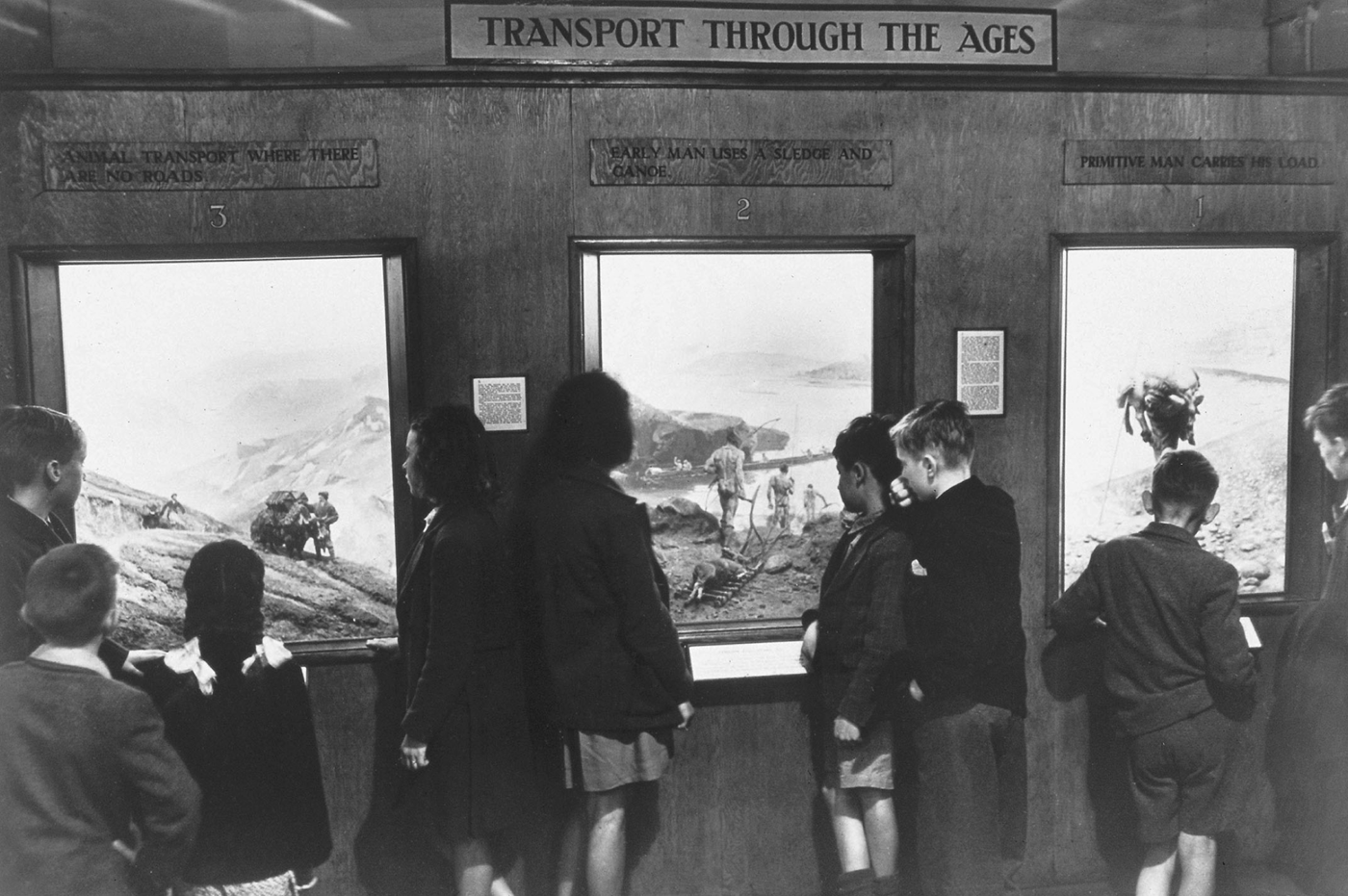
In collaboration with three other museum keepers, Maurice J.B. Davy, Frederick George Skinner and Geoffrey S.L. Clowes, Hartley devised a more detailed scheme for a historical transport exhibit. They all agreed that presenting to children a series of scale models in cases was a bad idea. To understand such models, they argued, the child had to be conscious of the need to make them and the underlying purpose of the whole exhibit. In fact, the company of an adult teacher was believed to be necessary. Besides, such scale models were expensive and time-consuming to produce. Rather, a series of dioramas, all of which could be made relatively easy and cheaply, would provide for children's interest and instruction in the subjects. Each diorama would present different means of transport used through the ages: through animal, pack and wheel transport to various forms of motorized and steam transport of the modern age (see Figure 1).Footnote 35 Hartley and the other museum keepers involved intended not only to attract the attention of children, but also to enable them ‘to make comparisons between different methods of transport and to obtain a grasp of the general evolution of transport and its influence on the process of civilization’.Footnote 36
Children viewing the Transport throughout the Ages diorama series in the Children's Gallery, 1949. The last diorama (not seen in the photograph) showed the state of transport when the Gallery first opened. It included a Handley Page HP42 aeroplane of Imperial Airways on the flight from London to Paris, a flying boat to be flown to the Far East in stages, a transatlantic liner, airships such as the Graf Zeppelin and the British R100 and R101, two cars – a Rolls-Royce Sedanca de Ville and an MG sports car – and a Southern Railway locomotive. Except for the Zeppelin, all were British inventions. Image no 10320045 in the online Science & Society Picture Library. Used with permission by Science Museum/Science & Society Picture Library.

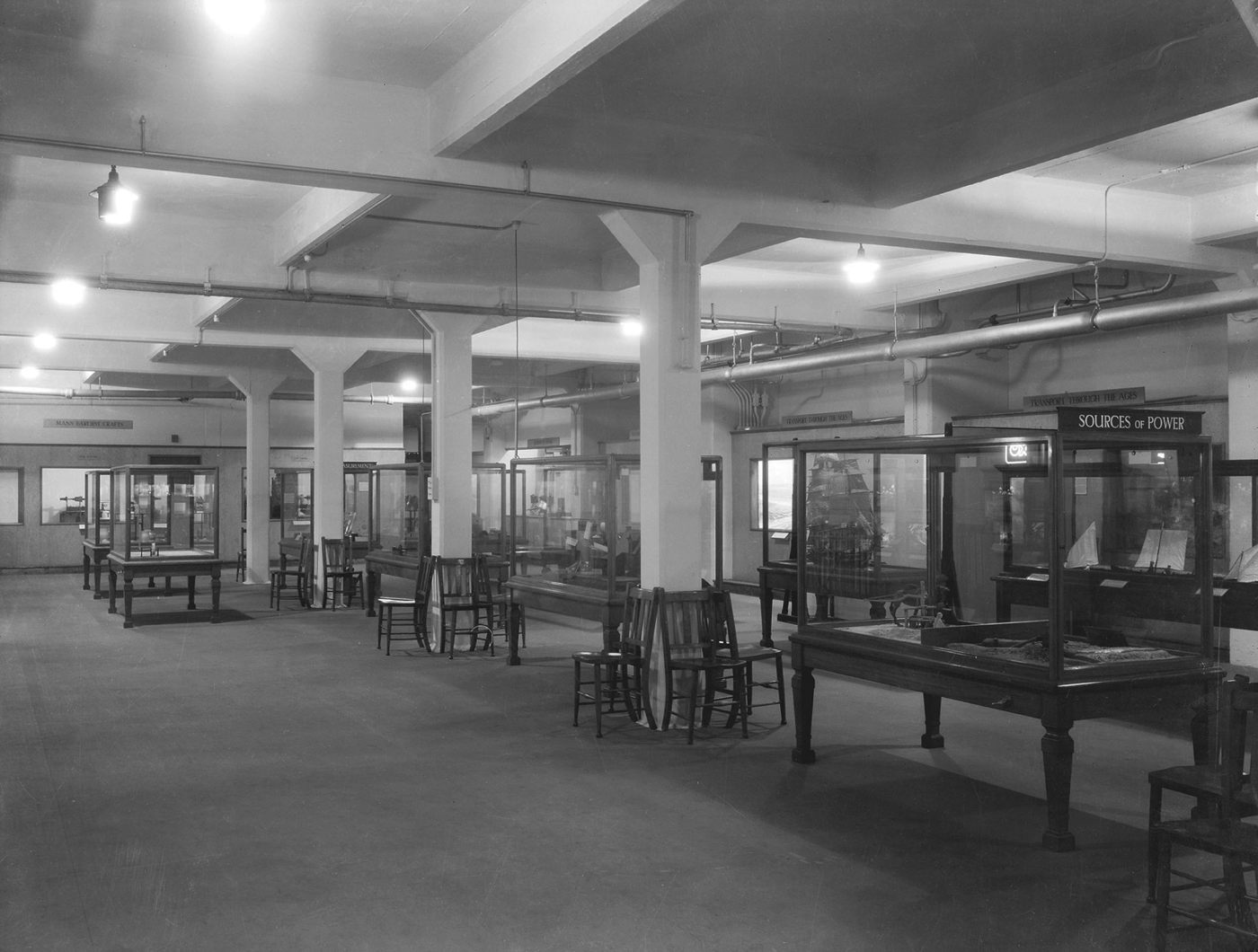
A general view of the Children's Gallery by the time of its opening. Displays illustrating Sources of Power appear in the middle glass cases, while the Transport dioramas are built into the walls. Chairs are provided for visitors to relax during their visit. Image no 10462886 in the online Science & Society Picture Library. Used with permission by Science Museum/Science & Society Picture Library.
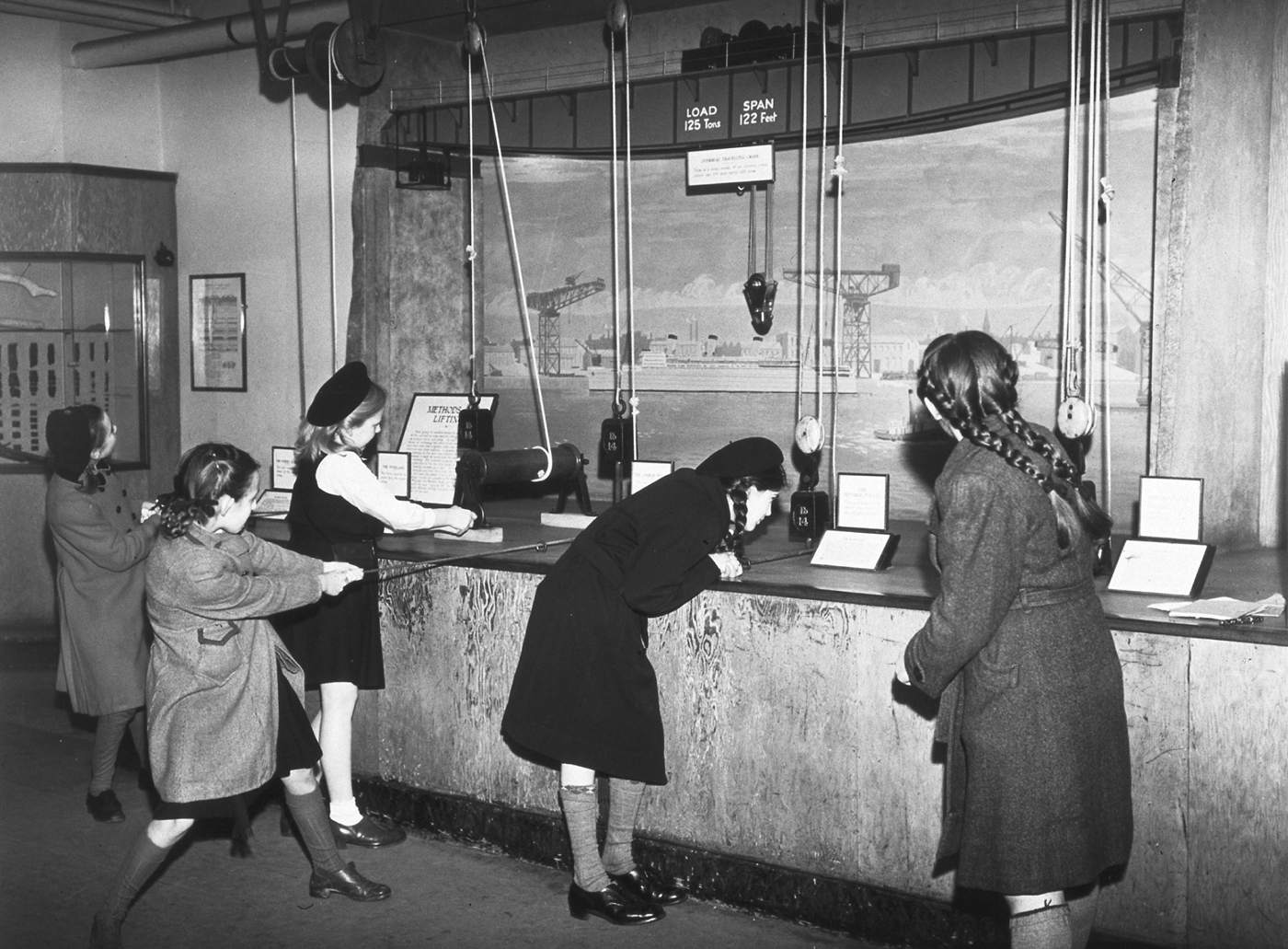
On 12 December 1931, the Children's Gallery, located in the basement of the East Block, was inaugurated (see Figure 2). The historical display technique penetrated the whole of the Gallery, most explicitly in the eleven Transport dioramas and in a series of illuminated scenes showing the evolution of domestic lighting from the cave-dweller's firebrand through oil lighting in Victorian homes to contemporary electrical illumination. The Gallery included historical displays illustrating sources of power from manpower to steam power and combustion engines, each set in a miniature landscape. In 1933, working exhibits showing the history of communication from beacon fires to the telephone were added. Each exhibit included an appropriate pictorial background in order to provide the visitor with a visual impression of how the communication technologies might have been used. Moreover, there were full-sized models depicting three of the earliest of human crafts – the flint-tool worker, the potter and the smith – and films of each at his work were being shown. Models were displayed, illustrating forms of time measurement. A model aeroplane in a wind tunnel accompanied by a sketch of the development of the aeroplane, illuminated transparencies showing astronomers at work and an illustrated comparison of alchemists’ and modern pharmacists’ shops also were featured in the Gallery. An exhibit of pulleys and jacks had been arranged to demonstrate how, by various lifting devices, a large weight can be lifted by a comparatively small force, the latter being supplied by the children using the exhibit (see Figure 3).Footnote 37
Girls using the Pulley Block Exhibit, 1951. Image no 10320041 in the online Science & Society Picture Library. Used with permission by Science Museum/Science & Society Picture Library.
The historical dioramas and the working models were intended to present the impact of science and technology on human life. In the words of Hartley, the Gallery aimed at showing ‘what things mean, that is, their significance in our daily lives, rather than how they work’.Footnote 38 The material and social contexts of scientific and technical objects were considered to be important in getting children and adults interested in, and possibly making them keen to learn about, science and technology. Even the pulleys and jacks exhibit demonstrating the relative effectiveness of lifting the same weight by different arrangements of rope and pulley was contextualized by including a background image representing a docks scene with cranes, liners and so on. Above the image hovered a reconstruction of an overhead crane using a pulley system. Thus the Gallery embodied not only certain views on science and technology in everyday life, but also particular visions of its visitors in terms of cognitive abilities and physical appeal. In the words of Hartley et al., the Gallery would ‘introduce a sense of reality in a way that cannot be accomplished by means of scale models’, furnishing the child ‘with ready-made comparisons and co-ordinations, without demanding a conscious effort on his part or the instruction of an adult’.Footnote 39
As previously noted by Anna Bunney, there is a strong link between, on the one hand, the historical diorama display technique employed in the Children's Gallery and, on the other, the historicized ‘science-for-all’ curriculum strongly recommended by science-education protagonists in the 1920s.Footnote 40 After the First World War, concerns were raised about the shortcomings of science teaching at the lower levels of education, the underlying premise being that Britain needed to attract many more young people to science and technology. The inclusion of history of science and technology in the curriculum was believed to make science topics more appealing to children and so boost recruitment to science and engineering education. Analysing the debate about the historical method of science teaching, Anna-Katherina Mayer has further argued that, in effect, stressing the history of science and technology not only served as a way in which to teach science more like the humanities, but also enabled a celebration of ‘secular moral progressivism’.Footnote 41 Thus the Children's Gallery not only was designed to provide an idealized version of the social and material dimensions of science and technology throughout history in order to attract children to those fields of learning, but also presented science and technology as the harbingers of the modern, industrial and, most importantly, morally and socially commendable way of life.
‘What he means by science’: first receptions of the Gallery
The Children's Gallery proved to be an immediate success in terms of attendances and reviews. In 1932, the total number of visitors to the Museum went up by 70,547 compared to 1931, with a large part of the increase attributed to the Children's Gallery. The Advisory Council of the Science Museum concluded that the Gallery met its educational purpose: a satisfactorily number of children visited it with their parents or on their own account and it was also being used by many school classes, approximately twelve parties per month. In addition, it was found that many adult visitors would go to the Gallery, in particular those ‘who find the more technical collections too unfamiliar to be interesting or even informative’.Footnote 42
The Museums Journal reviewed the Gallery quite favourably. The illuminated dioramas and transparencies, the interior lighting scenes, the films shown and the working models – all contributed to the attractiveness of the Gallery. In particular, it was noted that the lifting apparatus, by which heavy weighs could be lifted and let down with a bang, afforded immense delight to the boys visiting the Gallery. The reviewer concluded, ‘Though intended for the youngsters, so attractive is this Gallery that we expect to see it visited by a large proportion of adults’.Footnote 43
The early years of the Children's Gallery were covered in the columns of The Times, where the Museum's idea of celebrating the social and material impacts of science and technology by means of historical displays, which would readily appeal to juvenile minds bent on the concrete and realistic, was fully approved. Announcing the opening event, The Times described in great detail the content of the Gallery. In particular, the Transport diorama series was seen as a timely commemoration of ‘the increase in speed and frequency of communication which accompanied the full flow of the industrial revolution’.Footnote 44 Similarly, the newspaper agreed that the emphasis on ‘what things mean in our daily lives’ was the proper way to present the advances of science and technology to non-specialist visitors:
To the ordinary man or the ordinary child the name of science suggest first not its effects on human speculation, or its interference with the atom, but the practical ways in which it has enabled things which must be done to be done with less difficulty. New means of transferring energy, new forms of transport, the tools with which man works his materials, the vessels in which he stores and cooks his food, artificial means of heat and light, remedies against disease, and all the means of entertainment in the widest sense, from cinemas to the study of stars – these are what he means by science, and about these he first desires to learn.Footnote 45
On a few other occasions, The Times reviewed the Gallery in terms of its value as a new venue for family outings in London. In the 23 December 1931 issue, the Children's Gallery was included in ‘a Christmas round’ of ‘entertainments in London’ along with the Tower, the Zoological Gardens, the Imperial Institute, the museum of the Royal United Service Institution, the London Museum and the Bethnal Green Museum.Footnote 46 Six years later, the Gallery featured on a much longer list of ‘where to take the children’: pantomimes and Christmas plays, picture theatres, Christmas parties, lectures and museums and exhibitions.Footnote 47 This Christmas holiday guide was reprinted on 16 December 1938.Footnote 48 The inclusion of the Children's Gallery in various lists of London's family attractions hardly came as surprise, the Museum itself being seen by many people as a place of leisure. However, it does suggest that, for many families, the Children's Gallery fitted into a wider sociocultural pattern of things to do together. As such, the Gallery served as a kind of daily-life activity to its visitors, which was different to the knowledge-based, historically embedded and even morally uplifting vision of the Gallery propounded by the Museum. The Museum stressed science and technology as being relevant to the daily life of mankind throughout the ages, while families going to see the Children's Gallery, primarily because it appeared on a list of possible holiday trips, would see the Gallery as one of many sites in which to spend time together and, possibly, to strengthen social ties within the family.Footnote 49 Science and technology were understood not so much in terms of social and moral significance as in terms of modern leisure, which, in the words of historian James Walwin, since the end of the First World War has been widely ‘regarded as a right of all people – irrespective of economic circumstances’.Footnote 50
The Children's Gallery was well received by scientists such as astronomer and science popularizer Sir James Jeans, who visited the Gallery in May 1932. According to Lyons, Jeans appreciated the historical approach, but also expressed the view that the Gallery ‘did not go far enough, and gave as an instance of this that electrical applications were wholly omitted’.Footnote 51 At Lyons's suggestion, Jeans produced a draft scheme, which Lyons found ‘extraordinarily good, not only for children but for the non-technical general public who come largely but who are wholly unmoved by dynamos, transformers, etc.’Footnote 52 Jeans's proposal on Electricity 1832–1932 seemed well in line with the display principles already employed in the Gallery, presenting science as one of the prime movers of social and material change: the scheme introduced an upper set of pictures or transparencies to represent conditions about or prior to 1832 and a set of models below, many of which would have external handles to turn or knobs to push, to represent ‘the changes caused in 1932 by Faraday's discovery of 1832, the dynamo, and electric science in general’.Footnote 53 Lyons hoped that Jeans's proposal would also make an impression on the Advisory Council, persuading them to develop ‘that basement gallery … as an introduction to the technical collections in the main galleries’.Footnote 54
On 22 December 1933, an extension doubling the size of the Children's Gallery was opened to the public. A number of new physical exhibits were grouped together near the entrance, the idea being that the visitor would pass from them to the displays of the historical and practical implications of the (physical) sciences. The three large interiors illustrating the work of craftsmen and the working models depicting the production of power by the energy of animals, wind, water and steam were moved to the northern end of the Gallery. A model of the Battersea Power Station was added to the ‘sources of power’ group. Also, a new series of scale models and dioramas was introduced, ‘designed to convey an impression of the great benefits which have been conferred on the community by the advent of gas and electric power’.Footnote 55 Celebrating the enlarged Gallery, The Times found particularly delightful the artificial rainbow exhibit and the cyclorama model based upon the Schauspielhaus in Dresden, in which, by means of switches, the stage effects could be run through a sequence of different colours and impressions. The illuminated scenes showing the evolution of domestic lighting had been completed. They, too, could be operated by visitors. Moreover, The Times seemed to have noted the symbolic value of those operations in relation to the Gallery's overall narrative about the impact of science and technology on society: From Darkness to Light.Footnote 56
‘Some definite evidence’: gaining knowledge about children in the Gallery, 1951–1953
With the onset of the Second World War, the Science Museum was closed and, in accordance with prearranged plans, some of the more valuable objects were evacuated. The remaining objects were mostly concentrated on the lower floors and in the basement of the East Block. By 1941, it was decided to evacuate the whole of the Museum and eventually about two-thirds of the collection was sent to country houses in various parts of the country. The basement was turned into an air-raid shelter. The main building of the Museum escaped direct hits, suffering nothing worse than damage to windows and the glass roof. After the war, in February 1946, the Museum, including the Children's Gallery in its pre-war form, was one of the first London museums to reopen. Damage to a large number of dioramas in the Gallery was extensive, but not serious. In 1948, the restoration of the Gallery was regarded as complete. By 1951, three new dioramas had been placed on view, illustrating a Neolithic flint mine, a sixteenth-century Cornish tin mine and an eighteenth-century coalmine. Moreover, five large dioramas had been acquired from the People of Britain pavilion at the Festival of Britain, illustrating habitations from the Stone Age to the Middle Ages.Footnote 57
At the fiftieth meeting of the Advisory Council on 11 July 1951, the first meeting following reconstruction after the war, the newly appointed director, Frank Sherwood Taylor, presented his ideas and plans for the future of the Museum. Taylor, a historian of science and a keen popularizer of science history, at a meeting of the Advisory Council argued that the right way for the Museum to provide more specifically for children's needs would be to commence investigations into the use of the Museum by children. The Council, he maintained, ought to pay particular attention to provision for the Children's Gallery, since the public funds available for its development before the war had been cut. The Museum, therefore, had to rely largely on its own resources for accommodating the children's activities; also, since the subject matter of the Children's Gallery was not directly related to any particular industry, there were no obvious sponsors. Lord Halsbury, chairman of the council, congratulated Taylor on the attitude the Museum took towards children, adding that if investigations might lead to new demands, which the Museum in its current situation was unable to meet, then surely the council would make it its business to work for the provision, one way or another, of means to meet such demands.Footnote 58
As suggested by Taylor, a general inquiry into the visitors to the Science Museum, their description, interests and behaviours, was being planned.Footnote 59 However, deliberations with the Social Survey Branch of the Central Information Office led to the conclusion that it would be too expensive. Moreover, it was believed that, although such a survey would afford information useful in shaping the future policies of the Museum, there was sufficient knowledge about the adult visitors of the Museum. However, a less extended survey directed at children was much in demand. Particularly, Taylor agreed with the rest of the Advisory Council on the need to find out about: first, the number of children visiting various parts of the Museum; second, the objects which interest children most and least; third, the motives that bring them there; and fourth and finally, what they get from the Museum. Recognizing that it might not be possible to answer all of these questions, or easy to interpret what eventually would be discovered, he stated, ‘I am averse from attempting to settle any policy concerning children's activities without having some definite evidence other than that which is common knowledge’.Footnote 60 Following Taylor's recommendations, the Advisory Council agreed to set up a committee on the provision for the needs of children in the Science Museum. It was also agreed to ask Percy Dunsheath, an electrical engineer with a keen interest in general as well as specialist education, and chairman of the Convocation of the University of London, to serve on the Committee.Footnote 61
The work of the Committee on the Provision for the Needs of Children in the Science Museum was probably the first time the Museum engaged in a detailed study of its visitors.Footnote 62 Using contemporary terminology, we might say that the Committee represented the advent of the ‘active audience’ at the Museum.Footnote 63 Whereas, previously, the exhibits of the Gallery, indeed of the whole of the Museum, had been designed on the basis of the curators’ and the director's perceived view of the audience, the ‘passive’ or ‘virtual’ audience, it now became pertinent for the Museum to understand how visitors actually used the Gallery. The ‘virtual audience’ – that is to say, the children and adults that the Museum staff imagined would visit the Gallery – had three main characteristics: first, they were unable to engage in science and technology from a technical standpoint and thus needed to be addressed by the narratives of ‘what things mean in our daily lives’ and ‘science and technology as harbingers of modernity’; second, they were as restless as modern life itself and had to be entertained by push buttons and interactive exhibits; third, they were interested in learning about the social and material impacts of science and technology. Whereas the first and third of these characteristics of the virtual visitor of the Gallery go well together, the second could easily be seen as being rather subversive of the other two. The question whether the ‘active audience’ – that is to say, the children and adults who really approached and appropriated the Gallery – looked anything like the ‘virtual audience’ was what the Committee was hoping to answer. As we shall see, the answers found were highly disputed, and the policies settled upon somewhat conservative. The active and the virtual audience never really were united.
On 1 October 1951, the Committee held its first meeting, constituting Dunsheath as its chairman. Asked to attend all of the Committee meetings, Hartley provided the Committee members with a brief history of the Children's Gallery and its purpose. He stressed the fact that the Gallery was complementary to the main exhibitions: in the main exhibits, one could find, for example, the technical details of a steam engine, while in the Children's Gallery one would see how it fitted in with its social and material environment at different stages of industrial revolution. Children, he added, did not necessarily gain much direct knowledge by visiting the Gallery, but had their imaginations stimulated. Dunsheath agreed, arguing that the function of the Museum was to make the children interested in science and that it did not matter much whether this was done by showing them ‘how gadgets worked, or giving them broad views of science in relationship to environment, past and present – the result was probably the same in the end, namely, a general interest in science’.Footnote 64 The Committee decided to make an informal approach to an acquaintance of Dunsheath, the director of the Institute of Education, University of London, George Barker Jeffery. Put simply, the question to be answered was: ‘why do children come to the Museum, and what are the effects of the Museum on them, both immediate and ultimate?’Footnote 65
The director and Hartley then made a visit to Philip E. Vernon, professor of educational psychology at the Institute of Education, who expressed interest in the problem. Vernon specialized in psychometrics, the measurement of human abilities and personality.Footnote 66 At the time, among other things, he had conducted research into the intelligibility of educational radio broadcasts for the BBC Audience Research, as ever keen to apply his psychometric findings to real-life situations.Footnote 67 He suggested engaging a psychologist and, possibly, one or two students of his. Sherwood Taylor talked to James Hemming, one of the psychologists recommended by Vernon, and Hemming agreed to undertake a preliminary survey of the problem.Footnote 68 In his report, Hemming put forward some general criticisms of the existing display techniques at the Museum: the labelling being too difficult for children and most adults; the lack of simple guidance, or frame of interpretation, in most of the galleries; the absence of displays dealing with the scientific method; and the lack of sufficient displays at intermediate levels of difficulty – that is to say, at the level between the Children's Gallery and most of the main galleries.Footnote 69 The first two of these criticisms were later addressed: the Committee suggested having separate labels for specialist and non-specialist visitors, and also that routing indications – possibly in the form of arrows on the floor – should be tried in one Gallery as an experiment.Footnote 70
Having spent three days observing children visiting the Museum on their own and in family and school parties, Hemming was struck with the wide variety of child visitors attending the Museum as well as the great diversity of motives for coming:
A proportion came in with no aim other than to press buttons and race from display to display, sometimes merely pressing and running away without any real observation of the display, as though under a compulsion to set as much as possible going in as short a time as possible. A proportion came to enjoy the displays in a more determined way without bothering whether they understood what was going on. A proportion came with more serious purpose, obviously intent upon plumbing some of the mysteries of science in a general way.Footnote 71
Hemming also noted some of the many ways in which school parties were using the exhibits in the Children's Gallery. He watched one small group from a Bournemouth school party of forty secondary modern schoolboys manipulating the pulleys exhibit: they obviously treated it as an invitation to some sort of competitive test of strength. He observed a party of twenty-eight thirteen-year-old girls from an East London secondary modern school, who explored the Museum more widely than the Bournemouth boys – however, wonder rather than the desire to understand seemed to prompt their interest. And he followed an Edgware Wolf Cub pack visiting the Children's Gallery because of bad weather: the cubs clearly were enjoying themselves but seemed to have rather hazy, and sometimes quite erroneous, views about what the exhibits were designed to display. Concluding that ‘non-specialist schools do not make very intelligent use of the Science Museum’, Hemming urged the need for closer cooperation with schools.Footnote 72
Hemming's work was well received by the Committee and it declared itself in agreement with the views and conclusions expressed in his report.Footnote 73 Also, the report seemed to allow for some flexibility with respect to its interpretation. In its progress report to the Advisory Council, the Committee stated that Hemming's report ‘gave evidence that in spite of the apparently haphazard way in which the majority of children seem to use the Museum, the sum total of benefit and actual knowledge absorbed by them is considerable’.Footnote 74 Of course, we cannot know for sure whether this is the interpretation offered by Hemming in communicating his work to the Committee; however, in his report itself there is scant support for the tentative conclusions arrived at by the Committee.
‘Butterflies at the Science Museum’: tracking children in the Gallery, 1953–1954
By early 1954, three students under Professor Vernon's supervision were undertaking investigations into children's usage of the Science Museum: Joyce A.M. Brooks was completing her master's thesis on the numbers and types of children who were visiting the Children's Gallery, their behaviour there and the extent to which they comprehended what they saw; F.J.G. Stockwell and A.J. Legge (both science teachers) were studying the roles and value of the Science Museum in the teaching of science in secondary modern and grammar schools respectively.Footnote 75 The remainder of this article will focus on Brooks's results and their reception at the Museum. The main reason for this choice is that Brooks's thesis was the only one of the three which specifically dealt with the question how unaccompanied children used the Gallery; the relationship between the Museum and schools is an interesting topic worthy of another historical study.
Between July 1952 and March 1953, Brooks carried out fieldwork in the Gallery, taking, at the specific request of the director, a particular, although not exclusive, interest in unaccompanied children. Her thesis was completed in April 1953 and was made available to the members of the Committee. Later, she published a paper in the British Journal of Psychology, co-authored with Vernon, but based on her findings.Footnote 76 Counting attendances during six quarter-hour periods for two days on eight separate occasions representing ordinary weekdays and various holiday periods, she found that, as would have been expected, there were enormous variations on different types of day: from an estimate of 450 persons attending the Gallery on an autumn term weekday to an estimate of about 4,590 persons on an autumn holiday. At peak periods, over two hundred people entered the Gallery per quarter-hour, which invariably led to considerable overcrowding with up to three hundred persons at the same time in the Gallery measuring 160 feet by 40 feet (6,400 square feet or 595 square metres, including exhibit space). Somewhat more unexpectedly, at least to people outside the Museum, she also found that adult visitors normally exceeded children of all ages. Many adults accompanied children, but an appreciable proportion came on their own.Footnote 77
By following unaccompanied children around in the Gallery with a stopwatch and a prepared gallery plan, Brooks traced the movements of selected children or pairs of children and recorded the time spent by them at each exhibit. Like Hemming, she found a wide range of variation in the ways in which children were using the Gallery: more than 50 per cent of the fifty children being followed looked at less than half of the exhibits, and less than half of the exhibits were studied for more than one minute by the average child who looked at them at all; still, a proportion of children did spend somewhere between five and ten minutes or even more at particular exhibits that attracted their interest and almost always these were of the working model rather than the diorama type.Footnote 78
Map of Sample No 1 in Brooks's thesis: two boys, estimated age twelve to fourteen years, 2.28–2.53 p.m. Image reproduced from Joyce A.M. Brooks, ‘An enquiry into children's visits to the Science Museum Kensington’, MSc, Birkbeck College, University of London, 3-523, 1953, Appendix 1.
Map of Sample No 5 in Brooks's thesis: two girls, estimated age thirteen to fourteen years, 4.21 p.m.–after 5 p.m. (where Brooks gave up tracking them). Image reproduced from Joyce A.M. Brooks, ‘An enquiry into children's visits to the Science Museum Kensington’, MSc, Birkbeck College, University of London, 3-523, 1953, Appendix 1.
Brooks's thesis includes maps of the movements of six samples of children. Each map depicts how the children moved about in the Gallery and the time spent on each exhibit (see Figures 4 and 5). Although not in the least representative of the many different ways in which children were viewing the Gallery, the maps do provide an interesting glimpse into particular children's reception of the Gallery. Sample No 1 consisted of two boys, estimated to be between twelve and fourteen years of age, who spent twenty-seven minutes in the Gallery on Saturday 25 October 1952 (Figure 4). The two boys made a fairly detailed tour of the Gallery, not very methodically but quite exhaustively. They spent about two minutes looking at the Transport dioramas, then moved to the interactive models of the Archimedes screw and animal wheel (thirty-four seconds), dashed across the room to the interactive Eclipse exhibit (three seconds), then all the way back, briefly caught for seven seconds by the Carriages exhibits, to the Communication over Long Distances models near the entrance (nearly seven minutes, most of the time spent at the code signal tower). They spent twenty-seven seconds on Clocks (Measurement of Time), forty-one seconds watching the world clock, thirty-eight seconds sorting objects by their colours, twelve seconds counting parcels on a travelling belt and then a good two minutes and twenty-four seconds operating the switches of the Stage Lighting cyclorama model; the boys then looked at the Steam Power model (six seconds) and some of the Methods of Lighting exhibits (fifty-seven seconds), before going to operate the model illustrating Forces of an Engine crossing a Bridge (forty-five seconds). The pulleys and jacks exhibits must have been fully occupied by other children since the two boys only stayed for one second there, watching others. They then went to the Hand Nail Maker's Forge (ten seconds), A Roman Pottery Kiln (five seconds) and the Roman Villa (three seconds), before spending forty-one seconds at the Mining exhibits, forty seconds at the photoelectric burglar alarm and five seconds going through the photoelectric Automatic Door (one boy went through, the other read the notice). The last exhibits visited before leaving the Gallery were the two working models: Controlling Streetlamps (forty-seven seconds) and Optical Lenses (five seconds).
The two girls, estimated age thirteen–fourteen years, who made up Sample No 5, were a whole lot easier for Brooks to track (Figure 5). They visited the Gallery on Sunday 26 October 1952 and, according to Brooks, had gone to the Gallery to see their boyfriends. Although they stayed in the Gallery for a rather considerable period of time, they made little effort to view any exhibits, let alone make a tour of the Gallery. They simply spent their time leaning against the world clock or sat chatting on one of the chairs. Brooks watched them for about thirty minutes; then gave up hope that they would ever take an interest in the Gallery as such. She noted, ‘On the whole, the two girls seem to be more interested in each other than in the exhibits’.Footnote 79 She also concluded that ‘all maps of this type represent girls in their teens’.Footnote 80
Besides observing children, Brooks made observations of the physical arrangement of the Gallery, complaining that the room was usually noisy (due to the many children running about and the more or less constant operation of the pulleys’ working exhibit); that the Gallery was dominated by dark colours and poorly lit; that it was poorly signposted and, at first sight, appeared very confusing; and that it was badly ventilated, causing nausea and fatigue after about twenty minutes.Footnote 81 From her study of the behaviour of children in the Gallery, and from her own and friends’ physical experiences in the Gallery, she concluded,
At present a tour of the whole Gallery is so exhausting that none of the children attempted it. None of them ever looked at more than one-third of all exhibits, and friends of the present writer (all graduates both men and women), who made a special point in looking at all the exhibits because they were requested to do so, agreed that the result was exhausting and depressing. This is by no means due to the number of exhibits, but to the physical conditions in the Gallery, and to the organisation and presentation of individual exhibits.Footnote 82
Following the 1956 publication of Brooks's and Vernon's article in British Journal of Psychology, The Times picked up on the story. The medical correspondent of the newspaper used the term ‘butterflies’ to describe the ways in which children were reported to behave in the Gallery. The newspaper article cited Brooks's and Vernon's article, stating that a large proportion of children ‘tended to flit from one thing to another, stopping to press buttons or turn handles and treating the Gallery more as an amusement arcade than as a source of scientific information’.Footnote 83
‘Good display in relation to the purpose and traditions of the Science Museum’: the Museum strikes back, 1954–1958
Brooks's thesis provided an approach to the original questions that the Committee had set out to explore, i.e. why do children come to the Museum, and what are the effects of the Museum on them, both immediate and ultimate. Yet her observations and the conclusions received a lukewarm reception at the Museum, to say the least. At the sixth meeting of the Committee held on 17 June 1953, the director agreed that it would be useful to base any conclusions upon observational evidence. He warned, however, that ‘Miss Brooks’ personal impressions should not be treated as those of an expert’.Footnote 84 Hartley concurred, objecting to the suggestion that ‘the thesis should be made the basis of a report to the Council’:
It was not proper that a senior Museum officer of very long experience should be put in the position of defending his charge before the Advisory Council against the criticisms of an inexperienced young person. No doubt the Committee did not look at it in that light, but at what is needed to reach a great number of children and to stimulate them to a systematic use of the Museum, without requiring extra Museum staff or money.Footnote 85
As already mentioned, Brooks's thesis was made available to the members of the Committee. However, discussions in the Committee seemed to have been based on Vernon's short summary of Brooks's conclusions produced in early 1954. Vernon particularly emphasized the following ten points: unintelligibility of the labelling; gross overcrowding and congestion; lack of attractiveness for children of particular exhibits (up to two-thirds of all exhibits); the Gallery being a funfair for most children; popular exhibits (such as the pulleys) not necessarily best comprehended; unintentionally antiquated exhibits; too many ‘behind glass exhibits’; improved comprehensibility in those sections dealing with subjects relating to school science; unattractive decoration (and consequent lack of interest, appreciation and comprehension on behalf of the children); and unclear connection between several exhibits in certain sections. Vernon concluded, ‘Indeed the idea that the Gallery as a whole bears on Science in Daily Life is realised by very few children’.Footnote 86
On 9 February 1955, Vernon wrote to the director, Frank Sherwood Taylor, saying that he felt unable to continue to be associated directly with the work of the Committee, partly owing to lack of time, partly because correspondence on a proposed article by Brooks and himself revealed a basic divergence between Vernon and the director. It was agreed that the correspondence should be made available to Committee members and, in the meantime, the chairman should ask Vernon to hold his resignation in abeyance for the time being.Footnote 87 Due to the director's protracted absence because of illness, Brooks's conclusions as interpreted by Vernon were not given full attention by the Committee until the summer of 1955. With respect to labelling and display techniques, it was then agreed that exhibits needed to become more attractive and comprehensible to children. Some members of the Committee advocated employing outside expertise with respect to the drafting of labels, typography and design. Hartley argued that label writing was and always had been an important part of the Museum officer's duties and, as such, was closely bound up with his administrative responsibility for and detailed knowledge of the collections. Moreover, although no Museum officer would claim expertise in display design, they did know ‘what was good display in relation to the purpose and traditions of the Science Museum’. Although outside expertise on specific matters would be welcomed, ultimately control of labels and display had to be retained by the Museum.Footnote 88
While the Committee was in the process of preparing its final report, Sherwood Taylor died in January 1956. At this point, the Museum, due to a prolonged lack of management, ‘was in considerable disarray’.Footnote 89 Until the new director, Terence C.S. Morrison-Scott, was appointed in May 1956, Hartley served as acting director, a position he also held in 1950, when the previous director, Herman Shaw, died in office. (Hartley had applied for the post of director in 1950, but did not do so in 1956.) Morrison-Scott's orientation and style of management proved to be very different from Taylor's. Trained in zoology at Imperial College, Morrison-Scott had served as principal scientific officer at the British Museum of Natural History before joining the Science Museum as its director from 1956 to 1960. In 1960, he returned to the Museum of Natural History to become its director. With ‘no interest in education’ and an aggressive approach to reforming the Museum, Morrison-Scott increased internal differences between the Museum's director and its curators, and ultimately was happy to return to his ‘old museum’, when his mentor Gavin de Beer retired in 1960.Footnote 90
On 4 October 1956, the Interim Report of the Committee was finally presented to the Advisory Council. The report made several recommendations for the improvement of the Children's Gallery, most of which resulted from Brooks's criticisms: revising labels and displays with the employment of professional expertise; improving physical conditions (the level of noise, bad ventilation and bad illumination); updating the general appearance of the Gallery to suit ‘modern children accustomed to the standards of presentation of the cinema and television’; and increasing the educational value of specific exhibits and of the Gallery as a whole. The latter recommendation, it was noted, was already being implemented by promoting interest among science teachers in using the Gallery as an adjunct to their teaching.Footnote 91 The Advisory Council welcomed most of the recommendations of the report, although Sir Donald Bailey noted that the recommendation to use outside experts to devise labels and displays might cause resentment among the Museum's staff. He urged employing outside experts to merely advise staff on label writing and presentation, for example by some form of ‘refresher course’. The director referred to a recent paper on museum labelling appearing in the Museums Journal, arguing that there seemed to be no conflict between the Council's view on this subject and those of ‘up-to-date professional museum-men’.Footnote 92
The drafting of the report led to a controversy between Hartley, the Committee and the new director. Hartley had circulated his notes on the draft of the Interim Report, making it abundantly clear that he did not support its recommendations. First, he pointed out that the present gallery was only about one-third complete compared to the original plans produced in 1930. Consequently, it would have the appearance, to ‘the superficial observer’, of having no theme or plan. He also stressed that there were two levels of labelling in the Gallery, one for adults and one for children, and that some observers had failed to appreciate that the adult labels were not intended for children. It was simply impossible to write labels suitable for all age groups: ‘Thus every critic, viewing the labels from his own angle, is likely to find something not to his satisfaction’. Under the heading ‘Suggestion for the future’, he simply put, ‘Trust the experienced Museum officer in charge, give him the tools and let him get on with the job!’ Just below, an unknown reader of Hartley's note has scribbled in pencil, ‘Hartley knows best; members of the Committee ignorant of children's education and should mind their own business!!’Footnote 93
In a letter of 3 October 1956, Morrison-Scott thanked Hartley for his notes on the Interim Report, remarking that ‘your last sentence, read in the light of what you have said to me, does suggest that you feel I may have a disposition not to trust the Museum Officer’. Morrison-Scott responded that, for him, it was not a matter of trust or distrust, but simply a question of asking professionals in the field of children's education whether the operation performed by the Museum was exactly the right one. Morrison-Scott apparently aimed to reassure Hartley, persuading him to continue his cooperation with the Committee: ‘I hope I have convinced you that if I want you to operate in conjunction with the Children's Committee it in no way whatever reflects on standing, or on my regard for you as a Museum officer’.Footnote 94 Hartley responded that the last sentence in no way was intended as a suggestion to the director. It merely reflected his view that the Committee should not be left with the responsibility of developing the Gallery in any detailed way. ‘If they continue to show this tendency’, he wrote to Morrison-Scott, ‘I think they should be told that the job is one for professional museum men’.Footnote 95
Hartley unwillingly retired in February 1957. He had just turned sixty-one years old and was under the impression that the Museum wanted him to stay on as keeper until his sixty-fourth birthday. The dismissal was so controversial that it later caused a question in the House of Commons. In a letter to the permanent secretary, with whom the final decision rested, Hartley had accused the Museum of dismissing him because ‘he raised objections’ to the director. In the House of Commons, Kenneth Thompson of the Liverpool Walton constituency tried to downplay the controversy surrounding Hartley's retirement, but still had to acknowledge that ‘if the personalities involved had been different or if the times had been different, a different conclusion might have been reached’. Thompson concluded, ‘what is certain is that the atmosphere of the Museum had to be improved, causes of unsettlement removed and the new regime properly supported’.Footnote 96
Hartley's objections were in vain, and George B.L. Wilson, who in 1954 was hired as museum assistant and assigned to the Children's Gallery, took over main responsibility for the Gallery. In 1959, Wilson was designated schools liaison officer. Two years passed from the drafting and discussion of the Committee's Interim Report until the Committee held its final meeting on 26 November 1958. Present were P. Dunsheath (chairman), John Anthony Chaldecott (secretary to the Advisory Committee), Morrison-Scott and Wilson. Dunsheath opened the meeting by saying that he thought it best to come to a consideration of the new Children's Gallery with a completely open mind; so much time had passed since consideration had last been given to the matter that it might be better to start thinking afresh without paying too much heed to what had gone before. Based on Wilson's notes on the content and future development of the Children's Gallery, along with the director's written recommendations of Wilson's plans, the Committee agreed to the following pragmatic courses of action:
(a) Retaining the name, The Children's Gallery.
(b) Withdrawing the photographic transparencies showing the history of flight, hand tools, etc.
(c) Any exhibit serving as an introduction to a subject or collection would be more appropriately placed in the gallery relating to that subject.
(d) Good exhibits should not be excluded from The Children's Gallery merely because their principles could not be explained to children.
(e) Dioramas should be retained and, if possible, put in a separate part of the Gallery, thus keeping themed exhibits separate from that part of the Gallery devoted to ‘philosophical toys’.
(f) No need to attempt to bring up to date the series of dioramas showing scenes from the Stone, Bronze, Iron and Anglo-Saxon Ages.Footnote 97
Wilson had also suggested including a model railway in the Gallery. However, the director responded that he was a little dubious about such an exhibit as he was against turning the Gallery into ‘too much of a playground’. He argued that any such action would have a bad effect in that it might obscure the academic aspects of the Museum in the eyes of the Treasury. The chairman concurred in this view. Wilson's suggestion to set aside a section of the Gallery for demonstrations by the Museum assistant in which the children could participate was agreed upon. The chairman thought the idea ‘excellent’, and it was agreed to provide for such a room. For an experimental period, it should only be used by parties of schoolchildren in the company of their teachers; any extension of these facilities would depend on experience gained in the trial period.Footnote 98
‘Science is a very wonderful thing’: the New Children's Gallery of 1969
The controversy sparked by Brooks's thesis revealed two different perceptions of the Gallery. True to his original idea, Hartley maintained that the Gallery should be developed along the lines envisaged back in 1931: combining historical displays as a general introduction to the main galleries with a series of working exhibits appealing especially to children, while also servicing schools as far as possible. According to this scheme, the Gallery would retain the overall historical narrative about the social, material and moral impacts of science and technology on society. The Gallery should be used as an educational tool to enlighten the general public (including children) about the significance of science and technology in ‘our daily lives’. Brooks found the Gallery to be quaint, dark, noisy, cramped and badly ventilated. Based on her observations and interviews, she argued that most, if not all, children who went to see the Gallery on their own or in the company of friends did not pick up on its historical, social, material and moral dimensions. They were, to use the The Times's term, butterfly visitors, who flitted from one working exhibit to another, pressing buttons and turning handles with very little interest, to say the least, in the underlying principles or meanings attached to the exhibits on behalf of the Museum. The Museum could do no better than to accommodate such visitors by relocating the Gallery to a brighter, roomier and more open space, by redecorating it and by replacing the exhibits that the children did not use anyway.Footnote 99
In 1960, upon the departure of Morrison-Scott, David Follett, who joined the Museum as assistant keeper in 1937, was appointed director. An internal appointment, Follett served as director for thirteen years. He initiated the reform of the Museum that had been badly in demand since the early 1950s. One of his most significant achievements was the establishment in 1967 of the Museum Services, an attempt to bridge the gap between the Museum and its visitors by means of general information services, public relations, educational services, visual design, publishing and so on. Historian Scott Anthony has argued that while the Museum Services ‘relieved Keepers of mundane duties, it also, to an extent, sidelined them as the new department increasingly served as a nexus between internal logistics, the wider Civil Service and external museum expertise’.Footnote 100
During the 1960s, the development of the Children's Gallery progressed slowly, but steadily. From time to time new working exhibits were put on display in the Gallery: in 1962, for example, an electromagnet, a device for testing colour blindness, an angle-telescope (enabling the viewer to read an otherwise invisible clock around a corner) and a display showing how a coloured picture may be obtained by looking through an otherwise clear glass using polaroid screens.Footnote 101 In 1965, the chairman of the Advisory Council expressed the view that the basement was not the most suitable location for the Gallery and asked if there was any possibility of moving it elsewhere. The director responded that plans for its reinstallation in another part of the basement were too far advanced to be changed.Footnote 102 Mr Wheatland, a museum assistant who in 1957 had asked to be transferred to the Gallery, was well liked by the children – some referred to him as ‘Uncle Ken’ – and he was instrumental in making ‘contact with as many teachers and school parties as possible – with the result that there is an increasing tendency for groups and individuals to pay return visits regularly to the Museum’.Footnote 103
It also seems likely from the number of newspaper and magazine articles that suggested the Museum as a leisure activity that families were taking more interest in the Gallery. For example, the Woman's Realm in 1961 warned mothers in particular that ‘making sure the children are amused and happy through the long summer holiday is a fulltime job’, while also putting forward the more encouraging observation that, though they might sound a bit musty to adults, museums really were full of interest to children: ‘The ones where you can push buttons and make things work are always popular’.Footnote 104 Four years later, in the 5 August 1965 issue of the Sutton and Cheam Advertiser, Judith Doyle wrote that ‘once that “nothing to do and all day to do it in” feeling begins to pall’, there is no reason for parents to be ‘put off by museums’:
Most have got rid of their dull and dusty image of fossils in glass cases. They encourage youngsters to take an active part in their programmes. The children's gallery in the Science Museum in Exhibition Road, South Kensington, is a delight. I've even known pre-school children to get a kick from all the animated displays. There are plenty of buttons to press and handles to turn and suddenly school child's lesson last term comes alive for him. The children's cinema shows films at 11 a.m. that are for free.Footnote 105
In the Z Archive of the Museum (see Footnote note 31), there are many more examples of how parents recommended using the Gallery as a fun holiday activity, not unlike the way in which The Times already in the 1930s had presented the Gallery to its readers during Christmas. Yet there are very few records of the thoughts behind what, at the Easter opening in 1969, was presented as the New Children's Gallery. The only trace of a design or display scheme to be located in the course of this archival research is an anonymous, untitled and undated document, probably written in 1966.Footnote 106 This document reads much like the Museum's internal reflections about what to do with children and parents seeking an entertaining day out. The author, who might have been G.B.L. Wilson, observes that ‘children have very little historical sense of time’ and, furthermore, ‘they will not follow through a sequence of exhibits in the correct order – they flit’, ‘so chronological exhibits are wasted’. Children never read labels, long or short, and seem to be interested only in objects per se, not in their historical or social context. The child ‘does not regard objects as having any relation to life around him or throwing light on his civilization’, but simply ‘is drawn to an object which challenges him or gives him a chance to show his cleverness if asked’.Footnote 107
For lack of resources, but also because teachers still were making use of them, all of the dioramas and a few of the historical models were retained in the New Gallery. Many new working models were designed, most of which, in their labelling, aimed at challenging the children: limits of audibility (how high a note can you hear?), the horsepower (how hard can you work?) and so on. Labels throughout the Gallery were replaced by shorter, ‘competitive’ ones. For example, the new labels for the pulleys and jacks exhibit (see Figure 3) simply read, ‘Which is the easiest to raise? (Pulleys are like levers, the longest pull with the smallest movement of the weight is the easiest)’.Footnote 108
The anonymous author of the document mentioned above states that the recognition of children as being uninterested in history and mostly concerned about the physical challenges of the Gallery had ‘given us ideas as to what should be done with the Gallery – and in what direction its “aims” should lie’. Two of Hartley's original ideas were being preserved, namely diverting children from the rest of the Museum by providing them with appealing working exhibits and providing for the educational needs of schoolteachers. But the historical aim of the original Gallery was being abandoned in favour of a new third aim:
To fire the imagination of the children, to make them feel like little sorcerers controlling mysterious forces – and to give them the feeling that they are magicians. In this way they will combine ‘instruction with pleasure’ and [the Gallery will] make them feel that science is a very wonderful thing.Footnote 109
…
In short, the historico-didactic aims of thirty-five years ago have been largely superseded by a policy of firing the imagination of the children by letting them control the miracles of science in the belief that they will later come to appreciate the treasures of the other parts of the museum.Footnote 110
The story of the Children's Gallery provides insights into many different perceptions of the role of the Science Museum in presenting science and technology to children. The narrative takes off in the late 1920s with the Museum's attempt to teach children about the historical and moral importance of science and technology for ‘our daily lives’. After the Second World War, the belief gradually emerges that the Museum should fire the imagination of children ‘by letting them control the miracles of science’ and ‘make them feel that science is a wonderful thing’.Footnote 111 This narrative structure fits well with contemporary discourse about museum learning, with its emphasis on visitors’ own free-choice, meaning-making experiences.Footnote 112 However, there are important corrections to this storyline. In the interwar years, when the Gallery was first designed, displays already were arranged with an eye to interactive, fun and aesthetic experiences. From the Museum's perspective the moral didacticism of the Gallery was not opposed to the idea that children should be amused. Even when, in the process of trying to assess the children's experiences in the Gallery, the Museum gradually realized that some of the educational aims of the Gallery, especially the historical-moral meanings, were lost on children, the belief remained that, by having their imagination fired, children would be attracted to the rest of the Museum and thus to the history of science and technology. Although there is a shift in emphasis from history to ‘firing the imagination’, it seems that the Museum always tried to strike a delicate balance between historical education and fun learning experiences in the Children's Gallery.
The story also is fuelled by the tension between what has been called the ‘virtual audience’ – that is to say, the perceived ideas about the audience on the part of the Museum – and the ‘active audience’, in other words, the interpretations of the Children's Gallery on the part of children, families, journalists and so on. Detailed studies of how children behaved and what they made of the Gallery's exhibits were initiated in the early 1950s, at a point when visitor studies in museums were still in their infancy. This attention to the actions and responses of the audience seems to have anticipated the expansion of museum visitor studies in the 1960s, and it matches that later development with its interest in trying to develop museum exhibits on the basis of empirical understanding of visitors’ experiences. Still, again, it is important to understand these developments not as a radical change from one extreme to the other, but rather as a gradual shift in emphasis and method, or perhaps as a sign of an enduring difference that the Museum was – and indeed is – constantly trying to cope with. The historical narrative of the Children's Gallery provides ample evidence that, to various degrees, the virtual and the active audience always supplemented each other. Even before visitor studies were being performed in a systematic way, the Museum used its own experience-based knowledge about visitors to design and improve exhibits in the Gallery. Hartley's historical exhibits sprang not only from his and the Museum's own belief in moral didacticism, but also from his close familiarity with the children that ‘roamed’ the Museum. Similarly, the turn to the ‘active visitor’ never resulted in a complete sacrificing of the idea that the Museum to an extent still had to heed its own ideas about the ‘virtual visitor’.
Located within the physical and institutional boundaries of the Science Museum, the Children's Gallery also reflects trends and tensions in the development of the Museum as such. Three main themes identified in the introduction are popularity, uncertainty and their interrelation. The idea for a Children's Gallery emerged in the late 1920s partly as a response to the increasing popularity of the Museum and partly as an extension of then existing ideas about communicating more effectively to a broader audience, for example by means of temporary exhibitions.Footnote 113 The introduction of a special Gallery for children, which also served as an introduction for adults to the main galleries, not only resulted in the Museum gaining in popularity, but also increased internal differentiation. The establishment, the operation and the development of the Children's Gallery presented the Museum with new challenges that could only be properly met by advancing new concepts at the curatorial and the managerial levels. In other words, the external popularity of the Children's Gallery generated an increase in the internal complexity of the Museum, which again led to a higher degree of uncertainty about the proper role of the Museum at all levels. The history of the Children's Gallery shows that these uncertainties were never fully resolved. Rather, they probably should be seen as inescapable challenges to the Museum that in the past have been negotiated in certain ways and that constantly need to be renegotiated in the future.Footnote 114