


1. INTRODUCTION
The Richtmyer-Meshkov (Richtmyer, Reference Richtmyer1960; Meshkov, Reference Meshkov1969) instability (RMI) occurs when a shock wave hits an initially perturbed density discontinuity.
Richtmyer (Reference Richtmyer1960) showed, by numerically solving the formulated compressible problem, that the interface perturbations velocity increases and finally approaches an asymptotic value. In order to easily evaluate the growth velocity of the interface perturbations he also proposed the so called impulsive model. The latter is derived from the equation of the Rayleigh-Taylor instability perturbations evolution in which the usual acceleration is replaced with a velocity impulse Δuδ(t) imparted to the perturbed interface and supposed to account for the shock crossing. The solution obtained for the amplitude growth velocity da/dt reads as:

where a 0 = a(0) stands for the perturbations amplitude at t = 0, A T for the Atwood number and k for the wave number of the perturbation. To fit his numerical results, he proposed to associate a 0 and A T to the values just after the shock has passed the interface: a R = a(0+) and A T+. This Richtmyer's prescription was experimentally tested by Meshkov (Reference Meshkov1969) by exploring the behavior of shocked perturbed interfaces. He found only a qualitative agreement with Richtmyer's prescription, namely a rough linear behavior with an increase of the growth velocity with the density ratio. In the case of a heavy fluid accelerated in a light one, Meyer and Blewett (Reference Meyer and Blewett1972) prescribed to consider the average value of post and pre-shocked amplitudes a 0:

Improvements were then made until the end of the century in particular with works from Fraley (Reference Fraley1986), Yang et al. (Reference Yang, Zhang and Sharp1994), Mikaelian (Reference Mikaelian1994), Velikovich and Philips (Reference Velikovich and Phillips1996), and Wouchuk and Nishihara (Reference Wouchuk and Nishihara1996), who step by step managed to develop the analytical linear theory. Zhang and Sohn (Reference Zhang and Sohn1996) even explored the formalism valid also for the nonlinear regime.
The reason for this real interest in the magnetized RMI development is that it can occur in astrophysics (Liberatore et al., Reference Liberatore, Jaouen, Tabakhoff and Canaud2009), e.g., supernova (Fryxell et al., Reference Fryxell, Mueller and Arnet1991; Chevalier and Blondin, Reference Chevalier and Blondin1995; Jun et al., Reference Jun, Norman and Stone1995), and in inertial confinement fusion (Canaud and Temporal, Reference Canaud and Temporal2010; Giorla et al., Reference Giorla, Bastian, Bayer, Canaud, Casanova, Chaland, Cherfils, Clique, Dattolo, Fremerye, Galmiche, Garaude, Gauthier, Laffite, Lecler, Liberatore, Loiseau, Malinie, Masse, Masson, Monteil, Poggi, Quach, Renaud, Saillard, Seyton, Vandenboomgaerde, Van Der Vliet and Wagon2006) as shock waves trough the interfaces between the different media that compose the target (Canaud et al., Reference Canaud, Garaude, Ballereau, Bourgade, Clique, Dureau, Houry, Jaouen, Jourdren, Lecler, Masse, Masson, Quach, Piron, Riz, Van der Vliet, Temporal, Delettrez and McKenty2007a). Usually in inertial confinement fusion, only convergent aspect (Breil et al., Reference Breil, Hallo, Maire and Olazaba-Loume2005; Fincke et al., Reference Fincke, Lanier, Batha, Hueckstaedt, Magelssen, Rothman, Parker and Horsfield2005; Gupta et al., Reference Gupta, Roy, Sarkar, Khan, Pant and Srivastava2007) are considered without dealing with magnetic aspects. Moreover, fluids that come into play are likely to be ionized and then can experience the effects of a magnetic field (Liberatore et al., Reference Liberatore, Jaouen, Tabakhoff and Canaud2009; Canaud et al., Reference Canaud, Garaude, Garaude, Clique, Lecler, Masson, Quach and Van der Vliet2007b). Recent structures on inertial confinement fusion pellet implosions protonography (Rygg et al., Reference Rygg, Seguin, Li, Frenje, Manuel, Petrasso, Betti, Delettrez, Gotchev, Knauer, Meyerhofer, Marshall, Stoeckl and Theobal2008) revealed deviations of protons that could be caused by the presence of strong magnetic field. It is also known that self generated magnetic fields are present and they can modify the hydrodynamics. The RMI in the presence of a magnetic field is an interesting new problem addressed by Samtaney (Reference Samtaney2003), Wheatley et al. (Reference Wheatley, Pullin and Samtaney2005), and more recently Qiu et al. (Reference Qiu, Wu, Cao and Li2008) and Cao et al. (Reference Cao, Wu, Ren and Li2008). Samtaney numerically pioneered the configuration where the magnetic field is parallel to the shock wave propagation and found an inhibition of the RMI since the vorticity is transported away. Wheatley et al., Reference Wheatley, Pullin and Samtaney2005 also studied this configuration in the case of two ideal incompressible fluids impulsively accelerated. The configuration where a transverse magnetic field is applied was studied by Qiu et al. (Reference Qiu, Wu, Cao and Li2008) and Cao et al. (Reference Cao, Wu, Ren and Li2008) in the framework of incompressible media through analytical development of a magnetized impulsive model. They also find an inhibition of the RMI's growth with oscillations of the perturbations amplitudes.
We address here a numerical study of the problem when a shock wave hits a density discontinuity in the presence of a transverse magnetic field. We do so with the Lagrangian code LPC-MHD (Temporal et al., Reference Temporal, Jaouen, Masses and Canaud2006; Jaouen, Reference Jaouen2007; Liberatore et al., Reference Liberatore, Jaouen, Tabakhoff and Canaud2009) that contrary to previous work solves the compressible flow and compare our numerical calculations to Qiu's analytical work in the incompressible regime.
The Section 2 is devoted to the position of the problem. Section 3 focuses on the case of the B-field perpendicular to the direction of shock wave propagation and to the wave vector while Section 4 considers the case of the B-field aligned with the wave vector.
2. POSITION OF THE PROBLEM
We consider two materials separated by a perturbed interface. Both of them are considered to be ideal gases characterized by the ratio of specific heat γl and γr, the pressure p l and p r, their density ρl and ρr, and the magnetic field in each medium  and
 , where the subscripts l and r stands, respectively, for left and right. The perturbations wave vector is
 .
A plane step incident shock wave (IS) travels from the left to the right. As the shock wave strikes the contact discontinuity (CD), a perturbed shock wave is transmitted (TS) while another wave is reflected (RW). This wave can be of two kinds: either a shock wave or a rarefaction wave. This depends on the material impedance and on the shock strength (Yang et al., Reference Yang, Zhang and Sharp1994).
The problem then may be sketched as in Figure 1. We consider the linear regime of RMI where perturbed quantities are solutions of linearized ideal MHD equations. Perfect equation of state is considered here. Considering the z direction to be perpendicular to the plane containing vector  , we assume all perturbed quantities to have the form
 , where
 is perpendicular to
 . The linearization of ideal MHD equations (mass, momentum, energy, and magnetic flux conservation equations) then leads, in the framework attached to the contact discontinuity, to the following equation on the velocity perturbation
 :

where  is the unit vector along the magnetic field, α2 = v A2/c s2 is the squared ratio between Alfvén velocity
 and sound velocity
 in each medium. We set τ = kc st, ∇ = k∇~, and
 , with ξ = kz.
Sketch of magnetic Richtmyer-Meshkov instability. B-field and  are always in the plan of the shock front, perpendicular to the direction of propagation.

We address the problem numerically using our Lagrangian code LPC-MHD that solves simultaneously the one-dimensional basic flow and three-dimensional perturbed equations in the ideal magnetohydrodynamics assumption. The new method used in this code derives Lagrangian perturbation equations, based on a canonical form of systems of conservation laws with zero entropy flux. A very high-order Godunov-type scheme adapted to ideal magnetohydrodynamics is derived to solve this new general problem. The perfect gas equation of states is used with an adabiatic exponent of 5/3. The simulation box (cf Fig. 1) is bounded by a wall on the left and a flux boundary condition on the right. In order to stay in the post-shock fluid reference frame, all the fluids on both sides of the interface are initialized with a fluid velocity oriented from the right to the left. The velocity is chosen in order to generate, at the left wall (which acts as a piston), a strong shock at high Mach number (ℳ > 100) with a compression ratio of 4. Numerical convergence studies allow to define the minimum number of mesh per wavelength greater than 100.
3. THE CASE OF TRANSVERSE MAGNETIC FIELD 

We first address the case where the magnetic field is transverse to the shock wave propagation and to the  vector. In this configuration, the magnetic source term in Eq. (3) vanishes since
 . Eq. (3) reduces to the following simple form:

which leads to:

with i ∈ {x, z},  , and

Notice that magnetic field actually still hides in α. In Figure 2, we represent the time evolution of the amplitude of the interface perturbations, obtained with LPC-MHD, without and with a magnetic field in this configuration. The amplitude is normalized to its initial value a 0 (with a 0/k < <1). It emphasizes that the time evolution of the perturbations amplitude is the same as in a non-magnetized medium. Only the shock wave moves faster in the presence of a magnetic field leading to an earlier start in those cases.
Behavior of the amplitude of the interface perturbations for different values of the magnetic field (dashed lines) in the configuration where only b y ≠ 0 and without magnetic field (solid line).

In Figure 2, we have considered that the shock breaks through from a light medium into a heavy one. However, the behavior of the instability stays identical in the reverse case (from a heavy medium to a light one).
4. THE CASE OF TRANSVERSE MAGNETIC FIELD

We now focus on the configuration where the magnetic field is parallel to  (
 ). In this case,
 remains on the right-hand side of Eq. (3) but since
 , it simplifies to:
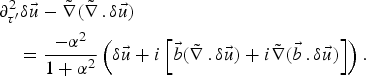
The right-hand side of Eq. (7) is a stabilizing term. Eq. (7) reduces to the following order differential equation set:

with i ∈ {x, z}, and

We report in Figure 3 the perturbations evolution obtained with LPC-MHD in this configuration. Here, the magnetic field clearly limits the development of the RMI since it makes the amplitude of the interface perturbations to oscillate in time and not to grow linearly anymore as it does in the classical RMI (without any magnetic field).
Time evolution of the normalized amplitude of the interface perturbations when  for different values of the magnetic field.

It can also be seen in Figure 3 that the higher the amplitude of the magnetic field, the smaller the oscillation period and amplitude are. This holds in both cases: when the shock wave intercepts a heavy-to-light density discontinuity or a light-to-heavy one.
This confirms the features from the magnetic impulsive model developed by Qiu et al. (Reference Qiu, Wu, Cao and Li2008) who find the following expression for the evolution of the perturbations amplitude a(t):

where ω is the frequency defined by  ,
 is the modified Alfvén velocity, A T = (ρr − ρl)/(ρr + ρl) is the Atwood number, ν is the cinematic viscosity, and Δu is the velocity jump underwent by the interface while impulsively accelerated as already mentioned.
As we deal with non-viscous fluids in our numerical calculations (ν = 0), the amplitude oscillates with the following expression:

with

and the frequency

In order to check the validity of Eq. (13), we perform a systematic variation of the B-field with LPC-MHD. The amplitude obtained numerically is Fourier transformed in time in order to estimate the frequency of oscillation. Numerical and analytical results are compared in Figure 4.
Comparison between Qiu's analytical expression of ω (plain and dashed lines) given by Eq. (13) and our numerical calculations (points) for a light to heavy transition.

In the case of a heavy to light fluid transition as well as for a light to heavy transition, we find a good agreement between Eq. (13) and LPC-MHD results as showed in Figure 4. The higher the magnetic field, the higher the frequency is.
Comparison of amplitudes of oscillation a(t), between numerical results and model, requires the definition of a(0) in the model (cf Eq. (10) or Eq. (11)). Indeed, contrary to numerical calculations, the impulsive model does not obviously take into account the compression of interface perturbation amplitude since no shock wave crosses it. Usually, in the impulsive model, one assumes that for t = 0−, just before t = 0, both media are in a post-shock state. At t = 0, the perturbed interface seeding perturbations is impulsively accelerated. Thus, the estimate of a(0) is missing. To correct this lack, we evaluate it following pioneering approaches existing in the literature. For instance, in the case of light-to-heavy interface, Richtmyer (Reference Richtmyer1960), first, proposed to consider the numerical post-shock amplitude a(0+), just after the shock crosses the interface. On the other hand, for the case of heavy-to-light interface, the Meyer and Blewett prescription (cf Eq. (2)) is much more appropriate. This is summarized as:

a m is estimated using one-dimensional post-shock hydrodynamic quantities given by numerical calculations.
Considering that a LPC(t) = a mLPCcos(ωt), a m (from Qiu's model) is directly compared to a mLPC/a(0), a(0) following previous considerations (cf Eq. (14)).
A qualitatively good agreement is found. The amplitude decreases as the amplitude of the magnetic field does.
5. CONCLUSIONS
In this work, we address by numerical calculation the growth of the compressible Richtmyer-Meshkov instability in presence of a transverse magnetic field by the mean of the LPC-MHD code. We show that the magnetic field has no effect on the RMI growth, when it is perpendicular to the shock propagation and to the wave vector. On the contrary, the magnetic field is aligned with the wave vector, the RMI is suppressed and the perturbation at the interface oscillates in time. The amplitude and frequency of oscillations are compared to pioneering works of Qiu, et al. (Reference Qiu, Wu, Cao and Li2008) that developed an impulsive accelerated RMI model in the incompressible limit. A good agreement is obtained between the model and our calculations. We show also that the Meyer-Blewett prescription and the Richtmyer prescription are well suited to reproduce the numerical results, in the case of heavy-to-light and light-to-heavy transition respectively.
Comparisons of the amplitude in the case of the reflexion of a shock wave (circles for numerical results and dashed lines for Qiu's model) and when a rarefaction wave is reflected with the Meyer-Blewett prescription to evaluate the a(0). Squares stand for LPC-MHD calculations while solid line represents Qiu's analytical model.



