Introduction
Why is choosing to study GCSE music so unpopular amongst 14-year-olds in England? This paper will explore this issue by introducing a new theoretical perspective which addresses the ways in which official school knowledge is structured and how pupils (and others) understand and perceive this knowledge. It thus has two aims: first, to open up questions around the unpopularity of music as a curriculum subject; and, secondly, to examine the value of this new approach in exploratory empirical studies.
As an academic subject, music enjoys a somewhat contradictory status in secondary school. While music listening is one of the most significant leisure activities for children and young people, active engagement with music is less common. For example, recent findings in the UK show that 91% of children and young people aged 7–19 like listening to music, but only 39% engage in music-making activities (Youth Music, 2006). Similarly, while studies show that English school pupils enjoy music lessons as part of the National Curriculum in Key Stage 3 only slightly less than they do in primary school (Lamont et al., Reference LAMONT, HARGREAVES, MARSHALL and TARRANT2003), studying music at GCSE level is extremely unpopular. In the early 2000s, only around 8–9% of the school age population opted to study GCSE music (QCA, 2002). Although this represents an increase from the 3% who opted for the earlier Ordinary Level music qualification during the 1980s (Bell, Reference BELL2001), it remains a minority subject. This is particularly marked when considering the take-up rate of study for GCSE qualifications in comparable subjects: across the same time-span as the 8–9% opting for music, 20% opted for physical education/sport, while 36% opted for art (QCA, 2002).
The low uptake of GCSE music is the focus of considerable debate in the music education community (e.g. Bray, Reference BRAY2000) and a matter of concern for educators (Mills, Reference MILLS1997). School music has also become the focus of government initiatives, such as the DfES Music Manifesto and Youth Music's Wider Opportunities programmes in the early 2000s, which aim to champion the status of the subject and encourage more young people to become involved in music making. However, despite this debate and a flurry of public statements and funded interventions (e.g. DfES/DCMS 2004, 2006; Davies & Stephens, Reference DAVIES and STEPHENS2004), there has been relatively little systematic research into the issue.
Most studies of music focus on the learning and playing of musical instruments in formal and informal settings outside school. These studies typically report that music in the school curriculum is often described as simply ‘out of touch’ or perceived as largely irrelevant by most children (e.g. Green, Reference GREEN2001; Sloboda, Reference SLOBODA2001). Though offering valuable insights into the wider issue of musical engagement, music in school is only a tangential concern in such research. Studies of school music itself, including the few studies that address the issue of low uptake at GCSE level, are less systematic. They typically offer speculation or ad hoc, piecemeal and largely descriptive accounts (e.g. Bray, Reference BRAY2000; Harland et al., Reference HARLAND, KINDER, LORD, STOTT, Schagen, Haynes, Cusworth, White and Paola2000; see QCA, 2004a). Though valuable for highlighting the issue as significant, such studies tend to be more suggestive descriptions of potential questions to be addressed than theoretically informed, empirically based explanations. Typifying many of these studies is the account by Bray (Reference BRAY2000), who examined statistical data on GCSE choices across a range of subjects. Bray showed that the small numbers opting for GCSE music were relatively stable over a five-year time-span, highlighted that typically students achieve higher in music, and argued that there were considerable school variations obscured within the overall figures (at around 7% in 1998). He then offered a number of speculative conjectures as to the causes of low GCSE uptake, which are worth considering in turn.
First, Bray suggests that GCSE level study may be seen as separate from prior musical experiences. Although the National Curriculum was intended to provide a logical and connected sequence of music education, some evidence supports Bray's suggestions. Pupils perceive marked differences between music at Key Stages 2 and 3 (at the transition from primary to secondary school; Marshall & Hargreaves, Reference MARSHALL and HARGREAVES2007) and between Key Stage 3 and GCSE level (Wright, Reference WRIGHT2002). However, as yet it is unclear how this may be related to low GCSE uptake, as the different perceptions between primary and secondary school do not typically result in a markedly more negative attitude towards music (Lamont et al., Reference LAMONT, HARGREAVES, MARSHALL and TARRANT2003). Secondly, Bray suggests music may be viewed by parents as unimportant because it lacks vocational value and may transmit this view to their children. Although interview studies suggest pupils are aware of the career-oriented nature of GCSE choices across the range of subjects (e.g. Warrington et al., Reference WARRINGTON, YOUNGER and WILLIAMS2000), there is no evidence yet on whether this specifically affects music qualifications. Thirdly, Bray argues that music may be inappropriate to be studied and assessed as an examination subject, which may make it unappealing. How this inappropriateness arises is not clarified, though one might assume this concerns the different attitudes shown to music and music-making out of school compared to the inauthenticity of school music (Green, Reference GREEN2006; see above). However, there is no empirical evidence available on this issue. Finally, Bray proposes that pupils may be deterred from choosing music for GCSE because they feel they need prior expertise in order to succeed. Although QCA's criteria state that ‘the scheme of assessment must ensure that the highest grades are accessible by those candidates who may not receive additional specialist music lessons’ (2005: 3), there is some evidence that pupils and teachers still believe that instrumental tuition and learning notation are both essential for GCSE (Wright, Reference WRIGHT2002).
Thus a limited amount of supporting empirical evidence can be found for some speculations, although not for all. However, other potential and often competing explanations have been proposed for subject choices, including but not restricted to music. We will briefly consider these in turn. In a small-scale study of music in one school, Wright (Reference WRIGHT2002) identified, amongst a number of other factors, that pupils’ own perceptions of the difficulty of GCSE music may be important in their decision-making. It is known from other research that pupils typically choose those subjects they are better at; for example, pupils’ reading abilities at age 11 have been linked to their decision to study humanities subjects at university (Van de Werfhorst et al., Reference VAN DE WERFHORST, SULLIVAN and CHEUNG2003). Another factor is the perceived importance of the subject: in one school, Wright (Reference WRIGHT2002) also found that pupils view music as typically relatively unimportant in comparison with other subjects. This combination of factors may shape pupils’ decisions about music: how difficult they think the subject is, how good they think they may be at it, and how important it is are all potentially powerful influences. However, how these factors interact with each other and with other possible explanations is yet to be explored.
Two final groups of factors which have received no attention in relation to music choices are enjoyment and wider social influences. There is conflicting evidence about the importance of enjoyment: some studies show enjoyment may predict subject choice at GCSE level (Stables, Reference STABLES1996), although it can change at different stages. For example, for history and geography, Adey & Biddulph (Reference ADEY and BIDDULPH2001) found that pupils’ attitudes and enjoyment of subjects at Key Stage 3 was entirely unrelated to their perceived enjoyment of it at GCSE. There has also been some limited evidence for the importance of peer pressure, public image and social groups on attitudes towards GCSE in general (Stables, Reference STABLES1996; Warrington et al., Reference WARRINGTON, YOUNGER and WILLIAMS2000), and there may also be gender differences in attitudes towards and involvement with music, just as there are for other school subjects (Stables, Reference STABLES1996; Francis, Reference FRANCIS2000; Brown, Reference BROWN2001).
In summary, there is useful but limited empirical evidence on subject choices regarding music. Existing accounts provide descriptions of the low uptake of GCSE music or valuable insights into the position and perception of music within the school, and hypothesise a wide variety of potential reasons for its low uptake. However, these studies are often undertheorised, small-scale or conjectural. While a plethora of possible reasons have been advanced, there is little evidence or explanations for the roles they play and how they may interact. To reach a fuller, more firmly based explanation of the issue requires both systematic research and a theoretical framework within which various factors can be empirically explored and analytically brought together. It also requires setting the question of GCSE music uptake in a broader context to consider the status of music as a school subject, exploring the relationship between music and other subjects. In the rest of this paper we draw on a framework capable of being applied to a variety of objects of study that, we suggest, offers a valuable starting point for enabling systematic empirical research. We also begin this process by discussing the results of two exploratory studies. Our aim is not to offer a definitive account of the low uptake of GCSE music nor to suggest this is the only approach that should be taken, but rather to begin exploring both this issue and what the approach can offer to research.
A new theoretical approach
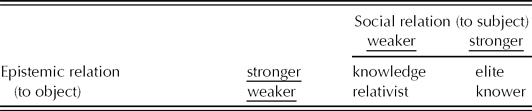
The framework we shall use is legitimation code theory, which brings together and develops ideas from the sociological approaches of Pierre Bourdieu and Basil Bernstein (for discussions of the theoretical background and development of legitimation code theory, see Maton, Reference MATON2000, Reference MATON2006, Reference MATON, Christie and Martin2007; and Moore & Maton, Reference MOORE, MATON, Morais, Neves, Davies and Daniels2001). The theory focuses on the basis of achievement or success within educational contexts. It views the practices and beliefs of actors as embodying competing claims to legitimacy, or messages as to what should be considered the dominant basis of achievement within a social field of practice. These ‘languages of legitimation’ are analysed in terms of their underlying structuring principles or ‘legitimation codes’. One dimension of the code is ‘specialisation’ or what makes someone or something different, special and worthy of distinction. This dimension of legitimation code is based on the simple premise that every practice, belief or knowledge claim is about or oriented towards something and by someone, and so sets up an epistemic relation to an object and a social relation to a subject. Put briefly, each relation may be more strongly or weakly emphasised in practices and beliefs, and the two strengths of emphasis together give the code. Table 1 outlines four such codes:
• a knowledge code, where possession of specialised knowledge, skills or procedures are emphasised as the basis of achievement, and the dispositions of authors or actors are downplayed;
• a knower code, where specialist knowledge or skills is less significant and instead the dispositions of the subject as a knower are emphasised as the measure of achievement, whether these are viewed as natural (e.g. ‘genius’), cultivated (such as an educated artistic gaze) or socially based (such as a specific gender, e.g. feminist standpoint theory);
• an elite code, where legitimacy is based on both possessing specialist knowledge and being the right kind of knower. (‘Elite’ does not necessarily mean ‘socially exclusive’ but rather highlights the necessity of possessing both legitimate knowledge and legitimate dispositions); and
• a relativist code, where legitimate insight is ostensibly determined by neither specialist knowledge nor specific dispositions.
Legitimation codes of specialisation
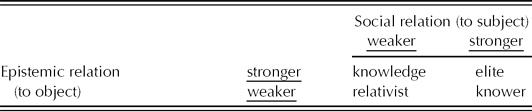
In summary, these codes conceptualise different rulers of achievement, where the underlying rules are that what matter is: one's demonstrated possession of specialist knowledge or ‘what you know’ (knowledge code); one's sensibilities and dispositions or ‘what kind of knower you are’ (knower code); both (elite code); or neither (relativist code).
The code describes what Bourdieu (Reference BOURDIEU1990) terms the ‘rules of the game’ – the dominant basis of success in any particular social context. For example, imagine a History classroom in which a teacher asks pupils about what significant historical events occurred in the year 1066. This teacher is operating with a knowledge code – she is asking pupils to demonstrate insight based on historical knowledge. If a pupil replies, ‘I don't know, Miss, I wasn't alive then’, the pupil is using a knower code, where insight is based on ‘who you are’ (in this case, whether you were alive at the time). In this example the pupil is either unable to recognise the basis of success and act accordingly or they are trying to change that basis. A contrasting example would be where the teacher asks pupils to imagine what it was like to be alive in the year 1066 (knower code), and a pupil offers only historical facts in response (knowledge code).
So, within any context a specific code may dominate as the (unwritten) rules of the game, but not everyone may recognise and/or be able to realise what is required, and there may be struggles over which code is dominant. One can thus talk of a code clash between the code characterising, in these examples, a pupil's ways of thinking and being (or in Bourdieu's terms their ‘habitus’) and that of the educational context. This may lead to difficulties in achievement and thence alienation, boredom and a sense that ‘this is not for the likes of me’. The dominant legitimation code may also change, between subject areas, classrooms and stages of the educational career. Such a code shift effectively changes the rules of the game. Pupils who succeeded under the old code may find themselves suddenly doing less well under the new code. If this change and the new code are not made explicit to pupils – what Bernstein terms ‘invisible pedagogy’ (1975) – then the inexplicable loss of form of pupils whose habituses do not match the new code may lead to disincentive, bewilderment, alienation and a sense that ‘this is no longer for the likes of me’. Where pupils are aware of a potential code clash or code shift in the near future, they may choose, if they have the choice, to opt out of facing that prospect.
This conceptual framework is being used in a range of studies looking at a variety of issues in education (see e.g. Wheelahan, Reference WHEELAHAN2005; Konza & Maton, Reference KONZA and MATON2006; Carvalho & Dong Reference CARVALHO and DONG2007; Hood, Reference HOOD, McCabe, O'Donnell and Whittaker2007; Doherty, Reference DOHERTY2008). Its value for our focus here lies in its applicability in research and fruitfulness in generating hypotheses capable of being empirically studied. Its applicability results from the theory's focus on analysing the structuring principles underlying the object of study. One can use legitimation code theory to analyse any number of contexts and practices: schools, classrooms, curriculum, pedagogy, particular interactions within a classroom, and so forth. The concepts are thereby fractal in application: one can use them to analyse a national curriculum, a subject area, specific aspects of a subject's curriculum, particular tasks within that area, and so on. They can also be used with a range of methods, including documentary analysis, surveys and interviews. This allows different dimensions of music education to be brought together and triangulated in the same analysis. Similarly, one can compare different contexts (such as classrooms) and analyse change over time without becoming lost in surface empirical differences. The theory is also suggestive. The notion of ‘code clash’ highlights that one issue in the low take-up rate of music may be that its underlying basis of achievement may not match those of the majority of pupils. The idea of ‘code shift’ brings our attention to the ways anticipated changes in the ‘rules of the game’ might affect pupils’ decision-making over which qualifications to pursue.
We shall now begin to examine how this framework may help us begin explaining the unpopularity of the GCSE qualification in music. Our main aims are to explore the legitimation code(s) for music, whether there are code shifts through the curriculum, and whether there are code clashes between the bases of achievement as defined in curriculum and as understood by many pupils. Following the issues raised by existing studies of school music discussed earlier, we shall also examine how the question of legitimation code might be related to pupils’ rating of the importance of and their self-perceived abilities at different subject areas. We do so through two exploratory studies addressing definitions of achievement in the curriculum and in pupils’ perceptions.
Method and results
Study 1: Curriculum documents
The first study addresses the levels of achievement expected of pupils at different Key Stages. The data for this study are the written National Curriculum attainment targets and programmes of study (for Key Stages 1–3; DfES/QCA 1999; QCA, 2004b), the Qualifications and Curriculum Authority criteria for GCSE (QCA, 2005) and the GCSE syllabi of major examination boards (AQA, 2004; Edexcel, 2000, 2006; OCR, 2000, 2005). All of these cover the period 2000–2005.
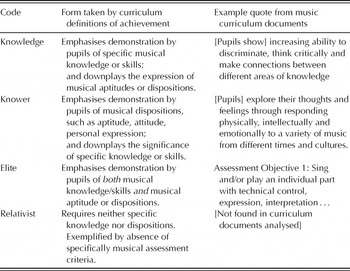
In operationalising the conceptual framework to analyse a specific object of study, one needs to develop what Basil Bernstein (Reference BERNSTEIN2000) terms a ‘language of description’ or means of translating between the theoretical and the empirical, and vice versa. Table 2 presents a basic language of description that provides a means of moving between:
• the four legitimation codes we have outlined (left column);
• the form these take in curriculum documents, focusing on curricular definitions of achievements (middle column); and
• examples of realisations of the codes within the documents analysed (right column).
A language of description for legitimation codes of specialisation

In brief, this instrument was used to analyse the documents in terms of whether they emphasised the assessment of: skills, procedures, techniques and knowledge; dispositions of the learner, such as aptitude, attitude and personal expression; both skills and dispositions; or neither.
Our analysis suggests the official requirements for music embody different legitimation codes of specialisation for different stages of the curriculum. In Key Stages 1–2 (ages 5–11) the National Curriculum defines achievement in terms of the capacity of pupils to express themselves rather than demonstrate skills or knowledge. During Key Stage 2, for example, pupils are expected to be able to:
sing songs and play instruments with increasing confidence, skill, expression and awareness of their own contribution to a group or class performance. They improvise, and develop their own musical compositions, in response to a variety of different stimuli with increasing personal involvement, independence and creativity. They explore their thoughts and feelings through responding physically, intellectually and emotionally to a variety of music from different times and cultures.
(DfES/QCA 1999: 18)The curricular focus here downplays the significance of pupils possessing specialist musical knowledge (beyond a passing mention of ‘skill’) and instead emphasises the subjective attributes of pupils – their involvement, creativity, thoughts and feelings: a knower code.
In contrast, during Key Stage 3 (ages 11–14) the Programme of Study downplays aptitude, attitude and personal engagement in favour of the demonstration of musical skills and knowledge:
pupils deepen and extend their own musical interests and skills. They perform and compose music in different styles with increasing understanding of musical devices, processes and contextual influences. They work individually and in groups of different sizes and become increasingly aware of different roles and contributions of each member of the group. They actively explore specific genres, styles and traditions from different times and cultures with increasing ability to discriminate, think critically and make connections between different areas of knowledge.
(DfES/QCA 1999: 20)Here the previous emphasis on subjective attributes of pupils has been replaced by a focus on their musical knowledge and ability: a knowledge code.
At GCSE level the code changes again. Examination syllabi for GCSE music require pupils to demonstrate both their capacity for personal expression and ability with technical skills. For example, the current QCA Subject Criteria for GCSE state:
With regard to performing activities, each scheme of assessment must define how musical expression and technique (as required by the demands of the music) are to be assessed . . . All specifications must give students opportunities to acquire the knowledge, skills and understanding needed to make music both individually and in groups, to develop a lifelong interest in music e.g. through community music-making; and to progress to further study . . . All specifications must give students opportunities to develop broader life-skills and attributes including critical and creative thinking, aesthetic sensitivity and emotional and cultural development
(QCA, 2005, emphasis added)Here, as we have highlighted, emphasis is placed equally on both musical sensibilities (expression, aesthetic sensitivity) and musical knowledge and skills (technique, knowledge, skills and understanding): an elite code.
These emphases are repeated in the assessment objectives of the three major GCSE examination board syllabi for 2003–2008 (e.g. AQA, 2003; Edexcel, 2000; OCR, 2000). These are expressed by Edexcel in relation to performing, for example, as:
Singing and/or playing an individual part with technical control, expression, interpretation and, where appropriate, a sense of ensemble.
(Edexcel, 2006: 5)Edexcel's syllabus includes a solo musical performance assessed for being both ‘accurate and fluent’ and ‘an expressive performance that is generally stylish’, with equal emphasis given to Accuracy and Interpretation (Edexcel 2006: 21, 22). Similarly, AQA (2004) declares that higher grades are given to candidates who can ‘demonstrate a successful and imaginative organization of sounds and use of resources . . . compositions will demonstrate flair, effective and idiomatic use of instruments, voices and sound sources and use rhythmic devices and dynamic contrast to create appropriate colour and mood’ (AQA, 2004: 45). AQA also score students’ performances for Accuracy, Interpretative Qualities, Expressive Qualities and Demand (AQA, 2004: 48). OCR score performances for fluency, technical control, sense of direction and communication of intended effect (OCR, 2000: 36). The recurrent theme across these syllabi is an elite code emphasis on both musical knowledge and musical dispositions as the basis of achievement.
This suggests one possible reason for low uptake may be legitimation code shifts underlying the prescribed definitions of achievement in music as pupils move through the curriculum. The first code shift (from knower code to knowledge code) reflects, we suggest, a general change in the school context, coinciding with the move from primary to secondary school. This changes the ‘rules of the game’ and could, we conjecture, create difficulties for many pupils across a wide range of subjects. More pertinently for our focus here, a second code shift occurs for music between Key Stage 3 and GCSE. The basis of success in music shifts from a knowledge code to an élite code. The rules of the game are thereby changed again, at least at the level of curriculum guidelines and syllabus demands, but now to a code requiring not only the right knowledge but also the right kind of personal dispositions. In other words, at GCSE level there are two underlying bases of legitimacy or, put another way, two rulers by which pupils may measure their possible future chances of achievement. Whether this may affect subject choices depends, of course, on whether these codes are reflected in pupils’ perceptions of success in school music, to which we now turn.
Study 2: Pupils' perceptions
Our second exploratory study focused on the definitions of achievement to be found in the perceptions of pupils. Data were gathered from 912 school children between years 4 to 9 in four different schools in the North East and South East of England in March–May 2004. The schools were sampled to provide a balance of location (urban/rural, North/South) and socio-economic status, and all were within the state educational sector. There were 163 pupils in year 4, 180 in year 6, 292 in year 7 and 277 in year 9. Pupils participated in their normal classroom setting, with a teacher present to aid in administration and help answer procedural questions. Pupils were asked to work alone in completing our questionnaire, and data collection took around 10–20 minutes.
The questionnaire asked three questions about five school subjects (mathematics, music, English literature, science and history). First, pupils were asked how important they thought it was to be good at each subject. Secondly, they were asked for a self-rating of their ability at that subject. Both questions used five-point scale responses from ‘not at all’ to ‘very’. Finally, pupils were asked what makes someone good at that subject. In this first attempt at operationalising the conceptual framework for quantitative methods, we offered respondents a forced choice of one of four options, which we believed might capture relativist, knowledge, knower and elite codes, respectively:
• Anyone can do it, nothing special is needed.
• You need to learn special skills or knowledge.
• You need to have ‘natural ability’ or a ‘feel’ for it.
• Only people with ‘natural ability’ can learn the special skills needed.
Pupils were instructed to pick one option only. Henceforth we refer to these as options (e.g. ‘knowledge option’) rather than as codes. The codes are principles underlying practices and beliefs, while the options are a possible way in which the codes may be realised in pupils’ perceptions.
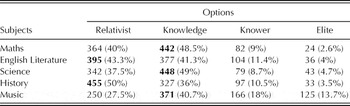
Results indicate that the basis of success/measure of achievement varied between the five school subjects. As this was measured using a categorical scale, responses are analysed descriptively and using non-parametric statistics. The results are shown in Table 3, with modal responses in bold. The modal response for maths, science and music was the knowledge option (‘you need to learn specialist techniques, skills or knowledge’). The modal response for English literature and history was the relativist option (‘anyone can do it, nothing special is required’). We return to discuss these results further below.
Basis of success: Subjects by options

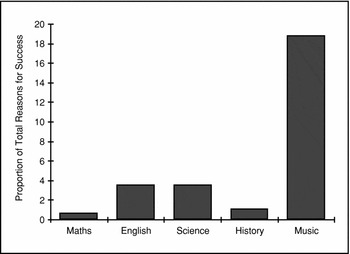
Taking each Key Stage separately, there was little difference between the modal responses for Key Stage 2 and Key Stage 3, except in the case of music. Although pupils predominantly chose the knowledge option to describe success in music in both key stages, as pupils come closer to GCSE study there was a significant increase in the proportion choosing the elite option (‘only people with ‘natural ability’ can learn the special skills needed’). By year 6 this was at 7.5%, and rose to 11.6% in year 7 and 18.8% in year 9. As illustrated in Figure 1, this is far higher than the proportion of pupils choosing the elite option for success in year 9 in other subjects, which is a maximum of 3.6%. This rises even further when looking at the responses of pupils who have chosen to study music for GCSE. We focused on year 9, when pupils have made subject choices for GCSE and so are looking ahead to their future studies, and asked pupils whether they had or had not chosen GCSE music. Of our sample, 11.4% stated they were planning to study GCSE music. The proportion of pupils choosing the elite option was higher among those who opted for GCSE music (24%) than for those who did not (17.4%). In other words, overall these results suggest that the longer pupils are at school and the closer they are to GCSE (and, in particular, to taking GCSE music), the greater the likelihood that they will choose the elite option for music.
Proportion of Year 9 responses choosing the élite option as the basis for success

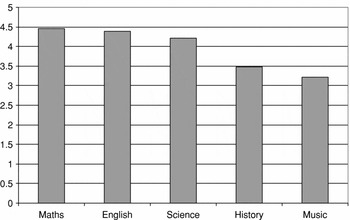
Focusing on the pupils’ perceptions of the importance of subject areas, music is viewed as of less significance than all other subjects. As illustrated in Figure 2, maths was rated as the most important subject with a mean rating of 4.45, and English literature and science were also important at 4.39 and 4.21 respectively; history was lower at 3.48 and music lowest at 3.22.
Importance ratings of school subjects

Moreover, the closer pupils get to GCSE level, the lesser the perceived significance of music. While importance ratings are maintained for the core curriculum subjects (maths, English literature and science) over the year groups, importance ratings drop for history and markedly so for music. Similarly, pupils’ ratings of their own ability for all age groups was lowest for music: mean ratings were highest for English literature (3.64) and higher for maths (3.58) and science (3.55) than history (3.42) and music (3.35). In summary, pupils viewed music as less significant and rated themselves as less able at music compared to other subjects.
One slight exception to these trends was the ratings from those pupils who had chosen music for GCSE study (the year 9 cohort). Again, music was not viewed as being as significant as mathematics. However, compared with those who had not chosen GCSE music, pupils who had chosen music felt that it was significantly more important (mean importance ratings of 3.4 compared to 2.69, t = −3.114, p = .002, df = 218) and rated themselves as significantly more able at music (mean ability rating of 4.12 compared to 3.04, t = −5.39, p < .0001, df = 218). Thus while music is generally less important than other subjects and pupils feel they are less able at it, these ratings are mediated by whether or not pupils have chosen to study it at GCSE level.
Analysis and discussion
Bringing results from the two exploratory studies together suggests the approach may prove fruitful for investigating hitherto neglected aspects of the low take-up of music at GCSE level and for providing a firmer foundation for empirical research. The study of definitions of achievement in curriculum documents reveals there are, at least in official guidelines, changes in the measures of success between different stages of the curriculum. These code shifts support descriptions in existing accounts of differences in music between Key Stages 2 and 3, and between Key Stage 3 and GCSE. The approach used in the current study goes further, however, to excavate the basis of these changes (in their underlying legitimation codes of specialisation) and to suggest possible reasons for how this may relate to the unpopularity of GCSE music. Principally, it signals a change in the rules of the game. Focusing on the second code shift, this is from an emphasis on knowledge and skills as the ruler of achievement (knowledge code) to an emphasis on both knowledge and dispositions (elite code). In other words, between Key Stage 3 and the GCSE attainment targets the code changes to one that is doubly demanding. There are two measures of achievement: musical knowledge and musical dispositions. Not only do the rules of the game change but it also becomes harder to successfully play.
This code shift appears at least partly reflected in pupils’ perceptions. Of the subjects we addressed in our survey, music was by far the most likely to be attributed to the elite option by pupils, particularly as GCSE approaches. This growing elite perception may be related to the tendency of pupils to rank themselves lower in self-ability at music than for other subjects. If pupils anticipate that the game is becoming or going to become harder to play, they may increasingly believe ‘music is no longer for the likes of me’ and thus view themselves as less able at the subject. This resonated with research highlighting the popularity of school music prior to subject choices for GCSE study (Lamont et al., Reference LAMONT, HARGREAVES, MARSHALL and TARRANT2003). Focusing on the issue of codes thereby may enable factors highlighted by existing studies (though often in an ad hoc or conjectural manner) to be brought together. For example, as discussed earlier, studies have suggested pupils may be deterred from choosing music GCSE because they believe it is too difficult or prior expertise is required to succeed (e.g. Wright, Reference WRIGHT2002). If music does become viewed increasingly as an elite code as GCSE study approaches, this would suggest that it is not simply the need for musical skills but also the further requirement for more ethereal qualities of musical ability (aptitude, attitude, etc.) that may play a role in this perception of excessive difficulty. Put another way, there are two possible bases for viewing music as difficult and for experiencing a code clash. Pupils may have musical sensibilities but still feel deterred from choosing music (or seeing themselves as more able at the subject) because of a perceived lack of musical knowledge and skills, and vice versa.
Another factor we explored is perceived significance. Our exploratory study indicates that music is viewed as less significant by pupils than other subjects, supporting evidence from earlier studies (e.g. Wright, Reference WRIGHT2002). It can be tempting to account for the low uptake of GCSE music solely in terms of its value in the occupational marketplace and to argue it has little vocational relevance or status among potential employers (cf. Bray, Reference BRAY2000). However, on its own this explanation fails to account for why the uptake rate of, for example, GCSE sport is double that of music. We would suggest that sport is not twice as valuable in the job market. Using legitimation code theory, we suggest it is more fruitful to consider the perceived significance of music in relation to its emerging elite code. Approaching the point of choice between GCSE subjects, music is increasingly viewed by pupils as having two measures of achievement, yet also viewed as decreasingly significant. The perceived investment of time and effort required to achieve in music is thus growing at the same time as the rewards to be gained from this investment may be diminishing, making music for many a relatively unattractive choice.
Legitimation code theory thereby offers a potentially useful approach for addressing the question of why relatively few pupils choose music, as one contributing factor may be its growing elite code of specialisation. We have emphasised these represent exploratory studies and so shall conclude by considering their possible limitations and what they highlight as needing further research.
The study of pupils’ perceptions was our first attempt at operationalising the framework using quantitative methods. Some of our results are intuitively surprising. While one might expect mathematics and science to be associated with the knowledge option, the choice by pupils of the relativist option for English and history is less easily interpreted. This, we believe, relates to the wording of the four options. First, our knower option offers only ‘‘natural ability’ or a ‘feel’ for it’. This wording reflects a dominant preoccupation of music education research, but neglects the notions of cultivated sensibilities or refined judgement or taste which have wider currency in subjects such as English literature. This may account for the relatively low response rate for the knower and elite options, both of which included ‘natural ability’. If pupils did not believe natural ability was the basis of achievement then they had only the knowledge or relativist options to choose from. So, for English and history the number of knower options responses may have been suppressed. Secondly, the phrasing of the elite option (‘Only people with ‘natural ability’ can learn the special skills needed’) makes ‘natural ability’ the basis for access to ‘special skills’ rather than bringing together both dispositions and knowledge, potentially limiting the choice of this option. (This does, however, make the higher level of elite option responses for music even more striking). Thirdly, the forced-choice survey design suggests the codes are four ideal types, rather than focusing on the relative strengths of the epistemic relation and social relation that underpin codes. Simply put, offering only four options does not access the relative strengths of emphasis on knowledge and dispositions. Accordingly, future research requires developing the survey instrument to include the issue of cultivated taste, exclude the sequencing in the elite option, and move from a forced-choice to a rating scale approach which would allows independent ratings to be provided of each of the rulers of success.
Our focus on curriculum documents and pupils’ perceptions is obviously only part of the picture. Further studies are required, including research into:
• the social distribution of legitimation codes among different groups of pupils to ascertain which pupils might experience a code clash between their habituses and an elite code;
• how school music is taught at different key stages, to examine whether these represent the same or different codes as in curriculum documents, and which codes in pedagogy encourage or discourage pupils from choosing music;
• the perceptions of teachers; and
• constructions of achievement within higher levels of music education, such as undergraduate degrees and conservatoires.
In summary, one reason for the low take-up rate for GCSE music may be its underlying principles of achievement or legitimation code. This is, of course, not the only factor. However, by highlighting this hitherto neglected dimension of music as curriculum and pedagogy, legitimation code theory offers a valuable basis for building a theoretically informed, empirically based explanation that moves beyond piecemeal or ad hoc accounts. One advantage of this approach is that it enables such disparate foci as curriculum guidelines, pupils’ and teachers’ perceptions, forms of pedagogy and different levels of education to be integrated within an overarching research programme that can more fully explore the pressing and multi-faceted issue of why more pupils are not choosing to study music.