Introduction
Natural resource degradation in developing countries is one of the major challenges facing efforts to reduce poverty since the rural poor heavily depend on land and other natural resources. Hence, degradation of natural resources is likely to affect poor people the most (Leonard, Reference Leonard1989). To address the natural resource degradation problem, developing countries have increasingly been using community-based resource management (Agrawal and Gibson, Reference Agrawal and Gibson1999; Western and Wright, Reference Western and Wright1994). Empirical evidence shows that community resource management can increase efficacy, legitimacy, and sustainability of natural resource management (NRM) (Western and Wright, Reference Western and Wright1994).
At the community level, the need for addressing NRM collectively is critical. Efforts by one farmer to adopt improved land management may be undermined if other farmers do not adopt such technologies since actions of one farmer may have spillover effects beyond the farmers' boundaries. For instance, if one farmer occupying a small share of the watershed area plants trees to control erosion, such action may not be effective if other farmers do not control soil erosion on their farms (Garrity, Reference Garrity, Cooper and Denning2000). For example, in southwestern Uganda, some farmers seeking fertile soil undermine terraces that have accumulated nutrients over years. This leads to increased erosion not only in fields of the farmer destroying the soil and water conservation (SWC) structures but also in fields of other farmers in the water catchment. Hence, incentives for individual farmer efforts may not be adequate to address land degradation problems in a community without collective action or regulation.
Research on community NRM in developing countries has been growing fast in the past two decades (Agrawal and Gibson, Reference Agrawal and Gibson1999; Agrawal, Reference Agrawal2001; Varughese and Ostrom, Reference Varughese and Ostrom2001). Among the questions being debated in the literature are the efficacy of communities to manage natural resources collectively (Tucker, Reference Tucker1999; Hardin, Reference Hardin1968; Ostrom, Reference Ostrom1990) and the determinants of sustainable collective NRM (Agrawal and Yadama, Reference Agrawal and Yadama1997; Chomitz, Reference Chomitz1995; Agrawal, Reference Agrawal2001). Most of the past research on community NRM has focused on natural resources owned collectively (the commons) and little has focused on collective action on privately owned natural resources. By contrast, this paper analyzes community regulations used to regulate privately owned natural resources. Additionally, there is still relatively little empirical work that has analyzed the factors that determine participation in community NRM (Zantell and Knuth, Reference Zantell and Knuth2004). This paper differs from most related studies since it analyzes the determinants of enactment, awareness, and compliance with community regulations. Most past research on collective NRM did not focus on analysis of the legal instruments that are used in community NRM.
The paper uses Uganda as a case study since the country is one of the African countries facing severe natural resource degradation problems, and where enactment and enforcement of NRM regulations is seen by many policy makers as necessary to address these problems. The rest of this paper is organized as follows. The next section discusses the theory and conceptual framework used in the analysis. This is followed by the data collection and analysis methods, which are followed by discussion of the results. The last section concludes the paper and draws policy implications of the results.
Theory and conceptual framework
Community NRM depends on many factors that are not easy to discuss exhaustively (Agrawal, Reference Agrawal2001; Poteete and Ostrom, Reference Poteete and Ostrom2003). These factors can be grouped into four conceptual variables, which we discuss below (Agrawal and Yadama, Reference Agrawal and Yadama1997; Poteete and Ostrom, Reference Poteete and Ostrom2004; Ostrom, Reference Ostrom1999).
Institutions
Institutions are humanly devised restrictions that shape human behavior (North, Reference North1990), and thus greatly influence the impact of other variables on NRM. Institutions develop in response to social needs and interactions among many actors or groups of actors in a society (Knight, Reference Knight1992). Among other things, development of these institutions affects the distribution and management of natural resources and the efficiency of economic activities (ibid.). Meinzen-Dick and Pradhan (Reference Meinzen-Dick and Pradhan2002) identify six major types of institutions that are common in developing countries: central government, local governments, customary institutions, religious institutions, project and organizational (e.g. water user group) institutions. In this research, we focus on local and state government institutions used by communities to manage natural resources. We examine three dependent variables: enactment of bylaw at the village (Local Council 1 or LC1)Footnote 1 level; the level of awareness of NRM regulations enacted at various levels of government (including local bylaws); and the level of compliance with NRM regulations. We expect NRM regulations to contribute to less degradation of natural resources if the community complies with such regulations.
Enactment of regulations at the community level may not be endogenous if the institution-makers (LC1 councilors) are completely determined by external forces such as central government policies (Shvestova, Reference Shvetsova2003). As Shvestova observed, there is growing consensus that institutions occur in an environment where law makers interact with internal and external (social) influences. For example, the Uganda Local Government Act of 1997 gives powers to the LC1 councilors to enact bylaws. However, the LC1 councilors are required to ensure that the bylaws they enact are consistent with the national statutes. This requirement suggests that the enactment of bylaws may be exogenous if councilors are forced to enact bylaws that are consistent with national statutes. However, the central government in Uganda does not appear to enforce such requirements, since only 11 per cent of the communities sampled in this study had enacted NRM bylaws between 1992 and 2002. Hence, enactment and enforcement of bylaws and other regulations appear to be endogenous, with these varying considerably across communities, contributing to major differences across communities in natural resource conservation or degradation.
In addition to local governments, there are other institutions that influence enactment, awareness of and compliance with NRM regulations. Below, we discuss the major institutions that influence NRM at the community level.
Presence of programs and organizations
One of the conditions for successful community resource management is institutional supply, which is determined by presence of community members or organizations with substantial leadership or other assets (Ostrom, Reference Ostrom1990). Government programs and Non-government Organizations (NGO) dealing with agriculture and the environment in communities are likely to influence positively community NRM. In Uganda, government programs and NGOs (hereafter referred to as P&NGO) that have a stake in NRM are given representation in the local environmental and natural resource committees. In turn, the organizations are required to sensitize and assist local people to use sustainable and improved resource management strategies and to observe environmental bylaws and other regulations (Lind and Cappon, Reference Lind and Cappon2001). Hence, organizations have the potential to play an important role in influencing land management at the local level. We thus expect communities with P&NGO that focus on agriculture and environment to be more likely to enact bylaws and become more aware of the existence of and compliance with NRM regulations since such P&NGO tend to advocate for NRM regulations, sensitize farmers about such regulations, and educate them on the benefits of complying with the regulations (Lind and Cappon, Reference Lind and Cappon2001).
P&NGO that focus on financial services are likely to improve farmers' access to financial services, which in turn could help community members to be better able to invest in soil and water conservation measures that require large financial outlays. By relaxing credit constraints, financial services also can reduce people's discount rates, thus helping to facilitate investments and collective action (Pender, Reference Pender1996). However, in an imperfect labor market as is the case in Uganda, access to credit may have a negative effect on NRM as communities with access to credit may invest in non-farm activities, which compete for labor with NRM (Scherr and Hazell, Reference Scherr and Hazell1994; Pender and Kerr, Reference Pender and Kerr1998; Clay et al., Reference Clay, Reardon and Kangasniemi1998). Due to this, some households in the communities with access to credit may not fully depend on agriculture for their livelihoods, hence they would have lower incentive to conserve the natural resource base. We therefore expect access to credit to have an ambiguous effect on NRM and hence on enactment of NRM bylaws and on compliance with NRM regulations.
Land tenure
Privatization of natural resources, titling and registration has been argued by many to increase land investment and efficiency of their use (Swynnerton, Reference Swynnerton1954; Dorner, Reference Dorner1972; Feder and Onchan, Reference Feder and Onchan1987; Harrison, Reference Harrison1987; Feder et al., Reference Feder, Onchan, Chalamwong and Hongladaron1988). However, a growing body of literature calls this assumption into question, particularly in the African context (Shipton, Reference Shipton, Downs and Reyna1988; Atwood, Reference Atwood1990; Migot-Adholla et al., Reference Migot-Adholla, Hazell, Blarel and Place1991; Place and Hazell, Reference Place and Hazell1993; Platteau, Reference Platteau1996; Feder and Nishio, Reference Feder and Nishio1999; Holden and Yohannes, Reference Holden and Yohannes2002; Brasselle et al., Reference Brasselle, Gaspart and Platteau2002). According to this literature, formal land titles may not be necessary or sufficient to ensure tenure security or access to credit. Land privatization and titling may also influence NRM by affecting the marketability of land, which may increase access to land of those households that are willing or able to invest in NRM or other productivity enhancing measures (Besley, Reference Besley1995) or increase farmers' willingness to make irreversible investments in land since such sunk costs can be recovered (Pender and Kerr, Reference Pender and Kerr1999). Increased marketability of land may also increase the collateral value of land and hence may increase access to credit (Feder et al., Reference Feder, Onchan, Chalamwong and Hongladaron1988). The impact of titling and tenure in general also depends on access, preexisting production systems and production potential, adjudication criteria and procedures and the design of support institutions for the tenure systems (Lawry, Reference Lawry1990). Regardless of the impacts of land titles, insecure natural resource tenure (whether or not this is due to lack of titles) is generally expected to influence NRM negatively (and hence may reduce enactment of and compliance with NRM regulations) as farmers with insecure tenure have less incentive to invest. A contrary result may be obtained, however, if households are able to increase tenure security by investing in natural resources (Besley, Reference Besley1995; Sjaastad and Bromley, Reference Sjaastad and Bromley1997; Otsuka and Place, Reference Otsuka, Place, Otsuka and Place2001). In that case, the incentive to invest in NRM may be greater where tenure is insecure.
Some studies have shown that customary tenure is likely to entail more rights, responsibilities, and restrictions that do not exist in the freehold and leasehold tenure systems (e.g. Tripp, Reference Tripp2004; Khadiagala, Reference Khadiagala2002a, Reference Khadiagala2002b; Lawry, Reference Lawry1990). Under customary laws in most Ugandan ethnic groups, parents are expected to bequeath their land to their children. This creates a special attachment to land held under customary laws and puts on parents a responsibility of ensuring that the land is still productive when they bequeath it to their children. Thus, the expected impacts of the land tenure system on NRM are ambiguous.
Customary institutions
Following North (Reference North1990), customary institutions include customary law, cultural traditions, norms, taboos, superstitions, land tenure,Footnote 2 and other regulations that exist in a community. In Uganda, as elsewhere in Africa, these institutions differ significantly across ethnic groups (Bikaako and Ssenkumba, Reference Bikaako, Ssenkumba and Wanyeki2003) but tend to be uniform in one given ethnic group. Hence, we will represent the customary institutions by ethnic group variables. Ethnicity also influences NRM in aspects other than customary institutions. For example, different ethnic groups may have different consumption preferences (for leisure as well as food and other goods), which may influence their NRM decisions (Nkonya et al., Reference Nkonya, Pender, Jagger, Sserunkuuma, Kaizzi and Ssali2004). Some ethnic groups may be more cohesive and hence more able to organize collective action. Different ethnic groups may pursue different livelihoods with different implications for the opportunity cost of time and interest in particular NRM activities (Smith et al., Reference Smith, Gordon, Meadows and Zwick2001). Since there are about 56 ethnic groups in Uganda, we group them into fewer major ethnic groups to reduce the number of variables. We categorize the ethnic groups into six groups following their common history and cultural characteristics (see Fleming (Reference Fleming1966) for a discussion of ethnic classification in Uganda): (i) the Baganda who are the Bantu people around the Lake Victoria region; (ii) Banyakitara, who include the Bakiga, Banyoro, Banyankole, Bafumbira, Batooro, and other Bantu people in western Uganda; (iii) the eastern Bantu people who include the Basoga, Bagishu, Bagwere, Banyole, and other Bantu people in the eastern region; (iv) the non-Bantu eastern people who include the Iteso, Kumam, Sebei, Sabiny, Japadhola, etc; (v) the northern non-Bantu people who include the Langi and Acholi; and (vi) the west Nile people, namely the Alur, Kakwa, and Lugbara.
As observed by Ntambirweki (Reference Ntambirweki1998), contemporary Ugandan communities have been heavily influenced by Christianity, Islam, and foreign cultures. The influence of foreign culture on local cultural values tends to be greater in communities where Christianity or Islam came first or was well-received and in areas closer to major urban centers. Areas closer to urban centers attract immigrants who increase the socio-cultural heterogeneity, which in turn may impede collective action (Baland and Platteau, Reference Baland and Platteau1996; Poteete and Ostrom, Reference Poteete and Ostrom2004; Bardhan, Reference Bardhan2000).Footnote 3 For example, Benin and Pender (Reference Benin and Pender2006) observed in Ethiopia that collective action in community management of grazing land was less likely in communities with greater economic or cultural heterogeneity. The Baganda live in the most urbanized central region around Lake Victoria (UBOS, 2003). Hence, we expect the weakest observance of customary institutions among the Baganda. Thus, we will use the Baganda ethnic group as the control group to which the other ethnic groups will be compared.
Demographic factors
Demographic factors include human population statistics, socioeconomic variables, which depend on occupation, education, income, wealth, and place of residence. Sociologists often use socioeconomic status to predict behavior (Columbia Encyclopedia, 2001). The demographic factors considered in this study are: poverty, human population density, human capital, and village wage rate.
Poverty
There is no consensus among scholars on the impact of poverty on NRM. One view argues that natural resource degradation contributes to declining agricultural productivity and reduced livelihood options, thus worsening poverty and food insecurity, while poverty and food insecurity in turn contribute to worsening resource degradation by desperate households lacking alternatives to degrading their natural capital stock (Durning, Reference Durning1989; Leonard, Reference Leonard1989; Cleaver and Schreiber, Reference Cleaver and Schreiber1994; Pinstrup-Andersen and Pandya-Lorch, Reference Pinstrup-Andersen and Pandya-Lorch1994). Poverty may reduce incentives to invest in resource conservation and make collective action more difficult to attain by increasing individual discount rates (Pender, Reference Pender1996).
Another school of thought asserts that there is no necessary linkage between poverty and resource degradation. If markets are perfect, land and other resources will be allocated to their most profitable uses and all investments yielding a positive net present value will be made (Singh et al., Reference Singh, Squire and Strauss1986). However, in an imperfect markets setting, the nature of poverty is important in determining the impacts on NRM and degradation. The communities that are not poor by welfare criteria such as minimum levels of consumption may face ‘investment poverty’ that prevents them from making profitable investments in resource conservation and improvement (Reardon and Vosti, Reference Reardon and Vosti1995).
A third view on impact of poverty on NRM is that poverty may promote greater affinity to conserve natural resources since the poor depend more on natural resources than the well-off. Furthermore, poorer households have lower opportunity costs of their labor, which can promote labor-intensive NRM investments (Clay et al., Reference Clay, Reardon and Kangasniemi1998; Pender and Kerr, Reference Pender and Kerr1998) and facilitate collective action in NRM (Gebremedhin et al., Reference Gebremedhin, Pender and Tesfaye2004). Based on these three schools of thought, we expect poverty to have an ambiguous impact on enactment of, awareness of, and compliance with NRM regulations.
Human population density and wage rate
Several empirical works have shown that the human population has an ambiguous impact on NRM (for example Allen and Barnes, Reference Allen and Barnes1985; Agrawal and Yadama, Reference Agrawal and Yadama1997). One view is that as population increases, scarcity of natural resources increases. Consequently, the value of land and other resources relative to labor increases, prompting farmers to conserve their natural resources (Boserup, Reference Boserup1965; Tiffen et al., Reference Tiffen, Mortimore and Gichuki1994). This may induce greater collective action to protect natural resources as well as intensification of agriculture on private land (Pender et al., Reference Pender, Jagger, Nkonya and Sserunkuuma2004a; Heltberg, Reference Heltberg2001). High population density is likely to decrease the wage rate, making it affordable to use labor-intensive NRM practices – hence facilitating compliance with NRM regulations. On the other hand, if the village wage rate is high, local community councilors may be reluctant to enact a regulation that they know would be costly for the community members to comply with. The wage rate can also reflect the transaction cost of enforcing NRM regulations (Hotte, Reference Hotte2005). For example, if regulations have to be enforced by employing law enforcement officers, a high wage rate is likely to reduce the likelihood of enacting a regulation that is too expensive to enforce.
As population continues to grow, the ability to attain effective collective action may decline however (Poteete and Ostrom, Reference Poteete and Ostrom2004). At very high population density, diseconomies of scale and moral hazard behavior may set in (ibid.). For example, Gebremedhin et al. (Reference Gebremedhin, Pender and Tesfaye2004) observed that high population density may lead to attempts by community members to ‘free-ride’ on efforts of others. High population density may also lead to severe scarcity and consequent breakdown of collective action. Thus, there may be an inverted U relationship between population pressure and collective action in NRM (Pender, Reference Pender, Birdsall, Sinding and Kelley2001).
Human capital
Human capital includes knowledge and skills embodied in people, such as education, health, experience, and knowledge. A higher level of education and knowledge may increase people's awareness on future benefits of complying with NRM regulations, thus leading to better NRM. However, education may increase the value of labor, which in turn reduces probability to use labor-intensive soil and water conservation technologies. Education may also increase non-farm opportunities, which would lead to competition for labor with farm activities (Scherr and Hazell, Reference Scherr and Hazell1994) and give people more ‘exit options,’ thus a tendency to undermine collective action (Bardhan, Reference Bardhan1993). Human health is expected to influence positively NRM since agricultural practices are typically manual and hence require a healthy person to perform them effectively (Bloom et al., Reference Bloom, Canning and Sevilla2004).
Natural resource stock and condition
Abundance of resources in high potential areas or places that have not been severely degraded may reduce the incentive for community members to practice natural resource conservation (Ostrom, Reference Ostrom1999). High resource potential is also likely to create more productive activities that may increase the opportunity cost of labor for NRM (Ostrom, Reference Ostrom1999). This in turn could have a negative impact on the likelihood to enact and comply with NRM regulations that require substantial labor input. Holding other factors constant, high resource potential is also likely to increase the value of the resources. Thus degradation of such resources leads to more costly losses and hence the need to comply with conservation regulations. However, higher natural resource potential increases the benefit of using a resource in a degrading way since the short-term benefits may be high.
In the case of low resource endowment, communities are likely to experience scarcity that could force them to enact and comply with regulations for conserving the limited resources. Severe degradation may also prompt communities to enact and comply with regulations aimed at controlling degradation if such degradation has not reached a point where the community members deem it beyond repair. However, communities in low resource potential areas may have to use resources extensively in order to meet their subsistence needs. For example, farmers may need to grow crops or graze animals on fragile lands, which may trigger severe land degradation. Fuelwood needs and other forest product needs in marginal areas may also exceed the biomass production, which in turn could lead to deforestation. All this could make it difficult to enact and comply with NRM regulations. For instance, Bardhan (Reference Bardhan1993) observed that collective action to protect natural resources is likely to break down under resource scarcity. Thus natural resource stock and condition have ambiguous theoretical impacts on enactment and compliance with NRM regulations.
In this study, the natural resource stock and condition will be represented by the agricultural potential, which is represented by the length of the rainy season (crop growing season) and distribution of the annual rainfall (Ruecker et al., Reference Ruecker, Park, Ssali and Pender2003).Footnote 4
Market access
Access of the village to markets, infrastructure, and services affects the value of agricultural products by affecting local prices or access to information (e.g., access to roads, transportation, harvesting technology, and extension services). As market access increases, the values of natural resources increase. Hence, the incentive to comply with regulations for soil conservation also increases. Market access also gives greater exit options to farmers who fail to comply with community regulations and restrictions (Pender and Scherr, Reference Pender, Scherr, Meinzen-Dick, Knox, Place and Swallow2002; Bardhan, Reference Bardhan1993, Reference Bardhan2000; Poteete and Ostrom, Reference Poteete and Ostrom2003). If institutions regulating natural resources are weak or absent, access to roads and other forms of communication decreases the transactions costs of resource harvesting. This suggests that access to roads and other forms of communication could accelerate natural resource degradation (Young, Reference Young1994; Chomitz, Reference Chomitz1995; Agrawal and Yadama, Reference Agrawal and Yadama1997; Poteete and Ostrom, Reference Poteete and Ostrom2003). However, law enforcement agents also use the same means of transportation and communication to enforce natural resource regulations. Hence, it is likely that enforcement of regulations in remote areas may be weak. For example, Banana et al. (Reference Banana, Gombya-Sembajjwe and Bahatí2001) observed that exploitation of forest resources in Uganda was less around the capital city Kampala than farther away because the forest department did not have enough resources to travel to remote areas to enforce forest harvesting regulations. Hence, market access is expected to have an ambiguous effect on enactment and awareness of and compliance with regulations, for similar reasons that agricultural potential has ambiguous impacts.
Methods
Data collection
This study uses mainly primary data collected at community level ((LC1), which is the lowest administrative unit in Uganda). A total of 273 communities were randomly selected from 45 of the then 56 districts of Uganda.Footnote 5 A semi-structured instrument was used to collect data from 10 to 15 key informants who were purposively selected to provide information on institutions, natural resource governance, and management and labor issues on behalf of the entire community. Typically the key informants selected were: the village chairperson or secretary, secretary for environment, secretary for agriculture, women and youth, and other key informants. The community-level poverty was quantified using secondary data obtained from the Uganda Bureau of Statistics (UBOS) data. To represent the degree of poverty for each community, we used the poverty gap, which is the difference between the poverty line and the real private consumption per adult equivalent. The poverty gap for each community was obtained by aggregating the household-level income data.
Data analysis
Econometric methods are used to analyze the determinants of enactment, awareness, and compliance with regulations that affect NRM. We use a probit model to analyze the determinants of probability to enact bylaws, since the dependent variable of this model is dichotomous (have enacted or not enacted bylaws). To ensure that the dependent variable is endogenous to the community, we set it equal to one only when the bylaw was enacted by the LC1 in 1992 or later. We chose 1992 as a starting point of endogenously enacted bylaws to correspond with the beginning of the decentralization policy implementation in 1992 (Onyach-Olaa, Reference Onyach-Olaa2003). Any bylaw enacted by the LC1 in 1991 or earlier or by a legislature outside the community was regarded as exogenously enacted.
Let LAW = 1 if a community has enacted an NRM bylaw in 1992 or later; LAW = 0 otherwise. We estimate the probability to enact an NRM bylaw using a maximum likelihood probit model

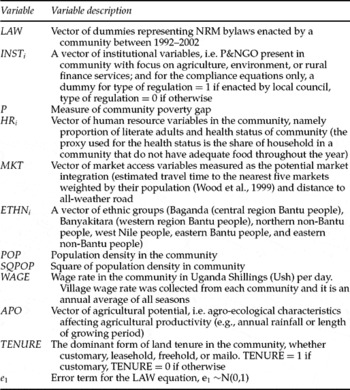
The variables used in this model are defined in table 1. Two variables, namely agricultural potential (APO) and land tenure (TENURE) need to be clarified further. The APO zones were grouped according to Ruecker et al., (Reference Ruecker, Park, Ssali and Pender2003), who classified Uganda into the following zones: high unimodal rainfall, medium unimodal rainfall, low unimodal rainfall, low bimodal rainfall, medium bimodal rainfall, and high bimodal rainfall. The APO dummies were strongly correlated with the ethnic groups. To address this concern, we grouped the APO zones into two categories: high agricultural potential (bimodal high, bimodal medium, and unimodal high rainfall) and low agricultural potential if the community is in the bimodal low, unimodal medium, and unimodal low rainfall.
Definition of variable used in the econometric models

The Uganda Land Act of 1998 recognizes four land tenure systems, namely leasehold, freehold, customary, and mailo. The customary land tenure system is governed by the customary institutions. The mailo tenure refers to land in central Uganda that was granted with freehold title to representatives of the Buganda king and other elite groups by the British colonial government.Footnote 6 There were only a few communities that reported having freehold and leasehold land tenure systems. Additionally, the mailo land tenure was highly correlated with the Baganda ethnic group. To address both problems, we grouped land tenure into only two groups: customary and non-customary tenure.
We analyzed the awareness of and compliance with only two legal instruments – no bush burning and the requirement to plant and protect trees – because these were the only regulations with a sufficiently large number of observations to warrant reliable statistical analysis. As noted earlier, level of awareness of regulations is likely to increase compliance with them. Hence, the error terms of the awareness and compliance equations are likely to have a non-zero covariance. To address the non-zero covariance of the two models, we use the maximum likelihood bivariate probit model (Greene, Reference Greene2003), which is specified as follows
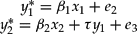
where y 1* is a latent variable representing awareness of the regulation (relating to bush burning or tree planting and protection); y 2* is a latent variable representing compliance with the regulation, y 1 =1 if y 1* > 0, y 2 =1 if y 2* > 0; xi = vectors of explanatory variables for the awareness and compliance equations, i = 1, 2; βi and τ are coefficients associated with xi and y 1, i = 1, 2;e 2 and e 3 are error terms for the awareness and compliance equations, which are assumed to be independently and identically distributed as bivariate normal (IIDN), i.e.

where ρ = cov(e 2, e 3).
Since awareness is likely to affect compliance, we include it as one of the arguments in the compliance equation. Since the bivariate model specified above is recursive, it addresses the endogeneity problem of the awareness regressor in the compliance equation (Greene, Reference Greene2003). We tested the statistical significance of the covariance of the error terms of the compliance and awareness equations and observed it was significantly different from zero (at p = 0.01) for the plant and protect tree equations, but not significantly different from zero (at p = 0.10) for the no bush burning equations.Footnote 7 This implies that estimating univariate probit models for the no bush burning equations is not affected significantly by the covariance of the error terms. Hence, we will report and compare results from the univariate and bivariate probit models for the bush burning equations.
The vectors of x 1 and x 2 include the following variables

The variables used are defined in table 1. To improve identification of the equations, we performed a Wald test using the full bivariate probit model for compliance and awareness to determine the variables that we could drop. The coefficients of the wage rate and human health were jointly not significantly different from zero at p = 0.10, and hence were dropped from the models.Footnote 8 We also dropped the following variables from the compliance equations after they were found to be jointly statistically insignificant using a Wald test with the full models: access to P&NGO (with either focus on agriculture and the environment or with focus on rural financial services), distance to all-weather roads, and the potential market integration of the community. These variables reflect access to information and services, and apparently influence compliance with regulations only via their impacts on awareness. Dropping these variables, although not strictly necessary for model identification because of the non-linear character of the bivariate probit model (Wilde, Reference Wilde2000), improved the identification of the model.
Results and discussion
Bylaws, ordinances and statutes affecting NRM
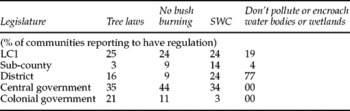
Using descriptive statistics results, this section reports the perceptions of community leaders of the NRM regulations that are in force in the community.Footnote 9 It is possible that national statutes and district ordinances may have been enacted that community leaders are not aware of; such laws (if they exist) would not be reported in our results. The most common NRM regulations perceived by communities in Uganda are regulations limiting tree cutting and requiring tree planting when trees are cut, prohibition of bush burning (commonly used to clear bush for agricultural production), requirements to invest in SWC measures on steeply sloping farmland, and prohibitions against polluting water bodies or encroaching upon and draining wetlands (table 2). Consistent with Ostrom (Reference Ostrom1999), prohibitions to cut trees, pollute and/or encroach water bodies, and to burn bush are more common in low agricultural potential areas.Footnote 10 However, the requirement to use SWC practices is more common in high agricultural potential areas, probably due to the severe soil erosion in the highlands. Prohibitions against bush burning are most commonly perceived to have been enacted by the central government, while restrictions against polluting water bodies or encroaching wetlands are most commonly enacted by the district government. Regulations related to tree protection and planting and SWC are perceived to have been enacted by different levels of government, including the LC1, sub-county, district, central government, and (especially in the case of tree regulations) the former colonial government.
NRM regulations and their relationships with legislature

Factors affecting enactment of local bylaws
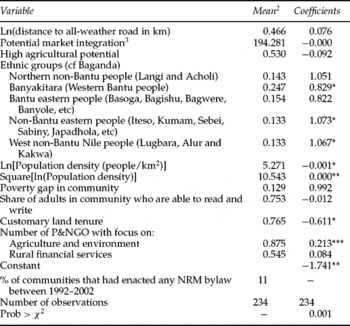
The factors that are significantly associated with enactment of NRM bylaws at community level are: major ethnic group in community, population density, land tenure, and presence of P&NGO with focus on agriculture and natural resources (table 3). Controlling for other factors, the non-Baganda ethnic groups are more likely to enact NRM bylaws than the Baganda. This is perhaps due to the socio-cultural homogeneity of these groups, an aspect that could enhance collective action (Agrawal and Gibson, Reference Agrawal and Gibson1999; Poteete and Ostrom, Reference Poteete and Ostrom2004).Footnote 11 However, socio-cultural heterogeneity has also been found to enhance collective action in some circumstances (e.g. Varughese and Ostrom, Reference Varughese and Ostrom2001; Olson, Reference Olson1965). It is also possible that the Baganda, who mainly grow perennial crops, do not need most of the common regulations such as those prohibiting bush burning and planting trees since the banana–coffee system predominant in the Buganda area is not compatible with bush-burning, which is a common practice in areas with predominantly annual crops. The Baganda also plant trees in their coffee–banana farms, not because there is a regulation requiring them to do so, but rather due to the robusta coffee–banana farming system. Shading is one of the ecological requirements of robusta coffee (Baggio et al., Reference Baggio, Caramori, Androcioli and Montoya1997). These aspects obviate the need to enact regulations for controlling bush burning and cutting trees.
Descriptive statistics and determinants of enactment of NRM bylaws by community1 (Probit regression)

Notes: *means p < 0.1; **means p < 0.05; ***means p < 0.01
1Bylaws enacted by the community local council (LC1) in 1992 or later.
2The unit for all categorical variables is proportion.
3Estimated travel time to the nearest five markets, weighted by their population (Wood et al., Reference Wood, Sebastian, Nachtergaele, Nielsen and Dai1999).
We observe a U-shaped relationship between probability to enact NRM bylaws and population density, which reaches a minimum at around 1,000 people per km.2 Since this is a very high population density that is not commonly observed in rural areas, in most cases the relationship between population density and enactment of NRM bylaws is negative, though non-linear.Footnote 12 These results contradict the hypothesis of an inverted U-shaped relationship between population pressure and collective action to manage natural resources, as found by Gebremedhin et al. (Reference Gebremedhin, Pender and Tesfaye2004) in northern Ethiopia, and Pender and Scherr (Reference Pender, Scherr, Meinzen-Dick, Knox, Place and Swallow2002) in Honduras. However, similar observations to ours are reported by Ostrom (Reference Ostrom1999), who observed that group size is likely to increase transaction costs of collective action.
Land tenure has a significant impact on the probability to enact NRM bylaws. Communities that have predominantly customary land tenure are less likely to enact NRM bylaws than those holding land under other tenure systems. This is likely due to the presence of customary laws on NRM that serve the same purpose as the LC1 NRM bylaws, such that there is no need to pass additional bylaws. For example, parents are required by customary laws and norms to conserve their land in such a way that it would be productive when they bequeath it to their children. As discussed earlier, customary institutions also prohibit community members from polluting or degrading wetlands and forests. The Buganda king also requires his subjects to have a matooke (plantain banana) plot to ensure they have enough food for their families and to have trenches on steep slopes.
The presence of P&NGO focusing on agriculture and NRM increases the probability of enacting NRM bylaws, as expected. This suggests that the advocacy for enacting NRM bylaws done by P&NGO operating in communities is effective in promoting enactment of such bylaws. The results also support Ostrom (Reference Ostrom1990), who noted that social capital embodied in P&NGO enhances effective community resource management.
Determinants of awareness of NRM regulations
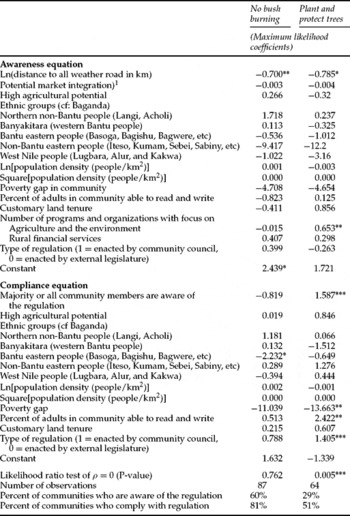
The major factors associated with awareness of NRM regulations are distance to an all-weather road, ethnicity and presence of P&NGO (table 4). Distance to all weather roads has a negative association with the level of awareness of no bush-burning and tree planting and protection regulations. The results of the impact of access to roads for the no bush burning equations were robust since they were significant for both the univariate and bivariate probit models (tables 4 and 5). The results suggest that road development facilitates access to information.
Determinants of awareness of and compliance with NRM regulations (Bivariate probit model)

Notes: 1*means p < 0.1; **means p < 0.05; ***means p < 0.01
2Awareness =1 if majority or all are aware; awareness = 0 otherwise
3Compliance = 1 if majority or all comply; compliance = 0 otherwise
4Estimated travel time to the nearest five markets, weighted by their population (Wood et al., Reference Wood, Sebastian, Nachtergaele, Nielsen and Dai1999).
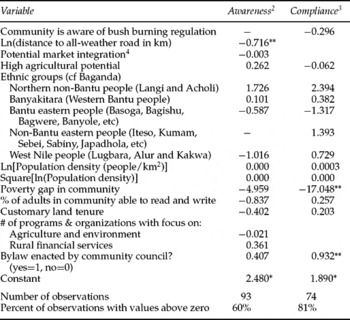
Determinants of awareness and compliance with bush burning regulation (Probit)1

Notes 1*means p < 0.1; **means p < 0.05; ***means p < 0.01
2Awareness =1 if majority or all are aware; awareness = 0 otherwise
3Compliance = 1 if majority or all comply; compliance = 0 otherwise
4Estimated travel time to the nearest five markets, weighted by their population (Wood et al., Reference Wood, Sebastian, Nachtergaele, Nielsen and Dai1999).
As expected, the number of P&NGO with focus on agriculture and the environment is positively associated with more awareness of regulations to plant and protect trees. This shows that these P&NGO participate in both facilitating enactment and awareness creation of the NRM regulations. Most explanatory variables of the awareness equations are not significant. This is especially true for the no bush burning equations for both the univariate and bivariate probit models. This suggests the need to conduct follow up studies to identify better factors that determine awareness of NRM regulations.
Determinants of compliance with NRM regulations
As expected, awareness increases significantly the probability to comply with tree planting and protection regulations (table 4). However, awareness does not have a significant impact on compliance with the no bush burning regulation for both the univariate and bivariate probit models (tables 4 and 5). This may be due to the limited variability of the awareness variable in northern Uganda, where bush burning is most common. About 87 per cent of communities in northern Uganda reported being aware of the bush burning regulation. These results underline the importance of environmental education that the National Environmental Management Authority (NEMA) and NGO's are promoting in Uganda. The eastern Bantu communities are less likely to comply with no bush burning prohibitions than the Baganda (table 4). This could be due to the predominantly perennial cropping system of the Baganda that is not compatible with the bush-burning practice.
Depth of poverty is associated with lower probability to comply with tree planting and protection regulations. Similar results are reported from the univariate probit regression for the no bush burning regulation (table 5). The result supports the view that there is a poverty – natural resource degradation trap, which raises concerns about greater resource degradation in poor areas. Interestingly, although poverty measures do not significantly affect awareness of NRM regulations, they do affect compliance. This indicates that the effects of poverty on lack of compliance are not because poor people are not aware of NRM regulations or problems, but because they face constraints that limit their ability to comply.
Literacy is significantly positively associated with compliance with tree planting and protection regulation. This suggests that well-educated communities are likely to understand better the benefits of conserving trees, or perhaps are more able to plant trees or have less need to cut them, due to other sources of income.
Compliance with regulations is also affected by the level of government that enacted the regulation. The probability to comply with tree planting and protection regulation is significantly higher if the regulation was enacted by the LC1 than if enacted by legislative bodies outside the community. Similar results were observed from the univariate probit model for the no bush burning regulation. These results support the arguments of Ostrom (Reference Ostrom1990) and Okubal and Makumbi (Reference Okubal and Makumbi2000) who observed that legitimacy and ownership of legal instruments increases their compliance.
Conclusions and policy implications
Our research shows that programs and organizations that focus on agriculture and the environment increase the probability to enact regulations and increase awareness of such instruments at the community level. The results suggest the need to design workable policies and strategies to make P&NGO more effective and sustainable in providing the critically limiting Natural Resource Management (NRM) institutions and building the limited skilled human capacity in rural areas of Uganda (Banana et al., Reference Banana, Gombya-Sembajjwe and Bahatí2001; Lind and Cappon, Reference Lind and Cappon2001; Onyach-Olaa, Reference Onyach-Olaa2003) and Africa in general. For example, it is important to create incentives for NGOs to operate in remote areas, where they are less present (Jagger and Pender, Reference Jagger and Pender2003). Most NGOs are also funded by international donors and tend to operate as short-term projects. This raises the need to create stronger locally owned and funded NGOs to build a sustainable local institutional capacity. This is especially important given the current privatization of advisory services in Uganda, which is facing lack of local service providers in remote areas.
We observe a higher probability to comply with NRM regulations when these instruments are enacted by the community council than when they are enacted by external legislative bodies. These results imply the importance of empowering communities to enact bylaws as stipulated in the Local Government Act of 1997. However, the need to increase the skilled human resource to manage natural resources in rural areas remains one of the daunting challenges of local governments in Uganda and Africa in general. Additionally, enforcement of regulations in Uganda and other countries in the region is done by local councilors who are elected officials. Hence, the local councilors may be unwilling to enforce regulations that may offend the electorate, as this could lead to losing votes if they seek re-election. The same problem affects statutory regulations, which are also enforced by local councilors. This suggests the need to explore alternative methods that do not require elected officials to enforce NRM regulations.
Our results show that compliance with tree planting and protection regulations increases as the level of awareness about them increases. This suggests that one of the major causes of low compliance with some of the regulations is lack of awareness, rather than defiance. These results therefore support the strong emphasis that NEMA puts on environmental law education. Awareness of no bush burning and tree planting and protection regulations is also greater in areas closer to all-weather roads, perhaps due to better access to information in such areas. This underscores the importance of developing roads and markets to increase access to information.
Empirical evidence from this research suggests that promoting literacy could increase compliance with NRM regulations. This suggests that continued investment in education could contribute to more sustainable NRM, as well as helping to reduce poverty in Uganda (Appleton, Reference Appleton2001) and Africa in general (Schultz, Reference Schultz1999).
The customary land tenure system decreases the likelihood of enacting NRM bylaws as compared to other tenure systems. This may be due to the existence of customary norms that promote improved NRM, making formal bylaws less necessary. Our study did not collect enough customary institution data to verify this. This implies the need to study more comprehensively the customary institutions that affect NRM, to better understand how they could be used to strengthen the enactment, enforcement, and compliance with local and central government legal instruments. There is also need to examine the implications of the 1998 Land Act and other legal instruments on customary institutions. For example, even though the 1998 Land Act recognizes the customary land tenure system, it does not explicitly recognize the customary laws, probably because they are not documented systematically and comprehensively. The constitution also requires that for any law to be legal and effective, it must be written. This invalidates customary laws since most of them are not written and are orally passed from one generation to another.
Our results suggest that income poverty decreases compliance with tree planting and protection and no bush burning regulations. Lack of education, which is another indicator of poverty, is also associated with less compliance with tree planting and protection regulations. Our results therefore give credence to the natural resource degradation – poverty trap and imply that efforts to reduce poverty could also help to improve NRM. However, we caution that different indicators of poverty might have different impact on NRM, hence our results should be interpreted based on the poverty indicators that we analyzed in this paper.