I believe we can do both. We are a country which was built by pioneers who had a rifle in one hand and an ax in the other. We are a nation with the highest GNP, the highest wages, and the most people at work. We can do both. And as long as I am president, we will do both.
Lyndon B. Johnson, the State of the Union Address of 1966Too much that is now spent on defense not only adds nothing to our strength but makes us less secure by stimulating other countries to respond.
The Democratic Party platform of 1972Bipartisanship has been vital for the making of national security policy in America. In the early post-World War II period, both parties reached consensus on “Cold War internationalism.”Footnote 1 Congressional members agreed to support containment policy against the communist countries and to pursue engagement policy towards new democracies. Indeed, the American security policymaking process came to be portrayed as the politics that stopped at the water's edge. Achieving bipartisan consensus on national security often means that political parties need to adapt to new policy choices. In the midst of creating the so-called “Cold War consensus,” Republicans discarded their traditional isolationism. Democrats also abandoned their long-established antistatism.Footnote 2 Only after both parties shifted their previous policy stance were they able to endorse the idea of Congressional deference. That is, members of Congress would delegate powers and defer to the executive branch and the nation's senior military leadership for the matter of national security.
The Vietnam War and the antiwar movements, however, brought this Cold War consensus to an end.Footnote 3 During the Cold War period, a majority of lawmakers in Congress endorsed a policy position of guns and butter as attainable together. In particular, President Lyndon B. Johnson and Congressional Democrats waged two-front wars, one against Vietnam and the other against poverty at home.Footnote 4 In the aftermath of the Vietnam War, liberal Democrats faithful to the “Great Society” programs came to discern a trade-off between defense expenditures and welfare spending. The lengthy and disastrous war in Southeast Asia led a significant number of legislators to abandon their pro-defense positions. As a result, liberal members of Congress since the early 1970s have essentially come to support the increase in welfare spending, potentially at the expense of defense budget.
With the American public and their representatives increasingly hostile to the Vietnam War, the Anti-ballistic Missile (ABM) appropriation bills became a major source of national controversy. The ABM debate in Congress was described as “the only occasion since the World War II on which a substantial part of the public and their representatives in Congress questioned the wisdom of the Defense Department on a major weapons issue.”Footnote 5 Bernstein and Anthony claimed that “the ABM issue caused more extensive debate in the Senate than did any other national security issue since 1945.”Footnote 6 Indeed, many political scientists and historians have explored how Congressional members addressed this symbolic ABM controversy.Footnote 7 Mayhew has identified the ABM vote as a rare “showdown vote” in the Senate where single roll calls achieved a high salience among the public generally. Jeffers has provided for detailed reports about the ABM debates in the Senate from President Nixon's announcement of his Safeguard ABM proposal through the 51–49 defeat of the Cooper-Hart amendment to ban ABM deployment on 6 August 1969. Frye has pointed out that Congress took a major step toward a revitalized role in national security policymaking. Johnson has focussed on Senator Stuart Symington, a Democratic Senator from Missouri and explained how the pro-defense senator switched his position and became a leading opponent of the ABM systems.Footnote 8
This article focusses on the House of Representatives and its members. In postwar politics, House members have been reported to be more hawkish than senators and more willing than senators to support the President's foreign-policy and defense-spending initiatives. The House members are allegedly more partisan and more vulnerable to constituency pressures than senators. My analysis of House members' legislative choices reveals that there was no drastic ideological shift among incumbent members of Congress over the issue of national security. Instead, the blend of constituency cleavages and procedural incentives allowed northern Democrats to break with their party. I argue that greater antiwar sentiments among voters, combined with procedural reforms in Congress, facilitated the members' position changes. The party leadership was still indecisive and southern Democrats continued to dominate the party's defense and military positions. When the politics of military spending opened a window of opportunity for liberal reform agendas on the House floor, liberal Democrats strategically defected from their party's position on defense spending in the post-Vietnam War period.
The ABM debates constitute a good testing ground for the study of legislator vote-switching, party position shifts, and policy change in Congress. This article proceeds as follows. Section I provides a historical overview of Congressional debates over defense spending in the post-World War II era. Section II examines the ABM controversy in Congress, with a focus on members' position-taking strategies and coalition-building efforts. Then, I suggest explanations for legislator position changes and present a series of hypotheses addressing constituency, ideology, and party dimensions. In the next two sections, I show the results of empirical tests and conclude the article by calling for more attention to intraparty and procedural politics in order to better understand legislators' national security decision-making in Congress.
I. THE PARTY POLITICS OF DEFENSE SPENDING IN POSTWAR AMERICA
Partisan politics have long been at the heart of national security debates in America. During the Franklin Roosevelt administration, the rural–urban divide in the Northeast affected the reshaping of partisan coalitions over American foreign and military policy.Footnote 9 As the urban Northeast gradually elected a greater number of Democrats to Congress, FDR successfully crafted a North–South coalition on free trade and neutrality issues. By the time France was defeated by Nazi Germany in May 1940, partisan cleavage over defense expenditures had almost disappeared. Almost all Democrats, including southern members, came to support strongly their President's initiatives on defense spending. The Republican Party also generally followed the direction of the Democratic President.
After World War II ended, partisan politics once again engaged in the debate over the nation's postwar policy direction and adjustment.Footnote 10 On one side were those who envisioned the United States as a great military and economic power and the champion of democracy against the Soviet Union. In the other camp were those who invoked an older political culture that was isolationist, antistatist, and antimilitarist.Footnote 11 Conservative Republicans such as Senator Robert Taft of Ohio entered postwar politics during the Republican-dominated 80th Congress in 1947 determined to dismantle the New Deal and avoid the possible nightmare of a “garrison state.”Footnote 12 The main Republican voice on foreign policy, however, was Senator Arthur Vandenberg of Michigan, who turned around his earlier isolationist position to support of the internationalism of FDR and Truman. Senator Vandenberg demonstrated significant Republican support for Truman's foreign policy of Soviet containment by helping to approve the Marshall Plan through a skeptical Congress.Footnote 13 Also, with the internationalist Dwight Eisenhower grasping the presidential nomination backed by New York governor Thomas Dewey in 1952 and defeating the isolationist Robert Taft, a decade-and-a-half-long pattern of eastern Republicans thwarting the party's Mid-western base continued over the foreign policy area.Footnote 14
With respect to the level of defense spending, Friedberg finds it remarkable how small American defense budgets were during the first fifteen years of the Cold War.Footnote 15 Friedberg noticed how quickly the forces opposing higher military expenditures had reasserted themselves after the Korean War. During the early Cold War, fiscal constraints, such as downward political pressure on taxation and a balanced budget, were the single most important factor pushing the United States toward a strategy of minimum deterrence and massive atomic capability without relying on conventional military forces. The relative unity of the Democratic Party and bipartisanship over Cold War internationalism had persisted through the Kennedy military buildup and Johnson's two-front war against Vietnam and poverty.Footnote 16 Democrats were largely confident in both guns and butter in the course of the early Cold War. The 1968 election of Nixon as a conservative Republican President, however, severely damaged Democratic Party cohesion over the choice between defense expenditures (guns) and welfare spending (butter).
As Rae correctly notices,Footnote 17 public perception of the Republicans as tough on foreign policy allowed Republican Presidents to be far more flexible and innovative in international affairs than Democratic Presidents during the Cold War. This paradox is well expressed in the observation that “only Nixon can go to China.” In addition, despite his own détente policy towards China and the Soviet Union, Nixon constantly proposed more defense spending than Congress wanted to approve. To some extent, Nixon's avoidance of defense spending cuts was an electoral strategy designed to court the votes of southern whites.Footnote 18 In the end, during the 91st Congress (1969–70), the Republican Party and the Democratic Party once again reshaped their positions on the level of military spending and the direction of American foreign policy.Footnote 19 As Coleman correctly notes,Footnote 20 defense appropriation was the policy issue over which Democrats were most intensely split and divided during the 1970s.
II. MEMBERS OF US CONGRESS AND POLICY CHANGE THROUGH POSITION-TAKING
Addressing the challenging task of staking out a new policy position, the party leadership often faces difficulties in persuading some of its rank-and-file members. Rank-and-file party members often represent diverse constituency preferences or personal ideologies within the “umbrella-like” political parties in America. In addition, party competition at the national level does not automatically guarantee position conversion on the part of rank-and-file members. Party members tend to place more emphasis on their own political benefits than on the credibility of party position. Ultimately, it is rank-and-file members who collectively create and change party positions through legislative processes. Credible voting records that are largely in accordance with constituency preferences are vital for members of Congress as “single-minded seekers of re-election.”Footnote 21 Consequently, legislators as party members weigh in electoral benefits from their party positions and their own voting records. A party's policy stance is a form of a “collective” position. A legislator's voting record is a “personal” position. Both positions are critical for the party's rank-and-file members.Footnote 22
It was Mayhew, in his seminal work on legislator behavior, who described members of Congress in America as “single-minded-seekers-of-reelection.”Footnote 23 He offers detailed accounts of three specific activities in which lawmakers engage for the pursuit of their reelection goals: advertising, credit-claiming, and position-taking. According to Mayhew, position-taking is “the public enunciation of a judgmental statement on anything likely to be of interest to political actors … and the statement may take the form of a roll call vote.”Footnote 24 Snyder and Ting also suggest that position-taking strategies include “introducing and cosponsoring bills, making speeches, and building roll call records that are in tune with their constituents.”Footnote 25 They argue that an endogenous preference for position-taking emerges with citizens and legislators both preferring “open” proceedings.
Based on the congressional literature, I assume roll-call voting decisions to be one of the major position-taking activities of legislators. What is also worth noting is the fact that members of Congress engage in position-taking activities regardless of whether they bring about the policy outcomes as they prefer. In other words, prior to final passage voting, party members often take positions that do not necessarily concur with those of their party. Mayhew also clearly points out that “in a large class of legislative undertakings, the electoral payment is for positions rather than effort.”Footnote 26 I argue that Congressional members tend to show their party-splitting positions, if necessary, in legislative processes, particularly when the final outcome of a bill at stake is highly predictable.
The formation of intraparty coalitions is another bottom-up strategy employed by rank-and-file party members over party position change. In the majority party, where diverse coalitions inherently exist, party members tend to form groups beyond their committee membership. Similar constituency preferences, such as sectional interests or district ideology, tend to lead legislators to build and join an intraparty caucus.Footnote 27 Making their collective cases inside and outside the party, the intraparty group members often make their voting decisions together, especially over policy issues which may heavily impact their own reelections. Indeed, intraparty group members across the committees often prevail over committees' gate-keeping power. Thus they effectively push for specific policy interests shared by cross-pressured members.
According to Rae, “American party factions have proven to be elusive, and thus resistant to analysis.”Footnote 28 The loose and decentralized nature of American parties has prevented party factions from developing the organizational skills, discipline, and durability found among party factions in other Western democracies.Footnote 29 At the same time, it is hard to deny that factional configuration within the parties has constantly influenced the strategic calculations of party leaders in executing their legislative and electoral strategies.Footnote 30 In essence, I claim that ideological, regional, and distributive politics surrounding foreign-policy issues also interact with party factions.Footnote 31 In addition, along with individual legislators' ideological changes from Congress to Congress, the rise and fall of party factions might also account for partisan polarization in the legislature.Footnote 32 Legislators often get their voting cues from the same faction members as well as from the same party members.
III. THE ANTI-BALLISTIC MISSILE DEBATES IN THE HOUSE, 1969–1970
In 1969, the costly Anti-ballistic Missile (ABM) system, combined with the disastrous policies of the Vietnam War, fueled public and Congressional concerns about the nation's defense-policy directions. In its special reports on defense spending, the Congressional Quarterly Almanac states that “The defense debate of 1969 was a major departure from past congressional clashes over military policy.”Footnote 33 Voters and their representatives raised questions about whether it was still viable to sustain both New Deal welfare spending and a high-cost defense budget.Footnote 34 The Vietnam War and stagflation, from the late 1960s through the 1970s, made them suspect that guns and butter might no longer be compatible. Diplomatic historian Walter LaFeber summarizes that the Johnson Administration gambled that American society could endure a vast array of domestic reforms, while fighting an extended war against an untiring enemy,Footnote 35 but Johnson ultimately lost the “life-or-death bet.” Congressional debates on the ABM system were at the heart of the controversy over how to redefine national security policies in the post-Vietnam and the post-New Deal era at the same time.
In the 91st Congress (1969–70), when liberal Democrats had a Republican President in the White House, the ABM debates set a new stage for substantial vote-switching by Congressional members. After a bitter three-day debate, on 3 October 1969, the House passed a $21.3 billion authorization bill for military hardware and research, having repeatedly rejected attempts to cut up the bill.Footnote 36 A final but controversial action on the bill and the ABM system was a recommittal motion proposed by Representative O'Konski (R – WI), which would have deleted funds for both procurement and research on ABM. The motion to recommit the bill to committee intended to delete $345.5 million for procurement and $400.9 million for research for the Safeguard ABM system. Opponents of ABM claimed that O'Konski's motion to cut research funds did not properly represent the position of any opponent. Even Republican leader Gerald Ford virtually admitted that the intention behind the motion to recommit was to ensure a substantial vote in favor of the President's ABM program.
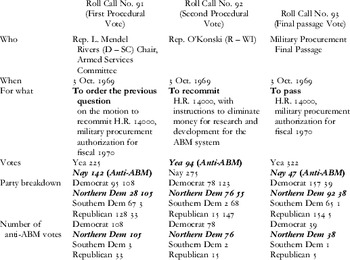
Liberal Democrats unsuccessfully tried to block a vote on the recommittal motion, when the House (on a 225–142 roll call) voted for a motion by L. Mendel Rivers. Representative Rivers, a South Carolina Democrat chairing the Armed Services Committee, ordered the previous question on the motion to recommit and thereby tried to cut off debates. Indeed, this vote was one of the fifteen key votes used by the Americans for Democratic Action (ADA) to measure member ideology and voting records. ADA suggests that voting against the Rivers motion had the effect of a 10 percent cut in the military procurement legislation.Footnote 37 The ABM bill was finally passed by a huge majority (322 yeas versus 47 nays). Table 1 shows the breakdown of three roll call votes over the ABM system on 3 October 1969.
Intermediate votes versus final passage over the ABM controversy, 3 October 1969, 91st Congress

Note: Three consecutive roll call votes on the same day over ABM positions: RC #92 (strongly anti-ABM), RC #91 (fairly anti-ABM), RC #93 (pro-ABM).
Constituency-pressure explanation
Several factors explain how and why the controversial ABM appropriation bill was passed by Congress, with the American public increasingly hostile to a blank-check granted for the military budget. First of all, Congressional scholars have long confirmed that constituency pressures affect members' voting decisions.Footnote 38 To measure constituents' preferences on the ABM spending bills, I use 1968 presidential election results that provide a direct and orderly picture of constituents' political preferences. District-level presidential vote share indicates the partisan and ideological predispositions of each Congressional district; from very conservative (votes for Wallace) to conservative (votes for Nixon) to liberal (votes for Humphrey). Liberal constituents, measured by larger votes cast for Humphrey, are hypothesized to oppose the Vietnam War and the increase in defense spending for the ABM system. As a result, liberal districts are more likely to push their representatives to vote against the ABM appropriations bills than are conservative constituents.
Although constituency pressures are critical for members' voting decisions, those pressures might be not the same if members face different level of electoral competitiveness. Electoral security might provide legislators with some degree of independence in translating voter preferences into legislative choices. One of the recurring subjects in Congressional studies is the “marginality hypothesis” by which Fiorina earlier meant that “legislators elected by narrow margins pay closer attention to constituency interests than colleagues with plenty of votes to spare.”Footnote 39 I employ a member's most recent victory margin to measure how secure or vulnerable a legislator is to constituency pressure during the ABM debates in Congress. If a member of the House from a liberal district has narrowly defeated his challenger in the 1968 Congressional election, the legislator is assumed to say nay to ABM.
Also, district economic interests are tested as determinants for members' voting decisions over ABM. Members of Congress often take positions to explain their votes back in their districts. Most studies on Congressional voting behavior in defense spending found little effect from districts' economic benefits from weapons systems.Footnote 40 Scholars have tried but failed to see the linkage between parochial interests benefiting districts or states and members of Congress or senators voting for defense-spending bills. I argue, on the contrary, that given the trade-off between guns and butter, constituency pressures based on economic benefits of the defense programs should be measured not only by members' pro-defense votes but also by anti-defense votes. Economic disadvantages under a limited budget size often would move members to vote against defense-spending programs, a factor which has frequently been overlooked in the analysis of Congressional voting behavior over defense spending.Footnote 41
Party explanation
Partisan affiliation has been also introduced as a critical vote determinant for Congressional members on foreign-policy agendas.Footnote 42 Members are often faced with different party positions in Congress, such as being members of the presidential party or the out-party, or being members of a majority party or a minority party. Different partisan affiliation might lead members to understand differently the policy implications of similar votes over foreign policies. Presidential party members, for instance, tend to vote for presidential positions on national security and foreign policies.Footnote 43 Majority-party members in a divided government, on the other other hand, often position themselves against the President's foreign policies.Footnote 44 In fact, prior to the 91st Congress, Democrats with a President in the White House were largely united on the issue of Vietnam War and guns-and-butter choices. The main force of the bipartisan coalition until the Vietnam War was a coalition between Democrats and eastern Republicans in support of an active and internationalist strategy toward free trade and a collective security system. When Nixon's first Congress convened in 1969, however, the political context changed dramatically. The Republican Party, having been consistently anticommunist, had its President controlling American foreign policies and had its members highly united on a conservative agenda in Congress.
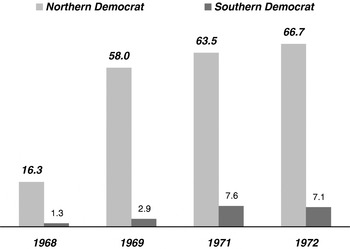
As for the Democratic side, northern Democrats began to defect from their original positions of support for defense spending during the Cold War consensus. Liberal members from the northern areas tried to use the defense spending issue not only to score political points with their constituents, but also to promote their positions and liberal ideas within the Democratic Party, which was still dominated by southern Democrats. As Rohde has pointed out, liberal Democrats believed that institutional arrangements largely based on the seniority system were unfairly biased against their policy preferences.Footnote 45 In addition, by the end of the Johnson administration, issues not only of domestic policy, but also of foreign and defense policy, became the locus of intraparty conflict. Figure 1 show how northern Democrats became increasingly hostile to ABM appropriations in Congress, while southern Democrats remained largely united and stable in supporting the ABM system.
Percentage of anti-ABM votes by northern versus southern Democrats.

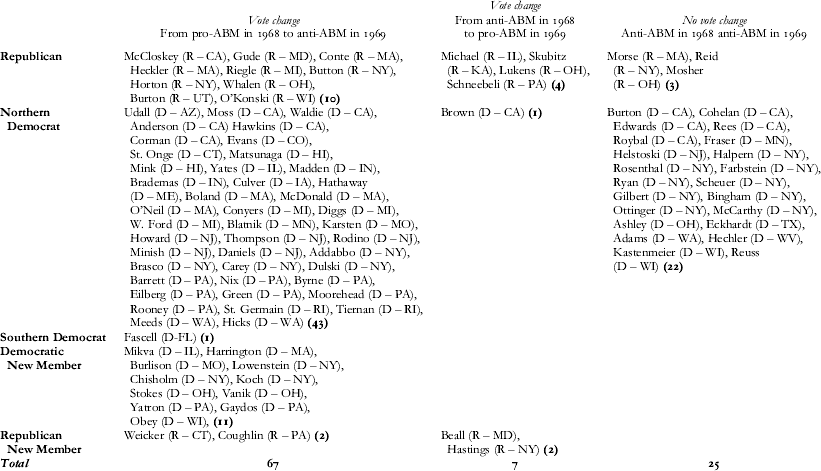
I also identify and incorporate into the model the membership list of the Democratic Study Group (DSG), a liberal caucus within the Democratic Party, which promoted liberal agendas.Footnote 46 As for the Republicans as minority-party members in Congress, partisan strategies to build favorable positions that appeal to swing voters in national elections are hypothesized to affect members' policy positions. In his analysis of regulatory policy decisions in Congress, James points out that “to retain the presidency as a much-desired party resource, rank-and-file party members repeatedly fell in line behind choices that repudiated their own strongly held policy preferences.”Footnote 47 I examine whether this logic is applied to rank-and-file members of the Republican Party when they vote on the ABM spending bills, for which President Nixon had announced his support two months after his inauguration. Table 2 identifies who switched their voting decisions over a one-year period from 1968 to 1969.
Vote change over the ABM program: 1968 (LBJ) versus 1969 (Nixon)
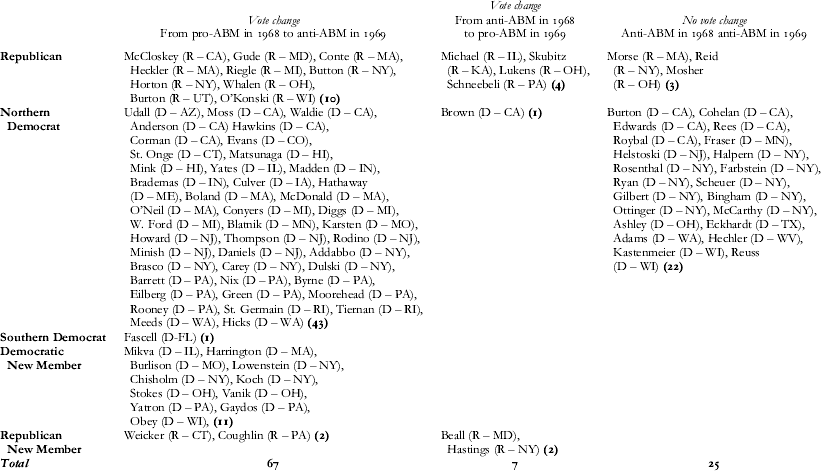
Source: Congressional Quarterly Almanac, 1968, 1969.
IV. FINDINGS
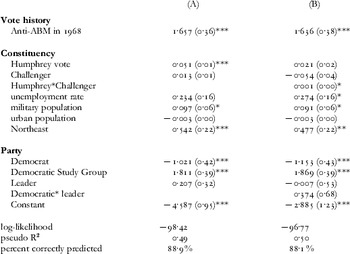
Table 3 reports the results of empirical analysis. Since the dependent variable is dichotomous (yea or nay vote by members of Congress), I used the probit regression analysis of members' roll call votes. The first model includes all the explanatory variables except for the interactive terms, with the interactive terms added into the second model. Indeed, the independent variables could be categorized into three groups of explanations: members' voting history, constituency pressures, and party influences. The second model, with interactive terms, is designed to show the distinct roles of competitive and liberal districts and Democratic leaders in inducing members to vote against the ABM appropriation bills.
Probit analysis of continuing members' position-taking: Voting anti-ABM in 1969, 91st Congress (1st Session)

N=377.
*** significant at 0·01; ** significant at 0·05; * significant at 0·1. Dependent variable is the legislator's position on the ABM system in 1969 (1=oppose, 0=otherwise).
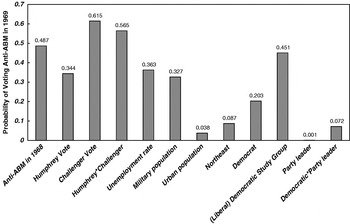
Overall, the roll call voting analysis performs well and confirms the literature on voting stability by members of Congress. Table 3 clearly shows that vote history in time t minus 1 (1968) heavily influences members' vote decisions in time t (1969). All models present that members' vote choice in 1968 significantly led them to cast votes the same way in 1969. If a member was supportive of the ABM system in 1968, he was likely to endorse ABM appropriation bills in 1969. When a member critical of defense spending voted against the weapons system in 1968, he was more likely to oppose ABM spending in 1969. The probability of a member standing by his or her initial position in 1969 increases by almost 49 percent. Congressional members rarely change their positions.
Although members of Congress show a great degree of voting stability, the 91st Congress under Nixon's first year in office introduced new voting contexts to many lawmakers. If representing a liberal and competitive district, representatives are more inclined to become opposed to ABM spending in 1969. Under pressure from their liberal constituents, legislators began to address their vote on defense budgets differently. With respect to the question of defense spending versus the welfare budget, I inserted the unemployment rates in Congressional districts to gauge their representatives' response to the trade-off between guns and butter. What is noticeable is that Congressional members from districts with high unemployment rates were more likely to vote against ABM spending, all other things being equal. This finding is critical, because until the Vietnam War debacle, Democratic Presidents including FDR, Truman, Kennedy, and LBJ tried to convince the public that American can do both defense buildup and welfare spending. In the wake of the unpopular war in Southeast Asia, some Democrats in the national legislature came to discard the traditional view of both guns and butter being attainable and began to call for Great Society programs at the expense of defense-spending cuts.
Figure 2 shows the substantive significance of explanatory variables analyzed in the probit regression. The numbers reflect the percentage change in the predicted probability of voting against the ABM spending bills when a relevant independent variable moves from minimum to maximum values, while holding all other variables at baseline values (continuous variables are held at mean values and dichotomous variables are held at zero). The results confirm the significance of unemployment rates in explaining members' position-taking on the ABM issue. More specifically, when unemployment rates in districts change from 0.55 percent (minimum) to 6.07 percent (maximum), the probability of a member voting against ABM spending increases by 36 percent. Also interesting in constituency effects is the districts' military population and its impact on members' voting on ABM. The coefficients of military population variable in the models are positive, indicating that the greater the military population within a district, the more likely a member is to vote against ABM. Although the military population factor does not survive in a model with the ideology variable included, the negative effect of military population on member vote choice on the ABM bill is statistically significant in the second model. A temporary verdict is that the number of military personnel and employees in Congressional districts does not necessarily secure a hawkish position toward one of the most expensive weapons systems in US history.
The substantive significance of the explanatory variables: Probability of voting anti-ABM by party members.

Finally, the results substantiate the evidence of cross-pressured members and their vote change. While a majority of Democrats were still supportive of defense spending in the 91st Congress, members from the Northeast or from the liberal Democratic Study Group voted significantly differently from their colleagues from the South. In all models tested, signs of Northeast coefficients are positive, which indicates that members from northeastern areas are more likely to oppose ABM than non-northeastern members in Congress. Thus the outcomes verify the importance of members' geographical representation in casting their votes over the ABM controversy. There is only an 8 percent increase in the probability for a vote against ABM in 1969, when a non-northeastern member (minimum value) is compared to a northeastern legislator (maximum value). In addition, an almost 30 percent probability jump is found for vote change into anti-ABM in 1969, when the legislator is a member of the Democratic Study Group.
V. DISCUSSION
In the US House of Representatives, where members of Congress face elections every two years, the stake of getting votes right is high. Making a bill into legislation often takes a long time and goes through complex negotiation processes in Congress.Footnote 48 At the same time, House members often need short-term evidence that they are in tune with the constituents, not “out of step” with district interests.Footnote 49 The bottom line is that legislators consider not only substantive policy changes but also symbolic position-taking in legislative processes. In essence, Johnson suggests that only by “recognizing the importance of procedural initiatives that superficially seemed devoid of policy content can we appreciate the myriad ways in which the legislature affected the conduct of the Cold War.”Footnote 50
The empirical findings of this article illustrate that cross-pressured members of the Democratic Party sided with their constituency and voted against ABM in legislative processes. This article has taken on the contentious issue of defense spending symbolized by the ABM controversy. The ABM debates in Congress highlight the need for a better understanding of partisan infighting and members' position-taking strategies to paint a complete picture of policy change in Congress. In other words, voting positions on final passage vote do not necessarily and completely reflect representatives' true preferences. In the long term, position-taking strategies could end up functioning as signals for a new party position change. Also, average party support levels indicate where parties collectively stand on policy issues, but do not always reveal whether individual members have maintained or changed their voting choices.
Obviously, the short-term impact of position-taking by those members was not substantial enough to repeal the ABM system. The anti-ABM movement did not instantly make House members defy the defense committees on other nuclear weapons programs.Footnote 51 But the long-term effect of vote-switching by a group of lawmakers was quite significant. Conversion of northern Democrats to a “guns-versus-butter” position during the 91st Congress ushered in the breakdown of the Cold War consensus that had been built on the premise of a large defense budget. Trubowitz confirms that “the domestic bases of Cold War internationalism changed in the late 1960s and early 1970s” and “with respect to the realignment, the pivotal House appears to be the 91st (1969–1970).”Footnote 52 Johnson also noted that the Congressional battle against the anti-ballistic missile program was the “first full-fledged congressional challenge to a Pentagon weapons system.”Footnote 53
Focussing on the Democratic Study Group (DSG), Stevens, Miller, and Mann essentially pointed out that during the 91st Congress, a “startling reversal of trends” occurred among DSG members to dissent from presidential dominance of foreign policies.Footnote 54 Coleman and others noted that Congressional Democrats became most intensely divided over the level and location of military spending in the post-Vietnam Congress.Footnote 55 With liberal northern Democrats pitted against conservative southern Democrats, national security and military spending became a wedge issue among the Democratic members of Congress.Footnote 56 Liberal Democrats viewed a vote against defense spending as a vote against southern conservative senior members within the party. Only the Reagan military buildup in the 1980s led southern Democrats to ultimately stand together with their northern colleagues in opposing the Republican President's “Star Wars” against the “Evil Empire.” Even in the recent elections of 2002 and 2004, the Republican Party effectively played the “national security card” to damage the reputation of the Democratic Party. Democrats still struggle to shed the party's image as “soft and divided on national security.”
My analysis of vote changes over the ABM debates confirms that northern Democrats and members of the liberal Democratic Study Group were the main forces who changed their positions. They tried to reverse the decision of national security policy. For sure, vote-switching by liberal northern Democrats was far short of the voting counts needed to affect the substance of policy changes. What should be noted, however, is that while “guns-versus-butter” Democrats scored political points in the short term, they also paved the way for a party position change in the long run. Party position change and reputation shift take some time and do not happen overnight.
More specifically, since the 1970s, the Democratic Party has experienced political realignment, seeing northern and southern members become similar in their policy preferences.Footnote 57 The increasing dominance of northerners and the concomitant decline of southern conservatives within the Democratic caucus during the 1980s eventually united Democrats in their opposition to a huge defense budget, known as the Reagan military buildup. Although it is still controversial when the contemporary party polarization in American politics began to unfold, divergence between Republicans and Democrats surely came in to existence during the Reagan era. Only after the northern liberal Democrats grasped political clout and became dominant forces within the party did party polarization over foreign policy start to fire up. In America, rank-and-file members' position-taking strategies and intraparty group activities brought about party position shifts over national security policy in the period after the Vietnam War.