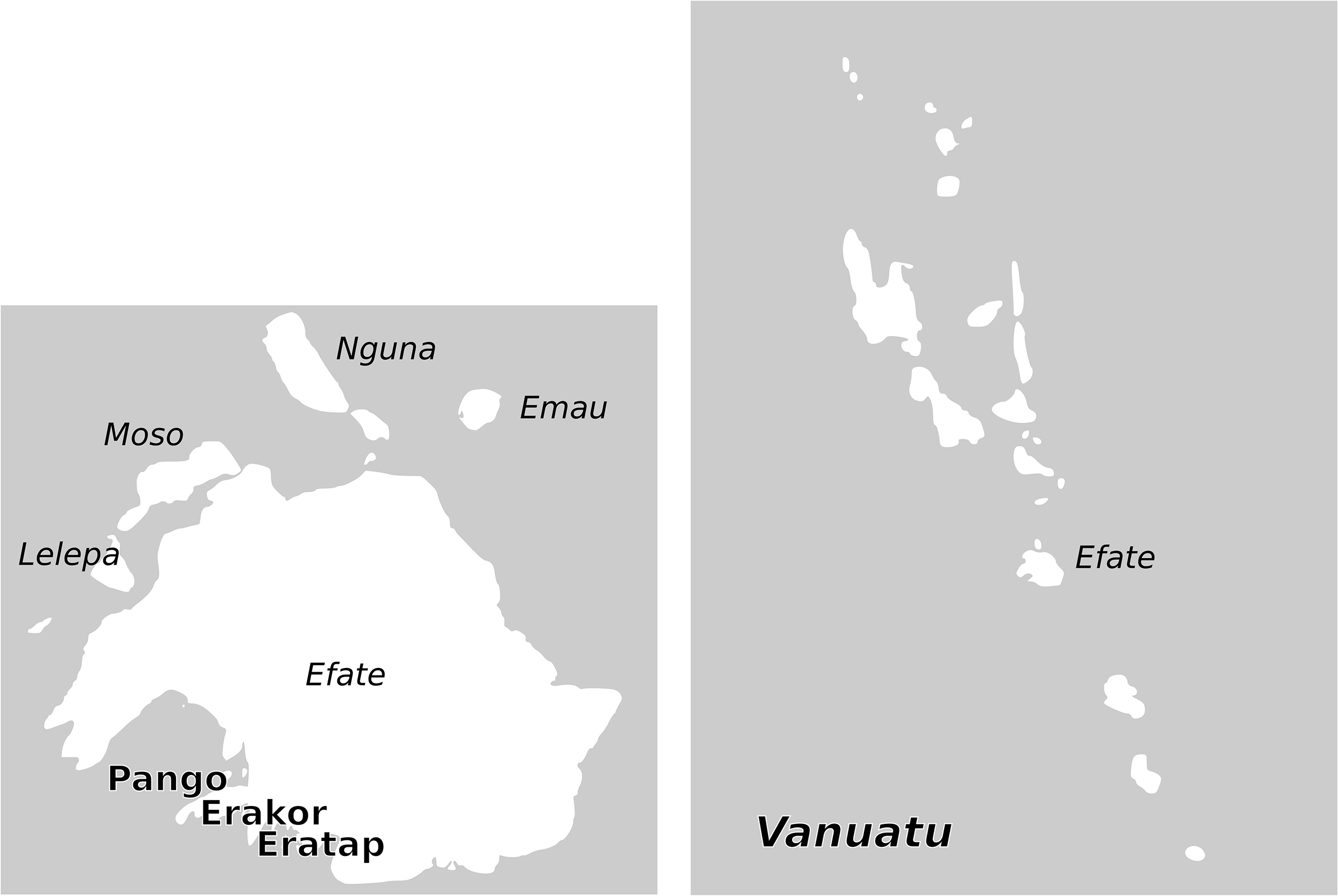
Nafsan (ISO 639-3: erk, Glottocode: sout2856), also known as South Efate, is a Southern Oceanic language of Vanuatu. It is spoken in Erakor, Eratap and Pango, three villages situated along the southern coast of the island of Efate (Figure 1) (Clark Reference Clark1985, Lynch Reference Lynch2000, Thieberger Reference Thieberger2006). Nafsan is also closely related to Eton, Lelepa, Nakanamanga and Namakura, spoken further to the north on Efate and some smaller neighbouring islands.Footnote 1 Nafsan is often described as the southernmost member of the North-Central Vanuatu group of languages, and the Nafsan and Eton-speaking communities are noted to be at the core of ‘an unmistakable area of innovation’ compared to their northern neighbours (Clark Reference Clark1985: 25). Though crosslinguistic comparisons suggest a clear boundary between North-Central Vanuatu languages and languages of the Southern Vanuatu group, there is evidence that Nafsan speakers have both linguistic and cultural links to the southern islands, suggestive of complex historical relationships between the populations of the central and southern regions (Lynch Reference Lynch2004; Thieberger Reference Thieberger, Jeff, John and Diana2007, Reference Thieberger2015). In terms of the sound system, Nafsan is noted to be of particular interest because it ‘forms a transition between the phonologically more conservative languages to the north and the more “aberrant” languages to the south’ (Lynch Reference Lynch2000: 320), and exhibits phonotactic patterns which are complex and typologically uncommon, particularly among Oceanic languages (Thieberger Reference Thieberger2006).
Locations of Nafsan-speaking villages, Pango, Erakor, and Eratap, on the island of Efate, Vanuatu (modified based on CARTO/Stamen/Open Street Map – CC BY 3.0).

Early records of Nafsan and related varieties, including some texts, wordlist materials, and grammatical observations, emerged in the context of missionary work from the mid-1800s (see overview in Thieberger Reference Thieberger2006: 33–40). Later work, as part of efforts to establish the genetic affiliations for languages of Vanuatu, includes extensive wordlists for Nafsan and many related languages (Tryon Reference Tryon1976), examination of the phonological patterns of Nafsan and closely related varieties (Clark Reference Clark1985), and discussion of the relationship between Nafsan phonological patterns and those reconstructed for Proto-Oceanic (Lynch Reference Lynch2000). A detailed grammatical description, with supporting texts and audio-visual materials, includes an outline of Nafsan phonology (Thieberger Reference Thieberger2006). The description of Nafsan phonology presented here draws on this work and extends it with the addition of new data, including acoustic phonetic analyses. The observations and examples given throughout this paper are based on materials recorded with 13 adult speakers of Nafsan during fieldwork in Erakor in 2017 and 2018, as well as earlier materials recorded with various speakers in Erakor primarily between 1995–2000.Footnote 2 The sets of examples showing phonemic consonant distinctions and phonemic vowel distinctions were recorded with Lingkary Kalpram. These and all other numbered examples given are included as audio files in the supplementary materials to this paper.
All of the speakers who have contributed to the description presented here identify Nafsan as their first language, and all also speak Bislama, the English-lexified creole which is the national language and lingua franca of Vanuatu. Most speakers contributing to this work also have some knowledge of either English or French, both official languages alongside Bislama, and some have knowledge of languages spoken on other islands of Vanuatu, acquired through family connections. Multilingualism of this sort is commonly found across Vanuatu (Crowley Reference Crowley2000). Many of Vanuatu’s more than 130 languages have small numbers of speakers, and there are some indications that Bislama may be encroaching on the use of traditional languages (Crowley Reference Crowley2000, François et al. Reference François, Franjieh, Lacrampe and Schnell2015a). Nafsan, with an estimated 6000 speakers (Lynch & Crowley Reference Lynch and Terry2001: 18), represents one of the larger speech communities, and though there is not yet any detailed information available on language use and transmission, impressions are that Nafsan continues to be spoken by most families in at least the village where the data discussed here were collected (Thieberger Reference Thieberger2006: 40–44). Many people also write in Nafsan when communicating via social media and text messages. Printed Nafsan materials which have been produced at various times typically follow locally established orthographic conventions, using p˜ and m˜ to represent the labial-velar stop and nasal, nr for the prenasalised trill, and g for the velar nasal. However, actual practices used by speakers of Nafsan when writing the language vary. Examples presented throughout this paper are given in their phonemic and, where relevant, phonetic form, with a corresponding English gloss.
Consonants
The phoneme inventory of Nafsan includes 15 consonants. Some examples illustrating the contrasts between these in word-initial, word-medial and word-final position, adjacent to open vowels, are shown in the list following the Consonant Table.Footnote 3


Obstruents
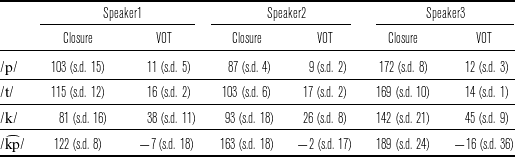
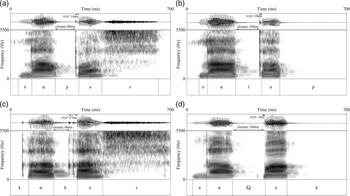
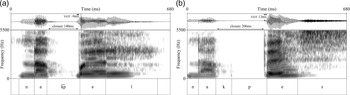
Nafsan exhibits a single plosive series; voicing is not contrastive, and the plosives are generally phonetically voiceless, though some voicing may be present when they occur between voiced segments in rapid speech. They contrast at four places of articulation: bilabial /p/, alveolar /t/, velar /k/, and labial-velar /k͡p/. The labial-velar plosive /k͡p/ is a double articulation, produced with overlapping constrictions at the lips and velum. /t/ may sometimes be produced with a dental place of articulation. The plosives are unaspirated; /p t k/ typically have short positive voice onset times, sometimes with slightly longer release phases for /k/, while the labial-velar plosives generally have a small amount of pre-voicing as well as slightly longer durations than the other plosives, as can be seen in Figure 2d compared to Figures 2a–c for examples from the above list, and as shown in Table 1, based on a small sample of stops produced by three speakers. The plosives are frequently unreleased when utterance-final.
Mean closure duration and VOT (in ms) for Nafsan stops, for 61 tokens produced by three female speakers (word-medially in disyllabic words, in an utterance-medial frame).

Spectrograms showing word-medial Nafsan plosives /p t k k͡p/: (a) /naːpas/ ‘coconut branch’; (b) /naːtap/ ‘statue’; (c) /kaːkas/ ‘to be sweet’; (d) /naːk͡pak/ ‘tree sp.’.

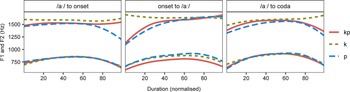
The timing of the gestures for /k͡p/ may depend on syllable position. Figure 3 shows first and second formant trajectories for 136 tokens of /aː/ adjacent to /k͡p k p/ in word-initial, word-medial and word-final positions, recorded with three female speakers in an utterance-medial frame. These indicate that as an onset, /k͡p/ is acoustically more like /k/ than /p/ as the articulators close, but more like /p/ than /k/ as the articulators open, as evidenced by the higher second formant frequency for /k͡p/ at the transition from /aː/ into the onset and the lower second formant frequency for /k͡p/ at the transition from the onset to /aː/. This suggests that the velar closure is typically initiated before the labial component when /k͡p/ occurs in syllable onsets, a pattern also supported by the typical realisation of /n/ as [Ŋ] when undergoing place assimilation preceding /k͡p/, as seen for ‘head’ in (4) below. In the transition from /aː/ to /k͡p/ as a syllable coda, /k͡p/ is acoustically more like /p/, suggesting the labial closure has greater overlap with, and perhaps even precedes, the velar closure.
Smoothed trajectories of first and second formant frequencies in tokens of /aː/ preceding and following /k͡p k p/ as syllable onsets and preceding /k͡p k p/ as syllable codas, for three female speakers.

However, /k͡p/ remains distinct from medial sequences of /k/ followed by /p/, as in the examples given in (1).Footnote 4
Spectrograms showing word-medial /k͡p/ compared to /kp/ sequence: (a) /nak͡pel/ ‘yam sp.’; (b) /nakpes/ ‘tree sp.’.


As can be seen in Figure 4, /kp/ sequences typically exhibit noticeably longer durations than /k͡p/, and sometimes a detectable burst at the segment transition. In a sample of 60 word-medial tokens of /k͡p/ and /kp/ in disyllabic words, recorded with three speakers in an utterance-medial frame, the mean duration of /k͡p/ is 155 ms (s.d. 23 ms) and the mean duration of /kp/ sequences is 200 ms (s.d. 24 ms).
There are two fricatives, labio-dental /f/ and alveolar /s/. A non-phonemic postalveolar fricative [ʃ] may also occasionally be heard, for example as in (2) (from French couchez), used to hush a dog (Thieberger Reference Thieberger2006: 101).

As is the case for the plosives, the fricatives are generally phonetically voiceless. A subset of verbs with /p/-initial stems undergo stem-initial consonant mutation, a process often observed for languages of Vanuatu (Crowley Reference Crowley1991). Under this process, /p/-initial forms marked for mood, reduplicated or nominalised are produced with stem-initial /f/ (as in (10) below, for example). This is strictly a morphological alternation, and /p/ is otherwise not lenited in this way (Thieberger Reference Thieberger2006: 162–170; Reference Thieberger2012). However, /k/ may optionally be lenited in various ways; sometimes, it is realised as a velar fricative [x] or [ɣ], approximant [ɰ], or glottal fricative [h], and sometimes it is completely elided (Thieberger Reference Thieberger2006: 47–49). Velar lenition can occur intervocalically between various vowels and also when /k/ is part of a medial consonant sequence. While velar lenition has not yet been comprehensively investigated for Nafsan, it appears to be present in the speech of some speakers more than others, though it is used by speakers of a range of ages and backgrounds. It is also more characteristic of rapid rather than careful speech.
A glottal fricative may also be optionally produced word-initially for some words which are otherwise vowel-initial. As is the case for velar lenition, initial glottal insertion appears to be more frequently used by some speakers than others, in both rapid and careful speech. Similar variation between vowel-initial and glottal-initial forms is observed for Bislama, which as noted is spoken by all Nafsan speakers who have contributed to the present study (Crowley Reference Crowley2004: 14–15). A non-contrastive glottal stop also sometimes occurs in Nafsan (Thieberger Reference Thieberger2006: 53–54). It may optionally be produced after a vowel which is word-final and pre-pausal, and also occurs medially in the high-frequency feedback particles shown in (3).

Nasals
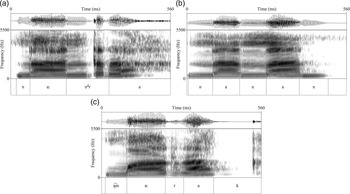
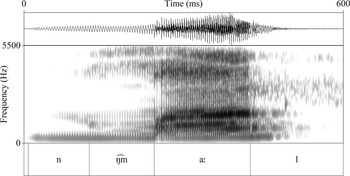
Nafsan has nasal consonants at four places of articulation, corresponding to the plosives: bilabial /m/, alveolar /n/, velar /Ŋ/, and labial-velar /Ŋ͡m/. As is the case for the labial-velar plosive /k͡p/, the nasal /Ŋ͡m/ is produced with overlapping labial and velar closure. However, as also noted for /k͡p/, formant trajectories indicate that in syllable onsets the velar closure for /Ŋ͡m/ is initiated before the labial closure, and the consonant release is similar to that of /m/, for example as seen in the low F1 and F2 following initial /Ŋ͡m/ in Figure 5c below.
Spectrograms showing word-medial prenasalised alveolar trill /ndr/ compared to alveolar nasal /n/ and alveolar trill /r/: (a) /naːndra/ ‘banana sp.’; (b) /nanan/ ‘goat’; (c) /Ŋ͡maːrak/ ‘to be clever’.

Though a range of heterorganic clusters are permitted in Nafsan, as discussed further below, alveolar nasals typically undergo a process of assimilation to the place of articulation of a following plosive. Many examples can be seen for nouns with a word-initial alveolar nasal which originates from an article /na/, also found in many other Oceanic languages (Crowley Reference Crowley1985). In Nafsan this article is frequently applied to common nouns (Thieberger Reference Thieberger2006: 123–124) and the vowel is often deleted, which then allows anticipatory assimilation to take place, as shown in the examples in (4).

The vowel deletion suggests some level of accretion, as also noted for this article in various other languages of Vanuatu (Lynch Reference Lynch2001), and in some cases the use of this article may be lexicalised, and forms with the assimilated nasal could be considered the phonemic representation. However, in Nafsan the article is also still used productively, for example in nominalisation processes (Clark Reference Clark1985: 31; Lynch Reference Lynch2000: 322; Thieberger Reference Thieberger2006: 132–137), as seen later in (10).
As in many languages (e.g. Gordon Reference Gordon2016: 131), the place assimilation does not appear to apply to non-coronal nasals; for example, as shown in (5) below, verb stems which include the historical (though no longer productive) de-transitivising prefix /ma/, which also has the form /m/, are all produced with a bilabial nasal regardless of the place of the following consonant (Thieberger Reference Thieberger2006: 70, 214–216).

This lack of assimilation in some nasal-initial onset clusters is perhaps also not surprising given that Nafsan freely permits various heterorganic clusters.
When the consonant following the alveolar nasal is labio-dental fricative /f/, assimilation generally does not occur, and /n/ of course already shares place features with fricative /s/ and liquids /l/ and /r/. When the segment following /n/ is also a nasal, assimilation may not occur in careful speech (e.g. as in the last two examples in (14) below, especially if the nasal originates from a productive use of the nominal article), but assimilation often occurs in rapid speech.
Trills and lateral
In Nafsan there is an alveolar lateral /l/ and both an alveolar trill /r/ and prenasalised alveolar trill /ndr/. The alveolar trill may occasionally be produced as a tap inter-vocalically. The prenasalised alveolar trill is a complex segment, involving a sequence of gestures beginning with an alveolar closure and open velar port, followed by some pre-stopping in the transition from the nasal to the oral articulation, then releasing into the voiced alveolar trill. While there are many possible consonant clusters in Nafsan, discussed further in relation to the examples in (12)–(16) below, distributional evidence suggests the prenasalised trill operates as a unit; for example, if it were a cluster it would be the only consonant cluster to occur in coda position, and would also occur with disproportionately high frequency as an onset cluster (Thieberger Reference Thieberger2006: 51–52, 58–62). A contrastive prenasalised trill may be present in other closely related varieties spoken elsewhere on Efate and the small islands to the north (Clark Reference Clark1985: 13; Sperlich Reference Sperlich1991: 59), and is also found in various other languages of Vanuatu, as well as in Oceanic languages such as Fijian and a number of languages of Manus Island (Tryon Reference Tryon1976, Blust Reference Blust, Jeff, John and Diana2007). The presence of the prenasalised trill in these languages is suggested to be reflective of a larger set of coronal contrasts in Proto-Oceanic, compared to that retained in most other contemporary Oceanic languages (Ross Reference Ross1988: 31; Lynch, Ross & Crowley Reference Lynch, Ross and Crowley2002: 64; Clark Reference Clark2009: 11). Both the alveolar trill and the prenasalised alveolar trill may be partially or fully devoiced when word-final and pre-pausal (e.g. as can be heard for ‘mouth’ in (4) above), or when preceding a voiceless consonant, and devoicing is also sometimes observed for the alveolar lateral in these contexts. For some speakers, the alveolar lateral may be produced with some pre-stopping when it follows the alveolar nasal in an onset cluster, as [ndl] (Thieberger Reference Thieberger2006: 52). This is similar to the pre-stopping noted for the prenasalised trill, but optional. Similarly, some speakers may produce onset clusters of bilabial nasals followed by a trill or lateral with pre-stopping, as [mbr] or [mbl].
Glides
Nafsan has two glides: palatal /j/ and labial-velar /w/. Phonemic /j/ occurs very infrequently; it occurs initially in only a very small number of words, including borrowed words and personal names, and as a word-medial phoneme it is also uncommon. However, a palatal glide is frequently produced in the transition between a close front vowel and a more open vowel in vowel sequences, or as an allophone of the close vowel in such sequences, for example as in (6), which comprises a stem ending in /i/ followed by a suffix /en/.

Phonemic instances of /w/ are more common than those for /j/, but similarly, it may also occur phonetically, in the transition between a close back vowel and a more open vowel in a vowel sequence, or as an allophone of /u/, forming a cluster with the preceding consonant, as seen in (7), with a stem ending in /u/ followed by a suffix /om/.

These instances of glide formation and insertion are frequent but optional, and the syllabification of words with vowel sequences beginning with /i/ and /u/ depends to some extent on speech rate, and likely interacts with other prosodic and phonotactic considerations. Both /j/ and /w/ also occur phonemically in onset clusters, as seen in (12) below, for example.
Vowels
Monophthongs


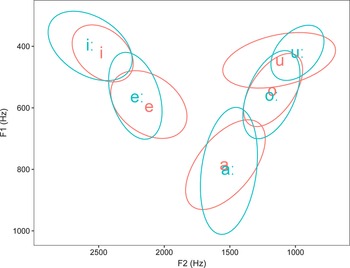
First and second formant frequencies (in Hz) at midpoints of Nafsan monophthongs in CVC words, for three speakers (
 $95\%$
confidence intervals).

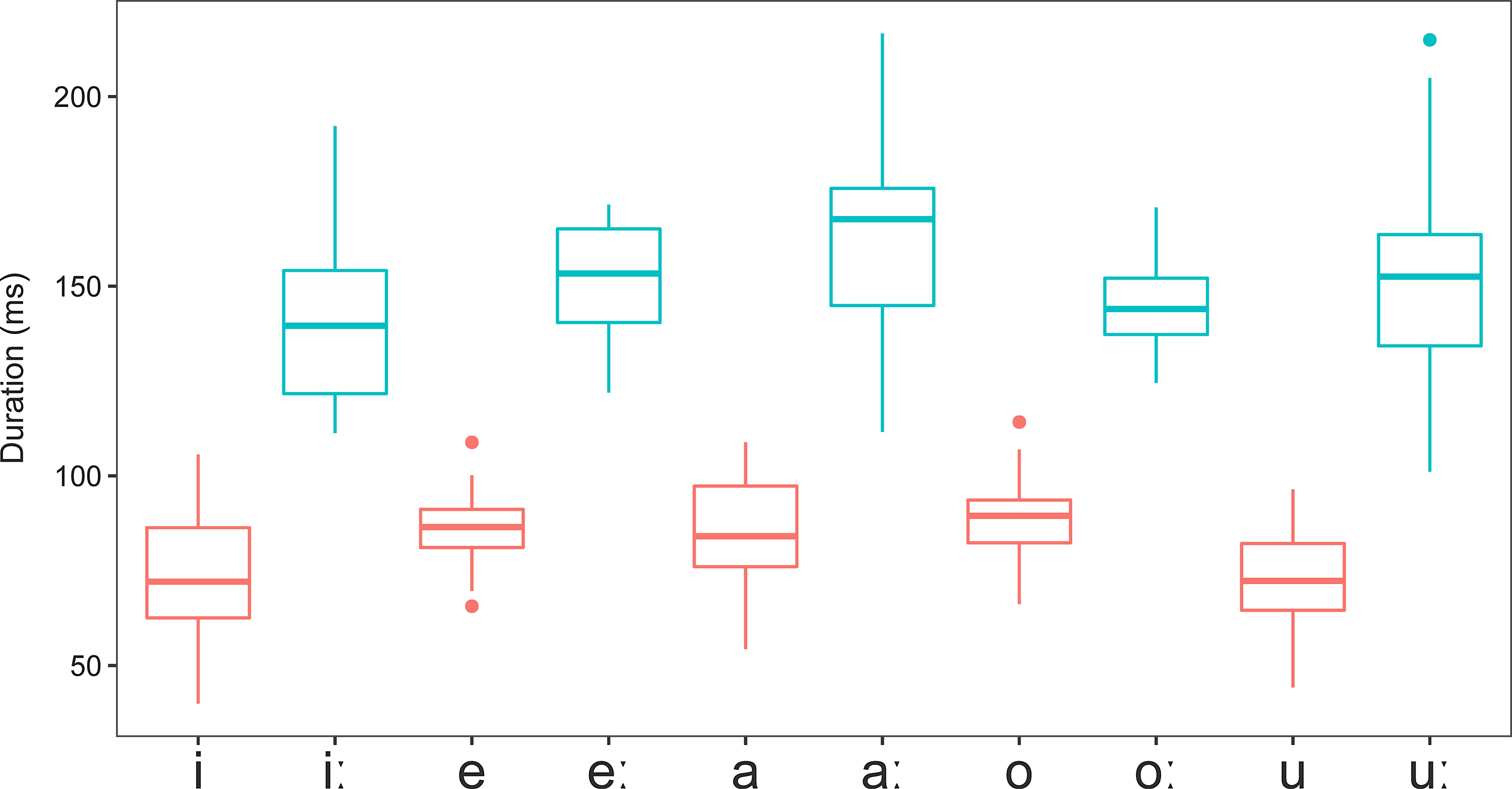
Duration values (in ms) for Nafsan monophthongs in CVC words, for three speakers.

The phoneme inventory of Nafsan includes ten monophthongs, /i iː e eː a aː o oː u uː/.Footnote 5 Some examples are shown above. Contrasts can be observed between five distinct vowel qualities, and each of these may occur phonemically short or long. A schematic representation of the ten monophthongs is shown above, and Figure 6 shows the acoustic vowel space of Nafsan, based on measurements of the first and second formant frequencies at midpoints of 325 vowel tokens in CVC monosyllables (with stop onsets and codas), recorded with three female speakers of Nafsan in an utterance-medial frame. Figure 7 shows the duration values for the same set of vowels, and clearly illustrates the length difference; the long vowels (mean 151 ms, s.d. 23 ms) are overall 1.91 times longer than the short vowels (mean 79 ms, s.d. 15 ms), and the duration differences are quite consistent across the five vowel qualities. Length is reportedly also used contrastively to at least some extent in the vowel systems of closely related language varieties (Schütz Reference Schütz1969, Sperlich Reference Sperlich1991, Lacrampe Reference Lacrampe2014). While the phonemically short vowels can be produced with a more centralised quality compared to the phonemically long vowels, in general the quality difference is very small in monosyllabic words or accented syllables. However, in syllables preceding an accented syllable, short vowels can show substantial centralisation (Billington et al. Reference Billington, Fletcher, Thieberger, Volchok, Julien, Joe, John and Caroline2018, Reference Billington, Fletcher, Thieberger and Volchok2020). A recent study of Nafsan monophthongs examines the acoustic and durational correlates of quality and quantity distinctions in more detail (Billington, Thieberger & Fletcher Reference Billington, Thieberger and Fletcher2021).
Diphthongs
The five contrastive vowel qualities in Nafsan are also drawn on in the formation of various diphthongs. These include the closing diphthongs shown in (8).

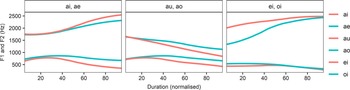
As noted earlier, there are also phonemic vowel sequences beginning with close vowels which may be produced phonetically with glide formation or insertion, and in addition, some other vowel sequences or possible diphthongs have been noted in a small number of lexical items (Thieberger Reference Thieberger2006: 64), but the phonemic status of these is not clear.Footnote 6 The closing diphthongs shown in (8) include contrasts between diphthongs which have similar trajectories but differ primarily in the closeness of the second target: /ai/ and /ae/, and /au/ and /ao/. This can be seen in Figure 8, which shows first and second formant trajectories for the 5–7 repetitions (total 37 tokens) produced for the items in (8). Further, there may be some durational differences; for these tokens produced in isolation, the mean duration for /ae/ is 244 ms and for /ao/ 245 ms, while means for /ai/ and /au/ are 182 ms and 172 ms, respectively (comparable to 196 ms for /ei/ and 180 ms for /oi/). Though /ae/ and /ao/ occur less frequently, various minimal pairs are attested in both open and closed syllables which show these diphthongs to be distinct from /ai/ and /au/.
Smoothed trajectories of first and second formant frequencies in tokens of /ai ae au ao ei oi/ in open syllables, for one speaker.

Vowel deletion
In Nafsan, short vowels may be deleted word-medially, as part of a process which appears to be both historical and ongoing (Clark Reference Clark1985, Lynch Reference Lynch2000, Thieberger Reference Thieberger2006). In comparing various recorded words with corresponding examples written down by early missionaries or reported for closely related language varieties spoken further to the north, it can be seen that many contemporary Nafsan words lack vowels which were produced at an earlier time in the language’s history, and which are retained in related languages. In many cases these forms with deleted vowels are the current phonemic form, consistently used by different speakers, though speakers may still be aware of older pronunciations. Many of the onset clusters given in (12)–(16) below have arisen as a result of this, and further discussion of historical vowel deletion can be found in Thieberger (Reference Thieberger2006: 2–3, 68–70) and Billington, Thieberger & Fletcher (Reference Billington, Thieberger and Fletcher2020: 127–128).
This process is also productive. While some words have stems which have lost historical vowels, others retain them but show regular patterns of vowel deletion in inflected and derived forms, for example in the monomorphemic nominal forms compared to forms marked for direct possession in (9).

Analyses of prosodic patterns and corpus materials indicate that this deletion process applies to penultimate short vowels of any quality preceding a final accented syllable; that is, vowel deletion is pre-tonic (Billington et al. Reference Billington, Fletcher, Thieberger, Volchok, Julien, Joe, John and Caroline2018, Reference Billington, Fletcher, Thieberger and Volchok2020; Billington, Thieberger et al. Reference Billington, Thieberger and Fletcher2020).
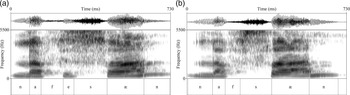
To some extent, the current productive deletion process appears to be mediated by phonotactic, grammatical, and lexical factors, described in detail in Billington, Thieberger et al. (Reference Billington, Thieberger and Fletcher2020: 136–140). For example, the words for both ‘language, story’ and ‘curse’ are derived from the stem /pes/ ‘talk’ via a regular nominalisation process (in which the stem form is /fes/ under the consonant mutation noted earlier), but, as shown in (10), the word for ‘language, story’ (also the autonym for the language) invariably shows vowel deletion (and the reduced form could be considered the phonemic form in this case).

The word for ‘curse’, which is not only semantically different but much less frequently used, is reportedly never produced with vowel deletion. Example spectrograms can be seen in Figure 9. Pre-tonic vowels in a grammatical morpheme (such as a verbal proclitic), or for which deletion would result in a dispreferred consonant sequence, are also typically retained though, as noted earlier, they may show substantial centralisation in this environment (Billington et al. Reference Billington, Fletcher, Thieberger, Volchok, Julien, Joe, John and Caroline2018, Reference Billington, Fletcher, Thieberger and Volchok2020).
Spectrograms showing presence compared to absence of vowel deletion: (a) [nafesaːn] ‘curse’; (b) [nafsaːn] ‘language, story’.

Historically, final short vowels have also been lost in Nafsan compared to other Oceanic languages, resulting in many closed syllables, and as noted earlier, /a/ in the common nominal prefix /na/ is also often deleted, allowing /n/ to form an onset cluster with other consonants (Clark Reference Clark1985, Lynch Reference Lynch2000, Thieberger Reference Thieberger2006).Footnote 7 These various deletion processes, combined with the possibilities for compounding as a word-formation strategy, lead to many possibilities for complex consonant sequences to arise, discussed in more detail below.
Word and syllable structure
In the lexical database developed in the course of Nafsan language documentation in recent years (see e.g. Thieberger Reference Thieberger2011), words of up to six syllables are attested. Disyllabic words are most common, followed by monosyllabic words, though patterns may differ in corpora of narratives and other texts. The maximal syllable structure in Nafsan is shown in (11):Footnote 8
(11) Nafsan syllable template
(C) (C) (C) V (V) (C)
Long vowels may occur in both closed and open syllables. As noted in Thieberger (Reference Thieberger2006: 57), the burden of complexity is on the syllable onset rather than the coda. Coda clusters do not appear to be present in contemporary Nafsan, with the exception of the prenasalised trill which, as noted, functions as a single phoneme.Footnote 9 Though the most common syllable type is CVC, followed by CV, onset clusters are quite common. While there are some restrictions on which consonants may co-occur, or how frequently they are likely to co-occur (Thieberger Reference Thieberger2006: 59–65), a striking characteristic of Nafsan phonology is that it permits a wide range of heterorganic consonant clusters in syllable onsets, representing almost all possible combinations of manner of articulation. Complex phonotactic patterns of this sort are quite different to the CV structures preferred by many Oceanic languages (Lynch et al. Reference Lynch, Ross and Crowley2002: 34), and the diversity of allowable onset sequences is typologically uncommon.
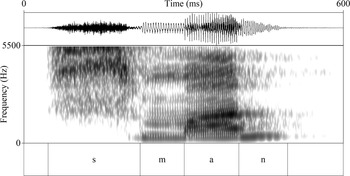
In many languages which permit consonant clusters, there is a preference for onset clusters to comprise consonant sequences with a rising sonority profile; that is, for the more sonorous consonant in the sequence to occur closer to the syllable nucleus (Gordon Reference Gordon2016: 99–104). Many heterorganic onset clusters in Nafsan exhibit a rising sonority profile, as in the examples shown in (12) of sequences of stops followed by fricatives, nasals, liquids and glides, sequences of fricatives followed by nasals, liquids and glides, nasals followed by liquids and glides, and liquids followed by glides. An example spectrogram is given in Figure 10.
Spectrogram showing onset cluster with rising sonority profile, for /sman/ ‘to praise’.


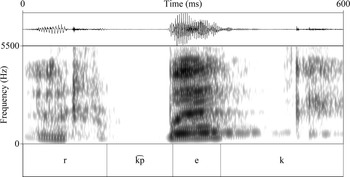
However, many heterorganic onset clusters also exhibit a falling sonority profile, which is crosslinguistically less preferred (Gordon Reference Gordon2016). As seen in (13), these include sequences of fricatives, nasals and liquids followed by stops, sequences of nasals and liquids followed by fricatives, and sequences of liquids followed by nasals. An example spectrogram is given in Figure 11.
Spectrogram showing onset cluster with falling sonority profile, for /rk͡pek/ ‘wrapped laplap’.


Nafsan also allows heterorganic clusters with a plateauing sonority profile, comprising segments which have the same manner of articulation. As shown in (14), these include sequences of stops, sequences of fricatives, and sequences of nasals. An example spectrogram is given in Figure 12.
Spectrogram showing onset cluster with plateauing sonority profile, for /nŊ͡maːl/ ‘yam sp.’.


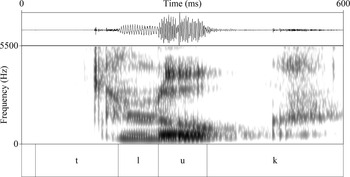
In addition to the range of heterorganic onset clusters, Nafsan allows some homorganic onset clusters. As noted earlier, many of these arise in the context of assimilation of the alveolar nasal to the place of articulation of a following consonant, but other types of homorganic onsets can also be found, as shown in (15) and in Figure 13. Sequences of identical consonants do not occur; in cases where there are adjacent identical consonants at word and morpheme boundaries, a process of degemination takes place (Thieberger Reference Thieberger2006: 71–72).
Spectrogram showing homorganic onset cluster, for /tluk/ ‘small cassava parcel’.


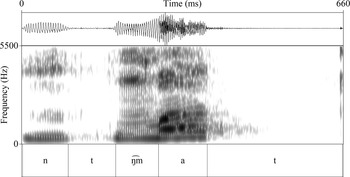
Sequences of three consonants may be found across a syllable boundary, and in a small number of words, sequences of three consonants are found word-initially, all with /n/ as the first segment (Thieberger Reference Thieberger2006: 58). Some examples are shown in (16), and an example spectrogram is given in Figure 14.
Spectrogram showing word-initial sequence of three consonants, for /ntŊ͡mat/ ‘peace’.


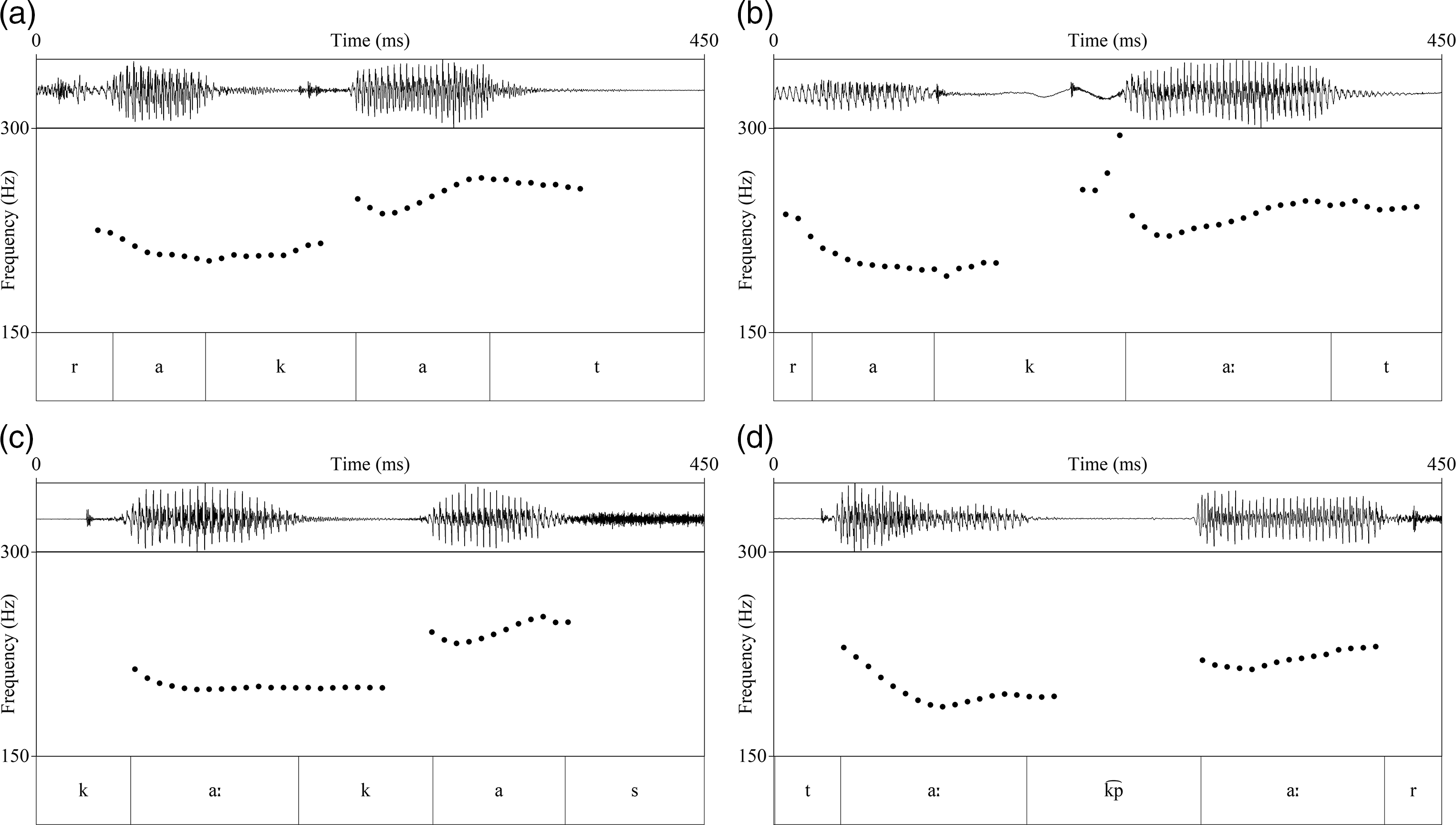
Fundamental frequency patterns in utterance-medial disyllabic words: (a) /rakat/ ‘bite (du)’; (b) /rakaːt/ ‘taste (du)’; (c) /kaːkas/ ‘to be sweet’; (d) /taːk͡paːr/ ‘a sin’.

Prosody
Research on the prosodic characteristics of Nafsan is ongoing, but indications are that there is a strong preference for words to be more prominent at the right edge. Analyses of disyllabic and trisyllabic words produced in an utterance-medial frame show a clear pattern of higher fundamental frequency values in final compared to preceding syllables (Billington et al. Reference Billington, Fletcher, Thieberger, Volchok, Julien, Joe, John and Caroline2018, Reference Billington, Fletcher, Thieberger and Volchok2020). Both short and long final vowels can be prominent on the basis of fundamental frequency, and this occurs regardless of whether there is a long vowel in a preceding syllable, as can be seen in Figure 15 for the disyllabic words in (17), also based on tokens produced in a medial frame.
(17) Final prominence on both long and short vowels (see Figure 15)

This suggests that syllable weight does not influence the location of prominence within the word. Results for duration and intensity show only very small differences on the basis of syllable position, and indicate that these are correlates of phonemic vowel length rather than prominence. Observations on productive patterns of vowel deletion, noted earlier, provide supporting evidence for prominence patterns in that when deletion takes place, it appears to primarily affect penultimate, and thereby pre-tonic, syllables. While previous descriptions of Nafsan have discussed various possible prominence patterns as lexical stress, there is emerging evidence that accentual prominence in Nafsan may be phrasal. Investigations of words of different lengths in initial, medial and final utterance positions and under different focus conditions suggest that strong rising f0 movements at the right edge of a word may demarcate an accentual phrase, and also find that there may be a shift in prominence location under some conditions, for example in non-focal contexts (Fletcher, Billington & Thieberger Reference Fletcher, Billington, Thieberger, Sasha, Paola, Marija and Paul2019).
For polar questions with no morphosyntactic question marking, an intonation pattern involving a rise in pitch on an utterance-final syllable marks the utterance as a question. Other polar questions are formed with tags, including ko ‘or’ and go ‘and’, which may be appended utterance-finally. For the counterfactual ko, the pitch rises on the preceding syllable but then falls on the utterance-final tag, while for go, the utterance-final tag has a marked rise in pitch (Thieberger Reference Thieberger2006: 284–286). A rising pattern is also used in continuation contexts, as can be heard in the accompanying recorded passage. Phonatory differences are also used for pragmatic effect; whispering can be indicative of shyness or embarrassment, and sometimes a pulmonic ingressive rather than pulmonic egressive airstream mechanism is used and encodes resignation to or summation of an event (Thieberger Reference Thieberger2006: 73).
Transcription of recorded passage
The passage presented in phonemic transcription below is a Nafsan translation of ‘The North Wind and the Sun’. It is based on an initial written translation made with the assistance of Joël Kalpram, which was then slightly modified following suggestions from Gray Kaltãau, before Gray was recorded telling the story. The story was recorded three times: the first recording was read speech, and the second and third were natural speech, with Gray re-telling the story without reference to the written text. The version presented below is the second re-telling.
-
nlaŊ niŊ not ito enpsaplil skot aːl
-
‘The North Wind was arguing with the Sun.’
-
nlaŊ itili naŊ Ŋa kin ikerkrai toːl aːl
-
‘The Wind said he was stronger than the Sun.’
-
aːl me itili naŊ Ŋa kin ikerkrai toːl nlaŊ
-
‘The Sun said he was stronger than the Wind.’
-
selwan rato enpsaplil nataŊ͡moːl iskei iseltra kiːr
-
‘As they argued a man met them,’
-
skot nkal namlaːndri neŊa
-
‘with his coat on.’
-
nlaŊ ito itili na takfo laka fei kin ke fo preŊ nataŊ͡moːl nen to kewaːlu nkal namlaːndri neŊa
-
‘The Wind said “Let us see who can make this man here take off his coat.”’
-
Ŋo nlaŊ ito kai tao sisi
-
‘And the Wind began to blow.’
-
isisi panpan Ŋo nataŊ͡moːl ne ioːfsok nkal namlaːndri neŊa
-
‘He blew and blew and the man pulled his coat around himself.’
-
aːl ito kai paː ipaː panpan Ŋo nataŊ͡moːl nen iwaːlu nkal namlaːndri neŊa
-
‘The Sun shone and shone until the man took off his coat.’
-
Ŋo nlaŊ ito kai tilsei na aːl kin ikerkrai toler randru
-
‘And the wind admitted that the sun was the stronger of the two.’
Acknowledgements
Sincere thanks to the Nafsan speakers who have participated in and facilitated this and earlier work, especially Lingkary Kalpram, Yvanna Atarua, Joël Kalpram, Gray Kaltãau, Lionel Emil, Marinette Kalpram, Michael Joseph, Jelona Kaltãau, Endis Kalsarap, Manuel Wayane and Toukolau Takau. We thank two anonymous reviewers, and JIPA editor Marija Tabain and associate editor Matthew Gordon, for comments on an earlier version of this paper. Thanks also to Ana Krajinović, Katie Jepson and Hywel Stoakes. Funding support from the ARC Centre of Excellence for the Dynamics of Language [Project ID: CE140100041] is gratefully acknowledged.
Supplementary material
To view supplementary material for this article (including audio files to accompany the language examples), please visit https://doi.org/10.1017/S0025100321000177.